TUDOR AND S TUART PORTRAITS
[5
Robert Peake (c.1551 – 1619)
Peregrine Bertie, Lord Willoughby de Eresby (1555 – 1601) Oil on panel: 24 x 19 ¾ in. (61 x 50.5 cm.) Inscribed centre left with the Lumley cartellino, Painted circa 1588 – 1590 Provenance John, 1st Lord Lumley (c.1534 – 1609); Dr Raffles, by whom sold 18th October 1863; Thomas Arthur Hope Esq.; National Maritime Museum (1938 – 1972); by whom de-accessioned, Christie’s, 24 July 1972, lot 67; Private collection, England; Sotheby’s, London, 14 July 1999, lot 83 (as ‘Sir Francis Drake’); with The Weiss Gallery; Private collection, England. Literature L. Cust,‘The Lumley Inventories’, Walpole Society, 1918, vol.VI, p.23, described as ‘of the first Lo: Willoughbye [Perigrine] Bartue’. Mark Evans (ed.), Art Collecting and Lineage in The Elizabethan Age; The Lumley Inventory and Pedigree: Facsimile and Commentary on the Manuscript in the Possession of The Earls of Scarborough, The Roxburghe Club, 2010, no.85, p.161. Exhibited London, The New Gallery, Exhibition of the Royal House of Tudor, 1890, no.322, p.112 (as ‘Sir Francis Drake by Frans Pourbus’).
1. The Latin name for the peregrine falcon, Falco Peregrinus, meaning ‘foreigner’ or ‘stranger’ because it is a migratory bird found throughout the world and tends to travel great distances. 2. In 1588, then at Flushing in Flanders, he directed the ships under his command to prevent the Duke of Parma’s forces from going to the aid of the Spanish armada. That same year, when the Spanish forces became active in the Netherlands, with his small force he defended the city of Bergen and through his energy kept them at bay until they finally retired. Peregrine returned to England in 1588 in ill health, and somewhat impoverished. In 1594 Elizabeth I sent Willoughby a letter, expressing the hope that he had recovered his health, and lamenting his inability to serve her, and by 1597 he was appointed Governor of Berwick. He arrived at his post and set about improving the fortifications and governing the district with a severity that although unpopular, was approved by the government in London. His health was rapidly failing, and he died in 1601, purportedly protesting with his last breath his loyalty to the Queen.
26
T
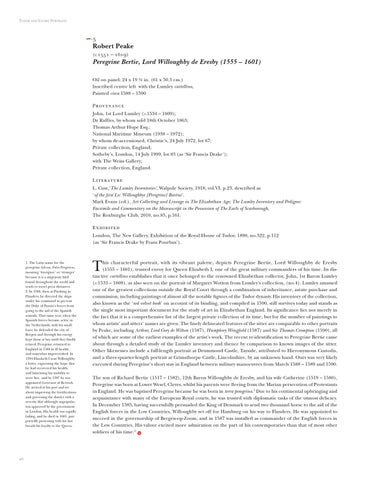
his characterful portrait, with its vibrant palette, depicts Peregrine Bertie, Lord Willoughby de Eresby (1555 – 1601), trusted envoy for Queen Elizabeth I, one of the great military commanders of his time. Its distinctive cartellino establishes that it once belonged to the renowned Elizabethan collector, John, 1st Baron Lumley (c.1533 – 1609), as also seen on the portrait of Margaret Wotton from Lumley’s collection, (no.4). Lumley amassed one of the greatest collections outside the Royal Court through a combination of inheritance, astute purchase and commission, including paintings of almost all the notable figures of the Tudor dynasty. His inventory of the collection, also known as the ‘red velvet book’ on account of its binding, and compiled in 1590, still survives today and stands as the single most important document for the study of art in Elizabethan England. Its significance lies not merely in the fact that it is a comprehensive list of the largest private collection of its time, but for the number of paintings to whom artists’ and sitters’ names are given. The finely delineated features of the sitter are comparable to other portraits by Peake, including Arthur, Lord Grey de Wilton (1587), Humphrey Wingfield (1587) and Sir Thomas Crompton (1590), all of which are some of the earliest examples of the artist’s work. The recent re-identification to Peregrine Bertie came about through a detailed study of the Lumley inventory and thence by comparison to known images of the sitter. Other likenesses include a full-length portrait at Drummond Castle, Tayside, attributed to Hieronymous Custodis, and a three-quarter-length portrait at Grimsthorpe Castle, Lincolnshire, by an unknown hand. Ours was very likely executed during Peregrine’s short stay in England between military manoeuvres from March 1588 – 1589 and 1590. The son of Richard Bertie (1517 – 1582), 12th Baron Willoughby de Eresby, and his wife Catherine (1519 – 1580), Peregrine was born at Lower Wesel, Cleves, whilst his parents were fleeing from the Marian persecution of Protestants in England. He was baptised Peregrine because he was born in terra peregrina.1 Due to his continental upbringing and acquaintance with many of the European Royal courts, he was trusted with diplomatic tasks of the utmost delicacy. In December 1585, having successfully persuaded the King of Denmark to send two thousand horse to the aid of the English forces in the Low Countries, Willoughby set off for Hamburg on his way to Flanders. He was appointed to succeed in the governorship of Bergen-op-Zoom, and in 1587 was installed as commander of the English forces in the Low Countries. His valour excited more admiration on the part of his contemporaries than that of most other soldiers of his time.2