facing the past
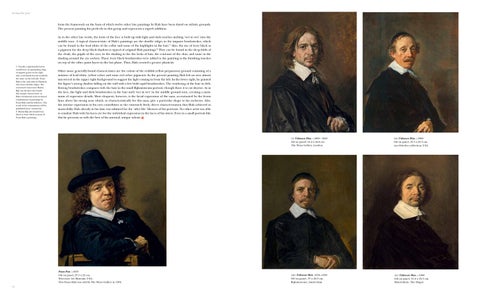
form the framework on the basis of which twelve other late paintings by Hals have been dated on stylistic grounds. The present painting fits perfectly in this group and represents a superb addition. As in the other late works, the form of the face is built up with light and dark touches melting ‘wet in wet’ into the middle tone. A typical characteristic of Hals’s paintings are the double ridges in the impasto brushstrokes, which can be found in the lead white of the collar and some of the highlights in the hair. 7 Also, the use of ivory black as a pigment for the deep black shadows is typical of original Hals paintings.8 They can be found in the deep folds of the cloak, the pupils of the eyes, in the shading to the the locks of hair, the contours of the chin, and some in the shading around the eye sockets. These ivory black brushstrokes were added to the painting as the finishing touches on top of the other paint layers in the last phase. Thus, Hals created a greater plasticity. 7. Usually a right-handed artist would leave an upstanding ridge of impasto paint on the right side; a left-handed artist would do the same on the left side. Frans Hals is the only artist in Haarlem who leaves double ridges. The renowned conservator Martin Bijl, was the first who found this unique characteristic in Hals’s brushwork at his technical examinations of paintings by Frans Hals and his followers. The result of his examinations will be published more extensively. 8. Martin Bijl also found ivory black or bone black in many of Frans Hals’s paintings.
Other more generally found characteristics are the colour of the reddish yellow preparatory ground consisting of a mixture of lead white, yellow ochre and some red ochre pigments. In the present painting Hals left an area almost uncovered in the upper right background to suggest the light coming in from the left. In the lower right, he painted the figure’s strong shadow falling on the wall with a few bold rapid brushstrokes. The rendering of the hair in deft, flowing brushstrokes compares with the hair in the small Rijksmuseum portrait, though there it is cut shorter. As in the face, the light and dark brushstrokes in the hair melt ‘wet in wet’ in the middle ground tone, creating a maximum of expressive details. Most eloquent, however, is the facial expression of the man, accentuated by the frown lines above his strong nose which, so characteristically for this man, give a particular shape to his eyebrows. Also, the intense expression in his eyes contributes to the extremely lively, direct characterisation that Hals achieved so masterfully. Hals already in his time was admired for the ‘after life’ likeness of his portraits. No other artist was able to emulate Hals with his keen eye for the individual expression in the faces of his sitters. Even in a small portrait like this he presents us with the best of his unusual, unique talents
Frans Post, c.1655 Oil on panel, 27.5 x 23 cm. Worcester Art Museum, USA. This Frans Hals was sold by The Weiss Gallery in 1994. 64
(i) Unknown Man, c.1660 - 1665 Oil on panel: 34.2 x 26.8 cm. The Weiss Gallery, London
(ii) Unknown Man, c.1660 Oil on panel, 35.5 x 29.5 cm. van Otterloo collection, USA
(iii) Unknown Man, 1656 –1658 Oil on panel, 37 x 29.8 cm. Rijksmuseum, Amsterdam
(iv) Unknown Man, c.1660 Oil on panel, 31.6 x 25.5 cm. Mauritahuis, The Hague