facing the past
11 D34
Circle of
Jan Claesz. (before 1570 – after 1618)
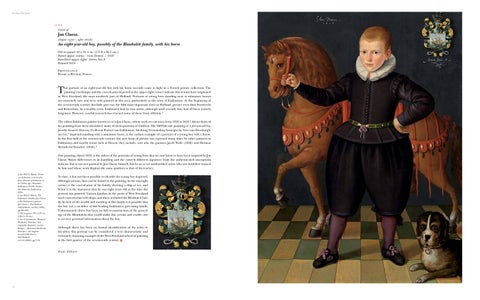
An eight-year-old boy, possibly of the Blauhulck family, with his horse Oil on panel: 44 x 32 ½ in. (111.8 x 82.5 cm.) Dated upper centre: ‘Anno Domini. / 1618’ Inscribed upper right ‘Aetatis Sua. 8.’ Painted 1618 Provenance Private collection, France.
T
his portrait of an eight-year-old boy with his horse recently came to light in a French private collection. The painting’s technique and the coat-of-arms depicted in the upper right corner indicate that it must have originated in West Friesland, the most northerly part of Holland. Portraits of young boys standing next to miniature horses are extremely rare and were only painted in this area, particularly in the town of Enkhuizen. At the beginning of the seventeenth century this little port was the fifth most important town in Holland, greater even than Dordrecht and Rotterdam. As a wealthy town, Enkhuizen had its own artists, although until recently they had all been entirely forgotten. However, careful research has rescued some of these from oblivion.1
The oldest Enkhuizen painter known to us is Jan Claesz., whose work we can trace from 1593 to 1618.2 About thirty of his paintings have been identified, many of them portraits of children. His 1609 life-size painting of A five-year-old boy, possibly Sieuwert Heinsius (Collectie Portret van Enkhuizen, Stichting Verzameling Semeijns de Vries van Doesburgh, inv.14),3 depicted standing with a miniature horse, is the earliest example of a portrait of a young boy with a horse. In the first half of the seventeenth century this new form of picture was repeated many times by other painters in Enkhuizen and nearby towns such as Hoorn; they include, inter alia, the painters Jacob Wabe (1626) and Herman Meindertsz Doncker (1646).4 Our painting, dated 1618, is the oldest of the portraits of young boys that we now know to have been inspired by Jan Claesz. Minor differences in its handling and the entirely different signature from the authenticated inscriptions indicate that it was not painted by Jan Claesz. himself, but by an as yet unidentified artist, who was doubtless trained by him and whose work displays the same qualities as that of his teacher. 1. See R.E.O. Ekkart, Portret van Enkhuizen in de Gouden Eeuw (Portrait of Enkhuizen in the Golden Age), Waanders Publishers, Zwolle/Zuider Zee Museum, Enkhuizen, 1990. 2. See R.E.O. Ekkart, ‘De Enkhuizer schilder Jan Claesz’ (‘The Enkhuizen painter Jan Claesz’), Oud Holland (Old Holland), vol.104 (1990), pp.180 -218. 3. Oil on panel: 391⁄4 x 271⁄2 in. (100.5 x 70 cm.) 4. See F. Laarmann, ‘Herman Meidertsz. Doncker - Ein origineller Künstler zweiten Ranges’ (‘Herrman Meidertsz. Doncker – An original second-rank artist’), Oud Holland, vol.114 (2000), pp.7–52.
To date, it has not been possible to identify the young boy depicted, although various clues can be found in the painting. In the top right corner is the coat-of-arms of his family, showing a ship at sea, and below it is the statement that he was eight years old at the time the portrait was painted. Various families in the ports of West Friesland used coats-of-arms with ships, and these included the Blauhulck family. In view of the wealth and standing of this family, it is possible that the boy was a member of this leading Enkhuizen governing family. Unfortunately, there has been no full reconstruction of the genealogy of the Blauhulcks that would make this certain and enable one to recover personal information about the boy. Although there has been no formal identification of the artist or his sitter, this portrait can be considered a very characteristic and extremely charming example of the West Friesland school of painting in the first quarter of the seventeenth century
Rudi Ekkart
32