facing the past
D934
Pietro de Pomis (c.1569/70 – 1633)
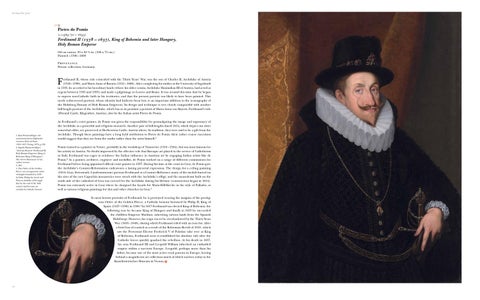
Ferdinand II (1578 – 1637), King of Bohemia and later Hungary, Holy Roman Emperor Oil on canvas: 39 x 28 ¾ in. (100 x 73 cm.) Painted c.1596 – 1600 Provenance Private collection, Germany.
F
erdinand II, whose rule coincided with the Thirty Years’ War, was the son of Charles II, Archduke of Austria (1540 – 1590), and Maria Anna of Bavaria (1551 – 1608). After completing his studies at the University of Ingolstadt in 1595, he acceded to his hereditary lands (where his older cousin, Archduke Maximilian III of Austria, had acted as regent between 1593 and 1595) and made a pilgrimage to Loreto and Rome. It was around this time that he began to supress non-Catholic faith in his territories, and that the present portrait was likely to have been painted. This newly rediscovered portrait, whose identity had hitherto been lost, is an important addition to the iconography of the Habsburg Dynasty of Holy Roman Emperors. Its design and technique is very closely comparable with another full-length portrait of the Archduke, which has as its pendant a portrait of Maria Anna von Bayern, Ferdinand’s wife (Ebental Castle, Klagenfurt, Austria), also by the Italian artist Pietro de Pomis.
1. Kurt Woisetschläger, Der innerösterreichische Hofkünstler: Giovanni Pietro de Pomis: 1569 –1633, Verlag, 1974, p.152. 2. Ingoda Hannesschläger, ‘Austrian Branch – Ferdinand II, Holy Roman Emperor [King of Bohemia; King of Hungary]’, The Grove Dictionary of Art, online version. 3. Ibid. 4. The Order of the Golden Fleece was an important order of knights founded in 1430 by Duke Philip the Good and Princess Isabella of Portugal that by the end of the 16th century had become an exclusively Catholic honour.
As Ferdinand’s court painter, de Pomis was given the responsibility for promulgating the image and supremacy of the Archduke as a powerful and religious monarch. Another pair of full-lengths dated 1614, which depict our sitter somewhat older, are preserved at Herberstein Castle, Austria where, by tradition, they were said to be a gift from the Archduke. Though these paintings have a long held attribution to Pietro de Pomis, their rather coarse execution would suggest that they are from the studio rather than the artist himself.1 Pomis trained as a painter in Venice, probably in the workshop of Tintoretto (1518 –1594), but was most famous for his activity in Austria. No doubt impressed by the effective role that Baroque art played in the service of Catholicism in Italy, Ferdinand was eager to reinforce the Italian influence in Austrian art by engaging Italian artists like de Pomis.2 As a painter, architect, engineer and medallist, de Pomis worked on a range of different commissions for Ferdinand before being appointed official court painter in 1597. During his time at the court in Graz, de Pomis gave the Archduke’s Counter-Reformation endeavours a lasting pictorial expression. The design for a ceiling painting (1614; Graz, Steiermark. Landesmuseum) portrays Ferdinand as a Counter-Reformer; many of the medals buried on the sites of the new Capuchin monasteries were struck with the Archduke’s effigy; and the mausoleum built on the south side of the cathedral of Graz was erected for the Archduke during his lifetime (construction began in 1614). Pomis was extremely active in Graz where he designed the façade for Maria-Hilf-Kirche in the style of Palladio, as well as various religious paintings for this and other churches in Graz.3 In most known portraits of Ferdinand, he is portrayed wearing the insignia of the prestigious Order of the Golden Fleece, a Catholic honour bestowed by Philip II, King of Spain (1527–1598) in 1596.4 In 1617 Ferdinand was elected King of Bohemia, the following year he became King of Hungary and finally in 1619 he succeeded the childless Emperor Matthias, inheriting various lands from the Spanish Habsburgs. However, his reign was to be overshadowed by the Thirty Years War (1618 – 1648), during which Ferdinand ruled with an iron fist. After a brief loss of control as a result of the Bohemian Revolt of 1618 , which saw the Protestant Elector Frederick V of Palatine take over as King of Bohemia, Ferdinand soon re-established his absolute rule after the Catholic forces quickly quashed the rebellion. At his death in 1637, his sons Ferdinand III and Leopold William inherited an embattled empire within a war-torn Europe. Leopold, perhaps more than his father, became one of the most active royal patrons in Europe, leaving behind a magnificent art collection much of which survives today in the Kunsthistorisches Museum in Vienna
28