14
Judith Beheading Holofernes 1610/1615 Giuseppe Vermiglio
1 Vermiglio studies we relaunched with a fundamental article by M. Gregori, ‘Il Sacrificio di Isacco: un inedito e considerazioni su una fase savoldesca del Caravaggio’, Artibus et historiae, 20, 1989, pp. 140-141, note 16, which used the study of style to establish an initial and substantial group of Caravaggesque works by the painter. This was followed by F. Frangi, ‘Giuseppe Vermiglio tra Caravaggio e Federico Borromeo’, in Studi di storia dell’arte in onore di Mina Gregori, Cinisello Balsamo, 1994, pp. 161-169; A. Morandotti, ‘Note brevi per Cerano animalista, Vermiglio pittore di figura e Carlo Francesco Nuvolone autore di ritratti’, in M. Gregori and M. Rosci, eds., Il Seicento lombardo, Turin 1996, pp. 65-84; M. Pulini, ‘A Giuseppe Vermiglio, pittore del ritorno’, Paradigma, 11, 1996, pp. 49-58; F. Cavalieri, ‘Giuseppe Vermiglio e il San Giovanni Borghese di Caravaggio’, Nuovi Studi, II, 3, 1997, pp. 53-57; M. C. Terzaghi, ‘Vermiglio all’Ambrosiana (in compagnia di Daniele Crespi)’, Nuovi Studi, II, 3, 1997, pp. 59-67; G. Crispo, ‘Giuseppe Vermiglio da Roma a Milano: il problema dei modelli’, Artes, 7, 1999, pp. 74-106; A. Morandotti, ‘Giuseppe Vermiglio, naturalista accademico e diligente’, in G. Romano, ed., Percorsi caravaggeschi tra Roma e Piemonte, Turin 1999, pp. 239271; M. C. Terzaghi, ‘“Quasi tutti li Pittori di Roma”: i Piemontesi’, in G. Romano, ed., Percorsi caravaggeschi tra Roma e Piemonte, Turin 1999, pp. 15-48; G. Papi, ‘Brevi note al Vermiglio caravaggesco’, Paragone, 51, 2000, pp. 26-37; M. C. Terzaghi, ‘Giuseppe Vermiglio lombardo e piemontese’, Paragone, 51, 2000, pp. 38-60; M. Pulini, San Matteo e l’angelo di Giuseppe Vermiglio, Siena, Amministrazione Provinciale 2001 (Quaderni del Sistema Musei Senesi: Quaderni storico artistici, 3); M. C. Terzaghi, ‘Giuseppe Vermiglio’, in A. Zuccari, ed., I Caravaggeschi. Percorsi e protagonisti, Milan 2010, II, pp. 751-763; M. Pavesi, ‘Un nuovo “San Giovanni Battista nel deserto” della fase caravaggesca di Giuseppe Vermiglio’, Arte Lombarda, 160, 2010 (2011), 3, pp. 14-19. The year 2000 saw the exhibition Giuseppe Vermiglio. Un pittore caravaggesco tra Roma e la Lombardia, in Campione d’Italia, with a
LITERATURE Unpublished
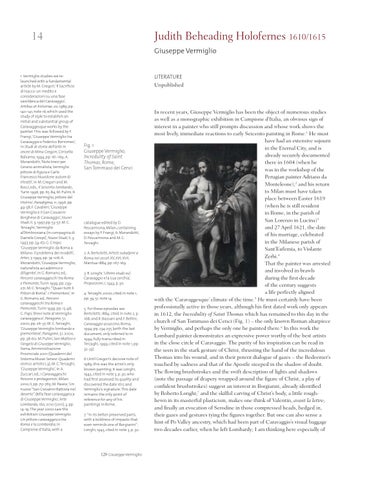
Fig. 1 Giuseppe Vermiglio, Incredulity of Saint Thomas, Rome, San Tommaso dei Cenci
catalogue edited by D. Pescarmona, Milan, containing essays by F. Frangi, A. Morandotti, D. Pescarmona and M. C. Terzaghi. 2 A. Bertolotti, Artisti subalpini a Roma nei secoli XV, XVI, XVII, Mantua 1884, pp. 167-169. 3 R. Longhi, ‘Ultimi studi sul Caravaggio e la sua cerchia’, Proporzioni, I, 1943, p. 30. 4 Terzaghi, 2000, cited in note 1, pp. 39, 51, note 14. 5 For these episodes see Bertolotti, 1884, cited in note 2, p. 168; and R. Bassani and F. Bellini, Caravaggio assassino, Roma, 1994, pp. 234-235 (with the last document, only referred to in 1994, fully transcribed in Terzaghi, 1999, cited in note 1, pp. 32-33). 6 Until Gregori’s decisive note of 1989, this was the artist’s only known painting; it was Longhi, 1943, cited in note 3, p. 30, who had first assessed its quality and discovered the date 1612 and Vermiglio’s signature. This date remains the only point of reference for any of his paintings in Rome. 7 “in its better-preserved parts, with a boldness of impasto that even reminds one of Borgianni”: Longhi, 1943, cited in note 3, p. 30.
120 Giuseppe Vermiglio
In recent years, Giuseppe Vermiglio has been the object of numerous studies as well as a monographic exhibition in Campione d’Italia, an obvious sign of interest in a painter who still prompts discussion and whose work shows the most lively, immediate reactions to early Seicento painting in Rome.1 He must have had an extensive sojourn in the Eternal City, and is already securely documented there in 1604 (when he was in the workshop of the Perugian painter Adriano da Monteleone),2 and his return to Milan must have taken place between Easter 1619 (when he is still resident in Rome, in the parish of San Lorenzo in Lucina)3 and 27 April 1621, the date of his marriage, celebrated in the Milanese parish of Sant’Eufemia, to Violante Zerbi.4 That the painter was arrested and involved in brawls during the first decade of the century suggests a life perfectly aligned with the ‘Caravaggesque’ climate of the time.5 He must certainly have been professionally active in those years, although his first dated work only appears in 1612, the Incredulity of Saint Thomas which has remained to this day in the church of San Tommaso dei Cenci (Fig. 1) – the only known Roman altarpiece by Vermiglio, and perhaps the only one he painted there.6 In this work the Lombard painter demonstrates an expressive power worthy of the best artists in the close circle of Caravaggio. The purity of his inspiration can be read in the seen in the stark gesture of Christ, thrusting the hand of the incredulous Thomas into his wound, and in their potent dialogue of gazes – the Redeemer’s touched by sadness and that of the Apostle steeped in the shadow of doubt. The flowing brushstrokes and the swift description of lights and shadows (note the passage of drapery wrapped around the figure of Christ, a play of confident brushstrokes) suggest an interest in Borgianni, already identified by Roberto Longhi;7 and the skilful carving of Christ’s body, a little roughhewn in its masterful plasticism, makes one think of Valentin, avant la lettre; and finally an evocation of Serodine in those compressed heads, hedged in, their gazes and gestures tying the figures together. But one can also sense a hint of Po Valley ancestry, which had been part of Caravaggio’s visual baggage two decades earlier, when he left Lombardy; I am thinking here especially of