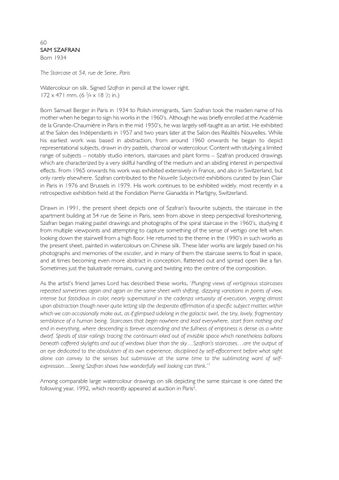
60 SAM SZAFRAN Born 1934 The Staircase at 54, rue de Seine, Paris Watercolour on silk. Signed Szafran in pencil at the lower right. 172 x 471 mm. (6 3/4 x 18 1/ 2 in.) Born Samuel Berger in Paris in 1934 to Polish immigrants, Sam Szafran took the maiden name of his mother when he began to sign his works in the 1960’s. Although he was briefly enrolled at the Académie de la Grande-Chaumière in Paris in the mid 1950’s, he was largely self-taught as an artist. He exhibited at the Salon des Indépendants in 1957 and two years later at the Salon des Réalités Nouvelles. While his earliest work was based in abstraction, from around 1960 onwards he began to depict representational subjects, drawn in dry pastels, charcoal or watercolour. Content with studying a limited range of subjects – notably studio interiors, staircases and plant forms – Szafran produced drawings which are characterized by a very skillful handling of the medium and an abiding interest in perspectival effects. From 1965 onwards his work was exhibited extensively in France, and also in Switzerland, but only rarely elsewhere. Szafran contributed to the Nouvelle Subjectivité exhibitions curated by Jean Clair in Paris in 1976 and Brussels in 1979. His work continues to be exhibited widely, most recently in a retrospective exhibition held at the Fondation Pierre Gianadda in Martigny, Switzerland. Drawn in 1991, the present sheet depicts one of Szafran’s favourite subjects, the staircase in the apartment building at 54 rue de Seine in Paris, seen from above in steep perspectival foreshortening. Szafran began making pastel drawings and photographs of the spiral staircase in the 1960’s, studying it from multiple viewpoints and attempting to capture something of the sense of vertigo one felt when looking down the stairwell from a high floor. He returned to the theme in the 1990’s in such works as the present sheet, painted in watercolours on Chinese silk. These later works are largely based on his photographs and memories of the escalier, and in many of them the staircase seems to float in space, and at times becoming even more abstract in conception, flattened out and spread open like a fan. Sometimes just the balustrade remains, curving and twisting into the centre of the composition. As the artist’s friend James Lord has described these works, ‘Plunging views of vertiginous staircases repeated sometimes again and again on the same sheet with shifting, dizzying variations in points of view, intense but fastidious in color, nearly supernatural in the cadenza virtuosity of execution, verging almost upon abstraction though never quite letting slip the desperate affirmation of a specific subject matter, within which we can occasionally make out, as if glimpsed sidelong in the galactic swirl, the tiny, lovely, fragmentary semblance of a human being. Staircases that begin nowhere and lead everywhere, start from nothing and end in everything, where descending is forever ascending and the fullness of emptiness is dense as a white dwarf. Spirals of stair railings tracing the continuum eked out of invisible space which nonetheless balloons beneath coffered skylights and out of windows bluer than the sky…Szafran’s staircases…are the output of an eye dedicated to the absolutism of its own experience, disciplined by self-effacement before what sight alone can convey to the senses but submissive at the same time to the sublimating want of selfexpression…Seeing Szafran shows how wonderfully well looking can think.’1 Among comparable large watercolour drawings on silk depicting the same staircase is one dated the following year, 1992, which recently appeared at auction in Paris2.
Issuu converts static files into: and more. Sign up and create your flipbook.