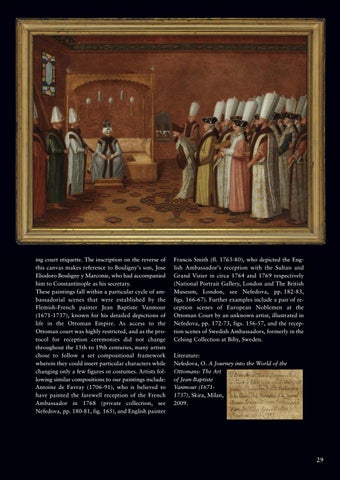
ing court etiquette. The inscription on the reverse of this canvas makes reference to Bouligny’s son, Jose Eliodoro Bouligny y Marconie, who had accompanied him to Constantinople as his secretary. These paintings fall within a particular cycle of ambassadorial scenes that were established by the Flemish-French painter Jean Baptiste Vanmour (1671-1737), known for his detailed depictions of life in the Ottoman Empire. As access to the Ottoman court was highly restricted, and as the protocol for reception ceremonies did not change throughout the 15th to 19th centuries, many artists chose to follow a set compositional framework wherein they could insert particular characters while changing only a few figures or costumes. Artists following similar compositions to our paintings include: Antoine de Favray (1706-91), who is believed to have painted the farewell reception of the French Ambassador in 1768 (private collection, see Nefedova, pp. 180-81, fig. 165), and English painter
Francis Smith (fl. 1763-80), who depicted the English Ambassador’s reception with the Sultan and Grand Vizier in circa 1764 and 1769 respectively (National Portrait Gallery, London and The British Museum, London, see Nefedova, pp. 182-83, figs. 166-67). Further examples include a pair of reception scenes of European Noblemen at the Ottoman Court by an unknown artist, illustrated in Nefedova, pp. 172-73, figs. 156-57, and the reception scenes of Swedish Ambassadors, formerly in the Celsing Collection at Biby, Sweden. Literature: Nefedova, O. A Journey into the World of the Ottomans: The Art of Jean-Baptiste Vanmour (16711737), Skira, Milan, 2009.
29