A rum barrel for a royal admiral
15. A George IV Barrel-Form Urn Silver London, 1823 Maker’s mark of John Bridge of the Royal Goldsmiths Rundell, Bridge & Rundell Height: 15 1⁄8 in (38.4 cm) Gross weight: 121 oz 10 dwt (3,780 g) PROVENANCE William, Duke of Clarence, later William IV (1765–1837) Property from a Kentucky Estate, Christie’s, New York, October 27, 1992, lot 230
The rum-barrel form of this urn was especially appropriate for the third son of King George and Queen Charlotte, who made a career in the Royal Navy. In 1823, the year this barrel was commissioned, he began his second term as Admiral of the Fleet. He was appointed Lord High Admiral in 1828. With the death in 1818 of Princess Charlotte, only child of the Prince Regent, a royal marriage race had begun between the younger sons of George III, collectively known as the Royal Dukes, in order to produce an heir to the throne. William, Duke of Clarence, had been in a long-standing relationship with a mistress, as he, like his brothers, had not been able to afford a wife. In his case, Dorothy Jordan, an actress, had produced a large brood of children with the duke and by continuing her successful acting career between pregnancies had managed to support both the duke and
40 | Koopman Rare Art
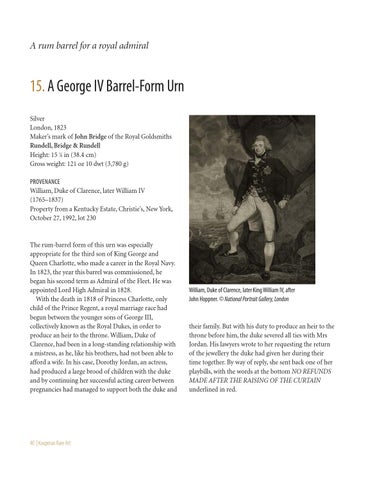
William, Duke of Clarence, later King William IV, after John Hoppner. © National Portrait Gallery, London
their family. But with his duty to produce an heir to the throne before him, the duke severed all ties with Mrs Jordan. His lawyers wrote to her requesting the return of the jewellery the duke had given her during their time together. By way of reply, she sent back one of her playbills, with the words at the bottom NO REFUNDS MADE AFTER THE RAISING OF THE CURTAIN underlined in red.