33406_Silver_pp1-56 _d4s 08/02/13 10.06 Pagina 18
5 Tea urn
After a design by Jean-Jacques Boileau
Silver gilt London, 1806 Maker’s mark of Digby Scott & Benjamin Smith, retailed by Rundell, Bridge & Rundell The base stamped RUNDELL BRIDGE ET RUNDELL AURIFICES REGIS ET PRINCIPIS WALLIÆ LONDINI FECERUNT Height: 141⁄2 in (36.9 cm) Gross weight: 241 oz 12 dwt (7,513 g)
PROVENANCE C. Ruxton Love, New York City The Audrey B. Love Foundation, Christie’s, New York, 14 June 1982, lot 132 His Excellency Mahdi Mohammed Al-Tajir EXHIBITED London, 1989: The Glory of the Goldsmith, Magnificent Gold and Silver from the Al-Tajir Collection, Christie’s, London, no. 121 PUBLISHED J.B. Hawkins, The Al-Tajir Collection of Silver and Gold, London, 1983, pp. 108–9 M. Clayton, Christie’s Pictorial History of English and American Silver, Oxford, 1985, p. 211, no. 3 The Glory of the Goldsmith, Magnificent Gold and Silver from the Al-Tajir Collection, exh. cat., London, 1989, pp. 158–9 A. Phillips and J. Sloane, Antiquity Revisited, English and French Silver-Gilt from the Collection of Audrey Love, London, 1997, pp. 7–8
18 | Koopman Rare Art
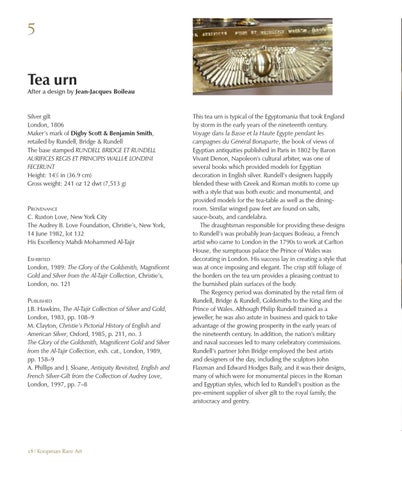
This tea urn is typical of the Egyptomania that took England by storm in the early years of the nineteenth century. Voyage dans la Basse et la Haute Egypte pendant les campagnes du Général Bonaparte, the book of views of Egyptian antiquities published in Paris in 1802 by Baron Vivant Denon, Napoleon’s cultural arbiter, was one of several books which provided models for Egyptian decoration in English silver. Rundell’s designers happily blended these with Greek and Roman motifs to come up with a style that was both exotic and monumental, and provided models for the tea-table as well as the diningroom. Similar winged paw feet are found on salts, sauce-boats, and candelabra. The draughtsman responsible for providing these designs to Rundell’s was probably Jean-Jacques Boileau, a French artist who came to London in the 1790s to work at Carlton House, the sumptuous palace the Prince of Wales was decorating in London. His success lay in creating a style that was at once imposing and elegant. The crisp stiff foliage of the borders on the tea urn provides a pleasing contrast to the burnished plain surfaces of the body. The Regency period was dominated by the retail firm of Rundell, Bridge & Rundell, Goldsmiths to the King and the Prince of Wales. Although Philip Rundell trained as a jeweller, he was also astute in business and quick to take advantage of the growing prosperity in the early years of the nineteenth century. In addition, the nation’s military and naval successes led to many celebratory commissions. Rundell’s partner John Bridge employed the best artists and designers of the day, including the sculptors John Flaxman and Edward Hodges Baily, and it was their designs, many of which were for monumental pieces in the Roman and Egyptian styles, which led to Rundell’s position as the pre-eminent supplier of silver gilt to the royal family, the aristocracy and gentry.