2 Cf. no. 322.2 in Gerald Ackerman’s catalogue raisonné for the artist (Jean-Léon Gérôme, Paris, 2000). The size of the present work, though considerably smaller than this recorded sketch, is standard for the artist.
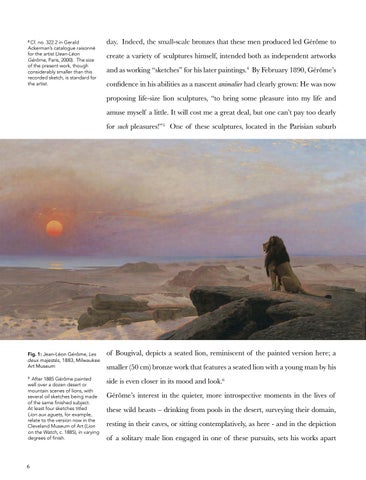
day. Indeed, the small-scale bronzes that these men produced led Gérôme to create a variety of sculptures himself, intended both as independent artworks and as working “sketches” for his later paintings.4 By February 1890, Gérôme’s confidence in his abilities as a nascent animalier had clearly grown: He was now proposing life-size lion sculptures, “to bring some pleasure into my life and amuse myself a little. It will cost me a great deal, but one can’t pay too dearly for such pleasures!”5 One of these sculptures, located in the Parisian suburb
Fig. 1: Jean-Léon Gérôme, Les deux majestés, 1883, Milwaukee Art Museum
of Bougival, depicts a seated lion, reminiscent of the painted version here; a
After 1885 Gérôme painted well over a dozen desert or mountain scenes of lions, with several oil sketches being made of the same finished subject. At least four sketches titled Lion aux aguets, for example, relate to the version now in the Cleveland Museum of Art (Lion on the Watch, c. 1885), in varying degrees of finish.
side is even closer in its mood and look.6
3
6
smaller (50 cm) bronze work that features a seated lion with a young man by his
Gérôme’s interest in the quieter, more introspective moments in the lives of these wild beasts – drinking from pools in the desert, surveying their domain, resting in their caves, or sitting contemplatively, as here - and in the depiction of a solitary male lion engaged in one of these pursuits, sets his works apart