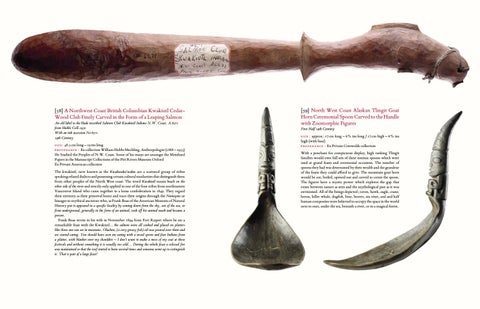
[58] A Northwest Coast British Columbian Kwakiutl CedarWood Club Finely Carved in the Form of a Leaping Salmon An old label to the blade inscribed Salmon Club Kwakiutl Indians N.W. Coast. A.6271 from Hubbs Coll.1932 With an ink accession No 6271 19th Century
s i z e: 48.5 cm long – 19 ins long p rov e na nc e : Ex collection William Hubbs Mechling, Anthropologist (1888 – 1953) He Studied the Peoples of N.W. Coast. Some of his essays are amongst the Meinhard Papers in the Manuscript Collections of the Pitt Rivers Museum Oxford Ex Private American collection The kwakiutl, now known as the Kwakwaka’wakw are a scattered group of tribes speaking related dialects and possessing certain cultural similarities that distinguish them from other peoples of the North West coast. The word Kwakiutl means beach on the other side of the river and strictly only applied to one of the four tribes from northeastern Vancouver Island who came together in a loose confederation in 1849. They regard their territory as their primeval home and trace their origins through the Numayms or lineages to mythical ancestors who, as Frank Boas of the American Museum of Natural History put it appeared in a specific locality by coming down from the sky, out of the sea, or from underground, generally in the form of an animal, took off his animal mask and became a person. Frank Boas wrote to his wife in November 1894 from Fort Rupert where he ate a remarkable feast with the Kwakiutl… the salmon were all cooked and placed on platters like those one can see in museums. Olachen, (a very greasy fish) oil was poured over them and we started eating. You should have seen me eating with a wood spoon and four Indians from a platter, with blanket over my shoulders – I don’t want to make a mess of my coat at these festivals and without something it is usually too cold… During the whole feast a colossal fire was maintained so that the roof started to burn several times and someone went up to extinguish it. That is part of a large feast!
[59] North West Coast Alaskan Tlingit Goat Horn Ceremonial Spoon Carved to the Handle with Zoomorphic Figures First Half 19th Century
s i z e : approx: 17 cm long – 6¾ ins long / 17 cm high – 6¾ ins high (with base) p rov e na nc e : Ex Private Cotswolds collection With a penchant for conspicuous display, high ranking Tlingit families would own full sets of these totemic spoons which were used at grand feasts and ceremonial occasions. The number of spoons they had was determined by their wealth and the grandeur of the feasts they could afford to give. The mountain goat horn would be cut, boiled, opened out and carved to create the spoon. The figures have a mystic power which explores the gap that exists between nature as seen and the mythological past as it was envisioned. All of the beings depicted; raven, hawk, eagle, crane, heron, killer whale, dogfish, bear, beaver, sea otter, seal and half human composites were believed to occupy the space in the world next to ours, under the sea, beneath a river, or in a magical forest.