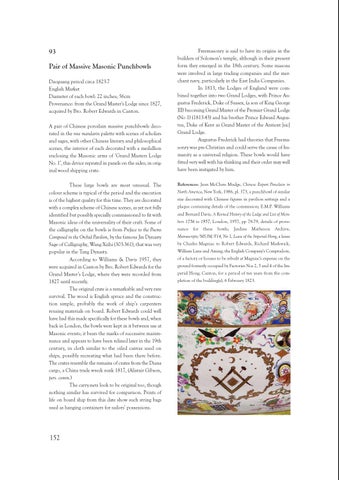
93 Pair of Massive Masonic Punchbowls Daoguang period circa 1823-7 English Market Diameter of each bowl: 22 inches; 56cm Provenance: from the Grand Master's Lodge since 1827, acquired by Bro. Robert Edwards in Canton. A pair of Chinese porcelain massive punchbowls decorated in the rose mandarin palette with scenes of scholars and sages, with other Chinese literary and philosophical scenes, the interior of each decorated with a medallion enclosing the Masonic arms of ‘Grand Masters Lodge No. 1’, this device repeated in panels on the sides; in original wood shipping crate. These large bowls are most unusual. The colour scheme is typical of the period and the execution is of the highest quality for this time. They are decorated with a complex scheme of Chinese scenes, as yet not fully identified but possibly specially commissioned to fit with Masonic ideas of the universality of their craft. Some of the calligraphy on the bowls is from Preface to the Poems Composed in the Orchid Pavilion, by the famous Jin Dynasty Sage of Calligraphy, Wang Xizhi (303-361), that was very popular in the Tang Dynasty. According to Williams & Davis 1957, they were acquired in Canton by Bro. Robert Edwards for the Grand Master’s Lodge, where they were recorded from 1827 until recently. The original crate is a remarkable and very rare survival. The wood is English spruce and the construction simple, probably the work of ship’s carpenters reusing materials on board. Robert Edwards could well have had this made specifically for these bowls and, when back in London, the bowls were kept in it between use at Masonic events; it bears the marks of successive maintenance and appears to have been relined later in the 19th century, in cloth similar to the oiled canvas used on ships, possibly recreating what had been there before. The crates resemble the remains of crates from the Diana cargo, a China trade wreck sunk 1817, (Alistair Gibson, pers. comm.) The carry-nets look to be original too, though nothing similar has survived for comparison. Prints of life on board ship from this date show such string bags used as hanging containers for sailors’ possessions.
152
Freemasonry is said to have its origins in the builders of Solomon’s temple, although in their present form they emerged in the 18th century. Some masons were involved in large trading companies and the merchant navy, particularly in the East India Companies. In 1813, the Lodges of England were combined together into two Grand Lodges, with Prince Augustus Frederick, Duke of Sussex, (a son of King George III) becoming Grand Master of the Premier Grand Lodge (No 1) (1813-43) and his brother Prince Edward Augustus, Duke of Kent as Grand Master of the Antient [sic] Grand Lodge. Augustus Frederick had theories that Freemasonry was pre-Christian and could serve the cause of humanity as a universal religion. These bowls would have fitted very well with his thinking and their order may well have been instigated by him. References: Jean McClure Mudge, Chinese Export Porcelain in North America, New York, 1986, pl. 373, a punchbowl of similar size decorated with Chinese figures in pavilion settings and a plaque containing details of the commission; E.M.P. Williams and Bernard Davis, A Revised History of the Lodge and List of Members 1756 to 1957, London, 1957, pp 78-79, details of provenance
for
these
bowls;
Jardine
Matheson
Archive,
Manuscripts/MS JM/F14, No 1, Lease of the Imperial Hong, a lease by Charles Magniac to Robert Edwards, Richard Markwick, William Lane and Aming, the English Company's Compradore, of a factory or houses to be rebuilt at Magniac's expense on the ground formerly occupied by Factories Nos 2, 3 and 4 of the Imperial Hong, Canton, for a period of ten years from the completion of the building(s), 6 February 1823.