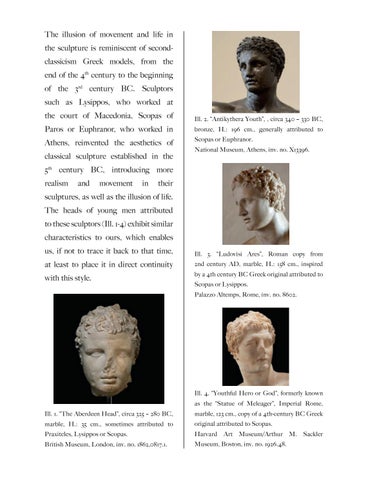
The illusion of movement and life in the sculpture is reminiscent of secondclassicism Greek models, from the end of the 4th century to the beginning of the 3rd century BC. Sculptors such as Lysippos, who worked at the court of Macedonia, Scopas of
Ill. 2. “Antikythera Youth”, , circa 340 – 330 BC,
Paros or Euphranor, who worked in
bronze, H.: 196 cm., generally attributed to
Athens, reinvented the aesthetics of
Scopas or Euphranor.
classical sculpture established in the
National Museum, Athens, inv. no. X13396.
5th century BC, introducing more realism
and
movement
in
their
sculptures, as well as the illusion of life. The heads of young men attributed to these sculptors (Ill. 1-4) exhibit similar characteristics to ours, which enables us, if not to trace it back to that time,
Ill. 3. “Ludovisi Ares”, Roman copy from
at least to place it in direct continuity
2nd century AD, marble, H.: 158 cm., inspired
with this style.
by a 4th century BC Greek original attributed to Scopas or Lysippos. Palazzo Altemps, Rome, inv. no. 8602.
Ill. 4. “Youthful Hero or God”, formerly known as the “Statue of Meleager”, Imperial Rome, Ill. 1. “The Aberdeen Head”, circa 325 – 280 BC,
marble, 123 cm., copy of a 4th-century BC Greek
marble, H.: 35 cm., sometimes attributed to
original attributed to Scopas.
Praxiteles, Lysippos or Scopas.
Harvard
British Museum, London, inv. no. 1862,0817.1.
Museum, Boston, inv. no. 1926.48.
Art
Museum/Arthur
M.
Sackler