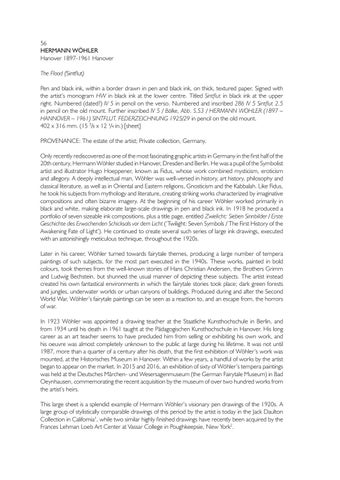
56 HERMANN WÖHLER Hanover 1897-1961 Hanover The Flood (Sintflut) Pen and black ink, within a border drawn in pen and black ink, on thick, textured paper. Signed with the artist’s monogram HW in black ink at the lower centre. Titled Sintflut in black ink at the upper right. Numbered (dated?) IV 5 in pencil on the verso. Numbered and inscribed 286 IV 5 Sintflut 2.5 in pencil on the old mount. Further inscribed IV 5 / Bölke, Abb. S.53 / HERMANN WOHLER (1897 – HANNOVER – 1961) SINTFLUT. FEDERZEICHNUNG 1925/29 in pencil on the old mount. 402 x 316 mm. (15 7/8 x 12 1/4 in.) [sheet] PROVENANCE: The estate of the artist; Private collection, Germany. Only recently rediscovered as one of the most fascinating graphic artists in Germany in the first half of the 20th century, Hermann Wöhler studied in Hanover, Dresden and Berlin. He was a pupil of the Symbolist artist and illustrator Hugo Hoeppener, known as Fidus, whose work combined mysticism, eroticism and allegory. A deeply intellectual man, Wöhler was well-versed in history, art history, philosophy and classical literature, as well as in Oriental and Eastern religions, Gnosticism and the Kabbalah. Like Fidus, he took his subjects from mythology and literature, creating striking works characterized by imaginative compositions and often bizarre imagery. At the beginning of his career Wöhler worked primarily in black and white, making elaborate large-scale drawings in pen and black ink. In 1918 he produced a portfolio of seven sizeable ink compositions, plus a title page, entitled Zwielicht: Sieben Sinnbilder / Erste Geschichte des Erwachenden Schicksals vor dem Licht (‘Twilight: Seven Symbols / The First History of the Awakening Fate of Light’). He continued to create several such series of large ink drawings, executed with an astonishingly meticulous technique, throughout the 1920s. Later in his career, Wöhler turned towards fairytale themes, producing a large number of tempera paintings of such subjects, for the most part executed in the 1940s. These works, painted in bold colours, took themes from the well-known stories of Hans Christian Andersen, the Brothers Grimm and Ludwig Bechstein, but shunned the usual manner of depicting these subjects. The artist instead created his own fantastical environments in which the fairytale stories took place; dark green forests and jungles, underwater worlds or urban canyons of buildings. Produced during and after the Second World War, Wöhler’s fairytale paintings can be seen as a reaction to, and an escape from, the horrors of war. In 1923 Wöhler was appointed a drawing teacher at the Staatliche Kunsthochschule in Berlin, and from 1934 until his death in 1961 taught at the Pädagogischen Kunsthochschule in Hanover. His long career as an art teacher seems to have precluded him from selling or exhibiting his own work, and his oeuvre was almost completely unknown to the public at large during his lifetime. It was not until 1987, more than a quarter of a century after his death, that the first exhibition of Wöhler’s work was mounted, at the Historisches Museum in Hanover. Within a few years, a handful of works by the artist began to appear on the market. In 2015 and 2016, an exhibition of sixty of Wöhler’s tempera paintings was held at the Deutsches Märchen- und Wesersagenmuseum (the German Fairytale Museum) in Bad Oeynhausen, commemorating the recent acquisition by the museum of over two hundred works from the artist’s heirs. This large sheet is a splendid example of Hermann Wöhler’s visionary pen drawings of the 1920s. A large group of stylistically comparable drawings of this period by the artist is today in the Jack Daulton Collection in California1, while two similar highly finished drawings have recently been acquired by the Frances Lehman Loeb Art Center at Vassar College in Poughkeepsie, New York2.
Issuu converts static files into: and more. Sign up and create your flipbook.