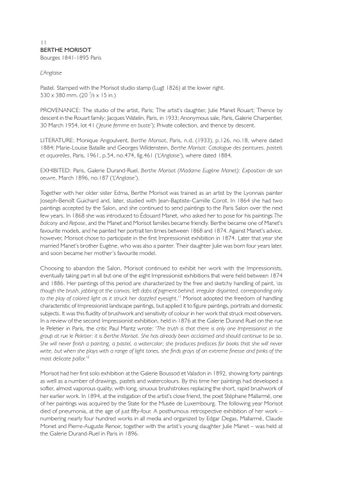
11 BERTHE MORISOT Bourges 1841-1895 Paris L’Anglaise Pastel. Stamped with the Morisot studio stamp (Lugt 1826) at the lower right. 530 x 380 mm. (20 7/ 8 x 15 in.) PROVENANCE: The studio of the artist, Paris; The artist’s daughter, Julie Manet Rouart; Thence by descent in the Rouart family; Jacques Watelin, Paris, in 1933; Anonymous sale, Paris, Galerie Charpentier, 30 March 1954, lot 41 (‘Jeune femme en buste’); Private collection, and thence by descent. LITERATURE: Monique Angoulvent, Berthe Morisot, Paris, n.d. (1933), p.126, no.18, where dated 1884; Marie-Louise Bataille and Georges Wildenstein, Berthe Morisot: Catalogue des peintures, pastels et aquarelles, Paris, 1961, p.54, no.474, fig.461 (‘L’Anglaise’), where dated 1884. EXHIBITED: Paris, Galerie Durand-Ruel, Berthe Morisot (Madame Eugène Manet): Exposition de son oeuvre, March 1896, no.187 (‘L’Anglaise’). Together with her older sister Edma, Berthe Morisot was trained as an artist by the Lyonnais painter Joseph-Benoît Guichard and, later, studied with Jean-Baptiste-Camille Corot. In 1864 she had two paintings accepted by the Salon, and she continued to send paintings to the Paris Salon over the next few years. In 1868 she was introduced to Édouard Manet, who asked her to pose for his paintings The Balcony and Repose, and the Manet and Morisot families became friendly. Berthe became one of Manet’s favourite models, and he painted her portrait ten times between 1868 and 1874. Against Manet’s advice, however, Morisot chose to participate in the first Impressionist exhibition in 1874. Later that year she married Manet’s brother Eugène, who was also a painter. Their daughter Julie was born four years later, and soon became her mother’s favourite model. Choosing to abandon the Salon, Morisot continued to exhibit her work with the Impressionists, eventually taking part in all but one of the eight Impressionist exhibitions that were held between 1874 and 1886. Her paintings of this period are characterized by the free and sketchy handling of paint, ‘as though the brush, jabbing at the canvas, left dabs of pigment behind, irregular disjointed, corresponding only to the play of colored light as it struck her dazzled eyesight.’1 Morisot adopted the freedom of handling characteristic of Impressionist landscape paintings, but applied it to figure paintings, portraits and domestic subjects. It was this fluidity of brushwork and sensitivity of colour in her work that struck most observers. In a review of the second Impressionist exhibition, held in 1876 at the Galerie Durand Ruel on the rue le Peletier in Paris, the critic Paul Mantz wrote: ‘The truth is that there is only one Impressionist in the group at rue le Peletier: it is Berthe Morisot. She has already been acclaimed and should continue to be so. She will never finish a painting, a pastel, a watercolor; she produces prefaces for books that she will never write, but when she plays with a range of light tones, she finds grays of an extreme finesse and pinks of the most delicate pallor.’2 Morisot had her first solo exhibition at the Galerie Boussod et Valadon in 1892, showing forty paintings as well as a number of drawings, pastels and watercolours. By this time her paintings had developed a softer, almost vaporous quality, with long, sinuous brushstrokes replacing the short, rapid brushwork of her earlier work. In 1894, at the instigation of the artist’s close friend, the poet Stéphane Mallarmé, one of her paintings was acquired by the State for the Musée de Luxembourg. The following year Morisot died of pneumonia, at the age of just fifty-four. A posthumous retrospective exhibition of her work – numbering nearly four hundred works in all media and organized by Edgar Degas, Mallarmé, Claude Monet and Pierre-Auguste Renoir, together with the artist’s young daughter Julie Manet – was held at the Galerie Durand-Ruel in Paris in 1896.
Issuu converts static files into: and more. Sign up and create your flipbook.