SPRING 2023
MEASURE TWICE, HIRE ONCE LEARNING from FAILURE
ATTACK OF THE RECORDS! I SAFETY
Artisan Spirit OF THE YEAR


BRAND STRATEGY | STORY DEVELOPMENT | NAMING LOGOS | PACKAGING | CUSTOM BOTTLES | PRINT | DIGITAL DRINK WITH YOUR EYES ® 2787 NAPA VALLEY CORPORATE DR, NAPA, CALIFORNIA 94558 T | 707 265 1891 WWW.CFNAPA.COM CFN216_ArtisanSpiritsAd_2_ FALL_2022.indd

TABLE of CONTENTS from the COVER Short Path Distillery in Everett, Massachusetts. Image by Amanda Joy Christensen. See the story on page 82 A LETTER FROM THE EDITOR 10 QUARTERLY GUILD & INDUSTRY REPORTS 13 Updates from guilds and associations within states, across the nation, and beyond! BUILDING YOUR BRAND DREAM TEAM 27 Brand Buzz with David Schuemann I HEART SAFETY 31 The Process Safety Management Series LAMBANOG 34 The history and mystery of this coconut spirit MUM’S NO LONGER THE WORD 37 Maneuvering pay disclosure across the country MAPLE SAP GIN 39 An interview with Peter Connor THE STATE OF THE CRAFT DISTILLING INDUSTRY 42 Part 2: The peripheral viewpoint FIVE & 20 SPIRITS AND BREWING 46 Beyond the Bottom Line 2022 SPIRITS INDUSTRY MERGERS & ACQUISITIONS 51 Year in Review 2023 ARTISAN SPIRIT DISTILLER OF THE YEAR 54 Recognizing a distiller of distinction WHAT DOES TERROIR IN WHISKEY MEAN? 60 Colorado and Wyoming are leading the charge to forge the answer STRAIGHTAWAY COCKTAILS IN PORTLAND, OREGON 62 A market explosion shapes one companies future BUILDING YOUR BUDGET 68 Best practices in budgeting for the craft distiller A FIGHTING SPIRIT 72 For over a half century, Khukri Rum has honored Nepal’s warrior heritage A CLEARER PATH 77 The TTB’s definition of American single malt whiskey opens several possibilities FIRE EXTINGUISHERS 80 Fire and Life Safety Corner LOCAL GRAIN ORGANIZATIONS 82 As supply chains squeeze, a community grows DESERT DOOR DISTILLERY 86 Tasting prehistoric Texas ATTACK OF THE RECORDS! 92 TTB record keeping compliance FORTIFIED WINES 96 Rediscovering an age-old partnership SHORT MOUNTAIN DISTILLERY 100 Tall tales from the Short Mountain THE SUCCESSFUL DISTILLERY 105 Learning from failure DISTILLERY ANALYSES: PART TWO 108 Enhanced analyses: Spectroscopy and chromatography TRANSPARENCY AND THE ART OF AN AUTHENTIC SPIRITS STORY 112 Simple steps for honest engagement TWO STILLS ARE BETTER THAN ONE 114 One still to rule them all, one still to refine them, one still for low wines too, and with the copper bind them BIG BRAND BOOZE 116 The story behind Arby’s Bourbon ADVERTISER INDEX 118
SafSpirit™
THE OBVIOUS CHOICE FOR WHISKEY
HIGHLY AROMATIC NEW-MAKE SPIRIT
S af S pirit ™ D-53

SCOTCH AND SINGLE MALT WHISKEY

S af S pirit ™ M-1


BOURBON AND AMERICAN WHISKEY
S af S pirit ™ USW-6

ISSUE 42 /// SPRING 2023
PUBLISHER & EDITOR Brian Christensen
CREATIVE DIRECTOR Amanda Joy Christensen
SENIOR WRITERS
Carrie Dow
Reade A. Huddleston, MSc.
Nicole Austin
Jason Barrett
Kris Bohm
Kim Bucek
Corey Day
Doug Hall
Paul Hughes, Ph.D.
Aaron Knoll
Rich Manning
Allyson Campbell
Amanda Joy Christensen
John Davidson
Carrie Dow
Jimmy Eagle
Let’s meet @ the 4 th Annual Beam Institute Industry Conference!
March 13-15 th I Lexington, KY
Gabe Toth, MSc.
Devon Trevathan
CONTRIBUTORS
PHOTOGRAPHERS
Exposed By Light Photography
Jeff Quint
Michael T. Reardon, P.E.
Robert Sarkisian
David Schuemann
John P. Thomas, II
Lisa Truesdale
Margarett Waterbury
Brendan Wheatley
Ladd Ford
Robert Mazza, Inc.
Michael T. Reardon, P.E.
Lindsey Swedick
Jackie Lee Young
SALES & MARKETING Ashley Monroe
ARTISAN SPIRIT is a quarterly publication by Artisan Spirit Media.
www.artisanspiritmag.com
facebook.com/ArtisanSpiritMagazine
ArtisanSpiritM ArtisanSpiritM
General Inquiries (509) 944-5919 Advertising (509) 991-8112 PO Box 31494, Spokane, WA 99223
All contents ©2023. No portion of this magazine may be reproduced without the written consent of the publisher. Neither Artisan Spirit Media nor ARTISAN SPIRIT magazine assume responsibility for errors in content, photos, or advertisements.

While ARTISAN SPIRIT makes every effort to ensure accuracy in our content, the information is deemed reliable but not guaranteed. We urge our readers to consult with professional service providers to meet their unique needs.
At ARTISAN SPIRIT, we take the opportunity to enjoy many different craft spirits and adult beverages. However, it’s also our responsibility, and yours, to always drink responsibly. Know your limit, and never drink and drive.
ARTISAN SPIRIT’s number one goal is to share and celebrate the art and science of artisan craft distilling. But please remember to follow all the laws, regulations, and safety procedures. Be safe, be legal, and we can all be proud of the industry we love.
INNOVATIVE SOLUTIONS since 1912
A barrel should be more than an aging vessel, it should be a partner in achieving your desired flavor profile. Using science-based research and experimentation, ISC barrel experts collaborate with world-class distillers to create innovative barrel solutions for their unique spirits.

iscbarrels.com
THANK YOU TO ALL OUR SPONSORS.
Our mission at Artisan Spirit Magazine is to share and celebrate the art and science of artisan craft distilling. We are humbled by the support of our sponsors. With their help, we can further our common goals of supporting creativity, innovation, and integrity within the industry we all love so much.

The American Spirits Exchange is a national importer and distributor serving the alcoholic beverage industry (spirits, wine, and beer). We provide domestic and international companies with access and support to the U.S. market. Regardless of your size — from micro, craft distiller to publicly traded multinational — our focus fuels your growth. Our flagship Foundations™ program provides companies with access to the U.S. market. We handle your business-to-business functions from start to finish: permitting, brand approvals, purchase order processing, invoicing, and compliance.
BSG is focused on supplying craft distillers with the best ingredients from around the world. The craft distilling market trusts BSG to deliver the finest ingredients at competitive prices, without sacrificing customer service. With distilling malts and grains from Rahr Malting Co., Weyermann®, Simpsons, Crisp and Malting Company of Ireland, as well as a full range of yeasts, yeast nutrients, enzymes, botanicals, and finishing products, we have a wide range of distilling ingredients to help you create high quality, artisanal spirits.
Cage and Sons Distilling Systems build premium distillation systems and equipment for premier distilleries. Every element of Cage and Sons equipment is designed and crafted to provide you with the very best distilling experience at an affordable rate because we know that bottom line matters, but so does function. At Cage and Sons, adequate is never an option, and we continue to develop and design new high functioning, cutting-edge distillation systems that enhance the distillation industry. Cage and Sons works every day to bring you the very best distillation systems for the very best value.
Unlike other agencies that work within a blinding myriad of industries; our focus is 100% within the spirits, wine, beer, and other alcohol sectors. This specialization has allowed us to become experts in the alcohol beverage category. We have an exceptional understanding of design that sells, complemented by professional project management and flawless production oversight. The result has been strategic solutions that consistently produce both critical acclaim and strong measurable return on investment for our clients.

6 WWW. ARTISANSPIRITMAG .COM
The Distilled Spirits Council of the United States (DISCUS) is the leading voice and advocate for distilled spirits in the United States. Representing producers and marketers of distilled spirits, DISCUS advocates on legislative, regulatory, and public affairs issues impacting the distilled spirits sector at the local, state, federal, and international levels; promotes the distilled spirits sector, raising awareness and opening markets in the United States and around the globe; and encourages responsible and moderate consumption of distilled spirits as part of a healthy adult lifestyle based on evidence-based research and policy. DISCUS also powers Spirits United, a grassroots platform for the distilled spirits industry. Spirits United is comprised of a community of advocates united with a common goal: to ensure adult consumers can enjoy distilled spirits where they want, how they want, and when they want. Learn more at distilledspirits.org and spiritsunited.org.
Trusted Oak Expertise Since 1912.
We’ve been in this industry for over 100 years, during which time we’ve learned a thing or two about what makes a great barrel to age great spirits. Our R&D team and account managers have hundreds of barrels currently in experimentation. Partnering with distillers, we think outside the box to develop new products that push your vision forward.
Our Mission: To craft world-class oak barrels and other cooperage products so our employees, customers, and communities flourish.
Lallemand Biofuels & Distilled Spirits is the industry leader in supplying fermentation products and valueadded services to the distilled spirits industry. We specialize in the research, development, production, and marketing of yeast and yeast nutrients as well as a solid belief in education of the distilled spirits industry.


A vital part of the alcohol production process, fermentation products from Lallemand Biofuels & Distilled Spirits have been designed and selected to create value by tailoring objective solutions to distillery needs.

Standing out in a crowded marketplace is an ongoing challenge for wine and spirits producers today. MCC’s experienced team of label engineers take a consultative approach, helping guide your project from inception to finished label. Whether it's an existing design, or a highly embellished new project, we are poised to give your brand the look it deserves. Housing many different printing technologies under one roof allows us to match our passion and expertise to your project, each and every time, without compromise. This ensures that your final packaging always achieves the desired look. With MCC and Fort Dearborn recently joining forces, we are poised to provide all spirits customers with amazing service and quality products.
Moonshine University is located in Louisville, Kentucky on the Beverage Campus with its sister company, Flavorman. Moonshine University offers a variety of classes for enthusiasts, entrepreneurs, industry professionals, and those seeking careers in the distilling industry. Our distillery was designed as part of our classroom, and all classes incorporate hands-on learning and sensory evaluation in order to provide a complete and comprehensive education. In addition to its knowledgeable instructors, Moonshine University hosts a range of renowned industry experts for specialized instruction and training.
WWW. ARTISANSPIRITMAG .COM 7
Founded in France in 1897 and based in the USA for more than 30 years, Saverglass provides for the premium & super premium spirits and wines. Over the years, the Saverglass Group has distinguished itself by its undeniable quality of glass coupled with innovative decoration techniques. Today, one of Saverglass’ main asset lies on its product offer: 110 original designs and 425 references which represent the largest selection on the market! Thirsty for genuineness, Saverglass has created exclusive bottles dedicated to Artisanal distilleries: The Craft Spirits collection is designed to convey the image of authentic, locally sourced and rare high-quality products. Recently, the Group has strengthened its presence and service offering in the U.S. by opening an ultra-modern bottle manufacturing and decorating plant in North America.

Southern Distilling Company is one of the largest artisan distilleries in the nation. We offer product development, contract distilling (standard and custom mash bill whiskeys, rum, and agave spirits), barrel warehouse aging, batching, blending, bottling, and co-packaging of award-winning products. We also keep an extensive inventory of aged bourbon and rye whiskey available year-round.
Our spirits are distilled in top-of-the-line Vendome Copper & Brass Works continuous column stills. Our product development services include working with you to perfect an existing recipe and consultations to help you create your own recipe. We can barrel and warehouse age your product to meet both short and long-term goals. At Southern Distilling Company, you get standout spirits that make brands unforgettable.
For over 60 years Tapi USA has produced cork stoppers and a wide variety of bottle closures. Family-owned and operated since its inception, our company continues to develop new products and enter new markets. Tapi USA is proud to support the growth of the artisan distillery industry and is honored to be the Bottle Closure Sponsor for Artisan Spirit Magazine.
Founded in 1999 in Thousand Oaks, California, the Thousand Oaks Barrel Co. manufactures a wide selection of products for distillery gift shops. We work with large and small distilleries and wineries, marketing and catalog companies, retailers, and web-based e-tailers. Our craftsmen provide made to order products or distilleries can select from our tried-and-true products such barrel heads, quarter barrels, flasks, and barrel key chains, to name a few, each with your distillery logo and branding. We look forward to providing you some of the best promotional products on the market and are sure they will be top sellers in your product line.
Total Wine & More is the country’s largest independent retailer of fine wine, beer, and spirits. Our strength is our people. We have over 5,000 associates, who must demonstrate comprehensive beverage knowledge before they are invited to join our team. After coming on board, all of our team members undergo an extensive initial training program. We believe that an educated consumer is our best customer. We want to demystify the buying experience for our customers so they will feel confident in choosing the bottle that is perfect for them. Total Wine & More works closely with community and business leaders in each market it operates to support local causes and charitable efforts.

8 WWW. ARTISANSPIRITMAG .COM
Trusted Partner to Distillers Everywhere.
Our mission is simple: to help you cra the best beverage possible.
To do that, we curate the most comprehensive and ever-expanding portfolio of ingredients and products in the industry.
But being a complete supplier means more than having the biggest catalog – we’re also a leader in innovation, technical expertise, and novel solutions for your business.

www.bsgdistilling.com | sales@bsgcra .com | 1.855.819.3950
A LETTER FROM THE EDITOR:

If you build it, no one will care.
Well, your mum will still care, but no one else. Not distributors, retailers, or consumers. Yes, I know that sounds soul crushing, but it's a newer reality distillers are having to grapple with after years of hearing the old trope. "If you build it, they will come."
That was partially true 10 or 20 years ago when competition was lighter, craft was still a buzz word on consumer lips, and the cost of nearly everything wasn’t as astronomical.
The truth is things are hard for smaller distillers and producers. The economic numbers you see (even in the pages of this issue) show hope and recovering market shares. Spirits even eclipsed beer’s value share for the first time!
However, the reality on the ground for a lot of distillers who have been operating for years now is that things are really, really difficult.

At this year's American Craft Spirits Association convention I heard time and time again from friends and peers that their businesses were struggling. Not everyone, but enough.
It's a sentiment you usually don't get to see in industry powerpoints or press releases. It makes sense because who wants to tell their friends that the labor of love they started years ago is losing money, or they are laying off employees, or they are struggling just to keep the lights on.
I say all this not to be ghoulish or become the industry doomsayer. I do it so you can look in the mirror and finally say to yourself, “It’s not just me.” More people than you know are fighting harder than ever to make their distilling dreams work.
I know I keep repeating the mantra that you are not alone. But if I have one job, it’s to do just that. You are never alone. Your fellow distillers are there for you, success or struggle.
With greatest appreciation,
Brian Christensen
(509) 944-5919 /// brian@artisanspiritmag.com /// PO Box 31494, Spokane, WA 99223 10 WWW. ARTISANSPIRITMAG .COM


PACKAGING DESIGNED FOR A PREMIUM EXPERIENCE. Glass delivers high-quality taste straight from the container. glass-catalog.com #chooseglass #drinktainer DISCOVER DRINKTAINERTM TODAY!
QUARTERLY GUILD & INDUSTRY REPORTS

If you were hoping for the spring crop of state guild reports to cover the industry's top trends like direct-to-consumer sales, reducing tax burdens, and finalizing legislative agendas, then you are in luck. But that's not all. In addition, there are some interesting topics unique to each state. Things like celebrating a new state grant in Colorado, a change in membership structures for Illinois, a success story of collaborative fundraising in Maryland, and the Oklahoma guild holding its first official meeting in January. Read on and find out more about what's happening in your state and beyond
Brian Christensen Editor, Artisan Spirit Magazine
AMERICAN CRAFT SPIRITS ASSOCIATION
In 2023, the American Craft Spirits Association will celebrate its 10-year anniversary. When I think of the transformation of the industry over the past 10 years, it really echoes in my own experience. In 2013, my distillery was in its third full year of production (fourth year since founding) and had grown from a flex-warehouse space focused on regional wholesale production into a larger space with a tasting room as a response to demand from our customers. We watched distillery tourism grow from an occasional visitor to a vital part of
our business where we connect with our customers and share our passion and excitement for our products. My business has grown, but we are still very small in comparison to the overall size of the industry and we struggle with the same forces affecting every other craft distiller.
One of my activities as ACSA president has been connecting with new members and older members who rejoin the organization. It has been a privilege to talk to those of you taking my calls, telling me about your businesses, and learning about what ACSA can do
QUARTERLY REPORTS UPDATES FROM GUILDS AND ASSOCIATIONS WITHIN STATES, ACROSS THE NATION, AND BEYOND!
13
to help you. The leadership of our organization is made up of independent distilleries of all sizes. We see and experience the same struggles you’re facing just to connect your products to the customers who want to buy them. An ever-increasing number of products is colliding headlong with consolidation in the distribution tier to make the on-ramp to distribution and retail sales more like a dead end. We face challenges in staffing — there just aren’t enough people with industry experience to meet our hiring needs. And there are always new wrinkles we face in regulation at every level. Our goal is to help you meet all these challenges.
With that in mind, we are looking forward
on several fronts. We need to build our membership while supporting your needs: We can’t effectively advocate without a broad, supportive membership, and we need to help meet your challenges through strong advocacy and education. We need to increase the diversity in the industry. Creating innovative products and building a workforce in today’s market means ensuring that the industry reflects the community of our customers. Our STEPUP Foundation is bringing new talent into the industry, and making it clear to folks looking for careers in the spirits industry that we will help them thrive. The market landscape is changing and creating new hurdles for independent craft distilleries: We need to
AMERICAN DISTILLING INSTITUTE
The American Distilling Institute is looking forward to our gala 20th anniversary conference later this year Las Vegas, Nevada. It’s hard to believe that it’s been 20 years since our first conference in California, which brought together a few dozen distillers and a handful of suppliers. This year, join thousands of attendees and hundreds of exhibitors for an exciting two days of learning, networking, and fellowship at the Mirage Casino and Resort on August 23-24. Workshops, masterclasses, training, and symposia before and after the
conference are also in the works. Keep an eye on our website, www.distilling.com, for ticket sales beginning April 1.
We’re also gearing up for ADI’s 16th annual International Spirits Competition. Registration ends March 3, and winners will be announced May 17. Best in Class winners will be awarded medals on stage at the 20th Craft Spirits Conference Gala on August 24 at the Mirage — and be invited to schedule meetings with major retail partners like Binny’s Beverage Depot, K&L Wine
work at the national level and with our state guilds to build opportunities for craft distilleries to access customers in a modern regulatory framework. We also need to support ACSA itself and ensure it has the resources and staff to do this essential work. When something matters, it’s key to ensuring we have the resources to get the job done.
When we are celebrating the 20th anniversary of ACSA, I am confident that the work we’re executing now will be foundational in transforming the landscape of the craft spirits marketplace. Our small businesses and their products will continue to make this the best time in history to be a spirits consumer!
Rebecca L. Harris President, Head Distiller,
Creek Secretary, Board Member, STEPUP Foundation President, American Craft Spirits Association
Merchants, and Total Wine. All entrants receive written feedback from expert judges, maximizing value for competitors. If you didn’t get a chance to submit this year, mark your calendar to submit in the winter of 2024.
After a couple of difficult years for spirits and hospitality brands, we’re delighted to hear producers around the country report a terrific OND (October, November, December). Here’s to a healthy, happy, and prosperous 2023 for everyone in the craft spirits industry.
Erik Owens President, American Distilling Institute
DISTILLED SPIRITS COUNCIL OF THE UNITED STATES
Announcing Responsibility.org
Executive Director & Leadership
We are excited to welcome Leslie Kimball as the new executive director of Responsibility. org. Before her appointment, Kimball served as chief of communications and branding for DISCUS and Responsibility.org, where she oversaw all communications work and built an award-winning, in-house team that helped achieve meaningful growth in reach and revenue for both organizations. Along with this
appointment, the Responsibility.org Board announced Maureen Dalbec as chief operating officer and senior vice president, research and programs; Darrin T. Grondel, Ed.D., as senior vice president of traffic safety; and Kelly Poulsen as senior vice president of government relations. With Responsibility.org’s strong vision and commitment to its missions and the combined decades of experience, the new leadership team will help drive the organization’s efforts in 2023 and beyond, and
will propel Responsibility.org to expand its lifesaving work to make families, communities, and roads safer.
Register for DISCUS Annual Conference:
50 Years Advancing Spirits in America
We are excited to gather with leaders, decision makers, and partners from across the
Learn more about the 2023 DISCUS Annual Conference
Catoctin
14 WWW. ARTISANSPIRITMAG .COM




U.S. from June 14-15, 2023, for the DISCUS Annual Conference in Chicago. We hope you will join us as we celebrate 50 Years of DISCUS and raise your glass as we recognize past achievements and look ahead to what the future will bring. Cheers to the next 50 years!
ABCs of ABVs
DISCUS launched a new public education campaign — the ABCs of ABVs — to help educate Americans on the definition of a standard drink and the importance of moderation. The campaign reaches adult Americans by sharing facts and information about the Dietary Guidelines and standard drinks through traditional and online media outlets, social media, and the website, StandardDrinks.org.
DISCUS Partners with Texas Food & Fuel Association on RTD Campaign
Did you know Texas is one of only 16 states where you can’t buy ready-to-drink (RTD) spirits products in gas stations, or convenience and grocery stores? DISCUS is supporting a new spirits RTD education campaign in Texas led by the Texas Food & Fuel Association (TFFA). The TFFA has launched a new website, Texans4MarketFreedom.org, which is focused on expanding consumer access to spirits RTDs in the Lone Star state. Texans can visit Texans4MarketFreedom.org to join the grassroots movement.
Continued Strong Growth in Luxury Spirits
The DISCUS Luxury Brand Index (LBI), which analyzes sales of spirits brands by volume at the top end of the distilled spirits market, shows luxury brands grew 15 percent year-over-year in the third quarter of 2022. American whiskey has the largest increase at a 33 percent annual growth rate followed by tequila at 29 percent.
DISCUS issued a press release on the latest LBI, which generated a number of articles in major outlets including Robb Report, Barron’s, MarketWatch, and Forbes.
USDA Awards Distilled Spirits Council $1.12 Million to Promote American Spirits Exports in 2023 DISCUS’ export promotion program continues to play a critical role in helping small and large distillers export and support the long-term viability of the U.S. spirits sector. U.S. distilled spirits exports continued to face significant headwinds last year due to retaliatory tariffs and the sporadic reopening and closings of the global hospitality sector from the lingering pandemic. Despite the challenges, our 2022 export promotion program was a success, resulting in approximately $1.4 million in new exports for U.S. distillers. In 2022, DISCUS implemented marketing campaigns in the United Kingdom, Canada, Australia, South Africa, and Japan, participated in trade shows in London and Berlin, and conducted a trade mission to Japan. Through the Market Access Program (MAP), DISCUS seeks to facilitate the increase of small U.S. distiller exports and promote the U.S. spirits sector by educating the hospitality industry, adult consumers, and media in key international markets on the taste, heritage, and style of American distilled spirits.
Protection of Bourbon: Another Victory in China
DISCUS continues to defend the term “bourbon” around the world through actively monitoring and guarding against improper trademark applications and inaccurate marketing claims. As a result of opposition from DISCUS, the Chinese trademark office advised that it has ruled against a Class 33 trademark application for “Breda Bourbon,” stating that the mark was likely to mislead consumers regarding the quality or origin of goods due to its similarity to “bourbon.” China is an important market for bourbon and our continued trademark efforts add to
the protections for “bourbon” in the nation going forward. DISCUS is currently pursuing additional trademark matters in China, Canada, France, the European Union, India, and other nations.
Alcohol Industry Unites to Launch “We Don’t Serve Teens” Campaign
More than 50 associations and companies representing all three tiers of the alcohol industry joined together with community groups to launch the “We Don’t Serve Teens” campaign on November 15. Originally launched in 2006, We Don’t Serve Teens is a national, multi-faceted initiative that invites consumers, businesses, and organizations to join together to bring an end to underage drinking. While the campaign has been refreshed, its core message remains: “Don’t serve alcohol to teens.
It’s unsafe. It’s illegal. It’s irresponsible.” As part of the campaign, this important underage drinking message will be seen in liquor stores and restaurants, heard on radio stations, and shared by popular online influencers. Parents and other adults are also encouraged to participate by engaging with the campaign online.
If you would like to join the campaign and show your support, take action by doing the following:
> Visit WeDontServeTeens.org, which will also lead you to the BrandMuscle portal for customized printed assets.
> Use the We Don’t Serve Teens digital toolkit.
> Access the social media images and social messaging document for turnkey posts for all social media platforms.
> Remember to use #WDST in all social posts!
Chris R. Swonger President & CEO Distilled Spirits Council of the United States and Responsibility.org
Read full Luxury Brand Index press release
16 WWW. ARTISANSPIRITMAG .COM
Learn more about the We Don’t Serve Teens campaign
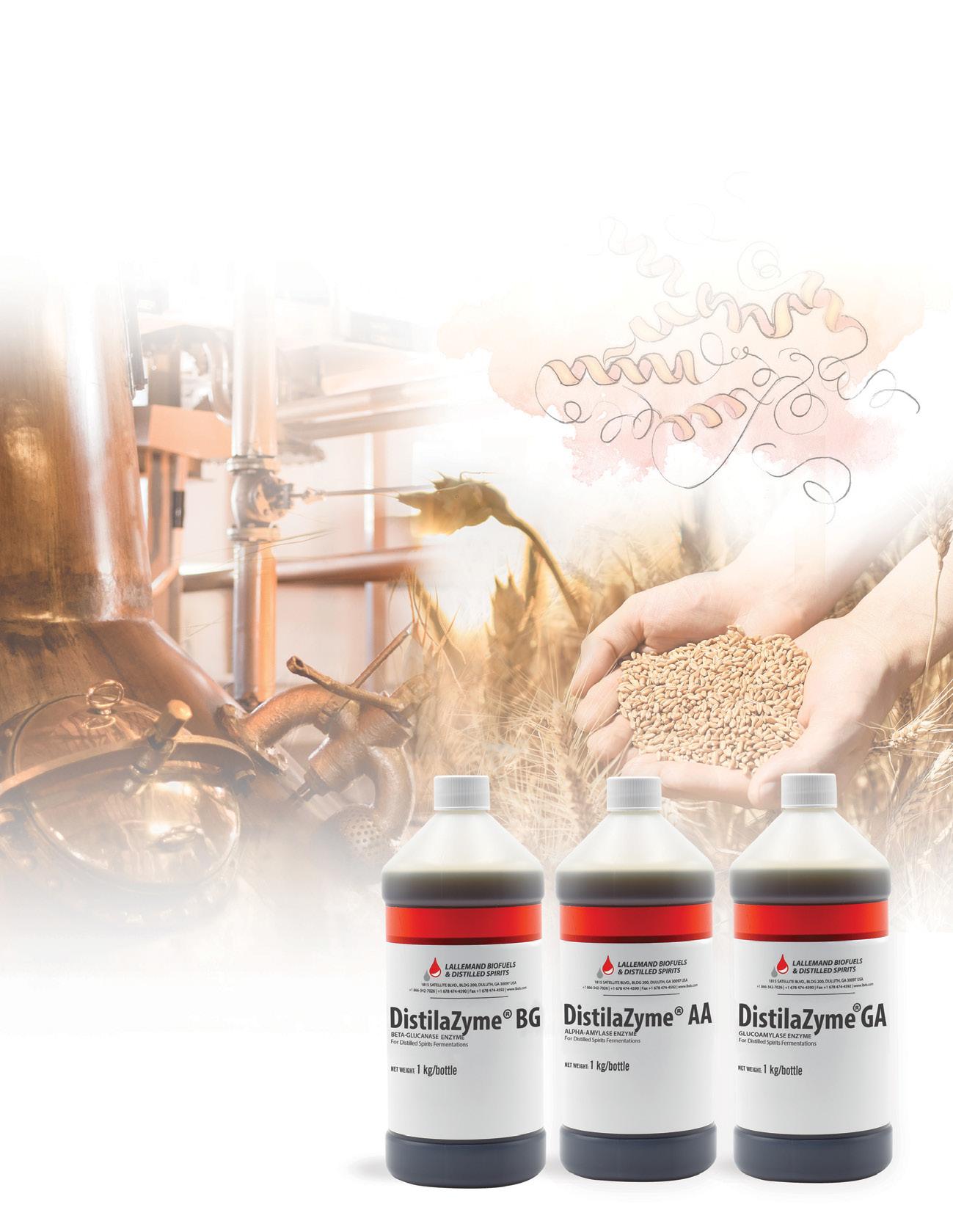

Pro cess aids f or higher ethanol yield and f erme nt ation consis ten c y.
isti
©20 23 L alle mand Bi of uel s & D is ti lled Spi r its Vi e w ou r e x t en s i v e o e r in g of c ra f t distilling inp u ts a t lallemandcraftdistilling.com.
D
la Z y me ®
AMERICAN STATE GUILDS CALIFORNIA
CALIFORNIA ARTISANAL DISTILLERS GUILD
The California Artisanal Distillers Guild (CADG) has been heavily negotiating for direct-to-consumer (DTC) shipping on the heels of AB 920, last year’s bill. The passing of temporary shipping privileges pushed the issue through 2023 giving CA distillers a lifeline. Our small group of distillers have worked tirelessly for two years to get permanent DTC, but funding is running low. The support for small distillers and DTC shipping is strong from state legislators in Sacramento but less supportive of large/out-of-state distillers.
Our negotiations include discussions with wholesalers, organized labor, DISCUS, ACSA and the Wine Institute among others. The appetite for change varies with each of these groups and the gap between what can
be negotiated is wide. California small distillers are caught in the middle of the larger and better-funded and connected organizations (wholesalers and DISCUS). What this means is, the core concept of DTC shipping for small distillers is burdened under the weight of all these negotiations. We need greater membership unity and fund raising. Without it, we could see the ability to win permanent DTC go away.
CADG is also busy working on expanding last year’s bill AB 1734 which currently authorizes the holders of a beer manufacturer's license and a winegrower's license at a single premises to combine retail sales and consumption authorized under those licenses in the same designated area (tasting room). Adding in distillers would assist approximately 60 California licensees. By focusing on this, it expands the volume of work needed at the capitol.
Both of these issues show the need for all California DSP’s to join CADG. Since 2012 CADG has worked on behalf of all California DSP licensee’s. Our only expense is our legislative advocate. Regional groups support the local efforts of distillers, but the statewide organization operates to handle state regulation and legislation. Many California licensee’s are not currently members of the CADG, and we need their support. The Type 74 license is the overwhelming license type and we need more distilleries to get involved to make our voices heard. Without more members, work on legislation will slow or stop and any legislative changes will be driven by parties that don’t have craft distillers' best interests in mind. California is a very large state, and typically a leader in many issues. We are all frustrated by the current laws. Joining CADG and ACSA is necessary to give a strong voice on state and federal legislative priorities.
Cris Steller Executive Director, California Artisanal Distillers Guild
COLORADO COLORADO DISTILLERS GUILD
The Colorado Distillers Guild has received a second grant from the Colorado Tourism Office, which gives us 75 hours of a marketing professional's time and $10,000 towards content creation. We will be using these resources
to support the Colorado Spirits Trail app and are officially launching that this spring.
This fall, Bobby Martin from Mystic Mountain Distillery was elected to be our vice president. Stephen Gould, from Golden Moon Distillery, was also re-elected to continue to be our government affairs
board member. Congratulations to them both! Gould has secured a position on the Colorado Liquor Advisory Group, which will attempt to rework Colorado’s liquor laws, and our legislative session is now underway.
We're looking forward to the many great things that 2023 is sure to bring. Cheers!
Meagan Miller Talnua Distillery President, Colorado Distillers Guild
ILLINOIS ILLINOIS CRAFT DISTILLERS ASSOCIATION
The Illinois Craft Distillers Association (ICDA) is starting off 2023 with a strong showcase of Illinois-made craft spirits. Our
guild worked closely with the governor’s office and distillery members to feature exclusively Illinois craft spirits at the governor’s inaugural ball on January 9. The event was attended by 2,000 people, including many elected officials, with drinks provided by Illinois craft distilleries, and entertainment
provided by Bruno Mars.
The guild also voted in its last meeting of 2022 to update its membership structure to allow for a broader group of manufacturers. Beginning in 2023, the ICDA will introduce a tiered membership system, opening doors to new members and linking dues to production
18 WWW. ARTISANSPIRITMAG .COM

levels. This was done to increase the resources of the organization to help drive positive change for all members.
The ICDA looks forward to a strong and eventful 2023, highlighted by the return of our annual fundraising event, Distillinois, in
June, and a visit with the Kentucky Distillers Association in April that is open to all ICDA members.
Ari Klafter President, Illinois Craft Distillers Association Head Distiller, Thornton Distilling Company
MARYLAND MARYLAND DISTILLERS GUILD
As we close the door on 2022 we are excited to see our distilling industry continue to grow within Maryland. We started the year with 48 distillery members and 14 affiliate members, and ended the year with 61 distillery members and 16 affiliate members. The guild also launched a new platform that allows a more streamlined way for our community of distillers to share information, network, plan events and pay membership dues. As we head into
2023 we are laser focused in Q1 with tackling some legislation that is due to sunset in June of this year. These changes would be detrimental to Maryland distilleries if they go through with the sunset rather than making them permanent. These changes would impose bottle limits on our sales, putting an end to self-distribution and DTC sales within the state of Maryland. The guild is unified and will be working closely with our elected officials to make sure our voices are heard this legislative session. Wish us luck!
Lastly, our “Spirits of Collaboration,”
project that is designed to help fund the guild continues to move forward after two successful product launches in 2022; a tamarind honey flavored rum between Lyon Rum and Puerto Rico Distillery. We also had a gin that was infused with 23 different botanicals and is inspired by Maryland’s native flavors.
Thanks to all the distilleries that participated. In 2023 we look forward to a bourbon from Tobacco Barn Distillery that was finished in a Sagamore double oak wave stave barrel and several others, stay tuned.
Brian Treacy
NEW YORK NEW YORK STATE DISTILLERS GUILD
The New York State Distillers Guild continued to thrive in 2022 with over 100 active members. In 2023, we will continue pushing forward on the legislative initiatives that are set annually by our membership. Our focus remains on two key issues; direct-to-consumer shipping and an alcoholic beverage production credit, a parity issue. As our industry matures, our goal is for parity or equality for
all New York State alcohol manufacturers. While each industry has unique needs, we all deserve the same tax treatment and market access to reach our consumers. Over 2021 and 2022, we are proud to have led a working group with other New York beverage manufacturer organizations — representing breweries, wineries, and cideries — to discuss issues and find ways to support one another’s needs.
When this goes to press, we’ll have had our annual meeting in Albany on January 30 and
31. We are expecting robust attendance for our general meetings including dialogue with our regulator and economic development officials, a roundtable on business growth, and our largest-ever trade show. We are also taking advantage of being in the Empire State capital and are helping our members meet with legislators and holding a first-ever NYS Distillers Guild Albany Reception. We expect this to be a well-attended event and the start of a promising 2023 legislative session.
Brian Facquet Founder, President, Head Distiller, Do Good Spirits President, New York State Distillers Guild
NORTH CAROLINA DISTILLERS ASSOCIATION OF NORTH CAROLINA
The Distillers Association of North Carolina is finalizing our legislative agenda for the 2023 Session of the North Carolina
General Assembly. Our priorities include reducing taxes on spirits, curtailing regulation of our industry, and continuing our quest for regulatory parity with breweries and wineries. The North Carolina General Assembly will be meeting through July, and DANC will be working with our lobbyist to promote our
legislative agenda.
DANC’s Annual Business meeting will happen in March at Cultivated Cocktails in Asheville. During this meeting, DANC will hold elections for our Board of Directors and discuss legislative priorities.
Leah Howard President, Distillers Association of North Carolina CEO, Cultivated Cocktails
Co-Founder & President, Sagamore Spirit
20 WWW. ARTISANSPIRITMAG .COM

OHIO OHIO DISTILLERS GUILD
The Ohio Distillers Guild (ODG) had a banner year in 2022 and has bigger plans for 2023. The guild was incorporated in 2012 by Ryan Lang of Middle West Spirits, Greg Lehman of Watershed Distillery, and Tom Herbruck of Tom's Foolery Distillery with the hopes that the guild would provide a legislative voice for Ohio's craft distillers as well as a forum where industry professionals could locate business resources and information.
In 2022 the ODG held two bourbon festivals where they featured members’ products and released limited runs of Guild Collaboration bottles. One event was held in Cincinnati and one in Columbus. More than 600 people attended each event. The plan in
2023 is to continue these highly successful events while also adding some locations to the rotation that may include Cleveland and Toledo. Proceeds of the Guild Collaboration bottles go back to the guild to further the legislative and promotional efforts of Ohio distilleries.
In 2012 there were only a small handful of distilleries in Ohio. Now there are 85, and that number is expected to grow in 2023. Thanks to a great partnership with OHLQ and Jobs Ohio, Ohio-based craft distilleries have experienced tremendous growth. Ohioans really get behind their local spirits producers and as a result many distilleries have a rampant local fanbase. Ohio distilleries employ over 700 people within the state and provide an estimated $50 million to the local economy.
Local distilleries are producing vodka, bourbon, rum, flavored whiskies and several other expressions.
One of the guild’s initiatives in 2023 is to create a state-wide Ohio Distillery Trail. This project will look similar to the ever-popular Kentucky Bourbon Trail and will incentivize people to visit, tour, and experience more of the distilleries Ohio has to offer. They’re hoping to have this launched sometime in Summer of 2023.
For more information about the Ohio Distillers Guild and to follow along with progress on the Ohio Distillery Trail, visit: www.ohiodistillersguild.org and check out their Facebook and Instagram pages by searching for “Ohio Craft Spirits.”
Andrew Lix
President, Ohio Distillers Guild
Cleveland Whiskey
Seth Warren
Vice President, Ohio Distillers Guild
Buckeye Vodka
Fred Wisen
Treasurer, Ohio Distillers Guild Lake Erie Distillery
Joe Bidinger Secretary, Ohio Distillers Guild Echo Spirits Distilling Co.
OKLAHOMA OKLAHOMA DISTILLERS GUILD
The Oklahoma Distillers’ Guild had its first official meeting Friday, January 20. It was our duty to vote for directors and officers as well as to approve various other business related to forming a nonprofit.
Our officers are Jeffrey Cole of WanderFolk Spirits (president), Hunter Gambill of OK Distilling (vice president), David Wood of Woodworks Distilling (secretary), Sean
Flynn of Rock Creek Distilling (treasurer), and Russell Thorpe of Caste Spirits (past president). Directors include all officers as well as Blue McDaniel of Hochatown Distilling who will also be serving as legislative liaison.
This quarter our primary focus is to create an official relationship with the Made in Oklahoma Coalition, a subdivision of the Oklahoma Department of Agriculture, Food, and Forestry. Our secondary focus is to create an official relationship with the Oklahoma Alcoholic Beverage Law Enforcement
Commission. Our third focus is to create an official relationship with our individual state legislators.
The next meeting is a special meeting set for March 3 during which we will be discussing the relationship with MIO as well as the upcoming Expo.
The next board meeting is scheduled for April 21 at 11 a.m., location TBD. If you wish to reach the OKDG, our email is info@okdistillersguild.com.
Jeffrey Alan Cole Spirits Director/Distiller, WanderFolk Spirits
VERMONT DISTILLED SPIRITS COUNCIL OF VERMONT
The Distilled Spirits Council of Vermont (DSCV) held elections on Sept 29.
DISTILLED SPIRITS COUNCIL OF VERMONT OFFICERS
PRESIDENT
Mimi Buttenheim
Mad River Distillers
VICE PRESIDENT
Chris Kessler
Black Flannel
TREASURER
Craig Stevens
Wild Hart
SECRETARY
Sean O’Rourke
Bhakta Spirits
The DSCV represents 15 member distilleries. Legislative priorities for 2023 include increasing the total number of farmers market permits and paving a way for DTC shipper permits for in-state spirits shipping. DistilledVermont.org.
Mimi Buttenheim President, Mad River Distillers
22 WWW. ARTISANSPIRITMAG .COM

WYOMING WYOMING DISTILLERS GUILD

The young and tiny but mighty Wyoming Distillers Guild (WYDG) continues to deepen its presence and impact in the Cowboy State. Membership holds steady at 75 percent and members are exceptionally engaged in the work to grow and stabilize the organization. WYDG continually
works to identify legislative pathways to increased growth for Wyoming’s distillers. In 2022 the WYDG launched two new fundraising events which brought together spirits, cocktails, art, and music to showcase the very best of Wyoming culture. In 2023 the WYDG plans to pursue legislation aimed at creating easier pathways to

market for the very smallest producers and will also be exploring deeper partnerships with the wine producers of Wyoming.
Michelle Forster
1 8
29
V I S I T M O O N S H I N E U N I V E R S I T Y . C O M IS YOUR GUILD OR ASSOCIATION MISSING? Don’t miss out on this opportunity to reach a national audience of distillers and suppliers! Share your latest victories, recruit supporters, request suggestions to solve your latest challenges, and inspire fellow groups. EMAIL BRIAN@ARTISANSPIRITMAG.COM TO GET INVOLVED!
6
1 3 5 0 0 + 9 0 +
24 WWW. ARTISANSPIRITMAG .COM
Wyoming Distillers Guild

PACKAGING EXPERTISE You Can Trust with Your Craft Saxco has served the distiller community for 90 years, combining our expertise and commitment to your success with modern packaging technologies. Leverage our buying power across a global network of suppliers to bring you the surety of supply you depend on at an unbeatable price. saxco.com | 1-877-641-4003 • Stocked Bottles, Cans & Closures • Custom Bottle Development • Can Shrink Sleeves • Warehousing & logistics

Non-GN barley, assuring low levels of Ethyl Carbamate Designed for all-malt whiskeys Sweet & bready, with notes of honey Available in whole kernel and flour Learn more about whiskey malt at BrewingWithBriess.com/Distilling ©2023 Briess Industries, Inc.
WRITTEN BY DAVID SCHUEMANN
BUILDING YOUR BRAND DREAM TEAM
Why choosing the right path with the right partners from the start can pay huge dividends for your brand.
It pays to pay the right people — especially when you’re building a spirits brand. When you go it alone, it can be more expensive in the long run. Seemingly affordable freelancers rack up billable hours. What seems like a simple website build turns into a digital catastrophe without a programming expert. Navigating supply chains for bottles, closures, and label paper alone can be confusing at best, and at worst, leave you without crucial packaging elements.
When you do it right the first time, with a team of experts, you’ll be able to build pre-launch hype with your digital marketing mix, you’ll have a smoother launch overall, and you’re going to be able to thoroughly brief your sales team so they’re more knowledgeable on the brand upon release. Without key players, you will miss out on building that rapport with your customers, and the sales dollars that come with it. Here are some experts and the reasons why hiring them is getting it done right the first time.
BRAND DESIGN PARTNER
A thoughtful and well-executed design invites trial, reinforces quality, and assists with recall. A quality design agency can guide you through the creative process to provide you with strategic packaging that is beautiful, and more importantly sells. They will have all the qualities listed below.

▶ STRATEGIC A brand design partner should not only provide you with a packaging solution that you love, they will also be able to help with brand story, strategy, and positioning.
▶ STRAIGHTFORWARD They’ll ask the right questions up front, maximizing your time and budget to deliver a design you love off the bat.
▶ PRACTICAL They will work within your cost of goods to create a design solution that is practical and within your budget.
▶ CREATIVE They’ll create a design that you’re thrilled with, and more importantly, captures your target consumer again and again.
▶ ATTENTIVE They will never deliver final art and say goodbye, they’ll provide print-ready production files and remain available to your vendors, so your vision gets executed.
LABEL PRINTER
You will want a trusted vendor to print your labels — a trusted printer will provide timely quotes, samples when necessary, and will provide recommendations for paper and treatments that stay within your budget and adhere to your timeline.
▶ DEMONSTRATIVE Ask for samples! An expert label printer will want to share their work with you. This will demonstrate their high-quality printing equipment — look for number of ink stations, number of presses, foil options, level of emboss/deboss detail.
▶ RESOURCEFUL They will be able to offer a variety of substrate options — if they have trouble sourcing due to supply chain, they’ll be able to suggest similar alternatives that fall within your budget.
▶ DETAIL ORIENTED Label printing experts think critically and strategically; they want to make sure your final label looks perfect.
▶ PRESS CHECKS Your print vendor should include you in any/ all press checking. They’ll want you to be involved in the print process and they will make sure you approve all colors and treatments before the final print run.
GLASS VENDOR
A good glass vendor will keep you up to date with lead times and available glass. They’ll have options for you if your top bottle choice is unavailable, and they’ll work to find a solution within the weight/ price point you’re looking for.
▶ These days, many spirits companies use CUSTOM GLASS to control their own supply chain. You can access your glass and fine tune your design to perfection at a comparable cost, rather than settle for a bottle you don’t love for the sake of what’s available.
BRAND BUZZ
WWW. ARTISANSPIRITMAG .COM 27
CARTON PRINTER
Your vendor should let you know your options based on the shipper format you’re looking for that stay within your budget and quantity needed. Experts will guide you through:
▶ YOUR OPTIONS The right shipper vendor may allow for a printed shipper where it previously seemed not possible due to lower quantities if they offer digital printing.
▶ PRINT METHOD Your design and quantities will determine whether your carton will print flexo/litho/digital. Your carton printer will be able to walk you through these and work within your quantities.
▶ SUBSTRATE Your print vendor can help recommend the right material for your carton depending on its purpose.
WEBSITE DESIGNER/PROGRAMMER

Today, your digital footprint can make or break you. It’s crucial to have a website that’s easy to use and on brand — so your image remains authentic from a phone screen to store shelves. Your website designer and programmer need to be well-versed in the below.
▶ STRATEGIC PLANNING The first step your web designer should take is to get to know your brand and your needs, to create a wellthought-out plan prior to starting design. The plan will incorporate social platforms, SEO strategies, CMS systems, DTC pathways, compliance, and ADA Compliance.
▶ WEBSITE DESIGN Are they aware of new technologies or ways to display your content that make sense for you? This is key to making sure you put your best virtual foot forward.
▶ DTC SELLING Your website should optimize direct-to-consumer selling. Your website designer and programmer should work in tandem to make sure the purchase pathway is clear and easy for a consumer to navigate.
▶ COMPLIANCE In the US, selling alcohol across state lines can be tricky. Your website needs to be compliant and lawful across the country, and your programming team should be knowledgeable about what’s possible based on your location and current laws.
▶ SEO Seeing is believing — if your target audience can’t see you when they google you, you can lose out on sales. Having a website expert that also can optimize your SEO is crucial to ensure you maximize visibility and ultimately sell more product.
MARKETING AND PR
If your website is at the center of your brand’s digital solar system, social media, digital marketing, and PR orbit closely.

▶ SOCIAL MEDIA A social media manager or a digital agency can assist you in determining which platforms your brand should be on, setting the brand voice on these platforms, and gathering brand visuals. This can build hype before your product even exists.
▶ DIGITAL ADS A digital marketing expert will help you leverage online ads to reach more people and drive more web and social media traffic.
▶ PR Getting the word out can be difficult — a public relations person or agency can amplify your brand and help your product reach your target audience. They’ll be able to bring your brand news to the forefront using press releases and other media outlets.
THE REAL COST OF WAITING spoiler YOU’RE NOT SAVING MONEY
You’ve heard the saying — measure twice, cut once. While it may seem cheaper to hire a ‘better’ design firm later, wait on a custom bottle, or go with a higher-performance label printer once you’re off the ground, what does waiting really cost? It’s almost incalculable— missed opportunities in the marketplace and a less-than-optimal first impression with retail and distributor partners equals a lot of opportunity missed. When you wait to do it the right way, you will have to re-acquaint your target audience with your new look, re-introduce yourself to sales reps, and ultimately you will have spent more money than if you’d cut once. Save yourself the money and heartache and build a branding dream team that can help bring your brand to life the right way, the first time.
David Schuemann is the owner and creative director of CF Napa Brand Design. For more information, visit www.cfnapa.com or call (707) 265-1891.
Specializing in Award-Winning Yeast Brewers & Distillers Strains Enzymes fermsolutions.com / 202-978-3376 / rjones@ferm-solutions.com FermLife Nutrient Analytical Lab Services Reduces Fermentation Time & Increases ABV Specialty yeast for Hard Seltzers & High Temps 28 WWW. ARTISANSPIRITMAG .COM


The Clear Choice for Your Grain Neutral Spirit Needs clearsourceus.com Medina, New York sales@clearsourceus.com 585.798.6695 Request A Sample Produced using corn sourced primairly throughout New York State, using a natural fermentation process. Distilled seven times through nearly 600 feet of distillation, our GNS will never impede your spirits taste profile. Less than 1 part per million of all impurities combined with no detectable organoleptic characteristics.
The SECOND EDITION of


the peer-reviewed Journal of Distilling Science has arrived.



SIGN UP TODAY for access to the digital and print versions of the publication visit journaldistilling.com


Peer-reviewed, original scientific papers
• Reporting significant research
• Technical reports


• Applicable analytical techniques and methods
• Reviews

Scientific and technical disciplines applied to the distilling of high-quality, potable alcoholic beverages

• Biology/microbiology




• Chemistry/ biochemistry


• Molecular biology
• Physics and engineering
International board members, contributors, and audience
• Universities and colleges
• Research institutes and industrial laboratories

SPECIAL THANKS TO THE SPONSORS MAKING THIS POSSIBLE
• Distilleries
• Raw materials producers
• Allied industries supporting the testing and quality control functions of distilling operations



I HEART SAFETY
THE PROCESS SAFETY MANAGEMENT SERIES
Ahuge milestone in distillery safety was reached last year, with the issuance of the very first issue of the Process Safety Management Series from the newly named DISCUS Safety and Risk Management Committee (previously the Fire Protection Committee).
Fire safety in distilleries has been a well understood area of risk management, thanks largely to the intense, collaborative work done by what was the DISCUS Fire Protection Committee. Recognizing that codes in this area are difficult for even experienced engineers to fully grasp, the committee worked over several decades to bring together experts from all sides of the industry, including operations, insurance, equipment manufacturers,
process safety engineers, and code experts, to explain how the codes may be best applied in our industry in a manner reflective of our best practices and knowledge.

The benefits of this approach are many. Rather than starting from a blank page every time something is built or upgraded, we may consult the Recommended Fire Protection Practices for Distilled Spirits Beverage Facilities manual to see how codes and standards have previously been applied and know that if we follow that guidance then we have the whole industry behind us. It fosters fairness and consistency in the implementation of standards. And most importantly, it helps keep our colleagues and consumers safe.
As helpful as the fire manual is, craft distillers will likely also be familiar with its limits. The manual was only available for a fee or free to DISCUS Members. The guidance was written largely from the perspective of existing large-scale producers for the audience of knowledgeable engineers, with underlying assumptions around size and scale that are often not applicable to small distillers or are unwieldy and confusing to implement at our scale. Most importantly, it addressed only the portion of process safety risks associated
specifically with fire safety.
Thankfully, there has been a sea change in distillery safety. The Safety and Risk Management Committee broadened their scope to include all areas of safety and risk management in distilleries (hence the new name) and has created a new Process Safety Working Group to tackle this effort. The committee has also launched a Small-Scale Production Working Group, to ensure that education and guidance will be helpful and appropriate for these types of distilleries.
The very first issue in the Process Safety Management Series, released in July 2022, is reflective of this new approach. It’s a BIG DEAL. HUGE. Other words that are synonyms for “very important, life saving, industry protecting.”
This first issue in the series addresses Pressure and Vacuum Relief in Pot Still Distillation. Approaching this correctly is an opportunity to mitigate one of the most significant process safety risks common to most distilleries. It is our hope and intent that this document will help every distiller
Written by NICOLE AUSTIN and KIM BUCEK
All stills should have independent pressure relief.
The primary function of Safety Relief Valves is the protection of life, property, and environment. A Safety Relief Valve is a (safety) device designed to protect a vessel or system against over-pressure should all other safety systems fail.
‘Pressure relief valves should not serve any other process related function — their only function is safety.
WWW. ARTISANSPIRITMAG .COM 31
understand how to apply pressure and vacuum relief in their operations.


The document is written in plain language, without assuming that readers are already familiar with process safety or engineering terms. It clearly outlines your responsibilities as the owner/operator and provides a worksheet to jump start your review. Its guidance is applicable to any commercial scale operation. And it is available for FREE.
If this guidance is successfully implemented industrywide, we personally believe that lives could be saved. This article is a call to


action: Read this document, implement its suggestions in your own distilleries, and share your findings with your colleagues. While we don’t want to spoil the thrill of reading the entire guidance, the most important takeaway is that all commercial pot stills require some form of independent pressure relief. And no, the distillate outlet does not count. If you have pressure and vacuum relief on your still, big kudos! If you’re not sure the last time you inspected or maintained it or what its setpoint is, then this document is for you, too!
It is a common misunderstanding among distillers that because stills are typically operated at or near atmospheric pressure, that the ASME Boiler and Pressure Vessel Code is not applicable to still operations. While it is true that not every portion of this Code is applicable to stills, the hazard presented by over pressure conditions in stills is such that pressure relief is absolutely required to protect both people and property, and the ASME Code is the best source for design and application guidance.
In all seriousness, I am so grateful that the industry is coming together to take on this work. We all benefit from working collaboratively to make our industry safer for all. Stay safe, everyone.
If you are interested in the work of the Safety and Risk Management Committee, have questions about the Pressure and Vacuum Relief in Pot Still Distillation guidance document, or even suggestions for topics to cover, please reach out to safety@distilledspirits.org.
Nicole Austin is the General Manager and Distiller of Cascade Hollow Distilling Co. In March 2020, Nicole was named as Artisan Spirit Magazine’s first ever “Distiller of the Year,” before earning the “Distillery Manager'' award from Icons of Whisky Awards in 2021. She’s been a fierce advocate for the distilling industry as a founding board member of the American Craft Spirits Association and co-chair of Legislative, Convention and State Guild Committees.
Kimberly Bucek is a Certified Safety Professional (CSP) with over 30 years of health and safety experience. She currently is Diageo’s Global Head of Fire and Process Safety. She is a member of the DISCUS Safety and Risk Management Committee.
32 WWW. ARTISANSPIRITMAG .COM
It is important to ensure that the pressure safety valve is capable of operating at all times and under all circumstances, independent of operator actions, power failures, and other situations. A safety valve is not a process valve or pressure regulator and should not be misused as such.
CONTRACT DISTILLING NEW FILLS CUSTOM MASHBILLS BARREL STORAGE CRAFTING YOUR VISION www.corsairdistillery.com/bulk 615-351-9442
Written by READE A. HUDDLESTON, MSC.

L A M B A NOG
Coconut
is a relatively common addition to many alcoholic drinks. The immense popularity of cocktails like the piña colada has ensured that almost every bar worth its salt has a can of coconut cream behind the bar, and the recent coconut water fad has helped propel coconut into more health-conscious circles. However few consumers realize just how coconutty alcohol can be. This is not a problem for Filipinos though, who, for hundreds of years, have been producing and consuming the unique coconut beverage known as lambanog. So, what is lambanog, and how did it come to be? In order to understand what lambanog is, we first need to learn a little about its history. The Philippines has a long history of alcohol production and consumption. When the Spanish first began to colonize the country in the middle 16th century, it was noted that drinking alcoholic beverages was one of the most popular pastimes of the native islanders and that alcohol was often used in rituals and religious ceremonies.1 Originally, most of the beverages consumed by native people were spontaneously fermented and low in alcohol. However, that began to change once the Spanish introduced the art of distillation to the islands. The native Filipinos were quick to adopt distillation and distilled spirits of all manner began to be produced and consumed throughout the island country.
Distillation was especially quickly adopted by coconut farmers in the coconut-rich regions of Quezon, Laguna, and Batangas.1,2 Farmers had long known how to harvest and ferment sap from coconut trees, but the products had always been unstable and difficult to transport. With the introduction of distillation, Filipino coconut farmers were given a way to preserve products long enough to transport them to market. Distilled coconut sap, lambanog, or vina ee coco as the Spanish called it, quickly became a major industry with many established producers and products being exported all over the world. Indeed, there is some evidence that Filipino migrants introduced and popularized the art of distilling in Mexico — giving rise to the modern-day mezcal and tequila industries.3
Unfortunately, the early success of lambanog was not to last. The Spanish were strict rulers of their overseas colonies and were loath to share success with anyone. Under the guise of protecting native peoples from drunkenness, the Spanish imposed new rules on alcohol production and introduced a system of state-controlled monopolies. The majority of lambanog production was driven underground, though it was still regularly produced and consumed illegally, especially in rural areas.1,4
When the United States took over the control of the Philippines in 1898, little initially changed for the lambanog industry. Eventually, in the early 1900s, the Food and Drug Board of the Philippines commissioned a study of alcohol production in the Philippines. Among other things, this study helped to create standards for the production of lambanog and other local
34 WWW. ARTISANSPIRITMAG .COM
The History and Mystery of this Coconut Spirit

spirits. It also gave lambanog a new name: Filipino palm brandy, which was an attempt to make it more accessible to English speaking consumers. Unfortunately, this new branding did not succeed, and lambanog remained a mostly regional product through to the 21st century.1
Lambanog production can be very labor intensive, though the steps are relatively simple. The first step is to choose the trees that will be harvested. Many producers of lambanog are also commercial farmers of coconuts so they will select a set number of trees from their farm that they feel have the highest capacity to produce. Although, there are a number of different types of palm trees cultivated in the Philippines, most producers of lambanog use a variety called the Laguna Tall.5
Once the trees have been selected specialized workers known as mananaggot, or tappers, will climb the trees and cut the heads off immature coconut flowers, also known as spadix, and bind them together before attaching a collection bucket. This allows sap from the tree to flow in much the same way that sap flows from tapped maple trees. An average tree will produce as much as 1.5 liters a day of sap, with the highest production of sap occurring during August and September.5,6 Tapping trees and collecting sap is the most laborious part of producing lambanog because the sap must be collected daily, and the tree monitored constantly. Most lambanog producers lack the manpower to tap more than 50 trees and many cottage producers tap far fewer.5
There are several different grades of sap produced by the palm trees, with the richest measuring as much as 20-23 brix sugar. This high-sugar sap is normally reserved for other products and lambanog is most commonly produced from sap that only contains about seven brix of sugar.5 The sap is also highly unstable microbiologically and will normally begin fermenting as soon as it is collected. Fermentation proceeds for roughly three to five days and is normally carried out in plastic or earthenware jars. The freshly fermented sap has an alcohol content of roughly two to four percent and is called tubâ. Tubâ can be drunk on its own and is often mixed with bark and other additives to extend its shelf life; for lambanog however, nothing is added and the tubâ is sent to be distilled.4
Traditionally, lambanog is distilled by specialized distillers known as tagaluto using a unique type of still called a kawa still, which is also sometimes called a wok still in the U.S. This still was made of two large domed pots and a hollow tree log with a hole where a collection spout was attached. The bottom pot was filled with tubâ to be distilled and then the log was placed on top of it. The second pot was placed on top of the log and filled with cold water. The contraption was then placed over a fire or other accessible heat source and distillation would proceed with the top pot’s water actively being replenished to control temperature and reflux.1,5 (Note: for readers that read my previous article on araga, the Mongolian milk distillate, the kawa still and shuuruun still are effectively the same thing and act in a very similar manner.) Lambanog is often highly distilled with fresh distillate being as high as 80 percent ABV. This means that multiple passes are required using a kawa still and loss can be significant. For this reason, many modern commercial distillers use pot-column hybrid stills that allow them to collect distillate more efficiently and reduce the amount of time spent actively distilling.7
WWW. ARTISANSPIRITMAG .COM 35
Freshly distilled lambanog is ready to be consumed as soon as it exits the still, though many commercial producers will proof it down to between 80 and 90 proof. Raisins or other fruit are also often added to lambanog to add sweetness and flavor. Recently, commercial producers have tried to entice younger generations by adding flavors such as bubblegum and blueberry and dying their products outrageous colors.2 It is also common practice to mix lambanog with spirits made from molasses because it is much cheaper to produce and has less of a distinctive flavor.5
Consuming lambanog is an important part of life for many Filipinos. Often lambanog is the primary beverage consumed during a tagayan session. Tagayan is the practice of convening in a group to socialize and share ideas while drinking from a communal cup. During a tagayan session participants will often sit in a circle and either the host or designated participant will fill and pass a single cup to each participant allowing them to speak a few words or give a toast before passing it on. Tagayans are commonplace in lambanog-producing regions like Quezon and are considered essential at many celebrations and social events.8
Lambanog consumption is not solely social. Lambanog is also consumed medicinally, with some believing that it is able to help with snake bites and malaria. However, there is no scientific evidence to prove this. Finally, lambanog consumption can sometimes be used as a sign of respect for nature. The practice of pouring a small amount of lambanog on the ground before consuming is meant to show that the consumer understands and respects the earth and its bounties.9
As mentioned previously, lambanog production and consumption remain a relatively small, regional industry with few outsiders even knowing of its existence. However, there are some commercial producers that are trying to change that. The small producer Philippine Craft Distillers began distilling lambanog in the Batangas region of the Philippines in 2013. Their brand, Lakan, which is a pre-colonial Filipino word for ruler, has garnered much attention and a number of prestigious awards in spirit competitions around the world.7 Who knows, perhaps lambanog will one day take the place of its cousin tequila, as the fastest-growing spirit category in the world.
Reade A. Huddleston, MSc. in Brewing and Distilling, is a beverage industry consultant based in Tampa, Florida. He is fascinated with all things drinkable and is always searching for strange and forgotten spirits. If you would like to contact him about said spirits, or anything else, please email him at ReadeHuddleston@gmail.com.
REFERENCES
1. Gibbs, H.D., Holmes, W.C., 1912. The Alcohol Industry of the Philippine Islands. Part II. Distilled Liquors; their Consumption and Manufacture. The Philippines Journal of Science. Section A Vol. 8. Pp 19-44
2. Gabriele, Amanda. 2018. Coconut Moonshine is the Best Thing you’re not Drinking. Available from < https:// www.thrillist.com/spirits/brandy/what-is-lambanog> [January 10, 2023]
3. Zizumbo-Villarreal, D., Colunga-GarciaMarin, P., 2007. Early Coconut Distillation and the Origins of Mezcal and Tequila Spirits in West-Central Mexico. Genet Resourc Crop Evol. Vol. 55. Pp 493-510

4. Sanchez, Priscilla. 2008. Philippine Ferment Foods: Principles and Technology. University of the Philippines Press. Pp 151-173
5. Ruffa, Grace Buenavista. 2008. Feasibility Study of Lambanog Manufacture. Notre Dame of Dadiangas University. Pp 1-54
6. The Coconut Company, 2020. The Art of Coconut Tapping: A Chat about Coconut Tappers. Available from < https://www.thecoconutcompany.co/ blogarchive/2020/9/24/the-art-of-coconuttapping-a-chat-about-coconut-tappers> [January 9, 2023]
7. Philippine Craft Distillers. 2020. About Us Available from < http://www.lakan.com.ph/ about> [January 10, 2023]
8. Coconuts Manila, 2016. Raise your Glass to the Art of Tagayan. Available from < https:// coconuts.co/manila/news/raise-your-glass-arttagayan/> [January 9, 2023]
9. Pianar, Robertgie. 2020. Practices and Values of Lambanog Drinking Culture in Alejandro Roces’ We Filipinos Are Mild Drinkers. Research Journal of English Language and Literature. Issue 1, Vol 8. Pp 27-32
36 WWW. ARTISANSPIRITMAG .COM
MUM’S NO LONGER the WORD
MUM’S NO LONGER the WORD
Maneuvering pay disclosure across the country
Written by ROBERT SARKISIAN & COREY DAY
Thisyear is quickly becoming known as the beginning of the pay transparency movement. States across the country have begun adopting laws that require employers to provide specific compensation information in any job posting, either through the employer’s own website or a third-party job board, such as LinkedIn or Indeed. Whether your distillery consists of a tight team all located in your state, or you have employees spread across the nation, this trend requires your attention. To compete for talent, you’ll need to know how pay transparency laws are changing job postings nationally. More importantly, you’ll need to understand these laws exist to ensure compliance and avoid liability.
Colorado was the first state to enact major pay disclosure legislation. On January 1, 2021, Colorado required all employers with at least one employee in Colorado to affirmatively list applicable salary ranges in job postings for all prospective applicants, as well as notify current employees of promotional opportunities. Many states, including California, New York, and Nevada, followed in Colorado’s footsteps in enacting or expanding their own pay disclosure legislation. Employers who are found in violation of these laws may be hit with steep penalties, in some cases up to $10,000. Given the growing list of states joining the pay disclosure movement, inconsistencies and ambiguities in these laws are becoming more prevalent, especially for employers that operate in more than one state. For example, the COVID-19 pandemic opened up the possibility for some employers to hire employees that are fully
remote and may work anywhere in the country. When an employer operating in a pay disclosure state posts a job that may be remote-only and is not limited to in-state applicants, the thinking may be that salary information need not be included given the position is not “located” in the state.
However, some states have taken the position that if there is “any” chance the position can be filled by an employee in the employer’s state that pay information needs to be included. This has already proved to be a headache for companies operating in multiple states. For instance, some states mandate that any company with at least one employee in the state must include salary information if the position can potentially be filled by an employee within that state. Now companies operating in multiple states must analyze whether there is a chance, no matter how slim, that the position may be filled by an individual living in a state with strict pay disclosure laws.
Whether to include salary information in the first place is not the end of the battle. As described above, some states vary on what they consider to be “salary information.” For instance, while thought to be the first mover in the pay disclosure space, Colorado took a more cavalier approach and required that employers not only include base salary in their postings, but to also include any relevant bonus, commission, or benefit information that supplements base pay. This adds another consideration for employers that operate in multiple states when posting a job that may be filled in a pay disclosure state.

WWW. ARTISANSPIRITMAG .COM 37
Further, while these laws are gaining steam, their effects can already be seen in the market. Any job touching on these states now includes specific salary information. While that data was available anonymously through sites like Glassdoor.com for years, these laws are confirming (or sometimes disproving) that information. Accordingly, even when looking for new talent in your distillery in a state without such a disclosure law, expect your

prospective employees to be better acquainted with “industry standards” of pay for their position and come prepared to negotiate. Similarly, don’t be surprised when existing employees pull out pay data from these reporting states when it comes time to negotiate raises.
The original purpose of these pay disclosure laws was to eliminate any inequity among employees working the same position. While that remains to be seen, the immediate effect these laws have had are adding to companies’ ever-growing burden to comply with yet another ambiguous law. Therefore, it is important to discuss with experienced employment counsel before moving forward with any job postings.

DISCLAIMER :
This article is intended to be a source of general information, not an opinion or legal advice on any specific situation and does not create an attorney-client relationship with our readers.

38 WWW. ARTISANSPIRITMAG .COM
Amidst the seemingly endless fields of trees and rocks about 90 minutes north of Green Bay, Wisconsin, Peter Connor began to chase his passion. “We don’t have agriculture here … what we have is a lot of maple trees.” One particular August, back in 2019, during his annual retreat to the Northwoods where he eschews modern comforts, the self-described “gin enthusiast” found inspiration in his surroundings and undertook the task of designing a gin unlike much else on the market. He would distill it from maple sap.
We sat down with Connor, and he shared with us a bit about how he works with this unusual base and why he would use it to create his 100 Mill St. Gin from it.
AARON: How did you get started?
PETER: So back in 2019, a couple of things that kind of came together to set me on this path … one of those things was a retailer knew that I was a gin enthusiast and was bringing me in because they were being just inundated with lots of gins. ‘Peter,

MAPLE SAP GIN
An Interview with Peter Connor
WRITTEN BY AARON KNOLL
we’re wine guys. Come in and tell us what the story is with these.’
I gave them a ‘good, better, best kind of deal, or terrible.’ I was seeing all these new gins and some of them were interesting. Some of them were [...] not all that interesting. But some of them were very, very good and during these times … there was a great gin that started in Wisconsin called Death’s Door.
For a lot of people, they don’t taste [the base spirit]. Like it’s not there. But for some reason, that corn ethanol thing doesn’t work for my palate personally. So that really struck me right away, that what you start with makes all the difference to what you end up with... Those two confluences came together and I was like, OK, I’m going to try to make some gin.
BOTANICALS IN 100 MILL ST. GIN
Juniper, vanilla, anise, lavender, licorice root, cassis, rose petals, coriander, orris root, fresh citrus peels (orange, grapefruit, and lemon), fennel, cardamom, angelica root, cardamom.
AARON: So creating your own base, locally inspired, in a way similar to how Death’s Door was using red winter wheat, was important to you.
PETER: We’re in the maple business. Maple trees are what I know. I know guys that have sugar shacks.1 I know guys that sell the equipment, the modern equipment that they use now … unfortunately it’s not as romantic as it used to be with the buckets and the hoses and all that stuff. It’s kind of an — it is an industry now. Not kind of an industry. It is an industry, and it takes a Herculean amount of effort to get the quantity we need.
Say we need 750 gallons to make 500 cases. So to make 3,000 bottles, we need 750 gallons of maple syrup. Okay, but it takes 40 gallons of maple sap to make one gallon of maple syrup. That’s 30,000 gallons of sap we need to ferment to distill 500, 750 ML cases. That’s a lot of sap. We make life for us a little bit harder than we should. But it is — we think — worth it, and we aren’t willing to really deviate from it. …
So I’m going to use maple sap as the sugar... Now you’re going to think this sugar content is really low, because it is. But it has about a 4-5 percent sugar content, which is considered very, very high for sap.2
1 Sugar Shacks are traditional facilities, often cabins, where sap is boiled, in order to turn it into maple syrup. They are common in regions where maple trees are present and often associated with a craft approach, or older ways of syrup production.
2 Peter notes that sap generally ranges from 2–5 percent overall across different regions.
PHOTOS PROVIDED BY 100 MILL ST. GIN
WWW. ARTISANSPIRITMAG .COM 39
In order for the yeast to really activate, and for you to make a productive amount of alcohol, you’re going to have to be at about 30 percent sugar.
I don’t know if you’ve been to a sugar shack before, but it’s almost impossible to stop halfway right at 30 percent. So you got to go all the way to syrup which is 66 percent. We then rehydrate it and basically dilute it to 30 percent.
Then we pitch the yeast and we get a good conversion. We’re coming out at about 1416 percent alcohol content out of a wash.
AARON: How did you decide what the right yeast was for your ferment?
PETER: Well, the yeast that we used, it’s like a champagne yeast. We have two things going on. We have high gravity, and this in combination with the yeast yields a very high alcohol percentage in our wash or beer, if you want to call it that. Because the alcohol level is so high we need a yeast that won’t fry out at that level, hence the champagne-type yeast. We just know that we needed a very strong, healthy yeast [...] that could tolerate the high sugar content that we have. There’s a lot of yeast activation and it doesn’t get hot. But it’s very, very active and very quick … five to seven days.
Everyone has some advice. When we talk
to other distillers, everyone talks about ‘I’m using this yeast’ or ‘I’m using that yeast’ and you kind of go back and forth on it. We have tried some other yeasts and we just didn’t get [the same yield]. We like to run the still and come off at about 180 [proof] believe it or not.
AARON: Tell me a bit about your still.
PETER: Our still is sort of a combination of a pot and a short column.
So we have a pot with an onion and then that goes through the botanical basket, and then it goes into a very short column that only has four plates in it. But we’re still coming off the still at about … 170, 180, somewhere in between. … So we’re not at vodka level … but we’re not exactly pot still either. We’re kind of hybridizing it between those two. Because we want the pot to transfer a good bit of the maple essence from the beer to the column, then we want enough reflux in the column to hit our ABV target.
AARON: With all of the attention and effort that goes into producing a base spirit from maple sap, why did you choose to produce a gin instead of a vodka?

PETER: I think that’s a great question … so obviously vodka is the number one consumed spirit in North America. It is the
market. When you love gin, you love gin, and I love gin. Erin, our master distiller and Nathaniel, our sales manager, love gin. For us, gin is our joie de vivre.
I don’t have anything against vodka. I don’t think less of vodka drinkers. I just don’t drink it. … I can’t be passionate about something that I don’t care about and I care about gin.
AARON: Tell me a bit about the gin side of things. How did you come up with a botanical bill to compliment your maple sap spirit?
PETER: We do a lot of cooking. [Where we are in Wisconsin] there really aren’t a whole lot of restaurants in a town of 750 [people]. It’s fish fry on Friday nights, brats on Sunday, and frozen pizza every other day.
So, I’m a culinary enthusiast … pulling together herbs and botanicals comes naturally in a way. I knew I didn’t want it super juniper forward. I knew I wanted citrus to carry it and then I knew I wanted to try to get to a vanilla-y kind of finish.
I think we’ve got probably a little more cardamom and a peppermint finish on it, but that’s not because there’s peppermint in there or anything like that. Just the way the botanicals’ essence kind of comes through. Everything goes in the basket. Erin3 has a very specific way of putting it in there. So it’s all infused. There’s no flavoring after distillation.
AARON: What’s next for 100 Mill St. Gin?
PETER: In the beginning it was just me and I was procuring the maple sap syrup and all of the raw materials that went into making the gin. So at that time, we were making just 500 cases.
But when we went from contract to having our own distillery, now we have rent. We have salaries. It’s not just Erin anymore. So we had to increase our production. So I had to go from the little local guys that I know to [bigger suppliers]. …
… We had to go from… where we were
3 Erin Dosh is the master distiller for 100 Mill St. Gin. Her prior experience included “making spirits using alternative sort of bases,” including other sugars such as molasses and honey.
40 WWW. ARTISANSPIRITMAG .COM
(500 cases) – to our goal — and we’re not there yet — to 2,500 cases a year. So that’s 150,000 gallons of maple sap that will have to be procured in order for us to make those 2,500 cases… I need [bigger suppliers] in order to do that for me because I can’t. There’s no way I can get that much sap and syrup together to do it. It’s just not possible. We also have a holiday pack that’s coming up.

One is a barrel-aged gin. The second one is what we call a ‘Toasted Old Tom’ which we’re using maple [as sugar], and we’ve got some maple wood chips that give it that toasted kind of flavor. The last one, which we’re working on, is a work in process, but it’s a Pheasant Back.4
4 Foragers might know it better as Dryad’s saddle (Cerioporus squamosus). It grows widely in the Eastern part of the United States on decaying hardwood trees, such as maples.
We selected the pheasant back mushroom for its fruity, lemony scent [...] we steeped our base spirit in mushrooms that our distiller, Erin, foraged from her farm in Monroe, Wisconsin.

AARON: Your spirits, overall, really seem to embody a sense of place.
PETER: The Northwoods is where we’re from. We’re from northeastern Wisconsin. Maple is what we do. It’s what we have on our timberland. It is part of our ethos. … It’s a very expensive way to make spirit, but we think it’s important and we put all of ourselves into it.
Aaron Knoll is a noted gin historian, critic, and consultant. He authored 2015's “Gin: The Art and Craft of the Artisan Revival,” which has since been translated into three languages, and additionally co-authored 2013's “The Craft of Gin.” He also founded leading gin website TheGinisIn.com in 2009.

If you can dream it, we can find a way to achieve it
www.mcclabel.com | info@mcclabel.com WWW. ARTISANSPIRITMAG .COM 41
The COVID-19 pandemic may not technically be over, but it feels safe to say that society is by and large done dealing with technicalities. It also feels like an appropriate time to check the pulse of craft distilling in what appears to be a post-pandemic world, from the people making the product to the organizations and communities supporting their efforts. In this second of a three-part series, we look at the state of the craft distilling industry from the perspective of peripheral organizations and businesses helping distilleries acclimate to the postpandemic world.
THE STATE OF THE CRAFT DISTILLING INDUSTRY
PART 2: THE PERIPHERAL VIEWPOINT
WRITTEN BY RICH MANNING
When disaster strikes, the government’s Federal Emergency Management Agency deploys what’s called a Community Emergency Response Team (CERT) to lead communities to recovery in a way that makes them stronger, more resilient, and in a better position to thrive. These teams come from a program overseen by the government through FEMA.
While there was no CERT helping the nationwide community that is the craft distilling industry during the pandemic, several peripheral organizations stepped up to function as a CERT through support and advocacy. Trade associations such as ACSA, ADI, DISCUS, and other organizations remain steadfast in their support, using a confluence of advocacy, technology, and passion for liquid craftsmanship to help grow the craft sector in unprecedented ways.
THE POWER OF DATA
Data is a great storyteller. In the craft distilling sector, it’s telling a tale of resiliency. If anything, the numbers produced by ACSA’s annual Craft Spirits Data Project portray the craft sector as a powerhouse capable of growth even during hellish conditions. To wit: ASCA’s 2020 report — the last report to display preCOVID numbers — showed there were 2,046 craft distilleries with a market valuation of
$4.8 billion in sales. Their 2022 report showed this number increased to 2,687 with a market valuation of $7.5 billion. “It’s never been a better time to be a consumer that enjoys craft spirits,” stated Becky Harris, ACSA President and co-founder and chief distiller for Catoctin Creek Distilling Company in Purcellville, Virginia.

“We’ve seen a crazy amount of growth,” added Scott Harris, Becky’s husband and Catoctin Creek’s co-founder/general manager. “It fit right in with all of that anecdotal talk about things turning into the Roaring ‘20s after the pandemic.”
These raw numbers, particularly the metrics concerning market valuation, suggest ties to other trends that continue to flourish in the post-pandemic landscape, such as craft’s further penetration into the economically buoyant ready-to-drink (RTD) market. They also point toward the industry’s ongoing association with super premiumization, which seems to be particularly noteworthy as the
scourge of inflation seems poised to tighten its grip on the average customers’ wallets. “Craft spirits bring affordable luxury to the consumer,” explained DISCUS President Chris Swonger. “It’s gratifying to see these spirits that contain this artisanal essence continue to fulfill the hearts and stomachs of the consumers during a time of economic turbulence.”
CONVERTING NUMBERS INTO ACTION
While these organizations acknowledge the industry isn’t completely out of the woods, the data justifies cautious optimism. The data is also poised to help the craft sector convert hope into action that furthers market
“We’ve seen a crazy amount of growth. It fit right in with all of that anecdotal talk about things turning into the Roaring ‘20s after the pandemic.”
SCOTT HARRIS, co-founder/general manager of Catoctin Creek Distilling Company in Purcellville, Virginia
“It’s never been a better time to be a consumer that enjoys craft spirits.”
BECKY HARRIS, President of American Craft Spirits Association and co-founder and chief distiller of Catoctin Creek Distilling Company in Purcellville, Virginia
WWW. ARTISANSPIRITMAG .COM 43
outreach and boosts sales.
In San Francisco, the software firm AnyRoad applies data analytics to help distilleries dig deeper into the numbers. In 2022, AnyRoad tracked 286,725 distillery tour bookings and 935,249 guests. These numbers represent a base for the company to deploy impact data techniques that extrapolate further information about consumer behaviors during and after the tour through a robust network of data points. “Raw numbers will tell distillers basic information, like 30,000 people took your distillery tour,” explained Daniel Yaffe, AnyRoad co-founder and COO. “Impact metrics will give distilleries a better idea about what they liked about the tour.”
Ideally, these various data points drawn from tours and post-tour behavior can provide craft distilleries a long-term measured impact of a consumer’s tour experience beyond the basic notion of a visit. In the long-term, the data can help craft distilleries build strategies that optimize consumer reach and market penetration. “When you’re not a household name, what you’re trying to do is to land with the right people, and these people may not have heard of them yet,” Yaffe said. “Data can help them identify and understand these people, so they have a better chance of turning them into brand champions.”
THE CONTINUED PUSH TOWARD COMMON SENSE
Despite the craft sector’s growth during the pandemic, there are plenty of roadblocks hindering its full potential. Archaic laws that still treat liquor as if Satan was the ultimate master distiller remain on the books, and post-pandemic legislation threatens to subdue the progress made, like the availability of cocktails-to-go. ACSA, DISCUS, and ADI remain tireless in their effort towards the modernization of the marketplace. According to Harris, the agencies’ work during the pandemic helped government agencies better understand that distilleries are helmed by people that put their heart, soul, and life savings into the community. “At the end of the day, we’re small businesses just like any other small business,” she said.
Still, the associations face an
uphill climb as they continue to advocate for common sense laws. Some of the biggest hurdles involve efforts to progress direct-to-consumer (DTC) sales, and these challenges aren’t exclusively associated with state legislatures refusing to budge. “Some opponents resort to scare tactics,” Harris said. “They’ll try and scare people by saying Bulleit will take over their business, or kids will be able to get booze on their doorstep. We have to spend time and energy demonstrating that these tactics are completely unfounded.”
There are also a few other knots to untangle to bring DTC to fruition. Outdated USPS rules prohibiting alcohol shipment to non-commercial addresses remain an issue, particularly for people operating in areas lacking access to UPS or FedEx. This particular issue underscores the primary benefit that’s always been at the base of the DTC argument. Specifically, it improves
distillery sales and consumer access.
The fight to keep cocktails-togo on the books also remains at the forefront, and these agencies have powerful allies. For instance, DISCUS joined forces with the National Restaurant Association to spearhead efforts to ensure permanency for a concept that was a lifeline for distillery tasting rooms and the on-premise accounts that matter so dearly to the craft spirits sector. Results remain mixed: While 18 states and the District of Columbia made cocktailsto-go permanent, 14 states still have expiration dates on the mandate, and the practice is verboten in the remaining states. Still, Swonger remains confident in DISCUS’ efforts. “Cocktailsto-go are here to stay,” he said. “It’s another example of modernization in the industry, and it’s also another way to demonstrate what craft spirits means to consumers.”
“It’s gratifying to see these spirits that contain this artisanal essence continue to fulfill the hearts and stomachs of the consumers during a time of economic turbulence.”
CHRIS SWONGER, president of DISCUS
“When you’re not a household name, what you’re trying to do is to land with the right people, and these people may not have heard of them yet. Data can help them identify and understand these people, so they have a better chance of turning them into brand champions.”
44 WWW. ARTISANSPIRITMAG .COM
DANIEL YAFFE, co-founder and COO of AnyRoad
THE ROAD AHEAD
There are a few other concerns facing craft distilling beyond legislative battles. Such as improving diversity in the craft sector is still an ongoing process. In addition, the industry retrenched in 2022 after 2021’s growth spurt, but supply chain issues and inflation threaten to cause economic headaches for the foreseeable future. Finally, the consolidation of the middle distribution tier due to acquisition has left some smaller distilleries twisting in the wind. “I’ve received a lot of calls from people telling me their distributors won’t return their calls,” Harris said.
Despite these issues, the future of the craft landscape still looks bright. This is partially due to ideas and innovations meant to boost sector awareness, tourism, and marketing efforts. Last June, DISCUS launched Destination Distilling, an ambitious web-based

repository that gives users easy access to information on distilleries and distillery trails nationwide. Last October, AnyRoad launched Fullview, a unique data gathering program allowing distilleries to capture key information on every person taking a tour within a paid group instead of just the single person making the initial tour purchase.
These organizations and their actions help to move the industry forward, not unlike an emergency response team moving groups forward after a disaster. However, the brightness surrounding craft distilling’s future ultimately emanates from the distillers themselves, since the work they do means so much to so many. “Distilleries have such an incredible commitment to the communities they serve,” Swonger said.
“I consider the people behind the spirits to be great patriots.”
Rich Manning is a freelance food and drink writer based in Fountain Valley, CA. He lives about 15 minutes south of Disneyland, but he hasn’t gone there in ages — he’d rather visit the nearby breweries and distilleries instead. You can check out some of his other written hackery by visiting richmanning.pressfolios.com. He can be reached at richmanning72@gmail.com.
“Distilleries have such an incredible commitment to the communities they serve.”
WWW. ARTISANSPIRITMAG .COM 45
CHRIS SWONGER, president of DISCUS
FIVE & 20 SPIRITS AND BREWING ONE MAN’S TRASH is ANOTHER MAN’S ... SEAFOOD?
Written by Gabe Toth /// Photos provided by Robert Mazza, Inc. / Five & 20 Spirits and Brewing
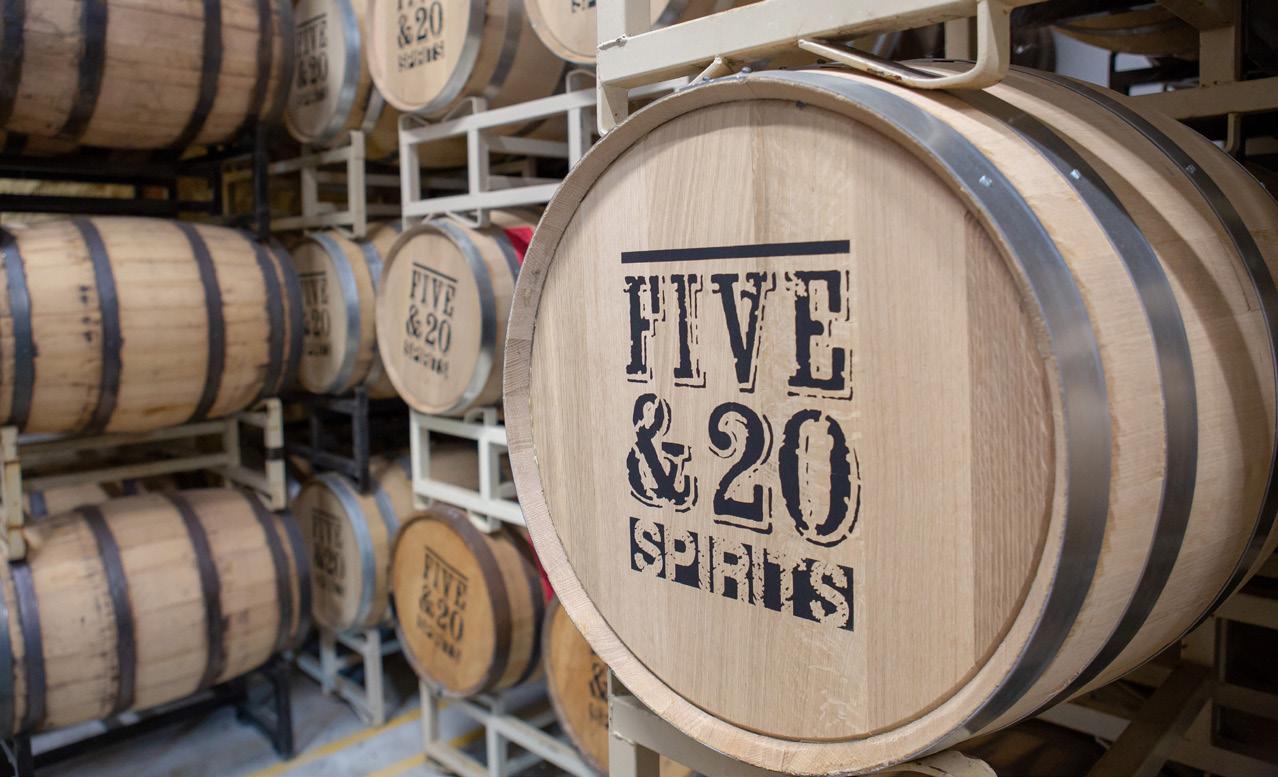
BEYOND the BOTTOM LINE
Tenyears ago, a distillery owner turned a friendly conversation with a tech startup into a partnership that turns fermentation and distillation byproducts into sustainable seafood. Prior to this conversation, the family owners of Five & 20 Spirits and Brewing made wine at Chautauqua Cellars. Then the distillery, and later brewery, came about as an offshoot of the company, which had grown into a whole family of wine brands. Aiming a little higher, they now hope that waste from the brewery and distillery in New York can help to sustainably feed the world.
This ambition grew from a partnership with TimberFish Technology, another local business that aims to turn fermentation and distillation byproducts, combined with wood chips, into sustainable seafood.
Five & 20 patriarch Bob Mazza was at a local board meeting getting a permit from the town of Westfield, New York, when he met TimberFish founder Jere Northrup, who was looking for someone to partner with. Northrup had developed the technology that underpins the TimberFish concept and needed a business that could provide a steady supply of high-nutrient waste product to demonstrate that the concept was commercially sound.
“We found a lot of alignment between us,” Northrup said. “It’s a long-term endeavor, and the last couple of years have thrown a curveball for everyone, but we really remain excited and committed to seeing this jump to the next level.”
By the time Northrup and Mazza had met, Five & 20 had been open for six years and was looking to grow, according to Bob’s son, distillery co-founder Mario Mazza. The elder Mazza had been in the wine business since the early 1970s, and when legislation in New York allowed for craft distilleries to offer samples and retail sales, he reached out to Mario, who was in Europe studying winemaking at the time.
Mazza had decided to come back into the family business after working in chemical engineering, but he didn’t realize how quickly things were moving when his father first brought up the idea of opening a distillery.
“The phone call that he and I had one time
was, ‘Hey, there’s this opportunity in New York, it might be cool. We could build an operation there, do a little distillation’,” he recalled his father saying. “I said, ‘Oh, that sounds interesting.’ I thought it was just a nascent idea. A month later we talked again: ‘I have a still ordered from Germany.’ My father, when he gets an idea in his head, he goes with it.”
They opened New York’s fourth distillery in 2006, joining Finger Lakes Distilling, Tuthilltown Distillery, and Montezuma Winery/Hidden Marsh Distillery. “At that time, neither he nor I realized what the craft spirit industry was going to become,” Mazza said.
Initially, craft spirits was an opportunity to add value and capacity to the winery by producing eaux de vies, grappa, fruit brandies, and fortified wines. But in 2012, Mazza said they doubled down on the spirits side of the

business, buying a 120-acre farm and moving the operation to a new facility there. They’ve since added on several times, including, most recently, a significant expansion and upgrade to the bottling operation.
The farm allowed them to start growing some of their own grain, but with three main physical properties in the overall organization — including the largest winery in Pennsylvania — a focus on local ingredients long predates the distillery and brewery.

“We’ve always been focused on using local agriculture; we have for 50 years with the grapes,” Mazza said. “It was a natural extension for us to do so with the distilled spirits space.”
Five & 20, named for its location between parallel US Route Five and US Route 20 along Lake Erie, operates under farm distillery and farm brewery licenses meaning their products
“We’ve always been focused on using local agriculture; we have for 50 years with the grapes. It was a natural extension for us to do so with the distilled spirits space.”
WWW. ARTISANSPIRITMAG .COM 47
— Mario Mazza
have to contain at least 75 percent New Yorkgrown agricultural inputs (grain and hops), however, they use 100 percent. They work with a few growers, all in Chautauqua County within 15 to 20 minutes of the distillery; including one who manages the onsite growing operation. Mazza said they’ve rehabilitated about 20 acres of the farm, including the area that they developed for the new facility and room to grow corn and rye, but are still looking to reclaim more of that space.
“There’s still a portion of that land that hasn’t been transitioned back into productive agriculture,” he said. “It was essentially overgrown when we acquired it 10 years ago, and eventually we’d love to transition that back.”
Not all of the farmers they’ve approached have experience growing rye, though. A lot of the small-grain competencies that were once handed down have disappeared, he said, as much of that grain production moved to the upper Midwest and Canada, but rye is a grain with deep local roots.
“Going back to revolutionary times, this
was the grain in this region,” he said. “If you look anywhere from western New York down through western Pennsylvania, there’s a lot of rich history there in terms of the birth of rye whiskey, whiskey in the US, the whiskey rebellion.”
As a result, a distillery that started off as an extension of the winery has been much more focused around whiskey. While they still make products like eaux de vies, applejack, and limoncello, the majority of their branded products are rye and bourbon. (Five & 20 also has a segment of the business dedicated

to co-manufacturing/co-packing.)
When they moved the distillery from nearby Mayville to the farm in 2013, they were able to add a brewing aspect to the business. The two grain-centric operations use different types of fermenters, heat exchangers, and other equipment, but they share a four-roller mill and a brewhouse designed so that the grain is mashed into the boil kettle, then either cooked for whiskey and transferred out or, for brewing beer, the mash is transferred to the lauter tun and then run off back to the kettle.
“Going back to revolutionary times, this was the grain in this region. If you look anywhere from western New York down through western Pennsylvania, there’s a lot of rich history there in terms of the birth of rye whiskey, whiskey in the US, the whiskey rebellion.”
48 WWW. ARTISANSPIRITMAG .COM
— Mario Mazza
The different aspects of production operate with separate teams, but they’re not siloed off from one another, allowing the teams to work together and innovate new products, including a variety of different barrel finishes in the distillery. Those include port, sherry, red wine, and barrels that go back and forth between the brewery and distillery, resulting in a dozen unique expressions of whiskies that are on the market or that haven’t been released yet.
This unique ability to integrate flavors from different parts of the company is something that Mazza called “a key focal point of our product portfolio.”
“We have an amazing ability with these flavor palates to play with things,” he said. “If a cask gets emptied and it’s being used for something else, it is emptied and left wet, (and) it is filled the next day. Not washed, not left to dry three months in a barrel monger’s warehouse.”
SEAFOOD FROM STILLAGE
As the distillery and brewery were being built out, the Mazzas started to also work with Northrup, who has been focused on the problems of climate change and environmental pollution for 50 years. His goal with TimberFish was to go beyond the abatement of waste streams to finding ways to use them in an economically viable way. The technology would work with municipal waste, he said, but in 2012 he was looking for a source that wouldn’t have the same type of stigma to use in food production. “Ninety percent of the seafood that’s eaten in the United States comes from overseas, and a lot of that is grown on municipal waste,” he said. Northrup said when he met Bob Mazza, the pieces fell into place. “Here was a dedicated waste stream that could be very beneficial,” he said. He started building a facility in 2016, soon began taking the organic matter and feeding it to microbes to grow biomass, then invertebrates, then started raising fish to feed on the bugs.
TimberFish was able to take all of the stillage from the distillery — even as it scaled up from a 50-gallon still to a 600-gallon still with a brewery attached — to raise channel catfish, yellow perch, largemouth bass, and freshwater shrimp in a 70- by 40-foot tank.

“It really worked well, and we were poised to go at the end of 2019,” Northrup said. Right as things were about to go into full production mode, with the ability to produce more than 20,000 pounds of fish per year, COVID shut down the largely volunteer operation.
The facility is currently mothballed as Northrup tries to take the leap from bootstrapping volunteers to a scaled-up, properly-funded operation. He plans to make a number of capital upgrades to the facility over the next two years to improve operations, upgrade equipment, and incorporate more automation.
The ultimate goal is to transition the current facility into a teaching/R&D facility and find opportunities for more widespread adoption of the technology. Northrup wants to see five-acre
WWW. ARTISANSPIRITMAG .COM 49
(or more) production operations capable of producing one to five million pounds of seafood a year replicated in multiple locations, “a major go-big-or-go-home push.” The pilot facility in New York will hopefully help him secure resources from the government, large corporations, and/or big non-governmental organizations. He said they’ve gotten a good response after talking to a number of local supermarkets and big grocery chains, which showed a lot of interest in a clean, contaminant-free, locally produced, sustainable product. “They’d love to have the seafood. The average unit of seafood in the United States travels 5,400 miles from where it is produced to where it is eaten,” he said. “We could cut that down to 20, 30 (miles).”

“Hopefully the political climate is changing enough that there will be some funding available,” he added. “If you can take what are now waste streams and combine them with forest material, you can make a big


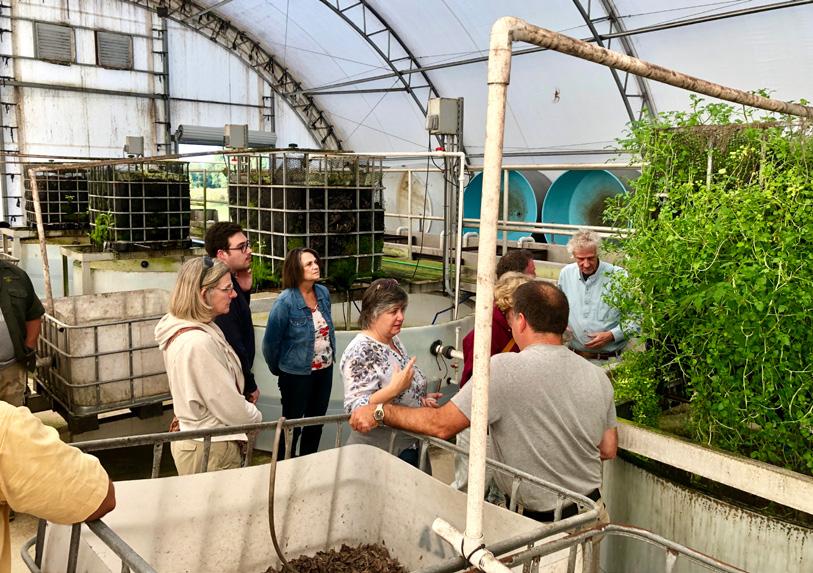
impact. This technology can fit in with facilities anywhere. It’s truly global in its extent, and that’s what it’s going to take to actually do
something significant with climate change, and we’re running out of time.”
www.fiveand20.com or call (716) 793-9463. 50 WWW. ARTISANSPIRITMAG .COM
Five & 20 Spirits and Brewing is located in Westfield, New York. For more information visit
2022 SPIRITS INDUSTRY MERGERS & ACQUISITIONS
Year in Review
Steady and subdued. That may be the best way to describe the pace of 2022’s spirits mergers and acquisitions. There was movement — at least 33 transactions took place during the 2022 calendar year, and four additional deals technically finalized in January 2023. But the combination of high costs and economic uncertainty prevented activity from accelerating more fiercely in a post-pandemic landscape. “The cost of capital may be too much right now,” explained Kevin O’Brien, principal of the merger and acquisition advisory firm Zepponi & Company in Portland, Oregon. “We’re not in a low-interest environment anymore. Plus, the chatter of a looming recession in the second half of the year, which caused some hesitation.”
Despite concerns of economic uncertainty, the spirits industry’s future is still bright. On February 9, the Distilled Spirits Council (DISCUS) released their annual economic briefing, and its data proclaiming market share gains for the 13th consecutive year was an appetizer for a larger feast. U.S. volume experienced a 4.8 percent YOY growth from 2021 to 2022, representing a
volume increase of 13.9 million. U.S supplier revenue also saw a 5.1 percent YOY growth during that time, translating to a revenue increase of $1.8 billion. Most exciting of all, however, was the reveal that spirits took the lead revenue share of the total U.S. alcohol beverage market. It’s the first time this has ever occurred, and it beats the projection of this feat occurring by three years.
Written by RICH MANNING
$36.8 $37.5 $35.8 $37.6 $14.0 $14.3
+1.8% +5.1% +2.5%
Beer Spirits Wine
FIGURE 1
Sales Growth by Beverage Alcohol Category ($ in Billions) 2021 2022
WWW. ARTISANSPIRITMAG .COM 51
Source: Distilled Spirits Council
These numbers underscore the industry’s eye-catching boom, which registered a 7.5 percent average annual growth from 2018 to 2022.
To take advantage of this exponential growth during rocky economic times, larger beverage companies are looking from within instead of reaching out. “The focus has been scalability by expanding their own brands,” O’Brien said. “Rather than acquiring smaller RTD labels, for example, you’re seeing them opt for brand line extensions, where brands are making RTDs on their own.”
Another part of this inner reflection involves recalibrating their existing portfolio when mergers and acquisitions do occur. The most prominent example of this was Heaven Hill nabbing the Samson & Surrey portfolio in February 2022, a move that instantly shifted the Louisville-based company into the premium category. “Heaven Hill didn’t have high-end labels before the acquisition,” O’Brien explained. “Picking up Samson & Surrey instantly filled in the white space in their portfolio by giving them some very nice high-end labels.” O’Brien also noted the transaction’s benefits for Samson & Surrey, pointing out how it helped expand the distribution power of well-respected craft brands like FEW Spirits, Widow Jane, and Bluecoat Gin. It’s a mutually advantageous partnership by design. “When a bigger brand snaps up a smaller brand, they’re not incentivized to screw it up,” O’Brien said.
Other larger companies took a notably nimble approach to acquiring brands. For instance, Diageo sold as many brands as they acquired between January 2022 and January 2023, shedding brands that didn’t quite fit their current core. The brands they did pick up due in part to their extra capital, like Balcones Distilling and Don Papa Rum, further point to the industry’s strong ongoing interest in premiumization.
The acquisition of Don Papa could also be symbolic of potential change in the merger and acquisition sector in the future. Currently, DISCUS data confirms that RTDs, whiskey, and tequila are the fastest growing spirit categories by volume. While there is still interest in these categories in the M&A space, O’Brien notes that a lot of the big companies have already placed their bets in these categories, — another reason why they’re focusing on internal strategies like line extensions. This may make going after premium brands in other categories more alluring. “The high-end whiskies have already been snapped up,” he said. “Does a high-end rum like Don Papa scratch that itch of acquisition?”
2022’s list of mergers and acquisitions also leave a lot of room for discussions on what the industry may look like in the next few years. Gallo’s investing in Komos tequila for their Spirits of
4.8% 5.1% 5.1%
4.9% 6.2%
Value High End Premium Super Premium Total Premium
FIGURE 2
Sales Growth by Pricing Category (2021-2022)
17.2% 10.5% 6.8%
6.9% 35.8%
Source: Distilled Spirits Council
RTD/ Cocktails American Whiskey Irish Whiskey Blended Whiskey Tequila/ Mezcal
FIGURE 3
Five Fastest Growing Categories by Dollar Sales (2021-2022)
52 WWW. ARTISANSPIRITMAG .COM
Source: Distilled Spirits Council
Gallo portfolio is another noteworthy example of the wine industry’s continued penetration into the craft spirits sector. It’s too early to tell if Pronghorn’s 2022 acquisition of Ten to One Rum signifies greater opportunity for diversity within the M&A space, but it is something to potentially monitor as Pronghorn grows in its crucial mission of bringing diversity and inclusion in the industry.

There’s also the nagging discussion regarding economic issues, and they are likely not going away any time soon. While DISCUS data demonstrated continued growth in premiumization, it did grow at a slower rate compared to value brands. This does spark some speculation on what may happen to both consumer behavior and the M&A market if the economy truly bottoms out. “If we do get into a recession, will more consumers go back to lower-priced spirits?” O’Brien asked. “This could impact what’s acquired in the superpremium spirits category, since brands are essentially placing bets for the future.”
Even if the worst-case-scenario of a recession doesn’t take place, the economic downturn the country is currently facing will likely continue to have an impact on what mergers and acquisitions occur in the months to come. They’ll still happen, but they could happen at a slower pace.
At the same time, however, there will be plenty of room for optimism even as the economy continues to stumble. The sputtering landscape gives the industry — and the craft sector in particular — yet another chance to display resiliency in the face of uncertainty. It’s something that the industry has had plenty of practice within the last couple of years due to the pandemic, and the DISCUS data indicates that it thrived. It seems foolhardy to bet against continued market growth through consumer sales and the power of mergers and acquisitions, regardless of what the economy looks like.
Rich Manning is a freelance food and drink writer based in Fountain Valley, CA. He lives about 15 minutes south of Disneyland, but he hasn’t gone there in ages — he’d rather visit the nearby breweries and distilleries instead. You can check out some of his other written hackery by visiting richmanning.pressfolios.com. He can be reached at richmanning72@gmail.com.
WWW. ARTISANSPIRITMAG .COM 53
2023ARTISAN SPIRIT OF THE YEAR Todd Leopold
 WRITTEN BY DEVON TREVATHAN /// PHOTOGRAPHY BY LADD FORD
Editor's Note: Each year after the selection committee of distilling peers chooses the recipient of the Artisan Spirit Distiller of the Year, I selfishly appoint myself the person to call the winner personally to share the news of their selection. Each call is exciting, memorable, and a deep honor each time, but this year what stood out to me the most was the fact that Todd accepted the news with quiet grace, and then proceeded to spend the next 30 minutes talking about other distillers that he respected and admired. That is just the kind of person Todd is.
There’s always a small thrill in hearing successful people admit to their own misfortunes along the way. We know that most paths of entrepreneurship are paved in hardship and folly but also tend to assume that those who made it did so because they took all the right steps. To hear Todd Leopold tell it, that was not the case. Todd is not afraid to openly discuss the mistakes made by him and his brother Scott Leopold, who is also his business partner, as they were building Leopold Bros., their independently owned distillery in Denver, Colorado.
When Todd and Scott founded their first production facility, a brewery in Ann Arbor, Michigan in 1999, they did so in a building that had a massive tasting room replete with rows of German-style picnic tables. The beers they were producing, as well as the tasting room, were heavily influenced by Todd’s time spent abroad, where he had traveled to train at the Doemens School in Munich following graduation from the Siebel Institute of Technology with a diploma in malting and brewing. After Doemens, he stayed on the continent, apprenticing at breweries and distilleries throughout Europe.
There was a hitch to this plan, particularly in the early 2000s: in a large group, there were bound to be those people who didn’t much care for beer. “We kind of became the place to either start your night or end your night, which was an awful business plan as you can imagine.”
That turn of events, however, became the catalyst for Leopold Bros. entrance into distilling, which ultimately saw them relocate to Colorado, where they have since produced a variety of award-winning spirits and revived the three chamber still, an antique still that was known back in the day for both its incredible inefficiency and the high quality whiskeys it could produce.
Todd has brought his apprenticeship experience in Europe and brewing knowledge to bear with their portfolio of whiskeys, gins, amaros, and liqueurs. It’s clear that he’s a man who values education and learning, which he has never stopped doing in his position as cofounder and head of production, and has never fallen victim to delusions of his own greatness, no matter the recognition he or Leopold Bros. receives. This honor will likely not do much to sway him in one way or another, but it is a pleasure to call him our Distiller of the Year.
I want to get a sense of your entire experience in the distilling industry, but of course keeping it condensed.
Oh geez, do I have to lie down on a couch for this?
Yeah of course, dim the lights, find a comfortable position.
So I did Siebel first and then Doemen second, the German brewing school, and then opened up a brewery in Ann Arbor with my brother in ‘99. We focused on unfiltered lagers and hefeweizen in the summer. It was a very large tasting room that could hold a couple hundred people.
When you get more than five people, somebody hates beer or lots of people hate beer. They want cocktails and wine or whatever else they want to drink. The way Michigan licensing worked, we didn’t bring in other people’s spirits. Pulling a distilling license was the only thing to do. I went back overseas and worked on eau de vie distilleries. All of them except for one were farm distilleries so I got to help with the harvest and do everything from pears to cherries, a little bit of everything. And then we came back and we started making gin, vodka, liqueurs. It was kind of one of the first distillery pubs in the country, that’s kind of how we got our start.
And this is all still in Michigan?
This is all still in Michigan. We only sold our spirits on site, we never sold in the state of Michigan.
“We just didn’t give up. It was probably genetically inherited stubbornness that kept us from giving up in the first decade and now we’re very fortunate to be in a good place.”
— TODD LEOPOLD
—Brian Christensen
WWW. ARTISANSPIRITMAG .COM 55
SELECTION GUIDELINES
Base Selection Standards:
› An individual (not a business)
› A distiller (active or retired)
› Having the fundamental skills in distilling, blending, fermentation, aging, etc.
› Recognized as a quality producer
› Distillery size is not a consideration (craft or macro)
› Distillery ownership is not a requirement
Education & Values:
› A steward of knowledge who educates passionately
› Fosters community
› Collaborates
› Not a “jackass” (aka, no history of shouting people down, pretentiousness, bigotry, sexism, etc.)
Innovation:
› Willing to push boundaries while still understanding and learning from tradition
› Not afraid to learn from failure
Advocacy & Leadership:
› A leader in legislative or community issues and regulations (state/federal/ guilds/associations)
› Industry advocacy to customers and others outside the boundary of the distillery
› Celebrity status within the distilling industry is not a selection requirement
In stores or restaurants?
In stores, yeah, because the laws are so…unreasonable, that’s a good word. The markup there was so bad, but to top it off the markup wasn’t going to roads or bridges or kids, I don't think that would have bothered us so much. It goes to the wholesalers. When somebody bought the building in 2007 the idea of trying to make a go of it, to move to somewhere else in Michigan, was just a non-starter.
You’ve since grown, both your production and your malting program.
Now we’re very fortunate to be in a good place. We've added much larger floor malting, so now we make 100% of the malt that we need on site, which we’re very excited that our supporters have allowed us to do, which is just awesome because it allows us creativity. It’s obviously a lot of hard work, but we take a lot of pride in making the malt and putting my brewing degrees to work. Because back then half of the brewing courses both in Germany and up at Siebel were in malting so I’ve had way too much information on malting banging around in my head all this time.
It feels like you’ve done a really good job carving out a space for yourself as an independent, relatively small to medium sized distillery that’s still getting a lot of great recognition and is growing. How do you position yourself in the landscape now?
That would be pretty accurate. We like to say we try to avoid delusions of grandeur. We’re very very happy with the size we’re at now. We’re having to add another dunnage warehouse because we’re looking to age our whiskey for longer and longer and that requires space, and we’ve got another three chamber still on the way. But again, these things are relative, so it’s three times the size of our current three chamber still but understand that that means we only get six barrels a day out of it, to which Rob Sherman, when I was at Vendome, laughed and said ‘look out Jack Daniel’s.’
There has been a smudging of the line between macro and independent with more money coming in.
You got it, it’s very different. For us, it’s still my brother and I. We’re happily still independent and we’re at a very good size where we can pay our staff very very well, we’re proud of the wages that we have for our crew. This will be by far my most creative year where we’re coming out with more and more spirits and putting down more whiskeys that haven’t been made in 50 years and of course it’s going to be years before we taste them. We’re feeling very lucky right about now, I guess, is the long and the short of it.
SELECTION COMMITTEE
Nicole
DIAGEO
DICKLE 2020
Johnny
BENTLY HERITAGE 2022
Year John McKee HEADFRAME SPIRITS 2022 Artisan
the Year Ashby Marshall SPIRIT WORKS DISTILLERY Jason Zeno PORCHJAM DISTILLERY Alex Castle OLD DOMINICK DISTILLERY Sydney Jones FEW SPIRITS Rob Masters THE FAMILY JONES Sailor Guevara AUTHOR, SPIRITS SPECIALIST 56 WWW. ARTISANSPIRITMAG .COM
Austin
– GEORGE
Artisan Spirit of the Year
Jeffery
Artisan Spirit of the
Spirit of
You all have talked about a dedication to the older ways of production and I think that’s very clear in the way you’ve designed the distillery and the changes you’ve made. Where did that interest in past production styles come from?
It came from brewing. Siebel has a library on site where it’s got—what’s now called IBD (Institute of Brewing and Distilling), they had old Brauwelt, which is a German magazine—they had all these old issues that go back a hundred years. You look at the changes that occurred over the last hundred plus years and a lot of the changes that occurred were about money. How do we make this more efficient? Sometimes, but not always—sometimes that efficiency in my opinion kicked the leg out of quality. Quality, or another way of putting it, uniqueness; you know the way that we ferment, we’re not fermenting aseptically here. We’re fermenting with an intentional bacterial fermentation to coax more organic acids in and try and get more esters and pushing after a house note. We’re trying to breathe life into the fermentations that we do here. That’s the last thing you want to do when you’re trying to make a global brand where the whiskey is consistent from barrel to barrel and from year to year.
It’s not that the way of making it consistent is bad. Like Beefeater is a glorious gin, there’s no way of getting around it. But I don’t distill the way that they do. I don’t [pull from] three years worth of botanicals to try and improve consistency. I don’t blend the hell out of everything— that’s why we have batch numbers on everything. I want to enjoy and showcase the differences in the seasons, the botanicals and the grains. In our tours we try and spend a lot of time trying to get people to understand that the grape isn’t the only organism on the planet that’s different every year.
At the same time, I don’t want anybody to pick up a bottle of our gin and say, “My god Todd this tastes nothing like the last batch.” What I’m trying to do is make sure the gins and whiskeys and liqueurs have the same character but are not identical.
How many people do you have working for Leopold Bros. now?
We have one, two…six employees now. It’s all in production, we don’t have anybody in sales or marketing and haven’t for three years now.
Since [COVID] we’re trying to read the tea leaves in the market and it’s really really hard. If we bring somebody on we want that to be for a reason and we can’t figure out what the heck that person would do because the way that people are figuring out about our spirits have changed and the restaurants, particularly in Colorado, haven’t quite pulled it together yet.
Six people, my brother and I, and my mom still comes in a couple days a week to do books.
So it’s still very much a family affair.
Very very much so.
And that can be good but that can be challenging too.
Oh yeah, it took a long time to figure out how to work with my brother. The first few years were rough.
He got his masters from Stanford in environmental engineering and is very much that way of thinking, and I’m much more the creative side of things and don’t know a thing about business. The problem was the first few years he kept insisting this was a partnership and we make decisions together. What he wasn’t accounting for was that I’m an idiot and don’t know anything about business and don’t have the education, you know he had an econ degree from Northwestern too before Stanford. He didn’t understand he was talking to a moron. I had to be the one to figure out, okay, I work for you. Once I figured that out, all of the fighting and arguments stopped, and the business started doing much better. And of course that sucked because he’s an older brother and having to admit that you’re an idiot wasn’t an easy thing to do, but I did and I’m pleased with myself that I was at least smart enough to understand what I don’t know finally.
That’s what made the business do so much better and made us get along. He still bristles when I say that, that I work for him, but that’s what made it work. I’m just a distiller, I’m a technician, I’m not a visionary when it comes to business. I do chart the path for what we’re making and when and all that, of course I run it all through him. When he says ‘no’ it’s always for a good reason. To make a genever or something like that—now granted when he wasn’t paying attention, I did make a genever. It’s now 10 years old but it would have been stupid to make any more than just a little bit for fun.
“We’re feeling very lucky right about now, I guess, is the long and the short of it.”
— TODD LEOPOLD
WWW. ARTISANSPIRITMAG .COM 57
You work closely with your family in your business but it also seems you’re pretty invested in the craft distilling family, being active in the American Craft Spirits Association (ACSA). What inspires you to do that?
Well I’m one of the old guys, it’s kind of my responsibility, right? We are financially stable and in my opinion that comes with an ethical responsibility to help when other smaller places that are either start ups or don’t have their feet under them can’t, so we try to do what we can financially. When they ask for help, we help.
On the educational side of things, I’m just kind of dipping my toe in. In fact nobody else asked, Sydney Jones asked. We kind of have a Letterkenny thing—they have a saying that when a friend asks for help you help them. It’s very Canadian and we certainly follow with that. If somebody asks for help, as long as it’s for something good, we’re all for it. Earlier in our career, there were a lot of people that you could tell weren’t necessarily interested in making something, they were trying to get in with the notion of selling your business. And that’s okay, there’s nothing wrong with that, but I had no interest in people asking me essentially for free consulting services.
In contrast to that are the people who are having technical problems that are actually trying to make something, so in that case I am delighted to help. I would get phone calls or emails over the years all the time: the mash is stuck, it’s not fermenting. Anything that I can do to help. That’s part of the job of being a geezer. That’s the way that I look at it, and happily it’s the way that Scott looks at it too. We’re here if people need us, we’re a resource if people need us. If they need some financial help at ACSA or STEPUP or anything like that, they know we will cut a check. It’s what you’re supposed to do, right? It’s the point of getting older. I know what it was like to have no help, and I know what it was like to have no freaking money. We lived that first hand.
Through your travels and your experience in the business, did you develop any mentors at all?
Not really, the mentors that I had at Siebel were as I was there. They basically give you, I think it was 14 binders, like a six inch binder that was filled. It was a lot, of course it was a lot for me, I was 25. It was my first exposure both to the brewing world but also to the corporate brewing world. It was unbelievably eye opening because they were so helpful and so thoughtful and so kind and did say, “Call me if you need anything or if you have any problems.” I didn’t do that, but I got to understand that there’s a difference between the marketing department and the people that actually make stuff. For me, I walked out of it with a deep, very profound respect for the corporate side of manufacturing, that it’s welcoming and that they do share knowledge and that they did it willingly and some of those binders are filled with handwriting I don’t recognize where somebody was trying to explain to a dumb kid how a lauter tun works.
I think it’s okay to say this: I kind of did it all by myself. I didn’t really reach out to anybody but that was kind of the fun of it, learning these things and putting it together, designing the distillery. What kind of stills do I use, what shape are they, how do we do the floor malting? There’s nobody I could call to design floor malting because it hadn’t been done in 50 plus years, who the hell am I going to call? There are people who operate them but designing and building them is a completely different thing.
You do have a penchant for self deprecation it sounds like—
It’s well earned.
But why do you think the panel gave you this recognition?
Oh god, I have no freaking— that I’m old? That I won’t go away? I will say one thing that was shared with me, that an important part of the award, is that you’re—and I’m quoting here—in so many words, “you’re not a dick.” That is something I took from Germany, and it was the 90s so it might have changed, but it was very much a caste system at the breweries I worked at. It was the master brewer who held all the knowledge, and then everybody else below them were literally beneath them and figuratively beneath them. It was like how chefs were looked at until just before COVID when we started to figure out that that’s shitty. I just looked at that and thought, ‘god, who would want to work there?’ Neither Scott or I have ever raised our voice to anybody [at Leopold Bros.] and would never do that.
We’re all somewhere on that learning curve. I’ve said this a
“We are financially stable and in my opinion that comes with an ethical responsibility to help when other smaller places that are either start ups or don’t have their feet under them can’t, so we try to do what we can financially.”
58 WWW. ARTISANSPIRITMAG .COM
— TODD LEOPOLD
million times but one of my favorite parts of what we do: I cannot go one week without having something completely surprise me and make me realize that I don’t know what the hell I’m talking about, whether that’s the way the malt is behaving with a new crop year. So the crop year last year was high in protein and with all the things that were happening in the steep tank it was generating heat like it never had before in eight years of malting, we’re now on year 10. I’m standing there with my assistant malster, my head malster now, and we’re just baffled. We’re checking everything, recalibrating all the instruments, we’re trying to figure this out. So of course I end up reaching out to Coors and they’re like, “Oh yeah we’re dealing with the same shit here.” We’re realizing Coors has been malting for 100 years, they have the barley experts…to hear them struggling

with unexpected heat, so we’re like okay, a) it’s not just us, and b) we’re all just figuring this out as we go. Applying the education and the experience that we have. Anybody who acts like they’ve got it all figured out, in my opinion they’re idiots. Every person that I have any respect for in brewing, malting, or distilling has the same attitude because they’ve been knocked on their asses so many times.
It’s both frustrating and exciting all at the same time. People may call it self effacing but to me it’s more acknowledging the reality of where I am in my career, that in some ways I’m much further ahead than when I was younger, and in many cases I’m further behind. It’s what keeps me coming to work in the morning and it’s what keeps me excited.
“Anybody who acts like they’ve got it all figured out, in my opinion they’re idiots.”
WWW. ARTISANSPIRITMAG .COM 59
— TODD LEOPOLD
What Does Terroir in Whiskey Mean?
Colorado and Wyoming Are Leading the Charge to Forge the Answer

InFebruary 2021, the results of The Whiskey Terroir Project, the scientific study led by Oregon State University and Ireland’s Waterford Distillery, were published. After several years of scrutiny, it confirmed what was already assumed for years in some distilling circles: Terroir in whiskey existed.
Two years later, the word terroir is increasingly infiltrating the whiskey world. As more distilleries outside the usual suspects of Kentucky and Tennessee crop up and produce brown spirits that highlight their place of origin, the word seems poised to further embed itself in the whiskey distiller’s lexicon. But as the term’s usage proliferates, it is important to answer one simple, yet critical question: What the hell is terroir in whiskey, anyway?
It's an answer being prominently explored by the distilling scenes in Colorado and Wyoming, two states geographically defined by Rocky Mountain ruggedness and flat, high
plains. The unique environmental elements enveloping the areas where grains grow — high elevation, dramatic diurnal temperatures, dry weather patterns — make it logical for the states’ craft distillers to take the lead on this conversation. These elements do play a role in defining the term from a regional perspective. At the same time, producers and distillers in the respective states could potentially broaden the word’s application when it comes to distilling brown spirits.
Building the Term
Terroir is a French term that, when loosely translated, means “a sense of place” traditionally applied to fine wine by oenophiles. This causes reluctance for some producers in the Colorado/Wyoming region to fully embrace the term. “I’m not a fan of the term ‘terroir,’ to be honest,” said David DeFazio, co-founder and owner of Wyoming Whiskey in Kirby, Wyoming. “It’s too pretentious of a word for whiskey.”
All protestations about pretense aside, the term works based on its typical definition. In the wine world, terroir chiefly applies to the conditions surrounding grape growth — the soil, the weather, the temperature, and the elevation. These elements are present in
WRITTEN BY RICH MANNING
whiskey terroir, as they interactto influence grain growth, providing the grain, and ultimately the whiskey, that “sense of place.”
“All whiskey comes from somewhere, just like wine,” explained Al Laws, founder and president of Laws Whiskey House in Denver. “This origin goes right down to the grain. When we talk about terroir, we’re not trying to sell you Colorado. We’re trying to show the effects of Colorado grain on whiskey."
The distillers aren’t alone in this mission. In the eastern Colorado town of Burlington, the grain brokerage firm Whiskey Sisters Supply helps curate this sense of place by growing grain for some of Colorado’s top distilleries. Laws is one of their partners, as are prominent brands like 291 and Breckenridge Distillery. Stephanie and Felicia Ohnmacht — the whiskey sisters behind the company — see the increased use of the term as a way for whiskey fans to connect even more deeply. “As nerdy grain advocates, we love grain,” Stephanie said. “When it comes to terroir, we want to lead and enable
High elevation, dramatic diurnal temperatures, and dry weather patterns make Colorado and Wyoming logical for the states’ craft distillers to take the lead on this conversation.
“When we talk about terroir, we’re not trying to sell you Colorado. We’re trying to show the effects of Colorado grain on whiskey.”
60 WWW. ARTISANSPIRITMAG .COM
— AL LAWS Laws Whiskey House in Denver, Colorado
conversations about grain and how to identify grain flavor, and we want to help enable distilleries to engage in the same discussions.”
These conversations include details on eastern Colorado’s unique geographic landscape: the coarse soils, the pH levels in the water, the minimal rainfall, the dramatic summertime diurnal temperature swings. Supporting discussions about quality augment such chatter. “You can’t grow grain with amazing flavor if the soil is awful,” Felicia noted. Ultimately, these discussions create awareness of the whiskey’s hyper-locality, which can be a thrill to the consumer. “People are excited to learn about this influence,” Felicia said. “When we point out the differences that can exist between regions, they really light up.”
Progressing the Term
The “sense of place” these grains add to a whiskey justifies the use of the word terroir. Yet, the whiskey world finds itself in an intriguing spot to expand the term’s definition in a way that makes it unique to their process.
In wine, flavor-influencing tactics like barrel-aging are considered techniques that are typically excluded from the definition of terroir. Distillers in the Rocky Mountain region don’t necessarily see it this way. “To me, terroir is best defined as the atmospheric environment that influences the maturation in the barrel,” DeFazio stated. “Barrel maturation is the key. If you look at a typical bourbon flavor wheel, you’ll notice that flavor note composition breaks down at around 10 percent ingredients, 30 percent yeast, and 60 percent maturation.”
This heavy emphasis on maturation suggests a different way to apply terroir to whiskey. The barrels so critical to building a juice’s flavor profile are also subject to the influence of its surroundings, as weather and temperature conditions can impact scientific processes like barrel expansion, barrel contraction,
and evaporation. This creates its own subset of challenges that differ from region to region — talk to a Texas distiller about whiskey-making, for example, and conversations about dealing with the Texas heat will likely crop up in a matter of minutes.
There are other potential aspects to whiskey terroir to consider. Open-air fermentation can also add a touch of character and influence that could vary from region to region. These elements can coalesce into the broader application of whiskey terroir, although those leading the charge may choose to keep grain and barrel separate due in part to how the final product tastes. “The flavor of our whiskies are a combination of terroir and the provenance of the barrel,” Laws said. “Actually, it’s not so much the terroir, but barrel provenance because of the barrel’s big flavors.”
Protecting the Term
While applying terroir to describe the regional differences in whiskey creates plenty of excitement in Colorado and its adjacent states, there are concerns that the term may devolve into an empty PR buzzword that over-emphasizes the region at the expense of whiskey and grain quality. “One thing I hate is people saying, ‘You’re Colorado whiskey,’” Laws said. “We’re not. The grains we get come from Colorado, yes, but we make whiskey from great substrate. We just happen to be in Colorado.”
Even if the term “Colorado whiskey” does get exploited in the hands of marketers, the region-based conversations that flow from it have the potential to yield enticing dividends. Distillers see potential for the country’s whiskey production to be divided by stylistic

regions like Scotland or, jumping back to wine, appellations like American Viticultural Areas (AVA). It’s a designation that distillers acknowledge won’t be ready for prime time for a while. “It’s going to take some time to build distinct patterns,” DeFazio explained. “You have to remember that the summary of American whiskey making still primarily revolves around Kentucky and Tennessee, and that for the most part, the rest of the country’s only been distilling whiskey for about 15 years. We’re just hitting our stride.”
In the meantime, Colorado and Wyoming’s emphasis on terroir — or, at least the environmental impacts that influence both the grain and the barrel within the whiskey-making process — is helping to spur an exciting conversation that is becoming increasingly relevant. After all, appreciating terroir’s place in the context of brown spirits can only enhance the sense of place that a consumer experience when enjoying a well-crafted dram of whiskey in the company of friends or loved ones.
Rich Manning is a freelance food and drink writer based in Fountain Valley, CA. He lives about 15 minutes south of Disneyland, but he hasn’t gone there in ages — he’d rather visit the nearby breweries and distilleries instead. You can check out some of his other written hackery by visiting richmanning.pressfolios.com. He can be reached at richmanning72@gmail.com.
Distillers see potential for the country’s whiskey production to be divided by stylistic regions like Scotland or, jumping back to wine, appellations like American Viticultural Areas.
“It’s going to take some time to build distinct patterns.”
— DAVID DEFAZIO
WWW. ARTISANSPIRITMAG .COM 61
Wyoming Whiskey in Kirby, Wyoming
IN PORTLAND, OREGON
STRAIGHTAWAY COCKTAILS
A Market Explosion Shapes One Company's Future
Imagine a time-lapse of the beer and wine aisle at your favorite grocery store over the past several years. The sun rises and sets. Shoppers come and go. Shelves are depleted, replenished, and depleted again. At some point, everyone starts wearing masks. And all the while, what started as a tiny little RTD section with a few cases of Mike’s Harder and a handful of wine coolers grows, and grows, and grows, eating into shelf space once occupied by pilsner and pinot noir.
“It’s like a volcanic eruption from the seafloor,” said Cy Cain, co-founder and CEO of Straightaway Cocktails in Portland, Oregon. “This category didn’t exist five years ago, and now an island is getting formed off of Maui.”
If RTDs are a new Hawaiian island, that
makes Straightaway Cocktails one of the first tropical plants to sink its roots into fresh volcanic soil. After starting with ready-to-serve spirit-based cocktails, the brand has expanded to wine-based canned spritzes, liqueurs, amari, and vermouths, all underpinned with a playful, cheeky aesthetic coupled with an unwavering commitment to high-quality ingredients at all costs — even if it means a cosmopolitan of a slightly different color.
RTDs are Straightaway’s Raison D’etre
For many producers, RTDs are an afterthought — a product extension for production distilleries, a way to wring more value from a canning line at a brewery, a shelf play
for wineries. Not so at Straightaway. When it opened in 2018, the company’s inaugural product line consisted of five bottled cocktails encapsulating years of tasting, tinkering, and trials.
“We very much approached this from the drinking side of the bar,” said Casey Richwine, the company’s co-founder and chief production officer. He and Cain were both avid home
 WRITTEN BY MARGARETT WATERBURY PHOTOS PROVIDED BY STRAIGHTAWAY COCKTAILS
“We very much approached this from the drinking side of the bar.”
— Casey Richwine
62 WWW. ARTISANSPIRITMAG .COM
Cy Cain (left) and Casey Richwine (right)

bartenders who loved mixing drinks, but didn’t love being chained to the shaker while their party guests socialized. One weekend for a friend’s birthday on the Oregon Coast, the two brought along a couple of bottles of pre-batched lintik, a lemony gin cocktail from the Philippines they’d read about in the classic cocktail book The Gentleman’s Companion by Charles H. Baker Jr. “It was gone the first night,” said Richwine. “That was kind of the ‘aha’ moment. Why don’t we just do this for everything?”
The hobby grew from there. After a few years of operating a “friends and family” holiday list for bottled cocktails, the duo decided it was time to go pro. The brand started just four

and a half years ago — a blink of the eye for whiskey makers, but practically the medieval era for the modern RTD boom. Cain said only about 30 other companies were making them at the time. Today, there are more than 500, with another 500 in the process of launching.
That means Straightaway was many Portlanders’ first introduction to ready-todrink spirit drinks — and the response, while warm, was also sometimes confused.
“There was equal parts ‘This is the best idea ever,’ and ‘I don’t get it. Should I add whiskey to this old fashioned’?” said Cain. But it didn’t take long for people to catch on. Straightaway offers a unique combination of convenience and cocktail-bar quality, with ingredients like
fresh juices, house-made bitters and liqueurs, and Oregon-made additions like Stumptown coffee, Smith Teamakers tea, and local honey. Drinkers with unpleasant memories of youthful escapades with wine coolers and hard lemonade were pleasantly surprised to find that a Straightaway cocktail tasted like, well, a real cocktail rather than syrupy soda with a vague bite. Today, you can buy Straightaway products across the country, including choice placements like Whole Foods, Total Wine, and Hy-Vee.
Straightaway’s success has put Cain and Richwine in the unusual position of being elder statesmen in the RTD world after just a few years of business. Here’s how this
64 WWW. ARTISANSPIRITMAG .COM
Oregon-grown company (literally — Cain’s from Estacada and Richwine grew up in MiltonFreewater) became a leader in putting a great cocktail in every cooler.

From Ready-To-Pour to Refreshed Liqueurs
Straightaway Cocktails has a few different product types. First, there’s a collection of bottled and canned spirit-based cocktails, ranging from familiar bar standbys to deeper cuts. In addition to the lintik of Straightaway’s origin story, the bottled line includes an Oregon Old Fashioned with house-made filbert bitters; a margarita with a split base of tequila and mezcal and a touch of mango-habanero syrup; the citrus-cranberry The Cosmos, a Negroni featuring house-made amaro and vermouth; a tropical The Swizzle; and a rye whiskey–based Paper Plane, also with house-made amari. Canned spirit-based drinks include vodka sodas made with Smith Teamaker teas, a paloma, and a hugely popular nitro espresso martini made with Stumptown cold brew (manufactured just a couple of blocks away) and meadowfoam honey from the Willamette Valley.
Formulating a bottled cocktail isn’t simply a matter of scaling up the ingredients you’d pour in your shaker. Ingredient ratios often have to be tweaked, and issues around colorfastness and shelf stability are paramount. Straightaway’s The Cosmos, for instance — their riff on the cosmopolitan cocktail — posed particular challenges. Early iterations featuring a cranberry-ginger sherry-based shrub tasted great, but faded in color almost immediately. “In the bottle, it was pink. But you could put it in the sun and practically watch it fade out,” said Richwine.
Consultations with Oregon State University’s Food Innovation Center and other food scientists were fruitless. There was just something about the combination of citrus, cranberry, and alcohol that caused the color to fade. Straightaway tried vegetable colorings and cochineal, but neither of those worked either. Committed to eschewing artificial colorings, Cain and Richwine finally embraced the natural properties of their ingredients and let their Cosmos “go blonde” rather than compromise their vision.
That no-compromises ethos is on full display in Straightaway’s Accompani line of liqueurs, amari, and vermouth, which grew out of the brand’s
WWW. ARTISANSPIRITMAG .COM 65
cocktail R&D. “There are tons of great spirits you can get. You can get any number of great gins here in Portland. But it’s all the modifiers that go into a great cocktail that are difficult,” said Richwine. Early on, Straightaway sourced ingredients where they could, but they quickly decided to bring liqueur and vermouth production in-house. “The awesome part is we could make that liqueur exactly the way we wanted it,” said Richwine.
Straightaway’s Negroni, for instance, contains house-made sweet vermouth as well as a house-made bitter red liqueur rather than the ubiquitous Campari. The swap not only satisfied Cain and Richwine’s creative urges, but also made their product more unique than just a bottled combination of all the standard ingredients in the cocktail bar staple. After having gone through all the work of formulating that liqueur, why not let it stand on its own? In 2021, they launched the Accompani line, which includes that bitter red liqueur (called Crimson Snap) as well as other cocktail-friendly bottlings like Flora Green, an
alpine herbal liqueur that makes a great swap for Chartreuse in a last word cocktail, and Mari Gold, a citrusy aperitivo that makes a killer spritz. The collection not only capitalizes on all their R&D, but also creates more opportunities to sell into on-premise accounts.
Straightaway also produces a wine-based line of canned cocktails inspired by Italy’s famously laid-back drinking culture. The collection came about after New Seasons, a Portland-based grocer, approached Straightaway hoping they could make something like a canned Aperol spritz. Oregon grocery stores can stock beer and wine but not distilled spirits, so the product would have to be made under a winery license and contain no spirit other than grape-based fortifying spirit. Straightaway immediately said yes, then went out and got a winery license to launch the collection, which also includes a Negroni Spritz, a Last Word Spritz, and a floral Fiore Spritz.
All three categories share colorful, fun branding that’s simultaneously retro and
modern. Labels inspired by 1930s-era travel ephemera like luggage tags, postcards, matchbooks, bar napkins, and travel ads transport drinkers even before they’ve opened the bottle. Flat, high-impact designs hide hidden “easter eggs” that point to the product’s origins, ingredients, or history. The Oregon Old Fashioned label, for instance, shows a woman and a squirrel using a two-man saw to split a hazelnut, a nod to Oregon’s lumber history as well as the cocktail’s distinctive, nutty flavor. “It should be fun, and we want people halfway towards that already just by having the bottle in their hand, or the can in their hand, and sparking some kind of conversation,” said Cain.
The Pandemic Acceleration
When COVID-19 came along, closing bars and leaving cocktail enthusiasts contemplating their dusty shakers and juicers with a furrowed brow, Straightaway was there to pick up the slack. During the first months of the pandemic, Straightaway’s web business spiked dramatically, buoyed by a change in

66 WWW. ARTISANSPIRITMAG .COM
Oregon laws that allowed producers to ship distilled spirits within the state and legalized home delivery of spirits.
“Because people were looking for cocktails, it kind of put us in a different spotlight,” said Cain. He cites a recent white paper about the adoption of RTD cocktails from McKinsey Consulting Group to put 2020’s growth in context: “They found that the adoption rate [of RTDs] got compressed by ten years in the first four months of the pandemic,” said Cain. With tasting rooms closed, face-to-face sales and education were off the table. Straightaway revamped its website to support discovery as well as repeat sales, including new designs, formats, and product descriptions. “When the pandemic hit, we switched to a more customer-facing experience” on the website, explained Cain. “We reworked the whole thing. It’s interesting talking to your customers through pixels and pages. What do we need to say now? And in what order? There wasn’t really a playbook around that in spirits. We kind of had to hash it out as we went.”
But when the pandemic began to subside, online sales ebbed, too. “For eighteen months, it was just like, that’s how everybody was buying everything. And then almost as quickly as the party started on e-com, it slowed back down. And people wanted to get back to real experiences,” he said. The good news for Straightaway is that those real experiences increasingly include ready-to-drink cocktails. The brand is celebrating a series of wins, including opening a new production facility a few miles away to meet growing
demand, earning best in show in the liqueurs category at the San Francisco World Spirits Competition for Mari Gold, and getting ready to launch some exciting new products, including dry and bianco vermouths.
As RTDs continue to grow as a category, Cain and Richwine are optimistic that the view from their brand-new island will only continue to improve. “Five years from now, batch cocktails are going to take their rightful place in grocery stores,” said Cain. “They will have equal footing with wine and beer.”
 Straightaway Cocktails is located in Portland, Oregon. For more information visit www.straightawaycocktails.com or call (971) 255-1627.
“Five years from now, batch cocktails are going to take their rightful place in grocery stores. They will have equal footing with wine and beer.”
— Cy Cain
WWW. ARTISANSPIRITMAG .COM 67
Photograph by Lindsey Swedick
BUILDING YOUR BUDGET BUILDING YOUR BUDGET
Best Practices in Budgeting for the
Craft
Distiller
The Budget’s Place in the Planning Process
It has long been said that “failing to plan is the same as planning to fail.” After 35 years in the business world, I’m firmly convinced this is the case. Without a plan, we tend to meander through the years, jumping after every new business opportunity or “shiny object” that catches our eye. Many entrepreneurs are particularly adept at capitalizing on new ideas (and often see it as fun), so we are even more prone than the average person to “fly by the seat of our pants” and get by on our survival skills along the way.
However, there is overwhelming evidence that most companies achieving significant success over the long term are those that have consistently had a plan ahead of them and have executed on that plan, deviating from it only in extreme cases where it becomes evident that a new strategy based on new information obtained makes more sense than the one you’ve been working toward.
Before we start our discussion on budgeting, there’s one more thing to know about business plans. There’s the annual business plan and then there’s the three- to five-year business plan. They’re different, of course, yet both are very important. A five-year plan will generally provide longterm strategy toward achieving a new position in your market, often stated as a “Big Hairy Audacious Goal,” (BHAG) as made famous by author Jim Collins in his book Built to Last. An annual business plan will then spell out annual goals which you will achieve to move closer and closer toward that long term objective you have in your sights. This is important to grasp, because your budgeting process should be broken down in a similar manner. You would have a five-year financial forecast that supports your five-year business plan as you would an annual budget that supports your annual business plan.
While this article is about budgeting, it is important to understand the budget’s role within the bigger picture. The bigger picture is the business plan itself. The budget is a supporting document to the business plan. It’s a form of “checks and balances” that helps you know if you can afford to do the things you want to do in your business plan and it reveals the financial reward that will be yours upon achieving your plans.
Written by Jeff Quint
Elements of a Good Budget
The more complete you make your budgeting process each year, the more useful and informative that budget will be. While laying out a pro-forma profit and loss (P&L) for the upcoming year is quite useful, it should only be seen as a bare minimum first step. As we will get into shortly, other important pieces to the budgeting puzzle include:

> Planned case sales, by product and by market, and planned cases to be produced/barreled
> Total headcount, including hire date and total estimated compensation
> Costing computations, to establish what production costs will end up in inventory on the balance sheet and what will run through the P&L
> Capital expenditures, to help determine cash flow needs and debt balances
> Forecasted balance sheets for the beginning and end of the year being budgeted, to determine cash and debt balances
Some of this may seem scary. But if you get yourself to do it once, you’ll see the benefits derived from doing it and it will get easier each successive year.
Many people skip the step of forecasting their balance sheets. These are the people most likely to run out of cash. To the extent you are building inventory (e.g., growing your whiskey inventory at a much faster pace than you are currently selling it so you can sell more later without reducing the average age of the whiskey) or expanding your production facility (capital expenditures), you may very well be consuming way more cash than your operation is generating. You want to know this at least a year in advance in order to give yourself adequate time to raise the proper amount of financing. This
68 WWW. ARTISANSPIRITMAG .COM
can all be done by forecasting your balance sheet. This also helps you budget interest expenses for the year, once you can see your beginning and ending debt balances on your balance sheet.
Where to Begin and When to Begin
Begin the budgeting process, like any significant project, with a logical plan and schedule. Refer to Exhibit A for a sample schedule. Generally, for those doing business on a calendar year basis, the budgeting schedule would begin in September, the moment your August financial statements are finalized. Most of your distributor partners will be doing this work on a similar schedule.
You’ll see that the first recommended steps in the budgeting process relate to forecasting out the remainder of the current fiscal year. This is always a great exercise and it accomplishes two things. First of all, it gets the team refocused on what they need to accomplish still this year. Secondly, it establishes your best estimate for how the current year will end up looking, to use as a basis for setting up next year’s budget. Once we have our current year P&L fully forecasted, we generally lay out the budget template for next year by lining up the following columns:
> Last year’s actual results
> This year’s original budget
> This year’s forecasted results
> Next year’s budget
By laying out the template in this manner, your team can see both recent results (from last year plus from this year’s forecasted results) and the previous budget. Having all of this information at your disposal helps keep next year’s plans in check as they are being entered and reviewed.
Building the Actual Budget
Once we have this historical information lined up, we can start populating next year’s budget. The first step here is all about sales. We generally recommend that the sales team fully populate the revenue portion of the budget as a first step. This is not to say it won’t get revised (maybe several times), but it’s a start. As leadership, you can, of course, drive the initial parameters for what will be acceptable. After all, it’s not uncommon for some sandbagging to occur during this initial step, so some preliminary guidelines may help eliminate the need for more revisions to come later.

And as we begin to populate the budget, it will be an opportune time to pull out the current year’s business plan and begin rebuilding it for next year. It’s difficult to build a budget until you know what your key objectives will be. How much will you sell? How much will you produce for future sales? What new markets are you entering and what investments will be made there? Are you planning to add any new locations or production facilities?
Once these initial revenue numbers are entered and work begins on the cost portion of the budget, a number of things come up. Firstly, you’ll need to identify the headcount for next year with estimated total paid compensation. Without this, you’re just guessing at your payroll numbers. Getting a grip on headcount and compensation early in the process sets the proper tone for your team from a disciplined planning perspective.
Second, you’ll start to see that you need to create a number of supporting schedules in order to build reliable numbers within this budget. Do rents escalate during the year, based
EXHIBIT A - Sample Annual Budeting Timeline
Item Description Due Date C/Y Spirit Case Projection Case sales projection for Sep-Dec by product by region 9/20 C/Y Company Revenue Projection Revenue projection for Sep-Dec by category (spirits/food/merch) 9/20 C/Y Forecasted P&L Complete C/Y P&L with revs and projected expenses — 8+4 9/30 Budget Year Priorities Define primary goals for next year (case/prod. goals, sales goals, etc.) 10/10 N/Y Spirit Case Sales Budget Case sales budget for next year 10/10 N/Y Company Revenue Budget Revenue budget by category (spirits/food/merch) — in total 10/15 Headcount Changes Finalize headcount for budget year 10/20 N/Y Brewing Cost Computations Complete cost estimate by PG for products going into barrel 10/31 Department Preliminary Discussions Expense budgets for departments 10/31 Incentive Budget Finalize incentives/commisions for budget year 11/15 Department Expense Budget Finalize budgets for departments 11/20 Company Expense Budget Expense budget by category for all expenses — year total 11/25 Consolidations Identify retail vs. wholesale sales and costs to consolidate out 11/30 Company Revenue by Month Split out revenues month by month 11/30 Company Expense by Month Split expenses out month by month 12/10 Board Approval Yearly budget reviewed and approved by the Board 12/15 Business Plan Finalization Update for new year with specifics 12/31
WWW. ARTISANSPIRITMAG .COM 69
on new facilities coming online? Are utility costs incurred evenly during the year or do they vary based on season and production activity? What will the standard cost of inventory be next year based on projected grain costs, product mix, and labor and facility costs? What will depreciation be next year based on this year’s and next year’s expected capital expenditures? These above items can be addressed with supporting schedules that, once created, can generally just be updated each year.
As your total budget from top to bottom begins to unfold, you can start to see where the corrections and modifications will need to be made. Generally, because we’re all human and cautious, we begin with too little overall revenues and too much overall costs. This is the point when it’s good to get everyone in the room together, so they can see the problem with you. And this is where you need to provide leadership by convincing the team of what is expected after another round of revisions.
Final Steps
Once you’re reasonably close to an acceptable final budget for the upcoming year, which adequately reflects the related business plan you’ve been building, you can swing back and finalize incentive plans for your key staff. While this is not necessarily budgeting, per se, it fits into the process well at this point and it needs to get done at some point. So, wrap it up now so you know it (a) reflects the priorities you’ve established in your business plan and (b) ties out to the total incentive plan amounts you’re budgeting.
Those of you with an active board of directors likely have a provision in your bylaws or operating agreement that requires at least an annual meeting. The annual meeting is often in December with the primary purpose of reviewing and approving the operating budget. Without proper adherence to the schedule offered here, you can very well be caught off guard and unprepared. This process can be overwhelming if you try to rush it. Conversely, it can be incredibly rewarding and valuable when done right.
Miscellany Related to the Budget Building Process
Dividing by 12 to Spread Costs by
fluctuations, property tax payments, etc. It’s worth the extra time to devote a minute or two to every line item to spread it with thought/analysis. You can set up a check column at the right end of the monthly budget table that will tell you when you’ve tied each set of monthly numbers to its annual budget total.
Capital
Expenditures.
While capital expenditures don’t end up directly on the P&L budget, depreciation does. Depreciation can’t be accurately budgeted without an accurate capital expenditure plan. Many smaller distilleries manage their own “book depreciation” numbers (often via a simple spreadsheet) and allow their tax preparation firm to manage their “tax depreciation” numbers. This allows for in-house computations of depreciation for budgeting purposes. Also, and possibly more importantly, capital expenditures use up cash, similarly to how building up an aged spirits inventory uses cash. This information is crucial to forecasting your year-end balance sheet for each budget year.
Forecasting Next Year’s Ending Balance Sheet.
This is critically important for those distilleries creating their own aged spirits inventory. For instance, building an ever bigger inventory, which is necessary for any growing whiskey producer, uses up a lot of cash. Investing in capital items (e.g. additional distillery equipment, tanks, bottling lines) uses up cash as well. Generally, during periods of significant growth, you will use up a lot more cash on these things than you’ll generate from operations. Where will this cash come from? The best way to quantify how much cash (and new debt) you’ll need is by forecasting your future balance sheet. If you lack the expertise to create this forecasted balance sheet on your own, seek help from your banker or local Small Business Development Center.
Brewing/Distilling Cost Computations.
This doesn’t work for nearly every cost account, with the possible exception of a few things, like rent, communications costs, and miscellaneous expenses. Certainly, cost of goods sold accounts (above the gross margin line) will fluctuate with monthly revenues — so watch your gross margin percentages each month to ensure they make sense. Selling costs may also move somewhat with sales, to the extent you are paying commissions and offering distribution incentives and investing marketing dollars. General and administrative costs may come closest to being evenly split, although there are plenty of exceptions here as well, including seasonal spends on visitor center costs, seasonal utility cost
Month.
Those of us who make our own spirits need to know how to accurately value them on our balance sheets. This valuation is typically complex and involves many factors, such as the cost of grain, utility inputs, labor inputs, etc. weighed against the volume of spirits being produced over a period of time, typically annually. Once this valuation computation is set up, it gets much easier to simply maintain and update it. This whole process is a subject for another time. If you are in this business and you don’t have this in place, find help from a good accountant to help you get this basic computation set up.
Projecting Bank Covenants.
No one likes bad surprises. Especially your banker. You should always be looking at least a year into the horizon to try to identify covenant issues well in advance, so you have time to do something about them before they become an urgent issue. When you have a reliable P&L budget in place for next year, along with an estimated balance sheet for the end of the budget year, you can head off these covenant issues before they happen by incorporating a covenant
70 WWW. ARTISANSPIRITMAG .COM
computation onto the bottom of that ending balance sheet. By identifying bank debt problems far enough in advance, you can either change your plans (slow your production growth, lower your costs, lease capital items rather than buying them) or raise more equity to fund this cash need before your bank takes over your business. If you identify possible covenant issues a year out, your banker will generally appreciate that and help you figure out what you need to do to avoid issues with the bank. Sometimes they’ll even relax their covenants if the problem appears to be temporary and minor.
Audited or Reviewed Financial Statements vs. Unaudited.

Oftentimes, a smaller craft distillery will prepare their own in-house financial statements for a number of years and then, as their bank debt grows with their business, they are required to have their statements audited or reviewed for the first time. If this becomes the case, you’re best to plan ahead. Audited or reviewed statements will need to adhere to strict accounting standards that may take some owners by surprise. These surprises can include things like fully catching up on your property tax accrual (which taxes are often paid a year-and-a-half in arrears), fully accruing for earned

vacations and sick time (“accrued compensated absences”), reserving for potential bad debts and inventory obsolescence, and capitalizing leases with owners onto the books in certain circumstances. Added together, these additional requirements can often catch a company off guard.
Summary
As you can see, good budgeting processes are time consuming. If you’re a small family shop, with two or three staff, some of these steps may not be necessary, or they may be quite simple to accomplish. But if you’re in growth mode, with an end goal of creating a profitable enterprise that doesn’t need you there 40-80 hours per week, or you’re hoping to sell to a larger buyer someday, you’ll want to have a budgeting process of this magnitude in place. It’s difficult to empower others without a clear plan and a solid budget to manage against. Once this system is put in place, it becomes a normal part of your annual operating activity and your key people will get more and more involved in the process.
WWW. ARTISANSPIRITMAG .COM 71
Jeff Quint is the founder and CEO of Cedar Ridge Distillery in Swisher, Iowa.

A Fighting Spirit
For over a half century, Khukri Rum has honored Nepal’s warrior heritage
WRITTEN & PHOTOGRAPHED BY CARRIE DOW

Nepal is a country filled with natural beauty and ancient history. It’s home to the impressive Himalayan Mountains and the world’s highest peak, Sagarmatha, better known to Westerners as Mount Everest. As the birthplace of Buddha, Nepal observes a colorful mix of Buddhist and Hindu traditions dating back more than two thousand years. These tranquil attributes are sought by travelers looking to connect with Nepal’s unique landscapes and customs. However, Nepal has two other historic traditions that may surprise most visitors — the world’s fiercest army and a half century of rum distillation. Welcome to the realm of Khukri Rum.
A khukri (pronounced ku-kur-ee) is a 12- to 15-inch angled Nepalese knife. Looking like a bent machete, it is the weapon of choice for the Nepalese special forces known as Gurkhas, a regiment so fierce Nepal was never colonized by any foreign entity. Nepali legend even states that if a Gurhka pulls a khukri from its sheath, he must draw blood before returning it. Gurkhas are a Nepali ethnic group who live near the Indian border. When the British Army couldn’t defeat the fierce Gurhka people in the Anglo–Nepali War of 1814-1816, they asked to be partners and the fighting spirit of the Gurkhas came to represent all of Nepal. The two countries have fought together ever since, including both World War I and II. When Britain’s Prince Harry secretly spent ten weeks of military duty in Afghanistan in 2007, he hunkered down with Gurkhas who presented him
73
Image provided by Nepal Distilleries, Pvt. Ltd.
with an honorary khukri. Today Gurkhas are frequently called into service for UN peacekeeping missions and the khukri is a symbol of Nepalese strength and honor.

Nepal Distilleries Private Limited began as an idea by Sam Manekshaw, considered India’s greatest army general. He fought alongside the Gurkhas and was known to appreciate a strong drink. However, Nepal Distilleries’ plant manager Sunil Kumar said it was his cousin Soli R. Manekshaw who made the distillery a reality in 1959. They believed rum, distilled in India since the British Raj arrived in the mid-1800s, would find a ripe market in the neighboring country. Another contributing factor was that Nepal’s agricultural region, the subtropical Terai plains in the southern slip of the country, also happens to grow sugar cane. With access to local molasses and Himalayan spring water, making rum was what Kumar called “a wise business decision.” He added that while the distillery has grown and upgraded since, the product itself is still true to what was produced 64 years ago, a product that won the Medalla de Oro (gold medal) at the Calidad Internacional Bebidas Alcoholicas in Madrid, Spain in 1983. The rum’s most recent gold medal was at the 2020 London Spirits Competition. Originally made on pot stills that are on display at the company’s Kathmandu facility and headquarters, Khukri is currently made on three fractional column distillation stills at one of the company’s other facilities in Nepal. The rum is then brought to Kathmandu where it is

74 WWW. ARTISANSPIRITMAG .COM
put through several processes in order “to reach our golden standard,” said Kumar.

Part of that golden standard is in a simple additive. The distillery has always made its own caramel by hand, instead of buying powdered or solid caramel additives like most mass-market distillers. Inside a small, hot room, two employees with long metal rods hand-churn two large cauldrons of sugar cooking over fires of Nepalese wood. This low-tech method fills a few metal buckets with the dark gooey liquid.
The rum is stored in stainless steel tanks. Then the spirit is pumped into 16 giant vats of Indian sandalwood, holding up to 30,000 liters, where it matures for eight months. When quality control deems the vatted rum ready, the fresh caramel is added and some rum goes directly into bottles, and the rest is stored in barrels made of shorea robusta (sal tree) wood, an indigenous Himalayan hardwood that imparts a distinct flavor. The barrels rest in warehouses at Kathmandu’s 4,600-ft. elevation for years, sometimes for decades. Master blenders then work their magic and it’s not unusual for them to use rum as old as 40 years.
In 1974, a special khukri-shaped bottle was commissioned for the coronation of King Birendra Bir Bikram Shah Dev. The company continues to produce Coronation Rum in these custom bottles, although people tend to buy it just as much for the bottle as the unique spirit inside. In 2008, the company created an award-winning spiced rum featuring ten indigenous spices to capture Nepal’s unique flavors. Reminiscent of masala chai (spiced tea), a sip of Khukri spiced rum will instantly transport drinkers to a Kathmandu trekker’s café.

WWW. ARTISANSPIRITMAG .COM 75
Images on this page provided by Nepal Distilleries, Pvt. Ltd.
A new owner in 2017 took the company through a complete overhaul. Along with updated equipment and technology, the company’s logo and bottles were also redesigned to make them even more distinctive while emphasizing Nepalese and Gurkha culture. The updated logo features two khukri knives and a Mount Everest motif with flowing water. A new font was created with the letter ‘k’ incorporating the shape of the khukri into it. Sleek new bottles were designed to evoke a soldier standing at attention with a customized flared cap resembling the khukri handle.
In the first few decades, Khukri Rum was distributed throughout Nepal and northern India and that was as far as it went. Then in 1996 it was introduced to the United Kingdom and Germany with the company slowly adding other parts of Europe. The new century brought Khukri Rum to the Czech Republic, Dubai, Japan, South Korea, and select cities in the US. Kumar said they want to continue expansion but in a deliberate and thoughtful way. Part of that plan is through new products such as their recently introduced rice-based vodka called Nude.

THE BEST SPIRITS START WITH THE RIGHT EQUIPMENT


Kumar highlighted that Nepal Distilleries has partnered with the Nepalese Army the last two years to clean up the Himalayas. Every year thousands of hikers and mountain climbers leave behind heaps of trash blighting the landscape. In 2022, they collected 33,877 kg of waste from the mountains of Everest, Lhotse, Kanchenjunga, and Manaslu. The distillery is also working to become 100 percent zero waste by 2025 and 100 percent fully sustainable packaging by 2032. In a country without comprehensive recycling programs, this is a difficult but important task. Kumar also said they have plans to open the distillery for public tours along with a museum of Khukri Rum history.
Kumar explained that Nepalis drink Khukri to celebrate life events, both big and small. Not just weddings and birthdays, but also concerts and sporting events, anytime people get together. He mentions that home distilling is legal in Nepal and many families make a clear spirit from leftover grains or rice, called raksi or rakshi. Therefore, Nepal’s embrace of Khukri Rum, which they have to buy, is a source of company pride.
“While the systems and technologies are upgraded,” he said, “we want to keep [the rum] for Nepalis. The taste of Nepal has been the taste of the rum and that has been done for six decades. Taste is important as is the culture of the khukri — the name of the brave.”
Nepal Distilleries, Pvt. Ltd. is located in Kathmandu, Bagmati, Nepal. Visit www.khukrirum.com more info. SALES | SUPPORT | SERVICE | PARTS
prosperoequipment.com 1-800-953-3736 info@prosperoequipment.com VISIT US AT CBE PITTSBURGH, BOOTH #100
76 WWW. ARTISANSPIRITMAG .COM
When I talk to distillers about the Alcohol and Tobacco Tax and Trade Bureau (TTB)’s pending-but-expected decision to officially recognize American single malt whiskey as its own category, the word “guardrail” comes up quite a bit. It’s a fitting term, because the freshly minted categorization shapes the boundaries and contours of an exciting road that’s steering toward countless possibilities.
Written by RICH MANNING
A CLEARER PATH

A LOOK AT THE GUARDRAILS
The TTB’s Definition of American Single Malt Whiskey Opens Several Possibilities
“The TTB’s decision is a win for us and consumers,” said Christian Krogstad, founder and master distiller emeritus of Westward Whiskey in Portland, Oregon. “Their decision codifies things, giving the category a definition and reducing confusion about what it is.”
It’s also a win for the American Single Malt Whiskey Commission. The dedicated collection of distilling industry professionals spent six years tirelessly advocating for American single malt’s categorical recognition. The journey’s not technically over yet — it won’t be made official until this spring or summer — but the TTB’s expected official stamp feels less like crossing the end zone and more like a post-score football spike. There’s reason to celebrate, too. Their diligence directly led to a newly defined category poised to inject even more creative elasticity within the country’s already malleable brown spirits landscape.
The proposed TTB standards for American single malt whiskey are relatively straightforward. It must be mashed, distilled, and aged in the U.S. The mash must be 100 percent barley. The juice must be completely distilled at a single U.S. distillery at a distillation proof of 160 or less. Finally, it must be stored in oak barrels no larger than 700 liters. These guardrails essentially mirror the self-policing processes most creators of American single malt were already using. Their regulatory nature puts these unwritten rules on paper, something that distillers that played within these parameters appreciate. “Some producers didn’t follow ‘the rules,’ so to speak. They’d produce whatever and just slap American single malt on the label,” explained Mark Vierthaler, head distiller for Whiskey Del Bac in Tucson, Arizona. “What makes the TTB’s decision important is that [it] holds distillers that say they want to make American single malt to a higher standard. It keeps them honest.”
At the same time, the standards’ elemental nature deliberately leaves an abundance of room for distillers to innovate within the category without going overboard. “It adds legitimacy to the category, but it’s not restrictive to where we can’t play around and push the boundaries,” explained Vierthaler, who uses mesquite-smoked barley to produce their signature smoky Dorado American single malt label. “It makes it possible to make sure all the whiskies won’t taste the same.”
“The TTB’s decision is a win for us and consumers. Their decision codifies things, giving the category a definition and reducing confusion about what it is.”
—
CHRISTIAN
KROGSTAD
FOUNDER AND MASTER DISTILLER EMERITUS OF WESTWARD WHISKEY IN PORTLAND, OREGON
WWW. ARTISANSPIRITMAG .COM 77
APPRECIATION FOR THE EFFORT
Despite the six-year march toward categorization, the framework was already in place for the American Single Malt Whiskey Commission to successfully lobby the TTB thanks to market penetration of existing brands and an interest from consumers looking for the next few drops of liquid intrigue. Still, this doesn’t necessarily mean that it was smooth sailing. “I anticipated a fight from incumbent regions, like Kentucky and Scotland, but there wasn’t,” Krogstad said. “From where I sit, there was not a lot of pushback, controversy, and opposition.”
That doesn’t mean there isn't need to convince others to get on board. Some old-time producers were hesitant at first due to concerns about pigeonholing the category too early. The efforts of the commission gradually assuaged these feelings. “We were reticent to join the commission at first, since the category is so young,” said Dave Smith, head distiller at St. George Spirits in Alameda, California. “But hats off to the commission for making compelling arguments that allow room for creativity in the space.”
The work of the commission is an inadvertent study in humility. Everyone is quick to deflect excessive credit toward other members who did the heavy lifting. Nobody thumps their chest and draws attention to themselves. It’s a total team effort, and it encapsulates the ethos one has come to expect within the craft distilling sector.
ANOTHER TIME FOR CRAFT TO SHINE
Craft distilleries dominate the list of the American Single Malt Commission’s member producers. Westland is a founding member. St. George and Whiskey Del Bac are there as well. This roster, along with the TTB’s decision, fortifies the notion of the industry’s craft sector leading the charge with innovation. For some smaller labels, the craft sector’s heavy involvement with the categorization gives them additional leverage to promote the category with a greater level of authority. “TTB categorization is a huge win for us,” explained Christian Loeffelholz, distiller and head of the whiskey program at Dampfwerk Distilling in the Twin Cities suburb of St. Louis Park, Minnesota. “It’s a celebration, because it not only defines the category for our customers, but it also provides us with a better frame of reference when we discuss the category during our tours. We’re already evolving these conversations to highlight these reference points.”
This reference point can also help with a distillery’s promotional efforts. “From a marketing perspective, having an official category provides us with a form of support from the industry,” explained Jenny Budwig, Whiskey Del Bac’s director of marketing. “Because there is an official category, it doesn’t look like it’s just one person or brand doing this.”
The groundwork laid by the craft sector provides the foundation for the industry heavyweights to get involved, and they are indeed slowly seeping into the market. This maneuver is no surprise, of course — it’s the expected pattern based on their reaction to previous industry innovations. Yet while their foray into the space is met with the occasional eye-roll or chuckle, the craft sector is ready to welcome them into the fold because of what it means in the long-term. “The big houses have figured out there was a thirst for American single malt and they’re now playing catch-up, but their interest further proves American single malt whiskey is legit,” stated Stephen Paul, co-founder at Whiskey Del Bac. “That adds greater value to the category.”

“From a marketing perspective, having an official category provides us with a form of support from the industry.”
— JENNY BUDWIG DIRECTOR OF MARKETING FOR WHISKEY DEL BAC IN TUCSON, ARIZONA
“TTB categorization is a huge win for us. It’s a celebration, because it not only defines the category for our customers, but it also provides us with a better frame of reference when we discuss the category during our tours.”
78 WWW. ARTISANSPIRITMAG .COM
— CHRISTIAN
LOEFFELHOLZ DISTILLER AND HEAD OF THE WHISKEY PROGRAM AT DAMPFWERK DISTILLING IN ST. LOUIS PARK, MINNESOTA
THE FUTURE OF AMERICAN SINGLE MALT
There are not set goals about how big the American single malt category can grow in the wake of recognition. The chatter so far seems realistic enough — nobody harbors predictions about the category surpassing bourbon as the top American brown spirit expression. They also don’t expect the category to curry much favor outside of North America, and that’s fine by them. “The Europeans already think that American whiskey is ‘brash’ and ‘uncouth’,” Vierthaler stated. “But that’s what makes American whiskey so appealing.”

At the same time, there is anticipation for plenty of growth in the space. “The category’s been around scratching at the surface for 25-plus years,” Smith said. “It’s going to blow up now.”
There are potentially other positive implications surrounding the category’s growth. The leeway for creativity baked into the standards may further proliferate conversations on spirits regionality and terroir. The TTB distinction may finally compel off-premise accounts to create dedicated shelf space for American single malt whiskeys instead of lumping them in with bourbons and ryes. There are a lot of directions for the category to go, but it finally has the guardrails in place to ensure it's the right direction.
Rich Manning is a freelance food and drink writer based in Fountain Valley, CA. He lives about 15 minutes south of Disneyland, but he hasn’t gone there in ages — he’d rather visit the nearby breweries and distilleries instead. You can check out some of his other written hackery by visiting richmanning.pressfolios.com. He can be reached at richmanning72@gmail.com.

“The category’s been around scratching at the surface for 25-plus years. It’s going to blow up now.”
WWW. ARTISANSPIRITMAG .COM 79
— DAVE SMITH HEAD DISTILLER AT ST. GEORGE SPIRITS IN ALAMEDA, CALIFORNIA
FIRE EXTINGUISHERS The First Line of Defense
building and fire codes were created to provide facilities with a high level of safety for both building occupants and fire responders, along with providing property protection. These codes have specific fire regulations for such things as construction materials, interior flammability limits, fire protection, and alarm systems. While these strict requirements may help reduce the probability of a fire occurring or containing the spread of a fire, the risk still exists. Another layer of protection, which is regulated in all building and fire codes, is
Model
the installation of fire extinguishers.
Fire extinguishers provide a first line of defense for occupants who witness a fire in the early stages. The intended use of a fire extinguisher is during the incipient and early growth stages of a fire. Many factors come into play when an occupant attempts to extinguish a fire, such as training, the size/growth of the fire, locality of the fire extinguisher, and, most importantly, personal safety. Building and fire codes recognize these and other factors, thus enforcing additional requirements in order to eliminate the need for human intervention.
Fire extinguishers are limited in use based on the type and size of the fire, and the amount of extinguishing agent available. Since there are a variety of fire scenarios, the use of fire extinguishers may not always be effective for some types of fire events. Furthermore, tenability conditions within a building during an emergency may hinder any attempt to extinguish a fire and could lead to dangerous situations for occupants. Tenability conditions such as rooms filling with smoke, limits in visibility leading to disorientation, and radiant heat exposure from the fire can lead to injury or death. Training on the use of fire extinguishers and recognizing the dangers of fire and products of combustions are important and should be taught to key employees or all employees. Many local fire extinguisher maintenance companies, along with some local fire departments, provide hands-on training.
There are many types of extinguishing agents which are


FIRE AND LIFE SAFETY CORNER
AND
WRITTEN
PHOTOGRAPHED BY MICHAEL T. REARDON, P.E.
TEMPE TURE Ignition Flashover Decay STAGE 1 STAGE 2 STAGE 3 STAGE 4 Non- aming smoldering Developing re well-ventilated aming Fully-developed re Decay TIME 80 WWW. ARTISANSPIRITMAG .COM
specific to the various types of fuels. These fuels include ordinary combustibles such as plastic and paper, flammable/combusti ble liquids, electrical components, and flammable/combustible metals. Recently, kitchen fire extinguishers have been utilized in commercial kitchens as they are more effective for fighting grease fires and also provide easier cleanup on cooking surfaces for health reasons.
> Type A Fires: Ordinary Combustibles


> Type B Fires: Liquids
> Type C Fires: Electrical
> Type D Fires: Metals
> Type K Fires: Kitchen
Four key elements are required for a fire to occur: Oxygen, fuel, heat, and a chemical reaction. Remove any of these four elements and you will extinguish a fire. Extinguishing agents typically provide a method of smothering a fire (removing oxygen), cooling the fuel (removing heat), or stopping the chemical reaction. Choosing the right type of extinguisher based on the types of materials and products within your building is key to providing effective firefighting operations. The most common type of extinguisher is a dry chemical extinguisher, often known as an ABC extinguisher. This extinguishing agent consists of a varying combination of monoammonium phosphate and ammonium sulfate which provides a combination of a smothering and cooling effect, along with stopping/controlling the chemical reaction. An ABC extinguisher is effective for almost all ordinary combustibles, electrical components, and liquids which are most commonly found in homes and commercial buildings.

NFPA 10: Standard for Portable Fire Extinguishers is the standard for determining the size, location, and maintenance of fire extinguishers. Fire extinguishers are sized based on the quantities of the various flammable/combustible materials within the building/area. The most common size of extinguishers varies from 5–20 lbs which allows for easy carrying and use. The location of the extinguishers is based on various factors; but primarily travel distance. A maximum of 75 feet of walking distance is required within any building which is required to have extinguishers. These extinguishers are required to be mounted on a wall or within a marked cabinet and must be located in a visible location. Signs are often required above fire extinguisher mounting locations which helps locate them in large areas. A common practice is to locate extinguishers adjacent to exit doors and within corridors. When designing your new facility, it is recommended that your local fire extinguisher maintenance company, Authority Having Jurisdiction (AHJ), or an engineer be consulted.
Fire extinguishers are required to be inspected and maintained at various intervals. Initially, extinguishers need to be inspected by a

certified person in addition to the local AHJ. Monthly visual inspections are required to be conducted and recorded by a certified person. This monthly inspection includes:

> Checking the mechanical parts of the extinguisher
> Verifying the chemical agent, typically by just checking the pressure/fill gauge
> Checking the overall condition of the extinguisher
> Verifying the extinguisher is properly mounted on a wall or surface
> Verifying the type of extinguisher is correct for the hazards present
Additional requirements such as hydrostatic testing and replacement of extinguishing agents are required at various intervals; typically 2–5 years depending on the type of extinguisher. Record keeping is required both on site and with the certified fire extinguishing company. The most common methods are tags on each extinguisher or bar codes which record the information on a database. The proper installation and maintenance of fire extinguishers is essential to mitigating a fire emergency. Controlling an emergency prior to fire department response and/or the use of building fire protection systems may reduce property damage, operational downtime, and most importantly increase safe egress of building occupants.
Heat
Oxygen Fuel
Chemical Reaction
Michael T. Reardon, P.E. is a fire protection engineer and president of Reardon Fire Consulting, P.C. For more information visit www.RFCFireProtection.com.
A D C B K WWW. ARTISANSPIRITMAG .COM 81
The proper installation and maintenance of fire extinguishers is essential to mitigating a fire emergency.
LOCAL GRAIN ORGANIZATIONS
As supply chains squeeze, a community grows
Manydistillers have responded to three years of supply chain woes by looking closer to home for their raw materials, such as grain. It’s not always a simple matter of changing out a national or international supplier for a local operation, but a few organizations are there to help make the shift from the commodity supply chain to a local one built on relationships.
Nels Wroe, co-founder at Dry Land Distillers and a board member of the Colorado Grain Chain, said the recent disruptions have been “a huge wake-up call” for a lot of grain users. It’s created a situation where growers are receiving the highest prices they’ve seen in years, but producers and consumers are being squeezed.
“Producers are realizing that being beholden to these huge international supply chains has made it extraordinarily difficult and expensive to get some of the raw materials that they need,” he said. “They’ve been hit by lack of availability, lack of supply, huge increases in transportation costs, and just overall cost increases. If I could just go to my neighboring farm and have the grain grown there, and cleaned and milled locally, a lot of the supply chain constraints or costs either go away or are mitigated.”
He said Dryland was able to pay their growers market rates — without all the layers of transportation and handling whittling that margin down for the farmer — and minimize their in-house transportation costs once they started sourcing grain from within 50 miles of the distillery. Their contracts also offer price stability for the distillery as well as the grower.
“The price we locked in three years ago for our heritage grains
 Written by GABE TOTH
that are grown locally were expensive at the time, but we are now paying less for heritage grain grown locally than it would cost us to buy commoditized grain on the open market,” he said.
Zachary Robinson, owner and distiller at Short Path Distillery, said his involvement with the Northeast Grainshed Alliance has already paid dividends by connecting him to a farmer 40 miles away. Short Path now gets 100 percent of their rye, as well as some barley, from that farm. Getting a commitment from the distillery meant that the farmer was able to take the plunge without having to shoulder all of the risk involved.
“It was really beneficial for him,” Robinson said. “He’s a dairy farmer and is trying to diversify and get out of growing just feed crop for cows, and he didn’t want to commit a bunch of fields, but we committed to buy a certain tonnage of grain.”
He noted that the arrangement also gives the distillery increased security in their grain supply. “This year when commodity (prices) went through the roof after the invasion of Ukraine, we were already locked in with these agreements with the farmer,” he said. “Their prices didn’t change, so we were able to weather that very well. Having a good relationship with the farmers and the maltsters has provided a consistent flow, consistent pricing, and consistent quality.”
Facilitating and encouraging networking and those types of relationships are key goals for these organizations. At the Artisan Grain Collaborative (AGC), executive director Alyssa Hartman said, “basically
“Producers are realizing that being beholden to these huge international supply chains has made it extraordinarily difficult and expensive to get some of the raw materials that they need.”
—
NELS WROE
Co-founder at Dry Land Distillers and board member of the Colorado Grain Chain
82 WWW. ARTISANSPIRITMAG .COM
we are a value chain coordination organization. We are facilitating relationships, connections, learning, resource exchange, among farmers, processors, end users, and advocates in the upper Midwest.”

Members tend to include farmers, millers, maltsters, brewers, distillers, and sometimes people who use spent grain. These groups often begin with a focus on the wheat—>flour—>bread supply chain, as the older and more developed artisanal bread market began to get on board with the farm-to-table mentality. Wroe said this was true of the Colorado Grain Chain. “I’m sure it was over beer or whiskey that the idea for the grain chain came to mind, but it was primarily (aimed at) that channel, the baking/milling/growing channel,” he said.
The Artisan Grain Collaborative, which covers Minnesota, Iowa, Wisconsin, Illinois, Missouri, Indiana, Michigan, and Ohio, began in 2016 when a group of bakers wanted access to local flour, Hartman said. These producers began asking, “This is America’s breadbasket. Why can’t I get any wheat that’s local?” They connected to folks in the environmental community who, for a long time, had been wondering what could be done in the midwest to holistically diversify the corn- and soy-heavy agricultural sector, and realized that small grains could be a strong option for building culinary markets and providing specialty, identity-preserved crops.
Eventually, these groups began to loop in additional grain users in their regions. John Clarke, brewing and distilling coordinator for the AGC, said distillers offer a unique opportunity to grow the supply chain because they can move a lot of grain without requiring a lot of processing or the same quality specifications as a baker working with a flour mill or a brewer relying on the maltster.
“There is a huge opportunity within brewing and distilling, mainly distilling, given that we don’t do barley well here in the midwest and the lack of craft malting infrastructure,” he said, “but we don’t need as much processing for grains, and we can grow different corn varieties, wheat varieties, rye varieties, and we have most of the post-harvest handling infrastructure available to get grain from farm to distillers.”
Users of local grain can also benefit from connecting with
these groups because of the opportunities to tap into knowledge about how to use unique varietals. In many cases, other grain users have already done the groundwork on how to manage unique varietals and how to optimize them in processing, potentially offering a huge savings of time for producers, Wroe said, translating to a huge value.
“There’s not as much sustained knowledge out there about some of these varieties of grain,” he said. “Having access to the grain chain means having access to people who have worked with and understand these grains.”
A number of other educational efforts, both producer- and consumer-facing, accompany the efforts to localize grain usage. The Artisan Grain Collaborative, according to Hartman, acts a bit like an extension office for a land-grant university in supporting the agricultural side of the equation, “because there is nobody right now in the Midwest working specifically for food-grade grain for farmers.” They currently are working on a grant-funded project to develop a post-harvest handling guide for wheat and rye at a small-to-medium scale.
It’s a reflection of another core goal of the organization: develop resources based on what members say they need. At the AGC, Clarke said it made more sense for them to rely on the membership for spreading the message, but the organization can help by providing verbage or talking points. “Leaving it to these individual businesses to talk in their own individual voice to their own built-in audiences is a better way to approach it than an organization like the AGC trying to break through a lot of the noise out there and reach consumers in a meaningful way,” he said.
To that end, they’ve produced a set of grain value chain illustrations in half sheets and larger 24x36-inch poster size, distributing the files freely for members to print. “Those are hanging up in bakeries, mills, taprooms, places that have a consumer-facing community that can engage with this content,” Hartman said. “As a decentralized network, it’s a lot harder for us to talk directly to consumers, but we can equip our members with language and resources to be able to do that.”
The Colorado Grain Chain, meanwhile, is in the early stages of creating an expanded online marketplace where
“Leaving it to these individual businesses to talk in their own individual voice to their own builtin audiences is a better way to approach it than an organization like the AGC trying to break through a lot of the noise out there and reach consumers in a meaningful way”
— JOHN CLARKE
WWW. ARTISANSPIRITMAG .COM 83
Brewing and distilling coordinator for the Artisan Grain Collaborative
grain growers, processors, and users (producers) can connect directly — a single go-to portal for all things Colorado grain and grain products. The new market will help to solve the connectivity challenge that members of the local supply chain often experience, Wroe said. It’s connecting the dots: “How do you find one another?” For the grower who got five tons of specialty grain out of a trial harvest, not enough to send to the commodity market, it offers an outlet to find buyers. For buyers, it offers a way to connect to the growers they’re looking for.
Other work at the grain chain includes consumer education efforts about the benefits of local grain to fill in the gaps in public awareness. “Consumers historically don’t know much about what goes into their products that they purchase at the store,” Wroe said. “Whether you realize it or not as a consumer, the products that you eat, most of them are made with grain that’s come thousands of miles, and it doesn’t help anyone in the local grain economy to do that.”
The Colorado Grain Chain plans to develop a certification program with a logo for producers using Colorado or heritage grain, and will have that certification information available in the marketplace. “The consumers now will have a portal where they can go and say, ‘I’m looking for pastas that are local and made with grain grown ethically and sustainably in Colorado,’” Wroe said. “They can go to the website and know the products meet those strict definitions.”
They also offer an ongoing series of online webinars, known as Grain School at Home, with a deep catalog of past topics ranging widely and including how to mill at home, how to make a sourdough starter, and how to make blue corn tortillas.1
To help consumers — and even producers — put into focus the impact of their purchasing on local agriculture, the Northeast Grainshed Alliance has launched the SQFT Project. The project helps producers to calculate the square footage of farmland used in various products. For example, it might take four square feet of wheat acreage for a loaf of bread, 19 square feet of barley farmed per gallon of beer, perhaps, or 64 square feet of farmland per bottle of malt whiskey.
“All these different grain products use a different amount of square feet, so it’s a way to visualize for the consumer to
1 https://www.coloradograinchain.com/education
look and say, ‘I’m drinking a beer and eating a piece of bread, and that’s seven square feet I’m supporting in one sitting’,” Robinson said.
The Northeast Grainshed Alliance, which brings together supply chain partners from across New England, as well as Pennsylvania, New York, and New Jersey, is also partnering with area universities on the northeast regional varietal testing program. They’re seeking out varietals that used to be grown in the area, and working to bring them from seed bank back up to becoming available at commercial scale.
Changing a paradigm that’s entrenched in the supply chain and reinforced with fiscal and structural incentives is no small task, though. Hartman said it’s a long-term play to create a more equitable food production system.

“We’re trying to think as much as we can about how to not just replicate the messed up grain production system that we have, but where the opportunities are to build more shared resources, to change the demographics of who has power in these systems, and we are at kind of at a tipping point where there is opportunity to do that and to think about the kind of system that we actually want to have 50 years from now, and take some actions that move towards that,” she said.
She noted developments in recent years supporting smaller-scale, diversified, decentralized meat processing, as well as opportunities around value-added dairy products such as cheese, yogurt, and gelato. “The same has not been true for grains,” Hartman said, but as part of the work to realize their vision of a more diverse, equitable grain system, the AGC is supporting Midwest Grit, a farmer training program, with a high proportion of women and individuals of color taking part, geared around food-grade grain production.
The Colorado Grain Chain was recently awarded a grant that will allow them to offer microgrants to brewers and distillers who want to develop and launch Colorado grainbased products using heritage and local grains that haven’t typically been seen in beer or spirits. It allows producers to identify grains that they want to work with but they might not have a source for or might be too risky for a farmer to gamble on. “It’s basically a way of catalyzing the grain economy in Colorado, specifically in industries that use a lot of grain, brewing and distilling,” he said.
Wroe echoed the need for a more responsive, local food system, and described a local county school administration experiencing much higher costs on a fixed public-institution budget. Ultimately they decided to do more local purchasing
“A local grain economy is far more resilient and flexible than being part of this huge international supply chain.”
— NELS WROE
84 WWW. ARTISANSPIRITMAG .COM
Co-founder at Dry Land Distillers and board member of the Colorado Grain Chain
on an ongoing basis as a hedge against inflation and supply chain disruption. “In many cases, it was no more expensive, if not cheaper, than buying commoditized products through food service,” he said. “It’s an important step as we start to think about how our food system can be more sustainable and local. A local grain economy is far more resilient and flexible than being part of this huge international supply chain.”

Hartman said the difficulties of the recent past may have opened the door a little further. “People across food and agriculture are just more open to this conversation around doing some of the legwork to make a more local or regional supply chain work than they would have been five years ago.”
Gabe Toth, M.Sc. is lead distiller at The Family Jones’ production facility in Loveland, Colorado and an industry writer focusing on the beer and spirits worlds. With a background in journalism, he has written books on floor malting and fermented food, as well as numerous articles for Artisan Spirit, The New Brewer, Brewer and Distiller International, and several other publications. He holds brewing and distilling certificates from the IBD and a master’s from the Rochester Institute of Technology, where his graduate studies centered on supply chain localization and sustainability. When not distilling or writing, he can be found gardening, messing around in the kitchen, or relaxing in the mountains. He can be reached at gabetoth@hotmail.com.

“People across food and agriculture are just more open to this conversation around doing some of the legwork to make a more local or regional supply chain work than they would have been five years ago”
Now opeN for eNtries the 2023 Great americaN iNterNatioNal May 6 - 7 2023 100% for Charity Easy & Affordable Top Industry Judges What Could Be Better? Deadline to receive entries is April 27, 2023 Go to www.gramspirits.com only $100 and 3 Bottles per entry May 6 - 7 2023 WWW. ARTISANSPIRITMAG .COM 85
— ALYSSA HARTMAN Executive director at Artisan Grain Collaborative
by GABE TOTH
DESERT DOOR DISTILLERY
Tasting Prehistoric Texas
Desert Door Distillery is looking to the past for inspiration. More specifically, they’re looking about as far back in the past as the historic and prehistoric record of humanity goes in west Texas.

Distillery co-founder Ryan Campbell said the sotol plant, which also lends its name to the unique spirit produced from the plant, was long a staple for anyone who lived in the area.
“If you go out to west Texas today, there are actually cave drawings of the plant,” he said. “Natives used it for sustenance for 10,000 years. They would make baskets from the leaves; they would make weapons from the stalks; they would also cook it and eat it. They figured out, about 1,000 years ago, after cooking it, if they mashed it up and added water to it, then put it in a hole in the ground, they could come back after a few days and get drunk.”
Written by Gabe Toth
The spirit originated about 300 years ago, when the Spanish taught the Native population how to distill their fermented beverage. “It was all sort of lost to history due to Prohibition and other government regulations, and we’re bringing it back,” he said.
Campbell, Brent Looby, and Judson Kaufmann caught the sotol bug after growing up in Texas and hearing about it from the old-timers in that part of the state — the more
Written
86 WWW. ARTISANSPIRITMAG .COM
Photo by Allyson Campbell
 Photo by Jackie Lee Young
arid, rugged part of Texas, compared to the more verdant east — and doing a class project on it together during business school. They had to build a business on paper and were looking for “something fun” to put together. Spirits sounded fun, and the native spirit was on-trend: local, with a great backstory, and the potential to be a premium product. “At the time, Desert Door fit perfectly into that,” Campbell said.
Once they figured out what they wanted to do and had decided to take the project from paper into real life, they had to figure out how to actually make the product.
“I literally was sitting at work one day, couldn’t take it anymore, hopped in my car, drove out to West Texas, and harvested the first plant that I could find,” Campbell said. “I didn’t even know really well what they looked like, I was looking at a picture on my phone while I was identifying.”
They started cooking the sotol plants, which have a pina similar to their cousin the agave plant, every way they could imagine
to figure out how to make it taste good. The group bought a Big Green Egg, wrapped the heart in aluminum foil, and smoked it for three days.
“It was horrible,” he said. A water bath in the oven was also no good.
Eventually, they tried using a pressure cooker used for canning. The hearts were too big, so they bought a wood chipper off Craigslist and shredded them up, then steamed them under high pressure.
“We’d ferment it in my spare bathtub, and we bought a little 15-gallon still off the internet and we would distill it on the weekends,” Campbell said. They ran the product and concept past people in the industry, including fellow Texan Bert “Tito” Beveridge, who told them, “You guys are really on to something. You need to go and do this.”
They began working on how to scale up production and settled on a decidedly modern approach. Their product may be rooted in a long tradition, but they chose high pressure and steam just like they did in the kitchen at

home. After steaming, they press the cooked mass to remove the juice, ferment the liquid, and distill. (The leftover plant material gets sent back to West Texas, where it’s mixed with cottonseed and molasses to be used for animal feed.) Steaming allows them to produce a spirit that tastes purely of its raw materials and locale, without adding outside flavors like smoke, caramelization, or Maillard reactions.
“What this allows us to do is just give you the essence, the terroir, rather than something else that’s been introduced through the production process,” Campbell said. “We’re really the only company that I know of, even in the entire agave world, using high pressure and steam. It’s a different approach to solving a problem. It’s just an evolution of technology.”
The technology also provides an effective solution to processing a difficult sugar source, a type of oligosaccharide called inulin. Because inulin is a fructose polymer, rather than the sort of glucose-chain starches that distillers and other processors are used to working with, there’s no commercially
88 WWW. ARTISANSPIRITMAG .COM
Photo by Desert Door
available enzyme that will break it down. It can be converted chemically, as some agave processors will do using acid hydrolysis, or heat, as is often done with roasting. Pressure and steam allows Desert Door to be precise about their approach and dial in the best conditions to break down the inulin into its constituent sugars.
“If you don’t do it right, you end up creating other compounds. Those compounds come through the distillation process and that’s a lot of what you’re tasting when you find those off-putting notes,” Campbell said. “We looked at mezcal and the polarity that happens there. You either love it or you hate it. There’s no in between. A lot of that has to do with the way it’s cooked, a lot of that has to do with the way that they distill it.”
Desert Door relies on wild yeasts that ride from the field on the sotol for fermentation with a nontraditional, proprietary yeast that they turn to for stuck fermentations. It’s all aimed at preserving the fresh, untainted flavors of the sotol plant itself.

“Everything we’re doing through the process is very delicate,” Campbell said. “We’ve got these herbaceous and vegetal notes, and floral notes that really come through. I think one of the most interesting things about Desert Door is this sweet finish.”
Sotol is generally associated with Mexico, where there are some rules that govern its production but no overarching body or regional protection as with products like tequila. Because it’s not an agave spirit, despite the physiological similarities, it’s categorized by the TTB as a DSS (distilled spirits specialty). Desert Door also uses a different species of sotol, though still in the same genus, than used in Mexico — Dasylirion texani rather than Dasylirion wheeleri.
“We go out of our way to call it a Texas sotol.
It literally has Texas in the name,” he said. They’ve traced the existence of sotol companies in West Texas back to at least the 1880s, and the distillery has purchased a ranch in west Texas with archaeological sites that demonstrate the uses of sotol going back hundreds and thousands of years. That includes trenches that the sotol would be cooked in, and piles of charred, broken rocks eight feet tall, 15 feet wide, and 25 to 30 feet long.
“After they would be done cooking it, they would clean it out, peel everything back and eat the sotol, and when they went to use it again, instead of digging another trench, they would just take the rocks that had fractured and discard them out to the side. We have on our ranch at least a dozen of these sites,” Campbell said. “We actually have the holes
“We looked at mezcal and the polarity that happens there. You either love it or you hate it. There’s no in between.”
— RYAN CAMPBELL
WWW. ARTISANSPIRITMAG .COM 89
Photo by John Davidson
“One of the best ways somebody described Desert Door, it was actually a pretty famous chef, is that ‘Desert Door reminds me of West Texas after a rainstorm,’ and I was like, ‘Yes, that’s it.’ It’s like the smell, the taste, like you’re out experiencing the land, but in a very approachable way.”
— RYAN CAMPBELL
in the ground where they could mash up the plants and put the water in it, and make a quote-unquote beer out of it. It’s this really incredible experience to be able to actually go out and be able to see and taste and touch the history of this plant and this liquor. That doesn’t exist for any other liquor that I know of, which is crazy.”
The plants are harvested from 50,000 acres of ranch land where they have contracts for harvesting rights. Campbell said the distillery has employees out harvesting five days a week, shipping two to four trailers a week back to the distillery in Driftwood, outside of Austin. They go through 50,000 to 100,000
pounds of sotol per week, but only harvest about 20 percent of the plants in a certain area. They cut the leaves off, harvest the heart without disturbing the roots and the plants are able to grow right back.

“We’re always leaving mature, flowering plants in that acreage so that they’re still dropping seeds. If you were at a place we were harvesting two years ago, it would look like we were never there, yet we took about four to five bottles of liquor for every plant we harvested out of the ground,” Campbell said. “The way we make it now, one of the coolest things about Desert Door, is it’s beyond sustainable. All of our plants are wild-harvested,
so we don’t plant them, water them, or fertilize them. There’s no insecticides or pesticides. We just go out and find these plants after they’re already mature.”
The plants are typically 12–15 years old when they’re harvested. He said the long plant maturation time — through climate cycles of drought and rain, heat and cold — impacts the flavor of the plant and creates a tremendous depth of flavor.
“There are elements when you’re drinking it, you can find the terroir in the flavor of it. It’s not lost on you that it’s made from something that’s clearly made from a plant, you’re also drinking something that was 12 years in
Photo by Desert Door
90 WWW. ARTISANSPIRITMAG .COM
its growth cycle,” Campbell said. “One of the things we found early on is that there’s variation from one ranch to the next, one side of a hill to the next, whether you have southern exposure or northern exposure.”
He said they had to come to terms with the terroir aspect of the sotol’s flavor as something out of their control. Now the distillery makes large blends to produce a consistent product despite the variability.
“One of the best ways somebody described Desert Door, it was actually a pretty famous chef, is that ‘Desert Door reminds me of West Texas after a rainstorm,’ and I was like, ‘Yes, that’s it.’ It’s like the smell, the taste, like you’re out experiencing the land, but in a very approachable way,” he said. “Everything is very balanced. It’s very delicate. Nothing is overpowering.”
In addition to their regular sotol, the fiveyear-old distillery also offers a barrel-aged product. They take the exact same spirit, bump up the proof to 100, and age it in new American oak barrels for a year. They also

do one-off releases of the barrel-aged product using finishing barrels, such as Garrison Brothers’ Cowboy Bourbon. “It pulls in all these incredible, deep bourbon notes. It’s awesome,” he said.
The distillery also founded a nonprofit 501c(3) foundation, Wild Spirit Wild Places, to support conservation work all over the state. They don’t harvest sotol from the company ranch, instead using it for projects such as monitoring insecticide and pesticide overspray from area ranches, working with Texas A&M to track migratory birds, as well as mentored hunts and artist residencies. “Conservation is a big deal. It’s a core part of our DNA and who we are,” Campbell said.
Desert Door coordinates a new conservation project every year with Wild Spirit Wild Places, building a whole storytelling campaign around it and making a spirit that reflects the project. The first year, Campbell
said they did a controlled burn on 1,000 acres to help restore the grassland. They harvested and distilled the sotol plants that had caught fire, calling the product Backburn. They expected it to taste smokey from the fire, he said, but it actually had a more green, vegetal character than their regular product.
In 2021, they removed juniper ash trees for riverbed restoration, harvesting juniper berries from the trees and using other gin botanicals to augment Desert Door’s standard sotol. In 2022, they worked with the city of Austin and the nonprofit organization Xerxes to turn the city into a wild bee capital of the United States, and made a product called Pollinator with an infusion of native flowers such as honeysuckle, hibiscus, mesquite, and others.
“We went all over town planting tons and tons of native pollinator gardens. It’s a cool change of pace; it allows us to be creative,” Campbell said.
Desert Door Distillery is located in Driftwood, Texas. Visit www.desertdoor.com or more info.
WWW. ARTISANSPIRITMAG .COM 91
Photo by Exposed By Light Photography
Written by John P. Thomas, II
ATT R
ATTACK OF THE RECORDS!
Distilling spirits can be a true form of art. Whether it be a large producer or a small craft distillery, the selection of ingredients, methods, and bottles reflects the physical embodiment of a passion for many distillers across the United States. However, this act of artistic expression may be slightly dampened by an array of record keeping regulations the federal government requires spirits producers of all sizes to follow.
These record-keeping rules encompass nearly all aspects of the production, storage, and tax operations of the production business. They may seem daunting to many distillers, especially to craft operations with more limited resources. Nevertheless, careful attention to compliance with record keeping requirements is key to success in a heavily regulated industry. Incomplete or improper adherence to record rules can lead to reporting headaches at best and legal penalties at worst, including fines and even license suspensions.
Keeping in mind basic rules and best practices can help spirits producers prevent interruptions to their distilling activities and assist them with their reporting requirements.
Record Keeping In General
One of the most central responsibilities of distillers of all sizes is record keeping. Required by section 5207 of the Internal Revenue Code,1 and further supplemented by federal regulations, these records detail everything from production levels to inventory and taxes paid. Their maintenance of them is not just important for business reasons; They also serve as the basis of the regular reports required by the Alcohol and Tobacco Tax and Trade Bureau (TTB or the bureau). For distillers, the records may also serve as documentary evidence supporting statements made to the TTB or state regulatory agencies should the producer come under investigation. The TTB, for its part, is entitled to enter the premises of any distiller and examine these records at any time.2
From a high-level viewpoint, each distiller is required to maintain records related to the three primary functions of a distillery: production, storage, and processing. A producer’s records generally must show the receipt, movement, transfer, and withdrawal of spirits. This would encompass documents including transaction forms and summaries, and any other sources of data relating to these operations.3
Aside from certain forms required for mandated filings, distillers generally are not required to keep their records in any particular format (print or electronic), so long as TTB officers can readily retrieve them for review. The records may consist of documents created in the ordinary course of business if they contain all required information, are clear, and can be understood by any agent reviewing them. Additionally, distillers do not have to maintain the records at the location where distilling takes place as long as the bureau is notified beforehand.4 However, they must maintain the records in a way that will ensure their readability and availability for inspection. If a record is destroyed or damaged, the distiller may create a reproduction of the original record and 1 26 U.S.C.A. § 5207. 2 27 C.F.R.


§ 19.11. 3 27 C.F.R. § 19.571. 4 27 C.F.R. § 19.573.
92 WWW. ARTISANSPIRITMAG .COM
TTB Record Keeping Compliance
the TTB will treat the reproduction as an original.5
Furthermore, distillers must maintain their records for at least three (3) years from the date they were created or the date of the last record entry, whichever is later. Note that TTB may require a distiller to keep records for additional time frames if the bureau determines retention is appropriate.6
Reports
Federal record requirements are important for more than just satisfying TTB investigatory requests. For distillers, they serve as a valuable and necessary part of running your business in a responsible and accountable fashion. Reporting is required for a variety of the areas covered by the record retention rules and the records act as a basis for the reports.
Each distiller must submit monthly reports of its operations to TTB using the original reports, while retaining a copy for its own records. The required monthly report forms are as follows:
▶ Monthly Report of Production Operations, form TTB F 5110.40;
▶ Monthly Report of Storage Operations, form TTB F 5110.11;
▶ Monthly Report of Processing Operations, form TTB F 5110.28; and
▶ Monthly Report of Processing (Denaturing) Operations, form TTB F 5110.43.
Licensed distillers must submit these reports to the TTB’s National Revenue Center by the 15th day of the month following the close of the reporting period. They may be submitted in either paper format or electronically.7
The TTB will accept computer-generated forms without preapproval from the bureau if the computer-generated form approximates the physical layout of the corresponding TTB form. Although the typeface may vary, the text of the computer-generated form must include all line entries and each penalty of perjury statement specified for the corresponding TTB form must be reproduced in its entirety.8
5 27 C.F.R. § 19.576.
6 27 C.F.R. § 19.575.
7 27 C.F.R. § 19.632.
8 27 C.F.R. § 19.634.
Production Records
The first area of concern for the TTB when it comes to retaining records is production. Distillers are required to maintain daily records of materials produced, received, or used in the production of distilled spirits. This includes records detailing the receipt and use of fermenting material, nonalcoholic materials, or other alcohol for production and redistillation. Additionally, the records need to detail any materials produced, destroyed, or removed from the premises before distillation, and the kind and quantity of distillates removed from the production system.9
Distillers must maintain daily production account records by kind and quantity of distilled spirits produced. The records must show the gauge of spirits in each receiving tank and the production gauge (in proof gallons) of spirits removed from each tank. The daily records of production must identify, prior to production gauge, the quantity of materials used to produce starches or sugars, fermented mash introduced into the distillation system, and original gauge of distilled spirits produced by distillation. This is intended to clearly establish the identity of the spirits and how they were produced. Standards of identity for different types of distilled spirits produced require identification of the grains or sugars used for fermentation. For example, bourbon must be produced from a minimum of 51 percent corn. A distiller is also required to maintain daily records of the distilled spirits withdrawn from the production account whether it be for tax payment, export, transfer to various locations, or the storage or processing accounts at the distiller’s premises.10
Storage Records
While the first round of records seeks to document production of distilled spirits, the next seeks to document how they are stored. Distillers are required to maintain daily records of the kind and quantity of bulk distilled spirits in storage using copies of gauge records, transfer records, and tank records. Receipts into bulk storage must include spirits deposited into storage, transfers in bond, receipts from customs custody or domestic suppliers, and receipts of spirits returned to bond. The daily records must detail all of the
C.F.R.
10 27 C.F.R. § 19.585. WWW. ARTISANSPIRITMAG .COM 93
9 27
§ 19.584.
activities and operations within the storage account, including mingling of spirits, spirits in tanks, spirits filled into packages from tanks and retained for storage, transfers from one tank or package to another, and additions and withdrawals from storage.
Distillers must keep summary records for each kind of spirits filled into packages (whether bottles or cans) and they must show the spirits deposited in, withdrawn from, and remaining in the storage account. Distillers may maintain package records according to the season or the year in which the packages were filled. However, they must also prepare and arrange these summary records separately and in a specific order detailed by the TTB. The bureau generally requires the records be organized alphabetically by state or country of origin, the date of the transactions, and the amount. The package summary records may be consolidated at the end of each month to show, for all types of containers and kinds of spirits, the total proof gallons received, withdrawn, and remaining in storage.11
Bulk spirits may be transferred to another permitted DSP, transferred into the processing account at their premises, taxpaid, used for research and development, or destroyed.
27 C.F.R. §
Processing Records
Similar to records required for production, distillers that process spirits must maintain daily records of transactions and operations in the processing account relating to the manufacture of products, finished products, the denaturation of spirits, and the manufacture of any other articles.12 The daily records must detail the amount of the spirits and alcoholic flavoring materials received into the processing account for manufacturing and the amounts of spirits received from other sources, such as storage or production, customs custody, or received by return to bond.
The distiller must also maintain daily records of each batch formulated and produced by proof gallons per batch, bottling or packaging records, losses in bottling, and all other dispositions of spirits.13 If a producer re-distills spirits in the processing account, they must prepare a record of the redistillation.14 The record must show the kind and quantity of the spirits entered into the distilling system and the kind and quantity of the spirits removed upon completion of the process.15 Bulk spirits in the processing account may not be re-deposited into their storage account.
Bulk spirits may be removed tax-paid from the processing account. If bottled to produce a finished beverage distilled spirits product, they must prepare a “bottling and packaging” record for each lot bottled or packaged. The bottling and packaging record must contain the bottling tank number, serial number, formula number, kind of distilled spirits product, details of the tank gauge, the date the bottles or packages were filled, the size of the bottles or packages filled, the number of bottles per case, and the number of cases or packages filled, among other details.16 Additionally, the distiller must maintain records detailing receipt, use, and disposition of liquor bottles and a daily summary record of the quantity of finished products bottled or packaged within the processing account.17
Lastly, a distiller must retain all tests of alcohol content and quantity bottled for inspection as a part of the processing records. The record must include information that will enable TTB officers to determine whether the proprietor is complying with the bureau’s requirements.18 After all bulk spirits are accounted for, taxes are determined by removal from bonded DSP premises based on bottle and case removals; so proof and fill checks are an essential component of the distribution flow of alcohol from bulk to bottle.
Tax Records
Any discussion of mandatory record keeping would not be complete without addressing the most dreaded of topics: taxes. A distiller is required to determine the tax on spirits when they are withdrawn from bond. When spirits are withdrawn from bond, the proprietor must also prepare a record of the tax determination. A serially numbered invoice or shipping document, signed or initialed by an employee of the distiller, is allowed as the record of tax determination, and each invoice or shipping document must contain information that would allow the TTB to determine the total proof gallons and effective tax rate.19 Daily summaries are especially necessary if a distiller withdraws spirits on determination but before payment of the tax. These daily summary records must show which tax determinations occur on which days, the serial numbers of the records, the total proof gallons on which tax was determined, and the total tax.20

If a distiller qualifies to claim a flavor credit for alcohols contained in the flavors, they may credit the product for a maximum of 2.5 percent of the alcohol claimed in the batch record of spirits available for bottling. Records calculating these credits can use an average effective tax rate per batch produced. To claim this credit they must also create daily summary records including the serial number of the batch, a record of each batch that will be bottled or packaged, the proof gallons, and the
18 27 C.F.R. § 19.600.
19 27 C.F.R. § 19.611.
20 27 C.F.R. § 19.612.
12 27 C.F.R. § 19.596. 13 27 C.F.R. § 19.597. 14 27 C.F.R. § 19.598. 15 27 C.F.R. § 19.602. 16 27 C.F.R. § 19.599. 17 27 C.F.R. § 19.603; 27 C.F.R. § 19.601.
94 WWW. ARTISANSPIRITMAG .COM
tax liability of each batch. At the end of each manufacturing month, the distiller must determine the total proof gallons and total tax liability for each summary record, add the sums to the like sums determined for each of the preceding five months, and divide the total tax liabilities by the total proof gallons.21 If a bottled spirit claims a credit for flavors added, each case must be assigned a designated tax rate prior to deposit into finished spirits storage with that tax rate paid on removal from the bonded DSP premises.
Conclusion
Reporting requirements can seem like an overwhelming and daunting impediment to distillers. They typically cover all details of the production, storage, processing, and they encompass tax reporting requirements as well, just to include an extra challenge.
However, record keeping can be less burdensome if properly managed. The keys to success include:
1. Adequately training distillery staff on how to properly keep and maintain records and their importance,
2. implementing technological solutions available for measuring the quantity and proof of bulk and bottled spirits, while also maintaining records of activity for three years, and

3. taking a holistic approach to planning records retention and reporting best practices. Implementing these practices will help any distiller to fulfill its record keeping obligations with increasing levels of ease and efficiency.
John P. Thomas, II is an associate attorney with GrayRobinson Nationwide Alcohol Industry Group, focusing on the laws that govern the production, importation, marketing, distribution, and sale of alcohol beverages throughout America. John works with all levels of the alcohol industry’s three-tier system, as well as providers who are not licensees. He has represented distillers and other domestic alcohol beverage manufacturers, regional distributors, and licensed retailers (including multistate on- and off-premises chains). For more information contact Gray Robinson’s Nationwide Alcohol Industry Group via telephone at (866) 382- 5132 or by email at beveragelaw@gray-robinson.com.
21 27 C.F.R. § 19.613. Save the date for our 20th anniversary Craft Spirits Conference & Vendor Expo! August 23-24 2023 more infomation at distilling.com WWW. ARTISANSPIRITMAG .COM 95
Rediscovering an Age-old Partnership SHERRY
FORTIFIED WINES
Fortified wines tend to stump some folks. For a type of alcoholic beverage that actually has the definition in the name, it’s amazing how murky its waters can seem. Shedding some light on fortified wines, which appear to be getting more and more popular each year following a decades-long slump, requires a look back at practices of the past.
Fortified wine is wine that has had distilled spirit added to it, bringing up its alcohol content, but that’s not the only use that this inclusion can have. Humans have known for centuries that highstrength alcohol stays better, longer, than its lower ABV alternative. Adding a fortifying spirit preserves the wine for greater stretches, however, that simple explanation hardly touches on the expansive world of flavor present in fortified wine. Classification is more strict and specific when you consider individual types of fortified wine, such as Madeira, port, or sherry. These names are protected geographical indicators and can only be used when the beverage in question has met a certain list of standards.
The most common type of distilled spirit used to fortify wine is grape brandy; a reasonable practice as both wine and grape brandy are made from grapes. Grape

neutral spirit is also used as a fortifying alcohol, as is neutral alcohol made from sugar beets or sugarcane.
When the higher-strength spirit is added to wine prior to completion of the fermentation, it kills the yeast, stopping the fermentation and leaving residual sugar behind to create a fortified wine with a sweeter profile. If the wine was left to ferment to the point that the alcohol would become toxic to the yeast and eventually halt its metabolism, the resultant wine would be considered dry, as most of the sugar present in the must would have been converted to alcohol. The fortification process, however, can stop that metabolism earlier via the inclusion of the higher strength alcohol.
As a result you have a wine that is both sweeter and stronger, normally finishing somewhere between 15 and 20 percent alcohol, 30–40 proof. Producers can modify the sweetness of their fortified wine by adding the fortifying spirit at a certain time during the wine’s fermentation. In the case of dry fortified wine styles, such as sherry, the fortifying alcohol is added to the wine shortly before or after the initial fermentation has completed, resulting in a beverage that has less residual sugar and a different flavor profile.
Sherry is one of the best known varieties of fortified wine, although common knowledge of its history and flavor has been heavily influenced by certain brands. Sherry is produced in Spain’s Jerez region in an area commonly referred to as the Sherry Triangle, and it must be made from a short list of approved grape varietals: Muscat, Palomino, or Pedro Ximénez. Sherry’s profile is unique for fortified wine, as it tends to be drier and nuttier than port or Madeira. This is a result of choices by the producers — not only is the fortifying alcohol usually added later, allowing most of the sugar in the wine to have been fermented to alcohol, but sherry makers intentionally expose their wine to oxygen. This process oxidizes the wine, creating a nutty, briny flavor profile.
In sherry bodegas, solera aging is common; sherry makers will blend whole barrels of sherry with portions of older wines as they all continue to age. This fractional aging and blending via a tiered system of barrels, called criaderas, allows young and old wines to mingle and age together in the hopes of ensuring more consistency and complexity in the final bottled product. After being fortified with grape spirit, sherry will typically end up somewhere between 15-18 percent alcohol by volume, meaning that sherry must be refrigerated after opening. Due to the fortification, however, sherry will stay fresh roughly four times longer than typical wine.
Sherry comes with its own subclassifications, including both dry and sweet styles. Wines intended to be sherry that are made from the Palomino grape will be fermented and some will be encouraged to
Written by DEVON TREVATHAN
The most common type of distilled spirit used to fortify wine is grape brandy; a reasonable practice as both wine and grape brandy are made from grapes.
96 WWW. ARTISANSPIRITMAG .COM
develop flor during that process. Flor, a type of Saccharomyces cerevisiae, is a thin layer or veil of indigenous yeast cells that is sometimes encouraged to develop on the top sherry wines while they are in a barrel or container. This waxy, ivory-colored layer can be up to two centimeters thick and develops naturally when a winemaker is biologically aging their sherry. It protects the wine from contact with the air as it creates something of a seal on the surface of the wine. Once considered a flaw, it is now essential in the production of Manzanilla, Fino, Amontillado, and Palo Cortado styles of sherry, all of which are made from the Palomino grape. With the addition of extra sweetener, those sherries with flor become either a pale cream or medium sweet sherry. Oloroso is a variety of sherry made from Palomino but without flor, and sherries made in this style that are then sweetened would be considered cream sherry.
Sherries that have been made from Pedro Ximénez, Muscat (Moscatel), or Palomino grapes that are then overripened on the vine or dried by the sun will become a variety of naturally sweetened sherry wines called Pedro Ximénez, Moscatel, or Dulce in the case of Palomino, following partial fermentation and fortification.
Some consider eschewing fortification and instead employing late harvesting and partial dehydration via sun aging to be the more traditional sherry production methods in Jerez, so much so that laws have been amended to allow this style to be legally called sherry even though no grape spirit has been added. Wines made in this style can also eschew acidification and the addition of sulfur, but the process itself is more labor and cost intensive.
PORT
Hailing from the Duoro region of Portugal, port wines are typically sweet red wines, though a variety of ports exist, including red, white, rose, and tawny port. Port can be made from a variety of Portuguese grapes including Touriga Franca, Touriga Nacional, Tinta Roriz (aka Tempranillo), Tinta Barroca, and Tinta Cão.

The two main categories of port wines are ruby, which are matured in bottle, and tawny, which utilizes oak influence through barrel maturation. With limited oxidation, ruby ports retain fruity aromas typical of the grape varieties used to make them — blackberry, plum, cherry, etc. Ruby ports can be classified as Ruby, Ruby Reservation, Crusted, Late Bottled Vintage, Vintage Single Quinta, and Vintage, with Vintage being considered the highest quality.
Ruby is the most commonly produced and most affordable style of port, with an average age of three years. Ruby Reserva is a port from a high-quality lot and its labels might include the terms “Vintage Character,” “Special,” or “Finest.” While made to consume now, it has great quality for the price. Crusted port is a blend of good vintage ports, aged two years in barrel and three in bottle. Late Bottled Vintage ports are bottled later than the Vintage ports, usually following four to six years in wooden vats and possibly aged longer in bottles. Vintage Single Quinta ports are ports made during years that the quality
would not be high enough to be considered a Vintage port, so it is instead dubbed LBV or Single Quinta. While being a single estate wine, Vintage Single Quinta are less expensive and considered less complex than Vintage. Vintage is the highest classification and ports with this denomination must be bottled between the second and third year following harvest year and usually require bottle aging, sometimes for dozens of years.
Tawny ports are made from the same grapes as ruby but include the addition of barrel aging, typically in 600-liter barrels. Oxidation occurs as a result, which changes the color of the port from a deep red to a lighter color that has hues of brown or amber. Nutty, briny aromas are not uncommon, as are flavors that typically occur in spirits aged in oak — toast, coffee, and chocolate among them. Tawny ports can be classified as Tawny, Tawny Reserva, Tawny with an age statement, and Colheita. Tawny Reserva wines spend a minimum of six years in barrel, thus retaining some of the fruit characteristics of port. Tawny ports with an age statement, usually 10, 20, or 30 years but going up much higher, is a declaration of age that doesn’t apply to every component of the blend. A Tawny 20-year will include vintages that are aged less and more than 20 years, though it will almost certainly have fewer notes of oxidation than its 30-year alternative. Colheita, considered one of the finest categories of Tawny port, is the only one from a single vintage. Colheita will age in wood for a minimum of seven years, with filtration following.
WWW. ARTISANSPIRITMAG .COM 97
MADEIRA
Madeira wine comes from Madeira Island off the coast of Portugal. The island became a standard port of call for ships during the Age of Exploration, and for the impending journey sailors would get wine with neutral grape spirit added into it. During the long voyage at sea, the barrels of fortified wine would be exposed to movement and excessive heat, which ultimately informed production of Madeira wine.
Madeira is made almost entirely from white grape varietals, the preference being for Malvasia, Sercial, Verdelho, and Bual de Madeira. Inexpensive Madeiras may use Tinta Negra Mole, Negra, and Listrão. While the production process of Madeira starts with steps that are typical to both port and sherry production — harvesting of grapes, crush, press, fermentation, addition of neutral grape spirit — after fortification the wines will experience estufagem (baking process) or canteiro (wood casks). For estufagem, wine is placed in large vats that are coated before the temperature is slowly increased by roughly five degrees Celsius per day and ultimately maintained between 45 and 50 degrees Celsius for a period of three months. Following estufagem, the wine is matured in wooden casks for a minimum of three years and up to many decades. The finest Madeira wines undergo heating in wooden casks that are placed on wooden beams called canteiro. The aging of these wines takes place in the top floor of the cellars, where the temperature and levels of humidity are naturally high. This can last at least two years, during which time these wines gently develop complex aromas and flavors.

The aging process of these quality Madeiras usually has a greater impact on the final profile than even the individual grape varietal. Wines of different varieties and from different vintages will commonly be kept separate for at least the first few years of maturation until producers begin to blend. Madeira wines are classified by their length of age: Finest refers to a minimum of three years, Reserve (five years), Special Reserve (ten years), Extra Reserve (more than 15), and Harvest or Colheita (wines of a single vintage aged less than Vintage), Fine Vintage (20 years or more), Vintage or Frasqueira (Fine Vintage with two years in bottle).
VERMOUTH
Vermouth is another variety of fortified wine, but it is the first in this piece that is part of the ‘aromatized’ wine family, meaning that its fortified base has been flavored with aromatic herbs, spices, and other ingredients. A particularly important flavoring herb used in vermouth production is Artemisia absinthium, or absinthe wormwood.
According to the European Economic Community, vermouth is differentiated from other aromatized wines via three distinctive requirements:
› It must be flavored with a minimum of one herb from the Artemisia wormwood family, though they do not specify the quantity or species.
› A minimum of 75 percent of the finished product must be wine.
› Its strength must be between 14.5 and 22 percent alcohol by volume.
Wormwood is a bitter plant that belongs to the Artemisia genus, the flavor of which is considered essential in vermouth. While regional examples are being made by distilleries around the globe, vermouth’s production began in Europe, with dry white vermouth being attributed to France and sweet red vermouth being considered an Italian invention. This distinction of dry versus sweet continues to be the most notable division in the classification of vermouth, although both Italy and France now boast a pantheon of dry and sweet styles of vermouth. An important procedural change between the two countries developed when French producers began aging their vermouths in oak casks, imparting a specific kind of character. In the 1960s, another important development for vermouth took place when bianco/blanc styles were created, which would fall in the medium sweet side of the spectrum. Vermouth can be generally broken down by its sugar level. Classification is as follows.
› Extra-dry: less than 30 grams of sugar/liter, a minimum of 15 percent ABV
› Dry: less than 50 grams of sugar/liter, minimum of 16 percent ABV
› Semi-dry: 50-90 grams of sugar/liter
› Semi-sweet: 90-130 grams of sugar/liter
› Sweet: 130+ grams of sugar/liter
While herbs and spices are common ingredients in the production of vermouth, fruits like orange, lemon, and strawberry are also typically used to flavor these products.
98 WWW. ARTISANSPIRITMAG .COM
ANGELICA
While all of the styles of fortified wine mentioned so far have originated in Europe, Angelica is a variety born in the new world of wine, specifically California. It’s one of the state’s oldest wines, with origins reaching back to the 1700s, and is said to have originally been made from the Mission grape, which Franciscan fathers used for its production. Today it is a sweet fortified wine, enjoyed most often as a dessert or digestif. Crushed mission grapes were mixed with brandy to make Angelica; according to notes of Emile Vachel’s visit to Los Angeles dated 1891, the appropriate proportions were three gallons of Mission juice to one gallon of 180 proof brandy. California producers are reviving this historical product with modern winemakers releasing their own versions of Angelica.


CONCLUSION
As the old adage goes: “any place warm enough to make great fortified wine is almost certainly too hot to enjoy it.” That may have been true at one point, but creative producers, bartenders, and imbibers are seeing the utility in this once popular category of beverage, bringing it back in new and modern ways. Fortified wine is a robust category ripe for innovation.

MARCH 30-31, 2023 REGISTER TODAY AT CRAFTBEVERAGEEXPO.COM Craft Beverage IS Your Business DON’T GET LEFT BEHIND -
WWW. ARTISANSPIRITMAG .COM 99
Devon Trevathan is the co-founder and president of Liba Spirits. Visit www.libaspirits.com for more information.
SHORT MOUNTAIN DISTILLERY
Tall Tales from the Short Mountain
Written by LISA TRUESDALE /// Photography provided by SHORT MOUNTAIN DISTILLERY
Melton wasn’t about to let something like Prohibition stop him from doing what he wanted to do. Once a legal whiskey-maker in Cannon County, Tennessee, he didn’t give up on his craft, even after it became illegal in 1920. Using his vast array of trusty distilling equipment — and enlisting the help of his 20 children — he continued making moonshine on Short Mountain for the next 12 years. His ’shine, made with fresh, limestone-filtered water from the nearby cave springs, was legendary for miles around. It eventually caught the attention of gangster Al Capone, who reportedly dispatched caravans of employees from Chicago to pick up booze to supply his hundreds of illegal speakeasies.
Cooper
Kaufman longed for the homesteading life his friends had; a distillery wasn’t in his original plans. “I just wanted a big organic farm,” he said, “with a CSA [community-supported agriculture] endeavor.” He got right to work on that, yet he couldn’t help but be fascinated with all the moonshine stories he kept hearing about his new property near the town of Woodbury.
Decades later, the sprawling, 400-acre property about an hour southeast of Nashville caught the attention of Billy Kaufman, a California native who was anxious to leave behind the glitz of Beverly Hills for a quiet, rural life in the Tennessee hills. Kaufman already had a few homesteading friends in the area, and some family ties, too; his great-grandfather Jesse Shwayder was the founder of Samsonite, and his grandfather Louis Degen helped open a Samsonite factory in nearby Murfreesboro in 1960.
“Pretty much everyone in Cannon County is related to a moonshiner,” Kaufman said, perhaps even kin to Melton himself, since he fathered such a large brood. Two of Kaufman’s new friends, old-time moonshiners named Ricky and Ronald, taught him how to distill, and he enjoyed practicing it as a hobby while developing his new farm, never dreaming that he would one day have his own legal distillery there.
That all changed in 2009, when the state deregulated alcohol production, legalizing it in all Tennessee counties and not just the three where it had been legal before. “I thought a distillery would be a great way to utilize the property,” he said, “to support the culture of the area, and to carry on the traditions.” Wanting a family-run business just like his great-grandfather’s (and like Melton’s, he realized later), he called on his two brothers, David and Ben, to join in, and they agreed.
“I thought a distillery would be a great way to utilize the property to support the culture of the area, and to carry on the traditions.”
100 WWW. ARTISANSPIRITMAG .COM
— BILLY KAUFMAN

PURE MOONSHINE
Short Mountain Distillery opened in early 2012, the first legal distillery in Cannon County since Prohibition. The brothers named the parent company the Golden Rule Distilling Company, a nod to the Golden Rule (“Do unto others…”) philosophy upon which their great-grandfather founded Samsonite.

Staying true to the property’s history, Short Mountain makes what Kaufman calls “historically accurate products.”
“We stay true to the heritage of moonshining,” he said. “We don’t make novelty products; we don’t package vodka and call it moonshine. We make traditionally historic moonshine… pure corn or sugar shine.”
The corn is grown locally, and freshly milled there, too. The spring water comes from the very cave where Melton got his water — now called the Cooper Cave Spring. Everything is small-batch, which it
really has to be, since the hybrid pot and column still from Vendome is a relatively small 250 gallons.
Short Mountain’s spirits are all produced, bottled, and labeled on site, like the 100-proof Organic Shine, made with 100 percent organic yellow corn, and the Tennessee Bourbon Whiskey, aged for four-plus years in American white oak barrels and featuring hints of vanilla, caramel, and black pepper. The Apple Pie Shine is also a fan favorite; it’s a 40-proof Tennessee moonshine cocktail flavored with seasonal apples, cinnamon, and vanilla. There’s also 60-proof Prohibition Tea, which blends Short Mountain’s Tennessee Moonshine with southern sweet tea and a hint of organic peach — delicious over ice with a splash of lemonade.
Guided tours allow visitors to relax in the rockers on the porch of the distillery (the farm’s former tractor shed) while they sip their samples and Kaufman relays the colorful history of the property and explains
“We stay true to the heritage of moonshining. We don’t make novelty products; we don’t package vodka and call it moonshine. We make traditionally historic moonshine… pure corn or sugar shine.”
102 WWW. ARTISANSPIRITMAG .COM
— BILLY KAUFMAN
the process behind his distilling. If the weather is nice, he’ll even guide visitors up the trail to the Cooper Cave Spring. The distillery also offers a separate cocktail-making class, and there’s a restaurant on site, which Kaufman is in the process of reopening with more of a supper club vibe.


As for the sprawling property, it’s become somewhat of a community gathering place, not just because of the distillery and restaurant but due to all the other events that happen there. Short Mountain is the site of the annual GreenWay Music Festival; a disc golf course on the property is free and open to the public; and an archeology professor from nearby Middle Tennessee State University sometimes hosts digs, frequently unearthing artifacts. Kaufman is also developing the Short Mountain GreenWay, a trail around the property that circles the conservation area and the wetlands.
The property also has a reputation for being haunted. Each fall, the Short Mountain
WWW. ARTISANSPIRITMAG .COM 103
— BILLY KAUFMAN


Fire Department hosts fundraising tours called Short Mountain Haunted Woods. Though Kaufman says he’s never seen a ghost — “Moonshiners were always making up stories to keep people away,” he laughed — tour attendees are convinced that spirits lurk in the nearby woods. Perhaps even Melton himself, who met a grisly demise there in 1932. (Surprisingly, it wasn’t Capone or even anything related to illegal moonshining that spelled the end for Melton; it was a heated love triangle.)
Though running a distillery is a lot of work, Kaufman still keeps up with his organic farm, tending to his greenhouse, raising hay, and raising mules.
“I always knew that the property I purchased on Short Mountain was destined for great things, and it was just too beautiful to keep to myself,” he said. “I’m so glad we are able to share it with thousands of people, and hopefully thousands more in the years to come.

“We’ll keep preserving the property for as long as we own it, and the barrels will just keep on aging and getting better, too.”


software that makes it easier to make great things
www rudolphresearch com – 973-584-1558 info@rudolphresearch com
FIVE x 5 Solutions gives you time back to do what
you love – making great products. Scan to learn how Fx5 can help your business.
INVENTORY
• PRODUCTION • COMPLIANCE
Short Mountain Distillery is located in Cannon County, Tennessee. For more information visit www.shortmountaindistillery.com or call (615) 563 -1243.
“I always knew that the property I purchased on Short Mountain was destined for great things, and it was just too beautiful to keep to myself.
I’m so glad we are able to share it with thousands of people, and hopefully thousands more in the years to come.”
104 WWW. ARTISANSPIRITMAG .COM
The Successful Distillery
Learning from failure
No one takes the risk to start a new business knowing it will not succeed, but regardless many new startups fail. Building a beverage alcohol business from scratch is hard. The production of distilled spirits has a multitude of challenges that can be daunting and upfront costs are huge. Based on industry data, up to 38 percent of new beverage alcohol businesses fail and or close within five years.1 During the planning phase of launching a distillery, everyone hopes and aims for their business to be successful. Therefore, when making plans for a business, a key question must be answered.
What is the difference between a successful and unsuccessful distillery?

This massively important question should be well researched and thoroughly answered in order to make plans that are based in reality and achievable. Understanding the greater market also plays a role in the strategies that will define your distillery from the beginning as it ventures forward. In the following paragraphs, I will answer this question from my own experience and provide further analysis of successful business practices.
Defining Success
Let's first attempt to define and measure success in a distillery. These measurements allow us to look closer at the internal workings of the business. Among nearly every successful business you will find common traits. We will narrowly define success using three specific metrics: profitability, sustainability, and velocity. Let's break down how each metric is measured.
Written by KRIS BOHM
1 U.S. Bureau of Labor Statistics 2021
WWW. ARTISANSPIRITMAG .COM 105
Profitability
Ideally a distillery is either profitable or at least self-sustaining, with revenue covering operating expenses. Achieving profitability or breaking even is the first metric that defines success. Reaching profitability is essential, as every business must be self-sustaining after a certain amount of time. If a distillery is not profitable for too long, it is almost certain to fail. Being unprofitable requires continuous infusions of cash and resources to keep the business operating.
Sustainability
Sustainability in this model means the ability to sustain and meet demand for products through growth. To clarify, we do not mean sustainability from an environmental impact or energy usage standpoint. For a distillery to be sustainable the equipment should have the capacity to increase output and meet new demand as sales grow. The sustainability metric is essential as most businesses must grow their sales to reach profitability. If your business cannot sustain growth, it is unlikely to increase to the level needed for the business to become profitable.
Velocity
Velocity is a measurement of how quickly your business is turning raw materials into finished goods and selling those goods. Whiskey of course is inherently a product with slow velocity as it takes time to mature. When whiskey reaches an age of proper maturation, there needs to be a consistent supply. Once a distillery has a high velocity of product, there will inherently be more consistent cash flow and as product velocity increases, increases in revenue and economies of scale often follow.
Now that we have defined the measures of success, let’s look at a specific business model and the divisions that support it.
Tripod Business Model
Most businesses achieve some measures of success, but few will achieve strong profitability, sustainability, and velocity. Among those that do achieve all three, there is a common thread. They usually have three separate divisions within the company that perform distinct business activities. They are production, sales, and marketing. This concept is referred to as the tripod business model. If the top of the tripod is a successful distillery, then these divisions make up distinct but equally important legs holding up the business. If you remove any one of the three legs leaving the business on only two, it will always fall. It is easy to say one leg is more important than the other, but if one was to look closely at established successful distilleries they would find truth in this observation that all three legs are equally important.
When a sizable amount of time and resources are heavily invested into sales and marketing, business probability will flourish. Often the business will flourish so strongly that production will often feel constrained in the resources it needs to meet the demand of the business. However, this is the correct way to invest time, financial resources, and manpower to grow. If too many resources are dedicated to production, in most instances production will have far too much capacity without enough demand to keep production running near its capacity.
Let's take a closer look at these divisions.
Sales
Sales is essential to the success of nearly any business that has a product to sell. For a new distillery, it can be easier to focus on their production with a plan to only sell spirits through a tasting room or cocktail lounge that is part of the distillery. This business plan can work, but it has a low ceiling that will often restrict a distillery from successfully growing to a new level. Real sales of considerable volume come from a distillery selling products in the same market as its competitors, which means selling spirits in liquor stores, bars, restaurants, and other venues. However, this market has immense competition. Therefore, the only way to compete in the larger spirits market is to invest in sales. This means having full time sales people whose only job is to push your spirits through the market and drive sales.
Marketing
Marketing is the driving force that directly links to successful sales and can be broken down into three principles: awareness, nurturing, and trust.
“The awareness stage of marketing lets your potential customer know you exist, the nurturing stage converts them to a customer, and the trust stage is all about validation and retention,” said Karen Locke, founder of High-Proof Creative.
Marketing is the crucial difference that will take a brand to the next level. With the overhead of starting a distillery, however, it’s common to overlook. Often product launches feel successful,

106 WWW. ARTISANSPIRITMAG .COM
but by our measurements are not truly successful in terms of off-premise sales, awareness, and engagement. The key missing principle here is awareness. The more a consumer or target consumer encounters a brand in the awareness stage, the higher the chance that the consumer will buy your brand. Oftentimes the business is able to sell some amounts of product, but in most instances, a lack of marketing will cause a business to plateau quickly.
“Consistency is key to growing a customer base,” said Locke. “Whether speaking to an audience in the same tone, cohesive photography, or a tried-and-true brand story, the brands that dial in consistency become beloved because deep down, humans love order and structure.”
Without an active marketing plan that accounts for all three principles, consumers will quickly lose sight of your brand. A strong marketing plan and the person or people to continually implement, monitor, and drive that marketing plan is of utmost importance to achieving success.
“The best advice I can give a new distillery is to account for marketing in the budget from day one,” said Locke. “Why spend all that money and effort to bring a product to life just to keep it hidden from the world?”

Production
It’s easy to spend too much time and energy on manufacturing in the distilling business. Whether you are distilling from scratch or bottling sourced spirits, the production part is important. While production is paramount, if too many resources are allocated to production, thus starving sales and marketing, there will inevitably be a lack of revenue to cover its cost. While considerable resources must go into production for it to function, I urge you to consider properly allocating your business resources to all three divisions.
The divide between the division
If you ask anyone who works in a distillery, whether they work in sales, marketing, or production, they will all likely tell you that their division is the most important to the success of the business. To be fair, all these folks have solid reasons to support that belief. Therefore, it is normal to have friction between the three divisions because they all have unique functions and priorities that at times do not align with each other. For a distillery to be successful, production, sales, and marketing must work together and when successes are shared, it is much easier for the business to work in harmony.
Written By Kris Bohm of Distillery Now Consulting, with info

 Creative.
716.542.3000 | www.niagaralabel.com YOU’RE PASSIONATE INTO YOUR BOTTLES WITH WHAT GOES WE ARE PASSIONATE WITH WHAT GOES ON THEM U TE I YO S AT G E PASSI
WWW. ARTISANSPIRITMAG .COM 107
and quotes from Karen Locke of High Proof
When Kris is not talking about distilling you can find him sipping pale ale and telling lame dad jokes.
Enhanced Analyses
Spectroscopy and chromatography
Thereare occasions where there is a need or a desire to know more about processes and products. This can be from a product performance perspective in the market (e.g. consumer insights), sensory properties, or chemical composition. For the purposes of this chapter, the discussion will be restricted to the latter.
To gain specific compositional data of a product or work-inprogress, the traditional approach was to develop specific analyses for individual or groups of similar molecules. One example is the measurement of diacetyl colorimetrically by its reaction with 1,2-diaminobenzene to create a quinoxaline with molar absorption coefficients over 10,000 from 190–380 nm (Scheme 1).
Written by PAUL HUGHES, PH.D.
Today, diacetyl is most conveniently measured using gas chromatography with electron capture detection (ECD), a method also effective at detecting contaminating halogenated compounds. Hopefully these latter are absent.
The use of colorimetry is an example of the application of spectroscopy to derive data and information from the absorption and/ or the emission of energy from chemical or biological systems. Spectroscopic methods are diverse, with cost of instrumentation ranging from around $4,000 to $200,000 or more, depending on the technique applied. Common spectroscopic methods are summarized in Table 1.
The simplest technique is UV-visible spectroscopy. Here the sample of interest is presented as a solution, and the absorption
characteristics of the sample are determined, anywhere from 190 nm, far into the UV spectrum, to around 800 nm, at the edge of visible and infrared radiation. For substances that bear one or more chromophores (i.e. molecular properties that allow for light to excite electrons), light is absorbed, which can then be detected. Additionally, in the case of turbidity, use of visible light in the range of 580–620 nm can be used to assess scatter and therefore assess cell density.
Fluorescence spectroscopy is less common and is often more commonly used as a liquid chromatography detector (see below). It is known as a selective detector as it relies on specific UV and/or visible wavelengths for both excitation and measured emission. The use of infrared spectroscopy usually relies on the detection of specific functional groups in molecules. It is diagnostic for many functional groups, such as carbonyls, carbon-halogen bonds, alcohols, and carboxylic acids. It is included here for completeness, but it does not have many uses in the distillery beyond evaluation of pure compounds.
Near infrared (NIR) spectroscopy, however, does have distillery-relevant applications. Unlike infrared spectroscopy, it does not obviously pick out specific molecular properties. Rather, the relatively unstructured spectra vary in a subtle way that can, with careful measurements of example substances, be calibrated to be able to indirectly derive analytical data. For instance whole cereals at intake can be assessed for nitrogen content in a matter of minutes by NIR,
O O H2N H2N N N +
Scheme 1. Sensitive colorimetric reaction for the specific determination of vicinal diketones, such as diacetyl.
DISTILLERY ANALYSES Part Two
DETECTOR SUITABLE SAMPLES EXAMPLE APPLICATIONS UV/visible Compounds with appreciable absorption from 190–800 nm Color, turbidity measurement, wood extractives such as tannins Fluorescence Selective based on excitation and emission wavelengths Certain mycotoxins, tannins such as scopoletin Infrared Molecules bearing polarized chemical bonds Generally confined to appraising pure chemical species Near infrared Potentially rapid method for screening wide range of materials Rapid alcohol measure-ment in obscured liquids, and raw material properties
Table 1. Common spectroscopic methods relevant to the distilled spirits industry.
a) b)
108 WWW. ARTISANSPIRITMAG .COM
Fig. 1. Idealized paper chromatography of black ink. a) Starting point, solvent at base of paper. b) Solvent has moved up the paper by capillary action separating the ink components according to the relative
affinity
of these components for the paper and solvent.
a) b)
requiring no sample preparation. Once a representative calibration set is available, such rapid screening analyses are simple to conduct.
For detection and identification of specific chemical components, chromatography — coupled with a suitable detector — is often a fruitful approach, at least for organic compounds. A common classroom experiment is to apply a drop of black ink to a piece of blotting paper and then to put that paper into a small pool of solvent. The solvent then moves up the paper by capillary action through the drop of ink (Fig. 1).
▶ The requirement of both a stationary and a mobile phase
▶ A method for delivering the sample
▶ A method for detecting eluted components
The paper chromatography example may seem simplistic, especially for a technique where sophisticated chromatographic instrumentation can run to hundreds of thousands of dollars, but the principles are consistent requirements for all chromatographic experiments.
Whilst paper- and thin-layer chromatography still have niche applications to this day, the overwhelmingly most common chromatographic approaches are based on liquid or gas chromatography (LC and GC respectively). The former generally relies on a silica-based stationary phase — the silica can be used as is or in its low polarity “reversed” phase by binding hydrophobic moieties to the silica. Mobile phase is a solvent applied under pressure by an appropriate pump. The sample is injected into the solvent stream and separation of components are affected by their relative affinity for the stationary and mobile phases, same as mentioned for the paper chromatography example. The main limitation of GC methods is the requirement of sample volatility. Volatility can be enhanced in some situations. One example is the derivatization of sugars, although with the development of LC methods there is a general move away from “forcing” GC methods when LC approaches are applicable.
Gas chromatography often relies on one of two types of column: packed or capillary columns. Packed columns have poorer resolution than capillary columns, but have certain specific applications, such as monitoring highly volatile organics. Capillary columns can achieve outstanding resolution of compounds, even to the point of separating enantiomers when chiral capillary columns are employed.
Both liquid- and gas-chromatographic techniques rely on injection of samples, either manually or via an auto-sampler. In any case there are various autosampler options that can blur the lines between sample preparation and injection. For instance, solid phase microextraction (SPME) is essentially an integrated “extraction + injection” technique that often reduces sample preparation requirements.
Perhaps the most radical development in chromatographic analyses has been the evolution of detectors (Table 2). The original detectors focused on sensitivity based on specific molecular properties, such as UV/visible absorption, fluorescence properties and — in the case of the flame ionization detector (FID) — essentially any compound that can burn in a hydrogen-rich flame. The development of mass spectrometric detection for GC and LC provides an additional diagnostic tool that can often help to elucidate the molecules being analyzed. Mass spectrometry is a technique that subjects chemical compounds to “targeted demolition,” often by accelerated electrons or ionized molecular species. The fragmentation pattern is often diagnostic of a given chemical entity.
GC has arguably been the more successful to date, inasmuch as there are dedicated libraries of GC mass spectra that can be directly compared with measured mass spectra. Such libraries do not, as yet, exist for LC-MS spectra. This is a consequence of the historic approaches to determining mass spectra in a traditional mass spectrometer, which relied on fragmentation in vacuum. This is much more akin to mass spectra derived from GC eluates. The main challenge for LC-MS spectra is due to the presence of solvents that need to be removed prior to mass spectrometry. In practice such spectra are more complex and arguably less predictable than their GC-MS counterparts. LC-MS libraries are on an analytical chemist’s bucket list!
Despite the success and data-rich opportunities that mass spectrometric detectors provide, some of the specialist detectors are still relevant. From a distilling perspective, the sulfur detectors are particularly pertinent as sulfur compounds can influence flavor at very low concentrations. The key attribute of sulfur detectors is their so-called selectivity. In this context, this means that molecules that only bear a specific attribute will be detected. In this example sulfur-containing compounds are selectively discovered by specific detectors: flame photometric (FPD), pulsed flame photometric (PFPD), and Sievers
DETECTOR APPLICATIONS
Liquid UV/visible Compounds with appreciable absorption from 190–800 nm
Fluorescence Selective based on excitation and emission wavelengths
Elastic light scattering (ELSD) “Universal” detector that is sensitive to almost all analytes
Conductivity detector Carbohydrates, certain amines, anions, and cations
Mass spectrometry Detection and identification of almost all analytes
Gas Flame ionization (FID) Broad; detects almost all organic compounds
Electron capture (ECD) Sensitive for compounds that can absorb electrons (e.g., halogenated, nitrated and diketones)
Nitrogen-phosphorus (NPD) Sensitive and selective for nitrogen- and phosphoruscontaining compounds
Sulfur (FPD, PFPD, SCD) Selective for sulfur-containing compounds
Atomic emission (AED) Can be tuned to detect many elements in a sample
Mass spectrometry
Detection and identification of almost all analytes
Table 2. Common chromatographic detectors and their applications.
WWW. ARTISANSPIRITMAG .COM 109
chemiluminescence (SCD). The FPD has largely been superseded by the PFPD, as the former relied on calibrations approximating y = mx2 + c, whereas the PFPD can be used with a more robust linear (y = mx + c) calibration.
So what can chromatography determine? Most organic compounds in the final product or work-in-progress can be detected and quantified using chromatography and an appropriate detector. There are few limitations as residual carbohydrates, fermentation volatiles, flavor compounds, botanical extractives, and wood extractives can all be adequately monitored using chromatography. For the “biomacromolecules,” such as polypeptides, complex polyphenols, oligo- and polysaccharides and oligo-nucleosides and -nucleotides, the best chance of success perhaps still lies in the realm of ‘hydrolysis + hydrolysate analysis,’ redolent of the classical organic chemistry approaches for the analysis of complex natural products.
Whilst chromatographic methods are versatile, they are not the ideal approach for certain analytes. For instance, it is telling that the TTB does not accept any GC method for alcohol determination. The “simplest” measurements can often be the most appropriate. There is though a class of analytes that are less amenable to mass spectrometric analysis — the components of minerals, which encompasses metals (e.g., calcium, potassium, zinc), and their counter-ions (e.g., chloride, sulfate, nitrate, phosphate).
The classical approach to determining mineral (especially metal cation) levels in water and other raw materials is to apply atomic absorption spectrometry. Light is used to excite electrons within specific atoms. The quantization of the energies of electrons in atoms and ions is unique to specific elements, so by applying light of specific wavelengths, individual elements can be quantified selectively in the presence of others. The requirement of a lamp for each element made analysis of a range of metal cations tedious, but this has been alleviated by the development of multi-element lamps.
For a broad analysis of metal cations, inductively coupled plasma mass spectroscopy (ICP-MS) is a very convenient option. Argon is forced into a plasma state by heating to 10,000 degrees C. This plasma digests the sample and the resulting digest is monitored by mass spectrometry. Perhaps, though, this is an example of an analysis to subcontract, given that instruments can cost up to $500,000.
If required, chromatographic techniques offer forensic evaluation of a wide range of matrices. These might be raw materials, work-inprogress, and final products. The analytical approaches discussed in this chapter generally require significant investment in ownership (i.e., purchase, maintenance, and trained staff). The investment decision is highly dependent on the known and expected needs of the business. For occasional requirements, contract laboratories can help with outsourcing needs.
There are even more esoteric analyses that can be useful in certain situations. However, I would not advocate investment in any of the instrumentation discussed here, as purchase and cost-of-ownership could only be justified in truly exceptional circumstances. Of primary importance are magnetic resonance techniques, which have a permanent place in the chemical analysis arena, as well as medical and biological sciences. It is impossible to do the subject justice within a short chapter, so let’s restrict its discussion to some potential applications for the distilled spirits industry.
Magnetic resonance analyses can refer to nuclear or electron measurements. By far the most common approach is nuclear magnetic resonance (NMR) methods. The basic experiment relies on the fact that nuclei with non-zero spin exist in two or more spin states. Under typical conditions these states have equivalent energies but, in the presence of an intense magnetic field, the spin state energies become non-equivalent, a phenomenon known as splitting. The magnitude of the splitting depends on both atomic/molecular properties and equipment specifications.
The stronger the magnetic field, the greater the energy splitting of a given nucleus and generally the better the sensitivity of the measurement. The sensitivity of qualifying nuclei depends on the proportions of various qualifying nuclei. For organic species, 1H and 13C are the most commonly used. Both have a nuclear spin of ± ½; unfortunately, the much more abundant 12C isotope has zero spin and therefore is unaffected by the presence of any magnetic field. This in itself restricts the sensitivity of 13C NMR unless the analytical is synthesized with a carbon source enriched with 13C. It is worth noting that the minor nitrogen isotope, 15N, is also amenable to NMR determinations, but its
1300 1200 1100 1000 900 800 700 600 500 400 300 200 100 0 -100 5 4 3 2 1 0 Chemical shi (ppm) Ethyl acetate H H H H H H O C C O C C H H H H H 110 WWW. ARTISANSPIRITMAG .COM
Fig. 2. Proton NMR spectrum of ethyl acetate. Each peak or cluster of peaks represents a specific proton environment. For the green, methyl protons, they show as a single peak, as there are no protons on adjacent atoms. The red and blue protons each “split” each other. (Creative Commons, attributable to T. Vanschaik.)
natural abundance is a mere 4.2 percent, with the 14N isotope being the most common isotope.1
So where might a distiller apply NMR spectroscopy? In common with all of the techniques described in this Chapter, the use of NMR falls firmly into the realm of research. It can for instance be used to assess the purity of, say, materials used for sensory evaluation (Fig. 2). Although beyond the scope of this chapter, it is worth pointing out that chemists can make use of the chemical shifts and splitting patters to help understand chemical structure.
This is a simple example, but for more complex chemical structures, the NMR spectroscopist can run increasingly advanced experiments (which go by such romantic names as COSY, NOSY, TOCSY, etc.)
A variation on a theme is the technique known as SNIR-NMR. The technique can detect the relative proportions of carbon, hydrogen, and oxygen isotopes in different parts of a molecule. While stable (e.i., non-radioactive) isotopes of a given element are almost identical chemically, their assimilation by plants and animals for metabolism is slightly different for these isotopes. SNIFNMR allows for these differences to be measured at each atomic position. The relevance is that aspects such as adulteration can be detected.
Two examples for using SNIR-NMR are the addition of sugars to grape juice during fermentation (known as chaptalization) to elevate alcohol yields, a tactic that is frowned upon. Another example is the use of chemically synthesized vanillin in foods and beverages. Natural vanillin is much more expensive than synthetic vanillin, so there is a temptation to pass the latter off as “the real thing.”
Another magnetic resonance technique is electron paramagnetic resonance (EPR, also referred to as electron spin resonance, ESR), which can be used to probe electron spin. The free electron has a spin of ± ½, and the approach is much the same as NMR experiments. The spin states of the electron have non-equivalent energies in a magnetic field and can be probed using a microwave generator. However, an EPR signal is only present if the total number of electrons in a chemical species is odd,2 otherwise electrons pair and spin/anti-spin line up with a net result of zero overall electron spin. For the distilling environment this is a rarely-used technique. It is worth noting, however, that EPR offers a good opportunity for the evaluation of toasting and charring in wood. Many processes that cook or burn organic materials will elevate the concentration of free spin that can be measured directly by EPR. Generally the higher the degree of thermal degradation, the higher the concentration of free spin is per unit mass of the sample. This certainly seems to be a potential area of research.
Circular dichroism is a spectroscopic technique that uses
1 Strictly speaking, 14N is measurable by NMR. However, it has a spin of 1, which substantially complicates its NMR properties and therefore seldom applied.
2 Occasionally, some molecules have an even number of electrons but still bear spin. Molecular oxygen has two unpaired electrons. One consequence is that solid oxygen is magnetic.
circularly polarized light, either UV/visible light. Vibrational circular dichroism (VCD) operates in the infrared region. Both help to determine the optical activity of chiral compounds. This is not by any means a routine analysis, although for flavor chemists it can be helpful in the assessment of flavor compounds.
A simple example is limonene. Its most common enantiomer, (R)-limonene (Fig. 3), has sensory attributes that are redolent of citrus fruits. The less common (S)-limonene is produced by dill, caraway, and bergamot plants. Interestingly, dill and caraway are key ingredients in aquavit recipes, whilst citrus peels and coriander seeds (rich in citrus limonene) are common gin ingredients. In any case processing optically-active compounds can result in interconversion between each, and therefore affects final flavor performance.
VCD has an extra trick up its sleeve. Enantiomers such as limonene can be considered to be a pair of gloves. Each clearly fits on one hand or another. VCD is proving to be a potent tool for understanding whether a glove is for the left- or right-hand (known as determination of absolute configuration). This is due to often excellent agreement between calculated spectra3 and those derived experimentally. Unfortunately, the equipment starts at around $200,000, so again a contract supplier is probably the best route.
There is a plethora of exotic analyses that will not be considered by most distillers. X-ray crystallography maps atoms in molecules in a three-dimensional matrix, helping to identify left- and right-handed gloves! X-ray diffraction has been applied by hop chemists to confirm the absolute configuration of hop and hop-derived bitter acids. This led to a minor revision of the three-dimensional structures of these compounds and simplified some of the thinking around the chemistry of hop resins.
Finally, the application of computational methods should be considered, especially in light of the ever-increasing sophistication of software and hardware. The options are wide-ranging, including the three-dimensional rendering of potential new builds to optimize design prior to building (brewhouses, distilleries, warehousing), computational chemistry, and bioinformatics. These require specific expertise to apply correctly but nonetheless in silico experiments and testing will often be faster and more economical than physical experimentation and can help to more rapidly direct hands-on developments.
Paul Hughes, Ph.D. is assistant professor of food science and technology at Oregon State University in Corvallis, Oregon. For more information visit www.oregonstate.edu or call (541) 737-4595.
3 For molecules up to around 40 heavy atoms (excluding heavy metals) the computation of a VCD spectrum is straight-forward on a reasonable PC. Preferably 64-bit though.
Fig. 3. The structures of (R)- and (S)-limonene. They vary only in the configuration of one chiral center, but this is sufficient to affect sensory quality and performance.
WWW. ARTISANSPIRITMAG .COM 111
(R) (S)
TRANSPARENCY AND THE ART OF AN AUTHENTIC SPIRITS STORY

SIMPLE STEPS FOR HONEST ENGAGEMENT
While there is certainly an art and a craft to making great whiskey from scratch — and we’ve been doing that for ten years at Black Button Distilling — I think there is a similar amount of craft and artistry to blending spirits from different producers to create incredibly unique spirits. But in spirits production, sourcing and blending, some stories are more transparent than others.
The thought of transparency, particularly in blending and sourcing, might scare some, but it doesn’t require disclosure of proprietary information. Transparency is about telling an honest story to your customers. If you’re blending, it’s just a different story than scratch producers. And remember, there are many variations in between.
Today we’re seeing some great people — whether they are non-distillery producers or those blending spirits with their own scratch-made spirits — doing just this. Some fairly large brands have also shared details about blending including the percentage of the whiskey, the state it’s from, and how old it is. One non-distillery producer, who sources whiskey, shares this information directly on their website along with the awards they’ve won and the six different distilleries where they sourced the whiskey. They note that some of their collaborators wish to remain anonymous; some of them enjoy the publicity, and five of these sources are craft distillers.
Sharing details about where the whiskey was made, blended, bottled, and brought to market as a unique offering benefits both the producer and the bottler. The more information you can provide to consumers to tell the creation story of your spirits, the better. Why? Today’s consumer is more educated and more interested in learning about the product they’re consuming than ever before. They’re interested in the nuance, the odd, and the
Written by JASON BARRETT
112 WWW. ARTISANSPIRITMAG .COM
The thought of transparency, particularly in blending and sourcing, might scare some, but it doesn’t require disclosure of proprietary information.
rare. Today’s consumer also respects that you’ve shared that information with them, and that they have the ability to sit down and taste those differences for themselves. Here are five best practices to increase transparency in the art of sharing an authentic spirits story:
1. If you’re sourcing whiskey, say so. Use fairly obvious language and positioning, like a clear reference on the back of the label. You don’t have to shout it from the rooftops, but it should be available to those who look.
2. Break down the percentages of the whiskey with as much information as you can: the age, the state it came from, the producer who made it. Put this information on both your website and label, if possible.


3. The more you can build relationships with your co-packing partners, the more opportunities you have to specialize. Long-term relationships can net benefits for both parties.
4. Do something unique to the spirits you bring in. Whether it’s blending, how you blend them, proof them down, or secondary aging, do something so that your spirits stand out from the crowd. Everyone knows what four-year-old MGP tastes like out of the bottle. What’s going to make your spirit unique and different?
5. Study other categories. If you’re going to be a master blender of whiskey, study the solera blending of rum, or how to marry cognac, or the Meritage style of wine making. The more you know about how various cultures and producers have managed blending over the last few hundred years, the more unique opportunities you have to bring these ideas back to your chosen category.
Tell the story that’s unique and transparent to your product and your brand.
Jason Barrett is the Founder/Master Distiller of Black Button Distilling, the first craft distillery in Rochester, NY since Prohibition. This summer, Black Button Distilling is celebrating a decade of crafting grain-to-glass craft spirits. A New York State Farm Distillery, Black Button Distilling is the first distillery in New York to obtain the New York State Grown and Certified status for commitment to locally sourced ingredients and high standards of quality. Named New York Distillery of the Year (2016 & 2021) at The New York International Spirits Competition, Black Button Distilling has produced more than million bottles of spirits and has been named to the Inc. 5,000 list of fastest growing privately owned companies four times. To learn more about Black Button Distilling, visit www.blackbuttondistilling.com.

Bavarian Breweries & Distilleries Efficiency is a matter of experience. For 32 years, Serving the Industry With Excellence. (310) 228-0905 or lh@potstills.com WWW.IRONHEARTCANNING.COM INFO@IRONHEARTCANNING.COM SCAN TO LEARN MORE! YOUR TURNKEY SOLUTION FOR CANNED RTD COCKTAILS! Unmatched Expertise & Service –Over 150 million cans filled, IHC will guide you through the canning process! Quality – Guaranteed seams, Dissolved O2 analysis, in house lab capabilities! Fl Flexible Can Sizes – 187ml to 19.2 oz, sleek, and slim cans! Materials Sourcing & Co-packing Partners – Whatever your situation we can get you product packaged! PROUDLY PARTNERING WITH MORE DISTILLERIES THAN EVER BEFORE! CRAFT BEVERAGE INSURANCE FOR OVER 30 YEARS DISTILLERIES & BREWERIES property | general liability | liquor liability workers compensation | auto equipment breakdown Northampton MA 413.586.1000 distilleryinsurance.net WWW. ARTISANSPIRITMAG .COM 113
Written by BRENDAN WHEATLEY
TWO STILLS ARE BETTER THAN ONE
let one still rule your production processes, instead consider two. A small secondary rectification still should be a solid consideration for any distillery that intends to make vodka, gin, and liqueurs, as well as barrel aged spirits.
Often when I come to a project, clients have begun the process of selecting equipment. The cost of primary distillation equipment is so high they choose to purchase a still they believe is a versatile system. These systems can make good sense. They are able to make a myriad of products in different styles, proofs, and richness of character. This may be just what you need depending on what the distillery is trying to make. If you make only one spirit, the still is no different than any other step in the process. If you want rectified spirits too, this is where you start to have challenges. A versatile system does everything well but nothing great. To make these stills versatile the systems often have add-ons that substantially increase the price. If your primary product is a beverage base that’s fermented, distilled, and then barrel-aged by you, why would you want to compromise the still you use to make it?
Another issue with a production facility designed for “theoretical versatility” is all the components are connected end-to-end in series,


and the still becomes a bottleneck. This bottleneck is amplified when you factor in the additional labor involved. Since all of your products are being distilled through the same still, a fair amount of time is spent scheduling and changing from one product to the next (and the next). A classic example of this would be going from whiskey to gin and back. There is down time while cleaning the still before running gin so it doesn’t taste of rye, and then cleaning it again so as not to end up with juniper in your whiskey. Cleaning a copper still is necessary to have a good reactive surface, but excessive cleaning shortens its functional lifespan.
One might argue that a big still’s efficiency is the way to go. This can be done but locks up a considerable amount of capital. Often your primary still’s supplemental equipment (e.g. boiler, chiller, etc.) can handle the additional demand of the small still without needing an upgrade. Secondary stills can be installed with minimal adjustments to the project's mechanical scope; and they allow you to explore many iterations during R&D to perfect your product. When R&D is performed on the still you intend to make the product on, there are no distortions of the flavor in scaling from lab trials to production. I also believe when a distillery is young and developing its house style, it benefits from as
Don’t
114 WWW. ARTISANSPIRITMAG .COM
One still to rule them all, one still to refine them, one still for low wines too, and with the copper bind them
many runs as it can produce. More runs = better gins and liqueurs and more staff knowledge of your equipment and products.


Copper is amazing stuff, and when used in stills, the improvements it can bring to spirits is long established. However, while reading old texts on liqueur production, you can find they refer to the “sweetness of tinned stills.” The tinning process of botanical stills creates a less reactive still surface than copper that resists the wear and tear caused by distilling citrus and other acidic herbs. An inert surface doesn't react with the botanicals, and so historically tinned stills gave a better, fresher, truer representation of the herbs. We can affordably achieve this concept in a small secondary still. We like copper for the heat transfer and its reaction with volatile sulfur compounds, but when you are working with an already finished distillate, I feel stainless steel is the way to go. It's durable, easy to clean, and affordable. This is why pharma and perfuming use it.
Rectification stills can be much smaller than stills designed to distill fermented beverages. Instead of starting with a liquid at around 10 percent ABV, you're starting with 50 percent. Heat-up time is quick and I find that these stills can run in the background at the same time your still operator is running your primary system. Staggering both stills prevents their cut points from overlapping so your team can focus on the critical points of each run without risk to quality. So every day can be gin/vodka day, and this product stacking brings with it its own efficiencies. The quick heat-up and run time has another advantage; heat degradation of your herbs is minimized and risk of empyreumatic notes reduced. I find this allows for a much higher yield. When it’s time to increase capacity, simply add a duplicate still right next to the first. Once it's set up, the staff already know how to use it. There is no lag time to figure out how it makes the spirit different and adjust the SOP or recipe to get the same flavor. I've seen this done in production facilities in France where a whole wall of small stills are run in parallel. I asked one of these distilleries what their production output was (a 100 ft x 30 ft building), and I was told 70,000 9L cases. Naturally, they had additional buildings for storage, proofing, and bottling, all of which were larger than the still house. The point I’m making should be clear; rectification equipment can be much smaller than conventionally thought yet have huge throughput. A 50-gallon still, run twice a day, five days a week for 40 weeks, can rectify between 14,000–17,000 proof gallons.

When you're planning out your facility design or auditing your current stillhouse to find increased capacity, consider a small rectification still. Don’t let the small size fool you, if designed right, they are as much a professional system as a massive copper showpiece.


Brendan Wheatley, founder of Plethora Brands & Consulting Co., has advised on design and build-out, and developed products for microdistilleries ranging from liqueurs and gin to long term multi-faceted barrel aging programs. In his 20-plus years in the industry, he has worked with or studied at distilleries spanning both coasts of the US, Hawaii, France, and Japan. You can contact Brendan at: www.pb.company

Mas h Made in Kenosha, WI www.americanwinepump.com Pumps www.americanbeerpumps.com John McGinn (262)-909-7267 USE QR CODE TO SEE VIDEO Different model sizes available WWW. ARTISANSPIRITMAG .COM 115
BIG BRAND BOOZE
The Story Behind Arby’s Bourbon

Whiskey is the king of consumer products. It is an iconic gift often given when a good friend gets a new job, a new house, married, or has a child. Because of whiskey’s cultural status, it’s not surprising that brands in other categories embrace whiskey as a way to connect to their customers. I’ve been lucky enough to help create some of those connections for businesses.
My distillery specializes in custom bourbon. We can produce it by the glass and bottle, as was done when the American whiskey industry was born in the mid-1800s. As such, we often get calls from around the world requesting limited-edition bottlings.
Last year, the most surprising of these requests came from Fallon, the advertising agency for Arby’s fast food restaurants. They asked if we would create a bourbon for them to celebrate their smoked brisket sandwich. The idea was to do a special limited-edition bourbon they could offer directly to their consumers to generate awareness and build upon their contemporary image.
Written by DOUG HALL
Photography by JIMMY EAGLE
I had mixed feelings about this request. It was a project we are particularly well set up to do, as we have won double golds in the past with our smoked bourbon. The production process involves “distilling smoke,” taking the best cut of the smoke to craft meaningfully unique flavors. The process is so unique that we have been granted a U.S. patent on it.
I knew a project like this would come with risks to our brand image. Also it could be a very hard sell to our staff of genuine artisans. It’s one thing to do collaborations, like we have with Edrington, makers of The Macallan. It’s another to do it with a fast food chain! Lastly, because we would be listed as the producer of the product, it meant we were giving our “craft” endorsement to the Arby’s brand. To me, it meant we had to be convinced they aligned with our core values and they would compliment the Brain Brew brand. This was especially important because we would work together to broadly promote the bourbon through joint interviews with
media, bloggers, thought leaders, etc. I felt if we couldn’t say we loved Arby’s products, then we shouldn’t do the project.
After further discussions with Fallon and private conversations with an Arby’s executive I knew, we decided to do it. What tipped us to say “yes” were three things:
1. Arby’s Clear Focus on Product Quality. It was clear Arby’s was looking for a genuine 90-plus point bourbon. They wanted something that was amazing. Now saying they wanted something great and actually following through on that are two different things. Embarrassingly, I had not been to an Arby’s in some time. In order to check on their commitment to quality, I went to an Arby’s and ordered a broad selection of their menu items. I was genuinely impressed by the quality, creativity, and attention to detail.
2. Opportunity for Our Team to Learn. Since this would be a very
116 WWW. ARTISANSPIRITMAG .COM
small, limited-edition release, the project provided an opportunity to really stretch our thinking on packaging and distribution. The agency wanted to create a true “one-of-a-kind” spirit package. In addition, we needed to pursue a collaboration with LibDib and Barcart to facilitate distribution of the bottles.
3. A Reasonable Return on our Investment of Time. We agreed to financial terms which were reasonable with the added bonus of the publicity that would be realized as a partner of Arby’s. That said, Joe Girgash, Brain Brew’s co-founder and COO, and I felt the biggest “return” generated from this was #2 above — the opportunity for our team to learn.
Doug
THE RESULTS
The project was a huge success! The bottles sold out in one minute and 52 seconds. The project also generated a ton of media exposure for Arby’s and our distillery. We ended up producing an amazing smoked whiskey that is very tasty. We expect it will do very well in big competitions this spring. Most importantly our team learned a lot from this project. It was well worth our effort. They learned:
1. How to create labels made of wood veneer.
2. How to apply bottle “dips” with a pull string for opening.
3. The value of smoking a bourbon with pecan, mesquite, and hickory, just as Arby’s uses to smoke their meats at Sadler’s Smokehouse in Texas.

RECOMMENDATION TO CRAFT DISTILLERS
Our advice to craft distillers is to take a chance on a few of those seemingly “crazy” requests, people who call saying they want to create their own bourbon or other spirit. There is a fine line between crazy and brilliant. In our case, the “crazy” people at Fallon and Arby’s turned out to be brilliant.
As you make your evaluations, consider these three things we used to make our decision about Arby’s.
1. Is the customer really committed to craft quality?
2. Will your team gain knowledge and grow from the experience?
3. Will the project give you a reasonable return on your investment of time, energy, and money?
If the answer to all three is yes then go for it. And don’t forget to enjoy the adventure!
WWW. ARTISANSPIRITMAG .COM 117
Hall is the co-founder and CEO of Brain Brew Custom WHISKeY, WoodCraft Bourbon Blender Franchising and founder/chairman of the Eureka! Ranch. He has spent 40+ years creating and commercializing innovations for companies such as Nike, Walt Disney, Diageo and over the past 22 years The Macallan of Scotland.
ARTISAN SPIRIT sponsors ADVERTISER index BARREL WAREHOUSING White Dog Trading & Storage, LLC 45 BARREL RACKS Western Square 79 BARRELS Independent Stave Co. 5 & 7 BARWARE The Distillery Store by Thousand Oaks Barrel Co. 8 & 107 BOTTLE & GLASS DECORATING Loggerhead Deco 104 BOTTLE MANUFACTURERS & SUPPLIERS Brad-Pak Enterprises 21 Imperial Packaging 50 Owens-Illinois 12 Phoenix Packaging 32 Saverglass 8 & 120 Saxco International 25 CANNING SERVICES Iron Heart Canning Company 113 COMPLIANCE & BACK OFFICE MANAGEMENT American Spirits Exchange Ltd. 6 FIVE X 5 Solutions 104 CONTRACT DISTILLATION Corsair Artisan Distillery 33 Southern Distilling Co. 8 CORKS & CLOSURES Tapi USA 8 & 119 DESIGN, BRANDING, & MERCHANDISING CF Napa Brand Design 2 & 6 DISTILLING EQUIPMENT Bavarian Breweries & Distilleries 113 Cage & Sons Distilling Systems 6 & 15 Prospero Equipment Corp. 76 Rudolph Research Analytical 104 Specific Mechanical Systems 19 Vendome Copper & Brass Works 71 EDUCATION Moonshine University 7 & 24 ENZYMES & YEAST AB Biotek 23 Ferm Solutions 28 Fermentis 4 Lallemand 7 & 17 FLAVORING Mother Murphy's 38 GNS & BULK SPIRITS SUPPLIERS ClearSource 29 Southern Distilling Co. 11 Strategic Sourcing Hub 115 INGREDIENTS Briess Malt & Ingredients Co. 26 BSG Distilling 6 & 9 INSURANCE Whalen Insurance 113 LABELS Multi-Color Corporation (MCC) Premium Label Solutions 7 & 41 Niagara Label 107 PACKAGING Liquor Bottle Packaging 53 PUBLICATIONS Journal of Distilling Science 30 PUMPS McFinn Technologies 115 RETAILERS Total Wine & More 8 SPIRITS COMPETITIONS Great American International Spirits Competition 85 TOTES & TANKS Spokane Stainless Technologies, Inc. 59 TRADE EXPOS American Distilling Institute 95 Craft Beverage Expo 99 TRADE ORGANIZATIONS Distilled Spirits Council 7 118 WWW. ARTISANSPIRITMAG .COM
info@tapiusa.com Making innovative bottle closures for over 60 years. Beginning production in the USA in 2023. TapiGroup.com (610) 222-9109 1020 E. Main St. Norristown, PA 19401
