“You need to know what environment, what pH, what nutrients do these bacteria need? You have to think like bacterium.” — TODD LEOPOLD Todd. “We let it sit for an extra day or two to allow the bacteria to go to work. This was something that was more common in older days.” While his is one of the larger DSPs in the micro-distilling community, Todd says they want to be recognized as a well-regarded family distillery. He says that while it may sound silly, he does not view Leopold Bros. as an international brand. “What I mean by that is that Beefeater has to be the same every time,” he begins. “It’s being poured all over the world. It’s expected. Now in my opinion it’s a world class gin and has beautiful notes to it, but hallmark for those larger, international brands is the consistency.” Instead of consistency, Todd wants his brand to be recognized for quality and he says the two are not synonymous. Further, he thinks you have to sacrifice something special when you are tied to consistency. “You can lose some of the soul to it,” he said. “When you’re going for consistency, you can miss out on some of the lows, but you can also miss out on some of the highs.” While encouraging bacterial fermentation influence is part of their house style which will encourage product variability and intrigue, that does not mean their products are out of control. “Now I can’t have it to where somebody buys a bottle of my gin and is like ‘What the hell is this?’” he laughs, “but I want them to have a bottle and say, ‘The juniper is a little sweeter in this batch than what I had last year.’” Todd suggests that just as distilling and blending for consistency takes a lot of work and patience to perfect, so too does controlling and working with the variables they encourage at Leopold Bros. “You need to know what environment, what pH, what nutrients do these bacteria need? You have to think like bacterium. Try to
WWW.ART ISANSP IRITMAG.COM
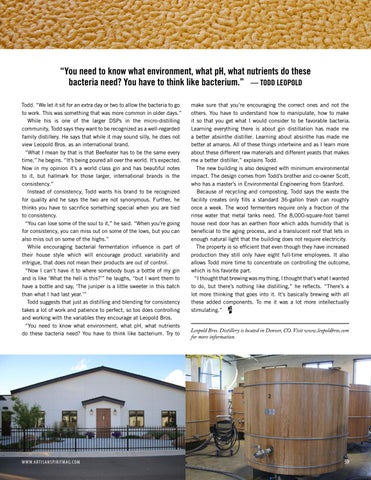
make sure that you’re encouraging the correct ones and not the others. You have to understand how to manipulate, how to make it so that you get what I would consider to be favorable bacteria. Learning everything there is about gin distillation has made me a better absinthe distiller. Learning about absinthe has made me better at amaros. All of these things intertwine and as I learn more about these different raw materials and different yeasts that makes me a better distiller,” explains Todd. The new building is also designed with minimum environmental impact. The design comes from Todd’s brother and co-owner Scott, who has a master’s in Environmental Engineering from Stanford. Because of recycling and composting, Todd says the waste the facility creates only fills a standard 36-gallon trash can roughly once a week. The wood fermenters require only a fraction of the rinse water that metal tanks need. The 8,000-square-foot barrel house next door has an earthen floor which adds humidity that is beneficial to the aging process, and a translucent roof that lets in enough natural light that the building does not require electricity. The property is so efficient that even though they have increased production they still only have eight full-time employees. It also allows Todd more time to concentrate on controlling the outcome, which is his favorite part. “I thought that brewing was my thing, I thought that’s what I wanted to do, but there’s nothing like distilling,” he reflects. “There’s a lot more thinking that goes into it. It’s basically brewing with all these added components. To me it was a lot more intellectually stimulating.” Leopold Bros. Distillery is located in Denver, CO. Visit www.leopoldbros.com for more information.
59