Winter 2026
WHAT
“Estate Whiskey” REALLY MEANS
HOW OXYGEN SHAPES AGING
CONVENIENCE HAS HISTORY
MARKETING WITHOUT MISSTEPS
HOME DISTILLING:
CURIOSITY MEETS CONSEQUENCES
DRINK WITH YOUR EYES ®
BRAND STRATEGY | STORY DEVELOPMENT | NAMING | LOGOS PACKAGING DESIGN | CUSTOM BOTTLES | MARKETING | DIGITAL 2787 NAPA VALLEY CORPORATE DR, NAPA, CALIFORNIA 94558
|
707 265 1891 | CFNAPA.COM
TABLE of CONTENTS A LETTER FROM THE EDITOR
10
QUARTERLY GUILD & INDUSTRY REPORTS
13
Updates from guilds and associations within states, across the nation, and beyond!
A BRAND TO ASPIRE TO
Brand Buzz with David Schuemann
STAYING RELEVANT IN 2026
How craft distilleries can adapt to a changing beverage market
THIS TOWN AIN’T BIG ENOUGH
Building a sustainable consulting ecosystem in craft spirits
22
PINK BENCH DISTILLING TURNS BEAR BAIT INTO BEVERAGES WITH A TASTE OF PLACE Beyond the Bottom Line
24
26
30
32
Harnessing the quiet force that shapes every barrel through science
WHAT’S NOT IN YOUR GLASS
69
MANAGING SUPPLY CHAIN COMPLEXITY IN A SHIFTING MARKET
72
FALL IN A DISTILLER’S GARDEN
74
ALCOHOL IN THE AMERICAS
76
THREE TRENDS
78
INTRODUCING 86 HARASSMENT
81
BULK WHISKEY TODAY
84
STRENGTH IN NUMBERS
87
PAIRING LIQUOR AND FOOD
89
WHO ARE THE SPIRITED WOMEN COLLECTIVE?
91
LAMB WINE
94
HOW TO PROVE YOUR CRAFT BOURBON TASTES BETTER
96
ADVERTISER INDEX
98
Building supply chains that move as fast as your customers do
Assessing the industry’s health through a trio of distilleries
Building safer, more respectful spaces in beverage alcohol and hospitality
A correction years in the making
THE ANSWER IS YES
42
THE VIRGINIA HERITAGE GRAIN PROJECT
48
CYBER VILLAINS OF THE DISTILLERY-VERSE
51
ESTATE WHISKEY ALLIANCE ROLLS OUT INITIAL ROUND OF CERTIFIED PRODUCTS 54 Three early adopters reflect on how the organization fits with their distilleries’ goals
64
Rethinking the myth of “firewater”
BARREL OXYGENATION 39
Protecting your digital domain from the invisible menace
GIN BOTANICALS FROM DOWN UNDER
Seeds, spirits, and seasons
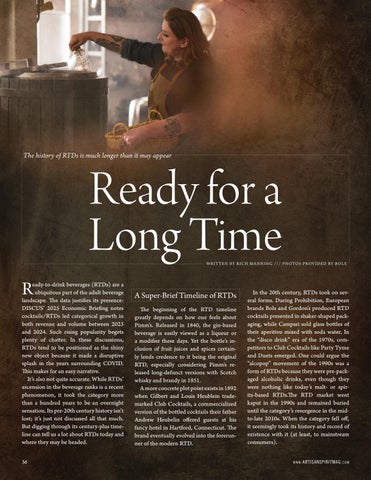
The history of RTDs is much longer than it may appear
An origin story
60
The untold story of distillery wastewater
READY FOR A LONG TIME 36
When the people behind Chattanooga Whiskey started asking questions, good things happened
NICE, MINNESOTA
Part 1
Where it stands now
Unifying standards for America’s distilling workforce
The importance of the DISCUS advertising code
Prairie Organic Spirits’ co-op model shines the spotlight on Minnesota farms
HOME DISTILLING 28 THE NEW FRONTIER OF AMERICAN SPIRITS WORKFORCE EDUCATION
PROMOTING PROPERLY 58
Part 2 — How to make great flavored spirits
Scope, possibilities, and limitations
Connection. Conversation. Collaboration.
A Chinese winter tonic known as yanggao jiu
Show, don’t tell: helping consumers taste the difference
from the COVER Pink Bench Distilling in Troy, Montana. Image by Amanda Joy Christensen. See the story on page 32.
ACTIVE DRY YEAST
ISSUE 53 /// Winter 2026 PUBLISHER & EDITOR Brian Christensen CREATIVE DIRECTOR Amanda Joy Christensen
The most popular yeast strain for Scotch and American single malt Whiskies Pungent
Clean
1.2
Stale
Phenolic Feinty
0.8
Cereal
0.4 0
Floral
Sulfury
SENIOR WRITERS Carrie Dow Rich Manning
Gabe Toth, MSc.
CONTRIBUTORS Kevin C. Baldridge, Ph.D. Jason Barrett Jamie Burns Frank Bobe, Ph.D. Kris Bohm Olivia Campbell Ryan Cuny Dave Gennaro Colleen Grinham Doug Hall Harry Haller
Alison Herman Jake Holshue Paul Hughes, Ph.D. Aaron Linden Karen E. Locke Shelley Sackier David Schuemann Gary Spedding, Ph.D. John P. Thomas, II
PHOTOGRAPHERS Aldehydic ( grassy/leafy)
Soapy
Sour
Estery (fruity) Oily
Solventy
Jamie Burns Amanda Joy Christensen Rachael Crowe
Aaron Ingrao Hugo Juarez
SALES & MARKETING Ashley Monroe ARTISAN SPIRIT is a quarterly publication by Artisan Spirit Media.
www.artisanspiritmag.com facebook.com/ArtisanSpiritMagazine ArtisanSpiritM
General Inquiries (509) 944-5919 Advertising (509) 991-8112 PO Box 31494, Spokane, WA 99223 All contents ©2025. No portion of this magazine may be reproduced without the written consent of the publisher. Neither Artisan Spirit Media nor ARTISAN SPIRIT magazine assume responsibility for errors in content, photos, or advertisements. While ARTISAN SPIRIT makes every effort to ensure accuracy in our content, the information is deemed reliable but not guaranteed. We urge our readers to consult with professional service providers to meet their unique needs. At ARTISAN SPIRIT, we take the opportunity to enjoy many different craft spirits and adult beverages. However, it’s also our responsibility, and yours, to always drink responsibly. Know your limit, and never drink and drive.
ARTISAN SPIRIT’s number one goal is to share and celebrate the art and science of artisan craft distilling. But please remember to follow all the laws, regulations, and safety procedures. Be safe, be legal, and we can all be proud of the industry we love.
THANK YOU TO ALL OUR SPONSORS. Our mission at Artisan Spirit Magazine is to share and celebrate the art and science of artisan craft distilling. We are humbled by the support of our sponsors. With their help, we can further our common goals of supporting creativity, innovation, and integrity within the industry we all love so much.
The American Spirits Exchange is a national importer and distributor serving the alcoholic beverage industry (spirits, wine, and beer). We provide domestic and international companies with access and support to the U.S. market. Regardless of your size — from micro, craft distiller to publicly traded multinational — our focus fuels your growth. Our flagship Foundations™ program provides companies with access to the U.S. market. We handle your business-to-business functions from start to finish: permitting, brand approvals, purchase order processing, invoicing, and compliance.
Every element of Cage and Sons equipment is designed and crafted to provide you with the very best distilling experience at an affordable rate because we know that bottom line matters, but so does function. At Cage and Sons, adequate is never an option, and we continue to develop and design new high functioning, cutting-edge distillation systems that enhance the distillation industry. Cage and Sons works every day to bring you the very best distillation systems for the very best value.
For nearly 50 years, CF Napa Brand Design has set the standard for alcohol beverage branding. Led by Owner & Creative Principal David Schuemann for the past 22 years, we focus on translating brand ethos visually, never using a one size fits all approach for projects. The result is a bespoke solution rooted in strategy and, most importantly, a design that sells. CF Napa’s expertise lies in the intricacies of our process — from project conception to conclusion, our team brings a strategic yet thoughtful eye to every detail. We understand the market and target audiences on a global stage. We balance listening with leading to execute a design that the client loves, and the consumer buys again and again. The Distilled Spirits Council of the United States (DISCUS) is the leading voice and advocate for distilled spirits in the United States. Representing producers and marketers of distilled spirits, DISCUS advocates on legislative, regulatory, and public affairs issues impacting the distilled spirits sector at the local, state, federal, and international levels; promotes the distilled spirits sector, raising awareness and opening markets in the United States and around the globe; and encourages responsible and moderate consumption of distilled spirits as part of a healthy adult lifestyle based on evidence-based research and policy. DISCUS also powers Spirits United, a grassroots platform for the distilled spirits industry. Spirits United is comprised of a community of advocates united with a common goal: to ensure adult consumers can enjoy distilled spirits where they want, how they want, and when they want. Learn more at distilledspirits.org and spiritsunited.org. Haskell is a diversified Architecture, Engineering, and Construction (AEC) firm with the resources to serve our clients across more than a dozen unique markets. Our worldwide team offers an unmatched depth of expertise, leveraging 2,600 subject matter experts across more than 20 design disciplines. With a dedicated beer, wine, and spirits team, Haskell provides integrated solutions for clients, specializing in sustainable facility design and complex manufacturing systems. Our team brings years of industry experience to breweries, wineries, and distilleries of all sizes. Whether it’s a turn-key can line, engineering expertise for a winery, or the design of a distillery, our team will work alongside you to determine the right solution. Learn more at www.Haskell.com.
6
W W W . ARTISANSPIRITMAG . C O M
We’ve been in this industry for over 100 years, during which time we’ve learned a thing or two about what makes a great barrel to age great spirits. Our R&D team and account managers have hundreds of barrels currently in experimentation. Partnering with distillers, we think outside the box to develop new products that push your vision forward. Our Mission: To craft world-class oak barrels and other cooperage products so our employees, customers, and communities flourish.
With an impressive legacy spanning over 30 years in the printing and label domain, Jack Vogel stands as a respected authority in the Spirits industry. For the past 23 years, he has been a steadfast and trusted advisor, contributing significantly to the evolution of label standards and practices. Jack's journey includes leadership roles at top label printers within the Spirits sector. Having transitioned into an independent consultant, he continues to channel his wealth of knowledge towards empowering brands to achieve excellence. As an original founding sponsor and advisor to organizations such as ADI (American Distilling Institute), ACSA (American Craft Spirits Association), and Artisan Spirit, Jack has played a pivotal role in shaping industry standards. At the core of Jack's professional philosophy is the belief in industry education as a catalyst for stability and growth. By imparting knowledge and insights, he contributes to the overall advancement of the Spirits label landscape.
Lallemand Biofuels & Distilled Spirits is the industry leader in supplying fermentation products and valueadded services to the distilled spirits industry. We specialize in the research, development, production, and marketing of yeast and yeast nutrients as well as a solid belief in education of the distilled spirits industry. A vital part of the alcohol production process, fermentation products from Lallemand Biofuels & Distilled Spirits have been designed and selected to create value by tailoring objective solutions to distillery needs.
Moonshine University is located in Louisville, Kentucky on the Beverage Campus with its sister company, Flavorman. Moonshine University offers a variety of classes for enthusiasts, entrepreneurs, industry professionals, and those seeking careers in the distilling industry. Our distillery was designed as part of our classroom, and all classes incorporate hands-on learning and sensory evaluation in order to provide a complete and comprehensive education. In addition to its knowledgeable instructors, Moonshine University hosts a range of renowned industry experts for specialized instruction and training.
For more than 40 years, Phoenix Packaging has worked to realize each client’s unique vision to best represent their story through their unique branding imagery. We provide our clients with options from around the world in a variety of materials such as glass, ceramic, plastics, paper, aluminum, and more. We help to coordinate everything from bottle design, manufacturing, decoration, and logistics. Our goal is to produce your packaging vision to help you achieve success.
Responsibility.org is a national not-for-profit that aims to eliminate drunk driving and work with others to end all impaired driving, eliminate underage drinking, and empower adults to make a lifetime of responsible alcohol choices. Responsibility.org is funded by the following distillers: Bacardi USA, Inc.; Brown-Forman; Campari Group; Constellation Brands; DIAGEO; Edrington, Hotaling & Co.; Mast-Jägermeister US, Inc.; Moët Hennessy USA; Ole Smoky, LLC; Pernod Ricard USA; Suntory Global Spirits; and William Grant & Sons. For more than 33 years, Responsibility.org has transformed countless lives through programs that bring individuals, families, and communities together to inspire a lifetime of responsible alcohol choices. To learn more, please visit www.Responsibility.org.
W W W . ARTISANSPIRITMAG . C O M
7
Since 2013, Statesville Contract Distilling has been producing award-winning, quality spirits at scale and doing it sustainably. Combining the artistry of distilling with cutting-edge technology and unparalleled customer service, we offer a diverse range of standard and custom new fill whiskeys, extensive aged barrel inventory, warehouse barrel storage, private label production, and co-packing for more than 150 brands globally. Partner with us to create spirits you can't get anywhere else, that you'll be proud to call your own. To learn more about our proven track record, visit statesvillecontractdistilling.com or call us at (704) 798-3447.
Stave & Thief Society was founded in 2014, and is the first bourbon certification program recognized by the bourbon industry and the only to be recognized by the Kentucky Distillers Association as its “Official Bourbon Education Course.” The programs were developed by professional distilling and spirits educators and advised by a panel of experts in the bourbon and hospitality industries to provide a premium, standardized bourbon education that is accessible and holds real value.
For over 60 years Tapi USA has produced cork stoppers and a wide variety of bottle closures. Family-owned and operated since its inception, our company continues to develop new products and enter new markets. Tapi USA is proud to support the growth of the artisan distillery industry and is honored to be the Bottle Closure Sponsor for Artisan Spirit Magazine.
Total Wine & More is the country’s largest independent retailer of fine wine, beer, and spirits. Our strength is our people. We have over 5,000 associates, who must demonstrate comprehensive beverage knowledge before they are invited to join our team. After coming on board, all of our team members undergo an extensive initial training program. We believe that an educated consumer is our best customer. We want to demystify the buying experience for our customers so they will feel confident in choosing the bottle that is perfect for them. Total Wine & More works closely with community and business leaders in each market it operates to support local causes and charitable efforts.
BENEFACTOR SPONSORS Led by Director of George Dickel & Luxury American Whiskey, Nicole Austin, the team at Cascade Hollow Distilling Co. continues the tradition of producing award-winning whisky at our historic distillery with high standards of authenticity and craftsmanship. George Dickel is behind some of the most beloved whisky of our time including Dickel Bourbon, George Dickel x Leopold Bros Collaboration Rye, award-winning Bottled in Bonds, the Cascade Moon series, and a variety of luxury variants like the rare, premium offering — Dickel Bourbon Aged 18 Years. Learn more about the incredible history and creativity that lives at Cascade Hollow at GeorgeDickel.com.
8
W W W . ARTISANSPIRITMAG . C O M
Unleash Unleash Unleash your your your true true true craft craft craft with with with Continuous Continuous Continuous Distillaion Distillaion Distillaion Scale Scale Scale with withExcellence with Excellence Excellence Grow Grow production Grow production production with with higher higher with higher extraction extraction extraction efficiency efficiency efficiency and and minimal minimal and minimal loss. loss. loss.
Speed Speed Speed Meets Meets Meets Precision Precision Precision Craft Craft your your Craft whiskey whiskey your whiskey your your way way your without without way without compromise. compromise. compromise.
Smarter Smarter Smarter Savings Savings Savings Lower Lower costs Lower costs per costs per bottle bottle perproduction. bottle production. production.
Tailored Tailored Tailored totoYour Your to Process Your Process Process Custom Custom Custom configurations configurations configurations designed designed designed toto fit fit to fit your your unique unique your production unique production production needs. needs.needs.
Easier Easier Easier Cleanup Cleanup Cleanup Spend Spend less Spend less time time less tidying tidying time up tidying up and and more upmore and more time time perfecting perfecting time perfecting your your craft. craft. your craft.
Beautiful, Beautiful, Beautiful, Dependable Dependable Dependable
Contact Contact Contact Us Us Us (403)-795-0602 (403)-795-0602 (403)-795-0602 info@cageandsons.com info@cageandsons.com info@cageandsons.com www.cageandsons.com www.cageandsons.com www.cageandsons.com
A LETTER FROM THE EDITOR:
These closures are more than data points; they’re friends, colleagues, and families who poured everything into their stills and their communities. Every shuttered tasting room marks the end of a dream, but also a reminder of what we’re fighting to preserve.
Bear with me, I’m going to beat a metaphor into irrelevance. We used to say that a rising tide lifts all boats. Like, all the time. We said it so much and so often even I grew to hate the phrase, despite my appreciation for nautical themed idioms. However, despite its overuse the phrase felt apt for the distilling industry. Every season seemed to bring a new distillery opening, a fresh product on the shelf, another story of craft success. We cheered for one another because each win — big or small — felt like progress for us all. But tides change. This year, the numbers from the American Craft Spirits Association’s Craft Spirits Data Project tell a harder truth: After more than a decade of steady growth, the total number of active craft distilleries has stalled for the first time. Many of our smallest producers — the heart and soul of this movement — have gone quiet. The reasons are familiar to anyone reading this: rising costs, a crowded market, tightening distribution, and the slow grind of regulation.
And yet, amid that uncertainty, I still find reason for hope. Because when the tide turns, the smart ships lash together. Told you I would beat this metaphor over the head. In an attempt to move from words to action, I've joined forces with Nicole Austin and Johnny Jeffery to launch Cut Point Consulting, a new consulting and fractional management agency. Our goal is to connect the people who know how to make things work with the people who still want to make them work. Basically what we’ve done for the last decade, but with a touch more organization. Because if this industry has taught me anything, it’s that resilience isn’t built in isolation. It’s forged through community, through shared experience, advice freely given, and the stubborn belief that better days are still ahead. At Artisan Spirit Magazine, we’ll continue to do what we’ve always done: tell your stories, share your lessons, and celebrate the craft of distilling, not just as a business, but as a calling. The tide may have shifted, but that doesn’t mean the voyage is over.
Hold fast, friends.
Brian Christensen (509) 944-5919 /// brian@artisanspiritmag.com /// PO Box 31494, Spokane, WA 99223
10
W W W . ARTISANSPIRITMAG . C O M
BOURBON STARTS WITH WHITE DOG There are 14.3 million barrels of aging spirits in ky and you can be part of it... but, only at white dog
Introducing White Dog Trading Post A smarter way to navigate the world of barrel trading. Our Marketplace simplifies buying, selling, and managing barrels of distilled spirits with confidence. Whether you’re a distiller, broker, or collector, every transaction is secure and hassle-free.
www.whitedogtradingpost.com
www.whitedogllc.com
(859) 214-7000
sales@whitedogllc.com
U P DATES FROM GU IL DS A N D A SSOC I AT I O N S WI T H I N S TAT E S , A C ROSS TH E N AT I O N , AN D B E Y O N D !
QUARTERLY
GUILD & INDUSTRY
REPORTS As the year draws to a close, it’s inspiring to see craft distillers across the country continuing to turn persistence into progress. Legislative wins, community engagement, and policy reform efforts are shaping a stronger future for our industry despite the brutal economic environment. In Illinois, the Craft Distillers Association celebrated a major milestone years in the making. The passage of SB0618 marks a transformative moment for the state’s spirits producers, introducing long-awaited updates to licensing, retail privileges, and self-distribution. Meanwhile, in South Carolina, the Craft Distillers Guild is heading into 2026 with impressive momentum. From tackling modern regulatory challenges like THC and hemp-infused beverages to advancing common-sense updates such as Sunday bottle sales, the Guild is keeping craft producers’ voices front and center in statewide discussions. Together, these efforts highlight what makes the craft distilling movement so resilient. Brian Christensen Editor, Artisan Spirit Magazine
AMERICAN CRAFT SPIRITS ASSOCIATION 2025 has been an especially hard year for craft distilleries in the U.S. Across the country, small and independent distilleries are being squeezed by outdated state and federal regulations, declines in category sales, increases in operating costs, and a three-tier system that no longer works. As a result, the American Craft Spirits Association has doubled down on our efforts to provide relief for all of these issues. At a regulatory level, we submitted comments to the TTB advocating small business exemptions from potential future requirements for nutritional information labeling requirements. On Capitol Hill, we spearheaded the creation of the Craft Spirits Caucus, co-chaired by U.S. Representatives Hillary Scholten (D-MI) and Jeff Hurd (R-CO), W W W . ARTISANSPIRITMAG . C O M
which will give our industry a core group of supportive legislators to approach about our issues. At our annual legislative fly-In, we brought nearly 40 independent distillers and industry allies to Capitol Hill to garner bi-partisan support for legislative priorities that will broaden market access and provide regulatory and tax relief. We petitioned the Federal Trade Commission to conduct a study on competition within the spirits sector and how direct-to-consumer shipping could benefit the small business sector. We also released two key reports in October: the 2025 Craft Spirits Data Project in partnership with Park Street and the annual DtC report in partnership with Sovos ShipCompliant. The findings from the Craft Spirits Data Project further confirmed what
the category is already feeling. In 2024, craft spirits volume represented 12.7 million 9L cases, a 6 percent decrease from 2023, while dollar sales saw a 3 percent decrease to $7.6 billion. Furthermore, as a result of an improvement in our tracking of active craft DSPs, we revised the number of active craft distilleries in the U.S. to 2,282 as of August 2025. Now in its fourth year, the DtC report tracks shifting consumer attitudes, state-bystate regulatory progress, and the real-world implications for distilleries trying to reach customers beyond their tasting rooms. One thing is clear: Consumer support for modernizing spirits shipping laws remains steady and strong, as 84 percent of regular craft spirits drinkers want to legally purchase craft spirits directly from distilleries. To make that a reality, we will be working closely with state guilds to change the market landscape. In 2026, we’re reimagining the ACSA Annual Convention and Expo to meet craft distillers where they are today. Join us in Sacramento, April 17–18, for fresh energy, 13
new ways to connect, and actionable education designed to deliver immediate value. Experience hands-on demonstrations, dynamic new partners, and more key decision makers from retail and distribution tiers. As
always, the annual competition medal reveal remains a highlight of the convention. In light of the government shutdown, we’ve extended the competition entry deadline to January 12, 2026 — giving you more time to showcase
AMERICAN DISTILLING INSTITUTE Happy New Year! The American Distilling Institute celebrated a successful 22nd annual conference in San Antonio earlier this year. It was terrific to see more than 1,350 old and new friends, learn from industry luminaries, and taste some incredible craft spirits courtesy of the Texas Whiskey Association and the Texas Distilled Spirits Association. We’re looking forward to another great conference next year, but we need your help to make it even better. If you’ve got an idea for a panel, presentation, or workshop, we’d love to hear about it. We have an open call for proposals for 2026 conference speakers through early mid-January — all the details are on our website, www.distilling.com. Registration for ADI’s 20th annual International Spirits Competition is now open. Since 2007, ADI has upheld the highest standards in
the industry by giving our judges the freedom to only award the very best, and being the first competition to provide written feedback for every entry. We accept entries in all classes and categories of distilled spirits, RTDs, cocktail bitters, no/low ABV spirits, mixers, aperitifs, and fortified wines. Early bird rates end on Feb. 8, 2026. All entrants receive written feedback from expert judges, maximizing value for competitors. Best of Class winners will receive one free pass to the conference and will be awarded medals on stage at the 23rd Craft Spirits Conference Gala in 2026, as well as invitations to schedule meetings with major retail partners like Binny’s Beverage Depot, K&L Wine Merchants, and Total Wine & More. Remember: ADI members get discounts on submissions. We’re also excited to announce the launch of a new initiative: Copper & Counsel, a new
DISTILLED SPIRITS COUNCIL OF THE UNITED STATES Join us at the 2026 DISCUS Annual Conference March 3-5 in Louisville, Kentucky!
Registration is now open! The DISCUS Annual Conference is the premier event for America’s spirits industry leaders, decision makers, and supply chain partners. DISCUS’ 7th Annual Conference will take place March 3-5 at the Omni Louisville hotel. The event will feature robust conference programming. Join us to hear the latest on mission-critical policies, connect with spirRegister for the its business executives at 2026 DISCUS networking events, learn Annual Conference from industry thought leaders and walk away with tangible insights to boost business. For questions or 14
to learn about sponsorship and trade show opportunities, please contact membership@ distilledspirits.org. See you in Louisville! Responsibility.org Launches Updated Virtual Bar to Educate Consumers and Empower Smart Choices
This year is flying by, and we are entering the last part of 2025, which brings many reasons to gather and celebrate. As we look forward to the holiday season, a commitment to responsibility is critical. That means making smart choices when it comes to drinking and never driving drunk. Too many people take to the roads when they have had too much to drink. But there is no excuse. The work that the team at Responsibility.org does day in and day out works toward keeping our roads safe
your best spirits. Register and learn more at americancraftspirits.org. Jordan Cotton President, American Craft Spirits Association Co-Founder & CEO of Cotton & Reed
think tank for our distillery members. Got a tough challenge? Submit it, and our panel of industry experts will tackle it head-on, offering smart, practical solutions you can actually use. You’ll also be able to join members-only live webinars to get real-time feedback, ask questions, and walk away with actionable guidance to overcome the hurdles holding your distillery back. We’ve also got a number of free educational opportunities on the horizon. Visit our website to see the full calendar for our monthly webinar series, which covers topics from congener development to using AI to make whiskey. Visit distilling.com to check out our events page or subscribe to our free weekly newsletter to stay in the loop with everything coming up. Wishing the entire craft spirits industry a prosperous and happy 2026, Erik Owens President, American Distilling Institute
so that no one ever has to Try out the blood alcohol content share the road with a drunk calculator driver. Responsibility.org’s recently updated Virtual Bar app, a blood alcohol content (BAC) calculator, uses the latest science to help you get a better understanding of how different factors affect your BAC. It shows how alcohol may affect your behavior and impairment based on your sex, weight, height, and what you plan to eat and drink. This is all before you take your first sip — it’s all part of planning ahead to be safe and responsible. Some of the new features in the Virtual Bar update include information about standard drink equivalents and alcohol by volume, as well as additional drink options to fit almost any occasion. Try it out — I think you’ll really find it a valuable tool. Visit www.responsibility.org/bac-calculator. W W W . ARTISANSPIRITMAG . C O M
Celebrating
250TH Anniversary
UNITED STATES OF AMERICA
0y ea rs
of Am er ic a
ns
p ir
s a l g
s
.
25
it. O
n e le g e n d a r y
We need #ToastsNotTariffs!
In this season of celebration, the U.S. hospitality industry faces troubling tariffs including 15 percent on cherished EU imports like Irish whiskey and Cognac, and 10 percent on UK spirits including Scotch whisky. These tariffs also dramatically increase the risk that the EU will retaliate with a crushing 35 percent tariff on U.S. spirits like bourbon. For decades, our industry thrived under fair, reciprocal, tariff-free trade. These tariffs threaten jobs, small businesses, and the future of American spirits. The deal to restore balance isn’t signed yet, and your voice can still Sign the Toasts make a difference. Sign our Not Tariffs petition petition to President Trump today to call for a permanent return to fair trade. Let’s protect the spirits that bring people together. DISCUS Issues New Edition of Code of Responsible Advertising and Marketing Practices
DISCUS has issued a new edition of the
Code of Responsible Read the Code Practices that includes of Responsible Practices updated provisions, establishes a new alternative complaint resolution procedure, and enhances the overall clarity of the code. The DISCUS code applies to all activities in the United States undertaken to advertise and market distilled spirits, as well as beer and wine brands marketed by DISCUS members. The code also covers the advertising and marketing of distilled spirits brands of non-DISCUS members. The FTC has commended the Code on numerous occasions and cited it as a model. Successful U.S. Trade Mission to Japan
DISCUS led a trade mission of 11 U.S. craft distilleries to Tokyo and Osaka, Japan, to promote the diversity and premium quality of U.S. spirits. The trade mission was supported by funding through the U.S. Department of Agriculture’s Market Access Program (MAP),
JOURNAL OF DISTILLING SCIENCE While we are all aware of the downturn in alcoholic beverage consumption worldwide, we do know that knowledge is key to a better understanding of the situation and our products. Therefore, we shift our focus to providing access to that key knowledge. The last Journal of Distilling Sciences ( JDS) editorial note opened with, “Publishing relevant papers for distillers has slowed.” Things are changing for publications here faster than ever now. Major political changes around the world and negative underpinnings in the world of journal publishing are having severe impacts in this area. Grant funding for research into general alcohol-related topics has always been limited, based on government agencies worldwide not wanting to be seen promoting alcohol consumption. Funding was a little better perhaps, until lately, for health-related issues. Especially, in the latter case, perhaps with a drive by the Movendi International temperance movement (International Organization of Good Templars), together with the World 16
Health Organization (WHO), pushing for a global prohibition of alcohol and drugs based on health considerations. Now, in the U.S., funding for anything scientific is being stripped away and with pending new nutritional regulations coming, purportedly at the end of this year, there is a need to educate distillers and the public more than ever about our distilled spirits world. Providing details on nutritional attributes and methods needed by distillers to better evaluate their products. Moreover, those details need to be accessible in dedicated-to-field publications such as the JDS. The world of scientific publishing has been fraught with controversy over the past few years as lead editors quit their roles in mainstream journals due to a lack of confidence in their own committees and reject profit-driven ideologies in the field. Adding to this, a recent report from Cambridge University Press, Publishing Futures, provides troubling details on the future of academic publishings. That report correctly notes up front that
which helps promote American agricultural products in international markets. DISCUS hosted trade activations in both cities, including an exclusive evening event in Tokyo for Japanese spirits media. Across both events more than 160 Japanese buyers, importers, media representatives, and on-trade professionals sampled a curated selection of American spirits. DISCUS’ trade mission to Japan represents a return to the market after a three-year hiatus. Japan is a key market for U.S. spirits, ranking sixth for overall exports and fourth for American whiskeys. In 2024, U.S. spirits exports to Japan exceeded $100 million, underscoring the strong demand for premium American products. For more information about DISCUS’ export promotion programs, contact Joel Matticks at joel. matticks@DistilledSpirits.org. Chris R. Swonger President & CEO, Distilled Spirits Council of the United States
less is more and academic Read Publishing publishing needs “radical Futures change.” Academic publishing needs “renewed focus and collective action” to embrace new approaches and ensure the future of the industry. Moreover, the report included comments by the managing director of Cambridge University Press, Mandy Hill, who notes that it has been clear for some time that the publishing ecosystem is under increasing strain. AI-generated articles are named as part of the problem and overburdening the system as the academic community continues to incentivize quantity over quality. These issues were noted in our last editorial missive. While you have choices in where to publish, we believe the peer reviews we provide allow an easily accessible, reputable, and relevant vehicle for your work or review while satisfying the needs of educating our distilling community. Upon recent reflection, the title of the journal might suggest to our audience that only scientific articles are valid for submission. W W W . ARTISANSPIRITMAG . C O M
Since 1903
WORLD-CLASS DISTILLATION EQUIPMENT AND CUSTOM TANKS
New Highly Efficient Tank and Vessel Facility 150,000 square feet of manufacturing space ASME Stamped Pressure Vessels and API 650
729 Franklin Street Louisville, KY 40202
Toll Free: (888) 384-5161
www.vendomecopper.com
However, we do encourage explanations of history, geographical features (terroir/provenance), botanical notes, raw materials, and processes along with appropriate packaging, dispensing, and glass types for each spirit. We also welcome social works outlining how distillers can best interface and market to changing consumer tastes. Comprehensive reviews of all topics are welcomed, assuming good author deliberation and interpretation of the matter under consideration (and not AI-driven!). Also, I propose a mini-notes section — a concise, easily readable, thoroughly authoritative overview of a specific topic or spirit class with a one- to two-page summation to promote a better analysis of beverages. Please note that no open-source advertising
is ever allowed in the journal. However, having publication sponsors allows you to publish with no page charges and in a freely accessible manner online. We publish as soon as possible after reviewing — addressing any required revisions — and after final acceptance and clearance to publish your material. Finally, I agree with the author Mandy Hill that we’ve got to stop talking about the problem and start doing something about it. I look forward to collaborating with authors willing to submit top-notch information of relevance to today’s distiller and the distilling community. Quality, not quantity is indeed what we seek, however, for us to grow and be a fully established organization of significant work, we need your submissions and the ability to revise material as needed based on our
WOMEN OF THE VINE & SPIRITS For Women of the Vine & Spirits (WOTVS) — the leading global membership organization dedicated to empowering and advancing women in the alcohol and alternative beverage industry — community and collaboration remain at the heart of every initiative. Celebrating its tenth anniversary this year, WOTVS closes 2025 with inspiring partnerships, meaningful dialogue, and innovative programming that underscore its commitment to creating real, lasting change. COLLABORATION – Leaning into one another's expertise
Through a dynamic live chat platform, WOTVS continues to serve as a vital hub for conversation and connection. Featuring WOTVS corporate members, these sessions bring together industry leaders, innovators, researchers, and experts to explore the most relevant topics shaping the alcohol and alternative beverage sectors. WOTVS live chats have become trusted spaces for professionals to engage in open, forward-thinking dialogue. Chats have included The Briefing Room series featuring such prominent leaders as Chris Swonger, president of DISCUS and Francis Creighton, president of Wine & Spirits Wholesalers of America (WSWA). Sessions have also included marketing strategies
18
hosted by brand leadVisit the WOTVS ers driving the industry calendar of events forward, to our monthly C-Suite Insight discussions bringing invaluable mentorship to members. New sessions are continually added to the WOTVS calendar of events and are open to members. COMMUNITY – Bringing industry members together
In October, WOTVS brought the industry together for two impactful in-person regional events. The first event, A Toast to Women Shaping the Industry hosted by corporate member Suntory Global Spirits, took place in Manhattan. Moderated by WOTVS Founder and CEO Deborah Brenner, the program featured an esteemed panel of women leaders from Suntory Global Spirits, Diageo, and Southern Glazer’s Wine & Spirits, who shared stories of perseverance, strategies for fostering innovation, and insights on leading with vision and purpose. Later in the month, a second regional event called Confidence, Clarity & the Data Mindset was hosted in New Jersey by corporate members Dimensional Insight, Opici Family Distributing, and Treasury
triple-peer reviews from our knowledgeable and experienced industry experts. Remember, we are also willing to assist non-scientifically trained distillers to help them publish the high-quality material that we need thus adding to the knowledge base for everyone producing the excellent, flavorful spirits we all desire. Fellow distillers, distilling/beverage scientists, and technical teams, please consider what you might be willing to offer your fellow compatriots and peers to help all our readership promote and grow the spirits industry. Together, we will get the job done and done right. Respectfully, Gary Spedding Lead Editor, Journal of Distilling Science
Wine Estates. Panelists discussed how to cut through the noise of data, focus on meaningful insights, and cultivate a mindset where data drives clarity rather than confusion. WOTVS FOUNDATION – Supporting the next generation
The WOTVS recently announced its latest cohort of scholarship recipients. The foundation provides annual scholarships supporting women’s careers in the food, alcohol/alternative beverage, and hospitality industries through education, leadership, and professional development. Since its founding in 2017, the foundation has awarded more than 400 scholarships to women across 80 countries and in 2025 it proudly surpassed the milestone of $1 million in total scholarships awarded thanks to the generosity of industry donors. Congratulations to the Class of 2025! 86 HARASSMENT – Committing to industry safety
In the spirit of collaboration, WOTVS also announced a new partnership with corporate member Provi to amplify awareness of a key initiative, 86 Harassment. Our 86 Harassment is a comprehensive effort that aims to prevent sexual harassment and gender-based violence in the alcohol/alternative beverage and hospitality industries, uniting these industries under one powerful campaign. The program provides free ongoing, industry-specific W W W . ARTISANSPIRITMAG . C O M
“Here at Jackson Purchase Distillery, we partner with Malteurop because most importantly the quality and consistency. Their ability to always offer the best product and deliver 24/7 without hesitation is what allows JPD to offer the best bourbon to our customers.” –Craig Beam, Master Distiller
“Malteurop is a staple in the making of great alcohol for years! Tradition, quality, and dependability are the key elements Malteurop has stood on so they are a must for Jackson Purchase Distillery. They do it and do it well!” –Terry Ballard, Assistant Master Distiller
For generations, Malteurop Malting Co has partnered with distillers to shape the whiskey enjoyed today. Our legacy is built on a deep passion for malting and a commitment to unmatched quality. learn more about our Distilling Malts
Learn more about
training hosted by leading 86 Harassment experts with a robust hub of downloadable assets and a 24/7 hotline and chat service staffed by RAINN, the nation’s largest anti-sexual violence organization. Through a Provifunded, multi-channel digital trade marketing campaign, tens of thousands of industry professionals will be reached, driving national awareness and catalyzing meaningful change.
LOOKING AHEAD – 10 years and just getting started
As WOTVS looks to the future, its impact continues to resonate across every facet of the industry, from empowering individuals through education and mentorship to uniting companies in a shared commitment to equity, safety, and inclusion. By fostering authentic connection and actionable change, WOTVS is not only reshaping the future of the alcohol and alternative beverage industry
but setting a new standard for what collective progress can achieve. Committed to championing women in the workplace, WOTVS is fostering an industry where women’s talents and perspectives are not just valued but drive success and fuel growth. Ten years and we’re just getting started. Deborah Brenner Founder and CEO of Women of the Vine & Spirits
AMERICAN STATE GUILDS ILLINOIS ILLINOIS CRAFT DISTILLERS ASSOCIATION
The Illinois Craft Distillers Association (ICDA) is so pleased to share that after years of hard work, our bill (SB0618) has passed the Illinois House and Senate, paving new opportunities for distilleries throughout our state. The bill is now on its way to the Governor’s desk to be signed into law and will need to be enacted by the Illinois Liquor Control Commission. It creates a Class 3 Craft Distillers license that aligns with brewery license types
SOUTH CAROLINA SOUTH CAROLINA CRAFT DISTILLERS GUILD
The South Carolina Craft Distillers Guild (SCCDG) is kicking off 2026 with a robust agenda aimed at strengthening the state’s craft spirits industry. On February 18, 2026, the Guild will host its annual Membership Meeting, Tradeshow, and Legislative Reception in Columbia. This pivotal event will bring together distillers, industry partners, and lawmakers to discuss policy priorities and showcase the vitality of South Carolina’s craft distilling community. Following a trend seen across the country, the South Carolina General Assembly is prioritizing one of this session’s most debated topics: the regulation of THC and hemp-infused beverages. SCCDG supports the emphasis on safety, age restrictions, and clear labeling on these products, while advocating 20
in our state to allow Illinois distilleries full retail privileges at their primary production sites, limited self-distribution, and the ability the open a secondary satellite location without requiring full manufacturing at that site. Further, it creates a Spirit Showcase Permit that will allow distilleries to sell bottles and cocktails at off-site locations for a limited period. This has taken a tremendous amount of campaigning, lobbying and negotiating and will provide a crucial lifeline for our state’s distilleries, open up new avenues for growth and
will generate important tax revenue for our state. While acknowledging all the work that the ICDA board, government affairs team and distillery members have done, we also want to extend a huge thank you to our representatives the Illinois House and Senate, the Governor’s Office and Liquor Control Commission for recognizing both the urgency and potential of this important piece of legislation.
for fair licensing and compliance measures. Additionally, the SCCDG would like to see parity in how THC/hemp beverages are regulated compared to similar products, ensuring a level playing field for craft producers. Another key initiative focuses on the Guild’s Sunday Sales Bill, which aims to remove outdated restrictions on bottle sales at distilleries. While distilleries can currently open on Sundays, they are prohibited from selling bottled spirits. SCCDG is advocating for legislation that would permit Sunday bottle sales—not only to boost revenue but also
to enhance tourism and agritourism opportunities across the state. Allowing visitors to purchase spirits during weekend tours aligns distillers with brewers and vintners who already enjoy this privilege. The South Carolina Craft Distillers Guild continues to champion policies that promote growth, tourism, and consumer access. With bipartisan support and increasing public interest, 2026 could mark a transformative year for South Carolina’s craft distillers.
Ari Klafter President, Illinois Craft Distillers Association Head Distiller, Thornton Distilling Co.
Trenholm B. Hardison Executive Director, South Carolina Craft Distillers Guild
IS YOUR GUILD OR ASSOCIATION MISSING? Don’t miss out on
this opportunity to reach a national audience of distillers and suppliers! Share your latest victories, recruit supporters, request suggestions to solve your latest challenges, and inspire fellow groups. Email brian@artisanspiritmag.com to get involved!
W W W . ARTISANSPIRITMAG . C O M
BRAND BUZZ W RI TT E N B Y DAVID S C H U EMA N N
A BRAND TO ASPIRE TO Great brands connect deeply with their consumer’s core beliefs and lifestyle. Aspirational brands take this one step further.
WHAT IS AN ASPIRATIONAL BRAND? Aspirational brands don’t just connect with their consumer’s lifestyle; they are the consumer’s lifestyle. They have a strong ethos and identity that customers adopt as a part of their own identity — so much so that many of these brands are often referred to as “cult brands” with their own posse of devoted followers.
EXAMPLES OF FAMOUS ASPIRATIONAL BRANDS — Their “Just Do It” tagline and marketing campaigns show athletes in relentless pursuit of goals, purporting that buying their products will guarantee your success. NIKE
— Their simple marketing doesn’t explain what they are selling because you already know what they are selling, and it’s more than just a phone or a computer — it’s a lifestyle and acceptance into a community of Apple users. APPLE
JOHNNIE WALKER — The brand’s colored labels signify steps up in quality and price, allowing consumers to start their whiskey journey with the entry-level Red Label for everyday drinking while aspiring to eventually trade up to the Blue Label. HENNESSY — The brand focuses on a very niche market — Cognac — and has become synonymous with the category. They are constantly developing new Cognacs utilizing experimental techniques and eye-catching packaging. Their strategic partnerships with celebrities and product placement in music videos and movies have cemented their image as an aspirational brand.
ASPIRATIONAL CONSUMERS & BRANDS The aspirational consumer is constantly striving to better themselves or improve or validate how others view them, whether it be through education, new skills, climbing the ranks within their career, or acceptance into an exclusive group. Globally, 37 percent of consumers are aspirational consumers, and they seek out brands that reflect their lifestyle (GWI).1 Aspirational brands embody positive traits that everyone wishes to see in their ideal future self. With each purchase made, the customer reinforces the idea that they are getting closer to this ideal self, and they may even be inspired to take actionable steps outside of their purchasing power to achieve their goals. Followers of an aspirational brand often develop their own community, whether online or in-person, with their own language and ways of identifying and communicating with other followers. The improved sense of self and acceptance into a community that results from following an aspirational brand fosters a deeper emotional bond with the brand.
WHY ARE ASPIRATIONAL BRANDS SALIENT? Historically, brands have focused on two factors when marketing their products — quality and affordability. These aren't especially exciting features. As outlined in Bain & Company’s B2B Elements of Value, these are just table stakes, the basic features most products need to succeed, but they aren’t differentiating, nor do they connect on a personal level (Forbes, 2024).2 1
https://www.gwi.com/blog/why-aspirational-consumers-matter
2 https://www.forbes.com/sites/renaegregoire/2024/02/08/turning-dreams-into-sales-how-aspirational-content-inspires-action/
22
W W W . ARTISANSPIRITMAG . C O M
A successful aspirational brand connects deeply with a very specific target customer, creating a strong functional and emotional bond. Aspirational brands focus on a third factor — aspirational value. The emotional reward for choosing an aspirational brand can outweigh the considerations of quality and affordability of the product (Ratheesh MS, 2024).3 Overall, affordability may not be as much of a consideration for those seeking aspirational brands. In fact, a more premium price tag often helps anchor a brand as aspirational in the consumer’s mind. The aspirational consumer demographic is 28 percent more likely to be in a senior management position and 33 percent more likely to be a CEO or president than other consumers on the internet, suggesting that they are likely to have the disposable income to trial new brands until they find the one that best represents their personality and values (GWI).4
THE STEPS TO CREATING AN ASPIRATIONAL BRAND
of your brand — your packaging, website, social media, etc. — needs to tell your story in a consistent fashion. This consistency will lead to a feeling of authenticity, a stronger brand voice, and a greater pull of attraction to your target customer. Staying true to your brand through the years will continue to nurture the relationship with your consumers and strengthen your bond. By definition, aspirational brands are not for everyone, but rather hyper-focused on their core consumers. A successful aspirational brand connects deeply with a very specific target customer, creating a strong functional and emotional bond. Once this relationship has been established, brand loyalty often remains as strong as the brand promise.
David Schuemann is the owner and creative director of CF Napa Brand Design. Visit www.cfnapa.com or call (707) 265-1891 for more info.
There is a lot of luck involved with developing a popular aspirational brand, and there is no one-sizefits-all path. However, keeping these steps in mind will help set the stage for success.
1
DEVELOP AN UNDERSTANDING OF
YOUR CUSTOMER : Research the customer segment that you want to target, including their beliefs and their aspirational goals.
: Develop the ethos of 2 your brand around the core values that
our commitment
YOUR NICHE
your target customer holds and how they view their ideal self. : This is the heart of the 3 brand. Weave together your learnings from YOUR STORY
customer research and your brand ethos to develop an emotional story that is relatable, accessible, and inspirational.
4
COMMUNICATE YOUR STORY THROUGH EVERY TOUCHPOINT : This
is where the rubber hits the road. Every piece 3 https://www.linkedin.com/pulse/beyond-quality-affordability-how-aspirational-value-shaping-ms-uf9dc/
Crafting Partnerships At Independent Stave Company, we’ve always believed that the best distillers deserve the best partners. Since 1912, we’ve proudly partnered with the world’s finest distillers united by shared values of quality, consistency, and creativity. We’re committed to what matters most to you, and building strong partnerships is one of our greatest strengths.
4 https://www.gwi.com/blog/why-aspirational-consumers-matter
W W W . ARTISANSPIRITMAG . C O M
23
Staying Relevant in
A
2026 How Craft Distilleries Can Adapt to a Changing Beverage Market
t the beginning of 2025, I shared my prediction that functional beverages, THC beverages, and various low-alcohol products would impact the alcohol beverage industry, and I encouraged industry members to embrace the changes that were coming. What was once a wide-open landscape now feels increasingly complex as we look toward 2026: Consumer behavior has shifted, distributor consolidation continues, non-alcohol and functional beverages are competing with alcohol for shelf space, and regulatory uncertainty remains a constant factor. The next year will be pivotal — not just for growth, but for survival. Craft distilleries can no longer rely on tasting rooms and a few local accounts to remain viable. The market has changed, and the distilleries that adapt strategically, rather than react slowly, will be the ones that stay relevant and profitable in 2026.
A Market in Transition Spirits growth in the U.S. has slowed from its post-pandemic surge and overall total spirits volume growth has been flat to slightly negative in recent quarters. Meanwhile, competition has expanded beyond traditional alcohol. Ready-to-drink cocktails, non-alcoholic spirits, THC beverages, and functional beverages now compete directly with craft spirits for consumer attention. The consumer’s mindset has shifted. Non-alcoholic spirits were once dismissed by distillers as a passing curiosity, but they now represent a meaningful revenue category. According to NielsonIQ Insight dated August 29, 2025, the U.S. no/ low-alcohol market is projected to exceed $1 billion by the end of 2025, and consumer usage patterns show it is being used with alcohol, not just instead of it. 24
Written by Alison Herman
Functional beverages — drinks enhanced with adaptogens, vitamins, electrolytes, or botanicals — have also captured consumer interest, especially among health-conscious drinkers. THC and hemp-derived beverages are another fast-growing market, drawing billions of dollars in investment but subject to shifting federal and state regulations. Regardless of whether distillers choose to enter adjacent categories, these alternative beverages have permanently raised consumer expectations for purpose-driven drinking experiences. Adapting strategically to a changing market means evaluating which emerging beverage categories best complement your core spirits portfolio. Determining whether to expand into RTD cocktails, non-alcoholic spirits, THC-infused beverages, or functional drinks requires a thorough assessment of how each aligns with your brand values and meets customer expectations. It’s equally important to understand the legal framework governing these categories and confirm that your business can secure the necessary licenses and approvals. Keep in mind that what’s permissible in one state may not be allowed in another. Before moving forward, invest time consulting with industry and legal experts to gain the insights needed to make an informed, compliant decision — one that positions your company to stay relevant and succeed in a rapidly evolving marketplace.
Distribution Challenges Gaining and maintaining wholesale representation is likely to be one of the most significant challenges facing small distilleries in 2026. Consolidation among major distributors has created increasingly limited portfolio space. Wholesalers of beer now sell wine, spirits, and non-alcoholic beverages (where permissible), and wholesalers of wine and spirits are also focused on becoming “total beverage distributors.” These moves narrow distribution channels and create concerns that smaller craft producers may have limited support and options in the market. Retailers are also reshaping expectations. Placement now demands proof of performance, and many expect suppliers to deliver local marketing support or in-store activation. This creates cost burdens for independent distillers trying to scale. Direct-to-consumer shipping could be a natural pressure release, but regulatory barriers remain. While wine has a robust DTC market, spirits DTC remains limited. Fewer than a dozen states allow interstate spirits W W W . ARTISANSPIRITMAG . C O M
shipping to consumers directly by distilleries, and the legal landscape changes slowly. Tasting room sales remain essential, but for long-term growth, distilleries will need hybrid route-to-market strategies that blend direct sales, self-distribution where legal, and targeted wholesale partnerships.
Understanding Today’s Consumer
updates, and be aware of competing products like THC/hemp beverages. Compliance missteps can put licenses at risk, so planning and awareness are critical.
Looking Ahead
Strategies for Staying Relevant
The craft distilling landscape will continue to evolve quickly. Despite the headwinds, opportunity remains strong. Consumer interest in premium, local, and meaningful spirits experiences is not fading — it is changing shape. Distilleries that adapt business models, diversify smartly, and deepen consumer relationships will not only survive 2026 — they will be positioned for sustainable growth. Staying relevant is no longer about keeping up with trends. It’s about building a business resilient enough to meet the future of beverages.
1) Expand thoughtfully beyond your core brand. Innovation doesn’t mean abandoning identity. Expansion into RTDs, seasonal or single-barrel releases, or even a non-alcoholic companion product can broaden market reach — but any new offering should align with your brand purpose to feel authentic, not opportunistic.
Alison Herman is an attorney with more than 29 years of experience in the alcohol beverage industry and Of Counsel at Malkin Law. This article is intended for information and education purposes only and does not constitute legal advice.
The modern spirits consumer seeks no- to low-ABV options, favors quality over quantity, and values tasting experiences. They are interested in mixology, new flavors, and experiential engagement, but their loyalty must be earned. To remain viable, craft distilleries should consider strategies that evolve them from product makers into experience-driven, strategically diversified businesses.
2) Make your tasting room a profit center. Tasting rooms will need to be more than showrooms. Hosting state-permitted experiences like cocktail workshops, pairing events, and private tastings — and possibly introducing exclusive membership or bottle club programs — can boost revenue. Strong marketing and social media promotion of these activities are key to success. 3) Focus on local markets. Building local brand loyalty remains critical. Partner with restaurants, tourism boards, hotels, and event venues to increase awareness and engagement. 4) Collaborate with complementary industries. Work with chocolatiers, culinary artisans, coffee roasters, local chambers of commerce, and tourism campaigns. Collaborations expand your audience and enhance brand relevance. 5) Diversify your sales channels. Avoid reliance on a single channel. Combine e-commerce, regional or national distributors, and shipping into states that permit spirits DTC to reach more consumers efficiently. 6) Invest in consumer relationships and data. CRM tools, loyalty programs, private release drops, and on-site data collection are essential. Understanding your customers allows you to pivot quickly when markets shift. 7) Stay aware of regulatory changes. Know the regulations in the states where you operate, including shipping, sampling, and tied-house laws. Support trade associations that advocate for spirits DTC laws, watch for TTB labeling
W W W . ARTISANSPIRITMAG . C O M
our commitment
Built for the Future At Independent Stave Company, sustainability is not just a priority, it’s a responsibility we proudly carry. As a vertically integrated company using 100% of the log, we ensure traceability from forest to barrel. Our American and French oak barrels are crafted from sustainably managed forests through certified programs including SFI and PEFC.
25
Building a Sustainable Consulting Ecosystem in Craft Spirits Written by Jake Holshue
This Town Ain’t
Big Enough
P
icture this: Two former distillers square off at a trade show booth, business cards at the ready like six-shooters. Their LinkedIn profiles read almost identically, “Award-winning distiller with 15+ years of experience in recipe development, operations optimization, and regulatory compliance.” The tension builds. Tumbleweed rolls past the trade show booth. One mutters through gritted teeth: “This industry ain’t big enough for the both of us.” The reality is that now it has to be big enough for dozens of us.
The Great Migration The craft spirits industry’s recent struggles have created an unprecedented exodus from production floors to consulting desks. With distilleries closing, downsizing, and tightening belts, talented professionals who once collaborated on creating award-winning spirits now find themselves competing for the same consulting contracts. We’ve gone from an industry built on “rising tides raise all ships” to one where former colleagues and friends are undercutting each other just to cling on to this industry we’ve built. The numbers tell a stark story. As bankruptcies mount and operations consolidate, every week seems to bring another announcement of a respected industry professional “transitioning to consulting.” What was once a niche specialty has become a crowded marketplace where everyone offers the same core services: recipe development, equipment sourcing, regulatory guidance, and operational efficiency.
26
The craft spirits industry’s recent struggles have created an unprecedented exodus from production floors to consulting desks.
The Brutal Economics
But here’s the crushing reality: Even as the supply of consultants has exploded, demand has contracted. The same economic pressures forcing distillery professionals into consulting are making it harder for the remaining distilleries to afford consultants at all. The numbers paint a bleak picture. According to the 2024 Craft Spirits Data Project, the industry experienced its first decline since tracking began, with volume dropping 3.6 percent to 13.5 million cases and value falling 1.1 percent to $7.8 billion. The average craft distiller now produces just 4,755 cases annually, down 8.4 percent from the previous year. When 90 percent of craft distillers are classified as “small producers” making fewer than 5,258 cases per year — with many operating at cash-flow-negative — the pool of potential consulting clients shrinks dramatically. Trade tensions and tariffs have squeezed margins. Distribution-tier chaos has made market access increasingly difficult. Generation Z isn’t drinking at the same rates as their predecessors. If a craft distillery is struggling to make payroll, hiring
a consultant often becomes a luxury they simply cannot afford. This creates a vicious cycle. More consultants chase fewer opportunities, leading to a race to the bottom on pricing. Consultants take on projects they shouldn’t, either because they lack the specific expertise required or because they’re underbidding to a point where they can’t deliver quality work. Clients get burned. Word spreads that consultants are a waste of money. The entire ecosystem begins to collapse.
The Real Danger My fear goes beyond the collapse of consulting opportunities. We risk damaging the very industry that created us. When desperate consultants take on projects outside their expertise, they don’t just fail. They can set clients back months or even years. Poor recipe development, inadequate regulatory guidance, or misguided operational advice can cripple a small distillery. In an industry where margins are thin and second chances are rare, bad consulting can be the difference between survival and closure. W W W . ARTISANSPIRITMAG . C O M
We’re in danger of becoming part of the problem rather than the solution. The craft spirits industry trusted us with its most precious resource — knowledge — and if we squander that trust in a desperate scramble for survival, we’ll poison the well for everyone.
The question isn’t whether this town is big enough for all of us.
Building a Bigger Town The solution isn’t to out-gun each other; it’s to build an ecosystem that can sustain us all while serving the industry we love. This requires a fundamental shift from competition to collaboration.
It’s whether we’re smart enough
We stand at a crossroads. We can continue down the current path, a desperate free-for-all that benefits no one and potentially harms the industry we’re supposed to serve, or we can choose collaboration over competition, specialization over generalization, and sustainability over shortterm survival. The craft spirits industry taught me that success comes from lifting each other up, sharing knowledge, and building something bigger than any individual could create alone. These principles don’t stop applying just because we’ve moved from the production floor to the consulting space. The question isn’t whether this town is big enough for all of us. It’s whether we’re smart enough to build it bigger together.
to build it bigger
Specialization Over Generalization: Instead of everyone claiming expertogether. tise in everything, we need to embrace our unique strengths. Some consultants excel at recipe development, others at regulatory navigation, still others at operational efficiency or brand development. Rather than competing headto-head, we should be referring clients to the specialist who can best serve their specific needs. Network-Based Solutions: Imagine consulting networks where complementary specialists work together on comprehensive projects. A recipe development expert partners with a regulatory specialist and a brand consultant to offer turnkey solutions no individual could provide alone. This allows for higher-value engagements that can support sustainable pricing. Quality Standards and Vetting: The industry needs a way to differentiate between legitimate expertise and desperation consulting. This might mean formal credentialing, peer review systems, or simply collaborative vetting processes that help clients identify qualified professionals. Regional Coordination: Rather than viewing every consultant in a geographic area as competition, what if we coordinated to ensure comprehensive coverage? Resource Pooling: Individual consultants often can’t afford the tools, databases, or research resources that would make them more effective. Collaborative networks could share these costs while improving service quality across the board.
W W W . ARTISANSPIRITMAG . C O M
The Choice Before Us
Jake Holshue is an accomplished distiller and spirits industry consultant with over a decade of experience in craft spirits production, education, and leadership across numerous distilleries both domestically and internationally. Currently, he serves as an industry consultant for Big Thirst, providing valuable guidance to distilleries on production and compliance matters.
our commitment
A Foundation You Can Rely On At Independent Stave Company, we are deeply committed to ensuring supply security for our customers. With four U.S. modern cooperages and a company owned stave mill network, our robust and responsive infrastructure is built for flexibility and resilience so you can count on us today and for generations to come.
27
H N P. T H
O M A S , II
E M O H G N I L L I T DIS
JO Written by
T STA WHERE I
I
NDS NOW
n recent years, there has been a proliferation of home brewing kits sold as gifts to enthusiasts looking to create their own signature brew at home. The holiday season offers a prime opportunity to give this type of kit to someone interested in this art form, but it may leave whiskey and spirits enthusiasts wondering: Can I participate in this trend and distill my own at home? The answer is complicated and evolving, and it involves conflicting state and federal statutes, a pending federal court case, and restrictions on potential distribution.
license, paying federal taxes, and receiving approval for the applicable labeling and bottling requirements. Overall, federal laws and regulations leave no room for home distillers to explore this art without obtaining licensure, which can be cumbersome, costly, and prohibitive for most individuals. However, states have begun to implement new laws to open the door for home distillers.
FEDERAL PROHIBITIONS
STATE EXEMPTIONS & ALLOWANCES
Under federal law, home distilling is not allowed and can result in significant repercussions if attempted without proper licensure. Federal statutes dictate that distilling spirits without a federal permit is illegal, regardless of whether it is for personal use or not. It is not illegal to own a registered still, but using it to produce liquor can result in consequences ranging from a $10,000 fine all the way to time in prison. These offenses can also extend to possessing and transporting liquor that was distilled without a permit. Anyone seeking to distill their own liquors, whether at home or not, would need to complete the full federal licensure process, in addition to any licensure required by their individual state. This would include, but not be limited to, obtaining a federal Distilled Spirits Plant (DSP)
It’s important to note from the outset that, due to the Supremacy Clause in the United States Constitution, unlicensed home distilling is prohibited nationwide as long as the current federal statutes remain. This, however, has not stopped some states from laying the foundation for allowing home distilling if the federal ban is lifted. Alaska statutes exempt the private manufacture of alcoholic beverages from needing licensure, with alcoholic beverages being defined to include distilled spirits. Alaska subjects this exemption to requiring the area where the manufacturing is taking place to have adopted a local option, and it limits the production amounts to those listed in federal law. However, the federal limits listed do not apply to distilled spirits, which creates a grey area regarding the amounts. West Virginia adopted House Bill 4793 in 2024, which specifically allows individuals who are 21 years or older to manufacFederal laws and regulations leave no room for home distillers ture alcoholic liquor for family use. The total amount allowed to explore this art without obtaining licensure. to be produced is limited to 50 gallons per calendar year if there
28
W W W . ARTISANSPIRITMAG . C O M
Individuals who try to take advantage of state statutes allowing for home production may still face federal repercussions for production without the required permits. are two or more individuals 21 years or older living within the household. If there is only one individual 21 years or older living in the household, the amount is reduced to 25 gallons per calendar CONCLUSION year. The law also specifically states that this alcohol cannot be sold or As it stands now, federal prohibitions on home distilling are still the offered for sale. law of the land, and those who violate them could be subject to federal Most recently, Maine enacted a new law in September 2025, allowpenalties for distilling without a permit. While some states have enacting for home distilling. Maine’s statute provides additional details that ed statutes that allow for home stilling, the federal statutes will still apare often missing from other states’ home distilling statutes. It provides ply, and those who utilize state statutes will still be operating outside of a definition for a home distillery and provides guidelines for mash federal law. The pending court case could change this if the 5th Circuit capacity and proof gallons. Home distillers are limited to using stills Court of Appeals upholds the Federal District Court’s ruling. However, with a mash capacity of less than 15.5 gallons, and they are limited to until that case is fully resolved, or until federal law is changed, aspiring producing 24 proof gallons per person residing at the location with home distillers will need to wait before they can try their hand at this someone 21 years or older. Maine defines “proof gallons” as one liquid craft. gallon of spirits that is 50 percent alcohol at 60 degrees Fahrenheit. Further, home distillers are prohibited from producing more than 48 proof gallons per calendar year or selling any of the spirits produced at John P. Thomas, II, is an attorney in GrayRobinson’s Tampa office and a member home. However, they are allowed to consume and serve these spirits of the firm’s national Alcohol Law Team. John works with all three tiers and all three segments of the alcohol industry, including substantial work experience with to family members and guests at the location where they are distilled. distillers. Prior to joining GrayRobinson and while in law school, John served as a As previously stated, regardless of the state law, home production senior judicial intern at the U.S. District Court for the Middle District of Florida is still prohibited at the federal level. Therefore, individuals who try for the Honorable Amanda Arnold Sansome. Subsequently, he became a guberto take advantage of state statutes allowing for home production may natorial fellow for the Florida Gubernatorial Fellows Program, where he served still face federal repercussions for production without the required within the Florida Department of Management Services. For more information, permits. Additionally, some states that allow home production do not email john.thomas@gray-robinson.com or call 813-273-5046. offer explicit clarity regarding what is allowed and what restrictions are in place. However, there is potential for the federal restrictions to change in the near future.
FEDERAL COURT CASE In July 2024, a Federal District Court ruled that the federal prohibitions on home distilling were unconstitutional and lay outside the federal government’s power. The case was brought by the Hobby Distillers Association, a Texas-based organization that advocates for home distilling for personal consumption. The organization argued that the federal prohibitions lay outside of the enumerated powers granted to the federal government by the United States Constitution and therefore were unconstitutional. The federal government argued in response that the federal prohibitions were based on both the federal government’s authority under the Commerce Clause and its ability to tax. The government argued that home distilling is a commercial activity that substantially affects interstate commerce in the aggregate. Additionally, they argued that the prohibitions were to protect tax revenue, with home distillers being less likely to pay applicable taxes compared to licensed distillers. The Federal District Court ultimately ruled in favor of the Hobby Distillers Association, determining that the federal prohibitions on home distilling exceeded the authorities granted to the federal government under the United States Constitution. The government appealed the ruling in August 2024, and it is currently pending before the 5th Circuit Court of Appeals. W W W . ARTISANSPIRITMAG . C O M
our commitment
Excellence in Every Barrel At Independent Stave Company, quality isn’t a checkpoint it’s a mindset. From forest to barrel, we invest in craftsmanship at every stage, combining the expertise of our cooperage teams with industry leading quality systems, including ISO 9001, ISO 22000, and ISO 14001.
29
THE NEW FRONTIER OF AMERICAN SPIRITS WORKFORCE EDUCATION U N I F Y I N G S TA N D A R D S F O R A M E R I C A’ S
DISTILLING WORKFORCE
WRITTEN BY KEVIN C. BALDRIDGE PH.D.
> C E RT I F I E D S P I R I T S JUDGE
> C E RT I F I E D S P E C I A L I S T OF SPIRITS
> WHISKEY SOMMELIER
> MASTER OF WHISKEY
> EXECUTIVE BOURBON S T E WA R D
T
he list goes on, and the options for getting trained and certified in the world of spirits seem endless. With the growth of the American spirits industry over the last two decades, the supporting industry for workforce training providers has grown too. The breadth of offerings provides workers with unprecedented opportunities, but it also presents a major challenge when making the right choice. Whether it’s an employer seeking qualified talent or a professional looking to advance their career in the spirits industry, understanding the training landscape is essential. 30
THE SPIRITS E D U C AT I O N LANDSCAPE One of the first certification programs available for spirits education began in 1969 with the Wine and Spirits Education Trust (WSET) launching three levels of qualifications for wine and spirits industry workers to meet the educational needs for the United Kingdom’s wine and spirits industry. Since then, the focus of WSET training has expanded into different sectors of
the global beverage alcohol industry, such as beer and sake, becoming one of the most widely recognized qualifications for industry professionals and enthusiasts. The WSET qualifications (Level 1, 2, and 3 awards) focus on an appreciation of many spirit categories with practical training components focused on sensory and further connecting to theoretical understanding of distilled spirits production at the higher qualification levels. The Chartered Institute for Brewing and Distilling (CIBD), another prominent international provider of spirits education, offers three levels of qualifications that are more focused on the science and engineering aspects of production processes. Both of these programs provide clear outcomes for completed qualifications, but their focus on global or UK-based markets may not always encompass the needs of many American spirits workers and employers. Within the United States, the spirits education landscape is widely variable. Several universities offer credit-bearing programs in fermentation or distilling, providing opportunities for graduates to prepare for entry into the spirits workforce. However, it can be a challenge for working professionals in the industry to balance their schedules (and budgets) when it comes to college or graduate coursework. Looking outside of traditional academic environments, there are more accessible opportunities for full-time workers. Some examples, like the Executive Bourbon Steward and the World of Whisky Level One qualification, focus on training participants’ palates with some level W W W . ARTISANSPIRITMAG . C O M
W H AT D O Y O U W I S H T H AT N E W H I R E O N YOUR TEAM KNEW ALREADY?
of knowledge about production and marketing. The Distilled Spirits Council of the United States (DISCUS) offers certificates targeted for spirits executives in focus areas such as regulatory, sustainability, safety, leadership, and business. The programs offered by Moonshine U, the Siebel Institute of Technology and the James B. Beam Institute for Kentucky Spirits at the University of Kentucky focus more on the technical aspects of manufacturing operations. The Beam Institute does offer customized programs to meet the needs of partners in the industry. For continuing education in the latest trends and innovations, there are several conferences like the Beam Institute Industry Conference, the American Distilling Institute, and the American Craft Spirits Association Convention. Among these programs, the length and depth of training can vary. For example, the Beam Institute builds one-day short courses for operations, safety, hospitality, and supporting industry teams. In addition, the Beam Institute partners with Jim Beam® Brands to provide 200 hours of instruction in a Registered Apprenticeship Program over the course of 15 months. With the wide variety of scope and depth provided by the many training programs, it’s important to make an informed decision and do the research. As an employer, it’s critical to know how to assess those qualifications listed on a prospective hire’s resume.
W W W . ARTISANSPIRITMAG . C O M
MY APPROACH IN BUILDING A CONSENSUS
W H AT D O Y O U W I S H T H AT Y O U H A D K N O W N W H E N Y O U S TA R T E D T H AT Y O U ’ V E L E A R N E D S I N C E ?
Recently a group of spirits educators, OUR GOAL: including the Beam Unify the American spirits industry Institute, embarked a r o u n d s a f e t y, on a collaborative quality of education journey with inand a shared dustry stakeholdlexicon. ers to take the next THE PROJECT’S step for growing OBJECTIVE: the workforce edElevate the safety ucation landscape and wellbeing of the to support the workforce and the American spirits industry as a whole. industry. THE PROJECT’S We’re kicking off EXPECTED a nationwide colOUTCOME: laboration to define Establish a standard industry workforce for the broad/ diverse educational education standards offerings for the to help evaluate industry to adopt. workforce training credentials. With this project, we hope to support continued growth of the industry by raising the level of readiness for new workers and the capacity for career growth for veteran workers in spirits. Providing clear expectations of what workers will gain from workforce education offerings will enable selection of the best suited program for workers seeking to advance their skill set and for employers looking for a prepared workforce. We want to develop clear, simple expectations for theory-based learning outcomes with practical core competencies connected to achieving a set of workforce training credentials. These credentials will be voluntary, and the requirements and definitions will be built by our stakeholders.
W H AT S E T S A P A R T L E A D E R S A N D T H E REAL PROS ON YOUR TEAM?
W H AT ’ S N E X T ? It’s critical to make sure the outcomes from this project truly serve the needs of our industry, so input from people in all sectors of the spirits industry is vital. Think about what you see as critical needs, intermediate competencies, and higher-level expertise. What do you wish that new hire on your team knew already? What do you wish that you had known when you started that you’ve learned since? What sets apart leaders and the real pros on your team? You can learn more about the project, its current status, and how you can help by visiting the Beam Institute website at beaminstitute.mgcafe.uky.edu. Kevin C. Baldridge Ph.D. is Education Coordinator at the University of Kentucky James B. Beam Institute for Kentucky Spirits. Visit beaminstitute.mgcafe.uky.edu/workforce-education for more information.
our commitment
Innovation by Design We design and produce bespoke barrels, pushing the boundaries of tradition with our extensive oak expertise. Our R&D and sensory teams collaborate with distillers, offering tailored support and technical insights. In-house engineers bring these innovations to life, delivering custom solutions.
31
BEYOND
the
BOTTOM
LINE
PINK BENCH DISTILLING Turns Bear Bait into Beverages with a Taste of Place
Written by Gabe Toth /// Photography by Amanda Joy Christensen
P
ink Bench Distilling in Troy, Montana, is trying to help reduce human-bear conflict in their area. Spirits just happen to be the avenue that presented itself to owners Shawna Kelsey and Kris Boyd. The pair worked together at a local nonprofit and were tasked with creating community projects to help reduce the dangerous interactions occurring when bears would come into town to forage. “One of the biggest issues is fruit trees in people's backyards,” Kelsey said. “We have tons of fruit trees here, and a lot of them just don't get picked. So we started this apple festival with the farmers market, and the purpose of that was to celebrate the fruit and give people a reason to pick their trees and press cider and make apple pie and do all this fun stuff while learning about bear safety and electric fencing and all that.” The festival was a hit and recently celebrated its 10th anniversary, but she said even pressing 1,200 pounds of apples into cider is a drop in the bucket when it comes to reducing the amount of fruit beckoning the local wildlife into town. Boyd explained that Troy is the lowest-elevation town in Montana, and the surrounding Kootenai Valley had been marketed as the fruit basket of Montana due to the mild climate. “The initial settlement focus was timber industry and mining, but also potentially fruit production,” she said. “Everybody's got some fruit trees in their backyard, four to six, or some people have 20. There's a lot of small homestead backyard orchards around.” As the property owners age and are no longer able to manage the trees, she said, the fruit doesn’t get picked and the trees themselves get overgrown, “and you can only use so many apples in a year,” Boyd said. Meanwhile, as property transfers to new hands, the trees don’t get cut down but are allowed to go rogue. “We just have a lot of feral old apple trees that need some care in order to allow people to get them picked again,” she added. 32
W W W . ARTISANSPIRITMAG . C O M
The two began brainstorming: “What could we do that would at once give us a reason to leave the nonprofit world and make jobs for ourselves, but also create a product that's exportable out of our tiny town and look and try to address this issue with the fruit?” Kelsey said. “Turning a problem into an opportunity, and the most efficient thing you can do with apples is to turn them into brandy.”
DIVERSE LOCAL FLAVORS The apples started them down that path, but as Boyd noted, brandy takes a while, so they had to broaden their focus. Surrounded by the Kootenai National Forest, they started looking at the local culture of herbalism and berry-picking and how those things could be incorporated into their spirits. “It’s very lush here, and there's all kinds of stuff that grows in the mountains that isn't really used. So we wanted to do something with non-timber forest products in a value-added way that could be part of our economic story in Troy,” she said. “There's some pretty gung-ho people out there who just love to go pick berries or they love to go into the woods and just hang out. So that's definitely something we thought would be appropriate.” It was an involved process to work through permitting with the National Forest Service to allow them and other people to harvest under their permit commercially, including a review under the National Environmental Policy Act and consultation with local Native American tribes. Boyd, who had worked as a wildlife biologist, was familiar with conducting plant surveys and other forestry work. “So when I approached them about it, I already knew what's appropriate to be harvesting, what's appropriate to ask for in terms of amounts, [and] how to harvest it sustainably,” she said. Kelsey added, “If there's anybody who's good at dealing with red tape, it's distillery owners.” They decided on producing a spruce tip liqueur called Symbosia — a simple concoction of spruce tips, vodka, and just a touch of sugar — which has become a very popular product, as well as Beary Fairy Berry Liqueur, using six different wild berries in proportions that will vary with the year and the weather. “It’s low impact. It's not hitting any one ingredient too hard,” Kelsey said. Boyd added that they intentionally steered away from using huckleberries, a vital bear food source, because of the existing pressure on those plants. “The huckleberry's already hit really hard, [and] bears really need huckleberries. We've specifically made it a mix of as many different berries as we could, so we could ride the wave of the year's harvest,” she said. “And so every year it will change depending on the harvest and what berries come into season and not, so we're trying to do things in the forest as sustainably as possible.” W W W . ARTISANSPIRITMAG . C O M
“We wanted to do something with non-timber forest products in a value-added way that could be part of our economic story in Troy.” — Kris Boyd They also collect dandelion roots from local gardeners and a nearby farm for Quaintrelle Dandelion Root Liqueur. The dandelions have to be pulled anyway, so the locals bring them in, and the plant’s large taproot get washed, chopped, roasted, and frozen. “That’s not a wild ingredient, but it’s all local dandelion root and honey,” Kelsey said. While dandelion greens and flowers are bitter, the root offers more earthy, coffee, and cocoa notes, especially when it’s roasted properly to intensify the sugars in the root. A gin recipe is under development and will be a natural addition to the roster given the strong focus on botanicals and what Kelsey describes as amazing common juniper that “you can just pop in your mouth and it tastes like the best gin.” “We have everything here in our forest that we need for a gin, so we're trying to keep it as wild as possible,” she said. They’re also using foraged ingredients in their tasting room and are developing a few other products, including a rose vodka, using local rose hips and rose petals, as well as a dry vermouth-inspired bitters with about 20 different botanicals in it. On the fruit side, they were able to put up an apple brandy, made with a variety of local apple types, to start aging in 2024. “One of the cool things about this brandy is that a lot of brandy is like a single variety, or, maybe a couple,” Boyd said, “but this, we don't even know how many varieties are in this brandy. And every year it'll be different because it's just whatever heirloom apples people bring us. I think the one we have in the barrel right now is at least 20 different varieties of apples.” Kelsey said the apple brandy, while it might not be consistent from year to year, will benefit from the unique types of apples available in their community. “There's so many flavors in those heirloom apples that you just don't get now because they don't travel well. They bruise if you put them in a box. They're just not meant for commercial use,” she said. “So it's gonna taste different every year, and it's going to have a lot of complex kind of flavors going on.” 33
As of this writing, Kelsey estimated an apple crop five times larger in 2025 as more residents become aware of their efforts and bring in apples from all over town. In general, their apples come from residents who pick them and bring them in, or the distillery connects residents with someone who can pick them, and they will offer a credit at the tasting room or for bottles. “We're not saving money by getting apples locally, but the money we're spending on it is going to the person that picked the apples or the grower or whatever,” she said. She said getting residents to care for their trees has been another unexpected space that they’ve seen a need for the distillery to step in. “So we had a workshop, the extension office guy came up and talked to a group of people about how to maintain their old apple trees, how to get them back into shape,” Kelsey said. “I never would've predicted that we would've been facilitating tree pruning, but it turns out that's a major impediment to people actually using their apples. It just keeps spreading and spreading, all the little ways that you can facilitate local agriculture.” After a late freeze in 2024 scuttled plans for pear eau de vie, they had excellent harvests of pears, as well as plums and peaches. “This year has seen a huge rise in stone fruit production,” she said. “There was essentially no stone fruit last year. This year, plum trees have been weighed down, branches breaking…We even had the opportunity to pick a large amount of peaches to save some trees from broken branches.” Boyd and Kelsey spent five years of part-time research and development before they opened on July 4, 2024. They learned under a distiller in Kalispell, a couple of hours away, learning both the processes and the paperwork involved in running a distillery. In March 2020, they bought a 100-year-old building, a former pharmacy and corner store that the community cherished but had fallen into disrepair. “If we would've torn it down, we couldn't have opened because people would have been so angry with it,” Kelsey said. They secured a bank loan, but wanting to open the business up to
the broader community, used crowdfunding to raise $174,000 from 94 different parties, including many from their town’s 850 residents. “There's a lot of locals and people who have a connection to the area. They grew up here or they live here,” she said. “Almost all of the investors are a thousand dollars or less. It felt really good to be able to do that with so many people involved. Lots of buy-in, lots of people wearing our T-shirts and hats.” They have no illusions of taking over the world with wild-foraged spirits, but they do look at the built-in limitations as a challenge to innovate with additional fruits and botanicals. “We don't have unlimited potential for growth, but that's okay with us. That's what we like about Troy, too; that there's a very tiny amount of private land, so there's a limited amount of growth,” Kelsey said. “You just gotta be where you are and enjoy it. And we have a variety of products in mind for the future. So rather than really focusing on any one product and growing that product, we can grow by diversifying our product line.” That approach weeded out some of their potential crowdfunding investors, who came to them with seven-figure investments and a lot of strings tied to that money, but Boyd and Kelsey weren’t interested in approaching Pink Bench like a project on Shark Tank. Their aim is growing at a slow enough rate that they can continue to align with the company’s founding values. “We don't want you to invest a million dollars,” Boyd said. “We would like you to invest $1,000. We could do $500. It's been an interesting process, seeing how there's a set of people who really get what we're doing, and there's a set of people who feel like there's no future or it's not what you would do to get big or it’s not a sellable business.”
A HIGH-VISIBILITY LANDMARK The distillery takes its name from a local landmark outside of the building, a remnant of a town beautification project that occurred about 25 years ago. The bench is located on their property but right next to the sidewalk, so it looks like a public bench. As Boyd and Kelsey were deconstructing and reconstructing the building into a distillery, they’d go out and sit on it to take breaks, sometimes trying to think of good names for the distillery that could be trademarked.
“Rather than really focusing on any one product and growing that product, we can grow by diversifying our product line.” — Shawna Kelsey 34
W W W . ARTISANSPIRITMAG . C O M
Kris Boyd and Shawna Kelsey on the pink bench that inspired the distillery’s name and serves as a quiet beacon of creativity in Troy.
The bench was a little run down, but it had never been vandalized and was still recognizably bright pink. Kelsey said it made them think about the impressions and stereotypes that people might have about a little blue-collar logging town. “We know that there's all kinds of stuff going on in this town… There's all kinds of artists and musicians and interesting people and that bench represented that for us,” she said. The partners eventually dug into the story a little more, inspiring them to name the distillery after it. “It’s definitely a beacon of creativity in town,” Boyd added. “The person who was in charge of choosing the color for this bench was a lady who really felt like the town needed a shot of color, feminine color. So she chose the brightest, most garish pink that you could find at the store, and that's the color that she chose to paint that bench.” Over the years, she said the property owners maintained the color, and “I’m glad that somehow we ended up getting guided to preserve the bench,” Boyd said. Inside the building, Kelsey and Boyd opted for simple and affordable equipment for the 800-square-foot distilling space, with the other half of the building occupied by the kitchen and tasting room. They have a 200-gallon still with a brandy helmet, five-plate column, and a gin basket, along with a couple of 200-gallon fermenters. It’s fruit-focused and simple because they don’t have to worry about grain-handling, although freezer space is at a premium. Troy has a city-run power company, and as a result some of the lowest-priced electricity in the country. But there is no natural gas utility, so it made sense for them to go with an electric, oil-jacketed still. They distribute in Troy and the surrounding area, Kalispell, and across the Idaho state line about 20 minutes away. They’re working to build a presence in bars and restaurants because Pink Bench’s products work well in cocktails. They’ve been able to build W W W . ARTISANSPIRITMAG . C O M
a group of regulars, even with a space that doesn’t fit the stereotype of a Montana logging town watering hole. “We have hot pink front doors. Our seating is hot pink, and it's modern looking. It’s really different from what people are used to,” Kelsey said. Despite Kelsey being from Troy and Boyd being a longtime resident, it took more than just creating jobs and offering a good product. They dove into the community and helped with things like the firemen’s fundraisers. Boyd said the locals are coming around to realize that they’re just trying to help their community, albeit outside of the focus on logging and mining. “Just the other day in our tasting room, in the middle of the day, there were three veterans who came in who had just gone to a funeral, all probably in their eighties,” Boyd said. “They came in all dressed in their whites and they sat at the bar. None of them had been in (before). And they all ordered Baby Ruth martinis, which is this chocolate martini plus a caramel and salted peanut powder rim. So they're all sitting there with this she-she chocolate martini drink in front of them, and they're just stoked.” “It has been really good so far, much more positive reception than I expected. And it's really cool to see some of our regulars. It’s always surprising to see who is excited about it. I just never would've guessed.” Pink Bench Distilling is located in Troy, Montana. For more info visit www.pinkbenchdistilling.com or call (406) 478-8788.
our commitment
Evolving with You For 113 years the Boswell family has led Independent Stave Company with a steadfast commitment to the spirits industry. As a family-owned business, we value long-term thinking, multi-generational relationships, and the trust we’ve earned from the world’s finest distillers. We’re not just a supplier we’re a partner committed to your success. Brad Boswell CEO & 4th Generation Cooper
35
The history of RTDs is much longer than it may appear
Ready for a Long Time
W R I T T E N BY R I CH M A N N I N G /// P H OTO S P R OV I D E D BY B O L S
R
eady-to-drink beverages (RTDs) are a ubiquitous part of the adult beverage landscape. The data justifies its presence: DISCUS’ 2025 Economic Briefing notes cocktails/RTDs led categorical growth in both revenue and volume between 2023 and 2024. Such rising popularity begets plenty of chatter. In these discussions, RTDs tend to be positioned as the shiny new object because it made a disruptive splash in the years surrounding COVID. This makes for an easy narrative. It’s also not quite accurate. While RTDs’ ascension in the beverage ranks is a recent phenomenon, it took the category more than a hundred years to be an overnight sensation. Its pre-20th century history isn’t lost; it’s just not discussed all that much. But digging through its century-plus timeline can tell us a lot about RTDs today and where they may be headed.
36
A Super-Brief Timeline of RTDs The beginning of the RTD timeline greatly depends on how one feels about Pimm’s. Released in 1840, the gin-based beverage is easily viewed as a liqueur or a modifier these days. Yet the bottle’s inclusion of fruit juices and spices certainly lends credence to it being the original RTD, especially considering Pimm’s released long-defunct versions with Scotch whisky and brandy in 1851. A more concrete plot point exists in 1892 when Gilbert and Louis Heublein trademarked Club Cocktails, a commercialized version of the bottled cocktails their father Andrew Heubelin offered guests at his fancy hotel in Hartford, Connecticut. The brand eventually evolved into the forerunner of the modern RTD.
In the 20th century, RTDs took on several forms. During Prohibition, European brands Bols and Gordon’s produced RTD cocktails presented in shaker-shaped packaging, while Campari sold glass bottles of their aperitivo mixed with soda water. In the “disco drink” era of the 1970s, competitors to Club Cocktails like Party Tyme and Duets emerged. One could argue the “alcopop” movement of the 1990s was a form of RTDs because they were pre-packaged alcoholic drinks, even though they were nothing like today’s malt- or spirits-based RTDs.The RTD market went kaput in the 1990s and remained buried until the category’s resurgence in the midto-late 2010s. When the category fell off, it seemingly took its history and record of existence with it (at least, to mainstream consumers). W W W . ARTISANSPIRITMAG . C O M
What’s New Is Old History hasn’t repeated when it comes to RTD, but it certainly has rhymed. In 1921, Bols launched Blue, a bluehued gin and sugar cream RTD cocktail. The drink, which was later renamed the Blue Car cocktail, was initially inspired by the brand’s blue curaçao and the desire to put a blue drink on the market. Blue curaçao didn’t end up in the drink, and there is a bit of a mystery around the rest of its specs. “My guess was that there was probably no acidity in the cocktail, maybe because there were concerns over the acidity causing discoloration,” explained Bols Global Education Manager Ivar de Lange. “Hopefully, one day we’ll find the original recipe.” What is known about the RTD (and the others they subsequently released, like the Side Car RTD) is the context surrounding its presence, which carries a few fascinating parallels. Bols launched the RTD two years after the Spanish flu, the original global pandemic that shut the world down. It also hit the market when people were trying to figure out how to enjoy cocktails at home and be social in a post-pandemic environment. “In the 1920s, cocktail parties were a new, fancy, and almost avant-garde thing to do,” de Lange stated. “We do know that Bols saw this trend developing in the market, and they started to think of what they needed to do to reach these people and help them out at home. They were coming up with a solution to a new challenge.” This should sound familiar. COVID’s shutdown compelled cocktail enthusiasts to make drinks at home, and the impetus behind those fancy cocktail parties of yore — that is, inviting friends over for drinks — thrives in a post-pandemic world. The formula for RTD success isn’t all that different from when Bols hit the market with their Blue drink 104 years ago. These parallels remain somewhat hidden from the American market due to timing. Since Bols launched the drink during American Prohibition, it’s not exactly a
W W W . ARTISANSPIRITMAG . C O M
known commodity over here. In retrospect, this wasn’t as big of a deal as it sounds. “Honestly, World War II ended up being a much bigger issue for us than Prohibition,” de Lange said.
RTDs in the Time of COVID The modern chapter of RTD history began writing itself a few years before COVID. When the pandemic hit, the category’s burgeoning success inspired some distilleries to hop on board the trend. This altered the drinks landscape for the better, as it ultimately ended up giving consumers more choice. However, the journey taking brands from Point A to Point B wasn’t always smooth. Aria Gin in Portland, Oregon, launched their Gin & Tonic RTD in 2021 but quickly ran into problems. “Our first batch sold quickly,” said Aria owner and distiller Erik Martin. “With the second batch, the calls and emails started coming in.” The messaging informed Martin the cans were leaking and leaving shelves halffull. The culprit was the cans. According to Martin, the manufacturer’s equipment applied a protective layer of lacquer inside the cans haphazardly, and these gaps allowed the RTD’s citric acid to eat through the aluminum. “We had whole palates that melted down,” Martin said. “We had no choice but to suspend the product.” Martin admits the episode caused Aria’s reputation to take a hit. Fortunately, they successfully re-launched the RTD with cans that kept the juice where it belongs, and so it’s been embraced by its loyal fan base. This recovery speaks to the importance of craft brands developing strong connections with consumers. It also highlights how unwavering the public’s interest is when it comes to RTDs. “There is a desire for ease of use, which RTDs fill,” Martin said. “You can make cocktails at home, of course, but people don’t always want to make a mess to get to the candy sweet prize that is the cocktail.”
An Eye Toward the Future Neal Cohen never had one of Hueblin’s Club Cocktails before they phased out of the marketplace, but he was indeed familiar with them. “I had some understanding of what they were,” said Cohen, co-founder and Chief Brand Officer of the Atlanta-based Tip Top Proper Cocktails. “It’s fun to see some of the old ads they used to run in print.” Like the OG RTD, Tip Top’s 100mL cans feature a wide range of
37
drinks like the old fashioned, the margarita, and the whiskey sour. That’s where the comparisons cease, and this divergence provides some insight into why today’s RTDs won’t likely experience the same fate as their 20th century predecessors. “The access to great ingredients is much greater now than it was back then thanks to things like the whiskey boom,” Cohen stated. “Also, the technology behind the packaging is much better. In our case, we wouldn’t be where we are now without the tech used to produce our 100mL cans.” These elements certainly give the RTD market definite staying power. But this sustainability isn’t automated. It still takes an understanding of the marketplace for an RTD to remain part of the category’s ongoing narrative. In Tip Top’s case, this involves keeping things simple and steady
even as they look toward the future. “The most popular cocktails right now are the old fashioned, the margarita, and the espresso martini. Twenty years from now, the most popular cocktails will still be the old fashioned and the margarita. They’re still room for exploring flavors that are further afield from the known classics, but we need to keep producing what’s in demand in a format that’s on-demand.”
Connecting Past and Present If there’s one common thread that ties the longer-than-typically-advertised history of RTDs together, it’s the impetus behind their creation. They primarily exist to meet people’s needs. In the 1920s, that meant providing people in places that still
allowed legal tippling the means to be socially sophisticated at home. Nowadays, it’s about providing them with a delicious beverage they can stick in an ice chest and tote to the golf course, the beach, or a backyard barbecue. While RTDs have come a long way since the early days of Heublein, their sentiment has stayed the same. “It’s all about giving people what they want,” said Cohen. “It’s what they’ve wanted for over 100 years.” Rich Manning is a freelance food and drink writer based in Fountain Valley, CA. He lives about 15 minutes south of Disneyland, but he hasn’t gone there in ages — he’d rather visit the nearby breweries and distilleries instead. You can check out some of his other written hackery by visiting richmanning.pressfolios.com. He can be reached at richmanning72@gmail.com.
YOU DON’T KNOW 340 WHAT 4000+ YOU 90+ DON’T KNOW. 200+
DISTILLERIES LAUNCHED
CLASSES TAUGHT
EDUCATED ATTENDEES
INDUSTRY EXPERT INSTRUCTORS
V I S I T M O O N S H I N E U N I V E R S I T Y. C O M 38
W W W . ARTISANSPIRITMAG . C O M
BARREL OXYGENATION HARNESSING THE QUIET FORCE THAT SHAPES EVERY BARREL THROUGH SCIENCE WRITTEN BY FRANK BOBE, PH.D.
T
he making of whisk(e)y is a remarkable feat of engineering, uniting chemistry, biology, and physics over time. The result is a liquid of extraordinary complexity, with more than 3,000 compounds interacting with one another — and with our senses — in ways still not fully understood. How does such complexity emerge? It all begins with three fundamental ingredients.
DISTILLATE — The character of a newly distilled spirit is shaped
by fermentation and distillation. Elements such as the mash bill, yeast strain, fermentation conditions, and distillation method (e.g., pot vs. column stills, cut points) define its profile and lay the foundation for everything that follows. OAK — Whisk(e)y is aged in barrels. They are built from oak
staves seasoned by rain, sun, and microorganisms before being shaped, toasted, and charred. These treatments transform the wood’s building blocks, yielding extractives from lignin, hemicellulose, and tannins. Over time, as the spirit rests within, these compounds infuse it with color, texture, and layers of complex flavor. OXYGEN — “Maturation is a slow process of continuous oxidation” (Dr. James S. Swan, 1994). But how does this work in practice? The controlled ingress of oxygen into the barrel drives the oxidative and esterification reactions that underpin maturation. The rate of this ingress — known as the oxygen transfer rate (OTR) — is a key determinant of how rapidly a spirit evolves. Ultimately, it is the interaction of the distilled spirit’s composition, the chemistry of the oak, and the availability of oxygen that defines the character and sensory identity of a well-aged whisk(e)y.
W W W . ARTISANSPIRITMAG . C O M
WHISK(E)Y MATURATION, A THREE-PHASE REACTION In chemical engineering, a three-phase reaction describes a process involving simultaneous interactions between a solid, liquid, and gas phase. Whisk(e)y maturation can be viewed through the same lens: oak (solid), distillate (liquid), and oxygen (gas) constitute the three phases participating in the transformation of a new-make spirit over time. Two of these three phases can be independently modified. The distiller can directly influence the liquid through the choice of distillate and the solid through the selection of barrels. The gas phase, however, remains the least controllable. As with any chemical reaction, oxidation during maturation can be influenced by substrate concentration and temperature. Increasing oxygen availability enhances oxidative pathways, while temperature rise accelerates reaction kinetics. Oxygen ingress is determined in part by barrel characteristics — such as integrity, anatomy, size, stave count, and oak grain density — though these factors exert only modest influence. By contrast, warehouse design and location play a far greater role, as temperature and environmental conditions strongly govern the pace of maturation.
THE BARREL, A UNIQUE THREEPHASE REACTION VESSEL The barrel plays a dual role in maturation. It serves both as a source of solid substrates and as a reaction vessel. Unlike a neutral container, the oak staves — 2.5 to 3.0 cm thick and arranged lengthwise for liquid tightness — form a non selective, semi-permeable barrier. Dry on the outside yet liquid-soaked within, the wood’s anisotropic structure allows oxygen to diffuse slowly inward from the surrounding air while letting ethanol, water, and other volatiles escape. No wonder a barrel-aged whisk(e)y reveals depths of richness and complexity that oak chips alone do not achieve.
39
THE PHYSICS OF BARREL OXYGENATION For most distillers, time is the only practical lever for controlling oxygen ingress — the longer a spirit rests in the barrel, the greater its cumulative exposure to oxygen. Entry occurs through several pathways. First, oxygen is introduced during the filling process. Once the barrel is sealed, the spirit begins to penetrate the wood, gradually reducing liquid volume and slightly deforming the near-airtight vessel. This drop in internal pressure draws oxygen from the surrounding air, which then passes through the wood, the stave joints, and even the bung, each contributing to the flow at different levels. The physical phenomena at work are primarily governed by two independent principles: Henry’s Law and Fick’s First Law.
Fick’s First Law describes steady-state diffusion of a substance (e.g., oxygen) through another substance (e.g., wood). It can be written as: J = −D ∙ dC / dx Where: J (diffusion flux): the amount of oxygen passing through a unit area of wood per unit time D (diffusion coefficient): a material-specific constant that captures how easily oxygen moves through wood, a higher D means faster diffusion dC/dx (concentration gradient): the change in oxygen concentration over a given distance, a steeper gradient drives a larger flux
Henry’s Law explains how gases dissolve in liquids. It states that gas absorption is directly proportional to its partial pressure above the liquid. In other words: the more oxygen there is above the whiskey, the more will dissolve into it. The equation is relatively simple:
The negative sign indicates that diffusion proceeds from regions of higher concentration toward regions of lower concentration. Oxygen movement into a cask is governed by two factors: the steepness of the concentration gradient and the permeability of the medium it must cross. On the outside, barrels are surrounded by air containing about 21 percent oxygen. Inside the spirit, however, dissolved oxygen levels are only a fraction of that — typically 0.01–0.05 percent. Separating these two regions are oak staves, usually 2.5–3.0 cm thick. Because of oak’s dense, moisture-laden structure, its diffusion coefficient is quite small. As a result, oxygen seeps through only very slowly — taking months, even years, before appreciable amounts reach the spirit. For barrel-aging whisk(e)y, Fick’s First Law can then be rewritten as:
C = kH ∙ p
J = −D (Coutside−Cinside / stave thickness)
HENRY’S L AW
Where:
C = concentration of the dissolved gas in the liquid kH = Henry’s constant (depends on the gas, liquid, and temperature) p = partial pressure of the gas above the liquid Strictly speaking, this law applies at equilibrium and assumes there is no chemical reaction between gas and liquid. It is worth noting that oxygen accounts for roughly 21 percent of Earth’s atmosphere — that is, its partial pressure equals about 0.21 of the total atmospheric pressure.
40
F I C K ’ S F I R S T L AW
Thinner staves allow oxygen to cross more rapidly because the distance is smaller. Higher oxygen partial pressure (for example, at lower altitude) increases the concentration difference, boosting flux. Also, wood species and conditioning (moisture, grain tightness, toast level) affect the diffusion coefficient D. More open-grained or drier staves promote faster oxygen ingress.
WHISK(E)Y OXIDATION From the moment a freshly distilled spirit is poured into a barrel until the day it is emptied, oxidation is a constant companion. It drives reactions at multiple levels — from Fenton chemistry breaking down wood components to the stepwise oxidation of dissolved substrates into higher-order oxidation products. Unlike extraction, which slows and largely ceases after several years, oxidative processes persist, steadily building complexity in the maturing liquid. Can oxygen ever spoil a whisk(e)y? Oxygen undoubtedly shapes and reshapes the sensory profile over time, but it does not “spoil” whiskey in the way it can ruin wine. Wine remains biologically active and vulnerable to acetobacter, which can transform it into vinegar (acetic acid). In contrast, whiskey’s journey starts after distillation and is microbiologically inactive. Over many years — and often decades — oxidation steadily shapes and transforms a barrel aging spirit. A prime example is Cognac, which over decades develops rancio charentais — a prized oxidative character celebrated for its remarkable depth. It unfolds from floral, nutty, and fruity notes to overripe tropical fruits, sandalwood and the aromas of old books and polished leather. W W W . ARTISANSPIRITMAG . C O M
INNOVATING BARREL AGING Why are oxidative processes in a barrel so slow? The reason lies in its design. An oak barrel strikes a balance, permitting small amounts of oxygen to diffuse inward while limiting the escape of alcohol vapor to the outside. For a standard 200 liter barrel, such evaporation losses (angel’s share) are around 3 percent a year (six liters). Oxygen ingress, on the other hand, is about 2.4 grams (about 12 mg per liter per year) or eight liters of air (at 20 °C and 1 atm). This illustrates both the trade-off and the opportunity: The air that carries oxygen inward is coupled to the loss of alcohol vapor outward.
TAMING THE ANGELS What if oxygen ingress could be decoupled from evaporation — allowing more oxygen into the barrel without the loss of alcohol? The answer lies in exploiting the molecular differences between oxygen and ethanol in the gas phase. Oxygen is a small, non-polar molecule (≈2.9 Å in diameter, 0.00 D dipole moment), while ethanol is larger and polar (≈4.4 Å, 1.69 D). Because oxygen lacks polarity, its molecules remain essentially independent, diffusing freely. Ethanol, by contrast, engages in strong intermolecular hydrogen bonding, leading to transient molecular clusters that limit its mobility and are larger. Molecular filtration could exploit these differences. A suitable filtration material is PTFE (polytetrafluoro ethylene, or Teflon). Composed of strong carbon– fluorine bonds, PTFE is chemically inert, hydrophobic, and partially amorphous. This structure permits relatively high permeability to small nonpolar gases such as oxygen, while effectively blocking polar vapors like ethanol. Using known permeability coefficients for oxygen and water (as a proxy for ethanol), one can calculate precisely the thickness and surface area of a PTFE film for a desired oxygen transfer rate.
LET US QUOTE YOUR 2026 GNS NEEDS Our grain neutral spirits offer a versatile, cost-effective, and consistent base that streamlines production, reduces ingredient costs, and ensures uniform quality for every batch. Take advantage of our annual, tiered pricing structure — let us quote your 2026 GNS needs and see why so many have made the switch.
REQUEST A QUOTE Available in 192-proof carbon filtered or unfiltered. Looking for lower proof? Let’s chat. Packaging options include drum, tote, tanker, or rail.
CUSTOMIZED BARREL OXYGENATION How can this principle be applied to barrel aging? The most logical point of access is the bung hole. By integrating a suitably sized PTFE film into a bung, oxygen ingress could be precisely regulated — driving maturation while controlling spirit loss. While still at the concept stage, the underlying science points to a tool that could transform how distillers shape the sensory profile of their whisk(e)y. Frank Bobe, Ph.D. is a retired biotech executive and distiller. Contact him at frank@deepcask.com. W W W . ARTISANSPIRITMAG . C O M
clearsourceus.com
sales@clearsourceus.com | 585.798.6695 Medina, New York
41
When the people behind Chattanooga Whiskey started asking questions, good things happened
The Answer is Yes Written by CARRIE DOW Photos provided by CHATTANOOGA WHISKEY
42
I
t started with a Facebook post: “Would you drink Chattanooga whiskey?” That was the question Tim Piersant and Joe Ledbetter asked their fellow citizens when the two young entrepreneurs thought about creating a whiskey distillery back in 2009. There was one roadblock in their path, however. Hamilton County, home to Chattanooga, was one of many Tennessee counties where distilling was illegal and had been since Prohibition. They had work to do.
They launched an online campaign called “Vote Whiskey” so they could update Tennessee’s distilling laws. Their motto: “Rules are good. Let’s change them.” The campaign roused community support, especially when they posted that simple question. It was genius because the only answer is “yes.” As a distilling bill moved through the state legislature, Piersant and Ledbetter went ahead and incorporated Chattanooga Whiskey in 2011. That’s because even though distilling whiskey was illegal, selling it was not. To get the ball rolling, they brought in a pre-Prohibition-style whiskey from out of state to exemplify the type of whiskey that would have been made in Tennessee back then. Called 1816, Chattanooga residents eagerly snapped it up. In 2013, after two years of lobbying, committee meetings, and the general slow nature of the legislative process, HB 102 — aka the Whiskey Bill — passed, allowing the possibility of distilling throughout Tennessee. Piersant and Ledbetter didn’t just chart a path for their own business; They opened distilling to the entire state. Shortly after this victory, chief product officer Grant McCracken came on board. McCracken was at Boston Beer Company when he saw the job notice. “I had a certification in distilling, but my career prior was in craft brewing,” he explained, resetting the brown and white trucker hat on top of his head. “I essentially got recruited to the company through their marketing campaign as well. I see ‘Rules are good. Change them.’ I liked the sound of that.”
W W W . ARTISANSPIRITMAG . C O M
PHOTO BY AARON INGRAO
At this time the fellas at Chattanooga Whiskey came to a crossroads. They accomplished their preliminary goals — changing Tennessee law and selling a popular whiskey. Now they had to actually distill whiskey in a city that had high expectations that they themselves created. It could have been a case of “be careful what you wish for.” “If you’re going to go to all that trouble to change laws, why not use it to your benefit?” asked McCracken. “For us, it was like finding a new starting point.” They began by building a facility they called The Experimental Distillery in a small space in downtown Chattanooga. They ended up in this building after a larger property they were interested in didn’t pass inspection. “That location, pun intended, fell through because of structural issues,” he said. Instead of a setback, it became a positive. “If we had started big, we probably would have had to pick a [whiskey] recipe that was already proven, probably more traditional in its makeup,” he explained. He said they also asked questions of themselves. “Maybe we should start smaller? Maybe we should figure out who we want to be in the future rather than forcing ourselves to be something more akin to what everybody else is doing.” 44
“If we had started big, we probably would have had to pick a [whiskey] recipe that was already proven, probably more traditional in its makeup.” — GRANT MCCRACKEN
Those questions guided them through a two-year stretch of creating several dozen whiskey recipes. Taking their own advice, they wanted to “change the rules” of traditional whiskey. “Traditional bourbon,” McCracken said, “the way we looked at it was, it knows what it is and what it wants to accomplish. We wanted to find a new starting point.” “What we had the most control over is using the power of the ingredients to tell a different story,” he continued. “In traditional bourbon, the ingredients are raw, sometimes like up to 95 percent. What if we start to use more specialty malted grains? Ones that have been lightly kilned, roasted and caramelized, or even smoked? Maybe we can express something from the very beginning.” They began using at least 25 percent malted grain in their experimental mash bills. McCracken compared it to a painter choosing colors.
“If you have a grain like wheat versus rye, raw wheat could be the color blue, rye the color purple, but malt gives you potentially every tone, shade, hue, and tint of blue or purple to be able to express something more specifically in the grain.” This led them to source a variety of malted grains from all over the world to develop what they call their Tennessee High Malt style of whiskey, and it is the foundation of all their products. “That’s not poo-pooing traditional whiskey at all,” he said. “We just felt like traditional bourbon put more emphasis on the barrel and the spirit itself was playing a supporting role, whereas our whiskies felt more balanced between the spirit and the barrel expression. You don’t know where one ended and the other one began.” Chattanooga Whiskey also uses a diverse collection of processes to create their W W W . ARTISANSPIRITMAG . C O M
products. Individually, these techniques aren’t new — distilleries have used them for decades, centuries even. However, putting them together and using them specifically for whiskey production makes them unique to Chattanooga Whiskey. It starts in their fermentation process. “We temperature-control our fermentation, and we extend them out to double the industry average,” he said, fermenting in the mid- to low-70s Fahrenheit and allowing the fermentation to run for seven full days. “That combination of lower temperature and longer time gives us the ability to highlight the expressiveness of the ingredients,” he said. The longer fermentation time also allows Chattanooga Whiskey to do something their 12 employees can appreciate — a 40hour workweek. “With a seven-day fermentation schedule, it’s pretty simple,” he noted. “Some of that (scheduling) complexity goes out the window because we don’t work weekends here.” Next, their products are distilled on two custom stills, first on a 30-foot tall, 14inch column still with a second run, what McCracken calls a flash run, in a 200-gallon custom double pot still where they dial the spirit down to three specific proofs: 113, 115, and 117. “The range of entry proofs is going to preferentially extract different flavors from the barrel,” he said. From there it goes into barrels, but not just number three char barrels like a bourbon would. The team worked with Independent Stave (ISC) in Kentucky to create specific barrel “recipes” for each of their products involving both charring and toasting to exacting specifications. “I think it took about a year to dial this in,” McCracken said. “When we first went to ISC, their toasting program was in more of an R&D phase. Now it’s prolific.” Today they have a menu of specific barrels for each of their products and even have a framed collection of wood samples that ISC made for them, highlighting the difference between charring and toasting. McCracken uses it to explain the barrels to visitors. For example, for their flagship 91 Proof whiskey, they use two types of barrels: 50 percent traditionally charred and the other 50 percent is both toasted and charred. W W W . ARTISANSPIRITMAG . C O M
45
PHOTO BY HUGO JUAREZ
“When you smell our whiskey, peeling apart what flavors come from the barrel versus what come from the malt, it’s really hard to do because they all live in concert with each other.” — GRANT MCCRACKEN
46
“Just like malt is toasted and roasted, so are these barrels, so they’re getting a lot of the same flavors,” he chuckled. “When you smell our whiskey, peeling apart what flavors come from the barrel versus what come from the malt, it’s really hard to do because they all live in concert with each other. It’s like trying to listen for the bassoon in an orchestra. Our goal is trying to say something bigger than just one instrument.” As if all these techniques weren’t difficult enough to keep track of, they also use the solera method on 91 to create consistency, turning three different proofs of whiskey in two
different barrel types into one spirit. “Ninety-one is our signature expression,” he said. “We want it to be more approachable. An everyday whiskey.” The team at Chattanooga Whiskey also produces a series of bottled-in-bond and finished whiskies. “Here’s where it gets really fun,” McCracken noted, rubbing his hands together while walking into the warehouse. Their bottled-in-bond whiskies are not just single-batch, single distillery expressions. They push the label as far as regulations allow.
W W W . ARTISANSPIRITMAG . C O M
PHOTO BY RACHAEL CROWE
“We try to make it into a seasonal expression,” he explained. “So, if the window is spring, legally speaking, then we tried to make [the whiskey] say spring. A seasonal bourbon, if you will. Then the fall vintage we lean into the more fall-friendly notes. Each expression is more akin to a wine than a bourbon.” All this leaves the whiskey connoisseur with one question: What does Tennessee High Malt mean? “It wasn’t a Tennessee whiskey from a formal perspective,” McCracken answered. “We wanted to take the craft of Tennessee [whiskey] in a different direction. Tennessee High Malt was our way of saying malted grains are where it starts, but then throughout the process it communicates a completely different style of whiskey, not just in bourbon, not just in rye whiskey, not just in wheat whiskey, but in all styles. You can take Tennessee High Malt wherever you want it to go.” With regards to the term Tennessee High Malt, however, the TTB had some questions of their own. “They wanted to know what ‘high’ meant,”
he chuckled with another reset of his hat. “You have to respect that. They were like, ‘We don’t allow the term ‘high’ because we don’t know what that means.’ I was like, what if we define it?” After some back and forth and McCracken pointing out that many whiskies are labeled as “high” rye, they were allowed to put the moniker on their labels.
Now McCracken has a question for this reporter: “Would you like to sample some whiskey?” You already know the answer. Chattanooga Whiskey is located in Chattanooga, Tennessee. Visit www.chattanoogawhiskey.com for more information.
StPats.com
4
CLOSEOUT of Filtrox Sheets + Modules
Up to 20% Below Filtrox' Best Wholesale Price!!
We carry a complete line of Filtration Equipment & Media • • • •
Lenticular Cartridge Plate and Frame Bag Filter
Bulk pricing on Valves and Fittings • Cartridge Filters • Lenticular Modules • StPats.com
W W W . ARTISANSPIRITMAG . C O M
47
THE VIRGINIA HERITAGE GRAIN PROJECT
AN ORIGIN STORY
W RIT T E N BY SHELLEY SACKIER
N
ot too long ago, I was on the ground beneath the backside of a tractor helping a farmer named Pete hook up a piece of equipment. I said to him, “So, I read that the soil is just like the gut microbiome, you want to put good things into it, it shouldn’t be the same thing every time, and you don’t want it leaking. Did I get that right?” “Exactly,” he said, “but who the hell cares about regenerative agriculture?” He plowed on and pointed to the ground. “You see this here patch of earth? This is what Virginia tastes like. This here patch of earth is what we need to be protecting. And that’s what your project should be preaching.” Except, that wasn’t going to go down well with the Virginia Spirits Board — the people who awarded me money to put together the Virginia Heritage Grain Project. I was using funds from their Research and Education Grant Program not to proselytize farming but to study some of our naI started pitching my plan out loud to tion’s oldest grains used within the spirits the most important people I knew — the industry. ones who were going to poke holes in all of I had pitched this project to the board it. One of those people, my favorite menbecause for years I’d been hearing distilltor, said to me, “Oof…You’re going to have er voices saying, “We can’t keep up with to break this project down into chunks. the big guys. We’re losing shelf space. We First you have to find those grains. Then don’t have the same economies of scale to you have to plant them. Then harvest. compete.” Then distill. And you know you can’t do all I thought maybe I could push back on those things at once.” all the competitive comparisons by creatCan’t, I thought, is such an evil word. ing a project that said, But also, a challenge. Therefore, I got to “Hey, whiskey drinkwork cold-calling people, which is exacters! Look over here. ly what I do when I’m on a crusade and We’ve got somethin’ slightly panicky. different. And different is good, right?”
48
I knew that finding old seeds would be tricky, but I also knew they were out there because I am a saver by nature. Call me a hoarder, call me thrifty, but I knew of another hoarding, thrifty organization out there: the USDA Germplasm. These agronomists, along with heritage organizations like Monticello and seed savers across many states, finally agreed to give me seeds. Granted, I now possessed an amount approximately the size of a box of Tic Tacs. But at least I had seeds. Next, I had to convince farmers. Easy peasy, I thought, because I speak farmer. I grew up in Wisconsin. I was raised on a steady diet of Prairie Home Companion episodes and John Deere catalogs. Telling them my plan to resurrect the flavors of history by “bringing back heritage grains” made most of them fall back into their cornfields laughing.
W W W . ARTISANSPIRITMAG . C O M
A search for old seeds becomes a wider push to reconnect distillers, farmers, and drinkers with the history — and identity — of their land.
But one couple agreed to plant for me. Then a few more joined in once they discovered Virginia Tech had decided to do the same, creating small seed trials across all three of Virginia’s geographical appellations — coastal, piedmont, and mountains. And then I argued that since this is an historical project, it made sense to not consider Virginia as it is outlined today, but rather as our earliest colonists drew those first maps — one where the state had a rather bloated waistline. It was called the Virginia Territory and it encompassed land that we now recognize as Kentucky, West Virginia, Ohio, Illinois, Indiana, Michigan, North Carolina, and even my home state of Wisconsin. It also made sense to pitch Virginia as the epicenter for the study because we are the birthplace of American spirits. You see, the story goes that as far back as 1620, an English colonist named George Thorpe received corn from the Powhatan Native Americans and distilled that grain on his plantation just outside of Jamestown. So, with this history— this distinction — distillers need to preserve and embrace our ancestral traditions. Except most distillers aren’t doing that. Instead of highlighting the history, we’re buying up Canadian rye or Mid-western I spat it out. And then I tried to conwheat because it’s what we can afford. vince everyone around me to spit this Sadly, somewhere along the evolution of poison out too. I swore I’d never have ancrafting American spirits, efficiency found its other sip of whiskey again. way in front of flavor, and yes, we should be cognizant of the parameters of yield, but it Except a barkeeper heard me tell doesn’t make sense to create a lot of product that tale and informed me that I’d been that doesn’t stand out on the store shelves. dropped into the deep end of the flavor So, I wondered…What will make us stand spectrum with nary a swimming lesout? son in sight. He waved his hands about. And then I knew. It’s what Pete said: “Our “Yes!” he said, “Of course there’s peat, patch of earth.” and smoke, and brine, but there’s also I remembered back to my first sip of brown fresh cut flowers, and vanilla, and lemon spirits when I was 22. I was traveling around cheesecake. And those flavors all come Scotland, and of course I’d taken a distillery from the patch of earth from where those tour. They handed me that beautiful dram, I distillery’s ingredients are grown.” took a sip and… Remembering that I found myself OH MY GODFATHERS, it was horrible! floating in a bubble of joy just thinking
W W W . ARTISANSPIRITMAG . C O M
about my project’s new potential. But then my favorite mentor pierced that little bubble and said, “Just how long do you think the board will keep funding you as you’re hunting for seeds, and growing, and harvesting, and distilling, and then barreling — waiting around for years during maturation to see if your little experiment pops something out that tastes like a ‘marmalade cosmopolitan’?” I panicked. Again. And then I started cold calling. Again. This time I paired up with a scientist at the University of Kentucky who’d been researching small batch distillation — grain requirements so small that all I’d need was a few pounds, or a family-sized box of Tic Tacs.
49
Now, within one growing season, I can plant, harvest, distill, and then send off that distillate to our panel of industry experts to analyze those results. If farmers have success in the field, it gets distilled. If the sensory panel discovers potential, we replant. If everyone agrees it’s a nightmare to grow and tastes like cowpie patties, we will know why this variety was kicked to the curb and is no longer spoken of in reverent tones. Also, if we have extra, we pass it along to bakers and chefs who provide valuable data and who are lining up alongside distillers to purchase these grains from the farmers. Of course, there’s the issue of cost. And cost is not something people with budgets can kick to the curb. Big Ag chooses to research, develop, and grow based on yield
50
instead of flavor, but who’s to say this must be the status quo? A quote I cling to from Seth Godin — an entrepreneurial icon — is: “We're not stuck in traffic; we are traffic. If we see a system, we can work to change it.” Therefore, as some of those people in traffic, we now have over fifty varieties of corn, wheat, rye, and barley entered into the study. With these grains, we’re adding diversity through crop rotation, providing a big stamp of cultural identity, and supporting the local grain economy. Now we pair local farmers with distillers and bakers, brewers and breeders — grain growers and grain users — and together we’re developing an option to commodify grains.
Together we are asking the important questions: Are these landmark historical flavors just waiting to be rediscovered, and are they worthy of being unearthed? The answers are as wide and diverse as those given when I’m shaking a magic eight ball. But I have learned this: If we can keep this project going, we can bring value to our communities and we can bring competition to the marketplace, because nothing tastes exactly like our little patch of earth.
Shelley Sackier is Director of Distillery Education for Reservoir Distillery in Richmond, Virginia. Contact shelley@reservoirdistillery.com for more information.
W W W . ARTISANSPIRITMAG . C O M
r e s e r b s y e n C a i y-v l r l e i V till s i D e h t of
M e l ib EN
c ena
e
D s nvAiARON LIN I e Y
ti c e t Pro
n
ou Y g
Greatest of greetings to you once again, Dearest Readers! As your personal protector of policies, champion of coverage, the O.G. insurance superhero, I present you with a new artisan crafted article for your perusing pleasure! I have battled the perils of frozen pipes, wrangled the rate-increase ruffians, and stared unflinchingly into the eyes of the dreaded Hard Market Hydra. Yet even I must admit that there exists an evil so elusive, so insidious, that not even my super-vision can spot it before it strikes. This felonious foe doesn’t kick down doors or burst barrels into flames. No, my friends, this villain creeps silently through your tasting-room Wi-Fi, slips into your sales system, and hides in that one employee’s password that is “password.” Yes, Dear Reader — the enemy this time is none other than cybercrime. Now, before you yawn and mutter, “Oh great, InsuranceMan’s gone full tech-nerd on us,” take heed! This is no dry insurance lecture from some nameless underwriter in a windowless cubicle. This, my friends, is the story of how your
igi D r
D tal
o
in ma
f
th ITTEN B m WR ro
distillery could be held hostage by a hacker halfway across the hemisphere — during the holidays no less — unless your cyber defenses are as strong as your barrel proof. Imagine this: The stills are humming, the tasting room is packed with revelers sipping your new release of pumpkin spiced whiskey, and suddenly the screens go black. The register freezes. A message blinks in Matrix green: “Your files are encrypted. Pay in Bitcoin.” No amount of fire suppression, flood insurance, or divine intervention can save you now. Unless, of course, you had the foresight, or the right insurance superhero, that secured you a cyber liability policy. Buckle your seatbelts, shake the crumbs out of your mousepads, and let’s surf the tangled web of the Internet itself. Today we uncover what cyber liability insurance is, why every distillery should have it, and how to keep your data as secure as your secret mash bill. Now, before you go thinking, “Surely, InsuranceMan, no villainous hacker would waste their evil energies on my small craft distillery,” allow me to adjust my cape and correct this misconception. In truth, cyber villains love nothing more than a small- to mid-sized business with a handcrafted website, a few point-of-sale terminals, and perhaps a staff of brilliant distillers who know far more about yeast propagation than password protocols. You are the low-hanging fruit in the orchard of online opportunity.
This villain creeps silently through your tasting-room Wi-Fi , slips into your sales system, and hides in that one employee’s password that is “password.” W W W . ARTISANSPIRITMAG . C O M
Point of Sale (POS) Systems Your tasting room hums with laughter, glasses clinking, and sales flow across your POS terminal faster than bourbon through a worm coil. Behind it all lurks a trove of credit card data, customer emails, and transaction histories, virtual gold to a hacker. A single breach can mean thousands of compromised cards and an expensive, reputation-tarnishing cleanup.
Online Sales Ah, the joy of e-commerce! Orders rolling in from states near and far, bottles lovingly wrapped in bubble wrap for shipment, and labels shining like holiday ornaments. But every online transaction transmits personal and financial information through servers and payment gateways. Without proper security, those digital pathways can be hijacked faster than a bootlegger on a back road.
Phishing and Email Scams Your inbox looks innocent enough, until it isn’t. One hurried click on a “shipping invoice” or “label art proof ” from what appears to be your supplier, and WHAM-O! Malware has slithered its way into your network. I’ve seen entire accounting systems locked up over one click of misplaced trust.
Vendors and Partners From label printers to website developers, you rely on a constellation of third-party vendors. But in the cyber realm, your weakest partner becomes your biggest exposure. If their system is breached, your client data and business operations may be compromised right alongside theirs. Shared systems mean shared risk. 51
Cyber Coverage Unmasked:
Your Digital Shield and Cape
As with all superpowers, the strength of your cyber protection lies not in its name but in its coverage. You see, “cyber” isn’t one monolithic policy that stops all bad things that go beepboop. It is a carefully stitched patchwork of protections designed to help you rebuild after the binary dust settles.
1. Data Breach Response and Notification When the villainous hacker steals customer info, it’s not enough to simply reboot and hope no one noticed. Most states require you to notify every single affected person, offer them credit monitoring, and perhaps even send apologetic bottles of your finest bourbon — though I wouldn’t advise that last one. Cyber insurance steps in here to cover notification costs, call-center staffing, and identity-protection services. It is the PR first aid kit for your wounded reputation.
2. Ransomware and Cyber Extortion The dreaded “Your files are encrypted; pay up or else.” Without coverage, that’s an ulcer waiting to happen. With coverage, you get access to cyber-forensic experts and negotiators who can determine whether paying the ransom is wise, legal, or even necessary. The insurer may foot the ransom bill if no better option exists, though they’ll probably insist on payment in something less shady than Monero.
3. Business Interruption and Recovery Costs When your systems go down, the still goes silent. No orders, no sales, no moolah. Cyber coverage can reimburse you for lost income, extra expenses to restore operations, and even contractual penalties if you can’t deliver on time. Think of it as the digital twin of business income and extra expense coverage — same concept, different battlefield.
4. Liability for Data Leaks Sometimes the villain isn’t in the shadows — it’s inside your own network. Maybe an employee accidentally emails the customer list to the wrong address, or a vendor’s system leaks your stored data. When lawsuits arrive faster than a Monday hangover, cyber liability steps up to pay for your legal defense, settlements, and judgments arising from those breaches.
While a “cyber security liability endorsement” offers a respectable starting place, it’s
not the same as true standalone cyber policy.
52
5. Reputation, Crisis Management, and Fines Cyber incidents can tarnish a brand’s good name. That’s why better policies also pay for public relations, brand rehabilitation, and even regulatory fines if privacy laws were violated. It’s the coverage that says, “Yes, you were hacked … but at least you can look good doing damage control.”
6. The Tech-Support Cavalry Perhaps the greatest, most overlooked benefit is access to 24/7 cyber-response hotlines. At the first sign of trouble, you call the number, and within minutes, digital superheroes arrive, WHOOSH! The IT forensic analysts, privacy attorneys, PR gurus — basically they are the Avengers of Insuranceopolis’ tech realm.
A Real-World Example:
The 'Endorsement Armor'
Now, before you don your cape and think, “Fantastic, I’ve got cyber coverage already,” allow me to lift the veil on what’s really hiding under the hood of many policies. Several carriers, even some of the best, include what’s called a “cyber security liability endorsement,” such as the ones issued by some of the big name carriers. On paper, it sounds like the ultimate digital safeguard, and truthfully, it’s a fine start. It typically provides coverage for things such as:
> Security Event Costs — breach response, legal guidance, notification, and PR recovery efforts
> Network & Privacy Liability — protection for
claims arising from a data breach of customer information
> Employee Privacy Liability — coverage if your staff ’s personal data gets compromised
In essence, this endorsement delivers the essentials I’ve already described — the cape, the mask, and perhaps even the trusty utility belt. But here’s the twist: his endorsement is usually tied to your general liability policy, meaning it shares limits with your liability coverage. That’s right — if you’ve got a $1 million occurrence limit and a cyber incident hits, your coverage limits could vanish faster than a whiskey flight at last call. Even more, defense costs often come from within those same limits. Furthermore, deductibles can be higher than you’d expect, and reporting deadlines are rather strict, typically within 60 days of discovering an incident. One serious breach could drain your entire limit, leaving your operation exposed for the next attack. So while the endorsement offers a respectable starting place, it’s not the same as a true standalone cyber policy. That, my friends, is what provides the true superpower — the strength and resilience needed to fend off the cyber villains of the modern distilleryverse. W W W . ARTISANSPIRITMAG . C O M
The Final Pour:
A Holiday Toast to Cyber Vigilance And so, as the snowflakes swirl and the scent of cinnamon fills your tasting room, it is tempting to believe that all is merry and bright. Bottles clink, glasses are raised, and your website hums with online holiday orders. But beware, for even as you revel in cheer and commerce, somewhere out there, in the cold glow of a monitor’s light, a cyber scoundrel is sharpening their phishing hooks, waiting to snatch your data like a Grinch in the grid. 'Tis the season of goodwill, yes, but also the season of increased digital mischief. When sales soar, vigilance must rise higher still. Let us, therefore, review our holiday list, and check it twice:
Should the unthinkable occur and your systems go dark on the busiest day of the year, you, Dear Reader, can lean back, take a deep breath, and whisper to yourself, “InsuranceMan told me so.” You’ll be ready, covered, and calm, knowing your operation can weather any storm, even one made of malicious code instead of snow. Happiest Holidays and as always …
Stay Vigilant, Aaron Linden a.k.a. Insurance Man
> Strong passwords that would make even a supervillain give up in frustration.
> Multi-factor authentication — the digital equivalent of a two-lock safe.
> Regular data backups stored far away from the mothership. > Cyber coverage standing ready to swoop in if all else fails.
Aaron Linden is a professional purveyor of insurance policy products proposed to protect people proactively against perceived perilous perils and pitfalls, primarily. He has been in the insurance industry for 23 years, has specialized in craft spirits insurance for the last 15 years, and literally wrote the book (ok, the insurance forms) on spirits coverage for many insurance carriers.
Generations of naturally crafting the perfect blend.
800-849-1277 MOTHERMURPHYS.COM W W W . ARTISANSPIRITMAG . C O M
53
Estate Whiskey Alliance Rolls Out Initial Round of Certified Products Three early adopters reflect on how the organization fits with their distilleries’ goals Written by Gabe Toth
A
fter more than a year of planning, coordinating, organizing, committee work, and incremental advances, the Estate Whiskey Alliance has crossed its Rubicon, announcing the first round of Estate Whiskey Certified products. The group, officially founded by the University of Kentucky and a small group of distilleries in summer 2024, certified its first product in April. That whiskey, Star Hill Farm wheat whiskey, was followed by more than a dozen additional SKUs from craft distillers in the United States and Canada in the following months. Star Hill is named for the 1,100-acre farm where Maker’s Mark, which has thrown its weight behind the effort, is located. The Maker’s Mark distillery is located on that site specifically for its connection to nature and central access to Kentucky farm country, according to master distiller Blake Layfield. “We believe that bourbon is nature-distilled: that it's water, it's oak, it's grains, it's yeast, it's time. How you manipulate and articulate those variables creates the diversity of products that you see on the shelf, and we believe by nurturing the land, respecting our waterways, it not only creates the most complex and flavorful whiskeys, but it also ensures the long-term consistency and sustainability, the ability to make something that lasts for
a long period of time,” he said. “We believe that the Estate Whiskey Alliance really aligns perfectly with that philosophy that Maker's Mark already has. The EWA specifically highlights distilleries that demonstrate exceptional quality, that have sustainable practices, and are profoundly connected to their terroir.” He said the certification creates a gold standard for single-source whiskeys and even “a new way to talk about a premiumized American whiskey.”“So you'll see us positioning Star Hill Farm as a leader in this new and really exciting segment,” Layfield said, “but it's just another way of — how do we elevate whiskey for all?” In DeKalb, Illinois, Whiskey Acres Distilling Co. had nine products certified by the EWA to kick things off, and they have more in the pipeline. Distillery CEO and president Jamie Walter said all of the whiskey they produce on their fifth-generation family farm exceeds certification requirements — at least 66 percent of the grain used being sourced from a farm within 75 miles of the distillery, owned or controlled by the distillery, and all production operations performed onsite at the distillery. In his case, everything they’ve ever distilled at Whiskey Acres has been made with corn, wheat, rye, and barley grown onsite. As a result, every whiskey
they’ve ever made would qualify. “That was our line in the sand. If it's in a Whiskey Acres bottle, it's not only been made by us, [but] it's been grown by us,” Walter said. “We actually have over a dozen products and more to come that eventually will be certified, but they're either sold out or they haven't reached the marketplace yet because they're still only two or three years old and still aging.” “It isn't just about grain being produced locally. It's about grain that's being produced by the distillery themselves, or at the very least on land that the distillery controls,” he added. “Our industry, frankly, for far too long has had a lot of smoke and mirrors and you've had a lot of brands that have been built on stories and imaging that isn't necessarily true, and I think consumers in some cases have felt a little duped by that. We think having transparency, a hundred percent transparency and authenticity to the consumers, that they'll reward us for that.” Black Fox Farm and Distillery in Saskatoon, Saskatchewan, is a founding member of the alliance and has their triticale single-grain whiskey certified. They opted to put that whiskey in the certification pipeline first as their flagship and as a nod to part of what makes Black Fox unique, according to co-founder Barb Stefanyshyn-Cote. “The majority of our spirits are actually triticale-based, and so we felt that it was very fitting to use it as our very first whiskey to be certified,” she said. “We would like to certify more. We've done the work, now it's just a matter of putting the certification on it, so why wouldn't we?” Most of Black Fox’s production will qualify for certification, she said, barring one season when they had a crop failure and had to
“The EWA specifically highlights distilleries that demonstrate exceptional quality, that have sustainable practices, and are profoundly connected to their terroir.” Blake Layfield
Master distiller, Maker’s Mark
54
W W W . ARTISANSPIRITMAG . C O M
bring in rye from her husband and co-founder’s cousin to keep from shutting down the distillery. She sees EWA certification — which entails detailed questions about their supply chain and traceability, a lot of paperwork, and a site visit — as an accreditation, “a signal to the marketplace and to consumers that we are doing something that’s really unique and special.” “They are doing a really good job to make sure that these certifications have teeth, that they actually have some value to them. It's not just a rubber stamp,” Stefanyshyn-Cote said. “What we really want to do is say that it was the distiller that made the decisions on what grain to grow, what varieties, where to plant it, how to get this done. Because that certifies that you're hands-on right from start to finish.” She added that the approach of certifying specific whiskeys, rather than making it a distillery-wide approach, allows the alliance to put up a bigger tent and bring in distillers who might have some products that qualify and others that don’t. “It’s inclusive. Anybody can be part of it if they follow the criteria,” she said. “It leaves it open if you have whiskeys that qualify, but you also have gin and vodka or you source neutral spirit for liqueurs or something like that.”
Tied to the Land Part of being a grower-producer often includes being a good steward of the land. While the EWA has not rolled out an explicit sustainability requirement for members or certified products, it is a focus area for the alliance and its membership. Stefanyshyn-Cote said she and her husband grew up on the farm and met at their local agricultural college. “Agriculture is really important to us. Passing on the soil in better condition than when it came into our hands is very important to us,” she said. “So we have been doing things like minimum tillage, crop rotation,
W W W . ARTISANSPIRITMAG . C O M
and integrated pest management for decades. Then when the distillery started, there were other things that we could incorporate.” Spent mash gets spread out into their you-pick flower fields, offering a great nitrogen-phosphorus balance for the soil. A geothermal loop under the distillery allows them to circulate hot condenser water through the ground, letting the ambient ground temperature absorb the excess heat. Heads from the still get reused for fuel or put in their irrigation pipes to keep them from freezing. Tails get redistilled and made into gin, “so gin, for us, is a co-product of making whiskey,” she said. Walter, likewise, incorporates a number of sustainability practices in the distillery. He’s planning a massive expansion of the distillery’s 55-acre solar power facility and uses regenerative practices on the farm, working to build soil health, retaining organic matter in the soil, reducing the impact that farm practices have on beneficial insects, and providing habitat for wildlife. “I think people underestimate how conscientious farmers are across the nation, whether you're in the distilling industry or not,” he said. “Farmers are your original conservationists, if you ask me, because for generations we're on this land, and if we don't take care of the land, it isn't gonna take care of my family. We're not gonna do things here that are bad for the land and bad for future generations because we'd be shooting ourselves in the foot.” He recognizes that farmers have not been great at getting that message out, so it’s a focus at Whiskey Acres to tell that sustainability story better, “not only on our behalf, but on behalf of farmers across the country.” At Maker’s Mark, a push toward more sustainable farm practices has led in recent years to becoming certified by the regenerative-ag verification group Regenified. Layfield said the group visited the distillery’s farmers to assess their practices — Are they using cover cropping? Are they rotating their crops? Are they tilling? What is the amount of exogenous chemicals being used? Another outside group, Understanding Ag, helped their farmers to understand the principles of
“It isn't just about grain being produced locally. It's about grain that's being produced by the distillery themselves, or at the very least on land that the distillery controls.” Jamie Walter
CEO and president, Whiskey Acres Distilling Co.
regenerative agriculture and what continuing improvement might look like on the farm. “Fortunately for us, in Kentucky the farmers that we're working with are the same farmers we've been working with since 1953. So it's a very small segment of family farms,” he said. They had some suppliers who didn’t make the cut and some who felt like the switch to regenerative agriculture wasn’t for them. “We have 10 partners. We had 25, that's down to 10 now. Those 10 are really boughtin and engaged with our vision,” Layfield said. To him, outside organizations like Regenified, B Corp (where they’re also certified), and the Estate Whiskey Alliance put a stamp of legitimacy on the distillery’s efforts. He recognizes the issue of companies greenwashing their operations, especially in the international market. “I think if you ask any distillery, ‘Are you sustainable?’ They're gonna say, ‘Yeah, of course we are,’ but there's no real independent third-party verification behind that. I tell people, go check our independent third parties. That really confirms what we're saying to you and the authenticity behind that,” Layfield said. “There's a lot of whiskeys and right now people are choosing to drink a little less, but when they
55
choose to drink, they're choosing to drink better. And how you define ‘better’ means a lot of different things. But we do think that there is a high degree of desire for certain consumers to choose things that are more sustainable, that are more transparent, that are more authentic.”
Location and Flavor Layfield said they also believe that healthier soil creates healthier crops, which simply makes better whiskey. He recalled working with David Van Sanford at the University of Kentucky and asking questions around grain varietal and flavor. “He's been in the industry for over 30 years, and he was quite confused when we were asking about flavor and grains. He said, ’In all my time, people only ever ask me about yield,’ and it speaks to the kind of commodity-driven nature of [grain growing],” he said. “I think that the ideology that terroir doesn't matter is an old-school ideology that is being replaced. And it's the same ideology that once said that the world was flat. We know that's not true, though. I believe the burden of scientific evidence is starting to show that terroir does matter. More nutrient-dense crops make more flavorful whiskey.” Stefanyshyn-Cote also mentioned working with local experts to explore varietals and flavor. Black Fox is located in Canada’s bread basket, she said, with the majority of the country’s grain coming from the area, so they’ve talked with the local plant breeders about finding more flavorful varietals of grain. “We have tons of researchers that have spent years and decades developing different varieties and such, a lot of which got tossed to the wayside because standability wasn't there, yield wasn't there, harvest time wasn't there,” she said. “Now when we talk to them, they're going, ‘Yeah, it wasn't the best yield, but boy did it taste good. Boy did it make good bread.’ Those are some of the things that we're trying to suss out right now by talking to these older breeders and going back in their gene pools and finding out what was there.”
56
Walter said they approach grain varietals at Whiskey Acres the way that a vintner would treat grape varietals. He has a little background making wine in California, and as an estate distiller he’s able to keep the varietals and lots that he grows separated and traceable. He sees demand continue to increase for the unique bourbons they make where the only difference in the recipe is corn varietal. “They all have different flavor profiles. We make a blue popcorn bourbon, a green Oaxacan corn bourbon, a Bloody Butcher, a glass gem, dent [corn],” he said. “Grain variety itself makes a huge difference. I can line up a half a dozen different bourbons that we make here out of different grains that we identity preserve, and you'd be shocked to taste the differences in those things.” Whiskey Acres’ master distiller, Rob Wallace, also looked at corn varietals and their impact on flavor from an academic standpoint, for his master’s thesis at HeriotWatt, and the farm has continued to research various corn genetics, including heirloom, open-pollinated, domestic, and recently varietals from Italy, crossing them, growing them up, and crossing again to improve the flavor profile. “We’ve even bred our own hybrid now that we're in the process of getting some intellectual property rights protection on,” Walter said. “We're still a couple years away from releasing this, but we can already tell, from everything from the white dog to the short aging in the barrels as it's developing, that this is a real winner.”
Pushing the Conversation Forward Now that the Estate Whiskey Alliance is established and operational, distillery members and the University of Kentucky team will be able to start directing some of the group’s funding toward research projects, and members have made it clear that research into terroir is a top priority. Layfield said it was important to continue adding to the available data around flavor and follow the burden of evidence.
“I believe the burden of scientific evidence is starting to show that terroir does matter. More nutrient-dense crops make more flavorful whiskey.” Blake Layfield
Master distiller, Maker’s Mark
“There's going to be a lot of different opinions on what research to take. But I think looking at sensory evaluations — how does terroir impact flavor and really starting to define that,” he said. Walter noted the need for the group to grow and continue adding members, and pointed to the limitations of funding for marketing and research efforts with a small group. “You need the critical mass of having distilleries that are participating in order to educate consumers. If it's just a handful of us that are very regionalized, that message to consumers is going to be more difficult to get out,” he said. “So we need more distillers to get involved. We need distilleries to step up and say, ‘This is a new organization. It's somewhat unproven, but we think it's worth supporting and we're going to get behind it and help grow the organization and help influence the organization.’ We don't want a bunch of people that just sit on the sidelines. We need active participants at an early stage to help influence the organization, but also help fund and grow it.” Along with research, the alliance offers distillers — especially those in the craft community — a louder voice with more exposure than they would be able to achieve on their own. For some, that’s one of the areas that offers a lot of benefits for both distillers and consumers. Walter went back to the comparison with wine: a lot of estate wines have hitched their wagon to the idea that their product is superior because of their ability to grow superior grapes.
W W W . ARTISANSPIRITMAG . C O M
“I think that can hold true in whiskey distilling, and the challenge is educating the consumer about why that matters,” he said. “The grain quality affects flavor, and it's a big deal. We want the consumer to understand what we're doing, why we're doing it, and why that's important. And how do we explain that to consumers and then as a group, how can we leverage the dollars and the expertise of a group of like-minded distilleries to research this area and all benefit from it? The University of Kentucky, of course, is well versed in all things whiskey and bourbon in particular, and they had resources available to us that as a small, family owned distillery we wouldn't have on our own.” Stefanyshyn-Cote said she ultimately wants the alliance to show that producers like her are working toward a better system for making whiskey. There’s a lot of room for improvement, she said, and transparency is a big opportunity for alliance members to set themselves apart.
W W W . ARTISANSPIRITMAG . C O M
“Everyone assumes that a distillery is starting their process from grain and they're doing the mash and the fermentation and the distillation and everything else, and that's not entirely true,” she said. “If I'm getting my grain from within our 75-mile radius, if that's what we're choosing, then it says that I am trying my best to support local farmers. I am doing my best to help with sustainability, reducing that carbon footprint of traveling. There are so many whiskey brands out there that all they are is just another label on a bottle. I think that is so deceitful and that it really frustrates me, and that's what I'm hoping that the Estate Whiskey Alliance can help suss out.” Layfield painted his own parallel with wine, describing how effectively vintners have been in discussing taste of place. “I think the industry that's done the best job of talking about terroir is the wine industry, and I think you've seen the Napafication of Kentucky in terms of our hospitality and visitor experiences, but also in our way of thinking about how terroir influences flavor, and picking
up some of those habits from the wine industry is an interesting model to look towards,” he said. “Educating consumers on the importance of provenance and agricultural heritage behind their glass is something really important to us. Consumers care where their products come from. They care about traceability, they care about sustainability, and they're willing to make choices on the shelf because they understand that.” Gabe Toth, M.Sc. is an accomplished distiller, brewer, and industry writer focusing on the beer and spirits worlds. With a background in journalism, he has written books on floor malting and fermented food, as well as numerous articles for Artisan Spirit, The New Brewer, Brewer and Distiller International, and several other publications. He holds brewing and distilling certificates from the IBD and a master’s from the Rochester Institute of Technology, where his graduate studies centered on supply chain localization and sustainability. When not working, he can be found gardening, messing around in the kitchen, or enjoying the mountains. He can be reached at gabetoth@hotmail.com.
57
Promoting Properly The Importance of the DISCUS Advertising Code
F
Written by RICH MANNING
or most businesses, a successful TV or social media ad campaign hinges on keeping a product or service top-of-mind with the target demographic. Forging these connections adds efficiency to advertising dollars and could potentially boost sales effectiveness. This blueprint applies to the distilling industry, but there’s an extra wrinkle. Portraying a healthy relationship with alcohol is an essential part of the formula. Without this message in place, everything that makes imbibing in distilled spirits or cocktails, from the appreciation of flavor and complexity to their ability to bring people together, goes right out the window. This has been the impetus behind the Distilled Spirits Council’s (DISCUS’s) Code of Responsible Practices for Beverage Alcohol Advertising and Marketing, a guideline to help distillers jumping into the advertising space go about advertising their products in a safe, responsible manner. Formulated in 1934 shortly after Prohibition’s repeal
“ 58
and available for DISCUS members and non-members alike, the code gives distillers the tools they need to self-regulate their ad campaigns and ensure the wrong messaging doesn’t happen. “The code holds the spirits industry to a higher standard and ensures products remain above the fray,” explained Courtney Armour, chief legal officer at DISCUS. “It helps us retain reputational value and it puts us in better standing with government agencies like the [Federal Trade Commission]. Above all else, it’s the right thing to do.”
The Code at a Glance DISCUS divides the 24-page code into two sections: code-complaint process and training, and code of responsible practices provisions. The former takes up the code’s first chunk, and it lays out what someone can expect if they flag something in an ad that they feel veers off into irresponsibility. While it may seem unusual to put the complaint process before the advertising standards themselves, this structure serves a specific purpose.
“We realize there may be a lot of people new to the code, from new distillery employees to ad agencies that are new to the industry,” Armour stated. “Putting the code up front will help them understand the code’s context and its scope, which could help answer any questions they may have.” The practice provisions section provides a detailed list of ad practices built around a framework that should make sense to anyone seeking to create a campaign that puts the industry in a positive light. These best practices aren’t anything out of the ordinary and nearly impossible to argue against. Highlights include:
› No non-premise advertising placed
within 500 feet of an established place of worship or school
› Don’t use materials that could direct-
ly appeal to underage drinkers, like cartoon characters
› No depictions of irresponsible drinking
› No use of the term “spring break” › No sexual themes › No promotion of any activity encouraging consumption
excessive
alcohol
According to DISCUS chief of communications and public affairs Lisa Hawkins, the code helps brands to further emphasize the positives surrounding alcohol
[The DISCUS Advertising Code] helps us retain reputational value and it puts us in better standing with government agencies like the [Federal Trade Commission]. Above all else, it’s the right thing to do.”
— Courtney Armour
Chief legal officer, DISCUS
W W W . ARTISANSPIRITMAG . C O M
“
Greater visibility allows the industry to educate consumers about quality, transparency, and responsibility, while also highlighting the artistry and craftsmanship that go into every bottle.”
consumption. “Part of it is about heritage and showing the rich history of alcohol,” she said. “The ads can also demonstrate how enjoying alcohol responsibly can be part of community building.” The code also states any media ad should only be run during a time when at least 73.8 percent of the viewing audience is of legal purchasing age. This number is not arbitrary, despite how it may appear. “The number is based on census data and the population percentage of those 21 and older,” Armour said.
Modern Adaptation Since the code is more than 90 years old, it goes without saying that adapting to technological innovations, marketing strategies, and consumer attitudes has been key to the code’s relevance. There is indeed consistent adaptation: The most recent update in July 2025 addressed the adherence of the code to N/A beverages and the prohibition of college stadium rights, among other elements. There is also the matter of applying the code’s tenets to social media outlets and smartphone apps. The provisions regarding content themes and responsible drinking still drive ad design. However, Armour noted the data surrounding user demographics in some of these new ad media can be tricky to decipher. “There are blind spots that can develop due to the available data not being reliable,” she said. “The data may report the account downloading a game app is a 43-year-old woman, but the person actually playing the game may be a 7-year-old boy.” Armour also said making sure ads aren’t seen by underage viewers can require international cooperation. “Our content can only go to people 21 years and older,” she stated. “However, TikTok is based in Singapore, and
W W W . ARTISANSPIRITMAG . C O M
their provisions state it can go to people 18 years and older. Fortunately, we’re almost to the point where we can get the app properly age-gated here.”
The Brand Perspective When a distillery dips their toe into advertising, they’re not just making an effort to reach a target audience. They’re also building a public persona. Staying within the parameters of the code ensures this latter component remains consistently positive. In Aspen, Colorado, Woody Creek Distillers built their persona by utilizing a celebrity spokesperson, actor William H. Macy. As a brand investor (not to mention a whiskey enthusiast), his presence is more organic than a run-of-the-mill celeb endorser. According to Woody Creek Distillers COO Katie Gezon, Macy’s connection with the brand and his presence as its “face” gives them additional leverage to steer their ad strategy toward promoting a proper appreciation of alcohol. “We focus on storytelling that emphasizes craftsmanship, quality, and moderation,” she stated. “Bill’s passion for the brand perfectly aligns with that mission. He’s directly involved in the creative process, ensuring everything we do feels authentic to him and true to who we are as a brand. That collaboration makes it easy to build campaigns that meet regulatory standards without ever leaning into overindulgence or a party image.” Macy also has an eclectic range of credits and colorful characters to his name, including characters that aren’t as polished and refined as Macy in real life. Gezon noted they bake in several precautions within their ad campaign to make sure there is plenty of
— Katie Gezon COO, Woody Creek Distillers space that separates the artist from his art. “While we can nod to the spirit of some of Bill’s most beloved characters, we can’t reference them or use them directly,” she said. “Fortunately, Bill’s real life reputation for being authentic, grounded, and full of character aligns beautifully with who we are as a brand.”
The Importance of Advertising Right Spirits advertising continues to evolve. It’s also arguably more normalized than ever — seeing an ad for a whiskey, rum, or tequila during a sporting event is nowhere near as strange as it may have been 20 years ago. It stands to reason that spirits-based advertising will maintain a robust presence even if the spirits market dips. This makes adhering to the code more important than ever. “We’ll always encourage everyone in the industry to comply,” Hawkins stated. “All it takes is one bad ad to cause big damage to our industry’s reputation.” For brands, producing code-appropriate ad campaigns can be the start of an even bigger conversation about spirits and their appreciation, Gezon said. “Greater visibility allows the industry to educate consumers about quality, transparency, and responsibility, while also highlighting the artistry and craftsmanship that go into every bottle,” she said. “Thoughtful advertising helps shift the conversation from stigma to sophistication, inviting customers to appreciate a distiller’s work as both a product and an art form.”
For more information visit distilledspirits.org/code-of-responsible-practices.
59
WRITTEN BY RICH MANNING /// PHOTOS PROVIDED BY PRAIRIE ORGANIC SPIRITS
NICE, MINNESOTA
PRAIRIE ORGANIC SPIRITS’ CO-OP MODEL SHINES THE SPOTLIGHT ON MINNESOTA FARMS
I
f you do a Google search for Prairie Organic Spirits, one of the first phrases you’ll likely see is the term “farm crafted.” It jumps out because it’s not quite sprung from the lexicon of familiar artisan spirit terms like “handcrafted” or “grain-to-glass.” It also ends up cracking the door open to a unique conversation about how the subsidiary of the Princeton, Minnesota-based Phillips Distillery goes about producing their award-winning vodka and gin.
Open the door a little further by hopping on to Prairie’s website, and you’ll see a nice section devoted to their farming partners. There’s not much space devoted to a distiller or a rectifier, at least by direct name. It’s an approach that starts to resemble something vaguely familiar, but only if you’re also a bit of a wine nerd. If you are, it may hit you that Prairie Organic resembles a co-op, much like some of the village wines produced in Old World countries like France or Italy. In
those situations, there’s no vintner that stands out — all the glory goes to the people providing the grapes. Prairie’s emphasis on their Minnesota farming partners mirrors this approach. “It’s crucial for us to highlight the Minnesota farmers. They do all the hard work. Everything else is easy compared to what they do,” explains Laura Donnelly, vice president of marketing for Prairie Organic Spirits. “Minnesota weather can be brutal. Not only in the winter, but also in the summer, since it can get pretty warm. It’s not easy to farm in these conditions, so they deserve all the credit.” Prairie’s focus on its farmers also intensifies the narrative of spirits being an agricultural product at its core. This ultimately sets the table for a broader conversation on the brand’s philosophy on ingredients, sustainability, and doing right by the land. As such, the best way to dig into the brand is to talk to the farmers giving Prairie’s co-op model its juice.
“It’s crucial for us to highlight the Minnesota farmers. They do all the hard work. Everything else is easy compared to what they do.” — LAURA DONNELLY, VICE PRESIDENT OF MARKETING FOR PRAIRIE ORGANIC SPIRITS
60
W W W . ARTISANSPIRITMAG . C O M
“The organic seal of a family farm in Minnesota is not freely given to farms. It’s earned.” — LAURA DONNELLY, VICE PRESIDENT OF MARKETING FOR PRAIRIE ORGANIC SPIRITS
THE FARMERS’ PERSPECTIVE Carolyn Olson co-owns the farm Olson Organics with her husband, Jonathan, in Cottonwood, Minnesota, roughly 140 miles west of Minneapolis. The two run the fourth-generation farm along with two fulltime employees, where they grow corn, soybeans, and small grains. “It’s a typical family farm,” she said. “There really are no corporate farms in Minnesota.” The Olsons are a key part of Prairie’s narrative. It’s been that way from the very beginning — the farm started selling their corn to Prairie when the brand launched in 2008.
W W W . ARTISANSPIRITMAG . C O M
This could surprise the consumers who make assumptions about the ingredients behind vodka production. “People think that corn isn’t a ‘vodka crop’ like they do for wheat or potato, but corn is great because of its scratch content,” Olson explained. “The corn can also
add flavor to a neutral grain spirit.” The lengthy partnership between farm and distillery reflects positively on the Olsons’ commitment to quality, something that Olson notes has been part of their DNA since the family began growing crops in the 1930s. Because Prairie steers their production narrative toward farming partners, they end up directing consumer attention toward the mechanics needed to retain a specific level of quality. Running a family farm with a small staff usually requires a more hands-on approach. The Olsons spend a healthy amount of time working the fields evaluating their crops and assessing the land through analysis of everything from crop tissue sampling to manure and soil tests. They also deploy an extended crop rotation strategy, which stretches over the course of three years. Additionally, they must renew their organic certification status every year through the Minnesota Crop Improvement Association (MCIA), requiring them to adhere to a few extra regulations. For example, they are required to have hedgerows around their crops to mitigate the instance of non-organic pesticide drift that may waft over from other farmlands. These extra steps aren’t lost on Donnelly. 61
PHOTO BY CARLOS MARGARIA
“The organic seal of a family farm in Minnesota is not freely given to farms. It’s earned,” she noted. “There’s a lot of bookkeeping and paperwork involved, and everything must be very well outlined and detailed. That seal guarantees the farms are treating the land right.” The tactics Olson Organics utilize, whether they’re government mandated or due to their own sensibilities, help the farm stay in line with the high standards Prairie sets for their co-op partners. They’ve worked impeccably over the years. “We’ve been able to hit all the metrics so far,” Olson stated. “Prairie checks each load [we deliver] for prohibitive substances like GMO, and we haven’t had a load rejected yet.”
THE CONSUMER PERSPECTIVE The relationship Prairie has with its farming partners like Olson Organics reiterates the brand’s co-op nature. It also lends credence to broader conversations the brand can have with consumers wishing to explore the vodka and gin beyond their juice. Prairie doesn’t lean into this kind of chatter with every customer, but the foundations of such discussions are in full view on the brand’s website: For instance, the content of their sustainability tab features quick explainers highlighting vital organic farming practices. They also devote a section of their website to their Bee Better initiative, a campaign highlighting partnerships and programs designed to support bee conservation efforts. These elements — the professional relationships, commitment to the land through organic processes, highlighting the goodness Minnesota can create — collectively point to Prairie’s core mantra of “Drink Better, Do Better.” According to Donnelly, leaning into the organic farming and sustainable side of their vodka and gin production is fundamental to understanding the brand’s very existence as a critically acclaimed product. “The ability to drink better and do better starts with farming,” she said. “Without it, we wouldn’t be able to produce the quality we do today.”
62
W W W . ARTISANSPIRITMAG . C O M
MINNESOTA PROUD There’s another message that naturally shakes out of Prairie Organic’s co-op nature: Minnesota’s farmland is capable of producing excellent things. The state’s agricultural prowess is on full display here — everything within the vodka and gin come directly from the Gopher State. To the farmers producing the grain, this endows them with a satisfying sense of ownership.
“It’s pretty cool that Prairie is a completely Minnesota product [that’s] grown and distilled right here,” Olson said. “Everyone involved with making Prairie are from Minnesota, and we know everyone that’s involved, and that’s one of the coolest things of all. When we grow and supply corn to them, we know that it will not only endure in the bottle, but it could also be in that same bottle with grains grown by other family and friends.”
“It’s so important to have a product on the Minnesota market that’s completely grown, made, and processed in the state. I’m proud that I can point to one of their bottles and say some of my corn is in there.” — CAROLYN OLSON, CO-OWNER OF OLSON ORGANICS
W W W . ARTISANSPIRITMAG . C O M
Ultimately, Prairie’s commitment to operating like a co-op — not to mention the spirit’s high quality and lauded appeal — provides the distilling industry’s unsung heroes a moment to shine in the spotlight like they deserve. “Prairie highlighting our work is a huge deal to me,” Olson said. “It’s so important to have a product on the Minnesota market that’s completely grown, made, and processed in the state. I’m proud that I can point to one of their bottles and say some of my corn is in there.”
Prairie Organic Spirits is located in Princeton, Minnesota. For more information visit www.prairieorganicspirits.com or call (763) 389-4903.
63
PART ONE
GIN BOTANICALS DOWN UNDER
WRITTEN BY GARY SPEDDING, PH.D.
FROM
M
any botanicals alongside juniper see use in gins from around the world. Australasia has an abundance of Indigenous and flavorful botanicals, and quite a few unique ones are used in gins made in Australia and New Zealand. This essay in two, maybe three, parts depending upon feedback, presents 30 or so botanicals as noted in a few cited references, along with notes from courses we have presented to distillers in the past few years (1-3). In addition, web-based and scientific papers are also consulted here for qualification of data, facts, and botanical names. General notes are provided on each botanical in a short “note-card” format with a summary of flavor descriptors provided in classic flavor wheel formats. Part One covers 15 botanicals from Down Under. See Figure 1 for a word cloud introduction to the common names of the botanicals presented and Figure 2 for the flavor wheel diagram, of the flavor terms associated with them. Bear in mind that several of these ingredients may be used together, along with other perhaps more familiar/traditional ingredients. A new world of flavorful gins from Down Under awaits! FIGURE 1. The 15 Botanicals Word Cloud.
A
D ON DA D SON V IDS D AVI B A M B O O E S E RT LIME AY O RAY / OOR PL U M/O P LUM L E AV E S N GERALDTON IS RESS E P Y ED A WA X IC LL B MYR A O K I O B G T L E BU O REEN N YA IN R E LIME B L O TEA G H N I N OD UT F L I M H EU BUS E C A LY P S ATA RA D IAT O ADI T A T U PERPP TOM NT M INT E RMI P E P PER OL GU IDA O L I D A ST S TRA R AWB W BER GU E RRY R Y G UM G UM
REFERENCES (1) Grbich, G.; Fisher, M. The Guide to Australian Gin. Vol. 1. 2022. People Media Group, Auckland, New Zealand. ISBN 978-0-473-64665-3.
64
(2) von Wyss, M. Gin & Botanicals Map of Australia & New Zealand VWMAPS Gintonica. 2017. VW Maps Pty Ltd. Kew, Victoria, Australia. [Maps: von Wyss. Words by Box, D. 2017, Botanical Illustrations: Drulie, L. 2017].
ANISEED MYRTLE Aniseed or anise myrtle, Syzygium anisatum (formerly Backhousia anisata and Anetholea anisata), is a large tree also known as the Ringwood or aniseed tree grows in the subtropics (incl. the Eastern shoreline of Australia). Its aromatic leaves smell and taste of true aniseed. It is noted for having the highest concentration of anethole of any natural plant. It also lends a camphoraceous cooling effect, hints of eucalyptus and menthol, and is used in place of other anise botanicals — liquorice root and star anise. Said to act synergistically with other ingredients. However, with the oil and anethole content it could promote some louching. See Figure 2 for more flavor descriptors associated with this botanical and how it might impact gin flavor profiles.
(3) Mossati, C. Australian Native Edibles - Grow It Eat It Drink It - [Edition 1.1]. 2025. Grow It Eat It Drink It Books.
W W W . ARTISANSPIRITMAG . C O M
M il d S w e
pine
Green Tea
YA N
ity
Syzy g anis ium atum
ge
se
lla
Nu
tty
Ve
Ro
t
e min
tal
tte
ry
ral
Bu
Flo
Cam sine ellia nsis TEA
E M LI RT DE
Fru
nic Ocea
G ra s s y
He rba ceo us
EN
nua
per
ric
m
on
y
ig
ht
y
ok
Sp
od
yC
ic
ity
y
ed
ar INNER TIER – The general name of the botanical.
y
MIDDLE TIER – Botanical scientific names
c
y
uo
ni
od
rus
ine
nce
dy-P
nt
Pep
Sl
al
pe
Gr
Sm
et
rb
r Te
Wo
Cit
He
Wo
Le
Wo o
Punge
d
W W W . ARTISANSPIRITMAG . C O M
C am ph or
Bamboos form a diverse group of evergreen perennial flowering plants in the subfamily Bambusoideae of the grass family Poaceae. Giant bamboos are the largest members of the grass family. Bamboo leaves can be eaten like vegetables and made into bamboo leaf tea, offering up a mild sweet taste with hints of green tea. Four Pillars — The Kyoto Distillery gin provides us with one example of a Down Under bamboo use gin.
Mint
BAMBOO LEAVES
S a lt y
r”
Fru
He
y
As tri ng en t
Swe
ris pa cy ae usa am obt
ss
Ju n ip e
Ch
ra
av
Myopor um in s u “ N a ti ve la r e
ALLA
5
G
Fl
BOOBI
yptus E u c a l0 s p e c ie s
p
us
Ju n ip e r
Over 7
ar
or
C
itr
oot
Stewe d Apple s
S
Sh
h -S
b er
et
a gl
a uc
Beetr
pl
a.
LY P T U
d rie n-dmato u S To i am Um
s.
ak
N 15 GI LS NICA BOTA DOWN FROM ER UND
UT
SE
Sol
el
spp
Liq
am
m anu
N Y SO A I D / O O R imby V D A U M llumb P L Mu um
E
ky rb o at us uba m M h o T R n ee Gr ive Ol w a ed R anc nu ia e n so Lim vid na Da rseya lum er P je Bitt
I S OK S IN RE H YP C
Car
M
EUCA
ins
LI
SH BU TO MA TO
- li k e
Rais
D
BAMBO O LEAVES
Bambus a vulgaris
Gr as sy
Lemon
BUN
et
OO
ANI S MYR EED TLE
Pine
BL
GRE
Arau cari a b aka i d w i l l . bu nya i i
F en n el
t
nut
stnu
to
au Cit
va s t r r u s r. a M x ‘E san l a s an g da llen uin i c a rin da ea ’ h le yb rid
Chest
Che
ota
ge
tus
yP
ran
e
rin
alyp
rch
dO
da
m
ap Li ef me ru rb it ac eo us
Sta
oo
an
Li
Euc
Bl
US EU CA LY PT Str aw ber ry m u G S tr aw b er rypt us O LI D A Bu bb leg um se e Eu ca ly TUS P A LY a ri ll a / E U C ATA S a rs a s pls a m ic E Ba G u m RADI t LIM min s p p e r alyptu ER G N M i n t P e e Euc e s TO FIN LD RA rus a tus GE AX Cit sic alyp W ala Euc str um au rus ci Cit au m ty t el atu Zes en am in ng nt tri Mi Ch unc As on m Le l sra lo es tru -F on Ci dy ert oo d W Un
M
FIGURE 2. FLAVOR WHEEL The general flavor terms for the 15 “Down Under” botanicals.
OUTER TIER – The generalized flavor terms for each botanical See the individual “note cards” for more information on each plant species.
BLOOD LIME Blood lime is a hybrid fruit — Citrus australasica var. sanguinea x ‘Ellendale Mandari’ hybrid. [See Red Finger lime — Citrus australasica on the parentage relationship here. Note also that the Ellendale mandarin is a large, juicy fruit from Australia with a rich, sweet-tart flavor and a smooth, deep orange-red rind that can be hard to peel.] The Blood lime — ‘Australian Blood Lime’ hybrid fruit was developed by the Commonwealth Scientific and Industrial Research Organisation (CSIRO) project to investigate salt-resistant crops. Only the flesh is used in the gins to prevent an oily bitterness from the tough skin. The fruit has qualities and features of the elongated fruit and red pigments of the red finger lime but with a more spherical shape than finger limes typically take. See also Finger Lime.
65
BOOBIALLA Boobialla or Native Juniper, Myoporum insulare, is a flowering, salt-tolerant shrub from the Scrophulariaceae (figwort) family. Also goes by the terms water bush, native mangrove, coastal boobialla, common boobialla, or blueberry tree. Endemic to coastal areas — all along the Southern coastline of Australia and parts of New Zealand shores. The edible purple-black fruit conveys a sweet and sometimes bitter taste. Distilling is stated as breaking down some of the inherent astringency and presenting more woody and fruity nuances.
BUNYA NUT Bunya nuts are the seeds of Araucaria bidwillii also commonly known as the bunya pine and sometimes “the false monkey puzzle tree.” A large evergreen coniferous tree in the plant family Araucariaceae. Found naturally in Southeast Queensland, Australia and in small regions in Northeast Queensland’s World Heritage-listed Wet Tropics, they are one of 19 species of Araucaria found around the world, with the nuts from South America in fact being the most consumed. The nuts are fire-roasted, ground into paste or flour, cooked up into little cakes, or eaten raw, boiled, or after being roasted in coals. Said to taste like a starchy potato or chestnuts. See the flavor wheel for more flavorful descriptors.
BUSH TOMATO The Bush Tomato or Desert Raisin — Solanum centrale is a small desert shrub member of the nightshade family. The fruit first ripens to yellow and is often left to shrivel up where it then presents with sun-dried tomato, tamarillo (bright, sweet-tart flavor with expressive tangy, acidic notes), and caramel flavors — with notes also of sweet raisins enhanced with distillation and the lending umami sweetness to the gins. Westwinds Distillers in Western Australia produce a gin with expertly picked bush tomatoes. “Our native Bush Tomato is gathered by a local Aboriginal tribe in Northern Territory, as many species of bush tomato are poisonous, so we rely on the incredible knowledge of the Aboriginal people to pick the correct species. It adds a lovely savory background to the gins reminiscent of a sun-dried tomato, offering background spice, almost 'Vegemitey' (umami) in taste. Gives the gin a real depth of flavour.”
66
DAVIDSON PLUM/OORAY Davidson plums — Mullumbimby Plum (aka. NSW Davidson Plum) — are botanically a part of the Davidsonia genus and are ancient Australian fruits belonging to the Cunoniaceae family. There are three main species of Davidson plums, including Davidsonia jerseyana, Davidsonia johnsonii, and Davidsonia pruriens. Davidson’s Plum, D. pruriens is noted specifically as one of a few Australian native trees widely cultivated, not only as an ornamental tree, but also for its edible dark blue plum-like fruits with a sour dark red flesh. Note, in the flavor wheel, Figure 2., it is the D. jerseyana species noted therein — so there could be some slight differences in flavors to consider here. The tart and sour fruits grow at the top or along the trunk of tropical trees, depending on the cultivar, and have traditionally been a nutritional food source for indigenous peoples throughout Australia. Davidson plums are also referred to as Ooray, Orray, or Sour plum; Ooray being a rainforest region in northern Queensland. The plums used in Australian-made (sloe) gins include the Botanic Australis Ooray Plum Gin from Mt. Uncle Distillery and Queensland-based Wolf Lane Davidson Plum Gin. Flavors include beetroot and bitter plum aroma and flavor nuances, musky rhubarb, rosella accents with “lolly-like” (candy lollipops) acidity.
DESERT LIME Citrus glauca, commonly known as the desert lime, is described as one of Australia’s true citruses and is a thorny shrub or small tree native to Queensland, New South Wales, and South Australia. An early work from 1889, “The Useful Native Plants of Australia,” records the common names native kumquat and desert lemon. Can be eaten whole (incl. skins/seeds). With a bright zesty flavor, low sugar, lending sharp sherbet note and grassy accents. Said to be not as tart as lime and conveying a herbaceousness when cooked with other flavors. A web search informs of a few “Down Under” gins using this botanical.
W W W . ARTISANSPIRITMAG . C O M
EUCALYPTUS The name Eucalyptus represents a genus of over 700 species of flowering trees, shrubs, or mallees within the myrtle family, where mallees refer to both a growth form and the resulting ecosystem of small, multi-stemmed eucalyptus shrubs and trees found in arid and semi-arid southern Australia. Plants in this genus have bark that is either smooth, fibrous, hard, or stringy, leaves with oil glands, and sepals and petals that are fused to form a “cap” over the stamens. The fruit is a woody capsule often referred to as a “gumnut.” The leaves are intensely aromatic — a mix of menthol, citrus and pine aromatics and flavors. Pungent flavors, bitter and warm finish with a cooling sensation. Terpenoids are abundant in the foliage providing for the characteristic aroma/smell of the eucalyptus plants. See also the eucalypt species E. olida — Strawberry Gum and E. radiata — Peppermint Gum.
EUCALYPTUS OLIDA:
STRAWBERRY GUM
Eucalyptus olida, or Strawberry Gum (sometimes known as forest berry), represents one of the newest identified eucalyptus species, found in only small pockets of Australia. The medium-sized tree is found in the Northern Tablelands of New England. The Northern Tablelands, also known as the New England Tableland, is a plateau and a region of the Great Dividing Range in northern New South Wales, Australia. It includes the New England Range, the narrow highlands area of the New England region, stretching from the Moonbi Range in the south to the Queensland border in the north. The unique flavor comes from the oil-dense, grassy green and aromatic leaves which taste fruity, basil-like and quite unique — with intense berry flavor and a jammy strawberry aroma. Since its 1990’s identification it has grown in popularity as a native ingredient favored in food manufacturing and distillation. Research has focused on its chemical composition. It is suggested, like for orris root, to have certain synergistic “aromatic re te n t i o n properties.”
W W W . ARTISANSPIRITMAG . C O M
EUCALYPTUS RADIATA:
PEPPERMINT GUM Eucalyptus radiata, commonly known as the narrow-leaved peppermint or Forth River peppermint, is a species of tree that is endemic to southeastern Australia. This native Australian tree forms a wide canopy with dark green leaves which have a peppermint scent when crushed. The bark is grey or grey-brown and is quite fibrous and finely fissured. Often the branches develop a pendulous habit to the foliage as the tree gets older. Small creamy white flowers appear from October to January. Noted as effusive of eucalyptus camphoraceous notes with a pronounced peppermint essence, overlaid by a hint of sweetness. Peppermint Gum from the Applewood distillery and Warndu's Peppermint Gum serve as examples of its use here.
FINGER LIME Finger Lime, Citrus australasica, is regarded as one of Australia’s most unique citruses on account of its oblong shape. A thorny shrub or small tree (Rutaceae — citrus family) found in dry to subtropical rainforest regions. The fruits, produced in autumn, are finger shaped and the aromatic skin is green tinged with red. The flesh of lime looks like caviar (lime caviar) or translucent pearls and brings forth a bright zesty lemony-lime flavor with hints of astringent mintiness. In distillation the flesh is used fresh or freeze dried, conveying acidic or sweeter citrus notes, respectively. Peels are not used on account of intense bitterness.
GERALDTON WAX Chamelaucium uncinatum, the Geraldton waxflower, is a flowering plant in the Myrtaceae (myrtle) family, endemic to Western Australia. It is an erect shrub 0.5 to 4m high, bearing needle-like leaves, and white or pink edible waxy and mildly floral flowers from June through November (Note: Leaves can be toxic in large quantities). The name uncinatum means "hooked" in Latin, in reference to the tips of the leaves. Noted as a popular floristry shrub, this plant is often used in place of lemongrass or lime leaf. Conveying a dominating grassy pine note that rises through the distillation along with potent citrus oil, lemon-scented gum, and some woody and floral undertones. It is the leaves that carry the citrusy tang and lemony flavor — said to vary depending upon the varietal.
67
GREEN TEA Green tea is the common type of tea that is made from Camellia sinensis leaves and buds that have not undergone the same withering and oxidation process used to make oolong and black teas. Several varieties of green teas exist, which differ substantially based on the variety of C. sinensis used, growing conditions, production processing, and time of harvest. Common descriptors for good quality green tea include sweet, bittersweet, nutty and floral. Other notes illustrated in the Flavor wheel, Figure 2. Distilled tea leaves may taste a little bittersweet, inferred from how steamed teas differ from nonsteam extraction methods of tea making. Green tea polyphenols are also responsible for its distinctive aroma, color and taste, a subject not often considered with respect to gin flavor or antioxidant properties.
HINOKI CYPRESS Chamaecyparis obtusa, Japanese cypress, hinoki cypress or hinoki is a species of cypress native to central Japan. The Hinoki cypress is a large, woody, needled evergreen tree with a broad, soft pyramidal shape and spreading, horizontal branches. It is in the Cupressaceae (cypress) family and has been widely used in Japanese architecture. Its cones are small and orange brown. The essential oil of C. obtusa contains a wide range of chemical compounds including many flavorful terpenes/terpenoids. Several key notes are also found in juniper. The essential oil distilled from its wood is uniquely scented and highly valued — dry, fine woody, light terpy aromatics, with soft herbal/lemony overtones and an unusual warm, sweet, and lightly spicy undertone. In conjunction with Japanese distillers, it is stated that the Australian brand Four Pillars Gin has used hinoki ( Japanese cypress) in a limited-edition gin called Changing Seasons. Scant details available here.
Gary Spedding, Ph.D. is a brewing, distilling, and sensory analytical chemist, and owner of Brewing and Distilling Analytical Services, LLC in Lexington, KY.
68
W W W . ARTISANSPIRITMAG . C O M
WHAT’S NOT IN YOUR GLASS THE UNTOLD STORY OF DISTILLERY WASTEWATER WRITTEN BY COLLEEN GRINHAM
W
hen we take a sip of our favorite craft cocktail or whisky on the rocks, we often think “Who made that particular batch?”, “Are whisky stones truly better than ice?”, or “Next time, maybe one more dash of bitters?” Seldom do we think, “Wow, this process must have generated wastewater that was high in organics and solids and definitely needed some type of pretreatment before it could be sent to the municipality.” Like all food and beverage manufacturing, wastewater is an inherent by-product, and craft spirits are no exception. There are two types of wastewater that are generated at any given distillery: sanitary and industrial. Sanitary wastewater or “domestic wastewater” is from human or household sources such as toilets, kitchens, laundry, showers, and other plumbing fixtures. Industrial wastewater is generated during manufacturing or processing. Most often, sanitary wastewater is segregated from industrial wastewater and discharged without treatment to the sewer collection system.
W W W . ARTISANSPIRITMAG . C O M
LIKE ALL FOOD AND BEVERAGE MANUFACTURING, WASTEWATER IS AN INHERENT BY-PRODUCT, AND CRAFT SPIRITS ARE NO EXCEPTION. Industrial wastewater is generated from washdowns and sanitations, off-spec batches, stillage, often utility wastewater such as boiler blowdown, and water treatment by-products (i.e., RO brine). Depending on flow and load of the wastewater, the distillery could be identified as a significant industrial user (SIU) per the local sewer use ordinance. This could require the wastewater to be collected and treated prior to being discharged into the municipal sewer collection system.1 To help distilleries and other beer, wine, and spirits manufacturers easily identify what type of industrial pretreatment is required — if any — we embarked on a wastewater sampling experiment. Working with spirits manufacturers in whiskey, rye, bourbon, and rum production, individual samples representing
discharge under normal operations were collected and analyzed by our partner, Eurofins. Samples were tested for typical wastewater constituents commonly found in industrial pretreatment discharge permits, including solids, organics, and
1 https://www.wef.org/contentassets/3b3dff329773488aa98f6c7680e8eaa8/ss-fact-sheetwith-wider-margins-1.pdf
69
Distillery A: Rye, Batch, Small-Scale
Distillery C: Bourbon, Continuous, Medium Still
Distillery E: Gin, Pot Distillation, Small-Scale
Distillery B: Bourbon, Batch, Pot Still
Distillery D: Single Malt, Continuous, Medium-Scale
Distillery F: Rum, Continuous, Large-Scale
nutrients.2 Specifically, Eurofins tested for total suspended solids (TSS), five-day biochemical oxygen demand (BOD5), chemical oxygen demand (COD) total and soluble/dissolved solids, total Kjeldahl nitrogen (TKN), and orthophosphate (PO4). While additional baseline sampling3 should include 24-hour composite samples collected during normal and abnormal/ cleaning operating conditions, review of this study’s grab samples provided interesting industry insight:
COD total (EPA Method 5220D)
TKN (EPA Method 351)
COD dissolved (EPA Method 5220D)
BODS (EPA Method 5210B)
TSS (EPA Method 2540D)
Orthophosphate (EPA Method 4500P)
→ Almost all organic contamination
(COD/BOD) was soluble, indicating that even if solids were removed from the wastewater, additional biological treatment may be required based on the discharge permit requirements.
→ High concentrations of nutrients
were present (nitrates and phosphates estimated on TKN and PO4 analysis), requiring removal prior to discharge in certain municipalities.
→ Most samples contained high
amounts of TSS, which can be readily removed utilizing primary treatment. Those solids can be collected and potentially repurposed for beneficial reuse such as composting, land application, or animal feed.
using chemical metering of acid and caustic may be required based on the pH swings caused by CIP/ sanitations
→ Due to the variety of wastewater
produced between operations, sanitations, changing batches, and swapping recipes, all systems should include a properly sized equalization tank (typically 12-24 hours hydraulic residence time) to allow for hydraulic and organic stabilization prior to discharge. pH adjustment4
2 https://www.epa.gov/sites/default/files/documents/criteria_nutrient_bioremoval.pdf 3 https://www.epa.gov/sites/default/ files/2017-07/documents/wastewater_sampling306_af.r4.pdf 4 https://www.epa.gov/system/files/documents/2025-09/ph-fact-sheet.pdf
70
Not all distilleries require wastewater treatment. The type and level of treatment depends on the local sewer use ordinances and industrial pretreatment programs, which are typically available for public use online. For processes that do require wastewater treatment, developing a pretreatment solution that is rightsized requires three pieces of informationt: 1)
Total wastewater volume discharged per day (average and peak flows)
2)
Analysis of the wastewater constituents under different operating conditions
3)
Municipality specific sewer use ordinances (SUO) and industrial pretreatment effluent discharge limits
Once there is a clear understanding of the above, a Basis of Design for the pretreatment system,5 if required, can be developed. This will summarize the wastewater flow and organic concentrations and loadings generated on site, recommend design and sizing
5 https://www.epa.gov/system/files/documents/2024-06/iwtt_fact-sheet_march-2024.pdf
W W W . ARTISANSPIRITMAG . C O M
for collection, conveyance, equalization, and metering systems for the wastewater, and may include recommendations for treatment equipment6 to meet the permit limits, as required. Pretreatment systems typically seen in this industry include neutralization (chemical pH adjustment), primary solids removal with screens or dissolved air flotation (DAF) units (depending on the size and quality of the solids), followed by biological treatment to remove organics and nutrients (which may be an aerobic or anaerobic7 system depending on the total loading and desired removal rates). 6
https://wwema.org/
7 https://www.resourcerecoverydata.org/ WEFfactsheets/wsec-2017-fs-002-mrrdc-anaerobic-digestion-fundamentals-fact-sheet.pdf
W W W . ARTISANSPIRITMAG . C O M
Following treatment, the wastewater is now discharge quality and can be metered and monitored prior to combining with the sanitary wastewater and sent to the publicly owned treatment works. The next time you enjoy a glass of your favorite craft spirit, take a moment to appreciate the unseen efforts behind it: the significant volumes of water carefully managed throughout production, and the technical expertise and dedication that enable distilleries to act as responsible stewards of both their communities and the environment. Colleen Grinham is an industrial water senior design manager at Haskell specializing in industrial water and wastewater treatment with over 10 years of operations, consulting, and design-build experience. She has worked across multiple industrial sectors from beer, wine, and spirits to pulp and paper to aerospace. She has her Master of Science degree in civil and environmental engineering and is a licensed professional engineer (PE) in Texas and Georgia. You can reach her at colleen.grinham@haskell.com or 774-766-1268.
71
Written by RYAN CUNY and DAVE GENNARO
Photos provided by INOVAR
Managing Supply Chain Complexity in a Shifting Market Building supply chains that move as fast as your customers do
T
he beverage alcohol industry is at an inflection point. After years of growth, the market has begun to soften. Shelves are crowded, consumers are choosier, and distillers — particularly small and midsize operations — are facing tighter budgets and stretched resources. At the same time, demand for variety hasn’t slowed: Consumers want more options and faster, from seasonal flavors to ready-to-drink cocktails (RTDs) and wellness-oriented beverages infused with alternative ingredients.
72
In this environment, managing supply chain complexity is critical. Nimble strategies like smaller digital print runs, vendor-managed inventory, and cost-conscious flexibility help brands respond quickly without overextending capital or staff. If your supply chain isn’t set up to match the pace of the consumer, you’re going to get left behind. You can spend years building brand loyalty, but it can be lost very quickly if you miss a shift or can’t get the right product to market at the right time.
Consumer Shifts Drive Supply Chain Pressure The most pressing challenge today is rapid changes in consumer preferences. From premium bourbons to tequila-based RTDs, tastes are shifting fast, and packaging must adapt accordingly. In the past, a distiller might have had a handful of core SKUs to manage, but now, that same distiller might need dozens — different flavors, formats, and seasonal releases. And each one requires unique packaging decisions. RTDs illustrate this well. Unlike traditional glass bottles, RTDs require cans or smaller single-serve packaging. Distillers unfamiliar with shrink sleeves or pressure-sensitive can labels suddenly face a different supply chain. Seasonality like summer cocktails dominating warm months and spirit-forward classics performing better in winter adds another layer of complexity. Consumers themselves are also evolving. Many younger buyers seek healthier options or experiment with cannabis-infused beverages. Others are drawn to premium products with distinctive packaging and authentic brand stories. Packaging is no longer just a vessel; it’s a storytelling tool and a differentiator. W W W . ARTISANSPIRITMAG . C O M
Flexibility Through Smaller Runs and Managed Inventory Flexibility is one of the most effective ways distillers can navigate today’s volatile market. Smaller print runs allow brands to test new SKUs or respond to seasonal demand without tying up capital in packaging that may never get used. Minimizing obsolescence is the number one benefit. If consumer tastes change, you’re not stuck with outdated packaging. You can move quickly to the next project, free up cash, and reinvest in ingredients or innovation. Vendor-managed inventory (VMI) adds another layer of support. By allowing suppliers to oversee stock levels, distillers reduce storage costs, avoid bottlenecks, and free staff from time-consuming logistics. In tight resource environments, these solutions can mean the difference between meeting demand or missing out.
The Risks of Falling Behind When packaging supply chains aren’t built for agility, the risks are significant. If you can’t adapt quickly, you miss out on sales, lose customer interest, and ultimately risk damaging your brand. Another issue is not involving your supplier from the beginning. Late supplier involvement creates unnecessary costs and headaches. A label that looks perfect on a computer screen may not adhere properly to a uniquely curved glass bottle. Without early input, these issues often only appear once the product is on shelves — a costly scenario.
Balancing Shelf Impact with Cost Control Packaging is often one of the biggest investments for a distiller. Balancing shelf presence with cost efficiency is a perennial challenge. Prototyping and testing play a critical role. Like test-driving a car, small sample runs ensure the packaging functions as intended and achieves the desired aesthetic before committing to full production. This step helps distillers avoid costly reprints and provides confidence for both brand owners and suppliers.
Looking Ahead: Packaging Trends Shaping Supply Chains Consumer trends will continue to shape packaging requirements. Two stand out: Experiences Over Possessions. Consumers increasingly value moments with friends over material goods. RTDs, with their portability and social appeal, fit naturally into this lifestyle. Packaging must adapt to single-serve formats, smaller SKUs, and products that travel easily. Consumers as Experts. Consumers, especially in the premium segment, are hungry for detail. They want to know the story behind every bottle — where it was made, what ingredients were used, and why it’s special. Packaging must deliver that information in compelling ways,
W W W . ARTISANSPIRITMAG . C O M
whether through label storytelling or digital enhancements like scannable QR codes. Digital printing enables one-of-akind packaging, variable information, and personalized storytelling that deepens consumer connection. Packaging has to be beautiful, but the story has to be beautiful too. Consumers want something they’re proud to put on the table and share — not just for how it looks, but for the meaning behind it.
Agility as the Competitive Advantage In a market defined by uncertainty, agility is the new competitive advantage. Distillers who embrace flexible supply chain strategies — shorter print runs, vendor-managed inventory, proactive supplier collaboration — are better equipped to keep pace with consumer demand, protect margins, and maintain brand relevance. Ryan Cuny, account executive and Dave Gennaro, technical manager, work for Inovar Packaging. Headquartered in Dallas, Texas, with 12 locations across the United States, Inovar is a leading provider of innovative prime pressure-sensitive and shrink sleeve labels for many of the nation’s top brands. With a broad range of embellishments and advanced manufacturing capabilities, Inovar partners with craft spirit brands to create distinctive, story-driven packaging that stands out on the shelf. 73
SEEDS, SPIRITS, & SEASONS
Written and photographed by Jamie Burns
FALL
A
IN A DISTILLER’S GARDEN
s the days grow cooler and the nights grow longer, flannels and dark spirits come back into fashion, and it’s fall in a distiller’s garden. The hustle and bustle of summer is left behind in August, and the last of the warm weather is savored before the rush of the holiday season begins. Fall may be the shortest of the gardening seasons — one untimely frost can end the growing season for less-hardy plants — but it’s a busy one, nonetheless. It’s a season of endings, harvesting, cleaning up, putting beds to rest, but also one of preparation as bumper crops are preserved to last the winter, cover crops and garlic are put in the ground, and seeds are saved. All of this is taking place in my backyard and kitchen.
Harvest is the thrill gardeners chase all year long; we’re true adrenaline junkies. Fall in my garden is a bounty featuring the last of the summer tomatoes, peppers, squash, cute little kernels of popcorn, carrots that weren’t picked in the spring, and raspberries. Oh, the raspberries! It’s an extra special treat to have fruit in the garden. And while the raspberries produce a little fruit throughout the summer, by the fall they are exploding. I don’t grow enough to make any sizable batch of raspberry liqueur (let alone an eau de vie), but there are enough every morning to put on top of a bowl of yogurt, and what a beautiful start to a fall day. The bees love them, too. This time of year, I always hear people talking about how the bees are starting to act weird. Well yeah, they’re hungry. While the rest of Coriander my garden is pretty much Old Fashioned done producing flowers 0.5 oz coriander syrup and bee food, the raspberries are still blossoming, 2 oz of your favorite local whiskey doing their part to keep (Ella Jones bourbon for me) this buzzing bunch happy. 2 dashes angostura bitters And gardens depend on Grapefruit peel happy bees. Make a coriander syrup by simmering a tablespoon of coriander in 4 oz of simple syrup. Once the syrup cools, stir 0.5 oz of it over ice with the whiskey and bitters. Garnish with a grapefruit peel for the perfect fall old fashioned.
74
While I never seem to have enough raspberries to make it past brunch, I usually end up with a surplus of other gifts from the garden. Tomatoes are reduced to a sauce, and basil is blended into a pesto. Both are frozen in batches perfectly sized to make a pizza, which, when enjoyed with a Negroni, make my ideal Friday night. Cucumbers, carrots, and peppers are lacto-fermented to last the winter. All of these kitchen activities mirror work in the distillery and have the same goal: to take an agricultural product and transform it into something that can be stored and sold. These traditions of taking excess produce and distilling it have existed throughout spirit-making history. Apple farmers in Normandy made enough cider to fill their cellars for the year. When it was time for the next apple harvest, anything left in the cellars was distilled into calvados to make room for the new crop. In colonial America, farmers on the frontier would distill whiskey from surplus grain. It was much easier for them to transport gallons of whiskey to far-away markets than to haul bushels of corn long distances.
W W W . ARTISANSPIRITMAG . C O M
Today, we live in a global economy where produce and spirits flow around the world with relative ease and are continuously available on grocery and liquor store shelves. Still, there is something uniquely special about enjoying food and drink that was locally produced. It’s even more special if you spent the time and energy to produce it yourself. At their best, local produce (and spirits) show off more than the terroir of a place. They share stories of the people who produce them, how they are traditionally prepared and shared, and how seeds were saved and passed down for generations. A garden is a community of plants that both shapes and reflects the community that tends to it. The seeds that have been saved in my garden this year include beans, peas, popcorn, wheat, marigolds, and six different varieties of coriander seeds. I’ve been looking forward to comparing the flavor of the different varieties of coriander since I ordered them from the seed catalogs in January. With work outside slowing down, I bring the coriander into the kitchen for some experimentation. The six types of coriander I grew were Calypso, Santo, Cruiser, Indian, Dwarf Lemon, and Nandini. To evaluate them, I made a simple syrup with each. I chose this method because it was less work than distilling each variety, and because I love an old fashioned with coriander syrup. I could definitely pick up flavor differences between the syrups – Santo tasted the most like coriander to me, Nandini had notes of malted barley, and Cruiser was my favorite with multiple layers of spice. Did I try them in a triangle test to see if I could really pick out the difference? No. Do I think any of them would vastly improve or change the flavor of a gin? Also no. But I’ll be growing Santo cilantro in my garden going forward, and I’ll have a good story to tell next year when I harvest it and throw some in the still.
Jamie Burns is the lead distiller at The Family Jones in Denver, Colorado. He holds beverage focused degrees from both Michigan State and Heriot-Watt University.
W W W . ARTISANSPIRITMAG . C O M
75
L
ong before “firewater” burned its way into the Americas, the land was alive with the quieter, subtler art of fermentation. For centuries, the story has been polished smooth like a stone by repetition: Europeans brought alcohol to the Americas. The Native peoples drank it. Chaos ensued. It’s a tidy narrative, too tidy perhaps, its edges sharp with condescension. In its simplicity, it manages to be both insulting and false, turning a vast and varied continent into a blank slate and its people into hapless victims of “firewater.” But long before Europeans unloaded barrels of rum and brandy onto these shores, Native Americans were already brewing their own fermented drinks. These were not the distilled spirits that would later wreak havoc, but quieter concoctions — mild, earthy, unhurried — woven into the fabric of communal life and sacred ritual. In the Andes, the Inca brewed chicha, a fermented corn beer. To drink it was to commune with the gods. It was not an individual act but a collective one: Its preparation required the hands, the mouths, and the enzymes of many women, who chewed the corn to break it down for fermentation in an act of intimacy, of labour, of transformation. Chicha was a kind of alchemy, turning the raw abundance of the earth into a liquid that carried both nourishment and meaning. Its value lay not in intoxication, but in its role as a bridge between people, between the human and the divine. Farther north in what is now Mexico, the Rarámuri people crafted tesgüino, another corn-based beer. Like chicha, it was not a casual indulgence, but a sacred creation brewed for ceremonies that celebrated abundance, renewal, and the delicate balance of life. Meanwhile, in Mesoamerica the Aztecs revered pulque, a frothy, milky Long before Europeans drink made from the fermented sap of the agave plant. Pulque was a paradox, unloaded barrels humble in appearance yet exalted in of rum and brandy status. To the untrained eye, it might onto these shores, seem unremarkable — cloudy, viscous, with a faintly sour aroma. But to Native Americans the Aztecs, it was divine. Its froth was a were already metaphor for fertility, its consumption brewing their reserved for priests, nobles, and ceremonies of profound significance. own fermented Even the deserts of the Southwest drinks. held their own liquid wisdom. The Tohono O’odham fermented the fruit of the saguaro cactus into a wine that was inseparable from their rain ceremonies, rituals tied to the monsoon downpours that sustained life in these arid lands. To drink this wine was to honour the rhythms of nature, to participate in the endless cycle of renewal. It was a way of acknowledging the thin line between abundance and scarcity, survival and loss.
ALCOHOL in the AMERICAS Rethinking the myth of “firewater” W R I T T E N B Y H A R RY H A L L E R
76
W W W . ARTISANSPIRITMAG . C O M
The story of alcohol in the Americas is not a simple tale of introduction and devastation. It’s a story of creativity, adaptation, and knowledge. And though evidence of pre-Columbian alcohol in North America is more fragmented, it exists. Testaments to ingenuity that were scattered like seeds: mead-like drinks made from honey, fruit, and water; ferments of roots and wild berries; Cauim in the Amazon, a drink of cassava and tropical fruit, its preparation echoing the traditions of chicha. Here, too, the process mattered as much as the product, with ingredients chewed by members of the community to initiate fermentation. A reminder that the act of making is often as meaningful as the thing made. The myth of European introduction persists largely because of the arrival of distilled spirits — those fiery, high-proof liquors that colonists brought by the barrel. Industrial distillation was an unknown art in the pre-Columbian Americas, and the strength of these spirits was alien to indigenous communities. The colonists, ever pragmatic in their exploitation, used alcohol as a tool of power, trading liquor for land, loyalty, or labour. The term “firewater” itself is telling, evoking the unfamiliar burn of whiskey, rum, and brandy, and the destruction they brought in their wake. The liquors were stronger, yes, but it was the context of their use — coercive, transactional, weaponized — that made them especially devastating. And yet, to imagine Native Americans as passive recipients of European alcohol is to miss the depth of their own history. Long before colonization, indigenous peoples across the Americas had mastered fermentation, creating beverages that reflected their environments, values, and needs. These drinks were not commodities or indulgences but sacred offerings vital to communal life. They were mild in alcohol content but rich in meaning, deeply embedded in the rituals and rhythms of life. The story of alcohol in the Americas is not a simple tale of introduction and devastation. It’s a story of creativity, adaptation, and knowledge. To remember this is to challenge the myths we’ve been handed, to see Native American cultures not as empty vessels waiting to be filled by European influence but as vibrant, complex societies with their own wisdom and traditions. That legacy, like the drinks themselves, is still there, waiting to be recognized. Not as a curiosity, not as an artifact, but as a testament to the ingenuity and resilience of the continent’s first peoples. Harry Haller is a consultant for the food and beverage industry. His main focus is on innovative ways to produce and use alcohol and the development of high-end milk chocolate recipes. W W W . ARTISANSPIRITMAG . C O M
Creating Cream-Based Ready-To-Serve Cocktails for Brands
READY TO GET STARTED?
C R EAMY C REATI ON.C OM INFO.US@C R EAMY C REATION.C OM
77
Assessing the industry’s health through a trio of distilleries
THREE
TRENDS
Written by Rich Manning
T
here’s a lot going on in the distilling industry, and it can be overwhelming. Economic woes, on-again offagain tariff threats, shifting customer attitudes, and more can sometimes coalesce into one giant jumble of noise, which can sometimes make achieving a sense of clarity on the industry’s current state challenging. The purpose of this article — the first in an ongoing series for Artisan Spirit — is to try to cut through the cacophony and take the industry’s pulse. To do this, we checked in with three craft distilleries to see what is going on. The hope is that their assessments can compartmentalize the industry in a way that allows for positive reflection.
FORT HAMILTON DISTILLING Brooklyn, New York
The year 2025 has been quite kind to Fort Hamilton Distillery. While this is good news, it’s also something co-founder Alex Clark doesn’t go around trumpeting out of respect for the industry. “We’re having a blockbuster year,” he said. “Not that we want to be bang on about it due to the doom and gloom that’s out there.” Part of the brand’s success stems from having a robust
78
If you “ want to be
presence in the New York bar scene. This makes a ton of sense, given NYC’s status as the epicenter of American cocktail culture. For Clark, these on-premise accounts are an essential part of their business model. “If you want to be profitable, you have to get your bottles into cocktails,” he noted. Clark also notes this essential component to his success is one of the bigger — ALEX CLARK issues he sees facing the Co-founder of craft industry today. He Fort Hamilton Distillery does have an advantage here due to his location — New York City allows local distilleries to self-distribute — and he knows the scene well due to his previous experience as a bartender in the city. Other markets may not have this luxury, which increases the barrier to entry caused by multiple factors. Some factors are straightforward, such as bars having limited shelf space. Others are more complex and point to a disadvantage that craft distilleries can have when seeking further market penetration. “There’s a lot of cheaper bottles flooding the market, and they’re inexpensive to put in a well,” Clark said. “Plus, bigger brands like Four Roses
profitable, you have to get your bottles into cocktails.”
W W W . ARTISANSPIRITMAG . C O M
are lowering their prices, and sometimes you can’t match them.” The economic distress hitting both the off-premise and the on-premise markets causes further restrictions. “Bars and restaurants are dealing with their own issues. Costs are rising everywhere from rent to cleaning products,” Clark stated. “They’re under pressure to cut ingredient costs in the bar and the kitchen. Plus, I’ve been hearing retailers complaining that sales and traffic are down, which presents its own problem.” Even though Fort Hamilton has performed well this year, these issues still lurk. For Clark, the best way to keep in front of these challenges is to focus on quality and let the bottom line take care of itself. “We want to stick to our guns,” he said. “For us, that means concentrating on delivering the best product possible.”
WYOMING WHISKEY Kirby, Wyoming
COVID-19 continues to affect the distilling industry but in ways that don’t involve the disease. At Wyoming Whiskey, co-founder David DeFazio points to the pandemic’s lingering impact by connecting the dots between alcohol consumption during COVID and Gen Z’s more cautious drinking habits. “There were a lot of kids that came of age during COVID,” DeFazio noted. “They may have seen their parents drinking excessively and decided they didn’t want to deal with that kind of thing.” DeFazio also points to looser laws around cannabis and psilocybin that give kids alternative means to relax. These notions hearken back to the dark days of the 1960s, when the counterculture eschewed alcohol and turned to marijuana and psychedelics because they didn’t want to get high the way their parents did. This doesn’t mean the industry is headed to the dark ages of the disco drink era. While Wyoming has experienced some slow-down, they’ve experienced some big wins through bottles like their limited-edition National Park series of bourbons. Still, DeFazio does see some changes to the industry on the horizon. In some cases, these shifts are due to trends hitting their end of their popularity cycle. “I think the private barrel programs are dying,” he said. “It feels like there’s a lot of fatigue surrounding the trend.” Other perceived changes are more severe. DeFazio feels the confluence of economic issues impacting the industry
W W W . ARTISANSPIRITMAG . C O M
will cause a near-Darwinian culling of the craft distilling scene. The brands that survive, however, may be able to use the market gaps caused by such herd thinning to their advantage. “The beauty of whiskey is that it doesn’t go bad in the barrel,” DeFazio stated. “If the slowdown causes us to slow production like we have been doing, we have the ability to age our barrels an extra six months to a year. That’s a good thing.” DeFazio also notes there is potential for the distilling industry to use the country’s upcoming 250th anniversary to gain positive traction, since there are ample whiskey stains on the pages of American history. How brands approach this, however, could spark some emotions. “We’re living in a very nationalist time,” he stated. “Whether brands will choose to celebrate the country turning 250 years in a classy and tasteful way remains to be seen.”
“ We’rein aliving very
nationalist time. Whether brands will choose to celebrate the country turning 250 years in a classy and tasteful way remains to be seen.” — DAVID DEFAZIO Co-founder of Wyoming Whiskey
MAVERICK DISTILLING San Antonio, Texas
When asked about the current state of the industry, Maverick Distilling President Mark Shilling frames things rather succinctly. “It’s interesting times,” he said. “Equal parts terrific and terrifying.” It’s tempting to lean into the latter part of the equation. While Shilling notes the bigger brands are so far absorbing the brunt of tariffs, the combined impact of shrinking shelf space, distributor consolidation, malaise toward distillery
79
glass
Designing and crafting exceptional spirits from ground to glass
JOHNNY JEFFERY
N
FOOD CHEMIST CONSULTANT
tion ●
Expertise in recipe development, distillation techniques, and sensory analysis
●
Designing efficient, scalable production facilities tailored to your needs
●
Implementing best practices in workflow optimization and safety
●
Overseeing project timeline, budgets, and construction phases
●
Barrel selection and maturation strategies for optimal flavor profiles
●
Guidance on blending, finishing and quality control for premium products
ilities
s for
ality
WHISKEYMAKER.COM 80
We “ have to
visits, and economic stagnation have wreaked havoc on the craft sector. This has compelled distilleries to make unpleasant choices. “Every distiller I’ve talked to in these last few weeks have had to cut production,” Shilling notes. “They’ve done this so they don’t have to lay people off.” Thankfully, there exists enough hope to keep the doom and gloom from fully engulfing the distilling scene. Shilling says the slowdown in production can create enough time and space for distillers to re-evaluate production techniques, experiment with blending, play around with other — MARK flavors, and strategize SHILLING how to meet the evolving needs of the community. President of “One of the things we’re Maverick Distilling looking at is making sure we’re intentional in what we do,” he stated. “We’re asking ourselves, is the way we made bourbon in 2017 the way we should do it today’?” The ability to take this step back is ultimately a good thing — good enough to keep Shilling excited at a time where excitement may be hard to come by. In his eyes, re-evaluation keeps people thinking creatively, which can lead to the types of innovation that often make craft spirits so intriguing. “We have to remain creative,” he said. “If we still make the safe stuff over and over again, our brain cells will rust.”
remain creative. If we still make the safe stuff over and over again, our brain cells will rust.”
Rich Manning is a freelance food and drink writer based in Fountain Valley, CA. He lives about 15 minutes south of Disneyland, but he hasn’t gone there in ages — he’d rather visit the nearby breweries and distilleries instead. You can check out some of his other written hackery by visiting richmanning.pressfolios.com. He can be reached at richmanning72@gmail.com.
W W W . ARTISANSPIRITMAG . C O M
Written by Olivia Campbell
G N I C U D O R T IN
86 T N E M S S A HAR er, B u il d in g S a f f u l S p a c e s in t M o r e R e s p e c h o l & H o s p it a l it y co Beverage Al
I
n 2024, the beverage alcohol and hospitality industries witnessed the launch of 86 Harassment, a groundbreaking, industry-wide resource dedicated to fostering safer and more respectful workplaces. The initiative represents the culmination of more than three years of collaboration, volunteer time, creative problem-solving, and a shared desire to build a better future for the industry.
Origins of 86 Harassment The 86 Harassment effort is a key initiative of Women of the Vine & Spirits (WOTVS),1 the leading mission-driven global membership organization dedicated to empowering and advancing women in the alcohol and alternative beverage industry. As a global community, WOTVS is committed to addressing challenges that have long impacted women in this historically male-dominated field and to creating a more equitable and inclusive 1 https://www.womenofthevine.com/cpages/ home W W W . ARTISANSPIRITMAG . C O M
industry. Recognizing that harassment and sexual violence remain pervasive issues across industries, WOTVS took action by developing a tangible solution. The name 86 Harassment is a deliberate play on words familiar to anyone in hospitality. In restaurant and bar lingo, to “86” something means to remove it from the menu or cut it out entirely. Applied here, it’s a bold statement of purpose — to remove harassment of any form from the beverage alcohol and hospitality industries. The urgency for change reached a peak in 2020 when the New York Times2 published an exposé on sexual harassment and assault within the Court of Master Sommeliers. The report triggered widespread reflection across the sector, and WOTVS responded with a Pledge of Commitment to End Sexual Harassment in Beverage Alcohol, signaling the need for immediate industry action. Shortly thereafter, WOTVS partnered with the Rape, Abuse and Incest National Network, (RAINN),3 North America’s larg2 https://www.nytimes.com/2020/10/29/dining/ drinks/court-of-master-sommeliers-sexual-harassment-wine.html 3
https://rainn.org/
est anti-sexual violence organization, to deliver customized training programs open to the public and at no cost to participants. The movement gained further momentum as the beer industry faced its own reckoning, with accounts of harassment shared publicly on social media. It became clear to WOTVS that a more robust industry-wide response was necessary — not just from large corporations with human resource teams and compliance departments, but from every corner of hospitality, including small wineries, breweries, and distilleries that often lack funding for such resources. Recognizing this gap, a small team from Pernod Ricard North America, led by Kayla Campbell and Michelle Cubbon, approached WOTVS with a vision to collaborate. Together, they envisioned a program designed for both employers and employees with practical, accessible tools laying the foundation for what would eventually become 86 Harassment. With financial support and strategic guidance from Pernod Ricard, and with additional industry sponsorship from Brown-Forman, The Distilled Spirits Council of the United States (DISCUS), Republic National Distributing Company (RNDC), and Spirits Canada, the initiative officially launched in March 2024. 81
“To truly prevent harassing conduct, employers need to drive an industry-wide effort,” Cubbon said. “86 Harassment brings this mission to life by providing guidance and resources to all employers, regardless of size. It also provides resources for victims so they may be supported and understand their options to report harassment.”
“To truly prevent harassing conduct,,
employers need to drive an industry-wide effort..”
— Michelle Cubbon
Pernod Ricard North America
> Confidential Hotline and Chat: Operated by trained specialists at RAINN, the hotline is available 24/7 in English and Spanish. It provides crisis intervention, empathetic listening, and connections to local service providers who understand the unique needs of hospitality and beverage alcohol workers.5
What 86 Harassment Offers Launched on a standalone website, 86 Harassment is completely free and accessible to those in the alcohol/alternative beverage and hospitality industries. The website is available in English, Spanish, and French. The program was designed as an industry-wide resource for organizations of all sizes, combining prevention education with survivor support. Key components include: > Customized Free Training Sessions: Conducted by experts from organizations such as RAINN, Safe Bars Inc., and Safe Bar Network, these programs focus on bystander intervention, setting boundaries, active allyship, and creating safer communities. The curriculum is regularly updated to address emerging challenges.4
4
https://www.86harassment.com/trainings
> Centralized Resource Hub: A digital library filled with glossaries, educational content, downloadable posters, handouts, and toolkits, ensuring that businesses of every size have access to best-in-class resources for prevention and response.6 This holistic approach not only helps companies implement effective policies but also equips individuals with practical skills to intervene and prevent incidents before they occur.
5
https://www.86harassment.com/hotline
6
https://www.86harassment.com/resource-hub
Impact on the Industry The launch of 86 Harassment has already had a measurable impact across the beverage alcohol and hospitality industries. Small businesses that once lacked access to robust HR infrastructure are now able to implement clear policies and connect their staff to expert training. Larger organizations, meanwhile, have embraced the program to strengthen existing cultures of safety and accountability. “Sexual harassment has absolutely no place in our industry,” said Chris Swonger, DISCUS president and CEO. “On behalf of our member companies, we are fully invested in this work, alongside our partners at Women of the Vine & Spirits, to provide this best-in-class prevention and response education. The mission is to continue to build an industry community that is safe, open, and inclusive for all.” Catherine Eaton, Vice President of Finance and Operations at Spirits Canada, echoed this sentiment. “Empowering victims of sexism, workplace harassment, and violence starts with recognizing their voices, meeting their needs,
Specializing in Award-Winning Yeast Brewers & Distillers Strains
FermLife Nutrient
Specialty yeast for Hard Seltzers & High Temps
Reduces Fermentation Time & Increases ABV
Enzymes
Analytical Lab Services
fermsolutions.com / 202-978-3376 / rjones@ferm-solutions.com 82
W W W . ARTISANSPIRITMAG . C O M
and turning compassion into action,” she said. “Through the meaningful work of the 86 Harassment Council, the industry is creating a future where support leads to change.”
Looking Ahead The future of 86 Harassment lies in continued growth and collaboration. The initiative is committed to expanding its training programs, developing new modules to address evolving challenges, and adding more translated materials to its resource hub to reach wider audiences. By working closely with sponsors, council members, and industry partners, 86 Harassment aims to embed prevention and support deeply into the fabric of the beverage alcohol and hospitality industry. Council members serve as champions for the initiative’s mission, ensuring that harassment prevention and response remain priorities at every level of the industry. “WOTVS has been more than a network for me; it’s been a catalyst for growth, connection, and transformation. That same spirit drives my work with the 86 Harassment Council, where I’ve had the honor of serving as a founding member,” said council member Melissa Linehan, northeast region president at RNDC. “This initiative is especially close to my heart. It's about more than policy — it’s about protecting people, elevating voices, and creating a culture where everyone feels safe, respected, and empowered. RNDC’s sponsorship of 86
W W W . ARTISANSPIRITMAG . C O M
Harassment reflects our deep commitment to these values, which are also championed through Athena, our associate resource group focused on advancing women. I am proud to stand alongside WOTVS in driving meaningful change across our industry and beyond.” Leah Kelly, manager of global alcohol responsibility at Brown-Forman, said her employer and its brands recognize the unique role council members play in cultivating safe and enjoyable environments for both consumers and industry members. “That’s why we proudly support industry platforms like 86 Harassment,” she said. “By increasing access to education and resources for hospitality members we’re able to ensure that a safe night out is the norm and the expectation.”
A Safer,, Stronger Industry The hospitality and alcohol/alternative beverage industries have always been about more than food and drinks — they are about creating meaningful human connection. That connection can only thrive in an environment where safety and respect are guaranteed for customers and employees alike. By equipping individuals with tools, policies, and resources, 86 Harassment is helping the industry move beyond awareness to concrete, sustainable change.
“By increasing access to
education and resources for hospitality members we’re able to ensure that a safe night out is the norm and the expectation..” Leah Kelly — Manager of global alcohol responsibility,, Brown-Forman
The program continues to invite industry sponsors and partners to join in its mission and to commit to continued access at no cost for our industry members. With collective action and shared responsibility, 86 Harassment stands as a testament to what is possible when an industry unites to confront its most difficult challenges.
For more information, or to learn how to get involved, visit 86harassment.com or contact info@86harassment.com. Olivia Campbell is the Community Relations Manager for Women of the Vine & Spirits, In her role she helps oversee WOTVS key initiative, 86 Harassment, dedicated to promoting a safer and more respectful workplace environment in the beverage alcohol and hospitality industries.
83
--
------
-
->
BULK Y A D O T Y E K S I H W A correction years in the making
Written by Jason Barrett
N
What can we glean from this data?
-
1 https://www.ttb.gov/regulated-commodities/beverage-alcohol/distilled-spirits/statistics
84
->
ew-make whiskey prices continue to fall, and it seems every week another distiller closes its doors or shuts down production. The sky is falling! Or is this the natural correction to 2022’s over inflated prices? First, the decrease in operating DSPs is accelerating with 72 percent From a micro economic perspective, this is brutal. I know more than of the last twelve months’ decline happening in the last six months. loans are getting called, equity built over decades is being stripped Additionally, this includes folks who have given up their DSP, so that away. From a macro economic perspective, this is not a surprise, nor means that there are more people struggling who haven’t closed out is it nearly as concerning as some reports in the media would suggest. their TTB accounts yet. That means we will soon dip below 3,000 DSPs For example, the Wall Street Journal reported that “America’s Bourbon for the first time since November 2021. If we drop below 2,000 DSPs, Boom is Over.” That statement on its own is a little misleading in my as some analysts are projecting, we would drop to December 2016 levopinion. els. Remember: This hits industry players differently. The big multinaIt’s a tough time to be in the whiskey business. That is not news. tionals may be turning off production, but they aren’t turning off DSPs However, a confluence of factors drove an incredible whiskey ma(at least not yet), so the brunt of this decline is being felt by smaller nia from 2020-2022. But as they say, what goes up must come back producers. down. We are now leftover with the hangover of too much whiskey, Second, based on Whiskey — End-of-Period Inventory, production slack demand, stagnant exports, and more expensive borrowing costs. is slowing down, but we are still making more whiskey than we are conMany have claimed that 2025 is the worst year for whiskey in 35 years. suming as an industry. And the five-year number is just incredible — a I would say it’s time to batten down the hatches because you ain’t seen 54 percent increase in inventory in five years. No wonder the market is anything yet. oversaturated today. Quarter 1, 2026, is likely to unleash a whole new level of pain. The Third, while Bottled in Bond for Domestic Use does not break out number of brands that are on the brink and betting on a Q4 rebound whiskey from brandy or other products, it is interesting that it is still is staggering. The consumption numbers just don’t support the idea growing in popularity in spite of overall slowdowns. Again, the fivethat sales are going to come rushing back. Consumers, retailers, and year growth is just incredible. distributors have all been burned and will be slow to spend given that And finally, Whiskey — Bottled for Domestic Use compared to so much product is available. There is no reason to stockpile at any tier Whiskey — End-of-Period Inventory are the two sets of numbers that of the industry. Let's look at some numbers --Year to Year over Five -from the TTB’s Monthly National Date Year years 1 Statistical Report, June 2025. - Change in number of industry members -5.3% -7.3% 10.4% Whiskey — End-of-Period Inventory
0.5%
4.9%
54.5%
Bottled in Bond for Domestic Use (in Wine Gallons)
1.5%
22.1%
107.5%
Whiskey — Bottled for Domestic Use (in Wine Gallons)
-1.7%
-6.8%
21.5%
W W W . ARTISANSPIRITMAG . C O M
If you have the opportunity to hunt around, there are deals to be had. ------
show why this supply/demand imbalance is so large. There is a 21 percent increase in bottling but a 54 percent increase in supply.
Where are prices in the bulk market today? Frankly, they are all over the place. It’s an inefficient market during the best of times, but today it has the added complexity of desperate sellers trying to generate cash in a buyers’ market. Deals are still happening but nowhere near as often as in 2022. And what is being traded is doing so at half or less than half of the 2022 prices and usually for immediate bottling. It’s simply too hard to find buyers willing to sit on inventory with this much uncertainty in the market. I have seen deals for three-year whiskey trading below new-make prices. I have seen brokers with inverted curves where their 2020 MGP is 20 percent higher than their 2019 MGP. If you have the opportunity to hunt around, there are deals to be had. You just need to find someone more desperate for cash than you are. At the same time, if you’re looking to sell, I would encourage you to do all that you can to wait. You are not going to like the market prices today, especially if you bought in 2020-2022. And I predict that when we get to 2027-2028, you may wish you kept some of those barrels. But if you need cash now, as many folks do, then you either need to work with a barrel broker that you trust or dedicate some serious time and energy to finding the right buyer. Remember: It is now a buyers’ market for aged whiskey. How will you stand out and add value to them to earn their business? Like any momentous change in circumstance, there will be entrepreneurs to fill new voids.
> Distressed asset capital investors will come in to buy up stocks
and brands for pennies on the dollar looking to flip them for a quick buck. They don’t intend to be a part of the industry longterm, but they see assets at a great value and are willing to take the risk to see if they can monetize them.
> New broker models, such as retainers paid by the seller, are
emerging such that it is less about who you know with more opportunities to transact.
> Self-service online barrel broker platforms provide an opportunity for transparency and self determination in selling bulk spirits. Will they be the Amazon or Facebook Marketplace of barrel selling? We will have to see.
> For the last ten years, we have viewed the big multinationals as the end buyers of brands. With the rise of national craft, we are
W W W . ARTISANSPIRITMAG . C O M
--------------
seeing craft-on-craft acquisitions providing resources and shared SGA expenses that will give some of these players the scale necessary to compete in an ever-more-competitive market.
> The new wave of craft copackers has spurred an opportunity for new entrants to come into the market in ways those of us ten years ago could only have imagined. Again, by sharing the costs of production and SGA, these brands will be more competitive than if every brand had its own DSP.
Are we at the bottom yet? Based on the TTB’s own data, there is more whiskey in barrels today than on January 1 — in fact, 5 percent more than one year ago today. It takes time to ramp up and ramp down production of whiskey. New-make contracts signed in 2022 were enforced in 2025. But who is signing new-make contracts for 2026? Not that many. So, consumption is declining, distributors and retailers are packed to the gills, and everyone is nervous about trade wars and geopolitical instability. Yet, as an industry, we are still making more whiskey than consumers are buying. On the plus side, the average age in a bottle is rising. But that’s about the extent of the good news. How can you adjust to this “new normal?”
How to adjust to the new environment > Focus on return on investment (ROI) in everything you do.
How will that dollar deployed help me grow my business? Whether it’s marketing spend, staff hires, or production costs, you need to guard your dollars and put them to work.
> Focus on your own backyard. With so many U.S. craft distillers,
it's not always helpful to sell in all states. It's often better to pull back and leave yourself with more money at the end of the year.
> Focus on selling your unique proposition. Consumers and bars need a reason to part with their hard-earned cash.
> Find your budget runway. Are you deficit funding, or do you
have a path to profitability? I think in 2026 it’s going to be harder for brands losing money to maintain operations. Cashflow is the lifeblood of small businesses and, at its core, most of us are small businesses. The idea of deficit funding for a big exit appears to be gone, and it was dangerous anyway. If your brand isn’t bought for a big sum by an international conglomerate, then what is your
85
The whiskey business has always been boom and bust and comes back stronger ---------------each time.
HIGH QUALITY LABELS. IMPECCABLE SERVICE.
route to returning your investors’ money? What was dangerous now seems to be nonviable.
> Know when to call the game on account of rain.
Don’t call it too soon, but chasing a bad plan or bad idea is a waste of time, money, and your life. Yet the sunk-cost fallacy is something we as humans all suffer from. I know this next statement is not popular, but not all brands are going to make it. Some people may even have to destroy whiskey that there is no market for.
In Closing: The sky is not falling. www.niagaralabel.com
Terrativo https://libaspirits.com Creative by www.chadmichaelstudio.com
The whiskey business has always been boom and bust and comes back stronger each time. The challenges of today are shaping new kinds of opportunity. Mature whiskey is now more cost effective while growth curves have normalized. Entrepreneurship is about matching your plans with a moment in time, and now is the time to adjust your plans and build something for the market of today. I am reminded of Theodore Roosevelt’s “Man in the Arena” speech.2 If you have never heard of it, I recommend you give it a listen. It may well remind you why you got into this industry to begin with and hopefully inspires you to look out upon the horizon to brighter days to come. Jason Barrett is the founder/master distiller of Black Button Distilling, the first craft distillery in Rochester, New York, since Prohibition. This past summer, Black Button Distilling celebrated a decade of crafting grain-to-glass craft spirits. A New York State Farm Distillery, Black Button Distilling is the first distillery in New York to obtain the New York State Grown and Certified status for commitment to locally sourced ingredients and high standards of quality. Named New York Distillery of the Year (2016 & 2021) at The New York International Spirits Competition, Black Button Distilling has produced more than 2 million bottles of spirits and has been named to the Inc. 5,000 list of fastest-growing privately owned companies four times. To learn more about Black Button Distilling, visit www.blackbuttondistilling.com. 2
86
https://www.youtube.com/watch?v=A311CnTjfos
W W W . ARTISANSPIRITMAG . C O M
STRENGTH in NUMBERS PA RT 2 — H O W T O M A K E G R E AT F L AV O R E D S P I R I T S WRITTEN BY KRIS BOHM
I
n a previous article, I made the case for why you should add more SKUs to your distillery through flavored spirits. In the first article, I dove into some firsthand examples of successful flavored spirits. For the second article, we're going to take a deeper dive into how these types of flavored spirits are made. While making flavored spirits can add some complexity to your production processes, a wellmade flavored spirit has the opportunity to sell in volume and generate a solid revenue stream for your distillery. There are a multitude of ways to go about producing flavored spirits, whether it be from raw ingredients, extract flavors, or other additives to finished spirits. This article will look at three different flavored spirits and the compliance side of flavored spirits, as there are additional rules and regulations in regards to how they are produced. When making flavored spirits, it is essential to go through all the steps in this process to not only ensure the spirits you make taste good but are also:
▶ Alcohol and Tobacco Tax and Trade Bureau (TTB) Compliant
▶ Safe to consume ▶ Shelf stable/high quality ▶ Compliant with food manufacturing regulations ▶ Delicious
Let's start by going over the old-fashioned method of making a flavored spirit. The process is based upon redistillation and extraction of flavor from ingredients, similar to how gin is made. Ingredients are macerated with a spirit, and the spirit is then redistilled to extract the flavor while keeping the spirit pure. For example, one type of flavored spirit I made in abundance as a distiller was a chipotle pepper-flavored vodka. We produced this spirit on a small 50-gallon still by infusing smoked chipotle chilis in 80 proof grain neutral spirit and then distilling it to extract the flavor from the chilis. To add further spice and flavor, we also placed chilis in the gin basket to extract more aroma from the ingredient. This produced a vodka that was quite smoky on the nose and had a nice bite of heat on the finish, but the spirit was crystal clear. It is important to note that we had to submit to the TTB the formula for how the product was produced and receive a formula approval prior to commencing production. Because this spirit was a simple redistilled product, there was not much additional testing needed on the back end of production. We did some testing for shelf and flavor stability and found the product held up well. While our chipotle vodka was a fun spirit, it did not appeal to everyone. Therefore, let's dive into a type of spirit that is perfect for the person who visits your distillery and does not like spirits. I know it is silly to think that someone who doesn’t like spirits would go to a distillery, but we all know of that poor individual who got dragged along by their friends or partner.
A well-made flavored spirit has the opportunity to sell in volume and generate a solid revenue stream for your distillery. W W W . ARTISANSPIRITMAG . C O M
87
Taking the time to create spirits that appeal to a wide variety of audiences can be a good move for your business. A spirit flavored with a unique ingredient and has sugar added to it will result in a product that is softer and easier on the palate. Flavored spirits are also often bottled at a lower proof than traditional spirits, which further adds to their drinkability. A good example of this is a huckleberry spirit we produced. This particular spirit was made where huckleberries were in abundance and easily picked right outside the back door. The base spirit was a rum that was much more reminiscent of a flavored vodka than a traditional rum. This spirit started its life as a slightly fruity but almost neutral white rum that was distilled to a high proof. We then steeped the rum with hundreds of pounds of huckleberries. The berries gave the spirit a ruby hue and a powerful smell and taste of fresh huckleberries. To complement the aroma, we added a sizable amount of sugar. Since adding sugar caused obscuration, additional lab equipment was needed to accurately test the proof of the product prior to bottling. It was worth the work, as the sugar further accentuated the huckleberry notes and yielded a spirit that was light and fruity. The huckleberry rum was bottled at 60 proof and appealed to the type of drinker who did not like the taste or burn of distilled spirits.
One challenge with the huckleberry spirit was that we discovered the product was prone to discoloration when exposed to sunlight, transforming from a beautiful ruby red to a sad yellowish brown. This discoloration was a problem because no one wanted to drink a spirit that looked like liquid that had been scooped out of a pond. The solution was to put the huckleberry rum in a dark bottle, which hid the spirit’s color. It allowed us to focus more on the taste and smell of the spirit instead of the color. In the end, this spirit was one of the top sellers in our cocktail lounge and led the way for us to produce a few other successful flavored spirits. Cream liqueurs and bourbon creams are a spirit type similar to Bailey’s that can have big opportunities for success in a craft distillery. While making these products from scratch is challenging, there are several manufacturers who make shelf-stable, ready-to-add cream that simplifies the process. Cream liqueurs are often bottled at a lower proof and with the richness of cream and the addition of sugar, they can appeal to customers who may not otherwise be interested in drinking spirits. This type of drink opens up the opportunity to bring in new customers you might not otherwise attract. Because the production of cream liquor has challenges, it is critical to perform shelf and flavor stability tests to prevent any issues. Whether you decide to produce a flavored spirit with natural ingredients, processed flavors, or the addition of other ingredients post distillation, it is well worth the consideration to expand your portfolio. Taking the time to create spirits that appeal to a wide variety of audiences can be a good move for your business. Kris Bohm is the Owner of Distillery Now Consulting. When Kris is not busy making peanut butter whiskey, you can find him riding bicycles around the world.
THE ART OF
PRECISION
SMITHVILLE, ONTARIO | PORTAGE, WISCONSIN
stanpacink.com | 905.957.3326
88
W W W . ARTISANSPIRITMAG . C O M
PAIRING LIQUOR & FOOD WRITTEN BY PAUL HUGHES, PH.D.
SCOPE, POSSIBILITIES, & LIMITATIONS
I
should confess that when I started looking into liquor and food pairing I was not convinced that pairing liquor with food was a practical construct. As an aperitif or an after-dinner sip (i.e., before and after eating, not during) I could understand. But I have come to realize that my thinking has aged with me, and that there are some pairing opportunities based on both historic and more recent observations. Food-pairing is inherently simple: Put out a plate of food and a glass containing the liquid of choice, and voilà. However, assigning random foods with a liquor-based drink may not be successful. For instance, I’m not sure that there is much room on a cocktail menu for Cognac and tomato juice! In recent years there have been growing efforts to establish a framework for pairing, as exemplified by the book The Art & Science of Foodpairing by Coucquyt, et al. (2020). It is worth noting that pairing can refer to pairing wines, beers, or spirits with food, but each liquid has its own physical and chemical properties that need to be considered. For instance, liquor with spicy foods can emphasize spicy heat, which may not be the intended consequence that the consumer expects or appreciates. Distilled spirits are often more W W W . ARTISANSPIRITMAG . C O M
flavorful than beers and wines, so from a balance perspective, the food should stand up to the drink and vice versa. Heavier spirits, such as Scotch whiskies, bourbons, Navy-strength gins, and aged tequilas often work well with rich, fatty, or boldly flavored foods. In contrast, lighter spirits, such as white rum, vodka, and dry gin generally work better with more delicate foods, including seafood, light cheeses, and raw vegetables. Although not strictly part of this discussion, there is often a need to pair the components of the drink itself. One example is the classic gin and tonic. The distinctive botanical flavors of gin are delicate and, as such, can often be swamped by flavors commonly found in tonic water: sweet sugars, bitter quinine, and carbon dioxide. Try comparing gin and water, gin and soda, and gin and tonic. The first is not especially edifying, but compared with the carbonated variants, it should be evident that a water addition offers the best conditions for gin sensory evaluation, if not as a social lubricant. There does not appear to be any hard and fast rules concerning pairing, but the term “flavor bridges” is increasingly common, referring to shared flavor components in potential
pairs. We might refer to this as “cognate flavors” — that is, flavors in common even for apparently disparate food and drink products. The first example in Coucquyt et al. (The Art & Science of Foodpairing) text is the pairing of kiwi with raw oysters, based on some commonality of volatile aldehydes and fruity esters between the two matrices. Without the chemical composition hypothesis, the pairing of these two foods does not appear obvious. Interestingly, other fish and shellfish contain similar organic compounds, implying a whole family of pairing opportunities. For the rest of this article, I will call out examples of what are considered to be good pairs, new pairing opportunities, and red flags that may help avoid a culinary disaster. Vanillin is a common flavor compound found in wood-aged spirits, such as whiskeys, brandies, tequila, rums, etc. The sweetness of vanillin makes it a good candidate for pairing with caramelized foods such as grilled corn. The botanical flavors in gin, aquavit, and absinthe are mainly derived from various herbs and spices. Aquavit, the Scandinavian botanical spirit, is sometimes flavored with dill, a common herb used during the cooking of fish. Dill is also used in the Greek yoghurt-based
THERE DOES NOT APPEAR TO BE ANY HARD AND FAST RULES CONCERNING PAIRING, BUT THE TERM “FLAVOR BRIDGES” IS INCREASINGLY COMMON, REFERRING TO SHARED FLAVOR COMPONENTS IN POTENTIAL PAIRS. 89
sauce tzatziki and is a common base for pickling. The versatility of dill leads me to speculate as to why dill is not used more extensively in distilled spirits. The pairing of Asian white spirits with food offers unique challenges. Beverages such as baijiu (China), shochu ( Japan), and soju (Korea) display a broad range of flavor attributes that reflect the range of cereals used for their production, such as wheat, barley, rice, corn, and sorghum. The choice of grain bill for, say, baijiu, creates a broad base of flavors for the category. Some baijiu brands have a pronounced umami (savory) flavor, which is likely to pair more seamlessly with an entrée rather than a dessert. Finally, we can consider the pairing of liquids with several scenarios that can stimulate our thinking. Along with the G&T example above, I contend that there are other options worthy of consideration. For example, the pairing of liquor with a beer comes to mind since beer is commonly considered to be a refreshing accompaniment to a shot. So, if we consider flavor bridges as a valid construct, what are the commonalities between beer and liquor flavors? By considering what their production has in common — fermentation, exogenous flavoring, and manufacturing that does not generally allow animal and animal products1 — one could suggest potential flavor similarities and therefore potential pairing opportunities. For spirits made from neutral alcohol, pairing is arguably more straightforward, inasmuch that we can arbitrarily control and develop flavors with botanicals and other additives such as sweeteners and coloring agents. A pepper vodka would seem to pair well with a spicy salad and perhaps even authentic wasabi-laced dishes. The peppered vodka may also pair well with, say, vanilla ice cream, with vanillin providing a clearly recognizable flavor bridge between the two products. Smoked foods, such as seafood, often work well with a peaty whiskey, based on 1 Some readers may recall that collagen fish swim bladders have been used extensively to remove excess proteins from beer during its production. The Noma Restaurant in Copenhagen used sugar ants as a “botanical” in their gin. There are very few absolutes in the alcohol industry!
90
THE CONCEPT OF PAIRINGS, WHETHER INGREDIENTS IN A RECIPE OR FINAL PRODUCTS CONSUMED SIDE-BY-SIDE, IS VALUABLE. the similarity of the phenolic profile of both. Personally, an Ardbeg combines a light spirit with assertive phenolic character and works well with, say, smoked salmon. Alternatively pairing a peaty whiskey with a rauchbier2 is likely to be a positive sensory experience. Sweetness is a broad base for pairing, delivered either one-dimensionally with refined sugars or more agriculturally through the addition of fruits. A lambic framboise beer works well with a cheesecake or a crème brulee. Simple syrup is a common ingredient for cocktails, offsetting additions such as bitters used in the preparation of a Sazerac cocktail for instance.3 The sweetness of fruits can work well in other contexts. Drambuie, a whisky-based liqueur, is sweet by European definitions (must contain at least 10 percent [w/w] sugar to be labeled as a liqueur). On its own, Drambuie serves as an excellent accompaniment with a sweet dessert or, mixed 1:1 with a whisky, results in the famed Rusty Nail. The flavor bridges are clear given that both liquids are whisky-based spirit, but the sweetness from the Drambuie adds viscosity to the mouthfeel, and its fruity character provides a flavor foil, especially with more assertive whiskies. The sensory perception of inorganic salts, such as sodium, calcium, magnesium, and potassium cations, and their common partners sulfate and chloride anions is known to influence flavor experiences. How to pair foods and beverages based on the salt content seems perplexing. Foods often benefit from seasoning with table salt (sodium chloride), as any TV cooking show will emphasize. My own experience is that a robust vodka, especially if freezer-chilled to enhance the viscosity of the
2 A traditional German beer style well worth seeking out. 3 Typically, a glass chilled with ice, sprayed lightly with absinthe then emptied and charged with a rye whiskey, Peychaud’s bitters and a citrus zest twist, and simple syrup added to taste.
shot, pairs well with olives, “raw” or roasted, and salted snacks such as cashew nuts and potato chips. A more intensely flavored whisky, such as Mortlach single malt, may work well with a steak, given the presence of significant levels of aroma-active sulfur compounds in both the cooked meat and the whisky. There is a cautionary tale here. Sulfur compounds have a wide range of flavor descriptors, such as garlic, meaty, cooked vegetables, burning tires, stagnant drains, etc. Therefore, how such a food pairing appeals to the consumer is likely to be idiosyncratic. One aspect not addressed above is the influence of personal preferences. This is a broad topic, but there are some pairing aspects that are worthy of consideration. First, pairing via a specific flavor bridge may be wasted on a consumer with a sensory insensitivity to the bridging compounds. For instance, pairing the tartness of blackberry (provided mainly by the presence of acetic acid) with the richness of meats such as lamb or wild boar is likely to work for many consumers, but perhaps it isn’t for those who do not appreciate volatile acidity. Nevertheless, the concept of pairings, whether ingredients in a recipe or final products consumed side-by-side, is valuable. While mankind has been pairing for millennia, a consciously constructed framework that facilitates insights into novel pairings can only be beneficial for innovating ingredients, foods, and beverages. Plenty to look forward to!
Paul Hughes, Ph.D. is assistant professor of food science and technology at Oregon State University in Corvallis, Oregon. For more information visit www.oregonstate.edu or call (541) 737-4595.
REFERENCE Coucquyt, P., Lahousse, B. and Langenbick, J., The Art & Science of Foodpairing, Octopus Publishing Group, 2020.
W W W . ARTISANSPIRITMAG . C O M
Who T Are The Spirited Women Collective?
he things that draw individuals to the spirits industry are the unique blend of myth, legend, science, art, and craft. This allure has seen a growing number of women and non-binary individuals taking on roles that span the entire process, from research and instruction to the creation of the final product. While this journey can be exhilarating, it often leads to a sense of isolation. The Spirited Women Collective, a nonprofit organization, serves a primary mission to foster a connected community for women and non-binary individuals in the industry. By nurturing these relationships, our members are not only creating a network of friendship, experience, and knowledge but also a sense of belonging. We are dedicated to building the next generation of industry professionals, providing community and mentorship, and prioritizing the development of close relationships, education, and knowledge sharing. We firmly believe that community and knowledge are power. Through these tools, we aim to dismantle barriers and cultivate a more informed, dynamic, inclusive, and diverse industry.
Written by Karen E. Locke
W W W . ARTISANSPIRITMAG . C O M
91
What makes our community special > We've got polls, prompts, posts, and questions that can bring more people into conversation in a space that's all our own.
> We have online spaces to efficiently organize our activities. You can easily search to find exactly what you need and save posts for quick and convenient access.
> We value your voice and experiences! Using both to contribute vital content and dialogue through "Let's Talk" (in the Connect collection) is essential.
> We seek to be a resource for further education and professional development, a place to find solutions to the challenges women in the industry face, a place of understanding and healing, and an opportunity to meet and collaborate with colleagues.
> We organize virtual sessions and in-person events.
> We keep conversations and messaging going before, during, and after our events.
> At our discretion, we can also arrange smaller groups and/or host our own online courses. In other words, we've chosen a spot designed to grow with us over time.
Our Commitments 1) We pledge to provide a safe and encour aging environment, at the heart of which is respect for each other and our shared cause.
2) We aim to generate insightful and mean ingful dialogues that can inspire change both within and outside our community.
3) We believe in the power of unity, and our strength in numbers is a testament to what we can achieve.
4) We promise to continue to adapt, grow, and evolve, supporting each other and our shared interests. 92
What Sets Us Apart Our community is more than just a platform for conversation and coordination. It's a beacon for change, representing our collective effort toward an inclusive and dynamic distilled spirits industry. We aren't here simply to exist but to make a difference, shaping our corner of the world into a place of opportunity for all women.
Our Diverse Community One of the truly special aspects of our community is our diversity. We welcome and celebrate women and non-binary from all walks of life, backgrounds, and cultures. Everyone's voice matters in our community, offering different perspectives, insights, and innovative ideas.
W W W . ARTISANSPIRITMAG . C O M
CONTACT
PHONE
John McGinn (262)-909-7267
Mash Pumps Scan QR code to see a video
Together, We Thrive Through mutual support and dedication, we aim to shatter those glass ceilings, fostering a more inclusive industry where everyone has the opportunity to thrive. Our goal is to make the distilled spirits industry a place that rewards innovation, creativity, and dedication, regardless of your gender. In conclusion, this is more than just a place for interaction — it’s a home, a sanctuary, a launchpad for daring ideas, and a catalyst for change. Every discussion, post, and connection helps to move us toward a brighter, more inclusive future. Mark your calendars! Our next in-person event is scheduled for Q1 of 2026. Will we have the pleasure of your company?
mcfinntech.com
D’AINCOURT curved metal plate & cap with cork stopper : Made in Zamac.
Note: The Spirited Women Collective is a 501(c) (7) not-for-profit organization that sustains itself through membership dues and financial support from the spirits community. One hundred percent of the revenue collected through our fundraising and membership dues supports the technology needed to connect us and the operating expenses of the entity. Zero dollars are spent on salaries. Our leadership are all volunteers interested in finding creative ways to create a web of collaboration and support.
Karen E. Locke is Founder and Moderator of Spirited Women Collective. For more information visit spirited-women-collective.mn.co.
W W W . ARTISANSPIRITMAG . C O M
As a modern industrial artisan, METAPACK enhances your spirits, your packaging and your luxury brands.
metapack.fr
93
WRITTEN BY HARRY HALLER
LAMB WINE A CHINESE WINTER TONIC KNOWN AS YANGGAO JIU
L
amb wine sounds like a dare until you realise it was once ordinary winter comfort. In Chinese it’s called yanggao jiu (literally “lamb wine”), and the idea is exactly what it sounds like: a sweet, low‑alcohol rice wine enriched with tender lamb and a few aromatics. A sixteenth‑century medical encyclopedia — the same kind of book that cataloged herbs and kitchen remedies — records a palace recipe in plain language: steam sticky rice, add a handful of bitter apricot kernels and a pinch of aromatic root, fold in pieces of very young lamb, stir in a living fermentation starter, and let the mixture do its work for about ten days. When you open the jar, the text promises, the result will be “sweet and smooth.” Read without the old medicinal claims, it’s a practical method for turning cold nights into something you can sip. That “living starter” is the key. Chinese grain wines aren’t distilled; they’re fermented, like beer. The starter, called qu, looks like chalky biscuits but is actually a compact ecosystem of molds and yeasts. The molds convert the rice’s starch to sugar; the yeasts convert sugar to alcohol. Slip lamb into that warm, enzymatic bath and a few things happen that cooks will recognize: gelatin and amino acids dissolve into the liquid, fat rounds out the edges, and the wine picks up a soft, savory depth that plain rice wine doesn’t have. If you’ve ever added a splash of stock to a pan sauce, you already understand the logic. Lamb wine is broth and dessert wine meeting halfway. How did anybody think to put meat in wine in the first place? One likely path runs across the Silk Road. Steppe and frontier cultures had a habit of blending animal fat and alcohol, and those habits often traveled with traders and herders. Chinese brewers, who already had a deep tradition of grain fermentation, seem to have absorbed the idea and made it their own. By the Song dynasty (roughly a thousand years ago), lamb wine was common enough to show up in city guidebooks with prices listed alongside tea and snacks. Poets, who were great cataloguers of pleasures big and small, mention opening a pot of lamb wine on winter nights, the scene lit by lamps and warmed by company. The references are offhand, which is the best kind of proof: Nobody explains a drink everyone already knows. 94
So what did it actually taste like? We have to translate old adjectives into modern ones. “Sweet and smooth” shows up again and again in the descriptions, which fits the category it belongs to: huangjiu, the amber rice wines of the north. Think of something with the gentle sweetness of a sherry or a sake, but thicker on the tongue and far lower in alcohol than spirits. The lamb doesn’t make it “meaty” so much as mellow and plush, like a soup that’s been simmered just long enough to go silky. Some versions added pears for fragrance and apricot kernels for a faint almond note; a pinch of aromatic root (think resinous, balsamic, warming) kept the sweetness from turning cloying. If you imagine a winter cordial built by a cook rather than a distiller, you’re in the right neighborhood. For centuries, people treated lamb wine as a tonic as well as a treat. Alcohol was called “the chief of a hundred medicines,” and many kitchens doubled as pharmacies. In that worldview, lamb is “warming,” rice wine is a friendly carrier, and the pairing is a natural fit for cold weather and tired bodies. Even if you set aside the medical theory, there’s a simple human truth under it: rich food and gentle alcohol make people feel restored. A jar shared among friends does as much for the spirit as any prescription. Lamb wine is broth Then the drink faded. Distilled liquor and dessert wine rose in status, and bottles that were clearmeeting halfway. er, stronger, and easier to ship pushed aside the old, soft wines. Meat‑infused brews also feel out of step with modern expectations around hygiene and shelf stability. The knowledge didn’t vanish so much as retreat to footnotes and local memory. Every tradition has these quiet disappearances; they tell you as much about changing tastes as about the thing that’s lost. And yet lamb wine never completely disappeared. In parts of northern China, small producers revived it in the late twentieth century, leaning on the classical recipes and pitching the wine as regional heritage. W W W . ARTISANSPIRITMAG . C O M
The old books may have called it a tonic. You can just call it comfort in a cup. You can still find bottles labeled “lamb wine” in a few places, and local cultural groups teach the brewing method as an “intangible craft.” There’s a certain poetry to that bureaucratic phrase. It implies that the recipe is more than a set of measurements; it’s also timing, judgment, and a feel for the living starter — skills you learn shoulder to shoulder, not only from a page. Could someone make lamb wine at home today? The texts are temptingly specific about ingredients and timing, but they assume a working brewer’s instincts that most of us don’t have. Introducing meat into a low‑alcohol ferment raises real food‑safety questions. Professionals address them with heat, acidity, alcohol levels, and filtration; a casual experimenter is guessing. The safer way to bring the past onto the table is to use the idea, not the exact method: pair a gently sweet rice wine with a small, clear pour of well‑made lamb broth; finish with a thin slice of pear or a roasted almond; serve it warm in tiny cups. It’s not authentic in the strict sense, but it gets you close to the sensation the old drink promised — sweetness anchored by savor, warmth that spreads. If all you take away is a better name for a strange phrase, that’s fine, too. “Lamb wine” wasn’t a metaphor. It was a seasonal ritual written into everyday life — something you could order in a market, the kind of bottle poets mentioned without comment. The charm of it now is how modest it is once you strip away the shock. There are no grand claims to believe or debunk, only a practical attempt to make winter easier and company better. What lingers, more than any single recipe, is the shape of the story: an idea travels across borders, takes root in a new place, slips into kitchens and poems, falls out of fashion, and then gets picked up again by people who decide the past is worth tasting. That cycle is common, but lamb wine gives it a memorable face. The name makes you look twice. The history rewards the second look. And the imagined flavor — rice sweetness lifted by pear, rounded by almond, steadied by a hint of broth — does the rest. If you come across a bottle today, expect something closer to a cordial than a table wine. Sip it warm, and think less about the “lamb” than about what the drink was built to do. It was made to take the edge off cold air, to slow down a conversation, to make a small room feel like a refuge. In that sense it fits right in with modern life, where we still look for ways to make the season gentler and the night a little longer. The old books may have called it a tonic. You can just call it comfort in a cup. Harry Haller is a consultant for the food and beverage industry. His main focus is on innovative ways to produce and use alcohol and the development of high-end milk chocolate recipes.
W W W . ARTISANSPIRITMAG . C O M
DOMESTICALLY DISTILLED. COMPETITIVELY PRICED.
Premium Grape Spirits. High-quality, American-made OTS. Reliable, cost-competitive alternative to imports. OTS Blending Wine, Ready To Ship Neutral & Aged Grape Spirits Apple Brandy, Gin, Dessert Wines Custom Distillation Services
For inquires, please visit oneillwine.com
PLEASE DRINK RESPONSIBLY. © 2025 O’NEILL VINTNERS & DISTILLERS.
GET INTO THE CANNING SPIRIT WITH IRON HEART! MOBILE PACKAGING • CO-PACKAGING (ALL MOQS) • BEVERAGE DEVELOPMENT CONSULTING • MATERIALS SOURCING - 100ML TO 19.2OZ CANS
CONTACT US TODAY!
WWW.IRONHEARTCANNING.COM | INFO@IRONHEARTCANNING.COM
95
Show, Don’t Tell: Helping Consumers Taste the Difference
WRITTEN BY DOUG HALL
How to Prove Your Craft Bourbon Tastes Better T
o win with a craft brand, restaurant, food company, beer, or bourbon, you must offer the world a product experience that is meaningfully unique. Meaningfully unique means your offering both tastes great and is a one-of-akind original. However, you don't need to just rely on marketing and hope. You can take the initiative to guide your customers to the intended result. In earlier articles I’ve written about how to create meaningfully unique products. This article focuses on two ways to help consumers, retailers, on-premise accounts, and distributors understand and believe that your product is something special.
96
Dilution as Revelation: A Flavor-Clarity Test The problem with helping customers deeply believe that your product is special could be made more complicated due to the spirits’ high level of alcohol and varying proof (percent alcohol) level. High ABV reduces the sensitivity of your taste buds. With higher alcohol levels, you taste the bite, the burn, and the mouth feel, not the flavor. In my experience, I have found that when you dilute spirits to around 30 percent alcohol (60 proof), the true differences in flavor are more easily distinguished. Thirty percent ABV is also about the strength of a classic old fashioned cocktail. Importantly, it’s the level where even novices can easily identify the flavor difference between two bourbons.
To create samples that are in the low 30 percent ABV, all you need to do is add water. To try it, simply gather three bourbons that are at different price levels (since higher prices typically mean high alcohol content) — one in the $30s, one in the $50s, and one that is $70-plus. Then add the water amounts below to get each to an alcohol level in the low 30 percent range. 40% +/- Bourbon — Mix two ounces with a half ounce of water 45% +/- Bourbon — Mix one and a half ounces with a half ounce of water 50% +/- Bourbon — Mix two ounces with one ounce of water For tasting to assess the complexity of each bourbon, it’s best to first take a micro sip to cleanse your palate and prepare it for
W W W . ARTISANSPIRITMAG . C O M
tasting. Then nose, and take a second sip to evaluate the flavor. The experience is nothing short of amazing as the flavors shine through when the alcohol level is reduced. When I do this tasting demonstration, it’s not uncommon for it to blow the minds of bourbon drinkers. They find their entire perception of bourbon flavor has changed. In fact, many say they like having a sipping bourbon at the lower alcohol level. Over my many trips to Scotland, I find myself doing as most Scots do — adding a half ounce or so of water.
The Three-Sweetness Old Fashioned Test A second way to showcase your craft bourbon is by mixing it in an old fashioned cocktail to build a foundation. The old fashioned is used because of its familiarity and because it’s a bourbon-forward cocktail that can easily be modified in sweetness. Done right, the bourbon is the star of your old fashioned cocktail experience. In this tasting, we showcase three levels of sweetness using a homemade simple syrup that mixes one part sugar with one part water. My recommendation is to take the best tasting and most complex bourbon from the first tasting. This is because the goal here is to create a cocktail that showcases the bourbon and doesn’t hide it with too much sugar. For simplicity, each of the three old fashioneds are made in a rocks glass with one large cube or a collection of smaller cubes. Add the ingredients as listed below and give it 20 good stirs before tasting. 2 oz of bourbon, one tsp of 1 to 1 simple syrup & two dashes of bitters 2 oz of bourbon, two tsp of 1 to 1 simple syrup & two dashes of bitters 2 oz of bourbon, three tsp of 1 to 1 simple syrup & two dashes of bitters Prepare yourself to be amazed because the experience of each will be totally different. The lower the sugar level, the more the amazing craft bourbon flavor shines. Conversely, with a cheap/poor quality bourbon you may find the reverse is true. The higher the sugar the more drinkable the old fashioned is. Both of these techniques can help educate consumers on the magic that is great craft bourbon. Cheers!
OPEN ACCESS
and available to the entire distilling community. Read all peer-reviewed articles online now. SIGN UP TODAY for access to the digital version of the publication visit journaldistilling.com Peer-reviewed, original scientific papers • Reporting significant research • Technical reports • Applicable analytical techniques and methods • Reviews
Scientific and technical disciplines applied to the distilling of high-quality, potable alcoholic beverages • Biology/microbiology • Chemistry/biochemistry • Molecular biology • Physics and engineering
International board members, contributors, and audience • Universities and colleges • Research institutes and industrial laboratories • Distilleries
• Raw materials producers • Allied industries supporting the testing and quality control functions of distilling operations
SPECIAL THANKS TO THE SPONSORS MAKING THIS POSSIBLE
Doug Hall is the co-founder and CEO of Brain Brew Custom WHISKeY, WoodCraft Bourbon Blender Franchising and founder/ chairman of the Eureka! Ranch. He has spent 40+ years creating and commercializing innovations for companies such as Nike, Walt Disney, Diageo and over the past 22 years The Macallan of Scotland. W W W . ARTISANSPIRITMAG . C O M
97
ADVERTISER index BARREL RACKS Western Square Industries
57
BARREL WAREHOUSING
DESIGN, BRANDING, & MERCHANDISING
GNS & BULK SPIRITS SUPPLIERS
CF Napa Brand Design
ClearSource
41
Statesville Contract Distilling
5
2&6
DISTILLERS
White Dog Trading & Storage, LLC
12
BARRELS
George Dickel
8
GRAINS
O'Neil Vintners & Distillers
95
Malteurop Malting Company
19
Independent Stave Co.
7, 23, 25, 27,
DISTILLING EQUIPMENT
29, 31, & 35
Cage & Sons Distilling Systems
6&9
Rudolph Research Analytical
86
BOTTLE & GLASS DECORATING
St. Patrick's of Texas
47
LABELS
Stanpac Ink
Vendome Copper & Brass Works
68
Jack Vogel
7
Niagara Label
86
88
INGREDIENTS
Brad-Pak Enterprises
77
Lallemand Distilling
Imperial Packaging
50
Moonshine University
7 & 38
Phoenix Packaging
7 & 83
Stave & Thief Society
8
7
STEPUP Foundation
63
CANNING SERVICES 95
COMPLIANCE & BACK OFFICE MANAGEMENT 6
CONSULTANTS Johnny Jeffery
80
AB Biotek
11
Ferm Solutions
82
Fermentis
4 100
CONTRACT DISTILLATION Statesville Contract Distilling
8
53
CORKS & CLOSURES Tapi USA
8 & 99
Glencairn Creamy Creation
77
Metapack USA
93
PUBLICATIONS
15
97
PUMPS 93
RETAILERS Total Wine & More
8
TOTES & TANKS 17
TRADE EXPOS American Craft Spirits Association
GLASSWARE
CREAM LIQUEURS
71
Vendome Copper & Brass Works
FLAVORING Mother Murphy's
Liquor Bottle Packaging
McFinn Technologies
ENZYMES & YEAST
Lallemand Distilling
PACKAGING
Journal of Distilling Science
ENGINEERING Haskell 6
American Spirits Exchange Ltd.
75
EDUCATION
BOTTLE MANUFACTURERS & SUPPLIERS
Iron Heart Canning Company
RahrBSG
21
TRADE ORGANIZATIONS Distilled Spirits Council
6
Responsibility.org
7
ARTISAN SPIRIT sponsors 98
W W W . ARTISANSPIRITMAG . C O M
info@tapiusa.com
(610)222-9109
tapigroup.com
TC
INNOVATE AND ELEVATE The Bioengineered Yeast Strain To Explore Uncharted Aromatic Journeys.
www.lallemanddistilling.com distilling-usa@lallemand.com @Company/Lallemand-Biofuels-&-Distilled-Spirits LallemandDistilling
NEW