
Artisan Spirit
OF THE YEAr

Dear Troubleshooter: LEAKS, prESSUrE, & FiXES
THE peculiar STOrY OF rAiSin JACK rUM’S rOLLErCOASTEr: 30 YEArS OF CHAngE


OF THE YEAr
Dear Troubleshooter: LEAKS, prESSUrE, & FiXES
THE peculiar STOrY OF rAiSin JACK rUM’S rOLLErCOASTEr: 30 YEArS OF CHAngE
Distilled
192 Proof | Unfiltered or Carbon Filtered

REQUEST A QUOTE
Contact


iSSUE 50 /// Spring 2025
pUBLiSHEr & EDiTOr Brian Christensen
CrEATiVE DirECTOr Amanda Joy Christensen
SEniOr WriTErS
Carrie Dow
Reade A. Huddleston, MSc.
COnTriBUTOrS
Luis Ayala
Jason Barrett
Meghan Barrett
Caitlin Bartlemay
Brad J. Berron
Kris Bohm
Jamie Burns
Luke Gambaro
Sailor Guevara
Doug Hall
Harry Haller
Ashley Hanke
Rich Manning
Gabe Toth, MSc.
Maggie Kimberl
Justin Koury
Aaron Linden
Jim McCoy
David Schuemann
Gary Spedding, Ph.D.
Brett Steigerwaldt
John P. Thomas, II
Jeffery K. Tomberlin
Lauren Voke
Colton Weinstein
Austin Yurt
iLLUSTrATOr Francesca Cosanti
pHOTOgrApHErS
Caitlin Bartlemay
Jamie Burns
Amanda Joy Christensen
Rob Lawson
Douglas Merriam
Tyler Prime
Sergio Salvador
Peter Sandground
VILD Photography
Laurence Winram
SALES & MArKETing Ashley Monroe
ArTiSAn SpiriT is a quarterly publication by Artisan Spirit Media.
www.artisanspiritmag.com facebook.com/ArtisanSpiritMagazine ArtisanSpiritM

General Inquiries (509) 944-5919 Advertising (509) 991-8112 PO Box 31494, Spokane, WA 99223
All contents ©2025. No portion of this magazine may be reproduced without the written consent of the publisher. Neither Artisan Spirit Media nor ArTiSAn SpiriT magazine assume responsibility for errors in content, photos, or advertisements.
While ArTiSAn SpiriT makes every effort to ensure accuracy in
At
ArTiSAn

There is no denying that the industry is experiencing its fair share of upheaval, but distillers are nothing if not resilient. What opportunities do you see in the distilling industry now and in the near future?

Despite the challenges the industry is facing, there are clear opportunities as we look forward into 2025.
▶ Low Alcohol/Non-Alcoholic Spirits – The alcohol industry is feeling the effects of 49% of Americans aiming to decrease or stop their alcohol consumption. Instead of fighting against this trend, work with it. Brands should expand their offering to include low alcohol and non-alcoholic spirits.
▶ High-Quality Mixers – Adding high-quality mixers to a spirits brand portfolio allows a brand to offer a more complete product offering and provides suggestions for how customers can use products for their home bartending adventures. These also are attractive to the low alcohol and non-alcoholic spirits consumer because mixers can be used to make craft mocktails.
▶ Niche Products – In a market flooded with vodka and whiskey, brands can differentiate themselves
by offering niche spirits. For example, the rising demand of tequila has generated an interest in agave spirits. Agave spirits are a much broader category of product than tequila and, therefore, are easier to make or source.
▶ Private Label Brands – While alcohol sales have been down over the past year, one bright spot is private label brands which are up 23% in comparison to 2022. A driver for this trend has been price point. Consumers are taking a hard review of their budget and are looking for ways to decrease the cost of the things they enjoy rather than cutting them out completely. Private label brands are often some of the most affordable beverage options on shelf, making them highly attractive at the point of purchase.
▶ Bulk Spirits – The growing product availability in the bulk spirits market allows for a lower investment path to market for new marketing-driven brands and for existing brands looking to expand or supplement their portfolio with new offerings. They allow for the flexibility to launch with smaller quantities and scale up as a brand grows.

Resilience, innovation, and adaptability have always been at the heart of the distilling industry. With the TTB’s landmark ruling officially recognizing American Single Malt Whiskey, we’re at the forefront of an exciting new chapter — one that will drive category growth and expand consumer appreciation for this distinctive style. This isn’t just a regulatory milestone; it’s a defining opportunity for whiskey makers to shape the future of American whiskey, and we’re ready to help our partners seize it.
Our mission at Artisan Spirit Magazine is to share and celebrate the art and science of artisan craft distilling. We are humbled by the support of our sponsors. With their help, we can further our common goals of supporting creativity, innovation, and integrity within the industry we all love so much.

The American Spirits Exchange is a national importer and distributor serving the alcoholic beverage industry (spirits, wine, and beer). We provide domestic and international companies with access and support to the U.S. market. Regardless of your size — from micro, craft distiller to publicly traded multinational — our focus fuels your growth. Our flagship Foundations™ program provides companies with access to the U.S. market. We handle your business-to-business functions from start to finish: permitting, brand approvals, purchase order processing, invoicing, and compliance.
Every element of Cage and Sons equipment is designed and crafted to provide you with the very best distilling experience at an affordable rate because we know that bottom line matters, but so does function. At Cage and Sons, adequate is never an option, and we continue to develop and design new high functioning, cutting-edge distillation systems that enhance the distillation industry. Cage and Sons works every day to bring you the very best distillation systems for the very best value.
The Distilled Spirits Council of the United States (DISCUS) is the leading voice and advocate for distilled spirits in the United States. Representing producers and marketers of distilled spirits, DISCUS advocates on legislative, regulatory, and public affairs issues impacting the distilled spirits sector at the local, state, federal, and international levels; promotes the distilled spirits sector, raising awareness and opening markets in the United States and around the globe; and encourages responsible and moderate consumption of distilled spirits as part of a healthy adult lifestyle based on evidence-based research and policy. DISCUS also powers Spirits United, a grassroots platform for the distilled spirits industry. Spirits United is comprised of a community of advocates united with a common goal: to ensure adult consumers can enjoy distilled spirits where they want, how they want, and when they want. Learn more at distilledspirits.org and spiritsunited.org.
We’ve been in this industry for over 100 years, during which time we’ve learned a thing or two about what makes a great barrel to age great spirits. Our R&D team and account managers have hundreds of barrels currently in experimentation. Partnering with distillers, we think outside the box to develop new products that push your vision forward.
Our Mission: To craft world-class oak barrels and other cooperage products so our employees, customers, and communities flourish.

With an impressive legacy spanning over 30 years in the printing and label domain, Jack Vogel stands as a respected authority in the Spirits industry. For the past 23 years, he has been a steadfast and trusted advisor, contributing significantly to the evolution of label standards and practices. Jack's journey includes leadership roles at top label printers within the Spirits sector. Having transitioned into an independent consultant, he continues to channel his wealth of knowledge towards empowering brands to achieve excellence. As an original founding sponsor and advisor to organizations such as ADI (American Distilling Institute), ACSA (American Craft Spirits Association), and Artisan Spirit, Jack has played a pivotal role in shaping industry standards. At the core of Jack's professional philosophy is the belief in industry education as a catalyst for stability and growth. By imparting knowledge and insights, he contributes to the overall advancement of the Spirits label landscape.
Lallemand Biofuels & Distilled Spirits is the industry leader in supplying fermentation products and valueadded services to the distilled spirits industry. We specialize in the research, development, production, and marketing of yeast and yeast nutrients as well as a solid belief in education of the distilled spirits industry.
A vital part of the alcohol production process, fermentation products from Lallemand Biofuels & Distilled Spirits have been designed and selected to create value by tailoring objective solutions to distillery needs.


Moonshine University is located in Louisville, Kentucky on the Beverage Campus with its sister company, Flavorman. Moonshine University offers a variety of classes for enthusiasts, entrepreneurs, industry professionals, and those seeking careers in the distilling industry. Our distillery was designed as part of our classroom, and all classes incorporate hands-on learning and sensory evaluation in order to provide a complete and comprehensive education. In addition to its knowledgeable instructors, Moonshine University hosts a range of renowned industry experts for specialized instruction and training.
For more than 40 years, Phoenix Packaging has worked to realize each client’s unique vision to best represent their story through their unique branding imagery. We provide our clients with options from around the world in a variety of materials such as glass, ceramic, plastics, paper, aluminum, and more. We help to coordinate everything from bottle design, manufacturing, decoration, and logistics. Our goal is to produce your packaging vision to help you achieve success.

Stave & Thief Society was founded in 2014, and is the first bourbon certification program recognized by the bourbon industry and the only to be recognized by the Kentucky Distillers Association as its “Official Bourbon Education Course.” The programs were developed by professional distilling and spirits educators and advised by a panel of experts in the bourbon and hospitality industries to provide a premium, standardized bourbon education that is accessible and holds real value.

For over 60 years Tapi USA has produced cork stoppers and a wide variety of bottle closures. Family-owned and operated since its inception, our company continues to develop new products and enter new markets. Tapi USA is proud to support the growth of the artisan distillery industry and is honored to be the Bottle Closure Sponsor for Artisan Spirit Magazine.
Founded in 1999 in Thousand Oaks, California, the Thousand Oaks Barrel Co. manufactures a wide selection of products for distillery gift shops. We work with large and small distilleries and wineries, marketing and catalog companies, retailers, and web-based e-tailers. Our craftsmen provide made to order products or distilleries can select from our tried-and-true products such barrel heads, quarter barrels, flasks, and barrel key chains, to name a few, each with your distillery logo and branding. We look forward to providing you some of the best promotional products on the market and are sure they will be top sellers in your product line.

Total Wine & More is the country’s largest independent retailer of fine wine, beer, and spirits. Our strength is our people. We have over 5,000 associates, who must demonstrate comprehensive beverage knowledge before they are invited to join our team. After coming on board, all of our team members undergo an extensive initial training program. We believe that an educated consumer is our best customer. We want to demystify the buying experience for our customers so they will feel confident in choosing the bottle that is perfect for them. Total Wine & More works closely with community and business leaders in each market it operates to support local causes and charitable efforts.

Led by Director of George Dickel & Luxury American Whiskey, Nicole Austin, the team at Cascade Hollow Distilling Co. continues the tradition of producing award-winning whisky at our historic distillery with high standards of authenticity and craftsmanship. George Dickel is behind some of the most beloved whisky of our time including Dickel Bourbon, George Dickel x Leopold Bros Collaboration Rye, award-winning Bottled in Bonds, the Cascade Moon series, and a variety of luxury variants like the rare, premium offering — Dickel Bourbon Aged 18 Years. Learn more about the incredible history and creativity that lives at Cascade Hollow at GeorgeDickel.com.


Welcome to the 50th edition of Artisan Spirit Magazine, a milestone that, quite honestly, feels bittersweet. We’ve spent more than a decade covering an industry that, for the most part, has been on an upward trajectory — until now. The first ten years were a whirlwind of growth, innovation, and boundless opportunity. But today, we find ourselves facing some of the hardest times the distilling industry has ever known. Sales are slowing, market revenue is dropping, and the sheer volume of aged spirits has driven prices down to levels we haven’t seen in years. It’s a tough time to be in the business of making spirits. But if there’s one thing we know about this community, it’s that distillers are relentless, and patient.
This issue of Artisan Spirit Magazine is dedicated to the fighters, the innovators, and the survivors — those who are adapting, refocusing, and finding new ways to thrive despite the headwinds. The reality is harsh, but hope isn’t lost. The distilleries that double down on their local markets, fine-tune their business operations, and maximize the power of their tasting rooms are the ones best positioned to weather this storm. More than ever, community and collaboration will define who makes it to the other side. Supporting each other, sharing knowledge, and lifting one another up is the only way forward.
Even while the industry struggles, it’s important to recognize good people that do their part to support the industry. With that, we are honored to shine a spotlight on one of the industry’s best: Ted Huber of Starlight Distillery, this year’s recipient of the Artisan Spirit of the Year Award (see page 44). Ted’s dedication to the craft, his contributions to the community, and his unwavering passion make him a truly deserving recipient of this recognition.
While we acknowledge the struggles of today, we also want to celebrate the achievements of the past twelve years. Artisan Spirit Magazine has grown far beyond its pages — we’ve helped launch the peer-reviewed Journal of Distilling Science (thank you Dr. Gary Spedding), brought industry voices together through the Still Talking Podcast (love you Colton and Zeno), fostered real-time discussions in the Society of Spirits Discord group (shoutout to the amazing volunteer board), supported initiatives like the Good Deeds Spirits project (John, Johnny, Sailor, and Jake get much credit), and rallied behind causes like the Rob Masters fundraising event (take a bow Johnny Jeffery and Matt Vogl). These are the projects that remind us why we do what we do — not just to report on the industry, but to build and strengthen this community.
We wouldn’t have made it this far without the unwavering support of our sponsors, advertisers, and trade associations like ADI, ACSA, and DISCUS (Chris, Margie, Bill, and Erik, sincerely, thank you). From the very beginning, they believed in a small, independent publication dedicated to telling the stories of distillers, and for that, we are endlessly grateful. But most of all, we thank you — our readers, the distillers, the business owners, the enthusiasts who turn to Artisan Spirit Magazine for knowledge, insight, and connection. You are the reason we are still here.
If there’s one thing we ask of you in this milestone issue, it’s this: stay engaged. Support your local guilds, work with industry associations, and advocate for your fellow producers. And if you believe in independent industry journalism, consider supporting Artisan Spirit Magazine. We’re shifting towards a future where our audience plays a bigger role in keeping us alive, because we are here to tell your stories, and we want to keep doing it for another 50 issues and beyond.
The road ahead is uncertain, but we believe in the people who make this industry great. Let’s keep moving forward — together.
Cheers, Brian Christensen


Across every state, the distilling industry continues to navigate a complex landscape of economic challenges, legislative battles, and industry evolution as we enter 2025. While some regions are seeing growth in membership and consumer engagement through distillery trails and events, others are experiencing closures and financial strain due to shifting market dynamics and regulatory uncertainty. From California to South Carolina, the resilience and adaptability of distillers will define the industry's trajectory in these chaotic times
In January, the ACSA team welcomed Emily Pennington as our new Chief Operating Officer, a newly created position that will enable the association to evolve and expand our service to the craft spirits community. Emily is working closely with CEO Margie A.S. Lehrman to address the key issues facing the craft distilling industry, including the organization’s continued push for modern market access and work defending its community of independent craft distillers in today’s challenging alcohol landscape. Many in our industry
likely already know Emily from her previous roles as the architect behind the development of industry publication Wine & Spirits Daily and, most recently, industry education platform Park Street University, Pennington will guide ACSA’s mission critical operations on membership, industry outreach, and sustainability to further the organization’s growth.
Pennington has been in the alcohol industry for nearly 15 years, specializing in content strategy and organization management. She has demonstrated capabilities in
driving operational excellence and strategic implementation, along with extensive experience working to provide guidance and solutions to thousands of small distillers around the world. Please join us in welcoming Emily to ACSA.
Emily came on board in time to help make ACSA’s 2025 Convention & Expo our best event yet, with more than 1,000 craft spirits producers and industry allies converging on Tucson, Arizona in March to experience more than 30 hours of education programming, nearly 200 exhibitors on the trade show floor,
distillery tours and engaging networking events that involved everything from a 5k run and pickleball competition to karaoke. We also awarded hundreds of medals in both the ACSA Craft Spirits Competition and Craft Spirits Packaging Awards. Congratulations to all of the medalists.
The call for submissions for our next ACSA competitions will be here before you know it. But before that, we’ll be facilitating the awards programs for some of our industry partners.
In July, we’ll once again be supervising the judging of the Heartland Spirits Competition,
Happy 2025 from the American Distilling Institute! We’re looking forward to a great year packed with exciting opportunities for networking, professional development, and ways to level up your distilling business.
We’re already hard at work planning our 22nd annual conference, which will be held this year in beautiful San Antonio, Texas. The main conference takes place August 25-26, and workshops, tours, and a Whiskey Summit will be held on August 24 and 27. ADI’s annual conference and expo is the oldest, largest, and most vital gathering of craft distillers and suppliers in the world, and we can’t wait to see you there.
While we’re still putting the finishing touches on the program, conference highlights will
include a stacked roster of breakout sessions and panels, hands-on technical workshops, and a keynote address by Alexandre Gabriel of Maison Ferrand, Planteray Rum, and Citadelle Gin — plus, of course, the chance to experience the amazing culinary and bar culture of San Antonio, a UNESCO City of Gastronomy and World Heritage City. Registration is open now on our website, distilling.com.
now in its fifth biennial edition. The awards, made possible by a collection of state corn growers’ associations, recognize spirits that use corn in their mash bills.
Stay tuned for further announcements on ACSA events throughout the remainder of 2025, including our annual Legislative Fly-In in Washington, D.C., the next American Craft Spirits Festival and our spirits and packaging competitions.
Kelly Woodcock Partner & General Manager, Westward Whiskey Board President, ACSA Board of Directors
The Heartbeat, to stay in the loop about everything coming up. Members can also join a private Facebook group called the Spirit Safe to connect with one another and share resources, provide or seek wisdom, and have a little fun — including a monthly virtual happy hour hosted by distillery partner lead John Foster (hats optional but encouraged).
Visit distilling.com
While you’re there, you can also check out the full calendar for our monthly webinar series, which covers topics from maintaining your distillery equipment to transforming your tasting room into a community hub. You can also subscribe to our weekly newsletter,
Protecting American Single Malt Whiskey
The Alcohol and Tobacco Tax and Trade Bureau (TTB) issued its final rule establishing a new American Single Malt Whiskey category. Earlier this year, DISCUS generated more than 1,000 letters through Spirits United to TTB Administrator Mary Ryan urging immediate action to finalize
the official standard for the American Single Malt Whiskey category. While TTB did not accept all our recommended requirements, they did adopt most of our suggestions and established a rule that will provide some uniformity and protection to this category.
We Need Toasts Not Tariffs
While the EU tariff on American whiskey has been suspended, it is scheduled to be reinstated at 50 percent on April 1, double the
Craft spirits producers continue to face challenging conditions, from neo-Prohibitionist messaging and inflation to confusing regulations and barriers to accessing national markets. Still, we’re optimistic about the future. If we’ve learned anything from 22 years in the industry, it’s to always bet on craft distillers.
Erik Owens President, American Distilling Institute
previously imposed 25 percent. Tariffs on distilled spirits don’t just harm distilleries: From agriculture to manufacturing and the hospitality sector, tariffs put American jobs at risk. We need #ToastsNotTariffs on distilled spirits products!
We invite all associations in the hospitality sector to join the growing list of members in the Toasts Not Tariffs coalition calling for immediate removal of tariffs on spirits and wine.
Toasts Not Tariffs Coalition members


represent the entire three-tier system of the U.S. alcohol industry including distillers and vintners who make the products, importers and wholesalers who distribute the products, and liquor stores and restaurants that sell the products. The coalition also includes related industries that are opposed to tariffs on beverage alcohol.
Join us at the 2025 DISCUS Annual Conference March 2628 in Washington, D.C.
Registration is open. The DISCUS Annual Conference is the premiere event for America’s spirits industry leaders, decision makers, and supply chain partners.
DISCUS' sixth Annual Conference will take place on March 26-28 at the Hyatt Regency on Capitol Hill. The event will feature robust conference programming: hear the latest on mission-critical policies, connect with spirits business executives at networking events, learn
from industry thought leaders, and walk away with tangible insights to boost business.
This year’s conference will include a trade show where spirits industry partners can showcase their products and services, and a rooftop reception overlooking the U.S. Capitol, where attendees can connect with members of Congress, spirits business executives and industry VIPs. We hope to see you there!
April is Alcohol Responsibility Month
Alcohol Responsibility Month is a time to reflect on the progress that we have made over the years in preventing underage drinking, eliminating drunk and impaired driving, and empowering adults of legal drinking age to make responsible choices regarding beverage alcohol. We hope that this month, you and your teams take a few minutes to share the messages and the important work that our team at Responsibility. org does.
Please also remember to take advantage of
2025 Conference
The Beam Institute’s annual industry conference brings Kentucky’s spirits industry together to share best practices, explore new discoveries, and advance the global growth and sustainability of the American whiskey industry. Confirmed speakers include technical leaders from Europe, Asia, Africa, Australia, and the Americas. For more information, please visit beaminstitute.ca.uky.edu.
The Latest from our Research Team
The Beam Institute strives to support the distilled spirits community through research studies targeted at industry needs. Below, we highlight some recent studies that we hope you find interesting. If you want to learn
more about these projects or you are interested in collaborating with the Beam Institute on a research project, please reach out to brad.berron@uky.edu
> “Detailed three-dimensional analyses of tyloses in oak used for bourbon and wine barrels through X-ray computed tomography.” Kim, Gollihue, Poovathingal, DeBolt. Scientific Reports 2024, 14 (1), 17044.
An interdisciplinary team is studying every aspect of spirits interaction with barrels. In our most recent study, researchers provided the first 3D images of the tylose structures that seal the pores in oak barrels. This study provides conclusive evidence of how tyloses alter the flow of spirits through different types of oak staves.
the resources and tools available to you, not just during Alcohol Responsibility Month, but throughout the year. We love talking to your teams at events, during employee resource group meetings, or contributing information and facts to a webinar or discussion. In addition, Responsibility.org has an eLearning tool called Responsibility Works (www.responsibilityworks.com) that provides fundamental alcohol education so that your team can become ambassadors of alcohol responsibility for your workplace and the community.
All of our materials are available at www. Responsibility.org. And remember to utilize the We Don’t Serve Teens campaign to continue to emphasize that selling, serving and supplying alcohol to anyone under the legal drinking age is irresponsible, illegal, and unsafe.
Chris R. Swonger President & CEO, Distilled Spirits Council of
the United States
> “Impacts of material characteristics on the anaerobic digestion kinetics and biomethane potential of American bourbon and whiskey stillage.” Hockensmith, Crofcheck, Barzee. Journal of Environmental Management 2024, 367, 121975.
Several new anaerobic digestion facilities are coming online for the treatment of distillery coproducts across North America. Beam Institute researchers recently surveyed the coproducts from local distilleries to determine how the production of bio-methane is related to the characteristics of the whole stillage.
> “Impacts of automated single barrel bourbon processing on overall product quality and production rate.” Berron, Veitch, Johnson, Alt, Williams. Journal of Distilling Science 2024, 4 (1).
Our researchers worked with Four Roses Distillery and JCS Process and Controls System to evaluate the
quality and throughput impacts of automating a single barrel processing system. Through analysis of production data, we quantified a significant
increase in production rate and decrease in quality holds for single barrel processing operations.
The end of 2024 was a mixed bag of news here in California. Tasting rooms started to show a resurgence in sales but not to the degree of years past. Overall year-over-year showed a difficult economy and the anti-alcohol rhetoric is having an impact on our cash registers. The California Distillers Association also had a tough year with lower membership, donations, and participation. We did have one bright spot, which was the annual meeting at Re:Find Distillery in Paso Robles, California. The meeting was very well attended, and a lot of discussion has continued with members connecting on a range of issues. We did also see the impact of having a strong trade association when one of our
The Florida Distillery Trail mobile app continues to thrive and drive traffic to our member distilleries. We have found that there is an engaged group of users who are consistently using it and trading in their success for rewards.
ILLINOIS CRAFT DISTILLERS ASSOCIATION
The Illinois Craft Distillers Association (ICDA) is starting 2025 strong with a reinvigorated government affairs team and a pair of updated bills we plan to introduce to our state
members was issued a citation from ABC. A mistake was made and acknowledged, ABC HQ was contacted, and a reasonable solution was found. Without CDA, the impact would have been catastrophic. We are all stronger together.
The 2025 legislative session has begun, and we are looking to introduce several needed bills. First up is direct-to-consumer shipping that is Granholm-compliant. This has been a multi-year effort, and the fight is tougher now than ever. We are caught between all the larger parties (DISCUS, Wine Institute, wholesalers, teamsters, etc.). California legislators want to help the craft/artisanal distillers, but the industry wants an across-theboard solution. Our 2024 bill was passed as a one-year extension again, but recently ABC
We’re hosting this year's annual meeting in conjunction with the Florida Brewers Guild Annual conference in July. We have more details forthcoming!
Our upcoming FCSA events include our annual trip to the state capitol building in Tallahassee for the Florida Farm Bureau Taste of Florida Agriculture event on March 18. Also,
government this quarter. These proposed bills aim to authorize DTC shipping and establish a Class 3 Craft Distiller license, providing greater operational flexibility and parity with our brewing peers. Prior to the bills’ introductions, we’re kicking the year off with a whirlwind of legislator visits to member distilleries to show lawmakers what Illinois
Brad J. Berron
James B. Beam Institute for Kentucky Spirits, Chemical and Materials Engineering, University of Kentucky, Lexington, Kentucky
was notified of a lawsuit stating we are not Granholm compliant. We very well could lose our temporary DTC shipping later this year.
As 2025 started, we saw the number of closures really pick up. It is not an exaggeration to say that at least 25 California DSPs have closed over the last six months. Most were not CDA members, but we lost some of our own as well. As we all know, this is a tough business with many roadblocks to success. Participation and membership are extremely important to each of us individually and collectively. Reach out to a board member or the CDA website and discuss the role the statewide association plays.
Cris Steller Outgoing Executive Director, California Distillers Association
many of our distiller members will be participating in the Treasure Coast Craft Spirits Festival in Vero Beach on April 5.
Allison Gorrell
Florida Craft Spirits Association
distilleries have built in their communities and the regulatory reforms that are needed to help our industry become more successful and resilient.
Looking back at 2024, our guild achieved a number of important wins despite no new liquor bills being passed in Illinois last year. On the legislative front, groups from across the


beverage industry came together to successfully defeat a proposed alcohol tax increase in Chicago that would have added to the challenges of local craft producers.
The ICDA also held its annual Distillinois event last summer, drawing local consumers to explore Illinois-produced craft spirits. Following the previous year’s successful production of Distillinois in Chicago, we took the 2024 festival on the road to Rush Creek in Harvard, Illinois, in order to bring out enthusiasts from different parts of the state, and for 2025 we’re planning on bringing it to Chicago’s southwest suburb Clarendon Hills in partnership with ICDA member Tierra Distilling Co.
MARYLAND DISTILLERS GUILD
The Maryland Distillers Guild has seen a growth in membership over the past year and is hoping for a relatively quiet legislative season. After a dip in membership from 2022-2023, and despite some distillery closures in the state, there has been a steady uptick in membership with new distillery openings across the state. In late December 2024, there was a
The New York State Distillers Guild continues to build on the enactment of direct-to-consumer shipping for the state’s distilleries and cideries with a show of gratitude to public policy makers, as well as a focus on a legislative proposal to make it easier for its members to contract distill and marketing efforts to build awareness of the privilege and drive sales.
When you read this, the guild will have held its third consecutive Annual General Meeting of Members in the state capital. The meeting will have featured a legislative reception honoring the elected officials who led the charge on DTC and for the first time will include a spirits tasting component. The guild’s members will have talked with state government
As a fundraising effort and as a display of the unity, strength, and overall quality of Illinois whiskey makers, the ICDA spearheaded the release of an all-Illinois blend of straight bourbon whiskies distilled at eight different distilleries from around the state.
The Resolution 19 blend, which took its name from the U.S. Senate resolution declaring bourbon to be an official spirit of the United States, incorporated bourbons that were matured four to seven years and was released during our yearly Distillinois festival to raise additional funds for our lobbying efforts. The ICDA also organized sales of Resolution 19 bottles at participating distilleries’ tasting rooms and is making good use of these bottles
to show lawmakers that distilleries are distilling unique and high-quality whiskeys right in their districts, while also creating jobs, promoting tourism, supporting Illinois farmers and developing the local food and beverage industry.
push by governor Wes Moore to get wine and beer in grocery stores, but a strong response from the retailer, wholesaler, and craft beverage associations caused the governor to back off his previous support. Additionally, MDG is fighting against an additional “Amusement & Admissions Tax” of three percent, which would be added to all on-premise bottle and cocktail sales. One focus for the remainder of the year will be to promote rye whiskey
as Maryland’s official state spirit, which will kick off with the Rye Revival Festival in March. Additionally, we have a series of events called Spirits of Maryland, which travels to different regions of the state and helps spread the word about the great craft spirits producers are making in Maryland.
Eli Breitburg-Smith
Head Distiller/Co-Owner, Baltimore Spirits Company Diploma in Distilling, Institute of Brewing and Distilling President, Maryland Distillers Guild
leaders in alcohol regulation, agricultural development, and economic development. In addition, they will have met with legislative leaders and their own elected representatives as we kicked off a new legislative session. In New York, every senate and assembly seat is up for election every two years, so 2025 offers us the opportunity to educate new faces and strengthen relationships with returning leaders and other members.
The guild’s 2025 priorities include a brand owner bill that will help our members contract distill. This is an important growth area for our members, and existing law presents certain administrative obstacles that do not serve any regulatory benefits.
The Guild has launched a NYS Distillery Trails app, which is available for smartphones and in a browser version at NYDistilled.com. The app helps consumers find distilleries and
plan trips in all corners of the state. Promotion of the app will tie in to the broader story of DTC. The guild developed the app as a way to drive in-person visits to its 90-plus member distilleries. Consumers who visit those distillers are now able to buy spirits and have the distiller ship those spirits to their homes. Consumers can also order those spirits for delivery after their visits. The guild’s goal is to help its members access markets, drive demand for member spirits in retail stores, and grow the NY Distilled brand.
The guild also continues to gain visibility as the go-to source for event organizers who want to highlight New York’s world class craft spirits.
Teresa Casey Executive Director, New York State Distillers Guild

The South Carolina General Assembly began its legislative session on Jan. 14. Since then, the SC Craft Distillers Guild has been actively gaining support from stakeholders and legislators for its bill concerning Sunday sales for distilleries, increasing the number of bottles to go, and extending hours for tours and tastings at micro-distilleries without a kitchen. These issues are crucial for the growth of the South Carolina distilling industry.
In preparation for this bill, the SC Craft Distillers Guild conducted a research study in fall 2024, which was distributed to guild members, micro-distilleries, and liquor manufacturers across South Carolina. This study gathered valuable information about individual distillers and manufacturers within the South Carolina distilling industry. The
collected data was compiled into a document to educate legislators on the industry's needs and its significance to the state's economy. The guild also collaborated with the American Craft Spirits Association to include national statistics in the document.
Alongside our lobbying efforts at the statehouse, the SC Craft Distillers Guild hosted its annual Meeting, Trade Show, and Legislative Reception on Feb. 18 at the Palmetto Club in Columbia. The event began with a membership meeting, followed by a trade show featuring our affiliate members, a luncheon, and breakout sessions by Can on the Run
and Amoretti. The day concluded with a legislative reception, including tastings from our distiller members. This event provides a great opportunity for members and elected officials to mingle and discuss South Carolina distilling.
The South Carolina Craft Distillers Guild looks forward to celebrating a successful legislative session this spring. Here's to a busy and prosperous spring 2025!
IS YOUR GUILD OR ASSOCIATION MISSING? Don’t miss out on this opportunity to reach a national audience of distillers and suppliers! Share your latest victories, recruit supporters, request suggestions to solve your latest challenges, and inspire fellow groups. Email brian@artisanspiritmag.com to get involved!


“Private labels are growing and growing strong.”
— Simon Cutts, Senior Director of Retail Partners, SPINS Research Firm (RetailWire, November
2024)
According to a November 2024 Supermarket News report, sales of private-label alcohol brands were up 12 percent over the previous 52 weeks, up 15 percent year-to-date, and up 23 percent in comparison to 2022. Private label brands provide an extraordinary opportunity to generate an additional source of revenue.
Private-label brands or “store-exclusive brands” are brands that are created for sale for a specific retailer. While the brand can be transparently marketed as a private label brand — Costco’s Kirkland brand for example — most retailers prefer that the brand has its own unique name. This allows for the brand to have its own identity, like any other established brand, rather than being directly associated with the store.
It is important to understand the two types of private labels brands and how they might fit into your business model.
1) Traditional Private Label Brands — A retailer will purchase bulk spirits and package them under their own brand name. If you are providing bulk to the retailer, you often have visibility in what you need to produce and when and therefore, visibility of your cash flow. The retailer will also be responsible for all marketing efforts for the brand.
2) Control or Exclusive Brands — As the distiller, you retain ownership of the brand and can offer the brand to the retailer that makes you the best deal. However, the onus is on you to sell and market the brand. If a deal falls through with your current retailer, it’s up to you to sell it to another retailer.
While a control or exclusive private-label brand puts more responsibility on the shoulders of the distiller, the availability of large quantities of high-quality bulk spirits have created a unique opportunity to take advantage of these programs.
Bulk spirits play a critical role in the production of private-label brands.
▶ Because bulk spirits are a finished product that is ready to be bottled or blended and then bottled, they allow brands to rapidly react to the short timelines often required by retailers for private label opportunities.
▶ There is a huge portfolio of products to choose from of varying quality levels and types, meaning that you aren’t beholden to only taking on opportunities that align with your current distillery’s brand, production or price points.
▶ They are a very cost-efficient solution versus distilling in-house and allow for rapid scaling, making them a very nimble solution.
There is demand for a wide range of spirits in the private label market. Here are some top-level opportunities:
▶ Gin — There has been a rise in popularity over the past several years, especially for modern versions that focus on botanicals other than juniper.
▶ Vodka — A hugely versatile spirit for usage in cocktails with a large customer base. There has been a growth in interesting, flavored vodkas, especially ones that can boast all-natural flavors.
▶ Whiskey — Large volumes of aged whiskey are currently selling for much lower rates than in years past, all available without having to patiently wait years for it to mature.
▶ Rum — There has been an increase in demand for high-quality, sipping rum and spiced rum.
▶ Tequila, mezcal, and other agave spirits — Cocktail culture and increased interest for premium tequilas led to a market value of $11 billion in 2023 (Fortune Business Insights, December 2024).
Along with it, interest in mezcal and agave spirits has grown. Agave spirits do not need to be made in Mexico, so it is a great option for producers looking to add a tequila-style flavor profile to their portfolio that don’t have the ability to source from a Mexico-based producer.
When private label brands are given their own unique name and branding, consumers can rarely differentiate them from any other brand on shelf. What consumers are very in tune with, however, is the often more
affordable price point of private label brands, making them highly attractive at the point of purchase. According to an April 2024 Statista analysis, 68 percent of consumers who choose private label brands made their decision based on the lower price point.
While spirits sales largely declined in 2024, private label brands are proving to be an exception to the rule (Supermarket News, November 2024). The current availability of bulk spirits is working together with this demand, creating an opportunity to develop additional streams of revenue without cannibalizing core brand offerings and providing a faster path to market.
David Schuemann is the owner and creative director of CF Napa Brand Design. For more information, visit www.cfnapa.com or call (707) 265-1891.


Malteurop’s Pot Still Malt is produced with Zero Glycosidic Nitrile barley varieties. This malt is crafted for all-malt or high-malt distillation whiskeys to deliver consistent performance and exceptional results for today’s generation of distillers.
• Crafted from 100% Odyssey, a GN Zero Barley Variety
• Made specifically for your next American Single Malt Whiskey creation
• American grown and malted
• More than 60 years of malting experience for the distilling industry


Contact us today to learn more about our new Pot Still Malt


Written by Jason Barrett
These last two years the spirits industry has been defined by its struggles: economic pressures, shifting consumer trends, and market challenges like oversaturation. Yet, within this narrative lies an essential truth: Opportunity, success, and growth are still attainable — especially for those who invest in the local market and tasting room experience.
When the broader market feels uncertain, the tasting room remains one of the most valuable assets for small producers. Why? Because it offers something no other sales channel can replicate: direct, meaningful emotional connections with customers.
In the tasting room, producers are free from the constraints of shelf-space battles and bulk pricing wars. Instead, they can create personal connections with their visitors, offering an intimate experience that speaks to the heart of their brand. Customers don’t always come to the tasting room to sip spirits. They may also come to engage with your story, your craft, and your passion. This is where the value lies.
A tasting room isn’t just a physical space; it’s a gateway to your brand. Creating a compelling experience can turn casual visitors into lifelong advocates. Here’s how to make your tasting room a cornerstone of growth:
Your tasting room’s design and atmosphere are the first things customers notice. Is the space inviting? Does it reflect your brand identity? From lighting and furniture to layout and decor, every detail should tell a cohesive story about your brand.
> Incorporate elements of your craft: Highlight barrels, stills, or unique design features tied to your production process.
> Focus on ambiance: Use lighting, music, and scent to create a welcoming environment.
Your tasting room staff are the face of your business. Their ability to connect with visitors can make or break the experience.
> Share your brand’s story: Train staff to convey the inspiration behind your products, whether it’s a unique flavor profile or your company’s history.
> Empower staff as educators: Equip them with knowledge about your production process, ingredients, and industry trends to enrich customer interactions.
The tasting room experience is about creating lasting memories. Go beyond the drink to leave an impression.
> Interactive experiences: Host guided tastings, food pairings, or behind-the-scenes tours.
> Educational opportunities: Teach customers about your production methods or the art of tasting. The more they learn, the more invested they’ll feel.
> Instagram-worthy moments: Create photo-friendly settings — a stunning backdrop, creative glassware, or a quirky display. Social media shares can amplify your brand’s reach.
When the broader market feels uncertain, the tasting room remains one of the most valuable assets for small producers.
To create a tasting room experience that resonates, you need to understand your audience. Are they looking for sophistication, relaxation, or adventure?
Tailor your offerings accordingly:
> Develop signature cocktails or exclusive blends available only in the tasting room.
> Provide diverse seating options, from cozy nooks to communal tables, to suit different group dynamics.
What will make your tasting room stand out in customers’ minds after they leave? Memorable experiences lead to repeat visits and glowing recommendations.
> Take-home connections: Offer branded merchandise, takeaway bottles, or recipe cards that allow visitors to relive their experience at home.
> Encourage storytelling: Create a unique experience worth sharing. Whether it’s exceptional service or an unforgettable tasting, give visitors something to rave about.
6. Build Community and Loyalty
A successful tasting room isn’t just a one-time destination; it’s a hub for community building and customer retention.
> Host events: From live music and trivia nights to seasonal festivals and private tastings, give people reasons to return.
> Create a membership program: Offer perks like exclusive releases, discounts, or members-only events to turn one-time visitors into loyal fans.
> Collaborate locally: Partner with neighboring businesses, food vendors, or artists to create a richer experience for guests.
While challenges in the spirits industry are real, they’re not the whole story. By embracing the unique value of the tasting room, focusing on quality and creating unforgettable experiences, small producers can transform adversity into growth. Your tasting room can become the heartbeat of your business, the space where connections are forged, loyalty is cultivated, and the future of your brand is shaped.
Jason Barrett is the founder/master distiller of Black Button Distilling, the first craft distillery in Rochester, New York, since Prohibition. This summer, Black Button Distilling is celebrating a decade of crafting grain-to-glass craft spirits. A New York State Farm Distillery, Black Button Distilling is the first distillery in New York to obtain the New York State Grown and Certified status for commitment to locally sourced ingredients and high standards of quality. Named New York Distillery of the Year (2016 & 2021) at The New York International Spirits Competition, Black Button Distilling has produced more than 2 million bottles of spirits and has been named to the Inc. 5,000 list of fastest-growing privately owned companies four times. To learn more about Black Button Distilling, visit www.blackbuttondistilling.com.


Since 1995, Stanpac Ink has been specializing in Applied Ceramic Labelling, a unique process that permanently fuses ceramic ink to glass bottles, eliminating the need for paper or film labels.
Treat your bottles like a blank canvas
Our printing process is tailored to your unique project to transform your bottle into a printed work of art using our wide range of ink colors and treatments including spray frosting and medallion application.
Experience the art of precision
Decades of craftsmanship and experience coupled with state of the art printing technology, automation and robotics, allows us to deliver precision print and exceptional quality control.
We pride ourselves on providing exceptional client experiences through our expertise and hands-on service, as well as personalized case/ pallet assembly and repack services.


Written by Jim McCoy
s Artisan Spirit celebrates the 50th issue, and as I approach 50 years dealing with the industry, I feel that the environment in which the distiller operates today, contrasted to 50 years ago, is worth a quick look. In the 1970s, regulation and taxation of alcohol remained pretty much as it was created in the post-Prohibition era of the 1930s. But change was in the works.
As a new inspector
with ATF in 1978...
I was introduced to the world of federal alcohol regulation, where
I was trained to lock tanks and warehouses, unlock them to allow the company access, gauge spirits for tax determinations, and handle a stack of transactional documents each day. When not wrapped up in paperwork, “direct supervision” of the Distilled Spirits Plant’s (DSPs) daily operations was conducted. That “supervision” involved purposefully wandering the plant to see that all was in order, securing the “vast and growing revenue” being protected by our humble presence. A phrase that I never forgot—“Maximum protection to the revenue, minimum interference to the proprietor”—was carried through into my other ATF work, as it preached a mindfulness for the job assigned, while respecting the fact that the
businesses needed to operate to actually generate the revenue which we were employed to “protect.”
From this trip down memory lane, I draw some contrasts to the later years when the alcohol industry was “trusted” to operate (since 1980) under bond and without this daily routine of on-site government supervision. With regards to former President Jimmy Carter’s recent passing, an interesting aside here: He was president when I started in service, and it was during his time in office that the law changed to end direct on-site supervision. Also of note is that I am writing this during the same week that, in 1919, the 18th Amendment banning alcohol production and sale was ratified by the states,
only to be repealed in 1933. So 125-plus years later, we have a robust industry that continues to evolve to meet market, with Prohibition becoming a footnote in history.
Today we can see, after decades of changes, a much different picture of the industry. Since 2010, the number of DSP operations has grown from a little more than 200 to nearly 3,000. Many are small businesses that, since a rule change in 2017, operate without providing a bond, and since 2018, all distillers have enjoyed a dramatically reduced tax rate on their first 100,000 proof gallons of product sold. Just imagine if the post-Prohibition era law requiring on-premises government employees was never changed.

In brief, the product is still taxed and you need to establish a secure and properly equipped facility. Qualifying to produce and process requires a detailed submission of documentation and data (albeit through an online portal versus actual paper), formulas and labels still require approval (also online), and you still need a form approved to be allowed to receive bulk spirits in bond from another distiller. Many are not required to submit a bond; many can file quarterly tax returns, and the industry is more diverse in products offered and in its ability to meet consumer-driven demands. Co-packing contracts and low-alcohol alternatives (seltzers, flavored drinks, cocktails, etc.) have become another contrast and opportunity. Questions continue to be complex, and recent rules from TTB and other agencies present both challenges and relief to distillers.
As stated, you don’t have a person showing up each day to provide on-site supervision, and many formerly onerous controls have been relaxed. You can deal with the TTB online instead of waiting for the mail, you have the no-bond, reduced tax rate benefit, you have fewer tax returns if qualified, and you can even operate a joint facility, alternating brewing, wine, and distillery premises and operations (still a journey to get that set up). You still pay tax and get label approvals. You still have a mountain of records and procedural requirements.

Curious to know what another 50 days, weeks, or years will
In closing, what I can offer here is that whether newly established or operating for a while, the distiller uniquely lives in a changing regulatory environment from a federal perspective. And with 50 ways that states regulate alcohol businesses across the country, the challenges are clear, especially if entering multi-state marketing. Curious to know what another 50 days, weeks, or years will bring.
bring.
Jim McCoy operates J. McCoy Alcohol & Tobacco Compliance Consultants LLC, and since 2010 he has assisted alcohol and tobacco businesses in their efforts to meet federal regulatory and tax requirements. For more information email Jim at jmccoy@jmccoyconsultants.com.

As counsel to distilleries engaging in alternating proprietorships, sometimes referred to as “APs,” I have witnessed both the financial and operational advantages for small spirits producers as well as the substantial compliance obligations required to demonstrate that each DSP proprietor is individually qualified as a manufacturer with the Alcohol and Tobacco Tax and Trade Bureau (TTB). That also includes any state regulatory body, as applicable, and that each proprietor will remain responsible for all obligations that come with such licensure, such as required record keeping, reporting, and payment of taxes.
Startups that share physical space with other distillers can benefit from the ability to commence manufacturing operations without needing to invest in their own production facility, share production costs, reduce operational expenses, and potentially qualify for lower tax rates
Existing DSPs that outgrow their current facility can also benefit from sharing space and overhead costs with larger facilities that have excess capacity. However, notwithstanding the attractive benefits of operating under an AP arrangement, the model is more complex than operating a traditional DSP and often demands more time, planning, and resources devoted to compliance. With the startup opportunities and financial savings that come from utilizing a shared space also comes navigating multifaceted and frequently changing federal, state, and local regulations. For distillery owners engaging in an AP arrangement, adhering to these legal requirements is critical to achieving long-term success and reaping the benefits of the AP model.
It is necessary for distillery owners to fully understand the TTB’s requirements for appropriate independence and segregation of each DSP proprietor. Failure to abide by these requirements may create delays in the examination of initial applications and could prompt an audit or investigation by federal or state regulators. Examples of common areas of noncompliance when operating under an AP arrangement include inadequate record keeping, failure to file required reports, failure to independently operate as separate and distinct licensed distilleries, and underpayment or nonpayment of taxes.
In the context of distilleries, an alternating proprietorship is an arrangement where two or more distilleries share the same production facility and equipment, but each proprietor is individually qualified as a manufacturer and maintains separate permits, product lines, production processes, and surety bonds. In many instances, an existing owner of a bonded DSP premises agrees to rent space and equipment to a new proprietor. The existing DSP proprietor is sometimes referred to as the “host” and the new proprietor as the “tenant.” Oftentimes, the host and the tenant share costs such as utilities, rent, and equipment and facility maintenance, while each remains responsible for their individual costs for raw materials, packaging supplies, ingredients, and payment of taxes. However, because each distillery is a distinct legal entity with its own Employer Identification Number, each permit holder must ensure that they comply with the relevant federal and state laws, just as if they were operating as a traditional DSP.
Distilleries in an alternating proprietorship must each qualify for and maintain an active federal DSP permit issued by the TTB. Each DSP permit application submitted to the TTB must detail the production activities, equipment usage protocols, internal record-keeping practices, and operational plans, including production schedules of each distillery in the shared space. The TTB will carefully examine the applications to ensure that each distillery’s activities can be monitored independently even though they are operating out of the same space. Included in the application will be a detailed diagram that will indicate what areas of the facility will be alternated, where each proprietor’s products will be stored, and what pieces of equipment will be shared. In lieu of a traditional lease, applicants can submit an alternating proprietorship agreement further detailing the proposed sharing of distillery space.
With an eye toward cost savings, DSPs engaging in an AP arrangement may be eligible to benefit from the significant reductions in federal excise taxes introduced by the Craft Beverage Modernization Act (CBMA). The CBMA tax benefits provide a per proof gallon reduction in excise tax rates for eligible distilleries, which can translate to further savings for distilleries trying to cut back on overhead costs operating under an AP model. For the first 100,000 gallons of distilled spirits produced and removed from the bonded DSP premises, the federal excise tax is reduced to $2.70 per proof gallon and $13.34 per proof gallon on the next 22.13 million proof gallons removed (the tax rate for distilled spirits not subject to the reduced rates is $13.50 per proof gallon). These reductions can translate to significant savings for distilleries operating under an AP model, provided they meet the eligibility criteria. Each proprietor must demonstrate eligibility for the CBMA tax benefits and maintain separate records for each business. In order for each entity to qualify as a single taxpayer and therefore qualify for the
maximum tax savings, the host and the tenant (whether or not under common control) should not produce or process distilled spirits under a common license, franchise, or other arrangement. Thus, similar to controlled group rules, which aggregate the production of commonly controlled entities for the purpose of determining CBMA tax-benefit eligibility among the commonly controlled entities, the single taxpayer rule aggregates the production of multiple entities under various arrangements for determining eligibility for those tax benefits. Recognizing that each producer is eligible for CBMA tax benefits on only a fixed quantity of products, the single-taxpayer rules prevent producers from obtaining the tax benefits on products beyond that quantity by, for instance, contracting out the production of their products. Each distillery must independently track its production to ensure that it does not exceed the production threshold for the reduced excise tax rates.
Due to the shared space arrangement, maintaining accurate and separate records for each distillery is essential for compliance. These records must track the type and quantity of raw materials used in production, the quantity of spirits produced, the amount of finished products on hand, and the removal of products from bond. When assisting clients engaged in an AP, I always recommend clear segregation between inventory from different distilleries, which can provide
clarity to the TTB in the event of a facility inspection and oftentimes streamline record-keeping practices. Each entity must submit operational reports to the TTB monthly, even if there was no activity during that period. Additionally, it is the responsibility of each DSP proprietor to keep permits up to date after qualification, including any changes to equipment, updates to diagrams, changes to the entity structure, and the filing of transfer-in-bond (TIB) requests or amendments to required bonds.
While federal compliance is critical, state and local laws add another layer of complexity for distilleries engaged in an AP. Each distillery must ensure it adheres to state-level regulations implemented by the applicable state regulatory agency, including licensing, tax obligations, and health and safety codes. Although laws and regulations differ from state to state, many states require distilleries to obtain separate state-level licenses in addition to federal permits, while some states do not allow two manufacturers to operate out of a shared space and therefore do not permit AP arrangements. With this in mind, it is critical to consult local counsel to determine whether an AP is a permissible method of operation in a given state prior to submitting your application to the TTB. States also often have different filing schedules and reporting requirements; therefore, it is recommended to become familiar with both state and federal requirements prior to starting the application process for an AP.

SAFETY : Maintaining a safe and compliant working environment is crucial when two or more distilleries share the same facility. Each distillery owner must ensure the shared space adheres to health and safety regulations.
AP AGREEMENT : Well-written alternating proprietorship agreements are essential to clarify the roles and responsibilities of each permittee. AP agreements typically outline concrete alternation of schedules; detailed protocols for the use of shared equipment including maintenance, shared costs, and responsibilities for repairs or replacements; the intellectual property rights of each party to the agreement including ensuring that each distillery’s formulas, trademarks, and proprietary processes are protected; each party’s respective insurance obligations including the indemnification obligations of each party, limitation of liability, and each party’s compliance obligations, among other pertinent clauses, as applicable to the parties.
LOCAL LAWS : Local laws regarding zoning and health standards should also be considered at the outset of the application process. Distilleries must ensure their shared facilities are in compliance with zoning regulations that permit the production of alcoholic beverages.
INSURANCE : Distillery owners in an AP agreement must secure adequate insurance coverage that addresses both individual and shared risks. Insurance coverage for distilleries typically includes, at minimum, general liability, product liability, worker's compensation, and property insurance to protect against potential damage or loss resulting from shared equipment or facilities.
Many small distilleries opt for the AP model since it is a cost-effective way to enter the market without hefty startup costs or to expand existing operations, but the model also demands a high level of regulatory compliance. I am often told by my AP clients that the cost savings and potential tax benefits of a shared facility outweigh the extra time and resources required to operate in a compliant manner. Again, it is recommended to create a thoughtful and detailed business plan prior to proceeding with the AP model and to consider local, state, and federal laws to determine whether the AP model is legal in a given location. Finally, be sure to consider licensing and permitting requirements, zoning requirements, location details, production processes, operational plans, estimated tax liabilities, and the hiring of employees and experienced legal counsel to assist with the process, market strategies, and financial projections.
Ashley Hanke is an alcohol beverage attorney at Malkin Law, P.A., and assists clients in all three tiers of the alcohol beverage industry, with a focus on the laws that govern the production, distribution, marketing, and sale of alcohol beverages. For more information, visit www.malkin.law, email ashley@malkin.law, or call (860) 394-7012.
Nothing in this article is intended to be and should not be construed as specific legal advice


Written by Gabe Toth /// Photos

SplitSpirits is putting a new name and an increasing level of commitment to the values established by a well-established Vermont distillery. The company has merged with Appalachian Gap Distillery, and instituted the first Climate Neutral Certified seal for a distillery in the United States.
Will Drucker, majority owner at the combined Appalachian Gap/Split Spirits distillery, said the evolution of the company grew out of his work with the founders of App Gap in his role as the owner of Split Spirits. Lars Hubbard and Chuck Burkins started Middlebury, Vermont’s, preeminent grain-toglass distillery in 2011, selling unaged spirits at first and adding whiskey as it matured.1 When Drucker started his Split Spirits brand, highlighting the importance of origin and the role of wood, he began producing at App Gap, and gradually became more involved at the distillery.
“A lot of it was really based on aligning on environmental ethos,” he said. “The two co-founders were looking at handing over the reins and I was interested in getting more involved and really like the line of whiskeys and gins and other products they were making.”
Drucker created Split Spirits as a collection of single-origin spirits infused and packaged with different types of wood, each named for the source of their ingredients. Vermont is a blend of barley, corn, and rye grow in-state, infused with sugar maple; Illinois is a corn-focused bourbon mashbill with white oak from Drucker’s family farm; and New York is 100 percent rye with black cherry wood.
He said he was inspired by visiting distilleries, learning about whiskey and wood, and then by researching coopering and the supply chain for white oak, the state tree of his home state Illinois.
“I wanted to know if whiskey aged in an Illinois white oak barrel would taste different

than whiskey aged in a Missouri white oak barrel, or barrel from Pennsylvania white oak,” he said. “The more I dug into the cooperage industry, I realized a lot of that white oak was coming from the Ozarks, and that it took a tree to grow at least 80 to 100 years old before it was ready for harvesting for barrels, and you typically would only get one and a half to two barrels out of a tree that started its life in the Roaring ‘20s. That just struck me as being kind of insane and not particularly sustainable.”
“I’m not anti-barrel, we make barrel-aged whiskies, just trying to educate people about what that means in terms of environmental impact.”
— Will Drucker
1 Read Yankee Ingenuity: Appalachain Gap Distillery of Middlebury, Vermont in the Fall 2021 issue of Artisan Spirit Magazine at issuu.com/artisanspiritmag/docs/ artisanspirit_issue036_web/64.
His tack with Split Spirits is to use portions of the tree with knots or imperfections that otherwise wouldn’t be suitable for lumber or barrel-making. Upcycling scrap wood, which would otherwise go to lower-value uses such as firewood, is more sustainable than using
barrels and allows him to capture as much value as possible out of that resource, he said.
“I’m not anti-barrel, we make barrel-aged whiskies, just trying to educate people about what that means in terms of environmental impact,” he added.
His first prototype was a piece of oak from the family wood pile that he charred in the fireplace and tossed into a jar of moonshine that someone had given his dad years earlier, “just to see whether I could capture flavors from Illinois white oak,” he said.
“Lo and behold, I noticed the color changing over the course of the first days, and it went from tasting like moonshine into something that tastes a lot more like a barrel-aged whiskey,” he continued. “I went, if I can do this with white oak, I can do this with any type of wood that I can get my hands on that might have interesting flavors to impart.”
“There’s lots of cool flavors out there, we
just don’t use those other species of wood because if we build a barrel out of them and try to store whiskey in it for four or five or ten years, it’s just going to leak out. It just doesn’t make sense from a practical standpoint.”
He’s found a few woods that weren’t very interesting, such as beech, or very bitter, such as walnut. Palo santo smelled amazing but was almost undrinkably bitter. Raw oak, he said, is also fairly bitter from the tannins, and is the only wood he uses that gets a pre-soak to draw out some of that character. Yellow birch was delicious, he said, but he couldn’t get it certified because it’s not on the federal GRAS list.


“I found hickory to be really interesting, but a little barnyard-y,” he said. ‘Like, ‘I would enjoy this, but not everyone might, and I probably wouldn’t rush out to get a second bottle of this.’ The balance of ‘that’s delicious’ to ‘that’s a little weird’ was a little more on the weird end of things.”
To get the wood flavor into his spirits, Drucker starts with a quarter log that would go into a fireplace, mills it with a bandsaw down to shingle-size pieces, and splits the wood along the grain with an ax. All of the wood gets an initial roasting with a wood fire using the same species of wood, then the most variable or inconsistent pieces get charred with a blowtorch. The two sets of toasted and charred pieces go into separate steeping bags and are bulk-infused into the spirit. He said the combination of roasting and charring gives him a more complex, full-bodied character.
“It’s just like roasting vegetables. A lighter roast will caramelize certain sugars, and if you roast your broccoli to the point that you’re getting some of those blackened bits, those are different sugars that are caramelizing,” Drucker said.
Once the infusion is done, the roasted pieces go into the bottles, continuing to infuse and offering consumers a visual cue to pause and think about what they’re drinking.
“I think it looks cool, but also it takes people a second to think about, ok, what am I looking at? What’s going on here? Just to help people be a little more intentional about what they’re choosing to drink,” he said. “Not everyone is going to care, but a lot of people do.”
The distillery’s name has a few meanings, Drucker said. The most obvious, he said, is that the wood is literally being split with an ax. It’s also a split with tradition, and an allusion to small wine bottles known as splits — the perfect size to share with a friend or loved one after a day out, he said.
While building the Split Spirits brand, he was making the actual products at Appalachian Gap and getting increasingly involved there. He was drawn to them because
of the quality at the distillery, and they saw eye-to-eye on sustainability in general. The original owners were already sourcing local grain from farmers using regenerative or organic practices. Initially, he was living in New York and traveling to Vermont for Split Spirits. As he was going to liquor stores around New York, conducting tastings with store owners and soliciting orders for his own brand, the App Gap owners suggested that he bring their products around with him, also. After helping build sales in New York and with the onset of COVID, he moved up to Vermont, getting more involved in marketing, sales, and on the production side.
“They had recently installed solar panels and were generating almost 100 percent of their electricity, and they have a line of products that are complementary to Split Spirits,” he said, including a handful of traditional barrel-aged whiskies, gin, and what he calls a “Vermont tequila,” made with blue agave and maple syrup. “It seemed like a natural transition.”
Drucker officially took the helm at Appalachian Gap in July 2023, though Hubbard and Burkins are still peripherally involved.
“At this point, they’re still owners of the business, but they’d like to get paid out eventually,” he said. “It’s not the big Diageo buyout like I’m sure a lot of craft distilleries are aiming for, but I see it as a natural next step to what they built, then what I helped build with them, and now what I’m continuing on.”
When he he started to get more involved in the distillery, he and the cofounders talked about the environmentally focused things they were already doing and agreed to lean into it as a central part of their story.
“As part of that, we were like, I wonder what our carbon footprint is, and what would it take to become fully carbon neutral or climate neutral. We started looking to see what other distilleries were doing on that front and didn’t find any other brands that had gone fully climate neutral,” he said. “There are a lot of different ways to approach this. We wanted to look at the whole organization holistically,

“Of course, we can’t minimize all of our [environmental] impacts, so what we can’t directly control we purchase offsets for.”
incorporating all of the impacts up through our supply chain, down through deliveries to retailer and the end-consumer.”
With a focus on the distillery’s overall per-bottle environmental impact, they found Climate Change (at the time called Climate Neutral), which specifically works with smaller, consumer-facing brands, Drucker said, making the organization a good fit for them. They plugged in the distillery’s data — information such as utility bills, grain volume and mode of transport, travel distances for events
— Will Drucker
— into the nonprofit’s business emissions estimator to establish a baseline for the business. From there, Drucker and the staff would commit each year to a few new incentives or action items to create a positive impact on their carbon footprint or broader environmental impact.
“Of course, we can’t minimize all of our impacts, so what we can’t directly control we purchase offsets for. We’re given a pretty wide range of pre-vetted offsets from third-party-verified carbon registries,” he said. “The
idea is that every year we’re able to keep reducing our absolute footprint so that we have to purchase fewer and fewer offsets and get down to zero.”
Even at the beginning of the process, he said, scope two emissions were effectively zero, with 97 percent of their electricity coming from the distillery’s solar array. However, they were purchasing natural gas to run the boilers, contributing to their onsite operation (scope one) emissions. An early action item was to begin purchasing renewable natural gas. “It’s still methane,” Drucker said, “but it’s natural gas derived from ag byproducts or Ben & Jerry’s whey, stuff like that.”
When they expanded the building, it was built to U.S. Green Building Council LEED® certification gold standard, using high R-value insulation and windows, and sustainable local materials as much as possible. “We worked
really closely with Efficiency Vermont, so we insulated a bunch of the steam pipes and the chill-water pipes, insulated our chill-water buffer tanks to minimize any loss from that,” Drucker said.
Bottles are now 100 percent recycled and non-bleached. He said the energy impact of glass is a “surprisingly large component of the per-bottle impact.” They’re also considering a bottle take-back program for the coming year to reduce the costs and energy associated with buying bottles.
He said they took a second look at their bottle shippers, filling a bunch of bottles with water and packaging them in both the inflatable plastic sheaths and cardboard inserts, then throwing the boxes off of the loading dock to see which broke first. “The cardboard actually held up better. Not only that, it’s cheaper and a much more sustainable alternative,” Drucker noted.
He’s interested in putting EV charging stations in at the distillery, as well as incorporat-
“I use my personal car for a lot of events and delivering whiskey around the state,” he said. “One of the big things that we have not been able to drive down, unfortunately, is when we get stuff delivered to the distillery, whether it’s bottles or grain, we can’t say to the carrier, ‘Next time you show up, could you arrive in an electric truck?’ That’s definitely one of our big scope three emissions that is tough for us to draw down ourselves. Hopefully with more companies like ourselves considering this stuff … I know FedEx has started incorporating electric small trucks in their fleet. Things are moving in the right direction on those sort of things.”
Because of their pre-existing relationships with local organic and regenerative farmers, the distillery’s raw materials supply chain is an area that’s harder to make an impact, but they’ve committed to continuing on with


“Cultivating these more sustainable networks takes time, and you need a lot of players.”
— Will Drucker
what they’re doing and nudge growers in the right direction where they’re able. Drucker said they’d also like to do what they can to support the broader supply chain.
“We would love to obtain our organic certification, to be able to do proper organic products through our facility, and wonder during that process if it’d be worth it to pursue ROC (regenerative organic certified) certification,” he said. “Cultivating these more sustainable networks takes time, and you need a lot of players. You need the farmers to grow it, you need the consumers to demand it, you need the distillers or brewers to make it, you need the maltsters to have an organic certified facility so they can maintain that chain of custody.”
He’s also talking with the team about how to support the supply chain in less quantifiable ways, such as sharing the stories of var-
users to incorporate sourcing from local regenerative or organic farms. No matter what he may choose to do with the distillery, the customer needs to be informed of and buy into those priorities to make an impact.
“I would say a lot of our customers, the majority of them probably aren’t buying our stuff because we’re climate neutral. They’re buying it because they like the label, and that’s fine, or it’s local, or they’ve had it before and it tastes great, and all those things need to be there,” he said. “But now that we’re cultivating more customers, using our social media channels we can highlight — ‘Hey, you love our Ridgeline? Fifty-five percent of that mashbill comes from Andre Quentin
and his regenerative farm up in North Hero. Here’s a photo of him. Here’s a photo of his farm. Here’s why barley works in his rotation. For this to work, he also needs to grow these other things, so consider buying some buckwheat flour, because without the buckwheat we can’t grow the barley.’”
“I don’t know if that’s going to be an official action item for 2025, since it doesn’t affect our actual carbon emissions, but it’s a really important part of what we’re doing and our commitment to being a responsible and sustainable brand, helping people to understand why this matters and who it impacts and what else they can do.”
Split Spirits is located in Middlebury, Vermont. Visit www.splitspirits.com for more information.
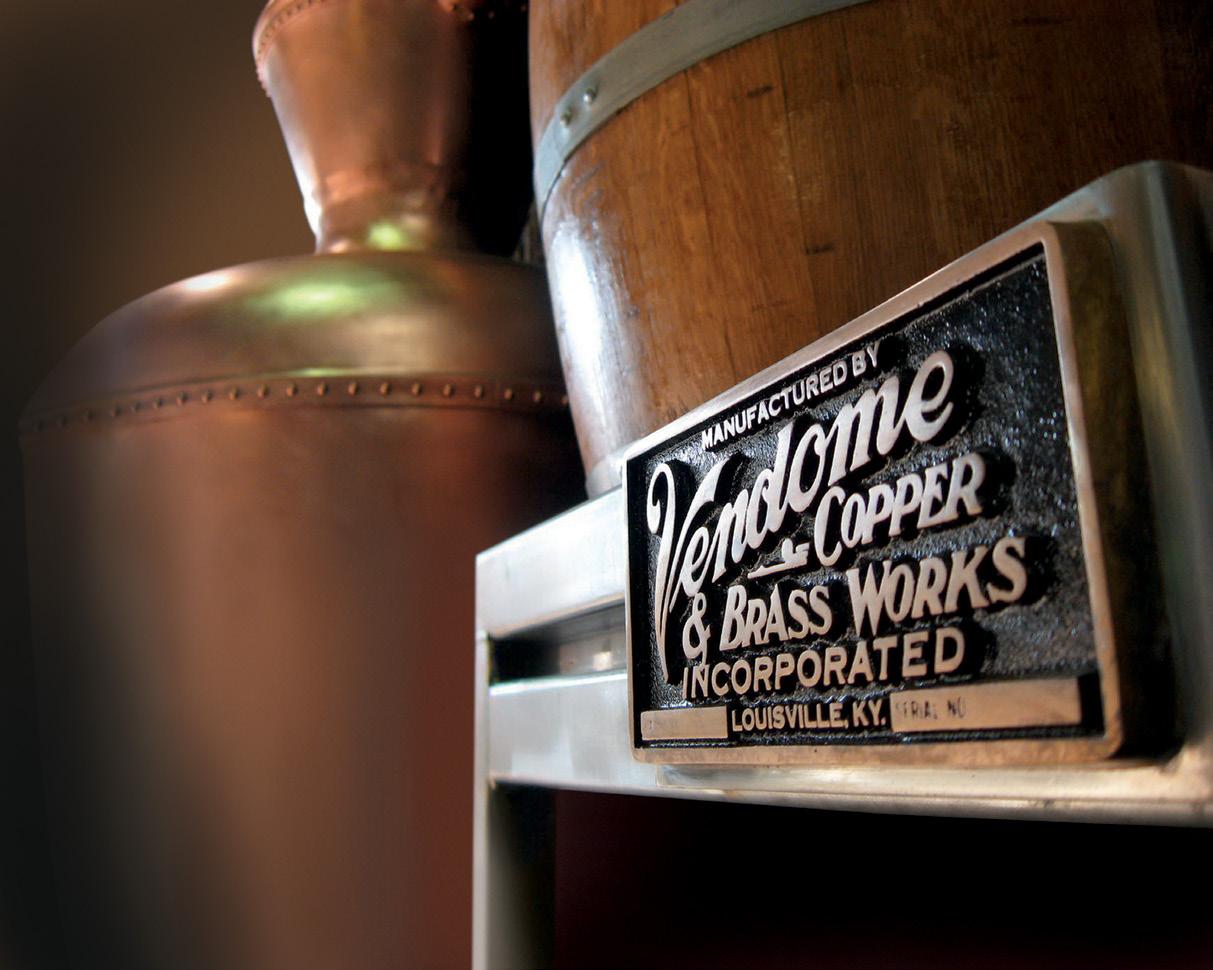

Ifirst met Ted Huber at his family's distillery where he was hosting an American Craft Spirits Association spirits competition. Our first interaction was when he handed me a sample of Pappy 23 (before it was cool) while chatting about how impressive his new trash compactor was at handling all the packing material the competition generated — a brag I thought was ridiculous at the time, but have since grown very jealous of.
Over the years, as I’ve gotten to know Ted, I’ve been constantly amazed at how humble he is while being such a force in our industry. There is something unique about being one of your state’s biggest tourist attractions and only wanting to talk about how the shape of your new fermenters will affect the flavor profile of your next whiskey.
Every time I walk into a new bar, restaurant, or liquor store and see something from Starlight Distillery I smile — because I know that not only is that placement well deserved, but represents years of tireless dedication to strengthening our community and industry. Ted embodies the idea that a rising tide lifts all ships.
What makes our small industry so compelling is the passion, comradery, and genuine interest that we all share in each other’s success — and Ted is one of our finest examples.
— Colton Weinstein
What is the best piece of advice you have received as a distiller?
To surround yourself with the most talented individuals available while maintaining an unwavering commitment to quality. Success in this industry is built on expertise, collaboration, and a dedication to continuous improvement.
Equally important is staying true to your brand identity and story. Authenticity resonates with consumers, and the moment you try to be something your brand is not, you risk losing the trust and connection you’ve worked so hard to build. Crafting exceptional spirits isn’t just about the product — it’s about the passion, values, and history behind it. Staying true to those foundations is what ultimately sets a brand apart.
Do you have a favorite memory or story from your time as a distiller?
While there are many memorable moments throughout my journey as a distiller, what stands out the most isn’t a single memory, but a feeling — the pride of watching my two sons take the lead in growing our company and pursuing their passion. Seeing them fully embrace the craft, build upon our family’s legacy, and drive the business forward is one of the most rewarding experiences any father could hope for. It’s a testament to the dedication, hard work, and shared vision that has shaped our distillery, and it gives me great confidence in the future of our brand and the industry as a whole.
Building a lasting career in the spirits industry requires curiosity, dedication, and a willingness to continually learn. Ask questions, seek mentorship, and stay committed to a clear plan while remaining adaptable to industry changes. Consistently researching and expanding your knowledge will help you refine your craft and stay ahead of evolving trends.
Equally important is staying engaged with industry associations and professional networks. These connections provide invaluable resources, advocacy, and opportunities for collaboration.
Most importantly, understand that building a spirits brand with true longevity takes decades. Success is not immediate — it is earned through patience, persistence, and an unwavering commitment to quality and authenticity.
“Building a lasting career in the spirits industry requires curiosity, dedication, and a willingness to continually learn.”
— TED HUBER
Base Selection Standards:
› An individual (not a business)
› A distiller (active or retired)
› Having the fundamental skills in distilling, blending, fermentation, aging, etc.
› Recognized as a quality producer
› Distillery size is not a consideration (craft or macro)
› Distillery ownership is not a requirement
Education & Values:
› A steward of knowledge who educates passionately
› Fosters community
› Collaborates
› Not a “jackass” (aka, no history of shouting people down, pretentiousness, bigotry, sexism, etc.)
Innovation:
› Willing to push boundaries while still understanding and learning from tradition
› Not afraid to learn from failure
Advocacy & Leadership:
› A leader in legislative or community issues and regulations (state/federal/guilds/associations)
› Industry advocacy to customers and others outside the boundary of the distillery
› Celebrity status within the distilling industry is not a selection requirement
Nicole Austin
DIAGEO – GEORGE DICKLE
2020 Artisan Spirit of the Year
Chris Montana
DU NORD SOCIAL SPIRITS
2021 Artisan Spirit of the Year
Johnny Jeffery
INDEPENDENT CONSULTANT
2022 Co-Artisan Spirit of the Year
John McKee
HEADFRAME SPIRITS 2022 Co-Artisan Spirit of the Year
Todd Leopold
BROS 2023 Artisan Spirit of the Year
Colton
“My goal has always been to ensure that independent distillers have the opportunities, resources, and regulatory framework necessary to thrive.”
— TED HUBER
How would you hope your legacy will be remembered in the distilling community?
I hope to be remembered as an early pioneer in the craft spirits movement — someone who embraced innovation and helped shape the industry during its formative years. Beyond that, I want my legacy to reflect my dedication to strategic planning and my unwavering commitment to advocating for the industry as a whole.
Through active legislative efforts, I have worked to create policies that promote fairness and parity for craft distillers at both the state and federal levels. My goal has always been to ensure that independent distillers have the opportunities, resources, and regulatory framework necessary to thrive. If my contributions have helped pave the way for future generations of distillers, then I would consider that a lasting and meaningful legacy.
How has your distillery adjusted to changes in the market and consumer preferences while staying true to its heritage?
We are fortunate to welcome over 750,000 visitors to our property in 2024, providing us with a unique opportunity to engage directly with consumers and gain real-time insights into evolving preferences. This high level of interaction allows us to adapt swiftly to market trends while maintaining the integrity of our heritage and craftsmanship.
Our 700-acre estate serves as an invaluable test market for new product development and innovation, enabling us to refine offerings based on direct consumer feedback. By carefully balancing tradition with innovation, we can introduce new expressions or refine existing ones while staying true to our core values of quality, sustainability, and authenticity.
This dynamic approach ensures that we remain relevant in an ever-changing marketplace while continuing to honor the legacy and time-honored practices that define Starlight Distillery.
What role do you think multi-generational distilleries like yours play in shaping other craft distilleries?
At Starlight Distillery, we take a long-term, multi-generational approach to our business. Unlike many distilleries that focus on 5-, 10-, or 20-year plans, we think in terms of sustainable growth over multiple generations — two, three, four, or more — ensuring that the legacy we build today can be successfully passed down.
As a multi-generational distillery, we believe it is our responsibility not only to uphold the values of our family and company, but also to contribute to the long-term success and integrity of the craft spirits industry as a whole. This means resisting shortcuts and prioritizing quality, authenticity, and sustainability over quick gains.
Family-owned distilleries face unique challenges, but those committed to longterm growth must be willing to pave a path less traveled — one defined by resilience, innovation, and a steadfast commitment to craftsmanship. By doing so, we hope to set an example for other craft distilleries, demonstrating that success is not just measured in years but in generations.

“Collaboration is the key to growth, and by working together, we can continue to strengthen and elevate the craft spirits community.”
— TED HUBER
industry-wide issues. By the late 1990s, however, a similar support network for distilleries simply didn’t exist.
You have a long history of supporting trade and industry associations. Why have you supported these groups, and how has this involvement benefited the industry and the broader community?
Growing up in a winemaking family in the 1970s, I witnessed firsthand the challenges faced by producers across the country and the critical role that state associations played in fostering collaboration and addressing
Throughout my career as a winemaker, I relied heavily on state and national associations to help navigate regulatory landscapes, advocate for industry interests, and promote business growth. But when we founded our distillery, I quickly realized that no such infrastructure was in place for craft distillers. In fact, many states — including Indiana — lacked the necessary permits to operate a craft distillery altogether.
To bridge this gap, it was essential to create networks that facilitated conversations with federal, state, and local authorities. The formation of the American Distilling Institute in the early 2000s was a pivotal step in fostering state-to-state collaboration and
establishing roadmaps for launching and operating distilleries. Later, the American Craft Spirits Association brought together existing distilleries to address ongoing challenges at the local and national levels. On a broader scale, the Distilled Spirits Council of the United States has been instrumental in shaping industry regulations, advocating for favorable legislation, and providing essential education and safety resources.
Without the efforts of these organizations, Starlight Distillery would not be where it is today. I strongly encourage any distillery — whether new or established — to join these associations, actively participate, and lend their voice to this ever-evolving industry. Collaboration is the key to growth, and by working together, we can continue to strengthen and elevate the craft spirits community.
Written by SAILOR GUEVARA
Anew standard of identity for distilled spirits labeling and advertising was added to Part 5 of the code of federal regulations (CFR) by the Alcohol and Tobacco Tax and Trade Bureau (TTB) on December 18, 2024. This standard of identity defines and protects the category of American single malt whiskey and is the first new standard of identity to be added to the CFR in over 52 years. Effective as of January 19, 2025, the new standard states that American single malt whiskey must adhere to the following production standards per the Federal Register, Addition of American single malt whiskey to the Standards of Identity for Distilled Spirits, published on 12/18/2024:
• Made from 100 percent malted barley
• Distilled entirely at one distillery
• Mashed, distilled and matured in the US
• Matured in oak casks of a capacity not exceeding 700 liters
• Distilled to no more than 160 (US) proof (80 percent alcohol by volume)
• Bottled at 80 (US) proof (40 percent alcohol by volume) or more
Many felt the importance of an official American Single Malt category was critical to the continued growth of American
whiskey. The new category officially recognizes and legitimizes a distinct style of whiskey produced entirely in the United States, allowing distillers to showcase their unique American terroir and innovative techniques while giving consumers a clear identity for these whiskeys, separate from traditional Scotch single malts, fostering further exploration and experimentation within the category.
There was much fanfare nationwide when the news was released. The American Single Malt Whiskey Commission (ASMWC) — established in 2016 with the support of Distilled Spirits Council (DISCUS) — and many other entities who led the charge to make this official category a reality were clearly proud of their tireless efforts and years of hard work.
Despite the excitement across the country, some producers were opposed to certain facets of the definition. One is Phil Steger, founder and CEO of Brother Justus Whiskey Company in Minneapolis, Minnesota.
When the TTB requested public comments on the proposed new standard of identity they posed eight questions:
• Use of Coloring, Flavoring or Blending Materials
• Use of the Designation “Straight”
• “Blended” American Single Malt Whiskey
• Impact on Trademark Owners and Producers of Malt Whiskey
• Use-Up of Previously Approved Labels
• Competition in the Alcohol Beverage Market

When the comment period closed, the TTB published their discussion of comments:
“After careful consideration of the petitions received in response to this issue in Notice No. 176 and the comments received in response to Notice No. 213, TTB is finalizing a standard of identity for “American single malt whisky,” with two changes from the standard proposed in Notice No. 213. As originally proposed, TTB is defining American single malt whisky as a type of whiskey that is mashed, distilled, and aged in the United States; is distilled entirely at one U.S. distillery; is distilled to a proof of 160 or less; is distilled from a fermented mash of 100 percent malted barley; is stored in oak barrels (used, uncharred new, or charred new) with a maximum capacity of 700 liters; and is bottled at not less than 80° proof.”
It went on to say:
“In the first change from the proposal in Notice No. 213, TTB is providing for the use of the designation “straight” with American single malt whisky that is aged for two years. The second change allows for the use of caramel coloring as long as it is disclosed on the label. This new standard of identity will be added to 27 CFR 5.143. The TTB is also revising certain other sections in part 5 to include cross references to American single malt whisky.”
— Addition of American Single Malt Whisky to the Standards of Identity for Distilled Spirits, A Rule by the Alcohol and Tobacco Tax and Trade Bureau on 12/18/2024
The rule that Steger and a few other producers took issue with was the distilling proof. Per the proposed rule, to meet the standard of identity for American single malt whiskey, the alcohol content of the liquor must not exceed 160° proof during distillation consistent with petitions TTB had received. It is also consistent with the current standards for many whiskey type standards, including “malt whisky” and “whisky distilled from malt mash.”
The opponents made mention that Scotland and other single malt producing countries like Japan have a proof cap of 190 proof; they feel that this rule of the cap of 160° proof will cap creativity.
“I respect the tradition so deeply. I am not here to just repeat what other people have said. My intention is to add a meaningful contribution to the conversation. In a way that contributes, in a way that doesn’t drown out anybody else or talk over anyone else. I am not trying to take away anyone else’s voice. I am just trying to add something to a 1,000-yearold tradition that will be meaningful and delicious. And I think we have to be very humble and teachable about what has been learned in the rest of the world throughout these thousand years of experimentation about what is the best way to treat malted barley when that is your entire mash for distillate,” said Steger.
The TTB included this paragraph in reference to the proof cap: “Five commenters opposed a maximum 160° distilling proof, including Loon Liquors LLC, Brother Justus Whisky Co. [sic], and Little Round Still. Loon Liquors LLC stated that consumer expectations have been shaped by single malt whiskies distilled in Scotland and elsewhere, which allow distillation at less than 190° proof, and limiting distillation proof to 160° could confuse consumers. Further, the commenter states that distilling at high proof (between 160° and 190° proof) provides for precision in creating their signature flavor profiles, and limiting proof to no higher than 160° proof prevents American distillers from innovating and competing with distilleries in other countries that do not have such a limitation. Brother Justus Whisky Co. [sic] similarly pointed out that other international single malt whisky standards allow distillation at up to 190° proof and stated that a lower limit
“I support definitions. I just feel that we are in the very early stages of experimenting with American single malt whiskey, too early to determine these standards and rules.”
— PHIL STEGER Founder and CEO, Brother Justus Whiskey Company
would stifle innovation and market access by smaller producers. Little Round Still stated that American single malt whisky should have the same distillation proof limit as single malt whiskies elsewhere, that is, less than 190° proof.”
The TTB went on to say that others supported the proof cap; “However, the majority of commenters specifically discussing this criterion supported it. For example, the ASMWC supports a distillation proof not exceeding 160° proof, stating that this is an important provision designed to ensure the flavor and character of the grain remains after distillation. The ASMWC points out that, while the Scotch whisky regulations for single malt allow for distillation of up to 190° proof, they also require the use of pot stills, which according to ASMWC, are intended to ensure that more grain flavor is retained in the final distillate. ASMWC asserts that the same result is achieved by providing a lower maximum distillation strength of up to 160° proof. The Scotch Whisky Association similarly expressed support for the 160° proof distillation limit for American single malt whisky, stating it is consistent with single malt whiskies produced elsewhere. Other commenters, such as the Whiskey Lodge expressed support for a distillation proof not exceeding 160° noting that the limit was in line with other American whiskies.”
In the TTB’s final response to the comments regarding the proof cap they stated they would be including the 160° proof cap; “With this final rule, TTB is incorporating a distillation proof of 160° or less for American single malt whisky, consistent with the proposal.” In their response they stated that, “the proposed criterion is consistent with the current standard for ‘malt whisky’ under TTB regulations, as well as most other types of whisky. As with other criteria, one goal in setting forth a standard of identity for American single malt whisky is to recognize the importance
of existing standards for single malt whiskies internationally while also reflecting unique aspects distinctive to American production.”
The TTB went on to say, “Additionally, international standards allowing for certain single malt whiskies to be distilled up to 190° proof exist within the context of other standards. The ASMWC points out in its comment that, while for example Scotch whisky standards allow for distillation up to 190° proof, those standards also require the use of pot stills. TTB also notes the ASMWC's assertion that the 160° distillation proof maximum accomplishes the same goal as the Scotch whisky pot still requirement in retaining the grain flavor in the distillate, which may be significant to consumers.”
Steger explains his main concern: “We are talking about a very early stage of a spirit category. Unlike bourbon and American rye whiskey, there is no tradition of experimentation in American single malt whiskey; the rye and bourbon definitions were codifications of traditions that developed over generations. For setting actual rules for bourbon and rye in the United States, there was already a tradition of making these whiskeys. The commission had a real challenge in front of it, before there was a tradition of making American single malt whiskey, before there was a tradition of experimentation and the exchange of knowledge and before consumers even know the term really means, this body said, we are going to determine what that means and then we are going to make that the law that every producer has to follow. That is challenging for me. I support definitions. I just feel that we are in the very early stages of experimenting with American single malt whiskey, too early to determine these standards and rules.”
Steger admits he was late in discovering the American Single Malt Whiskey Commission and since he did not agree with the rules that the commission had chosen, he could not become a member and did not expect them
to change what they had worked hard at for so many years at that stage. He takes no issue with the commission. What Steger takes issue with is the TTB making that definition the rule before there has been any broad-based experimentation. It should be noted that the first modern American single malt whiskey commercially released was McCarthy’s Oregon Single Malt in 1996, just 20 years prior to the forming of the ASMWC.
“I applaud the leadership of craft distillers. But even craft distillers don’t have a history of fermenting 100 percent fermenting malted barley. Our history is so short, and I believe we are closing off our imagination of what’s possible,” says Steger.
Steger proposed that a certification with a label that producers could choose to add to bottles if they made their whiskey to the commission’s standards should have come first before a federal law that affects every distiller in the United States and future distillers as well.
Have we pushed for a standard of identity too soon? Have we short-changed ourselves? Only time will tell.
Steger would like there to be an open discussion with all American single malt whiskey producers invited to the discussion to discuss the merits of capping distillation at certain proof levels to explore what you lose and what you gain with certain caps.
Steger ultimately felt the TTB’s failure to engage substantively with formal comments was a breach of legal obligation. Steger says that every distiller should have a problem with the lack of engagement on comments. “We have a big problem with how this was handled because the decision should be based on what’s best for the industry, not on how many votes for a certain point of view,” explained Steger.
Have we pushed for a standard of identity
too soon? Have we short-changed ourselves? Only time will tell. How distillers opposing these rules proceed will prove challenging, demanding compromise from some and conflict from others.
One thing is sure, craft distillers once again prove their power and might despite being underdogs.
Sailor Guevara is a veteran of the spirits and hospitality industry, the 2020 winner of the World of Whiskey Icon award, and an author and contributor to several spirits publications. As an acclaimed podcast host and published mixologist, Sailor enjoys sharing her passion for spirits and music with the world.



WRITTEN BY RICH MANNING
When you hop onto a distillery website as a consumer, there is one word that you might see that can deliver an instant burst of happiness: Shop.
This can be an exciting sight, especially if you’re seeking out a bottle that doesn’t have robust distribution in your home state (if there’s distribution at all). A few clicks, and you’ll never again have to lament about having to travel hundreds of miles and across several state lines to get your hands on that one local or regional bottle you discovered while on that business trip.
That’s the consumer viewpoint of online booze shopping from a distillery website, at least. The distillers may have a slightly different viewpoint of the practice. That’s not to say it isn’t beneficial to the distilleries choosing to set up a shop on their website — It does indeed have a few perks. However, as more distilleries turn to this method, the more glaring the gaps in the system become.
To the untrained eye (read: consumers), purchasing a bottle from a distillery website looks an awful lot like a direct-to-consumer (DTC) transaction. Of course, calling these purchases DTC is a large if not egregious misnomer. As of December 2024, only seven states — Alaska, Arizona, Kentucky, Nebraska, New Hampshire, North Dakota, and Rhode Island, plus Washington, DC — allow interstate DTC shipping and Alaska, Arizona, and Rhode Island place limitations on what can be shipped. Any distiller existing outside this bubble still requires a third-party partner like a fulfillment center for a bottle to properly get from point A to point B. This is a point of frustration for distillers selling their bottles online. The process strips the distiller of shipping control and customer engagement, which could be problematic should an issue with the order arise. In these instances, it’s not their problem to fix: It’s the nondescript online go-between that separates the distiller from the consumer, which could create some serious issues.
“As much as I’d like to make it part of our long-term growth strategies, I can’t due to all of the laws. If you can’t pull much of a profit from it, you can’t really invest in it.”
LIRAN REINGOLD
YEYO TEQUILA

“Traditional distribution fails small brands. The intentions are there but the attention simply isn’t.”
PHIL STEGER BROTHER JUSTUS WHISKY COMPANY
“When you’re dealing with a fulfillment center, your name is on the line, not theirs,” explained Liran Reingold, Los Angeles-based CEO and managing partner of Yeyo Tequila. “All you can do is just hope they’re following through on orders the way you want them to. Unfortunately, they work with hundreds of other brands, so they may not care about your brand like you would if you were in full control. If you find out there’s an issue with how they’re doing things, it may be too late to fix it.”
While online sales isn’t the DTC model that the craft sector craves, it’s still another potential revenue stream. Some distillers are learning how to swim in its metaphorical waters. “We’re just starting to figure it out,” said Robyn Cleveland, co-founder and head distiller at Norden Aquavit in Chelsea, Michigan. “It’s still a work in progress, but we’re doing what we can with it within our shoestring budget little by little.”
The model can be theoretically beneficial. However, Norden provides an example of the gap that exists between theory and practice. In 2024, they were dropped by Skurnik as a traditional distributor in several states. One of those states was California, and the decision knocked the brand out of the country’s most robust alcohol sales market. Ideally, an online shopping model can swoop in and save the day in a situation like this. Yet while the model does allow California fans the opportunity to visit Norden’s website and order a bottle or two, it hasn’t mitigated the impact of losing distribution.
Norden’s situation also demonstrates the shortcomings that can crop
up with having an online store with no accompanying on- or off-premise presence. “We’re a tiny distiller within a small spirit category,” Cleveland said. “Aquavit is traditionally a sipping spirit. While our main strategy is to push it as a cocktail ingredient or as a gin substitute, we eventually like to teach consumers to drink it on its own. Traditional distribution helps with this education because it puts us in bars and restaurants. It’s probably why some of our strongest online sales are with states we’re already in.”
The existing online shopping model does contain a few perks. While it won’t produce game-changing profits, it could help a distillery earn a few extra bucks. It could allow the spirit’s fanbase to grow into unique rivulets that would otherwise not be possible. In other words, it’s a nice little thing to offer to current and potential customers. Still, the legal limitations behind the current model prevent it from being a serious component within a brand’s profitability plans. “As much as I’d like to make it part of our long-term growth strategies, I can’t due to all of the laws,” Reingold said. “If you can’t pull much of a profit from it, you can’t really invest in it.”
Even as more craft brands turn to a third-party, web-based online shopping model, the hope for actual DTC legislature remains as strong as ever. Advocates of distribution reform feel such reform would allow distillers to have more control over how their products are sold. They argue that this could give craft brands the kind of market leverage they can’t experience with the current
distribution arrangement.
“Traditional distribution fails small brands. The intentions are there but the attention simply isn’t,” says Phil Steger, founder and CEO of Brother Justus Whisky Company in Minneapolis. “Distributors might want to help small brands, but big brands expect huge results and put a huge amount of pressure on distributors’ sales forces to give them their full attention. DTC would help small brands grow to the point where they get the attention they need to grow further.”
Those that clamor for a switch from on-site selling through a third party to true DTC reform aren’t necessarily looking for a dismantling of the current distribution rules in place. Some, like Steger, feel it can enhance existing models. “DTC would strengthen the three-tier system,” he said. “Distributors and retailers are absolutely essential to getting good product out to consumers at scale, as well as educating the public about what’s out there, what’s hot, and to some extent what’s good and groundbreaking. DTC gives small brands the chance to grow into larger brands that distributors and retailers can sell and use to grow their sales and improve their relationships with their customers.”
The debate over allowing distilleries around the country to genuinely ship directly to consumers instead of via a third party may likely continue even after legislation gets passed. There is no timeline here, so proponents of change will have to wait and push their fight forward. In the meantime, the faux version involving fulfillment centers will have to do. It’s not necessarily ideal, but as long as customers are compelled enough to press the “shop” button on the distillery website, it’s an option that’s here to stay.
When a historic inn and lavender farm in New Mexico added gin to their product portfolio, it was the start of a new era

OWritten by CARRIE DOW
MERRIAM

n the outskirts of Albuquerque, New Mexico, an area known for tumbleweeds and chiles, sits a lavender farm. At 25 acres it’s not the largest, but during summer blooms the fields of pastel greens and purples next to bright white barns evoke the sights and scents of Provence, France. Throughout the season, the farm hosts overnight guests at a tranquil inn along with holding weddings, anniversaries, and other life events for anyone wanting to celebrate inside an Impressionist painting.
Los Poblanos Historic Inn & Organic Farm has been an Albuquerque institution since the 1930s when the farm was founded by two prominent married Congressmembers from Illinois, Albert Simms and Ruth McCormick Simms, who wanted to improve American agriculture coming out of the Great Depression. Naming the property for the ancient Pueblo peoples (Poblanos) who once lived in the area, their experimental farm and ranch innovated the raising of a variety of crops and livestock, including heritage breed dairy cows, alfalfa,

oats, corn, barley, roses, and most famously sugar beets, reducing America’s dependence on imported beets during World War II. The couple also commissioned prominent architect John Gaw Meem to redesign the existing ranch house into a grand residence, complete with details and artworks (and New Mexico’s first swimming pool) by craftspeople and artisans hired through the New Deal’s post-war Works Progress Administration.
Over the ensuing decades, parts of the property were sold off, and after Mr. Simms passed away in 1964, the remaining farm and residence was sold to the Rembe family, who continued farming but planted lavender instead because it grows extremely well in New Mexico’s water-starved environment. They also turned the giant residence into a luxurious 45-room bed and breakfast, added a restaurant serving dishes featuring their organically grown ingredients and — needing to do something with all that lavender — developed an essential oil factory to create their own bath and spa products. The lavender products — soaps, salves, and lotions touted by the likes of Martha Stewart and Joanna Gaines — quickly turned into a thriving business on its own. But the Rembe’s weren’t done with lavender yet…
•••“With our lavender background, we have to do a lavender gin. We have to!” exclaimed Karen Converse, Los Poblanos’ director of manufacturing operations. “Is it going to be kitschy? Absolutely not. We’re going to put out a really nice product.”
Converse said the manufacturing side of the enterprise was already experimenting with distilled spirits when the 2020 pandemic shut down all of their in-person businesses. Since they already distill essential oils and hydrosols, it wasn’t much of a stretch. What they didn’t expect was people stuck at home and wanting to pamper themselves with lavender products, driving the sales of their newly opened online store. They had to scale up and fast.
“We outgrew our production space on


property,” she began, “and if we were gonna get a space, we’re gonna get a space,” she added, holding her arms up to show off the large building we stand in. “And to pay for it, we’re going to do distilling. Enter this building.”
“This” building originally opened as Heaston Town and Ranch Tractor Supply near downtown Albuquerque. It was a combination of hardware, feed, and grocery store plus luncheonette typical of Western frontier towns back then. Keeping the name Town & Ranch, the Rembes bought it and took great care in restoring the 1940s exterior. They turned the inside into their main manufacturing and distilling facility (divided in the building’s back half) while the front half is divided into a retail store with large windows on one side and a cozy speakeasy lounge with live music on the other.
The distillery has two flagship gins, Lavender (of course) and New Western. Lavender is made with 15 botanicals including four distinct lavender cultivars — Royal Velvet, Provence, Munstead, and Buena Vista — while the Western is made with a whopping 17 botanicals either grown on the farm or coming from the surrounding community. The Lavender, which quickly became their best-selling distilling product, has all the floral notes a lavender gin should, but Converse says it took about a year to settle on the recipe.
“Different lavenders have different profiles and tastes,” she noted. “There are lavenders out there that smell like bubblegum. Some smell like vanilla.” It was also a team effort with Converse and head distiller Jamie Lord sending sample batches from a small R&D still to the farm and restaurant for taste testing.
“We have a really robust cocktail program on the property,” she noted, “so their palate, the chef’s palate, the staff’s palate. I joke we don’t test on animals, just our employees.” Part of that recipe by committee includes the selection of cane neutral spirit as the gin’s base because of its inherent sweetness and soft mouthfeel. However, once they settled on a recipe, the TTB wasn’t convinced on the product category, and it took a bit of back and forth.
“It took about three months (with the TTB),” she said. “They were like, ‘It must be a flavored product.’ But it’s not flavored. It’s distilled. Then they’re like, ‘There’s probably not enough juniper in it.’ I’m like whatever. We’re not making a London Dry.”
Los Poblanos’ New Western Gin moves in a more earthy direction with the addition of some heat. It still retains the lavender but tones down the floral. Converse says the New Western Gin is a nod to New Mexico, where they pulled back the juniper to focus more on local ingredients like pinyon resin, Hawthorne berries, chamomile, lemongrass and several types of peppercorns, cementing the gin’s flavor with a sense of place. Devoting that much attention to local flavors and ingredients helps to explain the out-of-box success of the new distillery.
When both gins launched in 2023, Converse says they were voted as Best Craft Gins in USA Today’s Readers’ Choice Poll, so they must be doing something right. She says it goes back to their skills in distilling essential oils, which they’ve been doing for decades.
“We are very good at distilling botanics,”
she emphasized. “We know how to extract it…People are like, ‘When does your vodka come out? When does your whiskey come out?’ and we’re like, ‘No, we only do botanical spirits.’”
Converse wants to make it known that they aren’t competing with New Mexico’s distilling industry, even though they are state guild members. Los Poblanos is more about growing and supporting New Mexico.
“What’s cool is our mission is also to elevate New Mexico and New Mexico products,” she said, and that’s why they use and partner with local vendors and manufacturers throughout all of Los Poblanos’ businesses. She also adds that before they opened the distillery, New Mexico updated state liquor laws to include a “reciprocity law.” Tasting rooms are allowed to serve alcohol from other New Mexico distilleries, breweries, cideries, and wineries and are allowed to sell those bottles on premises. Passed in 2015 for beer, wine, and cider and later expanded to include spirits, the law requires that these products must


contain at least 50 percent New Mexico-grown ingredients. Converse believes it is one of the most progressive liquor laws in the country. “It lends very well to our model of elevating and promoting New Mexico.”
Converse says that Los Poblanos is branching out into other spirits, but only botanical ones. They have a line of bitters coming out and are “playing with” an absinthe.
“I think this [focus on botanical spirits] has helped to ease the other distilleries,” she said. “Admittedly, when we first started in the spirits business, I think there was a little bit of, ‘Oh, here come those lavender folks.’ I’m aware that our lavender products funded our still, and I know that’s not what a lot of distilleries can do. They put a lot of blood, sweat, and tears into it.”
“There are other distilleries in the state making great spirits — agave, whiskies, vodka,” she continued. “But if it has a botanic, we’re going to run with it. That is our brand.” Los Poblanos has the lavender-verse covered.
Los Poblanos’ Town & Ranch Tasting Room is located in Albuquerque, New Mexico. For more information visit spirits.lospoblanos.com or call (505) 808-1715.
Athe cocktail staple it should be (unless you are from Wisconsin, they know what’s up). One could speak about apples, peaches, or grapes as a starting point for a deep dive into brandy raw materials, but the story of Bartlett pears is far too curious to pass up.
Pears have been an important food staple for millennia. So long, in fact, that we do not know for sure where they originated (although there are stories). Speculated to have evolved from China and/or the Middle East, it is largely agreed that they were domesticated between the Black and Caspian Seas in the Caucasus region. Ancient Sumerian writings from 2750 B.C. mention pears, and dried pears were discovered in Ice Age caves in Switzerland, indicating their long history.
During the reign of the Roman Empire, the number of pear varietals increased from 6 to 40 and spread throughout the empire for use as food, drink, and the occasional poultice (don't you love a good ancient poultice). Our favorite ancient reviewer, Pliny the Elder, remarked on how the fermented pear juice beverage Castomoniale was held in higher esteem than similar drinks made from apples. Indeed, it is a fruit that spans the ages and has fed nomads and early civilizations alike. As for the Bartlett itself, there is an account from 1483 of a holy man named Francis of Paola who was compelled by the pope to fulfill a request by King Louis XI to travel to France and potentially cure the dying monarch. He brought pear seeds with him on his mission of mercy as a gift, asking only that they be planted and cared for. It is believed that this story is where the variety picked up an initial moniker of Bon Chretien, meaning “good Christian,” to reflect Francis’ kindness.
s craft distilling grows and evolves, more time is spent doing deep dives into raw materials, finding new and innovative ways to celebrate heritage or heirloom ingredients and shine a light on their cultural importance or history. Understandably, that tends to be more grain focused as whiskey continues to dominate production and consumption. However, brandy throughout its history has been a spirit of sustainable agriculture. American consumers often hold the opinion that brandy is “fancy” and see it relegated to dark and dusty corners instead of
The fruit’s “discovery” in 1765 by John Stair on his property in Aldermaston, Berkshire, England, is less disputed. Now I know what you are thinking: If this pear already had a name and an epic story behind it, who would have the audacity to rename it? Well, my friends, hubris is this tale’s most
The story of Bartlett pears is far too curious to pass up.


essential ingredient. For a brief time, it was known as the Stair's Pear or Aldermaston Pear before being picked up by a nurseryman named Richard Williams, who then renamed it the Williams Pear, although the full name is Williams Bon Chretien.

simple and exquisite Bartlett pear brandy.
Three names deep, we are off to the newly founded United States, where Williams Pears are imported by James Carter, who somehow managed to not rename them after himself on the boat ride across the Atlantic. The trees were planted on Thomas Brewer's property in 1799, and soon after, the property was sold to Enoch Bartlett. Not knowing the origin of the trees on his newly acquired estate, Enoch named the delicious and plentiful fruit and the tree it grew on after himself and thus began selling Bartlett pear trees throughout the Eastern U.S.
Grown in large quantities and in a convenient ready-to-ferment package, Bartletts have everything happy yeast needs to make delicious brandy. The fruit itself, intensely fragile when ripe, is traditionally picked green from the trees and delivered to cold storage. The necessity to protect the fruit by keeping it cool has another huge advantage for those making brandy. If left to ripen on the tree, a Bartlett will begin to ripen from the inside out and along each pear’s individual timeline. Cold storage changes the way ripening genes are expressed and instead of taking 9-12 days to ripen, creates consistency and allows for whole
Known for its sweet juice and incredible flavor, the Bartlett pear is a popular distiller's choice for brandy.
In 1828, a new delivery of Williams pear trees arrived from Britain, and a few years later it became ap-pear-ent that the Bartlett and Williams pears trees were the same tree. Due to its ease of growth, plentiful fruit production, and its incredible deliciousness, the tree was planted and shared throughout the U.S. to such an extent that the name "Bartlett" stuck. This popularity continues 200 years later with the Bartlett representing 75 percent of the pear crop harvested in 2022 for the U. S. and Canada.
Known for its sweet juice and incredible flavor, it is a popular distiller's choice for brandy. It is also worth noting that the first and third craft distillation operations in the U.S. (St. George Spirits and Clear Creek Distillery respectively) started with the
The fruit itself, intensely fragile when ripe, is traditionally picked green from the trees and delivered to cold storage.
truckloads to ripen in 7 days and evenly from pear to pear. Just like any other spirit, under-ripe or poor quality fruits have the largest effect on the finished product. With a low pH, Brix between 12-14, and warmed by the ripening process, the fruit is ready for yeast immediately after crushing with no need for water or energy inputs.

Designing and crafting exceptional spirits from ground to glass

● Expertise in recipe development, distillation techniques, and sensory analysis
● Designing efficient, scalable production facilities tailored to your needs
● Implementing best practices in workflow optimization and safety
● Overseeing project timeline, budgets, and construction phases
● Barrel selection and maturation strategies for optimal flavor profiles
Whole-fruit fermentations are more labor intensive, requiring daily punchdowns to manage temperature, oxygen, and incorporate the material into the main body of the ferment. The prize for your labor is pervasively fragrant brandy that smells so convincingly of the ripe fruit it was made from that your tastebuds expect more sweetness than a dry, 80-proof spirit can provide. The flavor itself is a balance of the whole pear, from the fruity and floral juice to the slightly tannic bitterness of the peel.
While Bartlett pear brandy has yet to have its moment in the spotlight, it is an essential part of both pre- and post-Prohibition distilling history in
While Bartlett pear brandy has yet to have its moment in the
● Guidance on blending, finishing and quality control for premium products





We have covered several topics over the course of the last few editions of this wonderful publication, but there is something big that we have not touched upon yet. The still is running and distillate is flowing, and all is right in the world. You have your property, casualty, and liquor liability insurance in place. You think to yourself, “Well done, self!”
Sales continue to grow, the tasting room is busy, and now is time to hire some much-needed additional assistance to take some of the load off. You post the open positions, resumes pour in with people who are excited to be a part of working at your distillery/brewery/winery/meadery, or whatever it is that you are crafting, and you hire the top four candidates. They all start on Monday. The world is your oyster. Everything is perfect. Or is it?
One thing that plenty of folks do not think about when hiring additional help is insurance. “But I have all of my insurance in place! Remember up above where I was congratulating myself?” you may be thinking. Well, bringing on employees is much more than just finding the right folks to work for you. There are a myriad of insurance coverages and protective measures that you need in order to not only protect you and your business, but to also protect those who work for you. That is what we will discuss in this masterful article. In particular, we will cover the following, not ranked in order of importance, but kind of:
º Workers’ Compensation Insurance
º Disability Insurance
º Employment Practices Liability Insurance (EPLI)
º Life Insurance or Group Term Life Insurance
º Accident Insurance
º Directors and Officers (D&O) Liability Insurance
º Key Person Insurance
º Fidelity Bonds/Crime Insurance
I will briefly break these down into an overview of what each of these coverages provide and why they are important for you to consider.
Workers Compensation Insurance , “Work Comp” or “WC” for the cool insurance lingo folk, is the most essential insurance coverage to have if you have even one employee on the payroll. Work Comp covers medical expenses and lost wages for employees who are injured on the job or become sick due to work related illness. This coverage is important due to the fact that it is required by state law and not having it is super no bueno! This varies from state to state, but in almost all states (I’m NOT looking at you Texas, you nonrequired work comp crazies, you.), this is required. If you are required to have it and don’t, you and your business could personally be on the hook for damages, face fines, and even jail time. Do you need work comp? Yes! Even if it is not required, I would HIGHLY recommend it. Not only does it ensure that your employees are cared for in the case of work-related injury or illness, it also can keep you out of lengthy and costly legal battles should something happen. This coverage lasts until the injured party reaches a Maximum Medical Improvement (MMI) up to the policy limit, or they can return to work.
Disability Insurance , on the other hand, provides income replacement for employees that are unable to work due to a debilitating injury or illness. This coverage can come in short term disability (STD) or long term disability (LTD) depending upon what you are looking to provide. This coverage is not required but often is a good idea as it can assist in attracting and retaining talented employees since it offers financial security.


ance , better known as EPLI, protects against claims of harassment, discrimination, wrongful termination, or retaliation. This coverage provides settlement costs, but more importantly, it covers the cost of defense in such a scenario. I have seen some bogus EPLI claims brought by employees that were litigated and found to be unsubstantiated, but the legal defense costs to prove that nothing happened were in the tens of thousands of dollars, all to prove there was no “there, there.” It is better to have an insurance company pay for these expenses than to be financially responsible for such lawsuits.
ance can provide for payments to beneficiaries in the case of death. This can be purchased on an individual basis or as a group. The group option is generally less expensive and can be offered to employees at very little or no cost to them. This coverage offers peace of mind knowing that if something were to happen to them, their beneficiaries would be taken care of. Again, this is a nice perk to attract and retain good employees.
. This coverage pays benefits for injuries regardless of fault. If there is an accident, medical bills, hospitalization, and potentially some lost wages can be covered. It is a nice supplement to health insurance, or a nice offering if health insurance is not provided. It is not as all-encompassing as health insurance, but it does provide an extra layer of financial protection to employees.
ance , or what we insuranceologists refer to as D&O, protects the company’s directors and officers from personal liability from business decisions such as breach of financial duty, mismanagement, and even regulatory violations. Again, this coverage includes defense costs, settlement amounts, and damages up to the policy limit. Having this coverage safeguards the decision makers and the company from lawsuits so that strategic risks can be taken confidently without facing personal litigation should something happen.
Key Person Insurance , this one comes up more and more every day. Let’s say that you have an integral employee without whom you simply could not continue doing what you do. Case in point, I have numerous distillery clients who have brought in master distillers to help them formulate their mash bill, distilling and aging processes, etc. Without this “key person,” (see what they did there), they could not do what they do. What if that person suddenly becomes ill or passes away? Well, key person insurance is like life
There are many businesses with employees currently that may not know that these coverages are available, and I am not insurance-shaming here.
insurance, but for the business. This policy pays out a lump sum amount of the face value of the policy directly to the business to help cover lost revenue as well as the costs associated with finding a replacement. In a situation like this, coverage could be the one thing that helps your business survive and recover from the loss of a linchpin employee.
That brings us to Fidelity Bonds/Crime Insurance . I saved this one for last because it is the one that we really don’t like to talk about. This is the “ick” that shall not be named. The decision to hire a particular person was painstakingly made, and we never make bad decisions, right? What if, in this case, this one time, we made a hiring decision and they turned out to be ripping us off? Unfortunately, it happens at all levels in all types of businesses. Let’s say that an employee is stealing funds or product, defrauding a vendor, forging documents, embezzling, or simply conducting dishonest actions while on company time. This policy can protect your business from these types of financial risks. It can even cover things such as illegal fund transfers, credit card fraud, and receipt of counterfeit funds. These coverages can also shield the business from potentially devastating financial losses and ensure stability and continuity of operations.
Of course, each of these coverage descriptions are a 30,000-foot perspective of the different types of insurance that are offered to protect you and your employees, and protect you FROM your employees in certain circumstances. While not a definitive list of all coverages that you could procure, it is a comprehensive list of the top eight that should be considered prior to and after hiring employees. There are many businesses with employees currently that may not know that these coverages are available, and I am not insurance-shaming here. What you don’t know, you don’t know. That being said, no one wants to be “insurance poor,” and you could literally insure against almost anything and everything on the planet, but when is enough, enough? That is for you and your insurance professional to decide. Not every coverage option is for every business, nor should it be. Consider your personal operation and needs, and tailor the coverage to your desires and abilities. In the end, as long as you have done what you can to protect yourself and your business, that is all that can be done.
Until the next time we meet, Dear Reader …
Stay Vigilant, Aaron Linden


Aaron Linden is a professional purveyor of insurance policy products proposed to protect people proactively against perceived perilous perils and pitfalls, primarily. He has been in the insurance industry for 23 years, has specialized in craft spirits insurance for the last 15 years, and literally wrote the book (ok, the insurance forms) on spirits coverage for many insurance carriers.
What you don’t know, you don’t know.
Whiskey has a long and storied history dating back to its first known production in Ireland in 1405. Malt whiskey is a lively distilled spirit that is produced today in countries all around the world. Recent changes to the U.S. Alcohol and Tobacco Tax and Trade Bureau American whiskey production rules have introduced the new category known as American single malt whiskey (ASMW). With this newly recognized category, there is no better time to discuss the techniques used to distill this spirit. In this article, we will discuss in depth a traditional malt whiskey production method. While it goes without saying that there are many ways to make malt whiskey, some of these methods are more traditional while others are new and more creative. This is the reason why the whiskey at one distillery rarely tastes the same as the whiskey at another distillery.
First, let's touch on some history. Single malt whiskey production was first developed and refined in Scotland, or perhaps Ireland depending on where you look, over several hundred years, and the results of that production method have produced some of the finest single malt whiskey in the world. This article will take you step by step through the method employed by Scots so you can better understand the processes that were developed by distillers who came before us.
American single malt whiskey, while similar to scotch, has its own legal definitions and requirements on how it can be made. ASMW is made from 100 percent malted barley. The malted grain contributes considerably to the overall character and flavor of the spirit and is what differentiates ASMW from American bourbon or rye whiskey. The second aspect of American single malt that differentiates it from other American whiskey styles is that single malt can be aged in used or new barrels. Used barrels contribute a different flavor and character to a spirit than new American oak barrels do, such as those used for bourbon production. Single malt whiskey is also required to be distilled entirely at one distillery, below 160 proof. All of these rules allow for creativity while also squarely defining the category. Now that we have defined American single malt, let's talk about how single malt whiskey production emulates the methods used for its production in Scotland.
The specific types of equipment that are used in the production of single malt play a strong role in the flavors that exist in malt whiskey. Typically, a roller mill is used to crack the malted barley into smaller pieces to aid in sugar extraction. While most whiskey mashing uses a cooker to process the grain in malt whiskey production, a lauter tun is used instead of a cooker. The lauter allows for separation of the malted barley from the liquid that the grain is steeped in. The product produced by a lauter is often a clean fermentable liquid that is mostly free of grains known as wort. The wort is transferred from the lauter through a pump and heat exchanger.
WRITTEN BY KRIS BOHM

There are many different types of fermenters that can be found in distilleries from open top to closed, stainless steel, wood, and everything in between. The most critical part of a fermenter is that it is sized appropriately to hold all of the wort that is produced from the lauter. The fermenter serves to hold the wort while the yeast ferments the sugars in the liquid and converts the sugar into alcohol to produce a beer suitable for distilling.
Let's break down step by step the first half of the process of single malt production from a bag of malted barley to a distiller's beer ready for distillation.
Here is a simple sample recipe breakdown.
Malted barley 1500 pounds Golden Promise 2 row malt
Yeast 1 Kilogram
Distillers whiskey yeast
Nutrient Yeastex 82 or similar 50 grams dissolved in water
Ph adjustment Acid or base to adjust PH Plus or minus target 5.5 ph
Strike water 350 gallons Will depend on lauter design
Sparge water 300 gallons Will depend on lauter design
It is important to stress that many of these quantities and numbers are wholly dependent on the specific equipment being used, and it will take some testing and trials to determine optimal water quantity, temperatures, and minerals to enhance operation of the equipment. It is best to test and confirm operation of equipment and holding temperatures prior to your first mash because if everything is fully tested before mashing, you should have a successful first mash to make a wash that can then be distilled into single malt whiskey. It is critical to write up step-by-step standard operating procedures (SOPs) on your mashing process to create replicable results for every single mash. An example SOP is on the left.
MALT
OpErATing prOCEDUrES
Mill in grain per mash bill. Check quality of grind to ensure proper crack.
Add 50 gal of 160 degree water to lauter tun. Cover false bottom plus minerals for ph adjustment.
Turn rakes on and add grain to lauter with 300 gallons of water through hydrator.
Once fully grained in, check temp of mash and adjust as needed. Target temp is 146-148.
Turn rakes off and let mash rest for 30 minutes.
Slowly start run off of wort into grant. Do not rush this process or the mash may get stuck.
Vorloff wort till clear grant clears, then reconfigure manifold to run off wort to kettle.
Confirm cooling is functional on heat exchanger.
Start run off of wort from lauter tun through heat exchanger and transfer to fermenter.
When 50 percent of wort is run off, start sparging the grain with 165 degree water.
Continue to run off wort slowly until lauter tun is nearly empty of wort or fermenter is full.
Aerate wort prior to pitching yeast and check sugar content by plato or gravity at this time.
Pitch 1 kg of yeast into each fermenter per yeast manufacturer's instructions.
Set temperature controller on fermenter to maintain temperature.
Check plato or gravity daily till ferment is complete (should take 3-5 days).
At this point you have a fermenter full of distiller’s beer made from malted barley, ready to be distilled into whiskey. Distiller’s beer is quite different from a beer made to be drunk as beer itself — it does not have any hops added to it and is typically fermented faster than beer for consumption, usually only three to seven days. At this time the beer is around 10 percent ABV. Some distillers have higher or lower ABV beer, but 10 percent is a reasonable expectation. Move the beer from the fermenter to a copper still, where it will be heated up and the alcohol distilled out of it. A distillery will often employ multiple stills to complete the process of making whiskey. The still used for distilling the beer is referred to as a wash still, while a second still used for redistillation of low wines is called a spirit still. During the first distillation of the beer, a rough unfinished product is distilled called low wines. Low wines are the sum of all the alcohol distilled out of the beer along with water, oils, and a ton of flavor. The distilled low wines are not a finished product, as the concentration of alcohol is too low and the resulting distillate has too large of a water concentration. Low wines also do not taste very good, as they have a high oil content. To complete the distillation, low wines are put into the spirit still
and redistilled. During this second distillation, the heads and tails cuts are made, which remove methanol and oils. The portion of the whiskey that is kept from the second distillation is often referred to as the hearts. This second distillation will yield a clear whiskey known as new make whiskey. New make whiskey (AKA white dog or moonshine) can be as strong as 75 percent ABV or as weak as 55 percent ABV. The new make is diluted with some water then put into barrels. Below is a chart that breaks down volume of distillation and expected yields from the distillation.

The stills themselves employed in the process of distilling single malt whiskey play a strong role in the influence of the flavor profile of the whiskey. In Scotland and in other whiskey-producing countries, single malt whiskey is almost exclusively distilled in copper pot stills using the traditional batch distillation method. This method of distillation is intensive in both its use of energy and labor, but it produces a flavor profile that is difficult to replicate using a more efficient continuous column still for distillation. Because the flavor profile of malt whiskey produced through batch distillation is unique, distillers today still employ the traditional methods of batch distillation in making malt whiskey. Traditionally malt whiskey is also twice distilled. One reason for this double distillation process is tied to flavor because there are many oils and congeners in distiller’s beer. By distilling whiskey a second time, more oils and congeners are carried over into the distilled whiskey. These oils and congeners play a large role in the flavor of the finished mature spirit and are essential to create the complex flavor profile of single malt whiskey.
Now that you have some freshly distilled new make whiskey, it’s time to drink it! Just kidding; we have a few years to go before this whiskey is ready. It is time to put that whiskey in a barrel. One of the wonderful aspects of single malt production is the option to age the spirit in a multitude of different types of barrels. Unlike bourbon and rye whiskey, which can only be aged in charred new American oak barrels, single malt whiskey can be aged in new or used barrels, like sherry butts, wine casks, or used rum, tequila, or bourbon barrels. The option to age whiskey in a variety of barrels and casks opens creative freedom for a distiller to add unique character to the distillate from the barrel. There are some distilleries that age their single malt in a variety of casks, with some whiskey aging in new charred oak barrels and some in used barrels. Aging in a variety of barrels creates a diverse whiskey profile of flavor and color, which then allows folks the opportunity to blend, giving it even more
complexity. The concentration of alcohol in a new make whiskey when it is put into the barrel is a bit stronger than the strength at which it is often bottled. Entry proof is a big factor in maturation. Some folks will fill barrels with whiskey as strong as 62.5 percent alcohol by volume; others will barrel at a much lower 50 percent. This difference of entry proof plays a strong role in the flavor components extracted from the barrel.
Now that the whiskey is in your barrel, let's hurry up and wait. The amount of time a whiskey needs to mature in the barrel can vary immensely depending on many factors. The biggest factor is the environment in which the barrel rests. In colder climates such as the northern United States and in Scotland the maturation period is rather long for a whiskey to reach its potential and can exceed 10 years. When a barrel is stored in a warmer climate, the required amount of time is a bit shorter. In places like Texas, some distillers have found that single malt whiskey will fully mature in as little as three years. Determining whether or not a whiskey is fully matured is a hotly debated topic and best left up to those who make the choice as to whether or not their whiskey is ready to be bottled. Since a 10-year whiskey aged in Minnesota will not taste the same as a 3-year whiskey from Texas, determining a whiskey’s maturity is
extremely subjective.
If the whiskey tastes fully mature, it is time to blend some barrels together to create a finished product. The process of tasting and selecting the barrels that will be blended together to make a finished product is just as important as the distillation process itself. No two barrels of whiskey will mature and taste exactly the same, even neighboring barrels made from the exact same whiskey. It is critical to take the time to taste barrels and test out the blending of different barrels. The purpose of this blending work is to create a blend that builds the best whiskey possible. This should be done before you start dumping barrels into a tank to bottle. When two different barrels are blended together, the resulting flavor profile can be different than the sum of the parts. Because blending will impact the finished taste and aroma of whiskey, it is of the utmost importance to test out blends before the barrels are actually married together.
With so many steps and factors that come together to produce the beautiful and complex spirit known as single malt whiskey, I hope this has helped to fill in some knowledge for those looking to leap into the endeavor. Single malt whiskey is one of the fastest-growing whiskey categories in America, and there is ample room in the market for new brands.


Former “mothballed” whisky distilleries connect Scotland's past and present.
Written by Rich Manning
In 1947, the legendary musical theatre duo Alan Jay Lerner and Frederick Lowe brought their musical “Brigadoon” to Broadway. The play focuses on a fabled Scottish village that magically pops up for one day every century. It ended up becoming a movie in 1954 starring Gene Kelly and Cyd Charisse. Your grandmother probably watched it on television at least once.
In the 21st century, a far more interesting and permanent version of the “Brigadoon” narrative has been going on along Scotland’s rolling hillsides. Several long-shuttered whisky distilleries — colloquially known as “mothballed” distilleries — are in various stages of revival. Some have already made triumphant returns to the consumer space with critically acclaimed new labels. Others are just getting started, carefully watching over new make and patiently waiting for new stories to emerge as the liquid matures. Regardless of the stage they’re in, these rousing producers are standing testimonies of legacy and resilience. But this is only part of their modern narrative.
When Rosebank shuttered their distillery in 1993 after roughly 150 years of production (give or take wartime hiatuses), Scotch aficionados mourned. The late influential whiskey writer Michael Jackson, who adored the brand, called its shuttering “a grievous loss.” The town of Falkirk, where Rosebank’s distillery stood, felt devastated
by the loss. “The word ‘legend’ is often used arbitrarily, but Rosebank was a legend within the community,” explained Gordon Dundas, Rosebank’s brand development advocacy director. “There were people who have long been yearning for it to reopen, so we view Rosebank as an opportunity to bring back a legend.”
This is an important distinction to make. Distilleries weren’t mothballed because of subpar liquid or lack of appreciation from aficionados. They were often victims of circumstance and difficult choices. Back in the 1970s and 1980s, Scotch whisky was entrenched in its “whisky loch” era, where Scotch supply far outpaced demand and the resultant surplus could allegedly fill a loch. Curtailing production was necessary, and tough decisions needed to be made by parent companies.
It’s a different story now. Even with recent market downturns, demand for Scotch and whisk(e)y categories remains strong, making it the ideal time for revival. When they do re-emerge, they may do so with older Scotch that’s been quietly maturing in barrels since before the distillery’s closure. This unique wrinkle allows some mothballed distilleries to make an immediate market impact, especially in the luxury sector. When Port Ellen Distillery re-opened in March 2024, for instance, it hit the highend whisk(e)y market with Gemini and Gemini Remnant: two distinct expressions of a 44-year-old whisky drawn from a trio of 1978 European Oak casks — some of the

last juice they put in barrels before being mothballed in 1983. They’re priced appropriately. Seeing shuttered distilleries spring back to life is undeniably cool. But those involved with getting the brand to a broader market also realize that the mythos associated with rising above the mothballs only goes so far. “Port Ellen only achieved ‘mythological’ status after closing,” explains Ewan Morgan, head of Whisk(e)y outreach for Diageo, the beverage company that revived Port Ellen. “People in the community thought it would eventually come back.”
Once a revived brand distillery establishes footing in the marketplace, its time of dormancy may not be as ballyhooed. Glenglassaugh returned to production in 2008 after being mothballed in 1986; fast forward to today, and they’ve earned enough critical acclaim to allow their mothballing to be part of the narrative instead of the driving force. “I like to talk about the whisky first and then go backward, so people’s opinions aren’t influenced by history,” said Stuart Buchanan, Glenglassaugh’s global brand ambassador. “If they’re captivated enough, they’ll want to know more about the distillery, dive into its history, and become their own brand historians.”
Market downturns merely caused a period of dormancy amongst distilleries. The criminal element almost caused some to disappear permanently.
In the late 2000s, copper thieves swarmed these places with the intent of dismantling the unused equipment and selling the scraps for profit. Evidence of their nefarious behaviors still exists if you know where to look. Some of Glenglassaugh’s original equipment — which they still use — bear the scratches of unsuccessful attempts of ripping them apart.
Rosebank and Port Ellen weren’t as lucky. Thieves successfully destroyed the stills, leaving the distilleries for dead. “It probably seemed to enthusiasts that Rosebank may be lost forever, especially subsequent to the stills being stolen and broken up for scrap,” said Rosebank’s distillery manager Malcolm Rennie.
Both distilleries bounced back from disaster thanks to outside help. Scottish spirits firm Ian McLeod Distillers purchased Rosebank’s ravaged site in 2017 and gradually brought it back to life. “I think it was really a minor miracle that IMD managed to secure the site
and embark on the remarkable rebuilding of Rosebank,” Rennie said. “I’m not convinced that any other company or individual would have been able to swing that deal.”
In 2019, Diageo embarked on a project to revive Port Ellen. Part of this effort included constructing slightly larger replicas of the stolen stills, which are appropriately nicknamed “Phoenix.” The hard reset allowed the brand to scale up production, but it also allowed them to lean a little more into sustainability.
“We made a big investment to make sure the new distillery was carbon neutral from day one,” Morgan said. “We wanted to honor old traditions and new methods, which was no mean feat.”
A revived distillery’s anticipation stems from reputation. If a product stank back in the day, there likely wouldn’t be a clamor for its return. This same reputation also creates the expectation that any new juice bearing the name of these formerly mothballed producers isn’t inferior. For newly resuscitated distilleries, hitting this metric typically means a strict adherence to patience. “Rosebank fans all want to know when the first whiskeys are

going to be released,” said Dundas. “The thing is, we don’t know ourselves, so we can’t tell them. They will be the first to know.”
Once bottles start hitting the shelves, however, they don’t necessarily need to stay patient. In 2023 — fifteen years after its revival — Glenglassaugh released a new trio of core expressions that replaced the label’s initial post-mothballed releases. Rather than replicating from the past, master blender Rachel Barrie adjusted the maturation process to build flavor profiles that capture the sense of coastal-driven terroir as it currently exists. Its aim is to not eschew what came before, but to honor the brand’s pursuit of creating a sense of place. “When Rachel builds whisky, she likes to emphasize the relationship between the whisky, the landscape, and
the seascape,” Buchanan explained. “The new maturation gives her a great chance to grow the spirit.”
The revival of mothballed distilleries generates plenty of positive buzz about what’s to come in the world of Scotch whisky. This is obviously a good thing. But as we celebrate the return of these resurrected brands, it’s equally important to reflect on the factors that drove their initial shuttering. Doing so provides unique insight into the ebbs and flows of a category that can almost seem impervious to cataclysmic fallout today. It may also make the appreciation of these liquid Brigadoons even greater, simply because they manage to exist.
Rich Manning is a freelance food and drink writer based in Fountain Valley, CA. He lives about 15 minutes south of Disneyland, but he hasn’t gone there in ages — he’d rather visit the nearby breweries and distilleries instead. You can check out some of his other written hackery by visiting richmanning.pressfolios.com. He can be reached at richmanning72@gmail.com.

Glenglassaugh’s stills stand tall, continuing the
Note: On Jan. 27, Glenglassaugh’s parent company Brown-Forman announced that production at Glenglassaugh would be paused until late 2025, and the distillery would be moving to a “shared production model” with fellow Brown-Forman Scotch distillery Benriach. While Gleglassaugh will not be going away, it is unclear at press time if the move to a shared production model means if the distillery solely dedicated to producing Glenglassaugh will be mothballed again.
Written and photographed by Jamie Burns
In the garden, I’m a hobbyist. Professionally, I’m a distiller. During the work week I get paid to make spirits. Outside of work, in the morning or evenings, you’ll often find me in my garden. “Putzing” is the right adjective to describe most of the time I spend in the garden. Did I mention that I’m a hobbyist?
In a distillery setting, knowing the cost of goods sold (COGS) for everything produced is important. In my garden, I couldn’t tell you if it costs fifty cents or five dollars to grow a tomato, and frankly I don’t care. Gardening is my idea of leisure, and I’d wager it costs less than a moderate golf habit.
Having a hobby contributes to better health and happiness and can be a creative outlet. I find this to be true, and I tend to let my mind wander while I weed, plant, or water. I often muse on how closely related my gardening
Whatever the reason, I’ve come to think of my little plots of vegetables and herbs not just as a garden, but as a distiller’s garden. While I’d love to take every reader on a walking tour, I’ll do my best with words to describe what having a distiller’s garden means to me.
I garden (and distill) in Denver, Colorado. I manage two small areas — four 8’4-by-4foot raised beds in my backyard, and a 10-by13-foot plot in a community garden in my neighborhood. I am a serious hobbyist, after all. I grow a couple dozen different varieties of plants but nothing in large enough quantities to sell or even to support a distillery tasting room. Some of what I grow ends up in the still, more gets mixed into cocktails, but most is eaten at home and shared with friends. I have a distiller’s garden not because of how much I grow, but because of what I choose to grow. Of the four major grains used in American distilling I’ve grown three of them — wheat,

a garden or put a few planters on the patio at your distillery. Maybe not, but a gardener can dream, and in the winter that’s what a gardener spends most of their time doing.

During the winter, my garden is resting. A cover crop of rye was planted in the fall, and a few blades of grass peek through a layer of straw. A few hardy plants hang on, but nothing is showing growth. From Thanksgiving to New Year’s this is just what I need — a break from the garden during the hustle and bustle of the holiday season. But come January, gardeners mark a new season not on the first of the year, but with the arrival of the first seed catalog.
If you ever find yourself in search of new marketing ideas, I suggest flipping through a seed catalog. The marketers behind these publications must convince you with pictures and words that what they’re describing is delicious and that you should put in the effort to grow it. The pages are full of colorful pictures, catchy names, and flowery descriptions (pun intended). Rarely do I need much from the seed catalogs, but I almost always purchase something that’s caught my attention.
To plan my garden, I like to sit down with four things: my collection of seeds, my stack of seed catalogs, notes from the last couple of growing seasons, and a neat pour of whiskey. I take stock of my seed inventory and check it against what I grew last year and what I want to grow this year. I review notes (and more

So what has made it into this year’s plan? A couple of experiments, a few new herbs, and, as always, several tomato varieties. I’ve mentioned that in the past I’ve grown many botanicals used to make gin. This year, I want to go deeper instead of broader. Paging through the seed catalogs, I’ve found six different coriander varieties. We all know different grapes or apples have different flavors. What about different varieties of coriander?
Over the past couple years, I’ve been saving purple wheat grains that I’ve found among the Oland wheat we use at the distillery. I’ll find maybe one or two purple grains per 50-pound bag of otherwise beige grains. These kernels have ended up in sweatshirt pockets, Ziploc bags, or other small containers on hand. I eventually collected enough seeds to plant a 2-by-2-foot plot in my garden last year. I wanted to see if the purple seeds would produce a purple wheat crop. It did. From the hundred or so seeds I planted, the yield from my first crop was maybe a half cup of grain. This year I plan on replanting those seeds in a larger plot. With a rough plan jotted down — and more seeds on order than I have room to grow — I’m optimistic about what’s to come. It’ll be a couple of months before things start to heat up and gardening starts in earnest. I mark St. Patrick’s Day on my calendar as the time to start seeds indoors because that is the unofficial start of the growing season.

Jamie Burns is the lead distiller at The Family Jones in Denver, Colorado. He holds beverage focused degrees from both Michigan State and Heriot-Watt University.
Written by Maggie Kimberl /// Photos provided by Hillrock Estate Distillery
Malted barley is the workhorse of any whiskey’s mash bill. Most grains used for whiskey production — corn, rye, and wheat — have very low enzymatic potential. That means that in order to access their sugars
for full fermentation they would either have to be fully malted themselves or access enzymes from another source. Barley has a very high enzymatic potential, so much so that even 10 percent malted barley in a mash bill has the potential to unlock all the sugars in all
the other grains. Even though this is a critical part of whiskey-making, very few whiskey makers malt their own grains. There may be around a dozen distillers in the United States malting their own grains, including Frey Ranch, Minden Mill, Hillrock Estate, Rogue, Leopold Bros., Copper Fox, Copper Works, and Whiskey Del Bac. There are also a handful of farms that began malting the grains they were growing and then went on to distill their own malted grains, including Rustic Brew Farms (Frey Ranch and Hillrock Estate may be counted in this camp depending on your vantage point). If malt is such a crucial part of the distilling process, why aren’t more people doing it?
“Like any other creative/scientific endeavor, having a theoretical knowledge of something versus having practical knowledge of something are two very different things,” said Whiskey Del Bac head distiller and blender Mark Vierthaler. “You think you know how something is supposed to work, but at the end of the day we're just doing our best to wrangle natural processes. Like cooperage, malting is an entirely separate skillset from distilling and blending. And when you learn to do it yourself, it deepens your admiration and appreciation of those that do it full time.”
Malting requires constant attention, without which there’s a risk of mold, over-germination, and clumping.

“Like any other creative/scientific endeavor, having a theoretical knowledge of something versus having practical knowledge of something are two very different things.”
— Mark Vierthaler Head distiller and blender, WHISKEY DEL BAC

“You can't forget to rake,” said Copper Fox founder Rick Wasmund. “You've got to rake it at least four times a day, if not five.”
However, malting can come with a big payoff in terms of creative control, and American single malt whiskeys are most often the beneficiaries of this creativity. Commercial malt is typically kiln-dried in the U. S. Some maltsters, particularly craft maltsters, are set up to do peat-smoked malt, but for the distilleries using woods like apple, cherry, and mesquite, there are very limited commercial options.
“Our setup is a custom malting rig that was designed by founder Stephen Paul and the engineering company that designed and built the rest of our original distilling setup,” Vierthaler said. “As I always tell people who come through on tours, you'll never see another system like it. We have a large steep tank in the back of our production facility that can hold 5,000 lbs of grain and 1,500 gallons of water. We'll steep our barley seed in cool, carbon-filtered water for 12 hours, air rest overnight, and steep another eight hours until the grain is approximately 46 percent moisture. This steeped grain is then transferred into our combination germination/kilning tank (GK tank). This tank is essentially a customized mash tun, with a rake arm and vertical screw augers to stir the grain as it germinates, and a false bottom for us to pass the warm air and smoke across. On the fourth day, when we've just about fully developed the enzyme in the grain, but while it's still moist before we kiln it, we smoke it. We have a very Rube Goldbergesque setup where the fire we build in a smoke box outside the distillery is drawn into the GKV tank. If the grain is too dry, the polyphenols of the smoke won't bond to the malt, thus it won't be very smoky. Think cold-smoking salmon — that's what we're doing with our malt! Once we're happy with the smoke on the malt we'll end the smoking process, typically nine to ten hours of steady smoke, and begin kiln and cure. It typically takes us five to six days to do a single batch of smoked grain.”
Whiskey Del Bac sources most of the malt used for non-smoked products, but because mesquite-smoked barley malt was difficult to come by on the commercial market at the time they started, this product is made in-house. Similarly at Copper Fox Distillery, many of the specialty malts are made using local fruit woods including cherry, apple, and peach.
“I had the idea of doing a single malt with different smokes,” Wasmund explained. “I was really fond of cooking and with the flavors of fruit wood smoke, particularly cherrywood and applewood, which were abundant where I was living. I went to a Scotch whiskey tasting and they were talking about the peat smoke and the malt. My dad was a Scotch drinker, and I drank bourbon and scotch, and I just had the idea, wouldn’t it be nice to try a whiskey that was made with fruit wood? The idea stuck with me long enough for me to go to the store and ask for it, and they didn't know what I was talking about. In 1999, it was either peat smoke or no smoke in the whiskey world. So I was like, ’Oh, come on. This is such a good idea. Someone's got to do it.’ I started visiting distilleries, no one in the United States or North America was doing this. And so I finally said, ‘Well, the idea is good enough.’ I’ve got to either do it or not. And I'm going to Scotland to see how they do it and ask for divine guidance.”
Wasmund spent six weeks working at Scotland’s Bowmore Distillery on the Isle of Islay, often sleeping in the malthouse, learning how to malt barley. When he came back and started Copper Fox Distillery, the size was small enough that 4,000-6,000 pound
floor malting batches would provide enough for his production, though he said if he ever scaled up he would have to mechanize.
Over at Minden Mill, Master Distiller Joe O’Sullivan explains, “There is an amazing difference between floor malting and auto-malted barley. We have an automalter that we use, and they're frustrating, problematic machines, for sure. We have a floor malting facility, too. I cannot tell you how much I enjoy the floor malted stuff. It's just wild how good it is.
“The reason why we wanted to do our own malting,” he continued, “it was just more authentic. It was more fun. It allowed us a better understanding of our own craft. I mean, I can't tell you how many distillers I know who don't understand cooperage or malting or any of that stuff, which isn't their fault. There's an industry that does that service for them, so why would you be intimate with it? But personally, I love the fact that everybody at Minden Mill has a great understanding of all the ins and outs. It just gives the producers a greater sense of ownership. It's certainly not the wisest financial decision, but it's a lot more fun.”
Minden Mill malts barley not because they are using a nonstandard type of smoke — their malt is propane kiln-dried without smoke — but because they are part of a growing movement of estate-grown whiskey-makers, distilleries who control the grain farming so they can control the entire process, grain to glass. While not every estate-grown whiskey maker has to malt their own grains — it’s perfectly acceptable to send out grains to be malted at a dedicated malting house — some
“It just gives the producers a greater sense of ownership. It's certainly not the wisest financial decision, but it's a lot more fun.”
— Joe O’Sullivan Master distiller, MINDEN MILL DISTILLERY
“The decision to start the malt house came out of a passion for the craft in our state, but also as an obvious next step from a farmer's perspective.”
— Heyward Gualandi Account manager, ROOT SHOOT MALTING

do because it’s just another aspect of the production process they can control.
Likewise, a few grain farmers have looked at malting as a way to add value to their product within the whiskey community.
“Our journey starts with agriculture,” said Root Shoot Malting account manager Heyward Gualandi. “As fifth-generation family farmers and contract barley growers for Coors and A-B [Anheuser-Inbev] over the years, we understand what it takes to grow malting-quality barley here in Colorado. The decision to start the malt house came out of a passion for the craft in our state, but also as an obvious next step from a farmer's perspective. This move to vertically integrate the added value of malting on top of raw grain supply allowed us to approach our robust network of stellar spirit (and beer) producers here locally in Colorado. Now, probably 95-98 percent of our grain stays right here in Colorado to be used by local producers.”
In addition to supplying malted barley to brewers and distillers, Root Shoot has also been contract distilling some of their grains at nearby Vapor Distilling and now has a whiskey on the market.
“We knew that we were making some great malt and had a sense that great malt would make great single malt whiskey, although none of our customers were yet using our malt to lay down single malt back in 2018,” Gualandi said. “So we were hesitant to undertake the whiskey project of our own accord, but we really wanted to begin to understand what our malt did when distilled, and how we could apply that to our ongoing malt production. We decided at that time to set aside a small amount of our production to create a unique Root Shoot Single Malt Whiskey. We worked with Vapor to lay down 10 barrels that year! Of course this is small for a whiskey producer. We've now packaged that first run from 2018 into a four-year bonded single malt, and used subsequent production to maintain that four-year label as our core expression.”
Matt Cunningham, a fourth generation farmer and founder of Rustic Farm Distillery, said they’ve been malting for about 10 years, selling the grain to brewers and distillers. Cunningham decided to attend classes in Canada and Montana before working with a local fabricator to build his own malting apparatus.
“That's what I like about the craft malt industry; everybody's doing [it] a slightly different way, but everybody's getting good results,” Cunningham said. “The first big problem was growing the barley because it was a new crop to our farm. We've never grown it here in Ohio. And turns out, not many people have. It can grow here, but it's not well-suited for this area. The Pacific Northwest is where it grows the best. I had to do some trial and error between finding the right type of variety that would work here. I found a European winter barley. We plant it in the fall, and it emerges, and then it goes dormant for the winter, and then starts growing again in the spring, and then we harvest it in summer. Once I finally settled on a good variety that would work here, then I learned the agronomy side to it to get a good, healthy barley crop so I could malt it. Then it was kind of a double-edged sword going into it. I was trying to learn how to grow it and malt it at the same time. But it was very educational because you could see how one side affects the other.”
Malting is part of an agricultural craft community that was common before Prohibition. Many whiskey makers see bringing back this lost art form of the pre-Prohibition days as a way to bring back historical whiskey flavors.
“My whole journey into the whiskey distilling world started back in 2010 when we were looking at what kind of world-class products we could make on our farm here in the Hudson Valley,” said Hillrock Estate Distillery founder Jeff Baker. “It became clear to me after doing a bunch of research that this region was a big whiskey producer and also produced something like half of the barley
and rye for the whole country back in the early 1800s. That’s been lost. So that whole concept of regional differences in whiskey was basically lost with Prohibition. We've probably tried 10 or 12 different barleys since we started back in 2010. We do different variations in the malting process like a level of smoke.
“There's still a lot of experimentation going on here in New York State to find the correct varieties for this location, which would be, in many cases, more heritage grain varieties. But the reality is it takes a long, long time to get amounts that are adequate to actually do commercial planting. We've worked with Cornell on a number of test trials. We've dialed into three or four different varieties, some of which are more traditional European varieties, and some of which are more modern varieties that have been developed by Cornell or others. Ultimately, it's fully our intent that if we can all figure out which varieties were grown here in 1810, and we can get enough of it to do batches, we certainly would. But we haven't quite gotten to that point yet.”
In-house malting gives distillers greater control and more options for creativity.
“The days of walking down a whiskey aisle and seeing 40 whiskeys all made by the same manufacturer with different labels, those days are going to wind down,” Baker said. “We're going to see people striving for products that are more unique.”
Just don’t forget to rake the malt.
Maggie Kimberl is the Content Editor of American Whiskey Magazine and the co-chair of the World Whiskies Awards. She is a freelance spirits journalist focusing on whiskey culture in the United States, though she considers herself to be “geographically blessed” to live in the epicenter of the bourbon world, Louisville, Kentucky. When she's not covering the bourbon beat, you can find her browsing through vintage vinyl with her kids or tending to her homegrown tomatoes. Follow her on Instagram @LouGirl502 and Facebook @LouGirl502, and check out her blog at LouGirl502.com.
Written by MEGHAN BARRETT
On a recent tour of Sun King Brewery in Indianapolis, Indiana, my hus band, Alex, and I (Meghan) listened to the tour guide share information about their facility’s incredible capacity while enjoy ing a refreshing cream ale. Over the past 10 years, Sun King — like many breweries in the industry — has experienced a surge in consumer demand, which they have met by increasing production. Rows of gleam ing tanks stood before us as evidence of Indianapolis’ thirst for unique beverages; in fact, as someone who enjoys visiting brew eries and distilleries for tours when I travel, I’ve seen this evidence of consumer interest across the nation.
As we reached the back of the production area where the spent grain is loaded into trucks, I was reminded that with incredible capacity for producing delicious alcoholic beverages comes incredible amounts of waste. This result has been featured at many family gatherings as my brother, Jason Barrett, runs a farm distillery (Black Button Distilling) in New York State. Any distiller or brewer can tell you that even smaller facilities produce a massive amount of spent grain each year — waste that must be hauled away and managed. Depending on the waste management strategy employed, spent grains can be costly — to the distiller/ brewer or to the environment — to dispose of efficiently.
A new, global industry has opened up novel organic waste management options and we’d like to introduce the star player: the black soldier fly.
sting. They also do not bite and, in general, are not a nuisance species — they don’t enjoy hanging around people. The adult female fly has a focused agenda: Locate organic waste where her young (larvae) will thrive and deposit her eggs nearby. The larvae will eat this waste, turning the nutrients it contains into body mass and, eventually, making more flies.


for it is a common topic of conversation at distillers’ and brewers’ conferences each year. A new, global industry has opened up novel organic waste management options and we’d like to introduce the star player: the black soldier fly (BSF).
Even smaller facilities produce a massive amount of spent grain each year — waste that must be hauled away and managed.
BSF adults are an unusual and striking species of fly that can be found all around the contiguous United States. They are large (though still less than an inch in length) with thin, aerodynamic bodies. They are often confused with wasps because of their color pattern and body shape, as well as a clear panel along their midsection that appears to mimic the thin waist of many wasp species. Fortunately, as flies, BSF cannot
What makes BSF particularly special is that their larvae (the immature maggot) are waste-feeding animals; they can consume a large variety of organic waste streams, and current evidence indicates they can consume and recycle spent grains. I (Jeff) have researched BSF globally for nearly three decades and my research, alongside that of other scientists globally, has determined that the larvae are extremely efficient at recycling spent grains. Personal experience indicates BSF larvae are capable of turning one metric ton of wet spent grain into 300 kilograms of larvae (once dried, about 100 kg) and 300 kilograms of other valuable by-products like frass (discussed in detail later). Interestingly, the Tomberlin lab has expanded these efforts to other waste streams as well, such as food/animal wastes or other agricultural by-products.
A growing body of research is looking at the effects of brewer’s spent grain (BSG) on BSF growth and performance. For instance, tests of malt, corn starch, barley, and


sorghum in different mixtures all yielded high BSF survival and good growth patterns comparable to a lab standard diet (Chia et al. 2018). Another study found that BSF larvae performed best when provided spent grain and trub together (Jucker et al. 2019) or when given brewer’s spent yeast in addition to BSG (Resconi et al. 2024; Chia et al. 2018). Importantly, studies have also shown that the low levels of starch in some BSGs can negatively influence BSF larval growth compared to, for example, a diet of chicken feed. These authors recommended mixtures of BSGs and other waste substrates could be used to enhance larval growth (Hansen et al. 2023), and our own work recommends maintaining a nutrient content of at least 50 percent with BSGs to protect the animal’s welfare and performance (Barrett et al. 2022).
Studies of distiller’s spent grains, DSGs, are not as plentiful as BSGs. A recent analysis of the nutrient composition of different whiskey by-products suggested that spent grains and pot ale were likely to serve as successful feed ingredients for BSF larvae (Wehry et al. 2020) while acknowledging a secondary market for draff as bioenergy. One study that researched BSF larvae fed 100 percent wet DSGs found that larvae converted a significant portion of the feed while also producing a large amount of by-products full of beneficial microorganisms that could serve as high-quality organic fertilizers (Mao et al. 2023). However, as with BSGs, DSGs may not always result in successful growth when provided entirely on their own (Mlambo et al. 2023). Significant further research into the conditions that make DSGs most successful with BSF larvae is a top priority. Heterogeneous (meaning, more variable) substrates or the inclusion of beneficial microbes can improve larval growth performance and welfare (reviewed in Barrett et al. 2022). Mixing DSGs with other
waste streams (such as food waste from the tasting room or nearby restaurants) may thus be especially good for growth and offers a holistic waste management solution.
Given the significant variation in the nutrient composition of different BSGs/DSGs, it may not be surprising that scientists have found variation in the performance of BSF larvae on different spent grains. Altogether, we take these data to show the critical importance of research that is informed by industry partners and actually addresses waste diets that are likely to be available to BSF farmers. Although it’s interesting to assess how each mixture of malt, corn starch, barley, sorghum, etc., changes BSF survival and growth, even more important is to know how the specific BSG/DSG compositions actually produced by alcoholic beverage companies in large quantities (and that are currently wasted) might impact survival and growth. A strong limitation of the current research literature — on BSF waste management for both BSGs and DSGs — is the involvement of the producers of these spent grains in driving the identification of, and filling in, key knowledge gaps.
The insect farming sector is a rapidly growing global industry with a large network of academic and industrial researchers supporting its development.
instance, behavioral enrichment for chickens or improved immune function in omnivorous fish. Accordingly, BSF larvae have been approved as a feed ingredient for poultry, select fish species, pigs, and even pets (dogs) in the United States; similar approvals can be found in the European Union and around the world.


At this point, we’ve demonstrated that feeding spent grain to BSF larvae results in less spent grain and more flies. But…what good are flies?
First, the larvae generated from consuming spent grains are rich in protein (40 percent on average). This level of protein is comparable to soymeal, a common ingredient in animal feed, and fishmeal, the feed used in the global aquaculture industry. A report by the United Nations suggests that insect-derived protein may be a sustainable alternative to these current feed ingredients, especially when fed on waste ingredients that are not otherwise recycled. There may also be welfare or health benefits to the animals consuming the insect protein — for
But the global industry driving the use of BSF as a feed ingredient is also researching ways to harness the process to generate other products that could have further economic or sustainability benefits. For instance, the remaining residue after BSF larvae finish feeding, called frass, can be used as a peat or chemical fertilizer replacement as it has a balanced N-P-K (nitrogen, phosphorus, and potassium) profile. BSF also produces compounds called “chitin” and “‘chitosan,” which can be found in their exoskeletons (the hard “skin” of an insect). Upon extraction, these materials could be used for creating strong and biodegradable packaging materials. And BSF can be processed to create oils used in cosmetics, pharmaceuticals, or feed industries. Essentially, researchers are finding that BSF can turn a lot of waste products into diverse products of significant value — turning spent grain into gold.
The insect farming sector is a rapidly growing global industry with a large network of academic and industrial researchers supporting its development. A 2025 Research and Markets report shows that the global insect protein market reached a value of more than 1 billion dollars in 2023, and projects in the market will reach a value of more than 4 billion dollars by 2032. As any business owner understands, success


for insect farms is not guaranteed, but insect farmers that have partnered directly with major waste producers have been particularly successful. By partnering with companies that specialize in BSF production, other industries have already found an outlet for their organic wastes. This can, first and foremost, diversify income streams for all parties engaged while also reducing the economic burden of storing or transporting these wastes to other locations. Other benefits can include reduced greenhouse gas generation or land contamination, depending on the waste management strategy a company previously employed.
The BSF farming industry features a variety of solutions for waste management, with operations that can digest up to 100 metric tons of waste a day. And BSF may be especially suitable for solving the waste problems of the brewing and distilling industries. BSF can consume large volumes of wet spent grains, reducing time and energy spent processing waste (such as drying); their lifecycle adheres to a weekly production schedule (the process of digestion takes seven days); they can also consume other waste streams like food waste that distilleries and breweries often have; and they can be reared entirely indoors, onsite, or nearby (reducing the economic and environmental costs of transportation).
Insects as food and feed industry, which includes the BSF as its most popular mini-livestock animal, is growing rapidly in the United States, and industry-academic partnerships are a key part of that growth. In fact, the National Science Foundation has supported researchers at Texas A&M University, Mississippi State University, and Indiana University,
Breweries and distilleries that have waste have a unique opportunity to partner with the insects-as-feed sector through linkages with BSF production.
Indianapolis in establishing the IndustryUniversity Cooperative Research Center for Environmental Sustainability through Insect Farming (CEIF).
The purpose of CEIF is to diversify and expand the research community and workforce within this young industry while expanding opportunities for the industry in the United States. Through CEIF, research is sponsored allowing for exploration of questions that are of greatest relevance to the industry and its partners, such as distillers and brewers seeking opportunities to divert their residuals to other uses. CEIF features a diverse array of industry partners, including insect farmers, technology companies, nongovernmen tal organizations (NGOs), end-users that buy insect protein, and companies that need waste management solutions to be identified and investigated. By bringing these partners together in a single space, industrial connections and growth are accelerated.
contact us: jeffery.tomberlin@ag.tamu.edu or meghbarr@iu.edu. While we know there are many details about spent grain waste management and processing we were unable to cover here, we look forward to discovering and sharing more information about economical, sustainable waste management together.
Meghan Barrett — Department of Biology, Indiana University, Indianapolis.

Jeffery K. Tomberlin — Department of Entomology, Texas A&M University
Globally, there is greater need for more efficiency in agriculture; one area of increased efficiency involves preventing any waste streams from going to waste. Breweries and distilleries that have waste also have a unique opportunity to partner with the insects-as-feed sector through linkages with BSF production. This may present opportunities for economic diversification while creating jobs and finding more sustainable ways to manage brewery and distillery spent grains.
We encourage any brewers or distillers with questions about the insects-as-feed sector or the ability of BSF to bioconvert spent grains into valuable products to
Acknowledgements of COI: Jeff Tomberlin, Department of Entomology at Texas A&M University, is a PI and Meghan Barrett, Department of Biology at Indiana University, is Co-PI at the National Science Foundation Center for Environmental Sustainability through Insect Farming (NSF CEIF). Barrett’s brother founded and runs Black Button Distilling in New York State. This work was supported by the National Science Foundation through the Industry/ University Cooperative Research Centers (IUCRC) NSF cooperative agreements NSF-IIP-2052454 (Texas A&M AgriLife), NSF-IIP-2052565 (Indiana University, Indianapolis), & NSF-IIP-2052788 (Mississippi State University). Any opinions, findings, and conclusions or recommendations expressed in this material are those of the author(s) and do not necessarily reflect the views of the National Science Foundation or the Industry Advisory Board Members of the Center for Environmental Sustainability through Insect Farming.

Barrett, M., Chia, S.Y., Fischer, B., & Tomberlin, J.K. (2023). Welfare considerations for farming black soldier flies,Hermetia illucens (Diptera: Stratiomyidae): a model for the insects as food and feed industry. Journal of Insects as Food and Feed, 9(2), 119-148. https://doi.org/10.3920/JIFF2022.0041
Chia SY, Tanga CM, Osuga IM, Mohamed SA, Khamis FM, Salifu D, Sevgan S, Fiaboe KKM, Niassy S, van Loon JJA, Dicke M, Ekesi S. 2018. Effects of waste stream combinations from brewing industry on performance of Black Soldier Fly, Hermetia illucens (Diptera: Stratiomyidae) PeerJ 6:e5885 https://doi.org/10.7717/peerj.5885
Hansen, M. J., Lykke, A. M., & Eriksen, N. T. (2023). Metabolic performance of black soldier fly larvae during entomoremediation of brewery waste. Journal of Applied Entomology, 147(6), 423–431. https://doi.org/10.1111/ jen.13124
Jucker, C., Leonardi, M., Rigamonti, I., Lupi, D., & Savoldelli, S. (2020). Brewery’s waste streams as a valuable substrate for Black Soldier Fly Hermetia illucens (Diptera: Stratiomyidae). Journal of Entomological and Acarological Research, 51(1). https://doi.org/10.4081/jear.2019.8876


Mao, W., Li, T., Khan, S., Wang, J., Li, H., Wen, T., Guo, J., & Yi, T. (n.d.). Optimizing the use of spent mushroom substrate and wet distiller's grains as feed substrates for Black Soldier Fly (Hermetia illucens) larvae: Implications for frass yield, quality. SSRN. https://doi.org/10.2139/ssrn.4516224
Mlambo, V., Dibakoane, S. R., Mashiloane, T., Mukwevho, L., & Wokadala, O. C. (2023). Rethinking food waste: Exploring a black soldier fly larvae-based upcycling strategy for sustainable poultry production. Resources, Conservation & Recycling, 199, 107284. https://doi.org/10.1016/j.resconrec.2023.107284
Resconi, A., Bellezza Oddon, S., Ferrocino, I., Loiotine, Z., Caimi, C., Gasco, L., & Biasato, I. (2024). Effects of brewery by-products on growth performance, bioconversion efficiency, nutritional profile, and microbiota and mycobiota of black soldier fly larvae. Animal, 18(9), 101288. https://doi. org/10.1016/j.animal.2024.101288
Wehry, G.-J. J. E., Little, D. C., Newton, R. W., & Bostock, J. C. (2022). The feasibility of underutilised biomass streams for the production of insect-based feed ingredients: The case for whisky by-products and Scottish farmed salmon. Cleaner Engineering and Technology, 9, 100520. https://doi. org/10.1016/j.clet.2022.100520

i have been working in the rum industry for almost 30 years. During this time, along with my wife, Margaret, I’ve written several books (all are long out of print by now), and in 2001 we launched a monthly rum magazine that is still in circulation today. I’ve traveled the world consulting for rum companies of all sizes, started a website called Rum Central, created our own Distilled Spirits Plant (DSP) to supply bulk-aged rum, and founded The Rum University to train rum professionals about all aspects of the industry.
I’ve earned my way into advisory boards, Washingtonbased think tanks, merger and acquisition ventures, and Fortune 500 projects by literally starting at the bottom: cultivating cane, processing sugar at mills, fermenting, distilling, aging, blending, bottling, and managing teams at every step of the process. It is my hope that in these pages I will share enough insight for those starting or revising their journey into the wonderful world of rum so that they may avoid the most common pitfalls, thus increasing their likelihood of success. But this article is not just for rum professionals: Many of these lessons apply to all distilled beverages.
My years of work in the rum industry have allowed me to see firsthand how some companies succeeded when others couldn’t and how some made fortunes while others lost them. I’ve seen infighting, counterfeiting, and treachery that would make a pirate shiver, but I’ve also seen how compassion, planning, and proper execution can excel beyond belief.
In the 1990s, the US rum landscape was not diversified, with 80 percent of the total depletions coming from Puerto Rico:
WRITTEN BY LUIS AYALA
This is not surprising, considering the Federal Excise Tax (FET) benefits extended to Puerto Rico and the US Virgin Islands by the US government. If you are not already familiar with Rum Excise Cover Over legislation, you may want to
read the Jones Act of 1917, followed by the Revised Organic Act of 1954, the Caribbean Basin Economic Recovery Act of 1983, the Deficit Reduction Act of 1984 and finally the Omnibus Budget Reconciliation Act of 1993.
To save you the trouble, I’ll summarize all this: The US Territories of Puerto Rico and USVI benefit from a refund (“Cover Over” in financial terms) of the FET collected from sales of the rum produced in those territories and sold in the US, plus the FET collected from ALL rums manufactured elsewhere and sold in the US.
If you are a new player in the rum industry and you are planning to sell primarily in the US, you must understand what the Cover Over means to your business plan and how it affects your bottom line. A failure to understand it and adjust business strategies accordingly has cost tens of millions of dollars to distillery investors and/or operators.
1. Beware of any ideas/ proposals (including from distributors/retailers) to compete pricewise with high-volume rums produced in Puerto Rico or the USVI. The Craft Beverage Modernization Act (CBMA) provides reduced rates for all distilled spirits producers in the US, but these reduced rates are capped at 100,000 proof gallons (PGs), thus introducing a hard ceiling on the potential growth of any single brand/company. Meanwhile, there is no cap to the volumes produced in Puerto Rico and the USVI, meaning that their ability to benefit from the FET Cover Over has no limitations.
2. Take the time to learn about the protective policies in every country where you want to do business. Like the US, other markets have free trade agreements and preferential treatment policies that favor some supplying nations over others.
3. Global military conflicts can also create opportunities. For example, rationing during World War II made whiskey and vodka hard to come by in the US, yet rum was easily obtainable owing to President Franklin D. Roosevelt's Good Neighbor policy, which opened up trade and travel relations with Latin America, Cuba, and the Caribbean.
I remember it like it was yesterday. I was in Barbados in 1998 as a rum judge during Caribbean Week’s ninth annual Rum Tasting Contest, when Zacapa Rum won its first international competition. I sat alongside Senators Keith Laurie and Viola Davis along with many master distillers and blenders from throughout the Caribbean. One rum had been entered into the competition, not by the distillery that made it, but by a judge who was a fan of it. The rum from Guatemala was deliberately sweet, very brandy-like, flavorful, complex, and yet exceedingly smooth. That rum — Zacapa Centenario 23 Years Old — won. I remember the competition organizers did not know how to contact the producers, so they had to contact the staff at the Guatemalan Embassy who, in turn, contacted the distillery. Shortly after, a team of representatives arrived in Barbados, and they proudly accepted their prize. The accolades earned in Barbados that year, along with the many that followed, opened up the eyes of Guatemalan shareholders and directors to seize the opportunity to take their brand to the next level.
I was also there in Austria in 2006 working with the Zacapa team and the Riedel glass team (led by Georg Riedel himself),
developing the Ron Zacapa rum glass. It was the first ever rum glass Riedel produced and was supposed to be a game changer emblematic of a new rum era; however, the logistics of incorporating the glass into the trade proved too much and the opportunity was, in my opinion, sadly wasted.
A few years later when Diageo acquired the global distribution rights for Zacapa, the rum world took notice. The rest, as they say, is history. Rum producers everywhere did not waste time creating their versions of the sweet, brandy-like and full-bodied rum that once was Zacapa 23. Having a Zacapa-like rum, however, did not translate into having Zacapa-level sales. It was still a worthwhile endeavor for many brands at the time because prior to Diageo’s involvement, importers and distributors around the world were making a small fortune from Zacapa sales; however, they all lost this revenue when Diago became the exclusive distributor, so the importers/distributors looked at other distilleries to supply rums with similar profiles to fill voids in their portfolios. Have you heard of Dos Maderas? The more you understand the global game of chess, the more you appreciate the roles played by the individual pieces.
Since Diageo’s involvement, Zacapa has changed its formulation and appearance multiple times, but my fondest memories of it are those from the early days in Barbados. Luckily, we still have several original bottles in our collection, which we bring out to enjoy on rare occasions.
1. It is possible for you to be a disruptor without even setting out to become one. Be aware of how your products are consumed and embrace reality, even if it contradicts your vision of the brand’s image. Also, trends are like pendulums; they freely swing in one direction, until their initial momentum is consumed, at which point they tend to swing in the opposite direction.
2. Having a similar or even identical flavor profile as a leading brand does not guarantee consumers will magically stop purchasing that brand in favor of the similar one, especially when both are retailed at the same price. Would you buy a Rolex replica at the same price as an original Rolex?
3. Another lesson learned is to keep an eye on the competition and design an R&D structure that can quickly react to opportunities. Through my consulting career, I have helped clients design and implement plans that allow them to do this, without worrying about potential “misfires” that could damage their image or risk missing opportunities.

In 1990, there were six craft distilleries in the US. By 2000, there were more than 25, and the industry’s growth was only beginning to accelerate. Today, there are over 2,300 distilleries (active and permitted), and their offerings are as diverse as the people running them. Over these years I’ve seen rum distilleries succeed, but I’ve also seen a large number of them fail, even before the COVID pandemic. In 2024, we experienced an industry “reset” where many wholesalers defaulted on their payments to distilleries due to slow-moving inventories. That resulted in many DSPs shutting down, and it’s possible that many more will fall in 2025.
I once read that there is no such thing as universal “luck.” Instead, most of the time, “luck” is nothing more than “opportunity” meeting “preparedness.” It is useless for an investment or purchase opportunity to come to you if you don’t have the money or resources to invest. However, if you have money and/or resources, you can take advantage of these and many other opportunities (and would therefore be considered a “lucky” person).
1. “Lucky” survivors of the current market reset will persevere thanks to their ability to prepare and react to emerging or changing trends and to take advantage of opportunities that present themselves. One opportunity available during times of market contraction is acquiring customers from companies that are abandoning them. Another opportunity is to purchase alcohol inventory and equipment from companies that desperately need cash.
2. Most new distilleries allocate every single penny to support the most basic components of their original business plan. Only a few have the budgets and/or strategies to take advantage of unexpected opportunities. Being prepared allows companies to plan on being “lucky.”
For many entrepreneurs entering the world of distilled spirits, opening the tasting room or seeing the bottles coming out of the line are welcome signs of relief. To some, these milestones suggest that the hardest part of the business is behind and that money will start flowing in almost effortlessly. The reality is far from that: Producing/bottling is only one half of the “push-andpull” strategy required to succeed in the alcohol industry. After ensuring adequate supply (“push”) at the DSP, producers must then turn their attention (and budgets) to help distributors and retailers/on premise accounts “pull” said inventories. A DSP with no marketing budget is like a business with no visible street sign. Even when its products are distributed through a wholesaler, the DSP is still expected to have a marketing budget to help drive traffic to liquor stores and bars. Ideally this traffic will be in the form of consumers entering and asking for the products by name.
1. Be very careful when selecting a distributor/wholesaler. The more homework you do, the better the negotiation will be. Ride along with your account manager while they make visits to accounts. Volunteer to have someone from your staff present tastings at stores.
2. Visit bars and liquor stores where your products are sold to ask the managers if your distributor is giving them all they need to promote the products.
Let’s start by clarifying the terminology a bit. Contrary to what you’d expect from such a regulated industry, there are two different (almost antagonizing) definitions of “premium:” The first definition, as an adjective, is the one commonly found in dictionaries meaning “something of superior quality.” The second definition comes from the Distilled Spirits Council of the United States (DISCUS), and it refers to the price range at which the leading products (by volume) in each category are retailed.
Premium ($70 to $130)
High End Premium ($130 to $175)
Super Premium ($175+)

Black, Flor De Cana, Appleton
Yes, you read this correctly: For rum, it means that Bacardi and Captain Morgan are the definition of “premium,” and so are any other rums that sell in the same price range (sourced from DISCUS).
Now that we have clarified this, when you hear of “premiumization” in the alcohol industry, more often than not the statements refer to the dictionary’s definition instead of DISCUS’ definition, suggesting a shift toward the “Super Premium” retail tier rather than a shift toward the one dominated by Bacardi and Captain Morgan.
From the day I started working in the rum industry, I remember hearing experts talking about the imminent “premiumization” of the rum industry and how that would be “the next big thing.” Fast forward almost three decades, and some of today’s experts still perpetuate the same claim. So, why haven’t we seen the premiumization that is so eagerly awaited? It definitely is not for a lack of trying. Two examples come to mind:
Industry heavy hitter Sidney Frank of Grey Goose and Jägermeister fame tried and failed with his gimmicky Coyopa Rum, which was supposed to be a “game changer.” Instead, it was simply a bottle that would play music and flash lights every time it was picked up until the battery died. The battery, by the way, could not be replaced by consumers or retailers.
LVMH Moët Hennessy Louis Vuitton tried and also failed to be a rum category disruptor with their 10 Cane Rum, which failed to live up to its expectations and was shut down by management after 10 years of hefty losses.
Why is it that large companies with marketing budgets between 15-20 percent of their gross revenue can’t seem to solve the riddle of rum premiumization? If you took the time to read about the FET Cover Over mentioned earlier, you would then understand how the bulk of the rum sold in the US is subsidized. What this means is twofold:
For Puerto Rico and USVI high-volume producers (I’m excluding smaller craft operations), their brands are associated with the lower price tiers where the bulk of their products retail. This means that it is extremely hard for those same producers to drive the premiumization initiative. For them, the FET Cover Over is the same per unit sold because it is based on ABV instead of retail price; therefore, it does not make sense to spend resources on more expensive expressions when those dollars could be spent pushing the low-end items that represent the bulk of their sales and income. For rum producers outside Puerto Rico and the USVI, the key is to understand that the path to “premiumization” requires mostly new consumers, not the existing ones who are happy with the price/quality offerings from the high-volume, subsidized producers. Finding new clients is tough: Either you have to create them or you have to steal them from another brand, both of which take a lot of time and money assuming, of course, that you have a good product in the first place.
1. Some of the failed attempts at premiumization were doomed from the beginning due to an over-reliance on feedback from bartenders, who usually prefer bottles with long, skinny necks that are easy to grab and pour. But having the “perfect” bottle for bartenders does not guarantee success if you don’t understand the business of promotions and incentives in the on-premise industry. Bartenders for the most part will serve/promote what management wants them to serve, and it does not matter how friendly a bottle is if no one walks up to the bar and asks for it by name.
2. Another is that premiumization takes a long time. It is hard for it to be done by a single brand/company, especially a new one. We will see rum industry-wide premiumization when the number of individual brands experiencing premiumization reaches a critical mass. Until then it will remain a localized phenomenon.

I’ve had the opportunity to formulate many rums for celebrity-centric brands and have seen them succeed at different levels. The biggest danger of having a celebrity brand is that as the celebrity’s fate goes, so does the brand’s. We’ve all seen the headlines about celebrities who fall from grace or get in trouble with authorities (or both), and sometimes these are unrecoverable setbacks. Having said this, there are also cases where all goes smoothly and everyone involved makes tons of money, so the motivation is there for new brands to seek strategic associations or endorsements.
1. If your brand/company will be associated with a celebrity, make sure that every aspect of their promotional activities is outlined in an enforceable contract. Do not assume that because the celebrity has equity that they will be sufficiently motivated to promote the products during every concert or public appearance. Sometimes the venues have paying sponsors that are spending a lot of money to promote their products, and those sponsors are unlikely to look the other way just because the celebrity wants to promote a particular brand.
2. Image/brand managers for celebrities are also likely to object to some ventures involving an alcohol producer not knowing if the producer’s actions will cast a negative shadow on the celebrity, so be prepared to abide by a very strict code of ethics and to have a hefty liability insurance policy.
I’ve been a part of many social and environmental initiatives in the rum world and am very proud of most of them. It bothers me that some stories go viral online, such as the claims that a particular distillery is poisoning and killing its sugarcane workers by forcing them to labor under oppressive conditions. Perhaps I will share more details about this particular story in a future article, but for now let me just encourage you to always verify that the information you are reading online is true. Find out the whole story before you are drawn into a boycott or any other form of negative campaigns. Sometimes the fallout from these protests can be devastating to communities and, if the reasons behind the actions turn out to be inaccurate, the damage can be twice as bad.
On the positive side, many companies are doing outstanding work for the environment and for their communities. My favorite example is the work done by Santa Teresa in Venezuela to rehabilitate ex inmates, to help bring water and electricity to settlements around their distillery, and to showcase that putting disadvantaged people first is not just something that you do to complete a compliance checklist, but that it can result in worldclass teamwork and performance — such as they proved with their rugby team (Santa Teresa’s Project Alcatraz). I encourage you to learn more about this. I’m sure you’ll be pleased and hopefully inspired.
As stated at the beginning, in the late 1990s, 80 percent of the rum sold in the US came out of Puerto Rico (Captain Morgan was originally produced in Puerto Rico but has since moved to St. Croix). Today, the lion’s share of the market still belongs to Bacardi and Captain Morgan, although now the production is split between Puerto Rico and the USVI, resulting in more of the FET Cover Over going to USVI’s treasury: This chart, however, does not fully illustrate how diversified the market is and how much the “localized premiumization” I mentioned earlier has grown. The overall rum industry during the last two decades looks like this:
But to understand the progress made on the premiumization front, we need to break these numbers into the different price categories, eliminating all but the Super Premium, which gives us this:


In 2003, the super premium category was 0.44 percent of the total US depletions volume. By 2023, the category represented 3.47 percent of the overall volume and, while the growth rate over 20 years is impressive, Super Premium rums still account for less than 5 percent of total consumption.
As long as the FET Cover Over remains in place, we’re likely to continue seeing most of the market dominated by the large rum producers from Puerto Rico and USVI, especially in the lower price tiers. There have been attempts to repeal it (see H. R. 3476 introduced by Rep. Clay Higgins, R-LA, in 2017), but these attempts have so far been unsuccessful.
Short-term, the industry reset will cause many distilleries to close and slow down the growth of others, but it will not stop the entrance of new players. There is an opportunity for existing brands to invest in strategic markets and convert consumers abandoned by the failing companies. There is also a growth opportunity in the Ready-to-Drink (RTD) market, but only for those companies prepared to take advantage of it.




Long-term, the super premium category will continue to grow. I suspect that more “heavy hitters” will attempt again to launch new game-changing rums, believing that they can single-handedly fulfill the premiumization prophecy, but my gut tells me that those approaches will also fall short. I remain convinced that true rum premiumization will succeed when a larger number of small-to-medium rum brands thrive in the super premium price segment and the category exceeds 15 percent of the total volume of rum sold. A key for DSPs in the US to be part of this evolution.
Luis Ayala is an international rum consultant, trainer, and supplier of bulk aged rum. He regularly teaches rum classes at Moonshine University (Kentucky) and at the Rum University in Texas. For additional information about his companies and services, please visit www.rumcentral.com or www.gotrum.com. He can be reached via email at luis@gotrum.com.
Written by Brad J. Berron

Americandistillers have drawn much of our distilling culture from European distilling practice, but our general awareness of Asian distilling practice is lacking. There is an enormous wealth of distilling technical expertise in China. For context, there are six brands in China that are more valuable than the top American brand, Jack Daniels. Each of these brands is host to a team of technical experts with decades of technical training. To connect with commonalities across global distilling theory and practice, I traveled to the fifth International Distilled Spirits Technical Forum (IDSTF) in the People’s Republic of China. I wasn’t alone in this pursuit. Once there, I was joined by technical leaders from Heriot-Watt, the American Society of Brewing Chemists, and other leading institutions from across the globe. The 2024 event was two days of technical programming hosted at the site of Anhui Gujing Distillery Co., which is just outside of Bozhou, Anhui.
can immediately apply to their spirits while promoting creativity through discussions of foreign spirit categories.
Technical distilling meetings across the globe are driving towards accessibility in the international community. As a result, we are rapidly coalescing into an interconnected technical community of distillers. The Worldwide Distilled Spirits Conference has
long been the premier spirits technical conference.1 Their strong technical community rooted in local spirits is enhanced by the international technical community bringing their best ideas to the UK. Similarly, our own James B. Beam Institute for Kentucky Spirits conference has international content but is grounded by a strong emphasis on North American whiskey.2 In this same spirit, the IDSTF is making a strong entry into the global distilled spirits community through a heavy emphasis on baijiu and other local spirits. This model’s success is derived from ensuring the local community takes away lessons they
1 https://wdsc2026.com
2 https://beaminstitute.ca.uky.edu/conference
IDSTF went to great lengths to welcome international guests. The conference program book included a dozen seminal papers covering key technological aspects of baijiu production in each regional style. Before the conference started, the technical basics of baijiu were established through a tour of the Anhui Gujing Distillery. We were introduced to the basic concepts of solid-state pit fermentation and their steam distillation techniques. We then walked through their state-of-the-art facility, where robotic systems emptied the fermentation pits, loaded stills, and then refilled the pits with fresh and recycled solids. Before the conference opened, we were comfortable with all the basic techniques and advanced technologies used in modern baijiu production.
The IDSTF was the most language-inclusive meeting I have ever attended. I was a bit nervous in the lead-up since I only speak English and an embarrassingly-small amount of Spanish. The conference provided international visitors with bilingual volunteers from the local community to escort them around the meeting. On the last day, I stepped out of

my room to grab a drink only to realize I had no idea where I was going. I had been there for two days and this was the first time I had attempted to get somewhere on my own. The most supportive feature of the IDSTF was the real-time translation service. Every conference attendee was provided a radio/headphone set where professionals provided translations of every talk and comment made in the meeting rooms. I felt like I was in the United Nations. The organizers also helped presenters create bilingual slides in advance of the meeting. Overall, the English-speaking inclusivity exceeded my every expectation.
The meeting organizers were intentional about creating a strong connection between the distilling conference and the local culture. The event opened with the Gujing Gongjiu Vintage Original Puree Autumn Brewing Ceremony. This event was an outdoor spectacle of exceptional scale that firmly tied the distilling community to the people of the region. Musicians and performers created an artistic narrative of the history of local baijiu production. They placed a clear emphasis on the uniqueness of their approach that crafts the characteristic spirits of this region. I left with a clear sense of place for this style of baijiu, where the distinct aromas of this spirit will be forever connected in my mind with the land, culture, and people of this region.
Baijiu consumption is closely connected with dining, and every meal was complemented by a healthy supply of local spirits. Keeping with local culture, one should be prepared for a baijiu toast at any moment
Technical conferences are an integral mechanism for disseminating information across cultural divides.
It’s a rare opportunity to strip away the marketing and dive into what makes each beverage work.
during a meal. Whether at a restaurant or the conference dining room, the local foods were delectable. The bold flavors of the local cuisine provided the missing context around my previous tastings of baijiu. Probably the biggest lesson I learned on this trip was that each region and cuisine co-evolved with a style of baijiu — the food and baijiu are interconnected. My previous baijiu tasting, which probably occurred in between bourbons, was likely jarring because it lacked the food that appropriately completes these sensory experiences. The IDSTF programming delivered worldclass technical content. The conference format mirrored their international peers where speakers presented data-driven talks in the spirit of collaborative learning. Every aspect of baijiu production was dissected and reconsidered by the leading minds in the community. These talks drove considerable conversation between the whiskey nerds in the room. After the first day, I walked away with enough new research ideas to occupy an army of PhD students. Many of these concepts could be categorized as: How might a given spirit category be changed by swapping out a single step with a traditional baijiu technique? The
opposite is also reasonable to ask, making the projects endless. Ultimately, only one question really matters — Who will drink it? And that’s where the content got even more interesting. There were several great talks to establish that consumers aren’t always honest on preference surveys and that there are new methods of extracting consumer preferences using biometric data. This pivoted to discussions of how each spirit category could gain greater penetration into foreign markets. The world’s spirits producers look enviously at baijiu’s market in mainland China, while the baijiu producers look for a greater international foothold. One can only hope that meetings like this will support the collaborations required for every consumer to access their spirit of choice.
This meeting underscored the potential for international collaborations in distilled spirits. Technical conferences are an integral mechanism for disseminating information across cultural divides. It’s a rare opportunity to strip away the marketing and dive into what makes each beverage work. Each meeting brings you closer to the international spirits community. New partnerships are formed, while existing relationships are strengthened. As I departed Beijing, I walked away physically exhausted and intellectually energized — the perfect way to end any spirits meeting.
Brad J. Berron — James B. Beam Institute for Kentucky Spirits, Chemical and Materials Engineering, University of Kentucky, Lexington, KY 40546, USA


The no- and low-alcohol (NoLo) category has seen explosive growth in recent years, with innovative products filling the shelves of bars, restaurants, and retailers. Yet, as the market evolves, it faces significant challenges. In a lengthy and sobering conversation, Justin Koury of BevFluence sat down with Chris Cardone, the founder of Continuous Beverage Solutions, who is no stranger to mixology and the evolving trends within the beverage industry. His journey into the nonalcoholic (NoLo) category began in 2015 when he made the life-changing decision to stop drinking.
As a seasoned bartender and industry educator, Cardone quickly noticed a glaring gap in the market: an absence of high-quality, authentic, nonalcoholic options for consumers. This realization sparked his mission to create spaces and products that empower people to make their own choices about alcohol consumption — whether that means indulging in a nonalcoholic cocktail, sipping a low-ABV drink, or enjoying a traditional spirit.
“Drinking culture needs to evolve to the point where nonalcoholic options are standard,” Cardone said. “It’s about providing choice, not judgment, and ensuring everyone has a seat at the table, regardless of their relationship with alcohol.”
Through his work with major brands like Diageo and his expertise in world-class bartending, Cardone has become a leading advocate for the NoLo movement.
Cardone emphasizes that brands must go beyond simply marketing their products and must also invest in training the gatekeepers: bartenders, liquor store employees, and restaurant staff. “You don’t need to train the world,” Cardone asserted. “You need to train the people serving this stuff — those directly engaging with consumers.” However, many brands operate on shoestring budgets and are reluctant to allocate resources toward comprehensive training. Cardone argues this short-sightedness could undermine the category’s credibility. This lack of understanding of event and education ROI is a large blind spot of the beverage industry.
In a market flooded with options, simplicity is emerging as the key driver of consumer preference. Cardone points to brands like Spindrift and High Noon as examples of how straightforward, high-quality ingredients resonate with buyers. “People gravitate toward products they understand,” Cardone explained. “Overcomplicated offerings with muddled flavors or excessive extracts confuse consumers and fail to connect. Simplicity and discernible flavors will drive the next wave of NoLo success.”
This approach extends beyond RTDs (ready-to-drink beverages) to the broader NoLo category. Cardone emphasizes that addition by subtraction often leads to better outcomes, urging brands to focus on quality over quantity. As the category matures, he anticipates a distillation process where only the most consistent, high-quality brands like Seedlip, Lyre’s, and Ritual will remain leaders.
One of the most debated aspects of NoLo beverages is their price point. Why, many ask, are nonalcoholic spirits often more expensive than traditional alcoholic options? Cardone identifies two key factors driving premiumization: production complexity and the perception gap.

One of the most significant barriers to growth in the NoLo category is the reluctance of brands to invest in marketing and engagement. Many companies prioritize case movement over long-term brand-building, a strategy Cardone believes is short-sighted. “Post-COVID, there’s been a singular focus on sales,” he explained. “But without education, brands miss the opportunity to build loyalty and trust. Bartenders and servers used to drive trends by championing products they believed in. That’s no longer the case, and it’s a huge loss.” This alarming trend is present in almost every category, driving concern and dominating brands' budgets. Those who invest in intimate branding experiences will have the upper hand in the future.
While RTDs and NoLo options are popular for at-home consumption, they also play a critical role in social settings. Cardone likens bars and restaurants to modern-day churches — spaces where people gather to connect and share experiences.
Unlike alcoholic spirits, which are byproducts of natural fermentation and distillation, nonalcoholic spirits require intricate processes like dealcoholization and flavor extraction. These methods are labor-intensive and require advanced technology, significantly increasing production costs. “Brands need to explain their processes from A to Z,” Cardone argued. “If even industry professionals don’t fully understand why a bottle costs $30, how can we expect everyday consumers to?”
The societal value placed on alcohol further complicates the pricing debate. “Alcohol has a tangible effect — it makes you feel something,” Cardone says. “Consumers often undervalue NoLo products because they don’t offer that immediate impact. But the value lies in their craftsmanship, complexity, and ability to elevate experiences without the negative side effects.”
Coupe
Lyre’s Coffee
Lyre’s Traditional Reserve
lemon juice
coffee syrup
aquafaba
Add all ingredients to a shaker tin and shake hard — strain into a coupe.
Garnish coffee powder
Glassware ...................................... Collins
Ingredients
2 oz Aplós Arise
1 Tsp Ritual NA Bitter
.5 oz lime juice
.25 oz jalapeno simple syrup
3 oz Fever-Tree pink grapefruit soda
Method .......................................................
Build all ingredients into Collins and gently lift a bar spoon to incorporate.
Garnish ............................. grapefruit slice
“NoLo beverages enhance these social interactions,” he said. “A well-crafted nonalcoholic cocktail can elevate a dining experience just as much as its alcoholic counterpart. The value isn’t in the buzz — it’s in the flavor, complexity, and the memory it creates.”
Recipes for NA cocktails. That can be adapted. The pics are attached.
The NoLo revolution represents a fundamental shift in how we approach drinking culture. With the proper focus on quality, education, and authenticity, this movement could redefine the beverage industry. As Cardone said, “It’s time to stop treating NoLo as a trend and start treating it as the standard.”
By adopting these strategies, brand and craft spirits producers can adapt to the NoLo movement by positioning themselves as leaders in a rapidly evolving market. The shift toward inclusivity, transparency, and innovation isn’t just a trend — it’s the future of the beverage industry.
Justin Koury is a transplant to California from Chicago, where he spent 10 years in wine and spirits retail. He is a graduate of Purdue University’s Hospitality and Tourism Management program and has taught culinary school, spirits classes, and wine training, and he has written extensively on the craft business.
Written by Maggie Kimberl

A DECADE AGO, Eric Felten wrote “Your ‘Craft’ Whiskey Is Probably From a Factory Distillery in Indiana,” alerting whiskey drinkers to the fact that sourcing whiskey was much more common than they might realize. The American craft spirits boom was barely percolating back then — active DSPs were numbered in the dozens, not the thousands like they are now — and artisan distillers worked to educate whiskey geeks about how to tell whether a distillery
had actually made the product they were selling. Bottled-in-bond spirits became a way to distinguish handcrafted spirits from those bottled from bulk or sourced whiskey. As time went on, many craft distilleries rose from farming traditions, either through farmers who started distilleries or through distilleries that partnered with local farmers to source unique grains. However,it has only been in the last few years that a few states have
“...It means you have to actually control land. You have to farm it. You have to grow the grain. And you have to make the whiskey all onsite.”
— JEFF BAKER Founder, Hillrock Estate Distillery
enshrined estate-grown designations into law, allowing producers to label their spirits as something they produced from grain to glass.
“These movements allow for you to keep money within a smaller geographical area by ensuring that you are purchasing from within your community,” said master distiller Joe O’Sullivan of Minden Mill Distillery in Minden, Nevada. “At Minden, we grow it right there on the Bentley Ranch, and we have 1,200 acres that we control under their management. We work with them and they do the ranching and farming itself, we don't have a big enough staff to do both the farming and the distilling. When Minden first started, it was Bentley Heritage. The Bentleys were ranchers and farmers, and everything that we're releasing currently does come from that era. Frey Ranch and Minden Mill were the two distilleries that pushed the state of Nevada in order to have an estate whiskey or estate license.”

Before 2013 there were no distilling laws whatsoever in Nevada. The first round of laws only allowed distilleries in that state to sell two bottles per person per month out of their gift shops. Subsequent laws increased that number to 12 bottles per person per month. The main focus of the laws was to regulate proof gallons made. There was still work to do.
“We got together with Bentley Heritage, who was the predecessor of Minden Mill, and passed the estate distilling law because the craft distilling laws were a little bit inhibitive, and we got the estate laws passed,” said Frey Ranch founder Colby Frey. “It gave us the ability to really increase our production to where it is today. The early laws really limited how much you could even produce, and so the estate distillery law allowed us to grow more. It also gave us that designation that we're growing it ourselves, and we're taking it one step further.”
Estate-grown and grain-to-glass designations accomplish several different things. First, it helps consumers to identify things created locally. Second, it opens the doors to conversation about terroir and how things like grain varietals and growing conditions can impact the end product of whiskey. Third, it helps to bolster local communities by keeping money and jobs local.

“It
“In the wine world, everybody talks about the grapes and where they came from and how they're grown and all the different nuances of the base ingredients, but nobody really talks about the base ingredients of whiskey, which is grain,” Frey said.
“And I don't mean that nobody does, but it's almost like an afterthought or a third or
gave us the ability to really increase our production to where it is today. The early laws really limited how much you could even produce, and so the estate distillery law allowed us to grow more.”

“Estate
programs show that there is variation within growing regions, and that the distillers themselves are planting grains to respond to that, so the consumer is going to have greater variation.”
— JOE O’SULLIVAN
fourth on the list of things to talk about. It should be first. Without grain, you couldn't have whiskey.”
The new Estate Whiskey Alliance, launched in September of 2024, spearheaded by the University of Kentucky with nine distilleries and six industry support business partners. The aim is to define estate-grown spirits and help distilleries implement programs through shared knowledge. Stated goals include increasing consumer transparency, enhancing consumer trust, supporting research, and providing authentication.

“This is a new area in whiskey,” said New York’s Hillrock Estate Distillery Founder Jeff Baker. “In wine it's existed for many years, and there's a fully developed set of guidelines for what it means to be estate bottled — 100 percent of the grapes in that wine need to be grown by the winery on land they own or control, and all the processes going into making that wine have to happen on the estate. For folks like us, we've been doing that for 14 years, but it means you have to actually control land. You have to farm it. You have to grow the grain. And you have to make the whiskey all onsite.”
New York State has its Empire Rye designation, which states that 75 percent of the mash bill must contain New York state grown rye, one of the earliest versions of provenance-driven whiskey designations. The estate-grown law in Nevada states that 80 percent of the raw materials must be grown on land the distillery owns or controls. Both Minden Mill and Frey Ranch grow 100 percent of the grain they distill. The reason the law was written the way it was, Frey says, is because something like gin production would by necessity require materials sourced from elsewhere. Frey’s suggestion to states looking to implement their own law is to state 100 percent of the base spirit must be made from materials grown on land the distillery owns or controls in order to strengthen the designation and still leave room to source things like botanicals.
The best possible outcome of this movement for consumers is in the flavor department.
“While the conditions that you grow things in isn’t the end-all for what the profile of a product comes out to be, it does have an effect,” O’Sullivan said. “There’s a difference between rye grown in ideal conditions and rye grown in less than ideal conditions, and how that manifests in the flavor is something that we're still figuring out. Stressed grain seems to have some really interesting effects down the line. Philosophically, it's more important to look at what you can't control. If you can control too much, then we're going to wind up producing grain
that is ideal. Humans have this concept that perfection is the goal, but uniqueness doesn't come from that. The best cider is made from crab apples.”
O’Sullivan explains that even within a state like Nevada, just a couple of hours away from Minden Mill, at Frey Ranch the growing season is longer and the growing conditions are completely different. An estate-grown whiskey from Nevada still isn’t going to be a uniform thing, but rather a signal to a consumer that this might be something they’ve never tasted before.
“Estate programs show that there is variation within growing regions, and that the distillers themselves are planting grains to respond to that, so the consumer is going to have greater variation,” O’Sullivan said. “In my opinion, it's almost like a stamp that says, ‘This is going to be something you haven't had and can't get somewhere else.’ It's not just barrel contribution. It is coming from the earth itself. This is something that can't just be marketed because it's coming from the foundation of the product.”
As the whiskey market begins to tighten, these types of differentiators will become much more important, particularly when it comes to things like flavor and authenticity.
“I don't really consider the product done until people are enjoying it,” added O’Sullivan. “That last step of people drinking and enjoying it and discussing what they like about it is really the final step.”
Maggie Kimberl is the Content Editor of American Whiskey Magazine and the Co-Chair of the World Whiskies Awards. She is a freelance spirits journalist focusing on whiskey culture in the United States, though she considers herself to be 'geographically blessed' to live in the epicenter of the bourbon world, Louisville, Kentucky. When she's not covering the bourbon beat you can find her browsing through vintage vinyl with her kids or tending to her homegrown tomatoes. Follow her on Instagram @LouGirl502 and Facebook @LouGirl502, and check out her blog at LouGirl502.com
Oregon entrepreneur Faith Dionne creates bespoke spirits and other products devoted to the flavors of the Pacific Northwest.
Written by CARRIE DOW

Faith Dionne’s culinary path from pastry chef to consumer products entrepreneur to restaurateur to distiller has involved a lot of back roads and detours. However, she maintains that she has always known where she is going — she just prefers taking the scenic route to get there. Where does she get this passion and drive? Blame Oregon.
“Stylistically, we do things differently in the Pacific Northwest,” she said. “We try to push the limits of flavor, whether we’re talking about our beers, our coffees, our chocolates. Our salt is saltier.”
I connected with Dionne to learn more about her Salal Berry Liqueur, a uniquely Oregon spirit she makes through her distilling company JAZ Spirits. During our conversation she spoke with a continuous smile and was quick with a joke, often at her own expense. What I didn’t expect was the myriad of other products Dionne has developed during her career. By her own admission, she is a serial entrepreneur.
“This idea of capturing flavors, presenting an experience, all of these [ways of] how do I maximize this particular ingredient,” she explained, “all of that is in my wheelhouse. I feel very comfortable in that water.”
“I remember when I first moved to Oregon, we had no craft ciders,” she recalled when asked how she got into business for herself. “Even though we have apples everywhere and we have people who know how to brew stuff, how do we not have ciders? Now we have cider companies on almost every corner. I mean we [PNW people] craft the heck out of everything!”
Part of that “craft everything” philosophy is Oregon’s surprisingly large chocolate industry. According to IBISWorld marketing research, Oregon’s chocolate manufacturers grew from 32 businesses in 2011 (which was already a lot) to 93 in 2024 with a market size of $66.4 million. Who knew Oregon was a hotbed of chocolate? Dionne knew.
Dionne, who describes herself as a “classically trained” pastry chef, set out to create a premium Oregon candy combining her dessert-making skills with Oregon’s artisanal chocolate. She thought the best way to do that was to “reconstruct” the classic American candy bar. She founded her first company, Bees & Beans, in 2010 with her first product the Honey Bar, a chocolate bar made with Oregon premium dark chocolate, regional nuts, butter, sea salt, and local honey (instead of corn syrup). After going nationwide, she sold the company in 2016.
While Dionne deliberately developed the candy bar, opening a spirits company was more of a back road brought about by her next business venture.
Dionne and her husband, Aaron, had opened a restaurant in 2014 called New American in Portland, specializing in fresh regional ingredients along with Oregon beer, wine, and cocktails. Creating the cocktail menu sprouted a curiosity about spirits in general and gin specifically. She knew there

were many well-established Oregon distilleries making fine gins and vodkas but found none using Oregon’s native ingredients — ingredients the couple were using in the restaurant’s dishes. How could she put those flavors into the cocktails? By making her own spirits.
“When I launched [the distillery] in 2016, there weren't that many people doing wild ingredients, let alone doing their own foraging, so I knew this was always going to be a small, story-telling brand,” she explained. “And that story is about ingredients that are not only local, but native. This story is older than the farms in Oregon…It’s drawing attention to the value of the standing forests, drawing attention to that idea that there was a rich and successful culture here before us.”
JAZ Spirits has only four products — Old Tom Gin, Dry Gin, Spruce Tip Vodka, and Salal Berry Liqueur — all made with ingredients Dionne forages for with her family.
“That was my vision with JAZ Spirits, to reintroduce these flavors of really abundant ingredients that are underutilized. Like spruce tips. Spruce is only native to the northwest
“This
story is older than the farms in Oregon… It’s drawing attention to the value of the standing forests, drawing attention to that idea that there was a rich and successful culture here before us.”
part of North America. Likewise, with the salal berry. [The berry] is uniquely evolved to be successful without any human intervention. No fertilizer, no water, and they are riotously successful year after year. They are also highly nutritional for humans. The salal berry has five times the level of tannins as blueberries.”
She makes the liqueur with salal berries foraged from Oregon’s Siuslaw National Forest. Salal shrubs, also called Oregon Wintergreen, are native to the North American West from southern Alaska to northern California and grow abundantly in Oregon’s Cascade Mountains. Having been a staple of Native American diets for centuries, salal berries are slowly appearing in more mainstream outlets because the fruit has been labeled as a superfood.
Dionne, who learned to forage growing up in southeast Alaska, gathers her ingredients on foraging vacations with her husband and two kids. “At least twice a year we have trips to the coast where we get a beach house and go picking berries and mushrooms. We go paddleboarding. We bring the dog. I’m teaching my kids about foraging and the responsible way to do it.”
She says the responsible way is by pulling permits with the forest service, so they know what she is picking, where she is picking it,

“We
can assign a monetary value to it, so when the forest service is looking for how people are using the forest, it’s not just logging. People are making money off of the standing forest too.”
and how much she gathers. That also helps the forest service. “We can assign a monetary value to it, so when the forest service is looking for how people are using the forest, it’s not just logging. People are making money off of the standing forest too.”
When developing Old Tom Gin, she already knew what flavor profile she wanted. “It’s a winter style. The juniper has been toasted, and we use honey, which at the time was not a thing, and the flavors themselves are on the dark universe of what a gin can be.” Her products are as much about location as they are about taste.
“I can have a martini made with my Dry
Gin,” she explained, “that has cottonwood buds and Douglas fir and juniper, and it’s a very specific place on Mount Hood I think of when I’m drinking it. When you’re having a martini, you can have the same experience, that sensory wash. I love that, connecting people with the forest in a new way.”
She developed the salal liqueur by taking cues from Europe.
“In Europe there’s a few examples of this — sloe gin, mirto, crème de cassis — like the weird fruits that are really prolific that aren’t all that good to eat, but they make something world class and place-based from it. There’s nothing here that really does it justice.”
She adds that like those classic European liqueurs, making salal liqueur is a slow process that can’t be rushed. She performs a whole
berry maceration — not juicing or pulverizing — to get the full color, flavor, and tannins of the berry. However, Dionne admits the liqueur is an acquired taste.
“A lot of people want it to be more like a marionberry,” she noted, “but the reality is the salal berry tastes closer to a green olive. It’s umami. It’s velvety, a little bit of huckleberry, but with some truffle. It’s a pre-human fruit, whereas marionberry was literally made by humans in Oregon to appeal to our particular palate.”
Dionne uses domestic non-GMO neutral grain spirits for her products and makes them at a local distillery. She uses different grains depending on which product she is making. For Old Tom Gin and Spruce Tip Vodka, she uses corn-based NGS because it has “the illusion of sweetness” and a smoothness she prefers. Her Dry Gin is made with wheat NGS because she wants it to be cleansing and
“A lot of people want it to be more like a marionberry, but the reality is the salal berry tastes closer to a green olive. It’s umami.”

evaporative. “Wheat disappears off the palate, and what you’re left with is a memory of flavor.”
“It goes back to the pastry chef in me,” she said, delving into why texture is so important. “What is going to be the best vehicle for this?” Her focus on taste and texture over efficiency, however, has drawbacks.
“As a distiller, I use my host distiller’s still four different ways for four different products,” she said. “I configure it differently for each type of spirit because the still acts differently…For example, I use three points of contact for the spruce tip, which means it’s extremely ingredient heavy, but it’s the only process that works.”
“I’ve tried all the conifer needle spirits that I’ve come across,” she added, justifying her process, “and none have fully captured it to the point where you have a complete visual of what a spruce tip tastes like. And I will tell you it does come at some pain. I can only produce 15 cases at a time because of this ridiculous process.” However, she continues to make it work.
“I’ve been able to stay in business because I don’t have my own equipment. I come under their license. I pay all the taxes and ingredient costs, and I pay a certain amount of rent and
bottling fee and all that, but I’m not paying for stuff I’m not using. I can go for months without doing production. That’s how I’m able to survive as a micro distiller.”
Recently, Dionne embarked on a new product venture that grew out of her distilling business — Dappled Premium Tonic Water. When showcasing her spirits to potential customers in cocktails, she felt short-changed by the mass-produced tonics made with high fructose corn syrup found in most stores. Like her spirits, Dappled is part of that same desire to fill what she saw as an opening in the marketplace along with exerting more control over the quality and flavor of her favorite drinks, both with and without alcohol.
“The goal is to show people how good tonic water can be,” she declared.
Officially launched last April, Dappled has three distinct flavors — citrus, floral, and aromatic. Through her experience with Bees & Beans and JAZ and by bringing in two other partners, she was able to get Dappled off the ground in about a year. And while she partly created JAZ Spirits to be with her children more, she says Dappled will help her
transition into a future without them since they are about to leave the nest.
“When I started JAZ, I was overworking [at the restaurant], probably 70 hours a week. I had young kids. That was not good,” she admitted. “I really did have to rebuild my life and reprioritize everything.” She even named her spirits company using letters from her kids’ names — Jack and Zoe — so they would be top of mind whenever she was working. But now she’s heading down another path.
“They’re on their way to adulthood, and I’m trying to see what my life is going to look like after they go,” she said.
“This part of the business — the startup and creation and brand building — is my happy place,” she added. “I love introducing something new to somebody and watching them realize why I made it. It’s delightful.”
JAZ Spirits are available in liquor stores throughout Oregon and parts of Washington. Dappled Tonic is available in grocery stores throughout Oregon and online with shipping nationwide. Dionne expects Dappled to be in Whole Foods regionally later this year.
JAZ Spirits is Distilled and bottled in Albany, Oregon. Visit www.jazspirits.com or www.dappledtonic.com for more information.
WRITTEN BY Harry Haller

THE Peculiar Story OF
Inthe haphazard realm of homemade spirits, raisin jack emerges as a drink of peculiar notoriety. It is not merely a concoction of dried fruits and chemical reaction; It is a relic of ingenuity born from necessity, a symbol of survival balanced precariously between resilience and recklessness. Its story unfolds in dimly lit kitchens, crowded prison cells, and now, the curious countertops of amateur brewers searching for something both nostalgic and forbidden. Raisin jack carries the weight of desperation, resourcefulness, and a faint but ever-present danger — a drink that has never truly belonged to polite society but refuses to disappear into obscurity.
Known simply as “jack” to those acquainted with its murky origins, this unassuming liquor first gained prominence during Prohibition. That bizarre experiment in governmental morality from 1920 to 1933 turned the United States into a nation of accidental alchemists, smuggling sophisticates, and reluctant criminals. While the privileged swirled illicit martinis in clandestine speakeasies, a different kind of innovation was happening among those without the funds for bootlegged whiskey. Raisin jack was not glamorous, but it was accessible, requiring only raisins, sugar, water, and yeast — ingredients that, while humble, had the potential to unlock a temporary escape from the harsh grind of daily life.

acrid and harsh they seemed to mock the very concept of relief. Then there were the risks that could not be ignored: the unclean pots, the contaminated raisins, and the fermentation mistakes that turned a harmless escape into something dangerous. For those who turned to jack out of necessity, these risks were part of the drink’s bargain — a gamble on survival wrapped in the faint promise of a buzz.
Raisin jack’s notoriety deepened when it found a second life in the unlikely setting of America’s prisons. Here, behind concrete walls and steel bars, the drink took on a grittier moniker: pruno.
Bereft of traditional ingredients, incarcerated brewers adapted the recipe with ingenuity, substituting oranges, sugar packets, bread, or even ketchup for the raisins of Prohibition lore. Fermentation happened in plastic bags hidden from guards, and while the methods were crude, the spirit of rebellion remained intact.
Raisin jack is not merely a concoction of dried fruits and chemical reaction; It is a relic of ingenuity born from necessity, a symbol of survival balanced precariously between resilience and recklessness.
The method itself was absurdly simple yet laced with possibility. Raisins, those shrunken remnants of summer’s sweetness, provided the sugar necessary for fermentation and a faint, fruity flavor that clung to the edges of each sip. Combined with water and a pinch of yeast, the mixture would bubble and transform over days or weeks into a crude but functional alcohol. For the rural poor, urban laborers, and anyone on the margins of Prohibition’s strange new economy, jack was not just a drink; it was a small rebellion, a reprieve from reality achieved with ingredients that could be cobbled together from pantry scraps.
But simplicity is a double-edged sword. What made raisin jack accessible also made it treacherous. Without the oversight of a distillery or the guidance of precision, its production was as unpredictable as the times that birthed it. Some batches were tolerable, even pleasant, while others were so
In the bleak monotony of prison life, pruno became more than a drink. It was a symbol of defiance, a tiny assertion of autonomy in a system designed to strip that away. For some, it represented camaraderie, and for others, a fleeting escape. But its risks multiplied in these conditions of improvisation. Some batches delivered a passable buzz; others produced nothing but disappointment.
And then there were the disasters: botulism outbreaks, the bitter sting of poorly brewed alcohol, the occasional tragedy that turned a small rebellion into an irreversible mistake.
Outside the prison walls, homebrewing small amounts of raisin jack for personal use is technically allowed, as long as no distillation is involved. Selling it, however, remains universally prohibited without proper licensing. Jack’s simplicity allows it to quietly sidestep the harsher legal scrutiny reserved for moonshine, but its health risks are no less real. Improper fermentation can produce methanol, a toxic compound that, in high doses, can cause blindness or death. While methanol poisoning is more closely associated with poorly distilled spirits, raisin jack’s lack of regulation leaves it vulnerable to similar dangers.
And yet, despite — or perhaps because of — these risks, raisin jack endures. It is more than alcohol; It is a story.
During Prohibition, it offered


struggling families a small, defiant luxury. In prisons, it became a subversive lifeline. And now, in an age captivated by the rustic and the artisanal, raisin jack has found new admirers among homebrewing enthusiasts. These modern acolytes approach jack with a mix of reverence and reinvention, treating it as both a historical artifact and a canvas for creativity. Recipes abound in online forums, updated with cinnamon, citrus zest, or vanilla to lend elegance to its crude origins. YouTube tutorials walk amateurs through the process, balancing nostalgia with modern precautions.
Not everyone welcomes its resurgence. Critics argue that romanticizing jack risks overlooking its association with poverty, hardship, and unregulated brewing. “Just because something has cultural significance doesn’t mean it’s safe,” warned Dr. Alan Rivers, a toxicologist who has studied the effects of homemade alcohol. He points out that even with care, the risks of jack are not easily dismissed.
Others take a more forgiving view. “Raisin jack isn’t just a drink,” said food historian Mary Gonzalez. “It’s history. It’s about survival, about creating something meaningful out of almost nothing. It’s messy, complicated, and fascinating — just like the times that created it.”
Whether viewed as a relic of desperation or a testament to ingenuity, raisin jack has carved a stubborn niche in the American imagination. From the kitchens of Prohibition-era homes to the hidden corners of prison cells and now to the countertops of experimental brewers, its story is one of adaptation and survival.
In today’s world of bespoke and handcrafted goods, raisin jack may yet find a place among the rustic and reclaimed. But its shadows remain. Each sip carries a weight far heavier than its ingredients suggest: a mix of invention, resilience, and the quiet dangers of walking the line between legality and rebellion. For those bold enough to try their hand at brewing it, jack offers more than alcohol. It is a window into human creativity under pressure, a reminder that even in the harshest of circumstances, people find ways to make, to endure, and to create something that refuses to fade.
WRITTEN BY AUSTIN YURT
For 2024, OSHA has once again put fall protection as the most cited standard under their construction and general industry settings. This is now the 14th consecutive year that fall protection is at the top of the list under OSHA’s most cited standards. Falls also continue to be the leading cause of death in the United States behind traffic accidents. Craft distilleries need to take protecting workers seriously when employees work from heights. The OSHA general industry standard requires workers to be protected from falls at four feet or more and the Construction Industry standard requires workers to be protected at six feet above a lower level. Five questions to ask before work from heights take place:
1. Who is working from heights?
2. Where will the work take place?
3. Can the hazard be eliminated?
4. Have workers been trained in fall protection?
5. Do all parties understand the scope of work?
Currently there are around 3,000 craft distilleries in the U.S. and with all those buildings comes the construction work of contractors that result in working from heights. There are some interesting statistics related to falls in the construction/general industry setting worth noting. According to the Bureau of Labor Statistics (BLS), there were 700 deaths in 2022 resulting from falls to a lower level. To put this statistic in perspective, that is two worker fatalities per day from falls to lower levels. Craft distilleries need to understand that workers compensation average for fall injuries is around $50,000 per claim. Slips, trips and falls are the leading type of worker compensation injury with $17.1 billion in claims for 2024.
These falls can occur in various parts of your distillery. Some high-risk areas that are subject to falls include rickhouses/warehouses, stills, and processing areas. There are also general operations that can produce such risks, including holiday decorating and tasks like pressure washing. Aerial lift usage is also becoming more common in craft distilleries, making training on such equipment critical. Many sites may rent an aerial lift but then do not follow up on the safety training needed to operate them.


Fall protection/authorized user training is required on an as-needed basis by companies using fall protection equipment. Craft distilleries need to teach their employees how to wear a device like a harness with a shock absorbing lanyard because these devices are the most common form of a personal fall-arrest system. Training needs to be specific to the work that is being performed at your distillery and also needs to include a handson demonstration in order to be effective. Handson demonstrations can be as simple as employees putting on the harness and performing a basic harness/lanyard inspection. Fall protection training needs to be documented with an attendance roster, documentation, and finish with an exam or quiz. A competency exam is important to make sure employees understand the training being taught. Please note that tool box talks or 30-minute discussions do not count as training.
Lastly, if your employees are provided fall protection in your distillery, you must make sure that they are performing inspections on the equipment before use (visual inspection) along with a competent person inspection based on manufacturer’s guidelines. OSHA defines a “competent person” as someone who is knowledgeable of applicable standards, capable of identifying workplace hazards, and has authority to correct them. It is everyone’s responsibility to ensure that fall protection gear is in good shape and safe to use. If fall protection gear is damaged or beginning to show significant signs of fatigue, then it needs to be taken out of service. There are five ways to extend the service life of your fall protection equipment: avoid moisture, avoid chemicals or acids, avoid excessive heat, avoid electrical power sources, and do not exceed 420 lbs in a harness.
Distilleries must have a strong understanding of how to protect workers when working at heights. Doing so will prevent fall related injuries and keep operations running smoothly. Please remember all it takes is one time for a fall incident to occur where an employee is out of work for a significant duration.
Austin Yurt graduated from Western Kentucky University with a bachelor of science in Environmental Health and Safety. Yurt holds certifications as an ASHI Medical Instructor, OSHA Authorized Instructor for General Industry, and Fall Protection Competent Person from Fall Tech Inc. He is also a member of prominent organizations such as NFPA, ASSP, and NSC, where he continues to contribute to the advancement of safety standards and practices.
Written by Luke Gambaro
Q: What are the basic building blocks of a shelf-stable cream liqueur?
A: Cream liqueurs consist of three key components: a cream liqueur base, flavors, and the option to add additional alcohol of your choice. The cream liqueur base is an emulsion of pasteurized cream and alcohol, specifically designed to maintain stability over time without refrigeration. If you've ever let an Irish Car Bomb linger too long, you've seen firsthand how cream and alcohol can separate. With advanced processing techniques, there are perfected formulas that remain shelf-stable, even at alcohol concentrations of up to 20 percent ABV.
Q: How difficult is the mixing process, and is it similar to the process of proofing down a spirit or canning an RTD?
A: Blending a cream liqueur is much simpler than you might think and requires no specialized equipment. Gently stirring while incorporating all ingredients is all that is required from a blending perspective. It is worth noting that a key step is neutralizing the pH (7.0 - 7.3) of any acidic ingredients using sodium hydroxide before mixing them with the cream so as to not disrupt the emulsion. Beyond that, there are no complex bottling or canning requirements. To maintain shelf stability without refrigeration, your final product must contain enough alcohol — typically, 12 percent ABV or higher — without needing a thermal processing step.
Answering common questions about cream liqueur
Q: What are some common mistakes businesses make when creating a cream liqueur?
A: While cream liqueurs are not particularly difficult to work with, there are a few important considerations to keep in mind. First, it’s essential to monitor the pH of any ingredients added to the cream. Acidic ingredients must have their pH neutralized before being incorporated into the cream base. Second, ensure that you have an effective cleaning process in place after handling cream, as it doesn’t self-clean like many other alcohol types. Fortunately, your current chemical supplier likely offers a range of solutions for this step. Finally, it’s recommended to conduct benchtop R&D experiments to fine-tune the formula and address any questions, helping to prevent any surprises when scaling up to production.
Q: Are there any noticeable market trends with cream-based liqueurs? (holiday themed, pumpkin, etc.)

A: Yes, seasonal flavors like pumpkin spice and peppermint continue to perform well year after year, but we’re also seeing a rise in more unique, nostalgic, and culturally inspired flavors. Recent popular examples include breakfast flavors (think maple, bacon, and butter), ube, chai, and orange creamsicle cream liqueurs. Another emerging trend is RTD cream liqueurs in cans, often designed to be thinner for drinkability reasons. Coffee-type flavors have historically done well as cream-based RTDs, but we expect to see the RTD flavor palate grow as the category does. Maybe we will see a canned spiced rum mango lassi, milk tea cocktail, spiked root beer float, or a spiked cream soda — the possibilities are endless.


Q: Do I need refrigeration to store and process cream?
A: No refrigeration is necessary. Thanks to the alcohol content, cream liqueurs are shelf-stable. However, it’s critical that the alcohol content remains above 12 percent ABV to ensure the product remains safe without refrigeration.
Q: Can I use my own spirit in the cream?
A: Absolutely! You can add your own spirit to the cream liqueur base to create a product that’s uniquely yours. Cream liqueurs make for a natural extension that complements many existing beverage portfolios.
Q: Do cream liqueurs only sell well in winter? How do I make my cream sell all year long?
A: Historically, cream liqueurs were highly seasonal beverages consumed in the cooler months. Today, cream liqueurs are popular year-round, especially with the introduction of lighter, more refreshing summer flavors such as key lime pie or blueberry cream. When served over ice, cream liqueurs offer a surprisingly refreshing option, making them a great choice for warmer months. We like to think of it as the adult version of ice cream on warm summer days.
Q: Do I need special equipment to use cream with my products?
A: No special equipment is required. Gentle agitation is the only process required to combine all the ingredients when making your product.
Q: What is the typical minimum order quantity?
A: Typically, cream liqueur bases can be sold in 260 gallon totes, which are ideal for facilities with limited footprints. If you’re looking for smaller production runs, you can easily use a single tote across multiple SKUs. For example, the same tote of unflavored cream base could be used for both a holiday special and a year-round flavor like strawberries and cream.
Q: What is “wine-based” cream? Does it taste different than a spiritbased cream?
A: A common alternative to spirit-based cream liqueurs is a TTB-approved, wine-based cream liqueur. Despite the name, the taste of wine-based creams is indistinguishable from spirit-based creams in the final product. The main advantage of wine-based cream lies in its tax and distribution benefits. For example, in states that restrict spirits from being sold in grocery or c-stores, utilizing a wine-based product can get you in those points of distribution, providing greater market access.
Q: How is the cream liqueur category doing? Who is adding a cream liqueur to their lineup?
A: Cream liqueurs are doing very well, in spite of the larger downturns in the alcohol industry. We are seeing innovative companies and brands leading the category with double digit growth. Companies of all sizes from craft distillers to large spirits companies are seeing outsized growth particularly in RTD’s and wine-based cream innovation. There has also been an increase in private label activity, including companies that are not in the alcohol space doing co-branded partnerships with distilleries or co-manufacturers. Ice cream, dessert, and candy companies have found success in this space since their flavor profiles translate naturally into cream liqueur-type products.

Luke Gambaro is the Beverage Sales Director at Galloway Company. Experienced in working with everybody from craft distillers up to large suppliers, Luke has a passion for helping BevAlc companies find a way to differentiate themselves through innovation. Before joining Galloway Company, Luke worked on the sales strategy team at Suntory Global Spirits across the entire portfolio of brands. Luke can be reached at lgamabro@gallowaycompany.com.

The start of a new year often brings a period of reflection on the prior year and a commemoration of the year ahead, which is a tradition that is no different in the alcohol industry. Throughout 2024, we saw changes in trends, the introduction of new products, an increased desire for streamlined licensing processes, and the general interest in consuming alcohol beverages fluctuating across numerous age groups. What we can rely on to be consistent, however, is the ability and desire of alcohol beverage laws and regulations to reflect and keep up with the general modernization and changes of the alcohol industry. It is important to stay up-to-date with current alcohol legislation, even if some new laws and trends do not apply to you or impact your business. Here, we will discuss a few changes to the legislative landscape throughout 2024.
The Alcohol and Tobacco Tax and Trade Bureau (TTB) reopened comment periods for two proposed rules that yielded significant attention from the alcohol industry.
In September 2024, TTB reopened the comment period for Notice No. 210 (originally published on May 25, 2022), which proposed changes to the authorized standards of fill for wine and distilled spirits.1 Specifically, TTB proposed to add 10 standards of fill to the list of
1 See Standards of Fill for Wine and Distilled Spirits, Federal Register, available at https://www.federalregister.gov/documents/2024/09/09/2024-20237/standardsof-fill-for-wine-and-distilled-spirits.
authorized standards of fill. Interestingly, the aspect of the proposed rule that sparked industry attention was TTB’s alternative proposal to eliminate all standards of fill for wine and eliminate all but a minimum and maximum for distilled spirits. After receiving an overwhelming number of comments related to the proposed rule, TTB closed the comment period in October 2024.
Based on the comments received, TTB promulgated the final rule and officially authorized 13 additional standards of fill for wine and 15 standards of fill for distilled spirits.2 Effective Jan. 10, 2025, the final rule also eliminates the distinction between standards of fill for distilled spirits in cans and those for distilled spirits in containers other than cans. Accordingly, distilled spirits can now come in 187-, 250-, 331-, 350-, 355-, 475-, 500-, 570-, 700-, 710-, and 945-milliliter sizes and 1.5-, 2-, 3-, and 3.75-liter sizes, in addition to the sizes already authorized by law for both cans and containers other than cans.3 Even though TTB did not ultimately eliminate standards of fill for wine or distilled spirits, TTB views the final rule as providing additional flexibility to use a wider range of container sizes, thereby providing consumers with broader purchasing options.4
2 See TTB Adds New Standards of Fill for Wine and Distilled Spirits; Eliminates Distinction Between Standards of Fill for Distilled Spirits in Cans and Other Types of Containers, Alcohol and Tobacco Tax and Trade Bureau (Jan. 8, 2025).
3 See e.g., 27 C.F.R. 5.203.
4 See Docket No. TTB-2022-0004, Standards of Fill for Wine and Distilled Spirits, United States Department of the Treasury Alcohol and Tobacco Tax and Trade Bureau, available at https://public-inspection.federalregister.gov/2025-00271.pdf (Jan. 3, 2025).
In 2022, the Department of Treasury recommended that TTB revive or initiate rulemaking relating to disclosing per-serving alcohol and nutritional information, major food allergens, and/ or ingredients on alcohol beverage labels.5 In response, TTB announced virtual listening sessions to receive input from and engage in conversations with the public, consumers, public health stakeholders, and industry members of all sizes.6 The virtual listening sessions were held in February 2024 and encouraged interested parties to register to speak. Additionally, TTB accepted comments and other feedback through March 2024, resulting in nearly 5,200 comments throughout the two-month comment period.7
Since March, TTB has not acted further on whether alcohol labels should disclose per-serving alcohol and nutritional information, major food allergens, and/or ingredients on alcohol beverage labels. This is likely due to the overwhelming amount of conflicting feedback received by TTB. Industry members and associations of all sizes pushed back on the disclosures, in part pointing to burdensome and costly implantation measures, existing industry participation in TTB’s voluntary nutrient content statement standards,8 standards of identity requirements, and product registration and labeling requirements at the federal and state levels. On the other hand, the effort received support from many health-based organizations.
Even though TTB has not acted further on the effort to potentially regulate disclosures of per-serving alcohol and nutritional information, major food allergens, and/or ingredients on alcohol beverage labels, the Office of the Surgeon General’s recent advisory relating to the links between alcohol and cancer9 may cause the conversations about alcohol nutrition labels to resurface in 2025.
5 See Competition in the Markets for beer, Wine, and Spirits, United States Department of Treasury, available at https://home.treasury.gov/system/ files/136/Competition-Report.pdf (Feb. 9, 2022).
6 See Labeling and Advertising of Wine, Distilled Spirits, and Malt Beverages With Alcohol Content, Nutritional Information, Major Food Allergens, and Ingredients, Federal Register, available at https://www.federalregister. gov/documents/2024/01/31/2024-01855/labeling-and-advertising-of-wine-distilled-spirits-and-malt-beverages-with-alcohol-content (Jan. 31, 2024).
7 See Notice No. 232: Labeling and Advertising of Wine, Distilled Spirits, and Malt Beverages with Alcohol Content, Nutritional Information, Major Food Allergens, and Ingredients, Department of Treasury Alcohol and Tobacco Tax and Trade Bureau, available at https://www.regulations.gov/ document/TTB-2024-0002-0001 (Jan. 31, 2024).
8 See Voluntary Nutrient Content Statements in the Labeling and Advertising of Wines, Distilled Spirits, and Malt Beverages, Department of the Treasury Alcohol and Tobacco Tax and Trade Bureau, available at https://www.ttb.gov/media/72036/download?inline (May 28, 2013).
9 See Alcohol and Cancer Risk, The United States Surgeon General’s Advisory, available at https://www.hhs.gov/sites/default/files/oash-alcohol-cancer-risk.pdf (Jan. 6, 2025).
Throughout 2024, many states implemented changes to the sales and licensing processes to meet consumer demands, modernize the alcohol beverage marketplace, and streamline the licensing regulator process.
> ARIZONA: The Arizona Legislature passed House Bill 2185, which modified a variety of alcohol beverage laws.10 HB 2185 addressed several issues, including allowing university presidents to obtain special event licenses; allowing for bar and liquor store licensees to lease their “to-go” privileges for off-premises mixed beverage sales to restaurant licensees that meet certain criteria; modifying the population-based formula used for issuing new bar and liquor store licenses; and changing the laws relating to commercial coercion, bribery, and product sampling.
> FLORIDA: The Florida Legislature passed legislation revising the exception to maximum allowable capacity for individual containers of wine sold in Florida.11 Prior to HB 583, the maximum allowable container size for wine was 1 gallon (approximately 3.78 liters), which the bill increased to include 4.5-, 6-, 9-, 12-, or 15-liter containers.
> COLORADO: The Colorado Legislature passed Senate Bill 24-231, a consensus bill implementing numerous recommendations of the Colorado Liquor Advisory Group. The “catch-all” bill was derived from 15 months of meetings, a comprehensive review of existing liquor laws, and the LAG’s corresponding recommendations to modernize the Colorado liquor code. SB 24-231, in relevant part, allows a brewery, a limited winery, and a distillery to manufacture alcohol beverages at up to two noncontiguous locations, permits a distiller that operates a salesroom to purchase and use common alcohol modifiers to mix with its spirituous liquors to produce cocktails, alcohol sales on Christmas, and authorizes a distiller with a salesroom to purchase and use common alcohol mixers to create cocktails for service on the licensed premises.12
Throughout 2024, the legislative landscape of the alcohol beverage industry resulted in the expansion of two practices catalyzed by the impact of COVID-19: alcohol to-go and direct-to-consumer (DTC) shipping. During the COVID-19 pandemic, state governments and alcohol regulatory agencies implemented a series of laws, executive orders, and policy changes which codified the authority for retailers to sell alcohol beverages to-go and created more opportunities for DTC shipping. However, some of these provisions were temporary and either expired after a certain date or required action by
10 See House Bill 2185, Arizona 56th Legislature, Second Regular Session (2024), available at https://www.billtrack50.com/billdetail/1662433 (June 10, 2024).
11 See House Bill 583, Florida Legislature, 2024 Legislative Session, available at https://laws.flrules.org/2024/45 (March 28, 2024).
12 See Senate Bill 24-231, Colorado General Assembly, First Regular Session (2024), available at https://leg.colorado.gov/bills/sb24-231 (May 18, 2024).
the applicable state agency to extend the term of the temporary order. Other states, however, moved to make alcohol to-go or DTC shipping permanent:
> NEW YORK: Governor Kathy Hochul signed legislation that expanded DTC shipping privileges to in-state craft manufacturers of spirits, cider, and mead.13 Licensed New York craft distilleries were originally not allowed to ship alcohol beverage products, but the bill created opportunities for New York craft distilleries and breweries to ship products directly to consumers within New York and throughout the country. According to a press release issued by Hochul’s office, New York is home to the largest number of craft cideries and the second-largest number of distilleries in the nation, and allowing such manufacturers to ship DTC “strengthens its position as a leader in the craft beverage industry while supporting the state's broader agricultural economy.”14 The bill also expanded DTC privileges to New York's spirits and cider producers, who have long advocated for the same privileges that wine manufacturers have enjoyed for nearly two decades while providing safeguards against underage access to alcohol and ensuring proper tax collection by mirroring responsible sales and delivery practices established under the DTC wine shipping laws. The bill also allows out-of-state manufacturers to ship alcohol beverages in limited quantities to New York residents upon applying for and obtaining an “out-of-state” direct shippers’ license.15
> NORTH CAROLINA: Former Governor Roy Cooper signed Senate Bill 527 into law, codifying and making alcohol to-go sales permanent for a variety of licensees and setting forth the requirements and restrictions on such sales.16 Alcohol to-go sales are now permanently allowed in North Carolina, so long as alcohol is sold either in the manufacturer's original closed container or a premixed cocktail is packaged in a container that is less than 24 fluid ounces and enclosed with a secure lid or cap designed to prevent consumption without removal of the lid or cap.17
> VIRGINIA: The Virginia Legislature passed a law making cocktails to-go permanent.18 Prior legislation included a sunset provision, which would have ended the cocktails to-go practice on July 1, 2024. However, the new legislation repeals this sunset and allows distillers, mixed beverage restaurant licensees, and limited mixed beverage restaurant licensees to sell mixed beverages for off-premises consumption. Farm wineries may also sell premixed wine for off-premises consumption. This bill also repeals the third-party delivery licenses, though this will not go into effect until July 1, 2026.19
13 See Governor Hochul Signs Legislation Allowing Direct-to-Consumer Shipping for New York Spirits and Cider, New York State, https://www.governor.ny.gov/news/governor-hochul-signs-legislation-allowing-direct-consumer-shipping-new-york-spirits-and-cider (Aug. 19, 2024).
14 See id.
15 See Senate Bill S2852A, New York State Senate, 2023-2024 Legislative Session, available at https://legislation.nysenate.gov/pdf/bills/2023/S2852A (Aug. 19, 2024).
16 See Senate Bill 527, North Carolina General Assembly, 2023-2024 Session, available at https://ncleg.gov/BillLookUp/2023/S527 (July 8, 2024).
17 https://ncleg.gov/Sessions/2023/Bills/Senate/PDF/S527v9.pdf
18 https://www.abc.virginia.gov/about/media-room/2024/20240628-virginia-abc-related-lawsgo-into-effect-july-1st
19 https://legacylis.virginia.gov/cgi-bin/legp604.exe?241+sum+HB688
There have been significant changes to the alcohol beverage industry in 2024 for producers, distributors, retailers, and, most importantly, consumers. The expansion of DTC shipping and retail alcohol sales to-go has expanded market access and allowed for greater revenue potential for varying licensees. Greater market access has especially increased for craft producers who can now reach customers directly and, as a result, yield a higher profit margin without the requirement to sell alcohol through the three-tier system or otherwise be limited to in-state or in-person sales transactions. For retailers, the modernization of sales laws provides new avenues for growth and better addresses changes in consumer preferences and the speed at which consumers want their products.
Further changes to the alcohol beverage industry are sure to be realized in the coming year. The modernization of alcohol laws and increased accessibility of alcohol beverages through the further expansion of trends like cocktails to-go and DTC shipments will likely continue to become permanent outlets for alcohol beverage sales. Additionally, a new administration at the federal level may bring further changes to the regulatory landscape of alcohol beverages and the ability for state agencies to promulgate, interpret, and apply state laws and regulations. It is important to consult with a licensed professional if you have any questions about these changes and developments.
Lauren Voke is an associate in GrayRobinson’s Miami office and a member of the firm’s national Alcohol Law Team. Prior to becoming an associate, Lauren was a law clerk supporting the national Alcohol Law Team, where she developed an understanding of the three-tier alcohol beverage system, tied-house issues, trade practice compliance, and federal and state alcohol licensing. Her practice as an associate involves providing counsel on alcohol licensing and general regulatory compliance with a focus on complex regulatory matters concerning alcohol, tobacco, and gaming activities. For more information, call (305) 420-3943 or email lauren.voke@gray-robinson.com.
John P. Thomas, II is an associate in GrayRobinson’s Tampa office and a member of the firm’s national Alcohol Law Team. John works with all three tiers and all three segments of the alcohol industry, including substantial work experience with distillers. Prior to joining GrayRobinson and while in law school, John served as a senior judicial intern at the U.S. District Court for the Middle District of Florida for the Honorable Amanda Arnold Sansome. Subsequently, he became a gubernatorial fellow for the Florida Gubernatorial Fellows Program, where he served in the Florida Department of Management Services. For more information, call (813) 273-5046 or email john.thomas@ gray-robinson.com.
Up until the 1960s, there existed much research on distilled spirits. Then with consolidation in the industry, publication of key data ceased. Secrets were now kept in-house. The history of research by the U.S. power giants of the day, Hiram Walker and Sons (HW) and the National Products Corporation (NDPC), and open access — or lack thereof — of that research data was briefly recounted in my article on acrolein in Artisan Spirit (1).
Brewers and winemakers — especially the new breed of craft producers — are way ahead of distillers in having access to key journals.1 Distillers were largely left out of the picture until the rise of the American Distilling Institute and the American Craft Spirits Association, the arrival of Artisan Spirit Magazine in 2012, the formation of the James B. Beam Institute for Kentucky Spirits in 2019, and the appearance in 2021 of Journal of Distilling Science (JDS), a peer-reviewed publication dedicated to distilling.

PH. D.
While a sizable number of other journals abound, including documents from regulatory agencies, such as the Tax and Trade Bureau (TTB) and the FDA , along with the trade association Distilled Spirits Council of the United States (DISCUS), such resources are not readily accessible by many craft folks. More significantly, these materials and data are often not available for free. Furthermore, research for the alcoholic beverage industry is not supported by government grant agencies, as they cannot be seen to be promoting alcohol. While a few key research groups (again referring to the US) are publishing quality and qualified research data, there is more work for us to do.
The purpose of this article is not just to illustrate recently published topics, but is designed to promote the ongoing need for more distilled spirits research, hopefully leading to the much needed Distillers’ Methods of Analysis Manual. It’s worth noting that the only base work to date is Spirituosen Analytica
— a German spirits manual published in 2009 (2). This publication may have been superseded by the OIV’s more recently published Compendium of International Methods of Analysis for Spirituous Beverages and Alcohols (3). Though this work is not yet fully evaluated by the author, it should be a useful addition to the arsenal.
The following is a discussion of current research activities that need extending and some newly proposed topics that will provide much-needed information to continue the production of quality spirituous beverages by current and future distillers.
The qualification of authenticity of distilled spirits beverages or rejection of products as counterfeit (i.e., not fit for human consumption and/or posing severe health risks or risk of death) has been an issue since the beginnings of industrial manufacturing. Methanol, a key causative poison, along with other compounds added to give a “heady lift” to spirits at play are suspected illegal additives to beverages. The topic is covered extensively in Scotland due to the enormous loss of revenue for the Scotch whisky industry. Recently some key works have appeared bringing us up to date on the latest technologies making it easier to spot quality issues, defects, inauthentic, and/or counterfeit products (4, 5). Details of the enormity of counterfeit economic losses, how spirits are adulterated, and how modern instrumental techniques are sniffing out the counterfeiters are presented by the research of Annie Hill and Michael Bryan of Heriot-Watt University (4). These issues are also being investigated by our own team in Lexington, Kentucky, and by John Edwards of Process NMR Associates. A key database of chemical fingerprints for whisky, tequila, mezcal, sotol (see below), and bourbon are now being established by these and other groups. As noted in an article on The Drinks Report website, which included input from our own team, “The research follows a project
1 Examples include the American Society of Enologists and Viticulturists (ASEV), the International Organisation of Vine and Wine (OIV), the Journal of the American Society of Brewing Chemists (J-ASBC), the Master Brewers Association of the Americas (The MBAA-TQ – Technical Quarterly), the Mitteleuropäische Brautechnische Analysenkommission e. V (MEBAK - Europe), the European Brewery Convention (EBC), plus the Journal of the Institute of Brewing (JIB). Brewers and winemakers are also aided by several Methods of Analysis Manuals (supported by several of the above organizations).

announced earlier this year, in which researchers trialed a ‘gin fingerprinting’ method to help futureproof gins, conduct quality control, and identify fraudulent products.” In that same web article, Bryan also noted, “Once complete, this database will provide in-depth analysis of hundreds of legitimate spirits, becoming an information source to determine the authenticity of a product.”2 Such a database — big data falls under an overarching term of omics ( 6) — will need inputs from all parts of a process from raw materials to finished products, and help build the complete or holistic view of a product or commodity.
The techniques noted above for authentication of spirits can be used for gin. However, as noted, these techniques are still in infancy as far as development goes for judging the value of the data obtained but can be used to judge the quality of botanicals used in gins. UV-visible and other types of spectroscopy can aid here, a method we use regularly in Kentucky (4, 5, and 7). This method may also be useful in seeking the maximum input of botanicals (for optimal extraction of the botanical volatiles that make up the gin flavor profile) in a multi-shot gin production process. For reference, single-shot process is a typical load-per-still capacity-volume, while multi-shot means incremental increases in that load. The extracted terpenes and other flavor volatiles, extracted via alcohol addition, are then diluted to bottle strength, increasing the amount of final gin to be bottled. Proofing is more complex with a multi-shot process because of the need to dilute the terpenes and then adjust to final alcohol strength (8). As noted in the previous reference, Chen’s group stated,“The number of shots the distiller chooses is often a risk management response to ‘louching’. (8)” Thus showing that adding another level of complexity only “clouds” our understanding of this overall process. Although it’s not covered much by any authors, there must be a diminishing return of extraction — the extraction process being very inefficient even for single-shot gin production. This process overall is barely covered
2 See: https://www.thedrinksreport. com/news/2024/19429-researchers-database-used-to-test-authenticity-of-spirits.html
in the literature, though a neat discussion was delivered in a speech a few years back by Anne Brock of Bombay Sapphire at a UK Gin Guild Symposium. Still, one must ask where is the maximum return point here, two, three, 25 times the botanicals weight input? More research is needed here.
Another complex topic of interest is the so-called “gin-fixative” effect. Discussed previously in Artisan Spirit (9), this is seen within the realm of perfumery. The idea, eloquently introduced to gin producers by Brock, deals with the retention of the aromatic top-note volatiles — notes not lost so quickly from a product. There are complications to this prospect because, unlike perfumery, little is known about the actual components and their chemical bonding to retain those top notes. To date it is merely suggested that angelica and orris root are “known” gin fixative botanicals. For example, orris root, the root of the iris plant (Iris germanica or Iris pallida), is regarded as a base note and fixative in perfumery and known for earthy, woody, and floral aromas. It works in gin as a base flavor note that stabilizes and binds other flavors.
There are other shelf-life/flavor stability issues to be aware of. One wonders if the fixative effect could also impact the release of volatiles from the essential oils during distillation. Oxidation rather than volatility might also be a factor in “flavor loss” or diminishing flavor impact (10, 11). Storage conditions, such as exposure to heat or light, might also be factors. Finally, our understanding of how we detect and perceive flavor aromas is much more complex than once thought (12 and 13).
A final exciting realm of gin research and data application for botanical formulations is coming into focus (14). These concepts were covered in the last two issues of Artisan Spirit (15, 16, and 17). A key question we have been asking for a while deals with how well botanicals marry together in a gin formula based on their representative terpenes and other flavor volatiles. This has been addressed quite nicely by Nicolas Ratkovich’s group at the Universidad de los Andes in Colombia (14). This group assessed botanical compatibility for gin formulations via mathematical modeling and a network (mapping) analysis. More significantly, they provided a database covering 160 botanical ingredients used in gin products and provided an early-stage open access algorithm that can currently assess five botanicals to see if they
marry well together or are in conflict based on terpene flavor components. This program will grow to cover more components; however, their database provides a wealth of information on gin botanicals, terpenic composition of essential oils, and mapping details for serious gin distillers. Moreover, they based part of their modeling on details from another Artisan Spirit paper authored by Paul Hughes’s group at Oregon State University (18). For gin distillers, this one paper by the Ratkovich group is worth its weight in juniper gold (14). While grounded in mathematics, the excel sheets and the algorithm-based program file they provide will address many questions that distillers will pose for future gin formulation programs.
In addition to the aforementioned gin research of the Ratkovich group, they have also been exploring rum along with several other key research groups (19, 20). Such work has involved rum classification (recalling a wide range of world origin rums) via volatile flavor profiling, mapping regional rum production by establishing chemometric data bases, and studying regulatory-based classification style rums. Their methodologies and approaches include machine learning, electronic noses and tongues, and traditional human sensory evaluations in addition to the mapping of congeners via sophisticated state-of-the-art chromatography methods (19, 20). A newer instrumental approach under development by a group called Brightspec uses a method of Molecular Rotational Resonance (MRR) Spectroscopy that proves promising. Machine learning, big data (omics), complex algorithms, and chemometric mappings are proving of immense value today. Such findings pave the way to developing specific sensors allowing for rapid and reliable authenticity testing. In addition to the above mentioned exciting developments, key information on rum fermentation has been detailed by Brett Steigerwaldt (21, 22, 23).
Between the efforts of these research groups, considerable advances are being made in providing a more holistic view of the worldwide spectrum of rum and cachaça (24). After speaking with Steigerwaldt myself, I believe his latest findings could have wider applications to the benefit of the bourbon industry.
A few years ago, we prepared an article entitled “Bits and Blobs and UFOs: A hazy problem in need of a clearer solution” (25). The work dealt with issues from brewers and distillers who saw unidentified floating objects (or in current vernacular UFAs = floating anomalies) in their products — in other words, hazes, floc, gelatinous masses, sediments, and other detritus clouding their spirits. Causes and origins are numerous but can include the use of new grains (heirloom species), still performance/material issues, a desire to not chillhaze filter spirits for fear of losing a tad bit of flavor, the use of natural fruit juices instead of flavor extracts, and packaging of spirits in poor quality glass bottles harboring anti-scuff oil on the inside surfaces (here fatty acid-metal ion complexes are to blame). The problem is often noticed by consumers who store their spirits in the freezer instead of chilling the drink with ice cubes. With their vast research, brewers and winemakers are well aware of these issues and can identify many such precipitates and hazes. More research is needed for some of the “UFOs” seen of late that include a salt species of calcium known as oxalates. The larger scale problems will be discussed by us in an ACSA seminar in 2025.
The Bits and Blobs article illustrated another example of the dearth of publications for distillers since the 1960s. We presented details from three key works by L. A. Warwicker, one from 1960 and two from 1963, (25) dealing with “Instability in Potable Spirits.” Little else has been readily available or searchable for distillers since. At this time, we seemed to be the only ones tackling these issues presented to us by craft distillers.
As for key brewers’ resources, it is time to create an illustrated guide to microbes, deposits, and sediments throughout the distilling process and into final products (26, 27). Further evaluations involving the shelf-life of spirits (a topic the big companies seem to want to keep from customers) are also warranted, especially now that products are going into cans instead of glass. Citric acid from fruits is a particular concern. See “Should You Can It” in this magazine as a cautionary guide here (28). Once these details and identities are known, counteractive measures or reformulations can be entertained.
The following topics require further discussion on research operations, much more than the few scant details that exist in these areas currently. A fuller picture on each respective topic can be gleaned through the references cited within.

A topic that might seem off-kilter but deserves a mention is the question of Generally Recognized As Safe (GRAS) products with regards to the FDA and other regulatory authorities. The point to make quickly here, besides the need to establish methods outside the regulatory agency labs, is how do we determine if a product is safe to use? Relying solely on the GRAS list might not be apropos after all. Just because a compound is listed as GRAS does not mean it has ever been assessed in an alcoholic environment!3
Sensory Evaluation of Beverages
Rapidly expanding literature is revealing more about this interesting topic (29-35). This also includes some material of relevance to the other topics covered above. The titles convey the specific areas addressed by each project. Note the extensive works of food chemistry professor Keith Cadwallader and group from the University of Illinois-Urbana-Champaign.
Raw Materials (including New Grains)
The use of new or improved grains and other raw materials are being adopted more widely by distillers to create novel spirits and other beverages, while also protecting the environment and promoting better agricultural practices (32, 36-39). This has taken on more significance since American single malt whiskey is now a recognized category of spirit.4 Due to an increasingly educated consumer, sustainability issues will be addressed by Nicole Volk, Annie Specht, and Amanda Bowling of Ohio State University in a forthcoming Journal of Distilling Science paper.
3 https://www.fda.gov/food/food-ingredients-packaging/generally-recognized-safe-gras and an update and key here: https://www.femaflavor.org/ fema-gras
4 https://www.federalregister.gov/documents/2024/12/18/2024-29938/addition-of-american-single-malt-whisky-to-the-standards-of-identityfor-distilled-spirits
Other agricultural research comes from Nicole Shriner of Michigan State University, who has published work on the sensory evaluation of new cereals, whereby it has been shown that cereal rye varieties grown in Michigan show substantial differences in growth habit, yield, and quality for distilled spirits.5 Shriner also presents details on how to maximize flavor from distinctive grains (39).
With the rising popularity of mezcal, including tequila, we would be remiss not to mention sotol. With some controversy over the denomination of origin, this Mexican spirit is being produced by distillers in the states bordering Mexico. Simply put, this is a mezcal-like beverage but rather than being made with fructose-rich agave plant sap, it is made using the plant dasylirion. Dasylirion is a genus of succulent, rosette-forming plants in the asparagaceae family. Most species are native to mountainous arid regions of Mexico, with some species also native to the Southwestern United States.6
While not an agave, the Dasylirion wheeleri (sometimes called spoon yucca) variety is used in the same way as mezcal to produce sotol: Leaves are cut from the plant and the heart cut off the base which is then roasted underground, crushed, fermented with wild yeasts, and the resulting mash distilled in small stills. Sotol also differs from mezcal because the name “sotol” is not recognized as a protected appellation by the United States therefore people can and do produce sotol in the US and label their products as such. This denomination issue is a topic of much controversy, but that story must await another day. Because of this controversy, quality control parameters and methods are very much needed for this spirit category. For those wishing to delve into sotol and mezcal spirits production, it is important to know how to handle the fermentation of this fructan-based sugar source (mezcals 30, 40 and sotol 41-44).
5 https://michigancraftbeverage.com/assets/ docs/Rye-MCBC-2022-Final-Technical-Report.pdf
6 https://apps.cals.arizona.edu/arboretum/taxon. aspx?id=99 and https://www.wildflower.org/plants/ result.php?id_plant=dawh2
Many more distillers are seeking alternate maturation methods and conditions for their spirit endeavors. This topic was covered in Distiller magazine and later in an eBook entitled “80 Years of Rapid Maturation: Why Are We Not There Yet?” by this author. Following new research and discussions with Scottish whisky expert Alan Wolstenholme, it turns out the Scottish distillers were talking about rapid maturation machines and techniques 136 years ago. So, an update of the title from 80 to 136 years is now available (45). I hope to expand upon this topic (my own aging/maturation time dependent) to include details from a newer dissertation recently uncovered by a research student in New Zealand.
Also of note, here is the mathematical work in modeling maturation by Chris Depcik of the University of Kansas (46). While many fascinating new papers on this topic could be listed here, I’ll wrap up with a couple from Tom Collins’s group at the Department of Viticulture and Enology, Washington State University (47) and a cogent discussion from 2023 by Espitia-López et. al. of various innovations in the production of whiskies around the world (48).
While much has been done, the need for more spirited research is clear. New research in these and other topics will show the way forward, yielding great results for the quality and appreciation of distilled spirits. As we celebrate the 50th issue of Artisan Spirit, we hope for more useful and valuable data to flow forth through the pages of this magazine and the Journal of Distilling Science for the next 50 issues and beyond. Lab coats and thinking hats on everyone. And don’t forget the omics.

Gary Spedding, Ph.D. is a brewing, distilling, and sensory analytical chemist, and owner of Brewing and Distilling Analytical Services, LLC in Lexington, KY.
1) Spedding, G. Acrolein: Bringing Tears to Your Eyes. Artisan Spirit. 2019. Vol. 26; pp 99-105.
2) Spirituosenanalytik (Spirits Analysis) Stichworte und Methoden von A-Z. (First Ed.) 2009 ISBN: 978-3-89947-440-4
3) Compendium of international methods of analysis for spirituous beverages and alcohols. International Organisation of Vine and Wine. 2023. OIV – 12 PARVIS DE L’UNESCO, 21000 DIJON
4) Bryan, M. A.; Hill, A. E. Worldwide Illicit and Counterfeit Alcoholic Spirits: Problem, Detection, and Prevention. Journal of the American Society of Brewing Chemists 2024, 82 (3), 187-203. DOI: 10.1080/03610470.2024.2319934.
5) Bauer-Christoph, C.; Dreßler, S.; Sahiri, T.; Sahiri, M. UV/VIS NanoPhotometer for authenticity testing of spirits. eFOOD-Lab international. 2018 (1); 11-13.
6) Spedding, G. OMICS and the Future of Brewing and Distilling Research. In Chemistry of Alcoholic Beverages, ACS Symposium Series, Vol. 1455; American Chemical Society, 2023; pp 135-157. DOI: 10.1021/bk-2023-1455.ch007.
7) Spedding, G.; Peters, C. Authentication and quality testing of distilled spirits using the SPECTROstar® Nano Technical Note AN 277. 2015.
8) Chen, F.M.; Abdi, N.; Torres, N. Applications of the Partial Molar Volume Concept in Whisky and Gin Dilutions with Water. Journal of Distilling Science. 2021 Vol. 1 (1); 8-16.DOI: 10.61855/ JDS0101.01.
9) Spedding. G. Keeping It In: The flavor of the whiskey or the gin. Artisan Spirit. 2020. Vol. 29; pp 109-114.
10) Hodel, J.; Pauley, M.; Gorseling, M.; Hill, A. Quantitative Comparison of Volatiles in Vapor Infused Gin versus Steep Infused Gin Distillates. Journal of the American Society of Brewing Chemists 2019, 77, 1-8. DOI: 10.1080/03610470.2019.1629263.
11) Hodel, J.; O’Donovan, T.; Hill, A. Influence of still design and modelling of the behaviour of volatile terpenes in an artificial model gin. Food and Bioproducts Processing 2021, 129. DOI: 10.1016/j. fbp.2021.07.002.
12) Spedding. G. Something to sniff about. Artisan Spirit. 2024. Vol. 45; pp 92-98.
13) Singh, S.; Schicker, D.; Haug, H.; Sauerwald, T.; Grasskamp, A. T. Odor prediction of whiskies based on their molecular composition. Communications Chemistry 2024, 7 (1), 293. DOI: 10.1038/ s42004-024-01373-2.
14) Ramirez, J.; León, J. C.; AmayaGómez, R.; Ratkovich, N. Assessing botanical compatibility in gin production: A mathematical model and network analysis approach. Food and Bioproducts Processing 2024, 145, 158-174. DOI: 10.1016/j. fbp.2024.03.002.
15) Spedding, G. Seven Unique Gin Botanicals. Artisan Spirit. 2024. Vol.48; pp. 89-97.
16) Spedding, G. Know Your Essentials ~ Oils that is. [E-Oiling Up Your Gin] Artisan Spirit. 2024. Vol.49; pp. 74-80.
17) Spurlin, H. The pH of Gin – Of Tooth Decay, Heartburn and Flavors. Artisan Spirit. 2024. Vol.48; pp. 105-107.
18) Hughes, P; Hartzog, I. Ginnovation Pacific Northwest style. Artisan Spirit. 2018. Vol.23; pp. 82-84.
19) Belmonte-Sánchez, J. R.; Gherghel, S.; Arrebola-Liébanas, J.; Romero González, R.; Martínez Vidal, J. L.; Parkin, I.; Garrido Frenich, A. Rum classification using fingerprinting analysis of volatile fraction
by headspace solid phase microextraction coupled to gas chromatography-mass spectrometry. Talanta 2018, 187, 348-356. DOI: 10.1016/j.talanta.2018.05.025.
20) Rincón-López, J.; Chica, J. C.; Rojas, V. E. R.; Martínez, L. M.; Gartner, Á. M. A.; Rosero-Moreano, M.; TabordaOcampo, G. Regulatory-based classification of rums: a chemometric and machine learning analysis. International Journal of Food Science & Technology 2024, 59 (12), 9072-9083. DOI: 10.1111/ijfs.17464.
21) Steigerwaldt, B. Distilling Research Grant Report: Bacteria in Rum Fermentations. Distiller Magazine. July 21, 2023
22) Steigerwaldt, B. Effects of the Coinoculation of Commercially Available Yeast and Bacteria on the Organoleptic Properties of Unaged Pot Distilled Rum. 2023. MSc. Degree Thesis. [Online availability.]
23) Steigerwaldt, B. The Past is Indeed Prologue. The history and future of bacteria in rum fermentation. Artisan Spirit. 2024. Vol.45; pp. 83-88.
24) Ratkovich, N.; Esser, C.; de Resende Machado, A. M.; Mendes, B. A.; Cardoso, M. D. G. The Spirit of Cachaça Production: An Umbrella Review of Processes, Flavour, Contaminants and Quality Improvement. Foods 2023, 12 (17). DOI: 10.3390/ foods12173325.
25) Spedding, G. Bits and Blobs and UFO’s: A hazy problem in need of a clearer solution. Artisan Spirit. 2017. Vol. 21; pp. 92-98.
26) Glenister, P.R. Beer Deposits – a laboratory guide and pictorial atlas. 1975. Miles Laboratories, Inc. [A classic now likely no longer available.]
27) Edwards, C.G. Illustrated Guide to Microbes and Sediments in Wine, Beer and Juice. 2005. A Winebugs LLC (Washington, USA) and Gusmer Enterprises Inc, Production. ISBN: 0-9772522-0-5/ISBN 13: 979-0-97725220-6. [Information is presented in several languages!]
28) Spedding, G. Should You Can It? Artisan Spirit. Part 1, 2022. Vol. 40; pp. 92-94; Part 2, 2023. Vol. 41; pp. 60-65.
29) Nose, A. Components in water reduce the alcohol- stimulative taste of spirits. MOJ Food Processing & Technology 2021 DOI: 10.15406/mojfpt.2021.09.00258.
30) Huang, X.; Cadwallader, K. R. A Critical Review of the Flavor Chemistry of Tequila. In Chemistry of Alcoholic Beverages, ACS Symposium Series, Vol. 1455; American Chemical Society, 2023; pp 1-36. DOI doi:10.1021/bk-2023-1455.ch001.
31) Wang, Z.; Cadwallader, K. R. Sensory Analysis Methods for Distilled Spirits Evaluation. In Chemistry of Alcoholic Beverages, ACS Symposium Series, Vol. 1455; American Chemical Society, 2023; pp 89-100. DOI doi:10.1021/bk-20231455.ch005.
32) Huang, X.; Flynn, D.; Cadwallader, K. Is the Flavor of Rye Whiskey Unique? An Initial Investigation of the Aroma Components of Unaged Rye Whiskeys. 2023; pp 77-87. DOI 10.1021/bk-20231455.ch004.
33) Wang, Z.; Cadwallader, K. Ethanol’s Pharmacodynamic Effect on Odorant Detection in Distilled Spirits Models. Beverages 2024, 10, 116. DOI: 10.3390/ beverages10040116.
34) Wang, Z.; Cadwallader, K. Effect of water type and proofing method on the perceived taste/mouthfeel properties of distilled spirits. Journal of Sensory Studies 2024, 39. DOI: 10.1111/joss.12892.
35) Herrera-Rocha, F.; Fernández-Niño, M.; Duitama, J.; Cala, M. P.; Chica, M. J.; Wessjohann, L. A.; Davari, M. D.; Barrios,
A. F. G. FlavorMiner: a machine learning platform for extracting molecular flavor profiles from structural data. Journal of Cheminformatics 2024, 16 (1), 140. DOI: 10.1186/s13321-024-00935-9.
36) Turner, H.M.; Sherman, J.D. Lachowiec, J.; Bachman, D.W.; Macleod, A. Levels and management of glycosidic nitrile production in North American grown barley varieties. Journal of Distilling Science. 2023 Vol. 2 (1); 8-14.DOI: 10.61855/ JDS0201.01.
37) Burns, J.; Holmes, C.; Meints, B.; Fisk, S. P. Investigating Grain-on Malt Whiskey Production Using Naked Barley Journal of Distilling Science. 2023 Vol. 2 (1); 15-26. DOI: 10.61855/JDS0201.02
38) Morrissy, C.P.; Fisk, S.P.; Jarrad W. Gollihue, J.W.; Hayley Sutton, H.; Bettenhausen, H.M.; Berron, B.J.; Hayes, P.M. Malting Barley for North American distillers: Novel GN0 winter barley varieties meet and exceed contemporary expectations. Journal of Distilling Science. 2024 Vol. 3 (1); 15-26. DOI: 10.61855/ JDS0301.02.
39) Shriner, N. How to Maximize Flavor from Specialty Grains: A Practical Guide [How to maximize flavor from distinctive ingredients] Distiller magazine. July 21, 2023
40) Spedding, G. Chapter 8 - Mezcal and Tequila. In Distilled Spirits, Hill, A., Jack, F. Eds.; Academic Press, 2023; pp 173-228.DOI: 10.1016/ B978-0-12-822443-4.00002-5.
41) Tunnell, C.; Madrid, E. Making and Taking Sotol in Chihuahua and Texas. In, Third Symposium on Resources of the Chihuahuan Desert Region. United States and Mexico. Edited by Powell, M.A. et al. November 1988; pp. 145-161. Chihuahuan Desert Research Institute.
42) Zavala-Díaz de la Serna, F. J.; Contreras-López, R.; Lerma-Torres, L. P.; Ruiz-Terán, F.; Rocha-Gutiérrez, B. A.; Pérez-Vega, S. B.; Elías-Ogaz, L. R.; Salmerón, I. Understanding the Biosynthetic Changes that Give Origin to the Distinctive Flavor of Sotol: Microbial Identification and Analysis of the Volatile Metabolites Profiles During Sotol (Dasylirion sp.) Must Fermentation. Biomolecules 2020, 10 (7). DOI: 10.3390/ biom10071063.
43) Casas-Acevedo, A.; Veana, F.; Montet, D.; Aguilar, C. N.; Rutiaga-Quiñones, O. M.; Rodríguez-Herrera, R. Microbial and chemical changes during the production of sotol: a Mexican alcoholic beverage. Food Biotechnology 2021, 35 (1), 67-90. DOI: 10.1080/08905436.2020.1869981.
44) Madrid-Solórzano, J.M.; GarcíaAlcaraz, J.L.; Martínez Cámara, E.; Blanco Fernández, J.; Jiménez Macías, E. Sustainable Industrial Sotol Production in Mexico—A Life Cycle Assessment. Agriculture 2022, 12, 2159. DOI: 10.3390/ agriculture12122159.
45) Spedding, G. 136 Years of Rapid Maturation: Why Are We Not There Yet? Distillers’ Resource Directory 2024. pp. 40-50.
46) Depcik, C. Modeling Whiskey Ageing [Educational Poster] Journal of Distilling Science. 2024 Vol. 3 (1). [Open access as are all JDS articles and posters.]
47) Ashmore, P.L.; DuBois, A.; Tomasino, E.; Harbertson, J.F.; Collins, T.S. Impact of Dilution on Whisky Aroma: A Sensory and Volatile Composition Analysis. Foods 2023, 12, 1276. DOI: 10.3390/foods12061276
48) Espitia-López, V.L.; Malpica-Sánchez, F.P.; Escalona-Buendía, H.B.; VerdeCalvo, J.R. Innovation and Development in Whisky Production Around the World. Beverages 2024, 10, 124. DOI: 10.3390/ beverages10040124.

For distillers, history is a great starting point when beginning a new endeavor — not only to provide context, but to properly vet “novel” ideas against historic practices/attempts and to therefore not reinvent the wheel. This is particularly true if the concept is seeking to challenge the current status quo. Often, these endeavors begin with a simple question: Why don’t we have high-ester whiskey?
In the Caribbean, Jamaica is most often associated with high-ester rum, which is primarily driven by long, complex fermentation techniques. (My Winter 2024 Artisan Spirit article titled The Past is Indeed Prologue — The history and future use of bacteria in rum fermentations, discussed these historic practices in depth and will be a great reference for the remainder of this article). For producers, it’s time to consider how this can be applied to whiskey to create a world where differentiation is more than mash bill, heritage grains, and maturation techniques, but also driven by adapted fermentation and distillation techniques (that still fall within the TTB class and type definitions). This article will discuss three fermentation techniques utilizing grain acid, dunder, and/or muck, and one distillation technique utilizing the Cousins Process, that could enable this exciting new world to be achievable for whiskey production.
We’re all familiar with malt vinegar: the tangy, malty, bright, and complex condiment typically used to enhance fish and chips. Now, imagine if the very same mash bill used to make your whiskey could be used to create a complex grain-based vinegar rich in acetic acid. This “grain acid” would then be added to your fermentation at a specific point to create precursors for ester development in subsequent distillation and maturation. Alternatively, you could preferentially select the grain(s) of your choice from your mash bill to create singular vinegars and then blend these prior to addition to really drive complexity. Success will ultimately depend on iteration and documentation and should be performed at laboratory-scale levels before proceeding to pilot-plant scale.
Dunder — spent wash rich in acids (lactic) and nitrogen sources (dead yeast) — is often left to mature in storage vessels (“pits”) to develop a diverse range of Lactobacillus bacteria cultures. Over the production year, these pits continue to receive freshly spent
wash, and in a sense, continue to be fed with nutrients, which allow continued growth and maturation. Their controlled additions to fermentations help to acidify a wash, charge the environment with ester precursors, and yield a distillate with a creamy mouthfeel and citrus/tropical fruit notes. Many whiskey distilleries already have a long history of using this “backset/sour mash” process and it would likely be the easiest to perfect out of the four options. These distilleries would be great resources to determine the ideal addition ratios for fermentations to achieve desired performance and organoleptic characteristics for their distillation process. Given that most small distilleries don’t have the space, lab facilities, or sufficiently understanding neighbors/communities to allow the creation of an external dunder “pit,” it would be hard to study the changes that take place as dunder matures over the distilling season. For pilot facilities like the James B. Beam Institute, this could be possible and worth undertaking to further improve our process knowledge and determine the ideal maturation time frame prior to fermentation addition such that we control ester precursor development and achieve predictable distillation and maturation results.
Muck — liquid-solid portions of dunder, wash bottoms (dead yeast), spent stillage (low or high wines) and cane trash — will be the most challenging to adapt and control and is the biggest unknown of the three fermentation techniques. Very little documentation exists that adequately describe its creation, and those facilities that do use it (i.e., Hampden Estate and Long Pond in Jamaica) are hesitant to provide any in-depth understanding outside of what Ashby described in my previous article. This complex putrefactive reaction yields an additive rich in butyric acids that would produce wonderfully fruity characteristics in the final distillate. It would primarily be used to produce richly complex whiskies for blending and could single-handedly drive product differentiation if successfully implemented.
Finally, the Cousins Process offers a distillation-based method for supercharging resulting distillates with esters that could be most easily adapted to whiskey production, depending on a facility’s production equipment and processes. This four-step process takes

place in a non-reactive container and uses (1) spent low/high wines with added lime (calcium hydroxide), (2) an evaporative heating process to produce “lime salts,” which are then combined with (3) sulfuric acid and low/high wines, and (4) mixed for 48 hours and then filtered to yield supercharged low/high wines that can be used for a “high ester” spirit run. Historically, this is associated with single- and double-retort stills, but it could be implemented for use with both three-chamber and continuous stills, particularly if those facilities use a thumper or doubler (both are similar to a low wines retort) for final distillation. At the end of a production day, these secondary distillation chambers would be emptied, and this process would liberate and concentrate the acids present within the liquid. Then, for select runs, these supercharged low wines would be added to those chambers, and the resulting distillate would contain very high ester levels and afford near limitless blending capabilities, even when used in minute quantities within a blend. The time is ripe for research and development within the whiskey category, and the above-described techniques offer many great opportunities for innovation, particularly at pilot-scale facilities. For those attending the upcoming James B. Beam Institute Industry Conference in March, I will be discussing these concepts and potential applications in a short, five-minute lightning-round presentation titled “What Can Big Whiskey Learn from Little Rum?” These fertile areas are ripe for investigation, and there is clearly much to be explored in this wonderful spirit category. I remain hopeful that an intrepid researcher takes up this challenge and produces many groundbreaking works for all of us to consider and implement at our facilities.
Brett Steigerwaldt is the head distiller for Windon Distilling Company, the home of LYON RUM, in Saint Michaels, Maryland, and the chair of the Maryland Distillers Guild Education Committee. He is committed to exploring how distilling can solve real world problems and strengthen communities, such as his volunteer work with DomSetCo in Dominica. There, he is the head distiller for Rosalie Bay Distillery in Rosalie, Dominica, the world’s first nonprofit rum distillery/ ocean conservation center. He holds a BSc and MSc in mechanical engineering and an MSc in brewing and distilling (Heriot-Watt 2023), where he investigated novel fermentation techniques to create organoleptically complex rums with minimal additional process complexity.


Written by Reade A. Huddleston, MSc. /// Illustrated by Francesca Cosanti

Misbehaving agitator shaft seals are a common problem for distillers. Indeed, if you gathered a room full of industry vets, you would be hard-pressed to find a single distiller that didn’t have some horror story on the subject. Nevertheless, agitating the contents of a still is useful, and therefore still agitators, and their shaft seals, are a necessary inconvenience.
Most agitator shaft seals are a type of seal known as a mechanical seal. These seals are relatively common in the distillery and can be found on centrifugal pumps, mixers, and other equipment where a rotating part requires a water- or vapor-tight seal. There are several kinds of mechanical seals, with the most common for agitators involving the use of a spring and a graphite (carbon) seal head. Going into the exact detail of how these seals work is a little confusing without visual aids and would take up more space than we have here, so I will
simply say that the special design of the graphite seal and the pressure from the spring work together to create a seal while allowing the shaft to rotate freely. It is also important to note that, unlike pump seals, most agitator seals are designed to be self-lubricating, which allows them to be run dry and at much lower speeds. (In the rare case that your mechanical seal does require lubrication in order to seal, always be sure to use foodgrade grease to prevent possible contamination of your product with unwanted chemicals.)
From the description given, it sounds like your graphite seal has begun to crack and fail. This is not surprising, as graphite seals are very delicate and prone to damage. Furthermore, overtightening can compound the damage to seal heads, as the carbon is very brittle and will easily shatter if tightened too much. Sadly, there is nothing that can be done to repair a broken seal head, and
it will require replacement. Replacing the seal head of a mechanical seal is typically a relatively straightforward process, although depending on the placement and size of the motor it may require some heavy lifting. Each graphite seal type is unique, and it is best practice to follow the manufacturer’s instructions when undertaking a replacement. One important thing to remember, though, is that gloves must always be worn when handling graphite seal heads. The reason for this is that the actual seal face is incredibly delicate, and the oils from your fingers can cause it to break down and develop leaks. Also be sure to inspect the seal head for any scrapes or nicks, as these too could prevent the head from sealing.
Once properly installed, mechanical seals are very robust, and they require very little maintenance or upkeep. Nonetheless, it is always a good idea to regularly
In our last issue, we introduced a column titled “Dear Troubleshooter.”
The goal of this column is to give distillers a chance to get answers to important questions and share tips and tricks. For this edition, we have selected two questions relating to equipment in the distillery. If you have questions that you would like answered, please reach out brian@artisanspiritmag.comto and we may feature them here. In the meantime.
Happy
!
inspect them to ensure they are in good working order (most facilities do this at least once a year). During these checks, the graphite seal head should be removed and examined, and the spring should be tested to verify that it is maintaining enough compression. If any of the parts of the mechanical seal show wear and tear, it is recommended that they be replaced immediately. This will reduce the possibility
What exactly are PRVs and why are they important?
The acronym PRV has a number of different meanings depending on what you are talking about; in the distilling industry though, it is most commonly used as an abbreviation for pressure relief valve. As the name implies, PRVs are valves that are designed to alleviate excess pressures on a tank or system, thus reducing the possibility of an explosion. The design of individual PRVs can vary greatly based on manufacturer and required duty; however, they almost all include a pressure plate that is held in place by a spring and a path for fluid or vapor to discharge. PRVs are usually thought of as being designed to release only positive pressures, but they can also be designed to release negative pressure and, in some cases, both. (When a PRV is relieving negative pressure, it is sometimes referred to as a vacuum relief valve.)
of having them fail during operation, which could be dangerous. Understanding the mechanical seals present in the distillery is an important skill that every distiller should have. Establishing good training protocols for employees will help to reduce downtime and guarantee a safe working environment. If you would like to learn a little more about how mechanical seals for agitators work and how to replace them, check out this excellent video1 from the folks over at StillDragon.
PRVs are considered critical safety equipment on equipment that can become pressurized and should be installed on stills and closed top fermenters. When installing a PRV, the first thing that a distiller should do is determine the acceptable working pressure of the vessel that the PRV is to be fitted to. Most stills and fermenters have a maximum working pressure at or below 1 bar (14psi); therefore, they require PRVs that will operate below that amount. Installing a PRV that does not trigger until say, 1.5 bar (21psi), would be both inadequate and dangerous, as the vessel could explode well before the
PRV has had a chance to activate. It is always important to first compare PRV ratings to vessel specs to confirm that they are compatible.
Once the correct PRV has been selected, it needs to be installed onto the tank. PRVs can technically be placed almost anywhere on a vessel; however, there are a couple of best practices and manufacturer limitations that distillers must be made aware of.
First off, most PRVs common to the distilling industry are designed by manufacturers to operate best when releasing vapor, not liquid. This means that these PRVs need to be installed in a place above the liquid level of a vessel. Traditionally distillers have installed them at either the head/hat of a still or on the tops of fermenters. Installing further down on a vessel risks the chances of liquid getting into the PRV and reducing its capacity to release pressure.
Another consideration distillers need to be aware of when installing PRVs is where they will discharge to. PRV discharge pipes should follow any local code requirements, and they should not be blocked by walls or other objects, as this can lower their effective capacity. They should also always be angled away from places where people commonly stand, such as walkways or entryways, and they should always be positioned away from fire exits. Lastly, PRV discharge pipes areas should be clear of important equipment,
such as HMIs or pumps, to limit damage. The best option for distillers is to build dedicated pipes that direct discharges out of the building into a designated zone, though this is rarely possible if not operating in a custom-built facility.
Finally, the last consideration that distillers need to be aware of when installing PRVs is ease of upkeep. Ensuring PRVs are operational is a vital part of maintaining safety in a distillery, and it is important that distillers be able to regularly maintain and inspect their PRVs. At a minimum, PRVs should be tested yearly, and there are many producers that test more frequently. PRVs should also be tested and cleaned after every activation. This helps to confirm that there is no leftover debris in the mechanism and that no damage has occurred which could affect its performance in the future. The exact method of testing and cleaning your PRVs differs from model to model, and it is recommended that distillers consult with manufacturers to determine best practices.
As you can see, PRVs are an often overlooked but important piece of safety equipment in distilleries. A properly maintained and operational PRV can be the difference between a minor mess and a major explosion. If you haven’t taken the time to inspect and maintain your PRVs in a while, consider this is your reminder.
Happy
!
Reade A. Huddleston, MBA & MSc. in Brewing and Distilling, is the Director of Distillation and Spirits for Monster Brewing Company and an industry consultant based in Tampa, Florida. He is fascinated with all things drinkable and is always searching for strange and forgotten aspects of beverage production. If you would like to contact him about this, or anything else, please email him at ReadeHuddleston@gmail.com.
Written by DOUG HALL
’ve experienced the ups and downs of the whisk(e)y industry for decades. However, I’ve never experienced a disruption as big as what is happening now. Quite simply, the world of whiskey is upside down. The supply of whiskey exceeds demand. The number of brands of bourbon are beyond what is reasonable. Prices are higher than most consumers will pay. As a result, the cost of aged barrels is dropping drastically, and some major brands are reducing pricing
While it is easy to blame this chaos on the media, younger consumers, distributors, cannabis and/or GLP1 drugs. The reality is that many brands of whisk(e)y were created without a solid foundation in the fundamentals of what makes a whiskey brand win and sustain.
In my 50-plus years of helping companies rebuild and restart their businesses there are three fundamentals I’ve observed and confirmed through quantitative research.
Consumers drink products, not clever marketing. This has always been true. However, it is critical in low-growth times like today. Creating a brand with marketing “smoke and mirrors” is at best a short-term opportunity when markets are in high-growth mode. And today, the transparency of the internet blows away your marketing smoke and exposes products that are nothing special.
+ How to know you have a wow product:
One suggestion I have for bulk whiskey customers is to use “meaningful uniqueness” as a product development success standard. When a product is meaningfully unique, odds of marketplace success vastly increases because of increased wordof-mouth awareness, trial, and repeat purchase rates. When a product is not meaningfully unique then they are a commodity with lower odds of success, sales, and profitability.
One way to quantify meaningful uniqueness is by using single-product testing. To measure “meaningfulness” ask potential customers how likely they are to buy the product using a 0 to 10 scale. Then quantify “uniqueness” by asking them how new and different the product’s taste is. Then weight the purchase intent/meaningfulness at 60 percent and New & Different/ Uniqueness by 40 percent. My go-to success standard is a 7.0 or higher. Single-product testing also provides quantitative insight into who the innovative product appeals to most: i.e. the true target audience.
Today’s consumers are hypersensitive to price versus value. They will pay higher prices when your product offers an amazing taste experience they cannot get anywhere else. They will not pay high prices for a whiskey with a taste experience that is nothing special. Basically, if your product’s taste is not unique, you better be cheap in today’s marketplace.
+ How to know you offer wow value:
One way to quantify value for the money is with blind, paired comparison testing against successful products costing 50 percent more than a test product's target price. Blind testing, without brand names, is used to remove any false positives or negatives because of brand perceptions. For established brands this ensures that we are getting a true measure of consumer perceptions of the meaningful uniqueness of our product.
The last of the three fundamentals is to use your marketing message to clearly communicate your meaningful uniqueness. Marketing messages should include your communications to consumers, distributors, the retail trade, and influencers. This is achieved through your packaging, point of sale, advertising, and web site.
+ How to know you have wow marketing: This is accomplished by doing concept and taste testing and comparing consumers’ perception of the uniqueness of your marketing message versus the uniqueness of your product. If consumers score your marketing message higher than your product, you are overpromising. If your product scores above your marketing message then you are under promising. Research finds that you will realize sustained business success when the wow of your marketing and product are aligned.
——
During the hypergrowth years for whiskey over the last 10 to 15 years, you could get away with the mindless game of marketing before product. Today that is not the case. The brands that are going to survive and thrive in the current marketplace chaos will be the ones with solid fundamentals.
So, what are you waiting for? Stop fretting, roll up your sleeves, and get to work rebuilding, revitalizing, and recreating your products to win despite today’s challenging marketplace.
Doug Hall is the co-founder and CEO of Brain Brew Custom WHISKeY, WoodCraft Bourbon Blender Franchising and founder/chairman of the Eureka! Ranch. He has spent 40+ years creating and commercializing innovations for companies such as Nike, Walt Disney, Diageo and over the past 22 years The Macallan of Scotland.


and available to the entire distilling community. Read all peer-reviewed articles online now.
SIGN UP TODAY for access to the digital version of the publication visit journaldistilling.com
Peer-reviewed, original scientific papers


• Reporting significant research
• Technical reports
• Applicable analytical techniques and methods
• Reviews
Scientific and technical disciplines applied to the distilling of high-quality, potable alcoholic beverages
• Biology/microbiology
• Chemistry/biochemistry
• Molecular biology
• Physics and engineering
International board members, contributors, and audience
• Universities and colleges
• Research institutes and industrial laboratories
• Distilleries
SPECIAL THANKS

• Raw materials producers
• Allied industries supporting the testing and quality control functions of distilling operations


PROVIDING PACKAGING COMPONENTS SINCE 1980 Roots in the packaging industry stretching back nearly 100 years

