SOUTH TEXAS LAW REVIEW
SOUTH TEXAS COLLEGE OF LAW HOUSTON
HOUSTON,TEXAS
i
SUBSCRIPTION PRICE
The subscription price to South Texas Law Review is $32.50 per annum (plus applicable sales tax). The price for a single symposium issue is $25.00.
Single issues in the current volume, including symposium and special issues, may be purchased from the Review by contacting Jacob Hubble at (713) 646-1749.
Complete volumes and single issues prior to the current volume are available exclusively from William S. Hein Co., Inc., 2350 North Forest Road, Getzville, NY 14068, (800) 828-7571.
South Texas Law Review is published four times each year by the students of South Texas College of Law Houston Four issues of the Review constitute one volume.
Subscriptions to South Texas Law Review are considered to be continuous and absent receipt of notice to the contrary, it is assumed that a renewal of the subscription is desired. Please notify the Editor in Chief of any change of address.
The Review welcomes the submission of unsolicited manuscripts. All submissions should be typed and double spaced with footnotes. Citations should conform with The Bluebook: A Uniform System of Citation (Columbia Law Review Ass’n et al. eds., 19th ed. 2010) and, where applicable, the Texas Rules of Form (12th ed. 2010).
Except as otherwise noted, South Texas Law Review is pleased to grant permission for copies of articles, notes, and book reviews to be made for classroom use, provided that (1) a proper notice of copyright is affixed to each copy; (2) the author and source are identified; (3) copies are distributed at or below cost; and (4) South Texas Law Review is notified of the use.
All communications should be addressed to:
South Texas Law Review
1303 San Jacinto, Houston, Texas 77002 Telephone: (713) 646-1848 or (713) 659-8040 ext. 1665 Facsimile: (713) 646-2948
Copyright 2017, South Texas College of Law Houston All rights reserved.
ii
CURRENT ISSUES
BACK ISSUES
SOUTH TEXAS LAW REVIEW
EDITORIAL BOARD
2017–2018
ADAM BATEMAN Editor in Chief
SHANNON BALDWIN Managing Editor
DANIELA BRAVO Research Editor Executive Editor
FANNY TURCIOS
SARAH CALLAHAN
AARON WALLACE Senior Note & Comment Editor Senior Articles Editor
DYLAN MORGAN
EMMA SHORT
SYDNEY HUBER
CHRISTOPHER ROBERTSON
GREG URBACH Note & Comment Editors Articles Editors
LAUREL SMITH
ASST.DEAN ELIZABETH A. DENNIS Faculty Advisor
PROF SHELBY A.D. MOORE Faculty Advisor
PROF.VAL D. RICKS Faculty Advisor
JACOB HUBBLE Scholarly Publications Coordinator
iii
WINTER 2017 VOL.59 NO.2
MEMBER,NATIONAL CONFERENCE OF LAW REVIEWS
SOUTH TEXAS LAW REVIEW
EDITORIAL BOARD
2018–2019
MATTHEW FIORILLO Editor in Chief
MITCHELL AUSTIN Managing Editor
HEATHER PENNING
ASHLEIGH NWAGUMA Research Editor Executive Editor
KIMBERLY DANG
EMILY NASIR
ANNA DODDS
CHRISTOPHER ROBERTSON
GREG URBACH Note & Comment Editors Articles Editors
TROY ROCKRISE
ASST.DEAN ELIZABETH A. DENNIS Faculty Advisor
PROF.SHELBY A.D. MOORE Faculty Advisor
PROF.VAL D. RICKS Faculty Advisor
JACOB HUBBLE Scholarly Publications Coordinator
MEMBER,NATIONAL CONFERENCE OF LAW REVIEWS
iv
WINTER 2017 VOL.59 NO.2
SOUTH TEXAS LAW REVIEW
Members
SANDRA GUILLEN
GRANT BEINER
MICHAEL BENDER
MIA BERRYMAN
MEREDITH CLARK
MERCER DAY
DAVID DORRIS
JOHN FLUD
HANNAH FRED
JOHN GARZA
JAMES HARRIS
ZACHARY HORNE
SEAN KOCH
CHRISTY KOTTWITZ
NICOLAS KROEKER
VESTA KUNTZ
MAGGIE LU
VARVARA MARMARINOU
HOUSTON MORGAN
SARAH PRESAS
BRICE SHERROD
JENNA SHORTER
NATALIE STANLEY
DAVID TRAUSCH
CLAYTON TRICE
BRYAN VECERA
NATHAN VRAZEL
WALTER WILLIAMS
The opinions expressed in the South Texas Law Review are those of the contributors and are not necessarily representative of the views of the editors of the Review or of South Texas College of Law Houston.
v
WINTER 2017 VOL.59 NO.2
SOUTH TEXAS COLLEGE OF LAW — HOUSTON —
DONALD J. GUTER, President, Dean, and Professor of Law
MAXINE D. GOODMAN, Vice President, Associate Dean, and Professor of Law
CATHERINE GREENE BURNETT, Vice President, Associate Dean, Professor of Law, and Director of the Pro Bono Honors Programs
JOHN J.WORLEY, Vice President, Associate Dean for Academic Affairs, and Professor of Law
FACULTY
JAMES J. ALFINI, B.A., Columbia University; J.D., Northwestern University School of Law; Dean Emeritus and Professor of Law
JOHN H.BAUMAN, B.A., Pomona College; J.D., Stanford Law School; Professor of Law.
DEBRA BERMAN, B.S., Georgetown University; J.D., American University Washington College of Law, Assistant Professor of Clinical Studies and Director of the Frank Evans Center for Conflict Resolution.
JOSH BLACKMAN, B.S., The Pennsylvania State University; J.D., George Mason University School of Law; Associate Professor of Law.
VANESSA BROWNE-BARBOUR, B.A., Carnegie-Mellon University; J.D., Duquesne University School of Law; Professor of Law.
CATHERINE GREENE BURNETT, B.A., University of Texas; J.D., University of Texas School of Law; Vice President, Associate Dean, and Professor of Law.
ELAINE A. CARLSON, B.S., Southern Illinois University; M.A., McMaster University; J.D., South Texas College of Law Houston; Stanley J. Krist Distinguished Professor of Texas Law; 2008 Distinguished Alumna and Professor of Law.
RICHARD R. CARLSON, B.A., Wake Forest University; J.D., University of Georgia School of Law; Professor of Law.
AMANDA HARMON COOLEY, B.A., University of North Carolina at Chapel Hill; J.D., University of North Carolina School of Law; Wayne Fisher Research Professor and Professor of Law.
GEOFFREY S. CORN, B.A., Hartwick College; J.D., George Washington University Law School; LL.M., The Judge Advocate General’s School, United States Army; Professor of Law
SUSAN WAITE CRUMP, A.B., University of California at Davis; J.D., University of Houston Law Center; Professor of Law.
vi SOUTH TEXAS LAW REVIEW WINTER 2017 VOL.59 NO.2
ELIZABETH A. DENNIS, B.A., Hollins College; J.D., South Texas College of Law Houston; Assistant Dean, Director of Academic Internships, and Associate Professor of Clinical Studies.
W. DAVID EAST, B.A., Baylor University; J.D., Baylor University School of Law; LL.M., George Washington University Law School; Director of Transactional Practice Center and Professor of Law.
MATTHEW J. FESTA, B.A. University of Notre Dame; M.P.A., Murray State University; M.A., Vanderbilt University; J.D., Vanderbilt University Law School; Professor of Law
TED L. FIELD, B.A., University of Illinois at Chicago; M.A., Northwestern University; J.D., The John Marshall Law School; Professor of Law
DEREK FINCHAM, B.A., University of Kansas; J.D., Wake Forest University School of Law; Ph.D., University of Aberdeen School of Law; Professor of Law.
SHARON FINEGAN, B.A., University of Virginia; J.D., American University Washington College of Law; LL.M., Columbia Law School; Professor of Law.
PAMELA E. GEORGE, B.S., University of Texas; M.L.S., University of Texas; J.D., University of Texas School of Law; Professor of Law.
MAXINE D. GOODMAN, B.A., Brandeis University; J.D., University of Texas School of Law; Vice President, Associate Dean, and Professor of Law.
DONALD J. GUTER, B.A., University of Colorado; J.D., Duquesne University School of Law; President, Dean, and Professor of Law.
HELEN BISHOP JENKINS, B.M.E., Peabody Conservatory of Johns Hopkins Institute; M.M.E., Howard University; J.D., University of Houston Law Center; Executive Vice President Emeritus and Professor of Law.
R. RANDALL KELSO, B.A., University of Chicago; J.D., University of Wisconsin Law School; Spurgeon E. Bell Distinguished Professor of Law.
CHRISTOPHER S. KULANDER, B.S., Wright State University; J.D., University of Oklahoma College of Law; Ph.D., Texas A&M University; Director and Professor, Oil & Gas Law Institute.
JOSEPH K LEAHY, B.A., Swarthmore College; J.D. New York University School of Law; Professor of Law.
KATERINA LEWINBUK, B.A., Minnesota State University; J.D., John Marshall Law School; Professor of Law.
BETTY J. LUKE, B.S., Lamar University; B.S., University of Texas Medical Branch; J.D., South Texas College of Law Houston; LL.M., University of Houston Law Center; Associate Professor of Clinical Studies.
BRUCE A. MCGOVERN, B.A., Columbia University; J.D., Fordham University School of Law; LL.M., University of Florida College of Law; Professor of Law.
SHELBY A.D. MOORE, B.A., Towson State University; J.D., University of Baltimore School of Law; LL.M., Harvard Law School; Professor of Law.
RAY E. MOSES, B.A., University of Texas; J.D., University of Texas School of Law; LL.M., Northwestern University Law School; S.J.D., Southern Methodist University School of Law; Professor of Law.
OLGA L. MOYA, B.A., University of Texas; J.D., University of Texas School of Law; Professor of Law.
JAMES L. MUSSELMAN, A.A., Illinois Central College; B.S., Illinois State University; J.D., Brigham Young University; J. Reuben Clark Law School; Professor of Law.
vii
FRANCESCA ORTIZ, B.A., University of Texas; J.D., Harvard Law School; Professor of Law
PHILLIP E. PAGE, B.S., University of Tennessee; J.D., Memphis State University College of Law; LL.M., New York University School of Law; Professor of Law
JAMES W. PAULSEN, B.F.A., Texas Christian University; J.D., Baylor University School of Law; LL.M., Harvard Law School; Professor of Law.
AMANDA J. PETERS, B.A., Texas Tech University; J.D., Texas Tech University School of Law; Helen and Harry Hutchens Research Professor and Professor of Law.
JEAN FLEMING POWERS, B.A., University of Texas; J.D., University of Houston Law Center; Professor of Law.
SCOTT REMPELL, B.A., University of Michigan; J.D., American University, Washington College of Law; Godwin Bowman & Martinez PC Research Professor, and Professor of Law.
JEFFREY L. RENSBERGER, B.A., Wabash College; J.D., Indiana University, Bloomington; Vice President for Strategic Planning and Institutional Research and Professor of Law
CHARLES W. “ROCKY” RHODES, B.B.A., Baylor University; J.D., Baylor University School of Law; Professor of Law
VAL D. RICKS, B.A., Brigham Young University; J.D., Brigham Young University, J. Reuben Clark Law School; Charles Weigel II Research Professor and Professor of Law.
ARNOLD ROCHVARG, B.A., University of Pennsylvania; J.D., George Washington University; Visiting Professor of Law
GARY S. ROSIN, B.S., Texas A&M University; J.D., University of Texas School of Law; Professor of Law
NJERI MATHIS RUTLEDGE, B.A., Spelman College; J.D., Harvard Law School; Professor of Law.
MARK R. SIEGEL, B.S., B.A., University of Florida; J.D., Florida State University College of Law; LL.M., Emory University School of Law; Professor of Law.
ANDREW T. SOLOMON, B.A., University of Michigan; J.D., Boston University School of Law; Professor of Law.
TOBIN A. SPARLING, B.A., Dartmouth College; M.S., Columbia University School of Library Service; M.A., Columbia University Graduate School of Arts & Sciences; J.D., Columbia Law School; Professor of Law.
MARK E. STEINER, B.A., University of Texas; J.D., University of Houston Law Center; Ph.D., University of Houston; Professor of Law.
DRU STEVENSON, B.A., Wheaton College; J.D., University of Connecticut School of Law; LL.M., Yale Law School; Professor of Law.
CHERIE O. TAYLOR, A.B., Harvard University Radcliffe College; J.D., University of Georgia School of Law; LL.M., Georgetown University Law Center; Professor of Law.
T. GERALD TREECE, B.A., University of Houston; J.D., University of Houston Law Center; Vice President, Associate Dean, Special Counsel to the President and Dean, and W. James Kronzer, Jr. Distinguished Professor of Law
KENNETH WILLIAMS, B.A., University of San Francisco; J.D., University of Virginia School of Law; Professor of Law
viii
JOHN J. WORLEY, A.B., University of Georgia; J.D., University of Georgia School of Law; M.A., Rice University; Vice President, Associate Dean, Director of Transactional Law Practice Certificate Program and Professor of Law.
KEVIN M. YAMAMOTO, B.S., University of California at Davis; J.D., University of San Diego School of Law; LL.M., University of Florida College of Law; Professor of Law.
ix
SOUTH TEXAS COLLEGE OF LAW
HOUSTON
BOARD OF DIRECTORS
EXECUTIVE COMMITTEE
J.KENNETH JOHNSON ‘86 Chairman
GENORA KENDRICK BOYKINS ‘85
MICHAEL K. HURST ‘90
MICHAEL W.MILICH ‘97
IMOGEN S.PAPADOPOULOS ‘84
GORDON QUAN ‘77
JEFFREY RUSK ‘83
RANDALL O.SORRELS ‘87
JAMES D. THOMPSON III‘86
MICHAEL S. HAYS ’74, EX OFFICIO
DON D. JORDAN ’69, EX OFFICIO
MEMBERS
LARRY BAILLARGEON ‘74
DARRYL M. BURMAN ‘83
ELIZABETH A.CAMPBELL
HON THERESA W. CHANG ‘96
HON.ROBERT A.ECKELS ‘93
STEWART W.GAGNON ‘74
HON. EVA GUZMAN ‘89
CHRIS HANSLIK ‘95
RANDY R.HOWRY ‘85
NICHOLAS J. LANZA,JR.‘89
JOSEPH K. LOPEZ ‘78
ANDREW SOMMERMAN ‘86
RUTHIE NELSON WHITE ‘96
CHAIRMEN EMERITUS
MICHAEL S.HAYS ‘74
DON D. JORDAN ‘69
x
SOUTH TEXAS LAW REVIEW
ADVISORY COUNCIL
MEMBERS
N. TERRY ADAMS, JR.
HON JEFF BOHM
ASHLEY GARGOUR
JAMES STUART LAWSON
JAMES D. SEEGERS
STACEY L.SEVEROVICH
DRU STEVENSON
DULCIE G.WINK
JOHN J.WORLEY
xi
SOUTH TEXAS LAW REVIEW
xii
WINTER 2017 VOL.59 NO.2 ARTICLES DEFIANCE AND SURRENDER.......................................................... Josh Blackman 157 THE PURPOSES OF THE FOREIGN EMOLUMENTS CLAUSE ..... Amandeep S. Grewal 167 THE MEANING OF THE THREE EMOLUMENTS CLAUSES IN THE U.S. CONSTITUTION: ACORPUS LINGUISTIC ANALYSIS OF AMERICAN ENGLISH FROM 1760 1799 James Cleith Phillips & Sara White 181 THE FOREIGN EMOLUMENTS CLAUSE WHERE THE BODIES ARE BURIED: “IDIOSYNCRATIC” LEGAL POSITIONS .................................... Seth Barret Tillman 237
DEFIANCE AND SURRENDER
II. WASHINGTON AND HIS S
III.
IV. PURPORTED DEFIANCE BY PRESIDENT WASHINGTON AND HIS SUCCESSORS IN THE EARLY REPUBLIC IS MORE PROBATIVE
I. INTRODUCTION
The Constitution’s Foreign Emoluments Clause provides that “no Person holding any Office of Profit or Trust under [the United States], shall, without the Consent of the Congress, accept of any present, Emolument, Office, or Title, of any kind whatever, from any King, Prince, or foreign State.”1 If the President is bound by this provision, he cannot accept foreign presents without the “Consent of the Congress.” If the President is not bound bythisprovision, he canaccept foreign presents without violatingthis clause. The pivotal question to decide if consent is needed, is whether the President
† Associate Professor, South Texas College of Law Houston. This essay is adapted from amicus briefs I have filed on behalf of Seth Barrett Tillman, Lecturer, Maynooth University Department of Law, and the Judicial Education Project in litigation concerning the Foreign Emoluments Clause.
https://www.scribd.com/document/351502583/CREW-v-Trump-Brief-for-Scholar-Seth-BarrettTillman-as-Amicus-Curiae-in-Support-of-the-Defendant [https://perma.cc/SS8R-KCMD];
https://www.scribd.com/document/359390871/Blumenthal-v-Trump-Amicus-Brief-of-ScholarSeth-Barrett-Tillman-and-the-Judicial-Education-Project [https://perma.cc/Z4RV-GKVC];
https://www.scribd.com/document/360883294/Amicus-Brief-of-Seth-Barrett-Tillman-and-theJudicial-Education-Project-D-C-and-Maryland-v-Trump [https://perma.cc/UCQ9-K5GB];
https://www.scribd.com/document/368168080/District-of-Columbia-v-Trump-Response-ofAmici-Curiae-Scholar-Seth-Barrett-Tillman-and-JEP [https://perma.cc/UWC3-EQPN].
1 U.S. CONST. art. I, § 9, cl. 8.
157-166_BLACKMAN (DO NOT DELETE) 6/21/201912:14PM 157
OSH BLACKMAN
I. INTRODUCTION...............................................................................157
J
†
R
ITHOUT SEEKING CONGRESSIONAL CONSENT 158
UCCESSORS DURING THE EARLY
EPUBLIC OPENLY ACCEPTED FOREIGN GIFTS W
VIDENCE
PRESIDENT
UCCESSORS DOES NOT
ESOLVE
COPE OF THE
OREIGN EMOLUMENTS CLAUSE...................................................................162
E
FROM
JACKSON AND HIS S
R
THE S
F
T
OLUNTARY
SUCCESSORS...................................................................................164 V. CONCLUSION ..................................................................................166
HAN V
SURRENDER BY JACKSON AND HIS
holds an “Office of Profit or Trust under” the United States. The Supreme Court has explained this sort of inquiry should begin with a careful study of the meaning of that language.2 Second, if the “constitutional text is ambiguous,” then a court should consider the provision’s “purpose.”3 Third, a court should analyze the “history” of how that provision has been interpreted within the political branches.4 This essay, submitted as part of the South Texas Law Review’s symposium on the Foreign Emoluments Clause, focuses on the final approach.
President Washington and other Founders who were his successors during the Early Republic openly received, accepted, and kept diplomatic gifts and other gifts from foreign governments and their officials without seeking or receiving congressional consent. These early presidents acted as if they were not bound by the Foreign Emoluments Clause.5 However, Presidents Jackson, Tyler, Van Buren, and Lincoln declined to personally accept foreign gifts. These later presidents, other scholars contend, acted as if they were bound the Foreign Emoluments Clause. Courts might take the intuitive position that because all presidents have equal authority, the latter presidents ought to be preferred. The Supreme Court has taught a different lesson: modern practice does not automatically overcome earlier precedents. There is an additional principle that informs this inquiry. When considering competing streams of historical practice by the three branches, courts favor purported defiance over voluntary surrender. Disputed assertions of power by Washington and his successors in the Early Republic are more probative about the scope of the Foreign Emoluments Clause than voluntary acquiescence by Jackson and post-Jackson presidencies.
II. WASHINGTON AND HIS SUCCESSORS DURING THE EARLY REPUBLIC
OPENLY ACCEPTED FOREIGN GIFTS WITHOUT SEEKING CONGRESSIONAL CONSENT
In 1791, President Washington received, accepted, and kept a diplomatic gift a framed full-length portrait of King Louis XVI from the French ambassador to the United States.6 There is no evidence that Washington ever sought or received congressional consent to keep this valuable gift. In addition to the portrait, Washington also had received the
2 NLRB v. Noel Canning, 134 S. Ct. 2550, 2560 (2014).
3 Id. at 2561.
4 Id. at 2561–62.
5. Josh Blackman & Seth Barrett Tillman, Yes, Trump Can Accept Gifts, N.Y. TIMES (July 13, 2017), https://nyti.ms/2vhvhm4 [https://perma.cc/SLC5-XKTW]
6 See Letter from George Washington to Ternant, FOUNDERS ONLINE (Dec. 22, 1791), https://founders.archives.gov/documents/Washington/05-09-02-0194 [perma.cc/5F2V-G5GU].
157-166_BLACKMAN (DO NOT DELETE) 6/21/2019 12:14PM 158
SOUTH TEXAS LAW REVIEW [Vol. 59:157]
main key to the Bastille accompanied with a picture of that fortress,7 from theMarquisdeLafayette,8 whoatthetimewasaFrenchgovernmentofficial.9 Both of these items were prominently displayed in the federal capital. The portrait and valuable ornate frame, which included the Washington family crest and the monogram of the French King to “embod[y] amicable Franco-American relations,”10 hung in Washington’s principal room.11 The key was on display in Washington’s first home in New York at No. 3 Cherry Street12 and was “showcased in Philadelphia when the seat of government moved there in the fall of 1790.”13 To this day, the key is on public display at George Washington’s Mt. Vernon estate just as is the framed full-length portrait of Louis XVI.
The provenance of these gifts from foreign governments would have been immediately recognizable to anyone who saw them. Indeed, the provenance of the key was widely reported in contemporaneous newspapers.14 Yet, there is no evidence that cabinet members including Attorney General Edmund Randolph who advised the President on constitutional matters recorded any dissent. Nor did anti-administration members of Congress or the press raise any objections. If the Foreign
7 FED GAZETTE & PHILA DAILY ADVERTISER (Aug. 12, 1790), https://www.scribd.com/document/351009487/Fed-Gazette-Phila-Daily-Advertiser-Aug-12-1790 [https://perma.cc/XGE5-3Y2E]; PA PACKET & DAILY ADVERTISER (Aug. 13, 1790), https://www.scribd.com/document/351009485/Pa-Packet-Daily-Advertiser-Aug-13-1790 [https://perma.cc/5VBL-BA69].
8 Should anyone mistakenly believe that the key was a private gift from LaFayette to his friend,President Washington, thisgift wasdiscussedindiplomaticcommunicationsfromtheFrench government’s representative in the United States to his superiors in the French Ministry of Foreign Affairs. See Letter from Louis Guillaume Otto to Armand Marc, Comte de Montmorin, (Sept. 25, 1790), https://www.diplomatie.gouv.fr/fr/archives-diplomatiques/acceder-aux-centres-desarchives-diplomatiques/ [https://perma.cc/2HC3-TJH8]
9 See e.g., André Maurois, Adrienne: The Life of the Marquise De La Fayette, (1961), http://archive.org/stream/adriennethelifeo012437mbp/adriennethelifeo012437mbp_djvu.txt [https://perma.cc/V8P4-DJZ6]; OFFICER IN THE LATE ARMY, A COMPLETE HISTORY OF THE MARQUIS DE LAFAYETTE 193–94 (1826) (At the time, Lafayette held multiple positions in the French government, including, among others, member of the legislature (and its former vice president), commander of the National Guard, and he had received a commission in the regular French army).
10 Louis Seize, Roi Des Français, Restaurateur De La Liberté, MOUNTVERNON ORG, http://www.mountvernon.org/preservation/collections-holdings/browse-the-museumcollections/object/w-767a-b/ [https://perma.cc/H328-NWWN]
11 S. W. Jackman, A Young Englishman Reports on the New Nation: Edward Thornton to James Bland Burges, 1791–1793, 18 WM & MARY Q. 85, 121 (1961)
12 See ESTHER SINGLETON, THE FURNITURE OF OUR FOREFATHERS 503 (1913)
13 Bastille Key, GEORGE WASHINGTON’S MOUNT VERNON, http://www.mountvernon.org/digital-encyclopedia/article/bastille-key [https://perma.cc/736AS9GB]
14 See FED GAZETTE & PHILA DAILY ADVERTISER, supra note 7; PA PACKET & DAILY ADVERTISER, supra note 7.
157-166_BLACKMAN (DO NOT DELETE) 6/21/2019 12:14PM
2017] DEFIANCE AND SURRENDER 159
160
59:157]
Emoluments Clause applies to presidents, then the President is precluded from accepting, not just “emoluments,” but also “any present . . . of any kind whatever” from foreign states absent congressional consent. Here, Washington accepted two such presents without congressional consent. That he did so absent any recorded contemporaneous objections in Congress, in the press, or elsewhere (including, apparently, private correspondence) provides strong evidence that the Foreign Emoluments Clause does not reach the presidency.
Time and again, the Supreme Court has looked to Washington’s decisions and practice when interpreting the text and structure of the Constitution.15 Justice Frankfurter fittingly “derive[d] consolation from the reflection that the President and the Congress between them will continue to safeguard the heritage which comes to them straight from George Washington.”16 Washington’s conduct, particularly his public acts, are entitled to special solicitude when construing the Constitution.17 Parties bear a heavy burden in asserting that “President Washington did not understand” the Constitution that his precedents helped define.18
Moreover, Washington was not the only President to accept gifts from foreign governments and their officials. President Jefferson received a bust of Czar Alexander I, a diplomatic gift, from the Russian government.19 Jefferson received, accepted, and kept this diplomatic gift.20 Jefferson’s “particular esteem” for Alexander “convinced him to break his [personal] rule of not accepting gifts while in public office.”21 There is no indication
15 See NLRB v. SW Gen., Inc., 137 S. Ct. 929, 935 (2017); NLRB v. Noel Canning, 134 S. Ct. 2550, 2561 (2014); NASA v. Nelson, 562 U.S. 134, 149 (2011); Free Enter. Fund v. Pub. Co. Accounting Oversight Bd., 561 U.S. 477, 483 (2010); Van Orden v. Perry, 545 U.S. 677, 686–87 (2005); Clinton v. City of New York, 524 U.S. 417, 440 (1998); Clinton v. Jones, 520 U.S. 681, 698 (1997); U.S. Term Limits, Inc. v. Thornton, 514 U.S. 779, 814 n.26 (1995); United States v. Curtiss-Wright Exp. Corp., 299 U.S. 304, 320–21 (1936); Myers v. United States, 272 U.S. 52, 207 (1926) (McReynolds, J., dissenting).
16. Youngstown Sheet & Tube Co. v. Sawyer, 343 U.S. 579, 614 (1952) (Frankfurter, J., concurring).
17 See AKHIL REED AMAR, AMERICA’S UNWRITTEN CONSTITUTION 290, 307 (2012) (“Washington defined the archetypical presidential role,” and “[a]s America’s first ‘first man,’ [he] set precedents from his earliest moments on the job.”).
18 Freytag v. Comm’r, 501 U.S. 868, 917–18 (1991) (Scalia, J., concurring)
19 See Letter from Levett Harris to Thomas Jefferson, FOUNDERS ONLINE (Aug. 7, 1804), https://founders.archives.gov/documents/Jefferson/99-01-02-0191 [https://perma.cc/4ATKBWVN]; see also Gifts from Foreign Dignitaries, MONTICELLO, https://www.monticello.org/site/research-and-collections/gifts-foreign-dignitaries [perma.cc/C26E-X23E]
20. See Letter from Thomas Jefferson to Levett Harris, FOUNDERS ONLINE (Apr. 18, 1806), https://founders.archives.gov/documents/Jefferson/99-01-02-3593 [https://perma.cc/3FX8-Y5TG].
21 Russia, MONTICELLO, https://www.monticello.org/site/research-andcollections/russia#footnoteref6_dnnir7i [perma.cc/D69R-CEAT] (last visited Mar. 31, 2018)
157-166_BLACKMAN (DO NOT DELETE) 6/21/2019 12:14PM
SOUTH TEXAS LAW REVIEW [Vol.
that Jefferson felt his decision was controlled by the Foreign Emoluments Clause. As with Washington, there is no evidence Jefferson ever sought or received congressional consent to keep the bust. Jefferson also received presents from Indian tribes, which he considered “diplomatic gifts” from foreign nations.22 During their great trek, Lewis and Clark exchanged many gifts with the Indian tribes in “diplomatic and social contexts,” which they later delivered to Jefferson.23 Jefferson did not seek or receive congressional consent to keep the gifts. He put them on public display at his Monticello estate, and they remain on display there today.24 Here too, there is no record of contemporaneous objections in Congress, by the Federalist opposition, in the press, or,apparently, incontemporaneousprivate correspondenceto what Jefferson had done in respect to these gifts. Likewise, subsequent historians and legal commentators failed to characterize Jefferson’s conduct as unconstitutional.
The fourth and fifth Presidents continued the practices of Washington and Jefferson. In 1816, General Ignacio Alvarez of the United Provinces of the Rio de la Plata (in present-day Argentina) gave President Madison two pistols “to form a closer connexion with the United States.”25 The pistols were manufactured in Buenos Aires “as an homage due to the chief Magistrate of the United States of North America.”26 The pistols were delivered to Madison via diplomatic channels.27 James Madison gave the guns to his successor, President James Monroe, absent any congressional consent.28 If the President is subject to the Foreign Emoluments Clause, then
22 Elizabeth Chew, Unpacking Jefferson’s Indian Hall, DISCOVERING LEWIS & CLARK, http://www.lewis-clark.org/article/3086 [perma.cc/658Z-WN5S] (last updated July 2009); see also Letter from Thomas Jefferson to Meriwether Lewis, FOUNDERS ONLINE (Oct 26, 1806), https://founders.archives.gov/documents/Jefferson/99-01-02-4473 [perma.cc/QB6Z-SWSD] (last visited Mar. 31, 2018)
23 Elizabeth Chew, Tokens of Friendship, MONTICELLO, https://www.monticello.org/site/jefferson/tokens-friendship [perma.cc/9BP2-565L] (last updated Dec. 2002)
24 See Alexander I (Sculpture), MONTICELLO, https://www.monticello.org/site/researchand-collections/alexander-i-sculpture [perma.cc/G8K9-LLL4] (last visited Mar. 31. 2018); Unpacking Jefferson’s Indian Hall, supra note 22
25. Letter from Ignacio Alvarez Thomas to James Madison, FOUNDERS ONLINE (Feb. 9, 1816), https://founders.archives.gov/documents/Madison/99-01-02-4930 [http://perma.cc/D47UV4H3]
26 Id
27 See Letter from John Graham to James Madison, FOUNDERS ONLINE (Aug. 8, 1816), http://founders.archives.gov/documents/Madison/99-01-02-5363 [http:// perma.cc/RD8B-2ASW].
28 See Pistols, JAMES MONROE 3D, http://jamesmonroe3d.umwhistory.org/pistols/ [https://perma.cc/T796-ED5B] (last visited Apr. 1, 2018); Jonathan Fildes, Science Probe for ‘Space Pistols, ’ BBC NEWS, http://news.bbc.co.uk/2/hi/science/nature/7414544.stm (last updated May 26, 2008). There is no doubt as to the provenance of the Washington and Jefferson diplomatic gifts, but the provenance of the pistols is disputed. Certainly, the pistols are not in the government’s archives, where they would be unless someone had removed them.
157-166_BLACKMAN (DO NOT DELETE) 6/21/2019 12:14PM 2017] DEFIANCE
AND SURRENDER 161
James Madison, another significant Framer, wrongfully converted government property. Likewise, James Monroe, another Founder, connived with his predecessor to receive (what would amount to) stolen U.S. government property.
Washington, Jefferson, Madison, and Monroe should not be viewed as having acted lawlessly. If any of them had done so, surely there would be some record, somewhere a recording of some objection or dissent. But there is no such record of any dissent. What all these presents from foreign states had in common was that the presidential recipients did not act like they were bound by the Foreign Emoluments Clause.
III. EVIDENCE FROM PRESIDENT JACKSON AND HIS SUCCESSORS DOES
NOT RESOLVE THE SCOPE OF THE FOREIGN EMOLUMENTS CLAUSE
In 1830, President Jackson “placed [a gold medal from the Republic of Columbia] at the disposal of Congress,” and said, “our Constitution forbid[s] the acceptance of presents from a foreign State.”29 Jackson’s message may have reflected his personal opposition to accepting foreign gifts, but as a constitutional matter, he is incorrect. Even assuming the provision applies to the President, such gifts could be accepted with the consent of Congress. President Jackson simply never asked for such consent. Practice and commentators uniformly agree that the President can accept a gift on behalf of the United States. Presidents Van Buren and Tyler both received gifts in this fashion. In 1840, the Imam of Muscat gave gifts to “theGovernment ofthe United States.”30 PresidentVanBurentold Congress, “I deem it my duty to lay the proposition before Congress, for such disposition as they may think fit to make of it.”31 Four years later, President Tyler communicated to Congress concerning more gifts from the Imam of Muscat “to the United States.”32 Tyler asked that the gifts “be disposed of in such manner as Congress may think proper to direct.”33 Like with Jackson, neither Van Buren nor Tyler took the precise action that would suggest they were bound by the Foreign Emoluments Clause: they never specifically sought congressional consent to accept the gifts. These presidents did not keep these gifts; instead, they voluntarily surrendered the gifts to Congress.
President Lincoln’s practices were a bit more complex. In May 1861, President Lincoln deposited with the State Department a diploma of
29 See, e.g., H.R. JOURNAL, 21st Cong., 1st Sess. 187 (1830)
30 14 ABRIDGMENT OF THE DEBATES OF CONGRESS: FROM 1789 TO 1856, at 140 (Thomas Hart Benton ed., 1860).
31 Id.
32 H.R. DOC NO 28-256, at 1 (1844).
33 Id.
157-166_BLACKMAN (DO NOT DELETE) 6/21/2019 12:14PM
162 SOUTH TEXAS LAW REVIEW [Vol. 59:157]
citizenship he received from San Marino.34 Because the gift was addressed to President Buchanan,the Office of Legal Counsel suggestedthat Lincoln treat the diploma as a “gift[] to the United States, rather than as [a] personal gift[].”35 Again, it would be improper for the President to personally accept a gift intended for the sovereign. As a result, Lincoln’s practice here is not probative to whether the President was bound by the Foreign Emoluments Clause.
In February 1862, President Lincoln acknowledged the receipt of a sword and photograph which had been sent to his predecessor, James Buchanan, by the King of Siam.36 Lincoln thanked the King for the sword and photograph, as well as “tusks of length,” and acknowledged the King’s “desire” to treat the gifts as “tokens of good will and friendship for the American People.”37 Once again, Lincoln never actually sought Congress’s consent to personally accept the gifts, which were ostensibly directed to the United States government as a whole. Rather, the Senate and House merely resolved that the gifts from Siam would be “deposited in the collection of curiosities at the Department of the Interior.”38
Presidents Jackson, Tyler, Van Buren, and Lincoln each received foreign gifts. However, none of these presidents sought congressional consent to accept these gifts the precise action that would be required were the President subject to the Foreign Emoluments Clause. Rather, each president simplyasked Congress todisposeofthe gifts.These precedents,set decades after the Federal Convention, do not resolve the scope of the Foreign Emoluments Clause. More importantly, there is no indication that Jackson, VanBuren,Tyler,orLincolnwereawareoftheearlier precedentsestablished by their predecessors actors who took an active hand in framing the Constitution, ratifying it, and putting it into practice in the early Federalist period.39
34 See Letter from Abraham Lincoln to Regent Captains of the Republic of San Marino (May 7, 1861), https://quod.lib.umich.edu/l/lincoln/lincoln4/1:596?rgn=div1;view=fulltext [perma.cc/U2G7-3BHW].
35 Proposal That the President Accept Honorary Irish Citizenship, 1 Op. O.L.C. Supp. 278, 281 n.3 (May 10, 1963) [hereinafter Irish Citizenship Proposal].
36 See Press Release, Nat’l Archives, The Nat’l Archives to Display King of Siam Letter to U.S. President (Sep. 23, 1999), https://www.archives.gov/press/press-releases/1999/nr99-122.html [perma.cc/SWY9-42QN].
37 Letter from Abraham Lincoln to the King of Siam (Feb. 3, 1862), https://quod.lib.umich.edu/l/lincoln/lincoln5/1:269.1?rgn=div2;view=fulltext [perma.cc/SU5ZPKYQ].
38 J. Res. No. 20, 37th Cong., 12 Stat. 616 (1862) (emphasis added).
39 See, e.g., Wisconsin v. Pelican Ins. Co., 127 U.S. 265, 297 (1888), overruled in part by Milwaukee Cty. v. M.E. White Co., 296 U.S. 268 (1935)
157-166_BLACKMAN (DO NOT DELETE) 6/21/2019 12:14PM 2017] DEFIANCE AND SURRENDER 163
IV. PURPORTED DEFIANCE BY PRESIDENT WASHINGTON AND HIS SUCCESSORS IN THE EARLY REPUBLIC IS MORE PROBATIVE THAN VOLUNTARY SURRENDER BY JACKSON AND HIS SUCCESSORS
In our separation of powers jurisprudence, where a branch of the federal government takes some action of doubtful constitutionality and in doing so arguably invades the constitutional sphere of another branch, if the latter acquiesces, such acquiescence (where pushbackisto beexpected) ratifies the propriety of the contested action.40 On the other hand, where a branch of the federal government takes some action of dubious constitutionality and in doing so surrenders its own arguable powers, such self-abnegation is accorded little weight because surrender occasions no public discussion or pushback by the other branches.41
The actions taken by Jackson, Van Buren, Tyler, and Lincoln do not resolve whether they considered themselves bound by the Foreign Emoluments Clause. But let’s assume the facts were different. What if Jackson, Van Buren, Tyler, and Lincoln sought congressional consent in order to personally accept foreign gifts? That is, they submitted to congressional oversight in regard to keeping gifts from foreign governments when their predecessors during the Early Republic did not. Among these two streams of authority, the Washington-era precedents are more probative, because courts favor purported defiance over voluntary surrender.42
40 See Stuart v. Laird, 5 U.S. 299, 309 (1803) (“[I]t is sufficient to observe[] that practice and acquiescence under it for a period of several years, commencing with the organization of the judicial system, affords an irresistible answer, and has indeed fixed the construction. It is a contemporary interpretation of the most forcible nature.”); cf. Dames & Moore v. Regan, 453 U.S. 654, 688 (1981) (“We are thus clearly not confronted with a situation in which Congress has in some way resisted the exercise of Presidential authority.”); Youngstown Sheet & Tube Co. v. Sawyer, 343 U.S. 579, 583 (1952) (noting that “Congress has taken no action” after President Truman’s communications)
41 Free Enter. Fund v. Pub. Co. Accounting Oversight Bd., 561 U.S. 477, 497 (2010) (“Perhaps an individual President might find advantages in tying his own hands. But the separation of powers does not depend on the views of individual Presidents, nor on whether ‘the encroachedupon branch approves the encroachment.’ The President can always choose to restrain himself in his dealings with subordinates. He cannot, however, choose to bind his successors by diminishing their powers, nor can he escape responsibility for his choices by pretending that they are not his own.”) (citation omitted); cf. Clinton v. City of New York, 524 U.S. 417, 451–52 (1998) (Kennedy, J., concurring) (“It is no answer, of course, to say that Congress surrendered its authority by its own hand . . . . Abdication of responsibility is not part of the constitutional design.”).
42 See, e.g., McPherson v. Blacker, 146 U.S. 1, 35–36 (1892) (“The question before us is not one of policy but of power, and while public opinion had gradually brought all the States as matter of fact to the pursuit of a uniform system of popular election by general ticket, that fact does not tend to weaken the force of contemporaneous and long continued previous practice when and as differentviews of expediencyprevailed. Theprescriptionofthewrittenlawcannot beoverthrown because the States have latterly exercised in a particular way a power which they might have exercised in some other way.”).
157-166_BLACKMAN (DO NOT DELETE) 6/21/2019 12:14PM 164 S
OUTH TEXAS LAW REVIEW [Vol. 59:157]
When Washington and the pre-Jackson presidents publicly accepted diplomatic gifts, if that conduct was arguably unconstitutional, if it invaded Congress’s authority to consent to such gifts under the Foreign Emoluments Clause’s consent provision, then one would expect someone to object. But there are no reports of any such objection, by anyone, even, apparently, in contemporaneous private correspondence. If there was no contemporaneous objection no calls for impeachment (much less a lawsuit) then the absence of public objections serves to ratify the contested conduct. On the other hand, when Jackson and post-Jackson presidents arguably surrendered their power to receive diplomatic gifts absent congressional consent, such acquiescence counts for something. Such acquiescence, however, counts for a good deal less than the Washington and other pre-Jackson precedents. Distant post-ratification acquiescence starting a half-century or later after the Constitution’s ratification is far less probative than disputed assertions of power by President Washington and other Framers and Founders who were his successors during the Early Republic. Indeed, OLC was only able to identify one instance where Congress gave a “grant of consent to a President, [where] it followed receipt” of a foreign gift.43 In an 1896 joint resolution, Congress authorized former-President Benjamin Harrison (whose term ended in 1893) to “accept certain medals presented to him by the Governments of Brazil and Spain during the term of his service as President of the United States.”44 This episode, coming over 100 years after ratification, is of only the slightest value to understanding the original public meaning of the Foreign Emoluments Clause.
Further, even if Harrison considered himself still bound by the Foreign Emoluments Clause perhaps because the gift was given during his administration this voluntary ex-presidential acquiescence in regard to congressional consent, over a century after the ratification of the Constitution, should not outweigh the precedents set by sitting presidents immediately after ratification. Indeed, these presidents included Founders, Framers, and Ratifiers. The Harrison gift and modern OLC opinions do not constitute a “[l]ong settled and established practice” that would prevail over
43 Irish Citizenship Proposal, supra note 35, at 278, 281 n.3
44 J. Res. No. 39, 54th Cong., 29 Stat. 759 (1896) (emphasis added) (authorizing Benjamin Harrison to accept certain medals presented to him while President of the United States). Had Harrison sought congressional consent during his time in office, he would have been placed in the odd position of having to sign a joint resolution into law that would have allowed him to accept a foreign gift. This oddity provides another structural reason why the Foreign Emoluments Clause should not be understood to extend to the elected officers. Members of Congress and the President should have no role in their own acceptance of foreign gifts with respect to bicameralism and presentment.
157-166_BLACKMAN (DO NOT DELETE) 6/21/2019 12:14PM 2017] DEFIANCE AND
165
SURRENDER
practices of our founding presidents.45 To the contrary, there has been no “constitutional impasse” between the President and Congress.46 As Thomas Jefferson explained, “one precedent in favour of power is stronger than an hundred against it.”47
V. CONCLUSION
Consider a hypothetical. In 1920, the U.S. District Court for the Southern District of New York issued a rule providing that “all clerk employeesmust request vacationtimetwoweeksinadvance.”JudgeLearned Hand and his law clerks were involved in drafting the rule. Today, there is a debate about whether this provision covers law clerks in addition to employees of the clerk’s office. There are two streams of precedents. First, throughout the 1920s, law clerks failed to request vacation time, and there were no negative repercussions even from the notoriously strict Judge Hand. Second, following World War II, as institutional memory faded, both types of employees would request vacation time two weeks in advance. Which stream of authority is more probative on the policy’s meaning: voluntarycompliance byactorsdistant fromtherule’sdraftingorthepractice of the original law clerks who had a hand in drafting the rule, and “violated” it with impunity without repercussions. Fortunately for the law clerks, courts generally follow the latter approach in which first-in-time evidence controls.48 This approach is especially appropriate where purportedly unlawful conduct went unchecked.
With respect to the Foreign Emoluments Clause, there are arguably two conflictingstreamsoflegalandhistoricalauthority.ThereistheWashingtonJefferson-Madison-Monroe stream and there is the post-Jackson stream. The former should prevail.
45 The Pocket Veto Case, 279 U.S. 655, 689 (1929); see also NLRB v. Canning, 134 S. Ct. 2550, 2559–60 (2014)
46. See Goldwater v. Carter, 444 U.S. 996, 996 (1979) (Powell, J., concurring).
47 THOMAS JEFFERSON,NOTESON THE STATEOF VIRGINIA125 (WilliamPeden ed., 1982)
48 See e.g., Myers v. United States, 272 U.S. 52, 136 (1926)
157-166_BLACKMAN (DO NOT DELETE) 6/21/2019 12:14PM
166 SOUTH TEXAS LAW REVIEW [Vol. 59:157]
THE PURPOSES OF THE FOREIGN EMOLUMENTS
I. INTRODUCTION
On his first full business day in office, Donald Trump faced a constitutional challenge related to his presidency. A D.C. based advocacy group, Citizens for Responsibility and Ethics in Washington (CREW), filed a lawsuit arguing that the President’s wide and complex building holdings established inevitable violations of the Foreign Emoluments Clause.1 Other lawsuits soon followed, including one by around 200 members of Congress.2 My previous law review article, The Foreign Emoluments Clause and the Chief Executive, 3 extensively examined the meaning of “emolument”
† Joseph F. Rosenfield Scholar and Professor of Law, University of Iowa
1. Memorandum Decision and Order at 1, Citizens for Responsibility & Ethics in Washington v. Trump, 276 F. Supp. 3d 174, 179 (2017) (S.D.N.Y. 2017) (No. 17-Civ.-458-GBD); see also S.M., Profit and the Presidency: A Lawsuit Against Donald Trump’s Business Ties Heats Up, ECONOMIST: DEMOCRACY IN AM (Aug. 7, 2017), https://www.economist.com/blogs/democracyinamerica/2017/08/profit-and-presidency [https://perma.cc/NS9V-JQ6M] (describing the parties and background to the CREW v. Trump lawsuit).
2 Complaint at 17, Blumenthal v. Trump, No. 1:17-CV-01154, 2017 WL 2561946, at *17 (D.D.C. June 14, 2017); Ben Brady & Toluse Olorunnipa, Trump Sued Over Foreign Business Dealings by Democratic Lawmakers, BLOOMBERG (June 14, 2017, 5:32 AM), https://www.bloomberg.com/news/articles/2017-06-14/nearly-200-democrats-to-sue-trump-overforeign-business-dealings [https://perma.cc/5YC9-7352] (describing the background and parties to the Blumenthal v. Trump lawsuit).
3 Amandeep S. Grewal, The Foreign Emoluments Clause and the Chief Executive, 102 MINN L. REV 639 (2017).
167-180_GREWAL (DO NOT DELETE) 6/21/201912:15PM 167
CLAUSE AMANDEEP S.GREWAL† I. INTRODUCTION...............................................................................167 II. DETERMINING PURPOSE.................................................................168 A Overview of the Three Potential Approaches 168 1. Textual Approach 169 2 Strong Purposivist Approach 169 3 Moderate Purposivist Approach 170 B. Proper Approach .................................................................... 170 III. CONCLUSION ..................................................................................179
under the Constitution and showed why these lawsuits rest on a weak legal foundation.4 In reaching its conclusions, the Article adopted a decidedly textual approach.5 It left discussions under other interpretive approaches for later.6
This Article, prepared for the South Texas College of Law Houston’s 24thAnnualEthicsSymposium,examinessomeofthepurposivist arguments thathavebeenmaderegardingtheForeignEmolumentsClause.It arguesthat commentators have overstated the extent to which legal materials support a purposivist theory of the Foreign Emoluments Clause, and it rejects a form of that theory put forward by some scholars.7
II. DETERMINING PURPOSE
A. Overview of Three Potential Approaches
Under the Foreign Emoluments Clause, no person holding any office of profit or trust under the United States (i.e., no U.S. officer) may accept “any present, Emolument, Office, or Title, of any kind whatever” from a foreign state, absent congressional consent.8 The Constitution does not specify a broader purpose for the clause, but some ratification-era materials suggest that the Framers added theForeign Emoluments Clause to prevent corruption andaddressdividedloyalties.9 Forexample,aU.S.ambassadorwhoaccepted
4 See generally id.
5 Id. at 662.
6 See id. at 641-43 (stating that the article’s purpose is to address how commentators on the Foreign Emoluments Clause have interpreted its language too broadly).
7 Aside from debating textual and purposivist approaches, scholars have examined different originalist approaches to the Foreign Emoluments Clause. See generally Robert G. Natelson, The Original Meaning of “Emoluments” in the Constitution, 52 GA L. REV 1, 55–57 (2017) (concluding that “emolument,” as originally used in the Constitution, means “compensation with financial value, received by reason of public office”); John Mikhail, The Definition of “Emolument” in English Language and Legal Dictionaries, 1523-1806, 27–28, https://papers.ssrn.com/sol3/papers.cfm?abstract_id=2995693 [https://perma.cc/8QHY-HGPP] (concluding that “emolument,” as originally used in the Constitution, means “profit, gain, advantage, [or] benefit,” without reference to “office” or “employment”) (internal quotation omitted).
8 U.S. CONST. art. I, § 9, cl. 8.
9 See DAVID ROBERTSON, DEBATES AND OTHER PROCEEDINGS OF THE CONVENTION OF VIRGINIA 345 (2d ed. 1805) (statement of Edmund Randolph, Governor of Virginia) (referring to constitutional restrictions on the acceptance of emoluments and arguing that it is, “impossible to guard better against corruption”); 2 THE RECORDS OF THE FEDERAL CONVENTION OF 1787, at 389 (Max Farrand ed., 1911) (noting that Charles Pinkney “urged the necessity of preserving foreign Ministers & other officers of the U.S. independent of external influence” and moved to insert the Foreign Emoluments ClauseintotheConstitution); 3 THERECORDSOFTHE FEDERALCONVENTION OF 1787, at 327 (Max Farrand ed., 1911) (statement of Edmund Randolph, Governor of Virginia) (describing an “accident which actually happened” where a gift “was presented to our ambassador by the king of our allies”).
167-180_GREWAL (DO NOT DELETE) 6/21/2019 12:15PM 168 SOUTH TEXAS LAW REVIEW [Vol. 59:167
PURPOSES OF THE FOREIGN EMOLUMENTS CLAUSE 169
valuable presents from a foreign government might favor that government in any treaty negotiations, to the detriment of the United States. The Foreign Emoluments Clause addresses this potential problem by preventing a U.S. officer from accepting presents, emoluments, offices, or titles from a foreign government, unless Congress consents.10
Though most agree that the Foreign Emoluments Clause addresses corruption concerns, scholars have taken different approaches in determining what that implies about the clause’s restriction on the acceptance of emoluments. At least three potential approaches have emerged.
1.
Some, like this writer, adopt a textual approach, and do not believe that the clause prohibits a U.S. officer’s receipt of any items other than those specified in the clause itself.11 That is, the Framers may have broadly wished to address corruption through the Foreign Emoluments Clause, but the language theychose establishes the law. U.S. officers cannot accept presents, emoluments, offices, and titles from foreign governments, but the clause prohibits nothing else. Regarding emoluments in particular: Because that term refers only to the compensation received in exchange for the personal performance of services by a U.S. officer,12 it does not prohibit business arrangements between a U.S. officer and a foreign government, except to the extent a compensated services transaction arises out of that relationship.13 Broad purposes may have animated the introduction and ratification of the clause but, for purposes of constitutional interpretation, the only relevant purpose is that embodied in the text itself.
2. Strong Purposivist Approach
Under a second approach, the restriction on the acceptance of emoluments prevents a U.S. officer from accepting anything of value from a foreign government.14 This approach, embraced by the plaintiffs in various pending lawsuits, contemplates that the Foreign Emoluments Clause “erects
10 See 3 JOSEPH STORY, COMMENTARIES OF THE CONSTITUTION OF THE UNITED STATES 216(FredB.Rothman&Co.1991)(1833) (statingthattheForeign Emoluments Clause,“isfounded in a just jealousy of foreign influence of every sort”).
11 See Grewal, supra note 4, at 641–42.
12 See id. at 649–51 (discussing relevant legal authorities).
13 Id. at 656.
14 See Norman L. Eisen et al., The Emoluments Clause: Its Text, Meaning, and Application to Donald J. Trump, GOVERNANCE STUDIES AT BROOKINGS 11 (Dec. 16, 2016), https://www.brookings.edu/wp-content/uploads/2016/12/gs_121616_emoluments-clause1.pdf
[https://perma.cc/TJT3-ZXU7] (“[T]he Clause unquestionably reaches any situation in which a federal officeholder receives money, items of value, or services from a foreign state.”).
167-180_GREWAL (DO NOT DELETE) 6/21/2019 12:15PM
2017]
Textual Approach
a preemptive categorical bar to best achieve its purpose”15 and eschews any “case-by-case” tests for corruption.16 Though the plaintiffs believe that the text of the clause supports this view, they also argue that even if the President’s “textual interpretation of the [Foreign Emoluments Clause] were plausible, it would be foreclosed by considerations of purpose.”17 Under this approach, purpose alone can control the Foreign Emoluments Clause’s interpretation, and that purpose establishes that a U.S. officer cannot accept anything of value from a foreign government, absent congressional consent.
3. Moderate Purposivist Approach
Some scholars have similarly invoked purposivist principles but have advanced a moderate approach.18 Under this approach, the payments that a U.S. officer receives from a foreign government will be prohibited emoluments whenever those payments may be attributable to his or her positionwiththeU.S.government.19 Inotherwords,theForeignEmoluments Clause prohibits the exploitation of federal office for private gain. But where a foreign government payment has nothing to do with a U.S. officer’s position, it may be accepted.20
B. Proper Approach
Virtually every legal authority relating to the Foreign Emoluments Clause defines emolument consistently with the textual approach. Various Office of Legal Counsel (OLC) opinions, Comptroller General opinions, legislative enactments, and congressional committee materials state or imply that emoluments refer only to the compensation received in exchange for the personal performance of services.21 Some authorities separately analyze the
15 Plaintiff’s Memorandum in Opposition to Defendant’s Motion to Dismiss at 40, Citizens for Responsibility and Ethics in Washington v. Trump, No. 17-cv-00458-GBD, 2017 WL 3444116 (S.D.N.Y. Aug. 4, 2017) [hereinafter Trump’s Brief].
16 Id.
17 Id. at 39.
18. See, e.g., Jane Chong, Reading the Office of Legal Counsel on Emoluments: Do SuperRich Presidents Get a Pass?, LAWFARE BLOG (July 1, 2017, 3:00 PM), https://lawfareblog.com/reading-office-legal-counsel-emoluments-do-super-rich-presidents-getpass [https://perma.cc/EL5A-ZTF6].
19 Id.
20 Id
21 Applicability of the Emoluments Clause and the Foreign Gifts and Decorations Act to the President’s Receipt of the Nobel Peace Prize, 2009 WL 6365082, at *7 (Dec. 7, 2009) (Barron, Acting Assisting Att’y Gen.) (forthcoming in 33 Op. O.L.C.) (illustrating a foreign government’s “conferral of [an] emolument” by referencing the “hiring [of] an employee”); Applicability of 18 U.S.C. § 219 to Retired Foreign Servs. Officers, 11 Op. O.L.C. 67, 67 n.2 (1987) (“The term ‘emolument’ has been interpreted to include compensation for employment.”) (internal citations
167-180_GREWAL (DO NOT DELETE) 6/21/2019 12:15PM
170 SOUTH TEXAS LAW REVIEW [Vol. 59:167
2017] PURPOSES OF THE FOREIGN EMOLUMENTS CLAUSE 171
Foreign EmolumentsClause under bothtextual andpurposivist approaches,22 but no authority invokes purpose to contradict a textual definition of emolument.
These conclusions are established in my full-length law review article, and there would be little point in repeating its underlying analysis here. However, this Symposium provides an opportunity to examine related issues a little bit further. To date, most discussions over the Foreign Emoluments Clause have focused on the strong purposivist theory, but the moderate purposivist theory warrants some further scholarly attention.
Several commentators have advanced the moderate purposivist approach, to some degree or another.23 On the LawFare blog, for example, Jane Chong argues that the OLC opinions and Comptroller General opinions have already established a moderate purposivist approach to the Foreign Emoluments Clause.24 That is, those opinions do not approve “the receipt of benefits that can even arguably be attributed to the prestige or influence conferredbyanoffice.”25 However,U.S.officers“donotneedtoforegofixed
omitted); Sec’y of the Air Force, 49 Comp. Gen. 819, 820 (1970) (“‘Emolument’ is broadly defined as profit, gain, or compensation received for services rendered. . . . Reward monies received for the service to [foreign] public authorities would, in our opinion, fall within [the Foreign Emoluments Clause].”); Gordon, U.S. Coast Guard, 44 Comp. Gen. 130,130 (Sept.11,1964) (“The term‘emoluments’ is defined . . . as‘[t]heprofitarisingfromofficeor employment’ and‘that which is received as compensation for services, or which is annexed to the possession of office as salary, fees, and perquisites.’”); Memorandum from J. Lee Rankin, Assistant Att’y Gen., Office of Legal Counsel, to S.A. Andretta, Admin. Assistant Att’y Gen. 8 (Oct. 4, 1954) (“[T]he term ‘emolument’ was intended to cover compensation of any sort arising out of an employment relationship with a foreign state.” (cited favorably in Emoluments Clause and World Bank, 25 Op. O.L.C. 113, 114 (2001) (also citing, for the same proposition, Application of Emoluments Clause to Part-Time Consultant for the Nuclear Reg. Comm’n, 10 Op. O.L.C. 96, 98 (1986)))).
22. See, e.g., Memorandum from J. Lee Rankin to S.A. Andretta, supra note 22, at 8 (discussing both the text and purpose of the Foreign Emoluments Clause).
23 See, e.g., Michael C. Dorf, Trump Emoluments Argument Mirrors His “Just a Hope” Comey Defense, TAKE CARE BLOG (June 14, 2017), https://takecareblog.com/blog/trumpemoluments-argument-mirrors-his-just-a-hope-comey-defense [https://perma.cc/6X8D-E9TY]
(arguing that no one should be “fooled by the disingenuous formalism of Trump and his defenders” and that “where the president or other officer has very substantial commercial holdings that are not in anything resembling a true blind trust and the market transactions thus pose a very serious risk of wealth transfers from the foreign government to the president or other officer, the Emoluments Clause is implicated,” though “market transactions that pose at most a de minimis risk of corrupt influence” don’t violate the clause.); Simon Stern, Presents, Emoluments, and Corruption, BALKINIZATION (June 20, 2017), https://balkin.blogspot.com/2017/06/presents-emoluments-andcorruption.html [https://perma.cc/B4HL-FSEZ] (“[T]he natural meaning [of emolument] entails a prohibition on the various transactions that induce the recipient to respond with gratitude”); Erik M. Jensen, The Foreign Emoluments Clause, 10 ELON L. REV 73, 120 (2018) (“[T]here is no good reason to interpret [emolument] narrowly. Doing so can prevent the clause from doing its job forbidding transfers from foreign governments to American officials that could call the loyalty of an official into question.”).
24 See Chong, Reading the Office of Legal Counsel on Emoluments, supra note 19.
25 Id.
167-180_GREWAL (DO NOT DELETE) 6/21/2019 12:15PM
benefits to which they are entitled for reasons manifestly unrelated to and uninfluenced by their office.”26 At the Anti-Corruption Blog, Professor Matthew Stephenson articulates a similar approach, arguing that “it makes most sense to view [an emolument] as a kind of payment, perk, or bonus of holding office, rather than literally anything of value received by an officeholder.”27
The moderate purposivist approach enjoys at least one major advantage over the strong purposivist approach: it avoids absurd results.28 Because anything of value qualifies as a prohibited emolument under the strong approach, if that approach controls, then an endless number of U.S. officers will have violated the Foreign Emoluments Clause. Any U.S. officer who enjoyed foreign copyright protections for a book he authored, for example, wouldhave violatedtheclause,as wouldanyU.S.officer whoearnedinterest on foreign government bonds held in her retirement account.29 Any U.S. officers who hold dual citizenship with a foreign country will also have violated the Constitution through their continued acceptance of the benefits associated with that citizenship.30 And retired military officers who establish businesses and make sales to foreign governments will also have violated the Constitution.31 But under the moderate purposivist approach, these results
26. Id. (arguing that the DOJ’s approach establishes a “perverse upshot” and provides a “constitutional free pass for super-rich presidents”).
27 Matthew Stephenson, When, If Ever, Does a Favorable Legal or Regulatory Decision Count as an “Emolument”?, THE GLOBAL ANTICORRUPTION BLOG (Apr. 25, 2017), https://globalanticorruptionblog.com/2017/04/25/when-if-ever-does-a-favorable-legal-orregulatory-decision-count-as-an-emolument/ [https://perma.cc/P45V-J3HP]. Professor Stephenson acknowledges that the principle he espouses does not necessarily translate into a workable legal doctrine. (“Asking the court to scrutinize each individual government decision that affects the President’s interests and figure out, as a factual matter, whether the decision would have been different if the President were not the President, seems hopeless.”).
28 See PAUL BREST ET AL , PROCESSES OF CONSTITUTIONAL DECISIONMAKING 96 (6th ed. Supp. 2017) (arguing that the strong purposivist approach requires “some sort of limiting construction” because otherwise it “would produce any number of implausible results”; “federal officials could not, without congressional consent, own index or other mutual funds that included any companies that do business globally.”).
29 See id. (stating that under strong purposivist theory, “officials could not receive royalties for books even from books written and published before they took office because some foreign . . . government’s library may have purchased the book.”).
30 Under the strong purposivist approach, it does not matter that the right to foreign government benefits accrued prior to the assumption of office. Thus, for example, the plaintiffs in the CREW lawsuit allege that President Trump has violated the Foreign Emoluments Clause through his continued receipt of royalties from “The Apprentice” television show, even though his right to those royalties was (presumably) established before he took office and without regard to his Presidency. See Complaint at 15–16, Citizens for Responsibility & Ethics in Washington v. Trump, No. 17-cv-458, 2017 WL 277603, at *17–18 (S.D.N.Y. Jan. 23, 2017).
31 See ChuckBlanchard, APrimeronEmoluments and Its Possible Applicationto President Trump, A GUY IN THE WORLD (Feb 17, 2017), http://aguyintheworld.blogspot.co.uk/2017/02/aprimer-on-emoluments-and-its-possible.html [https://perma.cc/UV66-5DBC] (“While the
167-180_GREWAL (DO NOT DELETE) 6/21/2019 12:15PM
172 SOUTH TEXAS LAW REVIEW [Vol. 59:167
2017] PURPOSES OF THE FOREIGN EMOLUMENTS CLAUSE 173
will be avoided, at least when the accepted benefits have nothing to do with the U.S. officer’s governmental position.
Nonetheless, though the moderate purposivist approach avoids absurd results, it does not square with the legal authorities that allegedly establish it. The Executive and Legislative Branches interpret the Foreign Emoluments Clause consistently with a textual approach, such that all compensation received for the performance of services qualifies as an emolument, even if that compensation bears no relation to the U.S. officer’s governmental position.32 For example, in a1957 ruling, the Comptroller General concluded that a U.S. federal court crier received prohibited emoluments when he accepted a pension from the British government for services he previously provided as part of the British Army.33 Yet that compensation obviously had nothing to do with the recipient’s U.S. position the British paid the pension for therecipient’s serviceduringthe war, not forhisservices as a U.S.federal court crier.34 Similarly, the Court of Federal Claims determined that a former Chief Petty Officer of the Coast Guard received prohibited emoluments through the compensation he received as a school teacher in a foreign public school.35 The officer there undertook that position more than a decade after his military retirement, and there was no indication that the foreign public school had hired him to exploit his relationship with the Coast Guard.36
Other authorities also advise that emoluments under the Foreign Emoluments Clause include compensation for services of all kinds, regardlessofanyrelationshiptotheU.S.officer’sgovernmental position.For example, the Standards of Conduct Office within the Department of Defense General Counsel warns that a U.S. officer “may not accept a compensated position (an ‘emolument’) from a foreign state unless Congressional consent is obtained,”37 making no exceptions for compensation unrelated to the
Emoluments Clause might seem obscure to many, this provision is not at all obscure to the over 2 million military retirees and 2.8 million federal employees. They are subject to the Emoluments Clause, and the issue of the Emoluments Clause could have consequences for federal employees and retirees. For example, if the Trump Organization’s sales to foreign governments gives rise to an Emolument, this would alsobe true of a small veteran owned business that makes sales toforeign governments which is not that rare in the government contracting world.”).
32 See generally Ellis, 37 Comp. Gen. 138 (Aug. 26, 1957) (concluding pension payment from the British Government for services in World War II was an emolument).
33 See id. at 140.
34 See id. at 138–40.
35 See Ward v. United States, 1 Cl. Ct. 46, 48–49 (1982) (advisory opinion issued in connection with congressional reference procedures, 28 U.S.C. §§ 1492, 2509).
36 Id. at 47–48.
37. U.S. DEP’T OF DEFENSE OFFICE OF THE GEN. COUNSEL, Application of the Emoluments Clause to DoD Civilian Employees and Military Personnel 2, http://ogc.osd.mil/defense_ethics/resource_library/emoluments_clause_applications.pdf [https://perma.cc/HBE4-U3UK].
167-180_GREWAL (DO NOT DELETE) 6/21/2019 12:15PM
174 SOUTH TEXAS LAW REVIEW [Vol. 59:167
recipient’s position. The ethics manuals published by House and Senate committeesalsobroadlyprohibittheacceptanceofcompensationforservices provided to a foreign government, regardless of any relationship (or absence of relationship) between that compensation and the recipient’s governmental position.38
Commentators who advocate the moderate purposivist approach sometimes draw inferences from a Comptroller General letter on the Domestic Emoluments Clause,39 but their reliance is misplaced. Under that clause, the President must “receive for his services, a [fixed] compensation” from the federal government and no “other emolument from the United States, or any of them.”40 Through its text, the clause expressly prohibits additional emoluments related to the President’s services as such,41 meaning that the factual relationship between a federal or state payment and the Presidency must be examined. But the Foreign Emoluments Clause does not refer to the emoluments that a U.S. officer may receive for his services as a U.S. officer. Rather, it refers to emoluments generally and it thus captures all compensation received by a U.S. officer from a foreign government, without regard to whether that compensation relates to her governmental position.42
Some have also invoked a 1986 OLC memorandum to defend the moderate purposivist approach.43 Given the memo’s author (current Supreme Court Justice Samuel Alito), the focus on that memo is understandable. However, nothing in that memo demonstrates that purposivist concerns control the Foreign Emoluments Clause.
38 COMM ON THE STANDARDS OF OFFICIAL CONDUCT, 110TH CONG., HOUSE ETHICS
MANUAL 206 (Comm. Print 2008) (“Members and employees may not receive any payment for services rendered to official foreign interests, such as ambassadors, embassies, or agencies of a foreign government”); SELECT COMM ON ETHICS, 108TH CONG., SENATE ETHICS MANUAL 86 (COMM PRINT 2003) (An “‘emolument’ means ‘any profit, gain, or compensation received for services rendered’”).
39 See President Reagan’s Ability to Receive Retirement Benefits from the State of California, 5 Op. O.L.C. 187, 190 (1991) (concluding that President Reagan could accept his retirement benefits from California because, among other things, their receipt had no relation to the Presidency); Chong, Reading the Office of Legal Counsel on Emoluments, supra note 19 (relying on Comptroller General letter).
40 U.S. CONST. art. II, § 1, cl. 7.
41 See U.S. CONST. art. I, § 9, cl. 8.
42 Id.
43
Memorandum from Samuel A. Alito, Jr., Deputy Assistant Att’y Gen., Office of Legal Counsel, to H. Gerald Staub, Officeof Chief Counsel, Nat’l Aeronautics & Space Admin. 2, 5 (May 23, 1986); See Jane Chong, What the Law Is vs. What the Executive Is Willing to Argue: Understanding the Stakes of the Emoluments Debate, 36 YALE J. ON REG.: NOTICE & COMMENT (July 5, 2017), http://yalejreg.com/nc/what-the-law-is-vs-what-the-executive-is-willing-to-argueunderstanding-the-stakes-of-the-emoluments-debate-by-jane-chong/ [https://perma.cc/FAV8X5GX] (arguing that Alito Memo embraced moderate purposivist approach to the Foreign Emoluments Clause).
167-180_GREWAL (DO NOT DELETE) 6/21/2019 12:15PM
2017] PURPOSES OF THE FOREIGN EMOLUMENTS CLAUSE 175
Inthe1986memo,theOLCaddressedwhetheraNASAemployeecould accept a small consulting fee from a foreign public university for reviewing a doctoral student’s thesis.44 Because the proposed payment would reflect compensation for the performance of services, the OLC acknowledged that the Foreign Emoluments Clause would usually prohibit its acceptance.45 However, it was unclear whether the payor (the foreign public university) qualifiedasaforeignstate undertheForeignEmolumentsClause.46 TheOLC expressed doubt that the university should qualify as a foreign state.47 Its governing council acted “entirely independently of the state government” in making key decisions, which made it different from other state instrumentalities.48 However, the OLC concluded that to answer the Foreign Emoluments Clause question, it should determine whether the proposed consulting arrangement with the university would raise the corruption concerns that motivated the Framers in enacting the clause.49 On reviewing that arrangement, the OLC emphasized that the university selected the scientist because of his international reputation and not because of his position with NASA.50 Additionally, the scientist would have no direct contact with university officials and, after the submission of his report, the relationship would cease.51 Consequently, the OLC concluded that the consulting arrangement did not present “the opportunity for ‘corruption and foreign influence’ that concerned the Framers and that we must presume exists whenever a gift or emolument comes directly from a foreign government or one of its instrumentalities.”52
Some argue that the OLC adopted the moderate purposivist approach in reaching this conclusion,53 but that is not so. The memo directly defines emolument under the textual approach, stating that a consulting fee (i.e., compensation for services) would ordinarily qualify as an emolument.54 The OLC did keep the “underlying purpose” of the clause in mind and emphasized that the university had not attempted to exploit the scientist’s NASAposition.55 However,that discussionrelatedtotheOLC’sforeignstate
44
Memorandum from Samuel A. Alito, Jr. to H. Gerald Staub, supra note 44, at 2.
45. Id. at 2–3 (“[A] stipend or consulting fee from a foreign government would ordinarily be considered an ‘emolument’ ”).
46 Id. at 3.
47 Id. at 4.
48 Id.
49 Id. at 4–5.
50 Id. at 5.
51 Id.
52. Id.
53 See Chong, What the Law Is vs. What the Executive Is Willing to Argue, supra note 44.
54 See id. at 3–5.
55 See Memorandum from Samuel A. Alito, Jr. to H. Gerald Staub, supra note 44, at 3.
167-180_GREWAL (DO NOT DELETE) 6/21/2019 12:15PM
analysis, not to its definition of emolument. After all, the OLC closed by stating that it must presume that the Foreign Emoluments Clause will be implicated whenever an emolument comes directly from a foreign government.56 That is, the OLC’s ultimate conclusion rested on the view that the university involved was not a foreign state, not on a determination that the compensation paid for scientist’s performance of services would not qualifyasanemolument.Nothingintheopinionestablishesthatthemoderate purposivist approach governs the Foreign Emoluments Clause.
Putting doctrine aside, the moderate purposivist approach would raise some practical challenges.Sincethat approachturns on whether anypayment made by a foreign government relates to the recipient’s U.S. position, U.S. officers will have a hard time determining whether they have violated the Constitution. For example, if a U.S. officer maintains an interest in a familyowned flower shop, and a foreign embassy orders a floral arrangement from that shop, the U.S. officer would ordinarily have no way of knowing whether the foreign government sought to gain favor through its order. One might doubt that anyone would bother to enforce the Foreign Emoluments Clause in these circumstances, but the government has adopted a strict approach towardstheclause,havingappliedit evenincircumstances presentingnorisk of corruption.57
Though no interpretive approach can avoid ambiguities difficult facts can muddy even the clearest laws the textual approach offers a familiar standard with which to work. Determining whether a payment from a foreign government reflects compensation for services rendered reflects a far more manageable inquiry than one focused on the nexus between a payment and the recipient’s official position. It is thus hardly surprising that interpreters have consistently adopted the textual approach.
One might fault the textual approach because, under it, the Foreign Emoluments Clause would not reach some payments that present a potential for corruption. For example, where a foreign government regularly patronizes a U.S. officer’s business, that officer may favor the foreign government through her duties. Yet, unless the business payments reflected
56 See id. at 5.
57 See Applicability of Emoluments Clause to Proposed Serv. of Gov’t Emp. on Comm’n of Int’l Historians, 11 Op. O.L.C. 89, 91 (1987) (finding that the Foreign Emoluments Clause applied even though there was no suggestion that the U.S. Officer would be subject to improper foreign influence); see also Memorandum from John O. McGinnis, Deputy Assistant Att’y Gen., Office of Legal Counsel, to James H. Thessin, Assistant Legal Adviser for Mgmt., U.S. Dep’t of State 2 n.1 (Aug. 29, 1988) (“[T]he application of the Clause . . . does not turn upon the existence of any actual conflict of interest.”); cf. 7 CONG REC 1331 (1878) (statement of Sen. Aaron A. Sargent) (expressing concern that President Hayes accepted from an Indian tribe a miniature canoe without seeking Congressional consent).
167-180_GREWAL (DO NOT DELETE) 6/21/2019 12:15PM 176 SOUTH T
EXAS LAW REVIEW [Vol. 59:167
2017] PURPOSES OF THE FOREIGN EMOLUMENTS CLAUSE 177
compensation for services personally rendered, the Foreign Emoluments Clause would not prohibit the arrangement. This concern is valid, but it reflects a myopic view of our laws. Though the Foreign Emoluments Clause protects against potential corruption, it is hardly the only safeguard. Numerous statutes address conflicts of interests, and a textual approach to the Foreign Emoluments Clause does not establishe a U.S. officer’s right to engage in unethical dealings.58
Admittedly, many conflicts of interests statutes do not apply or cannot apply to the President,59 and the Foreign Emoluments Clause may enjoy special importance in regulating his conduct.60 However, concerns about the President specifically should not drive the Foreign Emoluments Clause’s interpretation,whichappliestothousandsofofficersandwhichwasprobably geared principally towards ambassadors.61 And even if the President escapes conflicts of interest statutes, he remains the most visible public figure in American life and his behavior may be monitored or checked through Congress, the press, and the electorate.62
58 See generally U.S.OFFICEOF GOV’T ETHICS,COMPILATION OF FEDERAL ETHICS LAWS, (2017) (compiling various statutes relevant to conflicts of interest and federal officials).
59 See Letter from Laurence H. Silberman, Acting Att’y Gen., to Howard W. Cannon, Chairman, Comm. on Rules and Admin., U.S. Senate 4 (Sept. 20, 1974), http://fas.org/irp/agency/doj/olc/092074.pdf [https://perma.cc/7NCK-UF9S] (subjecting the President to 18 U.S.C. § 208 (1970) would “disable him from performing some of the functions prescribed by the Constitution” or would “establish a qualification for his serving as President (to wit, elimination of financial conflicts) beyond those contained in the Constitution”); CONG RESEARCH SERV., CONFLICTS OF INTEREST AND THE PRESIDENCY 2 (2016), http://fas.org/sgp/crs/misc/conflicts.pdf[https://perma.cc/3JV4-B4DW] (SupremeCourt has upheld some campaign finance disclosure rules but “[i]mposing any more formal restrictions on the President may require a constitutional amendment, given the concern that statutory limitations such as disqualification could impede constitutional duties and raise separation of powers concerns”).
60 Note, however, that whether the Foreign Emoluments Clause reaches the President remains unclear. See Zephyr Teachout & Seth Barrett Tillman, Common Interpretation The Foreign Emoluments Clause: Article I, Section 9, Clause 8, NAT’L CONSTITUTION CTR.: INTERACTIVE CONSTITUTION (Jan. 2018), https://constitutioncenter.org/interactiveconstitution/articles/article-i/the-foreign-emoluments-clause-article-i-section-9-clause-8/clause/34 (last visited Nov. 5, 2017) [https://perma.cc/WCE4-VTG3] (stating that whether the Foreign Emoluments Clause “reaches any or all federal elected positions i.e., Representative, Senator, Vice President, President, and presidential elector poses a difficult interpretive challenge”).
61 See The Constitutionality of Coop. Int’l Law Enf’t Activities Under the Emoluments Clause, 20 Op. O.L.C. 346, 348 (1996) (“The Emoluments Clause was intended to protect foreign ministers, ambassadors, and other officers of the United States from undue influence and corruption by foreign governments.”); Joseph P. Creekmore, Acceptance of Foreign Employment by Retired Military Personnel, 43 MIL L. REV 111, 115 (1969) (“[T]hroughout the first one hundred years of this nation’s existence it was considered that [the Foreign Emoluments Clause] was designed primarily to control the activities of our diplomatic officials .”) (citing Marshal of Fla., 6 Op. Att’y Gen. 409 (1854)).
62 See Nixon v. Fitzgerald, 457 U.S. 731, 757 (1982) (“[T]here are formal and informal checks on Presidential action that do not apply with equal force to other executive officials. The President is subjected to constant scrutiny by the press. Vigilant oversight by Congress also may
167-180_GREWAL (DO NOT DELETE) 6/21/2019 12:15PM
WhetheranycourtdepartsfromtheExecutiveandLegislativeBranches, and instead adopts a moderate purposivist approach to the Foreign Emoluments Clause, remains to be seen. Though that approach suffers from flaws, it is unfortunate that the various pending lawsuits do not present it. Instead, plaintiffs have embraced the strong purposivist approach,63 which the Supreme Court will not accept. It is hard to believe that our highest court will adopt an interpretation rendering unconstitutional the conduct of so many federal officials, including George Washington.64 A court’s examination ofthe moderate purposivist theory, bycontrast, could contribute to the public understanding of the Foreign Emoluments Clause, even though the textual approach should prevail.
III. CONCLUSION
This Article argued that a textual rather than a purposivist approach should govern the Foreign Emoluments Clause. In so doing, it did not delve into broader debates over methods of Constitutional interpretation, which often take place without regard to any particular clauses.65 Nonetheless, thinking about how different interpretive approaches may bear on specific clauses (even previously obscure ones) can help one get a better sense of the stakesinvolved.The South Texas Law Review Symposiumhasthusbothshed important light onthe Foreign Emoluments Clause andindirectlycontributed to broader discussions about our nation’s founding document. I am delighted to have taken part.
serve to deter Presidential abuses of office, as well as to make credible the threat of impeachment. Other incentives to avoid misconduct may include a desire to earn reelection, the need to maintain prestige as an element of Presidential influence, and a President’s traditional concern for his historical stature.”).
63. See Trump’s Brief, supra note 16, at 40.
64 See Seth Barrett Tillman, Business Transactions and President Trump's “Emoluments” Problem, 40 HARV J.L. & PUB POL’Y 759, 764–67 (2017) (“President George Washington, in a private capacity, engaged in business transactions for value with the Federal Government, notwithstanding that he received or intended to receive a pecuniary advantage. . . . [N]o one then, or since, has ever impugned the propriety of his conduct, much less the legal validity or constitutionality of his purchases.”); see also Andy Grewal, Should Congress Impeach Obama for His Emoluments Clause Violations?, YALE J. ON REG.: NOTICE & COMMENT (Dec. 13, 2016), http://yalejreg.com/nc/should-congress-impeach-obama-for-his-emoluments-clause-violations/ [https://perma.cc/2EW7-P3HQ].
65 See generally RANDY E. BARNETT, OUR REPUBLICAN CONSTITUTION: SECURING THE LIBERTY AND SOVEREIGNTY OF WE THE PEOPLE (2016); ERWIN CHEMERINSKY, INTERPRETING THE CONSTITUTION (1987); KEITH WHITTINGTON, CONSTITUTIONAL INTERPRETATION: TEXTUAL MEANING, ORIGINAL INTENT, AND JUDICIAL REVIEW (1999).
167-180_GREWAL (DO NOT DELETE) 6/21/2019 12:15PM 178 SOUTH TEXAS LAW REVIEW [Vol. 59:167
167-180_GREWAL (DO NOT DELETE) 6/21/2019 12:15PM
2017] PURPOSES OF THE FOREIGN EMOLUMENTS CLAUSE 179
167-180_GREWAL (DO NOT DELETE) 6/21/2019 12:15PM 180 SOUTH TEXAS LAW REVIEW [Vol. 59:167
C
L
FROM 1760–1799
J
“All our work . . . is a matter of semantics, because words are the tools with which we work, the material of which laws are made . . . Everything depends on our understanding of them.” –Justice Felix Frankfurter1
†James Phillips is a PhD candidate in Jurisprudence & Social Policy at UC-Berkeley, from which he also has a J.D., and an association in the constitutional law section of Kirton McConkie. Sara White has an M.A. in linguistics from Brigham Young University and is currently the J. Reuben Clark Law School’s inaugural Corpus Linguistic Research Fellow. The authors thank the South Texas Law Review staff for the invitation to participate in the 24th Annual Ethics Symposium, as well as the symposium’s participants, Nicholas Rosenkranz, and Kevin Quinn for their helpful comments.
1 Garson Kanin, Conversations with Felix, READER’S DIGEST, June 1964, at 116, 117 (reply to counsel who said a question from the bench was just a matter of semantics).
181-236_PHILLIPS &WHITE181-236_PHILLIPS &WHITE DOCX (DO NOT DELETE) 6/21/20198/21/20187/11/1812:15 PM9:44 AM2:26PM 181
THE MEANING OF THE THREE EMOLUMENTS
LAUSES IN THE U.S. CONSTITUTION: A CORPUS
INGUISTIC ANALYSIS OF AMERICAN ENGLISH
AMES CLEITH PHILLIPS &SARA WHITE†
I. INTRODUCTION...............................................................................182 II. BACKGROUND ................................................................................184 A. The Emoluments Clause and Current Litigation ....................184 B. Semantics and Constitutional Interpretation.......................... 186 C. Problems with Law-Office Linguistics.................................... 187 D Scholarship on the Meaning of “Emolument(s)” 192 III. CORPUS LINGUISTICS.....................................................................197 A. The Purpose of Corpus Linguistics 197 B. Corpora 198 C Tools of Corpus Linguistics 199 IV. DATA AND METHODOLOGY 202 A. This Article’s Three Corpora 203 B. Coding Methodology 205 V RESULTS 208 A. Frequency 208 B. Collocates 209
I. INTRODUCTION
With the election to the White House of a billionaire possessing a vast global business empire, a long-ignored word in the U.S. Constitution has drawn the attention of scholars,2 lawyers, and courts: “emolument.” Three constitutional clauses use the phrase, but for over two centuries scholars largely ignored these clauses, especially compared to the ink spilled over more well-known aspects of the Constitution, such as the Commerce Clause, the Equal Protection Clause, or the First Amendment.
With three federal lawsuits filed against President Trump since his surprise election victory, one of these clauses, the Foreign Emoluments Clause, has gained particular attention from academics, the media, and the public. Scholars have delved into the purpose behind the clause, historical practices related to it, how courts have historically interpreted “emolument(s),” what government officials, including the Attorney General’s Officeof Legal Counsel, have saidthevarious emoluments clauses mean, and the possible meaning of “emolument(s)” in late 18th Century English.
This last inquiry, however, has suffered from the same methodological flaws that have often plagued originalist inquiries into what is called the originalpublicmeaningofconstitutional wordsandphrases: analyzingsmall, skewed samples of the use of the word and an over-reliance on dictionaries. To provide a probable answer to the question of how Americans in the late
2 See, e.g., Lawsuit Against Trump Starts The Battle to Define ‘Emolument’, NAT’L PUB RADIO (Sept. 11, 2017), https://www.npr.org/2017/09/11/550058339/lawsuit-against-trump-startsthe-battle-to-defineemolument?utm_campaign=storyshare&utm_source=twitter.com&utm_medium=social [https://perma.cc/F5FS-V2WJ] (interviewing Georgetown Law Professor John Mikhail about his recent article on the Founding-era meaning of the word “emolument,” with Professor Mikhail confessing that “prior to maybe December of 2016, I had not given much thought to the word emolument”).
181-236_PHILLIPS &WHITE181-236_PHILLIPS &WHITE DOCX (DO NOT DELETE) 6/21/20198/21/20187/11/18 12:15 PM9:44 AM2:26PM 182 SOUTH TEXAS LAW REVIEW [Vol. 59:181 C Clusters (or N-grams) 213 D Senses and Sub-senses 217 1. Broad, General Sense 217 2 Narrow, Office/Public Employment Sense 219 a. Concordance Line Analysis 221 b. Relevant Examples .......................................................227 VI. CAVEATS AND FUTURE RESEARCH................................................230 VII. CONCLUSION ..................................................................................233 APPENDIX.......................................................................................235
2017] A CORPUS LINGUISTICS ANALYSIS 183
1700s would have understood the use of the word “emolument” in the Constitution, this Article applies a half-century old methodology in linguistics beginning to be used by scholars and courts in legal interpretation called “corpus linguistics,”3a methodology Professor Lawrence Solum has predicted “will revolutionize statutory and constitutional interpretation.”4 This Article thus becomes the first in American legal scholarship that performs a full-blown corpus linguistic analysis of constitutional text in American legal scholarship. While at least three others5 have performed corpus linguistics-like analysis in constitutional interpretation, none have used all of the tools of a corpus (collocation, clusters/n-grams, frequency data, and concordance lines), or used a sufficiently large and representative corpus of the relevant time period the underlying data of the soon-to-be released Corpus of Founding Era American English (COFEA) to make confident conclusions about probable founding-era meaning. This Article’s
3 In court cases, see, e.g., People v. Harris, 885 N.W.2d 832, 838–39 n.29 (Mich. 2016) (relying on corpus linguistic data to interpret the term “information” in a Michigan statute); id. at 850–51 n.14 (Markman, J., dissenting) (also relying on corpus linguistic data, but reaching a different conclusion); State v. Rasabout, 2015 UT 72, ¶¶ 68–75, 356 P.3d 1258, 1278 (Utah 2015) (Lee, J., concurring) (using corpus linguistic data to interpret the phrase “discharge a firearm” in a state statute); State v. Canton, 2013 UT 44, ¶ 27, 308 P.3d 517, 520–21 (Utah 2013) (Lee, J.) (presenting corpus linguistic data tosupport the court’s interpretation of the phrase“out of the state” in a state statutory tolling provision for criminal statutes); In re Adoption of Baby E.Z., 2011 UT ¶ 38, ¶ 89, 266 P.3d 702, 707 (Utah 2011) (Lee, J., concurring in part and concurring in the judgment) (advocating the use of corpus linguistic data to interpret the term “custody” proceeding in a federal statute). In the area of constitutional interpretation, see, e.g., Jennifer L. Mascott, Who are “Officers of the United States”?, 70 STAN L. REV (forthcoming 2018) (performing a limited, corpus linguistic-like analysis as a small portion of her overall analysis); James C. Phillips et al., Corpus Linguistics & Original Public Meaning: A New Tool to Make Originalism More Empirical, 126 YALE L.J. F. 21, 22–23 (2016) (arguing that corpus linguistics can help original public meaning overcome its methodological shortcomings); Lee J. Strang, How Big Data Can Increase Originalism’s Methodological Rigor: Using Corpus Linguistics to Reveal Original Language Conventions, 50 U.C. DAVIS L. REV. 1181, 1204 (2017) (advocating corpus linguistics for originalism). But see Lawrence M. Solan, Can Corpus Linguistics Help Make Originalism Scientific?, 126 YALE L.J. F. 57, 64 (2016) (taking a more tempered approach to the potential of corpus linguistics to make originalism more scientific, but concluding that “it is hard to imagine that this wealth of new information will fail to add value to constitutional discourse”). In the area of statutory interpretation, see, e.g., Thomas R. Lee & Stephen C. Mouritsen, Judging Ordinary Meaning, 127 YALE L.J. 788, 830–31 (forthcoming 2018); Stephen C. Mouritsen, Hard Cases and Hard Data: Assessing Corpus Linguistics as an Empirical Path to Plain Meaning, 13 COLUM SCI & TECH L. REV 156, 159 (2011) [hereinafter Hard Cases and Hard Data]; Stephen C. Mouritsen, The Dictionary is Not a Fortress: Definitional Fallacies and a Corpus-Based Approach to Plain Meaning, 2010 BYU L. REV 1915, 1919 (2010) [hereinafter The Dictionary is Not a Fortress].
4 Amanda Kae Fronk, Big Lang at BYU, BYU MAG , Summer 2017, https://magazine.byu.edu/article/big-lang-at-byu/.
5. See Randy E. Barnett, New Evidence of the Original Meaning of the Commerce Clause, 55 ARK L. REV 847 (2003); Joel Hood, The Plain and Ordinary Second Amendment: Heller and Heuristics (Apr. 17, 2014), https://papers.ssrn.com/sol3/papers.cfm?abstract_id=2425366 [https://perma.cc/7HST-K7TP]; Mascott, supra note 3, at 9–10.
181-236_PHILLIPS &WHITE181-236_PHILLIPS &WHITE DOCX (DO NOT DELETE) 6/21/20198/21/20187/11/18 12:15 PM9:44 AM2:26PM
methodology is thus based on the simple premise that the best way to determine how the founding generation would have understood the words of the Constitution is to examine how the founding generation used those words in similar contexts.
In so doing, this Article does not entirely discount or endorse other methodologies of constitutional interpretation, nor does the Article claim to provethemeaningofanyoftheConstitution’susesoftheword “emolument” (though it does make some meanings more plausible), nor does it take sides on whether President Trump has violated the Constitution, including whether or not the President is covered by the Foreign Emoluments Clause.6 But this Article does add another important piece to the emolument puzzle, and provides a more rigorous, relevant, transparent, and accurate methodology than scholars have so far employed in investigating the likely meaning of the various emoluments clauses to the founding generation. In sum, this Article is narrower than most on the topic, but within that niche dives deeper than any have ever gone.
This Article will next present the relevant legal questions and delve into recent scholarship in the area, particularly on the Foreign Emoluments Clause, as well as explain the shortcomings of traditional methodologies for discerning original public meaning. Part II will explain corpus linguistics. Part III will describe the data collected from three original corpora for this study and the methodology used to extract meaning from those corpora. Part IV will present the results of our analysis, showcasing the different tools of corpus linguistics and exploring the relevance of our results to the meaning of the three constitutional clauses that use the word emolument. And Part V will lay out caveats and potential future research before concluding.
6 For a debate of whether the Foreign Emoluments Clause applies to the President, see Saikrishna Bangalore Prakash, Why the Incompatibility Clause Applies to the Office of the President, 4 DUKE J. CONST L. & PUB POL’Y SIDEBAR 35 (2009), https://scholarship.law.duke.edu/cgi/viewcontent.cgi?article=1023&context=djclpp_sidebar; Seth Barrett Tillman, Why Our Next President May Keep His or Her Senate Seat: A Conjecture on the Constitution’s Incompatibility Clause, 4 DUKE J. CONST. L. & PUB. POL’Y 107 (2009); Seth Barrett Tillman & Steven G. Calabresi, Debate, The Great Divorce: The Current Understanding of Separation of Powers and the Original Meaning of the Incompatibility Clause, 157 U. PA L. REV 134 (2008).
181-236_PHILLIPS &WHITE181-236_PHILLIPS &WHITE DOCX (DO NOT DELETE) 6/21/20198/21/20187/11/18 12:15 PM9:44 AM2:26PM 184 S
OUTH TEXAS LAW REVIEW [Vol. 59:181
2017] A CORPUS LINGUISTICS ANALYSIS 185
II. BACKGROUND
A. The Emoluments Clauses and Current Litigation
Of the three times the Constitution uses the word “emolument(s),” two are implicated in recent lawsuits filed against the President.7 The Foreign Emoluments Clause prohibits, without congressional consent, a “Person holding any Office of Profit or Trust under” the United States from “accept[ing] any Emolument of any kind whatever, from any King, Prince, or foreign State.”8 Likewise, what we are calling the Presidential Emoluments Clause declares that the President shall “receive for his Services, a Compensation,” and that “he shall not receive within that Period [for which he was elected] any other Emolument from the United States, or any of them.”9
The plaintiffs in the federal litigation against the President claim that he has violated both of these clauses.10 That is because they argue there are two meanings, or senses, of “emolument” in use in the late 1700s (1) a broad, general sense that covers any profit, benefit, advantage, or gain one obtains, whether tangible or not, from any source; and, (2) the legally-authorized compensation or monetizable benefits from public office, employment, or service and the broad, general sense is the operative one in the Foreign and Presidential Emoluments Clauses.11 Thus, the plaintiffs posit that the President has violated both of these clauses through foreign and domestic governments paying the hotel bills of their officials from stays at a Trump Hotel, among other ways.12 If the broad, general sense is the correct sense of “emolument(s)” in these two constitutional clauses, and assuming the Foreign Emoluments Clause applies to the President, then they are likely correct that the President has violated the Constitution.13 But if the Constitution uses the narrow, public office, employment, or service sense of
7 The Congressional Emoluments Clause is not part of the litigation. See U.S. CONST. art. I, § 6, cl. 2. But, our analysis as to the likely meaning of “emolument(s)” to Americans in the late 18th Century is also applicable to that clause.
8 U.S. CONST. art. I, § 9, cl. 8.
9. U.S. CONST. art. II, § 1, cl. 7.
10 See Second Amended Complaint at 3, Citizens for Responsibility and Ethics in Washington v.Trump,276 F.Supp.3d174 (S.D.N.Y.Dec.21,2017) (No. 1:17-cv-00458-RA), 2017 WL 4680355, at *3 [hereinafter Citizens Complaint]; Complaint at 18, Blumenthal v. Trump, No. 1:17-cv-01154 (D.D.C. June 14, 2017), 2017 WL 2561946 [hereinafter Blumenthal Complaint]; Complaint at 4, District of Columbia v. Trump, No. 8:17-cv-01596-PJM (D. Md. June 12, 2017) [hereinafter District of Columbia Complaint].
11 See Blumenthal Complaint, supra note 10, at 26–28.
12. See Citizens Complaint, supra note 10, at 13–14, Blumenthal Complaint, supra note 10 at 41–42, District of Columbia Complaint, supra note 10, at 13–14.
13 See supra note 6 (documenting scholarly debate on whether the Foreign Emoluments Clause applies to the President).
181-236_PHILLIPS &WHITE181-236_PHILLIPS &WHITE DOCX (DO NOT DELETE) 6/21/20198/21/20187/11/18 12:15 PM9:44 AM2:26PM
“
emolument(s),” then based on the facts alleged it would appear that the President has not violated these constitutional clauses since no one has claimed that he is in the official employ or an officer of a foreign state. To answer the question of the meaning of these two constitutional clauses, as well as the Congressional Emoluments Clause, we adopt the perspective that theConstitutionmeanswhatpeoplewouldhaveunderstoodittomeanaround the time it was adopted, noting that for ordinary terms we focus on the understanding of ordinary Americans, and for legal terms-of-art we focus on the understanding of American lawyers of the time period.
B. Semantics and Constitutional Interpretation
Justice Felix Frankfurter proposed a simple concept for law: law is words.14 And those words have meaning. To figure out what the law is, we have to figure out what the law’s words mean. This is a task familiar to lawyers and judges, but also to linguists. And it seems odd that the law has been slow to adopt what linguists could offer in this shared endeavor.
In the field of constitutional interpretation, scholars and judges who ascribe to interpreting the Constitution according to its original public meaning have long been embarking on what is primarily a quest for “semantic meaning.”15 It is no surprise, then, that this theory of constitutional interpretation is sometimes called “semantic originalism.”16 After all, the purpose of original public meaning originalism is to determine “the meaning the words and phrases of the Constitution would have had, in context, to ordinary readers, speakers, and writers of the English language, reading a document of this type, at the time adopted.”17 Put another way, this inquiry is one into “objective original meaning,” the “meaning [words and phrases of the Constitution’s text] would have had at the time they were adopted as law, within the political and linguistic community that adopted” them.18 How does one determine “what readers of the historically-situated text would have understood the constitutional language to express[?]”19 In other words, what tools and data would one need to uncover “the likely original
14 See Kanin, supra note 1.
15 See Randy E. Barnett, Interpretation and Construction, 34 HARV J.L.&PUB POL’Y 65, 66 (2011) [hereinafter Interpretation and Construction].
16 See Lawrence B. Solum, Semantic Originalism 2 (Ill. Pub. Law and Legal Theory, Research Papers Series No. 07-24, 2008), http://papers.ssrn.com/sol3/papers.cfm?abstract_id=1120244 [https://perma.cc/2WV8-W8SH]
17 Vasan Kesavan & Michael Stokes Paulsen, The Interpretive Force of the Constitution’s Secret Drafting History, 91 GEO. L.J. 1113, 1118 (2003).
18 Id. at 1131.
19 Christopher R. Green, The Original Sense of the (Equal) Protection Clause: PreEnactment History, 19 GEO MASON U. CIV RTS L.J. 1, 12 (2008).
181-236_PHILLIPS &WHITE181-236_PHILLIPS &WHITE DOCX (DO NOT DELETE) 6/21/20198/21/20187/11/18 12:15 PM9:44 AM2:26PM 186 SOUTH TEXAS LAW R
EVIEW [Vol. 59:181
2017] A CORPUS LINGUISTICS ANALYSIS 187
understanding of the [constitutional] text at the time of its adoption by competent speakers of the English language who are aware of the context in which thetext was communicated for ratification[?]”20 Correctly recognizing that this question “can typically be discovered by empirical investigation,”21 original public meaning scholars have attempted “to identify patterns of usage that signal commonly accepted meaning.”22 In sum, original public meaning seeks to understand how everyday Americans and lawyers of the founding era would have understood the Constitution by looking at how such Americans used the words and phrases in the Constitution. Empirical investigation into semantic meaning via “identify[ing] patterns of usage that signal commonly accepted meaning” is the domain of linguists, particularly corpus linguistics.23 In short, to “do” original public meaning one must engage in corpus linguistics, whether originalist scholars have formally recognized the methodology their theory requires. It is like the maincharacterinMoliere’sfamousplay, The Bourgeois Gentleman,whohas the epiphany near the end of the play that he had been speaking prose all his life without realizing it.24 So too have original public meaning scholars (and judges) been practicing a rudimentary form of corpus linguistics without realizing it. Perhaps that is why some scholars have begun to call for corpus linguistics to take a much more prominent role in originalist constitutional exegesis.25 In particular, Professor Larry Solum has argued that corpus linguistics should be one of three methodologies used to “maximize the likelihood of accurately recovering the original meaning of the constitutional text” in an “objective and replicable” way.26
C. Problems with Law-Office Linguistics
So far, unfortunately, original public meaning methodology has not matched its theory, often resulting in law-office linguistics.27 That’s because
20 KURT T. LASH, THE FOURTEENTH AMENDMENT AND THE PRIVILEGES AND IMMUNITIES OF AMERICAN CITIZENSHIP 277 (2014).
21 Interpretation and Construction, supra note 15, at 66.
22 LASH, supra note 20, at 277.
23. Id ; see PAUL BAKER ETAL., GLOSSARY OF CORPUS LINGUISTICS 65 (2006) (“[T]he best wayto find out about how language works is byanalyzing real examples of language as it is actually used.”).
24 MOLIÈRE, LE BOURGEOIS GENTILHOMME act 2, sc. 4.
25 See Phillips et al., supra note 3, at 31.
26 Lawrence B. Solum, Triangulating Public Meaning: Corpus Linguistics, Immersion, and the Constitutional Record (Apr. 26, 2017), https://papers.ssrn.com/sol3/papers.cfm?abstract_id=3019494 [https://perma.cc/Y2RT-MH8D] [hereinafter Triangulating Public Meaning].
27 See generally Thomas R. Lee & James C. Phillips, Data-Driven Originalism, U. PENN L. REV (forthcoming 2018), https://papers.ssrn.com/sol3/papers.cfm?abstract_id=3036206 [https://perma.cc/QKL9-MTLS] (developing this critique further in a yet unpublished paper); Lee
181-236_PHILLIPS &WHITE181-236_PHILLIPS &WHITE DOCX (DO NOT DELETE) 6/21/20198/21/20187/11/18 12:15 PM9:44 AM2:26PM
original public meaning scholarship has either had a problem with its data or its traditional tools. As to data, scholars and courts often rely on a small number of examples of founding-era materials to extract the original public meaning,28 but this violates basic principles of sampling methodology. If one wantsto saysomethingabout, or generalizeto, alarger population, one needs a samplethat isbothsufficientlyrepresentative andsufficientlylargeto make conclusions with any confidence. Original public meaning originalism has more often than not violated these principles, tending to rely on a handful of language usage examples from sources that do not fully represent the American public, such as the Federalist Papers.29 Not that these data points do not have somevalue, butitisabit hardtoclaimthata halfdozenexamples of the use of a word or phrase by James Madison and Alexander Hamilton provide sufficient insight into how ordinary Americans or lawyers of the late 1700s would have understood that same word or phrase. This example may be a bit of an exaggeration, but these fundamental flaws weaken much of originalpublicmeaningscholarshipandjurisprudence.Evenoneofthebetter examples of trying to avoid these problems, Randy Barnett’s examination of every use of the word “commerce” in the Pennsylvania Gazette from 1728–1800 (nearly 1600 instances), still relies on just one newspaper.30
Second, original public meaning scholarship and jurisprudence relies heavily on dictionaries contemporaneous to the nation’s founding. This has a host of problems for original public meaning, both because of inherent characteristics of dictionaries, but also because of characteristics unique to founding-era dictionaries. For instance, dictionaries, especially those in the late 18th century, generally lack the ability to handle context or to define phrases.31 Context matters tremendously for interpreting meaning one could say it is everything and phrases are not always the sum of their semantic parts.32 This latter problem taps into the linguistics concept of “compositionality,” wherein “the meaning of a complex expression is a
& Mouritsen, supra note 3 (a similar critique of ordinary meaning analysis in statutory interpretation).
28. See Lee & Mouritsen, supra note 3, at 796–812.
29 See New Evidence of the Original Meaning of the Commerce Clause, supra note 5, at 850.
30 See id. at 856–57. While Professor Barnett cites historians who claim that the newspaper is representative, that claim is an empirical claim without much linguistic proof.
31 See The Dictionary is Not a Fortress, supra note 3, at 1924 (“A dictionary cannot tell us precisely what meaning a word must bear in a particular context, because the lexicographer cannot know a priori every context in which the term will be found.”).
32. For an example of how words combined can take on a new meaning that differs some from the individual meaning of the phrases constituent parts, see generally Samuel L. Bray, “Necessary AND Proper” and “Cruel AND Unusual”: Hendiadys in the Constitution, 102 VA L. REV 687 (2016).
181-236_PHILLIPS &WHITE181-236_PHILLIPS &WHITE DOCX (DO NOT DELETE) 6/21/20198/21/20187/11/18 12:15 PM9:44 AM2:26PM 188 SOUTH TEXAS
LAW REVIEW [Vol. 59:181
2017] A CORPUS LINGUISTICS ANALYSIS 189
compositionalfunctionofthemeaningsofits[semantic]parts.33 Exceptwhen it is not. So, while we do have word combinations that are the sum of their parts (e.g., apple pie is a pie made of apples), there are many exceptions where “the combination of words has a meaning of its own that is not a reliable amalgamation of the components at all, e.g. no fear, at all, for good.”34 Related to this is the idiom principle the observation that “a language user has available to him or her a large number of semipreconstructed phrases that constitute single choices [in communication], even though they might appear to be analysable into segments.”35 Examples include of course or in fact. If we looked up of and course in the dictionary, wewouldprobablynotcorrectlydeterminewhattheidiom of course means.36 Further, modern dictionaries can usually note what has been “linguistically permissible” at a particular time, but not what was likely in a givenscenario.37 Thus,foraparticularlinguisticcontext,moderndictionaries can tell us what is possible, not what is probable. However, dictionaries contemporaneous to the American Founding may not even be able to do that very well (more on that below). What is more, until Webster’s Third International Dictionary made the then radical and controversial move in the 1960s to define words according to how they were being used rather than according to how they should be used descriptive definitions rather than normative ones dictionaries tended more to reflect proper usage than common usage.38 It is thus ironic given his textualist theory of statutory
33 See ALAN CRUSE, MEANING IN LANGUAGE: AN INTRODUCTION TO SEMANTICS AND PRAGMATICS 29 (3d ed. 2011).
34 Alison Wray, Why Are We So Sure We Know What a Word Is?, in THE OXFORD HANDBOOK OF THE WORD 725, 737 (John R. Taylor ed., 2015).
35. John McH. Sinclair, Collocation: A Progress Report, in 2 LANGUAGE TOPICS: ESSAYS IN HONOUR OF MICHAEL HALLIDAY 319, 320 (Ross Steele & Terry Threadgold eds., 1987).
36 A related but distinct phenomenon has been dubbed the “pet fish phenomenon,” the “pet fish problem,” or the “pet fish canon” by linguists and legal scholars. See Jerry Fodor & Ernest Lepore, The Red Herring and the Pet Fish: Why Concepts Still Can’t Be Prototypes, 58 Cognition 253, 262
70 (1996); see also WILLIAM N. ESKRIDGE JR., INTERPRETING LAW: A PRIMER ON HOW TO READ STATUTES AND THE CONSTITUTION 44–45 (2016). As explained: “The prototypical pet is a dog, perhaps a setter. The prototypical fish is a trout or salmon. But the prototypical pet fish is a goldfish. This happens because we perform linguistic operations to combine smaller concepts into larger ones before we perform prototype analysis.” SPEAKING OF LANGUAGE AND LAW: CONVERSATIONS ON THE WORK OF PETER TIERSMA 200 (Lawrence M. Solan et al. eds., 2015).
37 HENRY M. HART, JR & ALBERT M. SACKS, THE LEGAL PROCESS: BASIC PROBLEMS IN THE MAKING AND APPLICATION OF LAW 1375–76 (1994). (“Unabridged dictionaries are historical records (as reliable as the judgment and industry of the editors) of the meanings with which words have in fact been used by writers of good repute. They are often useful in answering hard questions of whether, in anappropriatecontext, a particular meaning is linguistically permissible.”) (emphasis added).
38 See JONATHON GREEN, CHASING THE SUN: DICTIONARY MAKERS AND THE DICTIONARIES THEY MADE 449
57 (Pimlico 1997) (1996); HERBERT C. MORTON, THE STORY OF WEBSTER’S THIRD: PHILIP GOVE’S CONTROVERSIAL DICTIONARY AND ITS CRITICS 7 (1994);
181-236_PHILLIPS &WHITE181-236_PHILLIPS &WHITE DOCX (DO NOT DELETE) 6/21/20198/21/20187/11/18 12:15 PM9:44 AM2:26PM
–
–
190 SOUTH TEXAS LAW REVIEW [Vol. 59:181
interpretation that Justice Scalia heavily criticized Webster’s Third as a dictionary.39 As one leading scholar of lexicography explains, “[l]exicographical prescriptivism in the United States is exactly as old as the making of dictionaries, because of the role played by the dictionary in a society characterized by a great deal of linguistic insecurity.”40 These normative, or prescriptive, dictionaries “establish[] what is right in meaning and pronunciation,”41 providing users with what the lexicographer deems the “proper” usage of each word. Because of this, “the prescriptive school of thought relie[d] heavily on the editors of dictionaries to define and publish the proper meaning and usage of the terms.”42 On the other hand, “[t]he editors of a descriptive dictionary describe how a word is being used and, unlike their prescriptive counterparts, do not decide how a word should be used.”43 To the extent any dictionary is prescriptive, it is less useful for determining how people actually used language.44
Turning to the unique problems with dictionaries contemporaneous to the Constitution’s framing, such dictionaries tended overwhelmingly to be the work of only one person, and when they were not, they tended to be the product of just two minds. Webster and Johnson, whose dictionaries have been very influential in constitutional interpretation, are prime examples of this.45 This way of making a dictionary creates a host of difficulties for original public meaning inquiries. First, as the creation of one mind,
JAMES SLEDD &WILMA R. EBBITT, DICTIONARIES AND THAT DICTIONARY 79 (1962) (quoting the editor-in-chief of Webster’s Third as stating that “the dictionary's purpose was to report the language, not to prescribe what belonged in it.”); Samuel A. Thumma & Jeffrey L. Kirchmeier, The Lexicon Has Become a Fortress: The United States Supreme Court’s Use of Dictionaries, 47 BUFF L. REV 227, 242 (1999)
39. See James J. Brudney & Lawrence Baum, Oasis or Mirage: The Supreme Court’s Thirst for Dictionaries in the Rehnquist and Roberts Eras, 55 WM & MARY L. REV. 483, 508–09 (2013). (observing that Scalia’s reliance “on Webster’s Second and American Heritage identified as belonging to the prescriptive camp far more than Webster’s Third, the poster child for descriptive dictionaries” is a “preference” that “is not inadvertent: Scalia has disparaged Webster’s Third in his opinions . . . and in his recent book”).
40 HENRI BÉJOINT, TRADITION AND INNOVATION IN MODERN ENGLISH DICTIONARIES 116 (1994).
41. SLEDD & EBBITT, supra note 38, at 57.
42 Thumma & Kirchmeier, supra note 38, at 242
43 Id.
44 See Id. at 296. Prescriptive dictionaries are not completely irrelevant to understanding language use since they could have influenced how people understood and thus used language, but this is a one-step-removed type of argument rather than directly looking at how people actually use language.
45 See GREEN, supra note 38, at 4 (“Johnson and Webster stand as the ultimate personifications of the solo artiste. Johnson had his amanuenses . . . .; Webster had a single proofreader, enlisted toward the end of the project. But these assistants were secondary figures. In neither case did the man whose name adorns the title page allow such helpers the influence his end product.”).
181-236_PHILLIPS &WHITE181-236_PHILLIPS &WHITE DOCX (DO NOT DELETE) 6/21/20198/21/20187/11/18 12:15 PM9:44 AM2:26PM
2017] A CORPUS LINGUISTICS ANALYSIS 191
founding-era dictionaries tend tobeidiosyncratic,withthepotentialtoreflect more what the dictionary’s writer thought a word meant than what society thought. Dictionaries, especially those of the founding era, did not “emerge fromsome lexicographical Sinai;theyaretheproductsof human beings. And human beings, try as they may, bring their prejudices and biases into the dictionaries they make.”46
Second, and somewhat understandable given the massive undertaking it was to create a dictionary by oneself, founding-era dictionaries tended to plagiarize earlier dictionaries especially Samuel Johnson’s seminal (and idiosyncratic), A Dictionary of the English Language. 47 As Sidney Landau explains, “[t]he history of English lexicography usually consists of a recital of successive and often successful acts of piracy.”48 This can create a false consensus whereby it looks like all of the dictionaries independently agree, and thus reflect contemporaneous linguistic reality, but in actuality only reflect the views (quite possibly idiosyncratic) of a few dictionary makers. Plagiarism of earlier dictionaries also means that later dictionaries may miss linguistic drift, where the meaning of a word has changed or taken on additional meanings.Relatedtothislastproblemofanachronisticdefinitions, founding-era dictionaries often relied on then-authoritative sources for usage examples, such as Shakespeare or the King James Bible. This temporal distance wherein late 18th century dictionary writers are turning to English language usage examples from the late 1400s to the early 1600s also means that linguistic drift or innovation may be missed. Finally, there is the phenomenon among lexicographers (and anyone who categorizes information) of the lumpers versus the splitters:
Lexicographers tend to fall into one of two categories when it comes to writing definitions: lumpers and splitters. Lumpers are definers who tend to write broad definitions that can cover several more minor variations on that meaning; splitters are people who tend to write discrete definitions for each of those minor variations.49
46 Id. at 11.
47 See, e.g., ALLEN REDDICK, THE MAKING OF JOHNSON’S DICTIONARY, 1746–1773 11 (Cambridge Univ. Press rev. ed. 1996); Gregory A. Maggs, A Concise Guide to Using Dictionaries from the Founding Era to Determine the Original Meaning of the Constitution, 82 GEO WASH L. REV 358, 382 (2014).
48. SIDNEY I.LANDAU, DICTIONARIES:THE ART AND CRAFTOF LEXICOGRAPHY 35 (1984).
49 KORY STAMPER, WORD BY WORD: THE SECRET LIFE OF DICTIONARIES 119 (2017); see also THE ROUTLEDGE HANDBOOK OF CORPUS LINGUISTICS 433–34 (Anne O’Keeffe & Michael McCarthy eds., 2010) (discussing “lumpers” and “splitters”).
181-236_PHILLIPS &WHITE181-236_PHILLIPS &WHITE DOCX (DO NOT DELETE) 6/21/20198/21/20187/11/18 12:15 PM9:44 AM2:26PM
It is not surprising that dictionaries from the 1700s, being the product of one person with limited time and resources, would tend to take the easier route of lumping rather than splitting senses of words. And, if that was not enough, original public meaning scholarship and jurisprudence tends to cherry-pick, citing a few dictionaries that support the scholar’s or judge’s position, and ignoring those that contradict it (or, relatedly, scholars and judges stop looking once they have found a few examples supporting their view). Given these limitations in original public meaning methodology, it is difficult to know whether most original public meaninginquiriesto date have actually answered the constitutional questions investigated.
D. Scholarship on the Meaning of “Emolument(s)”
This brings us to recent scholarship on the meaning of “emolument(s)” in American English around the time of the country’s founding. We only examine and critique articles that claimto get at the meaning that would have been ascribed to the word in the Constitution by the American public (ordinary folk or lawyers) in the late 18th century.
Examining scholarship, starting with the oldest, we turn to the Brookings Institute White Paper written byNorman Eisen, Professor Richard Painter, and Professor Laurence Tribe.50 Granted, white papers are by design not as thorough as other forms of scholarship, and the paper raises numerous arguments besides original public meaning, but the paper’s attempt to discover the original meaning of the Foreign Emoluments Clause is thin. For just over a page, the paper cites merely three sources for its position that “emoluments” should be given a broad reading in the Foreign Emoluments Clause: an Office of Legal Counsel opinion, the Oxford English Dictionary, and an op-ed by James Madison.51 It is hard to see how such a sample is representative of American English usage at the Founding (the OLC opinion seems completely irrelevant) and of a sufficient sample size to say anything with confidence.
Furthermore, and perhaps drawing on the OLC opinion that may have made the initial error, the Brookings paper claims that the general sense of emolument ”advantage, benefit, comfort” is the “older meaning” of the word.52 But that claim is wrong, reflecting a common misunderstanding of how to read the Oxford English Dictionary (OED). Like most dictionaries, the OED ranks its sense historically, listing them in order that the OED has
51 Id at 11.
52 Id
181-236_PHILLIPS &WHITE181-236_PHILLIPS &WHITE DOCX (DO NOT DELETE) 6/21/20198/21/20187/11/18 12:15 PM9:44 AM2:26PM 192 SOUTH T
EXAS LAW REVIEW [Vol. 59:181
50 Norman L. Eisen et al., The Emoluments Clause: Its Text, Meaning, and Application to Donald J. Trump, BROOKINGS INST. (Dec. 16, 2016), https://www.brookings.edu/wpcontent/uploads/2016/12/gs_121616_emoluments-clause1.pdf [https://perma.cc/JJU8-RENH]
2017] A CORPUS LINGUISTICS ANALYSIS 193
evidence that they first appeared in English.53 And the OED’s entry for “emolument” is as follows: (1) “Profit or gain arising from station, office, or employment; dues, reward, remuneration, salary” or (2) “[a]dvantage, benefit, comfort.”54 Thus, by the OED’s own rules of sense ordering, the general, broad sense is younger than the officer-related narrower sense. But that’snottheonlyevidence.The OEDspecificallynoteswhen the twosenses first entered into the English lexicon, according to the dictionary’s long collected examples of English usage.55 The narrower, office-related sense first appeared in 1480, whereas the general, broader sense first appeared over 150 years later in 1633.56 Of course, both senses existed by the time the Constitution was ratified, so one being older does not mean it is the relevant sense in a particular constitutional clause. But the claim that the general, broad sense listed second in the OED is the “older meaning” of “emolument” is inaccurate according to the very dictionary the Brookings paper relies on for its claim.
Another piece of recent scholarship is by Professor Andy Grewal.57 In a fifty-four page article that focuses largely on history and legal precedent, Grewal spends two paragraphs on the semantic meaning of “emolument,” relying on eight sources: five citations to the Federalist Papers, two to Farrand’s Records of the Federal Convention, and one from the Virginia ratifying debates.58 These sources are neither representative nor sufficient in quantity to say much of anything about founding-era usage of the term. Grewal also refers to a “principal definition”59 and a “secondary definition” when describing founding-era meanings of “emolument ”60 But, it is unclear what these terms mean. The terms seem to imply usage, that one sense of “emolument” is used more frequently, but usage frequency cannot be derived fromdictionaries, especiallynot founding-era ones. Perhaps theseterms refer
53 See 1 THE OXFORD ENGLISH DICTIONARY xxix (2d ed. 1989) (“[T]hat sense is placed first which was actually the earliest in the language: the others follow in order in which they have arisen.”); See also The Dictionary is Not a Fortress, supra note 3, at 1931 (noting how dictionaries often rank their senses historically).
54 Emolument, OXFORD ENGLISH DICTIONARY, http://www.oed.com/view/Entry/61242?redirectedFrom=emolument#eid [https://perma.cc/A2RLKS6A].
55 For a fascinating description of the “Scriptorium” at Oxford University where the “slips” of sample usage arrived at the rate of almost 1,000 per day from more than 800 contributors sent in to make the OED, see SIMON WINCHESTER, THE MEANING OF EVERYTHING: THE STORY OF THE OXFORD ENGLISH DICTIONARY 109–16 (2003).
56 Id
57 See Amandeep S. Grewal, The Foreign Emoluments Clause and the Chief Executive, 102 MINN. L. REV. 639 (2017).
58 Id. at 650–51 n.46–47.
59 Id. at 641–42 n.10.
60 Id.
181-236_PHILLIPS &WHITE181-236_PHILLIPS &WHITE DOCX (DO NOT DELETE) 6/21/20198/21/20187/11/18 12:15 PM9:44 AM2:26PM
totheorderinwhichsensesarelistedinmost dictionaries,butasnotedabove, most dictionaries rank senses based on historical appearance in the lexicon. LiketheOED,moderndictionariesusuallymakethisexplicit intheirseldomread front matter.61 For instance, Webster’s Third warns that their division and orderingofsensesof words “doesnot establishan enduringhierarchy of importance among them. The best sense is the one that most aptly fits the contextofanactualgenuineutterance.”62 Thus,torefertoaword’s“primary” or “principal,” as compared to its “secondary” definition, is, like many scholars and courts have done, to engage in what one scholar has dubbed the Sense-Ranking Fallacy.63
The two most recent articles on emoluments engage in original public meaning analysis (or something similar) much more extensively. In the section of Professor Rob Natelson’s paper laying out four senses of “emolument” used at the founding (Natelson is a splitter rather than a lumper), he cites approximately ninety sources, eleven of which are dictionaries.64 This is certainly commendable, but this is still not sufficient in quantity or diversity (almost entirely legal sources) to fully generalize to his professed task: to determine “how an objective, informed observer would have understood that word, as used in the Constitution, during the period of its ratification.”65 Because we do not know whether “emolument(s)” is an ordinary or legal term, it is premature to limit the inquiry to one type of document.
While the quantity of sources Natelson examined is much greater than other scholarship in this area, the analysis is less than fully transparent. For instance, he declares that it is “[m]y impression from [this] survey” of materials that a sense of emolument, which was “the narrowest” in his view and which “referred specifically to benefits in money or in other items of financial value, other than periodic pay (salary), received solely by reason of a public civil or military position,”66 was the “most common use” in “official discourse (as opposed to general discourse),” and that the broadest sense in his view, “‘profit’ , ‘gain’ , ‘benefit’, or ‘advantage’ , apparently whether or
61. One modern dictionary is an outlier in that in ordering senses, it states that “the most frequently encountered meaning generally comes before less common ones. Specialized senses follow those in the common vocabulary, and rare, archaic, and obsolete senses are listed last.” THE RANDOM HOUSE DICTIONARY OF THE ENGLISH LANGUAGE xxxii (2d ed. 1987).
62 WEBSTER’S THIRD NEW INTERNATIONAL DICTIONARY OF THE ENGLISH LANGUAGE UNABRIDGED 19a (Philip Babcock Gove ed., 1971).
63 See The Dictionary is Not a Fortress, supra note 3, at 1926–38 (explaining and cataloguing the widespread phenomenon of the fallacy).
64. Robert G. Natelson, The Original Meaning of “Emoluments” in the Constitution, 52 GA. L. REV. 1, 16 n.56, 18 n.68 (2017).
65 Id. at 5 n.6.
66 Id. at 12, 19 (emphasis added).
181-236_PHILLIPS &WHITE181-236_PHILLIPS &WHITE DOCX (DO NOT DELETE) 6/21/20198/21/20187/11/18 12:15 PM9:44 AM2:26PM 194
SOUTH TEXAS LAW REVIEW [Vol. 59:181
2017] A CORPUS LINGUISTICS ANALYSIS 195
not pecuniary,”67 was the “least” common.68 But we are left just to take his word for it. At other times, Natelson does provide something a bit more rigorous and transparent than his impression. He counts thirty-one times the word appears in the Constitutional Convention (i.e., Farrand’s Records), notingthat while a few instances are ambiguous, the broad sense noted above is rare and the word is otherwise used in a sense related to office.69 Later, he informs readers that the sense of emolument referring “to compensation, in moneyorinitemsoffinancialvalue,paidsolelybyreasonofapublicmilitary or civil position”70 was “the most common sense of ‘emolument’ during the constitutional debates.”71 So, while we do not get actual numbers, and he is referring to less than three dozen instances, at least we get a rough idea of the distribution of senses he found.
But Natelson also appears to succumb to the Sense-Ranking Fallacy, though it does not appear to alter his results, when he refers to his broadest sense as, “the primary dictionary meaning of ‘emolument,’” and concludes thatthesense“thereforemayhavebeenthemostcommonmeaningingeneral discourse.”72 Additionally,thereissometensioninNatelson’sstatedgoal and his description of why he refuses to look at any evidence after May 29, 1790, the end of the Constitution’s ratification period. As noted, Natelson at one point states that he is seeking the original meaning of the Constitution, which he characterizes as “how an objective, informed observer would have understood that word, as used in the Constitution, during the period of its ratification.”73 This is a definition consistent with original public meaning. But elsewhere he states that his article “examines the meaning of the term ‘emolument’ as the Constitution’s ratifiers would have understood it.”74 This is a much narrower inquiry, which is called by some “original understanding,”75 though meaning and understanding are often used interchangeably. Given that Natelson won’t look at post-ratification evidence, it is likely that he was focused more on the latter ratifiers’ understanding than the former understanding of objective, informed observers. But regardless of his inquiry, looking at material after the end of
67 Id. at 18–19.
68. Id. at 19.
69 Id. at 30.
70 Id. at 15.
71 Id. at 49.
72 Id. at 18; see also id. at 19 n.63 (declaring it “was obviously not the case” that, as Grewal argues, Natelson’s broad sense “was merely a ‘secondary dictionary definition’”).
73 Id. at 5 n.6.
74 Id at 10.
75. See, e.g., Gregory E. Maggs, Which Original Meaning of the Constitution Matters to Justice Thomas?, 4 N.Y.U. J.L. & LIBERTY 494, 497 (2009) (defining “original understanding” as “thecollective meaningthatthedelegates whoparticipatedinthethirteenstateratifyingconventions beginning in the fall of 1787 understood the Constitution to have”).
181-236_PHILLIPS &WHITE181-236_PHILLIPS &WHITE DOCX (DO NOT DELETE) 6/21/20198/21/20187/11/18 12:15 PM9:44 AM2:26PM
the ratification period can still shed light on how the ratifiers or the more general public, including lawyers, would have understood constitutional language as longas linguistic drift had not occurred.The more distant in time from the ratification, the increased odds linguistic drift has occurred. But there is no need to categorically cut off investigation into language usage after May of 1790.
The final and most recent entry into the anthology of recent scholarship on the emoluments clauses is from Professor John Mikhail. In his article he undertakes the herculean effort of surveying all founding-era general “English language dictionaries” from 1604–1806, and “common law legal dictionaries” from 1523–1792 that he could access, fifty in total (forty general and ten legal).76 He finds that in the general language dictionaries, every entry for “emolument” included “one or more elements of the broad definition” (profit, advantage, gain, or benefit), with ninety-two percent of the time dictionaries making “no reference to ‘office’ or ‘employment.’”77 On the other hand, eight percent of entries also included an office or employment-related definition: “profit arising from office or employ.”78 He also found no legal dictionary from the time period that included a definition of “emolument,” though some used the term in the definitions of other words.79 And from these findings he makes the conclusion that the term “emoluments” in the Constitution would have been understood in its broad, general sense and that it was not a legal term of art.80
We applaud the scope of Mikhail’s dictionary inquiry certainly he did not give in to the temptation to cherry-pick, as is so often the case in originalist inquiries. And by putting all the material he analyzed in an appendix, he was transparent, enabling anyone else to investigate the same dataheexamined.But hisconclusions,ascommonsensicalastheymayseem, do not follow because they are based on inaccurate assumptions about dictionaries and about the semantic inquiry at hand. For instance, Mikhail never addresses the possibility of plagiarism and how that could also explain the pattern he found. He never deals with the criticism that founding-era dictionaries were idiosyncratic and drew on usage examples from much earlier instance of English. He doesn’t address the tendency of founding-era dictionary writers to lump senses rather than split, something particularly relevant here when the office-employment sense is narrower, and thus
76 See John Mikhail, The Definition of ‘Emolument’ in English Language and Legal Dictionaries, 1523–1806 1, (last updated July 13, 2017) https://papers.ssrn.com/sol3/papers.cfm?abstract_id=2995693 [https://perma.cc/HNX2-AXRF].
77. Id. at 8.
78 Id. at 1-2.
79 Id. at 9–10.
80 Id. at 27–28.
181-236_PHILLIPS &WHITE181-236_PHILLIPS &WHITE DOCX (DO NOT DELETE) 6/21/20198/21/20187/11/18 12:15 PM9:44 AM2:26PM 196
SOUTH TEXAS LAW REVIEW [Vol. 59:181
2017] A CORPUS LINGUISTICS ANALYSIS 197
technically covered by a broader, general sense. He does not speak to the fact that dictionaries cannot adequately answer the question of which sense is appropriate in a given context. And he does not note the likelihood that founding-era dictionaries were normative rather than descriptive in the definitionstheypublished.Thus,inhisquest “todeterminehow‘emolument’ was used in its normal or everyday sense by ordinary citizens during the founding era,” he contends that “[c]ontemporaneous dictionaries . . . normally are a reasonably accurate reflection of [original meaning].”81 We do not see that as accurate, as we have noted above. A hypothetical may help further illustrate our concern with the conclusions he draws based on his survey of dictionaries. Imagine in 2017 someone hired a contractor to build a “green” home. The builder was not sure whether the requestor wanted ahousethatwasthecolorgreenor ahousethatwasenvironmentallyfriendly. So, she surveyed every dictionary she could find from 1750 to present and found that in every dictionary entry for the word “green,” it always referred to color, and in only eight percent of more recent dictionaries, it referred to being environmentally friendly. She therefore concluded that in the context of building a home that is to be green, the buyer must have meant color rather than such things as energy efficiency. But dictionaries are not designed to answer questions of context. And for all of the aforementioned criticisms of dictionaries, particularly founding-era ones, we fear Mikhail has expended much effort without telling us much we can rely on. Whether people in the late 18th century reading the Constitution would have understood “emolument” in the context of an officer or as the receipt of something from a foreign leader or state cannot be answered by a survey of founding-era dictionaries, no matter how many. Corpus linguistics the methodology most modern dictionaries are constructed with82 is necessary for that.83
81. Id. at 27.
82 HANS LINDQUIST, CORPUS LINGUISTICS AND THE DESCRIPTION OF ENGLISH 52 (2009) (observing that “today all major British dictionary publishers have their own corpora . . . . The editors use concordances to find out the typical meanings and constructions in which each word is used, and try to evaluate which of these are worth mentioning in the dictionary. Many dictionaries also quote authentic examples from corpora, either verbatim or in a slightly doctored form”).
83 We also find some tension between Mikhail’s aim to “determine how ‘emolument’ was used in its normal or everyday sense by ordinary citizens during the founding era,” and the section of his article that notes that six of the prominent founders (Washington, Adams, Jefferson, Madison, Hamilton, and Franklin) never referenced dictionaries in their papers that included the narrower office/employment sense of emolument, but did reference dictionaries that included the broader, general sense. Mikhail, supra note 76, at 13–18, 27. This investigation into which dictionaries leading founders reference in their papers appears more appropriate in an original intent inquiry (what the founders intended), but seems irrelevant to understanding how “ordinary citizens” would have understood emolument. One would have to look at sources from “ordinary citizens” for that.
181-236_PHILLIPS &WHITE181-236_PHILLIPS &WHITE DOCX (DO NOT DELETE) 6/21/20198/21/20187/11/18 12:15 PM9:44 AM2:26PM
III. CORPUS LINGUISTICS
Corpus linguistics may sound enigmatic to the legal ear, but it has very familiar elements to those who have spent their careers comparing various examples of the use of a term, as lawyers and judges often do in sifting through a body (or corpus) of precedent.
A. The Purpose of Corpus Linguistics
Corpus linguistics is an empirical study of language that is based on the notion that “the best way to find out about how language works is by analyzing real examples of language as it is actually used.”84 Corpus linguistics gets its name from the databases (or bodies) of texts called corpora, or corpus in the singular, that linguists create to represent the speech community they seek to study.85 By studying language usage as it naturally occurs in print or spoken contexts, corpus linguists avoid the Hawthorne Effect, whereby people alter their behavior when they know they are being observed.86
Corpus linguistics is founded on the twin ideas that a corpus of texts can be constructed that accurately represents a particular speech community and that one can “empirically describe linguistic patterns of use through analysis of that corpus.”87 Corpus linguistics, thus, “depends on both quantitative and qualitative analy[sis].”88 Perhaps its “major contribution . . . is to document the existence of linguistic constructs that are not recognized by current linguistic theories.”89 And corpus linguistics results “in research findings that have much greater generalizability and validity than would otherwise be feasible.”90 Because “a key goal of corpus linguistics is to aim for replicability of results, data creators have an important duty to discharge in ensuring the data they produce is made available to analysts in the future.”91
84 BAKER ET AL., supra note 23, at 65. 85. TONY MCENERY & ANDREW HARDIE, CORPUS LINGUISTICS: METHOD, THEORY AND PRACTICE 1 (2012).
86 See, e.g., HENRY A. LANDSBERGER, HAWTHORNE REVISITED: MANAGEMENT AND THE WORKER, ITS CRITICS, AND DEVELOPMENTS IN HUMAN RELATIONS IN INDUSTRY 14, 23 (1958).
87 THE CAMBRIDGE HANDBOOK OF ENGLISH CORPUS LINGUISTICS 1 (Douglas Biber & Randi Reppen eds., 2015).
88 Douglas Biber, Corpus-Based and Corpus-Driven Analyses of Language Variation and Use, in THE OXFORD HANDBOOK OF LINGUISTIC ANALYSIS 160 (Bernd Heine & Heiko Narrog eds., 2010) [hereinafter Biber, Corpus].
89 Id.
90 Id. at 159.
91 McEnery & Hardie, supra note 85, at 66.
181-236_PHILLIPS &WHITE181-236_PHILLIPS &WHITE DOCX (DO NOT DELETE) 6/21/20198/21/20187/11/18 12:15 PM9:44 AM2:26PM 198 SOUTH TEXAS LAW REVIEW [Vol. 59:181
2017] A CORPUS LINGUISTICS ANALYSIS 199
B. Corpora
There are various types of corpora. At one level, corpora are either general, representing a broad speech community, such as a country, or are special, narrowed to specific types of speech or sub-parts of a language, such as a dialect.92 Another way to categorize corpora is whether it is continually updated to track current language usage called a monitor corpus or whether the corpus just captures language usage from a particular time period calledahistorical corpus.93 Finally,corporacanalsohaveembedded linguistic data. For instance, a parsed corpus contains annotation that shows the syntactic characteristics of words.94 Such corpora are rare because “parsing” must generally be done by humans since computer-automated parsing is still too inaccurate.95 A tagged corpus contains data on the part of speech of each word in the corpus, which tagging can be done by software and is fairly accurate, though not perfect.96 A raw corpus contains no such linguistic metadata.97 For this paper, we constructed three historical, raw corpora: one is clearly a general corpus, one is clearly a specialized corpus (legal language), and one is a bit of a hybrid of the two (mostly societal elite language, but also with language from more ordinary people).
But there is more to a corpus than its type. As in the computing term “garbage in, garbage out,” corpus linguistic analysis can be no better than the corpus one is using (and it can be worse if the corpus is not properly used or the data improperly analyzed). If a corpus is not adequately representative of the speech community one wants to make observations about, then the type of corpus or its size will make little difference. For example, a corpus composed of the transcripts of the television show Game of Thrones will not tell us much about language usage among late 20th century Ukranian teenagers (or probably most any speech community). The corpus must match and represent the group one wants to draw inferences about. Otherwise, we cannot generalize about the larger speech community. Hence, using Google as a raw, general, and/or monitor corpus is arguably not very effective given it is not clear which speech community it represents.98
92 Biber, Corpus, supra note 88, at 160.
93 See BAKER ET AL., supra note 23, at 64–65, 85.
94 See id. at 127.
95 See Hard Cases and Hard Data, supra note 3, at 192.
96 BAKER ET AL , supra note 23, at 48–49
97. Id. at 48–49, 67.
98 See Lee & Mouritsen, supra note 3, at 19–20 (criticizing the use of Google by Judge Posner in a statutory interpretation case where the court was tasked with determining the meaning of the verb “harbor” in an American federal statute).
181-236_PHILLIPS &WHITE181-236_PHILLIPS &WHITE DOCX (DO NOT DELETE) 6/21/20198/21/20187/11/18 12:15 PM9:44 AM2:26PM
C. Tools of Corpus Linguistics
Linguistic corpora have several tools that enable insight into linguistic meaningthatisgenerallynotpossible“byhumanlinguisticintuitionalone.”99 One is frequency, seeing how often a word appeared, including over time or across different types of genres or registers100 of language use can provide insight into meaning.101 And noting the different frequencies of senses can provide evidence of how a word might have been understood in a given context by the speech community represented by the corpus. Another tool is called collocation the “tendency of words to be biased in the way they cooccur,”orco-locate.102 Weliketothinkofcollocates,thewordsthatcollocate with a particular word, as word neighbors. This concept was first traced in linguistics to the mid-1950s with the observation that, “[y]ou shall know a word by the company it keeps,”103 but has been around in the law for much longer under the noscitur a sociis, “it is known by its associates.”104 Thus, we would not be surprised to see the word “dark” often appear in the same semantic environment as the word “light,” but would not expect “dark” to appear frequently near the word “perfume.” As this example illustrates, just because one word is a collocate of another does not mean the words are synonyms it just means they have some kind of relationship. Collocation can be examined via raw frequency or by statistics that measure how often a word appears near another compared to how often the word appears in the corpus. While collocation can reveal new patterns in language usage, it tends
99 Id. at 36.
100 There are competing views on the difference between genres and registers. Some linguistics use them interchangeably, some stick to one or the other, and some try to draw distinctions. Usually the distinction is that register is the variety of language used for a specific social setting or linguistic context and usually reflects differing levels of formality/colloquialism (e.g. face-to-face conversation). Genre is the type of written or spoken discourse and it is culturally and linguistically unique (e.g. story, news article, research paper, business letter). Some linguists take the stance that “a genre is a recognizable communicative event characterized by a set of communicative purpose(s) identified and mutually understood by the members of the professional or academic community in which it regularly occurs.” VIJAY K. BHATIA, ANALYSING GENRE: LANGUAGE USE IN PROFESSIONAL SETTINGS 13 (Christopher N. Candlin ed., 1993). Others argue that “a register is a variety associated with a particular situation of use (including particular communicative purposes).” DOUGLAS BIBER & SUSAN CONRAD, REGISTER, GENRE, AND STYLE 6 (2009). See generally JOHN M. SWALES, GENRE ANALYSIS: ENGLISH IN ACADEMIC AND RESEARCH SETTINGS (Michael H. Long & Jack C. Richards eds., 1990). Examples given for genre include a business letter or a newspaper article. We use this distinction too, but acknowledge that not all linguistics care to distinguish at all.
101 TONY MCENERY & ANDREW WILSON, CORPUS LINGUISTICS: AN INTRODUCTION 61–85 (2d ed. 2001).
102. SUSAN HUNSTON, CORPORA IN APPLIED LINGUISTICS 68 (2002).
103 J. R. Firth, A Synopsis of Linguistic Theory, 1930-1955, in STUDIES IN LINGUISTIC ANALYSIS 11 (1962).
104 Noscitur a sociis, BLACK’S LAW DICTIONARY (10th ed. 2014).
181-236_PHILLIPS &WHITE181-236_PHILLIPS &WHITE DOCX (DO NOT DELETE) 6/21/20198/21/20187/11/18 12:15 PM9:44 AM2:26PM 200 SOUTH TEXAS
LAW REVIEW [Vol. 59:181
to be an exploratory tool rather than one that is used to test hypotheses about language.
In addition to collocation, corpus linguistic analysis also “looks at variation in somewhat fixed phrases, which are often referred to as lexical bundles.”105 Generally, lexical bundles are defined as a repeated series or grouping of three or more words.106 In other linguistic circles these lexical bundles are referred to as N-grams or clusters.107 For example, “Do you want to” and “I don’t know what” are two of the most common clusters in conversational English.108 Clusters are “not complete phrases” and “are statistically defined (identified by their overwhelming co-occurrence).”109 For this study, we look at the most common clusters from each corpus that include the term ”emolument” or ”emoluments. ”
The final main tool of a linguistic corpus what we consider the heart of corpus linguistics analysis is the concordance line.110 Concordance lines are familiar to all who have ever done a search in Google, Westlaw, or LexisNexis.Theyare merelya snippet ofsearchresults,centered on the word or phrase searched. One can click on a concordance line and see the word or phrase in greater context. It is the slow and difficult analysis of concordance lines the qualitative aspect of corpus linguistic analysis that usually provides the best and most important data in corpus linguistic analysis. It is also very similar to running a search in a legal database that results in 100 cases, and then clicking through and looking at each result to get a sense of what courts are saying or doing in a particular area. The picture below shows a display of concordance lines from one of our corpora used for this Article.
105 GENA R. BENNETT, USING CORPORA IN THE LANGUAGE LEARNING CLASSROOM: CORPUS LINGUISTICS FOR TEACHERS 9 (2010).
106 Id.; see also DOUGLAS BIBER ET AL , LONGMAN GRAMMAR OF SPOKEN AND WRITTEN
ENGLISH 990 (1999).
107 Yu-Hua Chen & Paul Baker, Lexical Bundles in L1 and L2 Academic Writing, 14 LANGUAGE LEARNING & TECH 30 2010, https://pdfs.semanticscholar.org/2afd/400dfaa73ba7b5566a47ea71670273a64f39.pdf For this Article, we will refer to these as clusters since this is what they are referred to in the corpus linguistics software used in this study.
108. BIBER ET AL., supra note 106, at 994.
109 BENNETT, supra note 105, at 9.
110 Related to concordance lines is the Key Word in Context (or KWIC), but KWIC is more of an exploratory tool and is merely a way to display concordance lines to quickly scan for patterns.
181-236_PHILLIPS &WHITE181-236_PHILLIPS &WHITE DOCX (DO NOT DELETE) 6/21/20198/21/20187/11/18 12:15 PM9:44 AM2:26PM
2017] A CORPUS LINGUISTICS ANALYSIS 201
By clicking on a search result, one can look at it in its semantic environment the context of its use (see below). This enables the researcher to analyze each occurrence qualitatively.
IV. DATA AND METHODOLOGY
In order to use corpus linguistics to explore how Americans in the late 1700s used language, and thus what they might have understood the

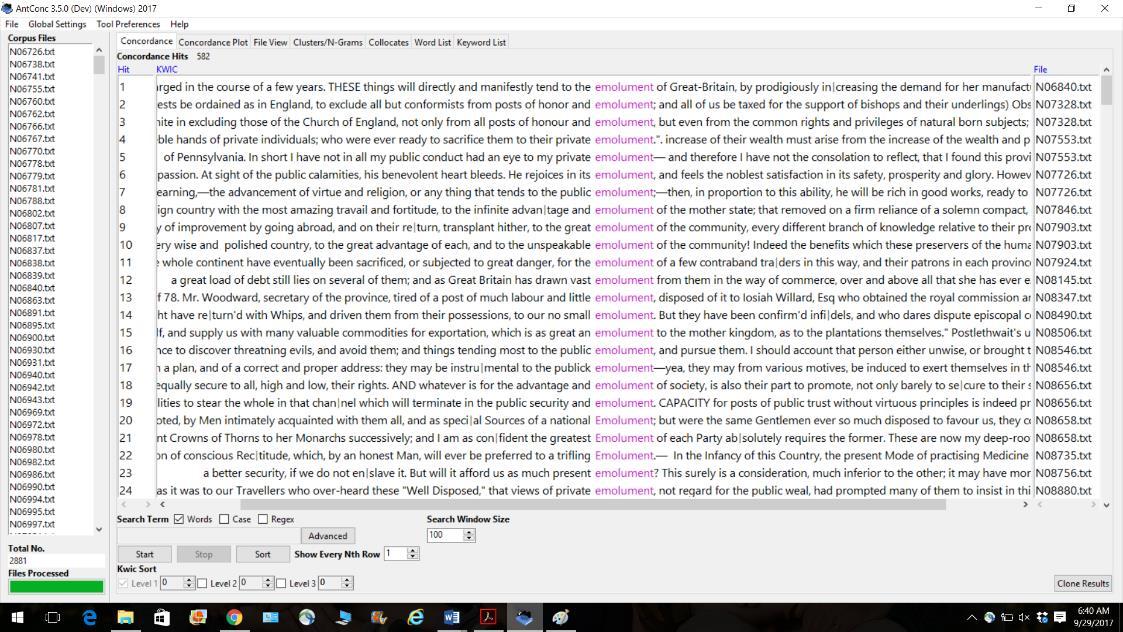
181-236_PHILLIPS &WHITE181-236_PHILLIPS &WHITE DOCX (DO NOT DELETE) 6/21/20198/21/20187/11/18 12:15 PM9:44 AM2:26PM 202 SOUTH TEXAS LAW REVIEW [Vol. 59:181
2017] A CORPUS LINGUISTICS ANALYSIS 203
Constitution to mean, we need a general, historical corpus that covers the time period and adequately represents American English usage. Unfortunately, no such public corpus exists. The closest corpus is the Corpus of Historical American English (COHA), but it doesn’t start until 1810 a bit late for founding-era linguistic inquiries.111
This deficiency will soon be remedied with Brigham Young University’s J. Reuben Clark Law School’s Corpus of Founding-Era American English(COFEA),112 which will cover 1760–1799 the beginning of the reign of King George III until the death of George Washington. But that corpus is not yet publicly available. However, the authors are involved in the creation of COFEA, and partially on our own and partially with the aid of computer scientists working at the law school,113 we compiled three distinct corpora to enable this Article’s research.114 We then loaded each corpus into a freely-available software designed by Professor Laurence Anthony called AntConc that enables one to apply the tools of linguistic corpora to one’s own dataset a build-your-own corpus computer program.115
A. This Article’s Three Corpora
The first corpus we created was of texts from the Evans Early American Imprint Series. Evans consists of “nearly two-thirds of all books, pamphlets, and broadsides known to have been printed in this country between 1640 and 1821.”116 These materials, particularly the books, often contain various other typesof language usage, includingsermons and fiction. Evans also contains works from all types of early American authors, ranging from the famous, to the forgotten, to the never known. Of the nearly 40,000 titles available in Evans, the University of Michigan’s Text Creation Partnership (TCP) worked with the owners of Evans (NewsBank/Readex Co. andthe American Antiquarian Society) “to create6,000accuratelykeyed and fully searchable . . . text editions . . . . [that are] fully available to the
111 CORPUS OF HIST AM ENG., https://corpus.byu.edu/coha/ [https://perma.cc/7V7V4QVN].
112 See Law and Corpus Linguistics Program Appoints Two Research Fellows, BYU LAW (Oct. 18, 2017), http://law.byu.edu/news2/law-and-corpus-linguistics-program-appoints-tworesearch-fellows [https://perma.cc/H7D6-VN8L] “COFEA” is pronounced like “Sophia” with an initial k-sound (koh-fee-uh).
113 Thanks to Wayne Schneider and Harrison Fry.
114 These corpora will form the bulk of COFEA’s underlying data when it launches.
115 AntConc Homepage, LAURENCE ANTHONY’S WEBSITE, www.laurenceanthony.net/software/antconc [https://perma.cc/F9SW-JULM]. Specifically, weused AntConc 3.5.0, a developmental 64-bit version designed for Windows.
116 Evans-TCP: Evans Early American Imprints, TEXT CREATION PARTNERSHIP, http://www.textcreationpartnership.org/tcp-evans/ [https://perma.cc/D6PF-LHRJ]
181-236_PHILLIPS &WHITE181-236_PHILLIPS &WHITE DOCX (DO NOT DELETE) 6/21/20198/21/20187/11/18 12:15 PM9:44 AM2:26PM
SOUTH TEXAS LAW REVIEW [Vol. 59:181
public.”117 All of these texts that fell within the time period of 1760–1799 were used for our Evans Corpus. We could classify this corpus as a general, historical, raw corpus.
The second corpus we created was of texts from the National Archives Founders Papers Online project.118 Founders Online contains the “correspondence and other writings ofsix majorshapers ofthe United States: George Washington, Benjamin Franklin, John Adams (and family), Thomas Jefferson, Alexander Hamilton, and James Madison.”119 Besides the writings of these major founders, the collection also contains letters written to these founders by a variety of Americans, including both other founders and more common folk. Again, we limited the date range to 1760–1799, and because the files were downloaded in the fall of 2015, our corpus does not reflect additional files the National Archives has since added.
Our final corpus consists of materials from Hein Online, which is partnering with BYU in providing its subscription materials for the creation of COFEA.120 Our Hein Corpus consists of legal materials from 1760–1799, including statutes, cases, legal papers, legislative debates and materials, etc. The table below shows the characteristics of our three corpora:
117 Id.
118 Correspondence and Other Writings of Six Major Shapers of the United States, FOUNDERS ONLINE, https://founders.archives.gov [https://perma.cc/2XSQ-CEAF].
119 Id.
120 See Shawn Nevers, HeinOnline Alumni Access, HUNTER’S QUERY (Nov. 13, 2014), http://huntersquery.byu.edu/heinonline-alumni-access-2/ [https://perma.cc/XY2M-B44R]
181-236_PHILLIPS &WHITE181-236_PHILLIPS &WHITE DOCX (DO NOT DELETE) 6/21/20198/21/20187/11/18 12:15 PM9:44 AM2:26PM
204
2017] A CORPUS LINGUISTICS ANALYSIS 205
By relying on these three corpora, rather than just one or two, we have more representation of “types” of Americans and types of language usage. For instance, Evans provides more “ordinary” types of documents from more “ordinary” Americans. This should provide insight into more generalmeanings.Heinprovideslegal documentsfromavarietyoffoundingera American sources and should provide a good view into the legal usage of terms. And Founders gives us documents not covered by the other two corpora letters as well as a heavy dose of language usage from important founders who either directly framed or at least significantly influenced the Constitution (though with letters from more “ordinary” Americans as well). Together these three corpora one general, one somewhat special (elites), and one special (legal)–provide a rather comprehensive picture of language usage during the American founding.121 Additionally, these corpora somewhat map onto varying theories of originalism. For those most concerned with how “ordinary” people at the Founding would have understood a word or phrase in the Constitution, the Evans Corpus is the most appropriate. For those most concerned about what the Founders may have intended, understanding how the Founders used
121 The coverage of our three corpora is not perfect we would have liked to have a corpus of newspapers from the era. But given that newspapers then were less likely to have a distinctive style of usage compared to today (since founding-era newspapers tended to not have so much journalistic writing as publishing of writing represented in our other corpora (letters, speeches, etc.)), we don’t feel the lack of a newspaper corpus changes the results. But that’s an empirical question that we can’t currently answer.
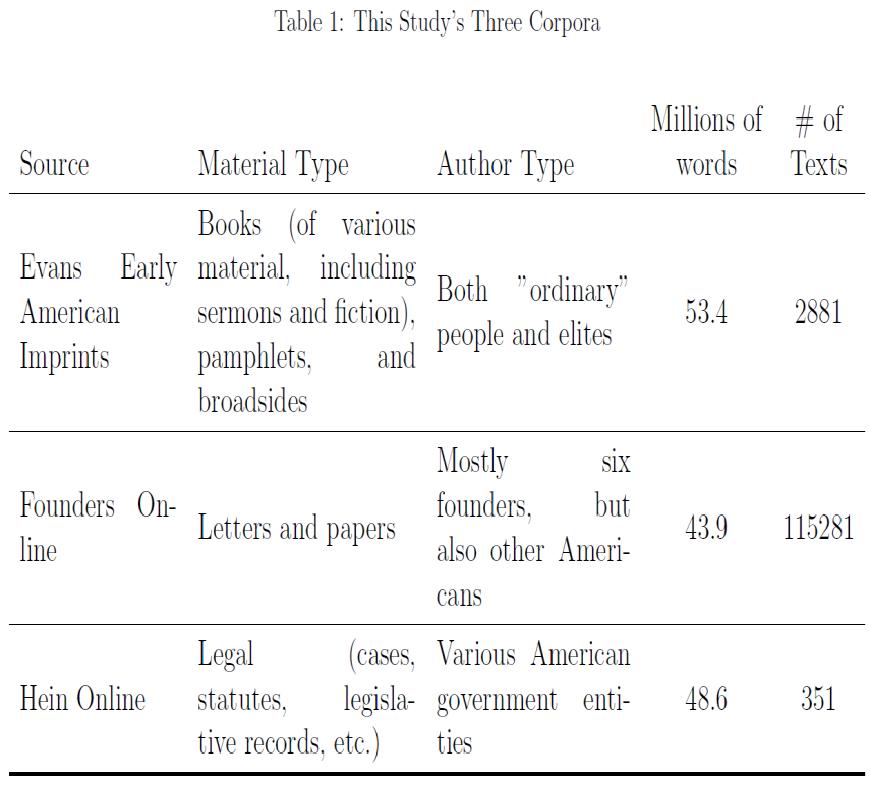
181-236_PHILLIPS &WHITE181-236_PHILLIPS &WHITE DOCX (DO NOT DELETE) 6/21/20198/21/20187/11/18 12:15 PM9:44 AM2:26PM
language can provide insight into the intent of specific word choices in the constitutional text, and the Founders Corpus will have the most value. Finally, for those most concerned with how American lawyers of the founding era would have understood the Constitution, the Hein Corpus will be of most interest. But since we don’t know which type of word “emolument(s)” is ordinary or legal it is helpful to look at all three corpora.
B. Coding Methodology
In undertaking coding (or classification) of the search results from our three corpora, we drew on principles and practices from survey and content analysis methodologies, which law and corpus linguistics is beginning to incorporate.122 First, we performed a search in each corpus for every instance of the word “emolument” or “emoluments.” We then randomly sampled enough “hits” from each corpus so that we had approximately a 5% confidence interval (at the 95% confidence level).123 In other words, we are 95% confident that the results we obtained for each corpus’s sample are within the confidence interval for the corpus overall.124 This resulted in the following number of “hits” and sample sizes for each corpus:
122 See generally James C. Phillips & Jesse Ebgert, Advancing Law and Corpus Linguistics: Importing Principles and Practices from Survey and Content-Analysis Methodologies to Improve Corpus Design and Analysis, 2017 BYU L. REV. (forthcoming 2018) (advocating for the survey and content-analysis methodologies to provide greater rigor, transparency, reproducibility, and accuracy in the important quest to determine the meaning of the law).
123 See EARL BABBIE, THE PRACTICE OF SOCIAL RESEARCH 206–08 (12th ed. 2010).
124 I.e., all instances of “emolument(s).”
181-236_PHILLIPS &WHITE181-236_PHILLIPS &WHITE DOCX (DO NOT DELETE) 6/21/20198/21/20187/11/18 12:15 PM9:44 AM2:26PM 206 SOUTH TEXAS LAW REVIEW [Vol. 59:181
In generatingourrandomsamples, we sampled withoutreplacement, meaning that no one instance of “emolument(s)” could be sampled twice. Additionally, our sampling unit was not each instance of “emolument(s),” but rather each document. This practice is similar to that of public opinion pollsters, whotend to sample at the householdlevel rather than theindividual level to avoid the likelihood that people in the same household will have similar views.125 Likewise, if a word or term occurs more than once in a document, the author is more likely to be using the same sense each time.126
Once we identified our sample, we began calibrating the “coding” (i.e., categorizing each result as a particular sense) by independently practicing on a random sample from each corpus that was a distinct sample from that which we would analyze for the Article. Coding content analysis can occur in one of two basic ways: manifest content and latent content.127 Manifest content is that which is readily apparent and can be counted, such
125 See generally BABBIE, supra note 123, at 199–200 (describing the process of random selection and probability theory in probability sampling).
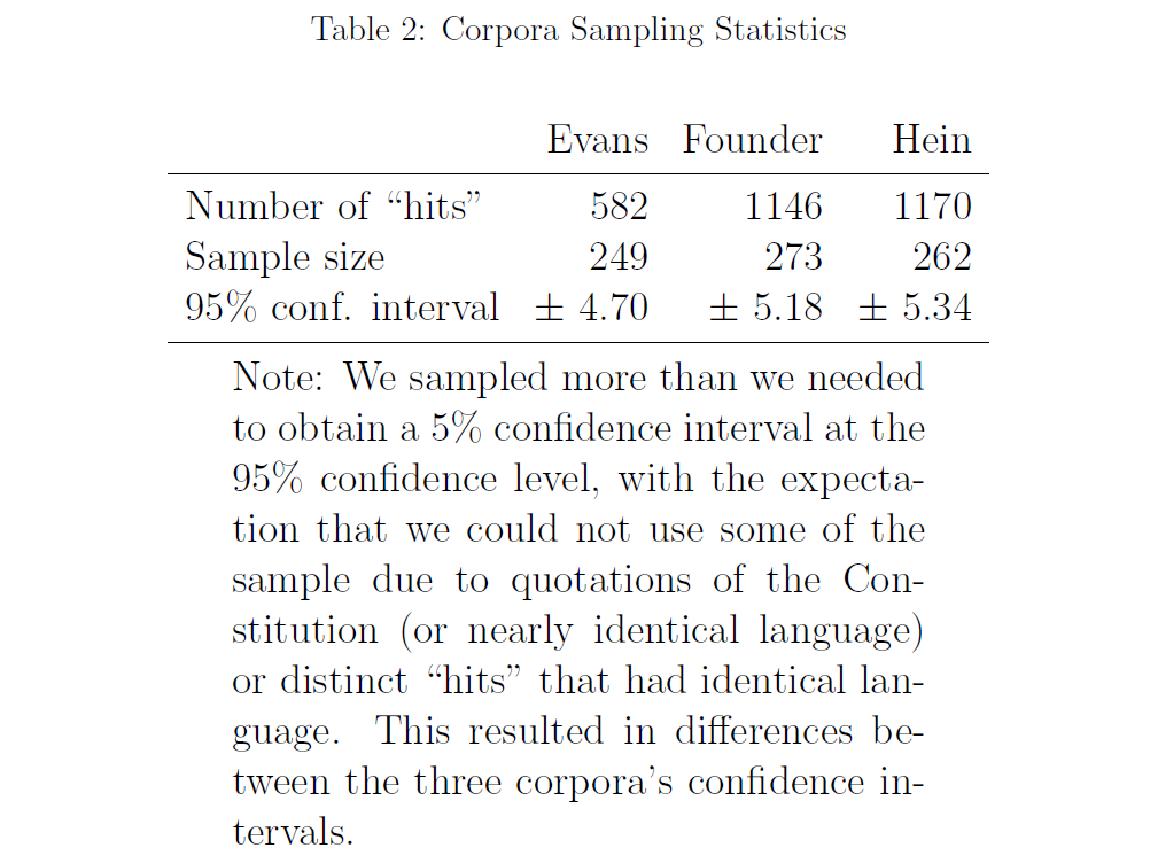
126. We were sometimes forced to sample more than once from the same document when there were fewer documents that had the term “emolument(s)” in them than the number of search results we need for our sample.
127 See, e.g., BABBIE, supra note 123, at 338.
181-236_PHILLIPS &WHITE181-236_PHILLIPS &WHITE DOCX (DO NOT DELETE) 6/21/20198/21/20187/11/18 12:15 PM9:44 AM2:26PM
2017] A CORPUS LINGUISTICS ANALYSIS 207
as the number of times an “emolument(s)” appears in a given corpora.128 While easily replicable by others, creating what social science calls reliability, manifest content may not tell us much. On the other hand, latent analysis looks at underlying meaning and is more holistic and subjective.129 This type of analysis also has trade-offs one may be less likely to miscode if one can take into account all of the information, but there may be less consistency among coders given the more subjective nature of the coding.
To code the concordance lines, we looked at how “emolument(s)” was used in context, usually about 150–200 words surrounding the term.130 And sometimes we looked at even more context when those 150–200 words were not sufficient. To put this in perspective, to code the concordance lines we had to read the equivalent of a Harry Potter novel of surrounding context.131 This was neither quick nor easy.
We also coded (or classified) whether the person receiving the emolument was an officer or public employee of some kind, and whether the direct source of the emolument was a government. After separately coding the same material, we met and went over the results, talking through why we chose to place a result in a particular sense category. After a few rounds of this we reached a 70% agreement rate, and then began to code the material for this Article. The process was similar. We would independently code fifty results, then meet and discuss any we differed on, coming to a consensus as to the proper category. This process is similar to the one modern lexicographers undertake in creating entries in dictionaries, with one distinction modern lexicographers sometimes work alone since they are tryingtocapturetherangeofpossiblesensesratherthanaccuratelydetermine the empirical distribution of senses.132
128. Id.
129 Id.
130
Therangeof words differedbecausewesetAntConc toreturn500characterssurrounding emolument(s).
131 We read over 156,000 words to code the concordance lines (Evans-50,618; Founders40,111; Hein-65,744; including those we used for training and those we had to discard for duplication or quoting the Constitution). The average Harry Potter novel was 154,881 words. See How Many Words Are There in the Harry Potter Book Series?, WORDCOUNTER NET (Nov. 23, 2015), https://wordcounter.net/blog/2015/11/23/10922_how-many-words-harry-potter.html [https://perma.cc/9JX2-RY48].
132 See, e.g., Kory Stamper, Capturing “Take” for the Dictionary: A Merriam-Webster Editor’s Knock-down, Drag-out Battle to Define a Deceptively Small, Innocent Word, SLATE (Mar. 14, 2017), http://www.slate.com/articles/arts/books/2017/03/how_a_merriam_webster_editor_captured_take _for_the_dictionary.html [https://perma.cc/KM7X-DCAU].
181-236_PHILLIPS &WHITE181-236_PHILLIPS &WHITE DOCX (DO NOT DELETE) 6/21/20198/21/20187/11/18 12:15 PM9:44 AM2:26PM
208 SOUTH TEXAS LAW REVIEW [Vol. 59:181
2017] A CORPUS LINGUISTICS ANALYSIS 209
V. RESULTS
To try and determine which sense of “emolument(s)” the three emoluments clauses of the Constitution would have been understood to containin the late18thcentury, we looked at frequencyof occurrence ineach corpus, collocates, clusters (or n-grams), and concordance lines. We also present some specific examples of “emolument(s)” that were in our samples that seem relevant to the Foreign Emoluments Clause.
A. Frequency
Wefirstnotehowfrequently“emolument(s)”appearsineachcorpus. Because of the differences in author and document type across the three corpora, frequency differences can provide some tentative evidence that the two different senses of “emolument” are used with varying frequencies in different contexts, perhaps indicating a technical or legal term-of-art sense. If one sense appears primarily in the legal corpus and the other sense primarily in the general corpus, then it would be possible evidence that one sense was a legal term of art, or at least a sense that was more common in the law, and the other sense had an ordinary meaning. Looking at the results below, we do see a pattern emerge:
“Emolument(s)” appears 2.2 times more often in the legal corpus (Hein) than in the general corpus (Evans). And it appears about 2.4 times more often in the hybrid special-general corpus of elite language (Founders) than the general corpus. This is interesting, though it is unclear how much to read into
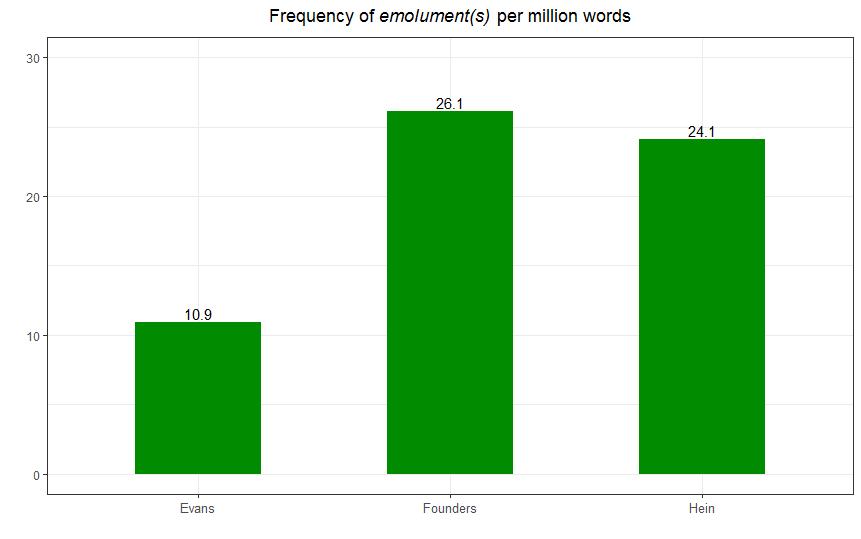
181-236_PHILLIPS &WHITE181-236_PHILLIPS &WHITE DOCX (DO NOT DELETE) 6/21/20198/21/20187/11/18 12:15 PM9:44 AM2:26PM
it. Because we have not yet examined in this Article thedistribution of senses in the three corpora, these frequency variations do not necessarily mean that one sense has more of a relationship with legal materials (or is a bona fide legal term-of-art), with the other sense a more ordinary one. (However, if “emolument” only had one sense and we were trying to see if it was an ordinary or legal sense, this would be stronger evidence of that.)
Also, the results from the Founders Corpus are somewhat unexpected. Based on the hybrid nature of the corpus, one would expect the frequency of “emolument(s)” in Founders to be somewhere in between the two corpora, perhaps closer to Evans than Hein. However, because Founders consists of the correspondence of six men who served in government or the military throughout most of the founding era, much of their correspondence is written in the context of conducting government or military affairs.133 And given that “emolument” has the potential of having a distinct sense specifically tied to government or military employment, it becomes less surprising to see the Founders Corpus have such a higher rate than the Evans Corpus. But this kind of frequency data can only tell us so much, because it is such a small piece of the linguistic puzzle.
B. Collocates
Next, we turn to the patterns of word association, or collocation, to see what they might reveal. We ran a collocate search in AntConc examining fivewordstotherightandleft of emolument(s).Thesesearcheswereofevery word in each corpus. We list the top fifteen collocates of emolument(s) from each corpus, showing overall occurrence frequencies, the frequency to the right or left of emolument(s), and statistical information, the latter providing the ranking. Given the differences between the types of corpora, we would expect to see different collocation patterns.
181-236_PHILLIPS &WHITE181-236_PHILLIPS &WHITE DOCX (DO NOT DELETE) 6/21/20198/21/20187/11/18 12:15 PM9:44 AM2:26PM 210
SOUTH TEXAS LAW REVIEW [Vol. 59:181
133 Correspondence and Other Writings of Six Major Shapers of the United States, FOUNDERS ONLINE, https://founders.archives.gov [https://perma.cc/2XSQ-CEAF].
Three patterns emerge. First, we only see one word that is common toallthreecorpora’stopfifteenrankings,thoughnot alwaysrankedthesame: “hono(u)r(s)” holds the top two ranks in Evans and Founders, but is the eighth-ranked collocate in Hein.134 This again reflects the distinct nature of the three corpora. Relatedly, we see some words that appear in two but not all three corpora. For example, “office(s)” is ranked fourth and seventh in Evans, and tenth in Founders, but does not crack the top fifteen in Hein.
134 AntConc, like most corpora software, treats differently spelled words as distinct. In modern English, that isn’t a problem, but in late 18th century English, with non-standardized spellings and both British and American versions of certain word spellings, that creates distinctions where none exist. Generally, we have combined alternate spellings when they represent the same word, but because AntConc computes the mutual information score separately, we could not combine the spellings here.
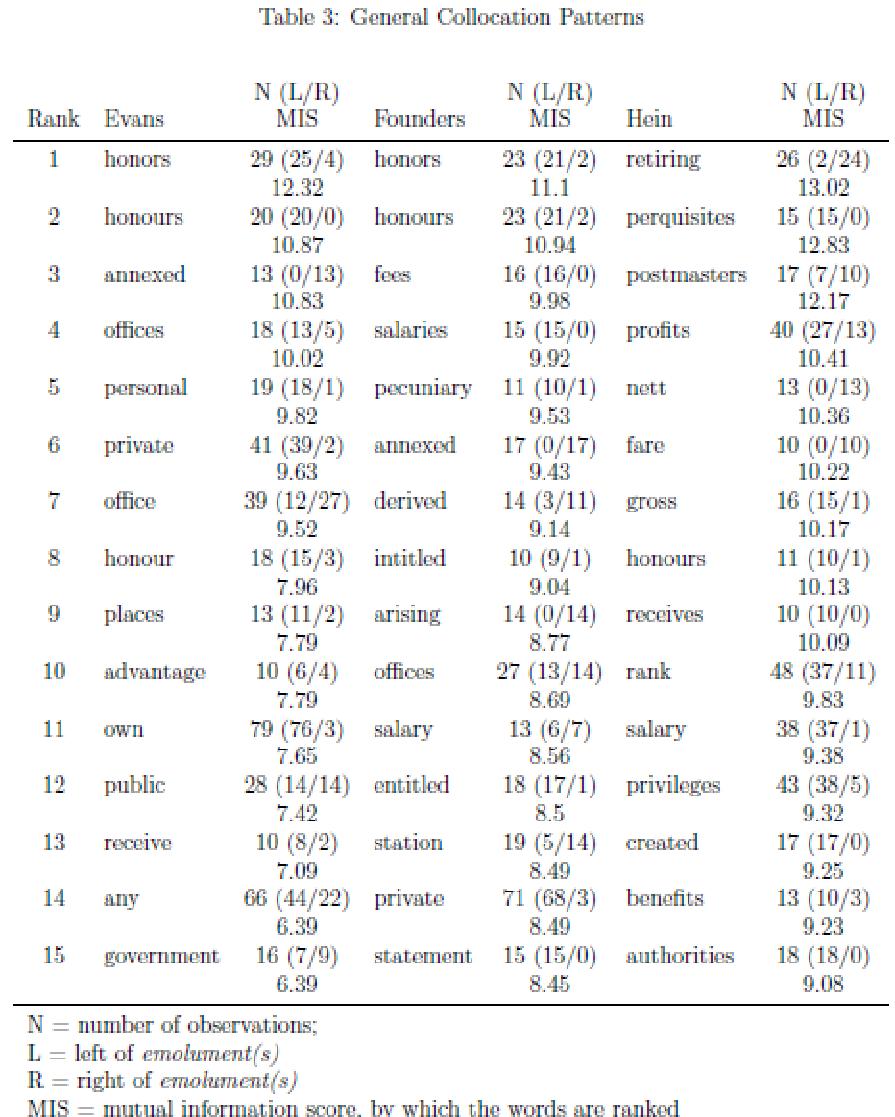
181-236_PHILLIPS &WHITE181-236_PHILLIPS &WHITE DOCX (DO NOT DELETE) 6/21/20198/21/20187/11/18 12:15 PM9:44 AM2:26PM
2017] A CORPUS LINGUISTICS ANALYSIS 211
212 SOUTH TEXAS LAW REVIEW [Vol. 59:181
Again, the rankings are based on the mutual information score,135 and that score is higher when a collocate is more likely to be located near the target word than other words in the corpus, which is only somewhat related to the frequency the collocate appears in the corpus. This can help explain the collocation rankings of “office(s).” “Office” shows up eighty-nine times in Hein more than double the thirty-nine times it appears in Evans. But because “office” occurs over four times more frequently in Hein (34,528 instances) than in Evans (8,240 instances), the occurrence of “office” is more spread out in Hein than in Evans, where it is more lumped with the word “emolument(s).” Inotherwords,alot morewordsareneighborswith “office” in Hein than in Evans, explaining why “office” has a higher mutual information score in Evans than in Hein.
Second, we see more collocates that appear to be related to the narrower, office/public employee sense of “emolument” than related to the broader, general sense of “emolument. ” For instance, annexed, office(s), places, government, public, e(i)ntitled, station, retiring, postmasters, authorities, perquisites, privileges, and rank all seem to reflect the narrower sense emphasis on seem sincecollocationisanexploratoryanalysis. Onthe other hand, own, personal, and private seem like they would go more with the general sense of “emolument(s).” And advantage, receive(s), any, fees, salar(y/ies), derived, arising, statement, profits, net, fare, gross, created, and benefits seemmoreneutralinthat theycouldgowitheither sense.(Ofcourse, to the extent any of these collocates fits more with one sense than another will emerge from concordance line analysis.) This pattern does not necessarily mean that the narrow sense of “emolument” is more common than the general sense. The collocation results could be explained by the narrow sense having a more consistent semantic environment, whereas the broader sense does not. This would be understandable given the broader sense is more general and the narrower sense is more technical. Third, we see divergent patterns on whether a collocate appears to the right or left of “emolument(s).” For instance, hono(u)r(s), personal, private, own, e(i)ntitled, fees, salaries (but not salary), perquisites, receives, privileges, and authorities appear almost exclusively to the left of “emoluments(s)” within the five words to the right or left context we searched). On the other hand, annexed, arising, retiring, derived, net, and fare appear almost exclusively to the right of “emolument(s).” And the rest of the collocates are more evenly distributed to the right or left of
135 See Kenneth Ward Church & Patrick Hanks, Word Association Norms, Mutual Information, and Lexicography, 16 Computational Linguistics 22, 23 (1990) (explaining that a mutual information score “compares the probability of observing [word] x and [word] y together (the joint probability) with the probabilities of observing [word] x and [word] y independently (chance)”).
181-236_PHILLIPS &WHITE181-236_PHILLIPS &WHITE DOCX (DO NOT DELETE) 6/21/20198/21/20187/11/18 12:15 PM9:44 AM2:26PM
2017] A CORPUS LINGUISTICS ANALYSIS 213
“
emolument(s).” This pattern, where the frequency of some collocates’ appearance skew to the right or left of “emolument(s),” can sometimes be explained by grammar. As the next table will show, some collocates, such as the adjectives personal, private, and own appear the word just before “emolument(s)” to describeor modifyit. Other collocatesthat areverbs,such as annexed, arising, or derived, make more sense grammatically following the noun “emolument(s).” But some collocates, especially nouns, can grammatically precede or follow “emolument(s),” and thus to see collocates such as hono(u)r(s), fees, salaries, authorities, privileges, benefits, rank, and perquisites appear overwhelmingly to the left of “emolument(s)” points to a possible phrase that could have its own meaning. We also looked at which collocates appeared just before the word “emolument(s)” with a minimum of at least five occurrences in a particular corpus. Below are the top fifteen in each corpus, ranked by mutual information score.
One of the most interestingfindings here isthat pecuniary isthetop collocate just to the left of “emolument(s)” in both Evans and Founders, but does not even make the top fifteen for Hein. Likewise, perquisites, gross, and official are the top three collocates in Hein, but do not even show up in the top fifteen in Evans and Founders.
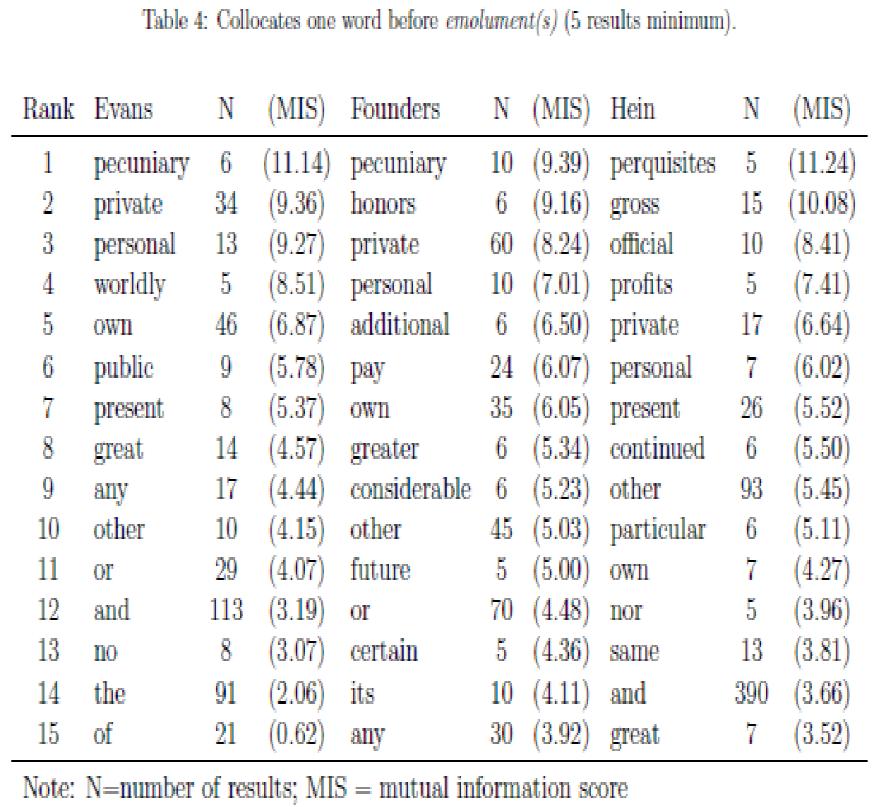
181-236_PHILLIPS &WHITE181-236_PHILLIPS &WHITE DOCX (DO NOT DELETE) 6/21/20198/21/20187/11/18 12:15 PM9:44 AM2:26PM
C. Clusters (or N-grams)
We next look at three-, four-, and five-word patterns where “emolument(s)” appears in either the first or last word position.136 Like collocation, this is more of an exploratory analysis that can reveal patterns that merit further investigation. And like collocation, the results are based off of every word in each corpus. First, the table below shows the top fifteen clusters by frequency when “emolument(s)” is the last word in the cluster.
Whereaswith thecollocatepatterns Evansand Founders oftenwould exhibit some similarities, with Hein diverging from the other corpora, here we see a mix. For example, the top cluster in both Founders and Hein is pay and emolument(s), which does not appear in the top fifteen meaning here it does not appear even four times in Evans. In fact, that cluster appears as often in Hein as thetopnineclustersinEvans combined. But thesecond most frequent cluster in both Evans and Founders was hono(u)r(s) and emolument(s), yet that cluster does not appear in the top fifteen clusters of Hein.
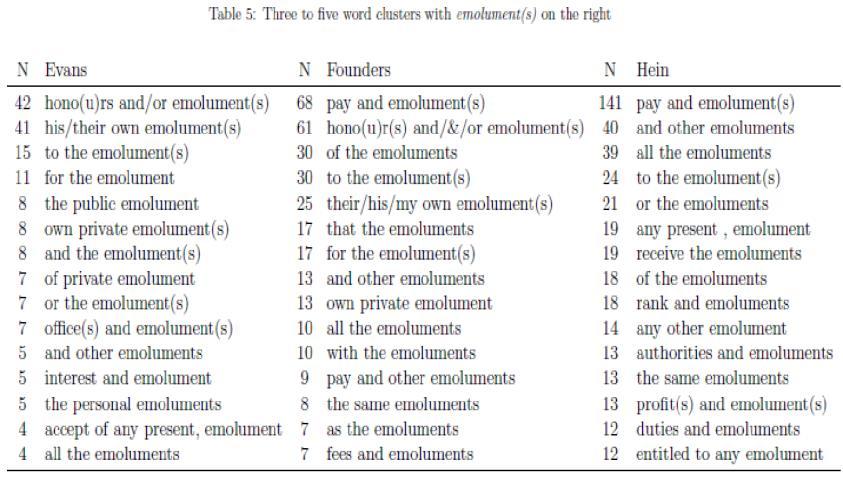
Next, we turn to the top fifteen clusters from each corpus where “emolument(s)” is the first word in the corpus.
136 Unfortunately, AntConc cannot search for all clusters where “emolument(s)” appears in any word position.
181-236_PHILLIPS &WHITE181-236_PHILLIPS &WHITE DOCX (DO NOT DELETE) 6/21/20198/21/20187/11/18 12:15 PM9:44 AM2:26PM
214 SOUTH TEXAS LAW REVIEW [Vol. 59:181
With these clusters, we see “office(s)” appearing more than when “emolument(s)” is at the end of the cluster. With the latter, the only cluster in the top fifteen in a corpus was office(s) and emolument(s), which was tied for eighth in Evans. But with clusters where “emolument(s)” is the first word in a cluster of three to five words, one finds emolument(s) of office (Evans: fourth; Founders: second), emoluments of his office (Hein: tied for tenth), emoluments of my office (Founders: tied for fifth), emoluments of that office (Founders: tied for tenth), and what is likely language from the Constitution or the Articles of Confederation, or people discussing one of them, emolument(s), office, or title (Evans: tied for tenth; Hein: tied for tenth). And emolument(s) annexed to appears inthetopfifteenof all three corpora, which phrase tends to be followed by the word office or a specific example of such.137
Comparing the clusters with “emolument(s)” on the right with those where “emolument(s)” is on the left, we see a pattern that was hinted at in the collocate data where nouns often occurred to the left of “emolument(s).”
When “emolument(s)” is linked to another noun by a conjunction (and, or), we see that “emolument(s)” almost always appears at the end. For instance, in the top fifteen clusters we find hono(u)r(s) and/& emoluments; office(s) and emolument(s); interest and emolument; pay and emolument(s); pay and other emoluments; fees and emoluments; rank and emoluments; authorities and emoluments; profit(s) and emolument(s);and duties and emoluments.But there is just one cluster where “emolument(s)” is first and connected to a noun with a conjunction: emolument(s) and advantage(s)
137 See infra Appendix.
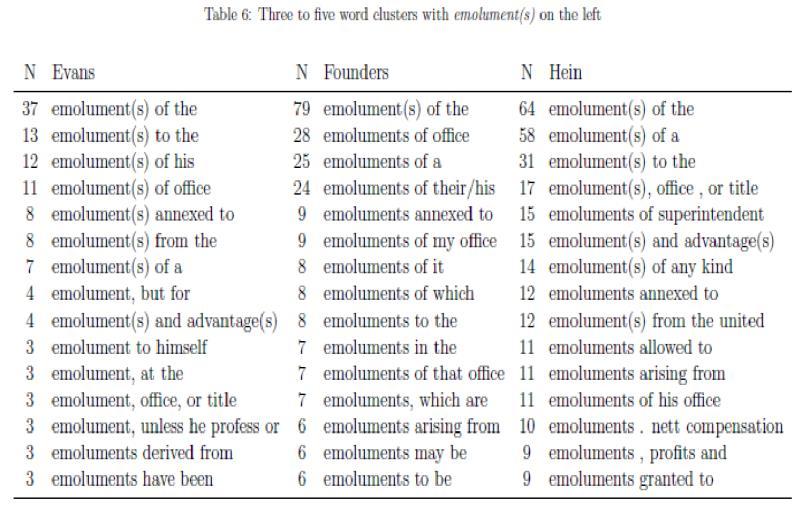
181-236_PHILLIPS &WHITE181-236_PHILLIPS &WHITE DOCX (DO NOT DELETE) 6/21/20198/21/20187/11/18 12:15 PM9:44 AM2:26PM 2017]
A CORPUS LINGUISTICS ANALYSIS 215
216 SOUTH TEXAS LAW REVIEW [Vol. 59:181
The fact that the order does not appear to be interchangeable is meaningful. In linguistics, these types of phrases or groupings of words are often referred to as binomials or multinomials. A binomial is “a coordinated pair of linguistic units of the same word class which show some semantic relation,” and are often, but not limited to, noun pairs.138 An example of this from legal language would be cease and desist or aid and abet, which are sometimes called legal doublets.139 “Multinomials are similarly chained by semantic and syntactic links, but consist of longer sequences of related words.”140 Examples include hold, defend, and favour or lock, stock, and barrel. 141 Binomials have been found to be characteristic of legal language and have been observed to be five times more frequent in modern legal writing than non-legal writing, making binomial usage “clearly a style marker in law language.”142 Examples of multinomials in legal language include give, devise and bequeath or right, title, and interest. This frequent occurrence of binomials and multinomials in legal writing is due to their ability to “increase the precision and all-inclusiveness of the documents, although they are also used for stylistic reasons and belong among the key features of the genre.”143 If the clusters found in this Article are binomials and multinomials, then it is likely that at the time they were used they had become or were in the process of becoming technical or legal terms of art. We thus investigated the most frequent clusters that appeared as though they might be binomials, examining them in reverse order as well. As the table below shows, ordering matters.
138 Joanna Kopaczyk & Hans Sauer, Defining and Exploring Binomials, in BINOMIALS IN THE HISTORY OF ENGLISH: FIXED AND FLEXIBLE 1,3(Joanna Kopaczyk & Hans Sauer eds., 2017).
139. See BRYAN A. GARNER, THE REDBOOK: A MANUAL ON LEGAL STYLE 224–25 (3d ed. 2013).
140 Anu Lehto, Binomials and Multinomials in Early Modern Parliamentary Acts, in BINOMIALS IN THE HISTORY OF ENGLISH: FIXED AND FLEXIBLE 261, 261 (Joanna Kopaczyk & Hans Sauer eds., 2017).
141 Kopaczyk & Sauer, supra note 138, at 3.
142 Marita Gustafsson, The Syntactic Features of Binomial Expressions in Legal English, 4 TEXT AND TALK: AN INTERDISCIPLINARY JOURNAL OF LANGUAGE, DISCOURSE, & COMMUNICATION STUDIES 125 (1984), https://doi.org/10.1515/text.1.1984.4.1-3.123 (last visited Sept 15, 2017).
143 Lehto, supra note 140, at 261. See generally BHATIA, supra 100 (implementing genre analysis as a means to analyze the unique aspects of legal writing).
181-236_PHILLIPS &WHITE181-236_PHILLIPS &WHITE DOCX (DO NOT DELETE) 6/21/20198/21/20187/11/18 12:15 PM9:44 AM2:26PM
A CORPUS LINGUISTICS ANALYSIS 217
Some examples are particularly striking. The binomial fee(s) and/or emolument(s) appears twenty-nine times across the three corpora, but never once in reverse. Likewise, interest(s) and/or emolument(s) and pay and/or (other) emolument(s) appear nine and eighteen times respectively, but the reverse binomials never appear in any of our corpora. Other binomials are disproportionately one direction as compared to the reverse. And in every instance but one of those we investigated, “emolument(s)” comes last. This does not appear to be by chance. These binomials likely have a meaning that is more (or somewhat different) than just the sum of their semantic parts. Additionally, some of the binomials appear much more in Hein as compared to Founders and Evans (and often more in Founders as compared to Evans), indicating a binomial that may have become a legal term-of-art. For example, fee(s) and/or emolument(s) appears twenty times in Hein, eight times in Founders, and just once in Evans. Likewise, rank(s) and/or emolument(s) appears nineteen times in Hein, eight times in Founders, and never in Evans. And dut(y/ies) and/or emolument(s) appears sixteen times in Hein, once in Founders, and twice in Evans. Finally, our analysis of concordance lines of “emolument(s),”144 revealed that most of these
144 See discussion infra Part IV.E.
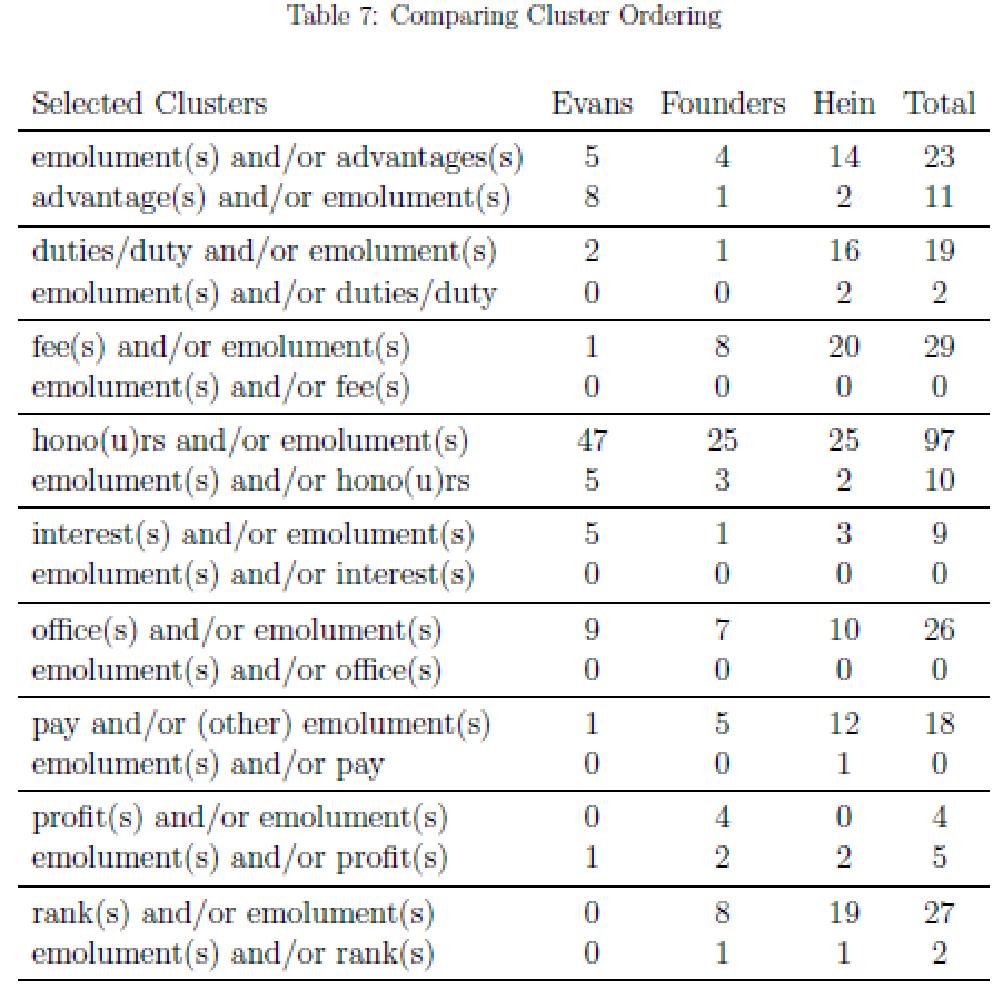
181-236_PHILLIPS &WHITE181-236_PHILLIPS &WHITE DOCX (DO NOT DELETE) 6/21/20198/21/20187/11/18 12:15 PM9:44 AM2:26PM
2017]
binomials were related to the narrow, office/public employee sense of “emolument.”
D. Senses and Sub-senses
As previously noted,145 most scholars, as well as founding-era dictionaries, indicate there are two senses of the word “emolument”: (1) the broad, general sense that covers any kind of gain or advantage, and (2) the narrow, office/public employment sense that only covers monetizable benefits from holding office or working in the government’s employ.146 Again, this matters in the litigation against the President because, if the broad sense is the correct sense inthe Constitution, the President has likely violated the Constitution, but if the narrow sense is the correct one, at least on the facts alleged, it does not appear that the President has violated the Foreign or Presidential Emoluments Clauses.
As we coded (or classified) each concordance line from our samples, we found additional sub-senses that seemed sufficiently distinct to note, particularly in the broader, general sense of “emolument.” Here are the main senses and sub-senses we discovered in the 784 instances of “emolument(s)” that we coded, with examples of each in corresponding footnotes (included without correcting spelling or punctuation).
1. Broad, General Sense
a. any advantage, gain, benefit, or profit;147
b. profits or other monetizable benefits (excludes intangibles, such as freedom or personal pride of ownership);
145 See supra Part II.A.
146. Professor Natelson differs in that he argues there are four senses of the word “emolument,” though his four senses could easily be collapsed under the two traditional senses as two sub-senses for each main sense. Natelson, supra note 64, at 12–13
147. See, e.g., James Anderson, To George Washington from James Anderson (of Scotland), 15 August 1793, FOUNDERS ONLINE, http://founders.archives.gov/documents/Washington/05-1302-0303 (last updated Feb. 1, 2018) [https://perma.cc/Y5RA-UEC6] (“And as long as I have reason to believe that it does not prove troublesome, I shall continue to send from time to time such little articles as fall in my way that I think may lend in any respect to the pleasure or emolument of the people in America.”); Johann Georg Zimmermann, Essay on National Pride. To Which Are Prefixed, Memoirs of the Author’s Life and Writings, EVANS EARLY AMERICAN IMPRINT COLLECTION, http://name.umdl.umich.edu/N27570.0001.001 [https://perma.cc/YD6Y-BLGX]
(“The French in their own estimation are the only thinking beings in the universe. They vouchsafe sometimes to converse with strangers; but it is, as creatures of a superior nature may be conceived to converse with men, who of course derive the [greatest] emolument and importance from such [condescension].”)
181-236_PHILLIPS &WHITE181-236_PHILLIPS &WHITE DOCX (DO NOT DELETE) 6/21/20198/21/20187/11/18 12:15 PM9:44 AM2:26PM 218
SOUTH TEXAS LAW REVIEW [Vol. 59:181
2017] A CORPUS LINGUISTICS ANALYSIS 219
i. proceeds of financial value from gainful activity (including leasing, agriculture, trades, markets, and other business);148
ii. financial benefit to a government or country;149
iii. government authorizes indirect or direct financial benefits to a person or entity not in the government’s employ;150
iv. private organization grants financial benefits based on office or service;151
148 See, e.g., Alexander Hamilton, From Alexander Hamilton to James McHenry, 7 January 1799, FOUNDERS ONLINE, http://founders.archives.gov/documents/Hamilton/01-22-02-0223 (last updated Feb. 1, 2018) [https://perma.cc/8QY9-4DBQ] (“The result has been that the emoluments of my profession have been diminished more than one half and are still diminishing . . . .”) (emphasis added).
149. See, e.g., Jonathan Mayhew, The Snare Broken. A Thanksgiving-Discourse, Preached at the Desire of the West Church in Boston, N.E. Friday May 23, 1766. Occasioned by the Repeal of the Stamp-Act (May 23, 1766), http://name.umdl.umich.edu/N08145.0001.001 [https://perma.cc/Z4HF-QZ4W] (“[A]nd as Great Britain has drawn vast emolument from [the colonies] in the way of commerce, over and above all that she has ever expended for them, either in peace or war.”); 8 ANNALS OF CONG. 1492 (1798–99) (“The effect, therefore, of denying convoy to our merchants will be to destroy this great and beneficial carrying trade; to transfer its emoluments to other nations .”).
150 See, e.g., George Logan, Letters, Addressed to the Yeomanry of the United States (1753–1821), http://name.umdl.umich.edu/N18135.0001.001 [https://perma.cc/7XEH-QFJE] (“The raw, bulky materials, which constitute the principal part of your exports, does not afford a freight to satisfy your merchants; and therefore, these men, ever attentive to their private emolument, have taken the advantage of your lethargy, and have influenced Congress to enact the most arbitrary and unjust laws, sacrificing your rights and your property, to add to their wealth.”); ACTS AND LAWS OF THE STATE OF CONNECTICUT, IN AMERICA 199–200 (Hudson & Goodwin 1796) (“Be it further enacted, That the Town of Milford, in the County of New-Haven, have Licence and Authority, and License and Authority are hereby granted to said Town, to have, use and keep the Ferry on Ousatonuck or Stratford River, between said Town and the Town of Stratford, in the County of Fairfield, commonly called Stratford Ferry, on the East side of said River; and to take and receive all the Emoluments, Profits and Fare, which may arise from the Transportation of Passengers, and of any and every Thing necessary to be transported across said Ferry, from the East side of said River, to the West side thereof, to the sole Use and Benefit of said Town of Milford, for and during the space of fifteen Years . . . .”).
151 See, e.g., The Acts of Incorporation, Bye-Laws, Rules and Regulations, of The Bank of The United States, EVANS EARLY AMERICAN IMPRINT COLLECTION, http://name.umdl.umich.edu/N17861.0001.001 [https://perma.cc/3KX2-YGMY] (“No [d]irector shall be entitled to any emolument, unless the same shall have been allowed by the Stockholders at a general meeting.”); Alexander Hamilton, Draft of an Act to Incorporate the Bank of the United States, [December 1790], FOUNDERS ONLINE, https://founders.archives.gov/documents/Hamilton/01-07-02-0279#ARHN-01-07-02-0279-fn0002 (last updated Nov. 28, 2017) [https://perma.cc/A7X5-WK8U].
181-236_PHILLIPS &WHITE181-236_PHILLIPS &WHITE DOCX (DO NOT DELETE) 6/21/20198/21/20187/11/18 12:15 PM9:44 AM2:26PM
OUTH TEXAS LAW REVIEW [Vol. 59:181
v. personally financially benefiting from office in an improper way;152 and
vi. financial benefits earned on the side of and independent to one’s civil or military office, employment, or service.153
2. Narrow, Office/Public Employment Sense
a. all forms of authorized compensation or pecuniary profit derived from the discharge of the duties of office or public employment or service (excluding non-financial benefits, such as powers, authorities, privileges, etc.);154
b. any benefit of monetary value other than salary that is authorized by one’s office or public employment or service; fringe benefits.155
152 Natelson argued that this type of emolument was referred to as a private emolument, though we found that termhad other meanings, including the emoluments one legallywould receive from office, and that private emolument wasn’t always invoked when this sub-sense was used. Natelson, supra note64,at17. See also JOHN MORGAN,A VINDICATIONOFHISPUBLICCHARACTER IN THESTATION OFDIRECTOR-GENERALOF THE MILITARY HOSPITALS, AND PHYSICIAN IN CHIEFTO
THE AMERICAN ARMY; ANNO 1776 XI (1776) (“[The] late Director-General of the Continental Hospital, has drawn from the Commissary-General's office, the well rations, for the sick, while in the General Hospital, and that he has pocketed the same for his own emolument . . . .”); JOURNALS OF THE CONTINENTAL CONGRESS 40 (Gaillard Hunt ed., 1912), http://www.heinonline.org/HOL/Page?men_tab=srchresults&handle=hein.congrec/jcc0019&size= 2&collection=slavery&id= (“. . . a high abuse of office, committed by James Mease, late clothiergeneral, and William West, jun., his deputy or appointee: who, in conjunction with Major General Arnold, did, under colour of office, in the year 1778, take from sundry inhabitants of this city, great quantities of merchandise, not necessary for the army, which were converted to their private emolument . . . .”).
153 See, e.g., James Monroe, To Thomas Jefferson from James Monroe, 17 June 1792, FOUNDERS ONLINE,http://founders.archives.gov/documents/Jefferson/01-24-02-0085(lastupdated June 29,2017) [https://perma.cc/A8LP-F6RD] (“.. .have determined to withdrawfromthose courts where an interference might take place, and in general to make such an arrangement in my business, as will in other respects leave me more at liberty to discharge the duties of the other station. This will in a great measure, if not altogether, exclude from it the idea of professional emolument . . . .”).
154. See, e.g., Alexander Hamilton, From Alexander Hamilton to John Armstrong, Junior, 1 April 1793, FOUNDERS ONLINE, http://founders.archives.gov/documents/Hamilton/01-14-02-0159 (last updated Feb. 1, 2018) [https://perma.cc/633N-P5ZW] (“The President has left here a Blank Commission for Supervisor of New York, with his signature, & with instruction to fill it up either in your name or that of Nicholas Fish, giving you the first option. I am therefore to request, that you will inform me as speedily as possible, whether the appointment is acceptable to you. The present gross emoluments of it may amount to about 1300 Dollars of which 900 is salary.”).
155 See, e.g., Alexander Hamilton, Enclosure: [Questions Concerning the Navigation of the Several States], [15 October 1789], FOUNDERS ONLINE, https://founders.archives.gov/documents/Hamilton/01-05-02-0234-0002 (last updated Nov. 26, 2017) [https://perma.cc/PY93-3ERY] (“What priviledges [sic], or emoluments do those Masters and mariners enjoy besides their pay and subsistance [sic].”); George Muter, To Thomas Jefferson from George Muter, 6 March 1781, FOUNDERS ONLINE, https://founders.archives.gov/documents/Jefferson/01-05-02-0103 (last updated Feb. 1, 2018) [https://perma.cc/AE8P-BDWV] (“. . . it might be a disputable point, liable to be settled in future
181-236_PHILLIPS &WHITE181-236_PHILLIPS &WHITE DOCX (DO NOT DELETE) 6/21/20198/21/20187/11/18 12:15 PM9:44 AM2:26PM 220
S
2017] A CORPUS LINGUISTICS ANALYSIS 221
Some of these sub-senses are more relative to the ongoing litigation against the President than others. No one is currently arguing in federal court that the President is an officer or public employee, or somehow in the authorized service of a foreign state, so the narrow sense and its sub-senses are not implicated (but could be under certain facts). But several sub-senses from the broad, general sense of “emolument” are relevant to the litigation. For example, what we have called sense 1.b.vi is implicated when the President makes moneyon the sideindependent of his office,suchasthrough his hotels.156 If a foreign government is paying the bill, then the Foreign Emoluments Clause is violated if sense 1.b.vi is the operative sense in that clause.Likewise,if thefederal or astategovernment pays a hotel bill because some federal or state official is staying there, then the Presidential Emoluments Clause would be violated if sense 1.b.vi is the operative sense. ThePresident could alsobeviolatingthese same clauses if sense 1.b.v, which is improperly using office for personal gain, is the operative one to the extent the President is using his office to increase profit of his businesses from foreign or domestic government clients.157 Another sub-sense that is covered by the President’s business dealings is 1.b.iii government authorization of direct or indirect emoluments which would arguably cover foreign and domestic copyrights or trademarks. For example, China granted a trademark to the President for his name lessthana month after takingoffice when China had previously denied the trademark for a decade.158 Thus, that trademark grant could be a violation of the Foreign Emoluments Clause if sense 1.b.iii is the one used in the clause. Finally, the President could violate either the Foreign or Presidential Emoluments Clauses if a foreign or American government provided some kind of intangible benefit to him and those clauses’ operative sense of “emolument(s)” was sense 1.a any advantage, benefit, gain, or profit.
Duetothedifficultyofparsingthesub-senses,wecodedjust whether a use of “emolument(s)” fell into one of the two main senses: broad or narrow. As can be seen from the table below, we agreed 79–93% of the time regardingwhichsensewastheproperone,dependingontheparticularcorpus and classification being coded.159 We also coded whether a use of the term by the Assembly, whether I was not entittled [sic] to the abovementioned emoluments as a Colonel, as well as to the sallary [sic] . . . .”)
156 See Citizens Complaint, supra note 10, at *16–19, *30–32 (discussing royalties to the President’s television shows, some of which are paid by entities controlled or owned by foreign governments).
157 See id. at *21 (noting membership fees at the President’s Mar-a-Lago Resort doubled after his election).
158 See id. at *17.
159 For those who prefer more sophisticated inter-rater reliability statistics given the limitations of mere agreement percentages, we have also reported Gwet’s AC. Gwet’s AC provides
181-236_PHILLIPS &WHITE181-236_PHILLIPS &WHITE DOCX (DO NOT DELETE) 6/21/20198/21/20187/11/18 12:15 PM9:44 AM2:26PM
“
emolument(s)” was in the context of an officer receiving an emolument or the government providing the emolument.160
A high degree of reliability, as evidenced here, indicates that the results can likely be reproduced by others. It is also a necessary but not sufficient condition for validity or accuracy. One can have high reliability without accuracy if both coders are independently and consistently wrong in their assessment. But one cannot have validity if there is not reliability.
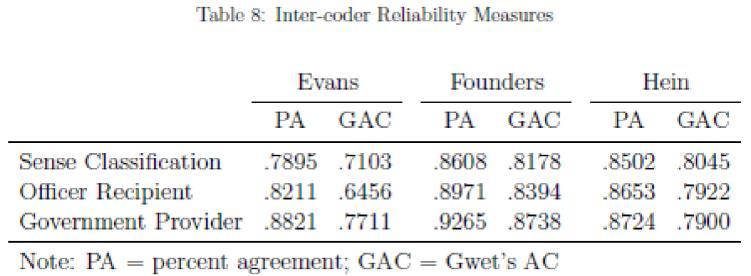
a. Concordance Line Analysis
As can be seen below, the Evans Corpus is quite different from the Founders and Hein Corpora in its distribution of senses of “emolument.”
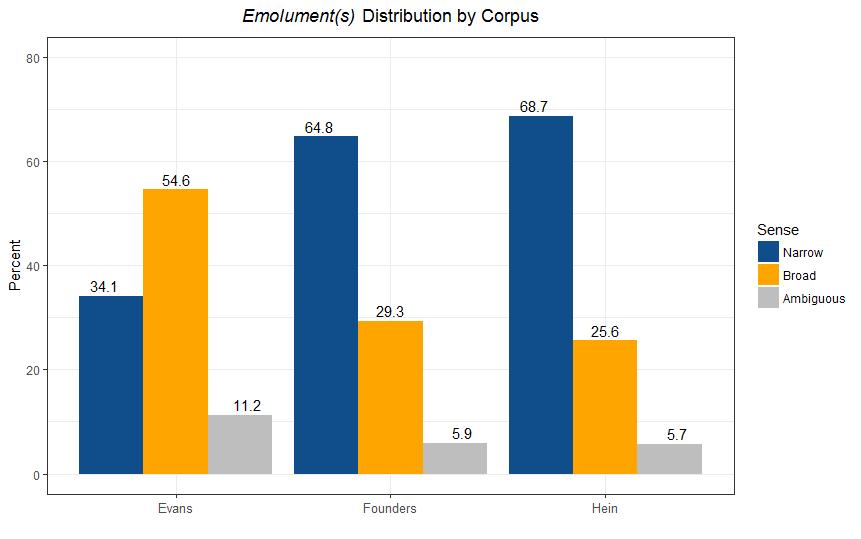
a “more stable agreement coefficient” than more common inter-rater statistics by avoiding “kappa’s paradox.” Kilem Li Gwet, Computing Inter-Rater Reliability and its Variance in the Presence of High Agreement, 61 BRIT J. MATHEMATICAL & STAT PSYCHOL 29-30 (2008).
160 See infra Part IV.E.
181-236_PHILLIPS &WHITE181-236_PHILLIPS &WHITE DOCX (DO NOT DELETE) 6/21/20198/21/20187/11/18 12:15 PM9:44 AM2:26PM 222
SOUTH TEXAS LAW REVIEW [Vol. 59:181
2017] A CORPUS LINGUISTICS ANALYSIS 223
Evans, a corpus of more ordinary, general American English usage, has just over half of the sampled uses of “emolument(s)” falling into the broad sense of the word, and about one-third falling into the narrow, office/public employment sense. Yet Founders, a corpus of mostly language usage by elites in correspondence, and Hein, a corpus of legal materials produced by government bodies, reverse the distribution with the general sense showing up about one quarter of the time and the narrow sense occurring about twothirds of the time. The differences in sense distribution between Evans and the other two corpora are statistically significant, whereas the minor differences between Founders and Hein are not.161 These results make sense. Legal materials and correspondence by those running the government or military are much more likely to involve government or militaryofficersor public employees.Moregeneral materials, such as books and pamphlets on a range of subjects, are instead more likely to speak of general matters, or at least will have broader coverage of topics. These findings show that context matters. And because context matters, dictionaries are inadequate tools to determine usage rates of competing senses. After all, the study noted earlier that surveyed dictionaries found 100% of the definitions of “emolument” contained the broad sense and only 8% contained the narrow sense. But when looking at actual usage, the distribution is quite different, and differs based on context. These data also illustrate the pitfalls of relying on dictionaries for frequency data when one sense is larger and could technically cover the narrower sense. If the dictionary maker is a lumper, the broader sense may swallow the narrower one. But context teases out which sense is appropriate. For example, if a former U.S. President was hired to give a speech to a university or corporation, and he showed up and engaged in expressive dancing, while that “speech” may be covered by the sense of “speech” in the Free Speech Clause, it would not satisfy the entity that hired him to speak. The broader sense of a word is only appropriate based on the context. Yet the data above do not satisfactorily answer the question of which sense of “emolument” is the one founding-era Americans would have understood to be used in the Constitution. If that is all the data we had, it wouldarguablyindicatethatthethreeemoluments clausesintheConstitution use the narrower sense because the Constitution is a legal document, thus invoking the Hein Corpus, whose authors were similar (or in some cases identical) to the six founding men who make up the bulk of the materials in the Founders Corpus. But we have even more relevant data because we can
161. Comparing Evans and Founders: Pearson’s chi-squared test = 49.1 (p < .001); the nonparametric Fisher’s exact test (p <.001). Comparing Evans and Hein: Pearson’s chi-squared test = 61.1 (p <.001); Fisher’s exacttest(p < .001). Comparing Founders and Hein: Pearson’s chi-squared test = .98 (p = .612); Fisher’s exact test (p = .611).
181-236_PHILLIPS &WHITE181-236_PHILLIPS &WHITE DOCX (DO NOT DELETE) 6/21/20198/21/20187/11/18 12:15 PM9:44 AM2:26PM
take into account the context “emolument(s)” was used in each clause, and then determine the sense distributions for those contexts. The Congressional Emoluments Clause reads as follows:
No Senator or Representative shall, during the Time for which he was elected, be appointed to any civil Office under the Authority of the United States, which shall have been created, or the Emoluments whereof shall have been encreased during such time . . . . 162
Thus, the clause refers to the emoluments of officers because of their office. The Presidential Emoluments Clause states:
The President shall, at stated Times, receive for his Services, a Compensation, which shall neither be encreased nor diminished during the Period for which he shall have been elected, and he shall not receive within that Period any other Emolument from the United States, or any of them. . . . 163
While it is not entirely clear if this is speaking of emoluments to an officer or another type of emolument, the source of the emoluments is government federal or state.164 Finally, the Foreign Emoluments Clause declares:
[N]o Person holding any Office of Profit or Trust under [the United States], shall, without the Consent of the Congress, accept of any present, Emolument, Office, or Title, of any kind whatever, from any King, Prince, or foreign State.165
The clause does not refer to the legally-authorized emoluments the President receives by holding the office of President of the United States, so the emolument mentioned here is not one that stems from the President’s role as an officer of the United States. The clause instead references emoluments from foreign government. Thus, all three emoluments clauses either refer to emoluments received for serving as an officer or from a government.
162 U.S. CONST. art. I, § 6, cl. 2.
163 U.S. CONST. art. II, § 1, cl. 7.
164 We are not engaging in intratextualism here, but instead looking at each clause independently to understand the context emolument(s) is used in. See generally Akhil Reed Amar, Intratextualism, 112 HARV. L. REV. 747, 748–49 (1999) (explaining that an intratextual analysis would require us to look to other clauses in the constitution to determine the meaning of a particular word).
165 U.S. CONST. art. I, § 9, cl. 8.
181-236_PHILLIPS &WHITE181-236_PHILLIPS &WHITE DOCX (DO NOT DELETE) 6/21/20198/21/20187/11/18 12:15 PM9:44 AM2:26PM
224 SOUTH TEXAS LAW REVIEW [Vol. 59:181
2017] A CORPUS LINGUISTICS ANALYSIS 225
Therefore, we also coded each sampled use of “emolument(s)” for whether:
(1) the person receiving the emolument was an officer or the emolument stemmed from holding office; and (2) the emolument, regardless of who received it, came from government. This enables us to see in the same context as the Constitution’s emoluments clauses which sense of “emolument” is more common, and thus the most likely way people from the era would have understood these clauses. This analysis is not possible with a dictionary.
As is clear below, when the recipient of the emolument is an officer, regardless of the corpus, the narrower sense of “emolument” is the one overwhelmingly used.
While it is not surprising that Hein has a higher proportion of the narrow sense an officer receiving an emolument than Founders, and that Founders has a higher proportion than Evans, it is somewhat surprising that Evans has such a high proportion of the narrow sense. And this increases the likelihood that even ordinary users of English in the United States during the founding era would have understood an emolument to an officer to refer to the emoluments that legally flow from office rather than extra-office emoluments. Thus, the most likely meaning of the Congressional Emoluments Clause is that it refers to the legally-authorized emoluments of financial value that Senators and Representatives receive for serving in those respective offices. However, this data does not shed much light on the Presidential Emoluments Clause, and sheds even less light on the Foreign
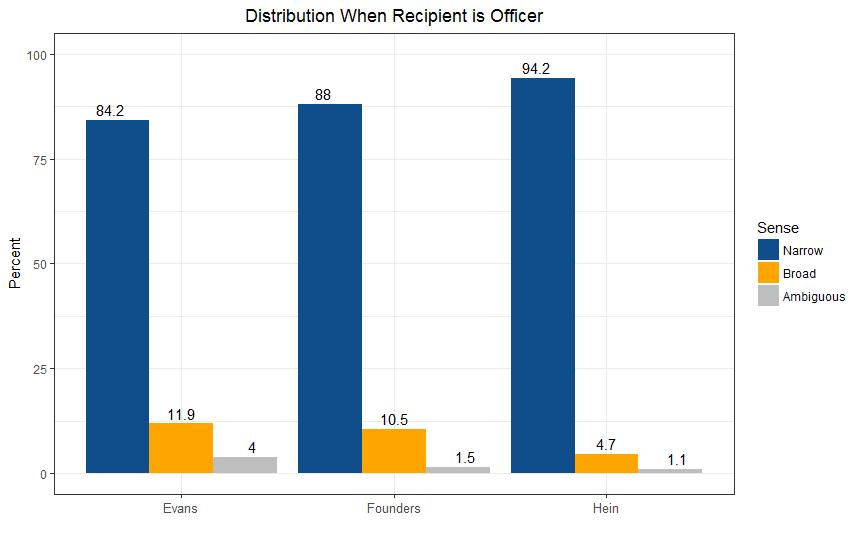
181-236_PHILLIPS &WHITE181-236_PHILLIPS &WHITE DOCX (DO NOT DELETE) 6/21/20198/21/20187/11/18 12:15 PM9:44 AM2:26PM
SOUTH TEXAS LAW REVIEW [Vol. 59:181
Emoluments Clause. Hence the need to look at emoluments in the context of being provided by government, as the graph below illustrates.
We found similar numbers in the emolument-from-government context as we did in the officer-receives-emolument context, though the proportion consisting of the narrow sense is even higher. Thus, in legal materials, when “emolument(s)” is used in the context of the government providingsuch, 97.3%of the time the narrow senseof the wordis beingused. And it appears that even “ordinary” Americans of the era would likely understand an emolument from government to mean an official emolument tied to office or civil employment, given that the narrow sense is 8.5 times more likely to be used than the broad sense in the Evans Corpus’s books, pamphlets, and broadsides on all topics. This data points to the most likely understanding of founding-era Americans ordinary folk and lawyers of the Presidential Emoluments Clause to be that the clause refers to financial compensation or benefits of a financial value stemming from his service as President of the United States. The Foreign Emoluments Clause is more complicated, however. Giventhisdata,onewouldbetemptedtotakethepositionthat themost likely founding-era understanding of the Foreign Emoluments Clause is that it prohibited financial compensation or benefits of a financial value from service to or employment for a foreign state, or for being an officer (civil or military) in a foreign state. But there is a catch. The Foreign Emoluments Clause has a catchall phrase after the prohibition: “any present, Emolument, Office, or Title, of any kind whatever. ”
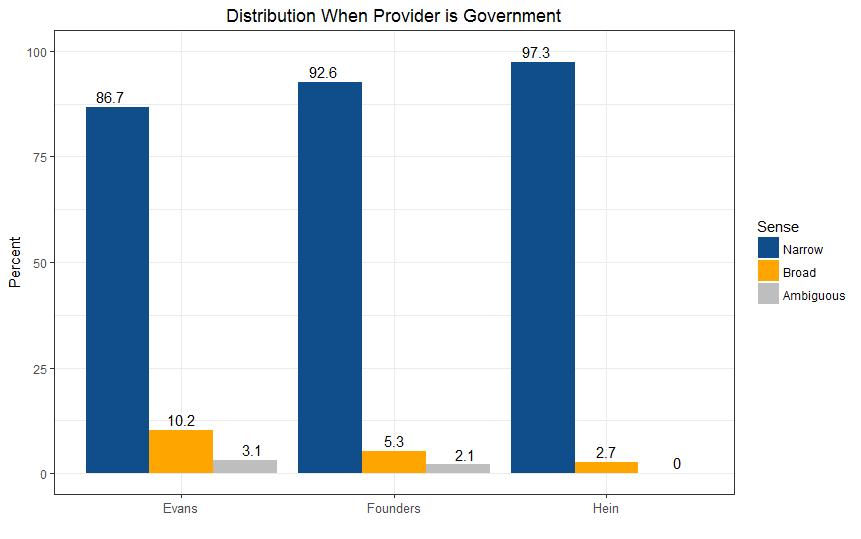
181-236_PHILLIPS &WHITE181-236_PHILLIPS &WHITE DOCX (DO NOT DELETE) 6/21/20198/21/20187/11/18 12:15 PM9:44 AM2:26PM
226
2017] A CORPUS LINGUISTICS ANALYSIS 227
The question, then, is whether “of any kind whatever” applies after the appropriate sense has been determined (as there were many kinds of office-related emoluments), in which the catchall phrase is only as broad as the scope of the sense, or if the phrase requires that the broader sense (or all senses) must apply. This is a difficult question. Further research is necessary on this phrase. However, it makes the most sense to apply the catchall phrase the same way to all of the items prohibited in the clause. And having the phrase require the broadest sense or all senses rather than cover everything within a particular sense is more problematic for other prohibited items. For example, the sense of the word “office” meaning “A room, set of rooms, or building used as a place of business for non-manual work; a room or department for clerical or administrative work” goes back to at least the fifteenth century, appearing in Chaucer’s Friar’s Tale. 166 So, “office” as a physical working space was a well-known and commonly used sense at the founding. To read “of any kind whatever” to trigger all senses of “emolument” would also seemingly require the catchall to trigger all senses of “office,”but thephysicalspacesenseof “office” wouldalreadybecovered by “present,” and it makes less sense in context. Similarly, “title” at the time of the founding (and since the late thirteenth century) also means a “[l]egal right to the possession of property (esp. real property); the evidence of such right; [and] title-deeds.”167 If “of any kind whatever” means all senses of the word, then the property sense of title would also be covered by the Foreign Emoluments Clause. However, this kind of title would be included in “present,” creating redundancy, and this kind of title is not generally associated with office or emolument, so it seems out ofcontext. Still, perhaps because the property sense of title is a legal sense, one could argue that “of anykind whatever” does not applyto legal senses,just the broadest non-legal sense. The principle for drawing that line is unclear. Yet, one could argue that “of any kind whatever” only applies to broader senses of the word that would cover the narrower sense, not distinct senses like “office,” where the physical space sense is arguably distinct from thepositionorstationsense(thatonecouldbegivenaphysical officewithout a position to go with it), or “title,” with its distinct legal sense. In the end, it is unclear what impact “of any kind whatever” has on determining the appropriate sense of “emoluments” in the Foreign Emoluments Clause. It could mean that “any kind” of office-related emolument (perquisites, fees, salary, or anything of financial value) is prohibited, or it could mean that any
166 Office, OXFORD ENGLISH DICTIONARY, www.oed.com/view/Entry/130640 [https://perma.cc/7GG4-GPNR].
167 Title, OXFORD ENGLISH DICTIONARY, http://www.oed.com/view/Entry/202602?rskey=SudRDx&result=1#eid [https://perma.cc/F9L8J77Y].
181-236_PHILLIPS &WHITE181-236_PHILLIPS &WHITE DOCX (DO NOT DELETE) 6/21/20198/21/20187/11/18 12:15 PM9:44 AM2:26PM
kind of emolument, including those not related to office, are prohibited. We are just not sure.
b. Relevant Examples
In reading over 900 examples168 of founding-era uses of “emolument(s),” we came across a few that seemed at least somewhat relevant to the meaning of the Foreign Emoluments Clause. One is a letter from George Mason (who opposed the Constitution) to Thomas Jefferson, written May 26, 1788. In the letter he lists some of his objections to the recently proposed federal Constitution, including that “[b]y the Consent of Congress, Men in the highest Offices of Trust in the United States may receive any Emolument, Place, or Pension from a foreign Prince, or Potentate; which is setting themselves up to the highest Bidder.”169 Mason’s objection appears to be congressional consent. What is interesting is how he re-characterizes “present,Emolument,Office,orTitle,ofanykindwhatever” to be “any Emolument, Place, or Pension.”170 Place and pension appear to be related to public service or office, meaning it would be odd to give emolument a broader reading. Still, he leaves out “present,” which has a broad meaning. However, this is just one person’s reading of the constitutional language and a somewhat unclear one at that. Another relevant example comes from Thomas Jefferson when he was Secretary of State. In an April 6, 1790 letter, he directs the letter’s recipient:
to make the accustomary present for me to the Indtroducteur des Ambassadeurs and to Sequeville their Secretary; to the former a gold snuff box, value 1200. To the latter, one of 800. [sic] value. But I believe the latter would prefer the money wrapped up in a wish that he should chuse a box for himself. Perhaps the former would also. If not, let as little be lost in the workmanship as possible, that it maybe worth the more to him when disposed of. You can learn from the diplomatic members how all this is to be done. Let the Introductor and Secretary know in time that I cannot recieve the accustomary present from the king. Explain to them that clause in our new constitution which sais ‘no person holding any office of profit or trust under the U.S. shall accept any present, emolument, office, or title of any kind whatever from any king, prince or foreign state.’ It adds indeed ‘without the
168 This includes the 784 coded for the study, and the 150 coded for practice beforehand.
169. George Mason, To Thomas Jefferson from George Mason, 26 May 1788, FOUNDERS
ONLINE, http://founders.archives.gov/documents/Jefferson/01-13-02-0117 (last updated Feb. 1, 2018) [https://perma.cc/S9JC-RKP4].
170 Id.
181-236_PHILLIPS &WHITE181-236_PHILLIPS &WHITE DOCX (DO NOT DELETE) 6/21/20198/21/20187/11/18 12:15 PM9:44 AM2:26PM 228 S
OUTH TEXAS LAW REVIEW [Vol. 59:181
2017] A CORPUS LINGUISTICS ANALYSIS 229
consent of Congress’ but I do not chuse to be laid on the gridiron of debate in Congress for any such paltry purpose; therefore the Introductor need notbetold of this qualification of the rule. Be sogood as to explain it in such a manner as to avoid offence, and if a good opportunity can be had, do the same to M. de Montmorin.171
It is interesting that Jefferson continued to direct the presentation of gifts to foreign ambassadors, which was custom at the time and not prohibited by the Constitution, but could not receive the same due to the constitutional prohibition. Whether Jefferson was following the Constitution’s strictures out of principle or out of convenience in this particular instance is unclear. Of course, this passage sheds no light on the meaning of “emoluments,” but is rather related to the prohibition on “presents” in the same clause. A further interesting and relevant mention of “emoluments” comes from a proclamation “[t]o the citizens of the Commonwealth of Virginia” from sometime in the 1780s declaring that, among others, “persons receiving salaries or emoluments from any power foreign to our Confederacy, shall be incapable of being members” of the Virginia Assembly.172 The term “salaries or emoluments,” at least in the data we analyzed, referred to those flowingfromofficerather than general emoluments. Of course,thislanguage does not include “of any kind whatever” after “salaries or emoluments,” limiting the applicability of this specific example.
In referencing a 1795 treaty between the fledgling United States and Great Britain, apparently prohibiting Americans from “accepting commissions or instructions from any foreign prince or state, to act against Great Britain,”173 one commentator critically asked: what legitimate authority can a treaty suggest, in order to justify the restraint upon that right of expatriation, which congress itself has not ventured to restrain, while legislating on subjects of a similar class? It is notintended to conveythe slightestdoubtof the power and propriety of controuling our citizens in their conduct towards foreign nations, while they are within the reach of domestic coercion: but to prohibit an American freeman from going whither he pleases, in quest of fortune and happiness to restrict him from exercising, in a foreign country, and in a foreign service, his genius, talents and industry; to
171 Thomas Jefferson, From Thomas Jefferson to William Short, 6 April 1790, FOUNDERS
ONLINE, http://founders.archives.gov/documents/Jefferson/01-16-02-0188 (last updated Feb. 1, 2018) [https://perma.cc/G987-UMEP].
172 Thomas Jefferson, III. Jefferson’s Draft of a Constitution for Virginia, [May–June1783], FOUNDERS ONLINE, http://founders.archives.gov/documents/Jefferson/01-06-02-0255-0004 (last updated Feb. 1, 2018) [https://perma.cc/8C8L-2RUU].
173 Treaty of Amity, Commerce, and Navigation, Between His Britannic Majesty and The United States of America, Gr. Brit.-U.S. 129-30, June 24, 1795.
181-236_PHILLIPS &WHITE181-236_PHILLIPS &WHITE DOCX (DO NOT DELETE) 6/21/20198/21/20187/11/18 12:15 PM9:44 AM2:26PM
SOUTH TEXAS LAW REVIEW [Vol. 59:181
denounce him for seeking honor, emolument or instruction, by enlisting within the territory and under the banners of another nation; to do such things, is to condemn the principle of our own policy, by which we invite all the world to fill up the population of our country: To do such things is, in fact, to prostrate the boasted rights of man 174
Here we see “emolument” from a “foreign prince of state” referenced in relation to “accepting commissions or instructions” from such foreign prince or state, or “enlisting within the [foreign] territory and under the banners of another nations.” This appears to be the emolument of foreign military service rather than something broader, though it is possible that the treaty placed a narrower prohibition on American citizens than a constitutionally broader prohibition on American officers, and thus does not necessarily shed much additional light on the Foreign Emoluments Clause.
A December 5, 1792 letter to the Secretary of the Treasury, Alexander Hamilton, from Governor Ar. St. Clair, Governor and Superintendent of Indian Affairs for the Northern Department of the Northwest Territory and the Western Territory, referenced Hamilton’s letter earlier that month noting the Senate’s “Order” to have a reporting of the “the Salaries, Fees and Emoluments of Persons holding Offices under the United States, and the actual Expenses and Disbursements attending the Execution of their respective Offices for one Year.”175 Governor St. Clair reported to Hamilton:
[T]he Office of Superintendant of Indian Affairs for the northern Department was united with that of Governor of the western Territory, and the Compensation that had been attached to that Office was added to the Salary of the Governor, making in the whole two thousand Dollars.That,sincetheestablishmentofthepresentGovernment,there has been no Appointment of a Superintendant and that, hitherto there has been no Fees, nor Emolument of any kind whatsoever beside the Salary.176
Here, the context makes the “of any kind” language appear to reference any kind of office-related emolument rather than any kind of emolument in the broad sense of the word. Emoluments were often treated as distinct from the
174 Id. at 130–31.
175 1 THE TERRITORIAL PAPERS OF THE UNITED STATES 25 (Clarence Edward Carter ed., 1934);Arthur St.Clair, To Alexander Hamiltonfrom Arthur St. Clair,5December1792, FOUNDERS ONLINE, http://founders.archives.gov/documents/Hamilton/01-13-02-0130 [https://perma.cc/9CZW-86JG].
176 Id.
181-236_PHILLIPS &WHITE181-236_PHILLIPS &WHITE DOCX (DO NOT DELETE) 6/21/20198/21/20187/11/18 12:15 PM9:44 AM2:26PM
230
2017] A CORPUS LINGUISTICS ANALYSIS 231
fees an officer or public employee could collect, although sometimes fees were a type of emolument. Still, it is just one example.177 States would sometimes have the equivalent of the Foreign Emoluments Clause in their own laws, prohibiting a state officer from holding office in and receiving emoluments from another state or foreign government, as well as sometimes their own state. For example, Thomas Jefferson observed in his famous Notes on the State of Virginia that the laws regulating the office of Governor in Virginia declared that “[d]uring his term he shall hold no other office or emolument under this state, or any other state or power whatsoever.”178 Similarly, North Carolina, finding it “necessary to keep separate and distinct the offices of the federal government from those of the state government,” declared that “no citizen of this state, shall hold at one and the same time, any office of trust, profit or emolument under the authority of the United States, and any office or authority either civil, military, judiciary, or otherwise, under the authority of this state.”179 But the “of any kind whatever” language does not modify “emolument,” and so it is unclear how similar these state equivalents to the Foreign Emoluments Clause are to the federal Constitution’s prohibition. In short, all the above examples, ultimately, are distinguishable from the Foreign Emoluments Clause, and thus it is unclear how much light they shed on the meaning of that clause in the Constitution.
VI. CAVEATS AND FUTURE RESEARCH
We note three caveats before pointing out some future research paths. First, we clarify that we do not claim to have proven the meaning of
177 While just outside of our time period by about two weeks, we also came across a law passed by Congress on January 17, 1800, that declared that “the superintendent of Indian trade, the agents, their clerks, or other persons employed by them, shall not be, directly or indirectly, concerned in exporting to a foreign country, any peltries or furs belonging to the United States, or interested in carrying on the business of trade or commerce, on their own, or any other than the public account, or take or apply to his or their own use, any emolument or gain for negotiating or transacting anybusiness or trade, during his or their appointment, agencyor employment, other than provided by this act, or excepting for or on account of the United States.” And Congress provided that “if any such person shall offend against any of the prohibitions aforesaid, he shall be deemed guilty of a misdemeanor, and shall, upon conviction thereof, forfeit to the United States a sum not exceeding one thousand dollars, and shall be removed from such office, agency or employment . . .
.” Act of Apr. 21, 1806, ch. 48, 2 Stat. 402, 403 (repealed 1811). This law would seem redundant if the Constitution already prohibited foreign business dealings with foreign governments by those holding a United States office. Of course, Congress can pass a redundant law, or Congress could pass a law prohibiting behavior already prohibited by the Constitution in order to attach specific penalties for violations.
178 THOMAS JEFFERSON, NOTES ON THE STATE OF VIRGINIA 320 (2d ed. 1794).
179 JAMES IREDELL, LAWS OF THE STATE OF NORTH CAROLINA 697 (Hodge & Wills 1791), http://heinonline.org/HOL/P?h=hein.ssl/lawstnc0001&i=1.
181-236_PHILLIPS &WHITE181-236_PHILLIPS &WHITE DOCX (DO NOT DELETE) 6/21/20198/21/20187/11/18 12:15 PM9:44 AM2:26PM
any of the emoluments clauses of the Constitution. Returning to Justice Frankfurter, his observation in the statutory interpretation context which webelieveisjust asrelevant toconstitutional interpretation that a“problem in [legal interpretation] can seriously bother courts only when there is a contest between probabilities of meaning.”180 That, we feel, captures the essence of legal interpretation: “a contest between probabilities of meaning.” And a contested constitutional clause will almost never be one where the probability of one of at least two possible meanings is zero percent. Thus, all we can say is that the corpus linguistic data we have analyzed and presented may shift the probabilities towards one meaning and away from another, but we can never say we have proven one contested meaning over another.
Second, by engaging solely in corpus linguistic analysis here, we do not imply that other types of analysis do not have value in determining constitutional meaning. Certainly, soaking in the intellectual, political and social milieu of the era what Solum calls “historical immersion” can provide greater context and insight into why certain provisions of the Constitution were proposed and ratified.181 And knowing the purpose or intent behind a constitutional clause can help one interpret an ambiguous constitutionaltermor phrase, as some scholars have focusedoninthe context of “emolument(s).”182 Butthepurpose orintent behinda constitutional clause can only take us so far, because it is the words themselves enacted, not the purpose behind them, that are the law; and it is often difficult to know which of several possible competing purposes animates the clause (or if several, which get more weight).
Additionally, studyinghistorical practiceand behavior can shed light on constitutional meaning, as some scholars have done regarding the Foreign Emoluments Clause.183 After all, how one acts can be an accurate reflection of how one understands language. Take our previous hypothetical of the construction of a “green” home. If we were trying to interpret someone’s request to build a home that was “green,” and then learned that the builder constructed a home that was energy efficient with solar panels, it would strongly imply the sense of “green” used in the original request. But there are limitations to this methodology. Drawing again on our hypothetical, the builder may have misunderstood the request. Or, she may have purposely
180 Felix Frankfurter, Some Reflections on the Reading of Statutes, 47 COLUM L. REV. 527, 528 (1947).
181 See Triangulating Public Meaning, supra note 26, at 19.
182 Compare Zephyr Teachout, The Anti-Corruption Principle, 94 CORNELL L. REV 341, 353 (2009) (arguing that fears of corruption animate the Foreign Emoluments Clause), with Natelson, supra note 64, at 8 (arguing that anti-corruption was just one of several competing and cross-cutting concerns behind the clause, which caused the clause to be a compromise).
183 See, e.g., Seth Barrett Tillman, Business Transactions and President Trump’s “Emoluments” Problem, 40 HARV J.L. &PUB POL’Y 759, 763 (2017).
181-236_PHILLIPS &WHITE181-236_PHILLIPS &WHITE DOCX (DO NOT DELETE) 6/21/20198/21/20187/11/18 12:15 PM9:44 AM2:26PM 232 SOUTH TEXAS LAW REVIEW [Vol. 59:181
2017] A CORPUS LINGUISTICS ANALYSIS 233
ignored its obvious meaning. Thus, historical practice and behavior often suffers from “observational equivalence” multiple explanations can be ascribed to the same behavior. Still, this methodology has some value and adds another data point in the quest to determine how the Constitution was likely understood by a previous generation. Arguably the best way to interpret the Constitution might be a multitude of methods, what Solum and McGinnis, drawing on social science concepts, have respectively called “triangulation”184 and “thick”185 interpretation. We also note that how the generation that wrote, ratified, and read the Constitution would have understood has varying relevance to constitutional interpretation, depending on one’s theory of interpretation as well as whether the constitutional language in question has been long interpreted by the U.S. Supreme Court or is being looked at for the first time. As an example of the latter, when interpreting the Second Amendment for the first time, even justices on the Supreme Court who normally would not give much or any weight to the original meaning of constitutional language engaged in such analysis.186 Our main point is that to the extent original public meaning (or whatever one wants to call it) plays any role in one’s constitutional exegesis, the way such meaning is traditionally determined is woefully inadequate. Corpus linguistics is needed. That then raises the question do all judges, lawyers, and law professors who are trying to interpret the Constitution need to be corpus linguists now? Well, in one sense, they already are at least in their sometimes-professed aims. They just have not been using the tools to match the questions they have sought answers to. At some level, legal interpretation is a form of linguistics.187 So, legal interpreters might as well do the best
184 See Triangulating Public Meaning, supra note 26, at 2. Triangulation is a common practice in social science, usually referring to looking at a phenomenon from a mix of quantitative and qualitative methods.
185 See John O. McGinnis, Thick Originalism as a Constraint on Ideology, LAW AND LIBERTY (Apr. 7, 2014), http://www.libertylawsite.org/2014/04/07/thick-orginalism-as-aconstraint-on-ideology/ [https://perma.cc/2EEG-R5DU] In the social sciences, the term “thick description” was made famous by anthropologist Clifford Geertz. See also Solan, supra note 3, at 64 (2016) (arguing that“like the lexicographer, the originalist will have other choices to make about how narrowly or broadly, thinly or thickly, to construe a relevant word”). See generally CLIFFORD GEERTZ, THE INTERPRETATION OF CULTURES (1973).
186 District of Columbia v. Heller, 554 U.S. 570, 576, 640-41 (2008) (both Justice Scalia’s five-member majority and Justice Stevens’ four-member dissent sought to understand the original meaning of the Second Amendment).
187 But see William Baude & Stephen E. Sachs, The Law of Interpretation, 130 HARV L. REV. 1079, 1082–83 (2017) (arguing that legal interpretation isn’t about semantics but about following the rules of interpretation dictated by the law); John O. McGinnis & Michael Rappaport, The Constitution and the Language of the Law, SOCIAL SCIENCES RESEARCH NETWORK 55 (Legal Studies Research Paper Series No 17-262, 2017), https://papers.ssrn.com/sol3/papers.cfm?abstract_id=2928936 [https://perma.cc/SG9U-TWVQ]
181-236_PHILLIPS &WHITE181-236_PHILLIPS &WHITE DOCX (DO NOT DELETE) 6/21/20198/21/20187/11/18 12:15 PM9:44 AM2:26PM
linguistics they can. And the methodology we have demonstrated here is, at its core, really quite similar to what legal interpreters already do sifting through examples to determine patterns just as lawyers and judges often sift through cases to determine patterns in precedent. Granted, we have introduced a new kind of source linguistic corpora rather than legal precedent and added some new tools. But we view the methodology employed in this Article as a difference in degree, not kind. With a little bit of training, the legal world can do what we have done here. Additionally, there appears to be a misunderstanding that corpus linguistic analysis is where one runs a query on the computer, which then spits out numbers that provide a linguistic answer. As this Article has sought to demonstrate, that is just not the case. Corpus linguistics can help one see patterns that are not easily intuited, providing insight that otherwise would have been missed. But the interpretation and analysis still requires the hard work of slogging through the results. And the heart of corpus linguistic analysis what in our view is the aspect of the methodology that provides the most valuable information is the most qualitative and is really no different than reading a sample of cases one has found from a computerized search of a legal database. As noted above, we read over 150,000 words of context to be able to place each instance of “emolument(s)” in a sense category. In short, corpus linguistic tools aid human analysis, they do not supplant it.
As to future research, the presence of binomials and multinomials indicates phrases that have begun to take on their own meaning, possibly legal terms of art. Further investigation is needed, both into these, but also into what they might indicate regarding the meaning of “emolument(s)” in the founding era. Additionally, “of any kind whatever” and similar phrasing does appear in our corpora. Further research into how that phrase modifies other words is needed to shed further light on the Foreign Emoluments Clause.
VII. CONCLUSION
The recent flurry of scholarship seeking to understand the meaning of the emolumentsclausesoftheConstitution,particularlytheForeignEmoluments Clause, in the wake of President Trump’s election and subsequently filed lawsuits, has relied on a host of interpretive methodologies. To the extent scholars now (and courts later) seek to understand what the word “emolument(s),” used thrice in the Constitution, would have meant to the founding generation, their methodologies in determining such need to be up
(arguing that the Constitution should be interpreted according to the legal interpretive methods in existence at the founding).
181-236_PHILLIPS &WHITE181-236_PHILLIPS &WHITE DOCX (DO NOT DELETE) 6/21/20198/21/20187/11/18 12:15 PM9:44 AM2:26PM 234 S
T
OUTH
EXAS LAW REVIEW [Vol. 59:181
2017] A CORPUS LINGUISTICS ANALYSIS 235
to the task. Using full-blown corpus linguistic analysis with all its tools and drawing on a sufficiently large and representative corpus, this Article finds that the Congressional and Presidential Emoluments Clauses would have most likely beenunderstoodtocontainanarrow,officeorpublic-employment sense of “emolument.” But the Foreign Emoluments Clause is more ambiguous given the modifying language “of any kind whatever” attached to it. Further research into that phrase is needed.
181-236_PHILLIPS &WHITE181-236_PHILLIPS &WHITE DOCX (DO NOT DELETE) 6/21/20198/21/20187/11/18 12:15 PM9:44 AM2:26PM
* * *
236
SOUTH TEXAS LAW REVIEW [Vol. 59:181 APPENDIX
181-236_PHILLIPS &WHITE181-236_PHILLIPS &WHITE DOCX (DO NOT DELETE) 6/21/20198/21/20187/11/18 12:15 PM9:44 AM2:26PM
Cluster Evans Founders Hein emolument(s) of the community farmer ingenious [husband] office/officers188 state 3 2 2 3 5 collector(s) department different [characters] field [commissary] office/officers189 post station 4 2 2 2 1 6 2 2 collectors/colle ctor ship company field [commissary] inspectors/insp ectorship office/officers 190 7 5 2 2 1 1 emolument(s) to the community farmer ingenious [husbandman] officer/officers191 state 3 2 2 3 5 government pay purchasers office/officers 192 same [belonging] 2 4 2 3 5 emolument(s) of his office(s)193 8 country office station 2 2 4 office 1 1 emolument(s) annexed to offices194 appointment195 2 4 station appointment196 office(s)197 2 2 3 station198 office199 appointment200 observance201 2 2 2 2 emolument(s) for the year 202 2 time203 2 emolument(s) of a captain 3 6 brigadier 4 2 188 Includes (1) several officers 189 Includes (1) marshals office, (1) present office, (1) quarter masters office, (2) several officers 190 Includes (1) said office 191 Includes (1) several officers 192. Includes (1) said office, (2) several officers 193 Includes (1) arduous office, (1) high office, (2) modern offices 194 Includes (1) public offices, (1) great offices 195 Includes (4) the appointment 196 Includes (2) the appointment 197 Includes (1) the office, (2) their offices 198 Includes (1) a station, (1) his station 199 Includes (1) each office, (1) that office 200. Includes (2) the appointment 201 Includes (2) the observance 202 Includes (1) two first years 203 Includes (1) time, (1) same time
2017] A CORPUS LINGUISTICS ANALYSIS 237
181-236_PHILLIPS &WHITE181-236_PHILLIPS &WHITE DOCX (DO NOT DELETE) 6/21/20198/21/20187/11/18 12:15 PM9:44 AM2:26PM
lieutenant204 major supernumerary 3 2 officer205 captain colonel commissioner deputy superintendent lieutenant206 major 4 8 3 2 5 1 1 9 emoluments derived from the [operation of our government] 2 emoluments arising from desertion 2 said [privilege] 2 emoluments in the gift 2 mean [time] 2 army 207 line208 3 2 emoluments of which have 2 for shall 3 4 emoluments allowed to officer(s)209 2 officer(s)210 general(s)211 5 2 emoluments of their grades212 office(s)213 3 4 office 2 204 Includes (2) retiring lieutenant 205 Includes (1) british officer, (1) general officer 206 Includes (7) retired/retiring lieutenant 207 Includes (2) late army 208 Includes (1) official line 209 Includes (1) retiring officers 210. Includes (1) an officer, (1) other retiring officers, (2) retiring officers 211 Includes (1) other major generals, (1) the adjutant general 212 Includes (1) respective grades 213 Includes (2) respective offices
181-236_PHILLIPS &WHITE181-236_PHILLIPS &WHITE DOCX (DO NOT DELETE) 6/21/20198/21/20187/11/18 12:15 PM9:44 AM2:26PM 238 SOUTH TEXAS LAW REVIEW [Vol. 59:181
F
SETH BARRETT TILLMAN†
I. INTRODUCTION 238
II. PRESIDENTIAL ELECTORS AND THE BRIEF OF THE LEGAL HISTORIANS 242
III. THE AFTERMATH OF THE HAMILTON DOCUMENTS IMBROGLIO: MIKE STERN’S “NATIONAL TREASURE ORIGINALISM” .................252
IV. PROFESSOR VICTORIA F. NOURSE AND THE ABYSS ......................262
V. THE WAY FORWARD......................................................................275
* A draft version of Part III, absent footnotes, appeared on The Originalism Blog † Lecturer, Maynooth University Department of Law. Roinn Dlí Ollscoil Mhá Nuad. I thank Professor Josh Blackman and the student editors at South Texas Law Review for the opportunity to present mypreliminarythoughts at their September 8, 2017 symposiumon the Foreign Emoluments Clause. In addition to my academic and popular, print and online, publications, I have filed several briefs in the three federal district court actions one of which is now on appeal. See, e.g., Brief of Scholar Seth Barrett Tillman & the Judicial Education Projectas AmiciCuriae Supporting Appellee and Affirmance, Citizens for Responsibility & Ethics in Wash. v. Trump, No. 18-0474-cv (2d Cir. June 5, 2018), ECF No. 135, 2018 WL 2722468; Corrected Response of Scholar Seth Barrett Tillman & the Judicial Education Project as Amici Curiae in Support of the Defendant, District of Columbia & Maryland v. Trump, No. 8:17-cv-01596-PJM (D. Md. Dec. 31, 2017), ECF No. 77, 2017 WL 6880026; Motion and Brief for Scholar Seth Barrett Tillman & the Judicial Education Project as Amici Curiae Supporting Defendant, District of Columbia & Maryland v. Trump, No. 8:17-cv-01596-PJM (D. Md. Oct. 6, 2017), ECF No. 27-1, 2017 WL 4685826; Brief for Scholar Seth Barrett Tillman & the Judicial Education Project as Amici Curiae Supporting Defendant, Blumenthal v. Trump, No. 1:17-cv-01154 (D.D.C. Sept. 19, 2017), ECF No. 16-1, 2017 WL 4230605; Amicus Curiae Scholar Seth Barrett Tillman’s & Proposed Amicus Curiae Judicial Education Project’s Response to Amici Curiae by Certain Legal Historians, Citizens for Responsibility & Ethics in Wash. v. Trump, 276 F. Supp. 3d 174 (S.D.N.Y. Sept. 19, 2017), ECF No. 85-1, 2017 WL 4685886; Motion and Brief for Scholar Seth Barrett Tillman as Amicus Curiae Supporting Defendant, Citizens for Responsibility & Ethics in Wash. v. Trump, 276 F. Supp. 3d 174 (S.D.N.Y. June 16, 2017), ECF No. 37, 2017 WL 2692500. My publications can be found on Westlaw, LexisNexis, HeinOnline, and on the Social Science Research Network. See Scholarly Papers [of Seth Barrett Tillman], SOCIAL SCIENCE RESEARCH NETWORK (last visited Jan. 7, 2018), https://ssrn.com/author=345891; see also Selected Works of Seth Barrett Tillman, BEPRESS (last visited Jan. 7,2018), https://works.bepress.com/seth_barrett_tillman/. Feel free to contact me if you have any difficulty finding Tillman-authored materials. sbarrettillman@yahoo.com, @SethBTillman.
237-280_TILLMAN (DO NOT DELETE) 6/21/201912:16PM 237
THE
OREIGN EMOLUMENTS CLAUSE WHERE THE BODIES ARE BURIED: “IDIOSYNCRATIC” LEGAL POSITIONS*
I. INTRODUCTION
In 2017, three sets of plaintiffs in three different federal district courts brought civil actions against the President of the United States: each action alleged that the President has and continues to violate the Constitution’s Foreign Emoluments Clause.1 The Foreign Emoluments Clause provides: No Title of Nobility shall be granted by the United States: And no Person holding any Office of Profit or Trust under them, shall, without the Consent of the Congress, accept of any present, Emolument, Office, or Title, of any kind whatever, from any King, Prince, or foreign State.2
There are only a handful of federal cases discussing the Foreign Emoluments Clause.3 Not one of these cases has any extensive discussion of the scope of the Foreign Emoluments Clause or the scope of the clause’s Office of Profit or Trust under the United States language (“Office-language” or “Office under the United States-language”). Not one of these cases,
1 See, e.g., Amended Complaint, District of Columbia & Maryland v. Trump, No. 8:17-cv01596-PJM (D. Md. Feb. 23, 2018), ECF No. 90-2, 2018 WL 1051866, amending Complaint, District of Columbia & Maryland v. Trump, No. 8:17-cv-01596-PJM (D. Md. June 12, 2017), ECF No. 1, 2017 WL 2559732 (motion to dismiss briefing and oral argument was based on the original complaint); First Amended Complaint, Blumenthal v. Trump, No. 1:17-cv-01154-EGS (D.D.C. Aug. 15, 2017), ECF No. 14, 2017 WL 7355132; Second Amended Complaint, Citizens for Responsibility & Ethics in Wash. v. Trump, 276 F. Supp. 3d 174 (S.D.N.Y. May 10, 2017) (No. 1:17-cv-00458-RA), ECF No. 28, 2017 WL 2734681 [hereinafter Second Amended Complaint, CREW v. Trump] (CREW v. Trump was subsequently transferred from Judge Abrams to Judge Daniels).Eachcasebrings a claimbasedontheForeign Emoluments Clause. See U.S. CONST. art. I, § 9, cl. 8. But only CREW v. Trump and District of Columbia. & Maryland v. Trump bring a claim based on the Domestic Emoluments Clause (a/k/a Presidential Compensation Clause or Presidential Emoluments Clause). See U.S. CONST. art. II, § 1, cl. 7. Detailed discussion of that second cause of action and constitutional provision is beyond the scope of this Article. Many of the documents (including pleadings and briefs) related to these cases can be found on the websites of litigators associated with the plaintiffs in these matters. See Emoluments Clause Litigation, GUPTAWESSLER, P.L.L.C (last visited Mar. 26, 2018), http://guptawessler.com/emoluments/; Rule of Law: Blumenthal,etal.v.Trump,HoldingPresidentTrump AccountableforHis Violationsofthe Foreign Emoluments Clause, CONSTITUTIONAL ACCOUNTABILITY CTR (last visited Mar. 26, 2018), https://www.theusconstitution.org/litigation/trump-and-foreign-emoluments-clause/. These websites would be more helpful to interested third-parties if they were complete. Regrettably, my amicus briefs in District of Columbia & Maryland v. Trump and Blumenthal v. Trump are not listed, or if listed, are listed absent links. Likewise, some Department of Justice briefs are not listed, or if listed,arelistedabsentlinks.Nodoubt, this wasallanoversight. See generally SethBarrettTillman, AWorkin Progress:Select Bibliographyof Court Filingsand OtherSources Regarding theForeign and Domestic Emoluments Clauses Cases, NEW REFORM CLUB (Feb. 28, 2018, 8:59 AM), https://reformclub.blogspot.com/2018/02/a-work-in-progress-select-bibliography.html [hereinafter A Work in Progress].
2. U.S. CONST. art. I, § 9, cl. 8 (emphasis added).
3 See, e.g., Citizens United v. Fed. Election Comm’n, 558 U.S. 310, 424 n.51 (2010) (Stevens, J., dissenting) (quoting the Foreign Emoluments Clause); United States ex rel. Newdow v. Rumsfeld, 448 F.3d 403, 410 (D.C. Cir. 2006) (discussing the Foreign Emoluments Clause).
237-280_TILLMAN (DO NOT DELETE) 6/21/2019 12:16PM
238 SOUTH TEXAS LAW REVIEW [Vol. 59:237
WHERE THE BODIES ARE BURIED
expressly or impliedly, affirms or denies that the clause applies to the President. Likewise, there is no decision by any court of record of which I am aware which affirms or denies that the clause’s Office-language, or closely similar language in any other constitutional provision, encompasses the presidency. If the courts were to reach the merits,4 the issue at hand, the scopeof theclause’s Office-language,isentirelyoneoffirstimpression.Still, there has been some discussion of the clause and its Office-language, primarily, but not exclusively, amongst academics. Such discussion has appearedinthe Department ofJustice’sOffice of LegalCounsel memoranda, academic articles, popular magazines focusing on news, politics, and law, and in amicus briefs.
Since 2008, I have argued in multiple publications that the Foreign Emoluments Clause’s Office-language, and closely similar language in other constitutional provisions, reaches only appointed federal officers, and not any elected federal officials, including the presidency.5 My position has not gone entirely unnoticed; indeed, it has even occasioned some firm and thoughtful opposition.6 My goal in this Article is not to illustrate the full
4. If one of the Foreign Emoluments Clause cases is dismissed on a traditional threshold issue, e.g., standing or justiciability, a court is less likely to address the scope of the Foreign Emoluments Clause’s Office-language. See, e.g., Citizens for Responsibility & Ethics in Wash. v. Trump, 276 F. Supp. 3d 174, 195 n.1 (S.D.N.Y. Dec. 21, 2017), appeal docketed, No 18-474 (2d Cir. Feb. 16, 2018) [hereinafter CREW v. Trump] (“Because Plaintiffs’ claims are dismissed under Rule 12(b)(1), this Court does not reach the issue of whether Plaintiffs’ allegations state a cause of action under either the Domestic or Foreign Emoluments Clauses, pursuant to Rule 12(b)(6).”). But see generally District of Columbia & Maryland v. Trump, 291 F. Supp. 3d 725 (D. Md. Mar. 28 2018) (finding plaintiffs have standing, but refraining from ruling on other threshold questions, and so not granting discovery at this juncture). It might be argued that the scope of the Foreign Emoluments Clause’s Office-language is akin to personal jurisdiction, and so a threshold issue, rather than a merits question.
5 My earliest publications on the subject include: Seth Barrett Tillman & Steven G. Calabresi, The Great Divorce: The Current Understanding of Separation of Powers and the Original Meaning of the Incompatibility Clause, 157 U. PA L. REV PENNUMBRA 134, 135–40, 146–53 (2008). Compare Seth Barrett Tillman, Why Our Next President May Keep His or Her Senate Seat: A Conjecture on the Constitution’s Incompatibility Clause, 4 DUKE J. CONST. L. & PUB POL’Y SIDEBAR 1 (2009), with Saikrishna Bangalore Prakash, Why the Incompatibility Clause Applies to the Office of the President, 4 DUKE J. CONST L. & PUB POL’Y SIDEBAR 35 (2009).
6. Compare, e.g., Zephyr Teachout, Gifts, Offices, and Corruption, 107 NW. U. L. REV. COLLOQUY 30 (2012) [hereinafter Teachout, Gifts, Offices, and Corruption], and Zephyr Teachout, Constitutional Purpose and the Anti-Corruption Principle, 108 NW U.L.REV ONLINE 200 (2014), with Seth Barrett Tillman, Citizens United and the Scope of Professor Teachout’s Anti-Corruption Principle, 107 NW U. L. REV COLLOQUY 1 (2012) [hereinafter Tillman, Citizens United and the Scope of Professor Teachout’s Anti-Corruption Principle], and Seth Barrett Tillman, The Original Public Meaning of the Foreign Emoluments Clause: A Reply to Professor Zephyr Teachout, 107 NW U. L. REV COLLOQUY 180 (2013) [hereinafter Tillman, The Original Public Meaning of the Foreign Emoluments Clause]; compare, e.g., Zephyr Teachout & Seth Barrett Tillman, Common Interpretation, The Foreign Emoluments Clause: Article I, Section 9, Clause 8, NAT’L CONSTITUTION CTR. (last visited Mar. 26, 2018), https://constitutioncenter.org/interactiveconstitution/articles/article-i/the-foreign-emoluments-clause-article-i-section-9-clause-8/clause/34
237-280_TILLMAN (DO NOT DELETE) 6/21/2019 12:16PM
2017]
239
SOUTH TEXAS LAW REVIEW [Vol. 59:237
spectrum of views opposing my position on the subject. There are far too many such views many of which contradict one another, and many of which do not appear to have gone through any sort of independent review process, by student editors, peer review, or otherwise.7 Instead, my more
[hereinafter Common Interpretation, The Foreign Emoluments Clause], with Zephyr Teachout, Matter of Debate, The Foreign Emoluments Clause, NAT’L CONSTITUTION CTR , https://constitutioncenter.org/interactive-constitution/articles/article-i/the-foreign-emolumentsclause-by-zephyr-teachout/clause/34, with Seth Barrett Tillman, Matter of Debate, The Foreign Emoluments Clause Reached Only Appointed Officers, NAT’L CONSTITUTION CTR , https://constitutioncenter.org/interactive-constitution/articles/article-i/the-foreign-emolumentsclause-reached-only-appointed-officers/clause/34; compare, e.g., Zephyr Teachout, Room for Debate, Trump’s Foreign Business Ties May Violate the Constitution, N.Y. TIMES (Nov. 17, 2016, 5:06 PM), https://www.nytimes.com/roomfordebate/2016/11/17/would-trumps-foreign-businessties-be-constitutional/trumps-foreign-business-ties-may-violate-the-constitution, with Seth Barrett Tillman, Room for Debate, Constitutional Restrictions on Foreign Gifts Don’t Apply to Presidents, N.Y. TIMES (Nov. 18, 2016, 10:41 AM), https://www.nytimes.com/roomfordebate/2016/11/17/would-trumps-foreign-business-ties-beconstitutional/constitutional-restrictions-on-foreign-gifts-dont-apply-topresidents?module=ArrowsNav&contentCollection=undefined&action=keypress®ion=FixedL eft&pgtype=blogs. See generally, e.g., Zephyr Teachout, The Anti-Corruption Principle, 94 CORNELL L. REV. 341 (2009).
7 See, e.g., Norman L. Eisen et al., The Emoluments Clause: Its Text, Meaning, and Application to Donald J. Trump, GOVERNANCE STUDIES AT BROOKINGS 9 n.32 (Dec. 16, 2016), https://www.brookings.edu/wp-content/uploads/2016/12/gs_121616_emoluments-clause1.pdf (citing Tillman disapprovingly). It is possible that all Brookings publications (including this one) go through some sort of internal review I see no indication of any such review noted in the publication itself. There are other such recent publications which argue that the President is covered bythe Foreign Emoluments Clause. These papers do not cite mypublications (or me), nor have they gone through (as far as I can tell) anysort of independent review. See, e.g., Joshua Matz & Laurence H.Tribe, President Trump Has NoDefense Under the Foreign Emoluments Clause, ACSBLOG (Jan. 24, 2017), https://acslaw.org/sites/default/files/pdf/Trump%20and%20the%20Emoluments%20Clause.pdf [https://perma.cc/R4TA-BMSY]; Laurence H. Tribe et al., The Courts and the Foreign Emoluments Clause, CASETEXT (Jan. 30, 2017), https://casetext.com/posts/the-courts-and-the-foreignemoluments-clause-1 [https://perma.cc/G2LX-BD5B]; The Text and History of the Foreign Emoluments Clause, CONST ACCOUNTABILITY CTR (last visited Feb. 4, 2018), https://www.theusconstitution.org/think_tank/the-text-and-history-of-the-foreign-emolumentsclause/; see also, e.g., Jonathan Hennessey, Reconstituting: The U.S. Constitution’s Emoluments Clause and Donald Trump Full Documentary, JONATHAN HENNESSEY (July 24, 2017), http://www.jonathanhennessey.com/documentary-donald-trump-emoluments/ (“30:04–48:00 Explaining and refuting Seth Barrett Tillman’s case that the Foreign Emoluments Clause does not apply to the president.”); John Mikhail, The Definition of “Emolument” in English Language and Legal Dictionaries, 1523–1806 (July 1, 2017), https://ssrn.com/abstract=2995693 [hereinafter Mikhail, Definition of Emolument] (citing two Tillman-authored publications). Mikhail’s article is a serious publication, but there is no information posted on the Social Science Research Network indicating that Mikhail’s article (which is now over a year old) has been accepted for publication by any journal of any sort. Id. Moreover, notwithstanding that these publications have not gone through any sort of independent review, some of the authors of these publications cite their own publications incourtfilings inwhichtheyareactingas attorneys (or“clients” intheamicus context)
See, e.g., Brief of Amici Curiae by Certain Legal Historians on Behalf of Plaintiffs at 3 n.10, Blumenthal v. Trump, No. 1:17-cv-01154-EGS (D.D.C. Nov. 2, 2017), ECF No. 26-1, 2017 WL
237-280_TILLMAN (DO NOT DELETE) 6/21/2019 12:16PM 240
2017]
WHERE THE BODIES ARE BURIED 241
modest goal here is to illustrate how deeply idiosyncratic8 some of these views are not merely in their conclusions, but more importantly in their broad methodological approach.
5513219 [hereinafter Legal Historians Brief (DC)] (citing Mikhail, Definition of Emolument, supra); Plaintiffs’ Memorandum in Opposition to Defendant’s Motion to Dismiss (NY) at 58, Citizens for Responsibility & Ethics in Wash. v. Trump, 276 F. Supp. 3d 174 (S.D.N.Y. Aug. 4, 2017), ECF No. 57, 2017 WL 3444116 (citing Tribe, supra); Second Amended Complaint, CREW v. Trump, supra note 1, at 2 n.1 (citing Eisen et al., supra). Amongst this entire group of academics andlitigators listedinthis footnote,itappears thattheonlyperson who hadpublishedon the Foreign Emoluments Clause prior to the election of President Trump was Richard Painter. He wrote two pages on the clause. See, e.g., RICHARD W.PAINTER,TAXATION ONLY WITH REPRESENTATION 107 (2016) (“The Emoluments Clause does curtail some avenues of foreign influence, but its reach is limited.”); id. at 120.
8 One should not be so thin-skinned as to imagine that “idiosyncratic” or other similar language is a mean-spirited expression rooted in sarcasm, contempt, or derision. It is a perfectly acceptable term, which might fairly apply to all interpretations, including my own, not well grounded in Supreme Court and other federal court case law. See, e.g., Memorandum of Law in Supportof Plaintiffs’ OppositiontoMotiontoDismiss at33 n.20, District of Columbia &Maryland v. Trump, No. 8:17-cv-01596-PJM (D. Md. Nov. 7, 2017), ECF No. 46, 2017 WL 5598183 (characterizing Tillman’s amicus brief as “idiosyncratic”); Eisen et. al., supra note 7, at 9 n.32 (denominating Tillman’s position as “idiosyncratic,” “myopic,” and “strained”); Gautham Rao & Jed Handelsman Shugerman, Presidential Revisionism: The New York Times Published the Flimsiest Defense of Trump’s Apparent Emoluments Violations Yet, SLATE (July 17, 2017, 5:42 PM),
http://www.slate.com/articles/news_and_politics/jurisprudence/2017/07/the_new_york_times_pub lished_the_flimsiest_defense_of_trump_s_apparent_emoluments.html (using, in its title, “flimsiest” in characterizing Blackman and Tillman’s position albeit titles are customarily chosen byeditors, notcontributors); id. (making arguments about the1793 Hamilton-signed roll of officers, which Professors Rao and Shugerman subsequentlyretracted in other fora,but, for whatever reason, no such retraction, even as a letter to the editor, appears on Slate); Deepak Gupta (@deepakguptalaw), TWITTER (Aug. 1, 2017, 10:58 AM), https://twitter.com/deepakguptalaw/status/892444459157381120 (“More evidence and visit to National Archives further discredits idiosyncratic view that President is immune from Foreign Emoluments Clause”); Mark Joseph Stern (@mjs_DC), TWITTER (Jan. 3, 2017, 11:48 AM), https://twitter.com/mjs_DC/status/816370577804054529 [https://perma.cc/7ZUY-6DK7]
(“Conservative professors, seizing on a 1974 Scalia memo, are arguing that the [Foreign] Emoluments Clause doesn’t apply to the president. Nonsense.”); Mark Joseph Stern (@mjs_DC), TWITTER (Jan. 3, 2017, 12:00 PM), https://twitter.com/mjs_DC/status/816373583073054721 [https://perma.cc/X9GF-LN3G] (“Maybe you’re right; I just find the argument so gobsmackingly bad that I can’t think of another explanation [other than politics].”); see also, e.g., Brief of Separation of Powers Scholars as Amici Curiae Supporting Plaintiffs at 16 n.9, Blumenthal v. Trump, No. 1:17-cv-01154-EGS (D.D.C. Nov. 2, 2017), ECF No. 25-1, 2017 WL 5513218 (“Defendant [Tillman’s] Amicus’s arguments hold no water.”); Brief of Amicus Curiae by Certain Legal Historians on Behalf of Plaintiffs at 22, Citizens for Responsibility & Ethics in Wash. v. Trump, 276 F. Supp. 3d 174 (S.D.N.Y. Aug. 11, 2017), ECF No. 70-1, 2017 WL 5483629 (“But [Tillman’s] interpretation of the clause does not withstand scrutiny.”) [hereinafter Legal Historians Brief (NY)]; Plaintiff’s [CREW’s] Memorandum in Opposition to Defendant’s Motion to Dismiss, supra note 7, at 31 n.18 (noting that “an amicus advances the idiosyncratic argument that the president is not subject to the Foreign Emoluments Clause”).
237-280_TILLMAN (DO NOT DELETE) 6/21/2019 12:16PM
SOUTH TEXAS LAW REVIEW [Vol. 59:237
II. PRESIDENTIAL ELECTORS AND THE BRIEF OF THE LEGAL HISTORIANS
The first filed of the three Foreign Emoluments Clause cases was Citizens for Responsibility and Ethics in Washington (“CREW”) v. Trump. 9 Five academics (the “Legal Historians”)10 filed an amicus brief (the “Legal Historians Brief”)11 in support of the plaintiffs. The Legal Historians Brief
9 Complaint, Citizens for Responsibility & Ethics in Wash. v. Trump, 276 F. Supp. 3d 174 (S.D.N.Y. Jan. 23, 2017), ECF No. 1, 2017 WL 277603 [hereinafter Complaint, CREW v. Trump]. The operative complaint, the Second Amended Complaint, was filed on May 10, 2017, at docket number 28. See Second Amended Complaint, CREW v. Trump, supra note 1.
10 The authors (or clients) of the Legal Historians Brief are Professor Jack N. Rakove (Stanford University), Professor Jed Handelsman Shugerman (Fordham University School of Law), Professor John Mikhail (Georgetown University Law Center), Professor Gautham Rao (American University), and finally Professor Simon Stern (University of Toronto, Faculty of Law), who has blocked me from reading his Twitter feed. In addition to the Legal Historians Brief (NY), supra note 8, at 26–27, the same five academics on that brief also filed amicus briefs in the other two Foreign Emoluments Clausecases. See Brief of Amici CuriaebyCertain Legal Historians on Behalf of Plaintiffs at 29, District of Columbia & Maryland v. Trump, No. 8:17-cv-01596-PJM (D. Md. Nov. 14, 2017), ECF No. 58-1, 2017 WL 5624876 [hereinafter Legal Historians Brief (Maryland)]; Legal Historians Brief (DC), supra note 7, at 26.
11. See Legal Historians Brief (NY), supra note 8. In the course of this brief, certain very regrettable claims were made albeit, not by my counsel or by me. Id. at 22 n.82. These claims were subsequently retracted by the Legal Historians in a letter to the Court and on Balkinization, a well-read legal blog. See Letter from Daniel J. Walker, Counsel for the Legal Historians, to Judge George B. Daniels, U.S. District Court Judge (Oct. 3, 2017) [hereinafter Letter to Judge Daniels]; John Mikhail, Our Correction and Apology to Professor Tillman, BALKINIZATION (Oct. 3, 2017, 8:30 PM), https://balkin.blogspot.ie/2017/10/our-correction-and-apology-to-professor.html [hereinafter, Mikhail, Our Correction and Apology to Professor Tillman]; see also Jed Shugerman, An Apology to Tillman and Blackman, TAKE CARE (Sept. 22, 2017), https://takecareblog.com/blog/an-apology-to-tillman-and-blackman [hereinafter Shugerman, An Apology to Tillman and Blackman]. In this Article, I have taken care not to criticize the Legal Historians Brief (and its authors) in relation to the position it (and they) put forward in that brief involving the authenticity of the signature of the original 1793 Hamilton-signed roll of officers and the purported signature in subsequent reproductions of that document Other positions put forward by the Legal Historians, collectively and individually, in their brief and elsewhere, such as their position on presidential electors, must remain on the table for public discussion. It would be remiss for me to fail to note that for many, many years, I had hoped that all the documents relating to Hamilton’s 1793 roll of officers would become the subject of inquiry and discussion by other scholars. It is with genuine regret that my hopes were not realized along the lines I had sought. See supra note 8 (discussing Rao & Shugerman’s article on Slate). Recently, Professors Shugerman and Rao created a website archiving these documents. See THE FOREIGN EMOLUMENTS CLAUSE: EVIDENCE FROM THE NATIONAL ARCHIVES (last visited Feb. 25, 2018), https://sites.google.com/view/foreignemolumentsclause. They cited this website in their amicus brief and elsewhere. See Legal Historians Brief (NY), supra note 8, at 23 n.82; Jed Shugerman, Questions about the Emoluments Amicus Brief on Behalf of Trump, TAKE CARE (Aug. 31, 2017), https://takecareblog.com/blog/questions-about-the-emoluments-amicus-brief-on-behalf-of-trump (“Our colleague Rebecca Brenner followed up with her own visit [to the National Archives] and took photos of every document in the archival box. We posted them online here on a website to offer to the public images of all of the contents of the archival box.” (emphasis added)); Gautham Rao (@gauthamrao), TWITTER (Aug. 11, 2017, 2:11 PM), https://twitter.com/gauthamrao/status/896116983099400192 [https://perma.cc/CTD6-XNAR]
237-280_TILLMAN (DO NOT DELETE) 6/21/2019 12:16PM 242
WHERE THE BODIES ARE BURIED 243
(“Some of our archival evidence for the Historians Brief can be seen here: http://sites.google.com/view/foreignemolumentsclause . . . (hat tip to @BrianneGorod too!)”) (reporting “likes” and/or “retweets” from Professors Shugerman and Mikhail). Again, it is with some regret that I report that this website is no longer active my attempts to view it produce: “Google404. That’s anerror. TherequestedURLwas not found onthis server.That’s all weknow.” (For an alternative website see A Work in Progress, supra note 1 ) Whether the Shugerman-Rao website’s designers passively allowed it to go moribund, or purposely deactivated the website, I do not know but I do know that an appeal in CREW v. Trump was filed on February 16, 2018. See supra note 4 (reporting subsequent history in CREW v. Trump). Yet, sources cited in the trial court record by the Legal Historians (who include academics both in law schools and in history departments) are already dissolving before our very eyes. E.g., Jed Shugerman, Questions about the Emoluments Amicus Brief on Behalf of Trump UPDATED, SHUGERBLOG (Aug. 31, 2017), https://shugerblog.com/2017/08/31/questions-about-the-emoluments-amicus-brief-on-behalf-oftrump-and-its-use-and-misuse-of-historical-sources/ (“I’m not deleting this Aug. 31 [2017] post because it’s important to acknowledge my error, not to erase it.” (emphasis added)). I do not have to wonder what the response on social media and elsewhere would be if I had done (or allowed to have been done) such a thing; you gentle reader might consider the response if you had done (or allowed to have been done) such a thing. See, e.g., Brianne J. Gorod, What Alexander Hamilton Really Said, TAKE CARE (July 6, 2017), https://takecareblog.com/blog/what-alexander-hamiltonreally-said[https://perma.cc/YCY8-XQC9 (“[A]fter months of pretending likethis document didn’t exist, [Tillman] finally acknowledged it and was forced to describe it in grossly misleading terms in order to discount its significance.” (emphases added)); Joshua Matz, Foreign Emoluments, Alexander Hamilton & a Twitter Kerfuffle, TAKE CARE (July 12, 2017), https://takecareblog.com/blog/foreign-emoluments-alexander-hamilton-and-a-twitter-kerfuffle [http://perma.cc/66Z7-VY76] (“It’s hardly an impressive defense to mislead so dramatically in the NYT but then say that it’s all okay, since a few years ago I had a footnote in a law review article alluding vaguely to this contrary material.” (emphasis added)); id. (noting that Tillman’s publications are “low-profile academic articles”); Mark Joseph Stern (@MJS_DC), TWITTER (Aug. 1, 2017, 11:36 AM), https://twitter.com/mjs_DC/status/892454064532934658 [https://perma.cc/4DRT-WD5G] (“@BrianneGorod went to the National Archives to debunk the claim that the Emoluments Clause doesn’t apply to Trump[.]” (emphasis added) (showing that the tweet was subsequently deleted with the link now indicating: “Sorry, that page doesn’t exist!”));
Laurence Tribe (@tribelaw), TWITTER (Sept. 1, 2017, 7:20 PM), https://twitter.com/tribelaw/status/903804726717841409 [https://perma.cc/GS65-VAYA]
(“Another devastating critique of Tillmania by@jedshug[.]” (emphasis added)). Three of these four people are litigators in the Foreign Emoluments Clause cases against the President of the United States; the fourth, Stern, a journalist, is cheering on the other three. See, e.g., First Amended Complaint, Blumenthal v. Trump, supra note 1, at 57 (listing Brianne J. Gorod among the attorneys for plaintiffs);Plaintiff’s[CREW’s]MemoranduminOppositiontoDefendant’s MotiontoDismiss, supra note 7, at 60 (listing Joshua Matz among the attorneys for plaintiffs); Second Amended Complaint, CREW v. Trump, supra note 1, at 66 (listing Professor Tribe among the attorneys for plaintiffs).Itispossiblethatthis sortof overreachiscausedbyparticipationinhigh-stakes litigation, and then finding out that someone you might otherwise respect is on the “other” side. Prior to the start of litigation, some demonstrated better behavior. See, e.g., Laurence Tribe (@tribelaw), TWITTER (Nov. 19, 2016, 6:38 PM), https://twitter.com/tribelaw/status/800166406897672192 [https://perma.cc/DS27-U2L9] (“Just wait, @kurteichenwald: Some kook will argue the Emoluments Clause doesn’t apply to the President. Ridiculous but predictable.”); Laurence Tribe (@tribelaw), TWITTER (Nov. 21, 2016, 4:00 PM), https://twitter.com/tribelaw/status/800851329178566657 [https://perma.cc/7DQQ-EVEU] (“Must apologize: turns out scholar @SethBTillman makes that argument carefully. He’s no kook, but I find the argument seriously unconvincing.”) Or, perhaps, such overreach is caused by commentators’ speaking without familiarizing themselves with some or any of the extant literature. See Glenda Gilmore (@GilmoreGlenda), TWITTER (Aug. 31, 2017, 4:53 AM),
237-280_TILLMAN (DO NOT DELETE) 6/21/2019 12:16PM
2017]
244 SOUTH TEXAS LAW REVIEW [Vol. 59:237
stated: “As holders of an office ‘of trust’ under the United States, [presidential] electors [like the President] would also be subject to the [Foreign Emoluments] [C]lause.”12
The Legal Historians’ claim regarding presidential electors is perplexing. They cite no authority for this position. The Legal Historians quote anti-federalist George Mason for the proposition that: “the electors in thestates might also [likethe President] ‘beeasilyinfluenced,’ byforeign emoluments.”13 But Mason does not actually say presidential electors fall under the scope of the Foreign Emoluments Clause or its Office-language. The Legal Historians also quote Edmund Randolph, a mercurial figure who chose not to the sign the Constitution at the Philadelphia Convention, but argued for ratification at his state’s (i.e., Virginia’s) ratification convention. According to the Legal Historians, “Randolph argued that the requirement that electors be appointed separately in the states and have to vote on the same day ‘renders it unnecessary and impossible for foreign force or aid to interpose.’”14 If Mason’s language tends to suggest presidential electors fall under the aegis of the Foreign Emoluments Clause, Randolph’s statement suggests just the opposite. In any event, none of the language quoted appears to be direct or substantive evidence, even of the (weak) original public expectations variety, for the Legal Historians’ position.15
https://twitter.com/GilmoreGlenda/status/903224236843704320 [https://perma.cc/53TX-VDJ5]
(“Trump lawyers use 1 Hamilton letter for argument; bury 2nd Hamilton letter to the contrary written same day. Historians know better.” (emphasis added) (blocking Tillman from her Twitter feed thereafter)). Professor Gilmore is, I believe, a recently retired historian from Yale University’s Department of History. There are many other such examples. See Marc Johnson, Episode 8: Article 1, Section 9, Clause 8, MANY THINGS CONSIDERED (Jan. 18, 2017), http://manythingsconsidered.com/podcast (Dean Erwin Chemerinsky stating that the position that the President is not covered by the Foreign Emoluments Clause is “a silly argument”) (at 32:25ff).
DeanChemerinskyis alsoa litigatorintheForeign Emoluments Clausecases. See SecondAmended Complaint, CREW v. Trump, supra note 1, at 66 (listing Dean Chemerinsky among the lawyers for plaintiffs). Think about the exampleGilmore and Chemerinskyare setting for others, including their own students, particularly JD and PhD candidates people who will emulate their behavior in academic and other professional settings.
12 See Legal Historians Brief (NY), supra note 8, at 17 n.59 (inner quotation marks are in the Legal Historians Brief (NY), which is, apparently, quoting the Constitution’s Foreign Emoluments Clause).
13 Id at 17 (quoting 10 THE DOCUMENTARY HISTORY OF THE RATIFICATION OF THE CONSTITUTION: VIRGINIA 1365–66 (John P. Kaminski et al. eds., 1993)). The material in the inner quotation marks is a quotation from Mason.
14 Id (quoting 10 THE DOCUMENTARY HISTORY OF THE RATIFICATION OF THE CONSTITUTION: VIRGINIA, supra note 13, at 1367). The material in the inner quotation marks is a quotation from Randolph.
15 See Legal Historians Brief (Maryland), supra note 10, at 19–21 (discussing George Mason’s and Edmund Randolph’s expectations: i.e., the Foreign Emoluments Clause applied to the presidency); Legal Historians Brief (DC), supra note 7, at 16–18 (same); Legal Historians Brief (NY), supra note 8, at 17–18 (same); see also Legal Historians Brief (NY), supra note 8, at 22 n.82 (“For contemporaneous evidence that the founders understood that the [Foreign Emoluments
237-280_TILLMAN (DO NOT DELETE) 6/21/2019 12:16PM
More troubling is that there is a substantial body of authority taking the position that presidential electors are state positions,16 not federal positions, and so entirely beyond the scope of the Foreign Emoluments Clause and its Office . . . under the United States-language.17 The Legal Historians did not discuss this line of authority. Furthermore, there is a more recent line of academic authority, initially put forward by Vasan Kesavan, that notes that the Constitution’s Religious Test Clause18 distinguishes offices under the United States from public trusts under the United States. Kesavan argues that
Clause] applied to the president, see the exchange between Mason and Randolph . . . .”); Jack M. Balkin, Text, Principle, and Living Constitutionalism, BALKINIZATION (May 20, 2008, 1:57 PM), https://balkin.blogspot.ie/2008/05/text-principle-and-living.html (explaining that “central to my theory is the claim that we are not bound by the original expected application”). But see Letter to Judge Daniels, supra note 11 (withdrawing footnote 82 from the Legal Historians Brief) See generally Letter from Professor William Andreen et al. to Majority Leader Mitch McConnell et al., Re: President Obama’s Nomination of Judge Merrick Garland (Mar. 7, 2016), https://www.afj.org/wp-content/uploads/2016/03/Law-professor-SCOTUS-vacancy-letter.pdf
(“The Senate must not defeat the intention of the Framers by failing to perform its constitutional duty.” (emphasis added) (signed by Dean Chemerinsky and others)); but see generally Seth Barrett Tillman, The Two Discourses: How Non-Originalists Popularize Originalism and What That Means, NEW REFORM CLUB (Mar. 28, 2016, 9:22 AM), http://reformclub.blogspot.ie/2016/03/thetwo-discourses-how-non-originalists.html (expressing doubts that Dean Chemerinsky and many of the other signatories to the McConnell letter are originalists of the original intent type or any other type).
16 See, e.g., Walker v. United States, 93 F.2d 383, 388 (8th Cir. 1937) (“It is contended by defendants that presidential electors are officers of the state and not federal officers. We are of the view that this contention is sound and should be sustained.”); Buckley v. Valeo, 519 F.2d 821, 904 (D.C. Cir. 1975) (per curiam), aff’d in part and rev’d in part on other grounds, 424 U.S. 1 (1976) (“[A] Presidential elector is a state officer, not a federal one.”) (citing In re Green, 134 U.S. 377, 379 (1890)); Beverly J. Ross & William Josephson, The Electoral College and the Popular Vote, 12 J.L. & POL’Y 665, 692 (1996) (“Relevant constitutional provisions imply that electors are state, notfederal,officers.”); id.at693–94(collectingstatecourtauthoritytakingthepositionthat electors are state officers); see also, e.g., In re Green, 134 U.S. 377, 379 (1890) (“Although the electors are appointed and act under and pursuant to the [C]onstitution of the United States, they are no more officers or agents of the United States than are the members of the state legislatures when acting as electors of federal[S]enators, or thepeople of thestates when acting as electors of [R]epresentatives in [C]ongress.”); CONG. RESEARCH SERV., THE CONSTITUTION OF THE UNITED STATES OF AMERICA: ANALYSIS AND INTERPRETATION: ANALYSIS OF CASES DECIDED BY THE SUPREME COURT OF THE UNITED STATES TO JUNE 28, 2012, S. DOC NO 112-9, at 475, https://www.govinfo.gov/content/pkg/GPO-CONAN-2012/pdf/GPO-CONAN-2012.pdf (“[I]n Ray v. Blair, the [Supreme] Court reasserted the conception of electors as state officers .”) (citing Ray v. Blair, 343 U.S. 214 (1952)). I take no position in regard to whether CRS correctly characterized Ray v. Blair
17 See 4 JOHN BASSETT MOORE, A DIGEST OF INTERNATIONAL LAW § 651, at 577 (1906) (“The provisions of the Constitution ‘neither prevent nor authorize persons who may hold office under any one of the States from accepting an appointment under a foreign government.’” (quoting State Department correspondence from 1872)) But cf Teachout, Gifts, Offices, and Corruption, supra note 6, at 37 (discussing the possibility that the Foreign Emoluments Clause might reach state officers, but conceding that such a view is probably not the “better reading”).
18 U.S CONST art. VI, cl. 3 (“[N]o religious Test shall ever be required as a Qualification to any Office or public Trust under the United States.” (emphasis added))
237-280_TILLMAN (DO NOT DELETE) 6/21/2019 12:16PM 2017] WHERE THE BODIES ARE BURIED 245
the position of presidential elector, although a federal position, is a public trust under the United States, as opposed to an office under the United States 19 Again, this alternative view was not discussed by the Legal Historians.
Failing to discuss academic authority and nonbinding federal case law isnot bestpractice.Butitiscertainlywithinthenormsofthelegal profession, particularly in a brief where space is scarce.20 Failing to discuss contrary Supreme Court authority is another matter entirely. In 1867, in United States v. Hartwell, 21 the Supreme Court held: “The term [‘office’] embraces the ideas of tenure, duration, emolument, and duties ”22 Presidential electors fail each and every element of this four-factor test. Presidential electors do not have tenure in office: what the state legislature gives, the state legislature can takeback(atleastpriortotheelectors’voting).23 Thepositionofelectorlacks duration: it exists only for a short time roughly, the time between the certification of the state general election ballot and the day the electors meet and vote. The position then ceases to exist for about 4 years until the next presidential election cycle. The federal government does not pay presidential electors any compensation, i.e., the position comes with no federal
19 See Vasan Kesavan, The Very Faithless Elector, 104 W. VA L. REV 123, 133 & n.45 (2001) (discussing “office” and “public trust” language in the Religious Test Clause); id. at 129 (“Electors are by definition neither (1) ‘Senator[s] or Representative[s],’ nor (2) ‘Person[s] holding an Office of Trust or Profit under the United States.’”). But compare Jed Shugerman (@jedshug), TWITTER (May 30, 2017, 6:20 AM), https://twitter.com/jedshug/status/869543960905211904 [https://perma.cc/7X5H-77XQ] (“Foreign Emoluments clause applies to all offices of public trust, so would apply to TJ, Madison, Monroe[.]” (adding without explanation, the word “public” prior to “trust” or, perhaps, mistakenly converting the “or” in the Religious Test Clause’s language to an “of”)), with Marci A. Hamilton, The First Amendment’s Challenge Function and the Confusion in the Supreme Court’s Contemporary Free ExerciseJurisprudence,29 GA L.REV 81,97 n.55(1994)(misquotingtheConstitution’s Religious Test Clause as stating: “no religious test shall be required as a qualification to any office of public trust under the United States” where it should state “office or public trust”). For the reader who is interested in my view, I agree with Kesavan’s position: presidential electors as a matter of original public meaning hold an Article VI “public trust under the United States.” Albeit, there is federal case law to the contrary. See supra note 16. For my apologia for academics (and others, including presidents) who misquote the Constitution see Seth Barrett Tillman, Trump, Academia, and Hyperbole, NEW REFORM CLUB (Aug. 19, 2016, 2:30 PM), http://reformclub.blogspot.ie/2016/08/trump-academia-and-hyperbole.html.
20 See, e.g., Matz, supra note 11 (“To be sure, there’s always a fine balance to be struck between scholarly nuance and word limits, especially in op-eds and works of legal advocacy. Many capable lawyers and legal scholars fail, at times, to reckon adequately with contrary precedents and primary sources.”). But see generally FED R. EVID 901 (requiring authentication or identification of evidence); FED R. CIV P. 44 (discussing authentication in regard to official records)
21 United States v. Hartwell, 73 U.S. (6 Wall.) 385, 385 (1867).
22. Id at 393 (emphasis added).
23 See Bush v. Gore, 531 U.S. 98, 104 (2000) (per curiam) (“The State, of course, after granting the franchise in the special context of Article II, can take back the power to appoint electors.”).
237-280_TILLMAN (DO NOT DELETE) 6/21/2019 12:16PM 246
SOUTH TEXAS LAW REVIEW [Vol. 59:237
emoluments (albeit, some states provide for travel and other expenses24). Presidential electors are best characterized as special federal agents (or holders of a “public trust under the United States”) with a single duty, i.e., to cast a ballot for President and Vice President.25 By contrast, a bona fide office, per Hartwell, must have duties, as opposed to a single duty. As the Congressional Research Service and the Library of Congress have opined since (at least) 2013: “The truth of the matter is that the electors are not ‘officers’ at all, by the usual tests of office. They have neither tenure nor salary, and having performed their single function they cease to exist as electors.”26 Prior to the start of the Foreign Emoluments Clause cases against President Trump, none of this was considered controversial in any way. Let’s clarify: If presidential electors are state positions, then the Legal Historians Brief erred. If presidential electors hold Article VI public trusts under the United States, as opposed to Article VI offices under the United States, then the Legal Historians Brief erred. If, per Hartwell, presidential electors do not hold “office” of any type, then it would seem to follow that electors do not hold an Office under the United States, and are, therefore, beyond the ambit of the Constitution’s Foreign Emoluments Clause and its Office under the United States-language and, again, the Legal Historians Brief erred. It is true that historical context matters, but legal context is an element, a very substantial element, of historical context.27 To be clear, my point is not that because the Legal Historians were wrong (and I do think they were wrong) about presidential electors being officers under the United States, then they must also be wrong about the President’s being an officer under the United States. Instead, the methodological point here is that the Legal Historians’ (and others’) focus on the Foreign Emoluments Clause’s abstract purpose does not tell the interpreter if both of these positions (i.e., the presidency and presidential electors), if only one of these twopositions,orifneitherofthesetwopositionsareofficersundertheUnited States. A focus on purpose provides little guidance about the precise scope
24 Cf., e.g., Satrucharla Chandrasekhar Raju v. Vyricherla Pradeep Kumar Dev, A.I.R. 1992 S.C. 1959, para. 7 (India), https://indiankanoon.org/doc/1633748/ (explaining that in determining if a position is an office of profit under the government of India, the court examines, among other factors, if the post is “paid out of the revenues of [the] Government of India”)
25 See In re Green, 134 U.S. 377, 379 (1890) (“The sole function of the presidential electors is to cast, certify and transmit the vote of the State for President and Vice President of the nation.”
(emphasis added))
26 S. DOC NO 112-9, supra note 16, at 474 (citing Hartwell, 73 U.S. at 393).
27 See, e.g., Legal Historians Brief (NY), supra note 8, at 24 n.86 (“[W]e caution against a narrowly linguistic approach to original public meaning if it ignores the historians’ commitment to understanding the political and intellectual contexts of constitutional debate. For sophisticated discussions of these methodological questions, see Jack N. Rakove .”); see also, e.g., Legal Historians Brief (Maryland), supra note 10, at 24 n.72 (same); Legal Historians Brief (DC), supra note 7, at 22 n.64 (same).
237-280_TILLMAN (DO NOT DELETE) 6/21/2019 12:16PM 2017]
247
WHERE THE BODIES ARE BURIED
of the clause’s Office-language. At best, purpose might guide us as a tiebreaker or in a close situation. But with regard to presidential electors, in my opinion, it is not close, and so abstract purpose teaches us very little. Professor Zephyr Teachout is an Office-maximalist, i.e., one who ascribes a wide (if not the widest) meaning to the Constitution’s divergent Officelanguage. But, as far as I know, even Teachout has never argued that presidential electors hold Office under the United States 28 Her intellectual caution is an example others should emulate.
Given all that, I pose the question: How could five academics tell a federal court, without citing any supporting authority or noting any contrary authority,29 that presidential electors hold an “office ‘of trust’ under the United States” and that electors fall under the scope of the Foreign Emoluments Clause?30
28 See Seth Barrett Tillman, Originalism & The Scope of the Constitution’s Disqualification Clause, 33 QUINNIPIAC L. REV. 59, 68–71 (2014) (describing the maximalist view) [hereinafter Tillman, Originalism & The Scope of the Constitution’s Disqualification Clause].
29 See Matz, supra note 20 (discussing the lawyer’s duty to “reckon adequately with contrary” authority). Matz was speaking generally in regard to “contrary precedents;” here, by contrast, we are considering (what I would characterize as): [i] contrary [ii] binding [iii] controlling [iv] Supreme Court precedent. Justto beclear, mylarger point is not that those involved in the Legal Historians Brief (NY) knew about United States v. Hartwell, thought it contrary, binding, and controlling, and failed to disclose what they knew. Rather, my point is that they might never have heard or considered Hartwell at all, and so were in no position to offer the federal trial court well informed friend-of-the-court guidance about the status of presidential electors and other positions ostensibly subject to the Constitution’s Foreign Emoluments Clause and its Office-language. See supra note 27 (quoting the Legal Historians’ repeated guidance in regard to “context”).
30 See supra notes 9–12 and accompanying text. The Legal Historians made this claim only in their amicus brief in CREW v. Trump. They filed that brief on August 11, 2017. See Legal Historians Brief (NY), supra note 8, at 17 n.59. They filed similar amicus briefs in Blumenthal v. Trump, filed on November 2, 2017, and in District of Columbia & Maryland v. Trump, filed on November 14, 2017, but their expansive claim about presidential electors was dropped. See Legal Historians Brief (DC), supra note 7, at 17 n.50; Legal Historians Brief (Maryland), supra note 10, at 20 n.58. Why this claim was made in August, but was gone by November, is unclear. I presume thatthe Legal Historians do not see Hartwell as contrary, binding, and controlling precedent, as they never communicated with Judge Daniels and retracted the claim that they had made about electors in their Southern District of New York amicus brief. See Seth Barrett Tillman (@sethbtillman), TWITTER (Oct. 26, 2017, 11:57 PM), https://twitter.com/SethBTillman/status/923805904486785024 [https://perma.cc/Y3BR-SVU6]
(“Congressional Research Service: ‘The truth of the matter is that the electors are not “officers” at all, by the usual tests of office.’ citing U.S. v. Hartwell (1868)”). Compare Seth Barrett Tillman (@sethbtillman), TWITTER (Nov. 14, 2017, 4:43 AM), https://twitter.com/SethBTillman/status/930415788321886208 [https://perma.cc/98A6-KJQL]
(“Congressional Research Service: ‘The truth of the matter is that the electors are not “officers” at all ….’ (citing U.S. v. Hartwell (1868)), https://www.congress.gov/content/conan/pdf/GPOCONAN-2017-9-3.pdf”), with Gautham Rao (@gauthamrao), TWITTER (Nov. 14, 2017, 5:09 AM), https://twitter.com/gauthamrao/status/930422432682397697 [https://perma.cc/V2KH-RANT]
(“This [discussion of presidential electors] is all very interesting. Thank you. We deeply respect your scholarship and look forward to discussing your critiques as we work on future briefs and scholarship.”) (reporting a “like” from Professor Shugerman), with Seth Barrett Tillman
237-280_TILLMAN (DO NOT DELETE) 6/21/2019 12:16PM 248
SOUTH TEXAS LAW REVIEW [Vol. 59:237
Here, I can only hypothesize. The Legal Historians are not particularly interested in the linguistic or genealogical historyoftheForeign Emoluments Clause’s controlling phraseology: Office of Profit or Trust under [the United States]. Perhaps, they believe that such meaning never existed, or that it cannot now be rediscovered and reclaimed through modern research. Rather, their focusis onthe historical purposeof the clause, which was(asall accept) an anti-corruption provision. Their thinking is (I hypothesize) if the clause were meant to apply to some federal positions, as it plainly was, then it is obvious that it was meant to apply to the most important positions,31 and that would include (among others) the presidency. And if the clause’s Officelanguage applied to the presidency, it is only logical (they suppose) that it would also extend to the electors who choose the President.32
The Legal Historians’ mistake, in my view, is to allow abstract purpose determine linguistic meaning as opposed to actual text in its contemporaneous historical legal context. When one attempts to reconstruct the historical purpose of a constitutional provision, as understood by the ratifying generation, there is no good reason to think that one will arrive at the right level of generality or abstraction which accords with the actual
(@sethbtillman), TWITTER (Nov. 14, 2017, 5:42 AM), https://twitter.com/SethBTillman/status/930430714251800576 [https://perma.cc/L2MD-3PWR]
(“That’s not exactly publicly reaffirming the correctness of your submission to the SDNY court. If you stand by your statement, that’s fine. But if you do not, if it is plainly inconsistent with Hartwell, binding Supreme C[our]t precedent, then don’t you think you should do something?”), with Gautham Rao (@gauthamrao), TWITTER (Nov. 14, 2017, 7:13 AM), https://twitter.com/gauthamrao/status/930453706784559105 [https://perma.cc/WU3P-BAY4]
(“We’re grateful for your continued engagement on this, and I’m sure it will be on our docket as we continue to work on future briefs etc.”) (reporting, again, a “like” from Professor Shugerman). See generally Citizens for Responsibility & Ethics in Wash. v. Trump, 276 F. Supp. 3d 174, 179 n.1 (S.D.N.Y. Dec. 21, 2017), appeal docketed, No 18-474 (2d Cir. Feb. 16, 2018) (dismissing case on standing grounds a month after the Tillman-Rao-Shugerman exchange on Twitter).
31 See Johnson, Episode 8: Article 1, Section 9, Clause 8, supra note 11 (Dean Chemerinsky states that the Framers/ratifiers/framing-era public “above all . . . would [have] want[ed] to make sure that the President and Vice President were not influenced by foreign governments.”) (at 32:58ff). I might respond that the President and Vice President are not expressly listed under the Foreign Emoluments Clause. By contrast, the Impeachment Clause expressly lists the President and Vice President. See U.S. CONST. art. II, § 4 (“The President, Vice President and all civil Officers of the United States, shall be removed from Office on Impeachment for, and Conviction of, Treason, Bribery, or other high Crimes and Misdemeanors.”).
32 One really wonders how far the Legal Historians would embrace their chain of reasoning. If electors hold office under the United States because they elect the President (who, according to the Legal Historians, also holds an office under the United States), then do the voters (or members of the state legislatures) also hold office under the United States because the voters (or members) elect the electors (and, therefore, indirectly elect the President)? See, e.g., In re Green, 134 U.S. 377, 379 (1890) (“Although the electors are appointed and act under and pursuant to the [C]onstitution of the United States, they are no more officers or agents of the United States than are the members of the state legislatures when acting as electors of federal [S]enators, or the people of the states when acting as electors of [R]epresentatives in [C]ongress.”).
237-280_TILLMAN (DO NOT DELETE) 6/21/2019 12:16PM 2017] WHERE THE BODIES ARE BURIED 249
SOUTH TEXAS LAW REVIEW [Vol. 59:237
language chosen. This is particularly true where chosen language is technical33 or the result of compromise, reconsideration, and reflection.34 In such circumstances, abstract purpose will tend to push the interpreter beyond the intended and public meaning of the language. I believe this is what has happened here. On the other hand, once one concedes that presidential electors do not hold office under the United States, then the Legal Historians’ entire intellectual house of cards no longer appears quite safe and satisfactory. This is not to say that their position is flat out wrong, but only thattheirpointofview,likeanypointofviewlackingafirmbasisinSupreme
33 The Legal Historians expressly claim that electors hold an “office ‘of trust’ under the United States,” as opposed to an office of profit under the United States. See Legal Historians Brief (NY), supra note 8, at 23 (quoting the Constitution’s Foreign Emoluments Clause); see also U.S. CONST. art. I, § 3, cl. 7 (referring to “Office[s] of honor . . . under the United States”). In other words, it appears that the Legal Historians have conceded that the words used in the clause have a technical meaning, quite apart from any general or abstract discussion of purpose. See infra note 34 (discussing meaning connected to compromise). In such circumstances, the search for meaning requires our looking to how such language was used among participants within the legal system (contemporaneous with ratification), in addition to or as an important component of the greater general public. See Calder v. Bull, 3 U.S. (3 Dall.) 386, 391 (1798) (explaining that “expressions” which are “technical” and “in use long before the Revolution . . . acquire[] an appropriate meaning, by Legislators, Lawyers, and Authors” (emphases in the original)); see also, e.g., Plaintiffs’ Memorandum in Opposition to Defendant’s Motion to Dismiss at 34 n.24, Blumenthal v. Trump, No. 1:17-cv-01154-EGS (D.D.C. Oct. 26, 2017), ECF No. 17, 2017 WL 5485653 (“Of course, the [Foreign Emoluments] Clause’s scope is limited by factors beyond the meaning of ‘emolument,’ such as the requirement that an officeholder ‘accept’ an emolument ‘from’ a foreign state. This means that certain benefits which might fit within the broadest definition of emolument . . . are nevertheless outside the Clause’s scope, because they cannot be ‘accepted’ or are not ‘from’ a foreign state.” (citing James Cleith Phillips & Sara White, The Meaning of the Three Emoluments Clauses in the U.S. Constitution: A Corpus Linguistic Analysis of American English, 1760–1799, 59 S. TEX L. REV 181 (2018)))
34 The progenitor clause of the Constitution’s Foreign Emoluments Clause was Article VI of the Articles of Confederation. Article VI of the Articles of Confederation stated: “[N]or shall any person holding any office of profit or trust under the United States, or any of them [i.e., any State], accept of any present, emolument, office or title of any kind whatever, from any King, Prince or foreign State . . . .” ARTICLES OF CONFEDERATION of 1781, art. VI, para. 1. Article VI became the Constitution’s Foreign Emoluments Clause, except Article VI’s language relating to state positions was dropped. See Tillman, Citizens United and the Scope of Professor Teachout’s Anti-Corruption Principle, supra note 6, at 5; Tillman, The Original Public Meaning of the Foreign Emoluments Clause, supra note 6, at 195–98; see also MOORE, supra note 17, at 577. I suggest this change in language was the result of compromise, or, at least, new thinking about the scope of the language ultimately chosen, quite apart from any general or abstract discussion of purpose untethered to the actual text. After all, the Framers could have simply copied the language already in the Articles of Confederation. Likewise, the contemporaneous (ratifying) public would (or, at least, could) have seen that the Constitution’s language departed from the extant language in the Articles. See supra note 33 (discussing technical meaning). The change in language here is not hidden; it is quite obvious.
237-280_TILLMAN (DO NOT DELETE) 6/21/2019 12:16PM
250
2017]
WHERE THE BODIES ARE BURIED 251
Court and other federal court case law, must be supported by argument and evidence beyond their mere assertion that it must be so.
35
35 See, e.g., Jed Shugerman, George Washington’s Secret Land Deal Actually Strengthens CREW’s Emoluments Claim, TAKE CARE (June 2, 2017), https://takecareblog.com/blog/georgewashington-s-secret-land-deal-actually-strengthens-crew-s-emoluments-claim [hereinafter George Washington’s Secret Land Deal Actually Strengthens CREW’s Emoluments Claim] (“If Tillman thinks no one ever has ‘impugned’ [President] Washington’s land deal [where Washington purchased government-owned land in a public auction in 1793 in the new federal capital], [Tillman] may want to update that sentence: I’ve seen other commentators question Washington’s deal as improper, and I’ll impugn that deal here.” (emphasis added)). As far as I know, over the course of the last year since Professor Shugerman wrote this post on Take Care blog, he has failed to come forward with any publication by any other commentator who has impugned Washington’s conduct in regard to the 1793 land auction. Shugerman’s own willingness to do so, i.e., to impugn President Washington’s conduct, whilehe(Professor Shugerman) isactivelyinvolvedinhigh-stakes litigation against President Trump, and so not properly behind the veil of ignorance, is not quite the sort of unbiased expert evidence the fair-minded naturallyturns to. See also, e.g., Rao & Shugerman, supra note 8 (asserting, while behind the veil of ignorance, that “[i]n every subsequent report of the TreasuryDepartment listing the employees and offices ‘under the United States’ [including those] from Treasury Secretary Hamilton himself the president is included . . . .” but not producing, quoting, or citing, directly or indirectly, any such document, although a year has passed (emphasis added)) Compare Gorod, supra note 11 (writing, while behind the veil of ignorance, “[s]o it’s important to know everything Hamilton did, in fact, say including that George Washington was a person holding an ‘office[] under the United States’” (emphasis added)), with AdamLiptak, ‘Lonely Scholar With Unusual Ideas’ Defends Trump, Igniting Legal Storm, THE NYTIMES, Sept. 25, 2017, https://www.nytimes.com/2017/09/25/us/politics/trump-emoluments-clause-alexanderhamilton.html?mtrref=undefined (quoting Gorod, who stated, after she was no longer behind the veil of ignorance, the provenance of the Hamilton documents is “ultimately immaterial” (emphasis added)); compare Rao & Shugerman, supra note 8 (writing, while behind the veil of ignorance, “[u]ltimately, the central piece of documentary evidence [Tillman points to] for this emoluments argument is a manuscript version of a 1792 [sic] document by Secretary of the Treasury Alexander Hamilton” (emphasis added)), with Jed Shugerman & Josh Blackman (with Jeff Rosen as moderator), The Emoluments Clause in Court, NATIONAL CONSTITUTION CENTER (Oct. 26, 2017), https://player.fm/series/we-the-people-69963/the-emoluments-clause-in-court (Professor Jed Shugerman, stating, after no longer behind the veil of ignorance, in regard to gifts given to early Presidents, “[Tillman and Blackman] put a lot of eggs into this particular basket”) (at 12:24ff); compare, e.g., Shugerman, George Washington’s Secret Land Deal Actually Strengthens CREW’s Emoluments Claim, supra (characterizing Washington’s 1793 land purchases as a “secret”), Shugerman & Blackman, The Emoluments Clause in Court, supra (Shugerman asserting that the auction “was not publicized”) (at 33:55ff), and Gautham Rao (@gauthamrao), TWITTER (May 29, 2017, 7:04 PM), https://twitter.com/gauthamrao/status/869373840303980545 [https://perma.cc/Z3G7-YASL] (“One might also [critique] the ahistorical nature of Tillman’s ‘public’ fwiw[.]”) (reporting a “like” from Professor Shugerman), with John M. Gantt, City of Washington. January 7, 1793, 67(IV) GAZETTE OF THE UNITED STATES (Philadelphia), Jan. 19, 1793, at 267 (“A number of Lots in this City will be offered for sale at auction . . . .” (emphasis added)). On the other hand, if Shugerman’s statement here impugning Washington’s 1793 land purchases at a public auction were something he stood ready to support by referencing independent historians (writing in a non-litigation context) or something he had published long before he turned his mind to litigation against President Trump or even if it were a natural extension of such prior publications, then his statement would carry more weight than it does now. See, e.g., Mikhail, Our Correction and Apology to Professor Tillman, supra note 11 (“We appreciate [Tillman’s] long-standing position on how to interpret the Constitution’s reference to ‘Office of Profit or Trust under [the United States],’ regardless of who is holding the office of President . . . ”
237-280_TILLMAN (DO NOT DELETE) 6/21/2019 12:16PM
III. THE AFTERMATH OF THE HAMILTON DOCUMENTS IMBROGLIO: MIKE STERN’S “NATIONAL TREASURE ORIGINALISM”
My amicus brief in CREW v. Trump stated: In 1792, the Senate directed President Washington’s Secretary of the Treasury, Hamilton, to draft a financial statement listing the “emoluments” of “ every person holding any civil office or employment under the United States ”36 The Foreign Emoluments Clause’s language is limited to offices of profit or trust under the United States The broader language used in the Senate order, however, includes all offices under the United States, without the “of profit or trust” limitation.
Hamilton took more than nine months to draft and submit a response, which spanned some ninety manuscript-sized pages. In it, he included appointed or administrative personnel in each of the three branches of the federal government, including the Legislative Branch (e.g., the Secretary of the Senate and Clerk of the House). But Hamilton did not include the President, Vice President, Senators, or Representatives. In other words, Hamilton did not include any elected positions in any branch. Like [President] Washington’s acceptance of [Ambassador] Ternant’s gift of the framed portrait of Louis XVI, the Hamilton document is another probative Executive Branch construction of the Constitution’s office under the United States-language, which was established during Washington’s first term (and so contemporaneous with the ratification of the Constitution). This official and meticulous correspondence is not consistent with Plaintiffs’ claimthat the Foreign Emoluments Clause’s “office . . . under the United States” language encompasses the presidency.37
The intellectual claims reflected in the passage above were entirely consistent with arguments I had made in my publications, including in,
(emphasis added)). I am hopeful that Professors Shugerman, Rao, and their Legal Historian colleagues (as well as others) will engage us all on these points in the not too distant future. See Mikhail, Our Correction and Apology to Professor Tillman, supra note 11 (“We look forward to continuing to engage the many important historical questions raised by this lawsuit.”); Shugerman, An Apology to Tillman and Blackman, supra note 11 (“There is much more to the arguments about the [Foreign and Domestic] Emoluments Clauses, and I look forward to engaging [Tillman and Blackman] in future briefs.”). Of course, as websites in the trial court record are allowed to deteriorate, the process of engagement becomes more difficult for us all. See generally supra note 11 (discussing the Legal Historians’ website of archived Hamilton-related documents, a website whichis nolonger active,althoughitwascitedintheir SouthernDistrictof NewYork amicus brief); Tillman, A Work in Progress, supra note 1.
36 Motion and Brief for Scholar Seth Barrett Tillman as Amicus Curiae Supporting Defendant at 18 n.75, Citizens for Responsibility & Ethics in Wash. v. Trump, 276 F. Supp. 3d 174 (June 16, 2017), ECF No. 37, 2017 WL 2692500 [hereinafter Tillman, Motion and Brief Against CREW] (citing S. JOURNAL, 2nd Cong., 2nd Sess. 441 (May 7, 1792)).
37 Id. at 18–19 (emphases and bold in the original).
237-280_TILLMAN (DO NOT DELETE) 6/21/2019 12:16PM 252 SOUTH T
[Vol. 59:237
EXAS LAW REVIEW
among others, a peer reviewed publication and a conference paper, over the course of many years of active publishing all long before President Trump announced his candidacy and became President.
I also discussed the provenance of the Hamilton-signed original in my brief.ThistooissomethingIhaddiscussedinmypriorpublications.Ipointed out that the original Hamilton document is housed in the national archives,38 and a (partial) reproduction appears in The Papers of Alexander Hamilton 39 I also noted the existence of a second, less interesting document, a reproduction or scrivener’s copy of the Hamilton-signed original, which was not particularly relevant to the inquiry at hand. Why? Unlike the Hamiltonsignedoriginal,theseconddocument was“notsignedbyHamilton.”40 Unlike the Hamilton-signed original, the second document was “undated.”41 Finally, unliketheHamilton-signedoriginal,theseconddocument was draftedby “an unknown Senate functionary.”42 This particular copy of the Hamilton-signed original was reported in American State Papers, and unlike the Hamiltonsignedoriginal, thecopyincludedthePresidentandVicePresident.43 Iposted copies (or partial copies) of both documents (which were in long hand) and both the typeset reports, appearing in The Papers of Alexander Hamilton and in American State Papers, on my Bepress website circa 2011 again, long before Donald J. Trump announced his candidacy.44 All these documents, along with other interesting related documents, remain plainly visible and accessible to this day on my Bepress website.
Five legal historians came to the conclusion exactly how, even now, I do not understand45 that the second document (i.e., the one reported in
Id Why the scrivener (or scriveners) changed the substantive contents in this manner is also something I have recently turned my attention to. See Seth Barrett Tillman, The Blue Book & the Foreign Emoluments Clause Cases Against the President: Old Questions Answered, NEW REFORM CLUB (Dec.31,2017, 6:10 AM), https://reformclub.blogspot.com/2017/12/the-blue-bookforeign-emoluments-clause.html [hereinafter Tillman, The Blue Book & the Foreign Emoluments Clause Cases Against the President: Old Questions Answered].
44 See Seth Barrett Tillman, Selected Works of Seth Barrett Tillman, BEPRESS (last visited Mar.3,2018),https://works.bepress.com/seth_barrett_tillman/203/(clickfileslistedunder“Related Files”).
45 A wide group of academics and litigators agreed with the five legal historians on Twitter, blogs, etc or, actively took the initiative to express similar views, before and after the five legal historians filed their brief. See, e.g., supra note 11 (collecting authority); Gorod, supra note 11 (“[A]fter months of pretending like this document didn’t exist, [Tillman] finally acknowledged it and was forced to describe it in grossly misleading terms in order to discount its significance.” (emphases added)); Matz, supra note 11 (“It’s hardly an impressive defense to mislead so dramatically in the NYT but then say that it’s all okay, since a few years ago I had a footnote in a
237-280_TILLMAN (DO NOT DELETE) 6/21/2019 12:16PM 2017]
WHERE THE BODIES ARE BURIED 253
38 Id at 19 n.76. 39. Id 40 Id 41 Id 42 Id
43
254 SOUTH TEXAS LAW REVIEW [Vol. 59:237
American State Papers) was a second original of some sort, Hamilton-signed (like the original), and drafted contemporaneously with the original. Their push back, along with the pushback of others who joined them on social media, blogs, and podcasts, against my long-standing views regarding these two documents was quiteastounding. Astoundinginregardtothe substantive position my opponents took, and also in regard to its intensity.
I chose (in part by necessity dictated by factors beyond my personal control) to reply in a timely, orderly, and professional manner. I drafted an affidavit explaining my position in detail, and I supported my filing with declarations from five experts: two from leading experts in regard to authenticating eighteenth century American primary documents,46 and three
law review article alluding vaguely to this contrary material.” (emphasis added)); id. (adding that Tillman’s publications are “low-profile academic articles”); Norm Eisen (@normeisen), TWITTER (July 6, 2017, 7:28 AM), https://twitter.com/NormEisen/status/882969451557249025 [https://perma.cc/GBY3-HRK4] (“[D]evastating @BrianneGorod rebuttal of ‘evidence’ for fringe claim that emoluments clause doesn[’]t apply to POTUS” (emphasis added)); Glenda Gilmore (@GilmoreGlenda), TWITTER (Aug. 31, 2017, 4:53 AM), https://twitter.com/GilmoreGlenda/status/903224236843704320 [https://perma.cc/53TX-VDJ5] (“Trump lawyers use 1 Hamilton letter for argument; bury 2nd Hamilton letter to the contrary written same day. Historians know better.” (emphasis added)); Laurence Tribe (@tribelaw), TWITTER (July 6, 2017, 8:00 AM), https://twitter.com/tribelaw/status/882977561986420736 [https://perma.cc/9PAF-BXDP] (“Read this devastating reply to the weird claim that Hamilton thought Presidents could accept Foreign Emoluments[.]” (emphasis added)); Laurence Tribe (@tribelaw), TWITTER (Aug. 1, 2017, 8:00 AM), https://twitter.com/tribelaw/status/892381453312503808 [https://perma.cc/W8VR-W4XW] (“A National Archives visit obliterates @SethBTillman’s thesis that [President] DJT isn’t covered by the Foreign Emoluments Clause” (emphasis added)); Laurence Tribe (@tribelaw), TWITTER (Sept. 1, 2017, 7:20 PM), https://twitter.com/tribelaw/status/903804726717841409 [https://perma.cc/GS65-VAYA] (“Another devastating critique of Tillmania by @jedshug[.]” (emphasis added)); see also, e.g., Jack Metzler (@SCOTUSPlaces), TWITTER (Aug. 31, 2017, 8:29 AM), https://twitter.com/SCOTUSPlaces/status/903278565902491648 [https://perma.cc/43YD2LYS] (“Tillman uses the document repeatedly when it suits him, and then misrepresents it as ‘nearly identical’ when it refutes his central point.” (emphasis added)). Jack Metzler has since blocked Tillman from his Twitter feed. But cf. Milan Markovic (@profmarkovic), TWITTER (Sept. 19, 2017, 11:48 PM), https://twitter.com/ProfMarkovic/status/910395103134355456 [https://perma.cc/HXN4-KMMS] (“But, [because] of confirmation bias, I’d be surprised if your adversaries considered [the] possibility that Hamilton[’s] signature was fake[.]”). Just to be clear, my own view is that the signature on the Condensed Report was not a “fake;” it was a copy from a time before photocopiers.
46 See Declaration of Professor Kenneth R. Bowling, Ph.D. (Exhibit H) at 3, Citizens for Responsibility & Ethics in Wash. v. Trump, 276 F. Supp. 3d 174 (S.D.N.Y. Sept. 19, 2017), ECF No. 85-9, 2017 WL 7964226; Declaration of John P. Kaminski (Exhibit G) at 3, Citizens for Responsibility & Ethics in Wash. v. Trump, 276 F. Supp. 3d 174 (S.D.N.Y. Sept. 19, 2017), ECF No. 85-8, 2017 WL 7964226. These declarations have been collected by Josh Blackman and Seth Barrett Tillman. See Josh Blackman, New Filings in the Emoluments Clause Litigation, JOSH BLACKMAN’S BLOG (Sept. 20, 2017), http://joshblackman.com/blog/2017/09/20/new-filings-inthe-emoluments-clause-litigation/; Tillman, A Work in Progress, supra note 1.
237-280_TILLMAN (DO NOT DELETE) 6/21/2019 12:16PM
WHERE THE BODIES ARE BURIED 255
from well-published Hamilton experts.47 The five Legal Historians did not respond with counter-declarations. Instead, theyconceded mypoint at least (or, better, only) in regard to my claims relating to the provenance of the two documents.48 I do not recount this singularly unhappy episode to embarrass the participants. I only do so in order that the reader can understand what came next.
Mike Stern,49 on the Point of Order blog, wrote:
Tillman responded to these charges [by the Legal Historians] by filing a proposed amicus response brief with a number of supporting exhibits, including declarations from five expert witnesses, two with expertise on authenticating founding-era documents and three with
47. See Declaration of Stephen F. Knott (Exhibit I) at 1–2, Citizens for Responsibility & Ethics in Wash. v. Trump, 276 F. Supp. 3d 174 (S.D.N.Y. Sept. 19, 2017), ECF No. 85-10, 2017 WL 7964225; Declaration of Robert W.T. Martin (Exhibit J) at 1–3, Citizens for Responsibility & Ethics in Wash v. Trump, 276 F. Supp. 3d 174 (S.D.N.Y. Sept. 19, 2017), ECF No. 85-11, 2017 WL 7964229; Declaration of Michael E. Newton (Exhibit E) at 1–3, Citizens for Responsibility & Ethics in Wash. v. Trump, 276 F. Supp. 3d 174 (S.D.N.Y. Sept. 19, 2017), ECF No. 85-6, 2017 WL 796420; Supplemental Declaration of Michael E. Newton (Exhibit F) at 1–3, Citizens for Responsibility & Ethics in Wash. v. Trump, 276 F. Supp. 3d 174 (S.D.N.Y. Sept. 19, 2017), ECF No. 85-7, 2017 WL 7964223. These declarations have been collected by Josh Blackman and Seth Barrett Tillman See Josh Blackman, New Filings in the Emoluments Clause Litigation, supra note 46; Tillman, A Work in Progress, supra note 1. 48. See supra notes 11, 46
47 (showing collection of sources discussing the Hamilton-signed original, scrivener’s copy, and subsequent reproductions); Letter to Judge Daniels, supra note 11 (“Although amici do not believe footnote 82 bears on an issue which is disputed by the parties in this case, additional research and new information that has come to light since their brief was filed have led them to conclude that footnote 82 is mistaken . . . ”). After the five Legal Historians conceded that my position in regard to the provenance of the two documents (i.e., the Hamiltonsigned original and the scrivener’s copy drafted circa 1833) was correct, the five Legal Historians neither affirmed nor denied, directly or indirectly, that I was correct in regard to the substantive issue. Id. Namely, the issue that the Hamilton-signed original is probative in regard to resolving the original public meaning of the Foreign Emoluments Clause’s Office-language. Id. What Judge Daniels, in the Southern District of New York, and other readers should have understood by the Legal Historians’ silence then and continued silence since remains puzzling. See Mikhail, Our Correction and Apology to Professor Tillman, supra note 11 (“We look forward to continuing to engage the many important historical questions raised by this lawsuit.”); Shugerman, An Apology to Tillman and Blackman, supra note 11 (“There is much more to the arguments about the [Foreign and Domestic] Emoluments Clauses, and I look forward to engaging [Tillman and Blackman] in future briefs.” (emphasis added)).
49 “Michael Stern specializes in legal issues affecting Congress, including congressional ethics, elections, investigations, and lobbying. He served as Senior Counsel to the U.S. House of Representatives from 1996 to 2004. He later served as Deputy Staff Director for Investigations for the Senate Committee on Homeland Security and Governmental Affairs and Special Counsel to the House Permanent Select Committee on Intelligence.” Mike Stern, About, POINT OF ORDER: A DISCUSSION OF CONGRESSIONAL LEGAL ISSUES (last visited Feb. 27, 2018), http://www.pointoforder.com/about/. As a long time employee of Congress, one might expect that Stern has some facility for researching congressional documents and archives. See infra notes 59
61, 63 (showing the various congressional documents which are publicly available, and material to the legal issues being discussed here). He certainly would have drawn our attention to relevant congressional documents i.e., those about which he knew existed.
237-280_TILLMAN (DO NOT DELETE) 6/21/2019 12:16PM
2017]
–
–
expertise on Alexander Hamilton. The evidence from these witnesses showed, to the satisfaction even of Tillman’s critics, that Hamilton signed only the Hamilton Report and not the version which listed the president and vice president. (That second version, which we will discuss later, was likely created in the 1830s, well after Hamilton’s death[.])[]Infact,thelegalhistorianswhohadfiledthebriefcriticizing Tillman issued a formal apology to him as well as a letter to the court withdrawing the footnote in which the criticism was made. At this point you may be thinking this is all very interesting (if you’ve read this far I will assume you are the sort of person who would find this interesting), but is this really the way we go about determining the meaning of a constitutional provision? An inference from omission that is said to cast light on the view of a single framer about the meaning of a phrase that is used in an entirely different context but is similar (though notidentical) to a phrase used in the Constitution? And which then leads to a battle of forensic experts about whether the omission happened in the first place? Is this original public meaning originalism or National Treasure originalism?50
Stern made other arguments; some of which I have already responded to on my blog.51 Here, I only intend to respond to Stern’s points above.
Stern says there was “a battle of forensic experts.” Not true. There were only experts on one side then the other side conceded.52 This is precisely how the legal system is supposed to work in regard to the production of evidence. This is not a bug; it is a feature. Indeed, the production of evidence by one party, leading to concession by the other party, is one of the main justifications for our summary judgment rules.53
Stern says the Hamilton document is significant (if at all) because it “cast[s] light on the view of [only] a single framer about the meaning of a
50 Mike Stern, Why Tillman’s Experts Show He is Wrong, POINT OF ORDER: ADISCUSSION OF CONGRESSIONAL LEGAL ISSUES (Oct. 22, 2017, 12:47 PM), http://www.pointoforder.com/2017/10/22/why-tillmans-experts-show-he-is-wrong/ (emphases added); see also, e.g., Tillman, The Blue Book & the Foreign Emoluments Clause Cases Against the President: Old Questions Answered, supra note 43.
51. See, e.g., Seth Barrett Tillman, You Do Understand That The 1793 (Complete) Report Was Not Hamilton’s Only Such Report, Right? ALetter to Mike Stern& Point of Order Blog, NEW REFORM CLUB (Nov. 28, 2017, 5:35 AM), https://reformclub.blogspot.com/2017/11/you-dounderstand-that-1793-complete.html.
52 See, e.g., CREW v. Trump: Debate Over the Emoluments Clauses October 26, 2017 Podcast Resource Materials, NATIONAL CONSTITUTION CENTER (last visited Mar. 26, 2018), https://constitutioncenter.org/media/files/CREW_v_Trump_update_podcast_resource.pdf (“Progressive scholars argued that other documents, excluded by Tillman, countered [Tillman’s] assertion but review by historians and other experts revealed Tillman’s interpretation and identification of [the] documents to be correct the progressive scholars were not citing to an original Hamilton letter but only a scrivener’s copy.”).
53 See FED R. CIV P. 56.
237-280_TILLMAN (DO NOT DELETE) 6/21/2019 12:16PM
256
SOUTH TEXAS LAW REVIEW [Vol. 59:237
phrase.” Not true. The Hamilton document was part of an official communication from the Treasury Department to the Senate, and so, its contentscastlightontheoriginal publicmeaningofthedocument’soperative Office . . . under the United States-language. That meaning is further supported by the fact that Hamilton, the document’s primary signatory and author, was a lawyer, Framer, ratifier, and Cabinet member in Washington’s first administration. Thus, the Hamilton-signed original carries every bit as much weight as a modern memorandum from the Comptroller General or the Office of Legal Counsel. One might even say that it carries more weight.
Sternsays thelanguage in the two documentsis “similar.”Thelanguage is more than similar, it is identical as a practical matter. First, the language in the Constitution’s Foreign Emoluments Clause is “Office of Profit or Trust under [the United States];” the language in the Hamilton document is “civil office or employment under the United States.” The language in the latter does not include the “of profit or trust” limitation in the former, and so, the language in the Hamilton document has a (potentially) wider ambit than the language expressedintheForeign Emoluments Clause.Second, thelanguage in the Hamilton document includes both “office[s] . . . under the United States” and “employment[s] under the United States,” and so, the language in the Hamilton document has (again) a wider ambit than the language expressed in the Foreign Emoluments Clause. It is true that the Hamilton document’s language is limited to “civil” positions. But the civil/military distinction is irrelevant to our discussion: Hamilton’s list did not include any elected (federal or state) positions it did not include the President, Vice President, Representatives, or Senators. These positions are civil positions, not military positions, and many contemporaneous documents (including documents emanating from Hamilton’s Treasury Department) reporting the “civil list” included all of these elected federal positions. Even Professors Rao and Shugerman acknowledge this54 so should Stern. It follows that if
54. See Rao & Shugerman, supra note 8 (discussing the “civil list” and noting that it systematically included the President, under both Hamilton and his successors at the Treasury Department); see also Suspension of the Privilege of the Writ of Habeas Corpus, 10 Op. Att’y Gen. 74, 79 (1861) (“[The President] is a civil magistrate, not a military chief . . . .”); 2 JOSEPH STORY, COMMENTARIES ON THE CONSTITUTION OF THE UNITED STATES § 789, at 258 (Boston, Hilliard, Gray, and Co. 1833) (“The sense, in which the term [‘civil’] is used in the Constitution, seems to be in contradistinction to military ”); Akhil Reed Amar & Vikram David Amar, Is the Presidential Succession Law Constitutional?, 48 STAN L. REV 113, 114–15 (1995) (noting the Constitution’s “civil/military distinction”). But cf AKHIL REED AMAR, AMERICA’S UNWRITTEN CONSTITUTION: THE PRECEDENTS AND PRINCIPLES WE LIVE BY 577 n.17 (2012) (“Under Article II, section 4 [the Impeachment Clause], only ‘civil Officers’ are impeachable. (Presidents and vice presidents are also mentioned separately in this clause, perhaps to blunt any argument that their role atop or in the VP’s case, potentially atop the military chain of command removes them from the category of ‘civil’ officers.)”). For Professor Amar to make his theory work, he has to convince the reader that the President and Vice President are in the “military” chain of command. But see Parker v. Levy,
237-280_TILLMAN (DO NOT DELETE) 6/21/2019 12:16PM 2017] WHERE THE BODIES ARE BURIED 257
any elected federal position (e.g., the presidency) fell within the ambit of the Foreign Emolument Clause’s limited Office of Profit or Trust under [the United States] language, then there was good reason for that position to have been reported in Hamilton’s 1793 roll of officers because the operative language in the latter was clearly a superset of the more limited operative language in the former. The language is not “similar,” but identical as a practical matter.
ThattakesustoStern’sfinal objection:“Is[Tillmanengagedin]original public meaning originalism or National Treasure originalism?” It seems to me that Stern could be making one of two arguments here. First, his complaint might be that something is methodologically unsound about examining core documents (i.e., “National Treasure[s]”) from American history when interpreting constitutional provisions. One can only surmise that such a restriction does not apply to the Constitution itself. If this is what Stern meant, it is hard to see the force of it. Judges and commentators have never refrainedfromfindingmeaningbyexploringAmerica’srichFoundingera documentary heritage, even beyond the Constitution itself. American judicial opinions and scholarship frequently discuss the Articles of Confederation, the speeches and communications of Washington and his successors, etc., etc., etc. Of course, if we had on-point Supreme Court or other federal judicial precedents examining the Foreign Emoluments Clause or its Office-language, then there would be less reason to turn to non-judicial extrinsic sources. But we have no such precedents, and in such circumstances, where we are plainly outside the thicket of precedent,55 the use of extrinsic sources becomes methodologically necessary and proper. GivenhowlittlesensethisinterpretationofStern’spositionmakes,Icanonly suppose that this was not Stern’s point. Stern was, I think, trying to make a different point.
It seems that Stern’s objection is not that I turned to an early American document per se; rather, Stern’s complaint is that I turned to this purportedly peculiarly obscure document and/or the methodological use I made of this
417 U.S. 733, 751 (1974) (“The military establishment is subject to the control of the civilian Commander in Chief and the civilian departmental heads under him, and its function is to carry out the policies made by those civilian superiors.” (emphases added)). Stern has an even more difficult roadtotravel.Hehas toconvincehimself andthereader that thePresident, VicePresident, Senators, Representatives are all non-civil, i.e., military, officers.
55 See, e.g., Josh Blackman, Back to the Future of Originalism, 16 CHAP L. REV. 325, 342
43 (2012) (“Perhaps the best examples in the first category are District of Columbia v. Heller and McDonald v. Chicago. In these cases, the Court was largely writing on a blank slate precedential open fields, as opposed to deep in the thicket. The Court was in no way bound by any sort of New Deal compromise, as the precedential slate was clear. Thus, the Court was free to receive, and did applyoriginalist arguments. In fact, both the majorityand dissent in Heller and McDonald advanced originalist arguments.” (emphases in original) (footnotes omitted))
237-280_TILLMAN (DO NOT DELETE) 6/21/2019 12:16PM 258 S
T
OUTH
EXAS LAW REVIEW [Vol. 59:237
–
document was somehow idiosyncratic beyond the customary methodological practices of our legal system. In other words, his complaint is not that I had engaged in “National Treasure originalism,” but that I had engaged in “National Treasure [Hunt] originalism.”
Is the Hamilton document obscure? In the 1830s, the editors of American State Papers, the Clerk of the House and the Secretary of the Senate,56 had to collect and choose among tens of thousands of documents in Congress’s archives (and elsewhere) for reproduction in this multivolume collection. A great many documents were left out.57 Hamilton’s 1793 roll of officers was among those chosen. Nor has the Hamilton roll of officers gone unnoticed since. Even after two centuries, it has been cited within our corpus ofmodernacademicarticlesandcaselaw.58 That adocument twogenerations after it is created is reported in a collection of America’s documentary heritage, and that two centuries after it is created, it continues to be cited by courts and commentators these reasons seem to me, at least, to be some substantial evidence that this document cannot be fairly characterized as obscure.
Was my (Tillman’s) methodological approach to the Hamilton document idiosyncratic? I don’t think so here’s why. Four score and six years after the founding of the nation, during the Civil War, Congress passed astatute.Thestatutemandatedthatcertainofficeholderstakealoyaltyoath this was a second oath, in addition to the ordinary oath prescribed by Congress pursuant to Article VI. The statute extended to “every person” holding “any office of honor or profit under the government of the United States.”59 The oath was passed during the Thirty-Seventh Congress. That
56. See 1 AMERICAN STATE PAPERS: FOREIGN RELATIONS, at title page & vii (Clerk of the House of Representatives and Secretary of the Senate eds., Gales & Seaton 1833).
57 See Declaration of Seth Barrett Tillman (Exhibit D) in response to Amici Curiae by Certain Legal Historians at 18–20, Citizens for Responsibility & Ethics in Wash. v. Trump, 276 F. Supp. 3d 174 (S.D.N.Y. Sept. 19, 2017), ECF No. 85-5, 2017 WL 7795997.
58. See, e.g., Tucker v. Comm’r of Internal Revenue, 135 T.C. 114, 124 n.8 (2010) (citing Hamilton’s 1793 roll of officers); Daniel J. Hulsebosch, The Founders’ Foreign Affairs Constitution:ImprovisingAmong Empires,53 ST LOUIS U.L.J.209,215 n.49(2008) (same);David Sloss, Judicial Foreign Policy: Lessons from the 1790s, 53 ST. LOUIS U.L.J.145, 195 n.263 (2008) (same).
59 See An Act to Prescribe an Oath of Office, and for Other Purposes, 37 Cong., 2d Sess., ch. 128, 12 Stat. 502 (July 2, 1862) (codified as amended at 5 U.S.C. § 3331). I do not adopt every aspect of Bayard’s position. See also, e.g., McCulloch v. Maryland, 17 U.S. (4 Wheat.) 316, 416 (1819) (stating, in dicta, in a discussion about inferior Executive Branch officers, “[y]et he would be charged with insanity who should contend that the legislature might not superadd, to the oath directed by the constitution, such other oath of office as its wisdom might suggest”). Legal usage in regard to “office” and “officer” changed between 1776/1788 and 1861. After all, it was a span of more than eighty years. See Seth Barret Tillman, Either/Or: Professors Zephyr Rain Teachout and Akhil Reed Amar Contradictions and Suggested Reconciliation 69
70 n.119 (Jan 1, 2012), https://ssrn.com/abstract=1970909 (noting linguistic slippage between the Office-language in the
237-280_TILLMAN (DO NOT DELETE) 6/21/2019 12:16PM
2017] WHERE THE BODIES ARE BURIED 259
–
Congress terminated on March 3, 1863. During that Congress, Senator James Asheton Bayard, Jr. (Delaware-Democrat) failed (or, perhaps, refused) to take the newly prescribed loyalty oath. Bayard was re-elected in 1863.60 When the first regular session of the new Congress met, Senator Charles Sumner (Massachusetts-Republican) put forward a resolution requiring all Senators to take the newly prescribed loyalty oath. Bayard refused to do so on a point of principle. Bayard contested the constitutionality of the statute (at least, as applied to members of Congress) and also its construction: i.e., Did the statute’s language reach members of Congress? Bayard made a varietyofarguments.Bayardopenedacopyof American State Papers,which was by then some three decades old, and on January 19, 1864, on the floor of the Senate, he proceeded to state:
Early in the history of the country, on the 7th of May, 1792, an order was made by the Senate
“That the Secretary of the Treasury do lay before the Senate, at the next session of Congress, a statement of the salaries, fees, and emoluments for one year ending the 1st day of October next, stated quarterly, of every person holding any civil office or employment under the United States, except the judges .”
To that resolution, in February following, Alexander Hamilton made his return, and in that return of the persons holding civil offices under the United States he included [administrative] officers of the Senate and [administrative] officers of the House of Representatives with their emoluments, but he did not include members of Congress. What, then, is the inference? Alexander Hamilton was certainly, as a jurist, as one familiar with the language of the Constitution, and with the mode in which it ought to be interpreted, a man whose opinions wouldbeentitledtogreatweight;andinobeyinganorderoftheSenate which required him to return the emoluments of all civil officers whatever, though he gave the officers of the Senate, the Secretary, all the clerks, the Doorkeeper, and also all the officers of the House of Representatives in the same way, he made no return of members of Congress, for the simple reason that they did not, in the language of the resolution, hold a civil office under the United States.61
Fourteenth Amendment and that used in the original Constitution); see also Jack Tsen-Ta Lee, The Text Through Time, 31 STATUTE L. REV 217, 218 (2010). See generally John Randolph Tucker, General Amnesty, 126 N. AM REV 53, 54–56 (New York, D. Appleton & Co. 1878) (discussing scope of Office-language in the Fourteenth Amendment)
60 See Dates of Sessions of the Congress, UNITED STATES SENATE (last visited Mar. 26, 2018), https://www.senate.gov/reference/Sessions/sessionDates.htm; BAYARD, James Asheton,Jr., (1799
1880), BIOGRAPHICAL DIRECTORY OFTHE UNITED STATES CONGRESS (last visited Mar.26, 2018), http://bioguide.congress.gov/scripts/biodisplay.pl?index=B000248.
61 CONG GLOBE, 38th Cong., 1st Sess. 31, 37 (1864) (statement of Sen. Bayard), http://memory.loc.gov/cgi-bin/ampage?collId=llcg&fileName=067/llcg067.db&recNum=684. But
237-280_TILLMAN (DO NOT DELETE) 6/21/2019 12:16PM 260
SOUTH TEXAS LAW REVIEW [Vol. 59:237
–
Bayard was an honest man. Six days after Bayard made his speech, the debate on the resolution concluded. A vote was held. The resolution passed, and afterwards Bayard resigned in protest. Of course, because Bayard was working from Hamilton’s 1793 roll of officers as (mis)reported in American State Papers Bayard believed the President was an “officer under the UnitedStates.” As a result, Bayard’s specific conclusions do not matter: what matters is his methodology.62 To put it another way, my methodology is the same as Bayard’s I have used Hamilton’s 1793 roll of officers precisely as Bayard did the only difference is that I had the advantage of having easy accesstotheHamilton-signedoriginal,to The Papers of Alexander Hamilton, to researchers at Columbia University’s Alexander Hamilton Papers Project, and to helpful archivists at the National Archives. By contrast, Bayard had to make do with what appeared in American State Papers. In short, my use of Hamilton’s 1793 roll of officers is consistent with what legal practitioners customarily do when construing undefined language. My use of the 1793 roll is consistent with what legal practitioners have done even with this specific document. There was and is no treasure hunt; nothing I have done was idiosyncratic.
I imagine that someone, somewhere will now say that Tillman is still wrong (they always do!), and Bayard was a crank. Let’s nip that argument in the bud before it too explodes on an unsuspecting and all too trusting public. Bayard was a lawyer, United States Attorney for Delaware, elected to the Senate three times, then resigned (on a point of principle connected to Hamilton’s 1793 roll of officers!), subsequently appointed to the Senate, and then again re-elected to the Senate. He was chairman of the Judiciary Committee in the Thirty-Fifth and Thirty-Sixth Congresses.63 He was the author of an antebellum treatise on the Constitution.64 His treatise continues
see also Legal Historians Brief (NY), supra note 8, at 24 n.86 (“Tillman and Blackman ostensibly relyon originalistinterpretation,butstruggletofindoriginal public meaningin overlookedandlowsalience practices . . . .”).
62 See, e.g., John O. McGinnis & Michael B. Rappaport, Original Methods Originalism: A New Theory of Interpretation and the Case Against Construction, 103 NW U. L. REV 751, 752 (2009); see also, e.g., William Baude & Stephen E. Sachs, The Law of Interpretation, 130 HARV. L. REV 1079, 1131 (2017); cf., e.g., Balkin, supra note 15 (rejecting originalism based on original “expectations”). See generally, e.g., JOHN O.MCGINNIS &MICHAEL B.RAPPAPORT,ORIGINALISM AND THE GOOD CONSTITUTION (2013); William Baude (@WilliamBaude), TWITTER (Feb. 21, 2018, 9:51 AM), https://twitter.com/WilliamBaude/status/966369683367702529 [https://perma.cc/T4W2-CLGN] (“[Nourse’s paper] seems to badly misread @SethBTillman’s work[.]”).
63 See BAYARD, James Asheton, Jr., (1799–1880), supra note 60; History of the District of Delaware, UNITED STATES DEPARTMENT OF JUSTICE (last visited Mar. 26, 2018), https://www.justice.gov/usao-de/history.
64 See JAMES BAYARD, A BRIEF EXPOSITION OF THE CONSTITUTION OF THE UNITED STATES (Philadelphia, Hogan & Thompson 1833).
237-280_TILLMAN (DO NOT DELETE) 6/21/2019 12:16PM
2017] WHERE THE BODIES ARE BURIED 261
262 SOUTH TEXAS LAW REVIEW [Vol. 59:237
to be cited by the Supreme Court and in modern scholarship.65 And, as far as I know, neither in 1864 nor any time since, has anyone criticized Bayard for engaging in “National Treasure” or “National Treasure Hunt” originalism.
IV. PROFESSOR VICTORIA F. NOURSE AND THE ABYSS
In 1995, Professors Akhil Amar and Vikram Amar wrote a highly influential article which appeared in Stanford Law Review. They argued that the Constitution’s varying terminology in regard to office and officer are all coextensive. In other words: “officer”(standingalone), “officer of the United States,” and “office under the United States” (and its variants) all mean the same thing.66 Their view is puzzling in three ways. First, different language raises a presumption or inference that different meanings were intended and understood. Second, ascribing the same meaning to different constitutional text seems to cut against the authors’ reputations as textualists. Nevertheless, many other interpretivists, textualists, originalists, and others adopted their position.67 Their willingness to adopt the Amars’ position absent substantive
65. See, e.g., Harmelin v. Michigan, 501 U.S. 957, 981 (1991) (quoting BAYARD, supra note 64); John F. Stinneford, The Original Meaning of “Cruel,” 105 GEO L.J. 441, 486 & n.263 (2017) (same).
66. See, e.g., Amar & Amar, supra note 54, at 114–15 (“As a textual matter, each of these five [differing] formulations [involving ‘office’ and ‘officer’] seemingly describes the same stations (apart from the civil/military distinction) the modifying terms ‘of,’ ‘under,’ and ‘under the Authority of’ are essentially synonymous.”); id at 115 (“‘Officers’ of or under the United States thus means certain members of the executive and judicial branches, but not legislators the legacy of an earlier view sharply distinguishing the ‘people’s’ representatives in Parliament from ‘crown’ officers in executive and judicial positions.” (emphases added)) But see Akhil Reed Amar, Philadelphia Revisited: Amending the Constitution Outside Article V, 55 U. CHI L. REV 1043, 1061 n.67 (1988) (“[I]t should be noted that if [Article V] Delegates can be considered ‘officers of the United States’ and it is not implausible to view them as such . . . .”); but cf. Akhil Reed Amar, Of Sovereignty and Federalism, 96 YALE L.J. 1425, 1447 n.87 (1987) (suggesting “that congressional delegates [to the Articles Congress] were state [as opposed to federal] officers”).
67 See, e.g., JOSHUAA.CHAFETZ,DEMOCRACY’S PRIVILEGED FEW 168n.68 (2007); Steven G. Calabresi & Joan L. Larsen, One Person, One Office: Separation of Powers or Separation of Personnel?, 79 CORNELL L. REV 1045, 1063 (1994) (“The sentence structure [in the Incompatibility Clause], beginning with the key words ‘no person’ and moving on to the phrase ‘holding any Office under the United States,’ clearly indicates that ‘Officers of the United States’ are the suspect bad apples here.” (emphases added)); Kesavan, supra note 19, at 129 n.28 (“The textual argument is incredibly straightforward: A ‘Person holding an Office of Trust or Profit under the United States’ holds an ‘Office . . . under the United States’ and is therefore an ‘Officer of the United States.”’ (omission in original) (emphases added)); Vasan Kesavan & Michael Stokes Paulsen, The Interpretive Force of the Constitution’s Secret Drafting History, 91 GEO L.J. 1113, 1208 (2003) (“There is good reason to believe that ‘officer’ in the Committee of Style draft [which is as it appears in the Constitution] is shorthand for ‘officer of the United States’ in the draft referred by the Framers to the Committee of Style, especially in the absence of any additional recorded debate on the point.”); Prakash, supra note 5, at 40 (“All federal officers [including the President], executive and judicial, occupy ‘offices under the United States’ and are ‘officers of the United States.’”); Howard M.Wasserman, The Trouble with Shadow Government, 52 EMORY L.J.281,288
237-280_TILLMAN (DO NOT DELETE) 6/21/2019 12:16PM
discussion, argument, and evidence is equally puzzling. Third, the Constitution was drafted by, among others, able politicians and lawyers over several months. It was not a rushed job cobbled together by amateurs. Likewise, later drafts were scrutinized by the Philadelphia Convention’s Committee of Detail and Committee of Style. For example, the Committee of Style changed the draft Religious Test Clause’s “any office or public trust under the Authority of the United States” language to what became that clause’s final language: “any Office or public Trust under the United States.” Nevertheless, the committee left much ofthe other divergent Office-language in the draft Constitution unchanged. This and other similar examples are someevidencethat finetextual distinctionsregarding Office and Officer were meaningful circa 1788.68 Certainly, neither committee made any efforts to standardize the Constitution’s divergent Office-language across the Constitution’s articles, sections, and clauses.
Since 2008, I have written a number of articles on this question. I have flatly rejected the Amars’ position. My position is: office (standing alone) means one thing, officer of the United States means another thing, and office under the United States (and its close variants) means somethingelse. Officer of the United States is the narrowest category. It extends toappointed officers in the Executive Branch and Judicial Branch.
Office under the United States (i.e., the language in the Foreign Emoluments Clause) is a wider category. This latter category (Office under the United States) is a superset of the former category (Officer of the United States). Office under the United States extendstoallpositionscreated, regularized, or defeasible by federal statute, including nonelected Legislative Branch positions. The major difference between the two categories is that Officer of the United States only includes Judicial Branch and Executive Branch appointees (and, potentially, civil servants below appointees), but Office . . . under the United States alsoincludes administrativepersonnel,i.e.,
(2003) (describing “Officers of the United States” and “Officers under the United States” as “synonymous terms” (emphases added)); cf. John F. Manning, Not Proved: Some Lingering Questions about Legislative Succession to the Presidency, 48 STAN L. REV 141, 142 n.9 (1995) (“For convenience, I will refer to the many clauses that associate ‘Officer’ or ‘Office’ with ‘United States’ under the rubric of ‘Officer of the United States.’”).
68 See PETER K. ROFES, THE RELIGION GUARANTEES: A REFERENCE GUIDE TO THE UNITED STATES CONSTITUTION 12 (2005) (noting that “[t]he Committee of Style rephrased the language by eliminating the words ‘the authority of’” from the draft Religious Test Clause). Likewise, the Committee of Style changed the draft Presidential Succession Clause’s “officer of the United States”-language to what became the clause’s final language: “officer” without modifiers. See Amar & Amar, supra note 54, at 116 (noting that “[a] later style committee deleted the words ‘of the United States’”); see also id. at 116 n.18 (noting “that the Committee of Style had authority to consolidate and clarify, but not to change, substantive provisions”).
237-280_TILLMAN (DO NOT DELETE) 6/21/2019 12:16PM 2017] WHERE THE BODIES ARE BURIED 263
appointed officers, in the Legislative Branch, such as the Clerk of the House and Secretary of the Senate.
Office, standing alone without modifiers, is a yet wider category. This latter category (Office, standing alone without modifiers) is a superset of the former category (Office under the United States). Office, standing alone without modifiers, includes all those holding Office under the United States as well as those holding certain elected positions: e.g., President, Vice President, and Speaker of the House (but not rank-and-file members).
Furthermore, I have never argued that the Constitution’s text is determinate. I have consistently recognized that there are competing streams of good authority on these difficult textual questions. Given that the text is indeterminate, I have regularly turned to contemporaneous history, e.g., historical practice in the Federalist Era and Early Republic regarding diplomatic gifts to presidents, Hamilton’s roll of officers, and other contemporaneous and roughly contemporaneous extrinsic evidence. Although I recognize that there are competing streams of good authority, I havealsowrittenthatsomeviewsarebetterthanothers,andthat oneposition, i.e., the position explained above, is (in my opinion) the best.
Professor Victoria F. Nourse published during February 2018 an article on this topic. She discussed my prior research. She wrote: Consider the now-important battle over the otherwise ignored Foreign Emoluments Clause. The Constitution states: “no person holding any Office of Profit or Trust under [the United States], shall, without the Consent of the Congress, accept any present, Emolument, Office, or Title, of any kind whatever, from any King, Prince, or foreign State.” Long before this issue arose as a public question with regard to the current President, scholars had staked out positions on this matter. At least one constitutional textualist/originalist argued that the clause did not even apply to the President because the clause says “Office,” and based on a survey of the use of the term “office” throughout the Constitution, the term “office” typically applies to unelected members of the executive branch, not the President. He claimed that many other scholars, originalists and others, agreed with the position that “office” means the same thing throughout the Constitution. More recently, the President’s lawyers, claiming allegiance to original meaning, have asserted that, even if the clause does apply to the President, it only covers emoluments from “offices.”
First, let us take the argument that the clause does not apply to the President. This is a classic form of textual gerrymandering an argument that takes text out of context to create a new meaning. Let us assume that, in some parts of the Constitution, the term “office” means a lower ranking, unelected, member of the [E]xecutive [B]ranch. The problem comes in moving that definition from one part of the
237-280_TILLMAN (DO NOT DELETE) 6/21/2019 12:16PM 264
SOUTH TEXAS LAW REVIEW [Vol. 59:237
Constitution (call this the home clause) to another part (the receiving clause). Once isolated from the home clause, the term “office” is recontextualized within the receiving clause. If the home clause only covers unelected officials, then the receiving clause is now deemed to cover unelected officials. Such inferences, however, can rewrite the Constitution.Thetransferredhomecontexteffectivelyamendsthenew receiving context the Foreign Emoluments Clause by inserting the term “unelected.” Of course, that is not the actual text of the Constitution. The term “unelected” does not exist in the Foreign Emoluments Clause; it has been added by the interpreter. Under “analytic textualism,” one asks whether a pragmatic addition such as “unelected” is falsified by any other text in the Constitution. And, yes, there is powerful evidence that the President can be covered by the term “Office.” No one doubts that the President can be impeached. And so, no one should doubt that the term “Office” in the Foreign Emoluments Clause can easily be interpreted to cover an elected officiallike thePresident.Article II, Section 4 provides thatthe President “shall be removed from Office [on] Impeachment” for “high [C]rimes and Misdemeanors.” Article I, Section 3, Clause 7 provides that the “Judgement in cases of Impeachment shall not extend further than to removal from Office.” This falsification procedure allows us to see that the claimed textual enrichment is not the “only possible” interpretation; in fact, it is not a terribly plausible enrichment at all: even President Trump’s lawyers now admit that the Foreign Emoluments Clause does in fact cover the President.69
69 Victoria Nourse, Reclaiming the Constitutional Text from Originalism: The Case of Executive Power, 106 CALIF L. REV 1, 26–28 (2018) (footnotes omitted), http://www.californialawreview.org/wp-content/uploads/2018/04/1Nourse-33.pdf; see also infra note 91 (discussing post-hardcopy publication changes to Professor Nourse’s article). The only Tillman-authored publication Nourse cites is my publication, Citizens United and the Scope of Professor Teachout’s Anti-Corruption Principle Nourse, supra, at 27 nn.120–22 (citing Seth Barrett Tillman, Citizens United and the Scope of Professor Teachout’s Anti-Corruption Principle, 107 NW. L. REV. COLLOQUY 1 (2012)). I share Professor Nourse’s admiration for Professor Grewal’s and Professor Natelson’s recent papers on this subject. Nourse, supra, at 27 n.121 (“For more recent and far more comprehensive claims about the Foreign and Domestic Emoluments Clauses, see A[mandeep] S. Grewal, The Foreign Emoluments Clause and the Chief Executive, 102 MINN L. REV [639 (2017)] [and] Robert G. Natelson, The Original Meaning of “Emoluments” in the Constitution,52 GA L.REV [1 (2017)] ”). If, however, Nourse had wanted a “more recent” Tillman-authored article, she could have turned to any number of my more recent publications. See, e.g., Seth Barrett Tillman, Business Transactions and President Trump’s “Emoluments” Problem, 40 HARV J.L &PUB POL’Y 759 (2017); Seth Barrett Tillman, Who Can Be President of the United States?: Candidate Hillary Clinton and the Problem of Statutory Qualifications, 5 BRIT J. AMER LEG STUDIES 95 (2016); Tillman, Originalism & The Scope of the Constitution’s Disqualification Clause, supra note 28; Seth Barrett Tillman, Why Professor Lessig’s “Dependence Corruption” Is Not a Founding-Era Concept, 13 ELECTION L.J. 336 (2014); Seth Barrett Tillman, Interpreting Precise Constitutional Text: The Argument for a “New” Interpretation of the Incompatibility Clause, the Removal & Disqualification Clause, and the Religious Test Clause–A Response to
237-280_TILLMAN (DO NOT DELETE) 6/21/2019 12:16PM
2017] WHERE THE BODIES ARE BURIED 265
I trust the fair-minded reader and, in time, even Professor Nourse, will not object to my stating that Nourse does not actually understand my position in regard to the Constitution’s divergent Office-language. Because she does not understandit,shefailstocharacterizeitfairly.Although Iwholeheartedly agree with the textual falsification method put forward by Professor Nourse, she has not actually falsified anything I have argued. It might help the reader if I point out that at no point does Nourse ever quote any actual language
Professor Josh Chafetz’s Impeachment &Assassination, 61 CLEV.ST.L.REV. 285(2013); Tillman, The Original Public Meaning of the Foreign Emoluments Clause, supra note 6. Nourse could have also utilized my more recent, lesser publications on the same general subject See, e.g., Teachout & Tillman, Common Interpretation, The Foreign Emoluments Clause, supra note 6; Tillman, Matters of Debate, The Foreign Emoluments Clause Reached Only Appointed Officers, supra note 6; Josh Blackman & Seth Barrett Tillman, Op.-Ed., The ‘Resistance’ vs. George Washington, WALL ST. J., Oct. 15, 2017, https://www.wsj.com/articles/the-resistance-vs-george-washington-1508105637; Josh Blackman & Seth Barrett Tillman, Op.-Ed., Yes, Trump Can Accept Gifts, N.Y. TIMES, July 13, 2017, https://www.nytimes.com/2017/07/13/opinion/trump-france-bastille-emoluments.html
Finally, Nourse could have turned to any of my recently filed amicus briefs in the three Foreign Emoluments Clause lawsuits. See, e.g., supra note n.† (collecting Tillman briefs); see also Josh Blackman, Defiance and Surrender, 59 S. TEX L. REV 157 (2018)
Finally, notice that Professor Nourse ends her analysis with the assertion that President Trump’s lawyers “now admit” that the Foreign Emoluments Clause covers the President. Compare Nourse, supra at 28 (“[E]ven President Trump’s lawyers now admit that the Foreign Emoluments Clause does in fact cover the President.” (emphasis added)), with SHERI DILLON ET AL., MORGAN
LEWIS LLP WHITE PAPER, CONFLICTS OF INTEREST AND THE PRESIDENT (Jan. 11, 2017), https://assets.documentcloud.org/documents/3280261/MLB-White-Paper-1-10-Pm.pdf
[https://perma.cc/B8BU-X4U3] (showing that the President’s personal lawyers took the position thattheForeignEmoluments ClauseappliestothePresident andthatthisdocument wasmadepublic more than a full calendar year before Nourse published her paper). So why does Nourse write “now admit”? And why write “admit”? Is there any evidence that the President’s Morgan Lewis attorneys had first taken or considered taking a different position, but were pressed or consented to making the“admission” thattheForeignEmoluments ClauseappliestothePresident? Ihave nogoodreason to believe that Morgan Lewis counsel considered the alternative, i.e., that the clause does not apply to the President. Moreover, Department of Justice counsel representing the President, in his official capacity, i.e., counsel who have submitted actual court filings, and who have written on this issue more recently than the President’s Morgan Lewis counsel, have made no such “admission.” Department of Justice Counsel have announced this more nuanced view both before and after Nourse published her academic article. Compare Defendant’s Supplemental Brief in Support of his Motion to Dismiss and in Response to the Briefs of Amici Curiae at 21, Blumenthal v. Trump, Civ. A. No. 1:17-cv-01154-EGS (D.D.C. April 30, 2018), ECF No. 51, 2018 WL 2042235 (“For purposes of his motion to dismiss, the President has assumed that he is subject to the Foreign Emoluments Clause on the assumption that he holds an ‘Office of Profit or Trust’ within the meaning of the Clause.”) (filed after Nourse published her article in February 2018), and President of the United States’ Statement of Interest at 4 n.2, District of Columbia & Maryland v. Trump, No. 8:17-cv-01596-PJM (D. Md. Mar. 26, 2018), ECF No. 100, 2018 WL 1511801 (“We assume for purposes of this Statement that the President is subject to the Foreign Emoluments Clause.”) (filed after Nourse published her article in February 2018), with Letter to Judge Daniels, supra note 11, at 1 (“[T]he government has not conceded that the President is subject to the Foreign Emoluments Clause.”) (filed on October 25, 2017, that is, before Nourse published her article in February 2018, but longafter MorganLewiscounselhadmadetheir legal advicefor the President public).Itappears that Professor Nourse does not understand the prior filings, current posture, and the chronology of events in the three Emoluments Clauses cases.
237-280_TILLMAN (DO NOT DELETE) 6/21/2019 12:16PM 266 SOUTH TEXAS
LAW REVIEW [Vol. 59:237
WHERE THE BODIES ARE BURIED 267
from any of my publications where I take the positions which she incorrectly asserts are mine.
First, Professor Nourse states that my view is that the term “Office,” as used in the Constitution, does not extend to the President. I have made no suchclaim. After all, suchaposition is anonstarter: theConstitution squarely states the President holds an “office.”70 What could be more clear? Rather, my view is that the President does not hold an “office under the United States.”71
My position was aptly summarized by Professor Baude in a four-page article on Jotwell 72 In fact, Nourse cites Baude’s article.73 Just to avoid any confusion on these issues, Baude presented my views in a helpful chart. I reproduce the most relevant part of Baude’s chart.74
70 U.S. CONST. art. II, § 1, cl. 1 (“He shall hold his Office during the Term of four Years .”).
71 U.S. CONST. art. II, § 1, cl. 2.
72 See William Baude, Constitutional Officers: A Very Close Reading, JOTWELL (July 28, 2016) (reviewing Tillman, Who Can Be President of the United States?: Candidate Hillary Clinton and the Problem of Statutory Qualifications, supra note 69; Tillman, Originalism & The Scope of the Constitution’s Disqualification Clause, supra note 28), https://conlaw.jotwell.com/constitutional-officers-a-very-close-reading/
73 See Nourse, supra note 69, at 27 n.122 (citing Baude, supra note 72).
74 See Baude, supra note 72, at 3.
237-280_TILLMAN (DO NOT DELETE) 6/21/2019 12:16PM
2017]
Second, Nourse states that my view is that the term “Office,” as used in the Constitution, “applies to unelected members of the executive branch.” I have made no such claim. My view is that Office and officer, standing alone without modifiers, include those holding office under the United States i.e., appointed positions in all three branches as well as those holding certain elected positions: e.g., President, Vice President, and Speaker of the House. (My view is that rank-and-file members of Congress, in the House and Senate, are not encompassed by the word “Office,” as used in the Constitution.)
Third,aftertellingherreadersthatmypositionisthat “Office”means the same throughout the Constitution, Nourse tells her readers that I claim to have found support for my position among other scholars who take the same position. This alsois not correct. Ireport the position ofthe Amars and others to distinguish my position from their position. These other scholars have argued that the Constitution’s divergent Office-language is coextensive. I
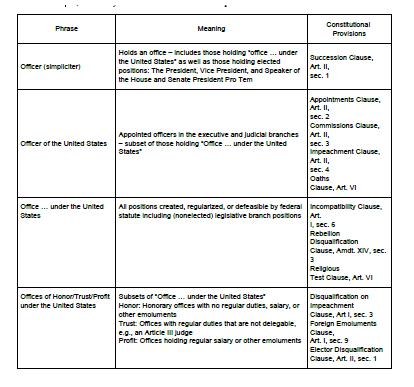
237-280_TILLMAN (DO NOT DELETE) 6/21/2019 12:16PM 268 SOUTH TEXAS LAW REVIEW [Vol. 59:237
disagree with that position. My position is that divergent language accommodates different meanings.
Fourth, Nourse states that “[t]his falsification procedure [which she puts forward] allows us to see that the claimed textual enrichment [put forward byTillman] isnotthe ‘onlypossible’interpretation . . . .” Iask: Why is “only possible” in quotation marks? Who is she quoting? Given that the only scholarship she discusses in that section of her paper is my scholarship, the reader is likely to think I am being quoted. Nourse cites only a single Tillman-authoredpublication,andIdonot usethequotedlanguage anywhere in my article.
For what it is worth, I do not believe that by interpreting the text of the Constitution, standing alone, one ought to conclude that there is only a single possible interpretation in regard to the Constitution’s divergent Officelanguage. In fact, I have repeatedly made a very different claim. In my Northwestern University Law Review article, which is my only publication actually cited by Nourse, I stated:
I do not suggest that the Constitution’s text, drafting history, and ratification debates are free from all ambiguity on the meaning of Office under the United States. Fortunately, we can turn to two incidents from President George Washington’s first Administration to understand the meaning of this somewhat opaque phrase.75 My position is that where the constitutional text is ambiguous, one turns to early practice and history. I would add that the practices of President George Washington and his administration, and that ofthe First Congress are entitled to special consideration. My methodological outlook is hardly an outlier. Finally, Nourse concludes that my use of intratextualism (with its assumptions of coherence) is methodologically unsound, and that my conclusion in regard to the scope or reach of the Foreign Emoluments Clause is not “terribly plausible.” My response, beyond what I have written above, isthat usingintratextualisminthisfashionpredatesmypublications,predates original public meaning originalism, and even predates original intent originalism. It is far older.
In his Commentaries on the Constitution,JusticeJosephStorywrote: [T]he [Impeachment] [C]lause of the [C]onstitution now under consideration, does not even affect to consider the[] [President and Vice President] officers of the United States. It says, “the [P]resident, [V]ice-[P]resident, and all civil officers (not all other civil officers) shall be removed,” &c. The language of the clause, therefore, would rather lead to the conclusion, that they were enumerated, as
75 See Tillman, Citizens United and the Scope of Professor Teachout’s Anti-Corruption Principle, supra note 69, at 14
237-280_TILLMAN (DO NOT DELETE) 6/21/2019 12:16PM 2017] W
269
HERE THE BODIES ARE BURIED
contradistinguished from, rather than as included in the description of, civil officers of the United States. Other clauses of the Constitution would seem to favour the same result; particularly the clause, respecting appointment of officers of the United States by the executive, who is to “commission all the officers of the United States;” and the 6th section of the first article which declares that “no person, holding any office under the United States, shall be a member of either house during his continuance in office; . . . .”76
In short, Story concludes that the President is neither an officer of the United States nor holds an Office under the United States (which is a superset of the Foreign Emoluments Clause’s more limited Office of Profit or Trust under the United States-language). At the very least, Story thinks this position is plausible and supported by the text of the Constitution. Indeed, although not discussed by Story, the drafting history of the Impeachment Clause also confirms Story’s interpretation: an early draft of the Impeachment Clause applied to “other Civil officers of the U.S.,” but the “other” was dropped by the Committee of Style.77 Nor was Story alone a fair number of later commentators followed Story’s lead.78 Nourse says (in effect that) Story’s
76 STORY, supra note 54, § 791, at 260. I hope this quotation from Story sinks in with the disbelieving reader. Story puts forward the position that the President is not covered by the Incompatibility Clause and its operative “Office under the United States” language. In other words, although the Incompatibility Clause precludes a Senator from serving in the cabinet, the text of the clausedoes notprecludea Senator fromconcurrentlyservingas President.If Story’s position,which defies modern separation of powers intuitions, is not implausible, my position in regard to the Foreign Emoluments Clause (i.e., that the clause’s Office . . . under the United States-language applies to appointed positions, not elected ones) is equally reasonable even if it defies modern intuitions involving foreign policy and conflicts of interest.
77 See 2 THE RECORDS OF THE FEDERAL CONVENTION OF 1787, at 545, 552, 600 (Max Farrand ed., 1911).
78 See, e.g., DAVID A. MCKNIGHT, THE ELECTORAL SYSTEM OF THE UNITED STATES 346 (Philadelphia, J.B. Lippincott & Co. 1878) (“[I]t is obvious that . . . the President is not regarded as ‘an officer of, or under, the United States,’ but as one branch of ‘the Government.’” (emphases added)); see also Proceedings of the Sen. Sitting for the Trial of William W. Belknap, Late Secretary of War, on the Articles of Impeachment Exhibited by the H. of Rep., 44th Cong. 145 (1876)(Senator Newton Booth, from California, stating, on May 27, 1876, “[T]he President is not an officer of the United States. As was tersely said by . . . Senator [Boutwell] from Massachusetts, . . . ‘He is a part of the Government.’” (citing STORY, supra note 54)); RUTH C. SILVA, PRESIDENTIAL SUCCESSION 135 (2d ed. 1968) (“The courts have been especially careful not to enlarge the meaning of the term ‘officer’ as used in the Constitution. They have defined an officer of the United States as a person appointed by the President and the Senate, by the President alone, by the courts of law, or by a departmenthead.”) (collectingcaselaw); RUTHC.SILVA,PRESIDENTIALSUCCESSION (1951)(“The courts have been especially careful not to enlarge the meaning of the term ‘officer’ as used in the Constitution. They have defined an officer of the United States as a person appointed by the President and the Senate, by the President alone, by the courts of law, or by a department head.”); Ruth C. Silva, The Presidential Succession Act of 1947, 47 MICH. L. REV. 451, 475 (1949) (“‘Officers of the United States’ are appointed by the President and the Senate, by the President alone, by the department heads, or by the courts. Officers in the constitutional sense are not elected by the electoral colleges.” (emphasis added)).
237-280_TILLMAN (DO NOT DELETE) 6/21/2019 12:16PM 270
SOUTH TEXAS LAW REVIEW [Vol. 59:237
view (a view with which I agree) is not plausible. But saying that it is implausible does not make it so,79 nor does her more strongly condemnatory language.80
This is not the place for a full defense of my views regarding the Constitution’s divergent Office-language. That has been done several times elsewhere. Here, I will respond to Nourse’s charge that I have engaged in intellectual “gerrymandering.” What is meant by this charge? Nourse provides helpful examples. Article II, Section 1, Clause 1, the Executive Power Vesting Clause, states: “The executive power shall be vested in a President of the United States of America.” In reading this clause, Justice Scalia has stated: “this [language] does not mean some of the executive power, but all of the executive power.”81 Scalia, in effect, is changing the language of the clause to: “All the executive power shall be vested in a President of the United States of America.” Nourse challenges this type of textual enrichment as unsupported by the text. In other words, such enrichment is both reliant on unsupported assumptions of coherence across the Constitution’s text andreliant on unstated preferences of the interpreter.82 I agree. Nourse also objects to “intratextual arguments . . . that come from excising particular words from one ‘home’ clause and moving that enrichment to a different ‘receiving’ clause, where the term takes on a new meaning.”83 I agree with this too: such a strategy poses dangers.
Consider the Impeachment Clause: “The President, Vice President and all Civil Officers of the United States, shall be removed from Office on
79 See, e.g., Edward W. Bailey, Dean Pound and Administrative Law Another View, 42 COLUM L.REV 781,802(1942)(“Theextentof[ProfessorKennethCulp Davis’s]accomplishment in that enterprise . . . is to demonstrate his own agility in avoiding contact with unpleasant facts.” (emphasis added)); Raoul Berger, Administrative Arbitrariness A Reply to Professor Davis, 114 U. PA. L. REV. 783, 808 (1966) (“Professor Davis assumes that bare restatement of his position suffices to still criticism, and he stubbornly avoids the uncomfortable issues. But assertion ex cathedra cannot take the place of reasoned refutation, even when it comes from Professor Davis.”
(footnote omitted))
80 See, e.g., Nourse, supra note 69, at 40–41 (“[F]or example, the assumption that ‘office’ must mean the same thing throughout the Constitution leads to the verging-on-silly argument that the Foreign Emoluments Clause does not apply to the President.” (emphasis added)); see also Johnson, Episode 8: Article 1, Section 9, Clause 8, supra note 11 (Dean Erwin Chemerinsky stating that the position that the President is not covered by the Foreign Emoluments Clause is “a silly argument”) (at 32:25ff). Although I think that both the Dean and Professor are incorrect, and that both display an inability to thoughtfully comment on ideas with which they disagree (or fail to understand) quite an unappetizing state of affairs for academics between the two, Dean Chemerinsky and Professor Nourse, I strongly prefer the former. The Dean, at least, is saying exactly what he means. I suspect Nourse’s use of “verging” is not quite what she actually meant, and if it is what she meant, more is the pity.
81 Morrison v. Olson, 487 U.S. 654, 705 (1988) (Scalia, J., dissenting).
82. See, e.g., Nourse, supra note 69, at 25 (complaining that “the interpreter is injecting the interpreter’s preferences into the text”); id at 40 (rejecting “assumptions” about textual coherence across the constitutional text).
83 Id at 40.
237-280_TILLMAN (DO NOT DELETE) 6/21/2019 12:16PM 2017] WHERE THE BODIES ARE BURIED 271
Impeachment for, and Conviction of, Treason, Bribery, or other high Crimes and Misdemeanors.”84 Now some read this clause as suggesting that the clause’s use of Office, standing alone, is equivalent to the clause’s “Officers of the United States” language. In other words, such interpreters engage in textual enrichment. Such people read the clause either as:
The President, Vice President and all Civil Officers shall be removed from Office on Impeachment for, and Conviction of, Treason, Bribery, or other high Crimes and Misdemeanors.
or
The President, Vice President and all Civil Officers of the United States, shall be removed from [the] Office of the United States [that they are holding] on Impeachment for, and Conviction of, Treason, Bribery, or other high Crimes and Misdemeanors. Others assumes redundancy they assume that the latter “Officers of the United States” language also covers the presidency and vice presidency. They read the clause as:
All Civil Officers of the United States, shall be removed from Office on Impeachment for, and Conviction of, Treason, Bribery, or other high Crimes and Misdemeanors.
or
The President, Vice President and all other Civil Officers of the United States, shall be removed from Office on Impeachment for, and Conviction of, Treason, Bribery, or other high Crimes and Misdemeanors.
All this textual enrichment assuming Office is coextensive with Officer of the United States and assuming Officers of the United States also encompasses the President and Vice President relies on just the sort of assumptions and inferences Nourse objects to. So do I. The meanings above are textuallypossible. It is also textuallypossible, as Storyhas stated, that the President and Vice President hold “office,” but they are not encompassed by the category of “Officers of the United States” or “Civil Officers of the United States.” The clause-bound text does not answer this question. Let’s look at another clause: the Elector Incompatibility Clause. It states: “[N]o Senator or Representative, or Person holding an Office of Trust or Profit under the United States, shall be appointed an Elector.”85 Some thinktheclauseusesredundant language.Theythinktheclausemeans: “[N]o Senator or Representative, or Person holding any other Office of Trust or Profit under the United States, shall be appointed an Elector.” In other words, they think the clause’s “Office of Trust or Profit under the United States”
237-280_TILLMAN (DO NOT DELETE) 6/21/2019 12:16PM 272
SOUTH TEXAS LAW REVIEW [Vol. 59:237
84 U.S. CONST. art. II, § 4 (emphases added). 85 U.S. CONST. art. II, § 1, cl. 2 (emphasis added).
language extends to Senators and Representatives. To put it another way, the positions of Senator and Representative need not have been separately listed as they were included by the clause’s Office-language. By contrast, others, like the Amars, think the Constitution’s divergent Office-language does not extend to members of Congress. Is the clause’s language redundant? That question cannot be answered from the text of the Elector Incompatibility Clause (standing alone). There is a second question. Does the clause’s “Office of Trust or Profit under the United States” language extend to the President andVicePresident?Heretoo,thetext oftheclause(standingalone) supplies no determinate answer. The fact that some elected federal positions werelisted(SenatorsandRepresentatives),butnotothers(President andVice President), might mean the latter positions are excludedfromthe scope of the clause. But such an inference is not obvious.
Finally, there is the Foreign Emoluments Clause. Again, the clause states:
[N]o Person holding any Office of Profit or Trust under [the United States], shall, without the Consent of the Congress, accept of any present, Emolument, Office, or Title, of any kind whatever, from any King, Prince, or foreign State.86 How does Nourse read the clause?
The President, Vice President, and no Person holding any other Office of Profit or Trust under [the United States], shall, without the Consent of the Congress, accept of any present, Emolument, Office, or Title, of any kind whatever, from any King, Prince, or foreign State.87
Here, it is Nourse that is engaged in just the sort of pragmatic enrichment she decries in Justice Scalia (who, you will remember, added “all” to the Executive Power Vesting Clause). Talk about unsupported assumptions and unstated preferences! Not only does Nourse not recognize the clause’s ambiguity in regard to the presidency, she affirmatively states that the contrary reading (i.e., the reading which excludes the presidency a post not
86 U.S. CONST. art. I, § 9, cl. 8 (emphasis added).
87 The Constitution and its Foreign Emoluments Clause “must mean something.” Either the clause applies to the President or it does not. The choice is a binary one. See Amar & Amar, supra note 54, at 136–37 n.143 (“The Constitution must mean something the best reading of the document either permits or bars legislative succession.”). Professor Nourse has stated that my position i.e., the position that the Foreign Emoluments Clause does not apply the President “verg[es]-on-silly.” Nourse, supra note 69, at 40. It is a fair inference that Nourse’s position is that the clause does apply to the President. Her claim to the contrary, i.e., that she is not “demand[ing] a particular textual reading” of the clause, is one the reader must judge for herself. Id at 28 n.128. I point out to the reader, should Nourse respond that she has no actual view in regard to the applicability of the Foreign Emoluments Clause to the presidency or that her view is that the clause is ambiguous, then it made little sense for her to call my position “silly.” A position can only be characterized as “silly” relative to its rivals. If my position is “silly,” then it follows Nourse has embraced a rival position, and there is only one such rival position.
237-280_TILLMAN (DO NOT DELETE) 6/21/2019 12:16PM 2017] W
273
HERE THE BODIES ARE BURIED
expressly mentioned by the clause’s text from the scope of the clause) is “verging-on-the-silly.”88
Nourse’s sole defense of her interpretation of the Foreign Emoluments Clause where she pragmatically enriches the text by adding language about the presidency is that: “Article II, Section 4 provides that the President ‘shall be removed from Office by Impeachment’ for ‘high crimes and [m]isdemeanors.’ [Likewise,] Article I, Section 3, Clause 7 provides that the ‘Judgment in cases of Impeachment shall not extend further than to removal from Office. ’”89 Here too, Nourse is engaged in just the sort of weak intratextualism she decries in others. She assumes that “Office,” standing alone, in the Impeachment Clause, and “Office,” standing alone, in the Disqualification Clause are co-extensive or sufficiently similar with the Foreign Emoluments Clause’s “Office of Profit of Trust under [the United States]” language to make comparison, enrichment, or even falsification meaningful.90 Ido not suggest that sucha viewis stupid; it is not. Othershave held this view in the past. Ido suggest that Nourse’s position is “not the ‘only possible’ interpretation.”91 The text is not determinate. There are competing
88. See, e.g., Nourse, supra note 69, at 40–41 (“[F]or example, the assumption that ‘office’ must mean the same thing throughout the Constitution leads to the verging-on-silly argument that the Foreign Emoluments Clause does not apply to the President.” (emphasis added))
89. Nourse, supra note 69, at 28 (quoting the Impeachment Clause and the Disqualification Clause) (emphases added).
90 See Nourse, supra note 69, at 28 n.128 (“It is worth noting that by invoking this comparison, I am not repeating ‘borrowing’ errors. My claim is not that the impeachment clauses use the term ‘Office,’ therefore the term ‘Office’ in the Foreign Emoluments Clause must include the President. I am using that clause to negate a hypothesized interpretation, not to demand a particular textual reading.”). Just as intratextualism requires identical or sufficiently similar language across clauses, analytic textualism requires identical or sufficiently similar language across clauses to effect falsification. Nourse assumes the Constitution’s use of “office” (alone, and without modifiers) in the Impeachment Clause and the Constitution’s use of “office” (alone, and without modifiers) in the Disqualification Clause are sufficiently similar to the Foreign Emolument Clause’s Office of Profit or Trust under [the United States] language such that the two former uses falsifymyproposed view of the meaningof thelatter language. Sheoffers no justificationor defense for this intratextual assumption. Such supposed “similarit[ies] . . . need to be defended, not assumed.” Id at 41 Notwithstanding all her protestations to the contrary, Nourse’s analytic textualism is ad idem with Professor Akhil Amar’s intratextualism. See id. at 40 (“‘Analytic textualism’ makes no such assumption [about similar and dissimilar words and phrases in the Constitution], indeed it seeks to interrogate such assumptions, by attempting to falsify claimed similarity relationships.”). That is precisely why her only efforts to falsify my position make use of clauses using the word “office” (standing alone and without modifiers), or merely announce her interpretive intuitions in a conclusory fashion.
91 Nourse, supra note 69, at 28 (inner quotation marks do not expressly refer to any distinct source). After hardcopy publication of Professor Nourse’s article in California Law Review [hereinafter CLR], and in response to my critique and complaints, the student editors at CLR removed these quotation marks from extant electronic reproductions of Nourse’s article. Nonetheless, the student editors refused to publish any response by me in CLR or on CLR Online Furthermore, I have received no assurances that an errata sheet will be published in any subsequent issue of CLR. Finally, I have no idea if these post-publication changes to Professor Nourse’s article
237-280_TILLMAN (DO NOT DELETE) 6/21/2019 12:16PM 274 SOUTH TEXAS L
[Vol. 59:237
AW REVIEW
reasonable views. Given that competing reasonable views are consistent with the clause’s text, I have turned to historical practice in the Federalist Era and Early Republic regarding diplomatic gifts to presidents, the Hamilton document, and other contemporaneous and roughly contemporaneous extrinsic evidence. But the merits of that debate are beside the primary point. The primary point I am making here is that Nourse does not understand my position, andthat inseekingto argue the contrary(i.e.,contrarytothepositon she imagines I have taken), she has engaged in just the sort of interpretive strategies that she says she opposes.
Professor Nourse’s inability to understand and properly characterize a line of argument i.e.,Joseph Story’sline of argument, Story’s successors’ line of argument, my line of argument does not breed confidence that she has actually grappled with and fairly considered the underlying legal materials, including the fairly small corpus of academic literature on the Foreign Emoluments Clause.92 For me that is a small loss; one I have experienced several times before. For her and her readers it is a greater loss, and for her students, colleagues, and wider legal academia a mentor’s, colleague’s, and peer’s inability to deal with idiosyncratic ideas in an evenhanded manner that is a loss beyond calculation.
V. THE WAY FORWARD
As illustrated above, much of the discussion regarding the Foreign Emoluments Clause, the scope of its Office-language, and relevant textual, scholarly, and historical inquiry has been less than useful. I think there are several reasons why we have come to this unfortunate state of affairs.
First, the commentators above (along with other commentators) believe their position carries a strong presumption of correctness (if not certitude), that it is my duty to displace that presumption, and that they will be the judges if I have carried that burden. Certainly, I have never agreed to such terms for this debate. Nor should I. The text of the Constitution does not expressly state that the Foreign Emoluments Clause applies to the President. The text of the Constitution does not expressly define the scope of the Constitution’s “Office of Profit or Trust under [the United States]” language. The Supreme Court has had no occasion to address the scope of the clause or
were made with Professor Nourse’s approval, and I have received not one word of explanation from Professor Nourse in regard to all these strange goings-on.
92 But see id. at 28 n.130 (“Nothing in this Article presumes to be a comprehensive review of the emoluments literature, which since the initial draft of this Article has grown exponentially.” (emphasis added)). The corpus of full-length articles on the Foreign Emoluments Clause and Domestic Emoluments Clause remains quite small, and a good many (if not most) of those articles deal primarily with standing and justiciability, as opposed to the meaning of “emoluments” and the scope of the Foreign Emoluments Clause’s Office-language. One wonders where lurks this “exponential” growth of articles about which Professor Nourse is speaking.
237-280_TILLMAN (DO NOT DELETE) 6/21/2019 12:16PM 2017] WHERE THE BODIES ARE B
275
URIED
276 SOUTH TEXAS LAW REVIEW [Vol. 59:237
the meaning of the clause’s operative language, or even the scope of closely similar language in other clauses. As educated generalists who have only recently chosen to inject themselves into this debate, these commentators’ opinions should get a fair hearing. Iwould add: so should mine. And because what is involved here is a debate between opinions lacking firm judicial support, our divergent ideas (and we) meet as equals.93 In regard to the actual lawsuits brought against the President, it behooves those who brought these lawsuits, supporting amici, and those offering them scholarly shelter to bear in mind that, as a general matter, in civil litigation, plaintiffs bear the burden of proof, production, and persuasion.94 If the very best that plaintiffs can show is that their position is no better than mine, then that ends the judicial challenge.
93 See JACK N. RAKOVE, ORIGINAL MEANINGS: POLITICS AND IDEAS IN THE MAKING OF THECONSTITUTION 10(1996)(rewritingthewords of Chief JusticeMarshall,andstating“historians can never forget that it is a debate they are interpreting”), https://www.amazon.com/OriginalMeanings-Politics-Making-Constitution/dp/0679781218; Declaration of Professor Bowling, supra note 46, at 4 (“In Hamilton’s day . . . . Office under the United States did not extend to elected officials. In my professional judgment, Hamilton’s roll of officers, The Complete Report, is consistent with what was one strand . . . of the contemporaneous . . . public understanding of office under the United States.”). Professor Rakove has cited Professor Bowling and his publications favorably in the past but not here in the context of the Emoluments Clauses litigation. See, e.g., THE ANNOTATED U.S.CONSTITUTIONAND DECLARATIONOFINDEPENDENCE 348 (JackN.Rakove ed., 2009) (citing Bowling); JACK N. RAKOVE, DECLARING RIGHTS: A BRIEF HISTORY WITH DOCUMENTS 204 (1998) (same); Jack N. Rakove, The Second Amendment: The Highest Stage of Originalism, 76 CHI KENT L. REV 103, 105–06 n.12 (2000) (same). Rakove’s amicus co-authors agree. See, e.g., GAUTHAM RAO, NATIONAL DUTIES: CUSTOM HOUSES AND THE MAKING OF THE AMERICAN STATE 226 n.52, 227 n.66 (2016) (same); John Mikhail, The Necessary and Proper Clauses, 102 GEO. L.J. 1045, 1059 n.47 (2014) (same); Shugerman, An Apology to Tillman and Blackman, supra note 11 (citing Tillman’s experts, including Bowling, approvingly). See generally Legal Historians Brief (NY), supra note 8 (filed on behalf of Professors Rakove, Shugerman, Mikhail, Rao, and Stern); supra note 10 (listing the Legal Historians’ other amicus filings). 94 See Nourse, supra note 69, at 28 n.128 (asserting that Professor Nourse is not “demand[ing] a particular textual reading”). In my amicus brief in Blumenthal v. Trump, I wrote: “Plaintiffs cannot point to a single judicial decision holding that this language in the Foreign Emoluments Clause,or thesimilar phrase‘Office. .. under theUnited States’ inother constitutional provisions, applies to the President.” See Brief for Scholar Seth Barrett Tillman & the Judicial Education Project as Amici Curiae Supporting Defendant at 2, Blumenthal v. Trump, No. 1:17-cv01154 (D.D.C. Sept. 19, 2017), ECF No. 16-1, 2017 WL 4230605; id. at 22 (same). An amicus supporting plaintiffs responded: “Defendant [Tillman’s] Amicus [brief] ‘cannot point to a single judicial decision . . . holding that . . . the Foreign Emoluments Clause . . . [does not] appl[y] to the President.’” Brief of Separation of Powers Scholars as Amici Curiae Supporting Plaintiffs at 16–17 n.9, Blumenthal v. Trump, No. 1:17-cv-01154-EGS (D.D.C. Nov. 2, 2017), ECF No. 25-1, 2017 WL 5513218 (quoting Tillman’s Blumenthal v. Trump amicus brief, supra). Efforts to turn my language on its head are not availing: the burden of proof, production, and persuasion lies with plaintiffs, not defendant. See also, e.g., Shugerman, Questions about the Emoluments Amicus Brief on Behalf of Trump UPDATED, supra note 11 (“No court has ever adopted [Tillman’s] interpretation [of the Foreign Emoluments Clause’s Office-language] . . . .”). Shugerman’s claim here is entirely correct he just fails to note that no court has ever held the converse, i.e., that the Foreign Emoluments Clause’s Office-language applies to the President.
237-280_TILLMAN (DO NOT DELETE) 6/21/2019 12:16PM
Second, it is time for my intellectual opponents to be fair.95 Claims that they have made that they know or now know to be incorrect should be withdrawn or revised. Claims that they have made asserting the existence of documentary support, should be promptly supported with actual documents or else the claims should be withdrawn. If they have to go through this process repeatedly, they might ask themselves if their position and expertise is really as strong as they have led themselves and others to believe.96
95 A good place for my opponents to start might be to refrain from making key admissions about contrary arguments in their footnotes. Such admissions belong in the main text, not one’s footnotes. See, e.g., Nourse, supra note 69, at 27 n.122 (“Tobe fair, Tillman also relies upon various historical claims . . . .”). Likewise, Professor Nourse reports claims I have made, but she fails to report limitations I have put on those claims in the very sentence in which I have made them. Compare id. (“According to Tillman, other scholars . . . embrace the position that ‘all office-related language means the same thing’ . . . ” (quoting Tillman, Citizens United and the Scope of Professor Teachout’s Anti-Corruption Principle, supra note 69, at 20 n.55)), with Tillman, Citizens United and the Scope of Professor Teachout’s Anti-Corruption Principle, supra note 69,at 20 n.55) (noting “[o]ther (living) commentators who have embraced this position that all office-related language means the same thing, or who have taken a position akin to it, include” (emphases omitted) (emphasis added)), and supra notes 66–67 (showing examples of others with positions similar to the stance that all office-related language means the same thing). Finally, when presenting my ideas to the reader, Professor Nourse announces in her main text that they are the ideas of some unnamed originalist. See Nourse, supra note 69, at 26–27 (“At least one constitutional textualist/originalist argued that the clause did not even apply to the President because . . . ”). She fails to put the reader on any notice that my reading is supported by Joseph Story’s Commentaries on the Constitution See STORY, supra note 76, and accompanying text. This is not fair to the reader, and well-informed scholars (including those who disagree with myposition) have avoided doing what Nourse has done here. See, e.g., Benjamin Cassady, “You’ve Got Your Crook, I’ve Got Mine”: Why the Disqualification Clause Doesn’t (Always) Disqualify, 32 QUINNIPIAC L. REV. 209, 291 nn.393, 395–96 (2014) (asserting that the President is covered by the Constitution’s officer of the United States-language, and then in regard to the contrary position, first citing Joseph Story’s Commentaries on the Constitution and then Tillman’s publications). Yet, we know that Nourse considers Story’s Commentaries on the Constitution good authority. Compare Nourse, supra note 69, at 43 n.198 (citing Story’s Commentaries on the Constitution), with id. at 27 (accusing other scholars of “gerrymandering”). Just as Nourse does, there are many legal academics who consider their own legal intuitions, and that of their modern peers, as evidence, without recognizing the contraryevidence in the formof the legal intuitions of others. See, e.g.,Erik M.Jensen, The Foreign Emoluments Clause, 10 ELON L. REV 73, 90 (2018) (“Come on (I have heard colleagues say), we really cannot be expected to think the President is not holding an office of profit or trust under the United States.”); see also, e.g., Josh Blackman & Dan Hemel, University of Chicago Federalist Society: Debate on the Emoluments Clauses (Apr. 9, 2018) (Dan Hemel: “But those trained in analytic philosophy think that actually intuition is argument or that intuition is a source of data that leads to arguments . . . .”) (at36:50ff), https://www.youtube.com/watch?v=biN5nrQQLfw&t=824s
96 Another way to think about this issue is that if you believe (as I do) that the arguments and objections launched by the commentators above (against the president-is-not-an-officer-underthe-United-States view) have failed, as did similar prior efforts, then that is some good reason to accept the position that has withstood their objections. Compare, e.g., Prakash, supra note 5, at 38
39 (“[Tillman] asserts that although the Constitution provides that the President ‘shall Commission all the Officers of the United States,’ Washington never commissioned himself or John Adams . . . Unfortunately,[Tillman] offers noevidencetosupportanyof thesepropositions, butmerelyasserts
237-280_TILLMAN (DO NOT DELETE) 6/21/2019 12:16PM 2017] WHERE THE BODIES ARE BURIED 277
–
Finally, it is time for my intellectual opponents to be forthcoming in regard to an improved debate and debate atmosphere an atmosphere rooted in mutual respect and goodwill. If that future debate is going to be informative, might not I (or you, the reader) ask these commentators to do morethanmakea meretacticalclaim: viz., the President falls under the aegis of the Foreign Emoluments Clause. Might not I (or you, the reader) ask these commentators to turn to the more challenging intellectual question: viz., What is the scope of the Foreign Emoluments Clause and its operative “Office of Profit or Trust under [the United States]” language? Some heavy intellectual lifting might be involved. Once they have defined that language, maybe they could, maybe they should, tell us if the clause extends to: (i) Senators, (ii) Representatives, (iii) presidential electors, (iv) federal jurors, (v) attorneys admitted to practice in federal courts, (vi) advisors to the President who lack individualized legal discretion to affect binding legal relations, (vii) state judges subject to mandamus orders by federal courts, (viii) elected territorial officials, (ix) territorial officers appointed by elected (nonjudicial) territorial officials, (x) enlisted federal military personnel, (xi) state militia officers called into national service by the President, (xii) federal civil servants, (xiii) federal contractors, (xiv) members of a national Article V convention, (xv) members of state ratifying conventions called pursuant to Article V, (xvi) American appointees to treaty-created offices (where the treaty is not domesticated by federal statute), (xvii) multistate compact officials, (xviii) qui tam plaintiffs asserting federal causes of action, (xix) holders of letters of marque and reprisal, (xx) trustees, directors, members, officers, employees, and other agents of federally chartered trusts, corporations, and other private entities with legal personality, and (xxi) individuals affiliated with private entities created under state (or federal, or even foreign) law in which significant equity is held by the United States government. I do not ask this to satisfy idle curiosity. Rather, the commentators above believe they have a coherent, if not correct, intellectual
them as fact.” (footnotes omitted)), with Case of Brigham H. Roberts, H.R. REP. NO. 56-85, pt. 1, at 36 (1900) (“[T]he provision in the last paragraph of section 3, of article 2, relating to the duties of the President, that he shall commission all the officers of the United States, does not mean that he is to commission members of Congress, [and] he is himself an officer, and he does not commission himself, nor does he commission the Vice President . . . ”). As Chief Justice McKean explained “It is in argument, in law, and in logic, as it is in nature (destructio unius, est generatio alterius) that the destruction of an objection, begets a proof.” Boyd’s Lessee v. Cowan, 4 U.S. (4 Dall.) 138, 141 (Penn. 1794). McKean, a proponent of the then proposed federal constitution, made thesameargument at thePennsylvania ratificationconvention. See 2 THE DOCUMENTARY HISTORY OF THE RATIFICATION OF THE CONSTITUTION: PENNSYLVANIA 542 (John P. Kaminski et al. eds., 1993) (McKean, on December 10, 1787, stating: “It holds in argument as well as nature, that destructio unius est generatio alterius the refutation of an argument begets a proof.”); see also 1 ANNALS OF CONG 560 (1789) (Joseph Gales ed., 1834) (Congressman Fisher Ames, on June 18, 1789, stating: “I believe nearly as good conclusions may be drawn from the refutations of an argument as from any other proof. For it is well said, that destructio unius est generatio alterius.”).
237-280_TILLMAN (DO NOT DELETE) 6/21/2019 12:16PM 278 SOUTH
TEXAS LAW REVIEW [Vol. 59:237
2017]
W
position.Buttheonlywayforustobeconfidentthattheirpositioniscoherent (orcorrect) and alsobetter thanitsrivals isforthemtocommunicatetheir positiontotherest of ussothat we canseehowit playsout,not onlyinregard to the presidency, but in regard to other federal and state positions. And if they cannot do so, if they are unwilling to do so, is that not telling?
237-280_TILLMAN (DO NOT DELETE) 6/21/2019 12:16PM
HERE THE BODIES ARE BURIED 279
237-280_TILLMAN (DO NOT DELETE) 6/21/2019 12:16PM 280 SOUTH TEXAS LAW REVIEW [Vol. 59:237