SOUTH TEXAS LAW REVIEW
SOUTHTEXASCOLLEGEOFLAW
HOUSTON,TEXAS
r
SUBSCRIPTION PRICE
Thesubscriptionpriceto South Texas Law Review is$32.50perannum(plusapplicable salestax).Thepriceforasinglesymposiumissueis$25.00.
CURRENT ISSUES
Singleissuesinthecurrentvolume,includingsymposiumandspecialissues,maybepurchasedfromthe Review bycontactingtheJacobHubbleat(713)646-1749.
BACK ISSUES
Completevolumesandsingleissuespriortothecurrentvolumeareavailableexclusively fromWilliamS.HeinCo.,Inc.,2350NorthForestRoad,Getzville,NY14068,(800)828-7571.
South Texas Law Review ispublishedfourtimeseachyearbythestudentsofSouthTexas CollegeofLaw.Fourissuesofthe Review constituteonevolume.
Subscriptionsto South Texas Law Review areconsideredtobecontinuousandabsentreceiptofnoticetothecontrary,itisassumedthatarenewalofthesubscriptionisdesired.Please notifytheEditorinChiefofanychangeofaddress.
TheReview welcomesthesubmissionofunsolicitedmanuscripts.Allsubmissionsshouldbe typedanddoublespacedwithfootnotes.Citationsshouldconformwith The Bluebook:A Uniform System of Citation (ColumbiaLawReviewAss'netal.eds.,19thed.2010)and,where applicable,the Texas Rules of Form (12thed.2010).
Exceptasotherwisenoted,South Texas LawReview ispleasedtograntpermissionforcopiesofarticles,notes,andbookreviewstobemadeforclassroomuse,providedthat(1)aproper noticeofcopyrightisaffixedtoeachcopy;(2)theauthorandsourceareidentified;(3)copiesare distributedatorbelowcost;and(4) South Texas Law Review isnotifiedoftheuse.
Allcommunicationsshouldbeaddressedto South Texas Law Review 1303SanJacinto,Houston,Texas77002
Telephone:(713)646-1848 or (713)659-8040ext.1665
Facsimile:(713)646-2948
Copyright2016,SouthTexasCollegeofLaw Allrightsreserved. 11
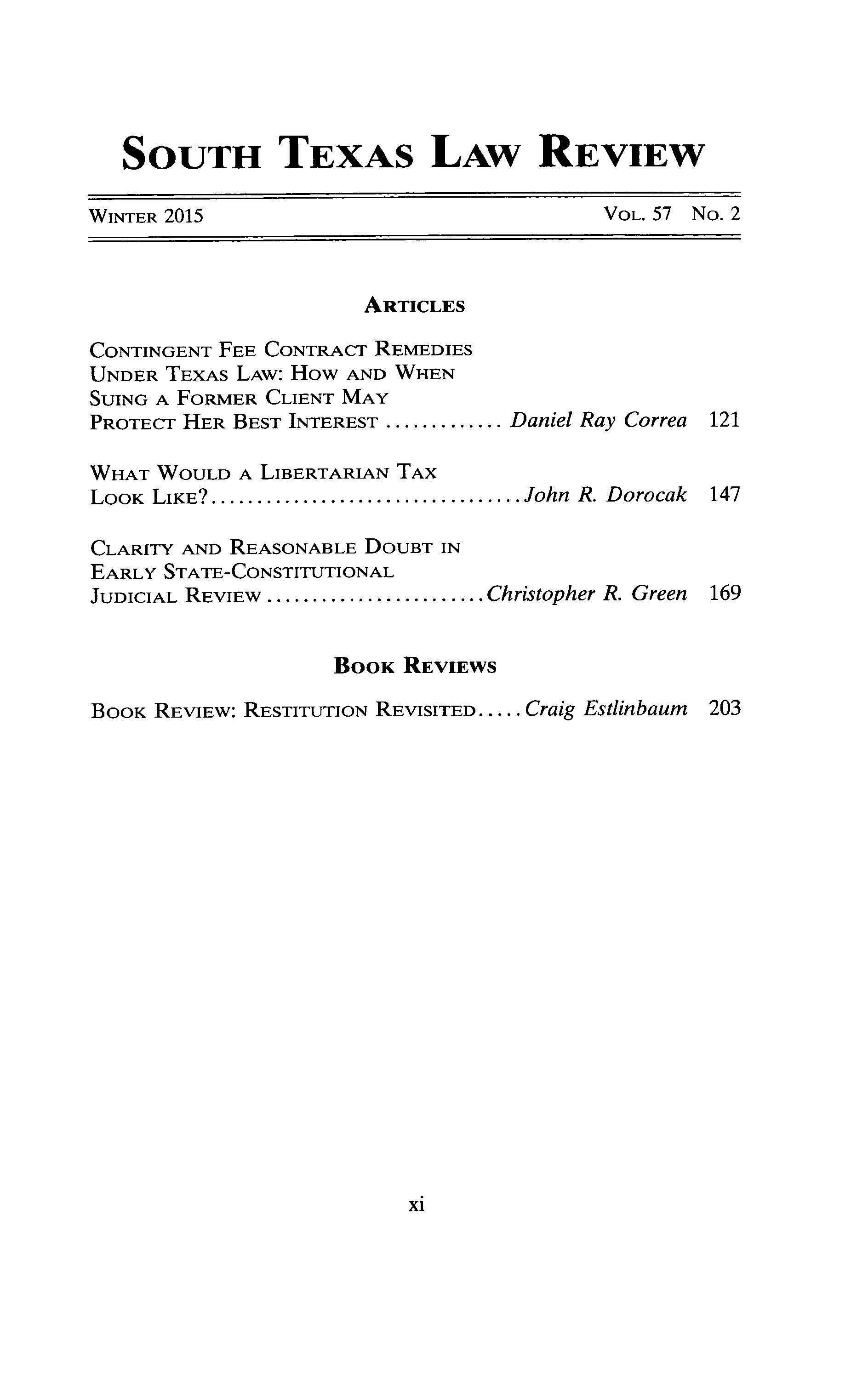
SOUTH TEXAS LAW REVIEW
WINTER 2015
Members
JOSEPH ANDERSON
AARON BENDER
BRIAN BUESCHER
ANGELA BURNETT
MICHAEL COHODES
JORDAN CORBITT
TYLER CUMMINGS
ERIN DEBOOY
JOVAN! DIAZ
STEPHANIE DENTON
SELINA FERDOUS
ALEXANDRA GEORGE
SERGIO GONZALEZ
DANA HOLMES
JANE LEE
CHELSEA Lu
PATRICK McGINNIS
Candidates
BERNARDINO AGOSTO
RANDALL BEATY
BRAD ERIC FRANKLIN
CHRISTY GILBERT
GABRIEL GONZALEZ
JOSEPH TENNANT
VoL. 57 No. 2
TERRY McGovERN
CALVIN McLEAN
BROOKE MILBAUER
GARRETT MIZE
TROY NEUMANN
STEPHEN pASTA
TIM REDDEN
CHRISTOPHER Ross
ANNA SWANSON
The opinions expressed in the South Texas Law Review are those of the contributors and are not necessarily representative of the views of the editors of the Review or ofSouth Texas College of Law.
IV
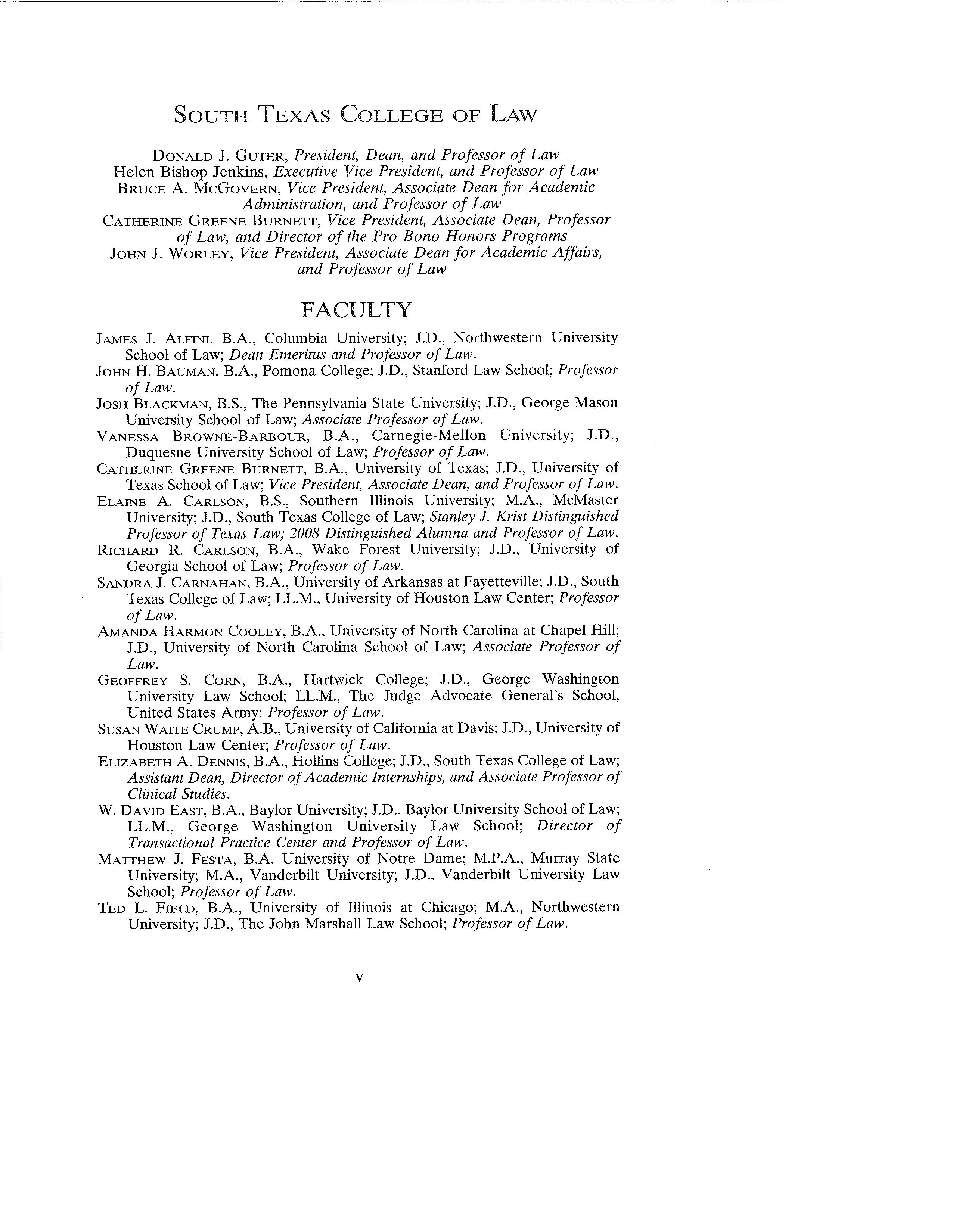
DEREK FINCHAM, B.A., University of Kansas; J.D., Wake Forest University School of Law; Ph.D., University of Aberdeen School of Law; Associate Professor of Law.
SHARON FINEGAN, B.A., University of Virginia; J.D., American University Washington College of Law; LL.M., Columbia Law School; Professor of Law.
PAMELAE.GEORGE, B.S.,UniversityofTexas;M.L.S.,UniversityofTexas;J.D., University ofTexas School of Law; Professor of Law.
MAXINE D. GooDMAN, B.A., Brandeis University; J.D., University of Texas School of Law; Professor of Law.
DONALD J. GuTER, B.A., University of Colorado; J.D., Duquesne University School of Law; President, Dean, and Professor of Law.
DAVIDR.HAGUE,B.A.,UniversityofUtah;J.D.,UniversityofKansasSchoolof Law; Assistant Professor of Law.
HELEN BISHOP JENKINS, B.M.E., Peabody Conservatory of Johns Hopkins Institute; M.M.E., Howard University; J.D., University of Houston Law Center; Executive Vice President and Professor of Law.
R. RANDALL KELSO, B.A., University ofChicago; J.D., University of Wisconsin Law School; Spurgeon E. Bell Distinguished Professor of Law.
JosEPH K. LEAHY, B.A., Swarthmore College; J.D.New York University School of Law; Professor of Law.
KATERINA LEWINBUK, B.A., Minnesota State University; J.D.; John Marshall Law School; Professor of Law.
BETTY J. LUKE, B.S., Lamar University; B.S., University of Texas Medical Branch; J.D., South Texas College of Law; LL.M., University of Houston Law Center; Associate Professor of Clinical Studies.
BRUCE A. McGOVERN, B.A., Columbia University; J.D., Fordham University School ofLaw; LL.M., University ofFlorida College ofLaw; VicePresident, Associate Dean, and Professor of Law.
SHELBY AD. MooRE, B.A., Towson State University; J.D., University of Baltimore School of Law; LL.M., Harvard Law School; Professor of Law.
RAY E. MosEs, B.A., University of Texas; J.D., University of Texas School of Law; LL.M., Northwestern University Law School; S.J.D., Southern Methodist University School of Law; Professor of Law.
OLGA L. MOYA, B.A., University ofTexas; J.D., University of Texas School of Law; Professor of Law.
JAMES L. MussELMAN, A.A., Illinois Central College; B.S., Illinois State University; J.D., Brigham Young University; J. Reuben Clark Law School; Professor of Law.
FRANCESCA ORTIZ, B.A., University of Texas; J.D., Harvard Law School; Professor of Law.
PHILLIP E. PAGE, B.S., University ofTennessee; J.D., Memphis State University College of Law; LL.M., New York University School of Law; Professor of Law.
JAMES W. PAULSEN, B.F.A., Texas Christian University; J.D., Baylor University School of Law; LL.M., Harvard Law School; Professor of Law.
AMANDA J. PETERS, B.A., Texas Tech University; J.D., Texas Tech University School ofLaw; Helen andHarryHutchensResearchProfessor and Professor of Law.
JEAN FLEMING PowERS, B.A., University ofTexas; J.D., University of Houston Law Center; Professor of Law.
ScoTT REMPELL, B.A., University of Michigan; J.D., American University, Washington College of Law; Associate Professor of Law.
vi
JEFFREY L. RENSBERGER, B.A., Wabash College; J.D., Indiana University, Bloomington; VicePresidentforStrategicPlanningandInstitutionalResearch and Professor of Law.
CHARLES W. "RocKY" RHODES, B.B.A., Baylor University; J.D., Baylor University School of Law; Vinson & Elkins Research Professor and Professor of Law.
VAL D. RICKS, B.A., Brigham Young University; J.I)., Brigham Young University, J. Reuben Clark Law School; Charles Weigel II Research Professor and Professor of Law.
GARYS.RosIN,B.S.,TexasA&MUniversity;J.D.,UniversityofTexasSchoolof Law; Professor of Law.
NrnRI MATHISRUTLEDGE, B.A., Spelman College; J.D., Harvard Law School; Professor of Law.
MARKR. SIEGEL, B.S., B.A.,UniversityofFlorida;J.D.,FloridaStateUniversity College of Law; LL.M.,Emory University School of Law; Professor of Law.
ANDREW T. SOLOMON, B.A., University of Michigan; J.D., Boston University School of Law; Professor of Law.
TOBIN A. SPARLING, B.A., Dartmouth College; M.S., Columbia University School of Library Service; M.A., Columbia University Graduate School of Arts & Sciences; J.D., Columbia Law School; Professor of Law.
MARKE. STEINER, B.A., University of Texas; J.D., University of Houston Law Center; Ph.D.,UniversityofHouston; GodwinLewisPCResearchProfessor and Professor of Law.
DRUSTEVENSON, B.A.,Wheaton College;J.D.,UniversityofConnecticutSchool of Law; LL.M., Yale Law School; Professor of Law.
CHERIE 0. TAYLOR, A.B., Harvard University Radcliffe College; J.D., University of Georgia School of Law; LL.M., Georgetown University Law Center; Professor of Law.
T. GERALD TREECE, B.A., University of Houston; J.D., University of Houston Law Center; VicePresident,AssociateDean, Special Counsel tothePresident and Dean, and W. James Kronzer, Jr. Distinguished Professor of Law.
MICHAELE. WHEELER, B.A., Arkansas Tech University; J.D., University of Arkansas at LittleRock William H. Bowen School of Law; Professor of Law.
KENNETH WILLIAMS, B.A., University of San Francisco; J.D., University of Virginia School of Law; Professor of Law.
JoHN J. WORLEY, A.B., University of Georgia; J.D., University of Georgia School of Law; M.A., Rice University; Vice President, Associate Dean, Director of Transactional Law Practice Certificate Program and Professor of Law.
KEVINM.YAMAMOTO, B.S., University of California atDavis;J.D., University of San Diego School of Law; LL.M., University of Florida College of Law; Professor of Law.
Vll
viii