Feature
An installer’s guide to wheel offset When dealing with custom wheels, this is one case where it’s better to be negative than positive By Sean Phillips
O
ne of the most common modifcations your customers make to their cars is to replace the wheels. It’s easy to see why — there is really no faster, more effective way to customize a car’s look or feel than by
3. Perhaps the most important factor in choosing and installing new wheels is the proper handling of wheel offset. Offset also can be one of the most diffcult factors to get right when replacing wheels. It’s a concept that is often very diffcult for customers to understand, and can be an enormously diffcult concept for service professionals to explain. However, it is important to get it right, because getting the offset wrong risks badly damaging the replacement wheels and tires as well as suspension components, and can put the driver at serious risk of a blowout. Any of these factors, if mishandled, can severely affect your reputation, not to mention cut down on repeat business!
What is offset?
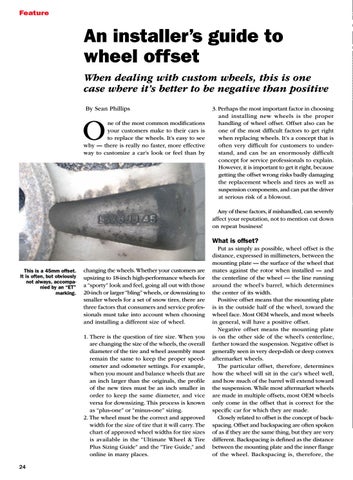
This is a 45mm offset. It is often, but obviously not always, accompanied by an “ET” marking.
changing the wheels. Whether your customers are upsizing to 18-inch high-performance wheels for a “sporty” look and feel, going all out with those 20-inch or larger “bling” wheels, or downsizing to smaller wheels for a set of snow tires, there are three factors that consumers and service professionals must take into account when choosing and installing a different size of wheel. 1. There is the question of tire size. When you are changing the size of the wheels, the overall diameter of the tire and wheel assembly must remain the same to keep the proper speedometer and odometer settings. For example, when you mount and balance wheels that are an inch larger than the originals, the profle of the new tires must be an inch smaller in order to keep the same diameter, and vice versa for downsizing. This process is known as “plus-one” or “minus-one” sizing. 2. The wheel must be the correct and approved width for the size of tire that it will carry. The chart of approved wheel widths for tire sizes is available in the “Ultimate Wheel & Tire Plus Sizing Guide” and the “Tire Guide,” and online in many places.
24
Put as simply as possible, wheel offset is the distance, expressed in millimeters, between the mounting plate — the surface of the wheel that mates against the rotor when installed — and the centerline of the wheel — the line running around the wheel’s barrel, which determines the center of its width. Positive offset means that the mounting plate is in the outside half of the wheel, toward the wheel face. Most OEM wheels, and most wheels in general, will have a positive offset. Negative offset means the mounting plate is on the other side of the wheel’s centerline, farther toward the suspension. Negative offset is generally seen in very deep-dish or deep convex aftermarket wheels. The particular offset, therefore, determines how the wheel will sit in the car’s wheel well, and how much of the barrel will extend toward the suspension. While most aftermarket wheels are made in multiple offsets, most OEM wheels only come in the offset that is correct for the specifc car for which they are made. Closely related to offset is the concept of backspacing. Offset and backspacing are often spoken of as if they are the same thing, but they are very different. Backspacing is defned as the distance between the mounting plate and the inner fange of the wheel. Backspacing is, therefore, the