53 minute read
Budgeting for success

Budgeting for success Th ink of a budget as a road map to profi tability
By Norm Gaither
Hard to believe it’s fall already and time to think about your 2012 business budget. Or are you one of those tire dealers who doesn’t do budgets? Sadly, there are many dealers like that.
Budgeting may be the most important management exercise that every successful store owner does all year. Without budgets, a business will be like a ship without a rudder. Budgets help all businesses stay on the course to bett er profi tability. Aft er all, isn’t this why we are in business?
Excuses, excuses, excuses
Many tire dealers ignore budgets because they don’t have the time to create them. Typically, store owners are working so hard “in” the business, they don’t make time to work “on” the business.
Many plan to ask their bookkeeper to throw one together if their banker asks if they have a budget. And many tire dealers who say they prepare a budget just copy last year’s numbers and hope to be able to beat them.
Either of these actions, of course, would be a wrong approach to preparing a successful budget for next year. Th ink about it, all successful companies, large or small, do budgets. Th at’s why they are successful!
Simple steps to gett ing started
Maybe now you are starting to ask if a budget makes sense for your business. You’re wondering:
• How do you start? • How long will it take? • Who should help? • Should you involve your people? • Where do you get the information to prepare a budget?
Th ese are all good questions, so let’s try to answer them. In order to get started, I suggest that you fi nd a day or evening when you won’t be interrupted by phone calls, customers or employees. Budgeting requires you to be able to think about what you believe will happen to your business next year.
Another way to look at a budget is to think of it as a plan or a road map to your business success. You would not think of driving 800 miles without a map or GPS. Budgets are the same thing — they off er directions.
Step one: Start by gett ing last year’s fi nancial statements by month.
Yes, I said by month. Some people do a budget showing the whole year in one column. While this is bett er than not doing a budget at all, it will not help you to compare your results by each month.
Now that you have last year’s profi t and loss statement by month, I suggest that you start by trying to do a budget for January. Th e best way is to have your bookkeeper set up a spreadsheet inserting last year’s actual numbers (see Chart #1 on page 54).
Notice we have captured as much detail as possible so we can identify and manage any area that does not meet our budget forecasts. Now, ask your bookkeeper, store manager and anyone else who is in a management role with your company: What has happened to our company since last January?
• Is the economy still soft ? • Have we lost a large customer? • Did we lose a valuable employee? • Will the city be working on the street in front of our store? • Did we gain a large customer? • Has the employment rate improved? • Do we have any new lines or services to off er?
All of these questions will impact what your revenue and profi ts will be for each month next year. Once you know all of the answers, you are ready to start to put the numbers
on paper. Start with sales by category by putt ing down how much you will do in tires, labor, alignment, parts, oil, shop supplies and so on (see Chart #2 on page 56 ).
Th e natural instinct is for you to be aggressive since business has been slow and you want next year to be bett er. Resist this impulse, put down only the actual numbers you know you will do. Once you complete the sales part of the budget, then you insert the cost of each category. I strongly suggest that you do not show any payroll costs in any of these categories. Put all payroll costs in the section called payroll below the gross profi t line. Now subtract the cost by category from sales by category and this, of course, will give you the gross profi t by category. Complete the process by putt ing in the percentages by category. You then calculate the cost by category divided by the sales in that category to determine what the percent of cost is by product.
Finally, you do the same for gross profi t by category down to the total. You now know how much gross profi t you think you will make for January of next year. Th e secret, of course, is not to spend more than this amount.
Step two: Anticipate your expenses.
Th is step will make your accounting people uncomfortable! I suggest you start by doing the payroll for the whole store by category. Again look at Chart #1 and see how we break out the payroll. Ask your bookkeeper to give you the weekly pay for each person with spiff s and bonuses plus the amount of
payroll taxes. I suggest that you use this number for your budget. Your current weekly payroll will give you an idea of how much payroll you are paying compared to the gross profi t you expect for next year.
Now, instead of using the percent of sales compared to payroll, I highly recommend that you divide each payroll category by the total gross profi t. Our goal for payroll divided by total gross profi t is to be sure it never goes over 45%. If it is higher this will be an area that you will need to adjust so you can show higher profi ts.
Step three: Complete every other expense for the month.
I suggest using the most current information unless you know that a given expense will go up next year. For example, rent. If you are paying $8,000 per month but in June it will go to $8,500, then when you do June’s budget show the higher number. Aft er all of the other expenses are posted, then you should get a total of all expenses without payroll. You should now subtract payroll and other expenses from total gross profi t to see if you will make a profi t for next January. Remember, January and February are usually the two worst months of the year, so don’t panic if you show a loss for these two months.
Step four: Repeat this process for each month for the rest of the year.
Once you have completed the budget for all 12 months, hopefully you will see a profi t that satisfi es you. If you see a budget that is not to your liking, then the budget is telling you to make changes or you could lose money next year. Th e good news is this is why we do budgets! Th e budget says if I continue with these sales and expenses for the next year I won’t like the results, so I have to make some changes.
Resist the temptation to increase sales to fi x the problem. Everyone thinks this is the way to do it. You may be able to increase labor rates, which will help, but don’t change your other sales forecast. I strongly suspect that if you and your team did a good job on forecasting sales and gross profi t, the problem must be in expenses. No one, I repeat, no one, wants to reduce expenses, but this is the answer to success. Maybe for the fi rst time since you have been in business you are going to be forced to look at this problem: “I must cut my expenses.”
Step fi ve: Look at payroll.
In my 30 years of consulting to the retail tire industry, I can tell you the problem is almost always in payroll. We seem to want to carry a lot of people to give good customer service even when we don’t have the sales to support them. In the current economic conditions in our industry, sales are very soft . So the questions are:

• Can I aff ord all of these people? • Can I aff ord all of this overtime? • Can I, as an owner, aff ord to continue to take out this much salary from the company?
If your budget for next year is not showing the profi ts you want, it’s probably because your payroll is too high. Once you have determined that you can’t increase sales or gross profi t, you must look at reducing payroll costs. If you compare your budget of payroll dollars divided by budget of gross profi t
dollars and the number is higher than 50%, you have too much payroll. Start by trying to reduce overtime. If your payroll is still too high, you may have to reduce the number of employees.
Step six: Look at your other expenses.
You will fi nd that if you examine each one separately, there is not a lot of room to reduce them. Rent is fi xed, utilities are hard to reduce. And even if you get three quotes every year, as you should, it’s hard to get insurance rates any lower. Are you spending too much on advertising? Are you gett ing the results from your current programs? Do you measure the results of each advertising and marketing program that you are paying for? Should you continue to be in the Yellow Pages? Is your website up-to-date and eff ective? Th is is the one area that if you are not gett ing the sales results that you want, then spend less or spend this money on more eff ective programs.
Step seven: Compare next January actual results to your budget and prior year by month.
I believe that this is the only way for you to look at your profi t and loss report each month.
Chart #3 (on page 58), shows last year’s results compared to your budget and fi nally this year’s results. Your current profi t and loss statement may only show the current month and year to date. Th is is not enough information to run your business. Use Chart #3 every month and you will start to bett er understand your numbers.
Count your profi ts
Running a business is very hard, and making a profi t is the most important thing in business. If you have never prepared a budget, now is the time to start. It may open your eyes to the potential of making more money just by changing litt le things in your business. It’s never too early to start making a budget. Start now and watch your profi ts grow. ■
Norm Gaither is president of Dealer Strategic Planning Inc. (DSP), a company that promotes “20 groups” in multiple industries. He is a well-known consultant in the automotive aft ermarket and has owned his own fi rm since 1984.

Your tire store actual profi t & loss for the year xxxx Jan. Feb. March April May June July Aug. Sept. Oct. Nov. Dec. Total
Sales: Passenger tires 17,307 15,389 20,415 21,755 22,415 23,015 21,715 22,007 21,345 22,315 21,795 20,065 249,538 Other tires 1,242 1,577 2,445 1,296 1,555 1,642 1,335 1,235 1,454 1,397 1,405 1,565 18,148 Mechanical labor 20,715 19,455 25,617 26,415 27,005 27,615 25,345 24,315 23,755 21,986 22,669 21,785 286,677 Tire labor 4,125 3,699 5,895 6,177 6,222 6,109 4,621 4,709 4,822 5,106 4,995 4,623 61,103 Alignments 4,696 4,100 5,200 6,875 6,744 6,944 5,225 5,665 5,975 5,877 5,235 5,200 67,736 Parts sales 17,555 17,321 21,047 22,416 23,015 23,665 22,415 21,075 21,415 19,995 19,775 19,005 248,699 Shop supplies 1,412 1,381 1,668 1,966 1,844 1,845 1,645 1,495 1,377 1,472 1,377 1,234 18,716 Road hazzard 955 785 977 1,145 1,076 944 905 976 985 885 841 852 11,326 Other - - - - - - - - - - - - - Total sales 68,007 63,707 83,264 88,045 89,876 91,779 83,206 81,477 81,128 79,033 78,092 74,329 961,943 Cost of sales: Passenger tires 12,980 11,542 15,311 16,316 16,811 17,261 16,286 16,505 16,009 16,736 16,346 15,049 187,154 Other tires 869 1,104 1,712 907 1,089 1,149 935 865 1,018 978 984 1,096 12,704 Mechanical labor - - - - - - - - - - - - - Tire labor - - - - - - - - - - - - - Alignments - - - - - - - - - - - - - Parts sales 9,129 9,007 10,944 11,656 11,968 12,306 11,656 10,959 11,136 10,397 10,283 9,883 129,323 Shop supplies - - - - - - - - - - - - - Road hazzard - - - - - - - - - - - - - Other - - - - - - - - - - - - - Total costs 22,978 21,653 27,967 28,880 29,868 30,716 28,877 28,329 28,162 28,112 27,613 26,027 329,181 Gross profi t: Passenger tires 4,327 3,847 5,104 5,439 5,604 5,754 5,429 5,502 5,336 5,579 5,449 5,016 62,385 Other tires 373 473 734 389 467 493 401 371 436 419 422 470 5,444 Mechanical labor 20,715 19,455 25,617 26,415 27,005 27,615 25,345 24,315 23,755 21,986 22,669 21,785 286,677 Tire labor 4,125 3,699 5,895 6,177 6,222 6,109 4,621 4,709 4,822 5,106 4,995 4,623 61,103 Alignments 4,696 4,100 5,200 6,875 6,744 6,944 5,225 5,665 5,975 5,877 5,235 5,200 67,736 Parts sales 8,426 8,314 10,103 10,760 11,047 11,359 10,759 10,116 10,279 9,598 9,492 9,122 119,376 Shop supplies 1,412 1,381 1,668 1,966 1,844 1,845 1,645 1,495 1,377 1,472 1,377 1,234 18,716 Road hazzard 955 785 977 1,145 1,076 944 905 976 985 885 841 852 11,326 Other - - - - - - - - - - - - - Total gross profi t 45,029 42,054 55,297 59,165 60,008 61,063 54,329 53,148 52,966 50,921 50,479 48,302 632,762 Payroll: Store manager 2,251 2,103 2,765 2,958 3,000 3,053 2,716 2,657 2,648 2,546 2,524 2,415 31,638 Counter 4,503 4,205 5,530 5,917 6,001 6,106 5,433 5,315 5,297 5,092 5,048 4,830 63,276 Service manager - - - - - - - - - - - - - Service technicians 12,415 10,455 10,247 10,566 10,802 11,046 10,138 9,726 9,502 8,794 9,068 8,714 121,473 General service 1,351 1,262 1,659 1,775 1,800 1,832 1,630 1,594 1,589 1,528 1,514 1,449 18,983 Owner 5,600 5,600 5,600 5,600 5,600 5,600 5,600 5,600 5,600 5,600 5,600 5,600 67,200 Offi ce 1,200 1,200 1,200 1,200 1,200 1,200 1,200 1,200 1,200 1,200 1,200 1,200 14,400 Payroll taxes 2,071 1,877 2,160 2,241 2,272 2,307 2,137 2,087 2,067 1,981 1,996 1,937 25,134 Total payroll 29,391 26,702 29,160 30,257 30,676 31,144 28,855 28,180 27,903 26,741 26,950 26,145 342,104 Percent 65.3% 63.5% 52.7% 51.1% 51.1% 51.0% 53.1% 53.0% 52.7% 52.5% 53.4% 54.1% Other expenses: Advertising 2,040 1,911 2,498 2,641 2,696 2,753 2,496 2,444 2,434 2,371 2,343 2,230 28,858 Bank charges 188 156 215 295 301 326 412 466 413 409 323 307 3,811 Cash (over) short - - 135 - - 170 - 100 - 235 134 525 1,299 Computer costs 221 297 355 312 - 415 - 566 371 409 235 416 3,597 Credit card 1,466 1,377 1,576 1,585 1,604 1,695 1,497 1,488 1,433 1,397 1,391 1,333 17,842 Depreciation 1,287 1,287 1,287 1,287 1,287 1,287 1,287 1,287 1,287 1,287 1,287 1,287 15,444 Donations 200 - - - - - - - - - - - 200 Dues & subscriptions 135 - - - - - - - - - - - 135 Employee benefi ts 495 400 400 400 400 400 400 400 400 400 400 400 4,895 Interest 397 386 375 364 386 386 386 386 386 386 386 386 4,610 Insurance 1,394 1,394 1,394 1,394 1,394 1,394 1,394 1,394 1,394 1,394 1,394 1,394 16,728 Leases - equipment 160 160 160 160 160 160 160 160 160 160 160 160 1,920 Leases - vehicles - - - - - - - - - - - - - Offi ce supplies 401 374 412 516 341 409 775 366 389 375 415 509 5,282 Outside services 877 661 775 809 923 888 795 788 1,009 755 793 866 9,939 Postage 84 - 121 - - - 209 - - 315 - - 729 Professional fees 1,000 1,000 1,000 1,000 1,000 1,000 1,000 1,000 1,000 1,000 1,000 1,000 12,000 Rent 6,500 6,500 6,500 6,500 6,500 6,500 6,500 6,500 6,500 6,500 6,500 6,500 78,000 Repairs - equipment 343 - 235 135 419 - - 377 212 479 306 512 3,018 Repairs - building 474 266 412 791 - - 812 - - 575 - 794 4,124 Security alarm 130 130 130 130 130 130 130 130 130 130 130 130 1,560 Shop supplies 977 697 844 955 908 952 888 848 797 764 703 699 10,032 Taxes 400 400 400 400 400 400 400 400 400 400 400 400 4,800 Telephone 388 374 397 386 412 427 451 509 406 395 384 377 4,906 Tools 130 - 215 - - - 301 - - 376 215 - 1,237 Training - - - - 705 - - 777 - - 975 - 2,457 Trash 101 100 138 126 130 135 147 123 121 118 115 109 1,463 Travel & entertainment 503 344 465 380 412 488 1,533 - 507 477 452 395 5,956 Uniforms 310 265 327 310 312 301 296 285 301 299 286 245 3,537 Utilities 855 1,277 975 855 706 831 988 1,323 1,486 945 766 709 11,716 Vehicle 415 345 408 397 388 412 426 475 466 497 430 401 5,060 401(k) & pension 155 155 155 155 155 155 155 155 155 155 155 155 1,860 Miscellaneous 135 - 255 406 315 286 476 201 313 297 260 233 3,177 Total other 22,161 20,256 22,559 22,689 22,384 22,300 24,314 22,948 22,470 23,300 22,338 22,472 270,192 Other inc. or expenses - - - - - - - - - - - - - Net profi t before taxes (6,524) (4,904) 3,578 6,219 6,948 7,618 1,161 2,020 2,593 880 1,191 (315) 20,466

Chart #2
Sales: Passenger tires Other tires Mechanical labor Tire labor Alignments Parts sales Shop supplies Road hazzard Other Total sales Cost of sales: Passenger tires Other tires Mechanical labor Tire labor Alignments Parts sales Shop supplies Road hazzard Other Total costs Gross profi t: Passenger tires Other tires Mechanical labor Tire labor Alignments Parts sales Shop supplies Road hazard Other Total gross profi t Payroll: Store manager Counter Service manager Service technicians General service Owner Offi ce Payroll taxes Total payroll Other expenses: Advertising Bank charges Cash (over) short Computer costs Credit card Depreciation Donations Dues & subscriptions Employee benefi ts Interest Insurance Leases – equipment Leases – vehicles Offi ce supplies Outside services Postage Professional fees Rent Repairs - equipment Repairs - building Security alarm Shop supplies Taxes Telephone Tools Training Trash Travel & entertainment Uniforms Utilities Vehicle 401(k) & pension Miscellaneous Total other Other inc. or expenses Net profi t before taxes 17,307 1,242 20,715 4,125 4,696 17,555 1,412 955 - 68,007
12,980 869 - - - 9,129 - - - 22,978
4,327 373 20,715 4,125 4,696 8,426 1,412 955 - 45,029
2,251 4,503 - 12,415 1,351 5,600 1,200 2,071 29,391
2,040 188 - 221 exp. 1,287 200 135 495 397 1,394 160 - 401 877 84
6,500 343 474 130 977 400 388 130 - 101 503 310 855 415 155 135 22,161 - (6,524) 25.4% 1.8% 30.5% 6.1% 6.9% 25.8% 2.1% 1.4%
100.0%
75.0% 70.0%
52.0%
33.8%
25.0% 30.0% 100.0% 100.0% 100.0% 48.0% 100.0% 100.0%
66.2%
5.0% 10.0% 0.0% 27.6% 3.0% 12.4% 2.7% 4.6% 65.3%
3.0% 0.3% 0.0% 0.3% 1,466 1.9% 0.3% 0.2% 0.7% 0.6% 2.0% 0.2% - 0.6% 1.3% 0.1% 1,000 9.6% 0.5% 0.7% 0.2% 1.4% 0.6% 0.6% 0.2% 0.0% 0.1% 0.7% 0.5% 1.3% 0.6% 0.2% 0.2% 32.6% 0.0% -9.6% 17,000 1,200 21,000 4,000 4,500 18,000 1,400 1,000 - 68,100
12,750 840 - - - 9,360 - - - 22,950
4,250 360 21,000 4,000 4,500 8,640 1,400 1,000 - 45,150
2,300 4,400 - 10,000 1,300 5,600 1,200 1,800 26,600
1,500 180 - 225 2.2% 1,300 - 135 495 373 1,400 160 0.0% 400 880 85 1.5% 6,800 200 200 130 900 400 400 125 - 100 250 300 910 425 155 150 21,163 - (2,613) 25.0% 1.8% 30.8% 5.9% 6.6% 26.4% 2.1% 1.5%
100.0%
75.0% 70.0%
52.0%
33.7%
25.0% 30.0% 100.0% 100.0% 100.0% 48.0% 100.0% 100.0%
66.3%
5.1% 9.7% 0.0% 22.1% 2.9% 12.4% 2.7% 4.0% 58.9%
2.2% 0.3% 0.0% 0.3% 1,585 1.9% 0.0% 0.2% 0.7% 0.5% 2.1% 0.2% - 0.6% 1.3% 0.1% 1,000 10.0% 0.3% 0.3% 0.2% 1.3% 0.6% 0.6% 0.2% 0.0% 0.1% 0.4% 0.4% 1.3% 0.6% 0.2% 0.2% 31.1% 0.0% -3.8%

Chart #3
Sales: Passsenger tires Other tires Mechanical labor Tire labor Alignments Parts sales Shop supplies Road hazzard Other Total sales Cost of sales: Passenger tires Other tires Mechanical labor Tire labor Alignments Parts sales Shop supplies Road hazzard Other Total costs Gross profi t: Passenger tires Other tires Mechanical labor Tire labor Alignments Parts sales Shop supplies Road hazzard Other Total gross profi t Payroll: Store manager Counter Service manager Service technicians General service Owner Offi ce Payroll taxes Total payroll Other expenses: Advertising Bank charges Cash (over) short Computer costs Credit card exp. Depreciation Donations Dues & subscriptions Employee benefi ts Interest Insurance Leases - equipment Leases - vehicles Offi ce supplies Outside services Postage Professional fees Rent Repairs - equipment Repairs - building Security alarm Shop supplies Taxes Telephone Tools Training Trash Travel & entertainment Uniforms Utilities Vehicle 401(k) & pension Miscellaneous Total other Other inc. or expenses Net profi t before taxes 17,307 25.4% 17,000 25.0% 18,689 24.2% 1,242 1.8% 1,200 1.8% 1,655 2.1% 20,715 30.5% 21,000 30.8% 24,366 31.6% 4,125 6.1% 4,000 5.9% 4,800 6.2% 4,696 6.9% 4,500 6.6% 4,750 6.2% 17,555 25.8% 18,000 26.4% 19,975 25.9% 1,412 2.1% 1,400 2.1% 1,635 2.1% 955 1.4% 1,000 1.5% 1,200 1.6% - - - 68,007 100.0% 68,100 100.0% 77,070 100.0%
12,980 869 - - - 9,129 - - - 22,978 75.0% 12,750 75.0% 14,017 75.0% 70.0% 840 70.0% 1,159 70.0% - - - - - - 52.0% 9,360 52.0% 9,988 50.0% - - - - - - 33.8% 22,950 33.7% 25,163 32.6%
4,327 25.0% 4,250 25.0% 4,672 25.0% 373 30.0% 360 30.0% 497 30.0% 20,715 100.0% 21,000 100.0% 24,366 100.0% 4,125 100.0% 4,000 100.0% 4,800 100.0% 4,696 100.0% 4,500 100.0% 4,750 100.0% 8,426 48.0% 8,640 48.0% 9,988 50.0% 1,412 100.0% 1,400 100.0% 1,635 100.0% 955 100.0% 1,000 100.0% 1,200 100.0% - - - 45,029 66.2% 45,150 66.3% 51,907 67.4%
2,251 4,503 - 12,415 1,351 5,600 1,200 2,071 29,391
2,040 188 - 221 1,466 1,287 200 135 495 397 1,394 160 - 401 877 84 1,000 6,500 343 474 130 977 400 388 130 - 101 503 310 855 415 155 135 22,161 - (6,524) 5.0% 2,300 5.1% 2,395 4.6% 10.0% 4,400 9.7% 4,200 8.1% 0.0% - 0.0% - 0.0% 27.6% 10,000 22.1% 11,375 21.9% 3.0% 1,300 2.9% 1,300 2.5% 12.4% 5,600 12.4% 5,600 10.8% 2.7% 1,200 2.7% 1,200 2.3% 4.6% 1,800 4.0% 1,972 3.8% 65.3% 26,600 58.9% 28,042 54.0%
3.0% 1,500 2.2% 1,526 2.0% 0.3% 180 0.3% 143 0.2% 0.0% - 0.0% - 0.0% 0.3% 225 0.3% 200 0.3% 2.2% 1,585 2.3% 1,600 2.1% 1.9% 1,300 1.9% 1,300 1.7% 0.3% - 0.0% - 0.0% 0.2% 135 0.2% 135 0.2% 0.7% 495 0.7% 495 0.6% 0.6% 373 0.5% 370 0.5% 2.0% 1,400 2.1% 1,400 1.8% 0.2% 160 0.2% 160 0.2% 0.0% - 0.0% - 0.0% 0.6% 400 0.6% 289 0.4% 1.3% 880 1.3% 915 1.2% 0.1% 85 0.1% 80 0.1% 1.5% 1,000 1.5% 1,000 1.3% 9.6% 6,800 10.0% 6,800 8.8% 0.5% 200 0.3% - 0.0% 0.7% 200 0.3% - 0.0% 0.2% 130 0.2% 130 0.2% 1.4% 900 1.3% 966 1.3% 0.6% 400 0.6% 400 0.5% 0.6% 400 0.6% 417 0.5% 0.2% 125 0.2% - 0.0% 0.0% - 0.0% - 0.0% 0.1% 100 0.1% 115 0.1% 0.7% 250 0.4% 375 0.5% 0.5% 300 0.4% 310 0.4% 1.3% 910 1.3% 976 1.3% 0.6% 425 0.6% 365 0.5% 0.2% 155 0.2% 155 0.2% 0.2% 150 0.2% 213 0.3% 32.6% 21,163 31.1% 20,835 27.0% 0.0% - 0.0% -9.6% (2,613) -3.8% 3,030 3.9%
Larry Brandt: TIA must grow
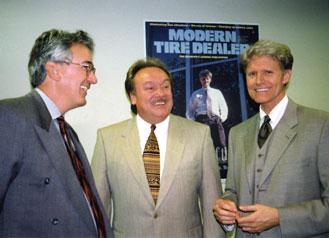
Keeping its members and the industry educated is another priority, says the incoming president
Larry Brandt is a man who believes in education. As it was an independent retail chain. He remained involved a college student, Brandt unloaded tires at a Minwhen it became company-owned by Bridgestone Retail nesota warehouse on his summer break. He broke Operations LLC. He says there are not a lot of diff erences into the tire business full time in 1979 as a wholesale tire between running seven stores or 144 stores. and antifreeze broker. In 1985 he merged that company with “Multi-store management always comes down to systems Tires Plus and he became the vice president of wholesale and people,” Brandt explains. “If an individual only had for the fi ve-store company. one store he would still have to have systems in place so
Brandt was named president of Tires Plus in 1995, a the store could run effi ciently when he wasn’t there. When position he held until the company was sold to Morgan you run a 144-store chain you have a lot of support people Tire & Auto in August of 2000. In the 15 years he was on to do diff erent functions such as marketing directors, the Tires Plus senior management team, the number of stores grew from fi ve to 144. He was chairman of the Tire Alliance Groupe from 1998-2000, and is still a member.
In 2001 he started MSB Tires LLC with two former executives of Tires Plus, Dan Gullet and Tom Gegax (above). MSB operated seven Tires Plus licensees in Minnesota and Iowa until he sold that company to TBC Corp. in October 2010. He is currently president of the United Tire Group. He also started Brandt Marketing, a consulting company that helps tire dealers. He has a consulting agreement with Comdata Corp., which helps automotive fl eet companies consolidate and control their fuel and maintenance.
As the Tire Industry Association’s (TIA) incoming president, he knows how important it is to stay educated in order to run a successful tire business. TIA represents all segments of the tire industry, and Brandt wants to help advance all of them.
Brandt has a unique perspective when it comes to running a tire business. He was president of Tires Plus when trainers and purchasing agents.” Brandt says smaller chain and individual store owners need to be aligned with strong suppliers that off er training and group discount programs for purchasing tires and parts. He believes that as a store owner, you need to be under some form of marketing umbrella. “At corporate Tires Plus, before we sold, we were the umbrella,” he says. “As a licensee, we aligned ourselves under that same umbrella managed by Bridgestone/Firestone. Th ere are many umbrellas out there. I feel you need to be
Larry Brandt (center), Dan Gullet (left) and former MTD Tire Dealer of the Year Tom Gegax ran Tires Plus in 1998.
under one of them to be successful.”
MTD: You have a strong retail background. How does TIA address the needs of retailers?
Brandt: I think the most important need that we meet for retailers is in training and education. TIA released the updated Automotive Tire Service (ATS) program this year and also launched the new advanced tire pressure monitoring system (TPMS) Training Program. Both programs give technicians comprehensive training on passenger and light truck tire service including lift ing, tire balancing, repairing, mounting/demounting/infl ation, lug unit torque/clamping force and TPMS.
We have also released the 2011 version of our widely successful TPMS relearn procedures, as well as OE and popular aftermarket replacement part numbers and torque specs. Retailers who use our training programs and resources can reduce their liability and gain a competitive advantage with a qualifi ed workforce.
We also have a new health insurance program for tire dealers. We continue to off er liability and workers’ comp insurance programs through our endorsed member benefi t programs.
MTD:What legislative issues will you and TIA focus on over the next 12 months?
Brandt: Our top issues will be to be selected for the National Highway Traffi c Safety Administration (NHTSA) consumer education program. Other top issues are to

make permanent the repeal of estate tax, and to feelings and concerns of manufacturers repeal or lessen the burden on mandatory health to SEMA’s board of directors. We insurance. will continue to work with SEMA
We plan to extend the work opportunity tax to strengthen our partnership and credit to returning vets and disadvantaged youths. ensure that the GTE will be the tire We also plan to push for the passage of H.R. 966 show for the industry. (the Lawsuit Abuse Reduction Act), to push for a fi ve-year extension of the Federal Aid Highway MTD: Is overseeing the govBill (with no motor fuel tax increases), and to ernment-mandated national tire oppose the privatization of highways, a national maintenance consumer education weight-distance tax, and any proposed increase program still a priority? of the FET on new truck tires. Brandt: Our top legislative/regu
We also want to repeal the retroactive liability latory goal is to have the National provision of Superfund (which has tire dealers tied Training and Simulation Association up in at least 31 states for proper disposal of tires, (NTSA) outsource the tire consumer used oil, used batt eries and fi lters). We want to education program to TIA. We believe repeal or end the Chinese tariff s. We have position we are uniquely positioned with the papers on all of these issues. We also have initiated For the next year, TIA President tire manufacturers, retailers and cona state legislative/regulatory newslett er and will Larry Brandt will place an emsumers to make this a very meaningful be more active and visible on that level. phasis on education and training. and positive program.
“Without trained employees, you
MTD: What has TIA done to improve the cannot survive in the automotive service industry today.” MTD:How many members does Global Tire Expo (GTE)? TIA have? How many of those mem
Brandt: TIA has expanded the education track to include bers are independent tire dealers? Green@Noon. We have held meetings with all the tire manuBrandt: TIA has 5,595 members and approximately 80% facturers regarding having a presence at the Specialty Equipare independent tire dealers (not a part of national chains). ment Market Association (SEMA) Show, and have relayed
MTD: As TIA president, what will be your agenda?
Brandt: In 2011 Mike Berra Jr. and myself started to transition TIA into an association that could not only survive but grow in the future. Th e association picture has changed in the recent economic downturn and I’m pleased to say that TIA is in a strong position now for the future, and is ready to grow and prosper. I plan to continue this transition and make TIA an even stronger association in the future.
In my view, TIA is about training and government aff airs. We have an excellent training team led by Kevin Rohlwing and we need to capitalize more on that team. TIA needs to be the training center for all types of tires — and we will be.
Th ere have never been more political issues that could aff ect the independent tire dealer than what is currently going on in Washington, D.C. TIA is extremely blessed to have an individual like Roy Litt lefi eld to represent and lead our independent tire dealer needs. We will be communicating what’s going on in Washington and how it could aff ect dealers’ business more than ever before.

MTD:If you could accomplish one thing as TIA president, what would it be?
Brandt: Once I became a member of the TIA board, I was amazed that there wasn’t a bett er relationship between TIA and the Rubber Manufacturers Association (RMA). Th e two probably agree on 90% of the issues facing our industry today. We need to be talking to each other more. When there is common ground, we need to have the industry speak with one voice. When we don’t agree, we respectfully agree to disagree. ■

Quik-Link: 800-687-1557 ext. 22140
Special tools needed for the Audi Q7 New or relocated tire(s) must be initialized.
SUBJECT VEHICLE: 2010 Audi Q7. SPECIAL TOOLS NEEDED? Yes, a torque wrench (V.A.G. 1410), and socket (V.A.G. 1410/1).
If a wheel sensor of the tire pressure monitoring system (TPMS) on the 2010 Audi Q7 senses a signifi cant loss of air pressure in one or more tires, the sensor(s) sends signals (values) to the tire pressure monitoring antenna. Th e antenna transfers the values to the tire pressure control module.
Th e control module then transfers the values to the driver information system in the instrument cluster. Th en it displays a fl at tire symbol and the text message “CHECK TIRE PRESSURE.” Aft er a few seconds, the message is replaced by the regular display; press the “CHECK” butt on to show the message again. If tire pressure is signifi cantly diff erent in one or more tires, check the tire(s) for damage or foreign objects. Replace the tire(s) if necessary.
Th e low pressure warning light in the instrument cluster illuminates when: • Tire pressure is 7 psi (48 kPa) lower than it should be; • Wheel(s) are installed without a tire pressure sensor;
• Winter tires are installed; • Incorrect pressure sensors are installed.
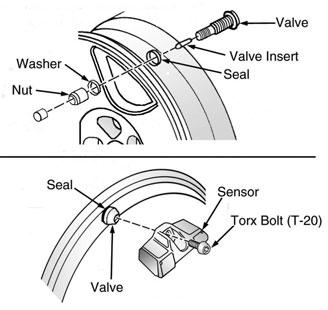
To remove an old sensor, follow these steps. 1. Remove tire and wheel assembly from the vehicle. 2. Demount the tire from the wheel Figure 1 following the tire changer manufacturer’s instructions while paying special att ention to the following to avoid damaging the pressure sensor: a. Press the tire off both rim edges on the opposite side to the metal valve. b. Turn the wheel on the tire mounting equipment so that the valve/tire pressure sensor is opposite the mounting head.

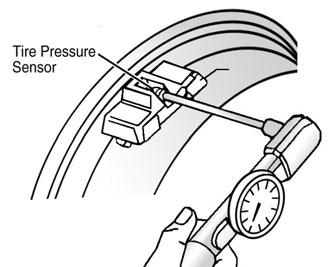
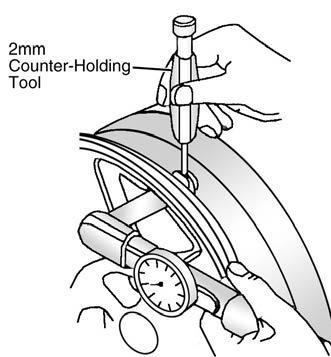
NOTE: To perform this procedure, a torque wrench (V.A.G. 1410) and socket (V.A.G. 1410/1) are required. 3. To remove the Beru System tire pressure sensors: a. While holding the tire pressure sensor against the wheel rim, remove the torx fastener. See Figure. 2. b. While counterholding the metal valve body, remove union nut and metal valve. See Figure 3. c. Remove and discard the valve insert from the valve stem. To install a new sensor, follow these steps. NOTE: When reusing Figure 2 tire pressure sensors, inspect the connection between the sensor and the metal valve for damage. It is also necessary to replace the valve nut, nickelplated valve insert, sealing ring, sealing washer and valve cap when reusing tire pressure sensors. See Figure 1. 1. To install Beru System tire pressure sensors: Figure 3 a. Install the metal valve body, and while counter-holding the valve (for example, 2 mm twist drill or counter holding tool — see Figure 1 and Figure 3), tighten the union nut to specifi cation. b. Press and hold the tire pressure sensor against the wheel rim and tighten the torx fastener to specifi cation. See Figure 2. 2. Mount the tire on the wheel following the tire changer manufacturer’s instructions, paying special att ention to the following to avoid damaging the tire pressure sensor: a. Make sure that the tire does not contact the tire pressure sensor while mounting the tire. b. Turn the wheel on the tire mounting equipment so that the valve/tire pressure sensor is opposite the mounting head. 3. Install the tire and wheel assembly to the vehicle. 4. Adjust the infl ation pressures of all tires (including spare tire), and balance the tires. Store the new tire pressures in the system. NOTE: Whenever tire pressure is adjusted, the adjusted pressure has to be stored again. If a tire was changed or relocated, the new or relocated
tire(s) must be initialized. Check and correct the tire infl ation pressures of the wheels on the vehicle as provided on the tire pressure label. Aft er properly infl ating the tires, current pressures have to be stored in the monitoring system. Th e system then implements an automatic adaptation process.
When a tire pressure monitoring system malfunction occurs, it will be indicated when the ignition is turned ON and the yellow malfunction lamp in the instrument cluster will fl ash for one minute and then stay ON. Th e yellow malfunction lamp cannot be switched OFF by pressing the multimedia system control butt on on the center console. Th is could be caused by the following: • If this symbol is displayed at the end of a learning phase, it means that the system cannot recognize which wheels are mounted on the vehicle. Th is may be because one or more wheels were mounted lacking a wheel sensor. • A wheel sensor or other component may have failed. • Th e system recognizes more than four wheels are present on the vehicle (i.e., when additional winter tires are being transported on the vehicle and are transmitt ing data). • A wheel was changed, and the new tire was not initialized. • If the vehicle is being operated with snow chains, system function can be aff ected by the shielding eff ect of the chains. • Th e system is not available due to a malfunction. • Other transmitt ing devices with the same frequency are emitt ing an electromagnetic fi eld which can cause temporary interference in the system.
To store tire infl ation pressures, follow these steps . 1. Adjust air pressure in all tires to specifi cations (as provided on the vehicle’s tire pressure label). 2. Turn the ignition on. 3. Select “CAR,” “SYSTEMS,” and “TIRE PRESSURES MONITORING.” 4. Press the multimedia control butt on on the center console when in the Tire Pressure Monitoring menu. 5. Th e new pressures will be saved when the vehicle is driven. ■
Information for this column comes from Mitchell 1’s ”Tire Pressure Monitoring Systems Guide” for domestic and import vehicles through 2010. Headquartered in Poway, Calif., Mitchell 1 has provided quality repair information solutions to the automotive industry for more than 80 years. For more information, visit www.mitchell1.com.

Countering these dreaded words at the sales counter
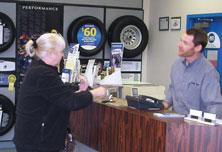
Ihave to think about it” is which is a point you and the prospect can both agree on. only six words, but it says Agreement, of course, is important. Depending on the a lot — or not. response you receive, you may want to ask more direct We used to say at the sales questions. “Is my price too high?” “Were you looking for counter, “Get the greenbacks, a lower-priced product?” “You don’t have the time to get not the comebacks.” Of course, the service now?” Is there anything I can do to help you money in the cash drawer is almake up your mind?” Th ese types of direct questions ways bett er than a promise. require direct answers that will give you the insights you No matter how good your need to either press on or back off . sales presentation, your listening skills, your reputation, sooner or later every sales person will hear By Wayne Williams Handling emotions Remember that you are never in complete control of these dreaded words, “I have to the sales process because a lot of what’s taking place in the think about it.” Because “I have to think about it” is vague, exchange is emotional. Emotion plays a part in everyone’s it can mean a variety of diff erent things. It can mean “No”; decision process. I suggest that you may att empt to personalize it can mean “I’m not comfortable”; it can be a stall tactic. the conversation with “you” words rather than “I” words. Whatever it is, it’s not clear, and to get the necessary clarity, “If you have the work done now, you’ll drive away safer it’s going to require more eff ort to discover the real reason and you’ll fi nd that blah-blah-blah,” or “If you schedule an behind the objection. appointment now for tomorrow, we can give you a ride to Your prospective customer is att empting to close the work and pick you up, if necessary,” or, “You’ll enjoy more door on your presentation, and you must, in eff ect, put peace of mind if you get this taken care of now.” your foot in the door. It’s awkward at best, and traditional All of these comments, and a million others like them, techniques for overcoming objections just don’t work. help express concern for the prospect and your desire to Emotion plays a part in help. One of my favorite sales techniques for showing or demonstrating empathy is the “feel-felt-and found” method. everyone’s decision process. It goes something like this, “I know how you feel. I’ve felt the same way, but let me tell you what I’ve found.” Find the common ground like this, “I know how you feel. $750 is a lot of money for The primary reason this scenario is so awkward is two tires and an alignment. I felt the same way a couple because you know that your next words will determine of months ago when I had to replace all four of my tires. if you’ll ever see that customer in your store What I found is the family again. Too much pressure and they are gone van rides much nicer and forever. Th e “just-right words” may salvage a my wife is much happier. sale either now or later. I had to do it.” Either way, you must fi nd common ground! Any way you choose, Remember, you’re not the only one feeling a the key, as always, is trust. litt le awkward, and it’s your job to control the A sincere and concerned conversation, to strengthen the trust required approach that is followed to make the sale now or at a later date. If at all by more sincere concern possible, you never want to end awkwardly. will help when your Common ground is found initially by asking for a few more moments of the prospect’s time. The feel-felt-found sales technique shows you empathize with your customer. prospect requires more time or more convincTh en you must reiterate important points in ing. When addressing or the original dialog, att empting to establish or re-establish re-addressing the prospect’s need to “think about it,” don’t a deeper level of trust that will facilitate your prospective be defensive, be more helpful, be more empathetic. Listen customer to reveal the true nature of his/her objection, more carefully, and be att entive to body language. ■ remembering that some customers do just have to think In the case of Mr./Mrs. I-have-to-think-about-it, it sounds about it. Wayne Williams is president of ExSell Marketing Inc., a Common ground is found by re-focusing on the prospect’s “counter intelligence” fi rm based in La Habra, Calif. He can needs. Th is works because the needs have not changed, be reached at exsellmkting@gmail.com.

Mobile barcodes: What’s with all the little boxes? Tag code uses appear endless and are limited only by your imagination

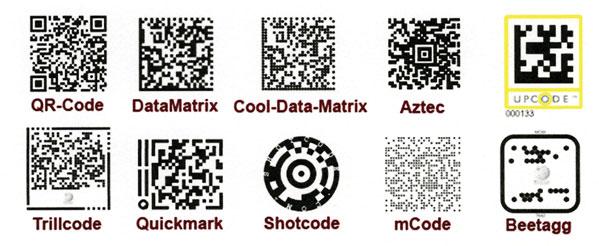
Mobile tagging is the process of providing data read from tags for display on mobile devices (source: Wikipedia). Th ese are commonly encoded in a two-dimensional barcode and use the camera of a cell phone as the reader device. Th e content of the tag code is usually a URL for information that is addressed and accessible through the Internet. Th ere are dozens of diff erent 2D By Wayne Croswell barcode standards. However, there are approximately 12 that are popular today with mobile phone users. Th e common ones used for mobile tagging today are listed in the chart on page 70. In addition, Microsoft has developed their own proprietary tag identifi ed by small multi-colored triangles.
Do you use mobile barcodes? You may have noticed that they are popping up everywhere. You almost need a smartphone to read your favorite magazine these days. Every ad and article seems to have a mobile barcode printed next to it. Take a walk down Main Street, USA and you will fi nd mobile barcodes in many storefront windows. Stroll through a shopping mall and you will fi nd them in store entry ways and throughout store shelves everywhere.
Sett ing the standard
QR-Codes seem to be the most popular. Th ey are square diagrams that look like they are comprised of many small litt le boxes. Th ey have slightly larger solid boxes in three of the corners — it almost looks like a maze.
To read them, you need to download an app on your smartphone, and most of the QR code-reader apps are free. Some of the popular ones are RedLaser from Occipital, Scan from QR Code City, QR Reader from TapMedia, LTD, Nokia Reader from Nokia, and i-nigma Reader from i-nigma.
For you, it’s not important which reader is used, except for the fact that most readers can only read one type of code, their own.
Th ere are some open-source readers available that can read more than one code standard, and many smartphone users have already fi gured out how to use them.
Microsoft has its own propietary tag (right) that connects customers to its website.
Gett ing started
What’s really important is what these mobile barcodes can do for you and how you can use them in your business. To use them to your advantage, you need to be able to create them. Th ere are many free, and not-so-free, mobile barcode generators; most people prefer the free ones.
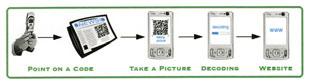
Th e generators are the soft ware tools that create those cute litt le icons. Once you decide which standard you want to use, you can easily download an app that creates the 2D mobile barcodes and you can start creating them. When you create a mobile barcode image, it is saved as a graphic fi le, like a .gif, .jpeg, or .png fi le. You can att ach the fi le to emails or upload them to a website just like any other graphic image.
You can also use them in print to include them on lett erhead, invoices, window displays, billboards, advertisements, mailings, counter posters, showroom posters, and business cards. Th e list is endless; I think you get the point.
Smartphone users can take a photo of the barcode image and be connected directly to your website.
Now what?
What information can you put in these mobile barcodes? Lots of things, and this is where the marketer in you should be gett ing excited.
You can encode something as simple as a phone number, or a website address. Or you can get fancy and include a specifi c website landing page, an SMS (text) message, an email message, contact details (such as a Vcard), an event that is automatically entered into an electronic calendar, a Google maps location, a social media launch, a link to a YouTube video – again, the list is endless.
You will be amazed at the information you can share with customers by using mobile barcodes, and at just how powerful

There are dozens of different 2D barcode standards. Here are the common ones used for mobile tagging today.
they can be. Here’s a great example, you can create a mobile barcode that will compose text message on a phone and send it. All the user has to do is scan the mobile barcode with their smartphone and press send, and off goes the text message sharing your business information with a “friend.” Th at is social media

marketing at its fi nest – instant sharing of information!
Th ese barcodes also can initiate a text message and send it directly to the user. When scanned, the user will receive a text message in their inbox reminding them about your business or even off ering them a discount for repeat business.
Mobile barcodes can also contain links to a webpage that provides extensive information about products or processes. Th ey can even link to a video that explains a safety feature, or shows the reasons that certain services need to be performed, like the importance of tire rotations.
I found one of these codes in a magazine ad recently. Th e advertisement had several pictures of clothes and accessories and a model was pictured standing right in the middle of the ad. Once I scanned the code, the model’s image appeared on the screen of my phone. It then allowed me to drag the various outfi ts and accessories toward the model; as I did this, the items would instantly appear on the model on the screen of my phone. How cool is that? Imagine doing that with a car, some tires, and wheels. Even cooler.
Th ink of the possibilities!
Now it’s time to get creative; imagine what you can do with these litt le boxes! You can put them on tires and other products in your showroom. When scanned, they could direct the customer to a video that describes the tire, explains its features and benefi ts, and even gives pricing information. You can put a barcode in your showroom window, or on the showroom wall, that invites users to a website and allows them to join your online loyalty club – or sends them a text message to remind them to sign up.
You can include these barcodes in your print ads to direct customers to your website, or to a video that promotes this week’s specials or even an upcoming event. Imagine putt ing one on a billboard. People passing by the billboard can use their smartphone to read the mobile barcode and get information about your business while on the road. Th e possibilities are endless and only limited by your imagination.
I think one of the most purposeful uses for a tire dealer is putt ing links to videos or webpages that give customers more information about what you are promoting. This isn’t something you could do easily before the invention of mobile barcodes.
What’ll they think of next? ■
As CEO and president of WECnology LLC (www.wecnology.com), Wayne Croswell is a “complimentary technology advisor” for independent tire dealers. Croswell can be reached at wcroswell@wecnology.com or (603) 249-5530.
This QR code will direct your mobile device to MTD’s website.

Plans are nothing without actions SalesMinded dealers know that real change is the key to execution
By Doug Trenary
Many years ago, I read a cover article in Fortune magazine titled, “Why do companies fail?” Th e article had huge depth of research and many examples — and these examples of companies who went by the wayside in some cases were titans at the time like Eastern Airlines — remember them? Th e organizations noted covered many diff erent industries and even diff erent time frames and economic conditions at the respective time.
Th e moral to the article: All of these companies had very detailed plans on how to operate and press forward. What did they all lack? Execution of their own plan.
What about your tire dealership? Do you have game plan? I know you do or you wouldn’t be in operation. And you might be very successful. Do you as an owner or manager feel good aft er each team meeting that the key issues for operations, sales and service got up onto the table? Do you spend money on training and then hope the training gets put into action? Do you have store
or division managers and associates that nod their head in agreement when asked to do something new but they won’t do it? Are your sales, service eff orts, collections and profi ts suff ering because they won’t? If you answered “yes” to any of these questions, you’re in common company – you notice I didn’t say good company — because it’s not a good condition. But it is a common condition — a common and very costly problem.
What’s the problem? Very simply, human beings resist change. Yet change is the key ingredient needed to raise the bar, to lead at new levels, to gain new skills, and to sell more tires, add-ons and service in this tight economy. Even more specifi cally, it is personal change in one person — one of your employees at a time, that makes all the diff erence.
So what can you do as a leader? Let’s start with defi ning the challenge.
Challenge: Lack of execution, taking action and following through because an employee does not want to change to do the new behavior. I see this all the time with tire dealers. A manager is fi red up aft er a training or coaching session — they’re loaded with new sales knowledge or how to more eff ectively communicate with their team. Th ey agree in a meeting to tighten their follow-up and hold their store team associates more accountable. But the test comes in a couple weeks — maybe 30 days — aft er these commitments. All you have to do is ask them, “How are the changes you agreed to make coming? How are they working with your store?” Th en comes the answer: “Well, I got so busy, I haven’t been able to do that yet... but I will though when things slow down and I can get my head above water.” Slow down? Who wants their retail dealership or commercial operation to slow down? I’m sure you don’t.
Solution: Applying behavior-change support, follow-up and accountability.
What’s the cost to you of having an employee who won’t change?
Now, these recommendations can get testy. Th ey are not easy. You may face resistance by any given employee — but you may not. You have to have a mind set of risk aversion (the cost to you of not having an employee make real changes) and say to yourself as a leader: “I must assume Bart is not going to change — even though he committ ed to. Th is is just the way most people are. So I have to stay with him closely for a few weeks to make sure he takes action on his new plan. And I need to make sure he gets
going on what he understands he needs to do that is new for him. Our store needs the new Bart, not the old Bart.” Here are some concrete actions you can employ to help any one of your team members change behavior and execute the plans you have in place.
SalesMind principles applied: Th e learning keys in play are clarifying the absolute necessity of change, clearly defi ning the new actions expected, and then holding an employee accountable very quickly to begin those new actions: • Clarity: SalesMinds know that plans are nothing without action — they have no eff ect on tire sales, leading people or productivity. You must defi ne on paper, in the open, and with given employees in personal counsel with them what it is you want them to change now. Plus get buy-in and ideas from them on how they think they should make those changes. Focus, too, on the benefi ts to them! Don’t be afraid to just simply ask them what they think it takes to perform at their best possible level — the one that drives your sales and service results. • Defi nition: SalesMinds create written action plans. Defi ne on paper (you and the employees do this together, but get them to write it down because it’s their commitment) the exact fi rst-step actions today that need to be taken to sell more tires and service faster. Is it asking bett er questions of customers? Listening more att entively? If you’re a wholesaler or commercial operation, is it making more eff ective calls and working on the skills of the sales process or making cold calls? Is it closing skills? Is it the skill of follow-up? Whatever the actions are, trap them on paper! Have the employee sign at the bott om that they agree to take these actions (which are changes) starting now, not later. • Accountability: SalesMinded leaders again know people — that a person tends to put off or delay changing the way they do things and default back to their old way — the way that no longer works. So, you the leader and your management team must lay down that you will review action plans each week with each key employee. Subsequently, this is the model that one of your store managers will also deploy with their assistant managers — and on down the line to the technician or counter people. Your goal is make it clear that the way you stay on our store team is to do right now the best things that will generate the best results — or our team is not the best place for you. Because that’s the goal — results, not plans. ■
Doug Trenary, president of Doug Trenary’s Fast-Track Inc., is an award-winning author, speaker and teacher who has helped companies of multiple sizes, including independent tire dealerships, increase sales and productivity since 1985. His book, “Th e SalesMind,” focuses on how to establish strong positions with yourself, your buyers — and your time. For more information, email him at info@dougtrenary.com or call (404) 262-3339.


Planning on servicing hybrids? Expect investment in equipment and training to be costly, reader says
Dear Editor,
It was the hybrid Toyota Prius, introduced on the U.S. market 12 years ago, that was the real game changer for the industry, as Michelin radial ply tires were in the U.S. in the 1960s.
In contrast with the Honda Insight, a two-seater, introduced two years earlier, the Prius, although classifi ed as a small car, off ered ample space for fi ve adults, including head and leg room, as well as a spacious trunk as compared to a mid-size passenger car, because of its highly effi cient design, including its interior to exterior dimensional ratio. Th is, as compared with other cars, made for a much more eff ective use of the car’s displaced volume in proportion to its total capacity, hence reducing weight, and therefore manufacturing cost, and on which Toyota lately improved upon with its latest Prius line of cars (the Prius V, the Prius C, and a lower cost fi ve-door coupe, and a Prius 7 passenger station wagon). When well-equipped, the current U.S.-sold Prius, weighing only 3,250 pounds, delivers 52 to 53 mpg under city/highway driving, and costs less than $25,000.
Today the car, for practical purposes, meets the fuel economy standards recently mandated by the U.S. government for 2015. How about that for product development? As with the radialization, the U.S. automobile industry again got caught fl at-footed by a foreign producer.
Of importance is that the Prius was developed and produced based on the system approach, which I introduced at Ford years ago for the radialization. Th e Prius was not an existing Toyota model on which a hybrid propulsion system was merely installed. To be really eff ective, such power train must be part of a vehicle specifi cally developed for it, that is to say “tuned,” and featuring high manufacturing precision, low frontal area,

low aerodynamic drag, low overall rolling resistance, low mass (3,200 pounds), and low friction from all bearings operating throughout the vehicle, and, fi nally, low tire/wheel assembly weight and rolling resistance, as well as much more reasonable tire/wheel dimensions. Th erefore, forget plus-sizing, and keep in mind that the eff ectiveness of low-power wastage tire/wheel systems grows as a percentage of total vehicle energy consumption. Furthermore, since the selection of the proper tire/wheel system is of crucial importance to the performance and operational effi ciency and economy of hybrid-propelled vehicles, I foresee a back-to-basics eff ort based on fundamental engineering principles, and this in view of the socio-economic circumstances facing America today.
Finally, the metamorphosis currently taking place in the tire and tire/wheel system industry would have never happened without the U.S. government fi nancial backing (i.e. the taxpayer), for lately the industry, on its own, has neither the guts nor the fi nancial means to do something really good and diff erent for the benefi t of consumes.
Th e question is: Who will pay to train the maintenance personnel to properly service hybrid vehicles in view of the limited technical labor skills available in the U.S. today, the government? Jacques Bajer, President Tire Systems Engineering Inc. Grosse Pointe, Mich.
Equipment to service hybrids can cost thousands of dollars, Bajer tells us. And add to that the considerable cost for technical training classes. Th ere will be extra costs for servicing diesel hybrids. Like Bajer says, it’s a game changer.-Ed.

“Tires sales have been soft, but are expected to increase over the next 12 months. Service is the driving force of increased sales and gross profi ts.” Paul Bernstein, Principal Delta World Tire New Orleans, La.
“Sales dollars will increase while units sold are down.” Marty Gilkes, General Manager Jee Wholesale Tire LLC Houston, Texas
Join Modern Tire Dealer’s National Advisory Council Each month, Modern Tire Dealer is guided and infl uenced by a select group of readers — members of our National Advisory Council. Th ese members’ opinions are the heart of the monthly Ludwig Report, compiled by well-known industry analyst Saul Ludwig. If you’d like to join this prestigious group, please let us know. We’d love to hear from you. Contact Editor Bob Ulrich at Bob.Ulrich@bobit.com or call (330) 899-2200, ext. 11.