15 minute read
Motor) SPORTS marketing

(Motor)SPORTS marketing Goodyear’s 59-year relationship with NASCAR increases brand loyalty and technology transfer
By Bob Bissler
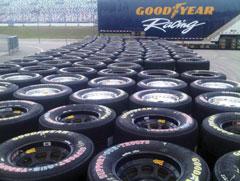
Any NASCAR fan knows. What’s the offi cial tire of NASCAR? Goodyear. And it will remain that way at least for the next five years. In October 2011, Goodyear and NASCAR signed an extended agreement for Goodyear to continue as the exclusive tire used in NASCAR’s top three racing series for the next fi ve years. Th at’s good news for the Goodyear Tire & Rubber Co. But it’s also good news for any dealer who sells Goodyear’s G3 tires — Goodyear, Dunlop and Kelly. “If we compare your average consumer versus somebody that identifi es himself as a NASCAR fan, we get a lift in market share,” says Kris Kienzl, Goodyear’s NASCAR marketing manager. “NASCAR fans come in to buy Goodyear Goodyear delivers all the tires used at tires, versus the avereach NASCAR race to tracks every week during the race season. The specially designed Goodyear “Support Our Troops” age consumer.” As the offi cial tire of tires shown above were used at the NASCAR, the Goodyear Daytona International Speedway at the tire brand is exclusive for July 3, 2010, Coke Zero 400 race. NASCAR’s top three series — the NASCAR Sprint Cup Series, the NASCAR Nationwide Series and the NASCAR Camping World Cup Series. “We have a lot of operational commitment as the offi cial tire,” says Kienzl. “We have a large group of racing engineers. Th ey’re not only in Akron, Ohio, working on developing tires for NASCAR; they follow them to the track. Th ey work with the teams and get a lot of data. Th ey get a lot of feedback so they can continuously use that information in future development.” Goodyear doesn’t release specifi c numbers on how much the company spends to be the offi cial tire of NASCAR. However, it is a signifi cant investment. Kienzl says the company’s market share data and sales volume fi gures do support the investment. It looks like the relationship is paying off . According to the 2011 Modern Tire Dealer Facts Issue, the top brand in the U.S. consumer tire market in 2010 was Goodyear, with 17.6% of an industry total of 226.3 million units (Bridgestone was second at 17.3%, followed by Michelin at 16.8%). Goodyear also has the highest percentages of the U.S. replacement consumer tire brand shares. Goodyear has 15% of passenger tires (based on 198.7 million units) and 12.5% of light truck tires (based on 27.6 million units).
Track to street
Bett er sales are only part of Goodyear’s motorsports marketing strategy. Consumers benefi t as well. How? Track to street technology transfer. Kienzl explains that being involved in motorsports helps the company design bett er tires for consumers.
“Our tires are endemic and are used in the sport versus being a sponsor in the NFL, where we would just be a name,” says Kienzl.
“Th e development that our engineers do with NASCAR tires really trickles through all of our company. Th ere’s a lot of learning week-in and week-out as far as thinking about new technologies, bringing new technologies to market and taking some of those technologies from racing tires and transferring them over to consumer tires.”
According to Jim Davis, Goodyear’s public relations manager, many of the technologies that Goodyear uses in consumer products were fi rst developed for racing. Th is includes various tires reinforced with carbon fi ber (the ultra-high performance Eagle ResponsEdge, for example) and DuPont Kevlar (the off -road Wrangler MT/R, for example).
In addition, a Goodyear innovation that crossed over from racing to street tires is run-fl at technology. In 1966, Goodyear developed an inner-liner for race tires to prevent race cars from decreased control aft er a sudden loss in tire pressure. Th e off spring of that was Goodyear’s RunOnFlat Technology used in some consumer tires.
Track to street technology transfer isn’t the only advantage for Goodyear. Th e tech transfer also goes from street to track.
“Goodyear developed a new rain tire for possible use in the NASCAR Nationwide Series,” explains Davis. “Th e tire could be used in wet track conditions at some road courses on the NASCAR Nationwide Series schedule. Th e race tire’s tread patt ern is similar to that featured on the Goodyear Eagle F1 all-season high-performance tire for consumer use.”
Marketing the NASCAR brand
Kienzl says NASCAR is the second-most popular sport on television in the United States. Th at’s a huge opportunity to reach a broad base of consumers. But NASCAR fans are no ordinary consumers.
“NASCAR fans are interested in technology,” says Kienzl. “Th ey tend to know a litt le more about cars. Th eir neighbors ask them for advice about cars and tires. From a marketing perspective, we want to grow Goodyear brand affi nity and purchase intent — and market share in the end. Our research shows that NASCAR fans are very brand-loyal.”
Goodyear’s research also reveals that NASCAR brand loyalty benefi ts dealers.
When a NASCAR fan is shopping for tires and deciding what brand they intend to purchase, they are more likely than the average consumer to walk into a store with the Goodyear brand in mind. And, they don’t change their mind once they enter the store.
“Th at is very positive for Goodyear when they’re coming in predisposed to buy our brand,” says Kienzl. “It may be up to the guy behind the counter to help them with which Goodyear tire is right for them, but they are coming in predisposed because they want our brand. Th at is a good thing for our dealers selling Goodyear tires.”
Kienzl says that Goodyear’s team of sales representatives around the country run sales incentives for Goodyear dealers. If a dealer wants to run a special NASCAR promotion, the
How important are the following marketing attributes in your decision whether to do business with a tire supplier?
60 Motorsport activities
50
40
30
20
10
0
2% Very important
17% Important
54% Neutral
Source: Modern Tire Dealer survey.
19% Not very important
7% Not important at all

company will help them with ideas and provide them with promotional materials. Th ey can provide dealers with NASCAR race tickets, garage passes and hospitality suite access.
“We have taken dealers on NASCAR garage tours and provided them with information about what Goodyear does at the track,” Kienzl explains. “Just reinforcing that knowledge helps bett er educate the people who are selling the tires.”
Another way Goodyear educates dealers and consumers is through national marketing campaigns.
Th e company launched its “More Driven” campaign earlier this year. Kienzl says the whole idea behind the campaign is that more experts choose Goodyear for its superior performance.
“Th e More Driven campaign absolutely has NASCAR integrated into it,” Kienzl says. “With our dealers, the more we integrate NASCAR and Goodyear brand loyalty, it will naturally trickle down to Goodyear dealers.” ■
Trackside tires
The Goodyear Tire & Rubber Co. delivers all the tires required for every NASCAR race weekend. That includes not only the tires that will be used during the actual race, but also the tires NASCAR teams will need for testing, practice and qualifying.
NASCAR rules require teams to lease the tires from Goodyear, so they don’t own them.
“We used to sell the tires to the teams,” explains Kris Kienzl, Goodyear’s NASCAR marketing manager. “What would happen is you’d have a team with a lot of sponsor money like a Hendrick Motorsports. They would be able to buy tires and then go out and do their own testing and become even stronger. Then they’d get on the track and you’d have them versus a one-car team that just couldn’t afford to do their own testing. So NASCAR asked us to put together a leasing program to even-out the playing fi eld.”
To further even-out the fi eld, NASCAR also changed the rules to limit teams from performing their own tire tests. Today NASCAR teams, big and small, are more evenly matched.
NASCAR teams lease the tires from Goodyear at what Kienzl calls “the low, low price of $449 a tire.” After a tire is used, it is returned to Goodyear. What would happen if someone didn’t want to return a tire? NASCAR and Goodyear have a unique method of ensuring that all tires are returned.
“We actually have radio frequency identifi cation (RFID) chips in those tires for tracking,” says Kienzl. “We check them out and check them in. So teams can’t leave — their hauler can’t drive away — until all the tires have been returned after the race. It’s a process that works very well and we’ve never lost a tire.”
Teams also are not allowed to keep the tires that are on the car when the race fi nishes. Goodyear provides temporary tires that are installed on each stock car so teams can put the vehicle back in the hauler. So what happens to all those used tires after the teams go home?
“We drill holes in the sides of them,” Kienzl reveals. “If anything were to happen to the tire — somehow somebody got their hands on one — it would be rendered useless.”
Hot wheels, cool tires Th e market for UHP tires packaged with custom wheels evolves as OEMs off er more highperformance packages
By Bob Bissler
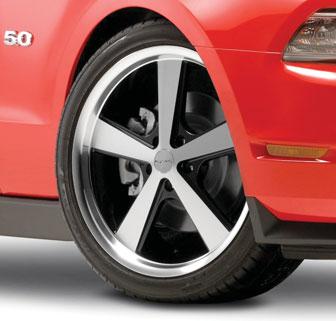
There are two kinds of people who buy high-performance wheels and tires. One is looking to improve the appearance of their vehicle, or to customize it so they can stand out in a crowd. Th e other is doing something that will enhance the performance of the vehicle.
“To upgrade appearance, a lot of people will choose more aggressive looking tires and sportier looking wheels,” says John Rastett er, director of tire information services, Th e Tire Rack. “Wheels are very much a fashion and a function market. Lighter-weight wheels can enhance a vehicle’s performance because it doesn’t take as much energy to make them go, make them stop or hold the road around a corner.”
Rastett er says that for people who want to enhance vehicle performance, the wheel itself in many cases is the fi rst determining factor. Th en they’ll add the tire to the package. If their vehicle came with a passenger or a touring tire as original equipment, going to a high-performance or ultrahigh performance (UHP) tire can take them to a new level
of responsiveness, cornering and stability. Th at makes the car more fun to drive. And this market is about fun.
“Cars are so much bett er today than they were last year or the year before,” says Greg Hathcock, president of Vogue Tyre. “Car manufacturers have done such a phenomenal job of building a great product; cars that are fun to drive, responsive and effi cient. UHP tires really just accentuate all the great benefi ts of these new cars.”
As OEMs improve product off erings, many are gett ing in on the UHP tire/custom wheel act.
“From our perspective, the market is leveling off ,” says Rastett er. “Th at’s partially because so many manufacturers are off ering more options as original equipment. Today, if you buy a version of a vehicle that’s got a sport package or a performance package, the wheels and tires tend to be a very important part of that. A vehicle might come with a 17-, 18- or a 19-inch wheel and tire rim diameter that is used as part of a sport package. Camaros will go up to 20-inches from the

factory as part of their performance packages.” Th ese more that at Vogue, the perception of a UHP tire is anything V-speed extreme performance packages appeal to a more extreme rated and above. However, the defi nition keeps gett ing broader. group of consumers. In addition to enjoying driving their cars UHP tires used to be purely summer tires. Now there are UHP on public streets, they will participate in autocross competiall-season tires, and also winter tires for UHP. tions or high-performance driver’s education events held at “For the person who buys a vehicle that has the optional racetracks. Many belong to car clubs.
For these consumers, the wheels and tires help the vehicle maximize what its engine, suspension and brakes can do. For the aft ermarket, if a car comes with Custom wheels are still a niche. 20-inch wheels, the consumer is less likely to want to further enhance them. Just a few short years ago, that same custom wheels and UHP tires on it, if they live in the north, car might have come with 16- or 17-inch wheels. trying to get through winter with very low-profi le, very wide
“Th at is aff ecting our business,” says Rastett er. “We’re in the large rim diameter tires can be more of a challenge,” explains tire and wheel business. While many people will buy one set Rastett er. “Th e person who has the vehicle in the north, that’s of aft ermarket wheels for their car, throughout the life of the fully optioned from the factory, may have their UHP needs met, vehicle they’ll be buying several sets of tires.” but they’ll come to us for a winter tire and wheel solution.”
Vogue Tyre also off ers tires and wheels packaged together. As this segment evolves, tire and wheel suppliers must keep Hathcock says that generally, these consumers want to go with up. As they do, there is reason for optimism in this market. plus-size applications. He says this is becoming more common “I think it’s still going to remain strong,” says Rastett er. “No because there are more cars coming from the factory with matt er where you have a vehicle and original equipment, there’s higher speed rated tires and lower aspect ratios. always going to be a group of enthusiastic drivers who want
“Custom wheels are still a niche,” he explains. “I would say to personalize their vehicle, to make it theirs.” that the percentage of those packages that can be characterized “Projections for new car sales are getting better,” says as UHP is growing, simply because OE applications that can Hathcock. “Th e average car on the road today is almost 11 be characterized as UHP are growing.” years old. So there’s clearly pent-up demand for new cars
Hathcock says if you talk to several diff erent people you’ll with performance wheels. When exactly that demand hits get several diff erent defi nitions of what UHP means. He says the market remains to be seen.” ■


TCi: one company, two divisions
Wholesale? Commercial? Each is a profi t center
What is TCi? As an independent tire dealership, it was known as Tire Centers Inc., or TCI with a capital “I.”
When Michelin North America Inc. purchased it in 1999, it became a wholly-owned LLC with a small “i.” However, it is made up of two divisions with no ties to each other.
In addition to its Michelin, BFGoodrich, Uniroyal, Trivant and Riken brands, the wholesale division supplies Maxxis, Pirelli, Hankook and Goodride passenger and/or light truck tires to independent retailers and car dealerships. “We have to compete against other price points,” says Jim Borkey, senior vice president of distribution.
Th e commercial division is a company-owned chain of 68 dealerships that off ers the Michelin, BFGoodrich, Continental, General, GT Radial, Hankook, Roadlux, Sumitomo and Yokohama truck tire brands to fl eets.
Sound confusing? It won’t be aft er you check out the TCi spider chart below. — Bob Ulrich
Guy Pekle oversees both of TCi’s divisions in Duncan, S.C., as CEO and president. He says neither is done growing.

John McLeod (below left) is senior vice president of operations for the commercial division. Nate Kirian (right), is vice president of marketing for TCi.

“We are not an orphan, we are not independent. But we’re our own profi t center.” Guy Pekle



“We are not standardized, but systematic.” John McLeod


Independent members of the Michelin Commercial Service Network, the nationwide truck and OTR tire program launched by the Michelin Americas Truck Tires division, are: A&E Tire Inc. New England Truck Tire Allied Oil & Supply Inc. Centers Inc. Bauer Built Inc. Ozarko Tire Centers Inc. Broadway Motors Inc. Phelps Tire Co. Inc. Canyon Tire Sales Inc. Service Tire Truck Center Inc. Colony Tire Corp. Shrader Tire & Oil Inc. Highlands’ Tire & Service Snider Tire Inc. Jack’s Tire & Oil Strouhal Tire Recapping Love’s Travel Stops Ziegler Tire and Supply Co. Meekhof Tire Sales & Service Inc. Valley Tire Co. Inc.
The 68 Tire Centers outlets also are part of the network. Ten of them have Michelin Retread Technologies plants; seven repair OTR tires. “We want to have as little overlap as possible with members of the Michelin Commercial Service Network,” says Pekle.
The 78 TCi distribution centers nationwide only wholesale consumer tires, says Jim Borkey (right), senior vice president of distribution. The distribution center in Greer, S.C. (pictured) has more than 30,000 square feet of space.
TIPS stands for Tire Inventory and Purchasing System. It links TCi customers with the consumer tire distribution center in their respective areas. All TCi customers can not only look up and order tires in real time, but also maintain their own list of authorized users and retail pricing. “TIPS is also a selling tool,” says Pekle. It is designed to be displayed to the consumer. Future enhancements will include total TCi inventory count and customer website integration.