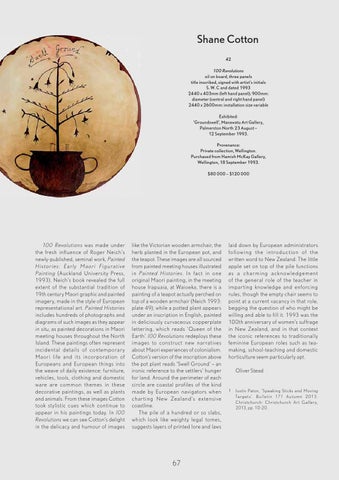
Shane Cotton 42 100 Revolutions oil on board, three panels title inscribed, signed with artist’s initials S. W. C and dated 1993 2440 x 403mm (left hand panel); 900mm: diameter (central and right hand panel) 2440 x 2600mm: installation size variable Exhibited: ‘Groundswell’, Manawatu Art Gallery, Palmerston North 23 August – 12 September 1993. Provenance: Private collection, Wellington. Purchased from Hamish McKay Gallery, Wellington, 18 September 1993. $80 000 – $120 000
100 Revolutions was made under the fresh influence of Roger Neich’s newly-published, seminal work, Painted Histories: Early Maori Figurative Painting (Auckland University Press, 1993). Neich’s book revealed the full extent of the substantial tradition of 19th century Maori graphic and painted imagery, made in the style of European representational art. Painted Histories includes hundreds of photographs and diagrams of such images as they appear in situ, as painted decorations in Maori meeting houses throughout the North Island. These paintings often represent incidental details of contemporar y Maori life and its incorporation of Europeans and European things into the weave of daily existence: furniture, vehicles, tools, clothing and domestic ware are common themes in these decorative paintings, as well as plants and animals. From these images Cotton took stylistic cues which continue to appear in his paintings today. In I00 Revolutions we can see Cotton’s delight in the delicacy and humour of images
like the Victorian wooden armchair, the herb planted in the European pot, and the teapot. These images are all sourced from painted meeting houses illustrated in Painted Histories. In fact in one original Maori painting, in the meeting house Irapuaia, at Waioeka, there is a painting of a teapot actually perched on top of a wooden armchair (Neich 1993: plate 49); while a potted plant appears under an inscription in English, painted in deliciously curvaceous copperplate lettering, which reads ‘Queen of the Earth’. I00 Revolutions redeploys these images to construct new narratives about Maori experiences of colonialism. Cotton’s version of the inscription above the pot plant reads ‘Swell Ground’ – an ironic reference to the settlers’ hunger for land. Around the perimeter of each circle are coastal profiles of the kind made by European navigators when char ting New Zealand’s extensive coastline. The pile of a hundred or so slabs, which look like weighty legal tomes, suggests layers of printed lore and laws
67
laid down by European administrators following the introduction of the written word to New Zealand. The little apple set on top of the pile functions as a charming acknowledgement of the general role of the teacher in imparting knowledge and enforcing rules, though the empty chair seems to point at a current vacancy in that role, begging the question of who might be willing and able to fill it. 1993 was the 100th anniversary of women’s suffrage in New Zealand, and in that context the iconic references to traditionally feminine European roles such as teamaking, school-teaching and domestic horticulture seem particularly apt. Oliver Stead
1
Justin Paton, ‘Speaking Sticks and Moving Tar get s’. Bulletin 171 Autumn 2013. Christchurch: Christchurch Ar t Galler y, 2013, pp. 10-20.