LINDA TYLER in the Garden of Eden yet the Bible and the Qur’an explicitly prohibit representation – statues are idols. Only God can make forms in his own likeness and make them come alive. Fear of the power attributed to images runs deep. Illingworth’s art is a counter to iconoclasm. It is grounded in the potency of representational figures to tell stories and exert influence. When his painted version of As Adam and Eve 1965 (formerly in the Paris Family collection) caused a ruckus because it was deemed obscene, he was incredulous: “I am talking about one of the classical symbols of our society – the love and joy of man and woman, and procreation.” He explained the gesture of the upraised arm in his paintings and sculpture as a kind of wave of fear and hope at the same time: “What am I doing here? Where do I belong?” His figures were greeting a new world of possibility: “an ideal that perhaps might become something but is certainly nothing at the moment.” Gods with upraised arms are found in Egyptian art – it is an archetypal image.
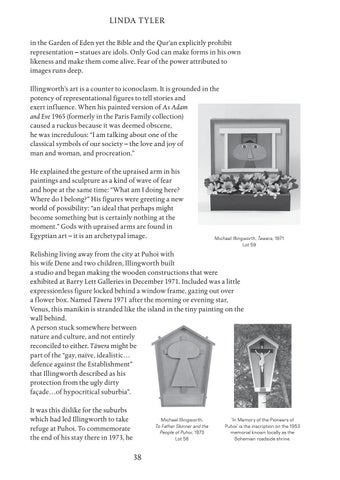
Michael Illingworth, Tawera, 1971 Lot 59
Relishing living away from the city at Puhoi with his wife Dene and two children, Illingworth built a studio and began making the wooden constructions that were exhibited at Barry Lett Galleries in December 1971. Included was a little expressionless figure locked behind a window frame, gazing out over a flower box. Named Tāwera 1971 after the morning or evening star, Venus, this manikin is stranded like the island in the tiny painting on the wall behind. A person stuck somewhere between nature and culture, and not entirely reconciled to either. Tāwera might be part of the “gay, naïve, idealistic… defence against the Establishment” that Illingworth described as his protection from the ugly dirty façade…of hypocritical suburbia”. It was this dislike for the suburbs which had led Illingworth to take refuge at Puhoi. To commemorate the end of his stay there in 1973, he
Michael Illingworth, To Father Skinner and the People of Puhoi, 1973 Lot 56
38
‘In Memory of the Pioneers of Puhoi’ is the inscription on the 1953 memorial known locally as the Bohemian roadside shrine.