The Isle of Axholme
Where You Live
Your Local History
Adapted by Anthony Catherall
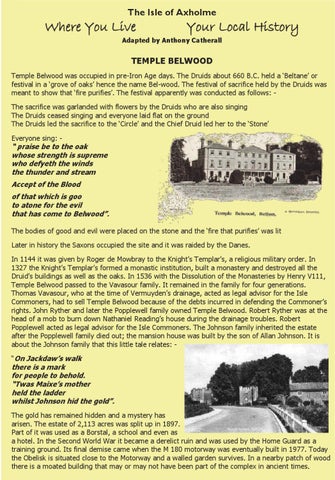
TEMPLE BELWOOD Temple Belwood was occupied in pre-Iron Age days. The Druids about 660 B.C. held a „Beltane‟ or festival in a „grove of oaks‟ hence the name Bel-wood. The festival of sacrifice held by the Druids was meant to show that „fire purifies‟. The festival apparently was conducted as follows: The sacrifice was garlanded with flowers by the Druids who are also singing The Druids ceased singing and everyone laid flat on the ground The Druids led the sacrifice to the „Circle‟ and the Chief Druid led her to the „Stone‟ Everyone sing: -
“ praise be to the oak whose strength is supreme who defyeth the winds the thunder and stream Accept of the Blood of that which is goo to atone for the evil that has come to Belwood”. The bodies of good and evil were placed on the stone and the „fire that purifies‟ was lit Later in history the Saxons occupied the site and it was raided by the Danes. In 1144 it was given by Roger de Mowbray to the Knight‟s Templar‟s, a religious military order. In 1327 the Knight‟s Templar‟s formed a monastic institution, built a monastery and destroyed all the Druid‟s buildings as well as the oaks. In 1536 with the Dissolution of the Monasteries by Henry V111, Temple Belwood passed to the Vavasour family. It remained in the family for four generations. Thomas Vavasour, who at the time of Vermuyden‟s drainage, acted as legal advisor for the Isle Commoners, had to sell Temple Belwood because of the debts incurred in defending the Commoner‟s rights. John Ryther and later the Popplewell family owned Temple Belwood. Robert Ryther was at the head of a mob to burn down Nathaniel Reading‟s house during the drainage troubles. Robert Popplewell acted as legal advisor for the Isle Commoners. The Johnson family inherited the estate after the Popplewell family died out; the mansion house was built by the son of Allan Johnson. It is about the Johnson family that this little tale relates: “On Jackdaw’s walk
there is a mark for people to behold. “Twas Maixe’s mother held the ladder whilst Johnson hid the gold”. The gold has remained hidden and a mystery has arisen. The estate of 2,113 acres was split up in 1897. Part of it was used as a Borstal, a school and even as a hotel. In the Second World War it became a derelict ruin and was used by the Home Guard as a training ground. Its final demise came when the M 180 motorway was eventually built in 1977. Today To advertise call 01302 or 07912 643010 the Obelisk is situated close toplease the Motorway and a532676 walled garden survives. In a nearby patch 7of wood there is a moated building that may or may not have been part of the complex in ancient times.