g n u K
Wi and S n a Stran d c hair t ience det reatm ox V Asia IP ticket ent, C s and a ontempo to pair o rary A f o ld a f S h o e r t bl e s S ho es e e
Hei Fat Choi! Ringing in the Year of the Wood Goat! F E B 2 0 15
Join your community online @ www.arounddb.com
Publishers in DB since 2002
FEBRUARy 2015
康慧台 HILLGROVE
$35K
寶翠閣 wOODGREEN
Gross: 919’ Saleable: 776’ 3 2
$35K
海燕徑 SEABIRD LANE
Gross: 1134’ Saleable: 980’
Great location with open view. Renovated and close to DB plaza and pier.
觀景樓 CLEAR VIEw
$58K
3
Gross: 1368’ Saleable: 1295’
Renovated apt with balcony, fully equipped kitchen and in a tranquil location.
2
$57K
海澄湖畔二段 SIENA TwO
$58K
3 2
Well maintained lowrise with garden, spacious living, bright and airy. A must see!
碧濤軒 COASTLINE VILLA
$85K
T
EN
G EA
L
SO
Gross: 1836’ Saleable: 1399’ 3 3
Beautifully joined unit, spacious living, modern kitchen and bathroom. Great view.
旭暉閣 JOVIAL
$5.95M
Gross: 2174’ Saleable: 1903’
Gross: 1388’ Saleable: 1110’ 3
Rare in market. Beautiful large lawn and patio. Fully upgraded with all new appliances.
2
觀灣樓 BAy VIEw
$6M
5 3
Renovated duplex, fully fitted kitchen and amazing sea views. Great for entertaining.
韶山閣 GREENBURG
$6.5M
T
EN
G EA
L
SO
Gross: 889’ Saleable: 755’ 3 2
Gross: 863’ Saleable: 703’
In good condition. Spacious apartment, convenient for transport. Great value. Must see!
尚堤 CHIANTI
$7.2M
2 1
1
Well maintained apartment, easy access to all transport. 24hr concierge service. A must see!
Designer renovated, well equipped open plan kitchen and rarely available. A must see!
觀星樓 STARVIEw
Gross: 1022’ Saleable: 780’ 2
Gross: 1068’ Saleable: 876’
$8.8M
3 2
倚濤軒 CRESTMONT
2
Spacious combined unit, well equipped kitchen and rare in market. A must see!
$14M/45K
Gross: 1282’ Saleable: 1119’
Gross: 1243’ Saleable: 1028’ 4
Well maintained apartment. Convenient for all transports and near schools. For sale with tenancy.
3 2
Renovated lowrise apartment with garden. Tranquil location offering open green views. Vacant sale.
Hong Kong’s First Exclusively Dedicated HairSPA. Do you want to improve the health of your hair and scalp with an exceptional therapeutic treatment? Equipped with state of the art technology to perfect your hair and scalp with clinically proven results.
Giving you beautiful healthy shiny hair. A relaxing therapeutic experience from the moment you enter the door. SErvicES offErEd: Hair Analysis: Take the guesswork away. Get a diagnostic approach to understand what hair type you really have . Hair treatments: Detoxification, Moisturizing and Damage Repair, Oil Therapy and Smoothening, to make your hair the best it can be. Get your individual personalized hair/ scalp home management plan to maintain beautifully healthy hair and scalp.
Healthy proven by Science Australia Certified Oils
Book now
your appointment
for Hair Treatment Tips like us on Flat 17 1/F Block 2 DB North Plaza (above Paisanos) | www.strandandscience.com | info@strandandscience.com |
Ph. 2886 3820
Great brands at
ToddlePak Toddler Reins
$225
various styles
I-Angel Four Season Hip Seat & Carrier
Mini Micro Scooter
Mamas & Papas Haxby Cot Bed
Tomy Digital Baby Monitor TF 525
pink or blue
Bag $189
$1,100
from Josh Black or Fleur Pink
$790 various colours
Baby Jogger City Light
Oak (mattress sold separately)
$3,500
$650
Lascal Assure Safety Gate
Baby Dan Dan Chair
B Kids Toys (3mths+)
$2,500 black or red
$899
$899 natural
from
Apace New England
Kiddylicious Snack Range
Maclaren Mark II 6mths -15kg
Single Bed $5,500 / Bunk Bed $9,999 white (mattress sold separately)
from
$6.50
$1,750
Carmine Rose or Midnight Navy
$49.90
Raleigh Bikes Atom 16�
$1,699
Pedder Building Store 5/F Pedder Building,12 Pedder Street, Central T: 2522 7112 Horizon Plaza Store 21/F Horizon Plaza, 2 Lee Wing Street, Ap Lei Chau T: 2552 5000 Stanley Plaza Store 2/F Stanley Plaza, 23 Carmel Road, Stanley T: 2555 6318
www.bumpstobabes.com
www.facebook.com/bumpstobabeshk
Asia Contemporary Art Show HONG KONG 2015
FEBRUARY 2015 FEATURES
10
28
PROFILE Meet DB Mothers & Friends’ founder, Nikki Boot
32
IN FOCUS Why being offended is a choice
36
FAMILY MATTERS How to raise earth-friendly kids
43
MONEY Markets update 2015
50
ESCAPES Hanging out in the Whitsunday Islands
56
ACTION Why it’s time to get CrossFit
63
LIFESTYLE Decorating with flowers for Chinese New Year
REGULARS 28
56
27
COMPETITIONS Win big prizes at www.arounddb.com
46
TALKING POINTS Gen up on the Year of the Wood Goat
48
HEALTH Dengue Fever alert!
68
DB FACES Candid community snaps
80
OUT THERE Thoughts on island life
AGENDA
36
10
IN&AROUND DB Catch up with the latest community news
21
ACROSS LANTAU See what’s happening island wide
66
HK HAPPENINGS Find fun things to do across the harbour
71
CLASSIFIEDS Great deals, employment, businesses and more
74
PROPERTY Choice local and overseas homes to buy or rent
77
LOCAL NUMBERS Your ultimate guide in DB and Lantau
46
ON THE COVER
Readers with a feature story idea, please email editor@arounddb.com If you would like to publicise a local event, email hannah@arounddb.com For general enquiries, email info@arounddb.com To advertise, email lissa@arounddb.com Around DB, Bay Media Ltd, 7E Glamour Court, Discovery Bay Call 2987 0577 | Fax 2987 0533
For the latest Around DB updates, find us on
ung
15 FEB 20
Good wishes for the Year of the Goat!
Win a Strand and Scienc hair treatme detox VIP ticket ent, s to Asia Conte and a pair mporary Art of foldable ShoeSee shoes
K i Fat Choi!at! Hethe Year of the Wood Go
Ringing in unity Join your comm
.arounddb.com online @ www
Publishers
in DB since
Illustration by Fred Boot 2002
Twitter and www.arounddb.com
Ava il for b able exp at a oth nd pilo local ts!
YOUR ROUNDUP OF RECENT COMMUNITY EVENTS!
Publisher Corinne Jedwood corinne@arounddb.com Editor Rachel Ainsley editor@arounddb.com Editorial coordinator Hannah Ball hannah@arounddb.com
Find more photos of community events @ www.arounddb.com
Advertising Lissa Morris lissa@arounddb.com Accounts Beatrice De Magistris accountant@arounddb.com Art direction Terry Chow cckterrychow@gmail.com Photography Baljit Gidwani Leticia Lemos (intern) Illustration Fred Boot Rift Leschinsky Contributors this month Beverly Au Richard Crowley Elizabeth Kerr Martin W. Hennecke Peter Sherwood Kate Whitehead Samantha Wong Disclaimer The views expressed in Around DB are not necessarily those of the publisher, editor or contributors. The publisher and editor cannot be held responsible for differences of opinion or statements published in good faith. The publisher, contributors, their employees and partners are not responsible for the results of any actions, errors or omissions taken on the basis of information contained in this publication and expressly disclaim all and any liability for any such action of any person. The mention of specific companies or products in articles or advertisements does not imply that they are endorsed or recommended by this magazine or its publisher in preference to others of a similar nature which are not mentioned or advertised. No part of this magazine may be reproduced in any form without permission.
Photos by Leticia Lemos
y Januar
24
GIRLS’ BEACH RUGBY! Tai Pak Wan
Girls from more than 35 local rugby clubs battled it out on the beach in the DB Pirates’ fifth annual All-Girls Beach Rugby Festival, sponsored by Bupa. Congratulations to everyone involved, especially the DB Pirates’ U12 and U 14 A teams for taking home the Bowl and Plate, and the U14 B team for winning the Shield! For the full list of results go to www.dbpirates.com.
IN&AROUND DB
HEALTHY DB POP UP!
Movement Improvement, DB North Plaza Health vendors from across Hong Kong (plus a few local suppliers) made sure the first Healthy DB Pop Up Event offered everything from supplements to skincare. There was a great turn out on the day.
y Januar
24
Photos by Leticia Lemos
PAWS ADOPTION DAY DB Plaza
y Januar
24
Photos by Leticia Lemos
February 2015
11
IN&AROUND DB
YOUR GUIDE TO UPCOMING COMMUNITY EVENTS!
www.dbrc.hk
CNY TAKE-HOME TREATS
h Throug 16 y r Februa
Peony, DBRC, DB Plaza
Order your CNY Lucky Puddings and Treasure Pots (hot pots) from Peony at the Discovery Bay Recreation Club (DBRC) by February 16. Choose from turnip or taro pudding with dried scallop and preserved meat, or sweet and gooey coconut pudding. There are four types of hot pot, including meat, fish and vegetables. Call Peony on 2500 1950.
February 7
Through 18 February
DROP BY INTEGRATED MEDICINE INSTITUTE in DB North Plaza to celebrate its first anniversary with a glass of herbal tea or an immunity-boosting shot of Sambucus. To book a consultation, call 2537 1087, or visit www.imi.com.hk.
STOCK UP AT THE PLANT MARKET
across from Haven Court, 2pm to 4.45pm. For more information, call 2238 3617.
JOIN A BEACH CLEAN-UP
ary 7
u Febr
at Nim Shue Wan, organised by Plastic Free Seas and DB Green, at 1pm. Visit www.dbgreen.org.
Find more information and events @ www.arounddb.com
DMR WORKS ry 7-8 a ITS MAGIC Febru Discovery College Theatre Young DB dancers are taking to the stage at DMR School of Ballet’s annual show, The Magic Feather. For details, call DMR on 2987 4338, or visit www.dmr-hk.com.
www.dmr-hk.com
Walk for DOMESTIC HELPERS
Start: Discovery Bay Church, Discovery Bay Road 8 ary
u Febr
Race from SUNRISE TO SUNSET Siena Park
The 12-hour Sunrise to Sunset (S2S) charity relay race, organised by three Year-13, Discovery College students, Boris Choy, Minato Umehara and Nina Rossiter, is raising funds for Pathfinders, the local charity which supports migrant mothers and babies in Hong Kong. Teams of between six and 20 runners complete as many laps as they can between 8am and 8pm. Entry costs HK$50 per runner. To sign up to run (by February 2), or to sponsor the event, visit http://s2s.discovery.edu.hk.
12
February 2015
7 February
Photo by Terry Chow
www.hdh-sjc.org
Take part in a sponsored walk, starting at 7am, to support the work of Helpers for Domestic Helpers (HDH), the non-profit run by St John’s Cathedral. The 26-kilometre walk, starting at Discovery Bay Church and ending at St Stephen’s Chapel, Stanley, includes a ferry ride from DB to Central, and a stop-off at St John’s Cathedral, Central and Emmanuel Church, Pokfulam. To sign up or find out more, email alexbarr@netvigator.com, or visit www.stjohnscathedral.org.hk.
IN&AROUND DB February 8
SHOP THE HANDMADE HONG KONG bazaar in DB Plaza
February 15
from 11am to 6pm. You can sign up for a stall at the May 10 bazaar from February 10 to 24, at www.handmadehongkong.com.
Celebrate VALENTINE’S DAY! Throughout DB
14 bruary
Fe
BUY AND SELL all your lightly used goods at the DB Flea Market in DB Plaza, from noon until 5pm. For more information, call 2238 3617.
TENNIS NATIONS CUP! DBRC, DB Plaza
You need to sign up before February 15 to take part in Discovery Bay’s best-loved tennis event of the year: the 22nd Tennis Nations Cup, being held March 21 and 22. Better start getting those crazy costumes ready too! Find out more at www.dbrc.hk.
:
www.hkri.com.hk
• At Tai Pak Wan, thousands of candles arranged in heart shapes light up the beach • DB restaurants are offering special lovers’ menus. For menu details, visit www.arounddb.com • For your chance to win a two-hour trip on The Bounty, worth HK$18,000, spend HK$800 or more at any D’Deck restaurant • Promotional room packages are available at Auberge Discovery Bay • Romantic messages are placed on a model Ferris wheel by DB Ferry Pier
line s’ dead Player uary 15 Febr
CHINESE NEW YEAR DAY!
Around DB would like to wish everyone in DB and Lantau a very happy and prosperous Year of the Goat! To gen up on what this year will bring, turn to page 46, for tips on CNY decorating, turn to page 63.
Photo by Baljit Gidwani
ry 19
a Febru
www.imagenesbing.com
February 2015
13
Friend us on Facebook for event reminders
IN&AROUND DB
Island Dance ON PARADE! Hong Kong Cultural Centre Piazza, Tsim Sha Tsui
9
ary 1
u Febr
Look out for the group of elite dancers from DB’s Island Dance, performing on and alongside Ocean Park’s float at the 2015 Cathay Pacific International Chinese New Year Night Parade, which starts at 8pm. Last year saw around 150,000 spectators line the streets of Tsim Sha Tsui for this must-see event. Visit www.discoveryhongkong.com. Photo courtesy of Madhu Kashyap
LION DANCE AND FIREWORKS DBRC and Club Siena
Everyone is invited to welcome in the Year of the Goat by watching the annual lion-dance performances at the DBRC at 10.45am and Club Siena at 12.30pm. Club members and their guests can also sign up for a Fireworks Harbour Cruise and dinner buffet, leaving from DB Ferry Pier at 7pm. Visit www.dbrc.hk. y 20 Februar
Photo by Baljit Gidwani
YROCK GIGS
The Venue, DB North Plaza Hear young YRock musicians and singers from all over Hong Kong (and DB) performing live every last Friday of the month from 6pm until 8pm. YRock offers teens the opportunity to showcase their musical talent and compete in the annual YRock POP Awards. For the full 2015 YRock schedule, visit www.yrock.com.hk. y 27 Februar
Photo by Baljit Gidwani
DB Mothers & Friends NEEDS YOU! Tai Pak Wan playground Throughout 2014, DB Mothers & Friends, set up by DBer Nikki Boot, collected DBers’ useful, secondary 28 hand items and Febru r e d i s t r i b u t e d Photo by Sarah Tolmay them to people in need. On February 28 from 12 noon to 3pm, Nikki is hosting a celebratory CNY lunch, co-organised by At Home In DB, for the beneficiaries. If you would like to contribute food or drink, or make a donation, email Sue Meldrum at sue@athomeindb.com. You can read all about Nikki, and DB Mothers & Friends, on page 28.
DMR
School of Ballet Est 1984
Thank you participants, teachers, parents and helpers for making “The Magic Feather” show possible!
“The Magic Feather” is on the 7th & 8th Feb at DC Theatre. Contact us for tickets. Shop 112 DB Plaza, Discovery Bay HK
2987 4338
info@dmr-hk.com - www.dmr-hk.com
IN&AROUND DB DB IN&AROUND
NEW IN DB ORGANIC MEAT DELIVERY Farmer’s Kitchen now delivers naturally farmed meat to DB homes. At the online site, launched last November by Hong Kong residents Emma Pike and Katie Campbell, you can choose from a wide range of organic Australian meats, along with tempting extras like cheeses and sauces. To place an order, visit www.farmerskitchen.com.hk.
Photo courtesy of DBRC
DBRC HEAD TENNIS COACH Around DB would like to welcome Roberto Santamaria, the new DBRC head tennis coach, to the community. Spanish-born Roberto has a successful pro-tennis career behind him and has been coaching tennis for over 20 years. For more information, call 2987 7381, or email dbrc-enquiries@dbrc.hk.
Photos courtesy of Emma Pike
PEER-TO-PEER LENDING Such an exciting new initiative: You can now borrow up to 36 times your monthly rental income at a lower rate than that offered by most banks through Monexo – the online marketplace for peer-to peer lending, set up by DB resident Mukesh Bubna in July last year. Monexo helps lenders beat inflation as well as diversify beyond equities and bonds in return for monthly repayments of principal and interest (up to Photo courtesy of Mukesh Bubna 15% returns). At the same time, it provides borrowers access to a cost-effective cash injection for business or personal needs. To find out more, visit www.monexo.co.
16
February 2015
Photo by Elysia Roach
SPORTS SUPPLIER Opening on February 4 in DB Plaza, Gigasports stocks steppers, dumbbell sets, exercise balls and yoga mats as well as big-ticket items, like treadmills and bikes. In addition to gym accessories and equipment, you can also find plenty of workout clothes from well-known brands, such as 2XU, Adidas and Puma. There are several locations around the city, including branches at Festival Walk, Times Square and Ocean Terminal. To find out more, visit www.gigasports.com.hk.
IN&AROUND DB
NEW IN DB
Friend us on Facebook for event reminders
ART VENUES Check out the art classes at Art is a Verb, the 1,600-square-foot art studio in DB North Plaza, which opened on December 1 last year. Compton Art Gallery, next door, which opened on January 10, displays works by emerging, international artists from all over the world. For Art is a Verb, call 2682 8099; for Compton Art Gallery, call 2682 8255.
www.sooqcentral.com
Shopping at SOOQ Check out Sooq, the online marketplace selling unique, handmade goods, set up by four-year DB resident Hui Hang last December. The Sooq team meets with local artisans and selects only the best products, saving you time and money, while you shop for what you want from the comfort of your own home. Visit www.sooqcentral.com.
CNY CAMP AT DISCOVERYLAND Check out Discoveryland’s CNY camp running February 16 to 19, 9.30am to 12.30pm, in DB North Plaza. With a maximum of 10 to a group, kids aged five to eight can expect plenty of fun activities, including rock climbing and arts and crafts. Children can stay on after camp hours, all for HK$750 per day. To register, email events@discoverylandhk.com, or call 2441 0098.
www.discoverylandhk.com
18
February 2015
Photo courtesy of XingNi Liu
INTERN CENTRAL!
With a new office in Central, StandOut Internships, founded in 2011 by seven-year, DB resident Samantha Cornelius, is your goto provider of interns and internships. The team pairs local and international students looking for work experience with Hong Kong companies, and also provides professional development training for interns. To find out more, visit www.standoutinternships.com.
Photo courtesy of Samantha Cornelius
Valid until 28 February 2015.
this discount is valid for clay mineral treatment only
Terms and conditions apply. Not to be used in conjuction with other promotions.
BUSINESS OF THE MONTH
List your Lantau business for free @ www.arounddb.com
l Private Tutoring, Owner of DB learning centre, Wiseow s shop 15-year DB resident Merridy Smits talk Tell us something about your business.
I opened Wiseowl Private Tutoring in September, 2012. We offer a dedicated space in DB Plaza for children to work on their homework and school projects. We make our service as individualised as possible and cater to the students’ specific needs.
What is your biggest challenge?
Balancing running the day-to-day operations versus growing my business is a challenge. I find that most of my day is taken up with tasks that require immediate attention, but aren't necessarily building Wiseowl. Finding ways to solve this is a work in progress!
Which well-known businessperson inspires you?
My current favourite is [US hedge-fund manager] James Altucher, who has founded over 20 companies. He always has practical tips that you can implement in your personal and business life. He is very ‘real’ and isn’t afraid to talk about his failures.
What’s the secret of your success?
I think about Wiseowl students as I do my own children. I want them to be happy and successful in school, and able to reach their potential. My tutors are also passionate and dedicated. We listen to parents’ feedback and try to offer new courses that may benefit their children.
Tell us three things you enjoy outside work.
I love watching my children in their various sport and musical pursuits, documenting my family’s life through a scrapbooking system called Project Life, and playing tennis. Right now, I am practising for the Tennis Nations Cup at the Discovery Bay Recreation Club in March.
How do you see your business looking in five years’ time? Photos courte
sy of Wiseow l Private Tut oring
We’d like all of our tutoring slots to be full. We’d also like to run multiple phonics/ early years’ classes in the mornings, along with a flexible and effective homework club in the afternoons.
Email Wiseowl Private Tutoring at info@wiseowl.com.hk, or visit www.wiseowl.com.hk.
THE RED LANTERN
Genuine antiques, small pieces of delightful furniture from the late ‘Ching Dynasty’
Six minutes walk from the Mui Wo ferry to the direction of the Silvermine Beach Hotel.
TEL: 2984 0099 FAX: 2980 4833 EMAIL: glandam@netvigator.com
Valid until 28 February 2015.
Terms and conditions apply. Not to be used in conjuction with other promotions.
this discount is valid for perming wave, digital wave and perm “chic”
ISLAND-WIDE EVENTS FOR YOU TO ENJOY!
www.marriott.com www.citygateoutlets.com.hk
ary 1ut nuug -Jaro ho r 1Th e b m e D ec February
CNY DISCOUNTS AND PRIZES!
CNY FINE DINING
Citygate outlets, Tung Chung To get you in the mood for CNY, Citygate outlets is offering 30% to 70% discounts at more than 90 international brand-name stores. Spend over HK$1,000 and you can redeem two sets of lai-see packets, and you’ll be entered into the mall’s Grand Lucky Draw for a chance to win a HK$10,000 shopping voucher. Visit www.citygateoutlets.com.hk.
RECYCLED ZODIAC ART Draw 2 — Art and Language Studio, Wanchai Eight-year Tung Chung resident Agnes Pang, of Draw 2 – Art and Language Studio in Wanchai, has posted a series of videos on YouTube whereby kids, aged five to 12, can create CNY-inspired art out of recycled materials. Designs made from red lai-see packets, include candy boxes, lucky scrolls and lanterns. In one themed project, children can make the 12 animals of the Chinese zodiac out of cork bottle stoppers. Agnes also runs hour-long workshops every Saturday from 10am to 6pm, costing HK$250 each. Call 8205 0502, or visit www.draw-2.com/chinese-new-year.html.
VALENTINE’S RACE
Start: Nam Shan, Sunset Peak
Find more information and events @ www.arounddb.com
t g ho u Throu uary Febr
Regal Airport Hotel and Hong Kong SkyCity Marriott Hotel, Chek Lap Kok Don’t miss the Shanghainese or Cantonese Poon Choi (hot pot) on offer at the Regal Airport Hotel’s Dragon Inn or Rouge restaurants this month. You can also enjoy Lunar New Year treats like lucky Lo Hei (raw salmon salad) at Hong Kong SkyCity Marriott Hotel’s Man Ho Chinese Restaurant. To make a reservation at Rouge, call 2286 6868; for Dragon Inn, call 2286 6878; for Man Ho Chinese Restaurant, call 3969 2888. gh Throu 15 March
Photo courtesy of Agnes Pang
Fe
y 14 b rua r
www.skycitymarriott.com
Runners of all abilities can sign up for Lantau Base Camp’s LBC Valentine’s Day Race. Starting at 9.30am, it covers 14 kilometres and some tough, hilly terrain. To register before February 10 (HK$350 per team of two), visit www.racematix.com; for more information, visit http://events.lantaubasecamp.com. www.regalhotel.com
http://events.lantaubasecamp.com
February 2015
21
ACROSS LANTAU
dli o n de a i s s i m 10 S ub March
ne:
http://serc.carleton.edu
Your chance to GET PUBLISHED! Budding young writers will want to take advantage of the CNY holidays to enter Around DB’s Young Writer’s Competition! This year, your task is to write a nonfiction account of 600 to 700 words, about a life-changing moment in your life or someone else’s. For details about the competition, turn to page 76, or visit www.arounddb.com.
DASH FOR A BEER
Friend us on Facebook for event reminders
Start: Ma Po Ping Prison, Tong Fuk Registration opens on March 16 for the seventh Lantau International Beer Dash on April 18. Around DB is a proud sponsor of this hugely popular 5-kilometre fun run which sees participants dress up and drink a different international beer at ever y checkpoint. Entr y costs HK$350 for an individual and HK$1,360 for a team of four. To sign up, visit https://regonline.activeglobal.com/ lantauinternationalbeerdash2015.
Save t
h e da
te!
Photo by Terry Chow
OFFICE 3483 5003
www.homesolutions.hk
Sharon Riley Kelly Merrick Angie Lindsay
9664 4749 9331 8141 6175 0155
(S-415474) (S-365384) (S-472175)
NOW SERVING SOUTH LANTAU AND TUNG CHUNG
36M TUNG CHUNG - COASTAL SKYLINE 3289’ Net
Four flats combined to make one stunning home. 5+ Beds, 6 Baths, Study room. Fully renovated with latest appliances. Sea views from every room. Great facilities in complex.
14.5M MUI WO VILLAGE HOUSE 2100’ + 700’ Rooftop
Amazing 3 Bed, 3.5 Bath & Study. Beautifully renovated village house with modern kitchen with up to date appliances. Built in wardrobes in every room. Large garden and rooftop.
15.38M CHEUNG SHA - LEYBURN VILLAS 1382’ Net
Gorgeous home in sought after area. 3 Bed, 2.5 Bath, Office. Open kitchen, living area with sea views. Large garden. Private car park, Complex includes swimming pool and tennis courts.
22K SHUI HAU VILLAGE HOUSE 1400’ + 700’ Rooftop
Wonderful location in picturesque and peaceful area! Duplex covering 1/F, 2/F and Rooftop. 4 Beds, 2 Bath. Open plan kitchen/living area. Beautiful renovation. Stunning views from the rooftop. Parking nearby.
13K MUI WO FLAT 389’ Net + 457’ Net Rooftop
Making you feel at home is our business
Lovely renovation in town centre. 1 Bed, 1 Bath, Open plan kitchen/ Living area. Very large rooftop direct access from living area. Bright and airy in fantastic location.
Call us any time at 3483 5003 or Email PROPERTY@HOMESOLUTIONS.HK
C-044849
ADVERTORIAL
SCHOOL ONLINE WITH ITS!
E
ver wondered what it would be like to attend school from the comfort of your own home? ITS Education Asia, which has operated schools and a whole host of educational advisory services in Hong Kong since 2005, launched its online school in March 2014, and there are benefits galore.
to-face live teaching online. Lessons take the form of a small, virtual classroom with no more than four to a class (one-on-one tutorials are also available), and students are able to see and interact with their peers and the teacher (who teaches from an ITS classroom), as well as ask questions and access resources on screen.
“ITS’ online school brings real school into students’ homes,” says ITS Education Asia’s co-founder and director, London-born Danny Harrington, an Oxford graduate with over 20 years’ teaching experience. “Whether you live in a remote area of South Lantau; you’re someone with an illness or a disability; someone who moves around a lot; someone who can’t fit into the normal system, or someone who simply wants a flexible schooling option that lets you learn at your own pace, our online school could be the perfect option for you.”
“One of the beauties of our online school is that it allows students to save their lessons,” says Danny. “This means they can review classes anytime, anywhere, and parents can log on and check how their kids are getting on and what they are learning. Our teachers always have to give their best and so do the students.”
Photos courtesy of ITS
Live lessons ITS is a fully accredited Edexcel examination centre and UCAS centre, and secondary students, typically 14 years+, can choose from a range of subjects, and get help with university applications. “The process is simple,” Danny points out. “Once students have chosen their course, they’ll have access to a personal account, where they can log on and participate in live lessons, receive reports, homework and get feedback from the teacher.” Supported by more than 60 qualified teachers, ITS offers personalised face-
Another benefit is flexibility. Students not only choose when they have their lessons (many opt for evening and weekend classes), they can also choose
where they have them – whether that’s in another country, or simply from the comfort of their own bed! Costing is also advantageous. “Since “Since we only cover the academic subjects and classes are so small, the cost is actually far less than a typical international school in Hong Kong, since the hours necessary for lessons are significantly fewer,” says Danny, who explains that the hours required for a regular class of 30 are double that needed for a small class and triple the hours required for one-on-one learning. For Danny, online learning is the future of education. “We parents need to remember that our own experience of school was 30 years ago. Learning at our online school gives students empowerment over how they run their education. The more people we show it to, the more people love it.”
sses and support for:
ITS provides online cla
• GCE and International A-level • International GCSE • IB tutorial support • SAT/ AP classes and tutorial support • University entrance, UCAS support, strategies and applications • Language tuition
Call ITS Education Asia on 2116 3916, email online@itseducation.asia, or visit www.itseducation.asia
COMPETITIONS
Here’s your chance to win great prizes!
Strand and Science HairSPA giveaway! YOUR PRIZE: Strand and Science HairSPA is offering three readers a detox hair treatment, plus a takehome shampoo and conditioner specific to their hair type (worth a total of HK$800 each).
Around DB competitions are incredibly easy to enter (you’ll even find the answers to our questions right here). You have until February 10 to submit your answers. To enter, email info@arounddb.com, click on the competitions link at www.arounddb.com, or scan the QR Code below. Don’t forget to give us your name and telephone number!
Where is Strand and Science HairSPA based?
How many artworks are on offer? www.asiacontemporaryart.com
Win tickets to Asia Contemporary Art Show! www.strandandscience.com
FIND THE ANSWER: Improve the health of your hair and scalp with relaxing and therapeutic treatments at Strand and Science HairSPA in DB North Plaza. The spa boasts state-of-the-art hair and scalp analysis and treatment equipment, plus top-of-the-range home treatment products. For an appointment, call 2886 3820; to find out more, visit www.strandandscience.com.
YOUR PRIZE: Asia Contemporary Art is offering six readers a VIP invitation for two (worth HK$520 per ticket) to see the show. FIND THE ANSWER: View over 3,000 works of art at the Asia Contemporary Art Show Spring Edition, running from March 12 to 15 at the Conrad Hong Kong, Admiralty. You can pick up original paintings, limited editions, photography and sculpture from both emerging and established international artists. For tickets, starting at HK$180 (kids under 16, accompanied by an adult, get in for free), visit www.asiacontemporaryart.com.
Take home foldable ShoeSees! Where can you find the ShoeSee collection?
www.shoesee.wix.com/shoesee
YOUR PRIZE: ShoeSee is offering two readers a pair of any ShoeSee foldable shoes (worth up to HK$230 per pair). FIND THE ANSWER: Super-comfortable ShoeSees not only provide relief for painful feet, they also look fashionable and fold up to fit into the smallest of handbags. With 13 different styles for ladies to choose from and sizes ranging from UK 2.5 to 9.5 (US 5 to 12), prices start from HK$190. View the collection at www.shoesee.wix.com/shoesee.
Congratulations to last month’s winners Krista Merrill for the photo session with Chris Coelho; Jennifer Tang, Ravinder Kumar and Ana Healey for the Chameleon Workshop fine-art packs; and Priyesh Manilal and Roberto Pace for fitness classes at The HIT Room. February 2015
27
Photos by Terry Chow and courtesy of Nikki Boot
PROFILE
28
DB Mothers & Friends’ founder Nikki Boot with baby Eloise
February 2015
PROFILE
DISCOVERY BAY’S
SWEETHEART Altruistic and ultra-practical, Nikki Boot is on a quest to make Hong Kong a better place – one sofa at a time, writes Elizabeth Kerr
F
or a woman who spends a big chunk of her time working – for free – on behalf of Hong Kong’s disadvantaged, four-year DB resident Nikki Boot is remarkably chipper. Not in a disingenuous way, more of an optimistic one. Maybe it’s because she’s been there. Maybe it’s because she grew up with a daily reminder that there were have-nots in the city, regardless of how glittery a face the SAR wears. Or maybe she’s just a better person than some of us. Nikki née Chan, a born-and-bred Hong Konger, bears all the hallmarks of your average Discovery Bay workat-home mother. Married eight years to Fred, a French artist and ESF teacher, and mum to Edgar, four, Elvire, two, and Eloise, three months, she is quick to laugh and intensely aware of the world around her. Having founded DB Mothers & Friends, a Facebook-based forum for local mums to get together and share in 2010, Nikki fell into working with charities only recently. Registered as a social enterprise in early 2014, DB Mothers & Friends has collected some 378 tonnes of useful second-
hand goods from over 1,000 DB homes, and redistributed them to the needy in that time.
Mother knows best By her own admission, Nikki never expected to be a full-time mum. Like most modern Hong Kong women, a business career was expected. “I finished school in a small town near Chicago the year after SARS,” she says. “Then the financial tsunami happened. I graduated in business management and worked for a short while in public relations but no economy, so no events.” Nikki decided to switch to teaching English, and it wasn’t long before she met Fred, at a party with friends. She had just been fully accredited as a teacher when she discovered she was pregnant. The young family relocated to DB for most of the usual reasons. “To bring up the children,” says Nikki. “There was too much pollution elsewhere. It’s a nice environment and they can run around. When it was just the two of us, we enjoyed the city – drinks after work, dining out all the time – but no more.”
And for the time being at least, fulltime work is out the window too. “I want to bring up my own kids,” Nikki says. “This is a difficult city for lots of parents… But I’m the youngest of 12 kids and I look at how my mother raised everybody without helpers. It can be done.” She pauses for a second before finally admitting, “We tried to have a live-in helper but I didn’t feel comfortable with someone always standing there.”
Building bridges The road to DB Mothers & Friends was, like most start-up endeavours in Hong Kong, born of necessity. As the Boot – a cleverly truncated Bouteiller – clan started to grow so did the need for more space and more stuff. The problem? What to do with the perfectly functional old stuff. “I started to see that getting rid of furniture was difficult or expensive. Then I heard constantly about the landfills, no environmental solutions, the Shek Kwu Chau incinerator proposal, and on and on,” Nikki explains. “I thought I would do something about all this furniture and send it to charities to help people. February 2015
29
PROFILE
Readying the removals truck with Elvire, Eloise and Fred
At the La Costa playground drop-off with Edgar and Fred
The gap between rich and poor is getting bigger.” DB Mothers & Friends isn’t restricted to just furniture; they’ll take whatever DB and Tung Chung (for now) dwellers don’t want. Nikki’s modus operandi is to collect everything, sort it and redistribute it among her network of organisations that habitually lack the manpower and funding to service Lantau. That network of donors and charities now includes Crossroads, Mission to New Arrivals, St Barnabas’ Society and Refugee Union Hong Kong. Nikki pays for any needed permits (and parking) and provides the manpower, making the trip worth it for thinly stretched NGOs. DB Mothers & Friends uplifts around 5.5 tonnes of furniture every week from DB. The group holds weekly ‘Charity Saturday’ events, providing a door-to-door collection service by appointment. Meanwhile, residents can also drop off their unwanted items at La Costa playground when a session is announced on Facebook. “Gathering all the collection orders on one day – Saturday – minimises costs and maximises the volume of goods we can send out,” says Nikki. “We hire a truck to carry out the collection nowadays, and it can’t come all this way for one desk.” Importantly too, Nikki doesn’t discriminate, so donors don’t need to worry about going to different charities. “It makes it easy to donate,” she says. “It’s encouraging.”
Reaching further Nikki’s commitment to helping lowincome families, refugees, the elderly, homeless and disabled isn’t inherent, but it’s close. She knows she’s fortunate and has witnessed the social gap for years. “When I was young we lived in Kowloon Tong. My father had a shop in Sham Shui Po and I went to a ‘bling bling’ school in Causeway Bay, where all the girls were well off. I saw the contrast every day.” Add to that a car accident one icy Black Friday in Chicago that resulted in a broken spine, a bleeding brain and helicopter evacuation to a nearby hospital. “After nearly a month in a coma, I opened my eyes and saw my brother and said, ‘What are you doing here?’” Nikki recalls. “It took a while to believe I was in a hospital.” While rehabilitating at home, she had to relearn the basics: eating, walking, talking. Needless to say she understands how easily it can all go south. Nikki also knows donations are not a long-term solution to what ails Hong Kong, and in order to provide job opportunities, she has just set up Nikki’s Delivery Service, a mover team made up of former beneficiaries. In the meantime however, she’s pleased with December’s co-sponsorship of 35 low-income families to a day at Hong Kong Disneyland, plus a winter clothes’ collection, food drive and flea market.
Find more local heroes
30
February 2015
This month, to coincide with everybody’s annual Chinese New Year clear out, Nikki is organising five DB collection days. There’ll also be a DB Mothers & Friends collection point at the DB Flea Market on February 15. And on February 28, in conjunction with Sue Meldrum of At Home in DB, Nikki is hosting a lunch for all those who benefited from DBers donations in 2014. When Nikki starts telling stories about her successes that’s when it becomes clear she genuinely enjoys her work. A story about a little girl who’s never known the childhood pleasure of a toy – a Barbie doll – puts longwinded race and gender politics arguments into perspective. It is, after all, a toy first. “I’m very happy,” she finishes. “The smiles that these people give are so genuine and they’re so thankful. It’s worth it.”
Find it • DB Mothers & Friends Facebook page, or visit www.2ndhanditem.wordpress.com • Nikki Boot, nikkiboot@gmail.com, 9677 6676 • Collection days: February 5, 7, 12, 14, 15 and 26 • Read more on page 14
@ www.arounddb.com
IN FOCUS
LIBERTY EQUALITY
FRATERNITY!
Illustration courtesy of www.rsablogs.org.uk and by Rift Leschinsky
Defending freedom of speech and freedom of the press less than a month after the killings in Paris, Peter Sherwood points out that being offended is a choice
32
February 2015
IN FOCUS
A
fter writing hundreds of satirical articles for various publications plus a number of books, it seems inevitable that I put down my thoughts and feelings on the barbaric massacre of some brilliantly talented staff at Charlie Hebdo. It’s not easy. This atrocity by religious extremists was a boot in the nether regions. I love the craft of satire as the 10 dead Charlie Hebdo journalists did, and such exceptional writers and cartoonists are among my heroes. Like Art Buchwald, the American humourist, who wrote his column for the New York Herald Tribune from Paris: “You can’t make up anything anymore. The world itself is a satire. All you’re doing is recording it.” And The Far Side cartoonist Gary Larson with his mocking-theFrench gem: “Welcome to hell. Here’s your accordion.” I know precisely what I want to say; the words are clear in my mind, but they are not the words you will read (supposing you get this far). What you’ll get is much diluted and roundly censored, and not by my editor or publisher, although they have the final say. What you are reading is self-censored and it’s a wearying but necessary discipline. These lines are not what I’m feeling right now in my embattled mind, and the truth is well beyond rage. I will not describe what I feel and not because I am incapable, but because this is a family magazine and some of you might be offended.
The world itself is a satire Yet to offend is part of the satirist’s job. It is our mission to stick needles into bubbles of hypocrisy and supersized egos, and expose via comedy those prejudices that should be reviled. It’s up to us to shine a comedic light on pretention, on phonies of all stripes – political, religious and corporate – and on all those who set themselves up so beautifully, as the fodder we crave.
Sometimes, I can achieve this in these pages as I did in the South China Morning Post for eight years, although looking back much of what was published of mine would never make it into print today. Political correctness has taken over. Charlie Hebdo has none of those problems and restrictions. It is a satirical paper and if it can raise the coin, it can do pretty much as it pleases. For them it is the Duke of Wellington response, “Publish and be damned”, and damned they were to the point where staff needed police protection and then even the cops were killed. Of course way back in 1979, when Monty Python released what is reckoned to be the funniest movie (according to surveys on both sides of the Atlantic) of all time, The Life of Brian, there was moral outrage from many religious institutions. But nobody died. And in a sane society that’s the way it should be. If some speech offends me then I’d be better living some place where people are not allowed to speak freely. There is plenty of choice. Satire is just words and images. It is not an AK-47 and it does not threaten people with a suicide bomb. People get offended because that is what they choose, and if you don’t believe it then try to offend me. Go on. I’ll let you know the result – and it won’t be via a bullet through your brain.
Satire is just words and images In France, the January killings resulted in a nationwide outpouring of grief, solidarity and defiance. People of all ages, religions and nationalities turned out – almost 4 million of them – not only to show their respect for the victims but their support for the values of the Republic: liberté, égalité, fraternité. And well they did because any other response could be the thin edge of a fanatical and disastrous February 2015
33
IN FOCUS
wedge, as it was in Germany in the 1920s and 30s when the rabid terrorists of the day were fledgling Nazis. A small number of Hitler’s thugs terrorised German cities, unopposed by public sentiment or a massive show of force such as we saw on the streets of Paris. The media was shut down; satire and parody were death-defying occupations (as they are becoming now). Quickly, as good men did nothing, neighbour was forced to spy on neighbour. Populations lived in terror and tens of thousands were executed for thought crimes. The time for Europe and the world to stand up and be counted is now. In Paris they expressed their defiance. (To the mainstream media’s everlasting shame, during those hundreds of hours of television coverage around 2,000 other innocents – mostly the elderly, women and kids, who could not flee as their homes were torched – were brutally slain by the crazed fundamentalist group Boko Haram in just one day in one small town in North East Nigeria. This horror never gained a mention on our screens).
Good satire is worth dying for Those slaughtered at Charlie Hebdo were courageous people working at a craft dependent upon an environment that supports freedom of expression. Try that in nearby Russia. They were well aware their lives and the lives of their families were at risk. They carried on anyway. Clearly they felt that good satire is worth dying for. They didn’t spike their material with gratuitous hate, venom or incitement, and to do so would be wrong and banal. No quality media publishes malicious and libellous messages for the hell of it. The satirist’s aim is to lampoon and make look ridiculous all those displaying signs of pomposity, or behaviour deserving of a clownish kick in the pants. This is a sophisticated
form of irony, too often read by literal or dogmatic minds as a direct assault on their character (it usually is, but funny). The extraordinary thing about modern-day terrorism is the impact on so many by so few: 19 people at 9/11 became the catalyst for mass death, destruction, one trillion US dollars spent in Iraq and America’s longest war in Afghanistan. And it took just two people with AK-47s to inspire the biggest public gatherings in France in 70 years.
It is difficult not to write satire It might be easy to imagine that press freedom and freedom of expression are blossoming around the world as our global interconnectedness gathers pace and with the internet an open forum, and for a time they were. Unfortunately the opposite now
February 2015
It’s vital for us to be aware that these freedoms were hard won and can never be taken for granted. The outpourings in France were a wake-up call and a reminder to all of us that we need to protect and value these freedoms. Sometime in the late 1st Century AD, Roman poet Juvenal wrote: “It is difficult not to write satire.” I’m certain those who were killed in Paris felt the same way. I certainly do. It seems to me that the glue that holds civilised societies together is twofold: an independent judiciary and a free press. If secular societies cave in to demands for one or the other to have religious caveats imposed on their institutions, then we have lost all we’ve gained over centuries.
Peter Sherwood has lived in DB for 16 years. The former head of an international public relations firm, Peter is the author of 15 books and he has written around 400 satirical columns for the South China Morning Post.
Find more topical topics
34
appears to be true, judging by reports from Freedom House and Reporters Without Borders.
@ www.arounddb.com
Clearwater Bay Golf & Country Club
BUY / SELL / RENT
Discovery Bay Golf Club
Hong Kong / China / Macau
• Golf & Private Club • Marina Club • School Debenture Transfer
The American Club Aberdeen Marina Club Hong Kong Golf Club Hong Kong Cricket Club Chinese International School Independent School Foundation For more information please visit:
www.evergolf.com.hk
EVERFINE MEMBERSHIP SERVICES LIMITED 永輝會籍服務有限公司 Email: enquiry@evergolf.com.hk
Hotline: 2174 7880
Photos courtesy of Ark Eden Foundation (Kim Campbell), DB Green, Discovery College, Dragontail Farm and Plastic Free Seas
FAMILY MATTERS
36
RAISING
EARTH-FRIENDLY KIDS It’s time to get your kids thinking about the environment and how their individual efforts affect the world they live in. Kate Whitehead reports
At Ark Eden, kids get to massage Charlie the pig
February 2015
FAMILY MATTERS
C
harlie the pig, one of the star attractions at the Ark Eden Foundation in Mui Wo, doesn’t just like to be petted, he enjoys a massage – and the lucky pig isn’t short of offers. “We encourage children to touch Charlie and give him a massage. I can see the difference between children who have had exposure to nature – they are more creative in how they approach issues,” says Jasmine Nunns, Ark Eden Foundation’s programme coordinator.
Introducing eco-concepts “The idea is to make children fearless in a good way – and respectful of the environment. When you are exposed to nature you know it, it’s not scary,” continues Jasmine, who completed a degree in Social Geography in the UK and returned to Hong Kong to work at Animals Asia Foundation before coming on board at Ark Eden. During the school year, Ark Eden offers environmental workshops, eco-tours and camps for local and international school students. And in the summer, from the end of June through to August, it runs eco-adventure camps that are geared towards reconnecting children with the wild. Activities include hiking, swimming, climbing up river gorges and learning about the animals and plants on Lantau. The foundation also runs eco family days and tours that take small groups to the lesser-known parts of Lantau. “We don’t expect everyone to become treehuggers, but what we do is empower them to find out what they want to do. It makes children more confident,” says Jasmine.
Engaging with nature Children are also given the opportunity to get an eco-education at Dragontail Farm. Don Latter called it quits on a 30-year teaching career 18 months ago to concentrate on his
plot of land in Mui Wo. The farm’s focus is on selling vegetables and herbs, but Don also runs educational and recreational programmes. Children get to plant seeds or dig up carrots or sweet potatoes, and they can have a go at making a scarecrow. Depending on the time of the year, they might also try and catch a fish in a nearby stream, or look for frogspawn in the pond. “The world is seeing so much environmental damage, but it’s difficult to persuade people to do anything about it if they’ve never experienced nature,” Don points out. “The loss of a few species won’t mean anything to children if they’ve never been close to nature. At the farm they see things they wouldn’t necessarily get to see at school.” Close to Discovery Bay, in the small community of Nim Shue Wan, Grandpa’s Garden is a small garden run by an elderly couple, known simply as Grandpa and Grandma, who sell their vegetables, fruits and herbs, and also offer school groups the chance to dig up some fresh vegetables. “I see the enjoyment and excitement on the children’s faces when they are in the garden, pulling vegetables out of the ground. It not only enhances their knowledge of crops, it lets them get close to nature and feel the sunshine on their faces – these are things of great value,” says Grandpa.
Lending a hand Discovery Bay resident Tracey Read, founder of the local eco-charity Plastic Free Seas (PFS), is a wellknown face in the community. In the last 18 months she has worked with 52 schools across Hong Kong, including Discovery Bay International School, Discovery College and independent Discovery Bay primary schools, such as Discovery Mind Primary School and Discovery Montessori. Beyond talks in schools, she gets children February 2015
37
FAMILY MATTERS
out of the classroom and involved in beach clean-ups. This year, Plastic Free Seas will launch a clean-up and leadership programme for secondary school students that will not only teach them how to safely run and market a beach clean-up, but also learn key leadership skills. And this year also sees the introduction of a programme for secondary school students that will have teenagers out on a newly acquired PFS trawler, helping collect plastic from the sea.
There is a tremendous amount of wellbeing that comes from doing voluntary work or something for the environment, it’s satisfying and makes people happy
38
Discovery Bay International School students on a DB Green/ PFS beach clean-up
A Singapore International School outing at Dragontail Farm
Getting kids to go green • Respect the environment. Get children on the path to greener living by exposing them to nature. Sign them up for an eco-tour or farm visit
It’s clear that field trips like this provide kids with a fun, hands-on opportunity to make a difference. Cleaning a beach focuses their attention on the issue of local pollution, engenders a sense of personal responsibility, and reinforces the environmental ethic.
• Recycle. Show kids how to sort (and rinse, if necessary) the garbage, and place it in the correct bins for collection
Beach clean-ups are also good for the soul. Tracey points to scientist and wild-water advocate Dr Wallace J. Nichols, who has written about the healing power of water and the positive and calming benefits of being near it. “There are so many positives of being on the beach and in the water. It gives kids the freedom they sometimes don’t have, it’s a chance to enjoy and explore,” she says.
• Reuse and recharge. Buy rechargeable batteries for your children’s electronics and toys and teach them how to care for and recharge them
February 2015
• Conserve energy. Remind kids to turn off lights when they’re not in use, power down computers, turn off the TV when nobody’s watching, and resist lingering in front of the fridge with the door open. Ask teens to cut back on the amount of paper they print and take shorter showers
• Consume better. Explain why using refillable water bottles, ecocleaning products and energy-efficient light bulbs is a no-brainer • Pass it on. Encourage children to gather unwanted toys, books, clothes, and other goods to donate to local charities. Involve them in community projects, like beach clean-ups Source: www.kidshealth.org
OZZIE COZZIE Swim & Resort Wear All Year KU FAT C NG H CHOI H OI KU NG HEI E I F AT
503 Tak Woo House, 1-3 Wo On Lane, Lan Kwai Fong, Central
2810 1356 www.ozziecozzieco.com
HARRY WRIGHT INTERNATIONAL
T H E P R E M I E R S W I M S C H O O L
From Infants...
To Beginners...
To Champions...
Indoor heated pools
ACCEPT I NG E NRO LLM E NT FOR
Convenient locations
Summer Term
March 9 - June 27 2015
Professional instruction
Mid-Term Camp
February 16-18 2015
Structured and progressive programme
Easter Camp
March 30 - April 10 2015
Perfect safety record since est. 1975
www.harrywright.com.hk
(+852) 2575 6279
FAMILY MATTERS
Cathay Pacific pilot Kate Wade offsets her carbon footprint running DB Green, which she founded in 2007. In addition to monthly beach clean-ups which she organises with Tracey, Kate also facilitates tree planting. In the spring, about 1,000 trees are planted every year just above Discovery Bay Lookout. Families are invited to join the annual tree planting, which is better suited to older children than young ones. “There is a tremendous amount of wellbeing that comes from doing voluntary work or something for the environment, it’s satisfying and makes people happy. And for the children, planting trees gives them a sense of legacy – even if they leave DB, the trees will still be there,” says Kate.
A Discovery College field trip to Grandpa’s Garden
Find it • Ark Eden, www.arkedenonlantau.com • DB Green, www.dbgreen.org • Dragontail Farm, 5167 2174, dragontailfarm@gmail.com • Grandpa’s Garden, 9137 0640 • Plastic Free Seas, www.plasticfreeseas.org
Find more child-centric stories
@ www.arounddb.com
SWIMMING LESSONS FOR AGES 2.5 AND ABOVE Open to ESF & Non ESF Students
SWIMMING LESSONS AT DISCOVERY COLLEGE Learn to swim or improve your child's current skills in the Discovery College pool. With professional coaches and individualised attention, the ESF Sharks Swimming programme provides a positive and fun swimming experience for all levels. • • •
First Aid, CPR, AED, Junior Lifeguard and Triathlon Training also offered.
• • •
Small group classes Beginner to competitive levels Parent & Child Focus on improving stroke Swimming technique Classes Endurance training for competitive swimmers Progressive classes with assessment at each level Internationally certified swimming coaches
Our programme is growing at Discovery College and we look forward to welcoming you to the pool. Contact us to meet our new Swimming Programme Manager, Vincent Alacon and arrange for a free swimming assessment.
www.esf.org.hk
swimming@esf.org.hk Tel
1/2 Page Around DB - FEBRUARY Sports Camp.indd 1
2711 1280
19/01/2015 13:10
Internships Made Easy for Companies and Students We Offer Real World Experience for Emerging Professionals.
Adult classes now available every Saturday 2 – 3 pm Our timetable as below: 4-7 year-old Monday Wednesday Saturday
1600-1700 1600-1700 1100-1200
8-12 year-old Monday Wednesday Saturday
1700-1800 1700-1800 1200-1300
13 year-old or over Wednesday 1800-1900
Tel: 2763 0738 hongkong@standoutinternships.com www.standoutinternships.com
Our contact is darumasports@gmail.com or tel: 6244 6093 (Emily)
Specialist Mortgage, the No.1 provider of Australian property finance to international investors
Australasian Taxation Services, the leading Australian Expat & property tax experts Why pay tax on your Australian Property investment when with legal tax planning it can be eliminated. If you own an Australian Property, you must lodge annual Australian income tax returns. ATS can ensure you remain fully compliant with Australian taxation requirements and can help you to a tax free investment and tax holiday through proper tax planning. Don’t risk high penalties and tax bills.
ATS
Making the right decisions on your Australia property
We can: •
Prepare your Australian Tax Return
•
Ensure tax free Australian property investment
•
Ensure you pay no tax for a period on your return to Australia
•
money and give you peace of mind for the future.
of all lenders and therefore can professionally guide you to the best loan
Expat tax planning
for your individual circumstances.
For a free, no obligation discussion contact: Helen Wong +852 3571 8700 Email: helen.wong@smats.net
•
We are fully independent
Provide full Migration and service
•
finance can save you
specialist mortgage
•
•
Choose from a range of interest rates in AUD, SGD, USD, HKD & GBP Access to over 30 banks and financial institutions ensuring the best range of loan products for your Australian property The most flexible lending criteria and repayment options Our service is FREE of charge
For a free, no obligation discussion contact: Dwight Stuchbery +852 3571 8700 Email: dwight@smats.net
Visit Our Website at www.smats.net
Since 1995
specialist mortgage
ATS
Level 24 Onfem Tower, 29 Wyndham Street, Central, Hong Kong Australia | China | Dubai | Hong Kong | Malaysia | Singapore | Indonesia | UK | USA
Australian Credit License Number: 385201
MONEY MATTERS
WORLD VIEW As 2015 kicks into gear, Martin W. Hennecke outlines some top global investment opportunities – bearish and otherwise
Photo courtesy of www.wikiimedia.org
E
arly in 2014, the World Bank’s International Comparison Program predicted that China would become the world’s largest economy before the end of the year. And they were bang on the money. In PPP-adjusted (purchasing power parity) terms, China enters 2015 in the top position, where it will likely remain for a very long time. It’s no easy job to compare the gross domestic product (GDP) of different economies, as vouchsafed by the fact that there have been only three such reports in the past 20 years. But the assessment has been made, and as of this year, the US can no longer claim to be the world’s economic top dog.
The QE merry-go-round
coming to the rescue.
Looking back at 2014, it’s interesting to recall that just as the US phased out round three of its bond-buying programme, Japan surprised the market by stepping in to fill the void. At the end of October, Japan announced not just a measured expansion of its own quantitative easing (QE) programme, but that it will be monetising approximately 100% of all newly issued government debt. This move is quite unprecedented in recent history.
Certainly this is something investors should at least bear in mind before going all in on Japan, which is not to say that there aren’t opportunities amid growing inflationary expectations. Keep an eye on the Japanese property market for instance, particularly on the residential side, where prices are historically low.
To be fair, Japan doesn’t have much choice. It has a debt burden worse than that of Greece, and unlike Greece, it has no hope of Germany
Chinese equities Meanwhile, in the market of Japan’s arch rival, China, it is not property but equities that are available at historically low prices, that is via Hong Kong-listed H-shares. February 2015
43
MONEY MATTERS
As of January, these were 30% less expensive (on average) than their mainland-listed, A-share counterparts, according to the Hang Seng China AH Premium Index. This valuation discrepancy is a result of the strong rally we saw last year in Shanghai/ Shenzhen A-shares, in which Hong Kong has not yet significantly participated. H-shares presently also trade at an approximate 40% discount to the global equity index on a price to earnings (P/E) ratio basis, and only 1.2 times net assets, which means they are among the most attractively priced globally. Investors should also note that even though Hong Kong-listed Chinese equities and related funds may be denominated in US or HK dollars, their income is ultimately derived from the mainland and in Chinese yuan. Such investments therefore provide Chinese yuan exposure and are not endangered by the (albeit diminishing) political turmoil in Hong Kong.
The energy sector Speaking of political turmoil, with regards to the Ukraine situation, it’s clear that sanctions, coupled with the oil price crash have put pressure on Russia’s economy and currency. However, Russia’s relatively low cost of energy production (lowered further by the rouble drop) could put its foreign-currency-earning exporters in a better position than their higher cost counterparts abroad. Moreover, the signing of a new, preliminary gas-supply agreement with China last November, on top of the US$400 billion deal reached in May, suggests a decreasing dependency on Europe. China is looking to reduce its coal usage in order to control pollution and meet its goals under a historic climate agreement with the US.
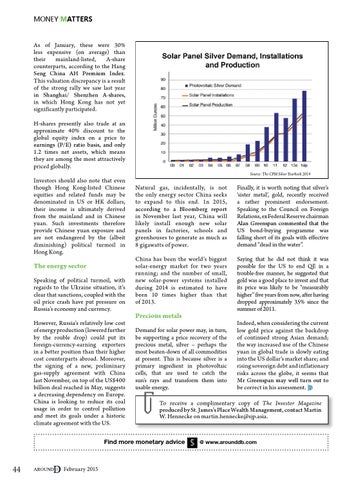
Source: The CPM Silver Yearbook 2014
Natural gas, incidentally, is not the only energy sector China seeks to expand to this end. 1n 2015, according to a Bloomberg report in November last year, China will likely install enough new solar panels in factories, schools and greenhouses to generate as much as 8 gigawatts of power.
Finally, it is worth noting that silver’s ‘sister metal’, gold, recently received a rather prominent endorsement. Speaking to the Council on Foreign Relations, ex Federal Reserve chairman Alan Greenspan commented that the US bond-buying programme was falling short of its goals with effective demand “dead in the water”.
China has been the world’s biggest solar-energy market for two years running; and the number of small, new solar-power systems installed during 2014 is estimated to have been 10 times higher than that of 2013.
Saying that he did not think it was possible for the US to end QE in a trouble-free manner, he suggested that gold was a good place to invest and that its price was likely to be “measurably higher” five years from now, after having dropped approximately 35% since the summer of 2011.
Precious metals Demand for solar power may, in turn, be supporting a price recovery of the precious metal, silver – perhaps the most beaten-down of all commodities at present. This is because silver is a primary ingredient in photovoltaic cells, that are used to catch the sun’s rays and transform them into usable energy.
To receive a complimentary copy of The Investor Magazine produced by St. James’s Place Wealth Management, contact Martin W. Hennecke on martin.hennecke@sjp.asia.
Find more monetary advice
44
February 2015
Indeed, when considering the current low gold price against the backdrop of continued strong Asian demand; the way increased use of the Chinese yuan in global trade is slowly eating into the US dollar’s market share; and rising sovereign debt and inflationary risks across the globe, it seems that Mr Greenspan may well turn out to be correct in his assessment.
@ www.arounddb.com
TALKING POINTS
GOAT FORTUNE! In the lead-up to Chinese New Year, Beverly Au gets the scoop on the Goat and reveals why its connection with wood, in 2015, is elemental Why it’s a Wood Goat Each year in the Chinese calendar is represented by one of the 12 animals of the Chinese zodiac, and on February 19, the headstrong Horse makes way for the passive, peace-loving Goat. You’ll also see 2015 referred to as the Year of the Sheep or the Year of the Ram, simply because yiang is the catch-all Chinese word for all these animals. This is not just any old Goat year however, it’s the Year of the Wood Goat. In the same way that the 12 animals of the Chinese zodiac show up on a rotating 12-year cycle, the five elements (wood, fire, earth, metal and water) take their turn in partnering each animal. 2015 sees the Goat paired with wood, so what can we expect from the year ahead?
This year’s mantra
Photos courtesy of www.wikimedia.org
Any Goat year is likely to be enjoyable, and this is particularly true of a Wood Goat year, which only comes around once every 60 years. This is because the Goat, and by extension the year it characterises, is associated with good things. Goats are gentle and calm, loyal and forgiving. Upheld as sympathetic and serene, they symbolise peace and harmony. Consider too that since ancient times, people have benefited from goats’ fleece, hide, milk and meat.
46
So, if a Goat year is good, a Wood Goat year is just great! Wood, by its very nature, is the element associated with all living things, with springtime and renewal. If last year was the Horse’s year to gallop off and cause chaos and destruction, 2015 ushers in some much-needed calm. This is the year for contemplating what has already been accomplished, to take a deep breath and think creatively. A steady path, generosity and keeping the peace are this year’s mantra.
February 2015
TALKING POINTS
Celebrity Goats People born under the sign of the Goat (1919, 1931, 1943, 1955, 1967, 1979, 1991, 2003, 2015) have a special sensitivity to art and beauty. They tend to be attractive with symmetrical figures and features. On the downside, they are often pessimistic, over-sensitive and susceptible to flattery. No surprise then that so many ‘creative types’ are… Goats. Here are a few: Julia Roberts, Nicole Kidman, Bruce Willis, Benicio Del Toro, Matt LeBlanc, Mel Gibson, William Shatner, Joe Pesci, Billy Bob Thornton, Chow Yun-Fat, Zhang Ziyi, Christopher Walken, Bill Gates, Kurt Cobain, Mick Jagger, Keith Richards, Billy Idol, Harry Connick Jr and Joni Mitchell.
Reading the signs The Year of the Wood Goat promises to be an excellent period for all the Chinese zodiac signs; Horses and Goats can get ready to be particularly happy. Career prospects are positive all-round, though Snakes, Roosters and Rats may face a few obstacles. It will be easy for Monkeys to climb the corporate ladder or start a new business, and Oxen can look forward to earning a lot of money.
Goat-born babies Babies born between February 19, 2015 and February 7, 2016 will assume the characteristics of the Goat, which is clearly no bad thing. People born in a Goat year grow up to be kind and dependable, good-hearted, caring and empathetic.
If you are a Dog or a Rooster, you are advised to watch your health. In matters of the heart, only Dragons, Roosters and Pigs may face relationship problems, and they are advised to find a way to express their feelings more readily. Single Snakes, Rabbits and Tigers are likely to attract new partners in 2015, and it’s an auspicious year for Dogs to have children.
Goats follow the pack – they avoid confrontation and are not born leaders. And for this reason, some parents prefer their children to be born in years governed by more dynamic signs, like the Dragon, Tiger and Horse. That said, the Goat is the eighth of the 12 animals in the Chinese Zodiac, and to have one’s fate associated with ‘lucky number eight’ is, of course, hugely auspicious.
Find more topical local topics
@ www.arounddb.com
February 2015
47
HEALTH
STOP THE SPREAD With dengue fever growing in prevalence both locally and across Asia, Hannah Ball consults Dr Yau Wing Him of Quality HealthCare Medical Centre – Discovery Bay
A
mosquito-borne tropical disease, dengue fever is thought to affect somewhere between 50 to 100 million people annually in over 100 endemic countries. It’s particularly prevalent in the Philippines and Thailand, and increasingly on the mainland. In neighbouring Guangdong, more than 40,000 people contracted the disease in 2014 alone, and six died from it. The Centre of Health Protection in Hong Kong advises that comparatively few people contract dengue fever locally, but it’s worth noting that there were 31 confirmed cases in 2005, compared to 103 in 2013. Last year, three people are known to have picked up the disease locally, and 105 imported cases were confirmed. “Increased travel to countries where dengue is endemic means that more people return carrying the dengue virus in their blood,” says Dr Yau Wing Him of Quality HealthCare Medical Centre – Discovery Bay. “Increasing cargo transport from these countries can also inadvertently import dengueinfected Aedes mosquitoes.”
Illustration courtesy of www.indiegogo.com
Symptoms and treatments Ten-year-old Cheung Sha resident, Lauren Price tested positive for dengue fever just two days into her holiday in Bali in October, 2014, and it’s therefore possible that she picked the disease up here in Hong Kong. Her symptoms included tiredness, headache and stomach ache, and a
48
February 2015
high fever (39.6ºC), which lasted for three days.
symptoms including the sudden onset of high fever, severe headache (especially behind the eyes) and muscle and joint pain,” Dr Yau adds. “Those who recover from one serotype of dengue fever have immunity from that particular serotype, but not the other three.” Hospitalisation can be necessary for sufferers with dangerously low blood platelet or white blood cell counts, and those in extreme pain. But according to Dr Yau, most cases are treated symptomatically. In Lauren’s case, it was a matter of keeping her body hydrated, and waiting for her blood platelet count to return to normal.
“She was lethargic and didn’t eat much,” says Lauren’s mum, Lindsey. “She was red in colour and hot to the touch, and her hands and feet were cold and clammy. She became very weak and suddenly vomited with no warning and then collapsed on the bathroom floor, which is when we called the emergency doctor.” “There are four different serotypes of dengue viruses (Den-1, -2, -3 and -4),” explains Dr Yau. “They are not graded in terms of severity, but each can cause dengue fever, or the more severe and potentially fatal dengue haemorrhagic fever, which causes sufferers to bleed or haemorrhage and can lead to circulation collapse. “In most cases, dengue fever acts as a severe flu-like illness, lasting between three to 10 days, with common
Find more on health and wellbeing
While general measures to prevent mosquito bites (such as spray) will reduce your chances of getting infected, Dr Yau says the most important thing is to avoid stagnant water, where mosquitoes breed. “Sanofi Pasteur is currently developing a vaccine, with early trials showing it prevents dengue fever in just over 50% of those vaccinated,” he adds. Lindsey has created a Dengue Fever Support Facebook group to raise awareness about the disease. “It is time to be aware of the virus,” she says, “especially when travelling to other parts of Asia where dengue fever is at an all-time high.” You can contact Dr Yau at Quality HealthCare Medical Centre – Discovery Bay on 2987 5633.
@ www.arounddb.com
Osteopathy & Chiropractic at IMI Discovery Bay Professional bodywork for men, women, children and babies: • Relieve neck, back, shoulder pain • Alleviate headaches and insomnia • Heal and prevent sports injuries • Optimise athletic performance • Pre & post natal care • Birth recovery for newborns • Improve cognitive development • Enhance physical growth & coordination Please call 2537 1087 to make an appointment.
G-02 Office Block Two, North Plaza www.imi.com.hk facebook.com/imihk
RS_GERMANCOMMUNITYAD.indd 1
25/03/2013 4:13 PM
ESCAPES
HEDONISTIC
RETREAT
Photos courtesy of One & Only and www.wikimedia.org
Just in time for Valentine’s Day, Kate Whitehead checks out Hayman Island – an idyllic base in Australia’s Whitsundays from which to fall in love with the Great Barrier Reef
50
W
e are 300 metres above the Great Barrier Reef, the turquoise waters dazzling in the morning sunlight, and as the helicopter makes a gentle arc through the cloudless sky we spot it – a heart-shaped reef encrusted with corals that sparkle like diamonds. This is Australia at its absolute finest; a slice of pure paradise, and definitely a photo opportunity. Out comes the iPhone and to avoid the glare off the curved chopper windscreen, I February 2015
open the flap close to my knees and reach down to take a snap. A headset clamped over my ears, it’s noisy in the chopper, but perfectly still. Not so outside. We are travelling at 250 kilometres an hour and it’s breezy out there. The wind snatches my phone and sucks it out of my hand.
Turns out that foreign objects and propellers aren’t a good mix. And what I’d thought was a ‘photo op’ window was actually an air vent. Nothing like a near-death experience to make you glad to be alive and there is no better place to be alive than Hayman Island, the most northerly of the Whitsunday Islands.
“Eek – I lost my phone!” I shout into the mic.
One and only Hayman Island
The Kiwi pilot blanches but his voice is calm: “I’m sorry about that, but be glad we didn’t crash.”
There is only one resort on Hayman Island, which makes for a peaceful and uber-private experience. No wonder
ESCAPES
Hayman Island’s heart-shaped reef, viewed from 300 metres
it’s a popular retreat for celebrities and singers taking time off from their world tours. Katy Perry and Mariah Carey were there at the same time as us – at opposite ends of the resort.
and gone through just as many reincarnations. The most recent is without doubt the most glam, giving all who stay there some serious bragging rights.
for couples and friends as it does for families. There are seven restaurants and bars, and separate pool zones ensuring that the grown-ups get some kid-free space.
It was Reg Ansett, the founder of the airline Ansett Australia, who established the first resort on the island in 1950. Careful conservation and low-impact tourism have ensured the island and its surrounds are as pristine as they were more than 60 years ago, but the resort itself has changed hands a number of times
The global group One & Only has splashed out A$80 million (HK$505 million) to reinvent the resort, which has been a favourite with Australian honeymooners for decades. Smart restructuring has ensured that the property is no longer just the reserve of the newly loved-up. This is a highend destination, catering as much
While the fitness centre opens at 6am, the massive pool is seven times the size of an Olympic swimming pool and filled with filtered seawater. If you’re lucky enough to be staying in a pool villa, you can dive straight off your private patio into the water. And for total pampering, the spa offers the full range of treatments – you February 2015
51
ESCAPES
Reefworld just off the Whitsundays
can even take things outdoors if you fancy a massage in a rainforest, or on a floating table on the sea.
The Whitsunday Islands Only seven of the 74 Whitsunday Islands have tourist resorts, but these cater to every budget, from the exclusive luxury of Hayman Island to the basic accommodation at Hook Island. The majority of the islands are uninhabited, and several offer back-to-nature beach camping stays. Of the numerous stunning beaches and secluded bays, 7-kilometre Whitehaven Beach, on Whitsunday Island (the largest island in the Whitsunday group), lives up to its reputation as one of the finest in the world.
Whitehaven Beach, Whitsunday Island
Blue Pearl Bay, Hayman Island
The Whitsundays lie just south of Bowen and north of Mackay. This is the closest point off the Queensland coast to the Great Barrier Reef. Most people fly into Hamilton Island, the group’s commercial centre. Hunkered down on Hayman Island, I found plenty to see and do. A 40-minute stroll over the top of the craggy island – look out for wallabies hopping about – takes you down to Blue Pearl Bay where there is excellent snorkelling. Dip your head under the water and you see giant green turtles, turquoise parrotfish and huge colourful corals. At low tide you can walk 100 metres from shore on the sandy flats and pick through the scattered treasures from the coral seabed – bright blue sea stars and sea urchins.
52
February 2015
Floating spa, Hayman Island
The Great Barrier Reef
one visible from outer space.
And then there is the Great Barrier Reef right on your doorstep and no shortage of ways of exploring one of the seven natural wonders of the world. Taking a seaplane or helicopter flight to admire the reef from above should be mandatory; it’s the world’s largest living structure and the only
Stretching over 2,000 kilometres in length, the Great Barrier Reef protects the Whitsundays from huge ocean swells providing the region with some of the safest sailing and cruising waters in the world. A diver’s delight, the sea is calm and there’s very little undertow. As well as the
Kung Hei Fat Choy!
Have a Happy and Healthy Year of the Goat!
Aqua Blu
Boat/Yacht Sales & Brokerage - Berths/Debentures - Marine Insurance - Marine Problems/Resolution
傅 耀 宗
Over 30 years’ international and local experience in maritime and shipping matters and marine insurance. Helping you safely navigate uncharted waters.
Pleasure craft Stayaboards
Sailing yachts Holiday boats
Super yachts Boat charters
Professional - Discreet - Effective AquaBlu Marine Consultancy Limited Paul Fortune, LLB (Hons) (Cardiff)
Telephone: (852) 6017 7802 Email: Oceanblu@netvigator.com
* No commission is charged to buyers Covering: Discovery Bay | Gold Coast | Aberdeen | New Territories
ESCAPES thousands of species of brightly coloured fish and brilliantly coloured hard and soft corals, you’ll likely spot dolphins, turtles, dugong and whales. Iconic dive sites include Black Island, the Stepping Stones and the Cathedral – renowned as some of the best diving on the Great Barrier Reef. Just a short helicopter ride from Hayman Island is Reefworld, a large pontoon that offers great snorkelling and diving. Even if you don’t want to get wet, you can still enjoy the reef by taking a tour on a semi-submarine, which has a 50-seat underwater viewing chamber. It’s a dream location, and the views from the chopper are incredible. Just remember that the little flap on the side of the door isn’t for holiday snaps – it’s an air vent!
Nara Inlet, Hook Island
Snorkelling off Hayman Island
re
Getting the
Qantas flies from Hong Kong to Sydney and now offers a daily, direct route from Sydney to Hamilton Island.
it When to vis April through November is the best time to visit the Great Barrier Reef. December through March can be hot and humid, and in the winter months ( June to August), the water gets ‘chilly’, though it rarely drops below 22°C.
Find more exciting travel destinations
@ www.arounddb.com
ACTION
GET PHYSICAL
Photos courtesy of 9 Dragons Fitness, Embody, Movement Improvement and The HIT Room
Gone are the days of going to the gym and sitting on the bike for 60 minutes, watching the clock. CrossFit is much more interesting, says Richard Cowley
56
C
hances are you’ve heard of it, or have a friend who does it. Simply put, CrossFit is about combining gymnastics, aerobics and weightlifting to create a varied and super-intense strength-andconditioning programme. CrossFit’s main draw lies in the fact that it is both physically and mentally stimulating. The aim is to improve, among other things, cardiovascular/ respiratory endurance, stamina, February 2015
strength, power, speed, coordination, agility, balance and accuracy.
The back story US fitness company, CrossFit, Inc., founded by Greg Glassman in 2000, licenses the CrossFit name to gyms and certifies trainers. It’s practised by members of over 10,000 affiliated gyms worldwide, half of which are located in the US, and by individuals who complete daily workouts posted on the company’s (or an affiliated gym’s) website.
The CrossFit methodology is used not only in gyms but by elite sports’ coaches, fire departments, law enforcement agencies and military organisations. No surprise then that it is also a competitive fitness sport. At the CrossFit Games, held since 2007, athletes compete in workouts they learn about only hours beforehand. Rogue elements, like rough-water swimming, are thrown in. The Games are styled as a venue for determining the ‘fittest on Earth’.
ACTION
Joey Lee-Pieterse holding a CrossFit class at 9 Dragons Fitness
Hardcore as it can be, CrossFit originated in big, warehouse-based gyms, known as ‘boxes’, and the gym is where its focus remains. You have to be fit to sign up for a varied workout combining short, sharp, explosive exercises – but not crazy fit. Sessions last between 45 minutes to an hour, and most people take a class anywhere between three to five times a week. Classes typically include a warmup, a skill development segment, the high-intensity Workout of the Day
(WOD), and a period of stretching. Equipment used includes barbells, dumbbells, gymnastics rings, jump ropes, kettlebells, medicine balls, plyo boxes, resistance bands and rowers. Performance on each WOD is often scored and/ or ranked to encourage competition and to track individual progress. One of the great things about CrossFit is that you’ll seldom, if ever, do the same workout twice. And there are 101 ways to stay CrossFit, whether
you choose to hit an affiliated gym, incorporate the methodology into your regular gym work, or even throw a programme together yourself.
The DB gyms Wesley Reid, co-founder of The HIT Room points out that the essence of CrossFit is integrated into all their sessions in DB North Plaza. “It’s a great workout and one of the best ways to keep yourself physically and mentally sharp,” he says. “Keeping the training February 2015
57
ACTION whom strive to incorporate CrossFit methodology into their varied and intense training programmes.
The Tung Chung box For the real CrossFit deal, 9 Dragons Fitness in Tung Chung is a fully affiliated CrossFit facility (licensed under CrossFit 9 Dragons), and all the trainers are certified. The gym offers a wide variety of fitness classes but according to co-owner Douglas Pieterse, CrossFit is currently the most popular.
Instructors at Embody recommend a Pilates and yoga combo
constantly varied means that your body never knows what’s coming next. Performing functional movements at high intensity means your results keep improving.”
power yoga and Pilates. “This class is not for the faint-hearted, and you will burn calories,” she says. “It builds up your core, while strengthening and stretching all parts of the body.”
Specialising in one form of exercise over another is discouraged, which helps prepare the body for any physical strain you throw at it. “CrossFit can offer something for everyone, whether you want to get better at sports, or simply find it easier to help friends move their king-size mattress out of their apartment,” Wesley says.
It’s worth noting that runningbased fitness classes also build core strength, endurance, agility, speed and cardio. These are offered in DB by Katia Kucher of d.BeFit and Thomas Kiprotich of Kipmovin, both of
Claire Dickson, the owner of Movement Improvement (MI) in DB North Plaza, is also a CrossFit fan. “We adhere to training the body as a whole system and not just a bunch of muscle groups,” she says. “At MI, using the Pilates method combined with TRX® suspension training and kettlebells is very popular.” This makes perfect sense when you consider that TRX® provides a superb cardio-and-strength workout, and with Pilates, the focus is on strengthening, lengthening and balancing the body. Add muscle-building kettlebell workouts to the equation and you have a CrossFitcalibre workout. For Susan Oliver, the owner of Embody in DB Plaza, another excellent CrossFit combo is
58
February 2015
Claire Dickson (back) at Movement Improvement provides CrossFit-calibre workouts, including Pilates
Joey Lee-Pieterse, 9 Dragons’ co-owner and Douglas’ better half, says, “The great thing is that you get a programme that allows for variety and less specificity toward any one sport. Don’t think that it’s going to be too hard or too intense. That’s a common misconception because the people you usually see doing it are competing at an elite level.” “It doesn’t matter who you are, how old, or which limitations you may have put on yourself, CrossFit is able to scale and adapt to your needs,”
ACTION
Douglas Pieterse of 9 Dragons Fitness powering up
Douglas explains. “Whether you are an endurance athlete, a mum with three kids, or a grandparent who wants to be self-sufficient, CrossFit is going to offer you something to improve your everyday life as well as complement your physical and fitness goals.”
The solo option But what if you find big group sessions intimidating and you prefer to work out by yourself? How can you get into CrossFit?
To this end, 9 Dragons offers an On-Ramp course, which provides a thorough introduction to CrossFit. “In the On-Ramp, you will learn how to perform the fundamental CrossFit movements safely and effectively, ensuring a seamless transition into a class environment,” Douglas explains.
Co-founder of The HIT Room, Cindy Reid offers this advice: “Remember that the beauty of CrossFit is that you don’t necessarily need fancy equipment. Of course, with the right equipment you can increase variety, but you can create a great workout just as easily with a couple of kettlebells and a chin-up rack that you can buy yourself.
Taken as a class, Douglas points out that CrossFit is all about meeting new people and having fun. “We have seen so many of our athletes overcome preconceptions of their own abilities, and training as a group, feeling part of a community helps with that,” he says.
“The important part is that you always keep it intense – from high repetition at low weight to low repetition at high weight, anaerobic to aerobic training, bodyweight training to gymnastic moves,” Cindy explains. “This way, you can have an effective workout in just 20 minutes!”
Find it
Cindy Reid of The HIT Room stays CrossFit with the help of kettlebells
• 9 Dragons Fitness, www.9dragonsfitness.com • d.BeFit, www.dbefit.com • Embody, www.embody.hk • Kipmovin, www.kipmovin.com • Movement Improvement, www.movementimprovement.com.hk • The HIT Room, www.thehitroom.com.hk
Find more clubs and activities
60
February 2015
@ www.arounddb.com
Get moving with KIPMOVIN! Offering running classes for kids and adults in Discovery Bay and Tung Chung. All levels and abilities welcome. For more details contact: Thomas on 6180 3256 Thomas@kipmovin.com www.kipmovin.com
DON’T WISH FOR IT, WORK FOR IT! At 9 Dragons Fitness Fitness results are earned not given, and we at Dragons Fitness are there to help you every step of the way! If you are looking to maintain a regular and varied fitness routine, call or email us to book a free trial session. 1. Group Training We have a wide variety of classes designed to deliver results and improve cardiovascular fitness, coordination, strength and flexibility 2. Strength Training This charges the body’s metabolism to burn fat, improves posture, alignment, balance and bone density, and shapes and firms specific body parts 3. Personal Training We can educate and empower you to train harder on your own, and help you optimize the benefit of every exercise 4. Cardiovascular Training Cardio activities burn the maximum amount of calories in the shortest amount of time, and increase energy levels and mental alertness We welcome you to make an appointment with us, so that you may come in and see firsthand who we are, and what we do!
• CROSSFIT • 9DFIT • KIDS PROGRAM • PILATES • YOGA • AERIAL SILK
Join us now! Seaview Plaza, 8 Tung Chung Waterfront, Lantau, H.K.
www.9dragonsfitness.com Tel: 2786 9699, 9494 7178 Email: train@9dragonsfitness.com
The Pine House is a beautifully designed one-bedroom serviced apartment in Midvale Village, Discovery Bay available for short term rental. Minimum stay is 3 nights and daily rate is HK$850/night. For bookings please contact +852 9187 7880 or email to cynthia.lie@mac.com
LIFESTYLE
T
his Chinese New Year (CNY) begins on the new moon of February 19. It’s the most important holiday in the Chinese calendar, and the time when we habitually open our doors to friends and loved ones. Since we are about to enter the Year of the Wood Goat, denoting 12 months of creativity and calm, there’s plenty to celebrate. The traditional way to decorate at Lunar New Year is to hang auspicious red paper scrolls, emblazoned with classical Chinese couplets and the Chinese characters for good fortune, wealth and the coming of spring. Place these scrolls upside down on your front door, where they will bid guests a warm welcome and signify good times ahead. At CNY, any red decorative item will immediately up the ante – the easiest way to boost your decor is by styling up with bold Shanghainesered accessories. This is easily done with well-chosen, inexpensive home accessories, like scatter cushions, table napkins and candles.
Photos courtesy of www.wikimedia.org
You can also rework classic Oriental accents to create the right mood. Pick up some miniature birdcages and use them as candleholders, or introduce red lanterns, lit up as a group either on the floor or as a table centrepiece. Since the colour red represents luck, prosperity and happiness, it’s a perennially popular decorating choice at CNY, and for 2015, you can also introduce a little green in order to celebrate the Wood (tree) Goat. According to the Chinese calendar, green is this year’s lucky colour, making it an excellent addition to any home decor. Jade (and wood) Goat figurines are likely to sell like hot cakes this year.
Customs worth keeping Tradition dictates that you lay out a CNY candy tray, filled with candied melons for good health, and red melon seeds symbolising happiness. It should also contain dried lychees and
1
DECORATING FOR
GOOD FORTUNE Usher in health, wealth and happiness at Chinese New Year with festive finery and flowers. Samantha Wong finds out how
desiccated coconut to promote strong family ties; kumquats for prosperity; and peanuts for long life. When visiting friends, don’t forget to bring along a bag of oranges or tangerines with leaves intact – this will promote good relations in the coming year. You will also want to hand out dollar-filled lai see packets to people who do stuff for you, including younger co-workers, helpers and doormen.
As with almost all activities at CNY, there is enormous symbolism in the use of flowers. For this reason, you’ll see that local florists do a roaring trade at this time of year. Head to the Mong Kok Flower Market near Prince Edward MTR, to the temporary stalls in Victoria Park, Causeway Bay or to the plant market right here in DB, to stock up on significant sprays. February 2015
63
LIFESTYLE
2
As with almost all activities at CNY, there is enormous symbolism in the use of flowers
4
64
3
5 February 2015
6
LIFESTYLE
Get the look! 1 Any flower that blossoms over CNY bestows a blessing but
a plant that blooms on New Year’s Day bestows 12 months of prosperity on the family that homes it. This is particularly true of the white narcissus. When choosing plants at CNY, ask your florist which ones are likely to bloom on February 19, as this way you’ll be guaranteed 12 months of good luck.
2 Well-chosen arrangements make a play on words. The
Chinese language opens up endless opportunities for punning, and this is demonstrated in the flowers that are most sought-after at this time of year. For instance, people rush to buy miniature kumquat plants (Gam Gat Sue) with their little golden fruits. This is because the word Sue rhymes with the Cantonese word for luck (Fŭ) and the Cantonese word for gold is Gam.
3 Choose red blooms for good fortune. Classic red roses
add a touch of elegance to any CNY arrangement, but bright red peonies (the flower of riches and honour in Chinese) are particularly auspicious. Over the holiday, business people spend a lot of money on bouquets of peonies to ensure that they will have a prosperous year. As well as bringing with them the promise of good fortune, peonies are also associated with romance, since they are a symbol of love, affection and feminine beauty.
4 Let the foliage you choose play a supporting role – in
more ways than one. Bamboo stems (implying compatibility) are often fixed on to pine sprigs (symbolising longevity and steadiness). These are then sculpted into meaningful Chinese words or characters, for instance Shou, meaning longevity. Mix in a couple of plum blossoms and the grouping symbolises friendship.
5 Go for live, flowering plants, rather than cut blooms. Plants
are the number one essential in terms of Lunar New Year decoration, since they symbolise new life. The blossom bursts forth at the end of winter (on a seemingly lifeless branch), symbolising courage and hope. Plants are the emblems of rebirth, intimately connected with the wish for happiness during the ensuing year.
6 Flowering peach blossom is particularly auspicious at this
time of year. Its significance lies in the symbolic importance of the peach, which, in Chinese culture, is a symbol of long life, and is regarded as the strongest defence against evil. It’s also believed that love will come your way if you walk clockwise around a peach blossom stem on the first day of CNY. Kung Hei Fat Choi!
Find more on stylish living
@ www.arounddb.com
February 2015
65
HK HAPPENINGS
ugh22 y Thro ruar b e F
10 FUN THINGS TO DO IN HK THIS MONTH!
www.tgec.asia/carnival
EUROPEAN CARNIVAL
Get your events listed @ www.arounddb.com
New Central Harbourfront
There’s fun to be had for all the family at the AIA Great European Carnival, complete with bumper cars, a carousel, jugglers and stilt walkers. Open from 11am to 11pm, you can try out Asia’s largest outdoor ice rink and a host of thrilling rides, and sample international food and drink from more than 20 different kiosks. For tickets, starting at HK$90 per person, visit www.ticketflap.com.
Something for VEGGIES!
Hong Kong Convention and Exhibition Centre, Wanchai –7
ry 5
a Febru
Party at ILLUSION! Lan Kwai Fong Be sure to check out Illusion, the latest place to party in the heart of Lan Kwai Fong. This 2,000-squarefoot upstairs lounge boasts full-service beer pong (complete with a referee), foosball, darts and karaoke, plus three VIP Rooms. To make a booking, call 2526 9996. To find out more, visit www.illusionhk.com.
www.wikimedia.org
At Vegetarian Food Asia, which is expected to attract over 10,000 buyers and visitors, there’s everything from Taiwanese mushrooms to wholegrain, organic oat milk on display, plus a range of health talks and cooking demonstrations to attend. Open to the public on February 7 only, from 11am to 7pm, admission costs HK$10. Visit www.vegfoodasia.com.
y Februar
8
www.kestreetathon.runourcity.org
66
www.boozingear.com
Belle and Sebastian LIVE! y 10
r Februa
AsiaWorldExpo Arena, Chek Lap Kok Catch Indie pop band Belle and Sebastian performing live at 8pm. Formed in Glasgow, Scotland in 1996, the band, led by Stuart Murdoch, is often compared to acts like Nick Drake. Belle and Sebastian released their long-awaited, ninth studio album Girls In Peacetime Want To Dance in January, so you can expect both new and old hits at the Hong Kong show. For concert tickets, costing HK$760, visit www.hkticketing.com.
Hong Kong Streetathon Kai Tak Cruise Terminal, Kowloon East If you missed the boat on the second, annual AXA Hong Kong Streetathon, which sees athletes run either 10 kilometres, or a half marathon, you can still enjoy the carnival. The races, from Kai Tak Cruise Terminal and back, start at 8.30am, so bring along a picnic to enjoy on the old airport runway, and expect live music performances, game booths and even outdoor yoga. Visit www.runourcity.org.
February 2015
www.the305.com
HK HAPPENINGS
Friend us on Facebook for event reminders www.wikimedia.org
–15
February 13
PETS ON SHOW
Hong Kong Convention and Exhibition Centre, Wanchai The Hong Kong Pet Show, now in its tenth year, starts at 12pm daily. You can expect a variety of seminars, performances and contests, plus you can meet with a whole host of vendors, looking to share their products and expertise. Admission costs HK$30, pets get in for free. For more information, visit www.petshow.com.hk.
13–15
www.asiaworld-expo.com
ry 14
a Febru
www.menmoments.com
VALENTINE’S TREAT Check out The Peninsula Hong Kong’s limited-edition Valentine’s Day Artisanal Chocolates. Hand-crafted in the hotel’s legendary Chocolate Room and placed in a glittering jewel box, the 12, heartshaped chocolates each represent a different gemstone. And you can even have them delivered by one of The Peninsula’s pageboys, all for a mere HK$1,800. To place an order, call 2696 6694; for more information, visit http://news.peninsula.com.
Celebrating CHINESE NEW YEAR! In and around Victoria Harbour
Across Hong Kong
1 Not I/ Footfalls/ Rockaby, February
AsiaWorld-Expo Arena, Chek Lap Kok
ary Febru
rch 29
25-Ma February
Four fabulous performances on offer this month that you simply have to see!
INDOOR SHOW JUMPING! The Longines Hong Kong Masters, Asia’s biggest indoor show-jumping event, sees 25 of the world’s top riders and their horses compete for HK$7.8 million (total prize money). As well as the show jumping and dressage, there’s a chance to meet the horses and their riders. For tickets, starting at HK$330, visit www.cityline.com; for more information, visit www.longineshkmasters.com.
Hong Kong ARTS FESTIVAL
25 to March 1. Lisa Dwan of London’s Royal Court Theatre brings to life three Samuel Beckett monologues in just under an hour.
2 Gala Flamenca, February 26 to
March 1. Director Ángel Rojas of Nuevo Ballet Español celebrates the intensity and passion of Spain’s unique national dance.
3 Christian Thielemann and the Staatskapelle Dresden, February 27 and 28. Staatskapelle Dresden, one of the world’s oldest orchestras, founded in 1548, performs famous works by Bruckner, Strauss, Liszt and Wagner.
4 Complicite – Lionboy, February 27 to March 1. UK theatre company, Complicite tells the story of 11-year-old Charlie Ashanti, who can communicate with cats – wild ones as well as household pets.
For the full line-up or to find out more, visit www.hk.artsfestival.org.
uary r b e F & 20 19
Welcome in the Year of the Goat with the Cathay Pacific International Chinese New Year Night Parade, starting at 8pm at Hong Kong Cultural Centre Piazza, Tsim Sha Tsui on February 19. The next day sees Victoria Harbour lit up by the spectacular, annual firework display, starting at 8pm. Visit www.discoverhongkong.com.
www.hk.artsfestival.org
www.wikimedia.org
February 2015
67
DB FACES
COMMUNITY SNAPS!
Email your photos for DB Faces to info@arounddb.com. Around DB accepts no liability for the photos sent
Who do you know? Find more familiar faces @ www.arounddb.com.
COMPETITION
Photos by Baljit Gidwani
Win prizes from Uncle Russ Coffee and The Pier Bar!
A
B
Y
C
Congratulations to last month’s winner James Cooper! Please contact our office on 2987 0577 to collect your prize.
our challenge this month is to identify which of the photos above is the exact copy of a photograph featured elsewhere in this issue of Around DB. You need to list the page number the photo appears on, as well as which of the three photos is the exact copy. You can contact us via the competitions link at www.arounddb.com, by clicking on one of the QR Codes, or by emailing info@arounddb.com by February 10. This is your chance to win a complimentary coffee from Uncle Russ, or a beer from The Pier Bar every day for a week. Don’t forget to include your name and telephone number with your answer. Good luck!
FINANCIAL PLANNING ASK THE EXPERT HELLO RESIDENTS OF DB, LANTAU AND THE REST OF HONG KONG! It’s time to consult THE EXPERT about your financial planning!
Who am I? KayeKaye Khemlani (PIBA No. 0032-009006), a native English-speaking insurance advisor, with a strong presence in Discovery Bay and Hong Kong.
My thoughts I understand we all go through different stages of life and so do our insurance needs. But the mandatory insurances required by the Hong Kong Government (including domestichelper insurance and automobile coverage), are always worth due diligence. Your home is your castle, so why not protect it from the elements, drunk guests, clumsy kids and thieves? A home package can do all that and more! Whether you rent or own your home, it’s better to be safe than sorry! Homeowners insurance is a security blanket. It is designed to protect you in the event of a catastrophe. Therefore, when you are choosing a policy, don’t always look to save money – the best deal may cost you more in the long run. But be sure to shop around. When you receive your annual renewal statement, check to see if you can snag a better deal elsewhere. Consider whether you have too much coverage. It’s common for policies to contain inflation-protection provisions that automatically increase your coverage amount. You may want to adjust your coverage amount to a more realistic figure.
My offer: I can do a comparison shop for you free of charge, to ensure that you have made the right choice, and check that you have the right product at the right price.
View DB property listings @ www.arounddb.com
WORSHIP SERVICE Discovery College Sundays @ 10 am
CONTEMPORARY WORSHIP PRACTICAL BIBLE TEACHING KIDS CHURCH XTREME & RDB TEENS
Pastor James Buckner Tel: 2987 7061 www.dbicc.org
HOME & REPAIRS
View local BUSINESS DIRECTORIES @ www.arounddb.com COMMUNITY
FINANCE & INSURANCE
THE CHURCH OF JESUS CHRIST OF LATTER-DAY SAINTS (MORMONS)
AUSTRALIAN TAX RETURNS Need to lodge your Australian tax return? If you are an expat or collect rental from Australian property, you must lodge an annual return. Let us do it for you here in HK. Contact Dwight Stuchbery, Australasian Taxation Services on 3571 8700, dwight@smats.net, or visit www.smats.net
Sunday 1pm. 4/F Discovery College. Visitors welcome. Call 9029 1251
EMPLOYMENT
HOME SERVICES
PETS
EXPERT MOVER
THE PLACE WHERE THE PETS GO - PETCODB
• MOVER • STORAGE • HANDYMAN Competitive rates. Professional quality service. Contact 2566 4799, sales@expertmover.hk. Visit www.expertmover.hk
Grooming & Pet Care Services. Trust us to provide loving & safe care for the ones you love! Contact 2914 0382, info@petcodb.com. Visit www.petcodb.com
DOG SERVICES
HEALTH & WELLBEING
FITTING MODEL
We are looking for lady fitting models for US brands intimate apparel. Size: 42DD/ Bust at Fullest Part: 48”/ Under Bust: 40”. Contact 3951 2412, recruitmentmail88@gmail.com.
HYPNOSIS &/ OR SHORT-TERM THERAPY
Quit smoking quickly. Divorce/ Post-Divorce Coaching. Resolve: • Fear of Flying/ Public Speaking • Overeating • Couples’ Conflicts • Career & Command-Training Stress • Anger Management • Phobias • Nail Biting • Insomnia • Exam Jitters Call Dr Melanie Bryan, Psy.D. Clinical Psychologist & Hypnotherapist on 2575 7707, or visit www.mindmatters.hk
DB-BASED REALTOR SEEKS EAA-LICENSED AGENTS Must have a good command of spoken & written English & Cantonese, an extra language is an advantage. Strong communication & interpersonal skills, mature outgoing personality, proactive, hardworking & detail oriented. Attractive remuneration package for the right candidates. Email your full CV to info@lifestylehomes.com.hk
ARE YOU LOOKING FOR A MESSENGER?
Michael, an Indian HK resident living on Lantau, seeks post of delivery person for mail/ documents/ small packages. Full- or part-time. Call 9145 6731
EARLY ADVENTURES PLAYGROUP
A dedicated playgroup with the emphasis on learning through play. Activities to stimulate all areas of development. Come & look at our facilities. Classes for kids from 20 months to 4 years. Morning & afternoon sessions. Call 9511 2107, or visit www.earlyadventures.net
Looking for a place to stay?
www.arounddb.com
Birth & Postnatal Support Antenatal Classes Breastfeeding support Placenta remedies
Jeanne Hauguel
DOULA
RETAIL ABBELIO WINES
Great value! High scoring! Wines from around the world! Free delivery & special offer for Discovery Bay residents. For details, visit http://abw.hk/db, or call 3170 8458
DB MARINA CLUB DEBENTURES
Do you have a C Class or B Class Debenture you are not using? Or one that is expiring, or coming up for extension? Lifestyle Homes has interested buyers. To find out more, contact info@lifestylehomes.com.hk
Trust in yourself when it matters...
© Cyril Almeras
MOVEMENT IMPROVEMENT DB NORTH PLAZA We are looking for new teachers to join our expanding team. • Spinning instructors • Pilates Matwork instructor • Pilates Allegro & Equipment instructor • Gym & TRX instructor Email your CV to claire@ movementimprovement.com.hk
KIDS
Home boarding, behaviour modification, Tui Na Massage & grooming. Reliable & honest. 100% safety record over the past 11 years. Contact Dave Chan on 9872 5439, www.quoquoclub.com
Looking for a business in DB, Tung Chung or South Lantau?
www.arounddb.com
6496 4318 | jeanne@doulabirthstory.com | www.doulabirthstory.com
February 2015
71
View local BUSINESS DIRECTORIES @ www.arounddb.com
Alcoholics Anonymous If you want to drink, that’s your business. If you want to stop, we can help. No dues or fees. 24 hour hotline: 9073 6922 Lantau hotline: 5668 2667 www.aa-hk.org
GIVING LIFE SHOULDN’T BE SO DEADLY Ramatoulaye, who lives in Burkina Faso, was about to give birth to her fourth child, but the boatman was nowhere to be found. Unable to get to the health centre across the river, she gave birth alone on the river banks. Maternal health is a human right — join Amnesty International to defend human rights for women like Ramatoulaye. Learn more at www.amnesty.org.hk.
© Anna Kari
72
February 2015
View local BUSINESS DIRECTORIES @ www.arounddb.com SERVICES ACCOUNTING & COMPANY SERVICES
SINCE 1997
OUR SERVICES
Prepare management accounts, weekly, monthly or yearly. Whatsapp 9673 7730. Email et@ponyservices.com
DOG & CAT GROOMING ( BY APPOINTMENT ) PET FOOD & ACCESSORIES SUPPLIES
NOTARY SERVICES
CAT SITTING SERVICE
Now available in DB at affordable rates. For enquiries, 9143 0799, notary@hpi.com.hk
FREE DAILY DELIVERY Ground floor 11B, Discovery Bay Plaza, Discovery Bay (next to Island Vet) Tel: 2987 0428 / Fax : 2914 1313 / E-mail : petsgallerydb@yahoo.com.hk Open from 9:00 am till 7:30 pm (Mon - Sun)
TRAVEL CONCORdE TRAVEL
Leisure Travel and Cruise specialists since 1978. Call 2526 3391 or visit www.concorde-travel.com Licence No 350343
TUITION & COURSES CHINESE (MANdARIN & CANTONESE), MATHEMATICS & ENGLISH
Be my Valentine?
Personal Professional Tutoring Service. • Curriculum: HSK, IB, GCSE, SAT • ESF & all international schools, Year 1 to 13 • For students & adults (homework/ exams/ business) • Mother-tongue Chinese tutors from the PRC (Levels: Basic, Intermediate, Advanced) • Mathematics tutors (UK B SC) • Native English tutors. (MA in Education, specialising in Early Childhood Stage) Contact 9107 5655, graciasx@hotmail.com
MANdARIN CHINESE CLASSROOM
In the Greens. Lessons for adults & children, individually & in small groups. Any level/ time/ purpose. Call 6071 9643, or visit http://tclearning.sinacool.com
FULLY QUALIFIEd SCIENCE TEACHER
With Honours, Bachelors Degree. Offering tutoring for KS3 & IGCSE Science (all disciplines) and IB/A’ Levels Physics. Contact 6079 2052, mr.m.walker@yahoo.com.uk
Mypetshop, North Plaza. Shop G09-92 Siena Ave. DB North Plaza Tel: 2987 8873 Open Daily 10am – 7:30pm
Importing all natural, handmade products from small British producers
NEED SOMEONE TO TALK TO? Counselling for individuals, couples, families & adolescents Sliding fee scale; affordable options for all clients
GMT FOODS
English, Putonghua, Cantonese, Hindi, Marathi and Marwadi speaking counselors Call 2523 8979 Now for Appointment http://www.resourcecounselling.org Serving the community over 35 years A Member Agency of the Community Chest
恭 喜 發 財
Tel: +852 6647 2292 email: gillian@gmtfoodshk.com www.gmtfoodshk.com www.facebook.com/gmtfoods twitter@gillian_GMT
est. 2009
KUNG
Deadline for March issue CLASSIFIEDS
February 10
HEI
FAT
CHOI
Exclusive barbecues for exclusive lifestyles!
February 2015
73
Find short-term RENTALS @ www.arounddb.com PROPERTY DB
PROPERTY DB
MODERN 1-BEDROOM FLAT
DELUXE SERVICED APARMENTS
Spacious open layout. Quiet, high floor. Fully equipped kitchen. Shower. Washer/ dryer. English movies & news, & wi-fi. Just unpack! Competitively priced. Contact 6680 2007, greenmountain123@gmail.com
Fully furnished 1-2-bed apartments with beautiful decor, wi-fi & broadband. Well-equipped kitchen, luxurious bedding, weekly cleaning service. Contact Annie on 2987 2626, annie@appletravel.com
STUDIO CLOSE TO PIER 2-BED APARTMENT At Greenmont Court, nice & fully furnished. Call 9108 5525
NEW 1-BED APARTMENT Brand-new, fully furnished, 533’ 1-bed apartment in Greendale Court. Deluxe renovation, on a high floor, with mountain view. Call 9108 5525
Comfortable, nicely decorated studio, close to DB Plaza & pier, with fully equipped kitchen. TV, DVD, wi-fi, linens & towels provided. Contact 9190 7348, niceroom_db@yahoo.com.hk
Search 1000s of DB property listings!
@ www.arounddb.com
CHERISH COURT SERVICED APARTMENTS SIENA 2 Quiet with sea views, near Club Siena & tunnel. Fully furnished, with bed linen & kitchenware. 55’ TVs, wi-fi, Blu-ray home theatre, washer/ drier. Short or long lease. Contact 9317 0624, nialady2011@gmail.com
Fully furnished, 2-bedroom flat with wi-fi & Now TV. Full sea view & Disneyland-firework view. Photos available. Contact Jacqueline 9811 0718, jacquelinedb@gmail.com
COSY NEW 1 BEDROOM FULLY FURNISHED 1-BED Smart apartment on a high floor with sea view. Close to pier & DB Plaza. Available fully furnished. Call Tiareti on 9732 8985
Cosy & brand-new 1-bedroom flat with sea view, convenient location, fully furnished with bed linen, kitchenware, washer/drier & English & Chinese TV channels. Free cleaning once every 3 days upon request. Minimum stay 3 nights. Contact Mary on 9726 6219, marydbay@gmail.com
PROPERTY OVERSEAS
LUXURY 2-BED Newly renovated, 2-bed flat with balcony. Luxuriously furnished, with TV, cable & broadband. Panoramic harbour views & short walk to pier. Contact Charles on 6140 7971, charles@headlandhomes.hk. Contact Katie on 9150 7319, katie@headlandhomes.hk
SLEEPS 4 Bright, fully furnished flat, sleeps 4. Fully equipped kitchen, plus wi-fi & broadband. Towels & linens provided. Minimum stay 1 month. Email dbstay4@yahoo.com
74
February 2015
AUSTRALIAN PROPERTY Everything you need to know about buying a property in Australia. Information on property markets, taxation, finance, migration & legal. Free online at www.aussieproperty.com
PHUKET VILLA SHORT-TERM RENT Deluxe, spacious 4-bedroom villa, with ensuite bathrooms & private pool. Wireless internet access, sala, bar & BBQ area. Kitchen is fully equipped with laundry area. Close to Laguna. Contact Roenel on 9050 4772, atsea@netvigator.com
Greenland Pest Control Tailored Pest Control Solutions for Rodent, Cockroaches, Fleas, Mosquitoes, Termites, Ants, Ticks etc‌ For info please call Thomas 9871 0771 or May 9774 3554 Email: greenlandpest@outlook.com
AROUND DB
YOUNG WRITER’S COMPETITION 2015! ALL SECONDARY SCHOOL STUDENTS LIVING AND/ OR STUDYING ON LANTAU ARE ELIGIBLE TO ENTER!
Around DB’s Young Writer’s Competition (YWC) is your chance to prove and improve your writing skills, express your ideas and get published! From the articles submitted, our three mentors will each select a winning story and work on improving it with the author. The three finished articles will then be posted on the Around DB Facebook page for an online vote.
You are • A secondary school student living and/ or studying on Lantau The article is • A nonfiction account of 600 to 700 words, about a life-changing moment in your life or someone else’s • Authors submit their name, age, year group and school (the mentors will be given the age of the writers only) How it works • March 10: Deadline for submission to info@arounddb.com • March 11 to 16: The mentors select three winning entries • March 17 to April 13: Each mentor meets with one winning writer to provide advice on improving the article. The writer reworks the piece and resubmits it to his/ her mentor, who checks it and passes it to Around DB for online posting • April 14, 8am: The three winning articles are posted on the Around DB YWC 2014 finalists: Facebook page for readers to vote online Sean Ho Lok Sung, Laila Joy Albuquerque and Navin Jain • April 19, 6pm: Online voting ends • April 20: The results of Around DB Young Writer’s Competition 2015 are posted on the Around DB Facebook page and www.arounddb.com What you get • The winning article is published in the May issue of Around DB • All three finalists are profiled in the April issue of Around DB • HK$1,000, HK$500 and HK$400 Dymocks’ book vouchers for first-, second-, and third-place winners • A copy of Unbroken: A World War II Story of Survival, Resilience, and Redemption by Laura Hillenbrand, for all three finalists, plus the three runners-up • Prize giving at Dymocks DB, the competition sponsor About the mentors DB residents Karmel Schreyer and Peter Sherwood are delighted to be reprising their role as YWC mentors, and this year Around DB is delighted to welcome Elizabeth Kerr on board to round out the mentoring team. All three mentors are writers and journalists of long-standing and, of course, Around DB contributors. Karmel, Elizabeth and Peter are thrilled to have this opportunity to share their insights and help Around DB’s young readers get published for the first time. Be sure to check the YWC guidelines @ www.arounddb.com, or the Around DB Facebook page, and submit your article by March 10 to info@arounddb.com Find us on
Twitter and @ www.arounddb.com
Add your business for FREE @ www.arounddb.com TUNG CHUNG
SOUTH LANTAU
CLOTHING & ACCESSORIES
AQ Prettiness Jumping Castles Shoesee Foldable
FOOD, RESTAURANTS & BARS
9527 6202 9662 1747 5502 6128 FOOD, RESTAURANTS & BARS
360° Sports Bar & Restaurant Airport Izakaya Andante Asian Taste Chef’s Express Deli Viet Bistro Delifrance Café Aficionado China Coast Bar & Grill Dragon Inn Erawan Essence Federal Palace Restaurant Mansarover Indian Cuisine McDonald’s Delivery Moccato Olea Pizza Hut Regala Café & Dessert Bar Rouge Skycity Bistro Spaghetti House Starz Wine Bar Zentro Garden
2109 4360 2286 6668 3602 8828 2109 4360 6504 4208 2109 0036 2109 4187 2286 6238 2286 6898 2286 6878 3760 6633 3602 8808 2626 0181 2109 1927 2338 2338 3602 8838 3602 8818 3180 0000 2286 6618 2286 6868 3969 1888 2109 1297 2109 0612 2802 8000
Bahce - Turkish Restaurant Café Bar Bombay Café Caffe Paradiso (Tom’s Café) China Bear Como Lake Deer Horn Restaurant & Bar High Tide Restaurant La Pizzeria Lantana Italian Bistro Lantau Taste Restaurant Maverick’s Restaurant, Pui O Rome Restaurant Sun Fat Restaurant Tak Chai Kee Seafood Taco Loco The China Beach Club The Gallery The Kitchen The Stoep
Dalcroze Impact Fitness Jill Marshall Pilates South Lantau Paddle Club Tony’s Salon
6627 4806 6385 0304 9708 0187 6770 1462 2984 0990 HOME & REPAIRS
2786 9699 3147 4088 2185 6550 2109 9396 2109 2288 2988 1534 2328 7282 2109 6800 2403 6613 2403 6623 2261 2626
HOME & REPAIRS
Akash Removals Mega Power Engineering/Locksmiths Shun Yu Engineering
2421 8088 2109 2330 2988 1488 HOTELS
Novotel Citygate Regal Airport Hotel Hong Kong SkyCity Marriott
3602 8888 2286 8888 3969 1888 LEARNING CENTRES
Clement Art School Discovery Mind International Play Centre Greenfield International Kindergarten Kidznjoy Kindermusik Little Academy Salala Kids House Soundwaves English Education Centre Sun Island Education Foundation Sunshine House International Preschool Tung Chung Catholic School (Yat Tung) Tung Yan Day Nursery YMCA of Hong Kong Christian College
9021 1502 2987 8070 2162 5538 6273 7347 6976 8867 3520 3500 2611 9193 2164 7210 2420 1068 2109 3873 2109 4962 3194 5120 2988 8123
SOCIAL, SPORTS & EQUIPMENT
Caribbean Coast Club House Coastal Skyline Club House Impact Fitness Seaview Crescent Club House Smash Cricket Socatots Stepz Studio Tung Chung Crescent Club House
2109 9277 2179 6678 6902 2250 3473 8700 5400 4109 2385 9677 3152 7535 2403 6770
UTILITY, SERVICES & EMERGENCY HOTLINES
Tung Chung Ambulance Depot Tung Chung Fire Station Tung Chung Police Station
2984 0222 2984 1847 2984 0498 2984 9720 2984 0009 3484 3095 2980 3002 2984 8933 5465 5511 3489 1282 5402 4154 2984 7982 2984 0418 2984 1265 9022 5737 2983 8931 2980 2582 5991 6292 2980 2699
HEALTH & WELLBEING
HEALTH & WELLBEING
9 Dragons Fitness Asian Hairdressers Bayside Dental Essential Health Family Clinic Human Health Medical Centre Island Veterinary Services Ltd Tung Chung Vet Centre Tung Chung Maternal & Child Health Centre Quality Health Dental Quality Health Medical Raffles Medical
LANTAU NUMBERS
2988 8282 2988 1809 3661 1694
Findley Leung Group Koon Wah Hardware Lee Wo Construction Engineering Man Shun Construction & Engineering Mantech Electrical Wah Sing AV Company
2984 8334 2984 8487 2984 1802 2984 9833 2819 6823 2984 0587 HOTELS
Mui Wo Inn Silvermine Beach Resort Tai O Heritage Hotel
2984 7225 6810 0111 2985 8383 LEARNING CENTRES
Buddhist Fat Ho College Lantau International Kindergarten Lantau International School Little Lantau Montessori Kindergarten Mui Wo Owls School & Kindergarten
2985 5150 2984 0302 2980 3676 3689 6709 2984 0006
PROPERTY AGENCIES
Home Solutions Real Estate Proper Trip Real Estate
3483 5003 2984 1666 RETAIL
Bikes Mui Wo BMX Shop Friendly Bike Shop Lantau Base Camp Red Hall Chinese Antiques Renge House (clothes & accessories) The Red Lantern ZenvarA
2134 1234 2984 2278 5463 6060 2988 1368 2984 0080 2984 0099 9586 3459
SERVICES & OTHERS
Hop Sing Automobile Jumping Castles SPCA Suzanne Goodwin Photography Thai Palin Massage Twig (Design Studio)
2984 1410 9662 1747 2984 0060 9025 3949 3114 0030 6351 8923 TRANSPORTATION
Lee Hing Loong Hon Kee Transportation Company Lantau Tours New Lantau Bus Company Sun Rising Moving Company
2984 2268 2984 8494 2984 8255 2984 9848 2984 7918
Add your business for FREE @ www.arounddb.com
DB NUMBERS
LEARNING CENTRES
COMMUNITY & HEALTH Bayside Dental Practice, North Plaza Beautiful Gate BMSE, North Plaza Catholic Church (Trinity Chapel) DB Alliance Church Community Centre DB International Community Church Discovery Bay Medical Centre Health & Care Dental Clinic Herbal Health Cares IMI (Natural Medicine Clinic), North Plaza Island Health Island Veterinary Services The Church of Jesus Christ of Latter-Day Saints The Neighbourhood Advice-Action Council, North Plaza
2987 0855 2323 0738 2259 3422 2988 1515 2987 8136 2987 7061 2987 5633 2666 6183 2834 7276 2537 1087 2987 7575 2987 9003 9029 1251 2259 3422
Island Dance A dance school offering ISTD Freestyle, Hip Hop & Tap & RAD Ballet classes from Monday to Saturday at DBRC & Club Siena. All ages welcome. 2987 1571 www.islanddance.com.hk
A fun place for little ones to play and have loads of fun, fun, fun! 9327 0507 littleexplorers@team-fear.com
2812 2660 2987 8226 3480 1348 2987 8460 2987 2098
7-Eleven Convenience Store Fusion by PARKnSHOP Just Green Watson’s Pharmacy Wellcome, North Plaza
2987 4401 2987 7486 2448 1180 2987 4089 2947 9092
FINANCIAL SERVICES HSBC Travelex Money Exchange, North Plaza Luen Fat Securities Co. Ltd
2233 3000 2682 1210 2987 1851
Playgroup run by Montessori-trained teacher. From 18 months to 4 years. 2623 4099; 9054 0565 playtimekidsdb@yahoo.com, www.playtimekidsdb.com
2987 1313 2987 4488 2987 0061 2987 5087 2987 7803 2987 1041 2987 0222 2987 0222 2987 7082 2987 0789 2886 8555 2987 0789 2987 9268 2987 4428
Previously Midget Gems Kids Club Established playgroup for children 2-4 years in DB Plaza 6341 5764 joannathewitt@gmail.com
Let us take the stress out of homework Homework Club and Private Tutoring, conveniently located. 9522 3297 info@wiseowl.com.hk www.wiseowl.com.hk
Woodentots is a Montessori playgroup providing a caring and nurturing environment in the Plaza. Run by a qualified Montessori teacher for children aged 2 1/2 - 5 years. 6108 9131 woodentotsdb@gmail.com
LEARNING CENTRES
Musical Drama – Acting – Musical Theatre Tues & Wed classes at Discovery College 4 to 12 yrs - 2 fully costumed performances a year 8122 9475 admin@actingantics.com www.actingantics.com
Brightsparks Playgroup Fun, safe and interactive environment for your children. 9632 4287
Dumper Trucks & Daisies A Montessori-based playgroup programme that focuses on the growth and development of the whole child. From 16 months to 4.5 years old 9667 6921 mandy@dumpertrucksanddaisies.com www.dumpertrucksanddaisies.com
Future Stars Dance Academy
Dance classes based on the ISTD requirements conducted in a fun, disciplined and safe environment. 2987 6867 melissa@futurestarsdanceacademy.com
78
February 2015
FÊTE Event Planners
Bespoke event planning services, from coordination to execution, making your event stand out. 5199 9743 www.fete-eventplanner.com
International Canadian Law Firm in DB North Plaza offering you customised legal services on the many aspects of your personal and professional life 2116 1333 www.harveylawcorporation.com
PetcoDB
HOME Good Luck Engineering Hoi Yu Transportation Home Services Engineering Hung Kee Co Interior 18 Japan Home Centre May’s furniture & curtain design Next Furniture Rapee-living Rich Point Hardware Materials Tactful Design & Build Tai Fat Hardware Store Wing On Department Store Yours Electrical Centre
The Best Travel Agency in DB 2987 2626 cas@appletravel.com
Harvey Law Group Playtime Kids DB
DAILY NECESSITIES
Apple Travel
Little Explorers
CLOTHING & ACCESSORIES BtoKidz, North Plaza In Style Little Whale, North Plaza Nomadic Start-rite
OTHER SERVICES
Art is a Verb, North Plaza Bayview House of Children DB International School (Kindergarten) DB International School (Pri / Sec) Discovery College Discovery Mind International Play Centre Discovery Mind Kindergarten Discovery Mind Primary School, North Plaza Discovery Montessori School, North Plaza DMR School of Ballet Early Adventures Learning Centre Funfit HK International Learning Academy, North Plaza Kumon, North Plaza L’Ecole Française de Discovery, North Plaza Links Parenting, North Plaza Mandarin for Munchkins, North Plaza SKH Wei Lun Primary School Sunshine House Int’l Pre-School Sunshine House Kindergarten, North Plaza Treasure House
2682 8099 6114 2436 2914 2142 2987 7331 3969 1000 2987 8028 2987 8088 2914 2202 2987 1201 2987 4338 9511 2107 9380 5771 2416 3088 2459 8808 8191 0813 6114 2436 2480 3909 2987 8608 2987 0813 2987 8143 2987 4217
MULTIMEDIA Bookazine, North Plaza Dymocks & Gallery Fotomax (F.E.) Ltd Fun to Read, North Plaza Movieland Pen’n Paper P-Solution
Grooming & Pet Services With Trust, Love & Safe Care For the ones you love 2914 0382 info@petcoDB.com www.petcoDB.com Amity Shoes Care Gillian florist, North Plaza Mypetshop, North Plaza Pets Gallery The Optical House Well Supreme Laundry Services
5369 2329 2529 8256 2987 8873 2987 0428 2987 1368 2987 5151
PROPERTY LISTINGS & BOATS
AQUABLU
Boat/ Yacht Sales & Brokerage - Berths/ Debentures - Marine Insurance - Marine Problems/ Resolution 6017 7802 Oceanblu@netvigator.com
Lifestyle Homes & Boats 2914 0888 info@lifestylehomes.com.hk www.lifestylehomes.com.hk Centaline Property Agency Ltd EPS Property Consultants Ltd Headland Homes Hong Kong Boats & Homes Kingsland DB Land Master Property Savills Hong Kong Ltd
2987 8484 2987 2023 2987 2088 6055 0146 2987 2987 2987 6238 2987 1919
FOOD & BEVERAGE, HOTELS
% Arabica Coffee Roaster & Farm 2987 1373 2987 8494 2914 2378 3105 3588 2987 7111 2987 8898 2987 1777
DB North Plaza 2885 1312 info@arabica.hk www.arabica.hk 22º North Auberge Discovery Bay (Hotel), North Plaza Berliner
Around DB’s March issue is coming out March 2
2987 2298 2295 8288 2987 8203
Add your business for FREE @ www.arounddb.com FOOD & BEVERAGE, HOTELS Café Duvet Caramba Mexican Cantina Chef’s Choice, North Plaza Ebeneezer’s Figos Seaside Café First Korean Restaurant Fresh Fruit Juice Paradise Hemingway’s by the Bay il Bel Paese Island Café Jaspa’s, North Plaza Kiraku Tei Koh Tomyums La Création Bakery Life Café McSorley’s Ale House Mirch Masala, North Plaza Nevale Kitchen, North Plaza Pacific Coffee Paisano’s, North Plaza Peony Chinese Restaurant Salt & Pepper Solera Subway Super Super The Venue Brazil Churrascaria & Bar Uncle Russ, DB Plaza Uncle Russ, North Plaza Zaks
SOCIAL, SPORTS & EQUIPMENT
2987 0966 2987 2848 2172 6111 2987 0036 2987 2915 2987 9123 2987 4768 2987 8855 2987 0202 2987 9311 2997 8688 2987 2886 2987 0767 2987 1829 2591 1422 2987 8280 2987 1337 2172 7099 2987 1662 2673 4445 2500 1950 2336 8001 2555 0772 2914 0005 2914 1308 2777 8411 2682 0068 2682 8110 2987 6232
Sportsmanship Gymnastics Programs, Health Consultancy, Weight Management & Nutritional Supplements 2870 3524 www.sportsmanship.usana.com
Sports World All your sporting needs right here in DB 2914 1323 info@sportsworld.hk
“Everyone is a swimmer” Affordable Swimwear, training equipment & accessories. 9725 3142 www.baysideaquatics.hk
Bodypump, Grit Strength, Boxing, Core, TRX, High Intensity Training. Located at North Plaza 6621 7410 www.thehitroom.com.hk info@thehitroom.com.hk
CAISSA Chess Club HK
DARUMA SPORTS Offering Judo classes for adults & children at Discovery College & Community Hall 6244 6093 darumasports@gmail.com
Embody Classical Pilates, Yoga and more! 6624 8712 susan@embody.hk www.embody.hk
HK Dragons Football Club Football for 2.5- to 14- year old girls and boys 2987 4274 www.dragons.hk
Movement Improvement Pilates, Yoga, Spinning, TRX, Zumba, Personal Training The complete solution on your doorstep at DB North Plaza 2987 5852 www.movementimprovement.com.hk
China Light & Power Information Line Discovery Bay Commercial Services Discovery Bay Fire & Ambulance Discovery Bay Management Discovery Bay Medical Services Discovery Bay Office Centre Discovery Bay Police Discovery Bay Post Office Gas Leakage Emergency Hotline Lantau North Report Room San Hing Gas Co Typhoon Signal Enquiries Water Fault Reports Water Supplies Department
2678 2678 2987 4242 2987 7502 2238 3601 2525 6798 2238 3388 2987 4052 2987 6046 2435 4511 2988 2369 2987 6738 2835 1473 2811 0788 2824 5000
WELLBEING
A Mother’s Touch
Specialists in Pregnancy & Newborn Care Tel: 2851 9654 clientservices@amotherstouch.com.hk www.amotherstouch.com.hk
Tinytots A professional sports play program specially designed for children 16 months - 5 years of age. 34887724 info@tinytots.com.hk www.tinytots.com.hk Club Siena DBees Ice Hockey DB Pirates Ltd. Discovery Bay Marina Club Discovery Bay Golf Club Discovery Bay Recreation Club
2987 7382 6473 4277 2517 8248 2987 9591 2987 7273 2987 7381
TOYS & KIDS’ PARTIES Babyland Bo Bo House Discoveryland Toysland
The Club gets together at the DB North Plaza Community Center 9681 2896 contact@caissahk.com www.caissahk.com
UTILITIES, SERVICES & EMERGENCY HOTLINES
The HIT Room
SOCIAL, SPORTS & EQUIPMENT
Bayside Aquatics
DB NUMBERS
Child & Family Development Practice Developing potential, exploring possibilities 2914 2223 www.childdevelopment.com.hk info@childdevelopement.com.hk
My Health Coach Lulu Improve your life balance through health and self awareness. I am able to offer a bespoke program just for you. 9154 1570 lulu@myhealthcoachlulu.com www.myhealthcoachlulu.com
M Spa 2997 8080 2987 4230 2441 0098 2987 7859
Provides door-to-door treatment service. Conveniently located in the Plaza. Reflexology, massage, pedicure/manicure. 2987 0614
TRANSPORT SERVICES
Nailed It
Limousine Rental
Limo service in HK & China • pick up from / to DB Tunnel • direct transfer to SZ / GZ Airport 5303 3489 / 9654 0899 limo9689@gmail.com ACCESSDB Rehabus DB Golf Cart Services DB Transit Services DB Transportation Services Hire Car Bookings Passenger Telephone Hotline Wiselink Golf Cart Services
6283 9270 2914 2727 2914 0186 2987 7351 2987 6348 2987 0208 2987 9368
UTILITIES, SERVICES & EMERGENCY HOTLINES 24-hour Customer Service Hotline China Light & Power Emergency
3651 2345 2728 8333
Professional artificial nail services in DB 2987 2266
MOW | Grooming & Skin Care A unique retail & treatment space at DBN, that caters to your grooming, skin care & therapeutic requirements 2499 8826 / 6773 3103 www.mowhk.com mowhk@mowhk.com Afflatus Hair Workshop, North Plaza Body Talk Maximum Care Salon De Coiffure Sense of Touch Spa Siena Strand and Science, North Plaza
2987 0283 6683 5755 2987 2060 2987 4112 2987 9198 2987 7382 2886 3820
View the business directory @ www.arounddb.com February 2015
79
OUT THERE
WE’RE NUMBER ONE! What finer way to kick off Chinese New Year than by celebrating how wonderful we are? Peter Sherwood sends up our city
H
ong Kong has much to be proud of. We’re often voted the best city in the world (by Time magazine, CNN and the like) and we boast the most crowded shopping district, Mong Kok. We’ve got the freest economy, the most efficient and cheapest public transport system, one of the best airports and the heaviest, longest road-and-rail suspension bridge at Tsing Ma. And if you’re in the mood to feel overwhelmingly gratified and glowing, we have the world’s highest density of 7-Elevens. There’s more: we hold the record for the largest three-legged race (most pairs) with – get this – 160 lawyers competing and strangely, unforgivably, no potholes to send them stumbling on their faces. This leads me to the conclusion that there is no justice.
Photo courtesy of www.travelbllgr.com
It’s who you know that counts
80
In one international competition, Hong Kong is so far out in front that it’s cringingly embarrassing, or it might be if anyone in power wanted to discuss it. Given their ‘Great Wall of Silence’ it seems government and big business would rather just quietly take dim sum together.
I speak of last year’s Crony-Capitalism Index, published by The Economist, which lists those places where politically connected billionaires are most likely to thrive. Like the recent, alleged, naughty HK$50 million payment to billionaire Hong Kong Chief Executive CY Leung from an Australian company, UGL – ‘to serve the needs’ of the firm in Asia. With Hong Kong again topping the list of sleaze, the Kremlin’s cronies are relegated to second place, and light years behind. China is not even nominated. A big number of commercial enterprises on the mainland are state owned, so a billionaire businessman cosying up to government, when he is both tycoon and part of the political machinery, is crony narcissism – a different category. After Hong Kong and Putinland, the next four countries topping the Crony-Capitalism Index are pretty evenly matched: Malaysia, Ukraine, Singapore and the Philippines.
According to the US-based Seven Pillars Institute, an organisation keeping a watch on global finance and ethics: “Crony capitalism, which is not inherently criminal, largely replaces market economies with political markets, in which economic success depends on harnessing connections rather than creating valuable products.” Interestingly enough, Hong Kong takes first place in both the Crony-Capitalism Index and the Economic Freedom Index for 2014. That’s cute, and true and crazy – and business as usual.
Peter Sherwood has lived in DB for 16 years. The former head of an international public relations firm, Peter is the author of 15 books and he has written around 400 satirical columns for the South China Morning Post.
Find more from Peter February 2015
The US comes out of it smelling of roses, mainly because spending vast amounts of money to win the heart and mind of a congressional leader is not officially crony capitalism, but ‘lobbying’. In the financial industry alone, lobbyists outnumber congressmen five to one, spending billions to oil the Wall Street/ government revolving door and rid the country of the sort of silly, nuisance regulations that would have prevented the financial meltdown of 2008.
@ www.arounddb.com
K it chen . vale Ne
.
. Nevale Kitc he n
. en tch
.
. Nev a
le K
i