36
Aarhus School of Architecture
Tine Nørgaard & Claudia Carbone
contexere1 – construction of (a) project site
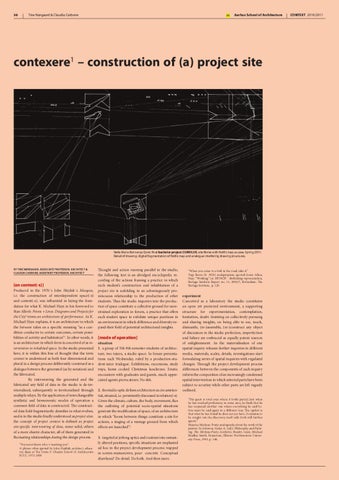
Nella Maria Konnerup Qvist: final bachelor project CUMULUS, site Rome with Nolli’s map as case, Spring 2011. Detail of drawing: digital fragmentation of Nollis map and analogue interfering drawing structures.
BY TINE NØRGAARD, ASSOCIATE PROFESSOR, ARCHITECT & CLAUDIA CARBONE, ASSISTANT PROFESSOR, ARCHITECT
[on context(-s)] Produced in the 1970´s John Hejduk´s Masques, i.e. the construction of interdependent space(-s) and context(-s), was influential in laying the foundation for what K. Michael Hays in his foreword to Stan Allen’s Points + Lines. Diagrams and Projects for the City2 terms an architecture of performance. As K. Michael Hays explains, it is an architecture in which the between takes on a specific meaning “as a condition conducive to certain outcomes, certain possibilities of activity and habitation”3. In other words, it is an architecture in which form is conceived of as intervention in inhabited space. In the studio presented here, it is within this line of thought that the term context is understood as both four dimensional and plural in a design process deliberately construed as a dialogue between the generated (as by notation) and the fabricated. By interweaving the generated and the fabricated any field of data in the studio is de-territorialised, subsequently re-territorialised through multiple relays. By the application of interchangeable synthetic and hermeneutic modes of operation a common field of data is constructed. The constructed data field fragmentarily densifies in what evolves, and is in the studio finally understood as project sites: the concept of project context is defined as project site-specific interweaving of data, some solid, others of a more elusive character, all of them generated in fluctuating relationships during the design process. “You never know who´s teaching you.” A phrase often quoted by John Hejduk, architect, educator, dean at The Irwin S. Chanin School of Architecture N.Y.C. 1972-2000
Thought and action running parallel in the studio, the following text is an abridged encyclopedic recording of the actions framing a practice in which each student’s construction and inhabitation of a project site is unfolding in an advantageously promiscuous relationship to the production of other students. Thus the studio inquiries into the production of space constitute a collective ground for unrestrained exploration in forum, a practice that offers each student space to exfoliate unique positions in an environment in which difference and diversity expand their field of potential architectural insights.
[mode of operation] situation 1. a group of 5th-9th semester students of architecture, two tutors, a studio space. In forum presentations each Wednesday, ruled by a production-student-tutor trialogue. Exhibitions, excursions, study trips, home cooked Christmas luncheons. Erratic encounters with graduates and guests, much appreciated agents provocateurs. No shit. 2. the studio optic defines architecture as circumstantial, situated, i.e. persistently discussed in relation(-s). Given the climate, culture, the body, movement, flux the outlining of potential socio-spatial situations generate the modification of space, of an architecture in which “forms between things constitute a site for actions, a staging of a vantage ground from which effects are launched”.4 3. targeted at jerking optics and routines into instantly altered positions, specific situations are implanted ad hoc in the project development process: trapped in screen-manoeuvres, pour concrete. Conceptual diarrhoea? Do detail. Do both. And then more.
“When you come to a fork in the road, take it.” Yogi Berra (b. 1925) malapropism, quoted from: Allen, Stan: “Working” in: HUNCH - Rethinking representation, Berlage Institute Report no. 11, 2006/7, Rotterdam: The Berlage Institute, p. 120.
experiment Conceived as a laboratory the studio constitutes an open yet protected environment, a supporting structure for experimentation, contemplation, hesitation, doubt. Insisting on collectively pursuing and sharing insights, on being able to see, touch, dismantle, (re-)assemble, (re-)construct any object of discussion in the studio perfection, imperfection and failure are embraced as equally potent sources of enlightenment. As the materialisation of one spatial inquiry releases further inquiries in different media, materials, scales, details, investigations start formulating series of spatial inquiries with regulated changes. Through the project development process differences between the components of each inquiry inform the composition of an increasingly condensed spatial intervention in which selected parts have been subject to scrutiny while other parts are left vaguely outlined. ”His quest is total even where it looks partial. Just when he has reached proficiency in some area, he finds that he has reopened another one where everything he said before must be said again in a different way. The upshot is that what he has found he does not yet have. It remains to be sought out; the discovery itself calls forth still further quests.” Maurice Merleau-Ponty analogously about the work of the painter. In Johnson, Galen A. (ed.): Philosophy and Painting. The Merleau-Ponty Aesthetics Reader, trans. Michael Bradley Smith. Evanstone, Illinois: Northwestern University Press, 1993. p. 148.
CONTEXT 2010/2011