ETHNIC DIVERSITY IT TAKES ALL KINDS
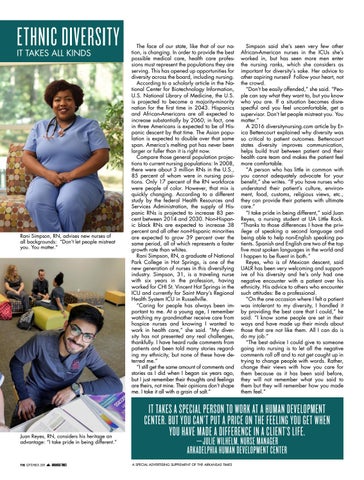
Rani Simpson, RN, advises new nurses of all backgrounds: “Don’t let people mistreat you. You matter.”
Juan Reyes, RN, considers his heritage an advantage: “I take pride in being different.”
116 SEPTEMBER 2019
ARKANSAS TIMES
The face of our state, like that of our nation, is changing. In order to provide the best possible medical care, health care professions must represent the populations they are serving. This has opened up opportunities for diversity across the board, including nursing. According to a scholarly article in the National Center for Biotechnology Information, U.S. National Library of Medicine, the U.S. is projected to become a majority-minority nation for the first time in 2043. Hispanics and African-Americans are all expected to increase substantially by 2060; in fact, one in three Americans is expected to be of Hispanic descent by that time. The Asian population is expected to double over that same span. America’s melting pot has never been larger or fuller than it is right now. Compare those general population projections to current nursing populations: In 2008, there were about 3 million RNs in the U.S., 85 percent of whom were in nursing positions. Only 17 percent of the RN workforce were people of color. However, that mix is quickly changing. According to a different study by the federal Health Resources and Services Administration, the supply of Hispanic RNs is projected to increase 83 percent between 2014 and 2030. Non-Hispanic black RNs are expected to increase 38 percent and all other non-Hispanic minorities are expected to grow 39 percent over the same period, all of which represents a faster growth rate than whites. Rani Simpson, RN, a graduate of National Park College in Hot Springs, is one of the new generation of nurses in this diversifying industry. Simpson, 31, is a traveling nurse with six years in the profession, having worked for CHI St. Vincent Hot Springs in the ICU and currently for Saint Mary’s Regional Health System ICU in Russellville. “Caring for people has always been important to me. At a young age, I remember watching my grandmother receive care from hospice nurses and knowing I wanted to work in health care,” she said. “My diversity has not presented any real challenges, thankfully. I have heard rude comments from patients and been told many stories regarding my ethnicity, but none of these have deterred me.” “I still get the same amount of comments and stories as I did when I began six years ago, but I just remember their thoughts and feelings are theirs, not mine. Their opinions don’t shape me. I take it all with a grain of salt.”
Simpson said she’s seen very few other African-American nurses in the ICUs she’s worked in, but has seen more men enter the nursing ranks, which she considers as important for diversity’s sake. Her advice to other aspiring nurses? Follow your heart, not the crowd. “Don’t be easily offended,” she said. “People can say what they want to, but you know who you are. If a situation becomes disrespectful and you feel uncomfortable, get a supervisor. Don’t let people mistreat you. You matter.” A 2016 diversitynursing.com article by Erica Bettencourt explained why diversity was so critical to patient outcomes. Bettencourt states diversity improves communication, helps build trust between patient and their health care team and makes the patient feel more comfortable. “A person who has little in common with you cannot adequately advocate for your benefit,” she writes. “If you have nurses who understand their patient’s culture, environment, food, customs, religious views, etc., they can provide their patients with ultimate care.” “I take pride in being different,” said Juan Reyes, a nursing student at UA Little Rock. “Thanks to those differences I have the privilege of speaking a second language and being able to help non-English speaking patients. Spanish and English are two of the top five most spoken languages in the world and I happen to be fluent in both.” Reyes, who is of Mexican descent, said UALR has been very welcoming and supportive of his diversity and he’s only had one negative encounter with a patient over his ethnicity. His advice to others who encounter such attitudes: Be a professional. “On the one occasion where I felt a patient was intolerant to my diversity, I handled it by providing the best care that I could,” he said. “I know some people are set in their ways and have made up their minds about those that are not like them. All I can do is do my job.” “The best advice I could give to someone going into nursing is to let all the negative comments roll off and to not get caught up in trying to change people with words. Rather, change their views with how you care for them because as it has been said before, they will not remember what you said to them but they will remember how you made them feel.”
IT TAKES A SPECIAL PERSON TO WORK AT A HUMAN DEVELOPMENT CENTER. BUT YOU CAN’T PUT A PRICE ON THE FEELING YOU GET WHEN YOU HAVE MADE A DIFFERENCE IN A CLIENT’S LIFE. —JULIE WILHELM, NURSE MANAGER ARKADELPHIA HUMAN DEVELOPMENT CENTER
A SPECIAL ADVERTISING SUPPLEMENT OF THE ARKANSAS TIMES