Appendix F
F-23. Under ideal conditions, the period when there is adequate visibility for large-scale operations is between beginning morning civil twilight (BMCT) and end evening civil twilight (EECT). Generally, visibility at beginning morning nautical twilight (BMNT) is about 400 meters—enough light for close coordination between personnel. Halfway between BMNT and BMCT (or EECT and end evening nautical twilight [EENT]), there is enough light for visual ground adjustment of close-in artillery fire and air strikes.
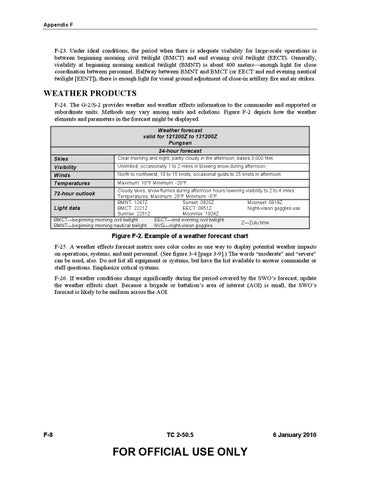
WEATHER PRODUCTS F-24. The G-2/S-2 provides weather and weather effects information to the commander and supported or subordinate units. Methods may vary among units and echelons. Figure F-2 depicts how the weather elements and parameters in the forecast might be displayed. Weather forecast valid for 121200Z to 131200Z Pungsan 24-hour forecast Skies Visibility Winds Temperatures
Clear morning and night, partly cloudy in the afternoon, bases 3,000 feet. Unlimited, occasionally 1 to 2 miles in blowing snow during afternoon. North to northwest, 10 to 15 knots, occasional gusts to 25 knots in afternoon. Maximum: 10°F Minimum: -20°F.
Cloudy skies, snow flurries during afternoon hours lowering visibility to 2 to 4 miles. Temperatures: Maximum: 20°F Minimum: -5°F. BMNT: 1247Z Sunset: 0820Z Moonset: 0819Z BMCT: 2221Z EECT: 0851Z Night-vision goggles use Light data Sunrise: 2251Z Moonrise: 1924Z BMCT—beginning morning civil twilight EECT—end evening civil twilight Z—Zulu time BMNT—beginning morning nautical twilight NVG—night-vision goggles
72-hour outlook
Figure F-2. Example of a weather forecast chart F-25. A weather effects forecast matrix uses color codes as one way to display potential weather impacts on operations, systems, and unit personnel. (See figure 3-4 [page 3-9].) The words “moderate” and “severe” can be used, also. Do not list all equipment or systems, but have the list available to answer commander or staff questions. Emphasize critical systems. F-26. If weather conditions change significantly during the period covered by the SWO’s forecast, update the weather effects chart. Because a brigade or battalion’s area of interest (AOI) is small, the SWO’s forecast is likely to be uniform across the AOI.
F-8
TC 2-50.5
FOR OFFICIAL USE ONLY
6 January 2010