AREAA EMERITUS AWARD RECIPIENT
Reed, you and your brothers, or the "Colfax boys," are famous success stories about home schooling. Can you tell us a little bit about that? "So, back in 1973, when I was 3 years old, my parents moved me and my two older brothers to a remote mountain top in Northern California and built a home there. They wanted to prioritize giving us a high quality education, and decided homeschooling would be the best way to do it. It wasn't necessarily a permanent idea, but it worked so they kept doing it."
Was transition to public schooling challenging?
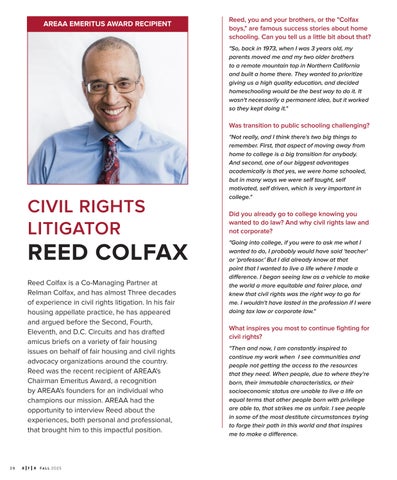
CIVIL RIGHTS LITIGATOR
REED COLFAX Reed Colfax is a Co-Managing Partner at Relman Colfax, and has almost Three decades of experience in civil rights litigation. In his fair housing appellate practice, he has appeared and argued before the Second, Fourth, Eleventh, and D.C. Circuits and has drafted amicus briefs on a variety of fair housing issues on behalf of fair housing and civil rights advocacy organizations around the country. Reed was the recent recipient of AREAA's Chairman Emeritus Award, a recognition by AREAA's founders for an individual who champions our mission. AREAA had the opportunity to interview Reed about the experiences, both personal and professional, that brought him to this impactful position.
28
FA L L 2 0 2 5
"Not really, and I think there's two big things to remember. First, that aspect of moving away from home to college is a big transition for anybody. And second, one of our biggest advantages academically is that yes, we were home schooled, but in many ways we were self taught, self motivated, self driven, which is very important in college."
Did you already go to college knowing you wanted to do law? And why civil rights law and not corporate? "Going into college, if you were to ask me what I wanted to do, I probably would have said 'teacher' or 'professor.' But I did already know at that point that I wanted to live a life where I made a difference. I began seeing law as a vehicle to make the world a more equitable and fairer place, and knew that civil rights was the right way to go for me. I wouldn't have lasted in the profession if I were doing tax law or corporate law."
What inspires you most to continue fighting for civil rights? "Then and now, I am constantly inspired to continue my work when I see communities and people not getting the access to the resources that they need. When people, due to where they're born, their immutable characteristics, or their socioeconomic status are unable to live a life on equal terms that other people born with privilege are able to, that strikes me as unfair. I see people in some of the most destitute circumstances trying to forge their path in this world and that inspires me to make a difference.