Page 4
February 12, 2014
Sports
Adnan Ramic / adiramic@gmail.com
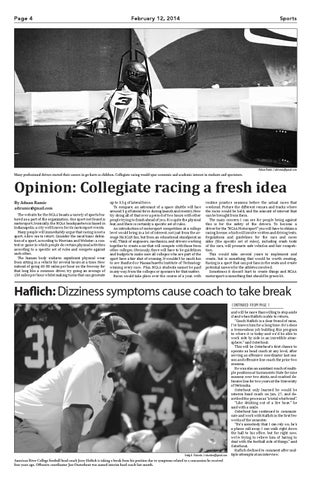
Many professional drivers started their careers in go-karts as children. Collegiate racing would spur economic and academic interest in students and spectators.
Opinion: Collegiate racing a fresh idea By Adnan Ramic adiramic@gmail.com The website for the NCAA boasts a variety of sports featured as a part of the organization. One sport not found is motorsport. Ironically, the NCAA headquarters is based in Indianapolis, a city well known for its motorsport events. Many people will immediately argue that racing is not a sport. Allow me to retort. Consider the most basic definition of a sport, according to Merriam and Webster: a contest or game in which people do certain physical activities according to a specific set of rules and compete against each other. The human body endures significant physical wear from sitting in a vehicle for several hours at a time. Now instead of going 60-80 miles per hour on the freeway for that long like a common driver, try going an average of 150 miles per hour whilst making turns that can generate
up to 3.5 g of lateral force. To compare, an astronaut of a space shuttle will face around 3 g of lateral force during launch and reentry. Now try doing all of that over a period of two hours with other people trying to finish ahead of you. It is quite the physical feat, and there is certainly a specific set of rules. An introduction of motorsport competition at a college level would bring in a lot of interest, not just from the average NASCAR fan, but from an educational standpoint as well. Think of engineers, mechanics, and drivers working together to create a car that will compete with those from other colleges. Obviously, there will have to be guidelines and budgets to make sure all colleges who are part of the sport have a fair shot of winning. It wouldn’t be much fun to see Stanford or Massachusetts Institute of Technology winning every race. Plus, NCAA students cannot be paid in any way, from the colleges or sponsors for that matter. Races would take place over the course of a year, with
routine practice sessions before the actual races that weekend. Picture the different venues and tracks where the races would be held, and the amount of interest that can be brought from them. The main concern I can see for people being against this is for the safety of the drivers. To become a driver for the “NCAA Motorsport” you will have to obtain a racing license, which will involve written and driving tests. Regulations and guidelines for the cars and races alike (the specific set of rules), including crash tests of the cars, will promote safe vehicles and fair competition. This would take several years to implement and create, but is something that would be worth creating. Racing is a sport that can put fans in the seats and create potential careers for the athletes involved. Sometimes it doesn’t hurt to create things and NCAA motorsport is something that should be green-lit.
Haflich: Dizziness symptoms cause coach to take break CONTINUED FROM PAGE 1
Emily K. Rabasto / rabastoe@gmail.com
American River College football head coach Jerry Haflich is taking a break from his position due to symptoms related to a concussion he received four years ago. Offensive coordinator Jon Ousterhout was named interim head coach last month.
and will be more than willing to step aside if and when Haflich is able to return. “Coach Haflich is a dear friend of mine, I’ve known him for a long time. He’s done a tremendous job building this program to where it is today and we’d be able to work side by side in an incredible atmosphere,” said Osterhout. This will be Osterhout’s first chance to operate as head coach at any level, after serving as offensive coordinator last season and offensive line coach the prior two seasons. He was also an assistant coach of multiple positions at Sacramento State for nine seasons over two stints, and coached defensive line for two years at the University of Nebraska. Osterhout only learned he would be interim head coach on Jan. 27, and described the process as “a total whirlwind”. “Like drinking out of a fire hose,” he said with a smile. Osterhout has continued to communicate and work with Haflich in the first few weeks of the semester. “He’s somebody that I can rely on, he’s a phone call away, I can walk right down the hall to his office, but for right now, we’re trying to relieve him of having to deal with the football side of things,” said Osterhout. Haflich declined to comment after multiple attempts at an interview.