Nicole Cadelina
Feature
Become
Nicole Cadelina
Feature
Become
An Obligation By Nicole Cadelina
As a Filipino-Australian creative, I grapple with the expectation to perform cultural stereotypes at the detriment of my art. August 2020, Starbucks Parramatta. I reconnected with a longlost ex, who now hails from the distant beaches of Umina. As we waited for my tall matcha green tea latte, I decided to kill the dead air that comes when connections with past lovers are rekindled. “There’s this movie I watched the other night,” I began (my dear ex knew nothing about cinema). “It’s called Before Sunrise. It’s about these two people, they go around somewhere in Europe – I forget which country it was – but it was great.”
“That sounds cool,” he replied. “…Are there any Filipinos in it?”
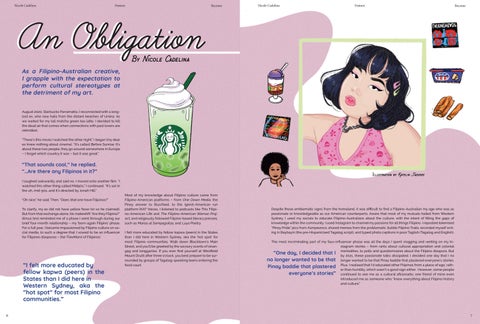
Illustration by Katelin Jaegers
I laughed awkwardly and said no. I moved onto another film. “I watched this other thing called Mid90s,” I continued. “It’s set in the uh…mid-90s…and it’s directed by Jonah Hill.” “Oh nice,” he said. Then, “Does that one have Filipinos?” To clarify, my ex did not have yellow fever (or so he claimed). But from that exchange alone, his makeshift “Are they Filipino?” litmus test reminded me of a phase I went through during our brief four-month relationship – my ’born-again Filipino’ phase. For a full year, I became impassioned by Filipino culture on social media, to such a degree that I vowed to be an influencer for Filipinos diasporas – the ’FlexMami of Filipinos’.
“I felt more educated by fellow kapwa (peers) in the States than I did here in Western Sydney, aka the “hot spot” for most Filipino communities.” 6
Most of my knowledge about Filipino culture came from Filipino-American platforms – from One Down Media, the Pinoy answer to Buzzfeed, to the Igorot-American run platform IKAT Voices. I listened to podcasts like This Filipino-American Life and The Filipino-American Woman Project, and religiously followed Filipino-based literary presses, such as Marias at Sampaguitas, and Luya Poetry. I felt more educated by fellow kapwa (peers) in the States than I did here in Western Sydney, aka the ’hot spot’ for most Filipino communities. Walk down Blacktown’s Main Street, and you’ll be greeted by the savoury scents of sinangag and longganisa. If you ever find yourself at Westfield Mount Druitt after three o’clock, you best prepare to be surrounded by groups of Tagalog-speaking teens entering the food court.
Despite these emblematic signs from the homeland, it was difficult to find a Filipino-Australian my age who was as passionate or knowledgeable as our American counterparts. Aware that most of my mutuals hailed from Western Sydney, I used my socials to educate Filipino-Australians about the culture, with the intent of filling the gaps of knowledge within the community. I used Instagram to channel my passions for all things Filipino. I reposted tokenised “Pinoy Pride” pics from Kampeonco, shared memes from the problematic Subtle Filipino Traits, recorded myself writing in Baybayin (the pre-Hispanicised Tagalog script), and typed photo captions in poor Taglish (Tagalog and English). The most incriminating part of my faux-influencer phase was all the days I spent vlogging and venting on my Instagram stories – from rants about cultural appropriation and colonial to polls and questionnaires about the Filipino diaspora. But “One day, I decided that I mentalities, by 2021, these passionate talks dissipated. I decided one day that I no no longer wanted to be that longer wanted to be that Pinay baddie that plastered everyone’s stories. Pinay baddie that plastered Plus, I realised that I’d educated other Filipinos from a place of ego, rather than humility, which wasn’t a good sign either. However, some people everyone’s stories” continued to see me as a cultural aficionado; one friend of mine even introduced me as someone who “knew everything about Filipino history and culture.”
7