8 Open
The Architect’s Newspaper
East
West
Cayton Children’s Museum
Apple Carnegie Library
PAUL VU
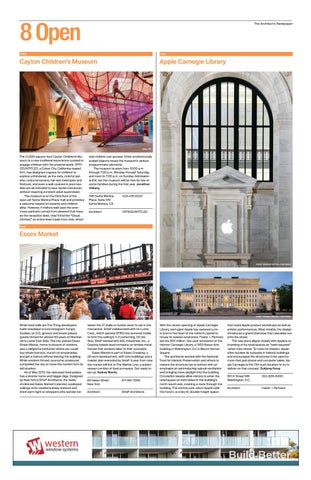
The 21,000-square-foot Cayton Children’s Museum is a new multilevel experience curated to engage children with the physical world. OFFICEUNTITLED, a Culver City, California–based firm, has designed a space for children to explore unhindered, as the nets, colorful palette, costume lockers, full-size helicopter and firetruck, and even a wall covered in pool noodles are all intended to spur tactile interaction without requiring constant adult supervision. The museum is on the third floor of the open-air Santa Monica Place mall and provides a welcome respite for parents and children alike. However, if visitors walk past the enormous aardvark carved from plywood that houses the reception desk, they’ll find the “Cloud Climber,” an entire level made from nets, which
only children can access. Other architecturally scaled objects house the museum’s various programmatic elements. The museum is open from 10:00 a.m. through 7:00 p.m. Monday through Saturday, and noon to 7:00 p.m. on Sunday. Admission is $14, but the museum will be free for low-income families during the first year. Jonathan Hilburg 395 Santa Monica Place, Suite 374 Santa Monica, CA
424-416-8320
Architect:
OFFICEUNTITLED
East
Essex Market
NIGEL YOUNG/FOSTER + PARTNERS
NIGEL YOUNG/FOSTER + PARTNERS
QUALLSBENSON
While food halls are The Thing developers build nowadays to lure Instagram-hungry foodies, an O.G. grocery and snack palace quietly thrived for almost 80 years on Manhattan’s Lower East Side. The city-owned Essex Street Market, home to dozens of vendors, was a delightful institution where you could buy whole branzini, munch on empanadas, and get a haircut without leaving the building. While vendors thrived, economic pressures compelled the city to move the market from its old location. As of May 2019, the relocated food palace has a shorter name and bigger digs. Designed by New York’s SHoP Architects, the newly christened Essex Market’s slanted, scalloped ceilings echo vaulted subway stations and shed warm light on shoppers who wander be-
tween the 37 stalls or hunker down to eat in the mezzanine. SHoP collaborated with Hi-Lume Corp., which packed GFRG into textured molds to form the ceiling’s 3-D patterning. On the floor, ShoP worked with AGL Industries, Inc., a Queens-based steel company, on simple metal frames that vendors tailor to their concepts. Essex Market is part of Essex Crossing, a 20-acre development, with nine buildings and a master plan executed by SHoP. A year from now, the market will link to The Market Line, a subterranean corridor of food purveyors. Get ready to eat up. Audrey Wachs 88 Essex Street New York
917-881-7096
Architect:
SHoP Architects
With the recent opening of Apple Carnegie Library, tech giant Apple has restored a civic icon in the heart of the nation’s capital to house its newest retail store. Foster + Partners led the $30 million, two-year renovation of the historic Carnegie Library, a 1903 Beaux Arts building in Washington, D.C.’s Mount Vernon Square. The architects worked with the National Trust for Historic Preservation and others to restore the structure top to bottom with an emphasis on reintroducing natural ventilation and bringing more daylight into the building. Circulation tweaks allow visitors to enter the retail space on both sides of the building’s north–south axis, creating a route through the building. The central core, which Apple calls the Forum, is a sky-lit, double-height space
that hosts Apple product workshops as well as artistic performances. Most notably, the design introduces a grand staircase that cascades out onto the street. The new store aligns closely with Apple’s rebranding of its retail spaces as “town squares” rather than stores. To meet its mission, Apple often locates its outposts in historic buildings and encourages the structures to be used for more than just phone and computer sales. Apple Carnegie is the 13th such location to try to deliver on that concept. Sukjong Hong 801 K Street NW Washington, D.C.
202-609-6400
Architect:
Foster + Partners