46
Facades
Case Study
130 William continued
The Architect’s Newspaper
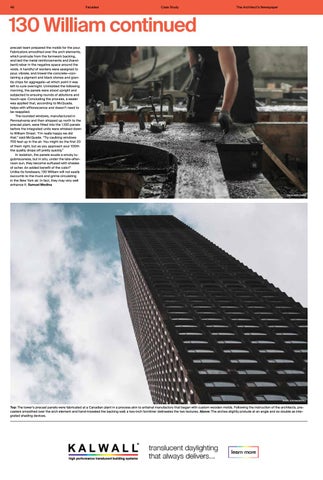
precast team prepared the molds for the pour. Fabricators smoothed over the arch elements, which protrude from the formwork backing, and laid the metal reinforcements and (handbent) rebar in the negative space around the voids. A handful of workers were assigned to pour, vibrate, and trowel the concrete—containing a pigment and black stones and granite chips for aggregate—at which point it was left to cure overnight. Unmolded the following morning, the panels were stood upright and subjected to ensuing rounds of ablutions and touch-ups. Concluding the process, a sealer was applied that, according to McQuade, helps with efflorescence and doesn’t need to be reapplied. The rounded windows, manufactured in Pennsylvania and then shipped up north to the precast plant, were fitted into the 1,100 panels before the integrated units were whisked down to William Street. “I’m really happy we did that,” said McQuade. “Try caulking windows 700 feet up in the air. You might do the first 20 of them right, but as you approach your 100th the quality drops off pretty quickly.” In isolation, the panels exude a smoky lugubriousness, but in situ, under the late-afternoon sun, they become suffused with shades of ocher. An added benefit of the color? Unlike its forebears, 130 William will not easily succumb to the muck and grime circulating in the New York air. In fact, they may very well enhance it. Samuel Medina
ZACH HERTZMAN
IVANE K ATAMASHVILI
Top: The tower’s precast panels were fabricated at a Canadian plant in a process akin to artisinal manufactory that began with custom wooden molds. Following the instruction of the architects, precasters smoothed over the arch element and hand-troweled the backing wall; a two-inch formliner delineates the two textures. Above: The arches slightly protude at an angle and so double as integrated shading devices.