PRINCIPLES AND APPROACHES TO HERITAGE MANAGEMENT PLAN
7 PRINCIPLES AND APPROACHES TO HERITAGE Management PLAN
Principle number P1 P2
Description of Principle Minimum intervention Reversibility Retention of buildings, settlements
P3
and context: conserve vistas, views, spaces and enclosures and sensitively interpret as necessary Anthropological (i.e., people centred)
P4
approach to heritage management and reuse Integration of the younger generation
P5
In accordance with the Venice Charter on Conservation (1964) and the ICOMOS Conservation Charter (2004) this chapter sets out the ways in which the significant values of the settlement, its integrity, and the heritage and material culture are to be safeguarded within a context of sympathetic development. Following the establishment of a broad philosophy, a set of general policies for development and conservation are discussed. This is followed by a set of detailed guidelines for restoration, consolidation, rebuilding and redevelopment measures (cf. definitions below).
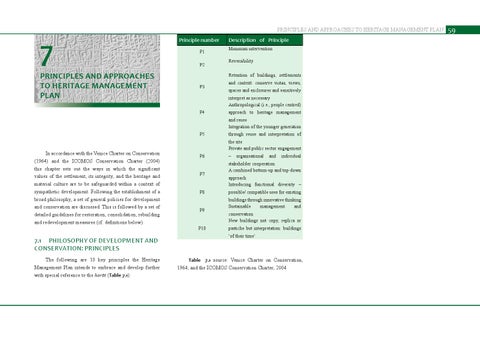
7.1 PHILOSOPHY OF DEVELOPMENT AND CONSERVATION: PRINCIPLES The following are 10 key principles the Heritage Management Plan intends to embrace and develop further with special reference to the harāt (Table 7.1):
through reuse and interpretation of the site Private and public sector engagement
P6 P7 P8 P9 P10
–
organisational
and
individual
stakeholder cooperation A combined bottom-up and top-down approach Introducing functional diversity – possible/ compatible uses for existing buildings through innovative thinking Sustainable management and conservation New buildings not copy, replica or pastiche but interpretation: buildings ‘of their time’
Table 7.1 source: Venice Charter on Conservation, 1964, and the ICOMOS Conservation Charter, 2004
59