50
ДĀRAT AL-ΚAQR (Bāhla): DOCUMENTATION AND HERITAGE MANAGEMENT PLAN the oldest schools of Islamic thought. The ideals of Ibadism, which have had influences throughout parts of the Arab world, are reflected in the fabric of the WHS through the simple and quiet dignity of many of the mosques. Social cohesion
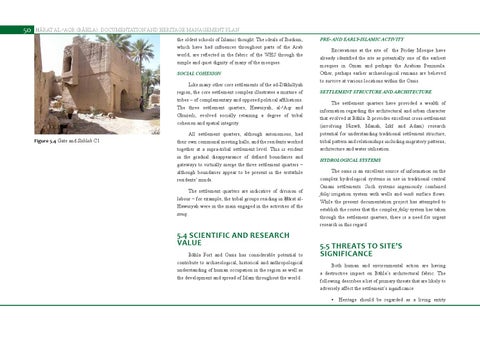
Like many other core settlements of the ad-Dākhilīyah region, the core settlement complex illustrates a mixture of tribes – of complementary and opposed political affiliations. The three settlement quarters, Hawuiyah, al-ΚAqr and Ghuzeili, evolved socially retaining a degree of tribal cohesion and spatial integrity. Figure 5.4 Gate and Sablah C11
All settlement quarters, although autonomous, had their own communal meeting halls, and the residents worked together at a supra-tribal settlement level. This is evident in the gradual disappearance of defined boundaries and gateways to virtually merge the three settlement quarters – although boundaries appear to be present in the erstwhile residents’ minds. The settlement quarters are indicative of division of labour – for example, the tribal groups residing in Дārat alHawuiyah were in the main engaged in the activities of the souq.
5.4 scientific and research value Bāhla Fort and Oasis has considerable potential to contribute to archaeological, historical and anthropological understanding of human occupation in the region as well as the development and spread of Islam throughout the world.
Pre- and early-Islamic activity
Excavations at the site of the Friday Mosque have already identified the site as potentially one of the earliest mosques in Oman and perhaps the Arabian Peninsula. Other, perhaps earlier archaeological remains are believed to survive at various locations within the Oasis. Settlement structure and architecture
The settlement quarters have provided a wealth of information regarding the architectural and urban character that evolved at Bāhla. It provides excellent cross-settlement (involving Nizwā, Manah, Izkī and Adam) research potential for understanding traditional settlement structure, tribal pattern and relationships including migratory patterns, architecture and water utilisation. Hydrological systems
The oasis is an excellent source of information on the complex hydrological systems in use in traditional central Omani settlements. Such systems ingeniously combined falaj irrigation system with wells and wadi surface flows. While the present documentation project has attempted to establish the routes that the complex falaj system has taken through the settlement quarters, there is a need for urgent research in this regard.
5.5 threats to site’s significance Both human and environmental action are having a destructive impact on Bāhla’s architectural fabric. The following describes a list of primary threats that are likely to adversely affect the settlement’s significance: • Heritage should be regarded as a living entity