BAHLA: HARAT AL-AQR c
c
c
Salim M. almahruqi Undersecretary for Heritage Affairs
c
This Heritage Management Plan contains a complete vision for the sustainable redevelopment and revitalization for the oasis settlement of al-Aqr in Bahla. Extensive fieldwork campaigns, detailed documentation and analysis of the built environment, as well as in-depth study of historical sources and anthropological data, have been brought together to provide a high-quality multidisciplinary examination of al-Aqr’s past, present and potential future. Drawing on previous experience and cooperation between Nottingham Trent University and the Ministry of Heritage and Culture, commissioning body of this study, the results exposed in this third volume aim to set the standard for future public-private partnerships in the field of heritage management.
BAHLA: HARAT AL-AQR
BAHLA: HARAT AL-AQR c
COMMITTEE FOR THE REGISTRATION AND PROTECTION OF HISTORIC BUILDING CLUSTERS
4
COMMISSIONED BY
MINISTRY OF HERITAGE AND CULTURE SULTANATE OF OMAN COMMITTEE FOR THE REGISTRATION AND PROTECTION OF HISTORIC BUILDING CLUSTERS
DEVELOPED BY
NOTTINGHAM TRENT UNIVERSITY CENTRE FOR THE STUDY OF
ARCHITECTURE AND CULTURAL HERITAGE OF INDIA, ARABIA AND THE MAGHREB
BAHLA: HARAT AL-AQR c
2
ДĀRAT AL-ΚAQR (Bāhla): DOCUMENTATION AND HERITAGE MANAGEMENT PLAN
© Ministry of Heritage and Culture, Oman 2013 All rights reserved. No part of this report may be reproduced, translated, stored in a retrieval system, or transmitted in any form or by any means, electronic, mechanical, photocopying, recording or otherwise, without prior written permission of the copyright holder. Printed and bound in UK by: The Printquarter
ACKNOWLEDGEMENTS
Research Team:
ACKNOWLEDGEMENTS
PROF SOUMYEN BANDYOPADHYAY Principal Investigator Project leadership, fieldwork, contribution to text
MD ABDULLH AL ZOBAIR PhD Student CAD documentation
DR GIAMILA QUATTRONE Research Fellow Project coordination, fieldwork, contribution to text, analyses
MARYAM AHMADI PhD Student Photographic documentation
DR MARTIN S. GOFFRILLER Research Fellow Fieldwork, contribution to text, GIS analyses The ministry would like to acknowledge the contribution of the Nottingham Trent University research team in carrying out the research and documentation leading to this management plan
DR MOHAMMAD HABIB REZA Research Fellow Fieldwork, CAD documentation HAITHAM AL-‘ABRI PhD Student Fieldwork, ethnographic analyses JOHN HARRISON Project Associate Fieldwork CHARLIE ADAMS SPUR (Scholarship Projects for Undergraduate Researchers) Student Contribution to analyses, 3D modelling
PAUL MACMAHON Graduate Student Visualisation PAUL COLFER Graduate Student Visualisation
Special thanks to the following NTU personnel:
• Ann Priest, Head of College Art, Design and the Built Environment • Prof. Marjan Sarshar, Associate Dean for Research, Art Design and Built Environment • Peter Westland, Dean of Architecture, Design and the Built Environment, • Prof. Dino Bouchlaghem, Head of Architecture • Paul Collins, Head of Engineering
3
4
ДĀRAT AL-ΚAQR (Bāhla): DOCUMENTATION AND HERITAGE MANAGEMENT PLAN
SUMMARY
summary
This Heritage Management Plan for the settlement of al-ΚAqr in Bāhla builds on the extensive fieldwork documentation carried out on site, as well as on the interim field report submitted on December 17th 2012. Alongside providing a comprehensive drawn documentation resulting from the survey carried out in October 2012, this report includes a preliminary strategic Master Plan which addresses issues of heritage management, conservation and development, as well as approaches for its implementation. The Master Plan illustrates areas and categories of development and conservation to be carried out, which builds on a statement of significance, and assessments of the state of conservation and the threats to heritage management at Дārat al-ΚAqr, drawing on the experiences of researching and developing Master Plan for Дārat al-Yemen (2011) and Дārat as-Sulayf (2012). The report also includes a comprehensive inventory of structural and non-structural defects present at the settlement as well as a study of the oasis context.
The Master Plan is informed by a comprehensive documentation, analysis and interpretation of the settlement structure, morphology, building typology and social conditions of the present and the immediate past. On this basis, a culturally and technically informed development plan is proposed, which advocates a sustainable revitalization centred on re-habitation, heritage tourism, education, training and skill development programmes with emphasis on traditional knowledge of the built environment and the crafts. As already suggested in previous reports for Bāhla by UNESCO and Atkins the intention is to move away from an entirely tourism-focused development and towards a more sustainable alternative. Key areas are identified in the Master Plan for protection, restoration, rebuilding, consolidation and redevelopment.
5
6
ДĀRAT AL-ΚAQR (Bāhla): DOCUMENTATION AND HERITAGE MANAGEMENT PLAN
TABLE OF CONTENTS
TABLE OF CONTENTS
1.
Introduction to the project
1.1.
Objectives and approaches
2.
Reconnaissance and fieldwork 2.1. Introduction 2.2. Reconnaissance 2.3. Preparatory work
2.4.
3.
Bāhla Oasis Past and Present
Fieldwork
3.1. Introduction 3.2.
Bāhla Oasis
3.3.
History of Bāhla Oasis
3.4.
Modern Bāhla
4.
al-ΚAqr: Documentation and Analysis
4.1. Introduction 4.2. Context and topography 4.3. History 4.4. Oasis
4.5. 4.6.
Settlement structure and morphology Settlement evolution
5. Architectural values and threats to site’s significance 5.1. Urban and architectural values 5.2. Historical values 5.3. Social values 5.4. Threats to site’s significance 5.5. States of preservation 6. Principles and Approaches to Heritage Management Plan 6.1. Philosophy of development and conservation: principles 6.2. Approaches to development and conservation 6.3. General policies for development and conservation 6.4. Guidelines for development and conservation 6.5. Additional studies and analyses
7.
Precedents
8.
Heritage Management & Development Master Plan
8.1. Introduction 8.2. Master Plan goals 8.3. Bāhla Oasis development 8.4. Urban design and development 8.5. Agriculture and irrigation 8.6. Phasing and the priority heritage conservation tasks
9.
Appendix a1, Tribal Mosaic
10.
Appendix a2, Bibliography
11.
Appendix a3, Photographic Documentation
7
8
ДĀRAT AL-ΚAQR (Bāhla): DOCUMENTATION AND HERITAGE MANAGEMENT PLAN
INTRODUCTION
1 INTRODUCTION
This Heritage Management Plan is supported by extensive fieldwork and off-site drawn documentation, and was undertaken to provide integrated conservation and development strategies and Master Plan for Дārat alΚAqr in the Bāhla UNESCO World Heritage Site (WHS Ref. 433). The project was undertaken with funding and logistical support from the Ministry of Heritage and Culture (MHC) of the Sultanate of Oman to develop such planned strategies for four oasis settlements in the ad-Dākhilīyah and ad-Dhāhirah regions of Oman, including Дārat al-Yemen in Izkī, Дārat as-Sulayf in ΚIbrī, and Дārat al-Hujrah in Fanja. It aims to maximise tangible impact from sustained high-quality research in the field of Oman’s vernacular settlement study undertaken at Nottingham Trent University. This is part of a longer term aim to debate, collaborate, contribute and influence heritage, architecture and urban design policy in Oman at the levels of the government, public and private sectors, charitable organisations and the local stakeholder communities, with additional benefits
becoming available to the UK and international learned bodies, heritage institutions, industries and communities. The work has been undertaken at the Centre for the Study of Architecture and Cultural Heritage of India, Arabia and the Maghreb (ArCHIAM), based at Nottingham Trent University, UK, which aims to provide an interdisciplinary research platform for historical and contemporary cultural developments across three interconnected global regions. The Centre consists of an international team of researchers from a variety of academic backgrounds in architecture, social history, architectural technology, archaeology, conservation and digital documentation, among others. In this sense one of the fundamental themes underlying the Centre’s research aims is the multidisciplinary study of how human culture and social practices are expressed spatially, and how in turn space affects the cultural practices of groups and communities. The Ministry of Heritage and Culture, in particular the Committee for the Registration and Protection of Historic Building Clusters, has recently established an inventory of over a thousand vernacular settlements of which 86 have been identified for immediate attention. Heritage Management Plans (HMPs) are the first step in the process. The ArCHIAM projects, beginning with a proposal for Дārat as-Saybanī in Barkat al-Mawz produced in 2011, will deliver detailed models and guidelines relevant to Oman and the Middle East, as well as develop appropriate, cost-effective and expedient methods for producing HMPs. While HMPs are fundamental to the shaping of historic settlements by suggesting methods of management and conservation of historic fabric, this report takes the position that the success of such approaches is only limited if not fully integrated with addressing developmental needs and aspirations of future generations. By developing new models and methods, the projects aim to contribute extensively to sustainable
9
10
ДĀRAT AL-ΚAQR (Bāhla): DOCUMENTATION AND HERITAGE MANAGEMENT PLAN modernisation in Oman and the Middle East. Findings are to be disseminated also to and via local institutions, stakeholder communities and international presence in Oman. The existing UNESCO HMP guidelines are focused on World Heritage Sites and are mainly Eurocentric, making their approach inadequate for sites of regional and national significance in the Middle East facing significant pressures of development. The project will reshape, refine and adapt UNESCO guidelines and methods for the key aspects of the HMP: a) detailed documentation, b) establishment of significance, c) integrating development and heritage management, and, d) sustainable built environment development guidelines. The contribution will underpin and inform future heritage management policy and budget allocation in the region. The project’s eventual success will be measurable from its impact on heritage policy, processes and methods, change in socio-cultural attitude and greater awareness of issues related to integration of heritage with development.
1.1 Objectives and approaches The objective is to prepare an HMP for an Omani oasis settlement of importance, possessing significant characteristics, including a distinctive setting, to develop: a. HMP and appropriate management guidelines; b. models and guidelines using existing HMPs as comparators; c. sustainable built environment developmental guidelines; d. expedient and cost effective documentation methods and related best practice guidelines. This has been undertaken by, a. conducting fieldwork documentation over two seasons; b. producing relevant drawn documentation (maps, plans and photographic documentation); c. analysing data for establishing significance; d. producing a strategic HMP as model and guideline; e. considering wider issues of design, culture and society for developing sustainable building and developmental guidelines; f. using alternative, cost effective and expedient methods of documentation.
RECONNAISSANCE AND FIELDWORK
2 RECONNAISSANCE AND FIELDWORK
2.1 INTRODUCTION This chapter outlines the processes and methods of data collection, survey and documentation that were carried out on 2 fieldwork campaigns at Дārat al-ΚAqr. The work was begun for a duration of 8 days in April 2012 and continued for another 3 weeks in October 2012. The goal of the exhaustive description of on-site work is to provide a standardized precedent for future documentation efforts and data collection methodologies. It should be noted from the outset that due to severe constraints in time and resources it has not been possible to extend the documentation effort to beyond the confines of the settlement. This was deemed acceptable as these areas have already been addressed in previous reports (UNESCO, WS Atkins) and did not fall within the immediate remit of this document.
2.2 RECONNAISSANCE Following agreement of collaboration with MHC, a first reconnaissance survey of Дārat al-ΚAqr in Bāhla was carried out in Spring 2012 to assess the relevance of the settlement to the conservation policies and strategies of the Ministry and the feasibility of the documentation work to be carried out by the Nottingham Trent University (NTU) research team. Дārat al-ΚAqr was one of four settlements chosen for initial documentation (the others being Дārat alYemen (Izkī), Дārat as-Sulayf (ΚIbri) and Дārat al-Hujra in Fanja). Due to the site’s fame as a WHS and the availability of UNESCO reports as well as the various previous studies carried out there by Atkins, a substantial amount of preparation was carried out prior to arrival on site. The settlement was chosen for documentation for the following reasons: • Its great importance as a UNESCO World Heritage Site since 1988 and consequent cultural repository and focus of tourism; • The completion of restoration works on the Bāhla Fort highlighted the need to continue the preservation effort on the surrounding urban environment; • The grand architecture of al-ΚAqr which is suffering greatly from environmental and human factors, a fact which has been pointed out repeatedly in UNESCO reports; • The great touristic potential of the oasis as a whole which is already attracting important numbers of visitors who are currently not being provided the necessary facilities in the area;
Figure 2.1 Sultanate of Oman and study area. Source: National Survey Authority with amends by the authors
11
12
ДĀRAT AL-ΚAQR (Bāhla): DOCUMENTATION AND HERITAGE MANAGEMENT PLAN • The historical importance of Bāhla as a onetime capital of the Imamate and its still relevant economic focus as an important market town for the local population • The complexity and large scale of its falaj network which is partially incorporated into the urban fabric, providing dwellings and mosques with water access, while also watering the surrounding palm groves
2.3 preparatory work As part of the preparation for fieldwork in al-ΚAqr, but also in order to gain a greater understanding as to the state of research on the site, a substantial number of contemporary sources were drawn upon. In particular UNESCO’s reports starting from the mid 1980s until the present day provided a host of important information which allowed not only assessing the overall morphology and dimension of the site, but also permitted to gage the gradual but substantial degradation of the oasis over the past 25 years. Prof. Bandyopadhyay’s experience as a reference in heritage management efforts in Bāhla as part of the Atkins team also provided an important advantage in planning ArCHIAM’s research strategy. Following reconnaissance fieldwork, extensive preparatory work was undertaken at Nottingham Trent University to develop fieldwork strategy and implementation procedures. The following were undertaken:
Figure 2.2 Bāhla aerial photograph as seen in 1998
• Preparation of detailed fieldwork documentation and drawing production guideline for use on site; • Procurement and preparation of aerial photographs
RECONNAISSANCE AND FIELDWORK for on-site use (Fig. 2.2); • Developing inventory data sheets appropriate for use on designated sites drawing on previous work on Omani hārat, focusing especially on states of preservation; • Creation of schematic components map including main building types and zoning (Fig. 2.3); • Establishing a data handling and storage strategy, as outlined in the ‘Fieldwork Guidelines 2012’, which was subsequently distributed to our contributors from the MHC to standardize proceedings; • Preparation of detailed fieldwork plan and logistics. Furthermore, the availability of high-resolution aerial photography of settlement and surroundings from 1975 and 1998 provided by MHC greatly complemented the already available materials.
2.4 fieldwork As outlined above two separate fieldwork campaigns took place in al-ΚAqr. The first was made to coincide with the period spent on the study of al-Yemen, Izkī, and therefore coincided with the late Spring of 2012. During this time only a relatively reduced section of the settlement could be recorded, concentrating primarily in zones B, D, E and G, but it allowed for the establishment of a more refined approach during the subsequent visit in the Autumn of 2012. The final used and referred to in this document is visible at Figure 4.20.
structures, etc. In addition to this were documented a series of grand houses in the central area of the settlement. These were drawn in plan and section in order to allow for 3D virtual reconstructions.
The Spring 2012 campaign concentrated primarily on identifying the main structures of interest, establishing a drawing convention in accordance with site-specific complexities such as terrain, current habitation, modern
Further work carried out during this short fieldwork period was a survey of the falaj network as it was integrated into the built environment of the settlement. Unfortunately large parts of older channels further up hill disappeared and
Figure 2.3 Дārat al-ΚAqr, preliminary zoning plan
13
14
ДĀRAT AL-ΚAQR (Bāhla): DOCUMENTATION AND HERITAGE MANAGEMENT PLAN most of the falaj network which supplied the settlement from the North East have been obscured by modern building. As part of the documentation work the ArCHIAM team also carried out an exhaustive photographic record of all surveyed and documented buildings. As in previous projects, at Bāhla too structures and spaces were drawn and measured in great detail using measuring tapes and laser measurer. This process was repeated also during the Autumn fieldwork campaign.
Figure 2.4 al-ΚAqr, section of dwelling G8 in current condition
The ArCHIAM team returned to Bāhla around the 30th of September 2012 with the intention of completing the fieldwork over the following 3-4 weeks. In addition to continuing the recording of dwellings and other structures a series of semi-structured interviews were carried out with erstwhile and current inhabitants of al-ΚAqr to learn more of the various quarters within the settlement, their history, ownership and tribal patterns as well as to gain a greater understanding of the inhabitants own expectations for the future of their settlement. Information from these interviews forms an integral element in the preservation strategies outlined in this report. As part of increasing the understanding of the greater oasis of Bāhla a number of studies were also carried out within the confines of Bāhla’s walled perimeter and immediately outside it. The ArCHIAM team carried out an examination of the falaj network at its point of origin in the upper reaches of the Wādi Bāhla. A brief survey of an archaeologically interesting area immediately outside the northern section of the oasis wall was also undertaken to assess possible future interventions in this area.
Figure 2.5 al-ΚAqr, sketch plan of dwelling cluster
2.5 methods Following reconnaissance involving the entire team, a strategy was worked out to establish how the work would be undertaken within the given time. While al-ΚAqr forms the principal focus of the project, it was realised that the Heritage Management and Development Master Plan would eventually need to address the oasis of Bāhla as a whole, including part of the agricultural land and waterrelated elements. Taking this future eventuality into account this HMP for al-ΚAqr presents a specialised vision for the settlement. The following key documentation approaches were adopted during fieldwork: • Sketching orthographic projections (plans and where necessary, sections) (Figs. 2.4, 2.5); • Measuring, using tape and laser measurers; • Photographic documentation; • Recording state of preservation of buildings on specially devised context sheets (Fig. 2.7); • Recording traces of use; • Semi-structured interviews with erstwhile inhabitants of the settlements and other stakeholders (e.g., government bodies) using audio and video recorders and transcribed into notes; Having recorded certain sections of zones A and B in Spring 2012, it was decided to proceed from this location along alphanumerically marked sectors, letters corresponding to quarters and numbers to individual dwellings. In cooperation with the members of the MHC it was decided to split the team into groups of two to three people,
RECONNAISSANCE AND FIELDWORK to begin sketching individual dwellings and then aid each other in taking the measurements.
hand-held GPS unit; this is expected to enhance the accuracy of the drawn documentation;
The following approaches were undertaken to physically document the settlements:
• Production of section drawings of enclosure-wall and other defensive features, and dwellings, where applicable; this enabled a better documentation of the three-dimensional quality of buildings and structures;
• Preparation of rectified, geo-referenced aerial imagery to use as references on site and during the sketching process; • Preparation of sketch plans and where necessary sections; both white-paper drawings, as well as drawings aided by graph paper were employed, the latter aiding the representation of proportion in the case of largely orthogonal structures; • Taking measurements using tape measures (5m, 7.5m, 30m, 50m, as required); this provided accurate measurements using methods of triangulation through measurements of sides and diagonals (Fig. 2.6); • Taking measurements using laser measurer; especially at locations where long distances or state of preservation of the fabric made it infeasible to undertake measurement using tape measure – however, a degree of error has to be factored in;
• Collection of datable material, such as pottery, lithics and organic remains, where possible; • Tracing and evaluation of water channels, where applicable.
Figure 2.7 al-ΚAqr, on-site data collection
In addition, at Bāhla three (3) semi-structured interviews were conducted with erstwhile inhabitants of the settlement to gain comprehensive understanding of the tribal mosaic of the settlement quarters. These were recorded using audio and video recorders and are currently being transcribed into notes, as and where necessary. Pottery finds and lithic materials of various origins have been collected from Bāhla and are currently being examined for dating and provenance. Accurate identification
• Extensive photographic documentation; taken in sequence and ensuring comprehensiveness but also recording significant elements/ objects in detail; • Detailed completion of individualised context sheets; these afforded the recording of significant information regarding a building – including its context, ownership, historical and social information, state of preservation, etc.; • Geo-location of selected features using a Garmin
Figure 2.6 al-ΚAqr, on-site data collection
Figure 2.8 al-ΚAqr, perimeter wall survey
15
16
ДĀRAT AL-ΚAQR (Bāhla): DOCUMENTATION AND HERITAGE MANAGEMENT PLAN of these finds will add to the economic and cultural image of the settlement’s past and provide information regarding supra-regional trade links over the ages.
2.5 Training
Figure 2.9 al-ΚAqr, survey and documentation
Figure 2.10 al-ΚAqr, training of ministry workers
As part of the continued effort to domcument and presrrve Oman’s vernacular architecture the ArCHIAM team has built up a significant amount of expertise, not just in the field of architectural history, but also in implementing successful documentation techniques, fieldwork organisation, sketching, recording of materials and adequate data storage methods. As per agreement with the MHC it was decided that it would be of great benefit for the research team to pass on certain aspects of this skill to local MHC employees so that they could successfully assist the researchers and speed up the fieldwork process and hence reduce the overall cost of the project. It was also expected that sharing these skill-sets and engaging in hands-on training with MHC employees will deepen the knowledge and understanding of the architectural heritage amongst stakeholders while simultaneously establishing the beginnings of an independent expertise. Training was provided in the following areas: • Understanding of geometrically complex spaces; • Drawing a sketching plans and elevations; • Establishing of a unified drawing convention; • Detailed measuring techniques and the taking of diagonals to assess the geometry of irregular spaces such as rooms, streets and courtyards; • Systematic and organised photographic documentation to create a progressive narrative of ‘stitchable’ images.
BAHLĀ OASIS PAST & PRESENT
3 Bāhla oasis past & present
3.1 Introduction This chapter outlines in detail the principal findings of the fieldwork research carried out on site. Additional attention was given to the contextual aspect of the oasis of Bāhla as a whole, focusing on the issue of settlement growth, agriculture, water supply and distribution, demographics and climatology. An ancillary focus addressed the geographical environment and how this has affected settlement in the region in the past. For the sake of a systematic approach this section is split into two main sections dealing with the Bāhla Oasis and the settlement of al-ΚAqr separately.
3.2 Bāhla Oasis The oasis of Bāhla lies at one of the important points of intersection along the old road to Nizwā and al-Hamra and in part connecting these sites of importance with the southern
regions of the ad-Dākhilīyah Governorate. This region is in itself one of the prime connectors of Oman’s interior with the coastal areas and the capital at Muscat, located about 200km to the east. About 10km to the west of Bāhla lies the important ancient centre of learning of Jabreen which has recently been transformed into a tourist destination. The oasis of Bāhla stretches north-south over some 4km along the eastern banks of the Wādi Bāhla, from the source of which the oasis derives a large part of its water supply. The oasis occupies the width of the narrow valley within a well defended perimeter consisting of a 12km long wall which is gradually succumbing to decay and development over recent decades. The length of the oasis was split in two by the main thoroughfare which divided the agricultural lands and palm groves that lie within the walled perimeters. The northern of these two sections, Alayet Bāhla, is the larger one and is the most watered by wells and supported the greatest extent and density of palm groves. Today, however, much of the old agricultural lands have been urbanised and built over. Sefalet Bāhla, the southern half of the oasis, has also been severely affected by development over the past decades, but perhaps less so than other parts of the oasis (Fig. 3.1). Over recent years this part of the oasis has seen an enormous amount of development without institutional guidance or view towards any kind of sustainable plan. As already pointed out in several past appraisals and management plans by UNESCO (1988), and WS Atkins International (2003, 2010), this has severely damaged the overall appearance of the oasis and greatly diminished its value.
Figure 3.1 Bāhla Oasis components plan
17
18
ДĀRAT AL-ΚAQR (Bāhla): DOCUMENTATION AND HERITAGE MANAGEMENT PLAN
Geology and Topography Not unlike many of the oases at the foot of the Jebel al-Akhdar mountains, Bāhla is also located within a narrow valley flanked by steep ophiolite and limestone formations. Their impermeability and lack of surface vegetation provides fast flowing surface runoff which is channelled into smaller tributaries which then flow into the Wādi Bāhla.
Figure 3.2 Дārat al-ΚAqr, GIS workspace
Figure 3.3 Bāhla Oasis and Дārat al-ΚAqr in topographical section
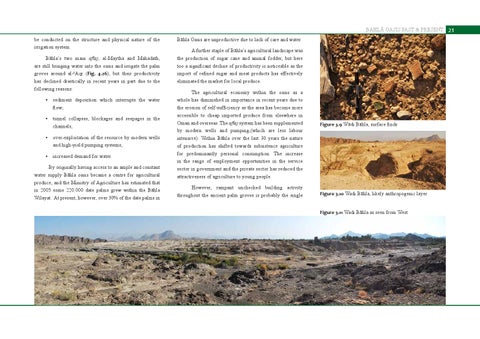
While the flanks of the mountains do not offer themselves for the practicing of agriculture in any meaningful way, their sparse vegetation has been used for centuries by Shawawi pastoralists and their goat herds. The flat bottom of the valley, narrowing slightly at the midpoint of the Bāhla oasis (Fig. 3.3), appears to have been a settlement area far into the pre-Islamic era, as has been corroborated by ancient burials and finds in the area occupied today by the al-Jamma Mosque north of al-ΚAqr, and the copious Umm an-Nar and Hafit remains in the ad-Dākhilīyah region in general. Indeed, the rich anthropogenic deposits which characterise the soil of the Bāhla oasis appear to stretch outside the current confines of the settlement areas along the northern extension of the
wādi, indicating earlier periods of occupation pre-dating the current limits of habitation (Figs. 3.8-3.11). Substantial pottery and lithic finds in the area corroborate the picture of an ancient settlement area potentially rich in archaeology. The settlement of al-ΚAqr sits at the foot of a mound occupied the famous fort of Bāhla. This location, on the high-ground at the bottleneck of the Bāhla valley provided the settlement with the immediate protection of the fort, but also afforded the inhabitants with expansive views towards the south and positioned the site well within the currents of cool air that descend from the Jebel al-Akhdar.
Climatology Settlement in Northern Oman is closely linked to the climate of the area and in particular precipitation levels, which are known to have varied substantially over the last millennia. Paleo-climatic research has established that from around 10-9.000 B.P. a substantial pluvial phase took place on the Arabian Peninsula as a result of a displacement of the Indian Ocean Monsoon northwards. The estimated increase
BAHLĀ OASIS PAST & PRESENT in rainfall by up to 30% would have had profound effects on the biogeography of the region and support a growing nomadic population. The gradual dying-down of this ‘wet period’ from about 7000BC increased the arid land areas and led to the localised concentration of water and associated food sources. This gradual increase in the aridity of the Arabian Peninsula appears to have peaked around the 3rd millennium BC, coinciding with the sedentarization of the ‘Jemdet Nasr culture in modern-day Iraq, and the sinking of wells into wādi beds for limited irrigation agriculture. This practice still continues to this day as can been seen from the well at Дārat al-Maghraf, were apart from taping ground water surface runoff could also be collected. The current climatic model for Bāhla is largely consistent with that of the ad-Dākhilīyah region in general. Temperatures range seasonally between around 40°C in Summer and 25-30°C during the winter months. Peaks well in excess of 50°C are not unusual during the summer. Precipitation does not tend to exceed 220mm per year, though torrential rains are known to occur periodically, bringing with them significant destruction on the infrastructure along wadi edges.
Morphology Unique amongst the oasis settlements of northern Oman is the large wall (Sur) of Bāhla oasis which encompasses it in its entirety and was constructed to protect the 347.5ha of productive plantations in its interior from raiders. While its 12km perimeter was built entirely from mud brick on shallow stone foundations, it counted with a number of access gateways, turrets, a pierced parapet and a sentry walk which
complemented its defensive capabilities. Reference to the reputed antiquity of the wall has been made by Costa (1983; 257) and more or less detailed drawings of the gateways have been produced by Atkins (2003). In recent times the curtain has been broken up in many stretches to allow for expansion of the urban development taking place within the oasis, as only small areas of the oasis actually lay outside the fortified area; these consisted primarily of some agricultural land on the west bank of the Wādi, cemeteries and scattered Shawawi habitation. A number of small mosques, known as the ‘flying mosques’ (Masjid al-Abad), located in a small valley to the north east of the oasis, pay tribute to the excluding character of the wall as they once housed a monastic Islamic sect.
Figure 3.4 al-ΚAqr, agriculture and irrigation
The Bāhla Oasis comprises a total of 9 settlement quarters or harāt spread out throughout the oasis. Some of these, such as Дārat al-ΚAqr, Ghuzeili and al-Hawiya have become attached to one another as the individual quarters grew. Others, such as Дārat al-Maghraf have retained their separate bounded nature by accommodating either the members of a single tribe, or craftsmen from a single trade such as potters. The locations of the individual harāt was determined by their proximity to the palm groves that the inhabitants farmed, but also by the nature of the terrain, the slightly higher ground located immediately above the falaj channels being favoured for reasons of defensibility, but also because fertile flat terrain had an inherent agricultural value which would be wasted by urbanisation.
Figure 3.5 al-ΚAqr, recording of irrigation patterns
Agriculture As elsewhere in Arabia, the potential for agriculture is determined by its main organising principle: the availability
Figure 3.6 al-ΚAqr, irrigation channels
19
20
ДĀRAT AL-ΚAQR (Bāhla): DOCUMENTATION AND HERITAGE MANAGEMENT PLAN of water. The arid environment and highly seasonal precipitation require complex and sophisticated water extraction, storage and management systems to not only collect the resource but also distribute it fairly over large agricultural areas.
Figure 3.7a,b Bāhla, 3D terrain model
In Oman this has been achieved since around 1000BC with the application of the famous falaj irrigation system, which appears to have been introduced into the region from South Eastern Persia (Cleuziou & Tosi 2007; 151). Water extraction was usually achieved by the construction of horizontal galleries into the alluvial fan of a mountain or into the higher reaches of a wādi. Within these galleries, which could measure up to several kilometres in length, condensation and underground aquifers could generate an impressive flow-rate of several hundred litres per second, such as the Falaj al-Kathmeen in Barkat al-Mawz. The Oasis of Bāhla received its water supply for a series of aflaj running north-south and entering the oasis from the north-west. The main falaj systems, al-Maytha (al-Methi) and al-Mahdith, al-Jizyayn, al-Maqil and ‘Ayn al-Lamih, enter from the north and the west but many others appear to
Figure 3.8 Wādi Bāhla
have entered the settlements from the surrounding territories (see preliminary report mrmewr calculations). Barth provides details on the relative sizes of the important falaj systems (Barth 1978: 56-57), where Falaj al-Maytha is by far the largest of the falaj systems, “arising in two different headwater areas and supplemented by a third source through the construction in 1966 of Falaj al-Gadid [Jadeed]” (Barth 1978: 56). Maqil (Makkil?) joins up with Maytha just outside the gate, Sabah al-Hawashim in Дārat al-ΚAqr. Abu Zayd ‘Abdullah b. Muhammad al-Riyami, the wali of Bāhla for 30 years under both the 20th century Imams, made significant improvements to the first three of its five aflaj (Wilkinson 1977: 100, 150-151), who also made other contributions towards the upkeep of the settlement and the Bait al-Mal properties. Jizyayn - the falaj with two branches - is mentioned at the beginning of the 17th century when the Nabahina rulers built a fort to protect Bāhla from attacks by the ‘Umayri malik of Sumayil and his Bani Hina allies (Kashf 1874: 147; also, Wilkinson 1977: 155 n. 21). The share of falaj water is normally decided through auction (Barth 1978: 58-60; Wilkinson 1977: 113); the price of abadda (the traditional unit of water share defined by a 12-hour flow in the channel) of water normally increases during the lean summer months. Northern (‘Alayet or upper) Bāhla seems to have had a better share of water: a high water table, extensive falaj channel network and many wells, a minor wādi and associated wells. While water from the wādi is still utilised for agriculture, as a result of a highly reduced flow over the last ten years, extensive areas of adjoining date plantation have dried up. The well network, mainly consisting of two types - the larger zigrah/jazirah wells and the simply sunk smaller localised wells, which had always supplemented the wādi flow and the falaj system, is increasingly falling into disuse. More specialised research, however, needs to
BAHLĀ OASIS PAST & PRESENT be conducted on the structure and physical nature of the irrigation system. Bāhla’s two main aflaj, al-Maytha and Mahadath, are still bringing water into the oasis and irrigate the palm groves around al-ΚAqr (Fig. 4.26), but their productivity has declined drastically in recent years in part due to the following reasons: • sediment deposition which interrupts the water flow; • tunnel collapses, blockages and seepages in the channels; • over-exploitation of the resource by modern wells and high-yield pumping systems; • increased demand for water. By originally having access to an ample and constant water supply Bāhla oasis became a centre for agricultural produce, and the Ministry of Agriculture has estimated that in 2005 some 220.000 date palms grew within the Bāhla Wilayat. At present, however, over 30% of the date palms in
Bāhla Oasis are unproductive due to lack of care and water. A further staple of Bāhla’s agricultural landscape was the production of sugar cane and animal fodder, but here too a significant decline of productivity is noticeable as the import of refined sugar and meat products has effectively eliminated the market for local produce. The agricultural economy within the oasis as a whole has diminished in importance in recent years due to the erosion of self-sufficiency as the area has become more accessible to cheap imported produce from elsewhere in Oman and overseas. The aflaj system has been supplemented by modern wells and pumping,(which are less labour intensive). Within Bāhla over the last 30 years the nature of production has shifted towards subsistence agriculture for predominantly personal consumption. The increase in the range of employment opportunities in the service sector in government and the private sector has reduced the attractiveness of agriculture to young people. However, rampant unchecked building activity throughout the ancient palm groves is probably the single
Figure 3.9 Wādi Bāhla, surface finds
Figure 3.10 Wadi Bāhla, likely anthropogenic layer Figure 3.11 Wadi Bāhla as seen from West
21
22
ДĀRAT AL-ΚAQR (Bāhla): DOCUMENTATION AND HERITAGE MANAGEMENT PLAN most destructive factor leading to erosion and desertification within the oasis by interrupting water distribution systems and upsetting the fragile microclimate created by the palmtree’s own shade. Core settlements
The oldest human remains in the Bāhla area are the mass-inhumations on the site currently occupied by the 13th century Mosque next to the Fort. This is in line with the common Umm an-Nar and Hafit practices to bury the ancestors on hill tops, while habitation tended to occur closer to the water sources in the wādi. Of the currently extant centres of habitation the main and the oldest quarters appear to be those surrounding the Fort and the mosque of Bāhla, often collectively known as the al-Harah Quarter, comprising al-ΚAqr, the principal, oldest and most extensive settlement, al-Hawuiyah, alGhuzeili and the Bait al-Mal properties, known as Bostan Dar. They form a ring along the southern, south-eastern and eastern boundaries. Al-Lahmah and al-Nadwa quarters lie to the west of the souq.
Figure 3.12 al-ΚAqr, zone D
Prior to the construction of the Sur wall which encompasses the entirety of the oasis and protects it from incursions many of the older harāt had to see to their own defence and were therefore walled, gated and fortified. These fortifications were retained even after the construction of the oasis wall and according to local informants the harāt gates would be closed during night time. These features have shifted outwards as the quarters went through successive expansions (Дārat al-ΚAqr, below). Many however, lost the need for fortification as the threats of tribal incursion disappeared. From this core - possibly representing the earliest phase of habitation - streets disperse in different directions, weaving a complex network of routes through
the oasis and connecting, but also wrapping around, the different harāt. There is a predominance of a north-south direction in the main routes, given the linear nature of the oasis, connected by a series of secondary winding routes running east-west. It is unclear today whether all harāt were walled and fortified initially and were accessed through clearly defined gateways. The gateways also controlled and monitored the secondary routes passing through the hārah. Settlements such as al-Maghraf used outcrops within the oasis to define their presence and boundaries, and consequently, have only a single gateway. Except Дārat al-ΚAqr, all settlements seem to have developed along a double-banked central street with dwellings on either side, with secondary routes leading away. Al-ΚAqr is somewhat different, in that, in each phase of expansion two routes defined a large lozenge-shaped territory between them, which gradually in-filled with dwellings, creating peripheral routes. Sefalet Bāhla
The harāt in lower Bāhla are less significant in size and lie isolated, when compared with the regular settlement pattern observed in upper Bāhla. Two of these are located against the eastern city wall. South of Дārat al-ΚAqr, the concentration of date palm plantation reduces considerably and gradually gives way to areas growing sugar-cane and other small crop, and finally to animal fodder. Summerhouses (masaif) constructed from reed mats or mud bricks dotted the agricultural lands, traditionally used by the inhabitants of the oasis during the hot summer months (Bandyopadhyay 1998: 365). More often these were simple cells, but some have evolved into somewhat more complex
BAHLĀ OASIS PAST & PRESENT structures through continued and now more permanent habitation. There are also structures connected with sugar cane harvesting and processing within the cultivation area, as well as simple field mosques.
3.3 History of Bāhla Oasis The area of the current Bāhla oasis is likely to have first seen settlement along the edges of the wādi, closer to the perennial pools which allow for easy access to water without the need for complex infrastructure. The earliest form of artificial extraction is likely to have been the sinking of wells into the wādi itself. Pottery remains and flint flakes have been found both as scattered surface finds as well as inclusions in the side-walls of gullies, along the northern area of Bāhla oasis, about 200m north of the current perimeter walls (Fig. 2.9). This serves as a likely indicator for an earlier phase of occupation which has left no evident architectural traces, but probably pre-dates the establishment of the Sur by several centuries. Indeed, from the archaeology of the ad-Dākhilīyah region in general and the existence of a substantial fort within the oasis it appears evident that Bāhla was a large and thriving community long before the advent of Islam. As the Capital of the al-’Atik tribe (Asad b. Imran Azd) during the early period of Arab migration into eastern Arabia Bāhla was often referred to as al-’Atik in the sources (Wilkinson 1977:188). The al-’Atik were members of the Imran Azd tribal confederation, the first Azd group to enter into the territory from the northern migration. The ‘Atik tribe laid the seed for the creation of two of Oman’s most impacting dynasties: that of the Nabahina (Banu Nebhan) and the Ya’ariba (Wilkinson 1988: 29). In the aftermath of the first imamate and the ensuing period of conflict the Nabahina
made Bāhla their capital and as such ruled over large parts of what is now central Oman for almost half a millennium. Among the most illustrious residents of the oasis can be counted the famous 10th century Islamic Scholar Abu Muhammad ‘Abdullah b. Muhammad, also known as Ibn Baraka. He is said to be buried in a small mausoleum that occupies the site of the mosque at which he used to preach in Дārat al-Dhurudh. While in general the documentation on medieval Oman is somewhat sparse, Bāhla is mentioned in the accounts of the Portuguese traveller and historian Joao de Barros (14961570) as being one of the three main cities of the interior of Oman together with Nizwā and Manah. The constant attacks and exploitative tributes by nomadic tribes which the oasis had to endure prompted the inhabitants to construct the 12km enclosure wall which constitutes the Bāhla Sur. Bāhla Oasis Defensive setup
As indicated above the Bāhla oasis was protected by the impressive Bāhla Sur, the 12km long perimeter wall which forms part of and envelops the entire World Heritage Site. One noteworthy factor for the Oasis of Bāhla is the comparative paucity of isolated watchtowers which are normally ubiquitous in Oman’s oasis settlements. Of unsophisticated construction these towers had a function that went beyond the merely defensive and instead took on the charge of territorial markers, stating claims of ownership in the often disputed agricultural belts of Oman’s open oases. In Bāhla, however, a more cooperative attitude appears to have existed between the tribes, as is evidenced by the construction of the Sur. Acting like a defensive membrane the oasis wall provided a cohesiveness to the community which elsewhere was lacking, and it appears that this obviated the
Figure 3.13 al-ΚAqr, façade of dwelling G8
23
24
ДĀRAT AL-ΚAQR (Bāhla): DOCUMENTATION AND HERITAGE MANAGEMENT PLAN need for the habitual tower constructions. General structure of oasis and habitation quarters
The town of Bāhla consists of two parts: the historic core of Bāhla, which is enclosed by the outer wall or Sur; and New Bāhla which comprises an area of post-1970s development which straddles the highway from Nizwā some 2km to north. There are also further pockets of new development to the west of the wādi such as al-Mustaghfir.
Figure 3.14 al-ΚAqr as seen from the Bāhla Fort
The settlement, sited at a natural oasis, is enclosed, with its agricultural hinterland within a mud-brick wall and dominated by a Fort and Grand Mosque located on a high rocky outcrop at the centre. Settlement within the oasis is comprised by a number of harāt of varying ages, though likely standing on habitation phases of great antiquity. These are enclosed, generally self-contained settlements of traditional mud brick, with two-storeyed and often contiguous dwellings and associated communal and functional buildings such as mosques, sbal, bath houses, with their associated stretch of aflaj. Traditionally the harāt housed distinct communities, based around family/tribal groups.
3.4 Modern Bāhla With the increased wealth of its population and demographic growth over the past 20 years the appearance of Bāhla has changed fundamentally, from a once green oasis to a heavily urbanised urban space interspersed by occasional green areas. There is no question that at the current rate of development within the next 5-10 years there will be no more palm trees standing in the former oasis. The construction of the modern hardtop road through the core of the oasis has separated the souq from al-ΚAqr and erased all traces of habitation around the northern and western sides of the Fort. While this has eased access and transit for the region at large it has also fragmented the community and encouraged urban growth inside the oasis. Increased affluence has also led to the abandonment of the traditional houses in favour of modern buildings outside the ancient settlement perimeters, giving the oasis a profoundly derelict appearance. The continued dereliction is a problem no only in so far as it affects the overall appearance
BAHLĀ OASIS PAST & PRESENT of the site and detracts from its touristic potential, but also in that it imbues traditional settlement quarters as a whole with negative connotations.
Settlements & Demographics Bāhla displays a demographic structure that is not uncharacteristic of most oil-boom countries, with a large percentage of young people and relying to a great extent on foreign labour. In 2009 the total population of Bāhla was 62,752 persons, including 11,028 non-Omanis. As per the 2009 census the number of households in Bāhla totalled around 8,888, located in 11,925 housing units. Within the Oasis itself, it is estimated that there were some 12,500 residents, a number likely to have risen by the time of this report. The population structure of Bāhla is typical of adDākhilīyah as a whole. It is characterised by a high proportion of young dependants (over half of the population is less than 15 years old) and a small proportion of older dependants (less than 5% of the population is aged 65 or above). There is thus a high dependency ratio, with the working age population having to support a relatively large number of dependants, reflecting the traditional Omani household structure of large extended families. The average household size in adDākhilīyah was 5.5 persons per household in 2003. In addition to the overall demographic structure, Bāhla is characterised by several other socio-demographic themes which require consideration in the Management Plan: • The size of traditional dwellings is often not large enough to accommodate the average modern Omani family without overcrowding; • Many of the dwellings in Bāhla, owing to the size
of the rooms, the heights of the ceilings, the difficulty in accommodating modern sanitation and domestic appliances and the maintenance and cleaning requirements, are perceived by the majority of the local population as falling below modern Omani standards of living; • Local outward migration as the population seeks to move to areas offering more modern accommodation available in New Bāhla or elsewhere in the Oasis has led to abandonment of many of the traditional buildings; • The creation of unbalanced residual populations within the old hārah has led to a decline in the social fabric of the community and dereliction of the architectural fabric;
Figure 3.15 Bāhla souq
• There is significance emigration from the region either to the capital area or the UAE for employment reasons. A growing number of dwellings within the old hārah have been vacated by their owners and are instead being rented to non-Omani workers and small-business owners who reside there. This provides additional income to the owners while simultaneously providing cheap housing for the working community. While this type of arrangement is beneficial to both sides and ensures a degree of maintenance being carried out on the dwellings keeping them habitable, the lack of sanitary infrastructure, waste disposal and basic utilities make the living conditions in the hārah less than attractive.
Figure 3.16 Bāhla souq
25
26
ДĀRAT AL-ΚAQR (Bāhla): DOCUMENTATION AND HERITAGE MANAGEMENT PLAN
AL-ΚAQR: DOCUMENTATION & ANALYSIS
4 al-ΚAqr: Documentation and analysis
1. Introduction The largest and likely one of the oldest still extant settlement quarters of Bāhla is that of al-ΚAqr, located at the foot of the Jama Mosque and the Bāhla fort. This Management Plan is primarily concerned with the current state and future use of this hārah and its two associated quarters Ghuzeili and al-Hawiya. Special attention has been given to the morphology of the urban environment, and the social and physical factors which impacted its evolution. Additional discussion will address the nature of the architectural units and their functions within the totality of the urban environment, complemented by detailed illustrations and mapping at the end of the chapter.
Figure 4.1 Bāhla, al-ΚAqr. Aerial photograph 1975
27
28
ДĀRAT AL-ΚAQR (Bāhla): DOCUMENTATION AND HERITAGE MANAGEMENT PLAN
History The precise history of occupation of al-ΚAqr is impossible to determine with any kind of certainty without extended archaeological excavation or substantial archival/ literary sources. There is, however, evidence that the area was occupied well within the pre-Islamic period as has been shown by funerary remains at the site of the Jamma Mosque. Recent excavations conducted by the Ministry of Heritage and Culture (MHC) within the Great Mosque (January 2003), sited on the same rocky outcrop as the Fort, indicate that it could well be one of the earliest mosque locations in Oman. A detailed analysis of collected material is presently under way. The commanding location of the mosque overlooking the presumed earliest settlement (Дārat al-ΚAqr) is significant and suggests a sacred site of great antiquity. The remains uncovered in its interior, dated to the 3rd millennium BC corroborate the image of extraordinarily long history of occupation in the area today occupied by alΚAqr.
morphology & Layout An analysis has been carried out of failure types affecting the 177 mud brick structures that still retain their original fabric. Out of a total of 241 building units that make up the settlement, 23 are built in their entirety from cement and concrete whereas 23 are of mixed construction (Fig. 4.21)
Figure 4.2 Bāhla, al-ΚAqr, settlement plan
The settlement of al-ΚAqr is, in fact, comprised of three urban nuclei (Hawuiya, al-ΚAqr, al-Ghuzeili) known collectively as al-Harah and which gradually coalesced into one more or less homogeneous sickle shaped settlement which wraps around the mound below the mosque and at the
AL-ΚAQR: DOCUMENTATION & ANALYSIS foot of the Fort. On the downhill side it is hemmed in by the palm groves and the falaj channels which irrigate them. The great antiquity of the finds at the mosque makes it likely that the area today occupied by al-ΚAqr also stretched far into the pre-Islamic ages. While without invasive excavation techniques it is impossible to determine the precise age of the settlement, the reputed Persian origin of Bāhla’s aflaj network and Fort hint at the existence of an important population in the area. Indeed the creation of the falaj and the associated agricultural surplus would have been prerequisites to urban development within the Oasis. The Harah Quarter forms a ring around the Great Mosque and extends in two prongs to face the eastern and southern boundaries of the fort. The Jamma Mosque (Fig. 4.3) has been described and documented by Costa in some detail (Costa 2001: 73-80) in which he notes with interest the isolated prominence of the artificial platform, raised above the surrounding harāt and facing the ‘towering mass of the citadel’ (Costa 2001: 73) Topographic features surrounding the fort, such as the steep slope on the eastern edge, are carefully engaged with to produce distinct architectural results. Towards the south and the west of the Great Mosque, however, the communal buildings and dwellings of Дārat al-Hawuiyah virtually attach themselves to the mosque, leaving almost no space between. The ring of buildings comprising the Harah Quarter varies in depth, being the deepest towards the east (al-ΚAqr), south (al-ΚAqr), southwest (al-Hawuiyah and al-ΚAqr) and west (al-Hawuiyah). As the ring branches out towards the fort the two settlement arms reduce in depth, to the extent that at the far northern end the arm (Дārat al-Ghuzeili) contains no more than a single strip of dwellings. The far western edge
(Bostan Dar), likewise, reduces to a double loaded lane of small single-storied dwellings for the guards (askaris). There seems to be some confusion in the minds of the local inhabitants, especially amongst the younger generation, as to where al-ΚAqr ends and al-Ghuzeili begins. Al-Hawuiyah and al-ΚAqr, again, do not have any specific architectural features clearly defining their boundaries.
Figure 4.3 al-ΚAqr and Jamma Mosque as seen from the Fort
29
30
ДĀRAT AL-ΚAQR (Bāhla): DOCUMENTATION AND HERITAGE MANAGEMENT PLAN Дārat al-ΚAqr and al-Ghuzeili
At some point expansion of Дārat al-ΚAqr began northwards. By then, as this expansion suggests, the need for having a fortified settlement was no longer a priority; thus the settlement edge - especially on the west, facing the Mosque and the Fort - is characterised by a high degree of porosity. This phase, yet again, locates itself on the edge of the outcrop, conserving valuable low-lying arable land. Possibly following the same peripheral route structure cut across by earlier access routes to gateways (this settlement structure now somewhat eroded by later ad hoc developments and outward expansions; it may well be that the settlement strip, extending south up to the Sabah al-ΚAqr and north is a later addition), the northward extension occurred from the eastern end of the square U2 with the street arcing out towards the edge. Another lozenge-shaped zone of development was added to this subsequently, extending the peripheral street Figure 4.4 al-ΚAqr, Sabah al-Nargila, gate A1
and expanding the settlement along the eastern edge of the fort. This latter formation is bisected by an extension of the route on the southern side of the fort creating considerable confusion regarding the extent of the northern extension of Дārat al-ΚAqr and the beginning of Дārat al-Ghuzeili. It was unclear to us whether the southern tip of the elongated formation or the bisecting route marked this transition. The two main tribes residing in al-ΚAqr, the al-ΚAbri and al-Qassabi (the caretaker/ person responsible, mosul, for al-ΚAqr was Sa’id b. ‘Ali b. Humaid al-Kassabi), are also present in al-Ghuzeili, further stressing this blurring of boundaries. What is clear from the structural morphology of the settlement, however, is that Дārat al-Ghuzeili developed initially formeing part of the northern extension to Дārat al-ΚAqr. A further thin, arched settlement strip extending as far as the northern tower of the fort, possibly encroaching on the garden once again, completes the extent of Дārat alGhuzeili, where the traditional mosque and sablah structures have been replaced by modern structures. Дārat al-Hawuiyah and Bostan Dar
Figure 4.5 al-ΚAqr, Sablah F7
Figure 4.6 al-ΚAqr, interior of dwelling E1
The extent of Дārat al-Hawuiyah is also marked by a sablah, which completes a square on the southern edge of the Great Mosque, at the junction of the two earliest phases of Дārat al-ΚAqr. According to local knowledge, the sablah, which now lies disused, is about 150 years old and was once destroyed in a fire. Part of this square is raised to form a terrace in level with the sablah, accessed through a flight of steps; a small coffee preparation room of recent blockwork construction marking the edge of the terrace also lies disused. The older sablah itself is a formidable structure, about 17m long and 5m wide, with a single door from the terrace and 5 windows on its southern and 2 on its eastern façade; its partially collapsed roof is in concrete poured over a timber and ply ceiling, replacing, as is so
AL-ΚAQR: DOCUMENTATION & ANALYSIS often the case with many traditional buildings in Bāhla, the earlier traditional roofing system. A diminutive square room attached to the northern side (back) of the sablah hall, acted as the original coffee preparation room. An open staircase, positioned perpendicular to the sablah by the door, defined the western edge of the terrace; it led up to the roof, which was possibly used as an auxiliary gathering space.
Civic structures & Public Spaces Mosques
Bāhla counts with one of the most important mosques of the ad-Dākhilīyah region. The Jamma Mosque, situated on the summit of the hill around which al-ΚAqr grew, stands on the site of an important pre-Islamic sacred space. Human remains and artefacts unearthed there and dating to the Umm an-Nar period (3rd millennium BC) highlight the at times astounding degree of ritualistic continuity that one can still observe in Oman’s sacred places (Cleuziou & Tosi 2007; 122). The mosque’s richly decorated mihrab dates back to 917 AH/ 1511 AD, designed by one of the foremost exponents of this craft tradition in the 16th century, Abdullah b. Qasim b. Muhammad al-Humaimi of Manah (Baldissira 1994). The other unique feature of the mosque is its architectural organisation (Bandyopadhyay 2003), and the manner in which the spatial planning negotiates the topography; while the access to the mosque terrace will have altered with the changing nature of the harāt. Further excavation and research would, no doubt, establish the importance of this character zone of Bāhla in Omani history.
Sablahs
There were several structures within the settlement referred to as ‘sablah’ (pl. sbal) or the semi-public male reception halls (majalis Κamm), a term which Bonnenfant et al believes, is entirely unique to Oman (Bonnenfant et al 1977: 115). While in many settlements of ad-Dākhilīyah most sbal were designated for the use of a particular tribe - in Bāhla these appear to be more communal in nature. It is this semi-public nature which distinguished these from the more private reception rooms (majalis khass) of the dwellings of the more affluent. Many sbal had a slightly more extended function, serving as the official reception room and office for the wali (Sablat al-Wali), or acting as QurΜanic school
Figure 4.7 al-ΚAqr, section of dwelling G8 in its projected original state
31
32
ДĀRAT AL-ΚAQR (Bāhla): DOCUMENTATION AND HERITAGE MANAGEMENT PLAN (madrasah) for young children during the mornings and as a sablah during the days of the week. In other settlements a sablah was also the venue for the auctioning of falaj water rights. Three of the four main sbal in Дārat al-ΚAqr, Bāhla are associated with gateways (sabah) into the harāt: Sabah al-Nargilah (or Sabha al-Hawuiyah), Sabah al-Hawashim (or Sabah al-Jassah) and Sabah al-ΚAqr (Fig. 4.8, 4.9) (or Sabah al-ΚAssah). Such sbal are always elevated to the first floor level. At the gateway al-ΚAqr a pronouncedly elongated
sablah is accessed through a staircase off an adjoining narrow lane. The staircase is located behind the qiblah wall of the mosque attached to the gateway (Masjid al-ΚAssah). A wide sentry-walk forms the approach to the sablah on the first floor, flanked by a coffee making cubicle on the left and a space to store drinking water on the mosque roof. A coffee making space is also found in the sablah above the gateway, Hawashim. Here, an enclosed staircase runs along the eastern edge of the gateway to the first floor sablah and continues further to reach the roof. Both sbal will have had a significant surveillance role to play. Surveillance perhaps was not important for Sablat alHawuiyah, the substantial communal meeting hall located on the southern side of the base of the hillock on which the Friday Mosque stands. The sablah is located on a raised terrace, which is set back from the street to form a small square marking the meeting point of the two settlement quarters, Hawuiyah and al-ΚAqr. On the terrace, the rectilinear volume of the meeting hall is set back to create a substantial front court. A prominent staircase providing access to the sablah roof forms the western edge of this terrace, while the eastern edge is defined by a coffee-making room of modern construction. Originally, the ritualised coffee preparation took place in a cubicle projected beyond the northeast corner of the meeting hall. Although the sablah belonged to the Hawuiyah quarter, its location, prominence and proximity to the Friday Mosque suggests that it performed a much wider role.
Figure 4.8 al-ΚAqr, Sabah al-ΚAqr K1 as seen from the East
Figure 4.9 al-ΚAqr, Sabah al-ΚAqr K1 as seen from the West
The possession of a sablah by a social group or grouping reflects their demographic, political, economic and social prominence within the settlement. The most important function of the sablah was to act as the general meeting place for the tribe, the times of which were determined by the times of the five daily prayers. The
AL-ΚAQR: DOCUMENTATION & ANALYSIS discussions that ensued during these meetings were usually centred on the hottest political or social topics of concern to the local community or the tribe. The sablah was also used as a meeting place during times of celebration and mourning, and as overnight accommodation for guests. In the past, during wars, the sablah would also act as the fortified position of a tribe; the spatial and formal peculiarity and complexity of a number of sbal in the Mudayrib oasis, arise directly out of such a requirement (Bonnenfant et al 1977: 116). A similar defensive arrangement is found in an isolated Masarir sablah (Burj Al-Masarir) within the oasis between Дārat al-Bilad and al-Fayqayn in Manah oasis. Compared to the sbal of Mudayrib, the ones in Дārat al-Bilad are relatively simple in their spatial organisation. In Дārat al-Bilad a comparatively less complex entry sequence lead into the rectangular reception hall, which unlike Mudayrib or a twentieth century example from Дārat al-ΚAqr in Nizwa, is never fronted by an arcaded gallery (liwan). Also, ancillary communal facilities associated with the sbal do not always make up a cohesive institutional unit, suggesting instead their more integrated presence within the harāt. Thus integrated, some sbal in Дārat al-Bilad are associated with the surveillance and protection of the entire harāt. The Masruri sablah, Sablat ash-ShaΚban and the Wardi-ΚAmri sablah, Sablat ad-DaΚnayn/DaΚnin, are incorporated into an observation turret and the western gateway, respectively. These sbal were clearly positions of surveillance, and as the loopholes on the floor of some of these sbal indicate, a position from where a gate would have been defended. This connection between surveillance and the male gathering place seems to have been part of the earliest defensive tradition of South Arabia.
Dwellings The residential architecture of al-ΚAqr stands testament to the importance and wealth of this once great town. The vast majority of the dwellings stand at least 2 stories high, some indeed, rise to a 3rd level, count with cellars and underground storage facilities and are accessible from street level. In terms of materiality all traditional structures are built from mud brick which, though very perishable and requiring constant maintenance, afforded the buildings with an extraordinary thermal mass that kept their interiors temperate throughout the year (Fig. 4.22). Complex ventilation systems are in evidence in most buildings, relying on narrow slits near the ceilings which would encourage the interior convection of air without letting in sunlight and maintaining privacy. Roof terraces are also common in most dwellings, and these
Figure 4.11 Partial reconstruction of dwellings E1 and E2
Figure 4.10 al-ΚAqr, interior if dwelling C4
33
34
ДĀRAT AL-ΚAQR (Bāhla): DOCUMENTATION AND HERITAGE MANAGEMENT PLAN could be used for the drying of dates as well as spending the cooler parts of the day during mornings and evenings. The architectural genotype is that of the Omani townhouse, characterised by large entrance lobbies with stairwells stretching off into the various upper levels (Fig. 4.10), which tend to be placed at unequal heights from one-another. This is partially due to the complex terrain which needed to be negotiated, but is also indicative of the gradual expansion of these residences, which expanded and became more elaborate with the increased wealth of their owners. In isolated cases, particularly in zones B and D, some of the dwelling had private access to the falaj channel which passed straight through the entire quarter. Apart from being a feature which would likely have reflected the wealth of the owners of these houses, it may also serve as an indicator of social status within the community.
Figure 4.12 Dwelling K7 with bathing facilities K6
The wealthiest individuals of al-ΚAqr appear to have resided around the central square known as Rahbat al-Ghilah (originally used for the manufacture of mud-bricks), with dwellings such as G8, E1, E2 and D7 taking centre stage with decorated façades and large wooden doors of exquisite craftsmanship. A number of important dwellings are located immediately outside the settlement perimeter. K7, belonging to the al-Qassabi tribe who arrived when al-ΚAqr had already reached its current extent, stands just east of the Bab al-Jasah and was built into the palm groves immediately adjacent to the branching of the falaj channel. This dwelling, standing two floors high, takes the shape of a small fort with a D-shaped tower oriented towards the walls of al-ΚAqr, as if to shield the property from that side.
Figure 4.13 al-ΚAqr, falaj splitter in area C
The vast majority of dwellings in al-ΚAqr are
abandoned, tough there are still substantial numbers of local residents, either living in their own houses or renting them out to expatriates (Fig. 4.21).
Water Besides the topography of the terrain it was the layout of the settlement’s water supply which had the biggest effect on its evolutionary patterns and eventual urban morphology. Scholars have pointed out that the inherent rigidity of irrigation systems, determined by topography, flow rate and head, often transforms them into the meta-structure or skeleton along which an associated settlement evolves. al-ΚAqr is an excellent example of this, as is visible in the gradual expansions of the settlement downhill, eventually spilling over the boundary drawn by the channels. As these could not be re-directed they were functionally integrated into the urban fabric of al-ΚAqr. Water is today brought into the settlement from the east via the main channel of the Falaj al-Maytha, surrounding what is now an enormous parking lot built into the former palm groves. Its construction has unfortunately completely obliterated any evidence of the other falaj which entered the settlement slightly further to the north (Fig. 4.26). The Falaj al-Maytha enters al-ΚAqr immediately north of the gate Bab al-Nargilah (Fig. 4.3), noted here as A1, and passes underneath some of the dwellings in zone A, from where it reaches the western corner of zone B. integrated into the sub level of unit B1 the falaj arrives at an open space where it is split into two diverging channels: the right one following the edge of the buildings and continuing towards the mosque, and the left one flowing through zone B and again splitting into two in the open space adjacent to the Bab
AL-ΚAQR: DOCUMENTATION & ANALYSIS al-Jassah gate. At this location there is a small pool (Fig. 4.13) at which a number of branches converge and divide, highlighting the extraordinary complexity of Bāhla’s falaj system. There is evidence of an older channel flowing into or out of this pool to service a public water access and palm groves lying immediately south of zone B. Here again the right arm leaves the settlement to irrigate the palm groves to the south, whereas the left arm continues along the edge of zone D, marking the southern limits of the settlement and providing access to washing and ablution facilities before finally exiting the settlement outside of the Eastern mosque.
importance to the construction and maintenance of public wells, of which there appear to have been at least 3 dotted around the settlement. Two of these were of the simple drawbeam type while a third, located near what is now the parking lot, was of the larger animal drawn type known as a zigrah.
While the falaj supports a respectable flow rate of around 50-100 l/s, this is significantly below the original carrying capacity of the channel which has been severely diminished by the lack of adequate maintenance of the system and the much larger amount of extraction upstream.
Defence
Apart from the famous falaj channels Oman’s vernacular settlements tended to also be supplied by water from intra muros wells. They could be both public or private depending on their location, and were habitually used to supply the household or an entire quarter with water. At Bāhla not all residents had access to the waters of the falaj, giving added
Due to its significantly larger production capacity the zigrah type of wells were usually used for the irrigation of small plots of land, whereas the standard draw-beam well was employed for domestic supply.
The dominant axis of Дārat al-ΚAqr lies east-west. The three extant gateways, all lying on the south and southwestern edge of the harāt, although dilapidated are clearly recognisable from their features. Also, gateways in central Oman have traditionally had certain functional elements associated with those; the ones in al-ΚAqr are no exception to this rule. While we are aware of at least two earlier positions of gateways and a still extant narrow emergency access passage on the eastern end of the settlement, there is no evidence of gateways on the northern edge, at all. While this may well be due to the absence of gateways altogether
Figure 4.14 al-ΚAqr, city walls between areas C and D
Figure 4.15 al-ΚAqr, oasis and defensive perimeter
35
36
ДĀRAT AL-ΚAQR (Bāhla): DOCUMENTATION AND HERITAGE MANAGEMENT PLAN from that direction, as the earlier phases of settlement saw no such need, the obliteration of gateway position/s due to successive expansion of the harāt (see below), cannot be discarded (Fig. 4.23).
Figure 4.16 Interior of the Bāhla Fort after its recent restoration
The best preserved of all three gateways is the Sabah al-Jasah, orientated northwest-southeast, with a sablah of the same name located above the entrance passage on the first floor. Flanked by recessed seating benches on either side, the gateway still retains one leaf of a solid wooden door (bab) on its southern end. An arch marks the other end of the passage leading into the settlement. Within the passage, immediately south of the entrance door, a narrow opening and a few steps gives access to a small open-air mosque - the floor slightly raised above the entrance level, recognisable solely through the shallow recess of a niche against the wall flanking the entrance door outside the settlement. The arched opening on the inside of the settlement has another rectilinear opening beside it with an enclosed staircase running up against the southern wall of the gateway to the first floor sablah. The
staircase and the sablah are possibly later additions to the gateway structure. The staircase leads up to a first floor landing with an attractive balcony overlooking the open space between the dwellings and the gateway leading up to the mosque. The sablah, the roof of which has already collapsed, has a number of windows on two external facades and two prominent niches on the inside. The southwest corner of the sablah has been ingeniously manipulated to access a small room for coffee preparation, which sits above a now-disused access to a falaj channel. The sablah-s are communal halls, usually tribe-specific - however open to many tribes in al-ΚAqr, where the male members of a tribe and its client groups assemble before or after the five daily prayers and during periods of war, strife or celebrations to discuss issues of communal relevance. During such sessions, it is the client group’s duty to prepare coffee and keep the supply of sweetmeat going. The sablah would act as a guest room during visits from friendly groups, but are also useful positions to conduct surveillance of adjoining terrain. The isolated nature of the gateway suggests a possible later phase
of settlement development. The function of these gates was not merely to keep out unwanted visitors or enemies, but also as a node of communication between the inhabitants of the harah and the outsiders. This can be illustrated by the construction of meeting halls or sbal atop many of the gates of Дārat al-ΚAqr. On the whole one does not find high-ground settlements in Bāhla as it seems to have been a priority to settle close to the water channels and the agricultural lands, though not so close that it would detract valuable land. This results in a foot-of-hill location for most harāt. While this type of siting provided the settlements with slightly higher ground from which to survey the surrounding territory, the decision to not occupy the hilltops themselves forced settlements to stretch over a larger area, and thus exposing a larger amount of flank towards the outside. Settlements, however, tended to grow outwardly, often integrating the defensive perimeter into newly built structures and dwellings with powerful external walls and small tapered turrets. In the case of Дārat al-ΚAqr substantial fragments of the walls are still standing, though they have at time collapsed or been demolished to make way for newer developments. Their mud brick construction is still clearly visible, rising to an original height of some 3-4m at parapet level. A substantial wall walk allowed for quick access to relevant sections and enhanced the defensive aspect of the feature. Due to the irregular construction it varied substantially in thickness.
Bāhla fort
Inducted into the UNESCO World Heritage List in
1987 the Bāhla Fort is likely to be one of the oldest standing structures in the Oasis. While there is evidence of a number of expansions taking place during the Islamic Era, in particular during the Nabahina Imamate, there is little doubt that one would find a Persian origin for the earliest fortifications at this location. The site is also said to have been one of the main locations of Khawārij resistance during the reign of Harun al-Rashid (AD 786-809) together with the other great centres of Central Oman Rustaq, Izkī and Nizwā.
AL-ΚAQR: DOCUMENTATION & ANALYSIS material has been accumulated on it.
In its current form it is the largest pre-gunpowder fort in Oman and one of the largest in Arabia. Standing on a hill some 50m above the wādi floor, overlooking the surrounding countryside with an ample visual horizon it is an imposing sight. It rests upon solid stone foundations which in certain locations rise up to some 10m above ground level and provide support for its largest towers. Though a fascinating structure, the Bāhla Fort does not fall within the scope of this report as it has been the subject of a number of heritage management interventions over the past 20 years and a significant amount of documentation
Figure 4.17 Panoramic perspective of the Bāhla Fort
37
38
ДĀRAT AL-ΚAQR (Bāhla): DOCUMENTATION AND HERITAGE MANAGEMENT PLAN Figure 4.18 al-ΚAqr, base plan with unit numbers
AL-ΚAQR: DOCUMENTATION & ANALYSIS Figure 4.19 al-ΚAqr, zoning plan
39
40
ДĀRAT AL-ΚAQR (Bāhla): DOCUMENTATION AND HERITAGE MANAGEMENT PLAN
Figure 4.20 al-ΚAqr, building types and components of the settlement
AL-ΚAQR: DOCUMENTATION & ANALYSIS
Figure 4.21 al-ΚAqr, types of construction
41
42
ДĀRAT AL-ΚAQR (Bāhla): DOCUMENTATION AND HERITAGE MANAGEMENT PLAN
Figure 4.22 al-ΚAqr, usage status of buildings and dwellings
AL-ΚAQR: DOCUMENTATION & ANALYSIS
Figure 4.23 al-ΚAqr, settlement accesses
43
44
ДĀRAT AL-ΚAQR (Bāhla): DOCUMENTATION AND HERITAGE MANAGEMENT PLAN
Figure 4.24 al-ΚAqr, dwelling accesses
AL-ΚAQR: DOCUMENTATION & ANALYSIS Figure 4.25 al-ΚAqr, social structure and tribal mosaic
45
46
ДĀRAT AL-ΚAQR (Bāhla): DOCUMENTATION AND HERITAGE MANAGEMENT PLAN
Figure 4.26 al-ΚAqr, partial survey of the falaj network
AL-ΚAQR: ARCHITECTURAL VALUES AND THREATS TO SITE’S SIGNIFICANCE
5 values AND threats TO SITE’S SIGNIFICANCE
This section addresses the main architectural values of the settlement of al-ΚAqr and the principal threats that are affecting its outstanding qualities. By being inscribed in the UNESCO World Heritage list Bāhla as a whole, and al-ΚAqr in particular, both oasis and settlement have an already accredited and acknowledged cultural value which requires no further justification. It is, however, of relevance to point out structures and elements of particular significance which require attention.
5.1 urban and architectural values • Due to the excavation carried out at the Friday Mosque it has become clear that the earliest phases of occupation settlement of al-ΚAqr is likely to date back to the 2nd-3rd millennium BC. This great antiquity warrants further study and archaeological intervention within and around the settlement
• The hillside location of al-ΚAqr required a complex negotiation of the terrain which resulted in distinct ownership patterns as dwellings grew closer in distinct clusters. • The antiquity of the settlement is likely to be accompanied by the antiquity of the falaj irrigation system which hems substantial parts of the urban space against the hillside. The extraordinary complexity of the falaj, which splitters, pools, side branches, etc., hints at the gradual growth and expansion of the system, a more detailed study of which is necessary. • Many of the down-hill dwellings of al-ΚAqr are located along and atop the falaj as it winds around the hill. The inclusion of the falaj into the interior of houses is an interesting feature which must be preserved and may be showcased. • Public access point to the water channels via mosques, bathing areas and water collection points are intrinsic meeting points which articulate Figure 5.1 al-ΚAqr as seen from the Friday Mosque
47
48
ДĀRAT AL-ΚAQR (Bāhla): DOCUMENTATION AND HERITAGE MANAGEMENT PLAN essentials aspects of the settlements social life • The grand architecture of many of Bāhla’s houses, in particular those located within zones B, C,D, G and E are an expression of the once-great past of the quarter and require attention. • The proximity of the palm groves to the dwellings, especially in zones D and K are a relatively unusual feature for a settlement in such an advanced state of decay. The form an essential buffer zone between the old Ήārat and the unchecked modern developments which have destroyed much of the oasis’ original lush appearance.
5.2 Historical Values
• Bāhla incorporates a series of defensive features such as large gates and powerful walls which, in addition to the proximity of the Bāhla Fort and the Sur, provided the settlement with an additional defensive perimeter.
The Fort and the wall, Sur, are surviving testimonies to the former status of Bāhla as the capital and political centre of the Omani state, located within a historically significant conflict zone. They are surviving indications of the past prosperity of the town and remnants of the influence that Bāhla had on the region, Oman and Arabian Peninsula as a whole. The periodic concentration of power within a fort in such close proximity to the harāt had an important effect on
• The Jama` Mosque, placed atop the hill overlooking al-ΚAqr and the Bāhla oasis, is one of the most Figure 5.2 Bāhla Fort as seen from Friday Mosque
important sites of the whole ad-Dākhilīyah governorate. Its size, age and emplacement above an important archaeological site afford this building a strong link with Oman’s great pre-Islamic past.
Bāhla represents a story of continuing historic development, from the prehistoric period of the 3rd millennium BCE to the main phases of development of the Fort of 9th, 17th and 19th centuries CE. Bāhla – the former capital of Oman
AL-ΚAQR: ARCHITECTURAL VALUES AND THREATS TO SITE’S SIGNIFICANCE the manner in which the collective settlement quarters of alΚAqr developed. Association with learning, Ibādism and artisanry
Bāhla’s association as a traditional and influential ‘bed of learning’ can be traced back for many centuries and many famous Omani scholars and poets have worked and taught here, including Ibn Baraka (also known as ΚAbu Muhammad ΚAbdullah b. Muhammad). He is acknowledged as having established, during the 11th century CE, a conservative view of thought on the collapse of the First Ibādi Imamate, which gave rise to the Rustaq School. It is believed that a small partially collapsed mosque within Дārat al-Dhurudh, south of al-ΚAqr, is where he regularly preached and is also where he is said to have been buried. The richly decorated and ornate mihrab of the Great Mosque dates back to 1511 CE, designed by one of the foremost exponents of this craft tradition in the 16th century CE, ΚAbdullah b. Qasim b. Muhammad al-Humaimi of Manah .
5.3 Social (symbolic, spiritual and political) values The intangible elements that contribute to the universal value of the World Heritage Site are less easily identified. But these elements whether experienced as a resident or visitor are no less important than the physical or tangible significances. The Friday Mosque, sbal, women’s prayer areas
The Friday Mosque, an early building within the
Figure 5.3 al-ΚAqr, walls and harāt towards zone D settlement, formed one of the original spiritual, social, educational and political foci of the community which is an integral part of Islamic life. This, combined with the many communal and semi-public meeting halls dispersed through the settlement quarters, provided the nuclei of social life. The women performed their ablutions and prayer in designated areas designed to safeguard privacy. These are important points of female congregation, apart from the regular coffee sessions held at homes.
Ibadism and the development of Islamic thought
Bāhla is recognised as the one of the most likely locations associated with the birthplace of Ibadism, one of
49
50
ДĀRAT AL-ΚAQR (Bāhla): DOCUMENTATION AND HERITAGE MANAGEMENT PLAN the oldest schools of Islamic thought. The ideals of Ibadism, which have had influences throughout parts of the Arab world, are reflected in the fabric of the WHS through the simple and quiet dignity of many of the mosques. Social cohesion
Like many other core settlements of the ad-Dākhilīyah region, the core settlement complex illustrates a mixture of tribes – of complementary and opposed political affiliations. The three settlement quarters, Hawuiyah, al-ΚAqr and Ghuzeili, evolved socially retaining a degree of tribal cohesion and spatial integrity. Figure 5.4 Gate and Sablah C11
All settlement quarters, although autonomous, had their own communal meeting halls, and the residents worked together at a supra-tribal settlement level. This is evident in the gradual disappearance of defined boundaries and gateways to virtually merge the three settlement quarters – although boundaries appear to be present in the erstwhile residents’ minds. The settlement quarters are indicative of division of labour – for example, the tribal groups residing in Дārat alHawuiyah were in the main engaged in the activities of the souq.
5.4 scientific and research value Bāhla Fort and Oasis has considerable potential to contribute to archaeological, historical and anthropological understanding of human occupation in the region as well as the development and spread of Islam throughout the world.
Pre- and early-Islamic activity
Excavations at the site of the Friday Mosque have already identified the site as potentially one of the earliest mosques in Oman and perhaps the Arabian Peninsula. Other, perhaps earlier archaeological remains are believed to survive at various locations within the Oasis. Settlement structure and architecture
The settlement quarters have provided a wealth of information regarding the architectural and urban character that evolved at Bāhla. It provides excellent cross-settlement (involving Nizwā, Manah, Izkī and Adam) research potential for understanding traditional settlement structure, tribal pattern and relationships including migratory patterns, architecture and water utilisation. Hydrological systems
The oasis is an excellent source of information on the complex hydrological systems in use in traditional central Omani settlements. Such systems ingeniously combined falaj irrigation system with wells and wadi surface flows. While the present documentation project has attempted to establish the routes that the complex falaj system has taken through the settlement quarters, there is a need for urgent research in this regard.
5.5 threats to site’s significance Both human and environmental action are having a destructive impact on Bāhla’s architectural fabric. The following describes a list of primary threats that are likely to adversely affect the settlement’s significance: • Heritage should be regarded as a living entity
AL-ΚAQR: ARCHITECTURAL VALUES AND THREATS TO SITE’S SIGNIFICANCE and not as a mere object of preservation. There is strong reason to believe that the object of heritage management in Oman has been the latter. • The settlement is currently largely uninhabited. This is a result of demographic shift, both generally from the predominantly rural interior to larger urban centres in the region, as well as towards the capital, Muscat. There is also a general lack of interest in living within traditional environments resulting from significant social change and ‘modernisation’. Depopulation and abandonment rather than overcrowding is the problem of Omani vernacular settlements. This Heritage Management Plan proposes to address this problem by broadening the usage focus of the site and by re-establishing the appeal of the site. • A number of houses are currently still inhabited by both locals and expatriates. The lack of utilities and basic services for this community has resulted in the accumulation of large amounts of waste which pose a health risk, and severely affect visitor numbers. • The unchecked reconstruction of houses by the inhabitants in concrete and cement with no concept of sustainability or preservation of townscape have severely affected the visual qualities of al-ΚAqr. • The use of cement or concrete to make roofs watertight has instead resulted in destabilising the structures and bringing them to collapse. • The continued lack of day-to-day maintenance and conservation arising from the above situation is a significant threat. To address this, the Ministry of Heritage and Culture (MHC) has taken the first step
by commissioning and supporting work on this documentation and management plan. • Tourism, in so far as there is any, is as yet not professionally managed and does not follow any strategic guidelines and guides are often inadequately informed. • The wide range of constructional, structural and architectural issues arising from neglect poses an extremely important threat. Structural failure arises from unchecked weather and bacterial action on the built fabric, as well as altered levels of stress and strain on building materials and components resulting from fluctuating levels of humidity and collapsed structures. Key architectural features of the settlement are being lost through erosion and collapse. In addition to the decay of structures due to the eroding action of the elements (Fig. 5.4), abandonment and resulting dilapidation, the inevitable loss of the richness and cultural/material value of the earthen architecture is caused by repair/ maintenance malpractices. This report provides a comprehensive understanding of the extent of constructional problems. • The lack of an adequate storm-water runoff system is continuously damaging the foundations of structures and weakening them further • Figures 6.8, 6.9 respectively map and describe the state of preservation of the settlement by broad categories, by: • indicating the degree of preservation of the building units; • showing it by means of sample photos;
Figure 5.5 al-ΚAqr, decorated ceiling
51
52
ДĀRAT AL-ΚAQR (Bāhla): DOCUMENTATION AND HERITAGE MANAGEMENT PLAN • suggesting actions to be implemented; • identifying and quantifying the building units falling into each preservation category. They show that the majority of the mud brick structures, which have not been intervened upon for repair/restoration purposes, are in a state of significant damage and would need immediate attention.
Figure 5.6 al-ΚAqr, collapsing floors
• Despite continued urging by UNESCO and other instances, the late adoption of heritage management and development strategies for the settlement has intensified deterioration and continues to threaten the wider significance of the site. The present report aims to address this problem by establishing specific strategies and detailed approaches, which require integration with broad economic, social, cultural and spatial development framework. • The local residents and especially the younger generation do not feel the sense of ownership they once had. This is due to a socio-cultural shift resulting from a particular kind of ‘modernisation’ that has moved the new generation away from a deep and continued understanding of vernacular environments. New urban development has paid very little regard to the existing vernacular environments. This, again, the development plan aims to address through concrete propositions.
Figure 5.7 al-ΚAqr, accumulation of debris
• There is a lack of available contemporary alternatives for intervening within such historic fabric to bring it back to use within the modern context. It is important that such international approaches and precedents are studied with care and with a view to
adapting these to the Omani context. A broad range of examples from differing contexts have been assembled and described in some detail in Chapter 8. • The Royal Decree 6/80 establishes foundation and provides guidance regarding the importance of conserving built heritage. MHC is working towards overcoming the challenges in extending, developing and coordinating the institutional framework required for dealing with a complex phenomenon. It is important that other governmental bodies work closely with MHC to coordinate policies at national and local levels to address integration of heritage management with planning and development. A robust tourism policy is again critical to the sustainable management of the historic built fabric. • In the short term, pending the development of wider coordinated policy, the present pressures on land for developing new housing, and economic, social and civic infrastructure is likely to lead to further deterioration of the settlement.
STRUCTURAL FAILURE AND STATES OF PRESERVATION
6 STRUCTURAL FAILURES AND STATES OF PRESERVATION
6.1 GUIDING PRINCIPLES TO CONSERVATION AND REHABILITATION The following complementary and interconnected precepts must guide any intervention to be carried out on the earthen built fabric of the settlement for conservation and rehabilitation purposes: • authenticity, in both material and form, which means that in the work of conservation of a structure which is part of a group, partially or fully, not only must the total authenticity not get diminished but the overall integrity of the group has to be enhanced too; • neutrality, which means that in the work of conservation of a structure its character must be neither enhanced nor degraded. Once a structure has been restored and, thus, rehabilitated the best way to preserve it from future deterioration is to
use it. Its continued utilization, even if for a new purpose, will pose a need for regular upkeep, which should in turn discourage neglect. The alteration and extension of a building structure for its adaptive reuse require a degree of spatial flexibility which earthen construction has, given its informal and plastic nature. If reuse builds upon these intrinsic characteristics, earthen structures are able to meet the requirements and standards of present-day uses without losing their essential qualities. With reference to the degrees of preservation of the settlement, conservation strategies will have to meet the following: • structures in “adequate” state of preservation: refurbishment alterations will be carried out in a way that respects the scale, massing, form, materials and the social status of the structure as well as the architectural composition and skyline of the cluster it belongs to (no new construction, demolition or modification which would alter the relations of mass and colour must be allowed, art.6 The Venice Charter 1964); • structures in “adequate”, “acceptable” and “inadequate” state of preservation: the original fabric will be retained as much as possible to be consolidated, restored, renewed and refurbished; • structures in “acceptable” and “inadequate” state of preservation: missing elements - walls, floors, roofs, staircases - will be replaced with new elements clearly distinguishable by material, form, texture, grain and construction from the original structure
53
54
ДĀRAT AL-ΚAQR (Bāhla): DOCUMENTATION AND HERITAGE MANAGEMENT PLAN (replacements of missing parts must integrate harmoniously with the whole, but at the same time must be distinguishable from the original so that restoration does not falsify the artistic or historic evidence, art. 12 of The Venice Charter 1964; any extra work which is indispensable must be distinct from the architectural composition and must bear a contemporary stamp, art. 9 of The Venice Charter 1964); • structures in “inadequate” and “ruinous” state of preservation: consolidation will be carried out by employing the most suitable available technologies at the time of intervention (where traditional techniques prove inadequate, the consolidation of a monument can be achieved by the use of any modern technique for conservation and construction, the efficacy of which has been shown by scientific data and proved by experience, art. 10 of The Venice Charter 1964).
6.2 GUIDING PRINCIPLES TO REPAIR ACTIONS The following methodological criteria must be met in implementing the general repair measures: • repair must be necessary, reversible, the minimum required to achieve the proposed result and compatible with the original fabric;
construction aspects - soil content, clay type, pH value, mud composition in bricks, mortar and plaster, strength of materials - climate aspects relative humidity and temperature both inside and outside the building units - environmental aspects thermal conductivity of mud walls and temperature of floors - use aspects - changes made to the structure which might have caused failure; • repair must take into account the results of recording and documentation in terms of historical background, social status, spatial organization and construction of the structures; • repair must take into account social, cultural and economic driving factors such as the need for local employment, maintenance of tradition and training; • repair must achieve a balance between the materials required for the intervention and the requirements of tradition; • repair must be fully documented and archived throughout works.
6.3 FAILURE ANALYSIS AND REPAIR GUIDANCE
• repair must be preceded by investigation of the reason for failure, so that recurring failure can be prevented by appropriately dealing with the causes of damage and making good effectively;
An analysis has been carried out of failure types affecting the 177 mud brick structures that still retain their original fabric. Out of a total of 241 building units that make up the settlement, 23 were built in their entirety from cement and concrete whereas 23 were of mixed construction. Those intervened upon for repair/restoration purposes and those built out of concrete have been excluded from the analysis.
• repair must be preceded by investigation into
Structural and non-structural pathologies affecting the
STRUCTURAL FAILURE AND STATES OF PRESERVATION mud brick envelope of the above mentioned units have been identified, listed and analysed under broad categories in order to accordingly devise conservation and rehabilitation strategies and understand why they occurred, how they developed and what kind of repair actions could be carried out. Pathologies identified are the result of the combined action of “anthropic” and “natural” degradation factors. The former consist in the physical transformation of the original built fabric, e.g. through addition, juxtaposition and superimposition of new build made of modern materials concrete blocks, cement plaster, aluminium sections - and substitution to the original built fabric made of mud bricks, mud mortar and palm tree wood beams and woven mats. The latter include the action of rainwater, wind, water runoff, water stagnations and infiltrations around the buildings and on the roofs, which then lead to erosion of wall tops and bases, wall surfaces and roofs.
6.4 GUIDANCE NOTES 1. For the purpose of having a complete mapping of failure types, these have been identified wherever present, that is in all affected building units, irrespective of their state of preservation and the feasibility and/or expediency of repair. 2. Only building units where failure is clearly visible and unequivocally classifiable have been indicated. 3. Presumably all mud brick building units underwent a stage where each failure occurred, even though at present there is no clear evidence of it. 4. Based on the above analysis, the following failure types have been identified: a. SURFACE EROSION “A” (caused by water penetration
from the head of a wall or through a roof): • the saw-toothed clefts which are typically produced by this type of failure are rarely present. However, they presumably developed at some point due to faulty wall capping, and when superficial erosion at wall heads got deeper they faded into the surrounding eroded wall surface; • wall heads that are still capped, that is those that were cemented over, show less and minor sawtooth serrations;
Figure 6.1 al-ΚAqr, Surface erosion “A”
• both external and partition walls are affected, irrespective of their height, and sometimes both faces of the same wall (Fig. 6.1). b. SURFACE EROSION “B” (caused by water runoff from the roof): • deep channels run down external and partition walls, presumably caused by water runoff. Lacking any evidence of gargoyles it is hard to tell whether the runoff occurred when the roof was still in place, due to faulty water spouts, or as a consequence of the roof collapse;
Figure 6.2 al-ΚAqr, Surface erosion “B”
• deep channels also run down the walls, below niches and openings, which constitute weak construction points (Fig. 6.2). c. with reference to SURFACE EROSION “C” (caused by water capillary rise): • the vast majority of wall surfaces are affected; • undercuts are particularly visible at the base of partition walls, where in most cases stone foundations are lower or non existent, and at the bottom of doorways (Fig. 6.3).
Figure 6.3 al-ΚAqr, Surface erosion “C”
55
56
ДĀRAT AL-ΚAQR (Bāhla): DOCUMENTATION AND HERITAGE MANAGEMENT PLAN d. SURFACE EROSION “D” (caused by loss of surface coatings): • all units are, to a different extent, affected; • external wall surfaces are generally more deeply affected than partition walls due to prolonged exposure to wind and rain action;
Figure 6.4 al-ΚAqr, Surface erosion “D”
• the degree of erosion of mortar and mud bricks varies greatly, ranging from surfaces which look like amorphous earth masses to surfaces where bricks are exposed and clearly legible (Fig. 6.4). e. DETACHMENT OF COATINGS “A” (caused by water penetration) • all units are, to a different extent, affected; • on walls that are still protected, though partially, by roofs the peeling off produced by this type of failure is more accentuated that on walls that are exposed to the weather;
Figure 6.5 al-ΚAqr, detachment of coating “A”
• both external and partition walls are affected, though the defect is more common amongst the
latter (Fig. 6.5). f. DETACHMENT OF COATINGS “B” (caused by incompatibility between the earth core and the applied surface): • walls rendered over in cement are affected as well as the majority of walls rendered in mud-straw mortar, which in most of the interiors is, in fact, missing at the base of walls (Fig. 6.6); • this failure type is present in units where the mud brick wall capping has been replaced with cement rendered concrete block courses and where stairs and walls have been rendered in cement mortar. g. WALL CRACKS (caused by expansion and contraction): • wall cracks are generally marked at wall junctions and around openings and niches; • in addition to standard vertical cracks horizontal cracks can be found above door lintels, presumably due to low static and mechanical resistance, where they have taken on a stepped configuration (Fig. 6.7). h. BRICK LOSS (caused by fall due to differential movements within the masonry): • loss of mud bricks occurs particularly above and around door lintels . i. COATING CRACKS (caused by unbalanced water-soil ratio in the mud mix or quick drying): • cracking of wall coatings occurs due to shrinkage following rapid moisture loss.
Figure 6.6 al-ΚAqr, Detachment of coatings “B”
Figure 6.7 al-ΚAqr, Wall cracks
STRUCTURAL FAILURE AND STATES OF PRESERVATION Figure 6.8 al-ΚAqr, state of preservation mapping
57
58
ДĀRAT AL-ΚAQR (Bāhla): DOCUMENTATION AND HERITAGE MANAGEMENT PLAN
Figure 6.9 al-ΚAqr, state of preservation table
PRINCIPLES AND APPROACHES TO HERITAGE MANAGEMENT PLAN
7 PRINCIPLES AND APPROACHES TO HERITAGE Management PLAN
Principle number P1 P2
Description of Principle Minimum intervention Reversibility Retention of buildings, settlements
P3
and context: conserve vistas, views, spaces and enclosures and sensitively interpret as necessary Anthropological (i.e., people centred)
P4
approach to heritage management and reuse Integration of the younger generation
P5
In accordance with the Venice Charter on Conservation (1964) and the ICOMOS Conservation Charter (2004) this chapter sets out the ways in which the significant values of the settlement, its integrity, and the heritage and material culture are to be safeguarded within a context of sympathetic development. Following the establishment of a broad philosophy, a set of general policies for development and conservation are discussed. This is followed by a set of detailed guidelines for restoration, consolidation, rebuilding and redevelopment measures (cf. definitions below).
7.1 PHILOSOPHY OF DEVELOPMENT AND CONSERVATION: PRINCIPLES The following are 10 key principles the Heritage Management Plan intends to embrace and develop further with special reference to the harāt (Table 7.1):
through reuse and interpretation of the site Private and public sector engagement
P6 P7 P8 P9 P10
–
organisational
and
individual
stakeholder cooperation A combined bottom-up and top-down approach Introducing functional diversity – possible/ compatible uses for existing buildings through innovative thinking Sustainable management and conservation New buildings not copy, replica or pastiche but interpretation: buildings ‘of their time’
Table 7.1 source: Venice Charter on Conservation, 1964, and the ICOMOS Conservation Charter, 2004
59
60
ДĀRAT AL-ΚAQR (Bāhla): DOCUMENTATION AND HERITAGE MANAGEMENT PLAN
7.2 APPROACHES TO DEVELOPMENT AND CONSERVATION
7.2.3 All development should respect and remain subservient to the rich cultural and material heritage of al-ΚAqr. Development should not in any way become overbearing
7.2.1 That all significant aspects of the
– urbanistically, architecturally and
settlement morphology, fortification,
otherwise visually. Further studies
townscape, structures (institutional and
identified below (§7.5) are crucial to
residential), irrigation and agriculture
establish a comprehensive picture of the
be retained, safeguarded, consolidated,
dynamic nature of this heritage.
restored and wherever appropriate rebuilt, to preserve the identity, integrity and authenticity of the site.
The identity of the settlement depends on the retention of all significant material, socio-cultural and historic characteristics amidst development that is both necessary and inevitable. Development should not overwhelm the past; rather, development needs to be carefully managed and integrated with heritage to retain the identity of alΚAqr. The significant aspects have been identified in earlier chapters (Chapters 4 & 5). However, further issues are expected to emerge from the necessary additional studies/ analysis identified below to extend our knowledge of the infrastructural and socio-cultural aspects (§7.5). 7.2.2 That all new development should be sympathetic to the cultural and material heritage of the settlement.
All development should respect and remain subservient to the rich cultural and material heritage of Al-ΚAqr. Development should not in any way become overbearing – urbanistically, architecturally and otherwise visually. Further studies identified below (§7.5) are crucial to establish a comprehensive picture of the dynamic nature of this heritage.
This will demand a knowledge-based yet creative approach to establishing policies, strategies, master plan and all interventions. An experienced multi-disciplinary team, which will draw from latest methodology and techniques, should be entrusted with addressing all aspects of development, conservation and heritage management.
7.2.4 All new-build and extension should be clearly distinguishable from existing and ‘authentic’ building and settlement fabric.
All alterations and additions should reflect the culture of its time and therefore should employ materials and construction systems relevant to the present. Hybrid systems engaging traditional materials and methods may be introduced to allude to the complex culture of today. The materials and construction methods chosen for new-build and extensions should explore the full range of opportunities presented by the juxtaposition of traditional and modern contexts, as long as it does not compromise with the essential integrity of the traditional settlement and its fabric.
PRINCIPLES AND APPROACHES TO HERITAGE MANAGEMENT PLAN 7.2.5 The use and application of traditional methods and techniques of construction and use of materials and building components are to be encouraged.
This should especially be the case where a ‘significant’ component or fragment is required to be rebuilt or where the character and integrity of the structure would be lost through the use of new materials and/ or construction systems. It would also be possible to employ new techniques of construction to traditional materials or in some cases, employing traditional construction methods to modern materials. Salvaged building materials and architectural components, wherever possible and relevant, should be reused. Such hybrid construction would still allow for making the clear distinction required under §7.2.4.
7.2.6 A link needs to be established between modern-day aspirations and continuation of age-old methods of livelihood and culture.
New programmes would need to establish the fine balance between the continued and very welcome existence of traditional life and those demanded by the globalised environment and societal change. Continued sustenance of the traditional ways of life gives the settlement its character and identity and is clearly an important socio-cultural and economic resource. Requirements emerging from societal changes driven by shifts in the globalised culture and economy, on the other hand, demand careful attention from the developmental perspective. Economics, employment, education, cultural and social development should be considered. Wherever feasible, traditional industry and economic methods should
be safeguarded (e.g., agriculture, crafts, infrastructure – irrigation systems and tertiary sectors dependent on traditional economics and modes of production). The nature and scale of new programmes to be introduced should be considered carefully – what size of production, its appropriateness, etc. A large scale ‘modern’ industrial production might be inappropriate for a settlement such as al-ΚAqr; however, a scaled down and modified or partial production might work, with a larger industrial component situated outside the vernacular environment. Decoupling of industrial production with careful consideration of impact of specific components of the processes might need to be carefully and creatively thought through. Cross programming should be considered to avoid zoned restrictions. The education industry might be a very useful programmatic introduction, possibly coupled with economic activities. Extension of an existing higher education provision (e.g., the nearby Nizwā University) into several autonomous ‘University Colleges’, with a wide reach and geographical distribution, could be a model worth considering.
7.2.7 A holistic approach to development should be adopted to achieve a balanced and sustainable future which is in sympathy with the past.
Such studies should take the entire oasis and its setting into account. Development needs, therefore, would have to be established for the entire oasis and not for a constituent settlement – such as al-ΚAqr – in isolation. In the light of the research being currently conducted, the present report thus calls for a revision of existing regional planning strategies
61
62
ДĀRAT AL-ΚAQR (Bāhla): DOCUMENTATION AND HERITAGE MANAGEMENT PLAN and policies to integrate heritage management as a crucial component of development.
7.3 GENERAL POLICIES FOR DEVELOPMENT AND CONSERVATION
A regional approach should be adopted for the establishment of use patterns for settlements. An adDākhilīyah wide plan is needed to consider the range and hierarchy of settlements for reuse. The strategy should be drawn up keeping significance and aspirations in mind. A regional significance hierarchy should be established to ascertain the importance of settlements and should be aligned with national and regional development policy and growth plans. Regional development plans, therefore, should include a comprehensive understanding of the extant historical settlements and fabric. The region-wide strategy will help avoid duplication and repetition of provisions (e.g., too many museums). It will avoid stresses and strains on limited infrastructure and resources.
The following general policies are envisaged to form the basic framework for development planning and conservation initiatives in al-ΚAqr.
7.2.8 A full evaluation of all conventionally available and standardised strategies should be undertaken before embracing any of those as acceptable approaches.
An example of this would be the often uncritical adoption of tourism as a universal panacea for heritage settlements. While this sector is certainly to play an important role, on its own it will fail to ensure sustainable heritage management. Less direct tourism might be worth considering – resulting in more ecologically and socially appropriate tourism. Tourism need to be also considered in terms of its very local nature – not just as international or Arab regional tourism (GCC/ Arab world); this is often overlooked. Increasing sensitive and sustainable local tourism (even within the region of e.g., ad-Dākhilīyah) would introduce a rich palette of experiences across visitor groups.
7.3.1 Establishment of a Buffer Zone to safeguard the settlement, its integrity and its visual appearance.
This would ensure that the settlement retains its traditional context or limits/ prevents any further damage to it. Additionally, all significant visual corridors need to be conserved, retained and/ or opened up to optimise the significant character of the settlement. A detailed survey needs to be undertaken to identify all significant structures (mosques, sbal, dwellings, water and agricultural infrastructure, etc.) located within the Buffer Zone. Conservation and developmental policies and guidelines established for the settlement will apply to the Buffer Zone to retain integrity. 7.3.2 Prioritise action on areas and structures according to historical and strategic importance to settlement.
Settlement analysis and the Statement of Significance have identified important phases of settlement development and structures that are historically important. Such highvalue structures and areas indicative of key phases of development need to be given action priority. Approaches to conservation and development (§7.2.6) have to be established in accordance with the priority list and the value assigned to structures.
PRINCIPLES AND APPROACHES TO HERITAGE MANAGEMENT PLAN 7.3.3 Establish a phasing plan for the development and conservation of structures. The phasing plan will take into account the physical state of structures, priorities, approach and available resources.
The phasing plan needs to take into account the established priority areas and structures. However, a key issue in that is the physical state of individual structures, their ownership and approaches to conservation and development those would demand. Together, the phasing plan, required approaches and available resources would provide the premises of the Master Plan.
7.3.4 Establish specific guidelines for conservation and development within settlement giving consideration to ownership.
Detailed conservation and development guidelines will have to take into account the ownership and nature of occupation of all structures concerned. A few important issues of ownership and occupation may be highlighted here: • Mosques (s. masjid, pl. masajid): While the mosques are used for prayer and congregation by the neighbourhood and the community, their day-to-day running is entrusted with the Ministry of Awqaf and Religious Affairs. However, physical upkeep of any mosque more than 100 years old falls within the purview of the Ministry of Heritage and Culture. All extant traditional mosques are in use and are in an acceptable state of preservation. • Meeting halls (s. sablah, pl. sbal) and communal facilities: Male meeting halls are normally owned by a particular tribe. However, in this harāt there is also
another distinctive type: those associated with dwellings as private reception lounges (s. majlis, pl. majalis) and under private ownership but also used by the tribe, of which there are a number in al-ΚAqr. While these lie in a state of disuse and dereliction, the socially and historically perceived and actual ownership issues are important considerations in the acquisition of these properties and in the preparation of guidelines and Master Plan. The ownership of other communal facilities, such as roasting pits (tannur), water access and bathing points along the falaj channels, etc., again, needs to be established. • Dwellings: All but two of the dwellings are occupied – one is owner-occupied and the other used as accommodation for farm labourers. The occupied dwelling are preserved; however, the maintenance problems arise from either under-or over-occupancy, as well as, from changed function of certain rooms/ spaces and the use of improper structural arrangements. Unoccupied dwellings are either accessible (no locks on door/ no doors/ substantially derelict) or inaccessible (locked up). In both cases relationships between ownership (perceived and actual) and maintenance are complex. A small number of vacated dwellings are still maintained and others are neglected, expediting dereliction.
7.3.5 Ministry of Heritage and Culture to establish policy and strategy for the acquisition of all relevant land and properties currently under private ownership. Acquisition could work in tandem with a strategy to involve the private sector.
Acquisition of important properties is critical to
63
64
ДĀRAT AL-ΚAQR (Bāhla): DOCUMENTATION AND HERITAGE MANAGEMENT PLAN the successful application of the Master Plan and phasing programme. All possible strategies and approaches related to acquisition, including a range of incentive measures, need to be given consideration. While acquisition is important for the early phase of the project, it should form part of a broader policy that incorporates the involvement of the private sector, the community and individual residents.
7.3.6 Conservation approach should be consistent with international approaches and guidelines and with the philosophy of development and conservation established for al-ΚAqr.
Consistent with international guidelines and definitions for conservation and development within historic contexts, the proposal will adopt the following distinction in approaches: • Restoration: Those structures or components of structures that will need careful attention to return it to their original condition and appearance. In alΚAqr this approach will be mainly directed towards painted decoration (wall and ceiling), stucco decoration, inscriptions and wood carvings (doors and windows). • Consolidation: Physical addition and the application supporting material to retain the architectonic, visual and structural stability of the ensemble. It will also involve the removal of all debris and organic and inorganic waste deposited on site. Usable and significant architectural and constructional components will be salvaged and treated for reuse. In al-ΚAqr such measures will be
directed towards a wide range of derelict properties (communal and dwellings) which are to be retained as ruins. • Rebuilding: Considerable reconstruction based on available documentation and conjecture to give the structure its earlier and more authentic appearance. In al-ΚAqr this will be directed towards significant structures needing intervention to reinvest the authentic experiential quality. • Redevelopment: New build with an established and restricted context of architectural operation. In al-ΚAqr this will be directed towards either, i) sites presently lying empty and earmarked for development or, ii) properties in such a state of severe dereliction so as to demand immediate clearance and redevelopment.
7.4 GUIDELINES FOR DEVELOPMENT AND CONSERVATION All porposed guidelines are consistent with the development and conservation philosophy and policies established above. The settlement has not been treated as a mere assemblage of built structures and artefacts, but specific attention has been given to the present state of life and future aspirations of the inhabitants, ownership status of structures and the opportunity for public-private partnership. The guideline takes a holistic view of development in al-ΚAqr. The guidelines are put forward with a view that the private sector, owner-occupiers and individuals with ownership of properties within al-ΚAqr will take an active interest and part in the development and conservation initiative to move towards the holistic goal. A set of general guidelines
PRINCIPLES AND APPROACHES TO HERITAGE MANAGEMENT PLAN for development and conservation in the harāt is followed by a set of more specific developmental/ design guidelines applicable to specific sites, buildings and structures to be redeveloped or rebuilt. The dwelling is given special attention in the light of their numerical dominance, the opportunities these present, the concerning state of preservation, and the range of development and conservation possibilities that can be envisaged. It is envisaged that the guidelines will be held under regular review and refinement as the project progresses.
7.4.1 General Guidelines
The following general guidelines will be applicable to all development and conservation measures: • The morphology of the original phase of the features, or the phases deemed to be of most significance, will be safeguarded and/ or highlighted to preserve the identity, integrity and authenticity of the site. • All reasonable attempts will be made to ensure the appropriate, and if possible, authentic reuse for any redundant components and features. It will be ensured that the new or continued inauthentic use of features does not distort or distract from the identified significance of older features or the wider traditional assemblage. • Traditional materials will be used wherever and whenever practicable during construction works within the settlement, whether the aim is to consolidate and/or to rebuild existing traditionally constructed buildings or in the construction of new buildings for domestic or commercial purposes. • Where rebuilding is required to preserve a building
or structure of significance, all attempts should be made to clearly distinguish those reconstructed elements which are based on accurate archaeological and architectural documentation and those which are merely founded on conjecture. • Maximum understanding of the architectural features and social values will be achieved prior to any intervention – whether the aim is to consolidate, rebuild or redevelop – and that this intervention will always be reserved to the minimum required to achieve those aims. Where analysis dictates that preservation in situ of a traditionally constructed building is unwarranted; then it will be preserved by record. This documentation will be approached as though one was recording an archaeological monument. • All measures will be taken to remove debris, hazardous construction and organic and inorganic waste from site. Adequate measures will be taken to prevent any future disposal of such waste on site and to manage and safely dispose of all household and commercial waste in future. All reusable building material and architectural components will be salvaged, catalogued and stored for reuse. • Any development in the area shall be according to the approved Master Plan. 7.4.2 Design Guidelines for redevelopment
The following general Design Guidelines will be adopted for all redevelopment within Дārat al-ΚAqr: • All efforts will be undertaken to ensure that existing vistas are retained and not blocked with any new construction.
65
66
ДĀRAT AL-ΚAQR (Bāhla): DOCUMENTATION AND HERITAGE MANAGEMENT PLAN • Any new development should respect and respond to the topographic conditions. Inappropriate cut and fill of the site shall not be allowed. • All defensive features and traditional open spaces next to defensive features shall be retained. • All existing dead end alleys and internal courtyards shall be retained and no encroachments will be allowed. • The traditional sinuous building line shall be maintained wherever possible. • No development shall be higher than the property it is attached to or 8 metres whichever is lower. • The height, scale and composition of any new construction should be in conformity with the compositional order and rhythm of the adjoining buildings, unless photographic and other forms of documentation suggest otherwise. • The traditional palette of materials and construction systems will be restricted to those found within alΚAqr, such as the following: 1. Stone for foundation; 2. Mud brick for walls; 3. Mud plaster (clay/sarooj) for external and internal rendering; 4. Clay/stone flooring;
7. Local timber for door and windows; 8. Traditional water proofing and protective materials. • Modern materials such as steel/aluminium/glass, etc., may be judiciously and appropriately used along with traditional materials in the development of proposed facility buildings. However, such design shall in no way distort the traditional setting, and the identity, integrity and authenticity of the area. • For all buildings chosen for restoration, consolidation or rebuilding, care should be taken while positioning the doors and windows. In dwellings facing each other windows should be staggered so that no window opens facing another window. Similar principle may be adopted for the relative positioning of doors to ensure that no doors are directly facing each other and views in from one dwelling to another are restricted. • Traditional Omani arched recess or arched opening employing traditional decorative elements may be adopted in traditional dwellings. Timber doors and windows of appropriate traditional design and construction may be used. • Any ventilation and/or air conditioning equipment should not in any way impinge upon the visual integrity of the dwellings. Air-conditioning and ventilation equipment should be suitably obscured.
5. Timber or date palm beams, reed/date-palm matting, consolidated mud for composite flooring and roofing; 6. Terracotta water spouts;
7.4.3 Design Guidelines for communal
PRINCIPLES AND APPROACHES TO HERITAGE MANAGEMENT PLAN facilities. The general approach to all extant communal buildings and structures or for which some physical evidence (e.g., foundation, ruins, etc.) exists, will be as follows:
• All extant significant components and elements which have suffered deterioration are to be restored and/ or consolidated. • All significant components and elements which have suffered significant damage or have disappeared but for which documentary evidence exists, are to be rebuilt. • All other components are to be rebuilt using either traditional materials or making clear their conjectural nature through the use of adapted traditional/modern materials/constructional systems, as deemed appropriate. • All communal structures for which some physical evidence exists, the remains will be retained and consolidated. • All communal buildings and structures are to be reused for communal or touristic purposes with appropriate programmatic strategy for adaptive reuse. • All communal facilities within Al-ΚAqr will be covered in Phase-1 of the Master Plan proposal and will have elaborate guidelines and constructional directives through the Tender Documents.
7.4.4 Design Guidelines for dwellings
The following approach is to be adopted for the various categories of dwellings. Clear guidelines will be established for all dwelling types. Traditional construction (vacant and/or derelict) MHC should establish policy and strategy for acquisition or ownership of all relevant properties under this category for consolidation and adaptive reuse. Phasing will be taken into account to establish whether the structures are to be demolished, receive façade treatment or have internal restoration and rebuilding.
7.5 ADDITIONAL STUDIES AND ANALYSES The following additional studies will be necessary to complete our understanding of al-ΚAqr. This is crucial to a holistic approach to the development and conservation within the settlement suggested earlier. For this, it is also important to undertake relevant studies on the entire oasis.
Case A: Guidelines for vacant sites The conservation measure to be adopted for such buildings shall be determined on the basis of the extent of dereliction. If the building is of low heritage value and of high dereliction, it may be demolished and the land subjected to redevelopment. Otherwise the building may be consolidated or rebuilt.
67
68
ДĀRAT AL-ΚAQR (Bāhla): DOCUMENTATION AND HERITAGE MANAGEMENT PLAN
Case B: Buildings (vacant/derelict) identified to be rebuilt 1. Footprint: The footprint of the building shall follow the existing plot boundary and shall not exceed the area of the existing dwelling. 2. Façade: The façade of the dwelling shall follow the line of the adjacent structure on the main street frontage. 3. Internal Spatial Configuration: The internal spatial configuration should be sympathetically retained wherever possible. For buildings subjected to adaptive re-use an indication of the original spatial configuration should be maintained with appropriate architectural treatment. 4. Material of Construction: Modern materials such as steel/aluminium/glass etc may be judiciously and appropriately used along with traditional materials. However, such design shall in no way disturb the traditional setting and the identity, the integrity and the authenticity of the area. 5. Height: The height of the new building shall not be greater than the height of the original structure and if appropriate consistent with the height of the neighbouring dwellings. 6. Architectural Elements: All individual architectural elements, such as carved doors, surface decoration, decorative motifs – internal and external – need to be carefully noted and restored/retained.
Case C: Buildings (vacant/derelict) identified to be consolidated 1. Footprint: The footprint of the building shall follow the existing plot boundary and shall not exceed the area of the existing building. 2. Structural Members: Structural elements employed for the consolidation of the building should be judiciously used so as not to impinge upon the visual integrity and authenticity of the building and the area.
Traditional construction (owner-occupied) An incentive-based approach has to be adopted to deal with and encourage maintenance and appropriate extension and rebuilding of the small number of traditional properties under continued ownership (owner-occupied/absentee landlord). However, extension or rebuilding should be of traditional construction and guided by the following set of criteria.
Traditional construction (rented) An incentive-based approach has to be adopted to deal with and encourage maintenance and appropriate extension and rebuilding of traditional properties under ownership. This approach will have to take into account and offset the discouraging effect of the present poor level of rent.
PRINCIPLES AND APPROACHES TO HERITAGE MANAGEMENT PLAN
Case D: Modification/Extension of traditional mud structure Proposals for the modification or improvement of traditional buildings through extension or enlargement shall be permitted if the plans do not detract from the character of the harト》 and strictly adhere to the following design criteria: 1. General: The proposed extension should not lead to net loss of agricultural land nor should it lead to the demolition and/or damage of any adjoining traditional structure. 2. Location: The proposed extension shall be located at the rear or side of the dwelling. 3. Height: The proposed extension should not be higher than any of the neighbouring buildings or 8 metres whichever is lower. 4. Floor Space: For single storey extensions, the additional floor space to be created shall not be more than 50% of the existing ground floor area. However, for two-storey extensions, the floor area shall represent not more than 50% of the net area of the upper and lower floors. 5. Faテァade Treatment: The position and form of external features and openings within the proposed extension including the faテァade, walls, doorways, windows, floors and roofs shall be of a similar design and finish to the existing structure to limit visual intrusion. Any ventilation and/or air conditioning equipment should not in any way impinge upon the visual integrity of the dwellings. 6. Building Permits: In considering building permits for
extension to existing dwellings the policies under Case B shall apply.
Case E: Redevelopment Building activity will only be permitted within defined areas and under strict development guidance. Defined areas shall be identified through study of available/ cleared property (existing) and the ones thought to be beyond repair and of low heritage value. Any new building shall be constructed as per the following rules: 1. Footprint: The footprint of the dwelling shall follow the existing plot boundary. 2. Height: The new building shall not be higher than the property it is attached to or 8 m. whichever is lower. 3. Material of Construction: Modern materials such as steel/aluminium/glass etc. may be judiciously and appropriately used along with traditional materials in the development of proposed facility buildings. However, such design shall in no way disturb the traditional setting and the identity, integrity and authenticity of the area.
69
70
ДĀRAT AL-ΚAQR (Bāhla): DOCUMENTATION AND HERITAGE MANAGEMENT PLAN
Study
Outline A detailed study of the Buffer Zone identified
S1
for al-ΚAqr to retain its traditional context and integrity. A study of the existing infrastructural
S2
provisions (water, electricity, waste, waste water, sewage, etc.) and their capacity. A detailed study of traditional materials
S3
and their sourcing, as well as an analysis of constructional systems. An update study of the WHS Falaj al-Maytha and associated traditional water supply system. This
S4
has to be dovetailed into an analysis of agricultural land within the harāt and its revitalisation and optimal utilisation. Detailed socio-cultural, anthropological and archaeological studies to arrive at a more in-depth
S5
understanding of life within the settlement and how changes in the economy and world view have affected age old practices. A continual study of and the creation of a database on the tourism factor and its impact on
S6
traditional life. Using such studies to update the development and conservation policies and the Master Plan. The creation and continual updating of a
S7
central database logging all relevant academic and professional studies of the settlement (al-ΚAqr) and the oasis (Bāhla). Revision of Regional Development Plan to integrate heritage management as a crucial
S8
component of development in the light of this present research.
DESIGN PRECEDENTS
8 Design precedents
The following pages contain examples of design precedents used here to illustrate various approaches for the Master Plan. The case studies highlight the importance given to a range of issues concerning conservation, restoration and rehabilitation. These precedents are grouped into two primary approaches and settings. The first group comprises mostly Western examples which are drawn from a buildingspecific approach by illustrating design strategies such as adaptive reuse, extension, encapsulation, juxtaposition and incorporation of the architectural fabric. The second group of design precedents applies more specifically to the case of Oman as it exemplifies a much broader approach to heritage management and development by addressing entire settlements and concentrating primarily on earthen construction. This second set of examples contains a number of World Heritage Sites and Islamic settlements from a wide variety of locations comprising the Maghreb, SubSaharan Africa and the Middle East which visualise the great
range of architectural possibilities inherent in this kind of setting. They also put into evidence the broad spectrum of opportunities afforded by an open and responsible approach to heritage development, in particular in relation to public/ private partnerships, and stakeholder participation in decision-making processes All precedents here presented have been carried out with a view towards minimum government involvement and the aim to maximise community participation and long term economic sustainability. While tourism is given varying degrees of importance at sites such as Siwa and Ouarzazate, the ultimate aim is always the development of the cultural heritage to include the stakeholder community’s aspirations and desires for the future.
71
72
ДĀRAT AL-ΚAQR (Bāhla): DOCUMENTATION AND HERITAGE MANAGEMENT PLAN
DESIGN PRECEDENTS
73
74
ДĀRAT AL-ΚAQR (Bāhla): DOCUMENTATION AND HERITAGE MANAGEMENT PLAN
DESIGN PRECEDENTS
75
76
ДĀRAT AL-ΚAQR (Bāhla): DOCUMENTATION AND HERITAGE MANAGEMENT PLAN
DESIGN PRECEDENTS
77
78
ДĀRAT AL-ΚAQR (Bāhla): DOCUMENTATION AND HERITAGE MANAGEMENT PLAN
DESIGN PRECEDENTS
79
80
ДĀRAT AL-ΚAQR (Bāhla): DOCUMENTATION AND HERITAGE MANAGEMENT PLAN
DESIGN PRECEDENTS
81
82
ДĀRAT AL-ΚAQR (Bāhla): DOCUMENTATION AND HERITAGE MANAGEMENT PLAN
DESIGN PRECEDENTS
83
84
ДĀRAT AL-ΚAQR (Bāhla): DOCUMENTATION AND HERITAGE MANAGEMENT PLAN
DESIGN PRECEDENTS
85
86
ДĀRAT AL-ΚAQR (Bāhla): DOCUMENTATION AND HERITAGE MANAGEMENT PLAN
DESIGN PRECEDENTS
87
88
ДĀRAT AL-ΚAQR (Bāhla): DOCUMENTATION AND HERITAGE MANAGEMENT PLAN
DESIGN PRECEDENTS
89
90
ДĀRAT AL-ΚAQR (Bāhla): DOCUMENTATION AND HERITAGE MANAGEMENT PLAN
DESIGN PRECEDENTS
91
92
ДĀRAT AL-ΚAQR (Bāhla): DOCUMENTATION AND HERITAGE MANAGEMENT PLAN
DESIGN PRECEDENTS
93
94
ДĀRAT AL-ΚAQR (Bāhla): DOCUMENTATION AND HERITAGE MANAGEMENT PLAN
ДĀRAT AL-ΚAQR: HERITAGE MANAGEMENT PLAN
9 heritage management plan
9.1 INTRODUCTION This chapter summarises the rationale and principal approaches suggested for the adoption of the Heritage Management Plan. The concluding section of the chapter includes a concise and comprehensive Master Plan which illustrates the full scope of interventions to be carried out on the settlement itself (Fig. 9.27) The concept here presented takes a holistic approach to development and conservation in al-ΚAqr keeping in mind an even broader context of the need to consider such issues for the entire oasis of Bāhla and current approaches being adopted within the ad-Dākhilīyah and ad-Dhāhirah Governorates (e.g., Nizwā, Manah, etc.) as a whole. However, considering the restoration work already underway at al-ΚAqr and to optimise the use of resources, the proposed Master Plan emphasises a phased approach prioritising certain aspects of the process as requiring immediate action. The phasing plan takes into account the established priority action areas and structures. Furthermore, a key issue is the physical state of individual structures, their
ownership and the diverse approaches to conservation and development those would demand. The eventual expectation for the future of the millenary settlements of central Oman is their reuse and reintegration into the country’s urban landscape as active participants in its economy. In the long term tourism, energy production, agriculture, as well as a host of associated creative industries, can ensure not just the survival of these ancient towns and villages, but also their sustained growth over future ages into a post-oil economy. Their varied nature in terms of morphology, location and size demands a high degree of adaptability in the measures proposed for their revitalisation, the foundation of which must lie in a clear understanding of their past usage and their individualised future potential. The future sustainable economic and social development of the Bāhla Oasis and al-ΚAqr is expected to settle on three key pillars of activity: Heritage tourism
This sector shows enormous growth potential, evidenced by the sharp rise in tourism interest, both international and domestic. While Oman’s built heritage and natural assets are significant, the tourism infrastructural provision is at an early stage of evolution. Settlement quarters of significance, such as Дārat al-ΚAqr, provide both heritage assets to a reasonably high level, as well as an armature for developing tourism infrastructure. The economic viability of locating major infrastructural nodes or provisions at strategic locations – and possibly somewhat removed from the key heritage locations – might ensure distributed access to such facilities, safeguarding heritage settlements of higher significance (e.g., Bāhla WHS) from over exploitation and irreversible damage. There is also the need for, and opportunity to, conserve craft traditions and create appropriate, innovative products for the
95
96
ДĀRAT AL-ΚAQR (Bāhla: DOCUMENTATION AND HERITAGE MANAGEMENT PLAN contemporary market and use. Short-stay accommodation, craftsmanship and the gastronomic sector, as well as guided experiential and interpretive tours and associated businesses will ensure a seasonal influx of capital. A partial, though not exclusive, focus on tourism is therefore to be encouraged. Agriculture
This sector has been consistently emphasised by the general strategies for national development and underpinned at different times by various Royal Decrees. Oasis settlements are holistic environments for inhabitation, in which agriculture, animal husbandry and related activities have played a critical role in organising livelihood and existence in an environment of restricted land and water resources. A greater reliance on local produce through the exploration of alternative methods of agriculture could contribute to a greater degree of self-sufficiency, lower food costs and the continuation of ancient traditions in conjunction with modern techniques. Much work has been undertaken in other countries on alternative, small-scale methods of agricultural production, which could be emulated and adapted to the Omani context. Energy and clean technologies
Figure 9.1 Photovoltaics potential (PV) of Oman. Source: DESERTEC Foundation
The vernacular settlements offer excellent solar energy harnessing potential. Indeed, Northern Oman has one of the highest potential solar power generation capabilities on the planet, with around 2800 kWh/m² per year. In particular the potential of Concentrated Photovoltaics (CPV) is positively enormous (Figs 9.2, 9.3) as the less sandy regions of adDākhilīyah and ad-Dhāhirah Governorates provide a much more stable and less abrasive environment than that of UAE or large tracts of Saudi Arabia where recently large scale solar projects have gone online. Greater reliance on this infinite energy source, and associated research and technological
ДĀRAT AL-ΚAQR: HERITAGE MANAGEMENT PLAN developmental opportunities will encourage the creation of a new technological knowledge base and reduce unnecessarily heavy reliance on fossil fuel, freeing up significant quantities of reserves for export. All three approaches can, if implemented responsibly, afford a substantial source of revenue for the local communities and also act as a business primer for many associated industries. In particular tourism is expected to contribute greatly to al-ΚAqr’s future due to the site’s picturesque location and ease of access, but its success will be measured by the oasis’ ability to successfully combine modern technologies with traditional values of natural balance and measured exploitation. An example for a successful heritage management implementation in a traditional oasis context is that of Siwa Oasis in Egypt, where an ancient settlement has been revived to showcase traditional lifestyles, as well as embracing modern sustainable technologies of water management and energy production (Figs. 9.8, 9.9). Challenging environments such as deserts and the tropics offer unique design and technological possibilities which can be addressed, or indeed embraced, as is being currently experienced at Auroville in India, where locally sourced materials are being re-used in novel ways (Figs. 9.6a,b,c) . The inclusion of the falaj into the urban fabric of Bāhla opens up the possibility of applying wind-tower techniques for efficient and cheap cooling of dwellings. These elements have been taken into consideration in the ‘targeted development strategies’ outlined below.
9.2 Management PLAN GOALS Any projects undertaken on the architectural and cultural heritage of the Sultanate of Oman will have to be
Figure 9.2 Concentrated Photovoltaics (CPV) potential of Oman. Source: DESERTEC Foundation
97
98
ДĀRAT AL-ΚAQR (Bāhla: DOCUMENTATION AND HERITAGE MANAGEMENT PLAN approached with a view towards strict fiscal responsibility, aiming for a high degree of economic sustainability by relying extensively on public/private partnership. In this sense the aim is not the wholesale reconstruction of entire settlements in a pseudo-high fidelity manner simply to showcase their supposed original appearance. Such a practice is necessarily economically prohibitive in the long term and does not serve the desired outcome of reinstating authenticity or revitalizing uninhabited settlements. It will also be noted that ‘revitalization’ is by no means limited to the immediate urban confines of a given settlement; much rather it is proposed here that successful re-habitation is only possible by addressing an oasis as a whole, including infrastructure, agricultural lands, palm groves, falaj networks, etc. The following aims are therefore proposed as defining the urban future of Oman’s interior: 1) Revitalization of Oman’s architectural
Figure 9.3 Bāhla Fort WHS with parking lot
• Doing so in a sustainable and cost effective manner through public/private partnerships and developing a business-friendly legal framework: private contractors competing for certain projects, opening the real estate and property market to foreign investors, etc.; • Inclusion of the local communities and stakeholders at all levels of development, giving them a say in the development of their own home; • Instilling a sense of pride of ownership and belonging among the locals, encouraging entrepreneurship and self-reliance to develop and maintain their cultural heritage. 2) Job creation in the private sector by:
heritage by:
• Providing
improvements to allow for the development of ancient sites: water, electricity, sanitation, communications, health and safety, etc.;
the
necessary
infrastructural
• Providing economic incentives in tourism, agricultural and energy production, and related
ДĀRAT AL-ΚAQR: HERITAGE MANAGEMENT PLAN industries, will add value to the region; • Create the necessary economic climate and legal framework for the revitalisation to effectively pay for itself; • Diversifying local economies importing modern technologies and job opportunities as has been achieved, for example, at Ksar Aït Ben Haddou in Ouarzazate, Morocco, where the local community has been closely involved in the revitalisation of their ancient town (Fig. 8.15). 3) Development of Oman’s interior regions by:
• Significantly reducing long term costs in government subsidies for energy and food; • Providing communities with the possibility of contributing towards sustainable energy production and responsible consumption will not only add value to the communities but will eventually contribute towards optimisation of the domestic use of natural resources (oil and gas), with the potential
to significantly increasing export volumes. 4) To protect, preserve and expand the cultural heritage of Oman by:
• Promoting a modern identity with strong traditional roots; • Cultivating music, arts and traditional crafts will provide touristic incentives, as well as aiding in the preservation of traditional ways of life; • Cooperation in research and study with national and international institutions to further global understanding and interest in Oman’s great heritage. The infrastructural improvements required for the development of Oman’s traditional settlements must go beyond the immediate urban confines of the settlement and encompass the oases as a whole. Key infrastructural points which require addressing are the following:
Energy Of around 915.000 bpd of crude produced by Oman in Figure 9.4 Bāhla Oasis with diminishing palm groves
99
100
ДĀRAT AL-ΚAQR (Bāhla: DOCUMENTATION AND HERITAGE MANAGEMENT PLAN 2012 about 20% were consumed domestically. Projections suggest that domestic oil consumption will continue rising over the following years significantly limiting the country’s export volume. Reduction of domestic consumption of fossil fuels must therefore be of paramount importance to ensure the current levels revenue, increased resilience against market fluctuations as well as laying the foundations of a solid post-oil economy. Further points of relevance are: • Decentralizing energy production and integrating it into urban and architectural designs providing a higher degree of self-sufficiency and lower government subsidies; • Reducing energy dependence: solar water heating, biomass usage, limited photovoltaic subsidies, etc.; • Increasing reliance on renewable energies to free up large amounts of oil for export contributing substantially to revenues; • Expanding solar and wind energy sector to open up new areas of technological expertise as well as employment; • In conjunction with water production, solar energy has the potential of dramatically reducing the cost of desalination. Figure 9.5 al-ΚAqr as seen from south
Water With an average consumption of 180 l/p/d Oman lies about 40 litres above the world average, consuming significantly more water than the average Japanese or Scandinavian person. The scarcest resource in Oman is also the most energy intensive to produce and, in comparison with energy, the water problem will pose some substantial technological challenges to overcome. It is expected that by 2014 the total domestic water production will rise from 88 million cubic metres in 2007 to a projected 236 million by 2014, an average annual increase of 15% per year (AlBarwani, 2012). Domestic consumption is estimated to account for just 5% of all water demand in Oman. Industrial demand for water is less than 5%. The greatest consumer of water in Oman is therefore agriculture. It consumes over 90% of renewable freshwater resources and contributes about 2% to GDP at current prices. Production is projected to rise to 197 million cubic metres during the first half of 2013 and demand for water is expected to double over the next 7 years, and without significant improvements in energy efficiency in desalination this will result in a significant increase in fossil fuel consumption otherwise available for export. While a number of issues regarding production and efficiency are currently being addressed, the potential of cost
ДĀRAT AL-ΚAQR: HERITAGE MANAGEMENT PLAN reduction is still enormous. Potential improvements in water catchment and management are the following: • Restoration and modernisation of falaj networks will reduce water loss and allow for greater irrigated areas amplifying habitable space and productive lands as well as attract a greater number of visitors; • With modern techniques up to 100% of urban waste water can be recycled and re-used, again reducing dependence on fossil water sources.
9.3 Oasis Protection policies While the protection of the oasis lands does not fall within the immediate remit of this project it will be noted that, as already established in all previous heritage management documents on the Bāhla oasis (UNESCO, WS Atkins), here too it is emphasized that the preservation of the palm groves and agricultural land within the Sur is of absolute importance. At the current rate of urban expansion and green-zone destruction within the next 10-15 years there will not be a single palm tree standing. The most effective and sustainable strategy for the preservation of heritage is that of taking an educational approach through which one may instil the value of the architecture and traditional environments and avoid the necessity of future government involvement. This is, however, a long term solution and will therefore result in significant decay and destruction before taking root. It is therefore suggested here that the most immediate result will be achieved by creating and, above all, enforcing a comprehensive heritage protection legislation in the form of building regulations and development guidelines which protect the oasis environment and its vernacular architecture.
Without the creation and strict enforcement of these regulations no tourism industry will develop, the link with the past will be lost, and a gradual cultural decline will necessarily ensue in the oasis settlements as quality of life plummets and living standards follow. The effects of a failed heritage management practice, or lack of its implementation, have been observed in detail at locations such as Benidorm, Mexico City, Beijing, Ibiza, etc. In particular the destruction of green areas contributes substantially to the decrease in value of an urban area. Measures to be taken in the protection of the oasis environment are therefore necessary: • A moratorium on all construction within a set perimeter (buffer zone) containing land of agricultural value; • Provision of developed land for housing established outside the agricultural perimeter; • Restoration and gradual expansion of the falaj networks to re-irrigate previously abandoned areas; • Introduction of electronic water management technologies to reduce water loss and labour; • Introduction of advanced soil-preparation techniques to improve water retention and plant
Figure 9.6a,b,c Compressed Earth Block (CEB) design
101
102
ДĀRAT AL-ΚAQR (Bāhla: DOCUMENTATION AND HERITAGE MANAGEMENT PLAN growth; • Provision of market access (by integrating grocery stores into the urban mesh) for local produce to incentivise production and sale.
Tourism Figure 9.7 Hotel Darhi, Tunisia
With the recently completed restoration of the Bāhla Fort and tourism in general on the rise in Oman a significant increase in foreign visitors can be expected to be visiting Bāhla and al-ΚAqr in the next years. While this interest in Oman’s heritage and the associated influx of capital are to be welcomed in general, it should be stated very clearly that the over-reliance on tourism inevitably leads to low economic diversification, and low resilience against market fluctuations. Furthermore, it cannot be in the interest of Bāhla’s residents to productify their culture and their architecture. Instead tourism should be regarded as complementary to a functioning local economy based on trade and production.
Figure 9.8 Siwa Oasis Resort, Egypt
9.4 Conservation and development of Hārat al-ΚAqr
Figure 9.9 Siwa Oasis Resort, Egypt
The conservation and revitalisation of Дārat al-ΚAqr will require a phased approach beginning with the cleaning of the site, provision of utilities and waste management systems, and finally a targeted and precise development strategy aimed at minimising costs, minimising impact on the resident population and providing development catalysts to encourage residents and local stakeholders to invest into the settlement.
At all costs must it be avoided to lunge headlong into the peculiar restoration practise of wholesale rebuilding without a final outcome in mind. This approach, implemented for example at Manah, ΚIbri and the Bāhla Fort, only results in a multiplication of costs and produces results which have to then be re-adapted to actual use by integrating the necessary facilities. This Management Plan proposes that the most successful and sustainable development and preservation strategy is the inclusion of the inhabitants into the decision making process and regarding them as partners rather than as clients. Conservation and development do therefore not necessarily have to be regarded as distinct processes as development can occur within the spirit of cultural conservation. New development, though embracing the broad palette of modern technologies and materials, must conceptually remain grounded in the local culture.
Priority works and interventions Дārat al-ΚAqr is currently home to around one dozen households living in buildings of various types and sizes. These residents are expected to form part of the future communal landscape of the settlement and are therefore encouraged to stay and, if possible, participate in the development discourse. Independent of whether full scale development of alΚAqr will ever be carried out a series of basic improvements will need to be put into place as a matter of basic human dignity. As already ascertained during the interviews with the inhabitants the priority improvement required on site include the following points:
ДĀRAT AL-ΚAQR: HERITAGE MANAGEMENT PLAN • clearing of debris and household rubbish from the various dumps located around the settlement; • provision of a garbage disposal system for residents; • consolidation of structures in danger of collapse and ‘safing’ of dangerous areas; in particular zone R, the most visible from the main road and parking lot, must be addressed immediately; • creation of an efficient and visually sensible stormwater runoff system to protect building foundations and streets. Rock-cut channels may be an efficient strategy; • clean and restore the falaj network to maximise flow and reduce water loss; • ensure that no sewage is discharged into the falaj; • restoration, reconstruction and development can and must only be initiated in areas that have already been provided with power and running water. Infrastructure
The first step in the development of al-ΚAqr must be provision of the necessary infrastructure to act as an investment motivator for private enterprises. Water, electricity, telecommunications and, wherever possible, sanitary lines will need to be placed underground in order to retain the cityscape. Where trenching is not possible due to the nature of the bedrock, waterless composting toilets are to be considered. The following concerns will have to be taken into account:
• Water: A combination of strategies are to be put in place to ensure safe and sustainable supply of water for
the range of demands within the WHS. The extensive falaj system that runs through the harāt, would remain the prime source of water for use in toilets and for washing, etc. The system would need to be restored and extensively cleaned up to ensure safer water supply. It is envisaged that localised water purification systems are to be put in place to purify falaj water for consumption. In addition, water from wells may be used, in conjunction with readily available source of mains water supply. Grey water will be collected in treatment basins located outside the settlement to then be reused in irrigation or in domestic situations, depending on the level of purity achieved. Storm water will be collected in large settling and storage tanks located outside the harāt. Combined with the use of composting toilets, aerator taps and low-flow showers, water consumption could be brought down significantly below Oman’s average.
• Electricity: While mains power will need to be provided to motivate initial investors, alternative methods of generating electricity using photovoltaic systems are to be considered, while solar water heaters should be made mandatory to further reduce power consumption. Early consideration of available options would ensure that these are suitably integrated into the architectural designs. These measures would diversify further the local economy and introduce new skill sets. Following the Scheer model (Scheer 2006), excess power production may be fed back into the grid at fixed prices providing added revenue for the community and setting a precedent for a new industrial sector in Oman.
• Garbage disposal: While ultimately recycling of all synthetic waste would be desirable, in the short term organic waste should be collected for energy production in micro-
Figure 9.10 Rammed earth public swimming pool, Zamora, Spain
Figure 9.11 Bāhla WHS Masterplan sketch (overleaf)
103
104
ДĀRAT AL-ΚAQR (Bāhla: DOCUMENTATION AND HERITAGE MANAGEMENT PLAN
ДĀRAT AL-ΚAQR: HERITAGE MANAGEMENT PLAN bio-gas plants and/or small-scale fertilizer production.
Access
To retain the urban layout and spatial appearance, the internal streets of al-ΚAqr will not be directly accessible to cars. The large car parking established at the western end of the harāt, would act as the principal vehicular parking area, providing access on-foot through the western gate, Sabah alNargila. Vehicular access is also present to the eastern gate, Sabah al-ΚAqr, and such access could be provided also to Sabah al-Hawashim. In addition, and to aid the transport of raw materials, a graded surface is to be provided along the eastern edge of the Friday Mosque, extending the present track giving access to the mosque. Wherever necessary, the paths will be paved in locally available stone, aiding storm water drainage and safe access. It may be necessary to shape the existing bedrock appearing on the surface to provide accessible steps and ramps.
These measures are to implemented with the partial cooperation of the current inhabitants of the hārah and not as a ‘top down’ directive. It is suggested that a meeting of all inhabitants and owners is to be organised at which these measures are to be discussed. Their successful implementation will not only result in an immediate increase in the local quality of life but also improve the visitor experience, gradually opening up avenues for potential future investment.
Cadastral and property assessment While this HMP has addressed the social make up of
Дārat al-ΚAqr in trying to determine the tribal settlement pattern within the settlement, this is in no way reflective of the actual ownership status of a given plot or architectural unit. It is therefore essential to determine the position of individual owners regarding intervention on their property. The overall plan for Дārat al-ΚAqr must be explained to these individuals and their participation and input welcomed. While monetary incentives may be given for the responsible reconstruction and re-use of dwellings, fines should be imposed on those owners/inhabitants who continue to let their properties decay or do not comply with the restoration guidelines. It will be necessary for the relevant local authorities to determine the exact ownership status of the real estate to move ahead with targeted intervention. Public spaces (streetscapes, squares, city walls, gates) may be tackled first to showcase the aims of the project and visualise the final outcome to the local stakeholders.
Outlining investment areas The aim of this HMP is the gradual and sustainable revitalisation of Дārat al-ΚAqr without leading to the displacement of the current inhabitants of the harāt. While it is argued that an over-reliance on tourism necessarily leads to the ‘museumification’ of the heritage, a modicum of visitor-centred development is to be encouraged. It is strongly suggested that for the purposes of reducing costs for the relevant authorities in charge a degree of foreign private investment should be permitted to act as a catalyst for local business. A small number of buildings, perhaps three or four, could be selected for foreign investment. In particular the tourism industry will profit greatly from a degree of
Figure 9.12 Rammed earth construction (above)
105
106
ДĀRAT AL-ΚAQR (Bāhla: DOCUMENTATION AND HERITAGE MANAGEMENT PLAN outside input in the form of short stay accommodation in particular. The opening of the real estate market to outside capital not only provides an influx of resources, but also acts as a business primer and inspirer to locals. This approach, taken throughout Europe’s major centres of tourism such as Mallorca, the south of France and more recently implemented in Morocco, Tunisia and Turkey, has ensured a gradual raising of the standard of living and reinforced the cultural self-confidence of the residents. Suggested areas of potential use for the purposes of outside investment are proposed in the master plan, but their ultimate location will have to be determined by local support.
Restoration and conservation Plan The following development is to an extent suggestive and in no way final. It should be made clear that a detailed phase II design and implementation project does not fall within the remit of this document and would require a dedicated project. The proposed strategies are geared towards an
Figure 9.13 Escuela de Artes Plasticas, Oaxaca, Mexico Figure 9.14 Escuela de Artes Plasticas, Oaxaca, Mexico Figure 9.15 Hotel Tierra, Atacama Desert, Chile
ecologically sustainable future of the settlement and fully embrace the potentials that come with modern technologies and building materials while at the same time retaining the current materiality of the settlement. Examples of the successful melding of traditional materials and buildings techniques with modern design and functionality are being constructed on a global scale and are often to be found at the leading edge of modern architectural design (Figs. 9.7, 9.10, 9.13-9.17). In terms of approach it is suggested that after the implementation of the priority measures discussed above a systematic approach should be taken towards the development of the settlement, addressing specific areas of the harāt in sequence. Reference will also be made to architectural design precedents as they have been applied elsewhere in the world. These precedents have been chosen due to their international value and broad applicability in terms of heritage management and modern design. In order to safeguard the architectural values of the settlement a number of measures will need to be carried out: • It is proposed to define the boundaries of the constituent settlement quarters of al-ΚAqr (al-ΚAqr, Hawuiyah and Ghuzeili) by applying differing conservations techniques; • Conserve and partially rebuild the gateway structures into the Дārat: Sabah al-Nargila (A4), Sabah al-Hawashim (C1) and Sabah al-ΚAqr (K1), along with their associated structures such as Mosques, wudus, aflaj, sablah and defensive features; • Conserve and partially rebuild the wall enclosing the harāt. Sections of particular interest are those
ДĀRAT AL-ΚAQR: HERITAGE MANAGEMENT PLAN outside area B and between zones C and D; • Restore the highly complex falaj network of Дārat al-ΚAqr, not only within the settlement but also beyond its walls. Associated features such as wudu and water access points on streets and within buildings must be conserved and restored; • The large courtyard providing access to C13, 14, 23, 26 will need substantial rebuilding, retaining the morphological evidences of Дārat al-ΚAqr’s formation in that area. As crucial morphological evidence, the entire rear building line running east-west through the middle of block C has to be investigated and restored with care; • Passages running east-west through the settlement act as the main thoroughfares and as such will need to be subtly surfaced. Other passages such as those that climb the hill towards the Jamma Mosque display significant topographic negotiations and will need to be restored with great care. A possibility may be to cut steps into the rock, retaining the current materiality of the feature; • The large square space between zones D, E and G is one of the central features of al-ΚAqr and displays some of the settlement’s grandest buildings. As such the ground needs to be resurfaced and provided with adequate water runoff systems. The buildings in this zone (G8, E1, E2 & D7) will have to be among the first to received direct attention. All restoration activities must be carried out with strict adherence the heritage management guidelines outlined in Chapter 7 of this volume and in accordance with the UNESCO/ICOMOS guidelines already proposed for
Bāhla in the past.
9.5 Targeted strategies
Development
As a result of extended fieldwork on site and long term observation of behavioural patterns amongst both local residents and foreign visitor a number of propositions can be made to cater to both interest groups within the settlement of al-ΚAqr. It should be pointed out that these are currently to be taken as suggestive and subject to refinement during any future phase II projection. All development is to be carried out in an ecologically sustainable manner and in agreement with the local residents, with strict consideration towards their own input. Certain areas of the settlement such as S, R and P will require a sensitive approach as they are currently still inhabited. In order to raise the quality of life within al-ΚAqr and incentivise the re-habitation of the settlement improvements such as eateries, stores and public health facilities will need to be
Figure 9.16 Roof terrace, Marrakesh
Figure 9.17 Riad Maktoub, Ouarzazate, Morocco
107
108
ДĀRAT AL-ΚAQR (Bāhla: DOCUMENTATION AND HERITAGE MANAGEMENT PLAN provided. These will also be available to visitors who, in addition to attracting business, will require public toilets and short stay accommodation. Defining the boundaries of the settlement quarters: it is proposed that the boundaries of the constituent settlement quarters of al-ΚAqr (al-ΚAqr, Hawuiyah and Ghuzeili) are defined once again through effective conservation involving restoration, consolidation and rebuilding, as necessary. Also, in exceptional circumstances and wherever relevant to sustainable conservation, additional definitions may be necessary, which are to be introduced through redevelopment. This will consist of a number of measures, including the restoration, consolidation and, if appropriate, the rebuilding of the various settlement components that defined the settlements: gateways, defensive and boundary walls, dwellings and other buildings, and other infrastructural components. It is proposed that all gateways (sabah) to the harāt are
restored and all remains are consolidated. The three key gateways Sabah al-Nargilah (A4), Sabah al-Hawashim (C1) and Sabah al-ΚAqr (K1), along with their associated facilities – mosques, falaj channel and associated ablution and washing facilities, sablah (pl. sbal), sentry posts and sentry walk, staircases, dwellings, etc. – should be addressed. Also the internal gateways (e.g., the western and eastern ends of al-ΚAqr) – while not physically significant but nevertheless morphologically important – would require similar attention. Rebuilding should only take place in cases where sufficient photographic and other documentary evidence (including drawings) exists to make informed decisions regarding its earlier physical state. It is proposed that all harāt walls and associated facilities (falaj channels, sentry walks, crenellations and other defensive and architectural features, etc.) are restored and all remains are consolidated. It would be necessary to identify the areas that would require attention, distinguishing between: 1. where the wall largely exists and would need restoration; 2. where it partly exists and would need partial rebuilding to provide sense of lost scale and physical presence; 3. where it has wholly disappeared and would require a full rebuilding.
Figure 9.19 Sra Pour Vacation School, Cambodia
If extant aerial photographs help in reconstructing the course of the city wall – at a given time – it would be possible to suggest that disappeared areas be rebuilt using such evidence in order to make the wall route legible (in a modern material or employing a different earth construction, e.g. rammed earth).
Figure 9.20 Sra Pour Vacation School, Cambodia
The principal master planning approaches to be adopted are
Figure 9.18 Sra Pour Vacation School, Cambodia
ДĀRAT AL-ΚAQR: HERITAGE MANAGEMENT PLAN as follows:
are released to ensure usage consistent with WHS management plan and this master plan.
1. The extant car parking is redesigned to make it appropriate and sensitive for a WHS. This is to be undertaken by introducing a hard-standing surface with the reintroduction of a date-palm canopy. The canopy will allow shaded environment for the growth of managed vegetation on the hard standing surface.
7. The core of Дārat al-ΚAqr is to be developed as a national crafts training and education facility, supported by necessary infrastructure, accommodation, workshops and business support facilities. 8. The main square within Дārat al-ΚAqr is to be developed as a key experiential attraction surrounded by splendid examples of dwellings and supporting facilities.
2. The disused dwellings in Bustan Dar (zone T) are restored – but mostly rebuilt and redeveloped – to establish a small souq for tourists, consisting of refreshment facilities (facing the now shaded car parking area) and shops selling touristic items.
9. Дārat al-Ghuzeili is an important area of continued habitation and should be retained and developed as such.
3. Main access to be routed through the western gate, Sabah al-Nargila to achieve better managed traffic through the harāt, with the administrative hub and information point located close to the gate. 4. The majority of the short stay accommodation and tourist-related facilities are to be located within Hawuiyah, and outside Дārat al-ΚAqr given its easy access from the car parking area. 5. The still-inhabited locations within the WHS are to be consolidated further through additional dwelling provision attracting dwellers back, as well as through the restoration and rebuilding of communal provision. 6. The western edge of Hawuiyah is to be reinforced with dwelling provision for the additional workforce that would be necessary for managing the WHS. It would also address the relocation of existing workers’ accommodation dispersed across the harāt. It is proposed that certain key properties
10. This will be supported by dwelling provision for returning Bāhlawis closer to the touristic (southern) end. The following areas are suggested for targeted development: Sabah al-Nargilah and its surroundings (Zone A)
It is proposed that the buildings and infrastructure surrounding the gateway, Sabah al-Nargila (Zone A) be given especial attention as the principal touristic access point into the harāt. The sabah (A4) is consolidated as a ruin and if photographic and other documentary evidence exists, restored as far as available evidence permits. The ruined staircase at the southeastern edge along the settlement wall is to be restored to provide access to restored sentry walk. Sentry walk to extend as far as Sabah al-Hawashim (or to the extent available evidence permits). It may therefore be possible to introduce an elevated experiential walkway along the rebuilt and restored
Figure 9.21 al-ΚAqr, gate A4 in current state of preservation
109
110
ДĀRAT AL-ΚAQR (Bāhla: DOCUMENTATION AND HERITAGE MANAGEMENT PLAN sentry walk, providing views over both the settlement and the surrounding agricultural land along the southern edge of the fortified harāt. The seating areas flanking the access street are to be restored to provide shaded resting area. If no evidence of additional superstructure is available, temporary shading is to be introduced in distinctive construction and material to provide cover.
Figure 9.22 al-ΚAqr, projected visualisation of the Sabah alNargila (A4) after restoration
The women’s prayer, ablution and bathing complex (A3) consists of structures of concrete block work construction
(which at some point had replaced mud brick structures). This complex is still in use and should be revived in its entire functioning to act as a women’s hub. It is proposed that an open space (courtyard) is configured centred on A3, involving the disused dwellings A7, R1 and R2, to form a training centre for women specialising in culinary skills training. Disused dwelling, F2, will be converted into a food court serving traditional Omani dishes produced by the trainee chefs. Disused dwellings, A5 and A6, are to be used as the entrance information point, providing also toilets/restroom facilities and refreshments. As the falaj channel passes under A5, it would provide a refreshing and experiential access to flowing water. Waterless and composting toilets are to be employed within the toilets. Dwellings A1 and A2 are currently used as expatriate workers’ accommodation and as private dwelling, respectively. These are partially modified traditional structures added to with concrete block work construction. It is proposed that both structures are brought under the strict control of the development guidelines proposed for the World Heritage Site. However, if the owners decide to introduce new use to these buildings or to sell the properties, it is proposed that these be carefully restored, distinguishing between traditional mud brick and modern construction and retained as administrative facilities for the WHS.
Zone B
B1 contains a complex spatial organisation and has the falaj channel passing under it, which would require careful restoration of its spatial qualities. This building is to be retained as an experiential example.
ДĀRAT AL-ΚAQR: HERITAGE MANAGEMENT PLAN B11 is a disused concrete block structure, which had remained in use in 2003, when survey was undertaken for the World Heritage Site Management Plan (Atkins). B11 is to be retained as evidence of the residents’ interest in ‘modernisation’ of their built environment. Careful subtraction and introduction of traditional materials and construction could convert this into a good example of conserving a modern structure within a WHS. It is proposed that the building is used as a central administrative facility for the settlement quarters. The dead-end lane and associated smaller structures within Zone B is to be retained as an example of how complex access to water was provided/retained within the built environment. B4 is currently used as expatriate workers’ accommodation. It is proposed that this be changed into short-stay accommodation for visitors to the WHS. Given the proximity of Zone B to the car parking area beyond the gateway, Sabah al-Nargila, and general vehicular access opportunities, it is proposed that disused B5-B8 are used as short-stay accommodation (possibly combining or connecting B5 and B6, and B7 and B8, into deep accommodation). Zones F, R and S
It is proposed that this zone is developed as the principal touristic hub with short-stay accommodation, lounge and rest areas, viewing galleries and recreational areas, information points and as the focus of a number of heritage trails through the settlement. F2 is to be developed as a large sablah for tourists, where Omani food prepared in the culinary school will be served, alongside Omani coffee and other refreshments. F1, F3 and F10 would work as short-stay accommodation, a dormitory facility would be available in remodelled F14. The open space behind F2 will be used as an outdoor
performance area for Omani dance and music performances, with terraces cut into the sloping hill face and a performance area at the base of F2 (the latter could provide ‘green room’ facilities on first floor). F12 to be used as a tourist information place, supported by additional exhibition spaces on the excavations undertaken at the Friday Mosque and its specific discoveries in F15-F17. Additional cultural venues could be established within Zone S (S9-S14b), supported by accommodation and communal support facilities in the remaining part of Zone S (S1-S8 and S15-S16).
Figure 9.23 al-ΚAqr, proposed renovation of the open space outside areas E and D
111
112
ДĀRAT AL-ΚAQR (Bāhla: DOCUMENTATION AND HERITAGE MANAGEMENT PLAN Zone R is proposed to contain the workforce required to support the workings and management of the WHS. These are organised such that family accommodation is located in the northern part close to the existing dwelling, R8, while single-person accommodation is proposed for location in the southern half of the zone.
Zone C
The gateway, Sabah al-Hawashim (C1) is to be restored carefully, and if feasible, its collapsed sections rebuilt, following available photographic and other documentary evidence. C1 is to be retained as an excellent extant example of combining the gateway with male congregation and defensive activities. A small prayer space contained between C1 and C2 is to be restored with care. C1, C2 and the disused dwellings B4, B6 and B7 form the boundaries of an open space fronting the diminutive gateway Figure 9.24 Proposed partial reconstruction of area T
providing access to the remaining Zone C. A space critical to the nature of the WHS, given its urban and infrastructural importance, it needs careful restoration. Further research needs to be undertaken to establish the routes of the falaj channels before their restoration and rebuilding. The space would benefit from paving and addressing its storm water drainage issues, so that the any contamination to the falaj water could be avoided. The small gateway into al-ΚAqr requires consolidation. Bāhla was famed for its fine crafts supporting agriculture and life within the ad-Dākhilīyah region. Pottery production is still on-going within the oasis. It is proposed that Zone C, east of the gateway, consisting of a large number of disused dwellings be restored, consolidated and rebuilt to form a heritage crafts education, training, display and marketing quarter. It is proposed that this is developed as a national centre of excellence for crafts in the ad-Dākhilīyah region, attracting skilled craftspersons, trainees, business developers and tourists into Дārat al-ΚAqr. Individual house owners would be encouraged to form partnerships (individually or collectively) with government bodies – the ministries of Tourism, Heritage and Culture, and Public Authority for Craft Industries (PACI), Omran and other government bodies – to develop sustainable business plans for stakeholder/ community integration. The potential for re-embedding crafts traditions within Omani society and re-utilisation of products has great potential. The Public Authority for Crafts Industries (PACI) is mandated to enable the proliferation of traditional crafts. Imaginative employment of the crafts to suit contemporary needs and demands would extend its vitality. To this end, associated training and educational facilities are being proposed within the core zone of the WHS.
ДĀRAT AL-ΚAQR: HERITAGE MANAGEMENT PLAN One of the prime foci of the Дārat al-ΚAqr, Bāhla WHS HMP is to create a sustainable local economy based on a variety of sources of income and a qualified work force. Education and training facilities for the fields of tourism, crafts, agriculture and alternative energy can be established at alΚAqr to function in conjunction with the immediate centres of production within the oasis and with national institutions such as ministries and universities. Those related to crafts will be located within Zone F, while tourism and alternative technology related training and education will be housed mainly in Zone B with any tourism related spill-over in Zone A, within the cultural experience quarter. It is proposed that the open space generated through dereliction at the core of Zone C, running east to west, be developed as a partially covered passage connected to the main streets through the site C8b to the north (opposite the sablah, F7) and the extant passage between C7 and C9, and C13 and C26 to the south. Highlighting an important morphological condition, the passage would act as a supply passage and outdoor workspace for the crafts workshops – but also a way of experiencing many craft productions first-hand for the tourists. Shading at appropriate locations and carefully erected walls would ensure privacy around existing inhabited dwellings (e.g., behind dwelling, C11). Leaving site C8b largely clear as access point for goods and instruments (brought in by small vehicles to the open space next to sablah, F7, part of the extant structure will be converted into a refreshment area, providing a stopping point on the long east-west trail along the northern edge of Zone C. Short-stay accommodation for skilled craftspersons visiting the training centre will be accommodated towards the eastern end of the zone.
Zone D
This zone contains a large number of access points to the falaj, as well as washing/bathing and prayer facilities for women. These would need to be restored with care and wherever earlier documentation is extant, rebuilt as far as evidence would permit. Sentry walk extending between C2 and D1 is to be restored and consolidated, along with the falaj channel that runs along it. This defensive component,
Figure 9.25 Proposed restoration of the square looking at dwellings E1a and E2
113
114
ДĀRAT AL-ΚAQR (Bāhla: DOCUMENTATION AND HERITAGE MANAGEMENT PLAN
ДĀRAT AL-ΚAQR: HERITAGE MANAGEMENT PLAN although short in stretch, could be employed along with dwellings C2 and D1 to provide experience of surveillance and the surrounding greenery.
Zone I, itself distinctively shaped but also contributing towards the distinctive profile of Zone E, similarly, requires retention in its entirety.
Some structures within Zone D (e.g., D7) are to be restored, consolidated, rebuilt and redeveloped as highquality short-stay accommodation for tourists providing excellent experience of staying within a WHS, as well as experiencing the surroundings of the settlement quarter. Small scale agricultural production could be integrated into the remaining disused dwellings, a strategy that could be extended along the southern edge of the settlement quarter with ready supply of water from the falaj channel.
Zone J and L
Zones E and I
It is proposed that this zone is developed as additional dwellings restored, rebuilt or redeveloped to primarily attract those Bāhlawis currently residing outside the region but wishing to return to Bāhla or to acquire a second property as a ‘holiday home’ within the prestigious WHS. The available amenities within Zones J and L will enable excellent quality of life within the WHS.
Zone E is an ensemble of excellent quality dwellings (E1a and E2), and separate washing/bathing areas for men and women (the latter with its own prayer space E3 and E4), outbuildings (E1b) and complex passages and back spaces straddling the falaj channel. It is proposed that this zone is restored in its entirety, with sensitive interventions, where necessary, and introduction of new usage related to providing an experience of Omani culture and inhabitation. E1a is to house a Omani coffee shop and restaurant on the first floor terrace. This and E2 could be connected at the first floor level providing a larger food court and associated facilities, rest rooms, etc. This group of buildings are to be treated in unison with dwellings D7, G7-G8 and C19; together these structures define the large square at the heart of Дārat alΚAqr.
Figure 9.26 al-ΚAqr, Bahla, Preliminary Development Master Plan (previous page)
It is proposed that Zone J, which contains a tannur and a well, is developed further to continue to provide communal facilities, including grocery shops and other amenities, while Zone L provides modern amenities such as a youth club (the modern equivalent of the sablah), complete with dining and internet café facilities. Zone N
Figure 9.27 al-ΚAqr, visualisation of F12 as information centre
Zones M, O, P & Q
These zones are currently inhabited by Omanis and will be encouraged to continue to do so. The WHS strategy will focus on retaining and enhancing the open space quality and to ensure that all new development strictly adheres to the developmental guidelines established as part of Bāhla WHS Management Plan. Zone K
This zone defines the western boundary of the harāt and contains the important gateway, Sabah al-ΚAqr. In addition it contains a smaller ‘escape gateway’, as well as a mosque attached to the city wall. The entire ensemble should be restored and consolidated, as necessary. If photographic and
Figure 9.28 al-ΚAqr, visualisation of public space development
115
116
ДĀRAT AL-ΚAQR (Bāhla: DOCUMENTATION AND HERITAGE MANAGEMENT PLAN
Figure 9.29 al-ΚAqr, reconstructive sketch drawing
other documentary evidence exists, appropriate rebuilding could be considered. The sablah requires particular attention as all of the extensive floor above (for the uniquely elongated sablah extending over the gateway) has collapsed. Partial rebuilding may be considered alongside consolidation to provide some indication of the scale of the gateway and the sablah. The staircase providing access to the sablah is present in an extremely dilapidated state and would require rebuilding. The mosque has been partially rebuilt in concrete block work and re-roofed using concrete slab construction, while in other parts its original mud brick walls have been rendered in cement render. This could be retained as it is.
Figure 9.30 al-ΚAqr, visualisation of re-developed area
Figure 9.31 al-ΚAqr, visualisation of area T as touristic souq
117
a1
GREEN
Al-Hawiyya: Al-ΚAqr:
BROWN
al-Ghuzeili:
PURPLE
appendix: tribal mosaic Zone &
Interview in Дārat al-ΚAqr, Bāhla • Interview for al-Ghuzeili with:
number
Date: 20 , October 2012 th
• Interview for al-Ghuzeili with: Salim b.Mohammed b.Abdullah Al-Qasabi Hmaid b.Nassir b.Hmaid Al-Qasabi Nasib b.Shwairid Al-Abri Said b.Abdullah Al-Qassabi Saif b.Mohammed b.Ali Al-Khfairi (Wakil al-Falaj)
Date: 07 , November 2012 th
Nr. of
A1
Aisha b.Ahmed b.Mohammed AlJadidi
Dwelling
1
A2
Ali b.Salim b.Habib Al-Shamakhi
Dwelling
2
mujaza
Ladies bathing
A3
A4
A5
A6
sabah al-Hawiya or (Sabah al-Narjilah) Salimin b.Saleh AlJadidi Salimin b.Saleh AlJadidi
Gate
Dwelling
Dwelling
Dwelling
1
B1
Salimin b.Saleh AlJadidi
Dwelling
3
B2
mujaza
Ladies bathing
1
B3
mujaza
Ladies bathing
1
B4
Salim b.Sulaiman AlYa’rubi
Dwelling
2
B5
Said b.Mas’ud b.Salim Al-Jadidi
Dwelling
2
B6
Mohammed b.Khamis Dwelling Al-Hashmi
2
B7
inheritance of Abdullah b.Mohammed Al-Hashmi
Dwelling
2
B8
Said b.Mas’ud b.Salim Al-Jadidi
Dwelling
2
B9
Said b.Mas’ud b.Salim Al-Jadidi
Dwelling
1
Zone B
Floors
Zone A
Abdul Rahman b.Salim b.Mohammed Al-Abri, Date: 18th, October 2012 • Interview for al-Hawiya with: Saleh b.Khamis Al-Jadidi Khalfan b.Salim b.Sulaim Al-Jadidi Marhun b.Musalam b.Hmaid Al-Jadidi Sulaim b. Khalfan b.Sulaim Al-Jadidi Ali b.Salim b.Habib Al-Shamakhi Abdullah b.Khamis b.Salim Al-Jadidi Ali b.Salim b.Habib Al-Shamakhi
Owner
Structure type
Salim b.Said b.AlMur Al-Jadidi
A7
1
2
1
1
118
ДĀRAT AL-ΚAQR (Bāhla): DOCUMENTATION AND HERITAGE MANAGEMENT PLAN
C16
inheritance of Sulaiman b.Ali Al-Qassabi/ Dwelling Salim b.Abdullah AlBimani
1
C17
Soorjat Bait al-Mall/ inheritance of Mas’ud b.Zaid Al-Jadidi
Dwelling
?
C18
inheritance of Mas’ud b.Zaid Al-Jadidi
Dwelling
1
C19
Khalaf b.Said b.Salim Al-Qassabi
Dwelling
1
C20
Hmoud b.Slaiym Al-Qassabi/ Said AlShukaili
Dwelling
2
C21
inheritance of Hmaid b.Saif Al-‘Alawi
Dwelling
2
C22
Soorjat Bait al-Mall
Dwelling
?
2
C23
Khamis b.Said AlShamakhi
Dwelling
2
Dwelling
1
C24
raha/ Jokha b.Slayim Al-Qassabi
Dwelling/ Mill
3
Khamis b.Mohammed Dwelling Al-Hashmi
2
C25
Salam b.Zaid AlJadidi
Dwelling
2
B10
Mas’ud b.Said alHatabi
Dwelling
1
C7
Zwaina Al-Hashmi
Dwelling
2
B11
Salim b.Sulaiman AlYa’rubi
Dwelling
2
C8a
Zwaina Al-Hashmi/
Dwelling
1
B12
Raha al-Maa
Wheat mill
C8b
Khalfan b.Hmaid AlJadidi
Dwelling
1
C9
Zaher b.Hmaid b.Abdullah Al-Qassabi
Dwelling
2
C10
Harib b.Saleh b.Byat Al-Jadidi
Dwelling
2
C11
Said b.Wdair AlMsulhi
Dwelling
2
C12
Khamis b.’Amr AlMahroqi
Dwelling
2
C13
Said b.’Amr AlMzahmi
Dwelling
C14
Abdullah b.Said b.Mohammed AlNabhani
C15
Zone C
C1
C2
C3
C4
C5
C6
sabah Al-Jassa + sablah for the HaGate/Meetwashim tribe + masjid ing hall sabah al-Jassa inheritance of Mohammed b.Sulaiman Al-Hashmi / mujaza Hamad b.Said AlHashmi Mas’ud b.Said AlHashmi Mohammed b.Saleem b.Salim Al-Shamakhi Khamis b. Mohammed b.Mas’ud AlHanshi
Dwelling/ ladies bathing Dwelling
Dwelling
Dwelling
Dwelling
2
2
2
2
2
2
BAHLĀ: TRIBAL MOSAIC C26
raha
Mill
1
D1
D2
mujzaz
Dwelling
Ladies bath1 ing area
D3
Waqf for Mzahmi tribe
D4
inheritance of Zahran b.Zaher Al-Abri/ inheritance of Salim b.Mas’ud Al-Hashmi
Dwelling
inheritance of Salim b.Hmoud Al-‘Alawi
Dwelling
inheritance of Nassir b.Salim Al-Abri
Dwelling
Saif b.Ali b.Salim AlRiyami
Dwelling
D5
D6
D7
?
Dwelling
2
E1
Dwelling
F7
sablat al-Hawiya
Meeting hall 1
1
F8
Said b.Wdair AlMsulhi
Dwelling
1
2
F9
Said b.Wdair AlMsulhi
Dwelling
?
F10
Hamad b.Salim b.AlHai Al-Jadidi
Dwelling
2
F11
Hamad b.Salim b.AlHai Al-Jadidi
Dwelling
1
F12
Hamad b.Darwish b.Hamid Al-Jadidi
Dwelling
2
F13
Hamad b.Darwish b.Hamid Al-Jadidi
Dwelling
?
F14
Dwelling Hamad b.Salim b.Al-Hai AlJadidi
Dwelling
2
F15
Sulaiman b.’Amr b.Saleh Al-Hanshi
Dwelling
1
Dwelling
2
E3
Mujaza
Ladies bathing
1
E4
Mujaza
Ladies bathing
E5
Said b.Saleh AlQumshu’i
Dwelling
Zone F 2
2
2
2
F1
F2
F3
F4
Zone E inheritance of Saif b.Sulaiman b.Ali AlAbri
Sulaiman b.’Amr b.Saleh Al-Hanshi
Inheritance of Ali b.Hmaid Al-Qassabi
Zone D Said b.’Amr AlMzahmi
F6
E2
F5 Dwelling
2
Hamad b.Khalfan b.Said Al-Jadidi
Dwelling
Sulaiman b.Khamis b.Salim Al-Jadidi
Dwelling
Amr b.Saleh Al-Hanshi
Dwelling
Mohammed b.Mas’ud Dwelling b.Salim Al-Shamakhi Mas’ud b.Said alHatabi
Dwelling
2
2
2
2
2
1
119
120
ДĀRAT AL-ΚAQR (Bāhla): DOCUMENTATION AND HERITAGE MANAGEMENT PLAN F16
‘Baid b.Said b.Aziz Al-Ya’rubi
F17
Khamis b.Saleh AlMahroqi
Dwelling
Dwelling
1
1
Zone G G1
G2
G3
Hmaid b.Mas’ud b.Hmaid Al-Jadidi
Dwelling
Sulaiman b.Hmaid Al-Shukaili
Dwelling
Ruwaia b.’Amr
Dwelling
G7
Ali b.Saleh b.Gharib Al-Hashmi
Dwelling
2
G8
Ali b.Saleh b.Gharib Al-Hashmi
Dwelling
3
G9
Hmaid b.Hamad AlJadidi
Dwelling
2
2 G10 2 G11 ? G12
G4
G5
G6a
G6b
Fatma b.Saleh b.Ali Al-Hashmi
Dwelling
inheritance of Saif b.Salim Al-Riyami
Dwelling
inheritance of Saif b.Salim Al-Riyami
Dwelling
Ali b.Saleh b.Gharib Al-Hashmi
Latrine
2
Ibrahim b.Said b.Saleem Al-Qassabi Ali b.Saif b.Sulaiman Al-Khfairi Ali b.Saif b.Sulaiman Al-Khfairi
Dwelling
Dwelling
Animal pen
1
G14a
Sulaiman b.’Amr b.Al-Mur Al-Jadidi
Dwelling
1
G14b
Sulaiman b.’Amr b.Al-Mur Al-Jadidi
Dwelling
1
G15
Salim b.Sulaiman b.Said Al-Ya’rubi
Dwelling
1
Zone H
H2
Sulaiman b.Khamis b.Said Al-Qassabi
Dwelling
1
I1
Inheritance of Khamis Dwelling b.Said Al-Qassabi
2
I2
Inheritance of Harib b.Hmaid Al-Shaibani
Dwelling
2
I3
Inheritance of Ahmed b.Hmaid Al-Qassabi
Dwelling
2
I4
mujaza
Ladies Bathing
1
J1
Awlad Saif b.Hmaid Al-Qassabi
Sablah
1
J2a
Inheritance of Saif b.Hmaid Al-Qassabi/ inheritance of Hmoud b.Matar Al-Qumshu’i
Dwelling
2
J2b
Inheritance of Saif b.Hmaid Al-Qassabi/ inheritance of Hmoud b.Matar Al-Qumshu’i
Dwelling
2
Zone I
1
Dwelling
1
1
2
Salim b.Mas’ud AlHanshi
1
Dwelling
2
G13 2
H1
Hmoud b.Slayim b.Mohammed AlQassabi
Zone J
BAHLĀ: TRIBAL MOSAIC J3
Sulaiman b.Said b.Hmoud Al-Shukaili
J4
inheritance of Ya’qub b.Hamad AlQumshu’i
J5
inheritance of Ya’qub b.Hamad AlQumshu’i
Dwelling
mujaza
Ladies bathing
J6
Dwelling + well
Dwelling
2
2
1
1
J7
furdhah
Men bathing 1
J8
Hamad b.Salim AlRiyami
Dwelling
1
J9
Hamad b.Salim AlRiyami
Dwelling
2
J10
inheritance of Saif b.Hmaid Al-Qassabi
Dwelling
J11
Waqf for al-‘Aqr tunoor
Palm grove
2
0
K2
Masjid ‘Assah
Mosque
1
K3
Saif b.Sulaiman AlAbri
Dwelling
2
K4
Ali b.Saif Al-Khfairi
Dwelling
2
K5 K6
mujaza
K7
Said b.Ali b.Hmaid Al-Qassabi
K8
Matar b.Abdullah AlQumshu’i
sablah al-‘Aqr/ sabah ‘Assah
Meeting Hall/gate
2
Dwelling Ladies bathing
Dwelling
Dwelling
L1
Ali b.Abhullah b.Said Al-Ya’rubi/ raha
Dwelling/ mill
L2
Mohammed Dwelling b.Abdullah Al-Ya’rubi
Abdullah b.Zaher AlHashmi
Dwelling
2
L4
inheritance of Ibrahim Dwelling b.Muftah Al-Qassabi
2
L5
Hamad b.Abdullah b.Hmaid Al-Qassabi
Dwelling
2
L6
Salim b.Hussain AlHarthi
Dwelling
2
L7
inheritance of Abdullah b.Said AlQassabi
Dwelling
2
L8
Abdullah b.Salim AlAbri
Meeting hall 2
L9
Said b.Khamis AlQassabi/ kharbat alQassabah
Dwelling/ storage facility
2
Mawza b.Ali b.Said Al-Hashmi
Dwelling
1
2 1
2
1
Zone L
Zone K K1
Ali b.Saif Al-Khfairi
L3
1
1
Zone M
M1
121
122
ДĀRAT AL-ΚAQR (Bāhla): DOCUMENTATION AND HERITAGE MANAGEMENT PLAN M2
Mawza b.Ali b.Said Al-Hashmi
Dwelling
2
M11
Sulaiman b.Mohammed AlSukaili
Dwelling
2
N9
Abdullah b.Khalfan Al-Mfarji
Dwelling
N10
inheritance of Mohammed b.Hmaid Al-Khanbashi
Dwelling
N11
Mohammed b.Saif AlDwelling Shiryni
N12
Mohammed b.Saif AlDwelling Shiryni
Zone N M3
M4
M5
Mawza b.Ali b.Said Al-Hashmi
Dwelling
Said b.Hashim AlHashmi
Dwelling
Said b.Hashim AlHashmi
Dwelling
1 N1 2 N2
M6
M7
M8
M9
Habib b.Salim AlRab’ani
Khamis b.Salim AlShukaili
Abdullah b.Hamad Al-Qamshu’i/ raha
Dwelling
Dwelling
Dwelling
Dwelling/ Mill
1
M10
Dwelling
Dwelling
inheritance of Hamad b.Ali Al-Qassabi
Dwelling + well (?)
N5
Salim b.Said AlHatabi
Dwelling
N6
Said b.Abdullah b.Mohammed AlHashmi
Dwelling
Abdullah b.’Amr b.Salim Al-Hatabi/ Hamad b.Rashid AlQassabi
Dwelling
inheritance of Said b.Hamaad Al-Mfarji
Dwelling
2
2
2 N8
1
Zone O
Salim b.Hamad b.Ali Al-Qassabi
2
1
Dwelling
N4
N7 Abdullah b.Mohammed AlQasabi
Hamdan b.’Amr AlAbri
Dwelling
1 N3
Saleh b.Hashim AlHashmi
inheritance Hamdan b.Sulaiman AlQassabi
O1
Abdullah b.Mohammed Al-Qasabi/ Salim b.Nassir Al-Qasabi
Dwelling/ meeting hall
O2
Khalfan b.Musror AlShukaili
Dwelling
O3
Khalfan b.Musror AlShukaili
Dwelling
O4
Obaid b.Musror AlShukaili
Dwelling
BAHLĀ: TRIBAL MOSAIC O5
Saleh b.’Amr b.Fraish Dwelling Al-Jadidi
O6
‘Amr b.Khalfan AlQaidi
Dwelling
O15
???
Dwelling
O16
???
Dwelling
Zone P O7
O8
O9
O10
O11
O12
O13
O14
Obaid b.Musror AlShukaili
Dwelling
Salim b.Khalfan AlRiyami
Dwelling
???
Dwelling
???
???
‘Khalifa Al-Riyami
Mas’ud b.Said AlRub’ani
???
P8
Nasib b.Shwairid AlAbri
P9
Hamad b.Said Dwelling + b.Hamdan Al-Shukaili well
2
P10
Mohammed b.Bashir Al-Rashdi
Dwelling
1
P11
Mohammed b.Bashir Al-Rashdi
Dwelling
2
P12
Shaikha b.Musalam Al-‘Adawi
Dwelling
2
1
P1
‘Abdullah b.Mohammed AlHashmi
Dwelling
1
P2
‘Abdullah b.Mohammed AlHashmi
Dwelling + well
2
P3
Said b.Abdullah AlQassabi
Dwelling
1
P4
Said b.Abdullah AlQassabi
Dwelling
2
P13
Nasib b.Shwairid AlAbri
Dwelling
1
P5
???
Dwelling
2
P14
Nasib b.Shwairid AlAbri
Dwelling
1
P6
???
Dwelling + well
2
P15
Khalifa b.Saleh b.Dhaim Al-Riyami
Dwelling
2
P7
???
Dwelling
2
P16
Ali b.Salam Al-Abri
Dwelling
1
Dwelling
Dwelling
Dwelling
Dwelling
Dwelling
Dwelling
123
124
ДĀRAT AL-ΚAQR (Bāhla): DOCUMENTATION AND HERITAGE MANAGEMENT PLAN P17
???
Dwelling
1
P18
???
Dwelling
1
P19
Salim b.Gharib Dwelling b.Hamdan Al-Shukaili
P20
Salim b.Khsaif AlSalmi
P21
Saleh b.Sulaiman AlQamshu’i
P22
???
Dwelling
Dwelling
Dwelling
1
1
1
1
Q5
Zaid b.Zaher Al-Abri
Dwelling
2
Q6
Masjid Al-Ghuzaili
Mosque
2
Q1
Q2
Q3
Q4
Abdullrahman b.Sakim Al-Abri Huwaishil b.Salam Al-Hinai Huwaishil b.Salam Al-Hinai
Dwelling
Dwelling
Dwelling
1
Abaid b.Mas’ud b.Hmaid al-Jadidi
Dwelling
2
R1
Dwelling
?
R2
Swaih b.Ali b.Hazeem Al-Jadidi
Dwelling
2
R11
Khalfan b.Salim b.Sulaim al-Jadidi
Dwelling
2
R3
Sulaim b.Salim b.Sulaim Al-Jadidi
Dwelling
2
R12
Saleh b.Khamis AlJadidi
Dwelling
2
R4
Khamis b.Saleh b.Byat Al-Jadidi
Dwelling
2
R13
Saleh b.Khamis AlJadidi
Dwelling
2
R5
Sulaiman b.Saleh b.Smaid Al-Jadidi
Dwelling
?
S1
Mohammed b.Sulaiman b.Hmaid Al-Shukaili
Dwelling
S2
Abdullah b.Khamis b.Salim Al-Jadidi
Meeting Hall
S3
Abdullah b.Khamis b.Salim Al-Jadidi
Dwelling
2
2
2
1
R9
Shamikh b.Saleh b.Shamikh al-Shamakhi
R10
R7 Dwelling
2
Ali b.Said b.Musod Al-Hinai
R6 Dwelling
Dwelling
Zone R
Zone Q Abdullrahman b.Sakim Al-Abri
R8
Msalam b.Salim b.Khalfan Al-Shukaili/ Harib b.Saleh b.Byat Al-Jadidi
Sulaim b.Khalfan b.Sulaim Al-Jadidi Mohammed b.Salim b.Ali Al-‘Adawi
Dwelling
Dwelling
Zone S
?
2
BAHLĀ: TRIBAL MOSAIC S4
Khamis b.Salim AlHatali
S5
Nassir b.Mohammed Dwelling b.Abdullah Al-Jamodi
S6
S7
S8
S9
S10
S11
S12
S13
Dwelling
Waqf
Comunally rented dwelling
Waqf
Comunally rented dwelling
Waqf
Comunally rented dwelling
Waqf
Comunally rented dwelling
Waqf
Comunally rented dwelling
Waqf
Sulaim b.Khalfan b.Sulaim Al-Jadidi Marhon b.Musalam b.Hmaid Al-Jadidi
Comunally rented dwelling
S14
Khamis b.Thani b.’Aziz Al-Jadidi
S15
Saleh b.Mas’ud b.Saleh Al-Jadidi
S16
Khamis b.Thani b.’Aziz Al-Jadidi
Dwelling
Dwelling
Salim b.Said b.Abod Al-Shamakhi
Dwelling
T2
Sablat al-Hawiya (New)
Meeting hall 2
T3
Khalifa b.Mohammed b.Salim Al-‘Aufi
Dwelling
1
Bait al-Mall
Comunally rented dwelling
1
Bait al-Mall
Comunally rented dwelling
1
Bait al-Mall
Comunally rented dwelling
1
Dwelling
Dwelling T6
2
T8
Mohammed b.Sulaiman b.Hmaid Al-Shukaili
Dweling
1
Bait al-Mall
Comunally rented dwelling
1
Bait al-Mall
Comunally rented dwelling
1
Bait al-Mall
Comunally rented dwelling
1
Bait al-Mall
Comunally rented dwelling
1
Bait al-Mall
Comunally rented dwelling
1
Bait al-Mall
Comunally rented dwelling
1
T15
Bait al-Mall
Comunally rented dwelling
1
T16
Bait al-Mall
Meeting hall 1
T10
T1
T5
Hamad b.Said b.Abod Dwelling Al-Shamakhi
T9
Dwelling
Zone T
T4
T7
2
T11
T12
T13
T14
125
126
ДĀRAT AL-ΚAQR (Bāhla): DOCUMENTATION AND HERITAGE MANAGEMENT PLAN
BIBLIOGRAPHY 52(1): 67-73.
a2 bibliography
ArCHIAM. 2011. Heritage Management and Development Plan for Дārat as-Saybani, Barkat al-Mawz (Oman). Nottingham Trent University, UK. 204pp. ArCHIAM. 2012. Heritage Management and Development Plan for Дārat al-Yemen, Izkī (Oman). Ministry of Heritage and Culture, Oman. 305pp.
___. 2010. Conflation of Celestial and Physical Topographies in the Omani Decorated MiΉrāb. Proceedings of the Seminar for Arabian Studies 40: 29-40. ___. 2008. From Another World! A Possible Būyid Origin of the Decorated MiΉrāb of Central Oman? In Olijdam, E. & Spoor, R. (eds.) Inter-cultural Relations between South and Southeast Asia, Studies in Commemoration of E.C.L. During Caspers (1934-1966). British Archaeological Reports International Series 1826: 372-382. Oxford: Archaeopress. ___. 2006. Interpretation of Heritage Sites and Assessing Cultural Significance: the Enclosed ZaraΚ of Дārat al-Bilād (ManaΉ Oasis). In UNESCO World Heritage Centre (eds.) Conservation of Earthen Structures in the Arab States: 7587. Grenoble: CRATerreENSAG. ___. 2005. The Deconstructed Courtyard: Dwellings of Central Oman. In Edwards, B., Sibley, M., Hakimi, M. & Land, P. (eds.) Courtyard Housing: Past, Present and Future: 109-121. Abingdon (Oxon) & New York: Taylor & Francis.
Al-Barwani, H, 2012. Seawater Desalination in Oman, Universität Karlsruhe, Germany
___. 2005. Diversity in Unity: an Analysis of Settlement Structure of Дārat al-ΚAqr, Nizwā (Oman). Proceedings of the Seminar for Arabian Studies 35: 19-36.
Atkins, W.S. International. 2003. BaΉlā Fort and Oasis World Heritage Site Management Plan. Unpublished draft report (4 volumes). Muscat: Ministry of Heritage and Culture.
___. 2004. Дārat al-Bilād (ManaΉ): Tribal Pattern, Settlement Structure and Architecture. Journal of Oman Studies 13: 183-263.
Avrami, E., Hubert, G. & Hardy, M. eds., 2008. Terra Literature Review An Overview of Research in Earthen Architecture Conservation. Los Angeles: The Getty Conservation Institute.
___. 2002a. The Roots of Omani Decorated MiΉrāb. PDO News April 2002: 22-28.
Bandyopadhyay, S. 2011. Spatial Implications of Omani Tribal Dynamics: Дārat al-Bilād in ManaΉ Oasis. Orient
___. 2002b. Problematic Aspects of Synthesis and Interpretation in the Study of Traditional Omani Built Environment. Global Built Environment Review 2(2): 1628.
127
128
ДĀRAT AL-ΚAQR (Bāhla): DOCUMENTATION AND HERITAGE MANAGEMENT PLAN ___. 2000. From the Twilight of Cultural Memory: The Būmah in the Mosques of Central Oman. Proceedings of the Seminar for Arabian Studies 30: 13-25. ___. 2000b. Deserted and Disregarded: The Architecture of Bilād ManaΉ in Central Oman. Archéologie Islamique 10: 131-168. ___. 1998. ManaΉ: The Architecture, Archaeology and Social History of a Deserted Omani Settlement. Unpublished PhD thesis. Liverpool. Bandyopadhyay, S. & Sibley, M. 2003. The Distinctive Typology of Central Omani Mosques: Its Nature and Antecedents. Proceedings of the Seminar for Arabian Studies 33: 99-116. Bonenfant, P. & Le Cour-Grandmaison, C. 1977. The IbrāΜ and MuΡayrib Area. Journal of Oman Studies 3(2): 91-94. Bonenfant, P. & G., & al-Дārthī, S. 1977. Architecture and Social History at MuΡayrib, Journal of Oman Studies 3(2): 107-136, plus plates. Cain, A., Afshar, F. & Norton, J. 1975. Indigenous Building and the Third World. Architectural Design 4: 207-224. ___. 1974. The Indigenous Built Environment of Oman: Its Problems and Potentials for Contemporary Planning and Design. Unpublished report. Muscat: Ministry of Social Affairs. CERKAS / UNESCO / CRATerre, 2005. Conservation Manual for Earth Architecture Heritage in the pre-Saharan Valleys of Morocco, Paris: UNESCO Consulting Engineering Services. 2004. Дarāt al-ΚAqr: Conservation and Development Project. Unpublished report: Survey Documentation and Master Plan (4 volumes). Muscat: Ministry of Regional Municipalities, Environment
and Water Resources. Cornerstones Community Partnerships, 2006. Adobe conservation. A preservation handbook. Santa Fe: Sunstone Press. Costa, P.M. 2001. Historic Mosques and Shrines of Oman. British Archaeological Reports International Series 938. Oxford: Archaeopress. ___. 1997. The Historic Mosques of Inner Oman. Rome: ISMEO. ___. 1983. Notes on the Settlement Patterns of Traditional Oman. Journal of Oman Studies 6(2): 247-268. Le Cour-Grandmaison, C. 1977. Spatial Organisation, Tribal Groupings and Kinship in IbrāΜ. Journal of Oman Studies 3(2): 95-106, plus plates. Cowiconsult. 1991. A’Dakhliya Regional Plan: Phase 3, Final Report. Unpublished government report. Muscat: Ministry of Housing. ___. 1989. Nizwā Town Structure Plan: Report of Survey 1. Unpublished government report. Muscat: Ministry of Housing. Damluji, S.S. 1998. The Architecture of Oman. Reading: Garnett. Eickelman, C. 1984. Women and Community in Oman. New York and London: New York University Press. ___. 1993. Fertility and Social Change in Oman: Women’s Perspectives. Middle East Journal 47(4): 652-666. Eickelman, D.F. 1987. Ibadism and the Sectarian Perspective. In Pridham, B.R. (ed.), Oman: Economic, Social and Strategic Developments: 31-50. London: Croom Helm.
BIBLIOGRAPHY ___. 1985. From Theocracy to Monarchy: Authority and Legitimacy in Inner Oman, 1935-1957. International Journal of Middle Eastern Studies 17: 3-24. ___. 1983. Religious Knowledge in Inner Oman. Journal of Oman Studies 6(1): 163-172. d’Errico, E. 1983. Introduction to the Omani Military Architecture of the Sixteenth, Seventeenth and Eighteenth Centuries. Journal of Oman Studies 6(2): 291-306, plus plates. Feilden, B. M., 2008. Conservation of historic buildings. Oxford: Elsevier. Galdieri, E. 1975. A Masterpiece of Omani 17th Century Architecture: The Palace of Imam Bilarab bin Sultan alYaΚaraba at Jabrin. Journal of Oman Studies 1: 167-179. Grandmaison, Le C., Spatial Organisation, Tribal Groupings and Kinship in IbrāΜ. Journal of Oman Studies 3(2): 95-106, plus plates. Ibn Ruzayq, Humayd b. Muhammad b. Ruzayq/ Raziq b. Bakhit al-Nakhli (Salîl-ibn Razîk in Badger; Badger, E.C. tr.). 1871. History of the Imâms and Seyyids of Omân (al-fath al-mubin fi sirat al-BusaΚidiyin). London: Hakluyt Society. ICOMOS (International Council on Monuments and Sites), 1980. Third International Symposium on Mudbrick (Adobe) Preservation. Ankara, Turkey 29 September-4 October 1980. ICOMOS (International Council on Monuments and Sites), 1987. Charter for the Conservation of Historic Towns and Urban Areas (Washington Charter 1987). Washington, DC October 1987. ICOMOS (International Council on Monuments and Sites), 1999. Charter on the Built Vernacular Heritage. Mexico, October 1999.
ICOMOS (International Council on Monuments and Sites), 2003. Principles for the Analysis, Conservation and Structural Restoration of Architectural Heritage. Victoria Falls, Zimbabwe. International Charter for the Conservation and Restoration of Monuments and Sites (The Venice Charter 1964). 2nd International Congress of Architects and Technicians of Historic Monuments, Venice 1964. Jokilehto, J., 2006. Considerations on authenticity and integrity in world heritage context. City & Time, 2 (1), 1-16. Izkawi, Sirhán b. SaΚid b. Sirhán b. Muhammad al- (attributed; Ross, E.C. tr.). 1874. Annals of Oman, from the Early Times to the Year 1728 A.D. (Kashf al-Ghumma: al-JāmiΚ li akhbār al-umma). Journal of the Asiatic Society of Bengal 2(2): 111-196. KanaΚan R. 2008. The carved-stucco miΉrābs of Oman: form, style and influences. In Salimi, A. al-, Gaube, H. & Korn L. (eds), Islamic Art in Oman: 230–259. Muscat: Ministry of Heritage and Culture & Ministry of Endowment and Religious Affairs. Kervran, M. & Bernard, V. 1996. MiΉrāb/s Omanais du 16e Siècle: Un Curieux Exemple de Conservatisme de l’Art du Stuc Iranien des Époques Seldjouqide et Mongole. Archéologie Islamique 6: 109-56. Lorimer, J.G. 1908; 1915 (1970 reprint). Gazetteer of the Persian Gulf, ΚOman and Central Arabia: I (Historical and Genealogical. 1915); II (Geographical. 1908). Calcutta: Superintendent of Government Printing. Mershen, B. 2004. Ibn Muqarrab and Naynūh: A Folk-tale from Кīwī. Journal of Oman Studies 13: 91-97. ___. 2001. Observations on the Archaeology and
129
130
ДĀRAT AL-ΚAQR (Bāhla): DOCUMENTATION AND HERITAGE MANAGEMENT PLAN Ethnohistory of Rural Estates of the 17th through Early 20th Centuries in Oman. Proceedings of the Seminar for Arabian Studies 31: 145-160. ___. 1998. Settlement Space and Architecture in South Arabian Oases - Ethnoarchaeological Investigations in Recently Abandoned Settlement Quarters in Inner Oman. Proceedings of the Seminar for Arabian Studies 28: 201-213. Miles, S.B. 1919 (1920 reprint). The Countries and Tribes of the Persian Gulf I. London: Harrison and Sons. ___. 1910. On the Border of the Great Desert: A Journey in Oman. Geographical Journal 36(2 & 4): 159-178 & 405-425. ___. 1877. On the Route between Sohár and el-Bereymí in ΚOmán, With a Note on the Zatt, or Gipsies in Arabia. Journal of the Asiatic Society of Bengal 46(1/1): 41-60. Ministry of Heritage and Culture. 1995. al-QalaΚ w’al-hisn fīl ΚUman. Muscat: Ministry of Heritage and Culture. Nash, H. 2007. Stargazing in Traditional Water Management: A Case Study in Northern Oman. Proceedings of the Seminar for Arabian Studies 37: 157-170.
Potts, D.T. 1990a. Arabian Gulf in Antiquity I. Oxford: Clarendon Press. ___. 1990b. Arabian Gulf in Antiquity II. Oxford: Clarendon Press. ___. 1985. The Location of Iz-ki-e. Revue D’Assyriologie et D’Archéologie Oriental 79(1): 75-76. ___. 1983. Barbar Miscellanies. Potts, D.T. (ed.). Dilmun: New Studies in the Archaeology and Early History of Bahrain. Berliner Beiträge zum Vorderen Orient (BBVO) 2: 127-139. Berlin: Dietrich Reimer Verlag. Sālimi, A. al-. 2002. Different Succession Chronologies of the Nabhānī Dynasty in Oman. Proceedings of the Seminar for Arabian Studies 32: 259-268. Scheer, H. 2006. The Solar Economy: Renewable Energy for a Sustainable Global Future, London: Routledge Scholz, F. 1978. Sultanate of Oman, Aerial Photographic Atlas: Natural Regions and Living Areas in Text and Photographs II. Stuttgart: Ernst Klett.
Peterson, J.E. 1987. Oman’s Odyssey: From Imamate to Sultanate. In Pridham, B.R. (ed.) Oman: Economic, Social and strategic Development: 1-16. London: Croom Helm.
Schreiber, J. 2007. “Transformation Processes in Oasis Settlements in Oman” 2005 Archaeological Survey at the Oasis of Nizwā: A Preliminary Report. Proceedings of the Seminar for Arabian Studies 37: 263-275.
___. 1978. Oman in the Twentieth Century: Political Foundations of an Emerging State. London: Croom Helm.
Skeet, I. 1974. Muscat and Oman: The End of an Era. London: Faber and Faber.
___. 1977. Tribes and Politics in Eastern Arabia. Middle East Journal 31 (Summer): 297-312.
Thompson, R – Mallowan, Q. 1933. The British Museum Excavations at Nineveh, 1931-32, Annals of Archaeology and Anthropology 20, 71–186
___. 1976. The Revival of the IbāΡī Imamate in Oman and the Threat to Muscat 1913-20. Arabian Studies 3: 165-188. Peyton W.D. 1983. Old Oman. London: Stacey International.
Warren, J., 1993. Earthen architecture. The conservation of brick and earth structures. A handbook. ICOMOS Specialized Committee on Earthen Architecture.
BIBLIOGRAPHY Warren, J., 1999. Conservation of Earth Structures. Oxford: Butterworth-Heinemann.
Oman. Proceedings of the Seminar for Arabian Studies 3: 40-51.
Wellsted, J.R. 1838. Travels in Arabia I: Oman and Nakab El Hajar. London: John Murray.
___. 1972. The Origins of the Omani State. In Hopwood, D. (ed.). The Arabian Peninsula, Society and Politics: 67-88. London: George Allen and Unwin.
Wilkinson, J.C. 1993. Frontier Relationships between Bahrain and Oman. (Khalifa, A. al- & Rice, M. (eds.). Bahrain through the Ages: The History. London & New York: Kegan Paul International. 548-566.
___. 1971. The Oman Question: The Background of the Political Geography of South East Arabia. Geographical Journal 137: 361-371.
___. 1990. IbāΡī Theological Literature. In Young, M.J.L., Latham, J.D. & Serjeant, R.B., (eds.) Religion, Learning and Science in the ΚAbbasid Period. Cambridge.
___. 1969. Arab Settlement in Oman: The Origins and Development of the Tribal Pattern and its Relationship to the Imamate. Unpublished D.Phil thesis. Oxford.
___. 1987. The Imamate Tradition of Oman. Cambridge.
___. 1964. A Sketch of the Historical Geography of the Trucial Oman Down to the Beginning of the Sixteenth Century. Geographical Journal 130: 337-349.
___. 1983a. The Origins of the Aflāj of Oman. Journal of Oman Studies 6(1): 186-189. ___. 1983b. Traditional Concepts of Territory in South East Arabia. Geographical Journal 149: 301-315. ___. 1978 Islamic Water Law with Special Reference to Oasis Settlement. Journal of Arid Environments 1 (1): 87-96. ___. 1977. Water and Tribal Settlement in South-East Arabia: A Study of the Aflāj of Oman. Oxford: Clarendon Press. ___. 1976. Bio-bibliographical Background of the Crisis Period in the Ibadi Imamate of Oman (End of 9th to End of 14th Century). Arabian Studies 3: 137-164. ___. 1976. The IbāΡī Imāma. Bulletin of the School of Oriental and African Studies 39: 535-551. ___. 1975. The Julandā of Oman. Journal of Oman Studies 1: 97-108. ___. 1974. Bayāsira and Bayādīr. Arabian Studies 1: 75-85. ___. 1973. Arab-Persian Land Relationships in Late Sasanid
Willems, D. 2000. Les Mosquées dans l’Émirat de Fujaïrah. Archéologie Islamique 10: 169-194. Yule, P. 1999, Studies in the Archaeology of the Sultanate of Oman, Leidorf : VML ___. 2007. Sasanian Presence and Late Iron Age Samad, Some Corrections. http://archiv.ub.uni-heidelberg.de/ propylaeumdok/volltexte/2008/121/pdf/Yule_sasanian_ oman01.pdf. Accessed on 2nd April 2010. ___. 2005. The Samad Culture – Echoes. Proceedings of the Seminar for Arabian Studies 35: 303-315. ___. 2003. Beyond the Pale of Near Eastern Archaeology: Anthropomorphic Figures from al-Aqir near BaΉlā, Sultanate of Oman. Stöllner, T., Körlin, G., Steffens, G. & Cierny, J. (eds.). Mensch und Bergbau. Studies in Honour of Gerd Weisgerber on Occasion of his 65th Birthday: 537-542. Bochum: Deutsch Bergbau-Museum.
131
132
ДĀRAT AL-ΚAQR (Bāhla): DOCUMENTATION AND HERITAGE MANAGEMENT PLAN ___. 1999a. The Samad Period in the Sultanate of Oman. Iraq 61: 121-146. Yule, P. (ed.). 1999b. Studies in the Archaeology of the Sultanate of Oman. Rahden, Westf.: Verlag Marie Leidorf. Zadok, R. 1981. Arabians in Mesopotamia during the LateAssyrian, Chaldean, Achaemenian and Hellenistic Periods Chiefly According to the Cuneiform Sources, ZDMG 131, 42–84.
PHOTOGRAPHIC DOCUMENTATION
a3 photographic documentation
133
134
ДĀRAT AL-ΚAQR, (Bāhla): DOCUMENTATION AND HERITAGE MANAGEMENT PLAN
CHARACTER ZONE
A
PHOTOGRAPHIC DOCUMENTATION
unit: A1
unit: A2
135
136
ДĀRAT AL-ΚAQR, (Bāhla): DOCUMENTATION AND HERITAGE MANAGEMENT PLAN
unit:a3 unit:
unit:A4 unit:
PHOTOGRAPHIC DOCUMENTATION
unit:a5 unit:
unit:a6 unit:
137
138
ДĀRAT AL-ΚAQR, (Bāhla): DOCUMENTATION AND HERITAGE MANAGEMENT PLAN
unit:A7 unit:
PHOTOGRAPHIC DOCUMENTATION
139
140
ДĀRAT AL-ΚAQR, (Bāhla): DOCUMENTATION AND HERITAGE MANAGEMENT PLAN
CHARACTER ZONE
B
PHOTOGRAPHIC DOCUMENTATION
unit b1 basement floor
unit B1 Top floor
141
142
ДĀRAT AL-ΚAQR, (Bāhla): DOCUMENTATION AND HERITAGE MANAGEMENT PLAN
unit:b1
unit:b2 unit:
PHOTOGRAPHIC DOCUMENTATION
unit: unit:b3
unit: unit:b4
143
144
ДĀRAT AL-ΚAQR, (Bāhla): DOCUMENTATION AND HERITAGE MANAGEMENT PLAN
unit:b5
unit:b6
PHOTOGRAPHIC DOCUMENTATION
unit:b7 unit:
unit:b8
145
146
ДĀRAT AL-ΚAQR, (Bāhla): DOCUMENTATION AND HERITAGE MANAGEMENT PLAN
unit:b9
unit:b10
PHOTOGRAPHIC DOCUMENTATION
unit:b11
147
148
ДĀRAT AL-ΚAQR, (Bāhla): DOCUMENTATION AND HERITAGE MANAGEMENT PLAN
CHARACTER ZONE
C
PHOTOGRAPHIC DOCUMENTATION
unit:c1
unit:c2
149
150
ДĀRAT AL-ΚAQR, (Bāhla): DOCUMENTATION AND HERITAGE MANAGEMENT PLAN
unit:c3
unit:c4
PHOTOGRAPHIC DOCUMENTATION
unit:c5
unit:c6
151
152
ДĀRAT AL-ΚAQR, (Bāhla): DOCUMENTATION AND HERITAGE MANAGEMENT PLAN
unit:c7
unit:c8A
PHOTOGRAPHIC DOCUMENTATION
unit:c8B
unit:c9
153
154
ДĀRAT AL-ΚAQR, (Bāhla): DOCUMENTATION AND HERITAGE MANAGEMENT PLAN
unit:c10
unit:c11
PHOTOGRAPHIC DOCUMENTATION
unit:c12
unit:c13
155
156
ДĀRAT AL-ΚAQR, (Bāhla): DOCUMENTATION AND HERITAGE MANAGEMENT PLAN
unit:C14
unit:C15
PHOTOGRAPHIC DOCUMENTATION
unit:C16
unit:C17
157
158
ДĀRAT AL-ΚAQR, (Bāhla): DOCUMENTATION AND HERITAGE MANAGEMENT PLAN
unit:C18
unit:c19
PHOTOGRAPHIC DOCUMENTATION
unit:c20
unit:c21
159
160
ДĀRAT AL-ΚAQR, (Bāhla): DOCUMENTATION AND HERITAGE MANAGEMENT PLAN
unit:c22
unit:c23
PHOTOGRAPHIC DOCUMENTATION
unit:c24
unit:c25
161
162
ДĀRAT AL-ΚAQR, (Bāhla): DOCUMENTATION AND HERITAGE MANAGEMENT PLAN
CHARACTER ZONE
D
PHOTOGRAPHIC DOCUMENTATION
unit:d1
unit:d2
163
164
ДĀRAT AL-ΚAQR, (Bāhla): DOCUMENTATION AND HERITAGE MANAGEMENT PLAN
unit:d3
unit:d4
PHOTOGRAPHIC DOCUMENTATION
unit:d5
unit:d6
165
166
ДĀRAT AL-ΚAQR, (Bāhla): DOCUMENTATION AND HERITAGE MANAGEMENT PLAN
unit:D7
PHOTOGRAPHIC DOCUMENTATION
167
168
ДĀRAT AL-ΚAQR, (Bāhla): DOCUMENTATION AND HERITAGE MANAGEMENT PLAN
CHARACTER ZONE
E
PHOTOGRAPHIC DOCUMENTATION
unit:e1a
169
170
ДĀRAT AL-ΚAQR, (Bāhla): DOCUMENTATION AND HERITAGE MANAGEMENT PLAN
unit: unit:e1b
unit: unit:e2
PHOTOGRAPHIC DOCUMENTATION
unit: unit:e3
unit:e4 unit:
171
172
ДĀRAT AL-ΚAQR, (Bāhla): DOCUMENTATION AND HERITAGE MANAGEMENT PLAN
unit: e5
unit: E6
PHOTOGRAPHIC DOCUMENTATION
173
174
ДĀRAT AL-ΚAQR, (Bāhla): DOCUMENTATION AND HERITAGE MANAGEMENT PLAN
CHARACTER ZONE
F
PHOTOGRAPHIC DOCUMENTATION
unit:f1
unit:f2
175
176
ДĀRAT AL-ΚAQR, (Bāhla): DOCUMENTATION AND HERITAGE MANAGEMENT PLAN
unit:f3
unit:f4
PHOTOGRAPHIC DOCUMENTATION
unit:f5
unit:f6
177
178
ДĀRAT AL-ΚAQR, (Bāhla): DOCUMENTATION AND HERITAGE MANAGEMENT PLAN
unit:f7
unit:f8
PHOTOGRAPHIC DOCUMENTATION
unit:f9
unit:f10
179
180
ДĀRAT AL-ΚAQR, (Bāhla): DOCUMENTATION AND HERITAGE MANAGEMENT PLAN
unit:f11
unit:f12
PHOTOGRAPHIC DOCUMENTATION
unit:f13
unit:f14
181
182
ДĀRAT AL-ΚAQR, (Bāhla): DOCUMENTATION AND HERITAGE MANAGEMENT PLAN
unit:f15
unit:f16
PHOTOGRAPHIC DOCUMENTATION
unit:f17
unit: falaj access
183
184
ДĀRAT AL-ΚAQR, BAHLĀ: DOCUMENTATION AND HERITAGE MANAGEMENT PLAN
CHARACTER ZONE
G
PHOTOGRAPHIC DOCUMENTATION
185
186
ДĀRAT AL-ΚAQR, (Bāhla): DOCUMENTATION AND HERITAGE MANAGEMENT PLAN
unit:g1 unit:
unit:g2 unit:
PHOTOGRAPHIC DOCUMENTATION
unit:g3 unit:
unit:g4 unit:
187
188
ДĀRAT AL-ΚAQR, (Bāhla): DOCUMENTATION AND HERITAGE MANAGEMENT PLAN
unit:g5 unit:
unit:g6a unit:
PHOTOGRAPHIC DOCUMENTATION
unit:g6b unit:
unit:g7 unit:
189
190
ДĀRAT AL-ΚAQR, (Bāhla): DOCUMENTATION AND HERITAGE MANAGEMENT PLAN
unit:g8 unit:
unit:g9 unit:
PHOTOGRAPHIC DOCUMENTATION
unit:g10 unit:
unit:g11 unit:
191
192
ДĀRAT AL-ΚAQR, (Bāhla): DOCUMENTATION AND HERITAGE MANAGEMENT PLAN
unit:g12 unit:
unit:g13 unit:
PHOTOGRAPHIC DOCUMENTATION
unit:g14Ag14b unit:
unit:g15 unit:
193
194
ДĀRAT AL-ΚAQR, (Bāhla): DOCUMENTATION AND HERITAGE MANAGEMENT PLAN
CHARACTER ZONE
H
PHOTOGRAPHIC DOCUMENTATION
unit:h1
unit:h2
195
196
ДĀRAT AL-ΚAQR, (Bāhla): DOCUMENTATION AND HERITAGE MANAGEMENT PLAN
CHARACTER ZONE
I
PHOTOGRAPHIC DOCUMENTATION
unit:i1 unit:
unit:i2 unit:
197
198
ДĀRAT AL-ΚAQR, (Bāhla): DOCUMENTATION AND HERITAGE MANAGEMENT PLAN
unit:i3 unit:
unit:I4 unit:
PHOTOGRAPHIC DOCUMENTATION
199
200
ДĀRAT AL-ΚAQR, (Bāhla): DOCUMENTATION AND HERITAGE MANAGEMENT PLAN
unit:
unit:
CHARACTER ZONE
J
PHOTOGRAPHIC DOCUMENTATION
unit:j1
unit:j2a
201
202
ДĀRAT AL-ΚAQR, (Bāhla): DOCUMENTATION AND HERITAGE MANAGEMENT PLAN
unit:j2b
unit:j3
PHOTOGRAPHIC DOCUMENTATION
unit:j4
unit:j5
203
204
ДĀRAT AL-ΚAQR, (Bāhla): DOCUMENTATION AND HERITAGE MANAGEMENT PLAN
unit:j6
unit:j7
PHOTOGRAPHIC DOCUMENTATION
unit:j8
unit:j9
205
206
ДĀRAT AL-ΚAQR, (Bāhla): DOCUMENTATION AND HERITAGE MANAGEMENT PLAN
unit:j10
unit:j11
PHOTOGRAPHIC DOCUMENTATION
207
208
ДĀRAT AL-ΚAQR, (Bāhla): DOCUMENTATION AND HERITAGE MANAGEMENT PLAN
CHARACTER ZONE
K
PHOTOGRAPHIC DOCUMENTATION
unit:k1
unit:k2
209
210
ДĀRAT AL-ΚAQR, (Bāhla): DOCUMENTATION AND HERITAGE MANAGEMENT PLAN
unit:k3
unit:k4
PHOTOGRAPHIC DOCUMENTATION
unit:k5
unit:k6
211
212
ДĀRAT AL-ΚAQR, (Bāhla): DOCUMENTATION AND HERITAGE MANAGEMENT PLAN
unit:k7
unit:k8
PHOTOGRAPHIC DOCUMENTATION
213
214
ДĀRAT AL-ΚAQR, (Bāhla): DOCUMENTATION AND HERITAGE MANAGEMENT PLAN
CHARACTER ZONE
L
PHOTOGRAPHIC DOCUMENTATION
unit:l1
unit:l2
215
216
ДĀRAT AL-ΚAQR, (Bāhla): DOCUMENTATION AND HERITAGE MANAGEMENT PLAN
unit:l3
unit:l4
PHOTOGRAPHIC DOCUMENTATION
unit:l5
unit:l6
217
218
ДĀRAT AL-ΚAQR, (Bāhla): DOCUMENTATION AND HERITAGE MANAGEMENT PLAN
unit:l7
unit:l8
PHOTOGRAPHIC DOCUMENTATION
unit:l9
219
220
ДĀRAT AL-ΚAQR, (Bāhla): DOCUMENTATION AND HERITAGE MANAGEMENT PLAN
CHARACTER ZONE
M
PHOTOGRAPHIC DOCUMENTATION
unit:m1
unit:m2
221
222
ДĀRAT AL-ΚAQR, (Bāhla): DOCUMENTATION AND HERITAGE MANAGEMENT PLAN
unit:m3
unit:m4
PHOTOGRAPHIC DOCUMENTATION
unit:m5
unit:m6
223
224
ДĀRAT AL-ΚAQR, (Bāhla): DOCUMENTATION AND HERITAGE MANAGEMENT PLAN
unit:m7
unit:m8
PHOTOGRAPHIC DOCUMENTATION
unit:m9
unit:m10
225
226
ДĀRAT AL-ΚAQR, (Bāhla): DOCUMENTATION AND HERITAGE MANAGEMENT PLAN
unit:m11
PHOTOGRAPHIC DOCUMENTATION
227
228
ДĀRAT AL-ΚAQR, (Bāhla): DOCUMENTATION AND HERITAGE MANAGEMENT PLAN
CHARACTER ZONE
N
PHOTOGRAPHIC DOCUMENTATION
unit:n1
unit:n2
229
230
ДĀRAT AL-ΚAQR, (Bāhla): DOCUMENTATION AND HERITAGE MANAGEMENT PLAN
unit:n3
unit:n4
PHOTOGRAPHIC DOCUMENTATION
unit:n5
unit:n6
231
232
ДĀRAT AL-ΚAQR, (Bāhla): DOCUMENTATION AND HERITAGE MANAGEMENT PLAN
unit:n7
unit:n8
PHOTOGRAPHIC DOCUMENTATION
unit:n9
unit:n10
233
234
ДĀRAT AL-ΚAQR, (Bāhla): DOCUMENTATION AND HERITAGE MANAGEMENT PLAN
unit:n11
unit:n12
PHOTOGRAPHIC DOCUMENTATION
235
236
ДĀRAT AL-ΚAQR, (Bāhla): DOCUMENTATION AND HERITAGE MANAGEMENT PLAN
CHARACTER ZONE
O
PHOTOGRAPHIC DOCUMENTATION
unit:o1
unit:o2
237
238
ДĀRAT AL-ΚAQR, (Bāhla): DOCUMENTATION AND HERITAGE MANAGEMENT PLAN
unit:o3
unit:o4
PHOTOGRAPHIC DOCUMENTATION
unit:o5
unit:o6
239
240
ДĀRAT AL-ΚAQR, (Bāhla): DOCUMENTATION AND HERITAGE MANAGEMENT PLAN
unit:0809
unit:o10
PHOTOGRAPHIC DOCUMENTATION
unit:o11
unit:012
241
242
ДĀRAT AL-ΚAQR, (Bāhla): DOCUMENTATION AND HERITAGE MANAGEMENT PLAN
unit:o13
unit:o14
PHOTOGRAPHIC DOCUMENTATION
unit:O15O16
243
244
ДĀRAT AL-ΚAQR, (Bāhla): DOCUMENTATION AND HERITAGE MANAGEMENT PLAN
CHARACTER ZONE
P
PHOTOGRAPHIC DOCUMENTATION
unit:P1
unit:P2
245
246
ДĀRAT AL-ΚAQR, (Bāhla): DOCUMENTATION AND HERITAGE MANAGEMENT PLAN
unit:p3
unit:p4
PHOTOGRAPHIC DOCUMENTATION
unit:p5
unit:p6
247
248
ДĀRAT AL-ΚAQR, (Bāhla): DOCUMENTATION AND HERITAGE MANAGEMENT PLAN
unit:p7
unit:p8
PHOTOGRAPHIC DOCUMENTATION
unit:p9
unit:p10
249
250
ДĀRAT AL-ΚAQR, (Bāhla): DOCUMENTATION AND HERITAGE MANAGEMENT PLAN
unit:p11
unit:p12
PHOTOGRAPHIC DOCUMENTATION
unit:p13
unit:p14
251
252
ДĀRAT AL-ΚAQR, (Bāhla): DOCUMENTATION AND HERITAGE MANAGEMENT PLAN
unit:p15
unit:p16
PHOTOGRAPHIC DOCUMENTATION
unit:p17
unit:p18
253
254
ДĀRAT AL-ΚAQR, (Bāhla): DOCUMENTATION AND HERITAGE MANAGEMENT PLAN
unit:p19
unit:p20
PHOTOGRAPHIC DOCUMENTATION
unit:p21
unit:p22
255
256
ДĀRAT AL-ΚAQR, (Bāhla): DOCUMENTATION AND HERITAGE MANAGEMENT PLAN
CHARACTER ZONE
Q
PHOTOGRAPHIC DOCUMENTATION
unit:Q1Q2
unit:q3
257
258
ДĀRAT AL-ΚAQR, (Bāhla): DOCUMENTATION AND HERITAGE MANAGEMENT PLAN
unit:q4
unit:q5
PHOTOGRAPHIC DOCUMENTATION
unit:q6
259
260
ДĀRAT AL-ΚAQR, (Bāhla): DOCUMENTATION AND HERITAGE MANAGEMENT PLAN
CHARACTER ZONE
R
PHOTOGRAPHIC DOCUMENTATION
unit:r1
unit:r2
261
262
ДĀRAT AL-ΚAQR, (Bāhla): DOCUMENTATION AND HERITAGE MANAGEMENT PLAN
unit:r3
unit:r4
PHOTOGRAPHIC DOCUMENTATION
unit:r5
unit:r6
263
264
ДĀRAT AL-ΚAQR, (Bāhla): DOCUMENTATION AND HERITAGE MANAGEMENT PLAN
unit:r7
unit:r8
PHOTOGRAPHIC DOCUMENTATION
unit:r9
unit:r10
265
266
ДĀRAT AL-ΚAQR, (Bāhla): DOCUMENTATION AND HERITAGE MANAGEMENT PLAN
unit:r11
unit:r12
PHOTOGRAPHIC DOCUMENTATION
unit:r13
267
268
ДĀRAT AL-ΚAQR, (Bāhla): DOCUMENTATION AND HERITAGE MANAGEMENT PLAN
CHARACTER ZONE
S
PHOTOGRAPHIC DOCUMENTATION
unit:s1
unit:s2
269
270
ДĀRAT AL-ΚAQR, (Bāhla): DOCUMENTATION AND HERITAGE MANAGEMENT PLAN
unit:s3
unit:s4
PHOTOGRAPHIC DOCUMENTATION
unit:s5
unit:s6
271
272
ДĀRAT AL-ΚAQR, (Bāhla): DOCUMENTATION AND HERITAGE MANAGEMENT PLAN
unit:s7
unit:s8
PHOTOGRAPHIC DOCUMENTATION
unit:s9
unit:s10
273
274
ДĀRAT AL-ΚAQR, (Bāhla): DOCUMENTATION AND HERITAGE MANAGEMENT PLAN
unit:s11
unit:s12
PHOTOGRAPHIC DOCUMENTATION
unit:s13
unit:s14as14b
275
276
ДĀRAT AL-ΚAQR, (Bāhla): DOCUMENTATION AND HERITAGE MANAGEMENT PLAN
unit:s15
unit:s16
PHOTOGRAPHIC DOCUMENTATION
277
278
ДĀRAT AL-ΚAQR, (Bāhla): DOCUMENTATION AND HERITAGE MANAGEMENT PLAN
CHARACTER ZONE
T
PHOTOGRAPHIC DOCUMENTATION
unit:t1
unit:t2
279
280
ДĀRAT AL-ΚAQR, (Bāhla): DOCUMENTATION AND HERITAGE MANAGEMENT PLAN
unit:t3
unit:t4
PHOTOGRAPHIC DOCUMENTATION
unit:t5
unit:t6
281
282
ДĀRAT AL-ΚAQR, (Bāhla): DOCUMENTATION AND HERITAGE MANAGEMENT PLAN
unit:t7
unit:t8
PHOTOGRAPHIC DOCUMENTATION
unit:t9
unit:t10
283
284
ДĀRAT AL-ΚAQR, (Bāhla): DOCUMENTATION AND HERITAGE MANAGEMENT PLAN
unit:t11
unit:t12
PHOTOGRAPHIC DOCUMENTATION
unit:t13
unit:t14
285
286
ДĀRAT AL-ΚAQR, (Bāhla): DOCUMENTATION AND HERITAGE MANAGEMENT PLAN
unit:t15
unit:t16
PHOTOGRAPHIC DOCUMENTATION
287
BAHLA: HARAT AL-AQR c
c
c
Salim M. almahruqi Undersecretary for Heritage Affairs
c
This Heritage Management Plan contains a complete vision for the sustainable redevelopment and revitalization for the oasis settlement of al-Aqr in Bahla. Extensive fieldwork campaigns, detailed documentation and analysis of the built environment, as well as in-depth study of historical sources and anthropological data, have been brought together to provide a high-quality multidisciplinary examination of al-Aqr’s past, present and potential future. Drawing on previous experience and cooperation between Nottingham Trent University and the Ministry of Heritage and Culture, commissioning body of this study, the results exposed in this third volume aim to set the standard for future public-private partnerships in the field of heritage management.
BAHLA: HARAT AL-AQR
BAHLA: HARAT AL-AQR c
COMMITTEE FOR THE REGISTRATION AND PROTECTION OF HISTORIC BUILDING CLUSTERS
4