112
ДĀRAT AL-ΚAQR (Bāhla: DOCUMENTATION AND HERITAGE MANAGEMENT PLAN Zone R is proposed to contain the workforce required to support the workings and management of the WHS. These are organised such that family accommodation is located in the northern part close to the existing dwelling, R8, while single-person accommodation is proposed for location in the southern half of the zone.
Zone C
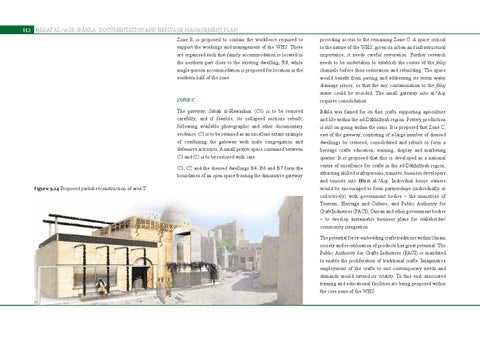
The gateway, Sabah al-Hawashim (C1) is to be restored carefully, and if feasible, its collapsed sections rebuilt, following available photographic and other documentary evidence. C1 is to be retained as an excellent extant example of combining the gateway with male congregation and defensive activities. A small prayer space contained between C1 and C2 is to be restored with care. C1, C2 and the disused dwellings B4, B6 and B7 form the boundaries of an open space fronting the diminutive gateway Figure 9.24 Proposed partial reconstruction of area T
providing access to the remaining Zone C. A space critical to the nature of the WHS, given its urban and infrastructural importance, it needs careful restoration. Further research needs to be undertaken to establish the routes of the falaj channels before their restoration and rebuilding. The space would benefit from paving and addressing its storm water drainage issues, so that the any contamination to the falaj water could be avoided. The small gateway into al-ΚAqr requires consolidation. Bāhla was famed for its fine crafts supporting agriculture and life within the ad-Dākhilīyah region. Pottery production is still on-going within the oasis. It is proposed that Zone C, east of the gateway, consisting of a large number of disused dwellings be restored, consolidated and rebuilt to form a heritage crafts education, training, display and marketing quarter. It is proposed that this is developed as a national centre of excellence for crafts in the ad-Dākhilīyah region, attracting skilled craftspersons, trainees, business developers and tourists into Дārat al-ΚAqr. Individual house owners would be encouraged to form partnerships (individually or collectively) with government bodies – the ministries of Tourism, Heritage and Culture, and Public Authority for Craft Industries (PACI), Omran and other government bodies – to develop sustainable business plans for stakeholder/ community integration. The potential for re-embedding crafts traditions within Omani society and re-utilisation of products has great potential. The Public Authority for Crafts Industries (PACI) is mandated to enable the proliferation of traditional crafts. Imaginative employment of the crafts to suit contemporary needs and demands would extend its vitality. To this end, associated training and educational facilities are being proposed within the core zone of the WHS.