ДĀRAT AL-ΚAQR: HERITAGE MANAGEMENT PLAN outside area B and between zones C and D; • Restore the highly complex falaj network of Дārat al-ΚAqr, not only within the settlement but also beyond its walls. Associated features such as wudu and water access points on streets and within buildings must be conserved and restored; • The large courtyard providing access to C13, 14, 23, 26 will need substantial rebuilding, retaining the morphological evidences of Дārat al-ΚAqr’s formation in that area. As crucial morphological evidence, the entire rear building line running east-west through the middle of block C has to be investigated and restored with care; • Passages running east-west through the settlement act as the main thoroughfares and as such will need to be subtly surfaced. Other passages such as those that climb the hill towards the Jamma Mosque display significant topographic negotiations and will need to be restored with great care. A possibility may be to cut steps into the rock, retaining the current materiality of the feature; • The large square space between zones D, E and G is one of the central features of al-ΚAqr and displays some of the settlement’s grandest buildings. As such the ground needs to be resurfaced and provided with adequate water runoff systems. The buildings in this zone (G8, E1, E2 & D7) will have to be among the first to received direct attention. All restoration activities must be carried out with strict adherence the heritage management guidelines outlined in Chapter 7 of this volume and in accordance with the UNESCO/ICOMOS guidelines already proposed for
Bāhla in the past.
9.5 Targeted strategies
Development
As a result of extended fieldwork on site and long term observation of behavioural patterns amongst both local residents and foreign visitor a number of propositions can be made to cater to both interest groups within the settlement of al-ΚAqr. It should be pointed out that these are currently to be taken as suggestive and subject to refinement during any future phase II projection. All development is to be carried out in an ecologically sustainable manner and in agreement with the local residents, with strict consideration towards their own input. Certain areas of the settlement such as S, R and P will require a sensitive approach as they are currently still inhabited. In order to raise the quality of life within al-ΚAqr and incentivise the re-habitation of the settlement improvements such as eateries, stores and public health facilities will need to be
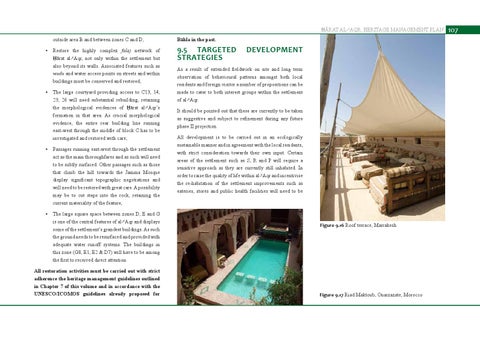
Figure 9.16 Roof terrace, Marrakesh
Figure 9.17 Riad Maktoub, Ouarzazate, Morocco
107