22
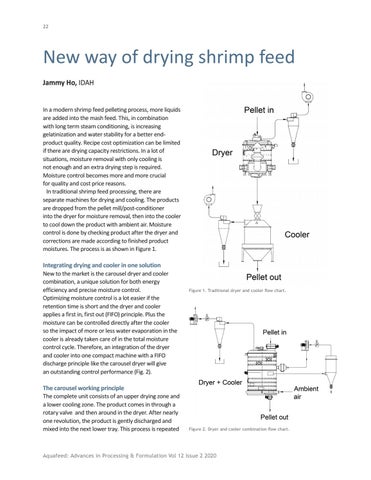
New way of drying shrimp feed Jammy Ho, IDAH In a modern shrimp feed pelleting process, more liquids are added into the mash feed. This, in combination with long term steam conditioning, is increasing gelatinization and water stability for a better endproduct quality. Recipe cost optimization can be limited if there are drying capacity restrictions. In a lot of situations, moisture removal with only cooling is not enough and an extra drying step is required. Moisture control becomes more and more crucial for quality and cost price reasons. In traditional shrimp feed processing, there are separate machines for drying and cooling. The products are dropped from the pellet mill/post-conditioner into the dryer for moisture removal, then into the cooler to cool down the product with ambient air. Moisture control is done by checking product after the dryer and corrections are made according to finished product moistures. The process is as shown in Figure 1.
Integrating drying and cooler in one solution New to the market is the carousel dryer and cooler combination, a unique solution for both energy efficiency and precise moisture control. Optimizing moisture control is a lot easier if the retention time is short and the dryer and cooler applies a first in, first out (FIFO) principle. Plus the moisture can be controlled directly after the cooler so the impact of more or less water evaporation in the cooler is already taken care of in the total moisture control cycle. Therefore, an integration of the dryer and cooler into one compact machine with a FIFO discharge principle like the carousel dryer will give an outstanding control performance (Fig. 2). The carousel working principle The complete unit consists of an upper drying zone and a lower cooling zone. The product comes in through a rotary valve and then around in the dryer. After nearly one revolution, the product is gently discharged and mixed into the next lower tray. This process is repeated
Figure 1. Traditional dryer and cooler flow chart.
Figure 2. Dryer and cooler combination flow chart.
Aquafeed: Advances in Processing & Formulation Vol 12 Issue 2 2020