34
Use of a natural feed additive to control parasites in fish Juan M. Alfaro, Enrique Guillamón, DOMCA SAU, José Luis Sáez, Piscifactorías del Mediterráneo, Felipe Almendras, Greenvolution, Alberto Baños, DMC Research Center The growing intensification of aquaculture production means that in recent years, parasitic processes have become very important to the sector, increasing the number of infestations and associated pathologies. Parasites have a negative impact on the production parameters of fish farms, causing great economic losses and significant fish and public health problems. Parasites in fish can be found internally (usually gastrointestinal tract, muscle, peritoneal cavity), or externally (skin and gills). The control of external
parasites in open and closed production systems is a complex process usually involving bath treatments based on the use of a limited number of registered chemo-prophylactics which, in addition to being expensive and scarce, could be harmful to fish, humans and the environment. Moreover, more complex legal requirements to register new drugs and the prohibition of the use of many traditional anti-parasite products/treatments, urgently demand the use of new approaches and
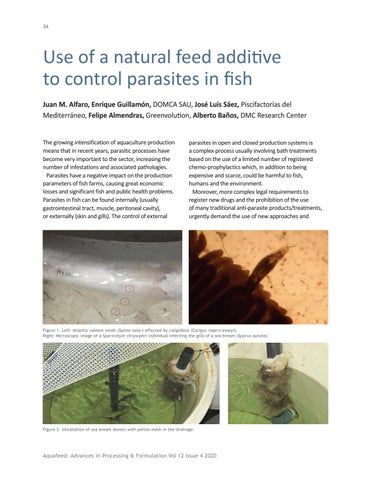
Figure 1. Left: Atlantic salmon smolt (Salmo salar) affected by caligidosis (Caligus rogercresseyi). Right: Microscopic image of a Sparicotyle chrysophri individual infecting the gills of a sea bream (Sparus aurata).
Figure 2. Installation of sea bream donors with perlon mesh in the drainage.
Aquafeed: Advances in Processing & Formulation Vol 12 Issue 4 2020