14
producers are already making plans on how to cope with this increasing demand in the future. Listening to RAS farmers, the importance of high-quality feed is essential for a beneficial business for RAS installation. Not only is nutrition quality of high importance, but also the physical quality of the feed. Some of the existing feed production lines may not meet the rigorous quality requirements RAS feeds demand. For this reason, it may be prudent to look for newer technology to produce feed.
Where the global wild fish catch has been more or less constant since the 1990s, the world’s demand for aquaculture (farmed fish) has kept on growing dramatically and with an estimated growth of additional two million tons per year approaching 2050, it will be necessary for the aquaculture industry to deliver this significantly enhanced volume of food in a sustainable manner. Also, special attention needs to be given to the impact on environmental integrity, farmed organism health, welfare and human health. Recirculation Aquaculture Systems (RAS) could in some degree be the answer to that. Although the COVID-19 pandemic has put some planned RAS projects on hold, it will most likely be a temporary hold. The global demands for sustainable aquaculture food are fast-growing and therefore, the demands for RAS projects will surely be relaunched very soon and potentially with more projects to follow. With the potential increase of RAS installations, the demands for feed will also increase. Global feed
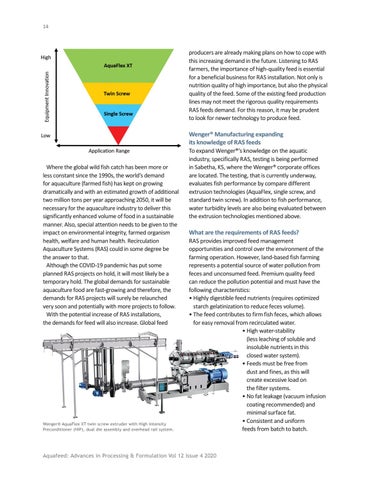
Wenger® AquaFlex XT twin screw extruder with High Intensity Preconditioner (HIP), dual die assembly and overhead rail system.
Wenger® Manufacturing expanding its knowledge of RAS feeds To expand Wenger®’s knowledge on the aquatic industry, specifically RAS, testing is being performed in Sabetha, KS, where the Wenger® corporate offices are located. The testing, that is currently underway, evaluates fish performance by compare different extrusion technologies (AquaFlex, single screw, and standard twin screw). In addition to fish performance, water turbidity levels are also being evaluated between the extrusion technologies mentioned above. What are the requirements of RAS feeds? RAS provides improved feed management opportunities and control over the environment of the farming operation. However, land-based fish farming represents a potential source of water pollution from feces and unconsumed feed. Premium quality feed can reduce the pollution potential and must have the following characteristics: • Highly digestible feed nutrients (requires optimized starch gelatinization to reduce feces volume). • The feed contributes to firm fish feces, which allows for easy removal from recirculated water. • High water-stability (less leaching of soluble and insoluble nutrients in this closed water system). • Feeds must be free from dust and fines, as this will create excessive load on the filter systems. • No fat leakage (vacuum infusion coating recommended) and minimal surface fat. • Consistent and uniform feeds from batch to batch.
Aquafeed: Advances in Processing & Formulation Vol 12 Issue 4 2020