www.australiainspace.com.au
NASA’s Pam Melroy on remote robotics & the Australian space sector
Getting the word out about
the UK – Australia Space Bridge
The United States of Australia - A collaborative approach to the Australian space domain.

Perth’s Curtin University leading the way in the Australian space sector
ISSUE #5 | 2023
The next frontier in space optics
AI, EO, and you
Building next generation autonomous space systems with AI
Destructive ASAT missile testing threatens everyone

AUSTRALIA’S DEFENCE STRATEGIC REVIEW ACCESS MORE IN DIGITAL EDITION PLUS www.australiainspace.com.au/tv

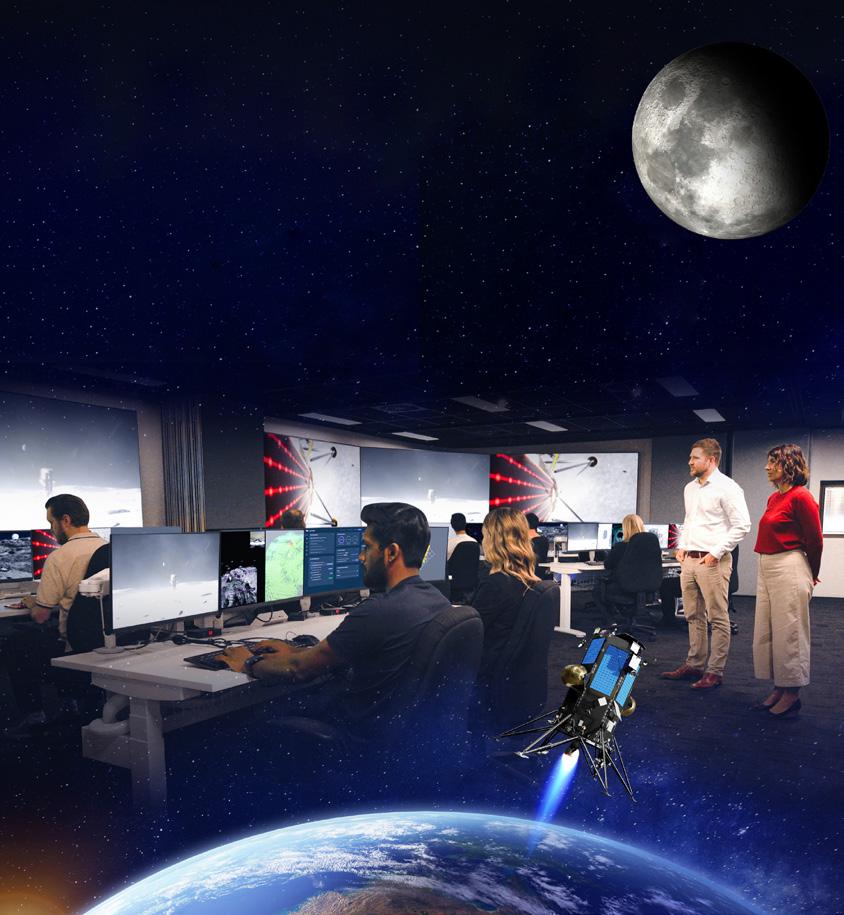

FROM DEEP SEA TO DEEP SPACE. MISSIONS DELIVERED... ANYWHERE. As a key partner of the Australian Space Agency (ASA), and with the support of the Western Australian Government, Fugro is proud to be part of the future of the Australian exploration and remote operations industry. Fugro will design, build and operate the Australian Space Automation, Artificial Intelligence and Robotics Control Complex (SpAARC). To find out more www.fugro.com/spaarc










WATCH NOW
EVENT PLAYLISTS
the full event playlist scan here
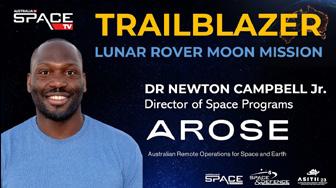
Avalon 2023 attracts AROSE for Space Programs and Australian remote operations
For
Polish Space Agency first exhibition at Avalon 2023 Curtin University’s wide ranging space programs
For more of the latest news and interviews in space sector! www.australiainspace.com.au/tv
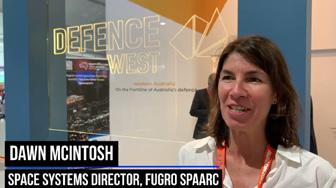
Fugro Australia Space Systems Director Dawn McIntosh
The journey and development of Singapore's space industry
Australia in Space Magazine | 3
Connecting the dots for the Singapore space industry
23-24 OCTOBER 2023, PAN PACIFIC HOTEL PERTH, WESTERN AUSTRALIA
Bringing together leaders from across the Indo-Pacific and beyond for opportunities in cross-sector technology and innovation
Western Australia's space capabilities include:

• Southern hemisphere location with ideal longitude for space situational awareness and global coverage of space assets.
• Geographically stable with clear skies, large arid areas, minimal radio interference, and radioquiet zones.
• Significant communications, computational infrastructure, and technical expertise.

• Substantial capabilities in space systems, ground stations, astronomy, and planetary research.
• World-leading capabilities in remote operations, automation, and robotics utilizing ultra-low bandwidth satellite communications.
• Diverse and highly-skilled workforce with over 100 international and Australian space-related companies.

SUPPORTERS BROUGHT TO YOU BY
RESOURCES AGRICULTURE ROBOTICS SUSTAINABILITY SPACE CRITICAL TECHNOLOGY EDUCATION INVESTMENT Trade | Investment | Collaboration | Future Opportunities WWW. SPAC EAND EARTH CONFERENCE.COM REGISTER NOW







WATCH NOW SCAN HERE For more of the latest news and interviews in space sector! or head to www.australiainspace.com.au/tv Australia in Space Magazine | 5
This year’s Summit for Space Sustainability focuses on several critical themes, including reinforcing sustainability and responsibility through corporate performance, strengthening space governance, and building a sustainable cislunar space economy.
















For information on partnership opportunities contact Krystal Azelton, Summit Chair, at kazelton@swfound.org.


















AUSTRALIA IN SPACE
Join us at the Secure World Foundation’s 5th SUMMIT for SPACE SUSTAINABILITY
13-14
Join the hundreds of global experts and stakeholders from industry, governments, and civil society to participate in keynotes, interactive sessions, panels, and networking designed to highlight opportunities and challenges for developing solutions for space sustainability.
#SWFsummit23 Register at swfsummit.org
June
in New York City


























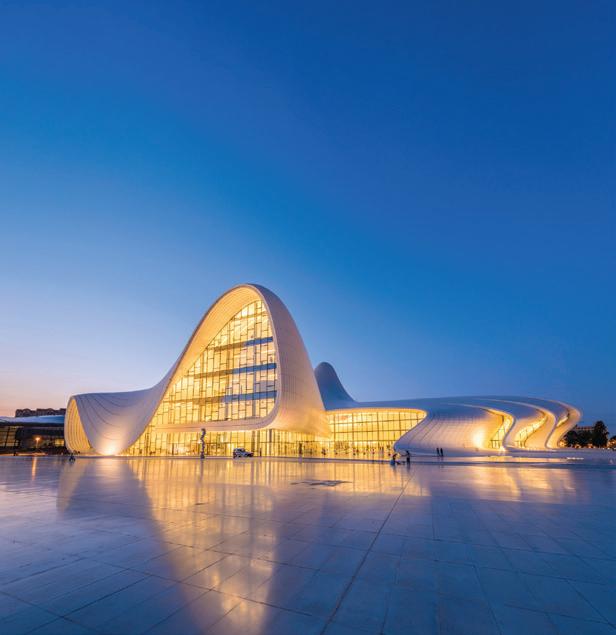

Australia in Space Magazine SUPPORTED BY: ORGANIZED BY: HOSTED BY: WWW.IAC2023.ORG 2-6 OCTOBER 2023 BAKU, AZERBAIJAN Global Challenges and Opportunities: Give Space a Chance The beautiful city of Baku is awaiting you! Register today and meet the international space community in October! 74th INTERNATIONAL ASTRONAUTICAL CONGRESS
with Michael Jones Executive Chairman and Group CEO of Equatorial Launch Australia (ELA)
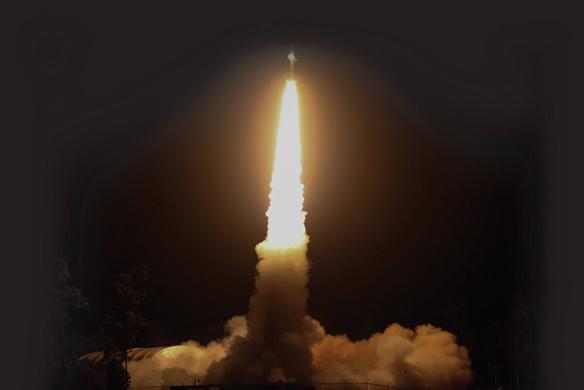
Equatorial Launch Australia (ELA) the developer, owner and operator of the Arnhem Space Centre (ASC) in Australia’s Northern Territory completed three launches in 15 days for the NASA DEUCE mission in mid-2022. The launches were for the Dual-channel Extreme Ultraviolet Continuum Experiment, or DEUCE, for the University of Colorado, Boulder.
We speak to Michael Jones, Executive Chairman and Group CEO of ELA on the business and challenges of space launches in Australia as the company welcomes further launches with the vision of 50+ launches per year by 2028.


SCAN HERE
For more of the latest news and interviews in space sector!
or head to www.australiainspace.com.au/tv

WATCH NOW
Interview
8 | Australia in Space Magazine
AUSTRALIA’S SPACEPORT AT 12 O SOUTH
Equatorial Launch Australia (ELA) owns and operates the Arnhem Space Centre.

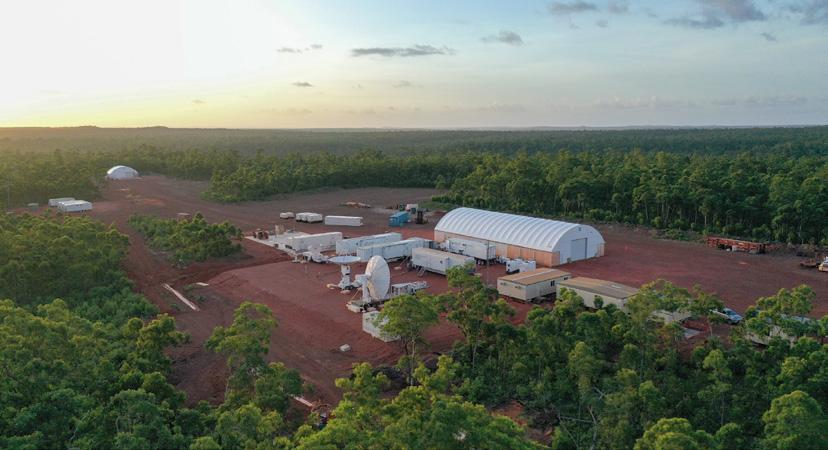
ELA offers world-class launch services to support testing, launch and recovery of payloads for orbital and suborbital missions. The Arnhem Space Centre enables high frequency launch access to multiple orbits and inclinations.
We understand the challenges involved in launching payloads, and we work with you to devise a custom, comprehensive and compelling solution that fits your needs. Whether you’re testing or launching, we have the expertise to ensure your mission is a success.
COST-EFFECTIVE OPERATIONALLY EFFICIENT MAXIMISE YOUR COMMERCIAL SUCCESS

Visit
110º Retrograde Constant Track SSO orbit
12º Equatorial orbit
20-40º Mid-Inclination orbit
98º Polar / SSO orbit
www.ela.space
find
how
can launch with
to
out
you
us
All material appearing in Australian in Space Magazine is copyright. Reproduction in whole or part is not permitted without permission in writing from the publisher. The views of contributors are not necessarily those of the publisher. Professional advice should be sought before applying the information to particular circumstances.





10 | Australia in Space Magazine Dharshun Sridharan Nipuni Silva Michael Cratt Ali Buchberger Dr Malcolm Davis David Flanagan Samara Thorn Shane Keating Dr Carl Seubert Victoria Samson Dr Chris Flaherty Masayasu Ishida CONTRIBUTORS English and U.S spelling may be adopted subject to print location and author preference Contents NASA’s Pam Melroy on remote robotics & the Australian space sector 14 Getting the word out about the UK – Australia Space Bridge 16 The United States of Australia -Part I 18 Such great heights 22 Why the Australian space industry’s culture can make or break gender diversity 26 Australian surgeon developing an extra-terrestrial medical life pod 30 Perth’s Curtin University leading the way in the Australian space sector 32 The defence strategic review - Implications for space 34 Saber Astronautics: An upward force in Australian Space 38 Space innovations are helping decarbonise industry on Earth 42 The next frontier in space optics 44 AI, EO, and you 48 Building next generation autonomous space systems with AI 50 Destructive ASAT missile testing threatens everyone 52 Lunar oxygen pipeline vulnerability model 54 SpaceTide - Accelerating commercialization of the space industry. 56 The Western Australia space industry sundowner 58 A giant leap into 2023 for The Andy Thomas Space Foundation 60 Contents OUR SPACE CHANNELS Director & Executive Editor Chris Cubbage General Manager –Industry Engagement Jessica Bainbridge Sales & Relationship Manager Troy Hale Digital Content Manager MJ Yun Data Scientist Muhammad Bilal Shaikh Managing Director David Matrai Art Director Stefan Babij Senior Digital Designer Melissa ten Bohmer Head of Communications Laura-Jane Hawkins Digital Content Senior Editor Sarah El-Moselhi Regional Correspondents Jane Lo - Singapore Sarosh Bana - India Andrew Curran - Australia 22 38 44 48 23-24 OCTOBER 2023, PAN PACIFIC HOTEL PERTH, WESTERN AUSTRALIA
the
and
www.spaceandearthconference.com MARKETING AND ADVERTISING promoteme@mysecuritymedia.com Copyright © 2023 - My Security Media Pty Ltd GPO Box 930 SYDNEY N.S.W 2001, AUSTRALIA E: promoteme@mysecuritymedia.com
“Bringing together leaders from across
Indo Pacific
beyond for opportunities in cross-sector technology and innovation”
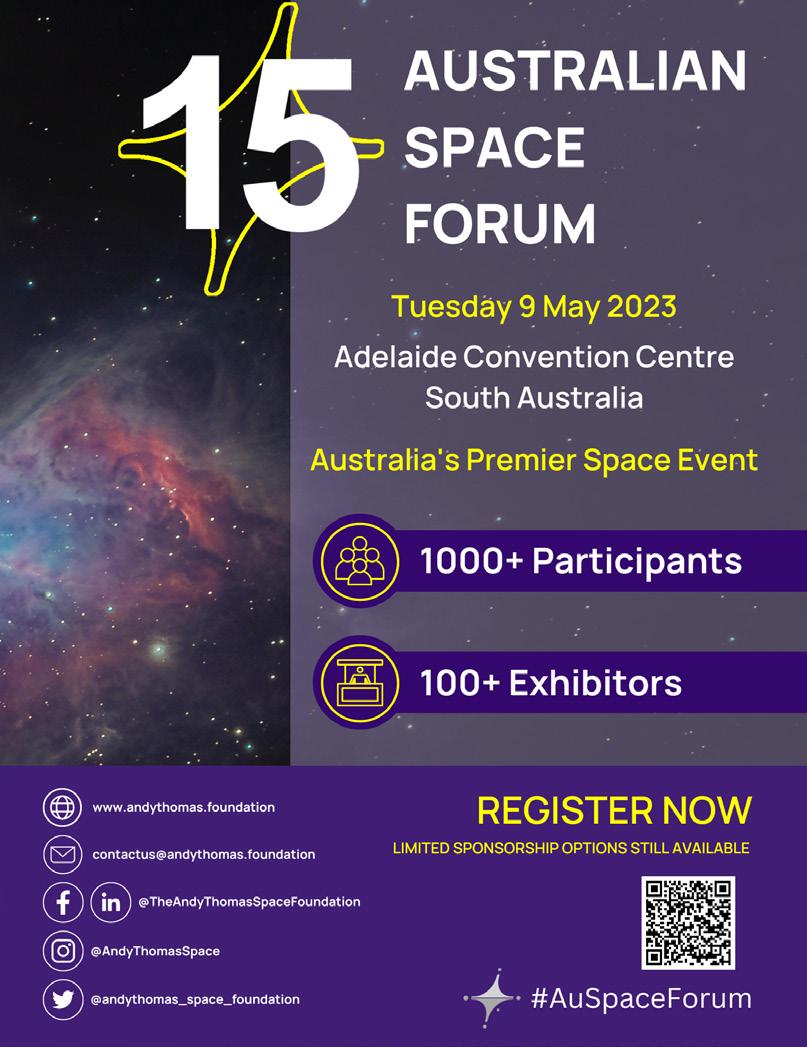
Welcome to a special export focused and international edition of the Australia in Space Magazine, released as Official Media Partners to the Space Foundation’s Space Symposium, Colorado Springs, The Andy Thomas Space Foundation’s 15th Australian Space Forum, Adelaide, Space Sustainability Summit, New York, and SpaceTide, Tokyo, amongst others around the world.
This edition follows our participation this year at the Avalon International Airshow, Melbourne and the Global Space and Technology Convention, Singapore. Both were very well attended by international space sector delegations and our interview playlists are available within.
The trilateral security pact, termed AUKUS, announced in San Diego in mid-March that Australia will spend nearly AUD370 billion over the next several decades to acquire a fleet of nuclear-powered submarines. AUKUS has espoused to “offer a generational change capability” and coinciding with this announcement, Australia had been on a global diplomatic offensive, briefing around 60 countries, including ASEAN nations, Five Eyes partners, and key European nations.
Just ten days later, NASA Administrators Bill Nelson and Pam Melroy used a speech at the National Press Club in Canberra to reflect on Australia’s space milestones and urged the country to continue the momentum. Nelson drew on his two decades of experience as a US Senator to reflect on the geopolitical implications of Australia stepping up its involvement (or not) in the space sector. He said there has never been a better time for Australia to deepen its involvement with space and NASA. “In the aftermath of the AUKUS agreement, Australia will have additional new technologies and a new highly educated and technological workforce. Why not have the parallel development of a space economy?”
To underline Nelson’s call for collaboration, Australia took one step closer to the Moon with the Australian Remote Operations for Space and Earth (AROSE) consortium, led by Fugro and Nova Systems, selected as one of two successful teams chosen for Stage 1 of the Australian Space Agency’s flagship Trailblazer program. The Trailblazer program will see Australia design, build, test, and operate an Australian-made lunar foundation services rover for NASA’s return to the surface of the Moon. The Trailblazer program requires the rover to be operated remotely to collect lunar soil and deliver it to a NASA-provided processing facility to extract oxygen. This is a critical step to supporting a sustainable human presence on the Moon, Mars and beyond.
In this issue we cover the challenges and importance of space in a globally contested geo-political environment. Dr Malcolm Davis writes on the contested, competitive and complex domain of space being vital for Australia’s security and prosperity. In terms of defence, modern warfare depends on sustained and uninterrupted access to space capabilities for joint and integrated multi-domain operations, and to facilitate network-
Chris Cubbage CPP, CISA, GAICD Director & Executive Editor

centric approaches.
In the same week as the AUKUS announcement, the 2030 Space+Spatial Industry Growth Roadmap and the Responsible Artificial Intelligence (AI) Network were announced. The roadmap lists nine key objectives to be achieved in order to future-proof Australia’s sovereign capabilities in two vitally important industries – with wide-ranging consequences for strengthening defence, safeguarding critical infrastructure, tackling climate change and enhancing disaster resilience.
The Responsible AI Network will be the gateway for Australia’s industries to uplift its practice of responsible AI, expected to be worth $22.17 trillion to the global economy by 2030. Bringing together a national community of practice, guided by world leading expert partners, and enabling Australian businesses with best practice guidance, tools and learning modules, the network is centred around six core pillars: Law, Standards, Principles, Governance, Leadership and Technology.
Dr Carl Seubert and Professor Ryszard Kowalczyk contribute in this issue, highlighting the huge opportunity for Australia to develop AI-based spacecraft autonomy capabilities for the next-generation space systems to enable national missions and achieve home-grown benefits of remote sensing, communications, and other vital services from space.
Shane Keating writes on the early success of the UK-Australia Space Bridge, with the IceCube project, funded through the scheme and managed and led by SmartSat CRC and supported by Austrade, the UK Government and the UK and Australian Space Agencies. The new AI techniques developed from this project are set to provide critical insights into Antarctic Sea ice change to enable enhanced climate forecasting and modelling.

And as a federated national system of government in Australia, Dharshun Sridharan and Nipuni Silva write on the escalation of space activities and the series of space strategies, industry profiles, capability assessments, and more that have been developed at both a national and state level, with arguably an ineffective nexus. While having individual state-based approaches to the Space Domain is not necessarily a bad thing, the analysis suggests that there is an undefined overlap or underlap across these approaches. This is Part 1 of an important overview for what is aptly titled the ‘United States of Australia’.
Finally, throughout this edition we celebrate a number of important industry and event partners, including The Andy Thomas Space Foundation, SSA Space Forum, AMDA, SSTL, SpaceTide, IAC2023 and our own event activities in Australia, including the Indo-Pacific Space & Earth Conference, Perth.
As always, we cover the full diversity of the Australian and international space industry and there is so much more to touch on, including additional, exclusive content in the digital edition.
Enjoy the reading, watching and listening.
Australia in Space Magazine | 11
"This is a genuine trilateral undertaking. All three nations stand ready to contribute, and all three nations stand ready to benefit.” '
- Australian Prime Minister Anthony Albanese, standing alongside US President Joe Biden and UK Prime Minister Rishi Sunak during the AUKUS announcement, San Diego, March 13 (US time).
Editor's Desk
12 | Australia in Space Magazine
Interview with Dr. Newton Campbell Jr. Director of Space Programs at the Australian Remote Operations for Space and Earth (AROSE) Consortium
SCAN HERE
For more of the latest news and interviews in space sector!
or head to www.australiainspace.com.au/tv
The Australian Remote Operations for Space and Earth (AROSE) consortium is one of two successful teams chosen for Stage 1 of the Australian Space Agency’s flagship Trailblazer program.

The Trailblazer program will see Australia design, build, test, and operate an Australianmade lunar foundation services rover for NASA’s return to the surface of the Moon. NASA has asked Australia to provide the lunar rover due to our world-leading expertise in remote operations and automation technology, developed through our resources industry.
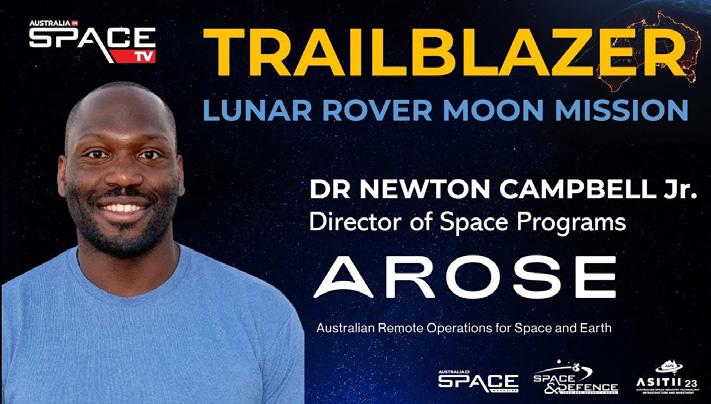
The Trailblazer program requires the rover to be operated remotely to collect lunar soil and deliver it to a NASA-provided processing facility to extract oxygen. This is a critical step to supporting a sustainable human presence on the Moon, Mars and beyond.
AROSE’s Trailblazer Stage 1 consortium is led by two amazing companies: Fugro, creators of Australia’s Space Automation, AI & Robotics Control Complex (SpAARC); and Nova Systems, an Australian-owned engineering services and technology solutions company.
Woodside Energy and Rio Tinto are also supporting the AROSE Trailblazer Stage 1 effort by providing knowledge transfer of their terrestrial robotic and automation capabilities. Additional support has been received from the Western Australian Government.
WATCH NOW
Australia in Space Magazine | 13
NASA’s Pam Melroy on remote robotics & the Australian space sector
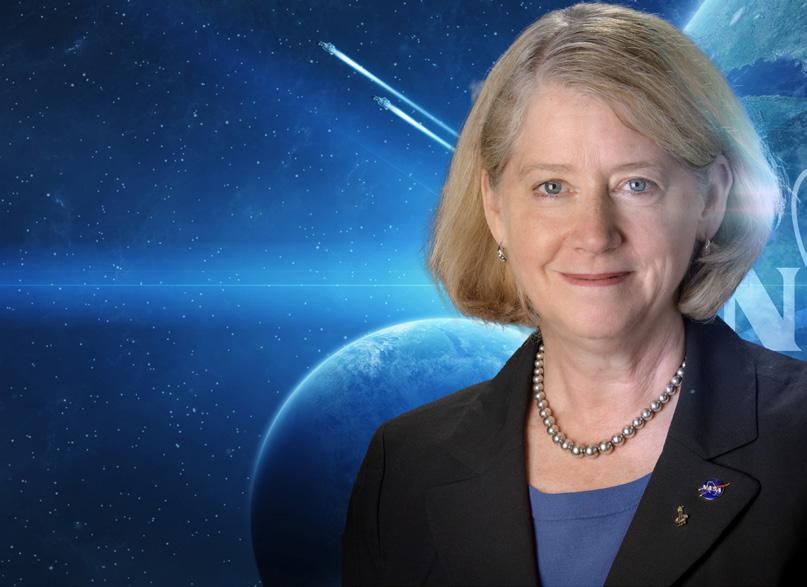 By Andrew Curran Correspondent Australia in Space
When NASA Deputy Director Pam Melroy touched down in Australia in February, it wasn't unfamiliar territory to her. Melroy surprised many when she moved to Adelaide at the start of 2018 to work with the local space industry there. However, that experience gave the former space shuttle commander a deep insight into the Australian space sector. It now also provides Australia with a firm ally in the upper echelons of the world's biggest space agency.
Melroy's visit was shorter this time, but she managed to cut a swathe through Sydney and Perth and stayed long enough to visit high schools, universities, space businesses, and also give a keynote talk.
In that speech to a capacity crowd at an American Chamber of Commerce in Australia event in Perth on February 10, 2023, Melroy listed a roll call of historical space events where Australia and the US had co-operated closely.
"Australia has been a crucial partner to the US since NASA began. Since 1958 there have been 13 major NASA space tracking missions in Australia. The first images of Apollo 11 landing on the moon came through Australia and were then beamed to the world," she said.
Melroy also highlighted more recent events, such as then Australian Prime Minister Scott Morrison visiting NASA headquarters in Washington D.C. in 2019 to sign a letter of intent and commit AUD150 million to help develop Artemis.
Melroy told the Perth lunchtime audience that Australia was one of NASA's first international partners to back up their cooperation talk with real money. She said it was a gesture deeply appreciated by the space agency. Melroy also referenced a series of launches in 2022 that made headlines around Australia.
Last year, NASA partnered with Australian space company, Equatorial Launch Australia (ELA), to send three rockets into space from the Arnhem Space Centre on the Gove Peninsula in the Northern Territory. What was just another space launch in a busy year of space launches was notable for two reasons – it was the first commercial space launch from Australian soil, and it was NASA's first launch from a fully commercial spaceport. By 2025, ELA hopes to send 50 rockets a year into orbit from the Arnhem Space Centre. It also sees itself as a serious competitor to the only other significant launch site close to the Equator, the French Government's Kourou launch site in French Guiana.
"Australia is in a unique location not just for ground communications," said Melroy when discussing why NASA partnered with ELA. "Australia also provides us with global coverage and helps us understand the atmosphere of the Earth and that upper region of this part of the world."
Melroy's speech wasn't just a diplomatic callout of historical space events. She pinpointed where she saw
14 | Australia in Space Magazine
AUSTRALIA IN SPACE
Australia's future in the global space sector, and it wasn't competing with the French Government. Instead, it was exploiting a very particular Australian field of expertise –remote robotics.

That expertise has its origins in Australia's mining and resources sector. In the north of Western Australia, where temperatures can reach 50°C by day and sub-zero at night, not much survives, and the area isn't friendly for humans. But it is rich in minerals, rare earths, and ores. Out of necessity, mining and resource companies have developed highly sophisticated machines to do the work and go places where people cannot.
"When I lived in Australia in 2018 and I talked to industry and travelled around the country, I was truly astounded at the amazing robotic and remote operations capabilities that I found in Western Australia, and knowing what it takes to support humans and science in remote locations, I immediately saw the connection and potential for Artemis and saw that this was going to be a critical in the future for Australia," said Melroy. "No one can catch up with Australia in this area, so while tremendous things have happened in the space industry in Australia, I think the future here is what's happening in remote robotics."
Remote robotics is familiar territory to Melroy. While living in Australia, she was involved in establishing
the Australian Remote Operations for Space and Earth consortium (AROSE), which is now involved in transferring that remote robotics knowledge from the mining and resources sector to the space sector.
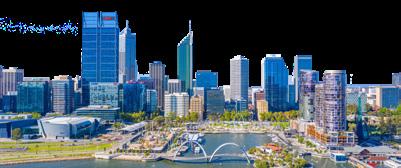
AROSE is based in Perth. It wasn't for that reason that Melroy visited the city, although catching up with old friends was an added attraction. Due to the work on remote robotics coming out of the local mining and resources sectors and the strong financial support of the Western Australia State Government, Perth has emerged as something of a hotbed of space startups and support infrastructure.
In addition to AROSE, Perth is also home to Fugro's multi-million-dollar Australia Space Automation AI and Robotics Control Complex (SpAARC), a facility in Australia that trains, tests and controls remote and autonomous operations in space and other unfriendly environments.
“SpAARC was just an idea when I last visited three years ago," said Melroy. "Now, it is a great example of how infrastructure can support multiple activities which raise the capabilities of industry, academia, and the country as a whole."
Against that background, NASA's decision to base one of three new lunar exploration ground sites, or LEGS, in Australia isn't surprising. The space agency still needs to fix a precise location, but Melroy said Western Australia's clear skies and low moisture levels give it a competitive advantage in such contests.
Melroy told the audience that the three new lunar exploration ground sites would be critical to the success of the Artemis program and help facilitate enhanced direct-toEarth communications capabilities for lunar missions.
The former astronaut has logged over 900 days in space in a career that started in the mid-1990s. Before that, Melroy clocked up over 6,000 flight hours as a US Air Force aircraft commander, including over 200 combat hours. Her reputation opens the doors to the offices of prime ministers and presidents worldwide. Now in her early sixties, she remains a passionate advocate for space.
"Going to space is hard – make no mistake," said Melroy. "But doing so lifts a country's capability in science and technology, and that has spillover effects and will spinout into other capabilities and solve other problems that a country has. In addition, with a growing commercial space industry, the economic benefits of a high-growth, high-tech industry cannot be understated. And besides that, it is just exciting. It's an incredible inspiration to marvel at the depth of the cosmos and ponder our place in it."
Australia in Space Magazine | 15 AUSTRALIA IN SPACE
"Going to space is hard – make no mistake," said Melroy. "But doing so lifts a country's capability in science and technology, and that has spillover effects and will spinout into other capabilities and solve other problems that a country has.
Getting the word out about the UK – Australia Space Bridge
By Andrew Curran Correspondent Australia in Space
Over two years after it was established, Josh Broom, head of space at the UK's Department for Business and Trade, admits the first questions he often gets asked about the UK – Australia Space Bridge program is, what is it, and how can entities get involved?

Getting the word out about the Space Bridge, a cooperation framework signed in February 2021 designed to speed up the growth of the UK and Australian space sectors, is a crucial goal for Broom and his Australian counterpart, Dan O'Toole.
Broom's admission that the Space Bridge needs to be better at promotion and determining that it would do so was among a range of Space Bridge goals the UK space boss recently outlined at the 2023 Australian International Air Show at Avalon.
"I think if you were to google the UK – Australia Space Bridge, the only thing you can find is the original announcement from two and a half years ago. One of the key things we want to do over the next 12 months and the future is to address that and bring a real sense of identity, purpose, and branding to the Space Bridge."
The Department for Business and Trade and Australia's trade agency, Austrade, are behind the Space Bridge. Since its inception, both countries have seen changes in their heads of government, but both countries have remained financially and politically committed to the space sector and the Space Bridge program.
Broom says despite its low profile, Space Bridge is proving successful. In a wide-ranging discussion, he pointed
to Airbus, Goonhilly, CGI, HEO Robotics, and Spire Global as examples of space businesses now working together due to the Space Bridge program. He says that in conjunction with other UK-based research centres, the Space Bridge has funded five projects ranging from earth observation, agritech, space communications, and quantum technologies. "We're hoping to build on those as long-term partnerships and research that both UK and Australia are doing," he said.
But Broom clearly thinks the Space Bridge program needs to maximize its potential. Most of the solutions he posed are relatively easy fixes. He believes bringing in an external media partner would help get the word out about Space Bridge.
"We need to be better at bringing together and communicating coherently. For example, what kind of UKAustralia events are taking place that Space Bridge and our organizations are supporting and will be present at? When are the trade missions that we're planning?"
"We also want to start promoting job opportunities and internships between the two sectors, almost a UK - Australia Space Bridge jobs board. We know that securing skills is a shared challenge. But as part of the Space Bridge, we're very clear that we do not want to start stealing from each other's skill sets. We need to be complementary."
Broom and O'Toole helped design the Space Bridge last decade and are now key point people for the program within their respective governments. O'Toole says he's been focused on everything from providing simple, pragmatic advice to UK start-up space companies looking to do business in Australia
16 | Australia in Space Magazine
to facilitating talks with the top tiers of government.
"Last year, we had sort of an AUKUS level discussion with industry with UK Space Command and Defence Space Command here and Space Force in Colorado. There have been some high-level discussions about how they can work together," he said.
The ability of the Space Bridge program to promote and support closer space cooperation between the UK and Australia depends on funding. The UK Space Agency and Australian Space Agency are finalizing their budgets. "We know that we're looking at new funding," said Broom. He was unable to provide specific details, but on the UK side, its space agency, in conjunction with the European Space Agency, is launching two new bilateral funds worth approximately GBP40 million. One focuses on scientific exploration, while the second focuses on strategic partnerships that help improve trade and export opportunities. That falls nicely within the Space Bridge program's remit.
Broom says something the Space Bridge program can do is make information on those programs and their funding easily accessible, as well as saying when funding will become available and how to access it.
"We want to make sure that as part of our external engagement, we have a single front door for any and all questions about what Space Bridge is, how to get involved, and when things are happening. Hopefully, a new online portal will help address that. We can then help (businesses) identify particular opportunities that may not be readily
available or obvious."
"We also want to bring the available commercial contracts in our two sectors together in one single place. If you're a company operating in either market, there can be a single compiled list of the available contracts that have been tendered out. We want a single portal in which those available commercial contracts are open to UK and Australian companies. We want to ensure everyone has all the information they need about space."
Touching on O'Toole's comments about high-level talks, Broom is keen to increase the Space Bridge's cooperation with the defence space sector, which until recently had not been extensive. That's now changing, and the program is starting to actively engage with the Royal Air Force and Royal Australian Air Force, as well as the various defence space command entities.
On a less complex level, Broom thinks something as simple as appointing a Space Bridge Ambassador could help promote the program. "We're still brainstorming these ideas," he says.
Broom knows he is working in a busy media environment with scores of competing frameworks and agencies all jostling to get the word about their mission out into the marketplace. But the UK space boss and his Australian offsider clearly believe that making more people aware of the UK – Australia Space Bridge is more about a series of nips and tucks rather than reinventing the wheel.
AUSTRALIA IN SPACE Australia in Space Magazine | 17
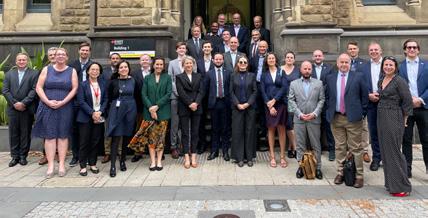
UK space trade mission - visiting RMIT University
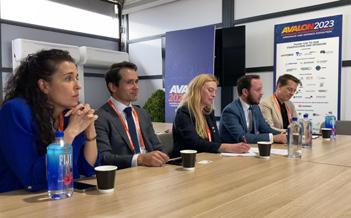
Space Bridge panel discussion at Avalon - (LtoR) Dr Barbara Ghinelli, Dan O'Toole, Dr Sarah-Jane Gill, Josh Broom, Dr Tony Parsons
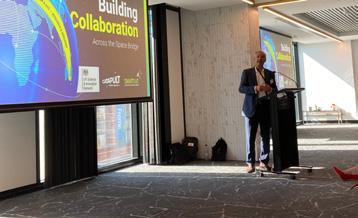
Presentation from SmartSat CRC's CEO Professor Andy Koronios
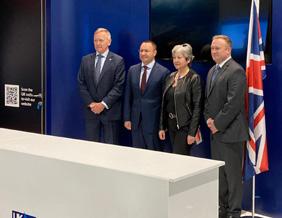
UK High Commissioner to Australia, Ukrainian Ambassador to Australia, Space Centre Australia - at Avalon
The United States of Australia
A collaborative approach to the Australian space domain - Part I
By Dharshun Sridharan Co-Founder, Piston Labs and Nipuni Silva People Stream, Piston Labs
To define the future, means understanding the past. Records indicate that as of 2008, Australia was one of two countries falling under the scope of the Organization for Economic Co-operation and Development that did not have a standing committee or governance body for the Space Domain. Since then, Australia's stance has changed. The escalation of space activities across the globe in the preceding years has rightfully emphasized the need to establish an organization to formally oversee Australia's space activities. This culminated in the announcement of such an organization at the 2017 International Astronautical Congress in Adelaide, South Australia. Within 12 months of that announcement, the Australian Space Agency was formally established in Adelaide, at Lot Fourteen. With it came Australia's reentry into the global Space Domain.
What followed was a series of space strategies, industry profiles, capability assessments, and more. However, they were developed at both a national and state level with arguably an ineffective nexus. While having individual statebased approaches to the Space Domain is not necessarily a bad thing, the analysis suggests that there is an undefined overlap or underlap across these approaches.
Analyzing, at a high level, the vision, aims, objectives, and intended outcomes of individual states (where artifacts
exist) provides an interesting picture of the Space Domain for Australia. Looking into aspects of how and where potential capability overlaps exist, where each state could potentially be Australia's Centre of Excellence (CoE), and where each state could be a fast follower instead, forms another interesting perspective. Together, these highlight opportunities for collaboration, with an underpinning Australian Space Domain Operating Model that sees the Australian Space Agency taking ownership of the national strategy, coordination, and direction setting, and each state fitting into the bigger picture to achieve economies of scale (this is Part 1 of this article series) and to distinguish a fit-forpurpose sovereign Space Supply Chain (this is Part 2 of this article series).
Where are we now?
Each state and territory within the Australian governmental hierarchy has its own goals, policies, and approaches to governance, including in the space domain. The development of jurisdictional space strategies has been the current approach to outline and govern the space industry and its participants. While this may be a well-thought-out approach in isolation, developing un-interoperable and duplicative
18 | Australia in Space Magazine
AUSTRALIA IN SPACE
strategies among different jurisdictions can be more harmful than helpful.
Although there may be sovereignty concerns, competition within a nation in the long term could be detrimental to the national industry. A high-level review shows both an overlap or duplicative capability set and a lack of focus on developing a sustainable space industry. It also alludes to the fact that, some areas of Australia's civil space priorities may be misaligned.
Queensland
Queensland aims to be a top hub for earth observation, launch activities, ground systems, niche manufacturing, and autonomous systems. The state's strengths include communication technologies, robotics, space operations, R&D in advanced technologies, and a broad range of manufacturing capabilities. Queensland is unique in offering radio-free zones and access to equatorial orbits, which are beneficial for launch and observation of both hemispheres. The state is investing in niche manufacturing, such as biomanufacturing and precision tooling, to strengthen its industry. Its strategic location, combined with its capabilities, makes Queensland an attractive destination for investors seeking to capitalize on Australia's growing space industry.
New South Wales (NSW)
NSW aims to foster an innovative and competitive space industry by promoting industry growth, supporting startups, encouraging collaboration, expanding the application of space technologies, and growing industry precincts. The state's capabilities include education, R&D, communication technologies, ground systems, quantum science, robotics, and manufacturing. Its geographic position also enables capabilities in communications and satellite positioning technology.
Australian Capital Territory (ACT)
The ACT does not have any documented objectives or strategic plans for the Space Domain. However, it has capabilities in communication technologies (such as NASA's Deep Space Network), earth observation, ground systems, Positioning, Navigation, and Timing (PNT), end-to-end Space operations, Space Situational Awareness (SSA) and debris monitoring, education, and R&D. As the capital of Australia, it also provides access to government stakeholders and participants, making it an ideal location for international collaboration.
Victoria
Victoria does not have any objectives or strategic plans documented for the space industry that could be identified. However, the state acknowledges that the growth of the space industry and its workforce can bring opportunities for
Victorian businesses. Additionally, Victoria has capabilities in artificial intelligence (AI), Earth observation, advanced manufacturing, PNT, robotics and autonomous systems, and digital games.
Tasmania
Tasmania's objective is to position itself as having a crucial role in Australia's R&D ambitions and as the centre of Space Domain Awareness (SDA) in Australia. As part of its growth strategy, Tasmania aims to strengthen its research infrastructure and grow its commercial Space industry, leveraging capabilities such as the Manufacturing CoE.
The state also has a nationally recognized capability in SDA, with ground systems that allow for the analysis and interpretation of received data. Tasmania's geographical location (polar and Southern Ocean geolocation) and frequent clear skies contribute to this capability. In addition, Tasmania's excellence in the field of Space medicine and life sciences is reflected in the Southern Hemisphere's only hyperbaric and hypobaric recompression chamber, as well as its association with the Australian Antarctic Division.
South Australia (SA)
SA aims to develop a strong space ecosystem and support the national space strategy by enhancing their capabilities in AI, machine learning, space intelligence, launch, and small satellites. They also focus on food production in space due to the Moon to Mars initiative. The state has a dynamic start-up ecosystem and an expanding workforce. It offers global competitive industry, international partnerships, and attracts investors. SA’s additional capabilities include space operations, launch activities, small satellites, ground systems, and AI and machine learning.
Western Australia (WA)
WA aims to develop and promote its priority areas, though they were not specified. However, it has set
AUSTRALIA IN SPACE Australia in Space Magazine | 19
Cont next page >> Note: All States Are To Retain These Capabilities For Supply Chain Security: - Ground Station (Infrastructure) - Advanced Manufacturing - Satellite Manufacturing - Astronomy and Astrophysics Note: ACT has nodes for Earth Observation and Remote Sensing, and Position, Navigation and Timing - that are not displayed on this map Legend: C= Civil, = Infrastructure, D = Defence, U= Unmanned, M = Manned, P= Production
objectives to enhance its space operations capacity, foster R&D collaboration, and improve relevant educational programs. The state possesses capabilities in astronomy, communication technologies, Earth observation, ground systems, launch activities, PNT, manufacturing, robotics and autonomous systems, defense operational capability, and application of space-derived R&D across various industries. It also excels in satellite development, SSA, and debris monitoring. Its geographical location provides natural advantages for SSA.
Northern Territory (NT)
The NT’s goal is to grow the space industry and connect its supply chain globally. Its objectives include developing capabilities in earth observation, ground systems, and launch activities, leveraging its geographic location, and being the global hub for high-altitude pseudo-satellites (HAPS). The territory is also leveraging the Charles Darwin University's Advanced Manufacturing Alliance. Its capabilities are in earth observation, ground systems, space launch, and HAPS.
Where should we go?
The analysis presents a view of individual states and territories above. Bringing it all together, the state-by-state approaches have overlaps (and occasional gaps) across their objectives and strategies.
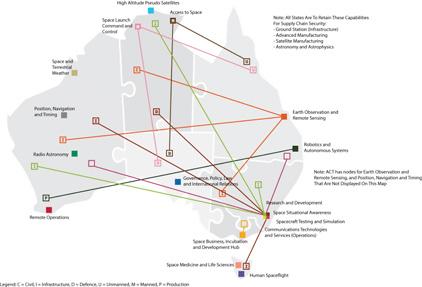
Given the rich history of expertise, it is understandable that each state would become a Centre of Excellence (CoE) for a specific capability (or capabilities). Drawing on the above analysis and industrial sovereignty towards each state or territory, the following hypothesis has been identified. The end outcome mimics that of NASA’s operational jurisdictions across the United States of America (USA), where it is more facility focused. Each facility serves as the CoE for a different capability, with the other facilities in the NASA ecosystem existing to support one another and create a country-wide collaborative model.
The following is an example of the utilization of a 'hub-and-spoke' model, whereby a Capability Hub ('Leader')
will remain within a single state or territory with Capability Spokes ('Followers') in multiple locations, depending on the circumstances. This modelled depiction was determined on the following principles:
• workforce
• geography
• industry presence
• existing infrastructure
• supply chain.
The requirement to retain Space Supply Chain sovereignty, and the ubiquitous nature of some capabilities, the following are decentralized across Australia and not represented explicitly:
• ground stations
• advanced manufacturing
• satellite manufacturing
• astronomy and astrophysics
• safety and security
• AI and machine learning
Operationalizing this arrangement would require each Capability Hub to set the strategic direction and objective for that specific capability. In essence, they are required to align to the requirements set by the Australian Space Agency.
The Capability Spoke becomes the tactical response to achieving the required goals. The Capability Hub itself can be both strategic and tactical in nature. The Capability Hub is allocated this responsibility of the ‘nation-leading’ capability and has been designated this way to ensure ‘one voice’ per capability.
From a governance perspective, this would ensure all of Australia’s capabilities are looked after and implemented by a dedicated Capability Hub, radically improving the coordination of and investment towards these capabilities as they are today. Only then will efforts be placed in a large enough capacity – whether it is time, money or resources – to actually achieve Australia’s ultimate Space goals.
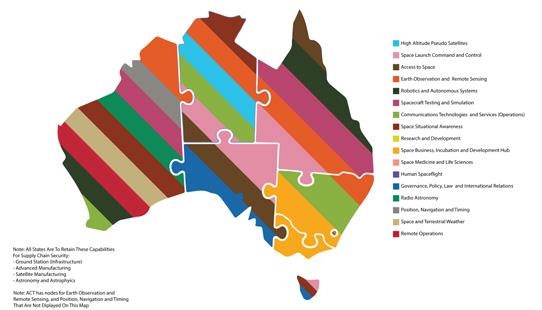
This is what the Australian Space Ecosystem requires to rocket off the launch pad set in motion from the International Astronautical Congress in 2017.
Stay tuned for Part 2 of this article next issue.
20 | Australia in Space Magazine
AUSTRALIA IN SPACE Note: All States Are To Retain These Capabilities For Supply Chain Security: - Ground Station (Infrastructure) - Advanced Manufacturing - Satellite Manufacturing - Astronomy and Astrophyics Note: ACT has nodes for Earth Observation and Remote Sensing, and Position, Navigation and Timing That Are Not Diplayed On This Map High Altitude Pseudo Satellites Space Launch Command and Control Access to Space Earth Observation and Remote Sensing Robotics and Autonomous Systems Spacecraft Testing and Simulation Communications Technologies and Services (Operations) Space Situational Awareness Research and Development Space Business, Incubation and Development Hub Space Medicine and Life Sciences Human Spaceflight Governance, Policy, Law and International Relations Radio Astronomy Position, Navigation and Timing Space and Terrestrial Weather Remote Operations
From a governance perspective, this would ensure all of Australia’s capabilities are looked after and implemented by a dedicated Capability Hub, radically improving the coordination of and investment towards these capabilities as they are today
Such great heights Australia’s longest-standing space technology business on the changing face of Australia’s space industry
By Michael Cratt, Managing Director Av-Comm Space and Defence
Australia was an early leader in the global space race when most notably in 1967, we launched our own satellite that played a vital role supporting interplanetary exploration, human spaceflight with tracking and communications. From our industry’s earliest days and over the following decades Australians were considered global leaders in the research and development of critical infrastructure and technologies that energised spaceenabled businesses.
However, some time ago our leaders lost sight of the critical contribution Australian industry makes to other space-enabled industries such as telecommunications, aviation and climate science. Most importantly, Australia’s local capabilities were for too long overlooked and underutilised by our own national programs. Thankfully that oversight is easing with the Australian Space Agency galvanising collaboration between government, academia and industry.
The formation of the Australian Space Agency in 2018 marked a significant shift in Australia’s commitment to developing local space capabilities. Notably, the Agency’s work advocating for legal and regulatory frameworks allowing space businesses to operate sustainably, and more-recently,
sponsoring the National Space Mission for Earth Observation. Its efforts sees Australian capability being put to use for all Australians and offers us all a focal point to gather around.
In my recent 2022 Year in Review article I commented on what I believe has been the Agency’s greatest contribution to our industry thus far: a culture of collaboration. Thanks to Australia’s’ growing confidence in the potential of space and our place in it, Av-Comm has broadened it’s civil, electrical and project management capabilities, which both local and international clients are now taking full advantage of.
Av-Comm’s recent announcement of our partnership with Quasar Satellite Technologies to develop an all-Australian ground segment solution, showcases the breadth of AvComm’s experience and capabilities across all areas of ground segment technology and systems engineering to a global audience. The partnership will support multiple missions including the connectivity of customer telemetry and space domain awareness services, offering a homegrown, globallyunique solution to local and international customers.
What surprises many people is the shape of the Australian space industry today: a group of small to medium-sized enterprises, like Av-Comm, who make a disproportionate contribution to Australia’s’ capabilities in Space. Av-Comm’s
22 | Australia in Space Magazine
unique position as the country’s longest-standing, privatelyowned space technology business proves that our countries heritage in space was already richly coloured however lacked the strategic direction and government leadership needed to propel us onto the global stage.
Most promising is the recent broader recognition and understanding that the space industry has two parts: what’s up there in space and what’s down here on earth. For nearly half a century, Av-Comm’s team have been championing the design of the ground segment in parallel with that of the spacecraft, working hand-in-hand with global space segment operators, to optimise and synchronise the data acquisition process for missions that support space-enabled industries both locally and abroad.
The game-changer for Australian SMEs is the Australian Government’s enhanced Australian Industry Capability (AIC) framework and Global Supply Chain Program (GSCP). Our experience with partners like Lockheed Martin Australia on projects like SouthPAN and the upcoming JP9102 program, has shown a genuine desire to develop a sustainable local capability. By trusting our expertise and allowing us to extend our scope on projects, Lockheed Martin has galvanised the Av-Comm team to push their technical limits and solve greater, more challenging problems. Av-Comm has grown from a team of three to almost 30, and our strategic acquisition of complementary businesses has meant that we can better meet the needs of a diverse range of customers.
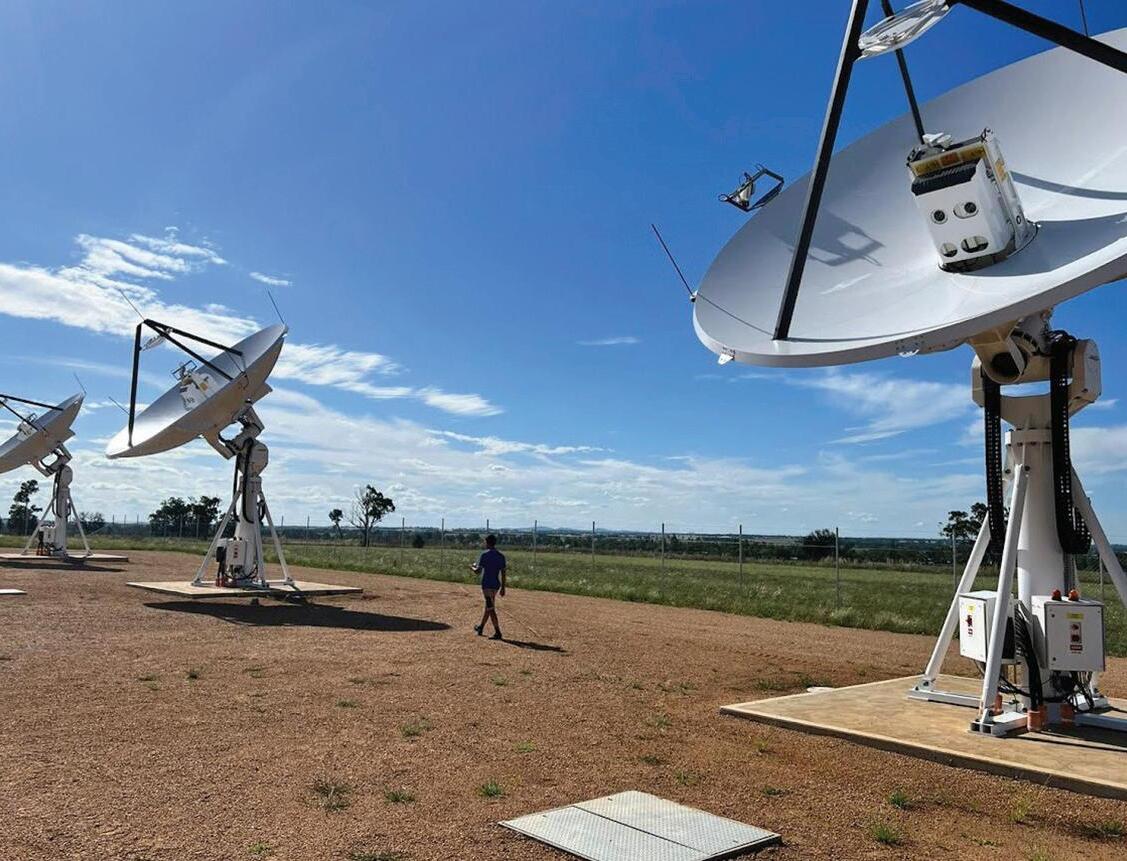
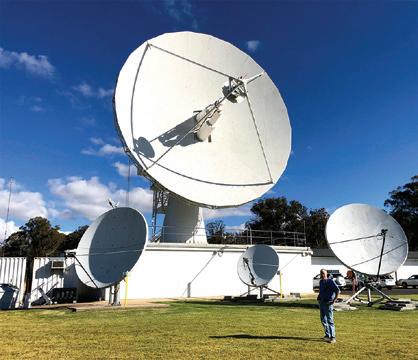
Working with Lockheed Martin has also given us the confidence to approach more customers right across the space industry, broaden our offering and enhance our technical capabilities. One such initiative is developing and manufacturing Australia’s first sovereign manufactured satellite ground system. Highlighting Australian innovation and collaborative research, Av-Comm’s Cassowary system directly enhances local skills, technology and infrastructure, making a significant and meaningful contribution to the local supply chain. With significant customers like the University of New South Wales, Av-Comm is dispelling the myth that Made in Australia is more expensive.
The relationship doesn’t end there, once Australian SMEs are given the opportunity to demonstrate their expertise, Primes like Lockheed Martin have helped Av-Comm build an international profile. With that subtle push to seek Australian content, Primes and Tier 1 Vendors are recognising Av-Comm’s capabilities in key areas and utilising our skills and expertise on projects around the world. Take for example the verification and validation work of a Q and V Band satellite ground station our team is currently completing in Cyprus. As the region’s only team with this technical capability, SMEs like Av-Comm are now contributing to Australia’s space industry exports.
About Av-Comm Space and Defence
Headquartered in Sydney, and with operations across the Pacific, Av-Comm is Australia’s longest-standing privately-owned space technology business. Incorporated in 1981, Av-Comm is a second-generation Australian family business, which specialises in the design, manufacture, and
installation of optical and RF ground segment. Building the space infrastructure on the ground that enables key sectors including telecommunications, agriculture, defence, aviation, astronomy, and many more.
With a 41+ year history of manufacturing and maintaining satellite ground stations and ground segment infrastructure, Av-Comm is a recognised leader and innovator in the Australian space industry.
AUSTRALIA IN SPACE Australia in Space Magazine | 23
'Working with Lockheed Martin has also given us the confidence to approach more customers right across the space industry, broaden our offering and enhance our technical capabilities'
SATELLITE COMMUNICATIONS GROUND SEGMENT SPECIALISTS

Incorporated in 1981, Av-Comm Space and Defence is a second-generation, family business that specialises in the design, manufacture and installation of optical and RF ground segment. Building the space infrastruture on the ground that enables key sectors like telecommuications, agriculture, defence, aviation, and astronomy.

COUNTERSPACE
SOVEREIGN SATCOM MANUFACTURING
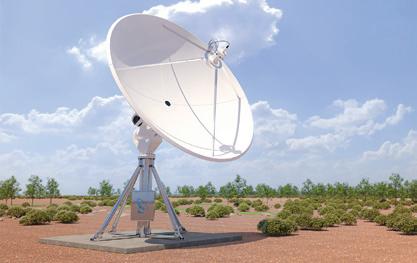
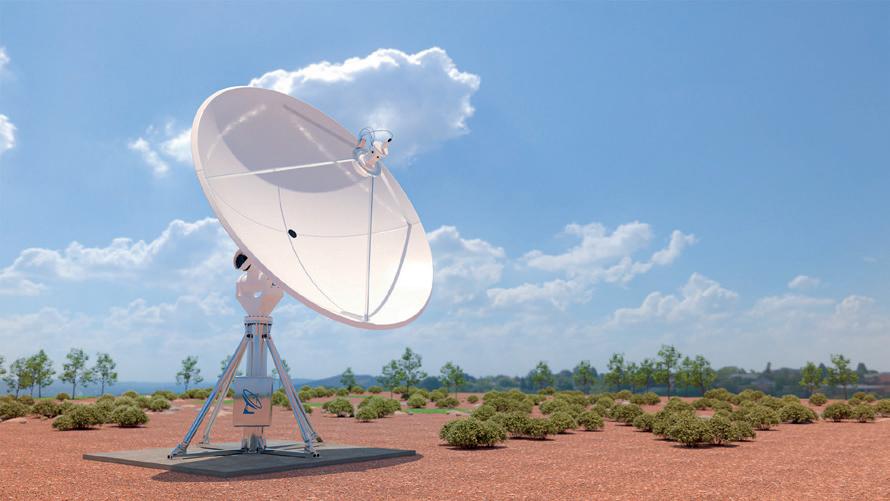
The Cassowary is Australia’s first sovereignmanufactured satellite ground system for S and X band, designed by Australia’s leading satellite ground station research and innovation team. Backed by over 40 years of experience.
SATELLITE GROUND STATION SUSTAINMENT
Australian team of specialist systems engineers trained and authorised by major ground station manufacturers to prescribe and provide preventative and corrective maintenance. When the unexpected occurs, Av-Comm's rapid-response team can be deployed to restore and recover your satellite ground station.
SYSTEMS ENGINEERING & PROJECT MANAGEMENT
Our Australian team is driven to find innovative solutions by challenging conventional thinking with smart systems engineering and project management solutions for ground station systems

AUSTRALIA IN SPACE 24 | Australia in Space Magazine
INFO@AVCOMM.COM.AU+61 (2) 9939 4377WWW.AVCOMM.COM.AU
Cassowary 2.4m Satellite Ground Station Tracking Antenna System
Interview with Michael
Managing Director, Av-Comm Space ad Defence
Michael Cratt is passionate about the unique and vital role the ground segment plays in the Australian space ecosystem. With over 17 years of experience across implementation and project management, systems engineering, and business development at Av-Comm, Michael brings a unique focus to building and sustaining satellite ground stations throughout APAC for Av-Comm’s clients.
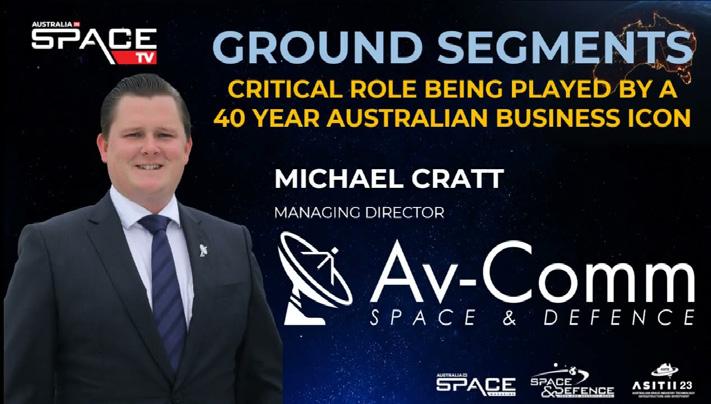
A collaborative project partner and empowering leader, Michael’s drive to ensure the efficacy and longevity of Australia’s space industry is demonstrated in his commitment to developing Australia’s local SATCOM workforce and building the Cassowary, Australia’s first sovereign-manufactured satellite ground stations.
Av-Comm Space and Defence specialise in the design, manufacture and installation of optical and RF ground segment in support of Space and Astronomy applications.
Av-Comm’s experienced engineers champion the design of the ground segment in parallel with that of the spacecraft to optimise and synchronise the data acquisition process for your mission
WATCH NOW
HERE
more of the latest news and interviews in space sector! or head to www.australiainspace.com.au/tv Australia in Space Magazine | 25
Cratt
SCAN
For
Why the Australian space industry’s culture can make or break gender diversity
 By Ali Buchberger Director, Industry Engagement QUT
Mary Jackson smashed structural and cultural barriers when she became NASA’s first black female engineer in 1958. As an ambitious young woman her best option would normally have been to go to secretarial school to learn to have a useful career for the years before she got married. Seventy years on, the first woman is set to land on the moon.
The history of space is a history of female firsts.
Valentina Tereshkova, the first woman in space (1963). Eileen Collins, the first woman Space Shuttle commander (1999). Peggy Whitson, the first woman to command the International Space Station (2008). And with diversity squarely on the agenda of the world’s leading space agencies, we are encouraged to reflect on the tremendous contributions women are making to the growth of the space industry right here in Australia.
However, we are also reminded that the Australian space industry has a lot of work to do to achieve gender parity -
particularly at senior levels - and a lot to lose if it doesn’t.
According to the Australian government’s STEM Equity Monitor 2022, women’s workforce participation is gradually increasing (that’s the good news). However, women are significantly underrepresented in leadership. One third of Australian companies currently have no women on their boards. In contrast, only 0.4% of boards have no male directors. Just 23% of senior management and 8% of CEOs in STEM industries are women.
There is clear evidence that Australian space companies do better when they appoint more women to leadership positions. A seminal report by the federal Workplace Gender Equality Agency has found that companies who appointed a female CEO increased their market value by 5% — worth nearly $80 million to an average ASX200 company. Increase the number of women across key leadership positions by 10% or more, and you will increase a company's market value by 6.6% or $105 million.
26 | Australia in Space Magazine
So, given we will all benefit from gender parity in the Australian space industry, what can be done to attract young women to space, encourage women to sidestep from other industries, and stay?
All the things that workplaces generally should do to improve gender equality: pay equity; prevention of and responses to workplace sexual harassment; recruitment and promotion practices; leave and flexibility options.
But if you believe – as I do – that the Australian space industry is unique, there are also two things that set us apart from other sectors of the Australian economy, and that could help us lead the world in gender diversity.
First, as a young industry we have an unparalleled opportunity to get our culture right from the start. In its recent Women in the Workplace report McKinsey argue a “Great Breakup” is underway where women leaders are switching jobs at the highest rates we’ve ever seen. Young women are even more ambitious and place a higher premium
on working in an equitable, supportive, and inclusive workplace. In other words, women need to be convinced that the Australian space industry is something they’d enjoy.
A growing body of research has highlighted the insidious relationship between gender double standards and women’s career progression. As an example, why do we seem to care so little about how men “manage it all” whilst we are deeply interested in how women do? It would be instructive to compare notes with male space executives. Jeff Bezos has four children, Richard Branson two and Elon Musk nine; at varying points all have been fathers of small children whilst managing challenging corporate careers. Who did the school pick-ups? What happened when the kids got sick? Who packed the school lunches and filled out the school forms?
For what it’s worth, my notes include: my kids chose their clothes yesterday from the “lucky dip pile” because I hadn’t had time to put them away; we had porridge and carrot sticks for dinner last night because I hadn’t gone shopping. Sometimes I’m on top of it, often it’s a debacle. I can only imagine how top space executives do it. And I do need to use my imagination because of the top space and aerospace companies, only one – Northrup Grumman - has a female President and CEO. The others have wives.
I mentioned that there are two attractive things about the Australian space sector for women. The second is the type and variety of work that space offers. While the space industry may not provide the mega starting salaries common in the mining sector, we do get to do really interesting things with our time. We play with rockets, lunar rovers and study the stars. Every. Single. Day. I promise your daughter’s classmates will have Mum envy at your next careers day at school. Unless your daughter’s classmates’ parents are superheroes.
If space exploration equals career inspiration, the biggest story in Australian space yet to breach the trade/ mainstream media divide is Australia’s first Moon mission. Australia has joined the global effort to go back to the Moon and on to Mars. In October 2021, the Australian Space Agency announced that it would support the development of an Australian-made “foundation services” rover to operate on the lunar surface from 2026 through its Trailblazer program. Australian space women stand to break multiple glass ceilings through their leading roles in this effort and the next generation of women will be watching, learning and participating when they do. Imagine what a compelling message we could send.
In the world of space, the 1950s seems a long, long time ago. In 2023, Australia’s best and brightest women no longer have no choice how to spend their time and where to build their careers. They have all the choice in the world.
AUSTRALIA IN SPACE Australia in Space Magazine | 27
'If space exploration equals career inspiration, the biggest story in Australian space yet to breach the trade/mainstream media divide is Australia’s first Moon mission.'
Dr Space Junk presents 5 questions. with

Daniel Joinbee MANAGING DIRECTOR Gunggandji Aerospace
Command;
• Project Management services to AIR5431 Phase 3; and
• Technical Aviation Regulation Consulting services to Air Force Headquarters.
Nelson introduced them to this book and noted that all royalties from its sale will be donated to Lifeline and Legacy.
Alice Gorman is a space archaeologist at Flinders University, Adelaide, and a member of the Advisory Council of the Space Industry Association of Australia. Every issue she will showcase up-and-coming talent, thought leaders, and companies in the Australian space sector. In this issue, her guest is Daniel Joinbee. Daniel Joinbee is a proud descendant of the Gunggandji Tribe (Yarrabah, QLD) and is the Managing Director of Gunggandji Aerospace. Daniel served in the Air Force as an Air Traffic Controller with postings to RAAF Richmond, RAAF Pearce, HMAS Canberra, HMAS Albatross and Head Quarters Joint Operation Command. Whilst providing technical and professional program and project management services, Daniel and Gunggandji Aerospace create nontraditional pathways into Aviation, Space and Emerging Industries for Aboriginal and Torres Strait Islanders.
1. What do you consider to be your greatest achievement so far?
Effective leadership is key to my space work. Dr Nelson embodies the type of leader that I aspire to be. Starting Gunggandji Aerospace. Backing myself and starting my own business has been the most challenging, stressful and rewarding of professional achievements. In twelve months, we have sought out and are currently delivering:
• Program Management services to Space
These professional consulting services have created opportunities for Gunggandji Aerospace to invest in and deliver First Nations Traineeships. Our first two trainees are placed with Jacobs Australia and we have two additional traineeship positions coming online shortly at an Aerospace Defence Prime.
2. What was the most useful subject you studied at school or university for your current career?
Maths has been the most useful subject I studied at school for both my former and current careers. It has provided me with a strong foundation in problem-solving, logical thinking, and data analysis. These skills have been invaluable in all my previous roles. As an Air Traffic Controller I calculated aircraft arrivals based off speed and distance or angular vectors to ensure procedural separation when the radar failed. Working as a business leader and now business executive, I use the same year 11 and 12 calculus skills to build financial models for tenders and forecast my company’s performance. Overall, mathematics has been a critical component of my success in all roles I’ve undertaken.
3. What are you currently reading and how does it relate to your space work?
Brendan Nelson, Of Life and Of Leadership, 2022. I was fortunate and humbled to introduce Dr Brendan Nelson, AO to the cohort of the Boeing Capability Uplift Program in November 2022. Dr
Leadership is the relevance to my space work. Dr Nelson embodies the type of leader that I aspire to be like and has left me with lessons to live by. I take his leadership lessons into Gunggandji Aerospace as I strive to create nontraditional pathways into the Aerospace Domain.
4. If you went on a one-way trip to Mars tomorrow, what is the one item you couldn’t leave without and why?
My laptop. Little known fact, I’m a ten out of ten 4X grand strategy nerd. Civilisation IV, Humankind and Transport Fever 2 are my favourite strategy games. I am often in trouble for setting myself time limits for playing only to find myself deep into a diplomatic negotiation or power struggle with another civilisation at 2 o’clock in the morning! I’d get lost playing these games on the ride to Mars, so I’m hoping it would help make the time go quickly!
5. What is your vision for the future of Australian space industry?
I think Australia has a uniquely innovative space industry because it doesn’t have the same size and scale as foreign space industries. Whilst I don’t want that ‘underdog Aussie’ vibe to change, I want to see a prosperous space industry where we are making meaningful contributions to international programs and it is seen as a viable career paths for all Australians.
: I want to see an Australian Astronaut that is a proud First Nations descendant in the next ten years – David Corporal, I’m looking at you – and for First Nations Australians to take up technical and professional leadership roles in the Space Industry.

Australia in Space Magazine | 29
Dr Alice Gorman Space Archaeologist at Flinders University
Australian surgeon developing an extra-terrestrial medical life pod
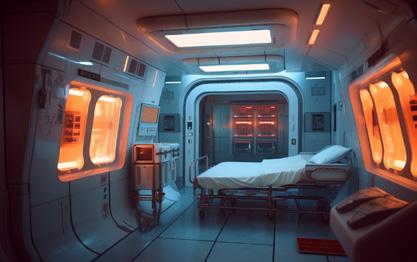
Inspirational concept image only
By Andrew Curran Correspondent Australia in Space
Australian vascular surgeon Abhilash (Abe)
Chandra is on a mission to change how critically injured patients are treated in remote and hostile environments and, potentially, how sick people living in extra-terrestrial environments in the future are treated.
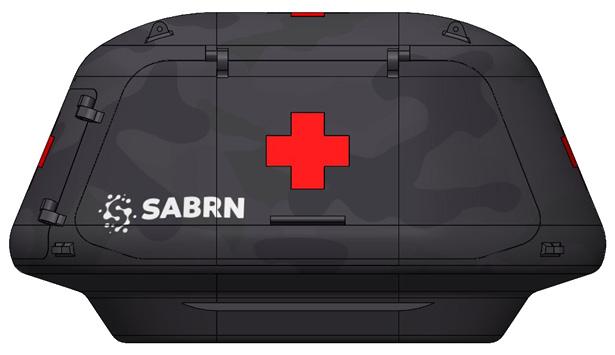
In addition to running a busy surgical practice from his base at Adelaide's Western Hospital, Chandra has founded a health/tech startup called SABRN that is developing a cutting-edge surgical life pod that can be dropped into warzones and humanitarian disaster regions on Earth, and one day, be deployed into space.
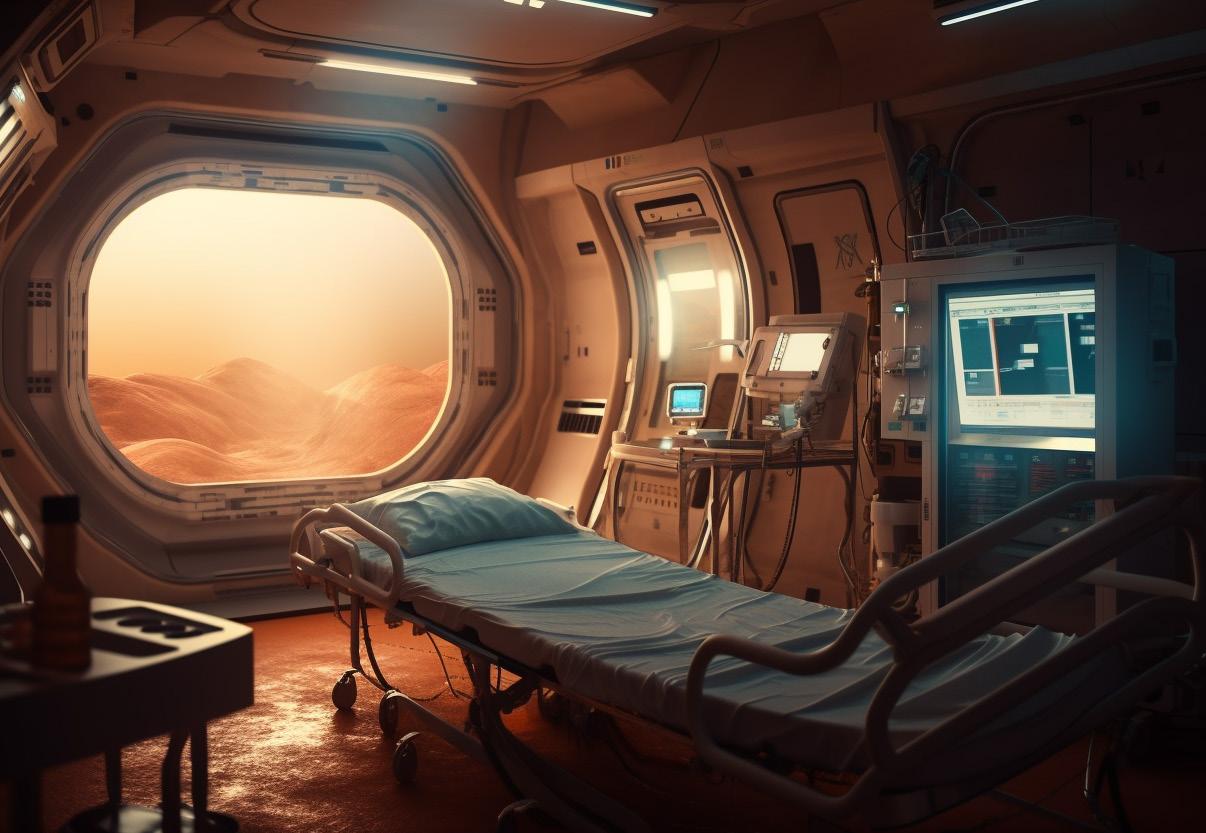
Chandra didn't form SABRN to be a pioneer in extraterrestrial medicine. His motivation for developing the life pods is straightforward. As a doctor, he knows too many soldiers die from injuries because they don't make it to a hospital fast enough.
"If we look at Afghanistan and Iraq, the soldiers who were killed in action, 25% of them were potentially preventable deaths, and this is an environment where the Allied Forces had complete air superiority," he told Australia in Space. "The paradigm now is that the patients must go to the hospital. I'm trying to change the paradigm - the hospital can come to the patient because that's where lives are saved."
Chandra wants to use his first life pods, extensively kitted out as one-person fly-in-fly-out trauma units, to make sure injured personnel, notably those with internal injuries, get top-tier emergency treatment within the so-called golden
hour and, ideally, within what he calls the "platinum ten," –treatment within ten minutes of receiving the injury.
The life pods are still in the developmental stage. He has mock-ups in Adelaide and will be showing those off at the 15th Australian Space Forum in Adelaide in May 2023. He says the basic version of the terrestrial life pods are the size of small shipping containers and weigh up to 500 kilograms. They can enter hostile zones as container cargo and do the last mile via truck or helicopter.
Chnadra points out that the ability to chopper critically injured soldiers out of war zones is decreasing. "The Allied Forces may not have air superiority in future conflicts. In fact, there may not be anything like an air capability for extraction because, as we see from Ukraine, nothing that goes up in the air stays in the air. We can provide better care for our soldiers on the ground because they will need to be maintained in the field for a much longer period."
Chandra is exploring several international opportunities and says that if he secures funding, he can have a working prototype ready by the end of 2024. "From a terrestrial pod perspective, all of the technologies exist now, and I will be able to put everything together by the end of this year to get a minimum viable product."
But it is Chandra's ambition to replicate his terrestrial medical life-pod into an extra-terrestrial environment that makes this piece of kit something special. "I'm working ona whole host of products to develop that extra-terrestrial pod,"
30 | Australia in Space Magazine
he said. "A lot of that is pure research and development. We need to figure out the AI algorithms. We need to look at integrating robotics with the advanced sensors – much of that is unproven and not developed yet."
SABRN's life pods are the kind of big-picture thinking that has the potential to link into NASA's Artemis program, which wants to set up a long-term human presence on the Moon and, eventually, push onto Mars. Via a 2019 funding contribution, Australia already has a foothold in Artemis.
"When we make that transition from a terrestrial variant to an extra-terrestrial variant, things will need to change," Chandra said. "We don't necessarily want something that is the shape of a shipping container, and the payload costs mean we can't take as many things. I was at the NASA Human Research Program in Houston in February, and they are doing a lot of things that are looking at miniaturising equipment."
The surgeon also talks about research underway in Adelaide to solve the problem of the inter-planetary communications time lag and sending precision instructions to a scalpel-wielding robotic arm on Mars. "I'm working with the Andy Thomas Space Centre here in Adelaide and the Future Industries Institute at the University of South Australia to try and develop a proof of concept of a completely autonomous surgical robot."
Chandra believes that with the rapid advances in robotics and medicine, a robot could perform minor surgery, such as excising a skin lesion, within the next five years. Getting regulatory approval to let a robot do that might take that long again. But it is unlikely there will be colony on the Moon before then, so the long lead-in time isn't necessarily a problem for SABRN's extra-terrestrial life pods.
"The proof of concept where we can have something being excised by a robot with zero human intervention or interaction is very, very soon. I think within three years," he said. Advances in robotic technology aside, sending a surgical or even a simple diagnostic life pod into an extra-terrestrial environment presents all sorts of logistical and design challenges. But Chandra says despite this, we will have an obligation to look out for the people we send to future lunar settlements.
"It's a duty of care," he said. "I think that we need to make sure that the level of healthcare we provide to the first people who colonise the lunar or Mars surface is at least the same as what is available to people on Earth, even better.
"According to US MEDEVAC policy, injured personnel cannot be transported without qualified medical personnel," he said. "Obviously, that will need to change over time as technology improves. Also, as the environment becomes more austere and hostile, if we can develop autonomous technologies that can look after and sustain life, then we don't have to risk the lives of search and rescue personnel. That becomes more real if we are going out into an extraterrestrial environment."
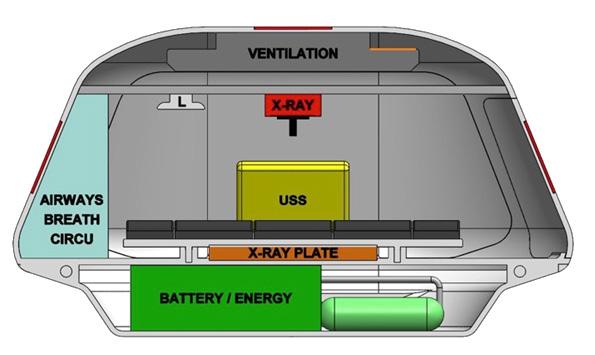
Chandra isn’t afraid to state that healthcare for our military personnel can be better. He also isn't all dreamy-eyed over this. He knows not every life can be saved. Still, he would like to see the current mortality count decrease, and he wants to pursue that agenda into extra-terrestrial environments.
AUSTRALIA IN SPACE Australia in Space Magazine | 31
Concept images supplied
Inspirational concept image only
"I think that we need to make sure that the level of healthcare we provide to the first people who colonise the lunar or Mars surface is at least the same as what is available to people on Earth, even better.
Perth’s Curtin University leading the way in the Australian space sector
By Andrew Curran Correspondent Australia in Space
Perth's Curtin University is fast making a name for itself in the space sector after spending years growing its space research institutes, recruiting top-flight academics, and building connections with the space sector at home and abroad.
The Times Higher Education 2023 World University Rankings rank Curtin as one of the top 250 universities in the world and 36th in the young university rankings. Evidently, Curtin is carving out a substantial niche in space research and emerging as Australia's top space university.
Professor Melanie Johnston-Hollitt, an astrophysicist and Director at both the Curtin Institute for Computation (CiC) and the Australian Space Data Analysis Facility (ASDAF), says Curtin's growing space reputation is due to the interests of individual academic groups and the university's overarching strategy. The establishment of the Australian Space Agency (ASA) in 2018 and the growing commercial interest in using space data have also accelerated growth in this area.
"On an individual level, you have people who are bringing groups together at a senior, professorial level, and from a capability point of view for Curtin, is moving into an emerging sector that has not been stifled by too many regulations here in Australia," Johnston-Hollitt said.
"In an era when we are starting to see a huge amount of commercialisation in space, it's a good strategic direction for a university to move in, particularly a technologically strong university like Curtin."
Professor Phil Bland is the Director of the Space Science and Technology Centre (SSTC) at Curtin University and Director of the Australian outpost of the NASA Solar System Exploration Research Virtual Institute. His enthusiasm for space and Curtin’s work in the sector is infectious.
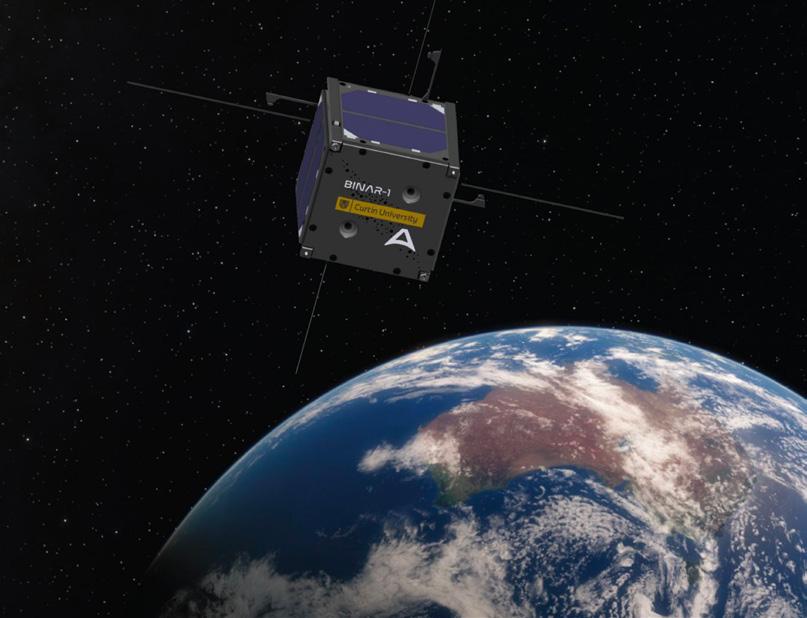
The SSTC is the Southern Hemisphere's largest planetary research institute - around twenty PhD and post-doctoral research students work at the SSTC at any one time, along with a rotating roster of intern undergraduates who Bland says are the backbone of the program. The Centre is also home to the Binar Space program. Binar-1 launched in August 2021 onboard the SpaceX CRS-23 International Space Station resupply mission. The mission's primary goal was to demonstrate the technology, which ended 14 months later when the satellite re-entered Earth's atmosphere. Bland says further launches are planned for later this year.
The SSTC is evidence of Australian research institutes’ growing partnerships with tier-one international space agencies. In the SSTC's case, those agencies include JAXA,
32 | Australia in Space Magazine
ESA, and NASA.Binar-1 was launched into orbit from the Japanese Experiment Module Kibo on the ISS through the Japanese space startup Space BD, with ESA providing mission control capability. More recently, the SSTC partnered with NASA Jet Propulsion Laboratory spin-off company, Chascii, with the goal of developing the first ever CubeSat with a tilting optical communications terminal.
John Curtin Distinguished Professor Steven Tingay, astrophysicist and Director of the Curtin Institute of Radio Astronomy (CIRA), says much of his industry and defencefocused work at the university is about space domain awareness. He describes that as "translating technologies and techniques out of radio astronomy. This includes technologies such as the antennas and the signal processing electronics, all the way to the data processing algorithms, and the post-processing analysis."
Last year, Curtin signed a formal partnership with Nova Systems, bringing the research out of the development stage and into the operational and commercial phases. "Not that the research ever ends," says Tingay. "We're constantly working to improve the algorithms and come up with new data processing strategies. That's always an ongoing process, but we have a pretty impressive set of core capabilities now
that we're ready to take operational."
The academics are enthusiastic about the future direction of the Australian space sector, saying there is plenty of opportunity for Curtin University and the broader Australian space industry. There is a substantial push to develop space remote robotic capabilities in Australia, an area the country is already a leader in. Bland doesn't dismiss this, but a true scientist at heart, he says it's important not to forget the research. "We should focus on science," he says, noting that it is the bedrock of the space industry.
Johnston-Hollitt says the role of remote robotics, derived from the mining sector, distinguishes Western Australia. She is also a big champion of the state's other space sector attributes. "There are two really interesting things here," she said. "One is the mining industry which has been geared up to develop infrastructure at scale quickly in remote and hostile environments. There is a huge amount of transferrable knowledge from the mining sector into the space sector.
“Then you’ve got the state of Western Australia itself. When you look at space-adjacent technologies such as radio telescopes, Western Australia is probably the best place in the world to put a radio telescope, and we have several thanks to the government establishing a radio-quiet zone in the Mid-West. We are already seeing spinouts from those astronomy research instruments into the broader space sector. Western Australia has a huge number of attractive requirements and capabilities associated with the space sector - that is a real point of difference for us when compared to Australia’s east coast.”
Tingay says he and his colleagues are well-positioned to equip students with the skills to work in the space sector and elsewhere. He says studying astronomy gives students solid maths, physics, engineering, and computing skills, which have applications beyond the space sector. Tingay talks about AUKUS, its future workforce requirements, and how he and his colleagues at Curtin can help.
"Behind the headline of some of these announcements, around the world I'm detecting a bit of a race to invest in fundamental STEM skills. Australia has a pretty small population. That means we've got to be good at building those skills, and that's something that Curtin is massively focused on,” he said.
"Astronomy is a really easy sell to get kids in the door, exposed to all of the mathematics, all of the physics, all of the computer sciences, all of those fundamentals that a bit later in their lives are going to be completely transferable to lots of other domains."

AUSTRALIA IN SPACE Australia in Space Magazine | 33
'Australia has a pretty small population. That means we've got to be good at building those skills, and that's something that Curtin is massively focused on'
The defence strategic review - Implications for space
 By Dr Malcolm Davis Senior Analyst Australian Strategic Policy Institute
The findings of the Albanese government’s Defence Strategic Review (hereafter ‘the DSR’) are yet to be released to the general public, with government suggesting that the key findings from the classified review will be announced ‘before the May budget’. Some clear hints though, particularly in relation to new capability choices, such as a focus on ‘impactful projection’ suggests a much greater emphasis on long-range strike, and perhaps less emphasis on acquiring the types of capabilities for a traditional close-in ‘Defence of Australia’ strategy that has dominated Australian defence thinking since the late 1980s, are prominent in public discussion. The role of space capability has to be a very significant and expanding component in the future of the ADF, and the DSR needs to address this important domain, or fall short in being credible policy guidance for Australia’s future defence requirements. More significantly, Government needs to support any defence vision of future space capability by promptly completing a coherent National Space Policy.
Certainly, there are other issues besides new capability choices, including whether the ADF’s force posture will be re-orientated northwards, with a consequent hardening of
northern defence facilities, and greater emphasis on national resilience against multi-domain threats. And any discussion of capability and posture are meaningless unless resources –money and people – are available, so it’s inconceivable that the DSR will recommend a defence spending cut. The May 2023 budget has to reflect the rapidly worsening strategic outlook by funding capability decisions emerging from the DSR adequately, and a priority must be growing the ADF in terms of highly trained personnel.
Above all else, time is not on our side, and the DSR must reflect an urgency in addressing readiness, mobilisation, sustainment and capability gaps. The 2020 Defence Strategic Update made clear that the traditional and comfortable assumption of ‘ten years strategic warning time’ is no longer fit for purpose as a basis for defence policy. It’s clear with growing tensions in Europe as a result of Russia’s invasion of Ukraine, as well as concerns over China’s rapidly growing military capability and potential intent towards Taiwan later this decade, that a happy and relaxed coast forward based on multi-decade acquisition cycles simply is no longer appropriate. We need to be thinking about what steps we can take in the next three to five years.
34 | Australia in Space Magazine
COVER FEATURE
With these key issues – new capability, enhancements to force posture, investment and personnel, and national resilience, space capability plays an inextricable role. No longer is the space domain an ‘after-thought’ in which access is simply assumed to be guaranteed. As Defence policy documents and commentators now commonly refrain, space is ‘congested, contested and competitive’. Congested as a result of growing numbers of satellites – a trend which will only sharpen with mega-constellations in LEO – and increasing amounts of space debris. Contested as adversaries develop a full range of counter-space capabilities designed to attack our satellites and deny us crucial access to essential space support. Competitive as the falling cost of accessing space and utilising space through commercial ‘Space 2.0’ business models open up the high frontier to more participants. Add in ‘Complex’ as this new commercial space renaissance allows new types of space activity, such as on-orbit refuel and repair and space mobility; space resource utilisation; and spacebased manufacturing.
This congested, contested, competitive and complex domain is vital for Australia’s security and prosperity. In terms of defence, modern warfare depends on sustained
and uninterrupted access to space capabilities for joint and integrated multi-domain operations, and to facilitate network-centric approaches such as that implicit in the United States’ ‘JADC2’ command and control system, or that which underpins the establishment of capabilities emerging from AIR 6500 that will form the basis of ADF Integrated Air and Missile Defence. Take out our access to space, using counter-space capabilities, and our ability to fight war in a manner consistent with principles of Jus in Bello and the Laws of Armed Conflict falls apart quickly, as our knowledge edge erodes, connectivity fails, and our understanding of the battlespace diminishes. Our adversaries understand the importance of space, which underlines China’s and Russia’s emphasis on developing both hard kill and soft kill ASAT capabilities that are increasingly threatening to our assured access to space.
The 2022 Defence Space Strategy emphasizes the importance of that assured access to space, and strongly promotes space resilience including through sovereign space capability that encompasses both satellite development and sovereign launch. That should be a strong hint to the authors of the DSR on how space needs to be developed for Australia. The DSR needs to reinforce and support the 2022 Defence Space Strategy’s call for assured access to space and space resilience as a starting point as an overarching principle. That opens the door to many possibilities going forward.
Firstly, if we are to truly develop sovereign space capability as a basis for assured space access and space resilience, then government needs to look at space not just in defence terms, but as a ‘whole of nation’ capability. Australia has a vibrant and growing commercial space sector, which is moving far more rapidly in the ‘Space 2.0’ context than traditional state-run taxpayer funded space activities of the past. ‘NewSpace’ is the future for the nation’s space enterprise, and the government must fully support it. A good place to start would be to fully support the completion of a National Space Policy that began with the former Morrison Government’s ‘Space Strategic Update’ which was announced in 2022, but which appears to be only making limited progress under the Albanese government. The National Space Policy is key to bringing together Australia’s commercial space sector with Defence, under the guidance of the Australian Space Agency, and to provide focus and direction for national space endeavours going forward. A failure to support the National Space Policy sends a signal of lack of government interest in building national space capabilities that serve both civil and commercial roles, as well as defence and national security requirements. Companies will simply

AUSTRALIA IN SPACE Australia in Space Magazine | 35
Cont next page >>
The 2022 Defence Space Strategy emphasizes the importance of that assured access to space, and strongly promotes space resilience including through sovereign space capability that encompasses both satellite development and sovereign launch
relocate overseas, jobs will be lost, dreams are shattered. We go backwards, not forwards. That would be a loss to the nation which has made such tremendous progress since 2017.
Secondly, with a National Space Policy in hand, Defence would then be better placed to update its 2022 Defence Space Strategy post-DSR to reflect the importance of supporting ADF long-range strike capability and to respond to the challenge posed by a more contested space domain. What might this mean in practical terms? Both the 2020 Defence Strategic Update, and its accompanying Force Structure Plan, as well as the 2022 Defence Space Strategy, briefly mention ‘space control’ but provide little detail on just what this means for Australia. There’s reference to the importance of Space Domain Awareness, and certainly Australia is playing a really important role in that mission under Operation Dyurra with a space surveillance telescope being operated at Exmouth, Western Australia, and with Defence Project JP-9360 set to expand ADF space surveillance in coming years. But if we are serious about assured access to space and space resilience, that are front and centre in the 2022 Defence Space Strategy, then we need to do more than simply Space Domain Awareness. More discussion is needed on just what Space Control actually means for the ADF. Australia has quite correctly signed up to a unilateral ban on the testing of kinetic kill ASATs that produce space debris (a ban opposed by China and Russia), but we need to start considering how we can defend crucial space capability. Defence Project 9358 on ground-based Space Electronic Warfare is one path forward, but the answer

lies in pursuing space resilience through augmentation and reconstitution, via the establishment of sovereign space launch and satellite manufacturing. We are back to national space capabilities and integration of commercial space capabilities with Defence requirements – and an absence of a National Space Policy to guide such a capability. The future is there – government simply has to open the door to it, by finishing the Space Policy to guide our path into it.
The DSR does present the opportunity for the Albanese government to show forward thinking and ambitious vision on how Australia’s commercial and civil space sector works more closely with Defence in coming years. Start by finishing a National Space Policy that considers the DSR’s findings and which provide a path forward to update the 2022 Defence Space Strategy. In capability terms what’s crucial is sovereign space capability that builds space resilience through national space launch and satellite manufacturing. That opens all sorts of intriguing possibilities. Look beyond projects such as JP-9102 and DEF-799 Phase 2, to ask what Australia can do which is ambitious and bold, and that allows us to not only assure our access to space, but burden share directly in space with key allies. If the DSR is focused on ‘impactful projection’ then developing innovative types of sovereign space based ISR and targeting for long-range strike capabilities might be a good step forward that opens opportunities for SMEs in Australia to bid as prime contractors for small-satellite technologies that can be launched from Australia, using Australian launch vehicles. How can those launch services leverage new technologies, such as reusability and rocket logistics as well as space mobility, to enhance ADF space capability and space survivability? We are witnessing a new renaissance in human activity in space as a result of these technologies. Defence needs to expand its vision, gaze skywards and be bold in its plans. Government needs to get behind that enterprise if it is to avoid wasting such amazing progress by Australia’s space sector in recent years.

AUSTRALIA IN SPACE 36 | Australia in Space Magazine
'Australia has quite correctly signed up to a unilateral ban on the testing of kinetic kill ASATs that produce space debris'
www.spaceandearthconference.com
23-24 OCTOBER 2023, PAN PACIFIC HOTEL PERTH, WESTERN AUSTRALIA
“Bringing together leaders from across the Indo Pacific and beyond for opportunities in cross-sector technology and innovation”
Curtin University is pushing the boundaries of space technology, advancing planetary science research and expanding our understanding of the local and distant universe.
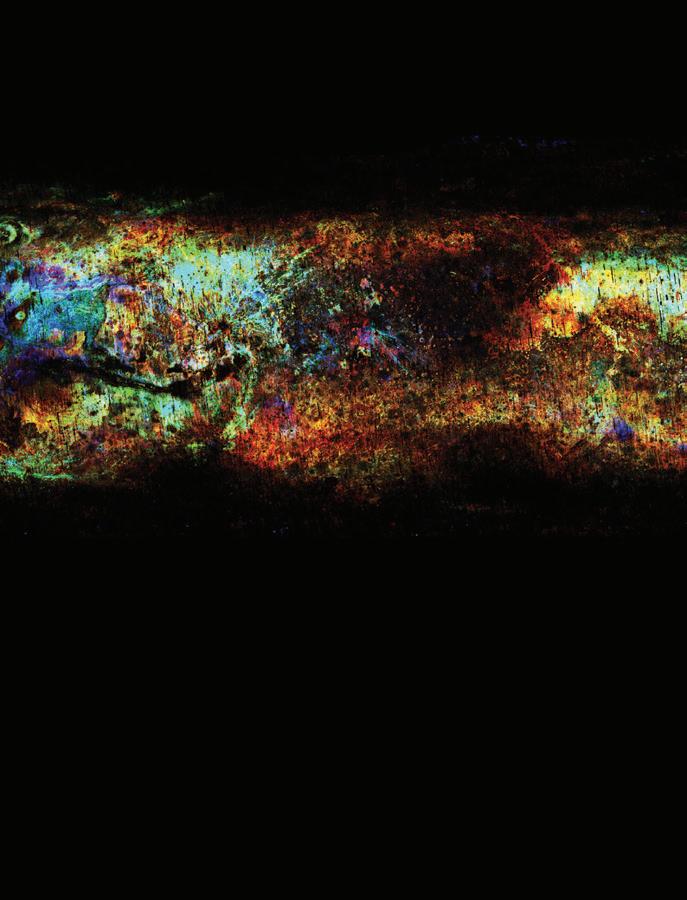
We’re tracking remote objects, analysing the composition of planetary bodies, designing and building end-to-end satellite technologies for on-orbit missions, and managing large-scale remote observation infrastructure. With embedded research excellence and support from trusted partners, our bold multidisciplinary research programs look to create impact, innovate and shape the future of the Australian space industry as we build our sovereign capability and capacity in the coming years.
To find out more about our programs and partnerships, visit curtin.edu/space.
OUR EXPERTISE
• Space systems engineering and remote operations
• Planetary geology, astrophysics and exploration science
• Communications, remote sensing, signal processing and navigation
• Analytics, computing and visualisation
• Robotics and automation
Authors
(1) Space Science and Technology Centre
(2) CSIRO - Pawsey Super Computing Centre
Space research without boundaries CRICOS Provider Code 00301J. 5528ROC
 Image: Mars craters densitymap
: Dr. Anthony Lagain(1), Prof. Gretchen Benedix(1), Mr. Konstantinos Servis(2)
Image: Mars craters densitymap
: Dr. Anthony Lagain(1), Prof. Gretchen Benedix(1), Mr. Konstantinos Servis(2)
Saber Astronautics: An upward force in Australian Space
By Saber Astronautics
Coming up on their 15 year anniversary, Saber Astronautics continues making significant contributions to the space industry, building onwards and upwards as a force in the Australian space industry.
Space is historically viewed as complex and challenging, needing the brains of thousands of engineers and scientists, millions of calculations, billions of dollars and astronomical risk. It’s fascinating, mysterious, exciting and increasingly vital to modern society.
From space beer to a commercial astronaut program, Saber is pushing the boundaries of what it means to be a successful sovereign space company whilst working towards their goal of democratising access to space.
Like many brilliant ideas, Saber sparked as a simple ‘back of the napkin’ idea.
In 2008, Saber’s founder Dr. Jason Held turned his passion for space, love of video games and his doctoral thesis into Saber’s flagship software, Predictive Interactive Ground station Interface (P.I.G.I.™). It was the first of its kind, mission operations software developed using a video game engine, P.I.G.I. transforms massive streams of data into 3D visualisation offering efficiency, reliability and intuitive understanding and control.
P.I.G.I. is currently used by Saber as part of their full
mission services offerings. It is a key technological disruption to the expensive and bespoke industry of space exploration.
The software also forms the baseline for a US Department of Defence specific program named Space Cockpit. Future-proofing themselves, both programs are built within a flexible framework, enabling continuous development as the space industry, available technologies and available data grow.
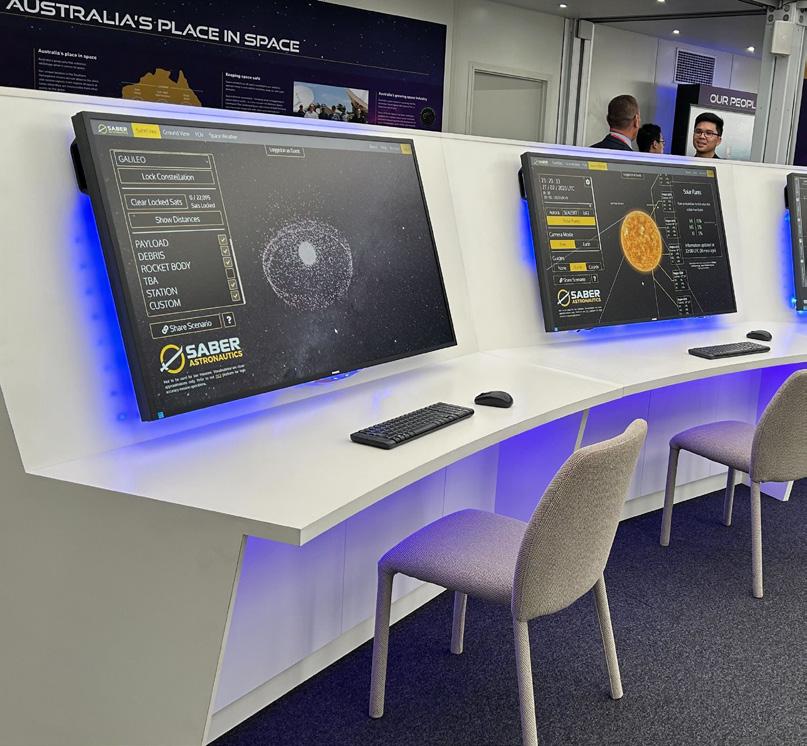
Flourishing beyond that first idea, Saber grew from a group of researchers in 2008 into an organisation operating at national strategic levels.
With a team of passionate and innovative engineers, space operators and flight teams, Saber now offers a range of products and services developed for space asset management. Like any other tech company, Saber is fast and agile, leveraging machine learning, artificial intelligence and other cutting edge technologies to improve efficiency and effectiveness for their customers.
One of the most important offerings by Saber is their mission operations services, which combine spacecraft control, dish management, and space traffic support into a single seamless service.
Saber conducts their operations and services using their Responsive Space Operations Centre (RSOC™) program
38 | Australia in Space Magazine
located in Boulder, Colorado and the flagship centre in Adelaide, South Australia which was funded in part by the nation’s $6m Space Infrastructure Fund awarded to Saber by the Australian Space Agency.
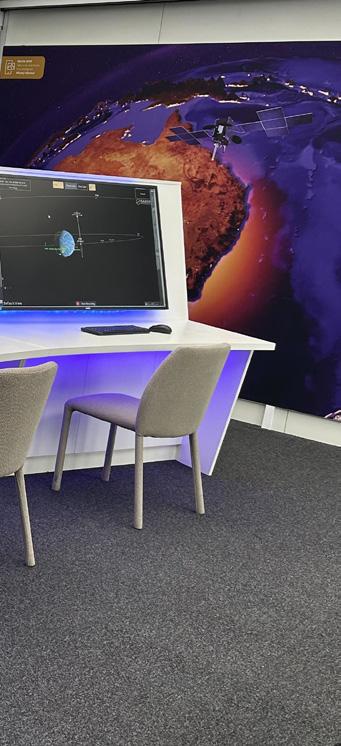
The RSOC™ is a major driver pushing towards a more open and accessible space industry, removing the bespoke nature of flight operations and control. Those looking to fly with the Saber program can access a thriving marketplace of data providers, groundstations, sensors and other upstream suppliers who are fully integrated into Saber’s systems. The RSOC™ is a one stop shop for those looking to fly their satellites and keep them safe on orbit.
Linked to the organisational goal to democratise the access to space, is the responsible use of space which is a key focus for Saber Astronautics. To this end, Saber is extremely active in the field of space traffic management.
The organisation is the Pacific Cell lead in the US Department of Defense Sprint Advanced Concept Training (SACT), a joint global exercise understood as the largest space wargame in the world. SACT’s unclassified program brings together commercial, government and academic participants from across the globe in a virtual hackathon to experiment with real-world space domain awareness scenarios in real-time.
As the Pacific Cell lead, Saber coordinates over 200 people from 4 nations whilst continuing to innovate processes and procedures leading to the responsible use of space. SACT brings together the full potential of all the participants, who offer the latest processes and technologies tested in realtime, real-world scenarios offered by the exercise.
As a natural consequence of Saber’s groundbreaking work in space traffic, the company also supports the US DoD’s Joint Task Force Space Defense Commercial Operations Cell (JCO) as their night shift operators. Saber’s shift, alongside the UK Space Command, provides the JCO a 24/7 “follow-thesun” capability.
Another key achievement is the continued development of the “DragEN” concept, a small, passive, reusable aerodynamic drag sail and tether energised by interactions with Earth’s magnetic field. DragEN uses the harnessed energy to assist in responsible deorbiting by pulling a spacecraft down to where it can safely burn in the atmosphere.
Saber recognises that in creating greater access to space, they must promote an ethical and sustainable use of space, ensuring access for future generations. The ideation and continued progress of DragEN reflects this.
First developed in Australia by a Saber co-founder, Dr Daniel Bunker, DragEN receives continued NASA support and interest. NASA’s Flight Opportunities program selected the DragEN for low gravity flight campaigns in 2015 and 2016 verifying the concept. DragEN was also the subject of a NASA Small Business Innovative Research (SBIR) grant to add a device for more responsive drag.
The next steps in the project, which are the subject of a University of Sydney CUAVA project and PhD candidacy, include developing control systems allowing the DragEN device to assist very small satellites in conducting basic manoeuvres on orbit. This is a critical capability ensuring small, lightweight spacecraft are able to change altitudes and avoid collisions, providing safe, continued productivity.
Future planned development of DragEN will contribute to decluttering space, especially critical orbits such as LEO (low earth orbit). Saber plans for the DragEN tether device to attach to orbital debris, generating energy and bringing debris down alongside the original spacecraft. DragEN will decrease threats to active spacecraft and decrease the potential of an occurrence of Kessler syndrome by removing two or more pieces of debris with each spacecraft deorbited using the device.
In recent years, Saber also developed and supported space startups in Australia, through a range of pitch events, competitions, and incubation. The highly popular space business plan competition Quest for Blue showed hundreds of university students how to develop their ideas and use
AUSTRALIA IN SPACE Australia in Space Magazine | 39
Saber conducts their operations and services using their Responsive Space Operations Centre (RSOC™) program located in Boulder, Colorado and the flagship centre in Adelaide, South Australia
Cont next page >>
Saber Astronautics' software demonstrated by the Australian Defence Force at Avalon 2023.
P.I.G.I., going from “napkin sketch ideas” to “viable business plans”. Winning teams received cash awards and interest from investors. Goldfish Tank, a pitch competition, introduced Australian space startups to investors. Pitching in front of packed audiences, several teams won their first seed investments, many of them in business and thriving today.
In 2020, Saber partnered with TCG to develop a space manufacturing focused incubator Wolfpack Space Hub. The “hunt as a pack” philosophy and progressive, collaborative atmosphere allows new entrants to tackle the industry as a team while growing
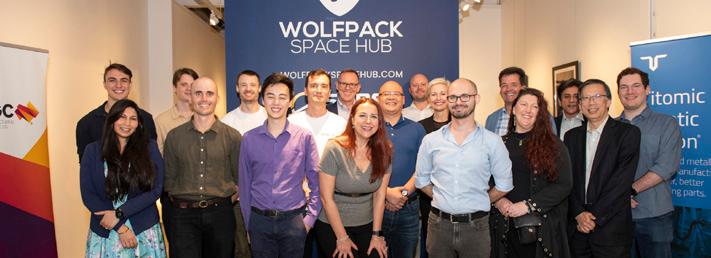
in a supported environment. From the Wolfpack Space Hub various successful space companies graduated, such as Dandelions, Spiral Blue and Sperospace. These companies are now established in their own right, continuously innovating and winning contracts as successful Australian SMEs.
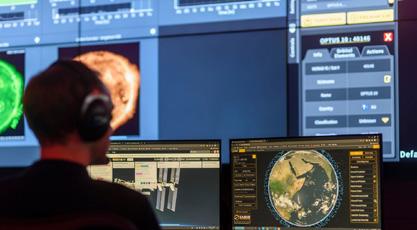
The latest Saber achievements include the successful integration, launch, monitoring, and command and control of the largest commercial communications array in LEO at the time of this writing. AST SpaceMobile’s BW3 launched late last year is now successfully deployed and undergoing operations– a massive achievement not only for AST but for Saber’s agile, and high performing team.
Another key achievement is the ideation and coordination to establish an Australian Astronaut Program, in partnership with US based company Axiom. With Axiom already flying successful private astronaut missions to the International Space Station (ISS), space travel is becoming more democratised, less limited by national capability and citizenship. The partnership led Saber to develop an Astronaut Program with the idea of opening up ISS access to Australian industry; Sending Australian products for development and commercialisation aboard the unique research environment of the ISS with an astronaut flying under an Australian flag.
Saber steadily supports the commercial space industry. The organisations’ achievements reflect their goal of achieving a democratised, sustainable and responsible access to space. From easing the path to responsible deorbiting to offering a more universal solution to mission operations, Saber is a driving force to open up space access to all.
The 15 year anniversary of Saber Astronautics will soon unveil brand new offices and a mission design centre accommodating for the growth of Saber’s international team of space engineers, operators, scientists and operational staff.
Saber is stepping up, with innovation and determination, creating a strong sustainable presence on the international and interplanetary stage. There is a bright future for us in the stars.
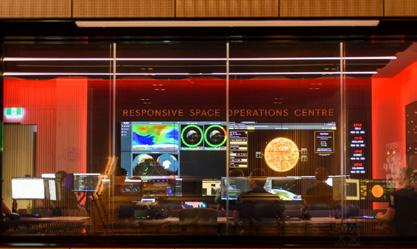
AUSTRALIA IN SPACE 40 | Australia in Space Magazine
Launching the Wolfpack Space Hub's new facilities in Sydney.
Saber's space operators ensure safety of flight for clients at the RSOC.
View of the RSOC from the publicly-accessible Australian Space Discovery Centre in Lot Fourteen, Adelaide.
Find In Space Adelaide
SOUTH AUSTRALIA
-THE PRIME PLACE FOR SPACE IN AUSTRALIA.
Home to the Australian Space Agency, Australian Space Discovery Centre, Mission Control Centre, the nation’s first two launch facility licences, over 100 space-related organisations, Australia’s first state satellite and a future space manufacturing hub – South Australia is at the forefront of the nation’s space endeavours.
Explore the possibilities now at SASIC.SA.GOV.AU

Space innovations are helping decarbonise industry on Earth
By David Flanagan Chair
Following the success of NASA’s first Artemis mission to the Moon we should ask what’s the value of space exploration? Why should we spend so much of our precious resources getting off Earth when there are so many issues to deal with at home, not least of all global warming and the increasing impacts of climate change?

Space technology touches many aspects of everyday life. Conveniences we take for granted were borne out of space exploration, including GPS, cordless power tools, computer mouse, phone cameras and infrared thermometers.
Space innovations are also helping on-Earth industries decarbonise and fight the impacts of climate change. Everyone from insurers to urban planners use satellite Earth observations to forecast risk and make critical decisions about the designs of our cities. We are bolstering our resilience to natural disasters with satellite images and data that provide early warning of bushfires and floods.
Curtin University is leading the way in Australia with the Binar satellite program. The first of seven contracted CubeSats, Binar-1 was launched from Cape Canaveral, Florida on a SpaceX rocket in August 2021, then deployed from the International Space Station.
The Binar missions will allow us to see our home from a whole new perspective, greatly enhancing our understanding of Australia’s geophysical environment. This will lead to
greater insights and better decision making across diverse areas such as water resource management, mine site design, fire and flood mitigation, and infrastructure development.
Australia is a world-leader in remote operations, particularly across our resources sector. Remote operations – utilising robotics, automation and artificial intelligence – reduce emissions and environmental impacts, lower safety risks and increase jobs diversity.
A core objective of remote operations collaborator AROSE (Australian Remote Operations in Space and on Earth) is to uncover and widen the application of Space capability across on-Earth industries. This approach is helping some of AROSE’s founding members to deliver on their sustainability and decarbonisation outcomes.
Global geo-data specialist Fugro is combining advanced remote operations capability with satellite imagery and communications to transform its ocean-going fleet of survey vessels. In 2021, Fugro used its first uncrewed surface vessel, the 12-metre Fugro Maali, to complete an entirely remotely operated nearshore inspection of three gas trunklines for Woodside’s North West Shelf Project.
According to Fugro, the program led to a 97% reduction in CO2 through reduced fossil fuel use. It improved HSSE outcomes by lowering offshore staff hours and enabled a more diverse workforce on the project.
42 | Australia in Space Magazine
AUSTRALIA IN SPACE
The Australian Remote Operations for Space and Earth consortium (AROSE)
NASA recognises Australia’s expertise in remote operations and has asked the Australian Government to provide a Lunar Services Rover – a semi-autonomous robot on wheels – for a future Artemis mission.
Australia’s leading gas producer Woodside Energy has also formed a collaboration with NASA. Woodside and NASA recognise the mutual benefits of working together on robotics and remote operations.
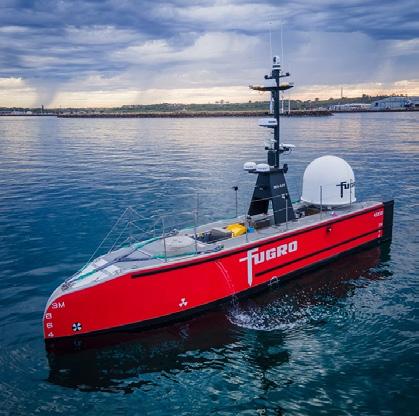
NASA sees Woodside as a great test bed of robotics in harsh environments, as Woodside is doing similar tasks at its operations which NASA envisages doing on the Moon and Mars.
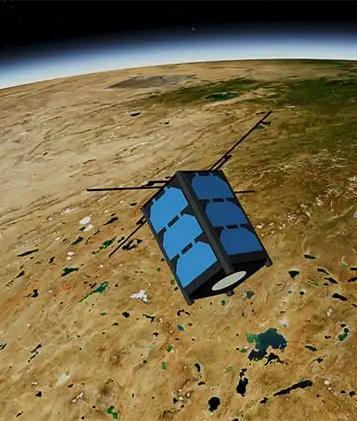
Investment in Space is also a significant economic multiplier. NASA estimates that for every $1 spent on the Space sector, an additional $7-$14 is generated in the broader economy.
Some say the new space race heralds the next and most profound industrial revolution in human history.
Perhaps more importantly, right now space innovations are helping decarbonise our most energy intensive industries, including marine, rail and road transport, heavy industry and food production.
Through the on-Earth deployment of space innovations and technology, industry’s journey towards net zero carbon emissions is well underway.
AUSTRALIA IN SPACE Australia in Space Magazine | 43
Investment in Space is also a significant economic multiplier. NASA estimates that for every $1 spent on the Space sector, an additional $7-$14 is generated in the broader economy
Fugro uncrewed surface vessel,12-metre Fugro Maali
Curtin University Cube Sat BINAR-1
The next frontier in space optics
 By Samara Thorn Engagement Manager The Australian National University
Of the many challenges the space industry faces, size and weight constraints when sending payloads into space is one of the most keenly felt pain points. The limited capacity of launch vehicles means every kilogram and every cubic centimetre of room matters. This makes improving the functionality of space technology difficult, as increased functionality often leads to increased size, weight and power requirements. Traditional optics has often been this choke point, with lens systems adding significant bulk. However, with advancements in technology, we may finally break through this bottleneck.
The relatively new field of meta-optics is the relief the industry has been waiting for, allowing for the simultaneous advancement and miniaturization of devices as it works in concert with existing optical elements to generate, manipulate and detect light.
Meta-optics uses sub-wavelength patterned surfaces, metasurfaces, to mimic the effects of traditional optical components such as lenses and mirrors. These artificially engineered materials manipulate light by scattering it within nanoparticles rather than refracting it through a traditional lens. Metasurfaces can engineer the light wavefront, emission and absorption in a way that demonstrates improved
performance over traditional optics with a vastly smaller footprint, and they offer functionalities that cannot be achieved conventionally. In addition, metasurfaces can also perform other functions, such as beam steering, beam focusing, and light modulation, by incorporating elements such as phase shifters, reflectors, and transmissive elements.
Unlike some other fields of fundamental science, research into meta-optics is largely driven by industry needs with desired applications defining research problems in university systems. Prof. Dragomir Neshev, Centre Director of TMOS, the Australian Research Council Centre of Excellence for Transformative Meta-Optical Systems says “We’re working closely with industry partners to identify the research pathway that is going to have the greatest real-world impact. Already, some of our projects have been taken in new directions as engineers in private space, defence and medtech companies have asked ‘can meta-optics do this…?’”
“We offer meta-optics discovery calls to help businesses identify how meta-optics might contribute towards their objectives, but these calls also give us crucial insight that helps to guide our work.”
Meta-optics has a part to play in almost all aspects of space technology. In Australia, the focus is on space
44 | Australia in Space Magazine
communications, space navigation, earth observation, and the development of new lightweight optical instruments.
Space communication

Secure quantum communications has been a key objective for many industries over the past few decades. While significant progress has been made, much of the technology requires clean rooms and cryogenic cooling, which are impractical for widespread use in space. There is a lack of affordable, reliable quantum light sources that can encode and transmit the information without these tools. Low light intensity also poses an additional challenge.
Researchers are currently working on incorporating metamaterials into devices that generate and/or detect photons as part of a quantum communication platform. They have developed new technology that integrates quantum sources and waveguides on chip in a manner that is both affordable and scalable, paving the way for lighter satellite payloads and more accessible use. These quantum source nanostructures are made of easily sourced and cost-effective hexagonal boron nitride, also known as white graphene. These new quantum emitters can be created using $20 worth
white graphene pressed onto an adhesive and exfoliated. The process of exfoliation, or peeling off the top layer, allows for the creation of a flexible 2D material that can be stacked and assembled like building blocks, providing a novel bottom-up approach to replace traditional 3D systems.
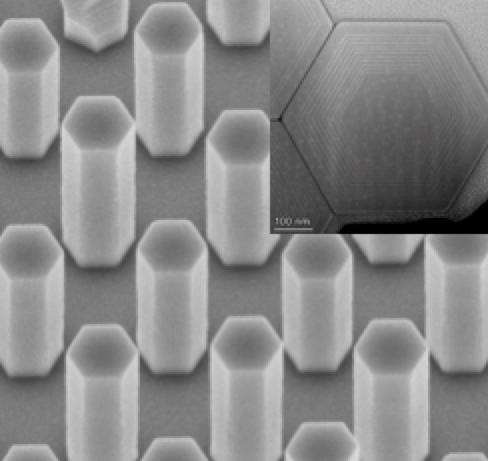
In addition to this evolution in photon sources, the team has developed a high efficiency on-chip waveguide, a vital component for on-chip optical processing, and is currently working on developing ultra-high quantum efficiency detectors suitable for quantum key distribution
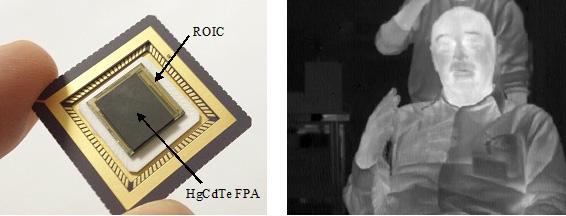
Prof. Neshev says “This combination of innovative quantum emitters and efficient waveguides sets the stage for exciting advancements in the field of optical technology. Low signal levels and bulky devices have been a significant barrier preventing quantum communications from becoming a typical inclusion in space technology.”
Space Navigation
While GPS has proven the most cost-effective system for space navigation, sometimes high accuracy Light Detection and Ranging (LiDAR) systems are preferable, such as during rendezvous and docking operations or mapping the surface
AUSTRALIA IN SPACE Australia in Space Magazine | 45
UWA semiconductor infrared imaging array_61_
Cont next page >>
InP Nanowire Array
of celestial bodies in order to aid with landing. Single photon detection at near-infrared is critical for this, but current high performance, portable LiDAR technologies generally rely on silicon-based single-photon avalanche diodes, which are limited in their operational wavelengths to 905nm. InP diodes can extend the operational wavelengths of a detector, however, in their current bulk form, they produce too much dark current to be effective.
Metamaterials made of low-dimensional III-V compound semi-conductor nanowires aim to increase the functionality of LiDAR detection systems by improving sensitivity and decreasing the dark count rate while simultaneously minimizing the device size to lower production costs and the costs associating with putting LiDAR systems into space.
Prof. Neshev says “Using nanowires enables high-quality materials at a reduced cost. Furthermore, nanowires can decrease the operating temperature of the device, which contributes to thermal noise while maintaining sensitivity to light. Nanowire metasurfaces have demonstrated good absorption of photons despite their ultra-thin form factor.”
Earth Observation and Situational Awareness
Small sized satellites, like nanosats, are an important tool for Earth observation as they are more cost effective than traditional large satellites, but the size and weight of conventional optics restricts their capability to execute complex imaging, such as polarimetry and/or multi-spectral imaging. Multiple polarimetric and/or spectral sensors must be able to accurately measure intensity and polarization state over a wide spectral range and multiple angles of incidence. A metasurface-based alternative can analyse the polarization state of light at different angles by combining polarization rotators and splitters in an engineered pattern that measures the intensity of the multiple polarization components to determine the degree and orientation of the polarization.
In addition to its flexibility to measure light of different wavelengths and angles of incidence, sensors made from metasurfaces have increased sensitivity and, when used as a diffractive metasurface, can form polarisation measurements without losing light to filtering. This is essential as dynamic earth observation requires low-light imaging.
Polarisation imaging has a wide range of satellite-based remote sensing applications, such as detecting organic aerosols in the atmosphere or removing sun glint from ocean surface images. Following successful simulations, researchers at ANU are currently fabricating a metasurface made of a
1-micrometer-thick patterned surface on a sapphire substrate that simulates and optimises polarimetric behaviour.
Prof. Neshev says “Polarisation and spectral imaging offers the opportunity to see the information that is invisible to our eyes. Metasurface-based polarisation and spectral imaging allows us to extract this information without the need for bulky optical components and it can be directly implemented in small satellites.”
Challenges facing the field
Metasurfaces have tremendous potential in the field of optics, and the recent advancements in this technology have been nothing short of remarkable. However, it is not without its challenges. In particular, the scalability of meta-surfaces for commercial use has significant hurdles. Metasurfaces are fabricated using planar fabrication technology, effectively merging optics and chip-making technologies.
Researchers at the University of Western Australia have taken a major step forward in this area, demonstrating this sovereign capability in the laboratory. They recently fabricated Australia’s largest semiconductor infrared imaging array that measures 10mm x 8mm and containing more than 80,000 individual photovoltaic detectors. However, incorporating meta-optics with imaging arrays is much more challenging, because the metasurface layer typically includes structures with dimensions that are sub-wavelength, thus requiring advanced photolithography capabilities such as electron beam lithography. In addition, most electron-beam lithography tools used in the laboratory cannot pattern large areas, and advanced photomasks are required for deep-UV lithography.
Businesses currently manufacturing chips are the best positioned to manufacture metasurfaces at scale. This presents a significant opportunity for those willing to invest in fabrication tool upgrades. The Australian Government has classified metasurfaces as a technology of interest and, as such, funding to assist with the commercialisation of metasurfaces may be available through the Modern Manufacturing Initiative.
Another challenge is the need for non-standard optical thin-films and substrates. Some headway has been made towards this by depositing amorphous silicon on glass wafers, however the technology still faces obstacles, including robustness in the face of environmental changes, a point of concern for all metasurface materials. Having already conducted rigorous laboratory testing and evaluation of several metasurfaces, TMOS is in negotiations to fully space qualify the materials by sending a payload into orbit in 2023.
The applications of meta-optics explained above are just a fraction of the many ways this exciting field is going to change the space industry as we know it. TMOS, the Australian Research Council Centre of Excellence for Transformative Meta-Optical Systems, offers discovery calls www.tmos.org.au/engagement/industry to help businesses understand how meta-optics can give added functionality to their products. The Centre is also keen to explore new research pathways based on industry needs.
AUSTRALIA IN SPACE 46 | Australia in Space Magazine
"Using nanowires enables highquality materials at a reduced cost. Furthermore, nanowires can decrease the operating temperature of the device...."
AI, EO, and you
By Shane Keating, University of New South Wales
Artificial Intelligence (AI) is seemingly everywhere these days, disrupting industries from web search to healthcare and finance to fine arts. The space industry is no different, and a host of innovative companies are finding novel ways to exploit the AI revolution.

Broadly speaking, artificial intelligence aims to create machines that mimic human intelligence by performing tasks that normally require “thought” --- tasks like recognising a face, understanding speech, or deciding whether to bring an umbrella on your morning commute. A neural network is a machine that mimics the brain itself, taking in information (“let’s look outside”) and passing it through a network of artificial neurons or nodes. Machine learning is way of developing artificial intelligence by looking for patterns in data (“It’s cloudy; it might rain.”). And deep learning is a type of machine learning that uses many neural networks stacked on top of each other to produce an output (“better bring a brolly”).
AI research started in the 1950’s, but progress surged in the mid-2010’s with the increased availability of powerful computers, more sophisticated algorithms, and, above all, data. Over the same period, there has been an explosion in the availability of Earth Observation (EO) data --- NASA estimates that their constellation of spacecraft alone produces 2 Gb of data every 15 seconds, with only a fraction of that amount being analysed. AI is now a crucial tool for making sense of the deluge of EO data from space.
“We're using AI to get fast results from our satellites,”
says Jessica Cartwright, a senior scientific programmer and remote sensing expert at Spire Global. Spire is a leading global provider of space-based data, analytics and space services, operating a constellation of more than 100 multipurpose satellites for monitoring maritime and aviation data, soil moisture and weather patterns. “AI enables us to create models by leveraging the massive amounts of data we have from these satellites,” says Cartwright.
Cartwright is leading a project at Spire that uses AI to measure sea ice from space. Sea ice is a crucial component of the climate system and improved measurements will help us better understand the impact of climate change. But measuring sea ice is challenging, given the geographic remoteness and vast scale of the Arctic and Antarctic and the costs and challenges of polar research. “If we can tell what's happening with the ice, we can understand not only how the climate is changing, but we can also understand who it might affect when it does change,” Cartwright told me.
Cartwright uses a technique called GNSS-Reflectometry, which uses reflected signals from Global Navigation Satellite Systems (such as GPS in the US and Galileo in Europe) to costeffectively collect large quantities of information about Earth’s surface. As the GNSS signal is bounced off Earth’s surface, it carries with it a signature of the surface that is measured by Spire’s satellites. Using that data to measure sea ice requires a model for how the signal is modified by the roughness and conductivity of the ice. That’s where AI comes in.
Spire partnered with our group at the UNSW Data
48 | Australia in Space Magazine
Science Hub as well as polar researchers from the UK and Australia to develop a machine learning algorithm that could “learn” the signature of different ice types. The IceCube project was funded through the UK-Australia SpaceBridge scheme, which is managed and led by SmartSat CRC and is supported by Austrade, the UK Government and the UK and Australian Space Agencies. We hope that the new AI techniques we have developed will provide critical insights into Antarctic sea ice change to enable enhanced climate forecasting and modelling.
AI has great potential for finding patterns in the vast amounts of Earth Observation data that is becoming increasingly available. But all that data can only be transmitted back to Earth within narrow windows of time when the satellite is passing over a ground station. “It’s like you are in the outback and going down some highway and there’s very spotty cell reception”, says Taofiq Huq, founder and CEO of Spiral Blue, a space start-up based in Sydney.
Spiral Blue is using AI to solve the downlink bottleneck using an onboard computing system that gives satellites the ability to process images on the satellite itself. The satellite can then decide which images to send back to Earth, dramatically increasing the capacity of the satellite, especially over regions with few ground stations. One application of Spiral Blue’s technology is to detect illegal fishing vessels from space. Simply downloading satellite images of the ocean to find one ship is not cost-effective, so Spiral Blue developed an AI algorithm that could identify
which images contained a ship, reducing the number of images that needed to be transmitted back to Earth. “We're able to do that automatically, not just on the ground, but on the on the satellite itself”, Huq told me.
A practical challenge for developing AI-enabled satellites is the need to process data at the point where the data is collected – in space. In the tech world, this type of application is called edge computing. Huq realized that the computer chips onboard satellites did not have the processing power they needed. “Running heavy processing workloads on a device that's constrained by power availability, constrained by access and constrained by communications --- it’s an edge computing problem, dialled up to 100,” says Huq. Together with co-founders James Buttenshaw and Henry Zhong, Huq developed the Space Edge One (SE-1) computer that has the processing horsepower needed to run AI algorithms but doesn’t draw too much power from the satellite and is shielded from the hostile environment of space. Their prototype, which was launched into orbit in January 2023 and is currently undergoing flight testing, has the potential to increase the capacity of EO satellites by as much as twenty times.

Improved efficiency and increased availability are helping bring down the cost of EO data, placing it within reach of more industry players. “The opportunities are immense and across so many sectors”, says Moira Smith, CTO of D-CAT, a UK and Australia-based space data analytics company that provides monitoring, reporting and verification services to businesses worldwide. “As we’re getting more good quality sensors up there, the data will become cheaper”, she told me. “We want to bring affordable opportunities as the price point comes down.”
D-CAT are using AI and advanced sensor processing technology to solve problems across a wide range of industries, from mining and energy to forestry and insurance. In Australia, D-CAT are working closely with the agriculture sector to provide farmers and agronomists with intelligence from space data to manage their crops and livestock, irrigate more efficiently, and monitor for frost damage. “Frost damage is increasingly becoming a problem here,” says Smith. “As the climate is changing and the weather is becoming more extreme, you get hotter summers, colder winters, and so parts of Australia that never used to get frost are starting to experience frost.”
Frost can be a big problem for farmers, damaging crops and significantly reducing yield. Knowing if and where crops have been damaged is vital so farmers can reduce the impact of frost. Remote sensing, including infrared imagery, can help detect frost damage early. “Farmers want to know as early as possible,” Smith told me. “Then they can make an informed decision about what they're going to do.”
For Smith, AI opens new opportunities to tackle big challenges, like climate change. “In the past, these things weren’t possible”, she told me. But with new AI processing capabilities and cheaper Earth Observation data, individual users can access insights from space. “All of that together helps us to solve humanity’s problems.”
AUSTRALIA IN SPACE Australia in Space Magazine | 49
"AI enables us to create models by leveraging the massive amounts of data we have from these satellites"
Building next generation autonomous space systems with AI
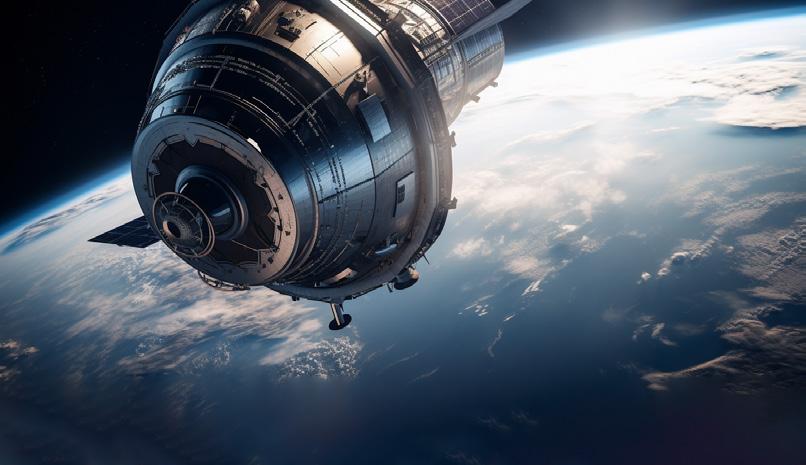 By Dr Carl Seubert, Chief Research Officer, SmartSat CRC and Ryszard Kowalczyk Professorial Chair of Artificial Intelligence, SmartSat CRC University of South Australia
Advancements in space technology continue to push the boundaries of possibility for orbit, with spacecraft autonomy seen as the key to nextgeneration space systems. These new systems promise to enable new applications and increase the efficiency, responsiveness and continuity of space-based Earth and science observations, communication and connectivity, meeting our Defence and National Security needs. The aim is to fly smarter spacecraft, with a reduced burden to onground operators and users and built around a responsible approach in congested orbital regimes.
The potential of spacecraft autonomy for Australia
For Australia, the possibilities are particularly exciting. While the nation’s space sector is still relatively young, it is already producing game-changing technologies, including worldfirsts across many sectors, from defence to communications. Distributed architectures and constellations of small spacecraft are achievable prospects that will enable us to take advantage of these new space systems.
One key factor in realising this vision is spacecraft autonomy and onboard artificial intelligence (AI). Recognised as a key capability, this is an opportunity for Australia to build on its technology prowess, developing these innovative technologies and contributing to the international space ecosystem. This is a huge opportunity for Australia to develop AI-based spacecraft autonomy capabilities for the next-generation space systems to enable national missions and achieve home-grown benefits of remote sensing, communications, and other vital services from space.
Spacecraft autonomy can cover many spacecraft and payload aspects, from planning and executing missions on
board to controlling the spacecraft in real-time, even when out of contact with ground stations. Key applications of spacecraft autonomy include:
Continuous mission planning & real-time execution
One of the primary benefits of spacecraft autonomy is the ability to perform continuous mission planning and execution onboard without relying on constant communication with ground stations. This allows the spacecraft to adapt to changing conditions and respond to unexpected events in real-time without needing to wait for commands from Earth. This can include an ability to navigate autonomously and adjust its trajectory based on scientific observations, avoid hazards or conjunctions or meet mission requirements.
Maximising mission objectives
Onboard decision-making enables the spacecraft or its payload to maximise mission objectives by utilising the available onboard resources or capabilities of nearby constellation spacecraft for edge processing. For example, if a spacecraft has limited power or fuel, it can prioritise its activities to ensure the most critical objectives are achieved before exhausting its resources. Additionally, spacecraft can work together in a coordinated manner to achieve shared goals, such as performing scientific observations or communicating with Earth.
System robustness
Spacecraft autonomy also enhances the robustness of the spacecraft systems, which refers to its ability to continue
50 | Australia in Space Magazine
AI generated concept image
functioning in the presence of onboard failures and external uncertainties. By implementing fault-tolerance and selfhealing mechanisms, spacecraft can detect and recover from failures autonomously, reducing the risk of mission failure or loss.
SmartSat is supporting the move towards resilience through a "smaller, smarter, many" spacecraft approach, focusing on technologies to enable these future distributed space systems and small satellite constellations. This hybrid space architecture is a shared vision with Defence allies, while also applying to future commercial and sciencebased constellation missions. Autonomy is a critical enabler for resilience from space, and for ensuring future Defence services remain resilient during threats, faults, and unexpected circumstances. SmartSat researchers have defined five target outcomes as a focus for delivering:
• Smart Sensing: Obtaining "live" information and reduced-latency actionable intelligence, including direct user tasking through onboard processing for realtime inferences
• Smart resiliency: Protecting and operating assets in a contested and congested environment, with local awareness, fault and threat protection and responses for resilience
• Smart spacecraft: Squeezing more capability out of small spacecraft and their payloads through management and optimisation of onboard and distributed resources
• Smart constellations: Federated constellations and operations with minimal human interaction, providing services to the user (as opposed to operating a spacecraft for a service)
• Smart assurance: Building autonomy around trust and ethical choices, so actions are predictable, and confidence is quantified to the user/operator
Achieving true autonomy in space flight
The adoption of truly autonomous spacecraft has been limited due to the inherent risk-averse nature of operating a complex and expensive spacecraft in the remote and unforgiving environment of space. As a result, large operations teams and onboard state machines are still the norm. However, the space industry is adopting edge processing and payload intelligence to overcome these challenges to fully realise the potential of spacecraft autonomy.
One of the areas that needs to be addressed for true autonomy is the size and weight constraints of small satellites. These also offer an ideal platform for training, running and maintaining large deep learning (DL) models on low-GPUs or single-board computers. Small satellites also offer the potential to optimise the design of DL models to minimise power usage and memory footprints, without impacting overall performance.
Another area to explore is how deployed AI/Machine Learning (ML) algorithms should operate in edge scenarios without additional support from the ground stations. For
example, considering how to recalibrate deployed DL models in orbit by detecting the data drift issue and re-developing models by adjusting the architecture and parameters. It is also vital to examine the inherent limitations or minimum DL building blocks needed to extract actionable intelligence onboard for specific end-user applications.
Achieving autonomy in space demands real solutions to all these fundamental and practical issues related to onboard processing and trusted AI.
Recent progress in the field
Spacecraft autonomy has been actively researched for some decades. The implementation depends on specific mission requirements and constraints, varying between a very low level of autonomy with a high level of ground control, to a high level of autonomy where most functions are performed onboard.
Most current AI-based solutions are typically deployed with the main processing performed on the ground, while onboard processing often limited to data collection, filtering, and aggregation. Recently, there has been an increased focus from academia and industry on generating more actionable intelligence onboard. Several companies are now providing commercial software for AI-based onboard processing, including the AIKO’s MiRAGE solution for autonomy (onboard data processing for perception) and downlink optimisation through onboard image processing.
Another area of progress is fault detection, isolation, and recovery (FDIR). Functionality has been gradually transferred from the ground to the spacecraft to ensure safe and highperformance operation with less intervention by human operators. This is particularly important for deep space missions or missions involving hundreds of small spacecrafts. However, FDIR uses pre-defined recovery strategies and cannot anticipate potential threats, unexpected errors or malicious attacks.
To this end, there is a need for Australia’s space sector to develop novel concepts, methods, and technologies to provide new AI-based spacecraft autonomy capabilities for next-generation space systems. Selected areas of interest to SmartSat include onboard processing and actionable intelligence, small spacecraft and constellation resilience, dynamic optimisation of constellation resources and real-time tasking and resource allocation. Through its broad program of satellite research, SmartSat is well placed to take on the task of progressing Australia’s spacecraft autonomy capabilities.
Australia is building skills, hardware, and capability in its burgeoning space industry and this must include autonomous algorithms to remain at the innovative front of space system development and implementation. As autonomous technologies advance and are embraced, their place in space will expand and present new opportunities for emerging Australian space technologies. The more we push the boundaries of what is possible, the more exciting the future of space exploration begins to look. With nextgeneration space systems on the horizon, the possibilities for science, discovery and innovation are endless.
AUSTRALIA IN SPACE Australia in Space Magazine | 51
'This is a huge opportunity for Australia to develop AI-based spacecraft autonomy capabilities for the nextgeneration space systems...'
Destructive ASAT missile testing threatens everyone
By Victoria Samson Washington Office Director, Secure World Foundation
The security and stability of space has been a concern since the beginning of the Space Age. It is more acute now, however, because more than 80 countries have satellites in orbit and there is a rising dependence on space capabilities for such critical needs as economic development, environmental monitoring, and disaster management. Although space security had historically been perceived as relevant only to the geopolitical superpowers, nearly every person on this planet now uses space data in some way and thus benefits from a predictable space environment with reliable access to that information. Furthermore, the space environment does not differentiate between military, civil, or commercial users, so disruptions or damage to the environment by one user can affect all, even if they were not the original target.
Today, a number of countries are developing counterspace and anti-satellite (ASAT) weapons which are capable of deceiving, disrupting, denying, degrading, or even destroying objects in space. The incentive to develop, and potentially use, these weapons stems from the growing role that space capabilities play today in every modern military force, particularly those of the major nuclear powers. Disrupting an opponent’s space capabilities might be considered in a military setting, but it could also lead to nuclear escalation and create long-term risks even after the war ends.
While many countries are pursuing significant research and development programs involving a broad range of destructive and nondestructive counterspace capabilities, only nondestructive capabilities are actively being used in current military operations.
Some ASAT capabilities are destructive in nature, physically striking an object in space and causing it to break up. While no country has ever attacked another country’s space object in this way, the mere testing of destructive ASAT weapons represents some of the most significant debrisgenerating events in history that are creating problems for operational satellites today.
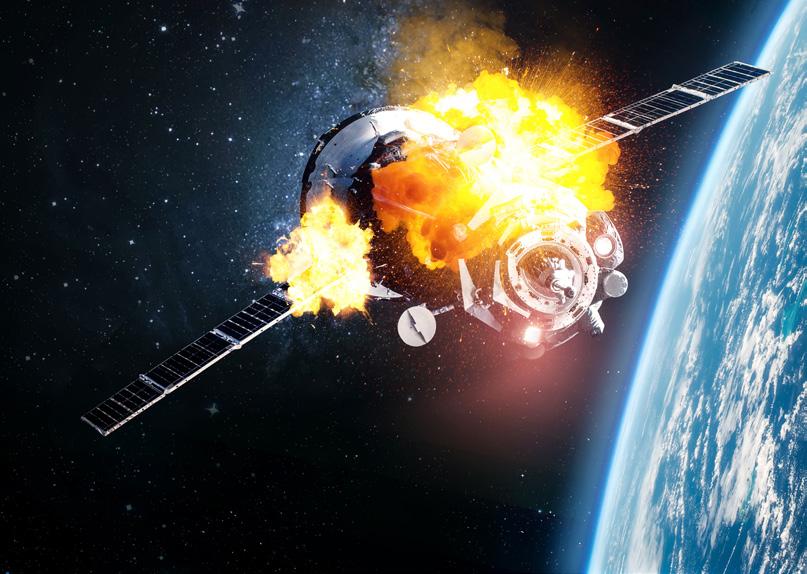
There has been a recent uptick in destructive antisatellite weapons testing, which is concerning because such tests can result in long-lived debris that can harm other satellites in orbit. They also can establish the precedent that ASAT weapon tests are acceptable and thus encourage more countries to conduct them. That in turn runs the risk of inadvertent escalation or even possible deliberate use of ASAT weapons during a conflict if this proliferation becomes more prevalent.
During the early years of the space age, the only two countries to test ASAT weapons systems were, chronologically, the United States and the then-Soviet Union. There w as a decade-long pause in these tests at the end of the Cold War, but they eventually resumed with the
AUSTRALIA IN SPACE 52 | Australia in Space Magazine
involvement of two more countries: China and India.
The destructive ASAT weapons tests that have been held since the 1960s have created over 6300 trackable pieces of orbital debris, more than 4,300 of which are still around and pose hazards to satellites. And given the altitudes of some of the debris created by these tests, they may continue to be around for years, if not decades more.
The sheer force of impact can spread debris out from these tests well beyond that altitude at which point the impact was made, at times hundreds or even 1000-plus kilometers farther out. This is significant because the higher up the debris is, the longer it will take to deorbit, and thus the longer it can threaten other space objects, satellites, or space stations.
Direct-ascent (DA)-ASAT programs refers here to those systems where there is an interceptor launched from a terrestrial platform (which can be ground-, sea-, or air-based) and which destroys its target by directly impacting it. The ground-based platforms can be fixed silos or mobile platforms.
The targets for DA-ASAT tests historically have usually been in low Earth orbit (LEO), and below 880 km. Although there has been one notable exception where an interceptor was launched to what has been reported to be 30,000 km; it should be noted that it is not clear that it was attempting to actually intercept a target and in any case, did not impact any target.
Some sort of tracking capability is also needed for a DA-ASAT capability; we often see this tracking capability emerging from indigenously-produced space situational awareness (SSA) systems.
During the early stages of DA-ASAT development in the 1960s, research and development programs considered using nuclear warheads on the interceptors with the idea that they would destroy their target either via a fireball or an electromagnetic pulse; thankfully, that approach was re-considered and thus programs shifted toward interceptors that strive to kinetically impact their targets. DA-ASAT interceptors have historically evolved from national ballistic missile capabilities and often have been interwoven with ballistic missile defense programs.
What can be done to mitigate this threat to the space environment? Given the growing global reliance on satellites and space applications, many in the international community have begun calling for a ban or prohibition on the testing of destructive ASAT weapons. In April 2022, the United States became the first country to declare a commitment to no longer conduct destructive ASAT missile tests; this declaration was soon followed by similar ones by Canada, New Zealand, Japan, Germany, United Kingdom, Republic of Korea, Switzerland, Australia, and France.
This was followed in December 2022 by UN General Assembly Resolution 77/41, “Destructive direct-ascent anti-satellite missile testing,” which calls upon all States to commit not to conduct destructive direct-ascent antisatellite missile tests and “Considers such a commitment to be an urgent, initial measure aimed at preventing damage to the outer space environment, while also contributing to the development of further measures for the prevention of an arms race in outer space.” It resoundingly passed, with a vote of 155 yeses, 9 noes, and 9 abstentions.
DA-ASAT tests have made operating in low Earth orbit more dangerous for years to come. All satellite operators and crewed vehicles will need to spend time, effort, and fuel on avoiding collisions as the debris from these tests deorbits and gradually reenters the Earth’s atmosphere.
The support of the commitment not to conduct destructive DA-ASAT missile tests works to delegitimize the testing of these weapons against satellites and sends a strong signal that the international community recognizes the danger that this behavior represents for the long-term sustainability of space.
This important topic, and other issues of space sustainability, will be featured at Secure World Foundation’s upcoming Summit for Space Sustainability. For more information and to register, visit swfsummit.org.
AUSTRALIA IN SPACE
Australia in Space Magazine | 53
'....All satellite operators and crewed vehicles will need to spend time, effort, and fuel on avoiding collisions as the debris from these tests deorbits and gradually reenters the Earth’s atmosphere.'
Lunar oxygen pipeline vulnerability model
By Dr. Chris Flaherty
In this edition, we are going to look at a recent proposal for an end-to-end system-level design study appearing on the NASA website for a L-SPoP: Lunar South Pole Oxygen Pipeline (Curreri, 2023). Proposals such as these for building Lunar Surface Infrastructure (LSI) raise some potentially interesting questions, as to how we would look at infrastructure vulnerability issues, normally applied here on Earth, for a build on the Lunar Surface? And rather than just science fiction, these projects are being pitched for implementation next year between 2024 and 2026!
L-SPoP Proposal
The L-SPoP proposal is based on the requirement that Artemis Program sustainability – the goal of which is developing a permanent Human presence on the Moon - is dependent on ability to utilize in-situ resources to reduce the cost and risk of Lunar operations. This project looks at solving the problem of how to efficiently and cheaply truck oxygen extracted from Lunar regolith, and water from Lunar ice, with the use of a pipeline. A Human Habitat or Liquification Plant that needs a regular supply of oxygen and water may be situated (to meet mission requirements) a long distance away from an
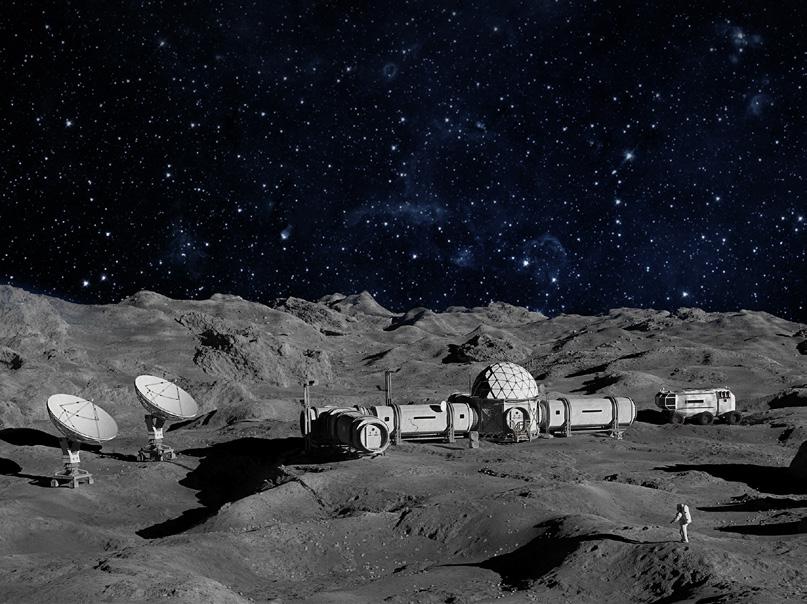
Extraction Area. It may be the case, that a radial network is developed servicing a distributed settlement covering a wider geographical area on the Lunar surface. As a possible mitigation strategy to enhance security from threats posed by random strikes, this may necessitate a distributed model of settlement. It can also be anticipated that as International Lunar Missions increase there will evolve a Lunar Commercial Services Entity connecting newcomers to the system – just think about how we setup new homes and industrial areas in cities, and apply this to the Moon!
The L-SPoP proposal has as its goal extracted oxygen will be used to provide: (1) Human Habitats, rovers, other Life Support Systems with a constant supply of high purity oxygen for Human consumption; (2) Oxidizer for launch vehicles departing the Moon (Curreri, 2023). It is generally known that the NASA program timetable for Oxygen Extraction Technologies are planned for large-scale demonstration on the Moon by early 2024, and providing direct support to Artemis Astronauts by 2026.
The L-SPoP proposal’s starting concept is for a 3.1 miles: 5 kilometres pipeline to transport oxygen gas from an Oxygen Production Source, to an Oxygen Storage/Liquification Plant near a Lunar Base – Human Habitat. It is proposed that pipeline components are made from local Lunar
54 | Australia in Space Magazine
surface aluminium deposits (other local metals could also be considered). Pipeline components would be passivated (made unreactive by altering the surface layer or coating the surface with a thin inert layer), and welded or fitted together. The proposal also suggests the pipeline could be constructed and repaired robotically. It is intended the pipeline would have a high operational reliability, and be able to survive in the Lunar environment for greater than 10 years.
Lunar Vulnerability Threat Analysis Model
If we are able to build between 2024 and 2026 a 3.1 miles: 5 kilometres pipeline to transport oxygen gas from an Oxygen Production Source, to where it is needed a key risk would be damage to the pipe, or infrastructure elements from a random meteorite. Earth has a protective atmosphere where meteoroids usually disintegrate. The Moon with little or no atmosphere makes its surface vulnerable to frequent impacts.
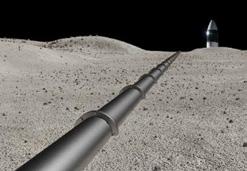
Current NASA studies of the Lunar impact rate estimate 11 to 1,100 tons: equivalent to the mass of about 5.5 cars, of dust collide with the Moon every day. A further 100 pingpong-ball-sized rocks hit the Moon over the same day. This statistic equates with approximately 33,000 strikes per year. Statistically, the odds are quite low, as the Moon’s
The slowest impacting rock travels at 45,000 miles-per-hour: 20 kilometres-per-second; the fastest travels at over 160,000 miles-per-hour: 72 kilometres-per-second.
surface area is about 14.6 million square miles: 38 million square kilometres, and any patch of ground will be hit potentially by a pingpong-sized object once every thousand years or so.
In 2019, a meteorite was recorded impacting the Moon’s surface at 38,000 miles-per-hour: 61,000 kilometres-perhour carving out a crater about 10 to 15 meters: 33 to 50 feet in diameter. The slowest impacting rock travels at 45,000 miles-per-hour: 20 kilometres-per-second; the fastest travels at over 160,000 miles-per-hour: 72 kilometres-per-second. At such speeds even a small object with a mass of only 10 pounds: 5 kilograms has enough energy to excavate a crater over 30 feet: 9 meters across, while hurling 75 tons of Lunar soil and rock on ballistic trajectories above the surface. In terms of scale of impact a pingpong-ball-size rock strikes the surface with the explosive force of 7 pounds: 3.2 kilograms. A larger rock, around 8 feet: 2.5 meters across, strike every four years, with an explosive force of a kiloton.

The only potential threat to any Lunar Surface Infrastructure (LSI) are randomized periodic meteorite strikes spread over the entire surface area of the Moon. While, odds for such an event are low, the impact – consequences of an event occurring at or near infrastructure could be potentially catastrophic. The Vulnerability Analysis model, is similar to how we might view a terrorism bombing on Earth. The Lunar surface is visualized as an Attack Surface where an Oxygen Pipeline traverses the area. Managing the route, this is divided into segments, each monitored by a Pipeline Segment Sensor. As well, Lunar Reconnaissance Orbiter photographs of the pipe and its surrounding area can be regularly examined to see it any craters have appeared, and this data can be assessed for potential risks or damage done to the pipe. Conceptualized as a series of 3D Vulnerability Analysis Boxes - this is where a piece of infrastructure is divided into parts, and where all the vulnerability data for that specific area is identified. If there is the risk of damage from a nearby random strike then the relevant vulnerability data can be looked at, to see if there are potential issues that need further investigation, even if the Segment Sensors are not showing an issue.
It should be noted a key factor affecting vulnerability, is how has a piece of Lunar Surface Infrastructure (LSI) been designed to withstand impacts. For instance, the L-SPoP proposal’s modular design goal is to develop an adaptable, repairable, and evolvable structure (Curreri, 2023).
For all you Earthbound civil construction engineers, and project managers it is time to swap your business suits for a Lunar Surface Spacesuit. And Yes – you can still put a tie on a Spacesuit!
AUSTRALIA IN SPACE Australia in Space Magazine | 55
Lunar South Pole Oxygen Pipeline - Image Source NASA
SpaceTide Accelerating commercialization of the space industry.
by Masayasu Ishida Co-founder, President & CEO, SPACETIDE Foundation Director and Global Space Group Lead, A.T. Kearney Member of Japan’s national space policy committee
The APAC region is one of the most promising areas where the commercialisation of the space industry has been accelerated in recent years.
We, SPACETIDE Foundation is a Tokyo-based non-profit organisation that aims to “bring new value to our society, lifestyle, culture, and future through the development of the space industry”. Since our establishment in 2015, we have been expanding our activities in the APAC region. Through this article, we would like you to know more about who we are and what we do.

Our Motivation
The space industry has been undergoing a major transformation and now creating new values for the world and society. This transformation has been driven by governmental motivations such as national security, new market entrants such as startups and non-space industries, new applications such as satellite constellations, etc.
However, the space industry is still considered to be a
niche industry when compared with other industries: the market size of ICT, automotive, healthcare, for instance, are more than 10x, 15x, and 20x larger, respectively. We strongly believe that the space industry can and should contribute more to the future of humanity.
Our three main differentiators
Orchestrator of the Space Industry
As mentioned above, we are not just a conference organizer. We define ourselves as an orchestrator creating new trends of commercial space. Taking a neutral position, we have cooperated with a wide range of organizations and individuals, and performed various programs such as organizing the conference, publishing our own space industry report, and providing acceleration program for space entrepreneurs.
APAC-Wide Community
We have been connecting all stakeholders in the region from aerospace companies to startups, to investors, to

Please feel free to contact us anytime through our official website: https://spacetide.jp/en 56 | Australia in Space Magazine
governments, to NPO and academia, and even to non-space companies. The ecosystem is now expanding even beyond the APAC region to America and Europe.
Involvement of New-To-Space Industries
The largest portion of our community consists of newto-space companies such as IT/telecom, transportation, insurance, etc. Utilising this uniqueness, we have strengthened interactions between space companies and non-space companies in terms of business creations, such as formulation of the satellite data market.
As a result of our value proposition, fortunately we have received a lot of strong support from around the world. For fiscal year 2022, we have 18 sponsors from domestic and international companies as well as five governmental organisations and numerous strategic partners in promotion activities.
Our Major Initiatives
As mentioned in our main uniqueness "Orchestrator of the Space Industry", we have been conducting various initiatives. The followings are a part of our major activities.
Annual Conference: SPACETIDE
The Space industry in the APAC region is dispersed across countries. In order to accelerate collaboration among a diverse set of stakeholders in the space industry, since 2015, every summer we have organised our own annual conference, SPACETIDE, one of the leading commercial space conferences in the APAC region. The previous conference, SPACETIDE 2022, held in July in Tokyo gathered around 750 participants and 90 speakers from 20 countries to exchange the latest trends of the space industry. We also invited world-leading companies such as SpaceX, Blue Origin, Lockheed Martin in past conferences.
Workshop: Space Industry Workshop
More focusing on the APAC region, we have been collaborating with Japan Aerospace Exploration Agency (JAXA) and co-hosting a workshop since 2019. The workshop is an official program of Asia-Pacific Regional Space Agency Forum (APRSAF), which is historically the international annual conference for space agencies in the region. Through this workshop, we try to accelerate discussions and partnership between public sectors and private sectors. The latest workshop was held in Hanoi, Vietnam in November 2022, gathering more than 160 participants from 20 countries with the highest participation ratio from public sectors in the history of APRSAF.
Industry Report: COMPASS
We have been also publishing our own industry report named COMPASS. In the report, we gather all segments of the space industry such as launch to deep space exploration, space
tourism, and analyse the latest trend of the segments such as startups and investment, focusing on Japanese domestic as well as APAC market. You can download the report for free from our official website.
Acceleration Program: AXELA
Apart from the conferences and the industry report, we just launched our own acceleration program named AXELA last year. We have collaborated in a space business contest named S-Booster, organised by the Cabinet Office of Japan. We have provided follow-up programs for the award winner of S-Booster as well as our own selected startup companies.
Upcoming Events in 2023
If you kindly get interested in our activities, please join our events! The following events are currently planned in 2023.
• Summit for Space Sustainability (in collaboration with Secure World Foundation) : New York, USA. June 13-14, 2023.
• Annual Conference: SPACETIDE 2023, Tokyo, July 4 -6, 2023
• Workshop: Space Industry Workshop – Indonesia, Autumn 2023

AUSTRALIA IN SPACE
For fiscal year 2022, we have 18 sponsors from domestic and international companies as well as 5 governmental organizations and numerous strategic partners in PR activities.
Australia in Space Magazine | 57
PERTH
The Western Australia space industry sundowner
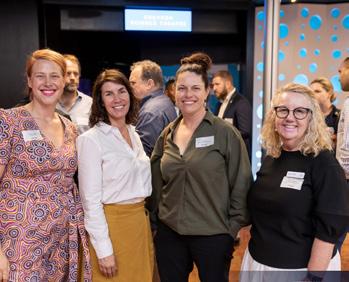
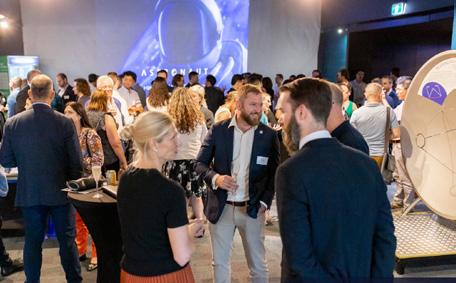 By Australia in Space Magazine
Held on 15th March, The Australia in Space WA Space Industry sundowner was a resounding success with a great turnout from industry, government, and academia. The event focused on Opportunities for Cross Sector Innovation and Technology and included members of the Australian Space Agency Advisory Board and Head Enrico Palermo in attendance. The event featured a diverse range of speakers, including Jessica Shaw MLA, John Chappell from Scitech, Dr Megan Clarke, Chair of the Australian Space Agency Advisory Board, Gary Hale from Curtin University, with MySecurity Media’s David Matrai as MC for the evening. Cross sector case studies were delivered by a panel of experts
from various sectors, including Michelle Keegan of AROSE, Linda Dawson of the Department of Jobs, Tourism, Science, and Innovation, Samuel Forbes of Fugro SpAARC, Shawn Fernando of Woodside Energy, Ryan Timoney, Ph.D. of First Mode, and Mark Gibberd of Curtin University.
The event provided a platform for cross-sector collaboration and the exploration of innovative technologies that could be leveraged for space-related endeavours. It highlighted the importance of industry partnerships and the role they can play in as well as learnings that can benefit other industries. We look forward to facilitating more opportunities to bring industry together.
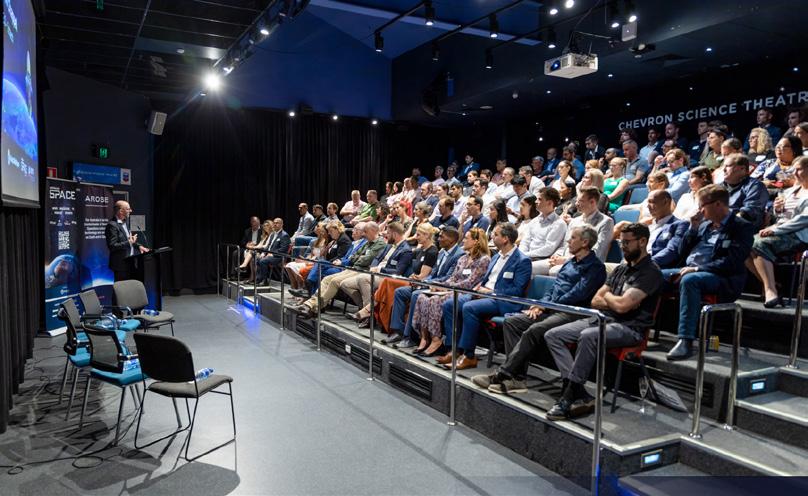
58 | Australia in Space Magazine
L to R: Renae Sayers, Dawn Mcintosh, Liz Smith and Eleanor Hughes
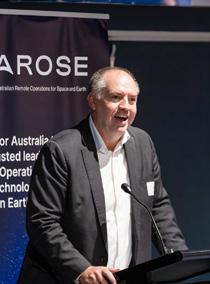
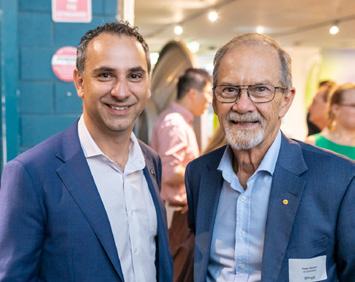
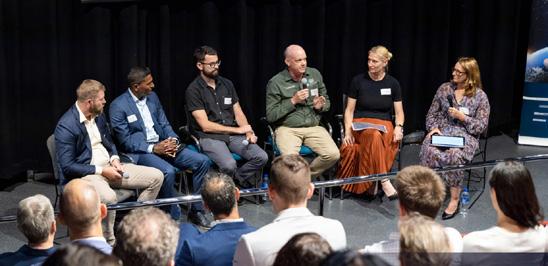
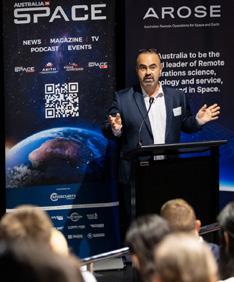
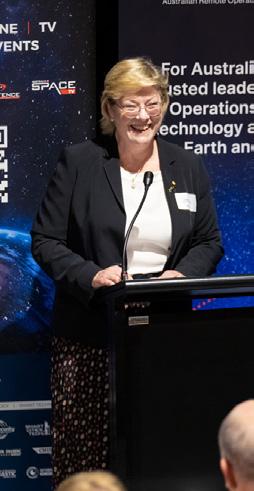
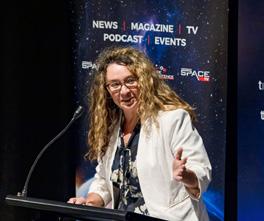
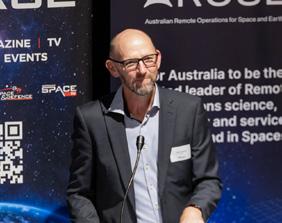
PERTH
L to R: Samuel Forbes, Shawn Fernando, Ryan Timoney, Mark Gibberd, Linda Dawson, and Michelle Keegan
Megan Clarke, Australia Space Agency Advisory Board Chair
L to R : Prof Peter Klinken, Jessica Shaw MLA, Leanne Cunnold, James Yuen, and Tom Goerke
Jessica Shaw MLA, Parliamentary Secretary to the Deputy Premier John Chappell, CEO Scitech
The First Mode Team Michelle Keegan, Program Director AROSE
Gary Hale, Curtin University Enrico Palermo and Prof Peter Klinken
Australia in Space Magazine | 59
David Matrai, Australia in Space
A giant leap into 2023 for The Andy Thomas Space Foundation
By Andy Thomas Space Foundation
The Andy Thomas Space Foundation (ATSF), Australia’s National Not-For-Profit promoting space education, outreach and innovation, takes a giant leap into 2023 with a jam-packed year planned.
After experiencing large scale growth across the various Foundation activities in 2022, the trajectory is expected to not only continue but incline significantly with ‘out of this world’ offerings for the Australian community, to be made available in 2023.
These offerings include two bigger and better than ever before Australian Space Forums, highlighting the great expertise and scope of industry available nationally and globally, a further increased and expanded Education Fund, as well as, innovative and engaging community outreach opportunities.
With the 15th Australian Space Forum quickly approaching on Tuesday, 9 May at the Adelaide Convention Centre, the time is now to make your mark on the Australian Space Industry.
Each year the Forum attracts over 1,100 delegates representing industry, government, academia and start-ups, 100+ national and international organisations exhibiting their products and services, as well as a number of subject-matter experts supporting the Forum’s key themes.
This year the Forum will see some major updates, ensuring that the growing and diverse needs of the local, national and global space industry members are being
met. Taking the opportunity to share some of the incredible talents and innovations that the Australian space ecosystem can bring to the global marketplace.
ATSF Annual Education Fund
In line with the Foundations mission, all income generated through the hosting of the Forum is directly dedicated to the ATSF Annual Education Fund.
Last year saw the ATSF dedicate $320,000 worth of scholarships, prizes and awards, celebrating students from primary school through to postgraduate, PhD and beyond. In 2023, this program of education opportunities will continue to grow and spread across Australia, ensuring that students around the nation have access to space, its applications and workforce pathways.
Recently, the ATSF alongside the Australian Space Agency launched the first activities of the national Kids In Space program, impacting thousands of students, their teachers and schools across each state and territory.
The first activity, state-based accredited professional development days, saw teachers from over 60 schools unite, learn and innovate together – training in all things 3D design, space industry and design thinking. Through the inclusion of professional development opportunities and free resource provision - with each school receiving a free 3D printer, it is hoped that the impact of this program can be felt within
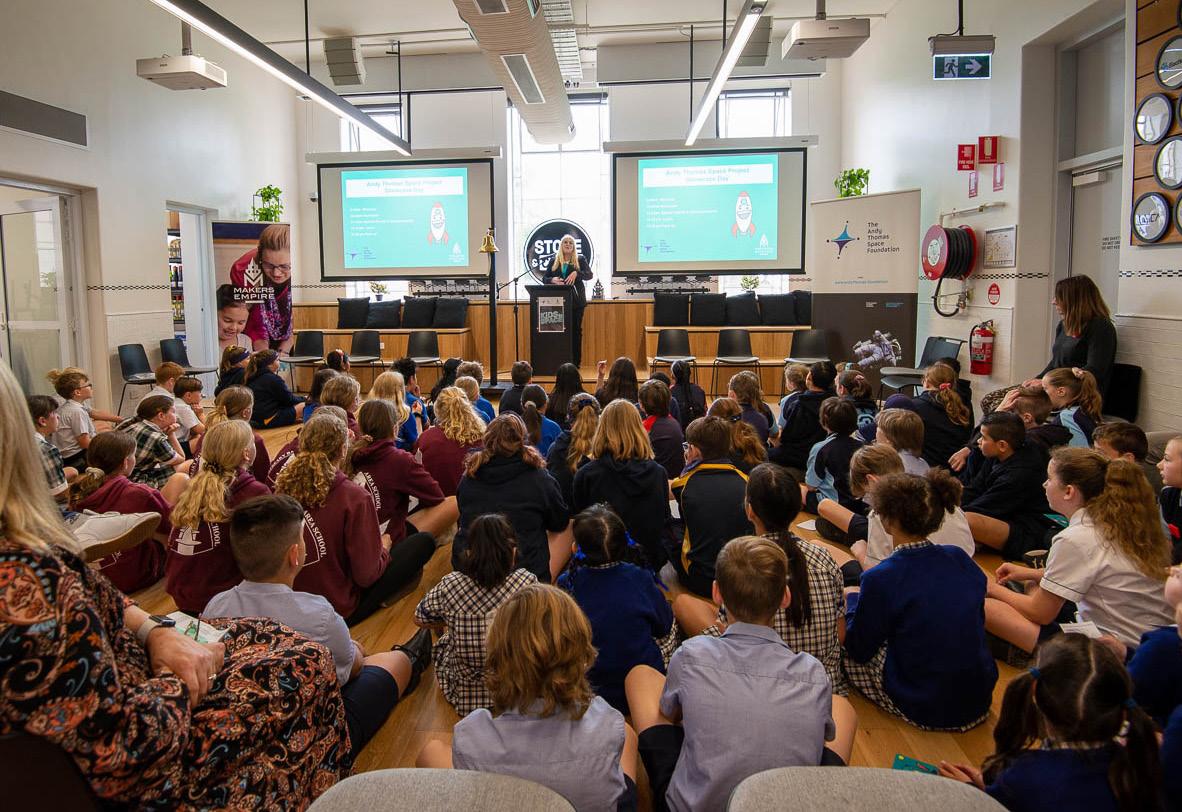
60 | Australia in Space Magazine
schools for years to come. Not only can this ensure long-term space education implementation in school curriculums but further encourages teachers to promote and support future space careers for their students, nurturing what will be the next generation of space leaders.
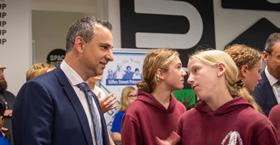
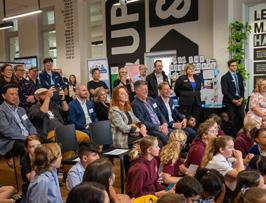
Kids In Space
The next phase of the Kids In Space program roll out will see students engaging in a semester long custom built spacebased Makers Empire design challenge. During this challenge students can take advantage of their varying skills – whether that be science, maths, arts, English, etc – educating students on the importance of cross and multi-disciplinary approaches to space industry careers.
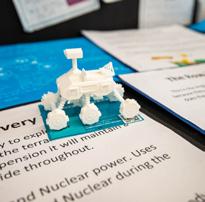
Following the design course, students will have the opportunity to compete against other schools within their state/territory before each winning team is flown to South Australia to participate in the national showcase at the Australian Space Discovery Centre. This Australian-first program focuses on the use of space as a tool for inspiration - empowering students, their teachers and their communities to look beyond the stars and to see the importance of space in our daily lives.
This program is one example of our growing list of opportunities available and whilst Kids In Space caters specifically for primary students, the ATSF has implemented
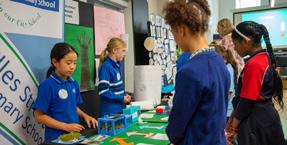

a holistic approach to offer tangible and productive offerings at each stage of education all the way to being an early career researcher or PhD student.
As the Education Fund continues to grow, so too does the opportunity to support the Foundations work. If you or your organisation are interested in supporting an existing education fund program or would like to collaborate on a novel initiative, please get in touch.
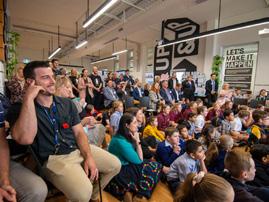
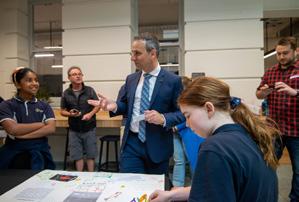
With an already exciting year underway, the Foundation would also like to celebrate the appointment of the Honourable Grace Portolesi as Executive Director.
Grace joins with an impressive record as a successful Member of the South Australian Parliament and former Minister in portfolios that included Education and Science. She has also been a prominent advocate for the interests of young people and for social development programs in general. She has more recent experience in the private sector, providing expert support for innovative projects involving, among other topics, space education in schools.
This appointment follows the retirement of former ATSF CEO, Nicola Sasanelli AM. We thank Nicola for his tireless work in establishing and building the events and programs of the Foundation and in particular in his contribution to the growth and success of the Australian Space Forum since its establishment in 2016.
Australia in Space Magazine | 61
Enrico Palermo speaking with students
Enrico Palermo speaking with students
23-24 OCTOBER 2023, PAN PACIFIC HOTEL PERTH, WESTERN AUSTRALIA
Bringing together leaders from across the Indo-Pacific and beyond for opportunities in cross-sector technology and innovation
Western Australia's space capabilities include:
• Southern hemisphere location with ideal longitude for space situational awareness and global coverage of space assets.
• Geographically stable with clear skies, large arid areas, minimal radio interference, and radioquiet zones.
• Significant communications, computational infrastructure, and technical expertise.
• Substantial capabilities in space systems, ground stations, astronomy, and planetary research.
• World-leading capabilities in remote operations, automation, and robotics utilizing ultra-low bandwidth satellite communications.
• Diverse and highly-skilled workforce with over 100 international and Australian space-related companies.
SUPPORTERS BROUGHT TO YOU BY
RESOURCES AGRICULTURE ROBOTICS SUSTAINABILITY SPACE CRITICAL TECHNOLOGY EDUCATION INVESTMENT Trade | Investment | Collaboration | Future Opportunities WWW. SPAC EAND EARTH CONFERENCE.COM REGISTER NOW
