CommunicAsia 2017
28th international communications and information technology exhibition & conference A host of smart future technologies such as big data analytics, cloud, the Internet of Things (IoT), cyber-security, artificial intelligence (AI), robotics, virtual reality (VR) and next generation broadcasting technologies were the key highlights of the three exhibitions - CommunicAsia2017, EnterpriseIT2017 and BroadcastAsia2017 (23rd – 25th
May) – that were held across two venues at the Marina Bay Sands and Suntec Singapore. With thirty-six International Group Pavilions – including Russia, China, Canada, USA, Korea and EU Business Avenues in South-East Asia - the event drew best-of-breed innovations from across the globe, hosting 1,800 exhibitors from 62 countries.
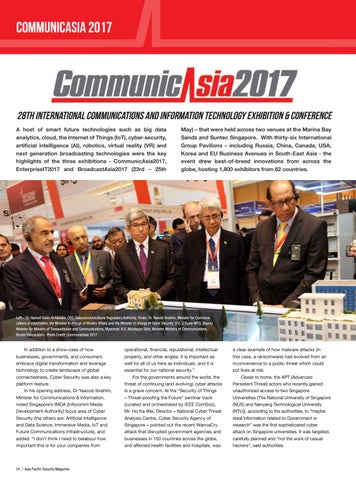
Left – Dr. Hamed Salim Al Rawahi, CEO, Telecommunications Regulatory Authority, Oman; Dr. Yaacob Ibrahim, Minister for Communications & Information, the Minister in charge of Muslim Affairs and the Minister in charge of Cyber Security; H.E. U Kyaw MYO, Deputy Minister for Ministry of Transportation and Communications, Myanmar; H.E. Mustappa Sirat, Minister, Ministry of Communications, Brunei Darussalam. Photo Credit: CommunicAsia 2017
In addition to a show-case of how businesses, governments, and consumers embrace digital transformation and leverage technology to create landscape of global connectedness, Cyber Security was also a key platform feature. In his opening address, Dr Yaacob Ibrahim, Minister for Communications & Information, noted Singapore’s IMDA (Infocomm Media Development Authority) focus area of Cyber Security (the others are: Artificial Intelligence and Data Science, Immersive Media, IoT and Future Communications Infrastructure), and added: “I don’t think I need to belabour how important this is for your companies from
24 | Asia Pacific Security Magazine
operational, financial, reputational, intellectual property, and other angles. It is important as well for all of us here as individuals, and it is essential for our national security.” For the governments around the world, the threat of continuing (and evolving) cyber attacks is a grave concern. At the “Security of Things – Threat-proofing the Future” seminar track (curated and orchestrated by IEEE ComSoc), Mr. Ho Ka Wei, Director – National Cyber Threat Analysis Centre, Cyber Security Agency of Singapore – pointed out the recent WannaCry attack that disrupted government agencies and businesses in 150 countries across the globe, and affected health facilities and hospitals, was
a clear example of how malware attacks (in this case, a ransomware) had evolved from an inconvenience to a public threat which could put lives at risk. Closer to home, the APT (Advanced Persistent Threat) actors who recently gained unauthorized access to two Singapore Universities (The National University of Singapore (NUS) and Nanyang Technological University (NTU)), according to the authorities, to "maybe steal information related to Government or research" was the first sophisticated cyber attack on Singapore universities. It was targeted, carefully planned and "not the work of casual hackers", said authorities.