Cyber Security
Facial Recognition
T By Jane Lo Singapore Correspondent
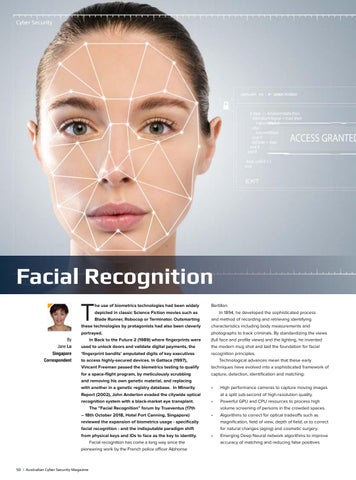
he use of biometrics technologies had been widely depicted in classic Science Fiction movies such as Blade Runner, Robocop or Terminator. Outsmarting these technologies by protagonists had also been cleverly portrayed. In Back to the Future 2 (1989) where fingerprints were used to unlock doors and validate digital payments, the ‘fingerprint bandits’ amputated digits of key executives to access highly-secured devices. In Gattaca (1997), Vincent Freeman passed the biometrics testing to qualify for a space-flight program, by meticulously scrubbing and removing his own genetic material, and replacing with another in a genetic registry database. In Minority Report (2002), John Anderton evaded the citywide optical recognition system with a black-market eye transplant. The “Facial Recognition” forum by Trueventus (17th – 18th October 2018, Hotel Fort Canning, Singapore) reviewed the expansion of biometrics usage - specifically facial recognition - and the indisputable paradigm shift from physical keys and IDs to face as the key to identity. Facial recognition has come a long way since the pioneering work by the French police officer Alphonse
50 | Australian Cyber Security Magazine
Bertillon. In 1894, he developed the sophisticated process and method of recording and retrieving identifying characteristics including body measurements and photographs to track criminals. By standardizing the views (full face and profile views) and the lighting, he invented the modern mug shot and laid the foundation for facial recognition principles. Technological advances mean that these early techniques have evolved into a sophisticated framework of capture, detection, identification and matching: • • •
•
High performance cameras to capture moving images at a split sub-second of high-resolution quality. Powerful GPU and CPU resources to process high volume screening of persons in the crowded spaces. Algorithms to correct for optical tradeoffs such as magnification, field of view, depth of field; or to correct for natural changes (aging) and cosmetic surgery. Emerging Deep Neural network algorithms to improve accuracy of matching and reducing false positives