BLACKS AND THE LAW Brother Raymond Pace Alexander * (This Bulletin is proud to present the following autobiographical sketch by Judge Raymond Pace Alexander, distinguised Jurist, recounting some of the problems and experiences which he has received as a black man aspiring to the study and practice of law, and his herculean successful efforts to overcome them. A brilliant student in college and law, an eminent attorney, he is now admired and respected as an outstanding member of the Bench. As student, lawyer, judge, civic leader and humanitarian, his story deserves the attention of all for his magnificent contributions to his people and the nation.) Ed. THE BLACK LAW STUDENT and the Black lawyer have come a long way toward being accepted as able, better than average and, in many instances truly brilliant performers in their respective fields since the cruel and forbidden days of the 1920s, 1930's and early 1940's. I speak from bitter experience. If perchance I become slightly auto-biographical, you will, I trust forgive me. It was suggested that I write from "personal experience . . . how have you been affected by discrimination . . . what have you done to alleviate this . . . (for) other blacks." Additionally, "can one be an activist within the . . . law?" Let me tell you like it was, and is, today. I am a native of Philadelphia, one of 5 children in a poor family whose mother died when I was five. My father was unskilled, uneducated, and, with the help of an aunt, kept the family together. My work days began at age 12. At age 17 I graduated from the famous Central High School at the top of my class. I was the Commencement Orator. My topic, ironically, was "The Future of the American Negro," whose future then (1917) was dark and dismal. I won a scholarship to Harvard, but I was too poor to pay for room and board, and so accepted the alternate, the University of Pennsylvania. I finished the four year course in three years with highest honors, but was denied membership in any honorary society for the stated reason, "No Negro was ever elected to membership." Two of the most esteemed Professors resigned from membership giving my rejection as the cause of their action. While a student at Penn I met my wife, then Miss Sadie Tanner Mossell, a senior who also graduated in 1919 after three years study with the highest honors. Thereafter Miss Mossell (Now Mrs. Alexander) was named to the Frances Sarjeant Pepper Fellow in Economics (M.A. in Educ. 1920), the first black woman in America to receive the coveted Ph.D. degree. I wanted to study law and my heart had long been set on Harvard. My Dean, always my friend, who warmly supported my election to honors on my commencement day at Penn, was surprised. Then three days later, I, as a Red Cap baggage porter in the famed Grand Central Station, New York, again cordially greeted him as he stepped from the Philadelphia Express. I escorted him and carried his golf bags and suit cases to the famous Bar Harbor, Maine Express for his vacation. I told him of my plans for Harvard. No scholarships to that renowned law school were available in those days. He knew my financial problems and arranged with the then Chairman of Harvard's Department of Eco-
48
nomics, Professor Edmund B. Day, to give me employment as his and Professor Burbank's Assistant. Professor Day later became President of Cornell. Thus, I was able to study law with no financial worries but my work in the college took many hours which I would have much preferred to devote to my law studies. However, all went well and I graduated with my class in 1923. There were eight blacks in my first year at law school. Six were returning World War I veterans and all from Negro Colleges, not too well prepared. I was the only one who graduated, I regret to say. Social life between the white law student body and the blacks was totally non-existant. In fact, there were no social contacts whatever between the black and white law students. I learned when the students registry was published that at least one-half of the first year class of 400 were from the South. They never spoke to the black students and even the pleasant and courteous Northern and Western students merely said a quiet "hello" and no more. Except for a miniscule number who might engage in a few words of conversation, my list of white friends were almost exclusively the liberal Jewish students, who were our sincere good friends. Law clubs denied Negro membership. We started a new Black one (with a few friendly Northern Jews as members) which only partially filled this vacuum. It did not do well because of the paucity of black students. My beginning class had the largest black entrants in history because six were war veterans, all on Veterans Allowances. The second year had three, all Vets and one, the late, lamented and brilliant Charles Hamilton Houston, father of civil rights law and cases in America, Phi Beta Kappa (Amherst 1917) Law Review, Harvard (1921), former Dean of Howard University Law School—was the first Black to make Harvard Law Honors. (Continued on page 49)
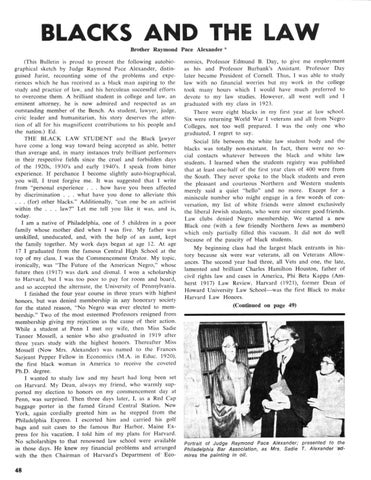
Portrait of Judge Raymond Pace Alexander; presented to the Philadelphia Bar Association, as Mrs. Sadie T. Alexander admires the painting in oil.