Hampton Dean, Bluefield "Prexy" - - Now Heads Fisk University CLEVELAND, OHIO—Dr. Stephen J. Wright, the 46 year old educator selected for the presidency of Fisk University out of a field of 48 candidates, is as methodical in his approach to school problems as a laboratory worker tracking down a germ. It was, in fact, his careful assembling of facts and figures to present to court in a Durham, N. C , fight for equal funds for Negro schools that helped establish him as a leader among people. Born in South Carolina, one of four children of a doctor who practiced in the tiny town called Dillon, Dr. Wright lived there until his father died. Stephen Wright was five years old at the time, and he and the other three children went to Vance, N. C , to live with their grandparents on a farm. His mother went North to find work. It was at Vance that he attended a one-teacher school for a while, but by the time he was 15 he managed to enter the high school department of Hampton Institute, a college in Virginia. "I never had any idea of being anything but a physician, like my father," Dr. Wright said. "I majored in science in college so that I would be ready for medical college." But when he received his B.S. degree from Hampton Institute in 1934, the depression made medical school impossible. "I didn't have any medical school money," he said. "It had been awfully rough going all the way. But I never did pay a cent of tuition. I won scholarships all the way, for all three degrees."
South Carolina Chapter (Continued From Col. 1, Page 12) portant item on our calendar is our annual spring dance to which all Alpha Brothers and their guests look forward. The Brothers of Alpha Psi Lambda wish to extend to all brothers throughout Alphadom a hearty, and happy New Year.
Delta Upsilon (Continued From Page 12) advisor Dr. Henry C. Montgomery. In less than three years on campus Delta Upsilon has been symbolic of scholarship, brotherhood, and most of all, personal progress. FEBRUARY, 1958
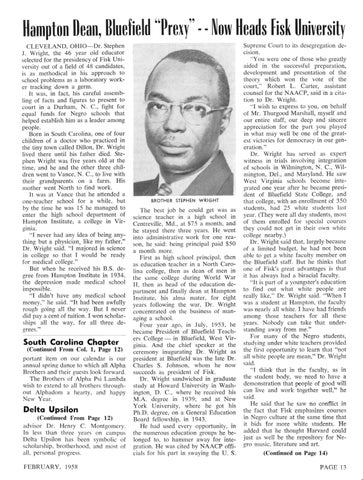
BROTHER STEPHEN WRIGHT
The best job he could get was as science teacher in a high school in Centreville, Md., at $75 a month, and he stayed there three years. He went into administrative work for one reason, he said: being principal paid $50 a month more. First as high school principal, then as education teacher in a North Carolina college, then as dean of men in the same college during World War II, then as head of the education department and finally dean at Hampton Institute, his alma mater, for eight years following the war, Dr. Wright concentrated on the business of managing a school. Four year ago, in July, 1953, he became President of Bluefield Teachers College — in Bluefield, West Virginia. And the chief speaker at the ceremony inugurating Dr. Wright as president at Bluefield was the late Dr. Charles S. Johnson, whom he now succeeds as president of Fisk. Dr. Wright sandwiched in graduate study at Howard University in Washington, D. C , where he received his M.A. degree in 1939; and at New York University, where he got his Ph.D. degree, on a General Education Board fellowship, in 1943. He had used every opportunity, in the numerous education groups he belonged to, to hammer away for integration. He was cited by NAACP officials for his part in swaying the U. S.
Supreme Court to its desegregation decision. "You were one of those who greatly aided in the successful preparation, development and presentation of the theory which won the vote of the court," Robert L. Carter, assistant counsel for the NAACP, said in a citation to Dr. Wright. "I wish to express to you, on behalf of Mr. Thurgood Marshall, myself and our entire staff, our deep and sincere appreciation for the part you played in what may well be one of the greatest victories for democracy in our generation." Dr. Wright has served as expert witness in trials involving integration of schools in Wilmington, N. C , Wilmington, Del., and Maryland. He saw West Virginia schools become integrated one year after he became president of Bluefield State College, and that college, with an enrollment of 350 students, had 25 white students last year. (They were all day students, most of them enrolled for special courses they could not get in their own white college nearby.) Dr. Wright said that, largely because of a limited budget, he had not been able to get a white faculty member on the Bluefield staff. But he thinks that one of Fisk's great advantages is that it has always had a biracial faculty. "It is part of a youngster's education to find out what white people are really like," Dr. Wright said. "When I was a student at Hampton, the faculty was nearly all white. I have had friends among those teachers for all these years. Nobody can take that understanding away from me." For many of the Negro students, studying under white teachers provided the first opportunity to learn that "not all white people are mean," Dr. Wright said. "I think that in the faculty, as in the student body, we need to have a demonstration that people of good will can live and work together well," he said. He said that he saw no conflict in the fact that Fisk emphasizes courses in Negro culture at the same time that it bids for more white students. He added that he thought Harvard could just as well be the repository for Negro music, literature and art. (Continued on Page 14) PAGE 13