TK System
Innovations
1 | 2011
Table of contents editorial 1
TRAUMA, PELVIS 45 Hip Preservation Surgery Set
VA-LCP Forefoot/Midfoot Set 2 Trauma, Upper Extremity 11 PHILOS Instrument Upgrade 3.5 mm LCP Periarticular Proximal Humerus Trauma, Hand 15 2.4 mm VA-LCP Volar Rim Distal Radius Plate 2.4 mm VA-LCP Dorsal Distal Radius Plate 2.4 mm VA-Locking Intercarpal Fusion System Trauma, lower extremity 26 LCP DF: 15–19 Holes 3.5 mm LCP Proximal Tibia Low Bend TRAUMA, Im Nailing 28 PFNA Augmentation AO Research Institute: Biomechanical Potential of PMMAAugmented PFNA Blades to Prevent Implant Cutout AO Research Institute: Heat Generation During PMMA Augmentation of PFNA Blades TFN with Screw Proximal Femoral Locking Compression Plates Versus Trochanteric Nails—A New Study Designed to Provide Clear Answers ETN PROtect (Expert Tibia Nail, with Gentamicin Coating) Tips and Tricks Using the ASLS for IM Nails
Trauma, Pediatrics 46 LCP Pediatric Hip (PHP) and Condylar Plate System 90° 3.5 and 5.0 mm LCP Pediatric Condylar Plate Slipped Capital Femoral Epiphysis (SCFE) Screw System Comparison of TK Experts’ Symposia in Asia, Europe, and North America 53 Craniomaxillofacial 55 Fracture Plates for Condylar Neck and Base Depth Gauge for Matrix Mandible System Piezoelectric Bone Surgery System Spine 60 T-PAL Insight Retractor and Tube Systems Matrix (Degen) Prodisc-C Nova AOSpine Knowledge Forum Portrait 68
Due to varying countries’ legal and regulatory approval requirements please consult the appropriate local product labeling for approved intended use of the products described in this brochure. All devices in this brochure are AOTK approved. For logistical reasons, these devices may not be available in all countries worldwide at the date of publication.
Editorial
1
Dear reader, In osteoporotic fractures the metabolic status of the patient and their bone has rapidly become the focus of patient treatment. Nonmechanical options to influence the metabolism of the bone are of increasing importance, eg, with vitamin D and calcium or even hormone treatment. With its geriatric fracture program, the AO Foundation is again at the forefront and looking into potential collaborations. The role of augmentation with bone cements and bone substitutes in geriatric patients is growing, especially in the case of acute fracture treatment, and the number of potential indications increasing. In spine, vertebroplasty and kyphoplasty are established treatment modalities for osteoporotic vertebral compression fractures. In trauma, the PFNA can now be used in conjunction with augmentation using Traumacem V+, a PMMAbased cement with improved biocompatibility and higher stability compared to standard PMMA. A large amount of testing has been performed to show the benefits in osteoporotic bone, especially in unstable pertrochanteric fractures. In the first clinical cases, neither cement leakage into the hip joint nor catastrophic failures like cutout or cut-through of the blade have been observed. A prospective multicenter trial is ongoing.
The prodisc-C nova is based on the ball-and-socket concept, maintaining motion which has successfully been used in joint replacement implants for over 40 years. It offers enhanced MRI compatibility, improved multilevel capability, and one-step atraumatic keel-cut preparation. The matrix system is a comprehensive thoracolumbar pedicle screw system. The matrix poly axial pedicle screws feature dual core double-lead threads, a threaded screwdriver holding a sleeve interface, a T25 StarDrive recess, 50° of angulation, and rod reduction features as a top-loading system. The locking cap has a square thread design and a concave saddle on the underside of the locking cap for rod insertion. The new T-PAL system is an interbody stabilizer to assist in the fusion of adjacent vertebral segments between vertebral levels L1–S1 using a transforaminal approach. The kidney-shaped implants are manufactured from PEEK and titanium.
In the lead article of this issue, the AO Foot & Ankle Expert Group provides a comprehensive overview of the variable angle locking forefoot/ midfoot set and its clinical benefits in reconstructive and trauma surgery. This set features new technologies in compression, several new and well-known plates enhanced by the option of variable angle screw placement.
Once again, we would like to stress that none of the articles in this publication is a substitute for the AO’s surgical techniques or the AO teaching tools. You can obtain more detailed information on these devices from the AO or from the official technical guidelines and documentation. If you have any comments or questions on the articles or the new devices, please do not hesitate to contact any one of us.
Other devices we like to highlight are the 2.4 mm VA-LCP dorsal distal radius plate with variable angle technology and anatomical preshaped plates for the radial and intermediate columns. The 2.4 mm VA-LCP intercarpal fusion system combines circular plating and variable angle locking which results in a stable construct with increased fixation properties, compared to a cortex screw construct for posttraumatic mediocarpal collapse after various carpal injuries.
The new piezoelectric system has been introduced for use in craniomaxillofacial and neurosurgery applications. Its ultrasonic cutting technology can be used for osteotomies, osteoplasties, decortication, drilling, and shaping in a broad variety of surgical procedures. The column, Portrait, features Bruce Frankel, Professor of Neurosurgery and Radiation Oncology in the Department of Neurosciences at the Medical University of South Carolina. His special interests include his R01 funded translational tumor research and leading the AO Nursing CE Spine Bioskills Workshop. We encourage you to follow his example and to share your talents with us. You may approach the AO Foundation any time if you have an idea for the improvement of patient treatment as Bruce Frankel did.
Yours faithfully,
Tim Pohlemann AOTK (Trauma)
Edward Ellis III AOTK (CMF)
Robert McGuire AOSpine TK
2
VA-LCP Forefoot/Midfoot Set
Michael Castro, Per-HenrikAgren, Ian Winson, Juan Bernardo Gerstner, Les Grujic, Andrew Sands
VA-LCP Forefoot/Midfoot Set Rigid fixation in the foot has recently taken an evolutionary step. The VA-LCP forefoot/midfoot set represents a leap of technology which allows the adaptive application of fixation to meet virtually any need in fracture treatment or reconstruction. The variable angle locking screws (2.4 or 2.7 mm) can be placed and locked 15° from perpendicular in any plane. The overall plane is 30°. This allows fixed angle fixation in juxtaposition to joints which is particularly important in the midfoot, where tolerances are small and joint contours vary. In addition, screws can be converged, diverged, or staggered optimizing the stability of the construct. Fig 1 VA-LCP forefoot/midfoot set.
Fig 2 VA-locking X-plate.
Fig 3 T-fusion plate.
Fig 4 L-fusion plate.
The implants are general and specific. Plate design took into consideration the specific anatomical entities, such as the talar neck, navicular, cuboid, first tarsometatarsal (TMT), and metatarsophalangeal (MTP) plates. Others, the “X” plate, “T,” “L”, and “U” plates, the straight plate, and the clover can be placed where a need exists. These designs can be adapted to virtually any fracture or reconstructive need in the foot. An example is the fixation of tarsal navicular fractures where the contour of the talonaviclar joint requires meticulous screw placement. Compression is afforded by the use of a compressive forceps and beaded, threaded pins. The plates possess a pin-slot at one end and a corresponding pin-hole in the other. The technique consists of fixing the plate to bone using a beaded pin through the hole and engaging the opposite cortex. After manual compression is applied to maximize the compressive effect, a second beaded, threaded pin is placed through the slot, again, engaging the opposite cortex. The ratcheted compression forceps is then applied and by virtue of the slot, the two surfaces are translated together. The slotted side of the plate is now fixed with cortex or locking screws, depending on the need and preference of the surgeon. If a lag screw is used first as in standard technique, then the plate must be placed in neutralization without compression. If the plate is used without lag screws, the controlled compression (ball squeezer) can aid in achieving compression across the fusion site. The other screw holes can then be filled with locking screws to achieve a fixed angle arrangement.
Fig 5 VA-locking straight fusion plate—long.
This technique allows for uniform compression across a joint surface. In certain cases, a second pair of beaded pins can be placed outside the plate to generate greater compression or to distribute force more evenly.
Fig 6 VA-locking straight fusion plate—short.
Fig 7 Cloverleaf fusion plate.
VA-LCP Forefoot/Midfoot Set
3
Applying compression this way may preclude the need for lag screw fixation that might otherwise require a separate or larger incision, more dissection, or undermining of tissue. Among the specific plates, the first MTP arthrodesis plate is available in left and right, and 0, 5, or 10° of dorsiflexion. This plate can be used with a ball-and-socket reaming set allowing precise positioning while maximizing apposition of the subchondral surfaces. Additionally it can be used with or without lag screw augmentation depending on the individual case. Another design consideration was the management of bone loss and the need for interposition bone graft. Fig 8 Compression forceps.
Fig 9 First MTP fusion plate.
Fig 10 First TMT fusion plate.
Fig 11 Tarsometatarsal fusion plate.
The plates designed for use at the TMT joints provide rigid fixation and stability and generate compression without the need for lag screw fixation. This is of particular benefit in patients whose bone quality may make lag screw fixation difficult, who risk fracture or breakout of the screws. In these cases the locking compression plates and their valuable angled locked screw provide resistance to shear and bending forces which might otherwise compromise lag screw fixation. In the treatment of fractures, the navicular and cuboid plates have proved very useful. The navicular plate can be positioned from plantarmedial to dorsolateral depending on the fracture pattern. Fracture of the navicular demonstrates the greatest application of variable angle screw placement. Screw placement can be optimized about the concavity of the navicular without violating the subchondral bone on either side. Of course, care must be taken to minimize soft tissue undermining maintenance of blood supply, but this too is aided by the variability of screw placement. Similarly, the cuboid plate is designed to efficiently restore length and height of this bone which is vital in the treatment of injury compromising the lateral column of the foot. Again, the utility of variable angle screw placement should not be understated in this application. Screw placement can be varied, adhering to the contour of the calcaneocuboid and TMT joint surfaces optimizing the integrity of the construct. The “mesh plate”, originally designed to address trauma—fractures and dislocations/subluxations—of the intertarsal region from Chopart to Lisfranc, can be cut and contoured to stabilize the midfoot medially, laterally, or in combination. Therefore, it is an ideal implant in case of bone loss or an adjunct in the reconstruction of neuropathic collapse.
Fig 12 VA-locking navicular plate.
Another new concept that is introduced in the VA set is the opening wedge implants and tools.In deformity correction many things can be achieved with angular correction. The opening wedge plates and the opening wedge-distractor gauge make it possible to perform corrections with a positive distracting correction without bonegrafting. The distractor gauge is used in a transverse osteotomy to open it up and make a correction that is measured and then secured with a plate with
4 
VA-LCP Forefoot/Midfoot Set
a metal wedge, spreading the cortices under the securing plate. Possible indications could be metatarsal and tarsal corrections where shortening is not desired.
Fig 13 VA-locking cuboid plate.
The variable angle locking compression forefoot/midfoot set is a revolutionary development in the treatment of reconstruction and fracture care. These implants provide a means of tailoring fixation to virtually any fracture or reconstructive surgical plan. In the short time since its release, additional applications for these implants have been found. The use of this set can facilitate the precise tailoring of fixation to meet any problem the surgeon may face. The authors feel confident that the use of these implants in conjunction with meticulous soft-tissue technique, respect for the blood supply, and early motion will improve the functional outcome of patients.
Fig 14 VA-locking mesh plate.
Fig 15 VA-locking opening wedge plate.
Case 1: First MP fusion VA-LCP A 57-year-old woman has suffered rheumatoid arthritis for several years. She presented with pain and deformity in the left forefoot moreso than in the right. Clinical examination reveals severe hallux valgus deformity and dislocation of MP joints 11 through V, with synovitis. Fig 1 Preoperative image of left forefoot.
Case provided by Juan Bernardo Gerstner, Cali, Columbia
a
Fig 2a–c Preoperative x-rays.
b
c
VA-LCP Forefoot/Midfoot Set
a
b
a
Fig 3a–b A dorsal transtendinous approach was used and reaming of the first MT head and basal articular surface of the proximal phalanx was performed with the new reamers.
a
Case 2: First MTP fusion plate. A 38-year-old man presented for opinion after two attempts to fuse the big toe MTP joint. The AP view is significant for luscency at the joint line. The lateral view is notable for loosening of the hardware and malposition because of the dorsiflexion built in to the precontoured implant. Revision was planned using a 0° variable angle locking/compression hallux MTP plate.
b
Fig 4a–b A left MP fusion was performed as well as a II to V MT head resection arthroplasty, and fixed with K-wires for 4 weeks. The patient was weight bearing immediately with wooden shoes and K-wires were removed 4 weeks postoperatively.
Fig 5a–b Immediately postoperative x-rays.
b
a
b
Fig 1a–b Preoperative images show revision MTP arthrodesis.
Case provided by Michael Castro, Scottsdale, Arizona, USA
Fig 2a–b At 10 weeks postoperatively the patient had no pain with weight bearing. The lateral view demonstrates improved position of the toe using a 0°angle plate.
a
5
b
6
VA-LCP Forefoot/Midfoot Set
Case 3: First TMT fusion plate. A 48-year-old woman, with hallus valgus and hypermobile medial column, also resulting in pes plano abductovalgus (flatfoot deformity). Case provided by Andrew Sands, New York, New York, USA
a
b
c
Fig 1a–c Preoperative x-rays.
a
b
c
Fig 2a–c First week postoperatively. Surgery consisted of first TMT and intertarsal corrective osteotomy plus fusion with movement of the first MT lateral and plantar. This corrects the hallus valgus as well as the pes plano abductovalgus (and stabilizes the medial column).
a
b
c
Fig 3a–c Three months postoperatively.
Case 4: First TMT fusion plate. A 60-year-old woman with pes plano abductovalgus (flatfoot deformity). Case provided by Andrew Sands, New York, New York, USA
a
b
c
Fig 1 a–c Preoperative x-rays.
VA-LCP Forefoot/Midfoot Set
7
a
b
c
Fig 2a–c Two weeks postoperatively. The patient was treated by headless compression screw 6.5 tuber osteotomy, TMT plantarflexing osteotomy, and first TMT fusion plate.
a
b
c
Fig 3a–c X-rays 3 months postoperatively.
a
b
c
Fig 4a–c X-rays 6 months postoperatively.
Case 5: First TMT, straight fusion and TMT fusion plates. A 46-year-old obese woman with coronary artery disease had sustained a Lisfranc injury while performing an exercise program. She was unable to weight bear and used an electric scooter. a
b
Fig 1a–b Preoperative x-rays.
a
b
Fig 2a–b Postoperative x-rays.
In an effort to restore her ability to exercise and taking into consideration her body weight and upper extremity weakness, a decision was made to use the variable angle locking compression plate. These postoperative x-rays were obtained at 3 months, one month after beginning weight bearing. The patient´s pain was reduced and she was able to resume a progressive exercise program after 4 months following surgery. Case provided by Michael Castro, Scottsdale, Arizona, USA
8
VA-LCP Forefoot/Midfoot Set
Case 6: VA-locking mesh plate. A 46-year-old female pedestrian was run over. Her foot was crushed by a car. It was a closed injury. She had no other bodily injuries and no medical problems. She sustained massive swelling and shear dorsal soft-tissue injury. Case provided by Andrew Sands, New York, New York, USA
a
b
c
b
Fig 2a–b Immediately postoperative images.
d
Fig 1a–d Preoperative images.
a
a
a
b
b
c
Fig 3a–c Three weeks postoperatively.
c
Fig 4a–c Three months postoperatively.
VA-LCP Forefoot/Midfoot Set
9
Case 7: VA-locking X-plate. A 49-year-old woman had extreme pain in the talonavicular joint. Case provided by Andrew Sands, New York, New York, USA
a
a
a
a
b
b
b
b
c
Fig 1a–c Preoperative x-rays: lateral (a), oblique (b), and AP (c).
c
Fig 2a–c Postoperative x-rays: lateral (a), oblique (b), and AP (c). As isolated fusion of the talonavicular joint is often hard to achieve, a 4.0 mm lag screw plus X-plate was used.
c
Fig 3a–c Follow-up x-rays 2 months postoperatively: lateral (a), oblique (b), and AP (c).
c
Fig 4a–c Follow-up x-rays 4 months postoperatively: lateral (a), oblique (b), and AP (c). Fusion of the talonavicular joint while saving the rest of the hindfoot complex motion.
10
VA-LCP Forefoot/Midfoot Set
Case 8: VA-locking X-plate. A 38-year-old man fell from a 7-foot height while at work. The patient was seen at an urgent care facility and diagnosed with an ankle sprain. He was placed in a stirrup brace and instructed to bear weight as tolerated. Case provided by Michael Castro, Scottsdale, Arizona, USA After 4 months the patient presented for a second opinion. His complaint was pain to the lateral column and subtalar joint. The preoperative lateral x-ray is notable for a malunited talar neck fracture with subluxation of the subtalar joint. The disproportion of the medial and lateral columns and a cavovarus position of the foot are seen on both the AP and lateral views. The degenerative changes at both the talonavicular and subtalar joints are significant.
a
b
Fig 1a–b Preoperative x-rays.
The patient was treated with arthrodesis of the talonavicular and subtalar joints. The compression/ distraction device was used to restore the length of the medial column. The articular surface of the subtalar joint was prepared arthroscopically. The talonavicular joint was debrided then packed with a tricalcium matrix. Length was maintained using a locking X-plate. The subtalar joint was then fixed with a 6.5 mm headless compression screw. The patient returned to work 3 months after surgery. He wears an ankle brace when on uneven surfaces. His lateral column and subtalar pain have resolved.
a
b
Fig 2a–b X-rays 5 months postoperatively.
Trauma, upper extremity
11
Dean G Lorich , Norbert Südkamp
Trauma, upper extremity PHILOS Instrument Upgrade One of the main complications in proximal humeral plating is primary screw perforation. Primary screw perforation happens if too long screws are set at the time of surgery, despite intraoperative image intensifier control. Using measuring notations on drill bits and K-wires seems inadequate for achieving reliable screw length in osteopenic bone. Therefore, dedicated instruments were developed to drill the lateral cortex only, followed by the use of a depth probe to feel the resistance of the subchondral bone in these patients. Additionally, the new proximal suture holes on the PHILOS plate are penetrating the plate from the top to the sides, allowing the attachment of the suture after the plate has been fully mounted to the bone.
3.5 mm LCP Periarticular Proximal Humerus The 3.5 mm LCP periarticular proximal humerus plate is indicated for fractures, fracture dislocations, and nonunion of the proximal humerus—particularly for patients with osteopenic bone. This construct acts as a fixed angle device with divergent and convergent screws offering superior biomechanical properties to improve fixation and pullout strength in osteoporotic bone [1–3]. The plate is positioned more distally (12–15 mm from insertion of rotator cuff) to avoid impingement and more anteriorly distally to lessen the need to elevate the deltoid insertion. The plate is produced in precontoured models. Six suture holes with undercuts allow for passing sutures to help with both reduction and ligament reattachment. Chamfers at the top and bottom edges of the suture holes prevent sharp edges. The plate head features six locking holes that accept 3.5 mm locking screws and two locking “kickstand” screws in the plate neck to direct the screws into the calcar region. The plate shaft has elongated combination holes and accepts 3.5 mm locking and 3.5 mm cortex screws. The second calcar screw can be used for shaft reduction with a nonlocking cortex screw. The cutout in the plate for the cortex screw head is deeper and more rounded for reducing screw head prominence. The tapered plate tip facilitates percutaneous insertion. The plate is available in 2–6, 8, 10, 12, and 14 holes in stainless steel.
12
Trauma, upper extremity
An insertion guide is available to facilitate careful placement of the plate head screws. This guide is compatible with the existing sleeve instruments and the new PHILOS instruments with depth probe. Usage of an endosteal implant (optional technique) Despite improved biomechanical characteristics, postoperative complications as high as 36% have been reported [4]. These included screw cutout with intraarticular displacement (23%) and varus displacement (25%). In a recent multicenter study, 13.7% of patients suffered loss of fixation when proximal humerus locking plates were used [5]. The only factor significantly associated with loss of fixation was a varus reduction of < 120º. The authors of these studies concluded that “avoiding varus should substantially decrease the risk of postoperative failures.” Previous studies have demonstrated importance of both the integrity and stability of the medial column [5–7]. Restoration of the medial column using an endosteal implant provides medial support, maintaining reduction and avoiding varus collapse. A semitubular plate or fibular allograft can be used as an endosteal implant. However, the fibula has the advantage of being drillable and shapeable, as well as able to be used as a tool to indirectly reduce the fracture endosteally avoiding excess manipulation of fragments and soft-tissue stripping. Additionally, the fibula appears to remodel into the medial cortex, which may contribute added support. The fibula allograft is positioned to support the head and calcar by delivering it through the lateral fracture line anterograde down the shaft. Once the majority of the graft is within the humeral shaft, it is then medialized and driven retrograde to the subchondral bone of the humeral head. The endosteal and subchondral placement of the graft typically reduces the head to the shaft indirectly, restoring the neck-shaft angle and providing provisional stabilization of the head-shaft relationship at the fracture site. This generally facilitates the reduction of the tuberosities. If a greater tuberosity fracture is present, it is then reduced anatomically into its bed. The plate is slid from proximal to distal along the lateral aspect of the shaft, under the axillary nerve. It is positioned such that the distal screws in the head are in the most inferior aspect of the head, further buttressing the medial calcar. Screws are then placed distally to the graft through the plate to secure it. Locked screws are then placed through the plate and the graft to the subchondral surface of the humeral head with care not to penetrate the articular surface with the drill or the screw itself. The rotator cuff sutures are then tied into place through plate eyelets; the wound is copiously irrigated, and then closed.
Trauma, upper extremity
13
The plate/graft/screw combination acts as a composite fixed angle device supporting the medial calcar and the humeral head, and also shortens the working length and lever arm of the locking screws. The authors believe this leads to a more reliable and stable means of fixing proximal humeral fractures and facilitates a more aggressive early rehabilitation protocol in the hope of minimizing postoperative capsular scarring. References 1 Seide K, Triebe J, Faschingbauer M, et al (2007) Locked vs. unlocked plate osteo synthesis of the proximal humerus— a biomechanical study. Clin Biomech; 22(2):176–182. 2 Siffri PC, Peindl RD, Coley ER, et al (2006) Biomechanical analysis of blade plate versus locking plate fixation for a proximal humerus fracture: comparison using cadaveric and synthetic humeri. J Orthop Trauma; 20(8):547–554. 3 Weinstein DM, Bratton DR, Ciccone WJ 2nd, et al (2006) Locking plates improve torsional resistance in the stabilization of three-part proximal humeral fractures. J Shoulder Elbow Surg; 15(2):239–243. 4 Owsley KC, Gorczyca JT (2008) Fracture displacement and screw cutout after open reduction and locked plate fixation of proximal humeral fractures [corrected]. J Bone Joint Surg Am; 90(2):233–240. 5 Agudelo J, Schürmann M, Stahel P, et al (2007) Analysis of efficacy and failure in proximal humerus fractures treated with locking plates. J Orthop Trauma; 21(10):676–681. 6 Gardner MJ, Weil Y, Barker JU, et al (2007) The importance of medial support in locked plating of proximal humerus fractures. J Orthop Trauma; 21(3):185–191. 7 Lee CW, Shin SJ (2009) Prognostic factors for unstable proximal humeral fractures treated with locking-plate fixation. J Shoulder Elbow Surg; 18(1):83–88.
A 72-year-old woman suffered a four-part fracture of the left proximal humerus following a fall from a standing height. The patient underwent open reduction and internal fixation of the proximal humeral fracture. Case provided by Dean G Lorich, New York, New York, USA
a
b
c
d
Fig 1a–d Preoperative x-rays.
14
Trauma, upper extremity
a
b
c
Fig 2a–c CT scans.
a
b
c
Fig 3a–c 3-D CT reconstructions.
a
b
a
Fig 4a–b Immediately postoperative x-rays.
b
Fig 5a–b X-rays at 1-year follow-up. Fig 6a–d Clinical pictures show range of motion 1 year postoperatively.
a
b
c
d
Trauma, Hand
15
Ladislav Nagy, Doug Campbell, Juan González del Pino, Tom Fischer, Jesse Jupiter, Fiesky Núñez
Trauma, Hand 2.4 mm VA-LCP Volar Rim Distal Radius Plate Very distal, mostly intraarticular fractures of the distal radius may require fixation very close to the volar articular lip. Proper placement of standard plates is difficult due to variances of the anatomical shape of the bone and the origins of the radiocarpal ligaments which must not be injured. Moreover, fixation options of the radial styloid and distal radioulnar joint have not been optimal so far.
a
The 2.4 mm VA-LCP volar rim distal radius derives from the 2.4 mm LCP distal radius plate juxta-articular, but has an anatomically preshaped design, a second distal screw row (outrigger), and variable angle locking technology. Highly polished low profile plates with round edges and fully countersunk screws minimize the risk of softtissue irritations and tendon ruptures. The anatomical plate design allows for very distal plate placement. CT scans were used to verify the fit of the precontoured plate. Bendable outriggers aid in adjusting the precontoured plate to specific anatomical need and individual variations.
b
Fig 1a–b Volar rim distal radius plate.
The second distal screw row provides for superior fixation stability of fragments, eg, radial styloid, and especially the most ulnar corner of the lunate fossa. Nonclinical dynamic-fatigue testing to determine fatigue strength of the plate construct showed that the VA plates are stronger than the 2.4 mm LCP distal radius plate juxta-articular.
a
b
Fig 2a–b Comparison of anatomical bend and screw placement of volar rim DR plate (a) and DR juxta-articular plate (b).
The plate is available in stainless steel and titanium (TiCp), each in four different versions: 5-hole shaft with 6-hole head in left and right versions, and 5-hole shaft with 7-hole head in left and right versions. For ease and expedience each plate version has a specific guiding block for standard screw orientation. Trial implants help determine the correct plate dimension for sterile implant use.
16
Trauma, Hand
A 74-year-old woman sustained an intraarticular distal forearm fracture of the radius and ulna after falling on her outstretched hand. Case provided by Daniel Rikli, Basel, Switzerland
a
b
Fig 1a–b Preoperative x-rays.
a
b
a
b
Fig 2a–b Initial management was with closed reduction and joint bridging external fixator. There was loss of primary reduction due to inadequate positioning of the external fixator (too lateral).
c
d
e
f
Fig 3a–f a–b CT scans show external fixator. c–e Radius with hyperextended palmar-ulnar key fragment. f Ulnar head split, displaced dorsally (CT sagittal reconstruction).
a
b
Fig 4a–b X-rays 3 days postoperatively: removable splint, early motion with physiotherapy.
a
b
Fig 5a–b Six weeks postoperatively: residual swelling, little pain, range of motion improving with physiotherapy; the patient uses her hand for daily activities.
Trauma, Hand
17
2.4 mm VA-LCP Dorsal Distal Radius Plate Dorsally displaced fragments which cannot be securely fixed through a volar approach need stabilization (often by simple buttressing) on the dorsal surface. The “convex” shape of the dorsal aspect of the radius causes the distal screws of fixed angle devices to point towards the center of the radius, so they cannot be directed parallel to the distal radioulnar joint for optimal support. Using a fixed angular locking dorsoulnar plate which has to be placed very distally can lead to screws entering the joint. This problem can be solved by tilting the screw in the variable angle locking-plate hole proximally. Variable angle technology allows up to 15° off-axis screw angulation which can provide better support of the distal radioulnar joint and/or more secure fixation of the radial styloid. Fig 1 Anatomical preformed radial and intermediate column plates.
Fig 2 Anatomical fit.
Fig 3 Radial column plate.
Fig 4 Intermediate column plate.
The 2.4 mm VA-LCP dorsal distal radius plate adds variable angle technology to the existing double plate concept of the 2.4 mm LCP dorsal distal radius plates. Additionally, new anatomically preshaped plates have been added to the set: one for the radial column in two different lengths, and one for the intermediate column, also in two different lengths and in left and right versions. All plates are highly polished and have rounded edges to minimize the risk of soft-tissue irritation and tendon ruptures. The recommended operating room technique for a dorsal shearing fracture is to apply the dorsoulnar plate first, fixed only by a cortex screw in the oblong combination hole. After, the dorsoradial plate is applied in the same way. The locking screws are then inserted in the dorsoulnar plate, starting with the most proximal hole. Finally, locking screws are placed in the dorsoradial plate in the same order. The VA instrumentation allows repositioning of nonoptimally placed screws. Laboratory cyclical-load testing to determine plate strength to failure confirmed that VA plates are as strong as (or stronger than) “Pi-Plate” with the anatomical prebend plates being stronger than the “flat” ones. Besides the anatomically preshaped radial and intermediate column plates, there is a total of 14 different flat plates available including T-, L-, and oblique L-plates in different lengths. All plates are available in stainless steel and titanium (TiCp).
18
Trauma, Hand
Case 1: A 62-year-old man fell on his outstretched left hand while playing tennis, sustaining an intraarticular fracture of the distal radius, Müller AO Classification 23-C3.2. Case provided by Renato Fricker, Bruderholz, Switzerland
a
b
Fig 1a–b Preoperative x-rays.
a
b
Fig 2a–b Preoperative CT scans.
a
b
Fig 3a–b Open reduction and internal fixation was performed under axillary plexus anesthesia the day after he presented. Active range-ofmotion exercises were started the first day postoperatively. Wound healing was uneventful.
a
b
Fig 4a–b Six-week follow-up.
Trauma, Hand
Case 2: A 44-year-old man sustained polytrauma following a car accident. Among his injuries was a distal radial fracture, Müller AO Classification 23-C1. Case provided by Vitezslav Ruber, Brno, Czech Republic
a
b
Fig 1a–b Preoperative AP and lateral x-rays.
a
b
Fig 3a–b Postoperative AP and lateral x-rays.
a
b
Fig 2a–b Preoperative AP and lateral 3-D CT scans.
a
Fig 4a–b Follow-up x-ray images.
b
19
20
Trauma, Hand
Fig 1 VA-locking intercarpal fusion system.
Fig 2 Seven-hole circular plate. Note the 2.4 mm variable angle locking holes, as well as thin holes for temporary fixation using K-wires. The central, plain hole is used for cancellous bone graft placement at the junction of the four bones to be fused.
Fig 3 Standard reaming guide with four pairs of K-wire fixation holes.
2.4 mm VA-Locking Intercarpal Fusion System Longstanding scaphoid nonunion advance collapse (SNAC) or scapholunate advanced collapse (SLAC) can lead to a painful wrist with limited range of motion. Midcarpal fusion, so-called “four-corner fusion,” is a reliable procedure for treating painful SNAC and SLAC wrists, with preservation of functional wrist motion. In this procedure the scaphoid is excised in order to address the painful radioscaphoid osteoarthritis. The midcarpal joint then needs to be stabilized, because depending on the stage of SLAC/SNAC, it may also be arthritic and painful. Stabilization is performed by arthrodesis among the lunate, capitate, hamate, and triquetrum, thus “fourcorner fusion”. As the radiolunate joint is usually spared from arthritic changes, it allows for sufficient and pain-free residual motion between the lunate and the radius. The 2.4 mm VA-locking intercarpal fusion system combines the circular plating technique with 2.4 mm variable angle locking technology and dedicated instrumentation (Fig 1). The circular plate design with a smooth surface and rounded edges minimizes soft-tissue irritation (Fig 2). To avoid impingement, proper positioning of the fusion, placement, and recession of the implant are mandatory. Apart from the standard reaming guide (Fig 3), the new reduction reaming guide permits reduction, compression, and stabilization of the fusion site during the reaming procedure (Fig 4). Laser markings on the reamer support the surgeon by precisely controlling the depth of reaming for optimal countersinking of the plate (Fig 5). The VA-locking plate holes accept both 2.4 mm cortex and VA locking screws. The use of cortex screws provides the option for compression by pulling the bones to the plate, whereas locking screws enhance the holding power in the cancellous bone. This results in an extremely rigid construct that can withstand the strains of early postoperative mobilization. Midcarpal fusion provides a functional (useful) wrist motion achieving a minimum of 30º extension, 30º flexion, and 30º combined ulnar-radial deviation. This is “the rule of the 30s” that allows the performance of about 90% of daily living activities.
Trauma, Hand
21
Two plate sizes are available: a 6-hole plate with a diameter of 15 mm, and a 7-hole plate with a diameter of 17 mm to fit different sized patients and applications.
a
b
Fig 4a–b a The reduction reaming guide also allows application of compression on the carpal bones. b The reduction reaming guide allows midcarpal distraction for bone graft packaging, and then application of compression at the carpal bones junctions.
Fig 5 The reamer has 6 cutting teeth for the improvement of cutting performance. The laser markings ensure a safe and precise reaming depth.
Overall, the VA-locking intercarpal fusion system presents a major technological and conceptual step forward in reconstructive wrist surgery.
22
Trauma, Hand
Case 1: SNAC wrist stage 3. Operative procedure and technical details. Case provided by Ladislav Nagy, Zürich, Switzerland, and Fiesky Núñez, Valencia, Venezuela.
a
b
a
Fig 1a–b Preoperative x-rays. Notice the midcarpal joint destruction and the DISI deformity of the lunate.
a
b
b
Fig 2a–b Dorsal intercalated segment instability correction and K-wire fixation.
c
Fig 3a–c Bone debridement. Guide positioning and fixation.
a
b
c
Fig 4a–c a–b Reaming. c Once the carpal junctions have been putting closer by the new reduction-compression guide, reaming is done.
Trauma, Hand
23
b a
c
a
a
b
d
Fig 5a–d Plate positioning and fixation. The combined VA-locking standard guide allows drilling in the appropriate direction.
b
Fig 6a–b Final appearance of fixed plate.
b
Fig 7a–b No impingement of the plate against the dorsal rim of the radius in extension.
24
Trauma, Hand
Case 2: Early degenerative wrist stage 3 secondary to a necrotic and collapsed proximal pole nonunion. Case provided by Ariane Scheller, Berlin, Germany
a
b
Fig 1a–b Preoperative x-rays. Note the carpal collapse and DISI deformity.
a
b
Fig 2a–b Intraoperative motion.
b
Fig 3a–b The lunate-radius couple has been successfully achieved. DISI deformity has been reduced.
a
Trauma, Hand
Case 3: Painful SNAC wrist in a 42-year-old man. Case provided by Juan González del Pino, Madrid, Spain
Fig 1 X-ray shows SNAC wrist.
b
Fig 2a–b X-rays show 6-month follow-up of a “four-corner fusion” made by a VA-locking intercarpal fusion system. The articulation between the lunate and the radius allows motion. Healing among all four bones, mainly at the capitate-lunate junction.
a
b
Fig 3a– d a–b X -rays of lateral view of the wrist during active extension (40°).
c
d
c– d X -rays of lateral view of the wrist during flexion (35º).
a
25
26
Trauma lower extremity
Sean Nork, Matthew Graves
Trauma lower extremity LCP DF: 15–19 Holes The LCP distal femur (DF) is indicated for distal shaft, supracondylar, intraarticular, and extraarticular, as well as periprosthetic fractures. Until recently, the plates were available in lengths up to 13 holes, with the longest plates 300 mm. Longer plates may be useful for appropriate bridging of comminuted fractures or for spanning a hip prosthesis to avoid stress risers in the proximal femur. For the treatment of these fracture types, additional plate lengths of 15, 17, and 19 holes with a maximum length of 436 mm are now available in left and right versions. They have the same design as the existing 5–13-hole plates and can be used with the same aiming arm, instruments, and screws. Fig 1 LCP DF all lengths, 19 holes far right.
3.5 mm LCP Proximal Tibia Low Bend The 3.5 mm LCP proximal tibia plates are indicated for fractures of the proximal tibia, including comminuted, depression, bicondylar combination of lateral wedge and depression, periprosthetic, and fractures associated with shaft fractures.
Fig 1 Standard bend 1.
Fig 2 Standard bend 2.
In addition to the existing plate, a version with a lower proximal bend has been developed to provide more options to match the different anatomies of the proximal tibia. The low bend version is contoured to fit closer to the bone under the lateral condyle and slightly lower to the tibial plateau compared to the current plate. This low bend is the result of human specimen and CT scan studies. The proximal head/neck contour is similar to the 3.5 mm LC-DCP proximal tibia plate. But even with this alternative version, bending will be required in certain cases due to the highly variable anatomy of the proximal tibia with various shapes and inclinations. Another change in the low bend plate is an elongated combination hole in the plate shaft (instead of a regular combination hole) designed to aid in plate placement. As for the existing plate with the standard bend, the plate head is contoured to match the lateral proximal tibia. The plate head profiles of both plate versions have been made thinner at the anterior edges. Suture undercuts to the proximal K-wire holes have been added. Both plates are available in lengths of 4–16 holes. No additional instrumentation is required, although a percutaneous aiming system is currently being developed.
Trauma, lower extremity
27
A 36-year-old man sustained a motorcycle injury: right femoral shaft fracture and right hyperextension bicondylar tibial plateau variant (Fig 1, Fig 2). Staged management with initial rodding of femur and placement of spanning knee external fixator with closed manipulative reduction of tibial plateau (Fig 3).
a
The patient returned to the operating room once soft tissue allowed for open reduction and internal fixation of the tibial plateau fracture via a lateral utility and anteromedial approach. Placement of low bend 3.5 mm proximal tibia plate laterally and 3.5 mm locking T-plate anteromedially to buttress the impacted anterior rim (Fig 4, Fig 5).
b
Fig 1a–b Preoperative x-rays.
a
b
c
Case provided by Matthew Graves, Jackson, Mississippi, USA
Fig 2a–c CT scans (axial, post coronal).
a
b
c
d
Fig 3a–d CT scans after intramedullary nailing of femur and external fixation of knee.
a
b
Fig 4a–b Postoperative x-rays of knee.
a
b
Fig 5a–b X-rays at 3 months follow-up.
28
Trauma, IM nailing
Christian Kammerlander, Michael Blauth, Ladina Fliri, Mark Lenz, R Geoff Richards, Markus Windolf, An Sermon, Cliff Turen, Sabine Goldhahn, Jan Ljungqvist, Michael Raschke, Gerhard Schmidmaier, Martin Lucke, Britt Wildemann, Thomas Fuchs, Dankward Höntzsch
Trauma, IM nailing PFNA Augmentation The proximal femoral nail antirotational (PFNA) in its short and long versions is indicated for pertrochanteric fractures, intertrochanteric fractures, and high subtrochanteric fractures. In addition the long version is indicated for low and extended subtrochanteric fractures, ipsilateral trochanteric fractures, segmental fractures of the femur, and pathological fractures. As an added benefit a cement augmentation is now available. Indications are unstable pertrochanteric fractures in severe osteoporotic patients. Perforated blade The new perforated blade comes in lengths of 75–130 mm in 5 mm increments and is available in titanium and stainless steel. The insertion/extraction instrument can be used with the new blade because the interface is exactly the same. The existing PFNA implants and instruments are fully compatible with the new perforated blade.
Fig 1 PFNA system with augmentation option.
Fig 2 Perforated PFNA blade.
Fig 3 Traumacem V+ cement kit.
Traumacem V+ cement kit The Traumacem V+ is a polymethylmethacrylate (PMMA) cement which is highly viscous immediately after preparation. The special mixing device comprises the powder which is mixed with the monomer from the glass ampoule. After mixing, the cement is filled into special syringes using an additional connector. The special side-opening cannula is filled with cement and allows controlled placement of the cement around the blade. Augmentation After finishing the usual procedure of inserting nail and perforated blade a leakage into the joint first has to be excluded by injection of contrast medium through the perforated blade. Then the prefilled sideopening cannula is inserted into the blade and the position checked by image intensifier. A medial perforation must be avoided. Furthermore, the special 1 ml syringe is adapted to the cannula and the cement can be injected. By turning the cannula the positioning of the cement around the helical blade can be navigated. Around 3–6 ml of cement should be injected. The whole injection procedure must be done under image intensifier control.
Trauma, IM nailing 
29
First clinical experience In the authors' department (University Clinic Innsbruck, director: Michael Blauth) 24 cases have been performed where there has been no cement leakage into the hip joint, nor was there any catastrophic failures like cutout or cut-through of the blade. The authors believe that it is a powerful and safe tool to prevent catastrophic failures in unstable pertrochanteric fractures. A prospective multicenter trial is under preparation.
Fig 4 Cement preparation.
Fig 5 Syringe 1.0 ml.
Fig 8 Side-opening cannula with plunger.
Fig 6 Syringe 2.0 ml.
Fig 9 Trauma needle and syringe kit.
Fig 7 Filling of the syringe.
Fig 10 Controlled injection of the cement.
30
Trauma, IM nailing
An 82-year-old woman with an unstable pertrochanteric fracture of the right proximal femur. Her Barthel Index was 80 and her preoperative Parker mobility score was 5, which means that she was walking at home unassisted. The patient's preoperative Parker mobility score of 5 was reached again at the 3-month follow-up. Case provided by Christian Kammerlander and Michael Blauth, Innsbruck, Austria Fig 1 Preoperative x-ray.
Fig 2 After implanting the PFNA the contrast medium is injected to avoid a cement leakage into the joint.
a
b
a
b
Fig 4a–b Postoperative x-rays after mobilization.
Fig 3a–b Image intensifier pictures show the distribution of the cement around the blade.
a
b
Fig 5a–b X-rays 1 year postoperatively show the fracture has healed well.
Trauma, IM nailing
31
AO Research Institute: Biomechanical Potential of PMMA- Augmented PFNA Blades to Prevent Implant Cutout Objective Helically shaped cephalic implants have proven their benefit to achieve better stabilization for the treatment of unstable intertrochanteric hip fractures. However, cutout ratios up to 3.6% still occur. This in vitro study investigated the cutout resistance of Polymethylmethacrylate (PMMA)-augmented proximal femoral nail antirotational (PFNA) blades in surrogate and human specimen femoral heads.
Fig 1 PMMA-augmented PFNA in synthetic bone.
Augmented center Augmented offcenter Control center Control offcenter 0
10000
20000
30000
Materials/Method Twenty-four surrogate femoral heads simulating porotic cancellous bone as well as six pairs of human specimen femoral heads were instrumented with a perforated PFNA blade. Bone mineral density (BMD) of the human specimens was measured by pqCT. For the surrogate femoral heads, four study groups were formed with central and off-center position of the implant in an augmented (3 ml Vertecem V+) and nonaugmented fashion. Within each human specimen bone pair, one blade was augmented using 3 ml of Vertecem V+ bone cement. Starting at 1000N compression in physiological orientation, the load was monotonically increased by 0.1N/cycle until failure of the construct. Movement of the head with respect to the blade was identified by means of optical motion tracking and x-rays at 250-cycle increments. Standard test statistics were performed on the cycles until failure to identify differences between study groups.
Cycles to 5° varus collapse
Fig 2 Surrogate samples: increased strength of PFNA constructs as a result of cement augmentation is clear. However, malplacement of the implant affects purchase with or without augmentation.
Results Surrogate samples: augmented samples clearly showed an increased number of cycles to failure compared to their control (all P = .012). In the groups with centric position of the PFNA blade, augmentation led to an increase of failure load by 100%. In the groups with off-center positioning of the blade, failure load was even increased by 150% due to cement augmentation (Fig 2). Human specimen samples: a significantly larger number of cycles to cutout was found for the augmented group (P = .028). A significant correlation was observed between BMD and cycles to cutout for the nonaugmented specimens (P < .001, R 2 = 0.97, Fig 3), whereas no correlation was found for the augmented group (P = .4, R 2 = 0.18).
32
Trauma, IM nailing
35000
Cycles to Failure
30000
Conclusion The results of this in vitro study suggest that cement augmentation of the PFNA blade clearly enhances the biomechanical stability under cyclic loading. The procedure is primarily indicated for osteoporotic bone and appears to be a valuable treatment option with clinical benefits in the elderly that seem to outweigh any possible risks associated with implant augmentation [1].
aug non
25000 20000
R2 = 0.97 p < 0.001
15000 10000 5000 0 50
Reference 100
150
200
250
BMD (mgHA/ccm)
1 Sermon A, Boner V, Schwieger K, et al Potential of PMMA cement-augmented helical PFNA blades to improve implant stability—a biomechanical investigation in human cadaveric femoral heads. J Trauma; Forthcoming.
Fig 3 Human specimen samples: a correlation between cycles to cutout and BMD was found for nonaugmented samples. No correlation was found for the augmented specimens.
Thermocouples
Fig 1 Schematic illustration of thermocouple placement surrounding implant and cement cloud.
AO Research Institute: Heat Generation during PMMA Augmentation of PFNA Blades Objective To reduce the risk for implant cutout in the osteoporotic hip, cement augmentation is a potential method to strengthen the implant purchase. Previously conducted biomechanical studies have clearly demonstrated superior biomechanical behaviour of augmented proximal femoral nail antirotational (PFNA) blades compared to nonaugmented ones [1, 2]. Nevertheless, there is concern about thermal bone necrosis due to the exothermic curing of polymethylmethacrylate (PMMA)based bone cements. The objective of this in vitro study was to quantify the temperatures arising around perforated titanium PFNA blades during PMMA augmentation. Materials/Methods Cylindrical samples from six pairs of fresh frozen human specimen femoral heads were used in this study. The specimens were assigned to two study groups for a randomized left to right comparison: 3 ml versus 6 ml cement. After centric insertion of the PFNA blade, six 1 mm holes were drilled radially around the tip of the implant allowing tight fitting of six K-type thermocouples at varying distances to the centre of the blade (Fig 1). To simulate physiological conditions the samples were placed in a 37°C water bath (Fig 2). Bone cement (Vertecem V+)† was injected in a standardized manner and temperatures were continuously recorded until full curing of the cement. Maximal temperatures were identified for all thermocouples.
Trauma, IM nailing
33
After testing, the locations of all thermocouples with respect to the cement cloud were reconstructed by means of pqCT. The distance of each thermocouple to the cement-bone interface was calculated. Data was statistically analyzed using parametric tests. Results The highest temperature of the experiment was 45.5°C ± 2.6°C (mean ± SD) for the 6 ml group and 44.6°C ± 5.3°C for the 3 ml group. These values were measured inside the cement cloud. The maximum temperature recorded in the surrounding cancellous bone was 43.1°C for the 6 ml group compared to 41.1°C for the 3 ml group (Fig 3). No temperature in the bone remained for longer than 600 seconds above 40°C. The average maximal temperature was significantly lower for the 3 ml group compared to the 6 ml group (P = .01).
Fig 2 Test setup. Specimen connected to thermocouples in a 37°C water bath.
Conclusion Based on the available literature the results of this study suggest that augmentation of titanium PFNA blades to reinforce implant purchase is not associated with a risk of thermal bone necrosis when using up to 6 ml of PMMA bone cement. However, it could be demonstrated that larger amounts of cement lead to higher polymerisation temperatures. PMMA application should therefore be kept at a minimum to alter the biological system to the least possible extent.
53
3ml 6ml
51
Maximal temperature (°C)
Cement
Bone
49 47 45 43 41 39 37 35
-6
-4
-2
0
2
4
6
8
10
Thermocouple tip position X (mm)
Fig 3 Maximal temperatures measured at different distances to the cement-bone interface (X < 0: inside cement, X > 0: inside bone structure).
References 1 Sermon A, Boner V, Schwieger K, et al Potential of PMMA cement-augmented helical PFNA blades to improve implant stability—a biomechanical investigation in human cadaveric femoral heads. J Trauma; Forthcoming. 2 Fliri L, Sermon A, Boner V, et al (2010) Biomechanical testing of polymethylmethacrylate augmented perforated PFNA® helical blades in surrogate femoral heads: an In vitro study. Eur J Trauma Emerg Surg; 36 Suppl 1:28–29, S059. †
Vertecem V+ has the same material and physical properties as T raumacem V+.
34
Trauma, IM nailing
TFN with Screw The trochanteric fixation nail (TFN) is intended for the treatment of stable and unstable pertrochanteric, intertrochanteric, basal neck fractures, and combinations thereof. The long TFN is additionally indicated for subtrochanteric fractures, pertrochanteric fractures associated with shaft fractures, pathological fractures of osteoporotic bone (including prophylactic use) in both trochanteric and diaphyseal regions, long subtrochanteric fractures, proximal or distal nonunions, malunions, and revisions. The TFN has been available with a spiral blade only, but will be offered with a screw as an optional femoral head element for those surgeons who are concerned about distraction of the fracture while impacting the TFN blade. This occurs very rarely in patients with dense, healthy bones. Fig 1 Long TFN screw.
AO has favored in the past, and will continue to favor, the spiral blade, since biomechanical research has demonstrated the advantages of the spiral blade compared to a screw, which includes preventing cutout and providing rotational stability. The screw is self-tapping and will be available in a diameter of 11.0 mm in lengths of 70–130 mm. Two flats allow an adjustability of 180°. A slot aids control of rotation and the amount of screw travel.
Fig 2 Trochanteric fixation nail screw only.
Using the TFN with a screw instead of a blade requires these additional instruments: inserter/extractor, compression nut, and tap/reamer.
The patient was involved in a road traffic accident. Case provided by Cliff Turen, Macon, USA
a
b
a
b
Fig 1a–b Preoperative x-rays.
c
Fig 2a–c Postoperative x-rays.
Trauma, IM nailing 
35
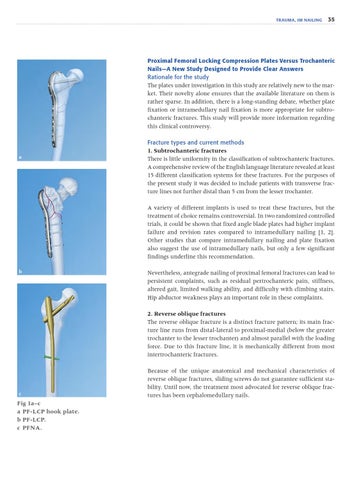
Proximal Femoral Locking Compression Plates Versus Trochanteric Nails—A New Study Designed to Provide Clear Answers Rationale for the study The plates under investigation in this study are relatively new to the market. Their novelty alone ensures that the available literature on them is rather sparse. In addition, there is a long-standing debate, whether plate fixation or intramedullary nail fixation is more appropriate for subtrochanteric fractures. This study will provide more information regarding this clinical controversy.
a
Fracture types and current methods 1. Subtrochanteric fractures There is little uniformity in the classification of subtrochanteric fractures. A comprehensive review of the English language literature revealed at least 15 different classification systems for these fractures. For the purposes of the present study it was decided to include patients with transverse fracture lines not further distal than 5 cm from the lesser trochanter. A variety of different implants is used to treat these fractures, but the treatment of choice remains controversial. In two randomized controlled trials, it could be shown that fixed angle blade plates had higher implant failure and revision rates compared to intramedullary nailing [1, 2]. Other studies that compare intramedullary nailing and plate fixation also suggest the use of intramedullary nails, but only a few significant findings underline this recommendation.
b
Nevertheless, antegrade nailing of proximal femoral fractures can lead to persistent complaints, such as residual pertrochanteric pain, stiffness, altered gait, limited walking ability, and difficulty with climbing stairs. Hip abductor weakness plays an important role in these complaints. 2. Reverse oblique fractures The reverse oblique fracture is a distinct fracture pattern; its main fracture line runs from distal-lateral to proximal-medial (below the greater trochanter to the lesser trochanter) and almost parallel with the loading force. Due to this fracture line, it is mechanically different from most intertrochanteric fractures.
c
Fig 1a–c a PF-LCP hook plate. b PF-LCP. c PFNA.
Because of the unique anatomical and mechanical characteristics of reverse oblique fractures, sliding screws do not guarantee sufficient stability. Until now, the treatment most advocated for reverse oblique fractures has been cephalomedullary nails.
36
Trauma, IM nailing
Background to the clinical study The full title of this study which began recruitment at the start of 2011 is “Comparison of proximal femur locking compression plates and trochanteric nails for the treatment of reverse oblique intertrochanteric and subtrochanteric fractures—a multicenter cohort study”.
a
As the title suggests, the proximal femur locking compression plates under investigation (more specifically the PF-LCP, PF-LCP hook plate or PeriLoc) will be compared to the control group of trochanteric nails (PFNA, TFN, or GN). It is estimated that 112 patients will be enrolled in the study, with the latest recruitment date being December 2012. The primary objective of this study is to compare the abductor muscle strength in patients with reverse oblique inter- or subtrochanteric fractures treated either with a proximal femoral locking plate or a trochanteric nail. Better early hip abductor muscle will provide better ambulation ability. Less limping reduces the risks of falls and thereby other fractures in the future. With faster, good functional recovery patients can expect an earlier return to daily life activities.
b
Fig 2a–b a A 56-year-old man sustained a right pertrochanteric femoral fracture. He had no other significant injuries. b The fracture of the right proximal femur was stabilized on the day of injury using the LCP proximal femoral plate. The plate was slid distally in a submuscular manner. The reduction was aided with manual traction.
What is rather unique about this study is that the primary outcome will be measured using a dynamometer to measure hip abductor strength. The study design was intensively discussed at several meetings of the Lower Extremity Expert Group until the most practical solution was decided on. Secondary outcomes include outcome measures (lower extremity measure, quality of life), infection, and revision rates. This is also the first AO Clinical Investigation and Documentation (AOCID) conducted study to make use of the WHO Fracture Risk Assessment Tool to measure a patient's risk of fracture prior to injury. It is being used in this study because an underlying preoperative osteoporosis with an increased fracture risk can modify the treatment effect and lead to complications. As of February 2011, eight centers in six different countries have signaled their clear interest in joining the study, and the majority of these have already applied for IRB approval. The position of a small number of other centers to join the study is currently being clarified. The principal clinical investigator is Philip J Kregor of the Hip and Fracture Institute, Nashville, with AOCID acting as clinical research organization.
Trauma, IM nailing
a
37
What clinical questions will the study answer? Not only is the biomechanical aspect of both implant groups in this study different, but the surgical approach also varies. In addition, most of the available literature only reports on outcome measures, such as reoperation and nonunion rates; there is very little information concerning patient function and hip abductor strength after the various treatment options. Furthermore, there is a lack of prospective clinical trials comparing proximal femoral locking plates with intramedullary nails. Therefore, the aim of this study is to assess whether patients treated with a locking compression proximal femoral plate will have superior functional results compared to patients treated with an intramedullary nail. References 1 Rahme DM, Harris IA (2007) Intramedullary nailing versus fixed angle blade plating for subtrochanteric femoral fractures: a prospective randomised controlled trial. J Orthop Surg (Hong Kong);15(3):278–281. 2 Pelet S, Arlettaz Y, Chevalley F (2001) [Osteosynthesis of per- and subtrochanteric fractures by blade plate versus gamma nail. A randomized prospective study]. Swiss Surg; 7(3):126–133.
b
Fig 3a–b a An 18-year-old man sustained a ballistic left comminuted subtrochanteric femoral fracture. b After closed reduction using skeletal traction, the fracture was stabilized with a proximal femoral nail.
38
Trauma, IM nailinG
Fig 1 Coating of tibial nail with gentamicin.
ETN PROtect (Expert Tibia Nail, with Gentamicin Coating) Despite improvements in the prophylactic and the therapeutic measures, soft-tissue damage and consecutive infection remain the major hurdles in the healing process of long bone fractures. Osteomyelitis is a consequence of local contamination by germs combined with a local and/or systemic immunodeficiency. Additionally, blood supply in the traumatized bone is disturbed which means systemically applied antibiotics cannot reach the fracture site. Consequently, this may lead to chronic osteomyelitis. Once local osteomyelitis has become manifest, removal of the implant and aggressive debridement of the infected bone as well as the soft tissue in combination with heavy local and systemic antibiotic therapy often represent the only option for effective treatment. Bacteria introduced during the insertion of surgical implants from the lower layers of the patient’s own skin, which are not reached by skin disinfection, or at the time of injury in open fractures, are in competition with the patient’s immune system. This is often described as “a race for the surface.” Certain bacteria can colonize the surface of an implant and form a protective biofilm composed of proteins and polysaccharides, protecting the bacteria from the patient’s immune system as well as from the effects of systemically applied antibiotics. An antibiotic coating on an implant could prevent colonization of the implant’s surface. In addition, a coating with high local antimicrobial concentrations could protect the site of injury and avoid side effects resulting from long-term high-dose systemic antibiotic therapy.
Fig 2 ETN PROtect.
The goal of the recently CE-marked ETN PROtect therefore is the prevention of implant colonization by bacteria. This may lead to a reduced risk of deep surgical infection. The fully resorbable coating consists of a polylactide (PDLLA) carrier containing gentamicin sulphate. Gentamicin, an antibiotic from the aminoglycoside family, was chosen due to its broad antibacterial spectrum, the bactericidal effect (nonproliferating bacteria), its synergistic effect in combination with cephalosporins, and because it is well established for local application in orthopaedics (bone cement, PMMA beads, collagen sponges). Gentamicin has a long and successful clinical track record in orthopaedic and trauma surgery, and despite its widespread use, in particular in bone cements, the rates of resistance against gentamicin have remained stable or have been decreasing in recent years. The total amount of antibiotic contained on one implant ranges from around 15–60 mg, depending on the size of the implant. The gentamicin is released from the coating immediately after implantation with an initial burst that achieves a high peak concentration in the first hours and fades out over a period of a few weeks. After coating, the implant is packaged and sterilized by gamma irradiation and delivered sterile to the clinics. The ETN PROtect is an improved version of an interlocking nail, which can be used in extended indications, such as very proximal or very dis-
Trauma, IM nailing
39
tal metaphyseal tibial fractures. In addition, the new implant may find its indication in revision surgeries or in patients where the immune system is compromised. Mechanical properties of the nail are not affected by the coating. Tests on human specimens and plastic bones proved the coating to be resistant to the abrasive forces present during insertion into a narrow and moist bone canal. The surgical technique does not differ from the regular standard of care in ETN implantation.
Clinical example of the first patient treated with the new ETN PROtect. A clinical series in selected hospitals in Europe started in March 2011. Case 1: A 33-year-old man with a third degree open fracture of his left tibia was initially treated with an external fixator and unilateral compartment release. He had undergone ACL reconstruction in the past. Case provided by Gerhard Schmidmaier, Heidelberg, Germany
a
b
Fig 1a–b Preoperative images show initial treatment with external fixator.
a
b
Fig 3a–b Postoperative x-rays.
a
b
Fig 2a–b Intraoperative views. a Photograph of soft tissues. b Image intensification of placement of drilling guide wire.
a
b
c
d
Fig 4a–d Soft tissues postoperatively.
40
Trauma, IM nailing
Case 2: Grade II open distal tibial fracture in a polytraumatized 52-year-old man. Case provided by Michael Raschke, Münster, Germany
a
b
Fig 1a–b a Grade II open distal tibial fracture. b Initial stabilization of multilevel thoracolumbar fractures.
a
Fig 2 CT scan indicates an ipsilateral Hawkins II talus fracture.
b
Fig 4a–b Preoperative planning of the exact nail diameter with Trauma Cad Planning tool of the intact contralateral side.
Fig 5 Open reduction and internal fixation of the fibula with LC-DCP. Percutaneous fixation of intraarticular involvement of distal tibia. Intramedullary nailing with ETN PROtect nail (10 x 390 mm) and distal angular stable locked fixation.
a
Fig 6 Lateral postoperative view.
Fig 3 Initial therapy—irrigation of the Grade II open tibial fracture and screw fixation of the talus fracture.
Fig 7 Detailed postoperative x-ray of the distal tibia.
Trauma, IM nailing 
41
Tips and Tricks Using the ASLS for IM Nails Angular stable locking of intramedullary (IM) nails has been a goal for many years. The aim is to achieve proximal locking of tibial nails with an end cap blocking the most proximal oblique screw or the spiral blade used with the distal femoral nail (DFN) and proximal humeral nail (PHN). Sleeve with corresponding thread.
D3
D2
D1
Screw with 3 different core diameters.
Premounted sleeve.
Sleeve expands radially inside locking hole. Fig 1 Angular stable locking system.
The increased overall stability of an angular stable locked construct in comparison to a conventional one has been demonstrated in biomechanical studies [1–3]. Animal studies have shown that bone healing is better and faster [4, 5]. Desired flexible elastic fixation can be achieved by the implant itself similar to angular stable plating compared to uncontrolled toggling. Ultimately, the construct would be an intramedullary internal fixator additional to the external fixator and the extramedullary internal fixator. Technique The angular stable locking system (ASLS) consists of a sleeve (function of a dowel) which is added to the locking screws. The sleeves are sterilepacked separate to the locking screws. The surgeon can decide during the operation if the nail should be locked angular stable or conventional. The sleeve is made of a bioresorbable material (70:30 poly L-lactide-co-D,LLactide). The screw is designed to expand the sleeve in the nail hole during insertion, leading to angular stable locking (Fig 1). From an engineering perspective, the goal to obtain an angular stable locked nailing construct has been achieved. Since 2009, the ASLS has been available in 4, 5, and 6 mm for the different nail diameters and has been successfully used with cannulated nails for the tibia, femur, humerus, and hindfoot. In the hands of experienced surgeons it has led to expanded indications for IM nailing. Provided here are some recommendations on how to use the system based on the experiences during the first two years. Tips and tricks As the decision on angular stable or conventional locking can be made intraoperatively, the screws and sleeves should always be available on the tray/shelf and properly sorted (similar to the suture material). The 6 mm ASLS is only required for the very strong femoral nail (> 13 mm). Depending on the local patient population, it may be sufficient to obtain only the 4 and 5 mm systems to minimize inventory. In proximal applications only ASLS may be used, or in the following combinations with conventional locking: dual-core locking screws, proximal locking screws blocked by an end cap, or all of them. ASLS should not be used in the dynamic locking slot as it does not provide enough hold/resistance.
42
Trauma, IM nailing
In distal applications, mixing conventional locking screws with ASLS does not make sense. Drilling is identical but the near cortex needs additional reaming so it is wide enough to insert the sleeve. The enlarged hole at the near cortex will be filled by the thicker part which has a larger diameter than the rest of the screw (Fig 2). Use of the hand reamer has proven to be more tactile compared to drilling with machines (Fig 3). Power-driven drilling is only needed for very strong cortices, eg, the femur.
a
Drilling does not have to be very precise as the ASLS tolerates deviance. An exact amount cannot be given but up to 15° seems to be unproblematic (Fig 4).
b
Fig 2a–b
To ensure sufficient sized reaming, insert the tip of the reamer until it may touch the hole of the nail. When using the hand reamer, the reamer cannot be damaged. The sleeve is threaded on the screw by hand just before implantation (Fig 5). The lip of the sleeve needs to face the screw head. The sleeve is positioned correctly when the gold part of the screw is visible on either side of the sleeve (Fig 6). If the sleeve is placed too far on the screw, the connecting bars may be damaged or break. In this case a new sleeve has to be used. A sleeve with broken bars will not work. A sleeve positioner is available which prevents overthreading (Fig 7). Fig 3
a
b
Fig 4a–b
Fig 5
a
Fig 6
Fig 7a–b
b
Trauma, IM nailing
43
The screw-sleeve construct is pushed into the nail's locking hole by hand. For the final placement, a light hammer (100 gr) may be used (Fig 8). You can actually feel and even hear the correct positioning. Use of a heavier hammer may lead to too deep placement or even pushing the sleeve too far through the locking hole. Control by image intensifier of the reamer and/or screw placement is only needed in the very early part of the learning curve (Fig 9). The final screw positioning can be felt as the broader screw thread widens the sleeve, filling up the enlarged near cortex.
Fig 8
In thin cortex, regardless of whether proximal or distal, the screw needs to be inserted very carefully, otherwise the tensile forces may pull the screw head beneath the cortex. Image intensifier control may be helpful in cases of thin cortex (Fig 10) or the use of the protection sleeve system to stop the insertion at the correct point (Fig 11). But the sleeve system does not need to be used in every case as it needs a bigger skin incision.
a
An inserted screw which is either too long or too short can be exchanged without problems. In most cases, the sleeve will remain in the nail and does not need to be exchanged. The ASLS should only be used with cannulated nails. In solid nails, the compressed sleeve develops heat through the increased pressure. In cannulated nails this does not occur as the material expands into the cannulated inner part of the nail. ASLS is not indicated for use with solid nails but if a solid nail is selected by the surgeon, insertion has to be done very slowly and with short breaks for cooling.
b
Removal of a nail locked with ASLS is not any different than without. If the sleeve is not yet fully resorbed it will remain in the nail and is removed together with the nail.
c
Fig 9a–c
a
Fig 10a–b
b
Fig 11
44
Trauma, IM nailing
Remember that removal of the locking screws does not remove the sleeve. In case of a resorbed sleeve, the screw may not have enough hold in the sleeve thread to be screwed out. In this case it can be beneficial to use an extraction forceps which closes behind the screw head and allows screwing and pulling at the same time (Fig 12). This extraction forceps is very helpful in similar kinds of screw removals without ASLS. Fig 12
Overall, the intriguing features of the ASLS are its universal use in all cannulated nails, the almost unchanged standard locking procedure, and its easy and tolerant application. These tips and tricks have demonstrated that only a few additional maneuvers need to be considered. References 1 Miller DL, Goswami T (2007) A review of locking compression plate biomechanics and their advantages as internal fixators in fracture healing. Clin Biomech; 22(10):1049–1062. 2 Perren SM (2002) Evolution of the internal fixation of long bone fractures. The scientific basis of biological internal fixation: choosing a new balance between stability and biology. J Bone Joint Surgery; 84(8):1093–1110. 3 Egol KA, Kubiak EN, Fulkerson E, et al (2004) Biomechanics of locked plates and screws. J Orthop Trauma; 18(8):488–493. 4 Kaspar K, Schell H, Seebeck P, et al (2005) Angle stable locking reduces interfragmentary movements and promotes healing after unreamed nailing. Study of a displaced osteotomy model in sheep tibiae. J Bone Joint Surg Am; 87(9):2028–2037. 5 Epari DR, Kassi JP, Schell H, et al (2007) Timely fracture-healing requires optimization of axial fixation stability. J Bone Joint Surg Am; 89(7):1575–1585.
Trauma, pelvis 
45
Keith Mayo
Trauma, pelvis Hip Preservation Surgery Set The hip preservation surgery set provides instruments for the correction of congenital deficiency of the acetabulum as well as the correction of hip impingements. The set consists of twelve osteotomes for different osteotomies, nine different femoral head templates with diameters ranging from 42–58 mm, and retractors to assist in soft-tissue retraction, available in aluminum and stainless steel.
Fig 1 Chisel.
Fig 2 Femoral head template.
Fig 3 Hip preservation surgery set.
The osteotomes are designed and manufactured so that the cutting end of the instrument does not deform in dense bone.
46
Trauma, Pediatrics
James B Hunter, Richard Reynolds, Theddy Slongo, Reinald Brunner
Trauma, Pediatrics LCP Pediatric Hip (PHP) and Condylar Plate System In addition to the existing portfolio of implants for the hip, two new plates were approved and added to address specific anatomical requirements: an LCP pediatric hip plate (PHP) 130° in 3.5 and 5.0 mm and an LCP PHP 140° in 3.5 and 5.0 mm. The LCP PHP system is a highly innovative system for stable fixation of varus, valgus, and derotation osteotomies, and fractures in pediatric orthopaedics. In addition, a pediatric condylar plate 90° for extension/flexion osteotomies for the distal femur was developed.
Fig 1 Pediatric hip plate 130° angle.
LCP PHP 130° in 3.5 and 5.0 mm The LCP PHP 130° has been developed to fit properly in all trauma cases and derotation osteotomies. The plate has been specifically designed for fractures and derotation osteotomies and is intended for use in pediatric patients until adolescence, and for small-stature adult patients. Due to the plate's more anatomically correct angle, the 130° plates offer improved anatomical fit compared with the current 120° plates. The plate will accommodate proximal femoral fractures with shaft extensions to different heights 31-M/3.1 I and II, 31-M/3.2 I and II, subtrochanteric metaphyseal fractures, and derotation osteotomies. The 3.5 mm plate is available in lengths ranging from 62–140 mm and the 5.0 mm plate in lengths ranging from 79–175 mm. It has a universal design for the left and right proximal femurs and all plates are available in sterile and nonsterile.
Fig 2 Plate 130° angle.
Case 1: LCP PHP 130°. A 15-year-old boy sustained a refracture of a pathological fracture of the subtrochanteric region following a severe trauma, previously fixed with ESIN, diagnosis: juvenile bone cyst.
a
b
Fig 2 a–b Intraoperative images. Indirect reduction with ESIN in situ was not p ossible, so the decision was made for stabilization with a 5-hole pediatric LCP PHP 130°. The nails were not removed to protect the bone in case the cyst did not heal.
Case provided by Theddy Slongo, Bern, Switzerland
a
b
Fig 1a–b Preoperative images.
Trauma, Pediatrics
a
b
a
Fig 3a–b Postoperative images. Independent of the ESIN in situ it was possible to fix this fracture in a very satisfactory manner. Thanks to the monocortical fixation there was no interference with the nail in the shaft fixation.
47
b
Fig 4a–b Seven weeks after surgery x-rays show nearly full consolidation of the fracture and also healing of the cyst; full weight bearing was achived and playing sport was allowed.
LCP PHP 140° in 3.5 and 5.0 mm Congenital coxavara is an abnormality characterized by a decreased femoral neck-shaft angle, shortening of the femoral neck, and the affected lower limb. The 140° plates offer improved placement of the femoral head in its correct anatomical position compared with the 150° plates. The new 140° PHP (straight valgus) has a sophisticated design for lateralization of the distal part of the femur. Similarly acquired varus and valgization for femoral head deformity require lateralization of the shaft.
Fig 1 Pediatric hip plate 140° angle.
The LCP PHP 140° is intended for use in pediatric patients until adolescence and for small-stature adult patients; corresponding to age, size, and bone quality. Indications include: Perthes' disease, idiopathic coxavara, deformity of slipped capital femoral epiphysis and proximal femoral focal deficiency, and congenital/posttraumatic pseudarthrosis of the femoral neck.
Fig 2 Plate 140° angle.
The plate is available in 3.5 mm (19 mm wide and 70 mm long) and in 5.0 mm (23 mm wide and 90 mm long). Both plates have two neck screws and one calcar screw in the proximal part and combination holes for locking or cortex screws in the distal part. All plates are available in sterile and nonsterile and have a universal design for left and right proximal femurs.
48
Trauma, Pediatrics
Case 2: LCP PHP 140°. A 9-year-old boy, weighing 30 kg, had postinfectious pseudarthrosis of the femoral neck and varus deformity. His preoperative CCD angle was 80°. Case provided by Theddy Slongo, Bern, Switzerland
a
b
Fig 1a–b Preoperative images.
a
Fig 2 Intraoperative image.
b
Fig 3a–c Postoperative CCD angle: 150°/20° extension.
Fig 4 X-ray 11 weeks postoperatively.
c
Trauma, Pediatrics
Fig 1 LCP pediatric condylar plate 90°.
Fig 2 Pediatric condylar plate 90° angle.
49
90° 3.5 and 5.0 mm LCP Pediatric Condylar Plate The 90° LCP pediatric condylar plate is mainly indicated for children and adolescents suffering from cerebral palsy who require distal femoral osteotomies. The incidence of CP is 2–3:1000. The current LCP pediatric hip plates are not optimal for stabilizing this osteotomy since their screw shaft angle is not 90°. The condylar plate is intended for use in pediatric patients up to adolescence and for small-stature adult patients—corresponding to age, size, and bone quality. Specific indications include: • Fixed flexion contracture of knee in neurological conditions • Deformity correction in the distal femur regardless of etiology • Rotational malalignment of the femur (if distal correction is preferred) • Supracondylar fractures of the femur The 90° LCP pediatric condylar plate is available in 3.5 and 5.0 mm with 3, 5, and 7 shaft holes available in each. There is one symmetrical plate for right and left corrections and all plates are available packed unsterile and sterile. The plate is from the same family of plates as the LCP pediatric hip plates and is inserted using the same instrumentation. The condylar plate is contoured so that distal screws will be at 90° to the midline of the shaft if the plate is fitted on the surface of the bone. Generally, the distal screws should be parallel to the growth plate in the coronal plane, although the surgeon must take care to ensure that there is no deformity of the distal fragment, which would negate this assumption.
50
Trauma, Pediatrics
A 12-year-old girl presented for the first time to the cerebral palsy clinic. Although weak as well as spastic she was able to stand and step and wished to walk better. Physical examination revealed fixed flexion deformity of both knees. Distal femoral osteotomy with some shortening was the preferred option as hamstring lengthening and posterior knee capsule release would have caused further weakening. Osteotomies were stabilized with the 5.0 mm LCP pediatric condylar plate. Postoperative management was non-weight bearing in splints, followed by weight bearing and rehabilitation at 6 weeks. Osteotomies healed uneventfully. Case provided by James B Hunter, Nottingham, UK
a
b
Fig 1a–b Preoperative x-rays.
a
Fig 2a–d Postoperative x-rays.
b
c
d
Trauma, Pediatrics
51
Slipped Capital Femoral Epiphysis (SCFE) Screw System Slipped capital femoral epiphysis (SCFE) is a common hip disorder in the pediatric population in which the femoral epiphysis displaces from the metaphysis through the physis. The standard of care for SCFE is insitu fixation with a single cannulated screw. The use of standard cannulated screws became an issue due to the difficulty in removal, which has become more important because of the increasing number of hip preservation procedures (open hip dislocations) performed in SCFE for impingement.
Fig 1 SCFE screw.
Fig 2 SCFE screw.
The SCFE screw system has been designed specifically for the treatment of SCFE and offers greater advantage for fixation compared to standard cannulated screws. The SCFE screw system is also indicated for fracture fixation of large bones and large bone fragments, pediatric femoral neck fractures, intercondylar femoral fractures, and sacroiliac joint disruptions. Further indications may be tibial plateau fractures, ankle arthrodesis, and subtalar arthrodesis. The SCFE screw is a 7.3 mm stainless steel cannulated shaft screw. The screw lengths range from 45–130 mm, in 5 mm increments and screws are self-tapping. Oval shaped washers are available for use in patients with poor bone quality to prevent countersinking of the screw head, allowing for greater screw angulation (up to 55°) as well as 1 mm and 2 mm adjustments in screw positioning. The set includes the existing 2.8 mm guide wire that is 450 mm long and consists of a cobalt based material to provide additional stiffness and resistance to bending. Specific instrumentation has been developed to aid in percutaneous insertion/removal of the screws. The new instruments include a 5.0 mm core/7.3 mm cannulated, and calibrated shaft-stepped drill bit, and 420.5 mm long. Additionally, the existing drill stop can be used with the drill bit.
Fig 3 SCFE screw profile.
A new trocar has been designed with a sharp tip allowing for easier insertion through the soft tissue, which helps to secure bone contact. The protection sleeve has been designed to interface with the new trocar. A cannulated direct measuring device, allowing screw length to be measured off of the guide wire, is also included. The 7.3 mm SCFE screw is compatible with the T40 StarDrive screwdriver which is also cannulated, and 350.5 mm long.
a
b
Fig 4 Mechanism.
Fig 5a–b Single screws.
52
Trauma, Pediatrics
A boy aged 11 years and 3 months presented with a limp and had had pain in the thigh for 8 weeks. Case provided by Richard Reynolds, Detroit, USA
a
b
Fig 1a–b Preoperative x-rays.
b a
Fig 2a–b X-rays taken 2 months postoperatively. The mild slip was recognized and the stable slip was stabilized using a short threaded shaft screw with a washer to obtain compression across the physis. Pain resolved in the hip within a couple of days and weight bearing was resumed.
Comparison of TK Experts´ Symposia in Asia, Europe, and North America
53
Tim Pohlemann
Comparison of TK Experts´ Symposia in Asia, Europe, and North America Goal and format of Experts´ Symposia The Experts´ Symposia are part of the quality control and knowledge acquisition of the TK System. The screening of clinical problems at an early stage helps to expand or limit the indications, triggers further developments, and supports education by identifying tips and tricks as well as possible dangers.
Fig 1 Experts’ Symposium Asia.
The meetings focus on the open medical exchange of highly experienced surgeons. Clinical issues, problem fractures, complications, and limitations of the existing techniques are discussed based on the detailed presentation of personal cases. The main focus is on difficult cases, uncommon indications, or situations where problems occurred. The implant is certainly important, but the discussion is clearly focused on the overlaying principles and universal solutions. Regional differences and similarities To obtain a worldwide overview about regional differences, similarities, and specific solutions, three symposia with the same format and content were held between May 2010 and January 2011 in Asia/Pacific, Europe, and North America. Each event was attended by 40–60 highly experienced surgeons presenting their own cases.
Fig 2 Experts’ Symposium Europe.
Fig 3 Experts’ Symposium North America.
The main findings 1 Proximal humerus In North America the intramedullary support (even with allografts) and augmentation of the medial cortex was stressed more compared to Asia and Europe. In Asia, the primary focus was on achieving and securing anatomical reduction and the use of lateral implants to enhance the medical support. In Europe, the problems identified were the same but the solutions discussed focused on plate-screw configuration or synthetic augmentation. 2 Proximal femur The problems identified were mainly identical around the world. Reduction was unanimously seen as the key to successful healing. Correct implant positioning was also identified as an important predictor regardless of the use of intramedullary or extramedullary devices. Generally a “center/center” position within the femoral head close to the subchondral area was recommended. Deficits in reduction and/or suboptimal implant positioning will always result in an increased complication rate.
54
Comparison of TK Experts´ Symposia in Asia, Europe, and North America
A problem specific to Asia was the higher incidence of trochanteric split fractures, especially with intramedullary nailing. A modified plate geometry for this fracture type may be helpful. 3 Distal femur/knee In Asia and North America the assessment of tibial head fractures rather varied, which implied many different treatment recommendations and types of complications. In Europe, the strict differentiation between compression fractures and fracture dislocations seems to have increased the quality of treatment selection and outcomes, especially with the concept of posteromedial support by separate approaches and the anterolateral fixation with angular stable implants. Potential improvements were identified in plate geometry depending on the function/application of the plate, eg, for posteromedial proximal tibia and medial proximal femur. The use of a permanent external fixator (hybrid fixator) still plays a certain role in Asia, but its overall importance is decreasing markedly. 4 Distal tibia At all three events the main issue was the problem of softtissue coverage (eg, quality of the reduction of the joint, metaphyseal disturbed healing). This problem worsens in geriatric patients due to their overall condition. The number of these cases is increasing.
5 Other observations Besides the above-mentioned anatomy-related issues, the nonmechanical options to influence the metabolism of the bone are of increasing importance. North America currently has the most experience, eg, with vitamin D and calcium and parathormone. The effect of long-term intake of osteoclast inhibitors, eg, bisphosphonates, was discussed controversially. The future role of augmentation in geriatric patients is still under discussion. In case of acute fracture treatment, the trend is positive and the number of potential indications increasing. But the concept of prophylactic augmentation to prevent fractures is not supported currently (with the existing cements and instrumentation) by an overwhelming majority. Summary This was the first time that a comparison was made by the TK System across three world regions. Even with the results likely not being representative, the differences were not as large as expected. It seems worthwhile to note that the knowledge of the scientific community is not interpreted/valued the same worldwide, but the “AO family” now plays an important role in global knowledge exchange and transportation of new treatment aspects. However, the different AO branches might improve their services by more rapidly adapting educational concepts and course concepts based on actual treatment developments. The TK System started an intense exchange with AO Education two years ago to improve this knowledge transfer. North America
Asia
l
¡
Europe ¡
¡
l
¡
¡
¡
l
l
l
l
l
l
l
¡
l
¡
l
l
¡
Proximal humerus
Intramedullary support and augmentation of the medial cortex Anatomical reduction and the use of lateral implants Plate-screw configuration or synthetic augmentation
Proximal femur
Reduction as the key to successful healing Correct implant positioning Higher incidence of trochanteric split fractures
Distal femur/knee
Many different treatment recommendations for tibia head fix Differentiation between compression fractures and fracture dislocations Improvements in plate geometry for poteromedial proximal tibia and medial distal femur Use of a permanent external fixator
l
l
l
¡
l
¡
Distal tibia
Soft-tissue coverage
l
l
l
Other observations
Influence the metabolism of the bone Role of augmentation in geriatric patients with acute fractures Role of prophylactic augmentation
l
¡
¡
l
l
l
¡
¡
¡
l
l strong; ¡ weak
Craniomaxillofacial 
55
Carl-Peter Cornelius, Daniel Buchbinder, Christian Matula
Craniomaxillofacial Fracture Plates for Condylar Neck and Base Fractures in the condylar region of the mandible present a specific challenge, ie, it can be difficult to access the region surgically due to the presence of the main stem of the facial nerve within the overlying soft tissue. The most common solution for fractures in the neck and base region of the mandible is either closed treatment or various linear plating approaches, such as adaptation plates. When internal fixation is used a two-plate technique offers better stability than a one-plate technique. In response to a growing number of requests for improved treatment in this region, a series of plates have been developed with specific designs to treat such fractures and if possible to overcome such issues. The first two plates are now available.
Fig 1a–b Trapezoidal plate.
Fig 2 Lambda plates, left and right.
a
Trapezoidal Plate The trapezoidal plate is designed to fit the region of the condylar base and provides improved strength and stability over previous single-bar plate designs, thereby eliminating the need to place two plates. It is precontoured to account for the curvature in the transition zone between the base of the condylar process and the adjacent neck. The location of screw holes enables plates to straddle the mandibular foramen and the adjacent canal inlet, thereby avoiding accidental nerve injury. The trapezoidal plate can be applied using external and transoral surgical approaches. If required a transbuccal cannula can be centered in the countersunk screw holes for proper drilling alignment. Lambda Plate The lambda plate comes in a left and right version. It emulates a two-plate technique as its specific shape and 7-hole design with the width of a single plate at the top segment allows the surgeon to advance the lambda plate high up into the very narrow zone of the condylar neck just below the head. The fixation arms straddle the mandibular canal to avoid injury risk of the inferior alveolar nerve. The lambda plate can be placed using retromandibular or submandibular surgical approaches. For positioning, the straight 5-hole segment is placed parallel to the posterior ramus border aligned with the condylar head. If required the anterior arm may be bent to fit the bony surface below the sigmoid notch.
b
Fig 3a–b Trapezoidal and lambda plates.
Both plates are based on the matrix mandible system platform. Therefore, they are compatible with the existing matrix instrumentation and use the established color-coding for easy identification in the operating room. Both are 1.0 mm thick and malleable (green-grey color coding) and manufactured from commercially pure titanium.
56
Craniomaxillofacial
1
3 2
B
Head High
x
Neck
Low x
A Base of condylar process
Fig 4 Subregions of the condylar process.
Fig 5 Ideal position for placement of the lambda plate.
Case 1
Case 2
Case 3
Case provided by Celso Palmieri, Shreveport, LA, USA
Case provided by Michael Rasse, Innsbruck, Austria
Case provided by Carl-Peter Cornelius, München, Germany
a
a a
b
Fig 1a–b Endoscopic fixation of trapezoidal (a) and lambda (b) plates.
b
Fig 1a–b Fixation of trapezoidal plate.
b
Fig 1a–b Fixation of fractures in the low condylar neck region using the lambda plates.
Craniomaxillofacial
57
Depth Gauge for Matrix Mandible System In constantly improving the functionality and design of hardware that is available to the surgeon, it is worthwhile taking a closer look at instrumentation. The new depth gauge for the matrix mandible system is used to measure the depth of holes for any screws from 2.0–3.0 mm in diameter and up to 45 mm in length. It is applicable for all trauma and reconstructive procedures in the mandible where bicortical screw fixation is compulsory. Although designed as part of the matrix mandible set, it can also be used with any other screw system. This device is made of stainless steel and radel (polyphenylsulfone) making it lightweight, ergonomic, and durable. In addition, it offers better readability than the former depth gauge because of reduced surface glare. It is now a two-piece (instead of a three-piece) device, facilitating assembly and cleaning and has a sharp and bent hook tip to consistently grab bone. The sliding mechanism has been improved so it remains stationary when not pushed.
Fig 1 Saw 20.9 x 14.1 x 4.0 x 0.6 mm.
Fig 2 Long saw 20.1 x 21.4 x 4.0 x 0.6 mm.
Fig 3 Scalpel round 22.45 x 12.6 x 3.9 dia. 0.7 mm.
Piezoelectric Bone Surgery System Piezoelectric bone resection has been developed in order to overcome the limits in traditional bone-cutting instruments, as it addresses the clinical need for: • Precision and safety • Better visualization of surgical field • More adequate interface between surgeon and bony tissues (brushtype cutting motion) • Advantageous bone healing compared to other powered cutting tools The new piezoelectric bone surgery system is an ultrasonic surgical system consisting of hand pieces and associated tips for cutting bone and bone substitutes. The system can be used for osteotomy, osteoplasty, decortication, drilling, shaping, and smoothing of bones and teeth, in a variety of surgical procedures, including general orthopaedic, otolaryngological, maxillofacial, oral, hand, foot, neurosurgical, spine, and plastic/reconstructive surgery. It utilizes a selected frequency range between 28–36 kHz and is active on mineralized tissue only, such as teeth and bone, in a very precise way, while limiting the risk of soft-tissue lesions. Soft tissues, such as nerves, blood vessels, dura, or the Schneiderian membrane are not altered by the cutting tip because of their ability to oscillate at the same speed and amplitude as the cutting tip. At the same time, narrow kerf and smooth cuts in the presence of irrigation result in less risk of necrosis. One major advantage of this instrument is the different shaped tips to be used, allowing the cutting vector to be either straight, angled, or curved, ie, directed backwards.
58
Craniomaxillofacial
The built-in irrigation and cavitation effect provides optimal visibility of the operative site, removes bone debris, and avoids increase in temperature liable to cause tissue degradation. The piezoelectric system is used with a vibration-free hand piece which only requires minimum pressure, resulting in greater precision and less hand fatigue for the surgeon. It is illuminated with LEDs for enhanced onsite visibility. The system is steered via a touch-sensitive LCD screen on the console. In addition, all functions can also be activated with the foot pedal. Fig 4 Vibration-free hand piece and console with touch-sensitive LCD screen in operating room environment. The console has two cable connectors eliminating the need to change cutting tips during procedures.
The system comes with a range of burr and saw tips which can be employed on almost all types of bone.
Case 1: A patient after multiple failed chin implants. Here piezosurgery proved to be superior to other oscillating instruments due to the controlled brush-type cutting motion, closeness to vulnerable structures which could be easily preserved, like the mental nerve on both sides, and protection of floor of the mouth vessels after completing the lingual corticotomy. Case provided by Nils-Claudius Gellrich, Hannover, Germany a
b
c
d
e
Fig 1a–e a Exposed pointed chin with bilateral dissected mental nerves. b Oblique cutting plane provided via piezosurgery. Additional vertical marking allows for internal referencing of later chin movement. c Extension of chin osteotomy to complete a chin-wing procedure. d Completion of osteotomy prior to movement. e Rigid fixation with L-shaped osteosynthesis using matrix orthognathic system.
Craniomaxillofacial
59
Case 2: Complex congenital deformity with distortion of alveolar processes and dentition, resulting in a 3.5 cm nonocclusion in the right maxillomandibular complex. Occlusion is exclusively controlled through the left second premolar to second molar. Piezosurgery was useful in this case due to complex anatomical deformities resulting in atypical positioning of the inferior alveolar canal on the right side. The cramped confines of dental and bony tissues in the deformed anatomy required an adequate type of osteotomy to do a significant yet controlled skeletal movement to overcome the vertical discrepancy intraorally, without changing the outer projection of the mandibular frame. Case provided by Nils-Claudius Gellrich, Hannover, Germany
a
a
b
b
c
c
Fig 1a–c a Preoperative image. b Sandwich osteotomy with asymmetrical lifting of the alveolar process and rigid stabilization with miniplates. Additional four skeletal anchors (Otten-hooks) are incorporated on both maxilla and mandible as well as an alveolar distractor in the upper right canine region. The occlusal level in the lower jaw was corrected in one surgical procedure. c Postdistraction of the upper jaw in comparison to the already corrected lower jaw.
Fig 2a–c a Double angulated tip provides rectangular osteotomy in the lower right quadrant posterior to the mental nerve. b Completed and stabilized sandwich osteotomy with interposition of block grafts from the mandibular angle and particulated bone grafts. Block grafts were harvested from the mandibular angle region. c Upper jaw osteotomy using the double angulated tip. Care must be taken not to harm the roots.
Fig 3 Intramedullary fixation provided via elastics and an intermaxillary splint. The splint served as a reference for the upper jaw alveolar distraction to reach the appropriate vertical and sagittal final position of the upper maxillary front segment.
60
spine
Michael Gabl, Roger Härtl, Nicholas Theodore, Rudolf Bertagnoli
Spine T-PAL The new T-PAL system is an innovative minimally invasive surgical cage system designed to replace lumbar intervertebral discs and facilitate fusion of the adjacent vertebral bodies at vertebral levels L2/S1 in a transforaminal approach. Fig 1 T-PAL PEEK cage.
Fig 2 T-PAL cage angulation.
a
b
Fig 3a–b a Applicator removal. b T-PAL insertion—approach.
Spinal fusion has traditionally been effective in treating low back pain and instability associated with spinal stenosis, degenerative disc disease, and deformity. While many studies indicate that transforaminal and posterior fusions with instrumentation result in improved fusion rates, the traditional open transforaminal and posterior procedure can result in severe patient morbidity, muscle tissue damage, open incisions, large areas of bony resection, excessive blood loss, and longer operating room time. In traditional TLIF procedures one major disadvantage is the difficulty in placing the implant in the correct anterior position. This often requires frequent hammering and many changes of the insertion instrument position. Not only has this been found to be too time-consuming by many surgeons, but the numerous passes in and out of the disc space can also result in an increased risk of nerve damage. Finally, it has not been possible to position the trial implant where the final implant will be, making implant selection more challenging. The development of T-PAL is a result of surgeons' feedback on the currently existing solutions for transforaminal lumbar fusion, in particular the request for improved instrumentation. It offers one main instrument—the applicator—which can be used for both the trial positioning and the controlled placement of the implant in minimally invasive procedures. This instrument also features a security button to prevent premature implant disengagement.
spine
61
The key new feature of T-PAL is the guidance rails on upper and lower surfaces of both the trial and final implants which guide the implant into the final position. This self-guidance feature places the implant exactly where the surgeon desires it in the disc space and consequently saves time and eliminates the need to constantly readjust the insertion angle. Unlike traditional rigid trials, the T-PAL trial implant pivots, allowing it to be placed in the same location as the implant.
Fig 1 T-PAL insertion schematic.
The kidney-shaped implants are manufactured globally from PEEK and most recently titanium (US only); they are available in two footprints (28 x 10 mm and 32 x 12 mm) and 11 heights (7–17 mm in 1 mm increments). With the exception of the shortest implant (7 mm high) all of these offer a 5° lordotic angle. Indications outside the US are lumbar and lumbosacral pathologies in which segmental spondylodesis is indicated, for example: • Degenerative disc diseases and spinal instabilities • Revision procedures for postdiscectomy syndrome • Pseudarthrosis • Degenerative spondylolisthesis • Isthmic spondylolisthesis It is important to note that T-PAL requires additional posterior fixation.
Fig 2 T-PAL trial cage final position x-ray.
Indications for the T-PAL spacer within the US are for patients with degenerative disc disease at one or two contiguous levels from L2–S1 whose condition requires the use of interbody fusion combined with supplemental fixation. The interior of the T-PAL spacer should be packed with autogenous bone graft (ie, autograft). Degenerative disc disease is defined as back pain of discogenic origin with degeneration of the disc confirmed by history and radiographic studies. These patients should be skeletally mature and have had six months of nonoperative treatment. The T-PAL spacer is intended for use with supplemental fixation, eg, TSLP, ATB, Antegra, Synthes USS (including Matrix, USS Small Stature, Click'X, Pangea, USS Polyaxial, USS Iliosacral, and ClampFix).
Fig 3 T-PAL PEEK cage final position.
62
Spine
Insight Retractor and Tube Systems Traditional open posterior lumbar spine procedures require extensive soft-tissue dissection and can result in significant blood loss and long patient recovery times. Minimally invasive surgical (MIS) techniques in spine surgery have been improved in the last decade with the goals of reduced approachrelated morbidity, blood loss, and scarring; improved recovery times and shorter hospital stays.
Fig 1 Insight retractor.
The insight retractor and tube systems are minimally invasive, posterior lumbar access systems. These systems are utilized by surgeons for performance of decompressions, microdiscectomies, laminectomies, and interbody fusion procedures. The insight retractor and tube systems are versatile in blade configuration and selection of blades/tubes providing direct minimal access to the operative level. The blades and tubes are radiolucent allowing for visualization of bony anatomy and disc space. The light clips, currently available in the US only, in both systems illuminate the surgical field.
Fig 2 Radiolucent aluminum tubes allow for visualization of bony anatomy and disc space. A large selection of tube sizes provides direct minimal access to the operative site.
The tube system includes a series of 35 access tubes with diameters ranging from 16–28 mm and length ranging from 30–90 mm. It can be used for a wide range of surgeries, including microdiscectomies and TLIF procedures, such as OPAL and T-PAL. Both systems also work together with MIS support system to provide stability and the dilation system for initial atraumatic access to the operative site. Insight retractor designs feature a wide variety of cranial/caudal and lateral blade types together with a Hudson connector for connection with MIS support flex arm and color-coded dilators.
A 45-year-old woman who had failed nonoperative treatment underwent a minimally invasive decompression, facetectomy, discectomy, and interbody fusion via a right-sided approach through a 22 mm insight retractor. Subsequent instrumentation was performed through an ipsilateral miniopen and contralateral percutaneous approach (not shown). Case provided by Roger Härtl, New York, New York, USA
a
b
Fig 1a–b a X-ray image insight access tube. b X-ray image insight access tube with insertion of T-PAL.
Spine 
63
Matrix (Degen) In cases of thoracolumbar-sacral instabilities, the primary goal of surgical procedures is to restore and preserve anatomical alignment, decompress the neural elements, resist forces in all axes of movement, and provide the optimal environment for bone fusion to occur. Overall, the trend in posterior thoracolumbar-sacral instrumentation is toward smaller, stronger, lower profile constructs. These constructs must be capable of providing multiple points of fixation to yield stronger stabilization with an enhanced likelihood of successful fusion. Stronger and more versatile fixation systems lead to the possibility of eliminating the need for postoperative bracing in most cases.
Fig 1 Matrix (degen) pedicle screws and rods.
The matrix system is the answer to multiple unmet clinical needs. It has the added benefit of CoCr rods, reduction screws, and pop-on heads, which all improve the construct strength and stiffness. The matrix system is a comprehensive thoracolumbar pedicle screw system designed to provide versatility, biomechanical performance, and a total solution to complex posterior pathological challenges. The system comprises pedicle screws, preassembled polyaxial pedicle screws, locking caps, transconnectors, rods, and polyaxial head implants. Matrix polyaxial pedicle screws feature dual core double-lead threads, a threaded screwdriver holding a sleeve interface, a T25 StarDrive recess, 50° of angulation, and rod reduction features located at the top of the screw head. The matrix snap-on transconnector is a preassembled implant. Its telescoping body is arched to accommodate grafts and anatomical structure. Finally, the jaws of the transconnector swivel and are spring-loaded making placement of the device far easier than in competitor systems.
Fig 2 Matrix transconnector.
Fig 3 Matrix locking cap insertion.
Fig 4 Matrix rocker fork.
64
spine
Prodisc-C Nova One of the most common causes for pain in the cervical spine is referred to as symptomatic cervical disc disease. It is basically defined as neck or arm (radicular) pain and/or a functional/neurological deficit with at least one of the following conditions confirmed by imaging (CT, MRI, or x-ray): • Herniated nucleus pulposus • Spondylosis (defined by the presence of osteophytes) • Loss of disc height
a
Historically, many of these patients are treated with anterior cervical discectomy and fusion. Cervical total disc replacement provides spine surgeons with a proven alternative to significantly reduce pain while restoring biomechanical stability, disc height and providing the potential for motion at the affected vertebral segment. The new prodisc-C nova is based on the same ball-and-socket design as prodisc-C, which has been successful in clinical use for many years. The ball-and-socket articulation permits a physiological range of motion and the restoration of the anatomical balance. The fixed center of rotation resists shear forces and enables controlled motion.
b
c
Fig 1a–c One-step keel preparation with the prodisc-C nova precision cutting system.
spine
65
Prodisc-C nova maintains many of the features of Prodisc-C, such as excellent primary fixation (keels), a simple and reproducible surgical technique as well as the proven CoCrMo/UHMWPE articulation, while offering these additional features: • Enhanced MRI compatibility • Improved multilevel capability • Anatomical footprint design • One-step keel preparation For improved MRI, the endplates are made of titanium alloy, reducing the amount of artifacts around the implant. The reduced keel size and its tripod arrangement facilitate a multilevel application. The endplates have a trapezoidal shape for optimal fit and coverage of the vertebral endplates.
Fig 2 Prodisc-C nova: titanium alloy endplates to enhance MRI compatibility.
The surgical technique of the prodisc-C nova is simple and consists of three main steps: • Trial • Keel preparation • Implant insertion The prodisc-C nova precision cutting system performs all three keel cuts in one single step within a few seconds using reciprocating saw blades that are guided by the trial implant.
A 36-year-old man with a previous history of mild chronic neck pain developed signs and symptoms of myelopathy in four limbs after a manipulation. The MRI showed an important compressing median herniated disc at C5/C6. Case provided by Bonny Noens, Gent, Belgium
a
b
Fig 1a–b a Preoperative x-ray. b Postoperative x-ray shows prodisc-C nova single level. The surgical procedure and postoperative recovery were uneventful.
66
Spine
Luiz Vialle
AOSpine knowledge forum AOSpine's Knowledge Forums: A Successful Launch at the Global Spine Congress 2011 Once more AOSpine leads the global spine care community by fostering innovation and evidence-based clinical practice through the Knowledge Forums. Knowledge Forums are working groups led by key opinion leaders in each of the five pathologies (spinal cord injury, degenerative disease, deformity, tumor, and trauma), focused on providing a clear understanding of current and future scientific directions and guidance for the production of curricula, materials, registries, and publications in their specific field. Objectives Each Knowledge Forum has the goal to generate and disseminate knowledge for a spine pathology by publishing evidence-based recommendations, developing and updating clinical-practice guidelines, and performing clinical studies which will assist all AOSpine members in clinical decision-making related to prevention, diagnosis, treatment, and prognosis.
Fig 1 Luiz Vialle at the Global Spine Congress 2011.
Who is behind each Knowledge Forum? Knowledge Forums comprise working groups led by key opinion leaders focused on publishing evidence-based recommendations, developing and updating clinical practice guidelines, and performing clinical studies. Knowledge Forum on tumor At the Global Spine Congress, the members of the first Knowledge Forums on tumor discussed their first two clinical studies with the aim of finding the best treatment options for primary tumors and the validity of the spine instability score. The members of this forum organized a public session on “Current concepts for evaluation and management of spine tumors” that attracted a significant number of participants from all regions. Each member held case-based presentations on the topic, leading to an open discussion. The Knowledge Forum on tumor was led by Stefano Boriani, Michael Fehlings, Charles Fisher, Ziya Gokaslan, Laurence Rhines, and Peter Varga.
spine
67
Knowledge Forum on spinal cord injury The potential need for a Knowledge Forum on spinal cord injury was assessed during a workshop at the Global Spine Congress on “Burning issues in the treatment of spinal cord injuries—how can AOSpine contribute to improve patients’ lives?” The session was moderated by Michael Fehlings and Luiz Vialle. Strong interest and vivid discussions confirmed the results of AOSpine’s recent survey, where research on spinal cord injury emerged as a topic of highest interest from the members’ perspective. Therefore, the International Board approved the formation of a Knowledge Forum on spinal cord injury. This Knowledge Forum will be officially launched in mid-2011. Knowledge Forum on deformity The international board also approved the set-up of a Knowledge Forum on deformity. Since AOSpine recently started a project in collaboration with the Scoliosis Research Society, the organization already has worldwide experts involved in the community. Outlook AOSpine is currently evaluating the needs and options for the remaining Knowledge Forum pathologies. According to Luiz Vialle, chairperson of AOSpine International, “Knowledge Forum studies will be always based on patient needs and a lack of support from medical literature; therefore it will not be unlikely to develop new device recommendations or a modification to an existing device based on the Knowledge Forum findings”. Keep looking forward to more developments and interesting changes in AOSpine.
68
Portrait
Robert McGuire
Portrait: Bruce Frankel Bruce Frankel is Professor of Neurosurgery and Radiation Oncology in the Department of Neurosciences at the Medical University of South Carolina (MUSC), Charleston, USA. Originally from New York, Bruce attended the State University of New York Upstate Medical University for medical school. After five years in practice at the University of Memphis, he chose MUSC because the institution offered a unique arrangement where the Neurology, Neurosurgery, and Neurosciences departments were combined into one large department. The intent was to facilitate the development of novel translational research programs driven by teams of researchers composed of physicians and basic scientists. Bruce thought this would be a valuable environment in which to continue his research into tumors of the central nervous system.
Fig 1 Bruce Frankel and his daughter, Sarah.
Fig 2 Medical University of South Carolina, Charleston, South Carolina.
The MUSC has grown from a small, private medical school in 1824 into one of the nation’s top academic health science centers, with a 700-bed medical center (MUSC Health) and six colleges that train approximately 2,600 healthcare professionals per year. In 2009, US News & World Report named MUSC Health “One of America’s best hospitals” in seven specialty areas, with nearly 300 MUSC Health physicians making the prestigious “Best Doctors in America” list. An active member in AANS and CNS, Bruce became engaged in the AO Foundation in 2010 after learning about the comprehensive programs offered. After several years of research in certain aspects of vertebral augmentation and product development, he was recognized for his work by the AO Foundation and invited to join the Fracture & Tumor Expert Group. He is particularly proud of his leading role in the AO Nursing CE Spine Bioskills Workshop held at MUSC on March 12, 2011. Over 30 nurses attended and several MUSC spine surgeons gave lectures. Special and current interests in spinal surgery for Bruce include less invasive approaches for the treatment of spinal fractures. This encompasses pathological conditions resulting from metastatic epidural spinal cord compressions, vertebral augmentation procedures, and novel device development. When asked about the many honors and rewards he has received, Bruce referred to his membership in the AOTK Fracture and Tumor Expert Group as “an honor to join an internationally recognized team of outstanding individuals”. He indicates that his most meaningful achievement was obtaining federal R01 funding to support his translational tumor research. Bruce says that he, his wonderful wife, and three children are fortunate to live in beautiful Charleston, South Carolina. When he is not driving from one school sporting event to another, he enjoys boating, fishing, and photography.
New New release release in in June June 2011 2011 Editors Editors Editors
René K Marti | Peter Kloen René René K K Marti Marti || Peter Peter Kloen Kloen
Concepts Concepts and and Cases Cases in in Nonunion Nonunion Treatment Treatment & Eg^cX^eaZh &#' 7Vh^X hX^ZcXZ VheZXih
6ji]dg EZiZg @adZc
&#'#) Cdcjc^dc VcY i]Z Veea^XVi^dc d[ eaViZaZi"aZj`dXniZ \Za EA< VcY WdcZ bdge]d\ZcZi^X egdiZ^c 7BE & Eg^cX^eaZh &#' 7Vh^X hX^ZcXZ VheZXih
6ji]dg EZiZg @adZc
<jhi kVc Bdci[dgi! 6aZmVcYZg = kVc YZg KZZc! EZiZg 6B :kZgih &#'#) Cdcjc^dc VcY i]Z Veea^XVi^dc d[ eaViZaZi"aZj`dXniZ \Za EA< VcY WdcZ bdge]d\ZcZi^X egdiZ^c 7BE & Eg^cX^eaZh &#' 7Vh^X hX^ZcXZ VheZXih
6ji]dg EZiZg @adZc
&#'#) Cdcjc^dc VcY i]Z Veea^XVi^dc d[ eaViZaZi"aZj`dXniZ \Za EA< VcY WdcZ bdge]d\ZcZi^X egdiZ^c 7BE
&#'#) C dcjc^dc VcY i]Z Veea^XVi^dc &#'#) C d[ eaViZaZi"aZj`dXniZ \Za EA< dcjc^dc VcY i]Z Veea^XVi^dc &#'#) C VcY WdcZ bdge]d\ZcZi^X egdiZ^c dcjc^dc VcY i]Z Veea^XVi^dc d[ eaViZaZi"aZj`dXniZ \Za EA< d[ eaViZaZi"aZj`dXniZ \Za EA< 7BE VcY WdcZ bdge]d\ZcZi^X egdiZ^c VcY WdcZ bdge]d\ZcZi^X egdiZ^c 7BE 7BE
'#&%#& '#&%#& '#&%#&
<jhi kVc Bdci[dgi! 6aZmVcYZg = kVc YZg KZZc! EZiZg 6B :kZgih <jhi kVc Bdci[dgi! 6aZmVcYZg = kVc YZg KZZc! EZiZg 6B :kZgih
&
,)
EaViZaZih VcY eaViZaZi"aZj`dXniZ \Za EA<
&
,* ,+
'
EaViZaZih ^c WdcZ ]ZVa^c\
( &
EA< VcY WdcZ \gV[i^c\ EaViZaZih VcY eaViZaZi"aZj`dXniZ \Za EA<
,+ ,*
) & '
7dcZ bdge]d\ZcZi^X egdiZ^ch 7BEh VcY i]Z^g gdaZ ^c WdcZ ]ZVa^c\ EaViZaZih VcY eaViZaZi"aZj`dXniZ \Za EA< EaViZaZih ^c WdcZ ]ZVa^c\
,, ,* ,+
* ' (
7BE VcY WdcZ \gV[i^c\ EaViZaZih ^c WdcZ ]ZVa^c\ EA< VcY WdcZ \gV[i^c\
,, ,+ ,+
+ ( )
GZ[ZgZcXZh EA< VcY WdcZ \gV[i^c\ 7dcZ bdge]d\ZcZi^X egdiZ^ch 7BEh VcY i]Z^g gdaZ ^c WdcZ ]ZVa^c\
,,+ ,,
) *
7dcZ bdge]d\ZcZi^X egdiZ^ch 7BEh VcY i]Z^g gdaZ ^c WdcZ ]ZVa^c\ 7BE VcY WdcZ \gV[i^c\
,, ,,
* +
7BE VcY WdcZ \gV[i^c\ GZ[ZgZcXZh
,, ,-
+
GZ[ZgZcXZh
,-
8dcXZeih VcY 8VhZh ^c Cdcjc^dc IgZVibZci GZc @ BVgi^! EZiZg @adZc
>cigdYjXi^dc
Cdcjc^dc d[ i]Z [ZbdgVa h]V[i¸^cigdYjXi^dc Cdcjc^dc d[ i]Z [ZbdgVa Cdcjc^dc d[ i]Z [ZbdgVa h]V[i¸^cigdYjXi^dc h]V[i¸^cigdYjXi^dc
When introduced by Küntscher in the 1930s, intramedullary nailing>cigdYjXi^dc was a revolution in treatment of femoral shaft & fractures. Since then the indication for locked nailing of & >cigdYjXi^dc fractures has been expanded inbeyond theintramedullary isthmus [1]. When introduced by Küntscher the 1930s, Femoralwas shafta fractures treated with locked reamed nailing revolution in treatment of intramedullary femoral intrashaft When introduced by Küntscher in the 1930s, medullary nailingthen nowadays have a very healing fractures. Since the indication forimpressive locked nailing of nailing was a revolution in treatment ofgold femoral shaft rate (nonunion rates expanded 0.9–4.1%) and is thethe standard in fractures has been beyond isthmus fractures. Since then the indication for locked nailing[1]. of the Western World [2–4]. Femoral treated with locked fractures shaft has fractures been expanded beyond the reamed isthmusintra[1]. medullary nailing nowadays have a very impressive healing Femoral shaft fractures treated with locked reamed intraThere has been some debate whether reamed nails are rate (nonunion rates 0.9–4.1%) andvery is the gold standard in medullary nowadays impressive healing better thannailing unreamed nailshave for afemoral shaft fractures. the Western World [2–4]. rate (nonunion rates 0.9–4.1%) and isprovided the gold standard in Several significant studies now have convincing the Western World [2–4]. over unreamed nailing in order data which favor reamed There has been some debate whether reamed nails are to decrease the risk of developing a nonunion [3, 5]. When better has thanbeen unreamed nails for femoralreamed shaft fractures. There somehowever, debate whether nails are nonunions do occur, they are severely disabling Severalthan significant studies now have provided better unreamed for femoral shaftconvincing fractures. and require one orreamed oftennails more surgeries to nailing heal. Nonunion data which favor over unreamed in order Several significant studiesto now have provided convincing occurance may be related patient/injury risk (eg, to decrease the risk of developing a nonunion [3,factors 5]. data which favor reamed overdelayed unreamed nailing in When order smoking, open fractures, and weight bearing [2]) nonunions do they are severely disabling to decrease theoccur, risk of however, developing a nonunion [3, 5]. When and/or technical errors. Richter’s retrospective series of 145 and require one or often more surgeries to heal. Nonunion nonunions do occur, however, they areidentified severely disabling femoral shaft nonunions, for example, improper occurance be related to patient/injury risk factors (eg, and requiremay onein or often surgeries toalso heal. Nonunion osteosynthesis 50% of more the cases [6]. Itweight is the author’s smoking, open fractures, and delayed bearing [2]) occurance may be related to patient/injury risk factors (eg, and/or technical errors. Richter’s retrospective series of [2]) 145 smoking, open fractures, and delayed weight bearing femoral shaft nonunions, for example, identified improper and/or technical errors. Richter’s retrospective series of 145 osteosynthesis in 50% of the [6]. Itidentified is also theimproper author’s femoral shaft nonunions, forcases example,
experience, that suboptimal surgical technique is a major cause for developing a nonunion (eg, plate too small/short, lack of compression, nails inappropiately locked or too small). Strategies solve these nonunions often fail to experience,tothat suboptimal surgical also technique is a due major the same Thisa causes unneccesary delays in healing cause for reasons. developing nonunion (eg, plate too small/short, experience, that suboptimal surgical technique is a major for the patient. lack offor compression, inappropiately locked too small). cause developingnails a nonunion (eg, plate tooor small/short, Strategies to solve these nonunions also often due to lack offixation compression, nails inappropiately orfail too small). Plate for femoral shaft fractureslocked isdelays mostly the same reasons. causes unneccesary inreserved healing Strategies toproximal solveThis these nonunions oftencomminuted fail due to for more of distal fractures,also severely for the the patient. the same reasons. causes unneccesary in injuries healing shaft fractures andThis fractures associated withdelays vascular for the patient. needing repair, orfemoral in case of large defects.isInmostly the developing Plate fixation for shaft fractures reserved world plating is still very common given its lower costs and for thefixation more proximal of distal fractures, severely comminuted Plate for femoral shaft fractures is mostly reserved ease offractures application intraoperative image intensification shaft andwithout fractures with vascular injuries for the more proximal ofwave distalassociated fractures, severely comminuted [7]. A recent report on plate fixation of fresh fractures needing repair,and or in case of associated large defects. the developing shaft fractures fractures withInvascular injuries using a submuscular, percutaneous (“MIPO” world plating is or still very givenapproach its costs and needing repair, in case common of largehigh defects. Inlower the developing technique) showed a surprisingly (95%) primary healing ease of plating application without intraoperative image intensification world is still very common given its lower costs and rate at an average of weeks. Submuscular minimally [7]. A report on12.8 wave plate fixation of fresh fractures ease ofrecent application without intraoperative image intensification invasive of femoral fractures involving the metaphyseal using a plating submuscular, percutaneous approach (“MIPO” [7]. Aleads recent report onhealing wave plate fixation of fresh fractures area to reliable buthigh is associated with a steep technique) showed a surprisingly (95%) primary healing using a curve submuscular, percutaneous approach (“MIPO” learning of the 12.8 surgeon andSubmuscular relatively high rates of rate at an average weeks. minimally technique) showed aofsurprisingly high (95%) primary healing alignment problems. invasive plating of femoral fractures invol ving the metaphyseal rate at an average of 12.8 weeks. Submuscular minimally area leads to reliable healing but is associated a steep invasive plating of femoral fractures invol ving the with metaphyseal learning of thehealing surgeonbut and of area leadscurve to reliable is relatively associatedhigh with rates a steep alignmentcurve problems. learning of the surgeon and relatively high rates of
osteosynthesis in 50% of the cases [6]. It is also the author’s
alignment problems.
V
W
X
Y
V
W
X
Y
V
W
X
Y
;^\ '#&%#&"&V·Y DWk^djh iZX]c^XVa Zggdgh ^c [gVXijgZ ÄmVi^dc kVgjh bVaedh^i^dc! ^chj[ÄXZci egdm^bVa adX`^c\ ! VcY cdcjc^dc igZVibZci eaViZ idd hbVaa! eZgh^hiZci \Ve # ;^\ '#&%#&"&V·Y DWk^djh iZX]c^XVa Zggdgh ^c [gVXijgZ ÄmVi^dc kVgjh bVaedh^i^dc! ^chj[ÄXZci ;^\ '#&%#&"&V·Y DWk^djh iZX]c^XVa Zggdgh ^c egdm^bVa adX`^c\ ! VcY cdcjc^dc igZVibZci [gVXijgZ ÄmVi^dc kVgjh bVaedh^i^dc! ^chj[ÄXZci eaViZ idd hbVaa! eZgh^hiZci \Ve # egdm^bVa adX`^c\ ! VcY cdcjc^dc igZVibZci
eaViZ idd hbVaa! eZgh^hiZci \Ve #
' 8VhZh '#& 8aVk^XaZ
,)
8dcXZeih VcY 8VhZh ^c Cdcjc^dc IgZVibZci GZc @ BVgi^! EZiZg @adZc
,)
8dcXZeih VcY 8VhZh ^c Cdcjc^dc IgZVibZci GZc @ BVgi^! EZiZg @adZc
6ji]dg ?ZhhZ 7 ?je^iZg
'#&#' B^Yh]V[i XaVk^XjaVg cdcjc^dc
Number of pages: 960 Number of pages: 960 Number Number of of pages: figures 960 and illustrations: 2,700 Number of fi gures Number of figures and and illustrations: illustrations: 2,700 2,700 *+&
*+& *+&
' 8VhZh '#& 8aVk^XaZ
6ji]dg ?ZhhZ 7 ?je^iZg
'#&#' B^Yh]V[i XaVk^XjaVg cdcjc^dc ' 8VhZh '#& 8aVk^XaZ
6ji]dg ?ZhhZ 7 ?je^iZg
'#&#' B^Yh]V[i XaVk^XjaVg cdcjc^dc
)
Table of contents Table Table of of contents contents
GZYjXi^dc VcY [^mVi^dc
The tactics of fixation of clavicular nonunions involving a segmental defect include debridement of the synovial ) GZYjXi^dc VcY [^mVi^dc membrane and bone ends, realignment with a small distractor ) GZYjXi^dc VcY [^mVi^dc or sculptured bone graft, and contoured plate The tactics ofinterpositional fixation of clavicular nonunions involving xation. afi segmental include debridement of theinvolving synovial The tactics ofdefect fixation of clavicular nonunions and bone ends, realignment with aofsmall amembrane segmental defect include debridement the distractor synovial or sculptured interpositional bone graft,with andacontoured plate membrane and bone ends, realignment small distractor fixation. or sculptured interpositional bone graft, and contoured plate
[
\
]
fixation.
[
W
X
V
W
X
V
W
X
WadX` d[ ^a^VX XgZhi Xdgi^XdXVcXZaadjh WdcZ ^h hXjaeijgZY id gZhidgZ i]Z gZfj^gZY aZc\i] d[ Y·\ 6 I]Z Y^higVXidg l^aa ]Zae Äghi Wn ZmeVcY^c\ i]Z YZ[ZXi id Äi ^c i]Z \gV[i VcY i]Zc Wn ;^\ '#&#'",V·^ Xdci i]Z XaVk^XaZ# 7n XgZVi^c\ XVcXZaadjh WdcZ ¹eZ\hº Vi ZVX] ZcY! i]Z \gV[i XVc WZ ^chZgiZY XdbegZhh^c\ ^i# Y·\ 6 WadX` d[ ^a^VX XgZhi Xdgi^XdXVcXZaadjh WdcZ ^h hXjaeijgZY id gZhidgZ i]Z gZfj^gZY aZc\i] d[ ] I^cid i]Z bZYjaaVgn XVcVah egdk^Y^c\ VYY^i^dcVa hiVW^a^in# I]Z Xdgi^XVa XdbedcZci ^h eaVXZY ]Z eaViZ ÄmVi^dc XVc WZ eZg[dgbZY Z^i]Zg [gdb i]Z YdghVa dg VciZg^dg hjg[VXZ# i]Z XaVk^XaZ# 7n XgZVi^c\ XVcXZaadjh WdcZ ¹eZ\hº Vi ZVX] ZcY! i]Z \gV[i XVc WZ ^chZgiZY ^c[Zg^dgan [dg WZiiZg ejgX]VhZ d[ V hXgZl! h]djaY i]Z eaViZ WZ eaVXZY dc i]Z YdghVa hjg[VXZ# ^ H jWXji^XjaVg XadhjgZ l^aa ]Zae id b^c^b^oZ V ]neZgigde]^X hXVg# L]Zc [VXZY l^i] V bdgZ ^cid i]Z bZYjaaVgn XVcVah egdk^Y^c\ VYY^i^dcVa hiVW^a^in# I]Z Xdgi^XVa XdbedcZci ^h eaVXZY I]Z Y^higVXidg l^aa ]Zae Äghi Wn ZmeVcY^c\ i]Z YZ[ZXi id Äi ^c i]Z \gV[i VcY i]Zc Wn XdbeaZm cdcjc^dc VhhdX^ViZY l^i] YZ[dgb^in! i]Z hjeZg^dg eaVXZbZci bVn egdkZ ZVh^Zg ^c[Zg^dgan [dg WZiiZg ejgX]VhZ d[ V hXgZl! h]djaY i]Z eaViZ WZ eaVXZY dc i]Z YdghVa hjg[VXZ# XdbegZhh^c\ ^i# id VX]^ZkZ# I]Z Y^higVXidg l^aa ]Zae Äghi Wn ZmeVcY^c\ i]Z YZ[ZXi id Äi ^c i]Z \gV[i VcY i]Zc Wn ] I ]Z eaViZ ÄmVi^dc XVc WZ eZg[dgbZY Z^i]Zg [gdb i]Z YdghVa dg VciZg^dg hjg[VXZ# XdbegZhh^c\ ^i#
^
^ ]
^
^
^
*
Y
1 1 1 1.1 1.1 1.1 1.2 1.2 1.2 1.3 1.3 1.3 1.4 1.4 1.4 1.5 1.5 1.5
;^\ '#&#'",V·^ Xdci Y·\ 6 WadX` d[ ^a^VX XgZhi Xdgi^XdXVcXZaadjh WdcZ ^h hXjaeijgZY id gZhidgZ i]Z gZfj^gZY aZc\i] d[ \ ] i]Z XaVk^XaZ# 7n XgZVi^c\ XVcXZaadjh WdcZ ¹eZ\hº Vi ZVX] ZcY! i]Z \gV[i XVc WZ ^chZgiZY ^cid i]Z bZYjaaVgn XVcVah egdk^Y^c\ VYY^i^dcVa hiVW^a^in# I]Z Xdgi^XVa XdbedcZci ^h eaVXZY \ ] ;^\ '#&#'",V·^ Xdci ^c[Zg^dgan [dg WZiiZg ejgX]VhZ d[ V hXgZl! h]djaY i]Z eaViZ WZ eaVXZY dc i]Z YdghVa hjg[VXZ#
[
V
GZ]VW^a^iVi^dc
HjWXji^XjaVg XadhjgZ l^aa ]Zae id b^c^b^oZ V ]neZgigde]^X hXVg# L]Zc [VXZY l^i] V bdgZ I ]Z eaViZ ÄmVi^dc XVc WZ eZg[dgbZY Z^i]Zg [gdb i]Z YdghVa dg VciZg^dg hjg[VXZ# XdbeaZm cdcjc^dc VhhdX^ViZY l^i] YZ[dgb^in! i]Z hjeZg^dg eaVXZbZci bVn egdkZ ZVh^Zg jWXji^XjaVg XadhjgZ l^aa ]Zae id b^c^b^oZ V ]neZgigde]^X hXVg# L]Zc [VXZY l^i] V bdgZ H id VX]^ZkZ# XdbeaZm cdcjc^dc VhhdX^ViZY l^i] YZ[dgb^in! i]Z hjeZg^dg eaVXZbZci bVn egdkZ ZVh^Zg id VX]^ZkZ#
A sling was used for the initial 2 weeks postoperatively, after which overhead motion was permitted. Lifting was * GZ]VW^a^iVi^dc permitted at 6 weeks if healing was progressing and full * GZ]VW^a^iVi^dc activities were allowed by initial 10–12 2weeks. A sling was used for the weeks postoperatively,
>beaVci gZbdkVa
after which motion permitted. Lifting was A sling was overhead used for the initialwas 2 weeks postoperatively, permitted 6 weeks if healing was progressing and was full after whichat overhead motion was permitted. Lifting activities were 10–12 weeks. permitted at 6 allowed weeks ifbyhealing was progressing and full activities were allowed by 10–12 weeks.
Implant removal is considered only if the patient experi>beaVci gZbdkVa
Implant removal is considered only if the patient experiences discomfort or has esthetic concerns. >beaVci gZbdkVa
ences discomfort has estheticonly concerns. Implant removal or is considered if the patient experiences discomfort or has esthetic concerns.
Z
;^\ '#&#'",V·^
&,%
Z 9 ZWg^YZbZci d[ i]Z hncdk^Va bZbWgVcZ l^aa [VX^a^iViZ gZVa^\cbZci d[ i]Z WdcZ# VY Z W I ]Z eaVXZbZci d[ V hbVaa Y^higVXidg l^aa ]Zae gZhidgZ XaVk^XjaVg aZc\i] Vh lZaa Vh egdk^YZ ^cigVdeZgVi^kZ hiVW^a^in# Y X I ]Z hXaZgdi^X ZcYh d[ ZVX] Wdcn [gV\bZci h]djaY WZ deZcZY l^i] V Yg^aa id ZmedhZ i]Z bZYjaaVgn XVcVah VcY Vaadl [dg eaVXZbZci d[ i]Z ;^\ '#&#'",V·^ XdcidjgZY WdcZ \gV[i# 9 ZWg^YZbZci d[ i]Z hncdk^Va bZbWgVcZ l^aa [VX^a^iViZ gZVa^\cbZci d[ i]Z WdcZ# V ;^\ '#&#'",V·^ Y·\ 6 WadX` d[ ^a^VX XgZhi Xdgi^XdXVcXZaadjh WdcZ ^h hXjaeijgZY id gZhidgZ i]Z gZfj^gZY aZc\i] d[ i]Z XaVk^XaZ# 7n XgZVi^c\ XVcXZaadjh WdcZ W I ]Z eaVXZbZci d[ V hbVaa Y^higVXidg l^aa ]Zae gZhidgZ XaVk^XjaVg aZc\i] Vh lZaa Vh egdk^YZ ^cigVdeZgVi^kZ hiVW^a^in# ¹eZ\hº Vi ZVX] ZcY! i]Z \gV[i XVc WZ ^chZgiZY ^cid i]Z bZYjaaVgn XVcVah egdk^Y^c\ VYY^i^dcVa hiVW^a^in# I]Z Xdgi^XVa XdbedcZci ^h eaVXZY 9 ZWg^YZbZci d[ i]Z hncdk^Va bZbWgVcZ l^aa [VX^a^iViZ gZVa^\cbZci d[ i]Z WdcZ# V X I ]Z hXaZgdi^X ZcYh d[ ZVX] Wdcn [gV\bZci h]djaY WZ deZcZY l^i] V Yg^aa id ZmedhZ i]Z bZYjaaVgn XVcVah VcY Vaadl [dg eaVXZbZci d[ i]Z ^c[Zg^dgan [dg WZiiZg ejgX]VhZ d[ V hXgZl! h]djaY i]Z eaViZ WZ eaVXZY dc i]Z YdghVa hjg[VXZ# I]Z Y^higVXidg l^aa ]Zae Ä ghi Wn ZmeVcY^c\ i]Z W I ]Z eaVXZbZci d[ V hbVaa Y^higVXidg l^aa ]Zae gZhidgZ XaVk^XjaVg aZc\i] Vh lZaa Vh egdk^YZ ^cigVdeZgVi^kZ hiVW^a^in# XdcidjgZY WdcZ \gV[i# YZ[ZXi id Ä i ^c i]Z \gV[i VcY i]Zc Wn XdbegZhh^c\ ^i# X I ]Z hXaZgdi^X ZcYh d[ ZVX] Wdcn [gV\bZci h]djaY WZ deZcZY l^i] V Yg^aa id ZmedhZ i]Z bZYjaaVgn XVcVah VcY Vaadl [dg eaVXZbZci d[ i]Z Y·\ 6 WadX` d[ ^a^VX XgZhi Xdgi^XdXVcXZaadjh WdcZ ^h hXjaeijgZY id gZhidgZ i]Z gZfj^gZY aZc\i] d[ i]Z XaVk^XaZ# 7n XgZVi^c\ XVcXZaadjh WdcZ XdcidjgZY WdcZ \gV[i# ¹eZ\hº Vi ZVX] ZcY! i]Z \gV[i XVc WZ ^chZgiZY ^cid i]Z bZYjaaVgn XVcVah egdk^Y^c\ VYY^i^dcVa hiVW^a^in# I]Z Xdgi^XVa XdbedcZci ^h eaVXZY Y·\ 6 WadX` d[ ^a^VX XgZhi Xdgi^XdXVcXZaadjh WdcZ ^h hXjaeijgZY id gZhidgZ i]Z gZfj^gZY aZc\i] d[ i]Z XaVk^XaZ# 7n XgZVi^c\ XVcXZaadjh WdcZ ^c[Zg^dgan [dg WZiiZg ejgX]VhZ d[ V hXgZl! h]djaY i]Z eaViZ WZ eaVXZY dc i]Z YdghVa hjg[VXZ# I]Z Y^higVXidg l^aa ]Zae Ä ghi Wn ZmeVcY^c\ i]Z ¹eZ\hº Vi ZVX] ZcY! i]Z \gV[i XVc WZ ^chZgiZY ^cid i]Z bZYjaaVgn XVcVah egdk^Y^c\ VYY^i^dcVa hiVW^a^in# I]Z Xdgi^XVa XdbedcZci ^h eaVXZY YZ[ZXi id Ä i ^c i]Z \gV[i VcY i]Zc Wn XdbegZhh^c\ ^i# ^c[Zg^dgan [dg WZiiZg ejgX]VhZ d[ V hXgZl! h]djaY i]Z eaViZ WZ eaVXZY dc i]Z YdghVa hjg[VXZ# I]Z Y^higVXidg l^aa ]Zae Ä ghi Wn ZmeVcY^c\ i]Z YZ[ZXi id Ä i ^c i]Z \gV[i VcY i]Zc Wn XdbegZhh^c\ ^i# 8dcXZeih VcY 8VhZh ^c Cdcjc^dc IgZVibZci GZc @ BVgi^! EZiZg @adZc
&,%
8dcXZeih VcY 8VhZh ^c Cdcjc^dc IgZVibZci GZc @ BVgi^! EZiZg @adZc
&,&
&,%
8dcXZeih VcY 8VhZh ^c Cdcjc^dc IgZVibZci GZc @ BVgi^! EZiZg @adZc
&,&
;^\ '#&#'"- M"gVn )- lZZ`h edhideZgVi^kZan#
;^\ '#&#'"- M"gVn )- lZZ`h edhideZgVi^kZan#
Principles Principles Principles Evolution of treatment of nonunions Evolution of of nonunions Evolution of treatment treatment Basic science aspects of nonunions Basic science aspects Basic science aspects Nonoperative treatment Nonoperative treatment Nonoperative treatment Bone graft Bone graft Bone graft Infected nonunions Infected Infected nonunions nonunions
;^\ '#&#'"- M"gVn )- lZZ`h edhideZgVi^kZan#
The gold standard for the treatment of nonunions was set by Weber and The gold standard for the theWith treatment of nonunions nonunions was set set by Weber Weber and ˇechgold The standard for treatment of was by C in the early 1970s. this new book the Editors René K Martiand ˇ C in early 1970s. this the K Cˇech echPeter in the theKloen earlyprovide 1970s. aWith With this new new book book the Editors Editors René K Marti Marti and comprehensive update on theRené state-of-the-art and Peter Peter Kloen Kloen provide aa comprehensive comprehensive update update on on the the state-of-the-art state-of-the-art and provide treatment of nonunions. treatment treatment of of nonunions. nonunions. More than 130 case descriptions are included in the unique cases More than 130 case descriptions are included 40 in the the unique cases More than case descriptions included in unique cases section; the130 core of this collectionare represents years of René Marti’s section; core collection represents 40 section; the the core of of this this collectiontreatment, representsdemonstrating 40 years years of of René René Marti’s personal experience in nonunion the Marti’s personal experience over in nonunion nonunion treatment, demonstrating the personal experience in treatment, demonstrating principle “technique technology”. The editors have alsothe carefully principle “technique over The editors have carefully principle additional “techniquecases, over technology”. technology”. Theseveral editorsexperts have also also carefully selected contributed by in nonunion selected additional cases, contributed by several experts in nonunion selected additional cases, contributed by several experts in nonunion treatment. Each case provides step-by-step descriptions of case treatment. Each provides descriptions of treatment. Each case case planning, provides step-by-step step-by-step descriptions of case case history, preoperative surgical approach, reduction, fixation, history, preoperative planning, surgical approach, reduction, fixation, history, preoperative planning, surgical approach, reduction, fixation, rehabilitation, and finally pitfalls and pearls. Hundreds of full-color rehabilitation, and finally pearls. Hundreds of rehabilitation, andillustrations, finally pitfalls pitfalls and pearls. Hundredsthe of full-color full-color pictures, precise andand x-rays demonstrate significant pictures, precise illustrations, illustrations, and x-rays x-rays demonstrate demonstrate the the significant significant pictures, precise steps in nonunion treatment. and steps steps in in nonunion nonunion treatment. treatment.
&,&
2 Cases (introduction and case collection) 2 Cases (introduction and 2 Cases (introduction and case case collection) collection)
In the principles preceding the case presentations relevant information In principles preceding case relevant In the the principles preceding the case presentations presentations relevant information information on evolution, basic science the aspects, nonoperative treatment, bone graft, on evolution, basic science nonoperative on well evolution, basic nonunions science aspects, aspects, nonoperative treatment, treatment, bone bone graft, graft, as as infected is provided. as as well well as as infected infected nonunions nonunions is is provided. provided. The guidelines and solutions presented for the management of The and solutions for management of The guidelines guidelines and orthopaedic solutions presented presented for the the management of nonunions support and trauma surgeons worldwide. nonunions nonunions support support orthopaedic orthopaedic and and trauma trauma surgeons surgeons worldwide. worldwide. “This book will serve as an invaluable aid for any orthopaedic or trauma “This book will serve as invaluable aid orthopaedic “This book willhas serve as an an invaluable aid for forofany any orthopaedic or or trauma trauma surgeon who to deal with the problem pseudarthrosis.” surgeon who who has has to to deal deal with with the the problem problem of of pseudarthrosis.” pseudarthrosis.” surgeon Norbert P Haas, President of the AO Foundation Norbert Norbert P P Haas, Haas, President President of of the the AO AO Foundation Foundation This new AOTrauma book will soon be available in electronic format on the Thieme E-Book Store: http://ebookstore.thieme.com
AO Education—Publishing / Faculty Support Media AO // Faculty Media AO Education—Publishing Education—Publishing Faculty Support Support Media Stettbachstrasse 6, 8600 Dübendorf, Switzerland Stettbachstrasse 6, Dübendorf, Switzerland Stettbachstrasse 6, 8600 8600 Dübendorf, Switzerland Phone: +41 44 200 24 20, Fax: +41 44 200 24 21 Phone: Fax: Phone: +41 +41 44 44 200 200 24 24 20, 20, Fax: +41 +41 44 44 200 200 24 24 21 21 info@aopublishing.com, www.aopublishing.com info@aopublishing.com, info@aopublishing.com, www.aopublishing.com www.aopublishing.com
Hazards Great care has been taken to maintain the accuracy of the information contained in this work. However, AO and/or a distributor and/or the authors and/or the editors of this work cannot be held responsible for errors or any consequences arising from the use of the information contained in this work. Contributions published under the name of individual authors are statements and opinions solely of said authors and not of AO. The products, procedures, and therapies described in this work are hazardous and are therefore only to be applied by certified and trained medical professionals in environments specially designed for such procedures. No suggested test or procedure should be carried out unless, in the user’s professional judgment, its risk is justified. Whoever applies products, procedures, and therapies shown or described in this work will do this at their own risk. Because of rapid advances in the medical sciences, AO recommends that independent verification of diagnosis, therapies, drugs, dosages and operation methods should be made before any action is taken. Although all advertising material which may be inserted into the work is expected to conform to ethical (medical) standards, inclusion in this work does not constitute a guarantee or endorsement of the quality or value of such product or of the claims made of it by its manufacturer.
Legal restrictions This work was produced by AOTK and AO Education, Dübendorf, Switzerland. All rights reserved by AO Foundation, Switzerland. This work contains works protected by copyright, trademark and other laws. Prohibited are in particular any commercial use as well as any copying of the work. It is prohibited to make this work or any parts thereof available on any Intranet or on the Internet or to create derivative works based on the works contained in this work. Restrictions on use The rightful owner of an authorized copy of this work may use it for educational and research purposes only. Single images or illustrations may be copied for research or educational purposes only. The images or illustrations may not be altered in any way and need to carry the following statement of origin “Copyright © by AO Foundation, Switzerland”. Some names, instruments, treatments, logos, designs etc. referred to in this work are also protected by patents and trademarks or by other intellectual property protection laws (eg, “AO”, “ASIF”, “AO/ASIF”, “TRIANGLE/GLOBE Logo” are registered trademarks) even though specific reference to this fact is not always made in the work. Therefore, the appearance of a name, instrument etc. without designation as proprietary is not to be construed as a representation by AO that it is in the public domain.
For further information please contact:
Editors:
AO Foundation
Univ-Prof Dr Tim P Pohlemann
TK System
Chairman of the TK System
Clavadelerstrasse 8
tim.pohlemann@uniklinikum-saarland.de
CH-7270 Davos Platz Phone: +41 81 4142-471
TK Office
Fax: +41 81 4142-290
Philip Schreiterer (Trauma)
aotk@aofoundation.org
philip.schreiterer@aofoundation.org
www.aofoundation.org/tk
Bennett Johnson (Spine) bennett.johnson@aofoundation.org Maria Velasco Rodriguez (CMF) maria.velasco@aofoundation.org Number of copies: 11,795 Issued: July 2011 Photos and illustrations courtesy of Synthes partners and authors Copyright © 2011 by AO Foundation, Switzerland